This was the very first series produced by the Stratemeyer Syndicate. Edward Stratemeyer used the pseudonym Arthur M. Winfield when writing this series, using a suggestion of his mother’s. The “Arthur” was supposed to stand for “author”, the “M” was for the millions he wanted to make, and “Winfield” because he wanted to “win” in his “field.” Edward Stratemeyer went on to create other pseudonyms for the ghost writers of the other series his Syndicate produced using a similar logic, often picking last names that had positive associations, like “Hope” for the pseudonym of the Bobbsey Twins series (Laura Lee Hope) and “Keene” for the pseudonym of the Nancy Drew series (Carolyn Keene).
Unlike later book series produced by the Stratemeyer Syndicate, the characters in this series age and grow up. The series centers around the characters’ adventures during their school years, and eventually, the characters graduate. There is a follow-up series after the first one that focuses on the children of the main characters.
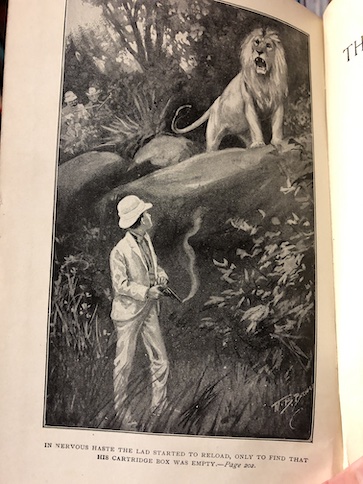
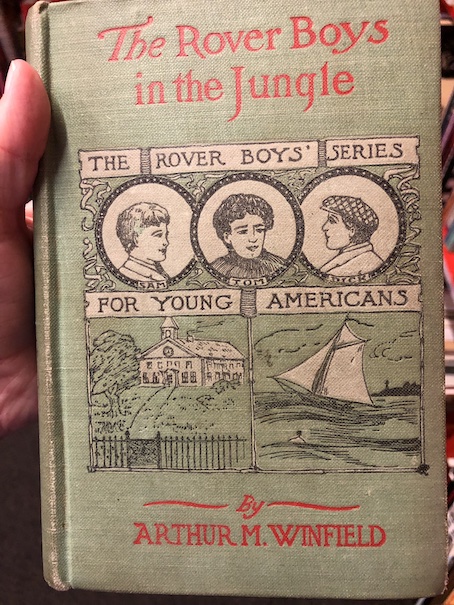
Overall, I wouldn’t recommend this series to young readers today. It’s okay for adults who have an interest in children’s literature and want to see what the earliest Stratemeyer Syndicate books were like, but there are several reasons why I think this series wouldn’t be good for modern kids. One reason is the racial language in the books. I knew before going into this series that Stratemeyer Syndicate books were rewritten and revised in the 1950s and 1960s, partly because of the Civil Rights Movement. I was surprised at just how much inappropriate racial language and racism I found in the third book in the series, The Rover Boys in the Jungle. It’s probably the worst book in the series, but it was bad enough to make me decide not to go further. Another reason why I would recommend this series is that the books tend to carry problems over from one book to the next, rather like episodes of old movie serials. At the end of each book, hardly anything is truly resolved. The books have to be read in order to make sense, and if you skip any, it’s easy to miss major developments.
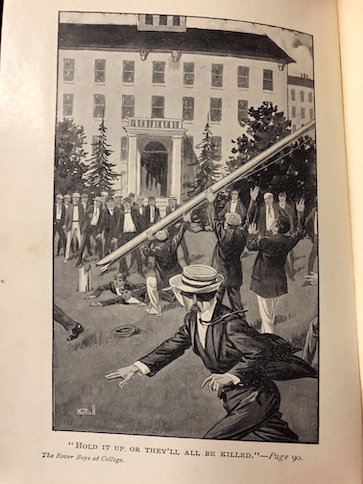
At the beginning of the series, the three Rover boys, Richard, Thomas, and Samuel (called Dick, Tom, and Sam), are living with their aunt and uncle in the country, but they learn that they are going to be sent to boarding school. The boys have been restless on the farm because they used to live in the city. Their aunt and uncle think that they need some discipline. They do, but the boys are also looking forward to seeing something of the world and having some adventures, so the prospect of going to boarding school sounds exciting to them. They have been to boarding school before and liked the experience, and they think that going to a military academy would be particularly exciting.
The boys’ Uncle Randolph spends all of his time in studying scientific farming, and he can’t understand why the boys can’t take an interest in the subject or at least give him some peace and quiet for his work. The boys aren’t too impressed because, so far, their uncle doesn’t seem too successful with his scientific agriculture. The Rover boys have only recently come to live with their uncle and aunt because their father is living overseas.

The boys’ father, Anderson Rover, is an expert on minerals and made his fortune in mining. The family had lived in New York. The boys’ mother died of a fever when the boys were young, and from that point on, the boys were mostly in the care of other people. After his wife’s death, Anderson Rover traveled restlessly because of his grief, sending the boys to boarding school in New York. Then, he had the notion to go to Africa, and left the boys with their Uncle Randolph. The boys and their uncle haven’t heard from him since, and they worry that something has happened to him. Uncle Randolph hasn’t had much experience with kids or young people, so the idea of boarding school seems like the ideal solution.
Richard (Dick) is the oldest of the three boys and is often quiet and studious. He is 16 at the beginning of the series. Thomas (Tom) is fun-loving, likes to play pranks, and is 15 years old at the beginning of the series. Samuel (Sam) is 14 years old at the beginning of the series and athletic. The books continue through the boys’ high school years at the Putnam Hall Military Academy and through their college years.
All these books are in the public domain now and are easily available online in various formats through Project Gutenberg and Internet Archive.
Books in the Series:
The Rover Boys at School, or, The Cadets of Putnam Hall (1899)
The three Rover brothers, who have been living with their uncle and aunt since their father went to Africa, are sent to a military boarding school.
The Rover Boys on the Ocean, or, A Chase for a Fortune (1899)
The Rover Boys in the Jungle, or, Stirring Adventures in Africa (1899)
The three Rover boys go to Africa to find their missing father.
The Rover Boys Out West, or, The Search for a Lost Mine (1900)
The Rover Boys on the Great Lakes, or, The Secret of the Island Cave (1901)

The Rover Boys in the Mountains, or, A Hunt for Fun and Fortune (1902)
The Rover Boys on Land and Sea, or, The Crusoes of Seven Islands (1903)
The Rover Boys in Camp, or, The Rivals of Pine Island (1904)
The Rover Boys on the River, or, The Search for the Missing Houseboat (1905)
The Rover Boys on the Plains, or, The Mystery of Red Rock Ranch (1906)
The Rover Boys in Southern Waters, or, The Deserted Steam Yacht (1907)
The Rover Boys on the Farm, or, Last Days at Putnam Hall (1908)
The Rover Boys on Treasure Isle, or, The Strange Cruise of the Steam Yacht (1909)
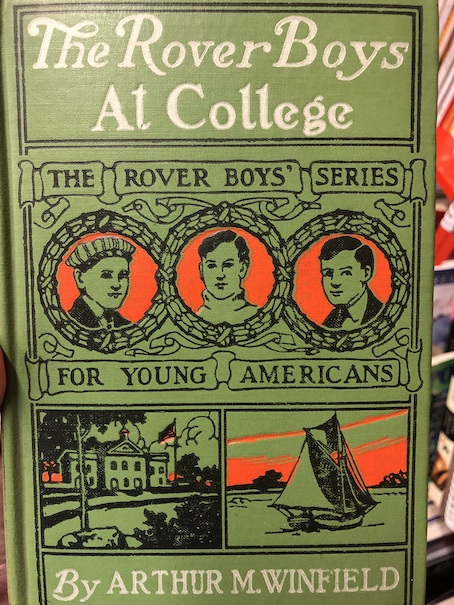
The Rover Boys at College, or, The Right Roads and the Wrong (1910)
The Rover Boys Down East, or, The Struggle for the Stanhope Fortune (1911)
The Rover Boys in the Air, or, From College Campus to the Clouds (1912)
The Rover Boys in New York, or, Saving their Father’s Honor (1913)
The Rover Boys in Alaska, or, Lost in the Fields of Ice (1914)
The Rover Boys in Business, or, The Case of the Missing Bonds (1915)
The Rover Boys on a Tour, or, Last Days at Brill College (1916)
Books in the Second Series:
This series focuses on Dick, Tom, and Sam’s sons and their school adventures. Dick’s son is named Jack, Sam’s son is named Fred, and Tom has twin boys named Andy and Randy. They attend Colby Hall rather than Putnam Hall. Colby Hall is run by the elder Rover boys’ old school friend, Larry Colby, who later became an army colonel.
The Rover Boys at Colby Hall, or, The Struggles of the Young Cadets (1917)
The Rover Boys on Snowshoe Island, or, The Old Lumberman’s Treasure Box (1918)
The Rover Boys Under Canvas, or, The Mystery of the Wrecked Submarine (1919)
The Rover Boys on a Hunt, or, The Mysterious House in the Woods (1920)
The Rover Boys in the Land of Luck, or, Stirring Adventures in the Oil Fields (1921)
The Rover Boys at Big Horn Ranch, or, The Cowboys’ Big Roundup (1922)
The Rover Boys at Big Bear Lake, or, The Camps of the Rival Cadets (1923)
The Rover Boys Shipwrecked, or, A Thrilling Hunt for Pirates Gold (1924)
The Rover Boys on Sunset Trail, or, The Old Miner’s Mysterious Message (1925)
The Rover Boys Winning a Fortune, or, Strenuous Days Ashore and Afloat (1926)
 Jestress's Forgotten Books and Stories