A Little History
Overview
The 1880s were part of the Victorian era. Queen Victoria, who had reigned in England since 1837, died in January of 1901. Because her reign lasted for about 63.5 years, there were many people alive at this time who had never known life without Victoria as queen. In America, this time period, during the late 19th century, was also known as the Gilded Age (considered to range from about the 1870s to the early 1900s). When you gild something, you cover wood, stone, or a much cheaper metal with a thin layer of gold for decoration. To some people, this represented an era where apparent prosperity and economic growth for some layers of society covered up more serious problems of poverty and inequality beneath the surface.
Society was becoming more industrialized and urban. Populations had already started shifting from the countryside to the big cities, and factories were increasing production of consumer goods. New technological developments were changing people’s lives. Some people were already starting to use electric lights, although, particularly in rural areas, many were still using oil lamps. Other new technological developments were beginning to make daily life easier. Thomas Edison founded the Edison Illuminating Company in 1880 to build electrical generating stations in New York. New York City began installing electrical public lighting during the course of the decade. In Germany, Karl Benz produced the world’s first practical automobile and patented his design. In 1885, the American Telephone and Telegraph Company (or AT&T, as it came to be known) was formed to provide and manage the growing number of telephone lines, and it would dominate the communications industry into the next century.
Among the notable events of this decade were the assassination of President Garfield in 1881, the dedication of the Statue of Liberty in 1886, and the inauguration of the Eiffel Tower at the 1889 World’s Fair (at which time, it was the tallest man-made structure in the world).
Two 1880s events which are often referenced in literature are the Great Blizzard of 1888 and the Jack the Ripper murders in London, which also took place in 1888.
Children
For many, being a child during these years was difficult. Child labor, even for rather young children, was still legal in the United States and would remain legal, in some form, for many more years. Children growing up on family farms would naturally engage in farm chores, supervised by parents and older siblings, but as the country became more industrialized, children were increasingly used in factories. Children were also used in coal mining, which had its own dangers and health risks. Poor families and immigrants often relied on money that their children earned to help make ends meet, and industries profited from their cheap labor, which made it difficult to keep rules and limits in place for the children’s welfare.
The practice of sending homeless or parentless children on “Orphan Trains” (typically called “Baby Trains” or “Mercy Trains” at the time) from the big cities on the East Coast of the United States to live and work on farms in the Midwest (or even further west) began in the 1850s and continued until the 1920s. The theory was that living in the country and working on farms would be more wholesome for them than remaining in crowded cities. For many of them, it did work out, and they lived better lives that they would have had otherwise. However, some were simply exploited as a source of cheap labor.
Children from more affluent families were more likely to focus on education rather than working, although many did not pursue higher education. In those days, not many jobs required college degrees, and more people could get decent jobs with a high school education or less. (Back when I was studying journalism, my teacher explained that newspaper articles are traditionally written at about an 8th grade reading level (roughly age 13 or 14 in the United States), partly to make them accessible for different age groups and reading abilities and partly because, for a long time, that was about the standard education level of adults who could read.)
It was common for babies to be delivered at home rather than in a hospital, and in the case of families who lived in rural areas, it was more likely that the birth would be attended by family members or women from neighboring farms than by a physician. Infant mortality rates were higher during this period than in modern times because the level medical care available wasn’t as good, antibiotics like penicillin had not yet been developed so infectious diseases were more likely to turn deadly, and there were less vaccines for preventing diseases in the first place. It was fairly common for families to lose at least one child in infancy. This is also part of the reason why the overall life expectancy was lower. It wasn’t that adults would always die at a much younger age (although that did happen sometimes because of diseases or accidents); it was also that quite a lot of people didn’t make it to adulthood, or even out of early childhood, in the first place. Remember that an “average lifespan” for a decade is an “average” number (the “mean” in math), not the most common number by itself (the “mode” in math). The difference is important because, to find out what age an adult would likely live to once they reached adulthood, you would have to focus on the average age at death only for those who reached adulthood, not including infants and children. Adding in the infant mortalities brings down the average overall and can give you a false picture that no one ever lived to see their grandchildren, which was not the case. So, if a person managed to survive some of the riskier points of life, such as early childhood or the child-bearing years for women, their odds of living to what we might consider a more normal lifespan might be better than you think. Of course, that’s “if.” People who lived at this time period would have been aware of the dangers of diseases and other risks for themselves and their children, and they would have known that even if they survived to adulthood, they might well lose a child someday. The good news is that, during the coming 20th century, new medicines and vaccines helped to save many lives that would otherwise have been lost, giving this generation’s grandchildren and great-grandchildren a far better chance in life than they had.
Literature
In literature, this decade saw the creation of the famous fictional detective Sherlock Holmes. The first Sherlock Holmes story, A Study in Scarlet, was published in 1887.
In late 19th century Britain (also in area of heavy British influence, including Canada, Australia, and sometimes the United States), many children’s stories were published in magazines that were printed every week or month. At the end of the year, shortly before Christmas, many children’s magazines would publish a collection of favorite stories, articles, pictures and games that had been published that year. These collections were called “annuals,” and they were often marketed as ideal Christmas presents for children. Later, during the early 20th century, the annuals also included some new stories that hadn’t been published yet. This practice continued up until World War II, when many of the annuals could not be printed because of paper rationing. Some of the annuals from the 1880s are:
- Little Wide Awake – short stories with illustrations.
- Little Robbie’s Picture Book – short stories, poems, and descriptions of exotic animals around the world
- The Girls’ Own Annual – Printed from 1880 to 1940 and marketed to middle-class girls.
Children’s Fiction Books
General Fiction
Heidi (1880)
A five-year-old orphan girl goes to live with her grandfather, who is a hermit in the Swiss Alps. By Johanna Spyri.
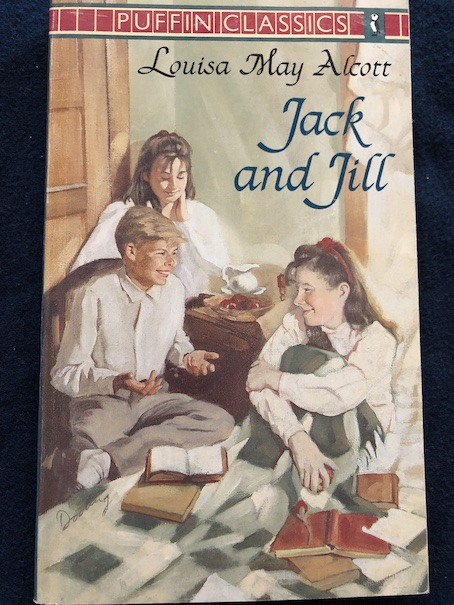
Jack and Jill (1880)
Two friends, Jack and Janey (called Jill), accidentally fall off their sled and injure themselves. While they’re confined to their beds, recovering, their parents find ways to cheer them up and teach them important lessons. By Louisa May Alcott.
Jo’s Boys (1886)
The continuing adventures of Jo and her husband and their school for orphaned boys. Part of the Little Women series. By Louisa May Alcott.
Little Lord Fauntleroy (1886)
An ordinary American boy suddenly learns that he is the grandson of an English nobleman. His grandfather had disapproved of his son’s marriage, but now that his son is dead, he wants to get to know his grandson and sends for him. Meeting the boy softens the grandfather’s heart, but trouble looms when another woman shows up with another boy, claiming that this other boy is the real heir to the estate. By Frances Hodgson Burnett.
A World of Girls: The Story of a School (1886)
Studious and straight-laced Hetty Thornton and mischievous Annie Forest clash at boarding school. Annie plays a series of pranks on Hetty, and Hetty is jealous of the attention that Annie gets from other girls, even from her own little sister. The girls become reconciled and Annie redeems herself in Hetty’s eyes when Annie risks her life to save Hetty’s sister after she is kidnapped by gypsies. By L. T. Meade.
Series
Children’s book series from the 19th century about the Carr family, especially their daughter, Katy. 1872-1890.
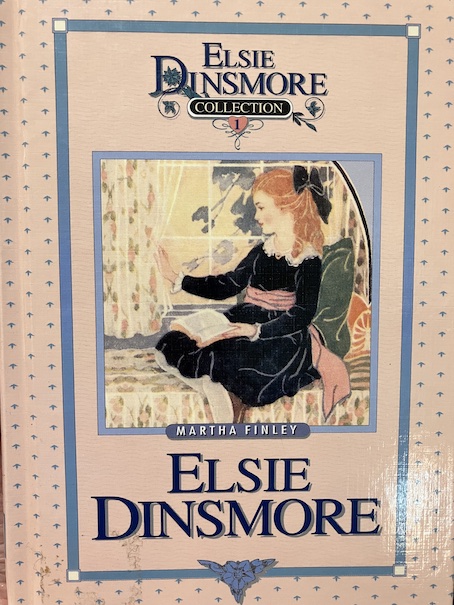
Elsie Dinsmore
A young girl struggles to become close to her widowed father after he returns from an extended trip in Europe. The stories emphasize Christian values. It was a highly popular series during the 19th century. By Martha Finley. 1867-1905.
The original stories take place in the American South before the Civil War and contain language and situations that would be inappropriate for modern children. The books have received criticism for being too preachy and for having an abusive father. However, revised editions of the books were published in the late 1990s, and there were Elsie Dinsmore dolls to go with the books. I’ve never read any of these, either the old or the new. I hadn’t even heard of them before I started researching children’s books from this period, although I later discovered some books for children and adults that reference this series, including some adult mystery books by Elizabeth Peters.
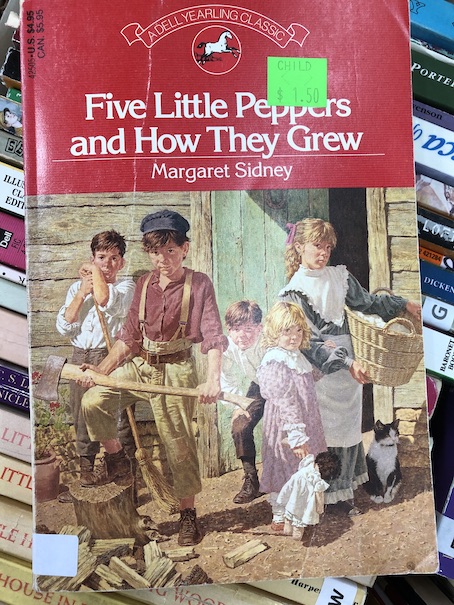
The Five Little Peppers Series
A widow and her five children do their best to support themselves, eventually finding a wealthy benefactor. By Margaret Sidney. 1881-1916.
Mildred Keith
A tie-in series with the Elsie Dinsmore series. Mildred is a cousin of Elsie. The series emphasizes similar Christian themes. Mildred and her husband end up becoming abolitionists and support the Union during the Civil War. This series was also revised and reissued during the early 2000s. By Martha Finley. 1876-1894.
Humor
The Peterkin Papers (1883)
The humorous antics of a silly American family and their zany solutions to perfectly ordinary problems. The help they get from their more practical friend, the Lady from Philadelphia, saves the day. By Lucretia P. Hale.
Adventure
Adventures of Huckleberry Finn (1884, 1885)
A follow-up story from the Adventures of Tom Sawyer. Huckleberry Finn’s abusive father returns to take advantage of the money that his son now has. To escape from him, Huck fakes his own murder and runs away, joining with an escaping slave who is running away around the same time. Together, the two of them travel the Mississippi River in search of a better life. Much of the book concerns a battle of conscience as Huck alternately worries about whether or not he should turn the slave in and about the consequences of doing so, and yet they help each other and share in each other’s adventures, ultimately both desiring freedom. Huck becomes his own man when he realizes that what his own conscience tells him is more important than what society expects because sometimes society is wrong about what it thinks is right. By Mark Twain.

Toby Tyler (1881)
An orphan boy runs away from his foster home to join the circus. By James Otis.
Treasure Island (1882)
A young boy gets involved with pirates and the search for buried treasure. By Robert Louis Stevenson.
Two Little Travelers (1883)
Two children travel around the world and see amazing things. By Frances A. Humphrey.
Historical Fiction
The Merry Adventures of Robin Hood of Great Renown in Nottinghamshire (1883)
A collection of stories about the legendary outlaw. By Howard Pyle.
Otto of the Silver Hand (1888)
A Medieval adventure story. Otto is the son of a German baron and was raised in a monastery because his mother died giving birth to him. When he is eleven years old, his father reclaims him from the monastery, and Otto is pulled into the violent rivalries and schemes of revenge among the barons. By Howard Pyle.
The Prince and the Pauper (1881)
When a poor boy encounters the Prince of Wales in 16th century England, the two of them realize that they look alike. They think it would be a funny stunt for the two of them to briefly switch places with each other, but it turns into a serious of case of mistaken identity. By Mark Twain.
Fantasy
The Happy Prince and Other Tales (1888)
A collection of fairy tale-type stories. By Oscar Wilde.
A House of Pomegranates (1888)
A collection of fairy tale-type stories. By Oscar Wilde.
The Necklace of Princess Fiorimonde and Other Stories (1880)
A collection of fairy tale-type stories. By Mary De Morgan.

Pinocchio (1883)
A naughty wooden puppet wants to be a real human boy but needs to learn some moral lessons first. By Carlo Collodi.
The Princess and Curdie (1883)
The sequel to The Princess and the Goblin. By George MacDonald.
Series
A series of collections of classic fairy tales. By Andrew Lang. 1889-1910.
Children’s Non-Fiction

The American Boy’s Handy Book (1882)
A guide to outdoor activities and hobbies for boys. By Daniel Beard.
The American Girl’s Handy Book (1887)
A guide to seasonal activities and celebrations for girls. By Lina Beard and Adelia Beard.
A Child’s Garden of Verses (1885)
A collection of poetry for children. Originally called Penny Whistles. By Robert Louis Stevenson.

Kate Greenaway’s Book of Games (1889)
A book about children’s pastimes and games with rules for playing. It includes games like I Love my Love with an “A”, Blind Man’s Buff, Frog in the Middle, Russian Scandal (this is an old name for the Game of Telephone, before the invention of the telephone became really popular – I don’t know why it’s specifically Russian, but I’ve also heard it as Russian Gossip or just Gossip) and Twenty Questions. Some games are like playground games (some of them are even still played on playgrounds today), that require running and motions, and others are more talking games (some of those have become classic road trip games, played in the car). Pastimes include making soap bubbles, flying kites, and swings. One of the interesting things about this book, besides noticing which games are still played and which are more obscure now, is that the children in the pictures are actually wearing clothes that are from an earlier part of the 19th century than when the book was written. This is a classic feature of Kate Greenaway’s illustrations, also seen in her other books. By Kate Greenaway.
For more information about Victorian games in general, see the Victorian Games section of my Historical Games site. (Games are also a hobby of mine.)
Kate Greenaway’s Mother Goose (1881)
A book of nursery rhymes with iconic illustrations. By Kate Greenaway.
Uncle Remus, His Songs and His Sayings: The Folk-Lore of the Old Plantation (1880)
A collection of African American folktales. Later adapted as Disney’s Song of the South. (The movie is controversial for the same reasons the book is, which is why Disney doesn’t promote it anymore. The ride Splash Mountain is based on the movie, although I’ve heard that they’re going to change it to make it more themed on The Princess and the Frog.) Because of the character and dialect stereotypes portrayed in the story, the book is controversial today, although the stories are based on real oral folktales and may be of interest to people who study folklore. It is the first in a series of folktale collections. By Joel Chandler Harris.
As I said, this book may be helpful to people researching folklore, especially if you want to research 19th century versions of stories or the reactions of 19th century white people to African American folktales, but if you are new to the topic or just looking for an entertaining read on the same subject, I would recommend starting with a more recent and less controversial book, such as The People Could Fly by Virginia Hamilton (1985). The two books contain the same kind of African American folktales (there is overlap between the two in content), but the styles of story-telling are different. Virginia Hamilton was an African-American author. Just be aware that there is is more than one book by that title by the same author – one is the collection of folktales, and the other is a picture book with a single story.
Children of the Decade
Children born in this decade in the United States:
Popular 1880s Names – Most would be names that we would consider “classics” in the early 21st century, like: Mary, Anna, Emma, John, William, and James.
They would have been in their early teens through their 20s around the time the Wright brothers built and flew their first airplanes during the early 1900s. Their earliest memories would be from a time before aviation existed.
They would have been in their 20s through their 30s during World War I (1914-1918) and would have remembered the event afterward. Some of them actually took part in the war (including British authors Hugh Lofting, author of the Doctor Dolittle series, and A. A. Milne, author of the Winnie-the-Pooh series). All of them would have called the war “The Great War” before World War II.
They were born before women in the United States could vote. None of their mothers had the right to vote at the time of their births or for their entire childhoods. They would later be adults in their 30s and 40s when women’s suffrage was granted. Girls born in this decade may have been among the first women to vote in the United States after the ratification of the 19th Amendment (although some western states did have women voting even before that).
They lived during a time when people not only did not have television but also did not have home radios (which were invented and popularized in the 1920s). If you wanted music at home, you had to either learn to sing or play an instrument yourself, listen to a family member who could, or use a phonograph (early record player) to play a record. Phonographs commonly were of the wind-up variety, so no electricity was needed. They were adults by the time home radios were invented.
They would have been in their 40s and 50s during the Great Depression. By then, many of them would be married with children of their own who were grown or nearly grown. Their children could have been among those who lost their jobs or were struggling to find work while still providing for their families. Their family’s lives may have been marked by poverty, uncertainty, and movement from place to place as the parents searched for work.
They would later have been in their 50s or 60s during World War II. Some of them may have seen their sons or even grandsons go overseas to fight. These people were parents and grandparents of the “Greatest Generation.”
They would have been middle-aged or older adults at the beginning of the Cold War and witnessed the beginning of the technology race and the invention of space flight. Most of them would not have lived to see the end of the Cold War, which happened when they would have been about 100 years old or more.
They would have been in their 70s and 80s as the Civil Rights Movement took place. Their schools were segregated by race when they were children. Their children’s schools would also have been segregated. Their grandchildren may have been among the first to attend desegregated schools.
They would have to have lived to be at least 100 years old in order to have witnessed the time people gained the ability to access the Internet and send and receive e-mail from home computers.
Children born in this decade would also have read books from the following decade, the 1890s, in their youth. However, children who were old enough to read some of the books published in the early part of this decade when they were first sold would have been born in the preceding decade, the 1870s.
Children’s Authors Were Children, Too!
Everyone was young once, and I’d just like to take this opportunity to remind readers that authors born around this time would have grown up like other children of their time, witnessing the same events and reading the same books as they grew up.
Children’s authors born in this decade:
John Gruelle – December 24, 1880 – Author of the Raggedy Ann books (1918-1937)
A. A. Milne – January 18, 1882 – Author of the Winnie-the-Pooh series (1924-1928)
Mary O’Hara – July 10, 1885 – Author of My Friend, Flicka (1941)
Walter R. Brooks – January 9, 1886 – Creator of the character of Mr. Ed the Talking Horse and author of the Freddy the Pig series (1927-1958)
Hugh Lofting – January 14, 1886 – Author of the Doctor Dolittle series (1920-1936)
Marguerite De Angeli – March 14, 1889 – Author of The Door in the Wall (1949)
Enid Bagnold – October 27, 1889 – Author of National Velvet (1935)
Other Resources
Documentary Films
CrashCourse
CrashCourse is a YouTube channel with fun educational videos on a variety of topics and different periods of history. The videos are fairly short for educational lectures. Most are less than 15 minutes long. These videos are intended for teenagers and older, so be aware that there may be topics and language inappropriate for younger children.
- Imperialism: Crash Course World History #35
- Expansion and Resistance: Crash Course European History #28 – Discusses the Opium wars and includes an explanation of the racial attitudes that evolved to justify imperialism and colonization.
- The Railroad Journey and the Industrial Revolution: Crash Course World History 214
- Gilded Age Politics:Crash Course US History #26
THE ULTIMATE FASHION HISTORY: The 1870s – 1890s
An educational lecture about clothing in the late 19th century. Discusses the introduction of the bustle, which replaced the hoop skirt in women’s fashions, and leg-of-mutton sleeves. About 20 minutes long.
For more about 1880s culture:
Significant events of the decade
A basic description of the events of the decade.
Wikipedia – 1880s in Western Fashion
Clothing of the 1880s.
Lists of 1880s children’s books:
19th C. Classic Children’s Books You Might Have Overlooked
A table of authors of 19th century girls’ series books and their works. The books range across the 19th century.
 Jestress's Forgotten Books and Stories