Although these books are all considered part of the same series, they move in different story arcs, following different sets of characters, some of which are actually the children of earlier characters. The books were also written somewhat out of order, sometimes returning to earlier sets of characters for more adventures.
To keep track of which ones go together in which arcs, I’ve separated them out by character groupings:
Katharine, Mark, Jane, and Martha
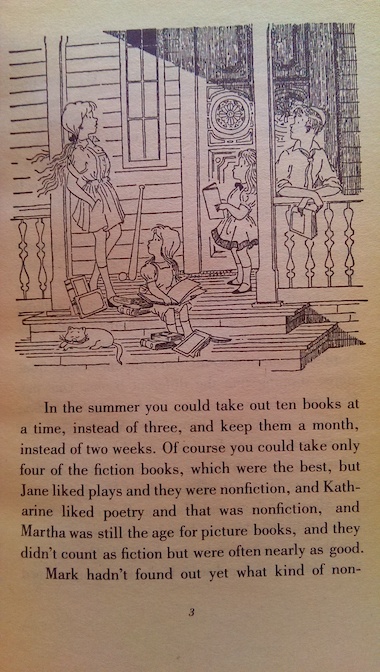
The first set of children have their adventures sometime during the 1920s. They are siblings who live with their widowed mother in Toledo, Ohio, but partly as a result of their magical adventures, they acquire a loving stepfather.
When the series continues with Katharine and Martha’s children, it explains that when they grow up, Mark moves to New York. Katharine and Martha live close to each other in the Midwest with their families for awhile, but then Katharine’s family moves to Baltimore, Maryland. Katharine’s husband is wealthy, and they have a large house and a chauffeur. The oldest sister, Jane, has become a world traveler and adventurer and is rarely home in the United States.
Eliza, Jack, Roger, and Ann

These children are the next generation of the 1920s children. Roger and Ann are Martha’s children, and Eliza and Jack are Katharine’s children. Roger and Ann live in Toledo, Ohio, where their mother and her siblings grew up. Eliza and Jack used to live in there, too, but then they moved to Baltimore, Maryland.
Like their elders, they also have magical adventures, and during one of their adventures that involves time travel, they get to meet their mothers and their mother’s siblings as children.
Laura, James, Kip, and Lydia

Unlike the previous sets of books, the adventures these children have may or may not include real magic. The author purposely leaves it to the readers’ imaginations. In these books, the previous books in the series are treated as fictional stories that these children have read and liked.
Laura and James are twins and neighbors of Kip and Lydia, who are not related to each other. Lydia lives with her grandmother, an eccentric artist, and is something of an outcast in the community until she becomes friends with the others and discovers her own artistic talent. Gordy, another local boy, hangs out with the others and accompanies them on adventures, although they don’t feel as close to him as they do to each other.
Barnaby, John, Susan, Abbie, and Fredericka

There is only one book with these characters. Possibly, the author was planning to write more, but he died a couple of years after this one was published. In their world, the first two sets of children are fictional book characters, whose stories they’ve read.
John and Susan are tall, good-looking, and good in school and at sports, so they are generally popular and are often chosen for positions like class president. However, their home life is unusual because they are orphans who live with their grandmother, who sometimes requires them to look after her as much as she looks after them. Barnaby, Abigail, and Fredericka are another set of siblings who are friends with John and Susan. Their father is a singer in advertisements, and their mother is a realtor. Barnaby is stubborn and sometimes hot-tempered, but John likes him because he’s imaginative and full of interesting ideas. Barnaby wants to be a writer and encourages the others to read more.
If you’re familiar with the fantasy stories of E. Nesbit, you’ll notice that all of these books borrow heavily on themes established in her stories, something that the author, Edward Eager, acknowledged himself, being a devoted fan of her work. He also enjoys making references to other works by various authors and kind of parodies some popular features of children’s adventure and fantasy stories. He particularly likes to have his characters make jokes about fantasy stories with “dear little fairies” in them as the kind of overly-sweet stories that some adults think children should like when what they really want is adventure.
Books in the Series:
Katharine, Mark, Jane, and Martha

Half Magic (1954)
Four siblings find a strange coin that seems to grant wishes. However, for some reason, it only grants half their wishes. When they want something, they have to remember to double whatever they ask for to get what they really want.
Magic by the Lake (1957)
After their mother remarries, the family goes to spend the summer at a lake and have magical adventures with the help of a talking turtle.
Eliza, Jack, Roger, and Ann

Knight’s Castle (1956)
A group of cousins has magical adventures with a toy castle that comes to life.
The Time Garden (1958)
While visiting a relative during the summer, the children discover something strange about her thyme garden. It turns out that it’s really a time garden, inhabited by the mysterious Natterjack. When the children pick a spring of thyme, the variety of thyme they choose takes them to another time.
Laura, James, Kip, and Lydia
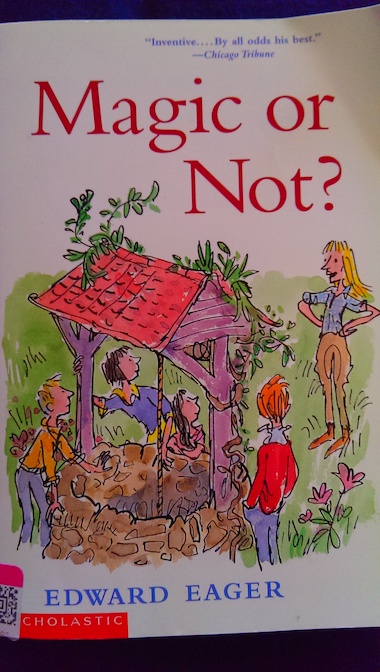
Magic or Not? (1959)
When James and Laura move to a new house in the country, they make some surprising friends and try to decide if the well on the property is magic or not
The Well-Wishers (1960)
The children thought that the wishing well from the previous book was out of magic, but a rash wish from their friend, Gordy, seems to reawaken it.
Barnaby, John, Susan, Abbie, and Fredericka
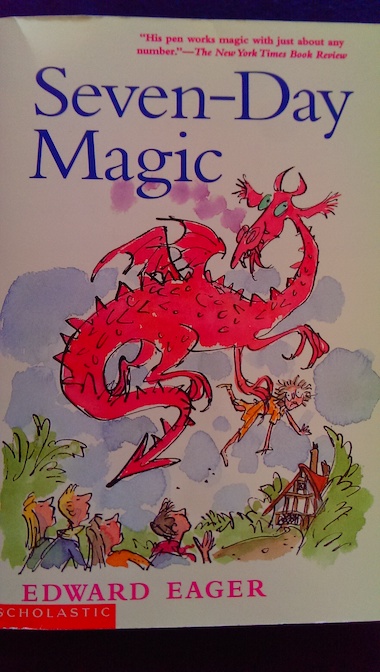
Seven-Day Magic (1962)
Some children find a strange book at the library which seems to be about them. However, the book is unfinished. Gradually, the blank pages of book write themselves, and whatever happens in the book happens to the children.
 Jestress's Forgotten Books and Stories