Little Witch's Big Night

Little Witch’s Big Night by Deborah Hautzig, illustrated by Marc Brown, 1984.

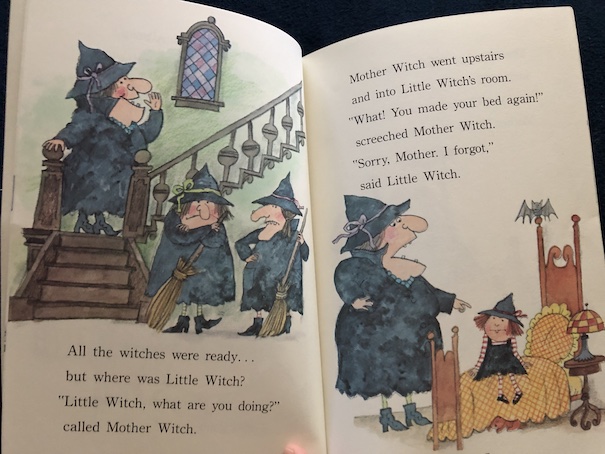
On Halloween night, all the witches in Little Witch’s family are busy getting ready for their big broomstick ride. However, when Mother Witch sees that Little Witch has cleaned her room and made her bed, something too nice for a witch to do, she punishes her by telling her that she will have to stay home.

Because Little Witch is left at home, she is there to answer the door for three trick-or-treaters dressed as an astronaut, a devil, and a pirate. Since she doesn’t have any treats to offer them, she offers to give them rides on her broomstick.

The trick-or-treaters have a great time as Little Witch has her broom do tricks and she shows the pirate a real pirate ship.

The trick-or-treaters have so much fun that they promise to come back next year. Little Witch resolves to be good all year so that her mother will punish her again and make her stay home from the Halloween flight, so she will be there to meet her new friends when they come back.

However, when the other witches come back, Mother Witch says that she missed Little Witch on the flight and that she will get to come on the flight next year. Little Witch asks if she can bring some friends with her, and Mother Witch says that will be fine, as long as Little Witch isn’t too good.

This was one of my favorite Halloween books when I was a child, and so is one of the other books in the series, Happy Birthday, Little Witch. The first time I read these books, I read them out of order, but you really have to read the books in order to understand Happy Birthday, Little Witch because it turns out that Little Witch still doesn’t understand the idea of trick-or-treating or that human children wear costumes on Halloween. She really thinks that she met a small astronaut, pirate, and devil on Halloween, and that makes it difficult for her to find them when she wants to invite them to her birthday party. The Little Witch in this series isn’t the same as the Little Witch in the Little Witch Craft Books.

The book is available to borrow for free online through Internet Archive.

The Mystery of the Creep-Show Crooks

The Three Investigators

The Mystery of the Creep-Show Crooks by M. V. Carey, 1985.

The Three Investigators are at the beach when Bob finds a plastic tote bag that appears to belong to a girl. Trying to figure out who the bag belongs to, the boys look through it to see if there’s some kind of identification. They find a teddy bear, a copy of People magazine, a self-help book about achieving success, some makeup, and a pair of earrings, but nothing with the owner’s name on it. When Jupiter takes a closer look at the book, he realizes that it’s a library book from the Fresno Public Library. The boys decide to contact the library, tell them that they found the book, and ask how to contact the person who checked it out. However, this simple attempt to return lost property turns into a much bigger mystery.

The librarian in Fresno gives the boys’ phone number to a frantic woman looking for her missing daughter, Lucille Anderson. Sixteen-year-old Lucille apparently ran away to Hollywood to try being an actress. Her parents are worried, the police haven’t been much help, and the boys’ inquiry about the tote bag and library book is the first lead they’ve had to Lucille’s location. Since the Three Investigators are all about solving mysteries, they immediately decide to search for Lucille themselves.

The self-help book immediately offers a few clues. The premise of the book is that anyone can become successful at whatever they want to achieve by imagining that they’re already successful. This is actually a real theory that I’ve heard of before, after a fashion. In real life, the theory is that you will also adopt the positive habits of the successful person you envision yourself to be, therefore promoting positive change in your life. (“If your habits don’t line up with your dream, then you need to either change your habits or change your dream.”) The self-help book in this story doesn’t seem to go into those details, though. Judging by the pawn tickets that Lucille has used as bookmarks, it’s not going very well for her.

Mr. and Mrs. Anderson come to Jupiter’s uncle’s salvage yard to meet the boys and collect Lucille’s bag. The Andersons bring along pictures of Lucille, and they talk to the local chief of police. There isn’t much the police can do, and runaways of Lucille’s type are unfortunately all too common. However, the police chief vouches for the boys’ reputations as amateur investigators, so the Andersons agree to let the boys try to find Lucille.

The boys’ first move is to check out all of the pawn tickets. They discover that, at each place where Lucille pawned something, she used a different name, the name of an actress who is already famous. Lucille has also been using makeup to change her appearance. The boys spot her at a pizza place, but because of her disguise, she gets away from them before they fully recognize her. They talk to some other people at the pizza place who know her under the name Arianne Ardis. At first, Lucille’s new friends are reluctant to say much about her to strangers, but the boys explain that her parents are frantic and need to know where she is. Lucille’s friends tell them where Lucille has been living.

It turns out that Lucille is being helped by a kind woman named Mrs. Fowler. Mrs. Fowler owns a large house, and she sometimes takes in teenagers like Lucille and gives them a place to stay and some work to do while they’re getting themselves established in life. Mrs. Fowler met Lucille at the hair salon where Lucille works part time. Now, Lucille is doing some house-sitting and helping Mrs. Fowler’s housekeeper while Mrs. Fowler is on a trip to Europe. Lucille says that it gives her some security and time to take acting classes and look for acting work. It’s a pretty cushy position for a teenage runaway. When the boys convince her to call her parents and bring her parents to see her, Lucille is angry and says that she doesn’t want to go back home with them because she is actually getting somewhere with her life and acting career.

Lucille tells them that she’s been offered a leading role in a new horror movie called Dracula, Mon Amour. It’s supposed to be a sequel to the classic Dracula. It sounds cheesy, and her parents are understandably skeptical. Lucille’s father doubts whether this movie offer is legitimate, and he recruits the Three Investigators again to research this film company and the movie producer to find out whether they’re even real filmmakers.

It doesn’t take the boys long to determine that the supposed producer isn’t who he claims to be. He’s assumed someone else’s identity, and when the Three Investigators meet with the real producer, he says that the phony is probably out to take advantage of this girl in some way. He says that there are some real weirdos out there and tells the boys to warn the young actress to back away from this supposed movie offer. However, when they go to tell Lucille what they’ve learned, they discover that she’s missing and may have been kidnapped! Why would phony movie producers kidnap a teenage runaway/wannabe actress? To make matters worse, the Three Investigators start to suspect that this horror movie crew might have something to do with a series of robberies committed around town by people dressed as horror movie creatures.

The book is available to borrow and read for free online through Internet Archive.

My Reaction

For part of the mystery, while the characters are pondering the real identity of the movie producers and Lucille’s whereabouts, I found myself wondering why Lucille left her tote bag of stuff on the beach. I wouldn’t have expected a teenage runaway, who has few personal possessions and probably can’t afford to replace any she loses, to be so careless with her things. At first, I wondered if this was an oversight or plot hole in the story, but it’s not. Lucille’s tote bag and its contents are key to the mystery. They’re the reason why the criminals are interested in Lucille. In a way, this story reminds me of the movie Charade with Cary Grant and Audrey Hepburn. In both stories, there is a bag full of seemingly innocent contents, but someone wants something in the bag very badly. The challenge is to figure out what they want and what its significance is.

There are also a couple of twists about the crimes being committed. The main criminals aren’t doing all of the things everyone suspects them of doing, and there is another criminal involved because there is another crime that isn’t discovered until the end.

The Mystery of the Sinister Scarecrow

The Three Investigators

#29 The Mystery of the Sinister Scarecrow by M. V. Carey, 1979.

Jupiter Jones is going on a buying trip with Hans and Conrad, the men who work for his uncle’s salvage yard, to see someone who had some things to sell to his uncle. Jupiter’s friends, Bob and Pete, go with them, but they’re all stranded when their truck blows a tire. They look around for a place where they can call the salvage yard to explain their situation and get help, and they see a large house with a cornfield nearby.

However as Jupiter approaches the house to ask to use the phone, he is suddenly tackled by a man with a jagged rock in his hand! Hans comes to his defense, and the man is surprised and sorry when he realizes that he’s just tackled a boy. It turns out that the man is nearsighted and has lost his glasses on the ground. He starts to explain that he thought that he was tackling a scarecrow, and then, he suddenly stops and says that he’s been having trouble with trespassers. Jupiter asks him what meant when he talked about the scarecrow, but the man dodges the question. Instead, he asks them why they’re there, and they explain about wanting to use the phone.

The man invites them into the house to use the phone. The man isn’t really a farmer. His name is Dr. Wooley, and he’s an entomologist who’s working on a book. He’s studying army ants, which are carnivorous. He shows them the colony he’s studying, but the sight of all those ants just encourages them to finish their call and leave fast.

However, Jupiter is still intrigued about why Dr. Wooley seemed to attack him because he thought he was a walking scarecrow. He persuades Bob and Pete to return to the area with him to investigate. When they stop in a cafe, a man there hears them talking about the scarecrow, and he says that he’s seen the walking scarecrow himself. He works in the area, doing security for a nearby museum. The boys ask him for details about his sighting of the walking scarecrow, and he says that he saw it near the Radford house, which is where the boys met Dr. Wooley.

When they go to the place where the man saw the scarecrow, they meet a woman named Leticia. Leticia asks them what they’re doing, and they explain about looking into a sighting of a walking scarecrow. Suddenly, Leticia gets very excited. She has seen the scarecrow herself, but no one will believe her. She asks the boys if they will come to the house and explain to Mrs. Chumley that she really did see a walking scarecrow.

Leticia Radford is a jet-setting heiress who lives in the mansion by the cornfield. Mrs. Chumley has been with her family a long time as a secretary and housekeeper, but she’s been confined to a wheelchair for years after being in a car accident. Leticia spends most of her time traveling in Europe, but she returns home periodically, usually after one of her disastrous romances. She has phobias of both insects and scarecrows. Actually, her fear of scarecrows is related to her fear of insects and other creepy-crawly things. Leticia explains that, when she was a child, a scarecrow fell on her when she visited a pumpkin patch one Halloween, and when it broke apart, it had spiders in it, so she always associates scarecrows with bugs. Until the boys explain that other people have seen the walking scarecrow, Mrs. Chumley had thought that Leticia had imagined it.

Leticia blames Dr. Wooley for the walking scarecrow because he made a scarecrow after he moved into the cottage on the estate property to do his research on the ants. Dr. Wooley makes her nervous because she associates him with both bugs and scarecrows. Leticia says that the scarecrow seems to be targeting her because it has shown up multiple times, seemingly looking for her, and once, it hid in her car and threw bugs on her.

While the boys are in Leticia’s mansion, explaining to the other people in the house that Leticia hasn’t imagined the scarecrow, Dr. Wooley shows up, angrily accusing the boys of faking their car trouble the day before just to get into his lab. Dr. Wooley says that someone dressed as a scarecrow entered his lab, hit him on the head, and stole a jar of some of the ants he’s been studying. It doesn’t take them long to figure out where the ants went because Leticia finds them in her bedroom, along with the jar from Dr. Wooley’s lab.

It’s obvious that someone is purposely trying to frighten Leticia by dressing as a scarecrow and tormenting her with bugs, the two things guaranteed to terrify her. The boys are surprised when Dr. Wooley is the one who hires them to find the person tormenting Leticia. Dr. Wooley says that he isn’t responsible for frightening Leticia, but he can see that it all looks bad for him because he was the one who made a scarecrow and the ants in Leticia’s room were his ants. He doesn’t want his professional reputation ruined, and he also feels sorry for Leticia. Leticia can’t figure out why anyone would target her because she’s never been a threat to anyone, but she may be more of a threat to someone than she knows.

My Reaction

The combination of a mystery involving scarecrows and insects and someone who is afraid of both scarecrows and insects is a little strange, but I thought the author did a good job of explaining how the two are related in this story. Leticia’s two fears are connected because she thinks of scarecrows as being homes for bugs.

One of my questions during the mystery was wondering whether someone is trying to convince Leticia that she is crazy (“gaslighting” her, like in the movie of the same name) or just trying to drive her away from the house. I had a couple of theories about what could be going on. Some of what I considered turned out to be right, but someone I suspected turned out to be completely innocent.

At first, I also wondered if there would be an unexpected romance between Leticia and Dr. Wooley because the story establishes that they are both single, and there are points when they hang out together when they don’t have to. However, the story doesn’t end with any clear romance. Leticia is still afraid of insects at the end, which would make romance with an entomologist awkward. She does allow Dr. Wooley to continue his work on her property, though. The boys also notice that Leticia seems to branching out and finding new interests at home rather than running off to Europe again, so that might represent some new developments in her character and a possible turning point in her life.

The Mystery of the Whispering Mummy

The Three Investigators

The Mystery of the Whispering Mummy by Robert Arthur, 1965.

In the original editions of The Three Investigators, their cases were introduced by Alfred Hitchcock. Later editions of the books in the 1990s were rewritten to remove Alfred Hitchcock, but I’m using the version of this book that includes Alfred Hitchcock’s introduction for my review.

This story begins with two letters address to The Three Investigators. One of them is from an elderly woman in a wealthy area of town, who has heard about how The Three Investigators helped a friend of hers find her lost parrot in the previous book in the series. This lady would like their help to find her missing cat. Bob and Pete thinks that sounds like a simple enough case, but their other letter is from Alfred Hitchcock, so they decide to read that before committing themselves.

Alfred Hitchcock’s letter is incredible! He tells The Three Investigators about an old house that has been turned into a private museum by an archaeology professor. His museum has relics from his archaeological digs in Egypt. Recently, a mummy has arrived at his museum from a museum in Egypt. Professor Yarbrough was the one who originally discovered that particular mummy, but since it arrived at his museum, he has noticed a bizarre phenomenon. The mummy seems to whisper! Professor Yarbrough can’t figure out how the mummy can whisper, but it seems like the mummy is trying to tell him something important. Professor Yarbrough has consulted with a friend, Professor Freeman, who is a language expert, but the mummy only seems to talk when Professor Yarbrough is alone. Knowing how crazy this predicament sounds and what his other colleagues would say if he told them, Professor Yarbrough decides to tell his friend Alfred Hitchcock instead. That is why Alfred Hitchcock decides to tell The Three Investigators and see what they make of it.

Bob and Pete think that the mummy mystery sounds exciting but creepy. Since Jupiter is away on an errand, they decide that they would rather try to find the missing cat first. However, when Jupiter returns, he already knows about their prospective cases, and as predicted, he can’t wait to investigate the mummy. At first, Professor Yarbrough doesn’t have much confidence in the boys because they’re younger than he expected, but Jupiter persuades him to let them try. The professor’s butler, Wilkins, is very nervous and tells the boys that there is a curse on the mummy. Strange things are happening that make Wilkins think that the professor is in danger from the curse. The boys are there when a large statue in the professor’s museum suddenly falls over, almost striking the professor. Wilkins would rather send the mummy back to Egypt, but the professor doesn’t believe in curses. In spite of the talking mummy, the professor is sure that there must be a logical, scientific explanation for everything.

Jupiter also believes in scientific solutions, and his first theory about the whispering is that it’s being transmitted electronically, but they can’t find any electronics on or around the mummy. His next idea is to capture some of the mummy’s speech on a recording, which is successful. Professor Freeman says that the mummy seems to be speaking a form of ancient Arabic.

Then, Wilkins sees someone walking around in a jackal costume. Someone steals the mummy, and strangely, comes back a second time to steal the mummy case. Even the missing cat puts in an appearance.

Who wants the professor to think that the mummy is whispering and believe that it’s cursed? Who wants the mummy case, and why is that case even more important to the thief than the mummy itself?

The book is available to borrow and read for free online through Internet Archive (multiple copies).

My Reaction

From the beginning of the book, I had a couple of theories about who could be responsible for the mummy’s whispering and “curse”, but I was only partially correct. There are different people involved, doing different things and for different reasons. The main villain is one of the people I suspected, but I didn’t know this person’s motive until it became clear that the mummy case is what they really want. The missing cat is part of the mystery, but don’t worry, the cat is fine and being cared for!

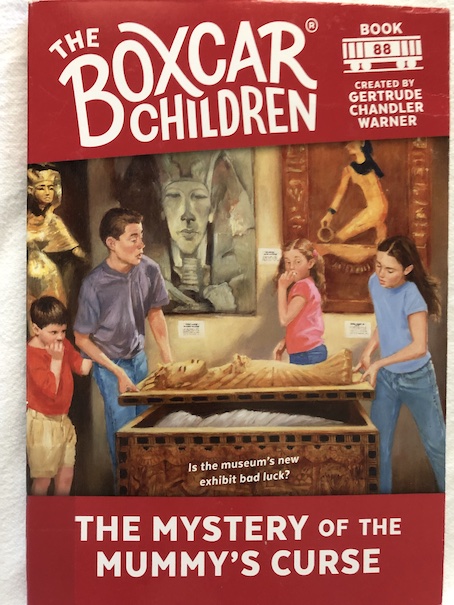
The Mystery of the Mummy’s Curse

The Boxcar Children

The Mystery of the Mummy’s Curse by Gertrude Chandler Warner, 2002.

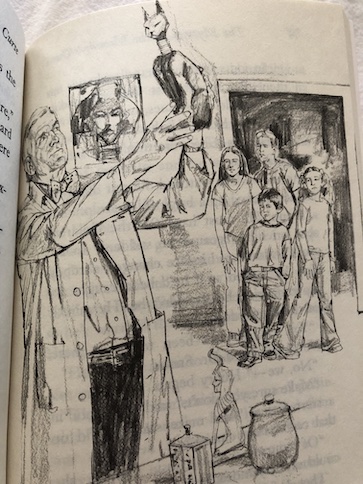
The Alden children are at the museum to get a sneak preview of the new Egyptian exhibit because the man in charge of the exhibit is the son of one of their grandfather’s friends.  When he shows them the mummy that will be the centerpiece of the exhibit, one of his assistants accidentally falls off a stepladder and breaks her ankle.  The museum personnel joke that it’s the “mummy’s curse,” although they quickly reassure the children that they don’t believe in curses.

With the opening of the exhibit coming soon, there’s a lot of work to do, including cleaning up the exhibit hall where it will be set up.  Losing the assistant has left the museum short-handed, so the Aldens volunteer to help with the cleaning and setting up.

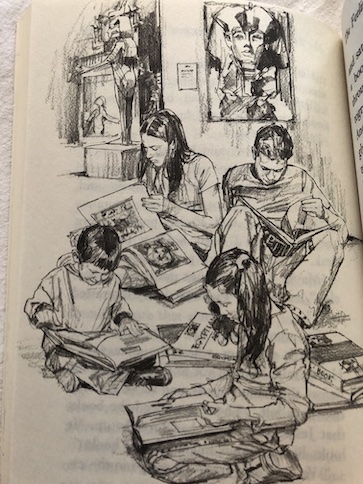
However, the children notice other odd things about the exhibit when they’re helping to clean up.  They hear strange noises, as if someone were creeping around the off-limits areas where the artifacts are being stored and the exhibit getting set up.  Then, some of the artifacts that they noticed when they were first introduced to the exhibit disappear.  When they check to see what else is missing, they realize that some of the artifacts they’ve seen aren’t even listed on the official roster.  Jessie tries making her own list of artifacts in the exhibit, since the master list isn’t reliable, but someone steals it.

Who is stealing from the Egyptian exhibit?

The book is available to borrow and read for free online through Internet Archive.

My Reaction

I enjoyed the mystery. I was pretty sure that I knew early on who was responsible for the thefts, but mysteries involving museums, mummies, and stolen artifacts are my cup of tea!

I did think, as I was reading this, that few museums would let random kids help set up an exhibit like this, including valuable artifacts, even if most of what they were doing is just cleaning up. In the story, the eldest of the Alden children is 14, and I’ve done enough volunteer work to know that there are age limits and training requirements for certain volunteer tasks. There are really only two reasons why kids like the Aldens would be doing this. One, the requirements of the story: having the kids help set up an exhibit of Egyptian artifacts is exciting, something that plenty of kids would find fascinating, and it allows them to be in the right place to notice the thefts. Two, Grandfather Alden is rich: if the children’s grandfather wasn’t rich and well-connected, the Aldens wouldn’t be doing most of what they do in the stories. The second reason isn’t as charming as the first, and it never occurred to me when I was younger that the Aldens are actually very privileged to be in the position to do the things they do and meet the people they meet, but they are.

I wouldn’t say that the knowledge spoils the story for me, but it did make me stop and think. Sometimes, when adults, especially older adults, look back on books like the Boxcar children series, they talk about how independent the kids in these stories are and how willing to work, but the truth is that, in most of the stories, the kids’ grandfather sets them up with the opportunities for volunteer work or independence that the children have. The kids didn’t get this volunteer position because it’s an extension of special classes any of them are taking in history or archaeology or because they’ve done lower-level volunteer work for the museum before, working their way up, or because they applied for the position. They got it because of someone their grandfather knows. The Alden children are still willing to take advantage of opportunities that come their way and work hard at them and learn whatever they can, but when you think about it, it’s not quite the same as people who have to prove themselves and their merits first just to get the opportunity to do the same thing. So, I enjoy the story for the fun and mystery, but thinking about it now, as an adult who has done volunteer work for museums as well, I’m not quite so impressed with the way other, older adults compare the characters to real kids of non-rich, non-connected parents.

There are still volunteer opportunities for youths who want to get involved in museum work, but most of them require the kids to be older teens. One of the reasons for the age requirements is that there can be liability issues if someone gets hurt on the job, but people who hire volunteers also want to know about the skills the volunteers have, what kind of training they’ve had or need, and how much they can alreay do unsupervised. Rules can vary by location and position, but in the places I’ve been, kids under 14 are usually required to be supervised by an adult, 18 or over. Often, teens who do those sorts of jobs have already proved their skills or worked their way up in some way, applying for volunteer jobs and discussing their skills, taking related classes, being part of museum programs for younger children before, and/or volunteering in tandem with a parent first. The same is true of other places where I’ve volunteered, like animal shelters. So, the kids who seem more independent are that way because the adults in their lives took them through the preparation and training first and helped them connect with people who could take them further. This is a fun mystery story, but just understand that real children often aren’t like kids in mystery adventure books because they are real people in the real world, where circumstances are different from the ones in fiction. Real life has rules and regulations, and not everybody has a rich grandfather or family friends who are willing to treat them as special exceptions to the rules. If you want to see the kids around you get involved in a cause like this and gain some skills, the best way to go about it is to get involved yourself, both with the cause and with the lives of the kids, and give them the training and knowledge they need to go further on their own. Things like this don’t just happen on their own.

Haunting at Black Water Cove

Haunting at Black Water Cove by Norma Lehr, 2000.

Kathy is spending some time with her mother at the lake while her mother takes care of a friend’s lodge there.  Kathy’s great-grandmother and her brother used to live in the area, and her mother used to visit the lake regularly as a little girl.  Soon after she arrives, Kathy meets a new friend, Drew, a boy who lives with his older brother and is self-conscious about his asthma.  While the two of them are by the lake, Kathy thinks that she keeps seeing a raft that nobody else can spot.  Later, she sees the ghost of a young girl in a ragged dress with a blue aura around her. 

Drew writes a small local newsletter, and when Kathy accompanies him to interview an elderly woman, she learns that years ago, her great-granduncle, Duncan, was involved in the disappearance of the woman’s older sister.  Ruby Faye’s body was never found, but people believe that she must be dead, assuming that she must have drowned in the lake. They believed that Duncan must have somehow caused Ruby Faye to drown because he was with her at the time. Although Duncan had a reputation as being a bit of a hooligan, Kathy can’t believe that he would have harmed the girl, named Ruby Faye, or let her drown in the lake if he could have prevented it. Duncan himself lost the ability to speak because of whatever happened that day, so he could never explain to anyone what really happened, but it must have been something terrible to send him into such a shocked state. About a year later, Duncan died young of an illness without regaining the ability to speak.

Before Ruby Faye died, the water in the cove had been clear, and the place was called Sunny Bay. Since then, the water turned dark and cloudy, giving Black Water Cove its new name.  Kathy is sure that the ghost girl she’s been seeing is Ruby Faye, and she thinks the girl’s spirit is trying to tell her the truth behind her mysterious disappearance.

The book is available to borrow and read for free online through Internet Archive.

My Reaction and Spoilers:

I enjoyed this spooky book for the mystery it poses about the disappearance of a young girl many years before. Because Kathy has been seeing her ghost, readers know that she must have died, but there is still the mystery of how it happened and what left Duncan so traumatized. I love mystery stories, and this story was also interesting for me because it turns out that the secret of Ruby Faye’s disappearance relates to a real historical event. Duncan and Kathy’s other relatives lived in the area during the famous 1906 earthquake that struck Northern California. Ruby Faye disappeared the day after it happened. 

Spoilers

Ruby Faye and Duncan had been in love. Duncan had a raft that Ruby Faye helped him build, and when she disappeared, most people assumed that he had been goofing off on the raft and caused her to drown.  In fact, Ruby Faye did not drown at all; she died from a fall.  When Kathy goes to the spot by the lake where Duncan had left his raft years ago, she sees their spirits act out what happened that day.

Like Drew, Duncan had a handicap that made him self-conscious: one of his legs was shorter than the other, and he couldn’t walk without a crutch.  On the day after the earthquake, he and Ruby Faye were playing by the lake.  She was making a garland of flowers.  She decided to go up the nearby mountainside and get some more flowers.  Duncan warned her not to go because the place was dangerous, but she just laughed it off.  Shortly after she left Duncan, he heard her scream for help.  Duncan tried to go to her, but his crutch had fallen off the raft, and he couldn’t find it.  He tried to get up the mountainside anyway, but he couldn’t manage it.  There was no one else around to help.  While Duncan didn’t cause the accident that befell Ruby Faye, Duncan’s guilt and helpless anger at not being able to save Ruby Faye robbed him of his ability to speak. 

Kathy ventures up the mountainside herself to see where Ruby Faye went when she screamed and disappeared, and just as Ruby Faye did herself, falls into an open mine shaft.  The earthquake opened it up the day before Ruby Faye went there in 1906, but no one thought to look for her there because they were sure she had fallen in the lake.  Kathy manages to hang on until her dog alerts people to her danger, and they come to help her.  Drew is the first person to see Kathy’s dog, but like Duncan, he is unable to save Kathy himself because he gets upset and brings on an asthma attack.  However, he manages to get help from his brother and Kathy’s mother.  After Kathy tells Ruby Faye’s sister what really happened, the water in the bay clears, and Kathy sees the spirits of Ruby Faye and Duncan, happily floating together on their raft.

The Shimmering Ghost of Riversend

Kathy Wicklow is going to visit her Aunt Sharon at their old family home over the summer. The old family home, Wicklow Manor, is in Riversend, California, which is in an area where gold was found years ago. Kathy isn’t happy about the trip. She has to leave her dog behind because her aunt owns a cat. She doesn’t even really know her aunt very well. Aunt Sharon is her father’s sister, and her mother has said that she’s weird (which was not a good thing for her to say, both because it’s insulting and because that’s not something to make her daughter glad about spending time with her). Kathy blames her mother for going back to work. Because her mother is working and won’t be home with her, Kathy has to leave her home, her friends, and her dog for a month!

Although Kathy loves to draw, she doesn’t think that she’ll want to do that in a place she is sure she’s going to hate. She also thinks maybe her parents don’t trust her at home because of the weird dreams she’s been having. Kathy has dreams about things that later happen, although she doesn’t know why.

Her father has nostalgic memories of the old family home where he and Sharon grew up. Sharon has only recently returned there after living on the East Coast. Kathy’s father says that Sharon is looking forward to seeing Kathy again and getting to know her because she hasn’t seen Kathy since she was a baby.

Right from the first, Wicklow Manor gives Kathy the creeps. There’s even a small graveyard nearby where Kathy’s father says their ancestors are buried because people used to be buried close to their homes. When she can actually see the house, Kathy is also shocked to realize that she has drawn that house before! She thought that she had invented the house she drew from her imagination, but somehow, she had a vision of the real house. Her father thinks that she must have seen a picture of it somewhere or maybe was inspired by his descriptions of the place. However, Kathy has also done a drawing of Aunt Sharon’s pet cat, without knowing what it looked like before. When they meet Aunt Sharon, she mentions that she’s glad Kathy is there because the house has been lonely, especially at night. Kathy’s dad starts to ask her if something is still happening, but Aunt Sharon quickly denies it before he can finish the thought. Kathy can tell there’s some kind of secret between them.

Aunt Sharon has turned the family’s manor into an inn, and she’s expecting guests soon. It also turns out that part of the reason why Kathy’s mother says that Sharon is weird is that she’s into health food, and Sharon is aware that Kathy’s mother thinks that she’s a weird health nut. Kathy’s father volunteers her to help in the kitchen, although Kathy is a little worried that she won’t like the health food, although the lemonade that she makes with maple syrup instead of sugar is pretty good.

Still, Aunt Sharon gives Kathy a beautiful room with a balcony. Kathy also meets a boy named Todd who lives nearby with his great-grandfather, who is called Upstream Mike. Todd and his great-grandfather pan for gold in the nearby river, and Mike also takes his burro called Nugget into town so tourists can pay for rides on him and pictures with him. Todd is just a little older than Kathy, and he tells Kathy that he likes to write down stories that his grandfather tells him, especially scary stories about the old Wicklow Manor. Kathy asks if there are ghosts there, and Todd tells her to ask his great-grandfather about it. Kathy asks her aunt about ghosts, and Aunt Sharon tells her that Mike has told scary stories about the place for years that were apparently passed down in his family. Mike’s family lived in the area when the first Wicklows arrived.

Aunt Sharon shows Kathy some of the things in the house that belonged to their ancestors, including a portrait of a pretty young woman, who Aunt Sharon says was Jenny Wicklow, who died young by drowning in the river and was buried in the old family graveyard. One of their ancestors, James Wicklow, made his fortune as a banker during the Gold Rush days, and Jenny was his daughter. There is one room in the house where Kathy isn’t allowed to go, which is the old room in the tower. Aunt Sharon says that the staircase is broken, and she can’t have it fixed yet.

On her first night at the manor, Kathy sees a woman in a cloak with a lantern. When she asks Mike about it, he says that it’s a ghost or spirit of some kind that usually appears to young ladies at the manor, possibly a banshee or similar spirit that is a harbinger of death. Kathy worries about that, and Mike tells her the story about Jenny Wicklow. Jenny was one of three children of James Wicklow. She also had a sister named Lora and a brother named Daniel, and Kathy is a descendant of Daniel. After their parents died, Daniel went to work in the city and left the running of the manor and family farm to his sisters. The two young women hired a handsome young drifter to help them, but he started flirting with both of the sisters. The sisters seemed to develop a rivalry for him and argued with each other about it. Rumor had it that Lora was the one who pushed Jenny into the river so she could have not only her own inheritance but her sister’s as well and get the man they both wanted. After Jenny was dead, it seemed like all of their gold disappeared, and so did Lora. People assumed that Lora ran off with her lover and took the money. Mike thinks that the ghost is dangerous, and that Sharon is the one who’s in danger!

Kathy soon begins to learn that Mike is both right and wrong about the ghost. The ghost is Lora, but she’s not trying to hurt Sharon or anyone else. Something tragic happened at Wicklow Manor years ago, and Lora is trying to tell someone about it, if she can find anyone brave enough to listen … and to discovered what actually happened to Lora herself.

The book is available to borrow and read for free online through Internet Archive.

For a good part of the story, I wasn’t sure exactly what Lora’s ghost was attempting to accomplish, keeping me in suspense. I did have the sense that Lora wasn’t the one who had murdered Jenny and that she had probably been murdered herself, which was why nobody saw her after Jenny’s body was found.

Mike is correct that Lora is the ghost, but she was not Jenny’s murderer. Like Kathy, Lora was psychic. She has been trying to communicate with different girls in the family over the years to clear her name, but the other girls have all been frightened of her. Sharon claims not to believe Kathy at first about how Lora is trying to communicate with her, but she later admits that it was because she was frightened. She also saw Lora when she was young, and that’s part of the reason why she was afraid to return to the old family home for so long. She was afraid to admit that the house was really haunted and that she was afraid of the ghost. It was a long time before she could even tell her own mother and brother about seeing Lora because she was afraid of being different from everyone else in the family. Sharon is also psychic, and like Kathy was initially, she was afraid of her gift.

Kathy and Todd use the messages that Lora communicates through Kathy’s drawings and Lora’s old diary to learn the truth. Jenny was murdered by the man she loved. Lora didn’t actually love him at all. She saw that he was a violent person and tried to warn Jenny about him, but Jenny wouldn’t listen because she thought Lora wanted him for herself. Lora saw the murder that was going to happen in a dream, and she wanted to stop it by using her own inheritance to pay the man to leave her sister alone. However, Lora was unable to save her sister. After he killed Jenny, the man came after Lora and murdered her, too. Then, he stole both of their inheritances. He hid Lora’s body, which was why everyone thought she must have run away with him.

After Lora’s ghost leads Kathy to where her body is buried in the cellar and she is given a proper burial in the family graveyard, the haunting ends. However, Kathy learns to appreciate her psychic gift because of this experience. She finds it reassuring that she shares her abilities with other people in her family. When she reads in Lora’s diary that Lora thought of her own psychic abilities as a gift, Kathy also comes to think of being psychic as a gift rather than a weird defect or something to fear.

The mystery in the story was good, and I also liked the information about panning for gold that Mike gives to Kathy when he gives her a gold panning lesson. There is also a tie-in with real children’s literature because Kathy mentions that she is reading Down a Dark Hall by Lois Duncan. I’ve reviewed Down a Dark Hall on my site, and it is about girls with psychic abilities at a haunted boarding school who channel the spirits of famous people to complete their unfinished works. The channeling and spiritual possession in that book are dangerous and harmful to the girls doing it, but in this book, Kathy becomes reconciled to her psychic abilities and Lora’s gentle spirit, who needs her help.

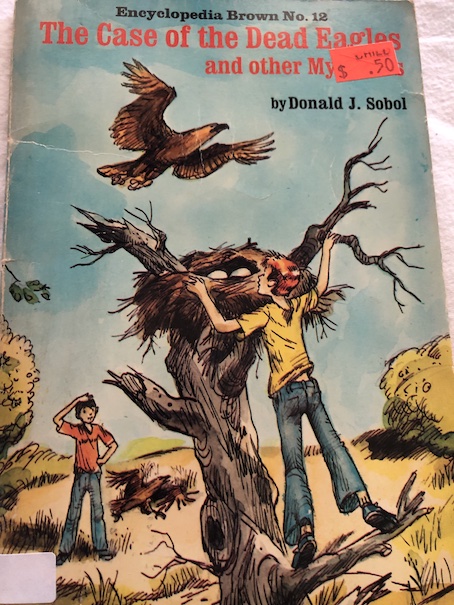
Encyclopedia Brown and the Case of the Dead Eagles

Encyclopedia Brown and the Case of the Dead Eagles and Other Mysteries by Donald J. Sobol, 1975.

The Idaville police department has an excellent record, but that’s because the chief of police’s ten-year-old son is Encyclopedia Brown. People praise Chief Brown, and Chief Brown doesn’t feel like he can admit how much help his son gives him because he doubts anyone would believe him. Encyclopedia himself doesn’t want to admit to other people that he helps his father figure out tough cases because he doesn’t want to seem too different from the others kids at school. However, Encyclopedia also has a detective business, helping the neighborhood kids to solve their problems for only 25 cents a day, plus expenses. Sally, a smart and tough girl, is his partner in the detective business, and Bugs Meany, a bully who’s the leader of a local gang of youths called the Tigers, is their main nemesis, although they also deal with other bullies and criminals.

I always liked Encyclopedia Brown books when I was a kid! There are a couple of instances where modern kids might not understand the solutions to some cases because of certain habits and traditions that modern people don’t follow anymore. There is one case in this book in particular that I didn’t understand when I was a kid, and I wouldn’t expect modern kids to get the answer, either.

The book is available to borrow and read for free online through Internet Archive (multiple copies).

Stories in the Book:

The Case of the Dead Eagles

Encyclopedia is camping with his friend Charlie Stewart when they hear a gunshot. When they go to investigate, they find a dead eagle. They think they know who’s responsible because this person has killed eagles before. Can they prove it in time to save the mother and babies from the same fate?

The Case of the Hypnotism Lesson

A boy named Dave hires Encyclopedia because he thinks Bugs Meany cheated him. (Always a likely possibility in anything Bugs does.) This time, Bugs charged Dave a dollar for a lesson on hypnotizing lobsters. Dave saw Bugs and his friends cooking and eating lobsters they had caught earlier, and Bugs told him that the secret to catching lobsters is to hypnotize them. However, when Dave gave him the money, Bugs just showed that he could pick up a lobster, and the lobster wouldn’t move. He didn’t actually show Dave any hypnotism and refused to teach him anything unless he paid more money. Dave realizes that Bugs was trying to trick him and wants his money back. When Encyclopedia sees a picture that one of Bugs’s friends took, he knows how to prove that Dave was cheated.

The Case of the Parking Meters

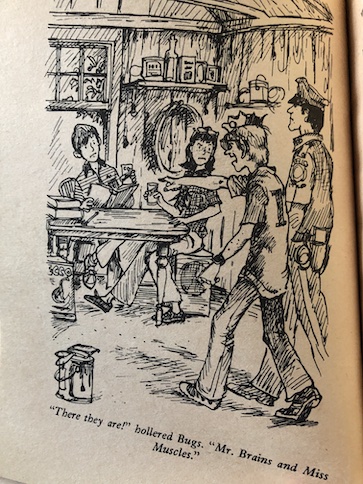
Both Encyclopedia and his detective partner Sally have received phone calls asking them to meet people at different locations, but each time, they waited around, and nobody showed up. They’re starting to suspect that this is another of Bugs Meany’s tricks, trying to get back at Encyclopedia for foiling his schemes. Sure enough, Bugs Meany shows up at Encyclopedia’s house with a police officer, claiming that Encyclopedia is running a racket to get money from people parked at parking meters by putting money in the meters, telling them that they’ve been saved from the fine for an expired meter, and asking them for money for the favor. The police officer isn’t sure that such a thing is actually illegal, although he’d have to inquire with a judge about the matter. Bugs claims that he could prove what happened except that Sally stole the film that he had of Encyclopedia putting money in the meters. When Bugs manages to “find” the film where Sally supposedly ditched it after taking it, Encyclopedia points out why Bugs’s story can’t be true. The solution would make more sense to somebody who understands how reel-to-reel films work.

The Case of the Hidden Will

Encyclopedia’s father, Chief Brown, tells him that a wealthy man named Brandon King has died, but his will is mysteriously missing. Evidently, Mr. King hid the will himself and swore his own lawyer to secrecy about it. The reason for the secrecy is apparently because one of Mr. King’s four sons, who all helped to run the family business, is a thief. Mr. King’s friends knew that was the case, although none of them knew which son it was. Mr. King’s lawyer gave Chief Brown a note written by Mr. King which hints at which son is the thief and saying that his property will go to the other three sons. Chief Brown isn’t sure which of the Kings is considered the “odd King out” until Encyclopedia tells him who it has to be, and Encyclopedia also tells him where the will is.

The Case of the Mysterious Thief

Encyclopedia and Sally go to a restaurant to order a pizza for lunch. While they’re waiting for their pizza, someone attacks the owner’s daughter in the ladies’ room and steals the money she was going to take to the bank. The owner’s daughter is very strong, and it must have taken someone very strong to overpower her and knock her unconscious so quickly and easily. It doesn’t seem likely that it would be a woman, but people would have noticed if a man had gone into the ladies’ room. Sally figures out the answer to this one, but it isn’t likely that modern readers. I didn’t get it when I was a kid, either, because the solution is based on an old piece of etiquette in restaurant seating that I don’t think people observe anymore.

The Case of the Old Calendars

Encyclopedia and Sally hurry over to Butch Mulligan’s house because they hear that Butch is fighting Bugs Meany and the Tigers. Butch is a big, strong 18-year-old, and the Tigers are no match for him. Encyclopedia asks Butch’s younger brother how the fight started, and he explains that Butch’s math teacher recently moved and gave Butch a stack of old calendars with some cool Civil War pictures on them. Then, Bugs claimed that he asked the teacher for those calendars himself, but the teacher forgot. He produced a note supposedly from the teacher that asks Butch to share the calendars with Bugs. Butch was willing to share, but there are an odd number of calendars, and Butch thinks Bugs cheated on the coin flip they had to determine who would get the odd one. He probably did, but Encyclopedia can prove that Bugs faked the note from the teacher, too.

The Case of Lightfoot Louie

Only a few days before the state worm-racing championship, Encyclopedia’s friend Thad accidentally stepped on his prize worm. It’s sad, but as a member of the Worm Racers’ Club of America, Thad can time other people’s worms to be entered in the race. He’s worried because Hoager Dempsey wants him to time a worm, and if he says the worm isn’t fast enough to enter the race, Hoager might beat him up. Thad asks Encyclopedia and Sally to watch the time trial as witnesses to make sure there’s no foul play.

The Case of the Broken Window

John Hall is a wealthy man with an impressive stamp collection. Some of his stamps are worth thousands of dollars. One evening, he calls Chief Brown and asks him to come to his house but to wear a costume because he’s giving a costume party, and he doesn’t want his guests to know that he’s called the police. Chief Brown and Encyclopedia put on their Halloween costumes and go to the Hall estate to investigate the theft of one of Hall’s expensive stamps. Hall thinks one of his guests is the thief, but which one?

The Case of the Gasoline Pill

“Twinkletoes” Willis is a young track star, and he comes to see Encyclopedia about a run-in that he had with Wilford Wiggins, a local high school dropout who’s into get-rich-quick schemes. Wilford has called a meeting of local kids at the city dump to tell them his latest money-making idea, which can only mean trouble. Wilford’s latest money-maker is a pill which he says allows cars to drive thousands of miles if you put it in the gas tank. Fortunately, Encyclopedia knows just how to prove that Wilford is a fraud.

The Case of the Pantry Door

Hilda’s hobby is fly hunting, and she’s a crack shot with rubber bands. She invites Encyclopedia and Sally to a little birthday party that she’s having for her pet frog, who lives in the birdhouse in her backyard. When Encyclopedia and Sally go into the pantry at Hilda’s house for sugar for catching flies, someone locks them in and steals the household money that Hilda’s mother hid in the kitchen. Hilda’s cousin, Lois, says that she saw a boy running away from the house, but Encyclopedia knows who really took the money.

TACK into Danger

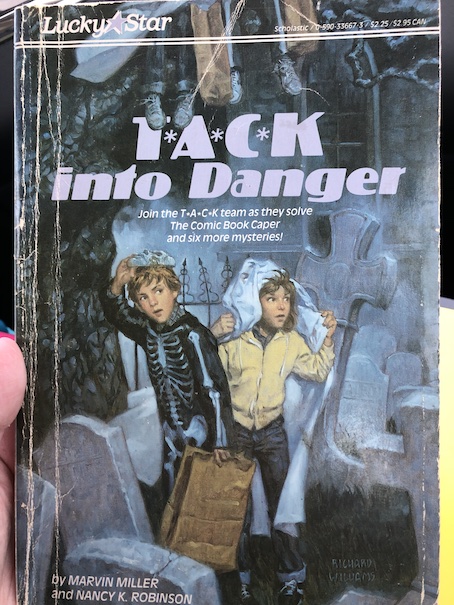
TACK into Danger by Marvin Miller and Nancy K. Robinson, 1983.

This book is part of the TACK mystery series, which is very much like the Encyclopedia Brown series, although it’s not as well known and doesn’t have as many books. In fact, my copy references Encyclopedia Brown on the back: “Move over Encyclopedia Brown … make way for the TACK Team!”

The books in the series are collections of short mysteries that readers are invited to solve along with the characters before looking at the answers. TACK is an acronym for the names of the main characters. They’re kind of a mystery-solving club of neighborhood kids, although they say that they don’t really have a clubhouse or regular meetings. They just help out members of their community by solving problems whenever they can.

T = Toria – Her full name is Victoria Gardner, but she doesn’t like being called Vicky. She is the one who narrates the stories. She wants to be a newspaper reporter when she grows up, and she considers the journals she keeps of the group’s cases to be good writing practice.

A = Abby – Her full name is Abby Pinkwater. Abby and Toria were best friends before she moved away. Now, Abby is considered their “Agent-on-Remote” because the others still consider her part of the group, and she still comes back to visit and becomes involved with their mysteries, even though she no longer lives close.

C = Chuck – Chuck is the best speller at school, and his participation in a spelling bee is part of one of the stories.

K = Will – His full name is Will Roberts, and he’s the leader of the group, although he leads in a very informal way. Will’s initial is the odd one out. They use ‘K’ in place of his initial both because it makes their acronym easier to pronounce and because ‘K’ stands for “SWITCH” in telegraph language, and they think that’s an appropriate code name for him “because of the way his mind can switch all over the place.”

Overall, I like the characters in the stories, and I think they’re well-written. They would be of interest to people who like Encyclopedia Brown and similar types of Solve-It-Yourself style mysteries.

Stories in the Book:

The Comic Book Caper

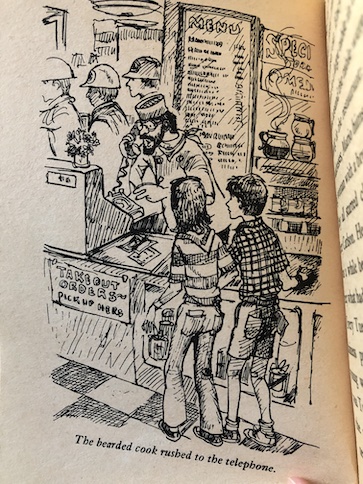
Toria and Will are on their way to Will’s father’s hardware story, where they’re supposed to be helping out, when Toria’s sister Holly says that she wants a comic book. Toria takes Holly to buy one so she’ll be entertained while the older kids are helping at the store. While Holly is looking for a comic to buy, Toria overhears a couple of rough sailors talking about someone they’re waiting to meet. They don’t know what the man they’re waiting for looks like, but there’s a code word that he’s supposed to use. Unfortunately, the code word turns out to be the name of the comic Holly wants to buy, and the men start following Holly, thinking that she might be some kind of courier. Toria is afraid of what the men might do to Holly because her comic contains a secret message relating to a boat that’s recently been stolen.

Spelldown!

Chuck is taking part in the county spelling bee, but the bad news is that so is a kid from Monrose, and the Monrose kids are known to be cheaters. The meanest kid at Monrose (and that’s saying something) is Red Jamieson, and he’s made it known that he’s going to do something terrible to Chuck if he doesn’t let the Monrose student win the spelling bee. Will tells Chuck not to worry about that because he’ll come up with a plan to distract Red so he won’t have time to come after him. One thing that Red can never refuse is a chance to bet on something. After the spelling bee, Will offers Red the chance to hit him while the two of them are standing very close together, but only on the condition that he pick the spot where they’ll stand.

The Great Blueberry Pie Robbery

Will and Cyrus are spending the day with Toria’s family. They were going to have a cookout, but they have to change their plans because it rains. Instead, they decide to spend their time inside, reading. However, Cyrus brings Toria’s mother some blueberries, which she makes into a pie. Everyone is looking forward to having the pie after dinner, but when dinner ends, they discover that someone has eaten all of the filling out of the pie. Toria’s mother demands to know who the guilty party is, and this time, Toria is the one who comes up with the solution.

TACK into Danger

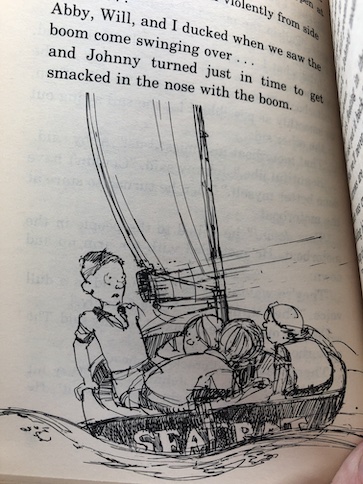
Abby comes to visit her friends for the summer, and they tell her about the cases they’ve recently solved, especially the one about the boat theft. As their reward for catching the thieves, they’ve been getting free sailing lessons from the boat owner, Johnny, and Abby gets to join them. However, while they’re out sailing, someone else driving their motorboat recklessly breaks a sign and rocks their boat. The boom swings over and hits Johnny in the face, breaking his nose. The kids need to get Johnny to the Coast Guard station, but how will they figure out which way to go with the sign broken?

Zoo TACT-tics

Will’s aunt takes the kids to the zoo along with her young son, Nicholas. While they’re at the zoo, they spot a dog who has somehow found his way into the polar bear enclosure. Fortunately, the polar bear is asleep, but can they get the dog out without waking the bear?

E-Z Parties, Inc.

Holly’s birthday is coming up, and Toria’s mother is overwhelmed with playing for it. Every year, it seems like Holly’s birthday part is difficult: kids fighting and crying, Holly not wanting to invite certain girls to the party, Holly wanting to buy a wedding cake she saw in a store window, etc. Toria’s mother wishes someone else could handle all the fuss, so she hires Toria and Will to do it. They manage to pull off the party without the kids getting into any fights, although it gets tricky when trying to divide a piece of cake between a set of twins in a way that satisfies each of them.

Halloween Shadows

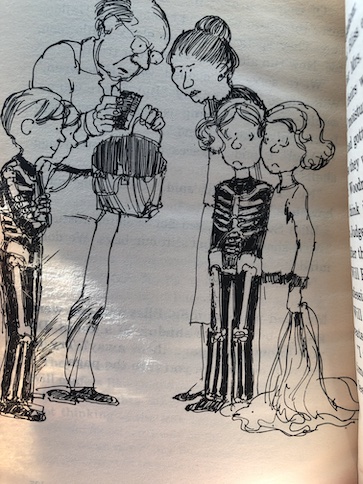
Toria isn’t happy that her mother made her a haystack costume for Halloween because it feels clumsy and it’s difficult to see out of. As soon as she and Will are finished taking their younger siblings trick-or-treating, she makes herself a ghost costume for when she and Will are going to meet Chuck for more trick-or-treating by themselves. However, while she’s waiting for the boys, she sees someone in a skeleton costume like Will’s with someone dressed like a ghost and follows them into the graveyard, where they climb a tree and just look down at her creepily. At first, Toria thinks the boys are playing a trick on her, but then Will shows up, proving that the kid in the tree wearing a skeleton costume isn’t him. It’s just a coincidence that there are two sets of kids wearing similar costumes. However, some angry adults come along because a kid in a skeleton costume and a kid in a ghost costume just played some nasty tricks at their houses. When the adults see that there are two sets of kids who look alike, can Toria and Will prove to them that the pranksters are the other kids?