The Ghost Belonged to Me

GhostBelongedToMe

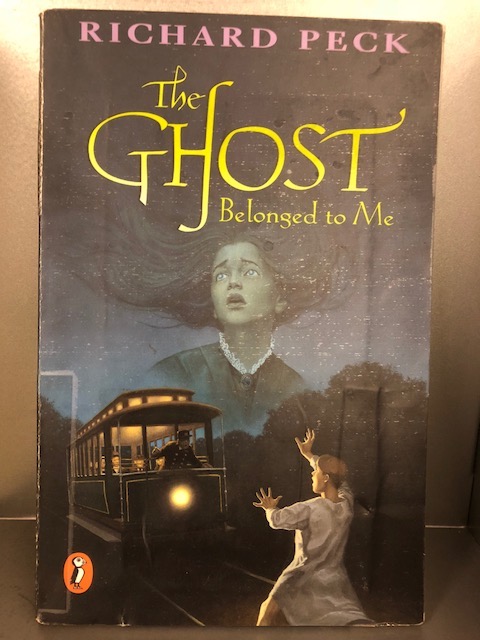
The Ghost Belonged to Me by Richard Peck, 1975.

The book takes place in the 1910s in a small town on the Mississippi River. Alexander Armsworth, a boy in his early teens, is approached by a girl from his class who tells him that the barn on his family’s property is haunted and that Alexander himself has the ability to see the “Unseen.” The girl, Blossom Culp, is a poor girl from a family of outcasts who has been known to tell tall tales, so Alexander isn’t sure he believes her at first. However, he can’t help but be curious, and when he sees a light coming from the barn at night, he decides to investigate.

Inside, he finds the ghost of a young girl who warns him of danger on the trolley tracks near his house and tells him that he must act fast to save everyone. Frightened, Alexander gets the trolley to stop and learns that by doing so, he has saved the lives of everyone on board from a disaster at the bridge further on. Naturally, everyone wants to know how Alexander knew to warn them. When Alexander explains, he is met with skepticism from his social-climbing mother and sister and unwelcome attention from news people and curiosity-seekers from town.

The ghost, who tells Alexander that her name is Inez Dumaine, is also in need of help before she can rest peacefully. Alexander will need the help of those who believe in him and the ghost to find Inez’s body and return it to her home in New Orleans.

In this first book in of the Blossom Culp series, Alexander is the main character, but the other books focus more on Blossom, who discovers that she also has the ability to see ghosts.  The book is available to borrow and read for free online through Internet Archive.

This is the movie that the Disney movie Child of Glass was based on, and the movie is available on dvd. Sometimes, you can also find it on YouTube, at least clips and reviews of it.

My Reaction

The story has sad and scary points, but those are balanced out by humorous situations. Alexander’s sister’s turmoil over the fiasco at her coming-out party is hilarious, and his mother’s change in attitude when she realizes that, instead of making them social outcasts, the ghost business actually attracts attention from one of the town’s leading citizens is a hoot. Blossom, of course, is wonderfully nosy, elbowing her way into Alexander’s life and selling tours of the haunted barn.

I was very young when I saw the Disney movie based on this book, Child of Glass (a live action movie that aired on television), and I was afraid of ghosts. However, years later, I took another look at the movie and decided to read the book that it was based on. When I did, I saw things I didn’t appreciate when I was young. The dialog and depiction of life in the early 20th century in the book are wonderful. It conjured up memories of Meet Me in St. Louis, especially the Halloween scene (which took place only about a decade earlier than this story). Unfortunately, this early 20th century setting wasn’t present in the movie version of this book because Child of Glass was placed contemporary with the time it was made, during the late 20th century.

The Disney movie was also different from the original book because it added the feature of the “child of glass” which didn’t exist in the original book. The “child of glass” was mentioned in a poem at Inez’s grave that explained how to lay her ghost to rest. At first, the Alexander and Blossom in the movie don’t know what it means, but it turns out to be Inez’s doll, which was lost when she was murdered by her wicked uncle. In the book, Inez died under different circumstances. However, the discovery of the doll in the movie uncovers the secret motive behind her murder, which is similar to the reason why Inez’s body was hidden in the book after she died in a riverboat accident.  In the book, Inez’s spirit finds rest after her body is found and taken to her family’s cemetery in New Orleans.  The Disney movie also turns this story specifically into a Halloween story, which wasn’t the case in the original book.
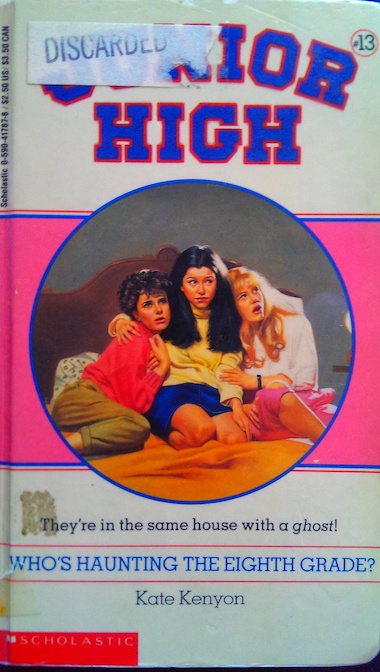
Who’s Haunting the Eighth Grade?

Junior High Series

JHHaunting

#13 Who’s Haunting the Eighth Grade? by Kate Kenyon, 1988.

A group of eighth graders are going on a field trip to see a Shakespeare play in another town, but right from the start, everything seems to be going wrong. The teachers who are accompanying them on their trip are in a foul mood and spend a good part of the trip arguing with each other, which bothers the kids because they know that the teachers have recently become engaged to each other. Then, the bus breaks down in a small town before they can reach their destination.  The entire class is going to have to spend the night somewhere in the small town.

At first, things look like they’re going to improve when the group decides to spend the night at a local bed and breakfast in a big, beautiful, old house. However, their spirits are almost immediately dampened again when they are told that the house is haunted and that anyone who tries to stay there is scared away by the ghost. Still, they proceed with their plan to stay there in order to avoid staying at the dumpy local motel, the only other choice of accommodation.

Needless to say, before the night is over, the ghost puts in an appearance, and strange things start to happen.  By then, the students have come to feel sorry for the owner of the bed and breakfast, a nice older lady who grew up in the house but can’t really afford to keep it unless she can make her inn a success. Can the eighth graders catch the ghost, stop the hauntings, save the bed and breakfast from having to close, patch up the relationship between their feuding teachers, and still make it in time to see the play?

The book takes place in the 1980s, and the kids in the story are 14 years old. They mention the decade somewhere during the course of the story, and the descriptions of the clothes and some pop culture references make the time period fairly obvious. It also has some of the stock characters that books for pre-teens and early teens in the 80s have (ex. a boy-crazy space cadet, a level-headed health nut, a class clown, and a couple of young punks). Still, even though there are some things about the book that are a bit dated, it is still pretty enjoyable. The author has a sense of humor, and she plays with the characters’ stereotypes a bit. The class clown is secretly quite sensitive and even a bit perceptive. There are also a couple of fun scenes when the girl who is only interested in boys is shocked to discover that the boys are more interested in the mystery than in her.

Heckedy Peg

HeckedyPeg

Heckedy Peg by Audrey Wood, 1987.

A mother leaves her seven children, all named after days of the week, alone at home while she goes to the market.  Before she leaves, each of the children asks her for something special, and the mother warns them not to let strangers in or touch the fire.

However, while she is gone, a witch, Heckedy Peg, comes to the house and asks the children to light her pipe for her, offering them a sack of gold in return.  At the sight of the gold, the children let her in, and she turns each of the children into a different kind of food, which she takes back to her hut in the woods.

HeckedyPegChallenge

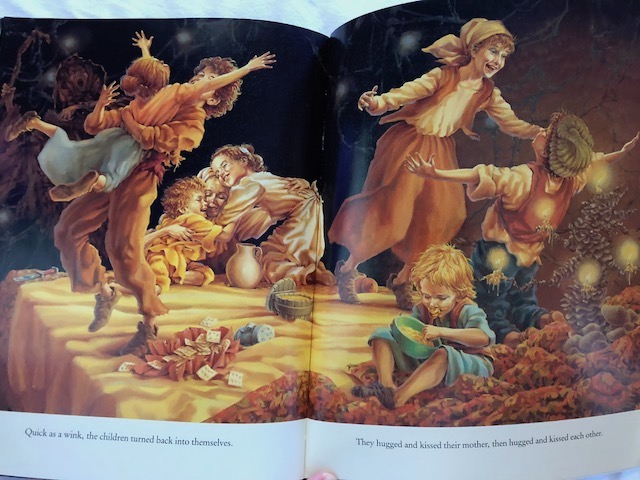
When the mother returns home and discovers that the witch has taken her children, she goes into the woods to get them back.  Heckedy Peg says that the mother can reclaim her children if she can determine which type of food on her table is which child.  At first, the mother doesn’t know what to do, but then she realizes that the things her children wanted from the market are the clues to determine their identities.

The book is currently available online through Internet Archive.

HeckedyPegAnswers

My Reaction

The pictures in the book are wonderful, but the most interesting part for me is in the note on the back, which explains that the story is based on a 16th century game that children still play which involves guessing the identities of children within a certain category of things.

I wouldn’t recommend the book for very young children because the way the children in the story were turned into food might be frightening.  Also, when the mother goes to the witch’s hut the witch refuses to let her in until she cuts off her feet, which she only pretends to do, but the idea is a little disturbing.  The part about cutting off the feet is a reference to part of the original game.

HeckedyPegCelebrate

Monster Manners

MonsterManners

Monster Manners by Joanna Cole, 1985.

Rosie Monster’s parents worry about her because she just can’t seem to understand how monsters are supposed to behave. Monsters are supposed to be fearsome. They’re supposed to growl, fight, and break things. Rosie is just the opposite. She’s endlessly polite and sweet.

MonsterMannersRosie

Rosie’s friend Prunella tries to teach her real monster manners, but no matter what, Rosie just can’t stop being polite.

MonsterMannersPrunella

It wouldn’t be such a problem for Rosie, except that she knows that her family and friends are disappointed in her.

MonsterMannersDisappointment

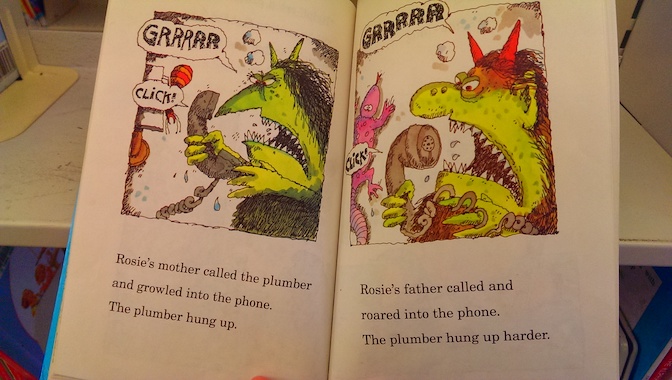
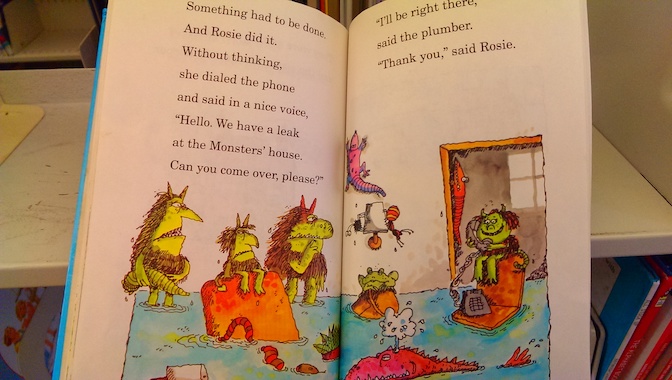
Then, a water pipe breaks at Rosie’s house. Although her parents, and even Prunella, try calling a plumber, they can’t get him to come to the house and help them no matter how loudly they growl into the phone.

MonsterMannersGrowling.jpg

It takes Rosie’s politeness to get the message across and get the help they need!

MonsterMannersPhone

A friend of mine who works in customer service wishes that more callers would be polite or, failing that, that he could just hang up like the plumber in the story.  Trying to help people who are determined to make the process of helping them harder than it has to be and who will curse and insult you for even trying is a frustrating experience.

The book is currently available online through Internet Archive.