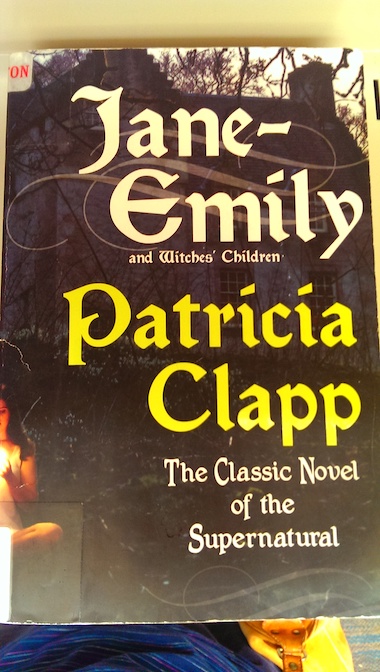
Jane-Emily by Patricia Clapp, 1969.
Louisa is a young woman around the turn of the century. She is only 18 years old and unmarried, but she is in love with a young man named Martin. However, her parents think that she is becoming too serious about Martin too soon, so they insist that she spend the summer taking her young niece, Jane, to visit her other grandmother. Jane has lived with her maternal grandparents, Louisa’s parents, since the death of her parents. Louisa loves her niece, but she resents her parents changing her summer plans in order to keep her away from her boyfriend.
However, this is not just a love story but a ghost story. Jane’s parents were killed in a strange buggy accident, which is why she lives with her grandparents and young aunt. Her other grandmother has lived alone since the death of her son (Jane’s father) and her husband, some years earlier. She had another child, a daughter named Emily, but Emily died young many years ago of a sudden illness.
As Louisa soon learns, Emily was a pretty and clever but seriously disturbed child. Her father idolized her, coming to love her even more than he loved his wife. He thought she was absolutely the most perfect child in the world and could never forbid her anything. He gave her everything she ever asked for and refused to allow his wife to discipline her for any reason, even when she needed it. It would be enough to spoil any child, but Emily was extremely callous, cold, and manipulating by nature. Her father’s catering to her only fed her selfishness and ruthlessness.
Emily was known to resort to extreme measures to get her way, and in the end, it led to her death. She fell in love with the son of the local doctor, deciding (without his consent) that they would get married one day. However, he didn’t really care for her at all, seeing her extreme selfishness. In a bid to get his attention and sympathy, Emily decided to make herself ill. One cold night, she soaked her nightgown in water and deliberately sat by an open window. Unfortunately, it worked too well, and she became so ill that she died.
However, Emily’s selfishness and determination to get her way seem to have lasted beyond the grave, and young Jane’s presence in her old house, in the very room that used to be Emily’s, seems to have awakened Emily’s wrathful spirit. Jane becomes fascinated with the reflecting globe in the garden, which Emily declared was hers alone and that no one else could ever look into it. Jane claims that she can see Emily’s face in the globe, but people don’t believe her at first. Jane bears a close resemblance to Emily, although the two of them are very different in character. Jane seems to develop an unhealthy obsession with her dead aunt, and she seems to know things that only Emily could have told her. Emily seems to be slowly taking over Jane.
Jane’s grandmother confides that she has believed that Emily caused the sudden deaths of her husband and son because they both died under unexplained circumstances and Emily could never let go of anything or anyone she thought belonged to her. Now that Emily seems to be showing an interest in Jane, her grandmother begins to fear for her.
Meanwhile, Louisa is falling in love with Adam, the young man Emily had planned to marry and who is now a doctor himself. Adam also loves her, wanting her to marry him. However, Louisa has become convinced of Emily’s evil presence and the threat that she poses to young Jane. When Emily forces Jane to go out in a freezing rain, making her become ill in the way she did before she died, Louisa must help Jane to fight for her life.
Emily’s presence centers around the gazing globe in the garden, and the only person who can end her evil influence and save Jane is her grandmother, who finally finds the courage to stand up to her daughter and tell her that there are some things that she can’t have.
The book is currently available online through Internet Archive.
My Reaction
Parts of the story feel a bit preachy on the subject of parents who spoil their children, but Emily and her family are presented as an extreme case of that. At times, characters wonder what Emily would have been like if her father hadn’t constantly catered to her every whim and had given her the discipline she needed. They all agree that she would have lived a longer life, as would other members of her family. However, Emily was already a naturally selfish person and apparently incapable of empathy. Her father’s worship of her was seriously unhealthy and, in a way, a reflection of his own selfishness; Emily represented all the qualities that he loved in her mother but she was a creation of his (well, you know, 50%, genetically speaking), making her infinitely more perfect and more worthy of his love than his own wife. One of the other characters comments that his wife was the real victim in the end because her husband blamed her for their daughter’s early death (which was definitely Emily’s fault alone) and subjected her to years of guilt over it, rejecting all the love they had once had for each other.
The story ends happily but on a somewhat ambiguous note because Louisa realizes that there are many things that she doesn’t understand, and although Emily seems like she’s finally gone, the memory of her will haunt them all.
 Jestress's Forgotten Books and Stories
One thought on “Jane-Emily”