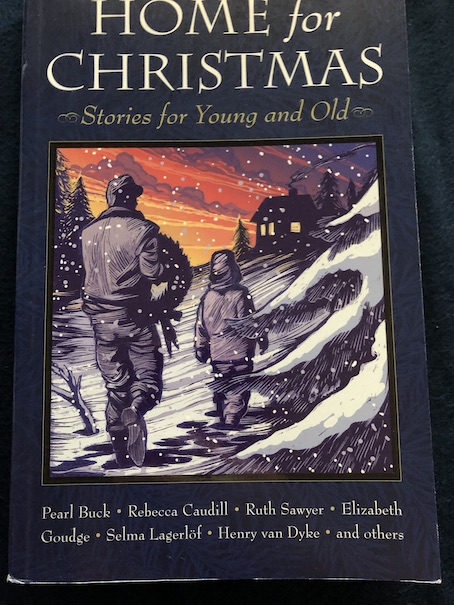
Home for Christmas

Home for Christmas: Stories for Young and Old compiled by Miriam LeBlanc, 2002.

Disclosure: Plough Publishing House sent a copy of this book to me for review purposes, but the opinions in the review are my own.

This is a collection of short Christmas stories written by famous authors from around the world. One of the things that I found interesting about the selection of authors in the book is that many of them are better known for writing on very different themes. Among the authors in this book are Madeleine L’Engle, who is known for writing science fiction, such as A Wrinkle in Time; Elizabeth Goudge, who wrote the mid-20th century classic children’s fantasy story The Little White Horse (later made into the film called The Secret of Moonacre); Katherine Paterson, known for her children’s novels, including Bridge to Terabithia, Jacob Have I Loved, and historical novels set in Asia, such as The Master Puppeteer; and Pearl S. Buck, author of The Good Earth.

Although the book is intended for children and families and many of the authors are known for writing for children and young adults, I think that many of the stories wouldn’t particularly appeal to children, especially younger children, because children wouldn’t be likely to understand them or they have darker themes, like bitterness that must be overcome and grief at the death of a child. The stories generally end well, but for young children, something simpler and lighter in subject matter, like the short stories in Merry Christmas from Eddie, would be more appealing. Really, I think this book would be best for adults, although I noted some of the more child-friendly stories.

One thing that I wished the book included is sections of information that explain a little more about the stories behind the stories. I recognized the historical references behind some of the stories, but other readers, particular children, might require a little more explanation to fully appreciate them. I think that’s another good reason why the stories might appeal more to adults.

There are 20 stories contained in the book. Each of the stories in the book has one black-and-white picture in an old-fashioned woodcut style.

I don’t think that there are any copies of this book available to read for free online, but this book is available for purchase through Plough Publishing House.

The stories contained in this book are:

Brother Robber by Helene Christaller

A young monk sends three robbers away without food before Christmas because they are violent criminals, but an older monk convinces him to have compassion and to find them and give them the food they have asked for.

The compassionate brother, Brother Francis, is St. Francis of Assisi, although it is not explicitly explained in the story, and the younger brother, Brother Angelo, is the main character. The story of St. Francis, Brother Angelo, and the robbers is an old one that has been told before in other forms, but this is a good rendition.

Three Young Kings by George Summer Albee

Three boys at a school in Cuba are given the role of playing the Three Kings in their school play as well as delivering presents to the rest of the children in their community, giving them presents that their parents have already bought for them. However, their task proves harder than they thought when they see how upset the poor children are that they pass their houses and leave nothing because their parents couldn’t afford presents. What can they do?

This is a good book for talking about making choices. In the end, the community is satisfied with the boys’ choice, but a good topic for discussion after this story would be what the community will choose to do next year, when new boys become the Three Kings.

Transfiguration by Madeleine L’Engle

A nun in New York City struggles to answer a poor man’s questions about why Christmas should be so “merry” when there are so many poor people and bad things happening in the world. The real answer comes to her after the man tries to rob her.

The Cribmaker’s Trip to Heaven by Reimmichl

Willibald Krautmann spends his life making manger scenes for Christmas, and he is sure that his work will earn him a place in Heaven. Unfortunately, when he dies, he is not received in Heaven as he thought and, confronted with the history of his faults that prevents him from entering, he must seek an advocate to help him plead his case. However, it’s not too late for him to mend his ways, and the reader is left to imagine how much was real and how much was dream.

The Guest by Nikolai S. Lesskov

Timofai was a bitter young man, an orphan defrauded of his inheritance by his uncle. After a violent fight with his uncle, he is sent into exile in Siberia. Even after his life improves and he marries and has a family of his own, he still finds himself bitter about the injustice that was done to him. Is there anything that his friend and brother-in-law can say that will help him? When he finally meets his uncle again, after many years, will they both get the closure they really need?

Christmas Day in the Morning by Pearl S. Buck

An older man and his wife decide how to spend Christmas now that their children are grown and living their own lives, separately. As the man reflects on Christmases past, he realizes that love is what makes Christmas special and what you do to show other people how much you love them.

This is one of those stories that I think adults would understand more than children, although it’s a good thought to explain to older children.

The Other Wise Man by Henry van Dyke

The story of a wise man who set out to follow the star at Christmas, like the others, but didn’t arrive at Bethlehem with them because he stopped to help someone. Although he arrives too late to see the Christ Child, he is in the right places to help people because he set out on the journey. At the end of his life, this wise man does actually see Jesus at his crucifixion.

This is a famous 19th century story.
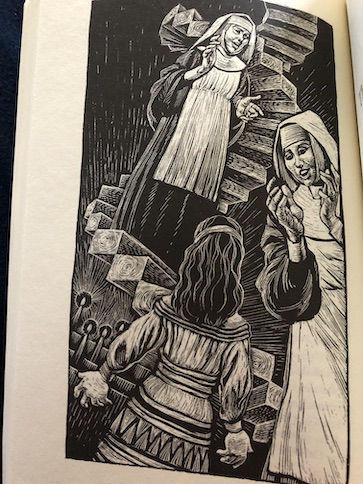
The Miraculous Staircase by Arthur Gordon

In Santa Fe, New Mexico, in 1878, an unusual carpenter promises that he can build a staircase to a church choir loft, even though the original architect didn’t leave space for stairs. Even though other carpenters had failed to find a solution to the problem, the mysterious stranger solves it. But, who was that mysterious carpenter, and how did he do it?

This is actually based on a true story! I’ve been to the church in Santa Fe, the Loretto Chapel, and I’ve seen this staircase myself! The short story ends with a few details about the history of the event.

No Room in the Inn by Katherine Paterson

When an eighteen-year-old boy’s parents leave him alone at the family’s inn, which is closed for Christmas while they visit his sister’s family, he’s a little sad at spending Christmas alone but also looking forward to some freedom to relax. However, a mysterious stranger who needs a place for the night changes his plans.

The Chess Player by Ger Koopman

The Christ Child must help an old man to forgive his estranged daughter on Christmas. Can the Christ Child soften a hardened heart over a game of chess?

The Christmas Lie by Dorothy Thomas

A poor young girl from a large family invents a story that some friends have invited the whole family to join them for Christmas dinner when, in fact, no invitation has been made. It had really been more of an impulsive wish that they had been invited, but when her family believes her and begins preparing for the event, can the girl find the courage to admit the truth? What will happen when everyone realizes that she lied?

This is one of the better child-centered stories in the book.

The Riders of St. Nicholas by Jack Schaefer

A group of cowboys have to decide which of them are going into town to celebrate Christmas and which of them will be staying on the ranch. The ones who get left behind plan a small feast for themselves as consolation for being left out of the fun. However, their plans change when they rescue a neighbor who got drunk and almost froze in a snowstorm.

Grandfather’s Stories by Ernst Wiechert

An old coachman tells stories that his grandfather told him. One Christmas Eve, his grandfather’s grandfather was driving a coach and saw a strange, smiling boy who seemed to be asking for something. Although his employer wanted him to drive on, the coachman gave the boy a ride, and it turns out to be the beginning of a miracle. In another story, a cruel master is changed for the better when he sees that the victim of his cruelty is Christ.

The Vexation of Barney Hatch by B.J. Chute

A panhandler gets recruited as a store Santa and helps a poor boy who only wants a harmonica.

The Empty Cup by Opal Menius

King Herod, knowing of a prophecy that a new king would be born, attempted to kill the new king to preserve his own power. Unable to tell which baby would be the prophesied king, Jesus, he ordered all of the boy babies in the area to be killed.

This story focuses on a man whose only child was killed. His wife seems unable to get over the shock and grief of their son’s death until another little boy teaches her how to get over a loss.

The Well of the Star by Elizabeth Goudge

The Well of the Star is a well where legend has it that the Wise Men stopped on their way to see Jesus. David is a poor shepherd boy who is left behind when the other shepherds go to see the baby Jesus. He is visited by the archangel Michael, who sends him to join the others, meeting the Wise Men on the way.

This is one of the better child-centered stories in the book.

A Certain Small Shepherd by Rebecca Caudill

Jamie’s mother died shortly after his birth, and for much of his young life, Jamie is unable to talk. When he begins going to school, he does well, except that he can’t answer questions out loud in class and not at all if he doesn’t know how to spell the word that he wants. It’s frustrating. However, when his teacher makes him a shepherd in the school Christmas play and his family has some unexpected visitors in a snowstorm, things change.

This is one of the better child-centered stories in the book.

The Carpenter’s Christmas by Peter K. Rosegger

The carpenter’s wife thinks that he isn’t be pious enough on Christmas, but he has an important job to do for someone less fortunate.

What the Kings Brought by Ruth Sawyer

In Spain, the tradition is that the Three Kings bring presents to children on Twelfth Night. A traveler in Spain shortly before Twelfth Night meets a poor young boy who is desperately trying to raise money to buy a new burro to help his father on his farm. The traveler and his friend come up with an idea to help the boy without it seeming like charity.

This is one of the better child-centered stories in the book.

The Christmas Rose by Selma Lagerlof

A Robber Mother trespasses on monastery ground and angers the monks when she tells them that their beautiful herb garden cannot compare to the way the forest looks on Christmas Eve. Abbot Hans decides to pay the Robber family a visit on Christmas, although it ends up being his last.
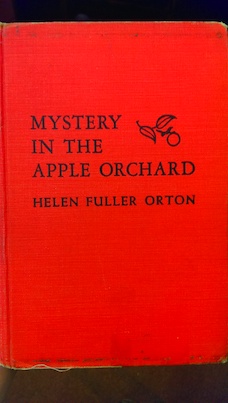
Mystery in the Apple Orchard

Mystery in the Apple Orchard cover

Mystery in the Apple Orchard by Helen Fuller Orton, 1954.

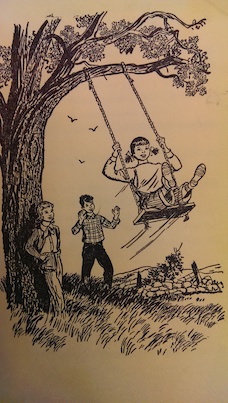
Mystery in the Apple Orchard swing

Dee Waters (age nine), her brother Ronnie (age eleven), and the other neighborhood children enjoy playing in the nearby apple orchard. The orchard was planted by Dee and Ronnie’s grandfather, and the trees are all different types of apple. Sometimes, the children take a lunch with them and spend hours climbing trees and playing. They like to watch the animals there, like the squirrels and crows, running around and hiding things in the trees. There is also a swing hung in one of the trees.

The Waters’ housekeeper, Mrs. Brown, lives in the city and commutes to her job in the country. She also has a son, Timmy, and she’s been concerned about him. Timmy is recovering from a broken leg. The bullies in his neighborhood dared him to climb a tall pole, and he fell. Although Timmy’s been out of the hospital, he hasn’t been getting enough fresh air and time outdoors in the city because they don’t live near a park. Dee and Ronnie don’t know Timmy, but hearing that he’s been unwell, they suggest that Mrs. Brown bring him along the next time she comes so that they can show Timmy the apple orchard. The children’s mother thinks that’s a good idea and also urges Mrs. Brown to bring Timmy for a visit.

Timmy is a little younger than Dee and Ronnie, and he can’t play many games with the children yet because he still walks with a crutch and can’t run. Still, he is fascinated by the animals in the orchard and enjoys watching them. He doesn’t see many wild animals in the city.

Most of the other children in the area are nice to Timmy, but Gloria is a little bit of a snob. Ronnie finds Gloria annoying because she is so prissy and extra careful about her clothes, and on Timmy’s first day in the orchard, Gloria shows up with a ring that she says has a real diamond and a family. The other children don’t believe her at first because it would be silly to wear an old, valuable ring to an apple orchard, especially when it looks so loose on her finger. Ronnie warns her that it could get lost, but Gloria tells him to mind his own business. She also tries to cheat when they play hide-and-seek, asking Timmy to tell her where everyone is because he can’t play the game anyway. Timmy refuses to help her cheat, and Gloria leaves in a huff. Because this is a mystery story, you can see where this is probably leading.

Mystery in the Apple Orchard play ticket desk

When Timmy comes the next time, the children decide to pretend that they’re going on trips by airplanes, with the trees in the orchard representing the planes. Timmy is sad that he can’t climb with the others, so they make him the ticket agent in the airport. Gloria shows up again, still with her diamond ring, and the other children again warn her that she could lose it in the orchard. Gloria says that’s impossible because she tied it to her finger, and she shows the the string. (What was it they said about the Titanic being unsinkable?)

Naturally, the ring gets in the way while Gloria is playing with the others, catching on a twig in a tree. They have to untie the string to get her loose. The other children tell Gloria to put the ring somewhere safe while she plays, suggesting that Timmy the ticket agent could watch it. However, Gloria decides to put the ring on a stone near the old well that has been filled in. (Considering that there are small animals in the orchard that happen to like shiny things, this was not the best decision.)

Mystery in the Apple Orchard digging

Sure enough, by the time Gloria comes down from her tree and her imaginary flight to Paris, her ring is gone. Naturally, Gloria is upset and admits that she was wearing the ring without her mother’s permission. (Gloria likes to show off.) She accuses one of the other children of taking the ring. Timmy seems like the most logical suspect, since he was on the ground while the others were in the trees, but he denies it, saying that he closed his eyes so he could imagine a flight, like the others were doing. Dee suggests that an animal could have taken the ring. Earlier, a chipmunk carried off the piece of string. On the other hand, crows also like shiny things. Could the crow have swooped down and carried it away?

Gloria still insists that Timmy took the ring, and she threatens to tell her mother that he stole it. Can the others find the ring before Timmy is labeled as a thief?

It take awhile for the other children to find Gloria’s ring, and because they failed to find it with the animals right away, some readers might wonder whether a human was responsible for taking. However, the mystery itself is very simple and wouldn’t really surprise anyone but young children. In the end, though, the important point is that Timmy is so motivated to find the ring and clear his name that he finds the courage to climb a tree again. He has healed from his broken leg more than even he thought he had. Before coming to the country, the doctor had told him that he could stop using his crutch, but he hesitated to do that because he was so afraid of re-injuring himself. Once he gets the courage to try not using his crutch, he discovers that he can also do many other things, although he does freeze up when trying to come back down the tree and needs the help of a couple of telephone linesmen to get back down. The linesmen tell him that it’s okay and that God has smiled on him for helping him to improve and do what he needed to do. Timmy is reassured by the discovery that he can do more than he thought he could, and his mother and Mrs. Waters decide that the Browns should move to the country permanently so that Mrs. Brown won’t have to commute to work and Timmy can have more fresh air, playing with the other children in the apple orchard.

This book is available to borrow for free online through Internet Archive.

Mystery in the Old Cave

Mystery in the Old Cave cover

Mystery in the Old Cave by Helen Fuller Orton, 1950.

Mystery in the Old Cave nut gathering

Andy and Joan Draper are excited about spending the fall and winter in the country. Usually, they live in an apartment in New York City and only go to their family’s vacation home in Vermont during the summer. However, this year, some friends of their father will be moving to New York, and they’ll need a place to stay because they are having trouble finding an apartment of their own. The children’s father has decided to rent their apartment to his friends while his family stays in Vermont. That means that the children will have to go to school in Vermont, but the children like the idea because they will be able to do things that they normally can’t do when the seasons change, like gathering nuts. When the first frosts come, the hickory nuts on the trees fall to the ground, making it easy to collect them.

After Andy and Joan collect nuts for the first time, they decide to store them in the old sugarhouse on the property. Normally, the family doesn’t use the sugarhouse for anything, but it used to be used during the times when their vacation house was a working farm and people tapped the maple trees for their sap to make maple syrup. They would process the sap in the sugarhouse. Sometimes, farm hands also used to sleep there during the harvest.

Soon, the children begin to suspect that there’s a stranger hanging around the property. Their dog, Ponto, barks at someone the children don’t see and comes running back to them, acting like someone kicked him. Later, a strange man approaches them and asks them if they know anything about a cave in the area. Andy and Joan don’t know anything about a cave. The man tells them that it’s supposed to be near the old sugarhouse, but if the children haven’t seen it, it might have caved in or something. He seems very secretive and doesn’t want the children to tell anyone that he’s been asking questions, and the children wonder if he could be the one who kicked their dog earlier. Later, someone (perhaps this strange man) steals many of the nuts that the children gathered and even some cookies. The children change their minds about storing things in the sugarhouse and decide to keep their gathered nuts in an unused room in the main house. The only clue to the identity of who’s been sneaking around is a red pencil that the person dropped.

Mystery in the Old Cave store

The children make friends with a boy named Phil who lives nearby. Phil is an orphan who lives with his Cousin John (who he sometimes calls Uncle John because he is so much older), a mean and stingy old man who doesn’t treat him very well and makes him work hard around the house instead of going to play after school with the other kids. He doesn’t even replace Phil’s clothes when they get old and torn. Phil gets a job at the local store to earn some money for a new sweater, but Cousin John even confiscates Phil’s earnings.

Mr. Lane, who owns the local store, is nice, and he tells Andy and Phil about how maple syrup and maple sugar are made, something that everyone in town used to participate in so that it was like a community party. The boys think it sounds like a lot of fun, and while they are talking about the old sugarhouse, Mr. Lane mentions that, once, some thieves joined in when they were making making syrup. Nobody knew they were thieves at first; they were just a couple of strangers who came along with everyone else and started helping out. Later, there were some robberies in the area, and the thieves were found hiding in a cave near the sugarhouse. Mr. Lane says that he and his friends used to play in that cave when they were young, and Andy and Phil decide that they want to find it.

Mystery in the Old Cave bones

The boys take some tools with them while they’re looking for the cave, in case the entrance has been covered over, which turns out to be the case. Once they dig through the entrance, the rest of the cave appears intact. They find some old bones inside that probably belonged to a bear. They can’t look around much more because the cave is too dark, so they decide that they’ll return later with some lanterns. Mr. Lane tells the boys that there still might be stolen loot around because they never did find everything that the thieves took, including a pearl necklace that belonged to Andy’s grandmother, who was living there back then. Could these things be what the mysterious stranger is looking for?

Mystery in the Old Cave stove in store

During the course of the book, Mr. Lane begins to notice that Phil’s cousin isn’t giving him enough food. Cousin John denies Phil food when he refuses to turn over the extra money that he’s been earning to him. Mr. Lane gives Phil food from the store to eat. While Phil is at the store, he overhears the stranger, who calls himself Joe Williams, talking to Mr. Lane. Joe Williams admits that he’s looking for treasure in the area. Mr. Lane says that he doesn’t have high hopes that Joe Williams will find anything around the cave because the whole area was searched thoroughly years ago.

Phil tells Mr. Lane that he can’t stand living with his cousin anymore and wants to run away. Mr. Lane tries to persuade him not to go, saying that he can deal with Phil’s cousin, but Phil has had enough and worries that his cousin will make life hard for anyone who tries to help him. When Phil hides out in the old sugarhouse, he meets up with Joe Williams, who explains to him more about how he knows about the treasure that may be hidden in or around the cave. He’s about ready to give up the search, but Phil finds something that everyone else has overlooked.

In the end, Andy and Joan’s parents decide to take Phil in. Phil’s cousin agrees to sign over custody to the Drapers, provided that he gets to keep the money from Phil’s job that he took and the money that Phil’s mother left for Phil’s upkeep. I’m pretty sure that’s illegal and that the courts and social workers would have something to say about that if this story happened in real life in the 21st century, but in the story, Mr. Draper accepts the deal and basically uses the money that was meant for Phil to pay off his cousin to surrender custody of the boy. The story ends at Thanksgiving, with Phil sitting down to Thanksgiving dinner with his new family, who will really love him and treat him much better than his cousin did.

Mystery in the Old Cave hiding

This is one of those older mystery stories that’s really more adventure than mystery. There’s really only one suspect for the odd person sneaking around, and his reasons for sneaking around turn out to be exactly what he said they were. There is no other hidden purpose or secret past behind that man other than what he said, and in the end, he just kind of leaves the story. The kids don’t have many clues to the location of the stolen items, and in the end, Phil finds them more by accident than anything else.

Sometimes, when I’m unsatisfied by the ending of a story, I like to make up an alternate one of my own. If I were writing this, I’d have had Phil’s nasty cousin be involved in the robbery and the hunt for the hidden loot. For example, maybe he was actually one of the original thieves and had a falling out with his partners, and he’s secretly searching for the rest of the loot they hid for years. Maybe he’s had to redouble his efforts recently because they’re getting out of prison soon, and he wants to get to the hidden loot before they do. Cousin John is money-hungry enough that it could be plausible, and that would allow the story to end with him being sent to prison, which seems fitting.

This isn’t important to the story at all, but I just wanted to say that the copy I have of this book is damaged in a very odd way. On some of the beginning pages, someone has cut out a few of the words, ransom-note style. I don’t know why that happened. There aren’t enough missing for a real ransom note, and some of the cut-out words are still stuck in the pages, but since this is a mystery book, I kind of like the image of someone using it to write some kind of mysterious secret message.

I haven’t been able to find an online copy of this book yet, but Internet Archive has others by the same author.