
Mary Poppins Opens the Door by P. L. Travers, 1943.
This Mary Poppins book was written during World War II, and the author has an acknowledgement in the first chapter that things have changed because of the war. Like other Mary Poppins books, each chapter is its own short story, and the first one takes places on Guy Fawkes Day. A note at the beginning explains what Guy Fawkes Day is, and it also mentions that people haven’t celebrated it since the war began. However, the author says that she is sure that the situation is only temporary and that people will celebrate it once again after the war is over.
Sadly, people reading older versions of Mary Poppins books also have to be warned about the racial language. The stories are magical, but at the same time, one of the most grating things about the original printing of this book is that characters have a tendency to use racial language or racial terms as insults. When characters, even Mary Poppins, are irritated with each other, they’ll call people things like “Hottentot“, “black heathen”, “Blackamoor“, and similar things, implying that these people are behaving like “savages.” Some of the words the books use would be considered offensive by themselves, but it’s worse when they’re specifically used as insults. These incidents don’t take place in every story, but they happen throughout the original printing of this book, and they’re also found in other old Mary Poppins books. On a somewhat lighter note, I liked the character of Mrs. Clump, even though she’s an antagonist in one of the stories, because she used “vampire” and “pirate” as insults. If someone is going to use insults, I like them imaginative and funny like that. Fortunately, later reprintings of this book revised or removed the inappropriate racial language, so some people who grew up with the revised versions may not have even been aware that they were ever there.
This is the third time that Mary Poppins returns to the Banks household to be the children’s nanny. In the previous two books in the series, she came suddenly and left suddenly, without warning. Mrs. Banks finds it upsetting that Mary Poppins comes and goes so unexpectedly because she never knows if she can count on her to be with the children or if she will disappear suddenly. All the same, Mrs. Banks is always grateful when Mary Poppins comes because she’s so good at putting the household in order.
The book is available to borrow and read for free online through Internet Archive (multiple copies).
Stories in the Book:
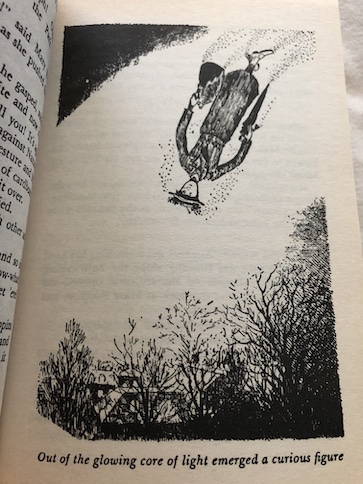
The Fifth of November – Mr. Banks is in a bad mood and declares that he won’t be home for dinner that night, upsetting his wife and children because it’s Guy Fawkes Day, and the family wants him to help set off fireworks. He won’t even shake hands with the chimney sweep, even though that’s supposed to be good luck. Part of the trouble is that the family is missing Mary Poppins, and they haven’t found anyone to replace her, leaving the house in disorder. Mrs. Banks considers hiring Mr. Banks’s old governess, but the children beg her not to because they know how strict she is. The discussion is interrupted by the chimney sweep. Mrs. Banks doesn’t remember scheduling the chimney sweep for the day, and the household staff panic at the idea of having to clean up after the chimney sweep. The chimney sweep offers to take the children to the park and set off some fireworks to give the household time to prepare for him, and the children eagerly accept. The chimney sweep and the park keeper set off fireworks with the children. For some reason, though, there are no sparks from the last rocket, and they can’t figure out why. As everyone else starts heading home, the children see something odd in the sky, a strange spark. It gets larger, and the children recognize it as Mary Poppins.
The children are overjoyed to see Mary Poppins again, and she takes them home. Mrs. Banks is also glad to see Mary Poppins again even though she’s still irritated at the way that Mary Poppins comes and goes suddenly without word or warning. Mr. Banks’s mood improves as well. Mary Poppins immediately starts making herself at home and putting things in order. She measures the children, but instead of learning their heights, she learns about bad habits they’ve developed. The children ask Mary Poppins if she’s going to stay with them this time, and she says that she’ll stay “until the door opens.” Jane is upset because the nursery door opens all the time, but Mary Poppins tells her that she means “the other door” without explaining what that means.
Mr. Twigley’s Wishes – When Mrs. Banks says that she needs to find a piano tuner, Mary Poppins recommends her cousin, Fred Twigley. She takes the children to Mr. Twigley’s house to see him. Mrs. Clump, the housekeeper, tries to send them away, but Mary Poppins pushes in anyway. Mr. Twigley has locked himself in a room. When Mr. Twigley finally lets Mary Poppins into the room with the children, they can’t see him at first. When Mary Poppins asks him what’s going on, Mr. Twigley explains that he’s been “wishing” and that he’s hiding from Mrs. Clump. He makes himself visible again and explains that, at certain times and under certain conditions, he has the ability to make seven wishes that come true. It’s a tricky business because it’s easy to waste wishes on whims and random thoughts. Mrs. Clump is scheming to marry him because she wants him to use his wishes to give her what she wants, and Mr. Twigley doesn’t want to marry her. When Mrs. Clump tries to come see him, Mr. Twigley suddenly wishes that he was somewhere safe, and he finds himself on one of the music boxes that he’s been making. Then, suddenly, the children also find themselves on music boxes. Mrs. Clump brings a policeman to deal with the chaos, and Mr. Twigley also traps Mrs. Clump and the policeman on music boxes. Mrs. Clump promises that she won’t try to force Mr. Twigley to marry her anymore if he lets her go. What Mrs. Clump had wanted Mr. Twigley to wish for her was a golden palace, so he shrinks her, turns her into a mechanical woman, and puts her into a music box golden palace.

The Cat that Looked at a King – Michael has a toothache the day after his birthday, and Mary Poppins says that it’s because he’s eaten too many sweets. Michael angrily tells Mary Poppins not to “look at him like that.” Mary Poppins says that “Even a cat may look at a king,” and the children and Mary Poppins talk about what the phrase means and if it’s true. A china cat from the mantelpiece comes to life and runs off. Mary Poppins tells the astonished children that the cat has gone to see the queen.
Mary Poppins begins telling the children a story about a king who thought that he knew practically everything, but he kept wondering about all sorts of random things that he doesn’t know. He would think of all sorts of random questions and then send his subjects out to find the answers for him. He kept everyone so busy with finding out random information and writing it down that ordinary tasks would be neglected. The queen feels neglected by the king, the kingdom is poor, buildings are crumbling because they aren’t being maintained, and the castle is infested with mice. Then, a cat comes to the castle and hunts the mice. Then, it sits on the king’s desk and stares at him. The king asks him what he’s doing, and the cat says that he wants to look at him. The king says the cat can look at him, and when the cat has had a good look, the king asks the cat what he thinks. The cat doesn’t think much of the king, and the king is offended because he thinks that his great knowledge deserves more admiration than that. The cat says that it knows everything, and the king says that’s impossible because even he doesn’t know everything. The cat says that cats know everything, and the king challenges the cat to prove it. The cat agrees to the challenge but sets the condition that whichever of them wins gets to govern the kingdom. As the king asks questions, the cat replies as if they’re all riddles. The king says that he’s not being serious and is missing the point, and the the cat says that all questions must have a point and his ridiculous questions don’t have one. The king is unable to answer any of the cat’s questions, but the queen, a page, and the prime minister can, so the cat says that he has the right to rule the kingdom with the help of the people who could answer the questions.
However, the queen, the page, and the prime minister all refuse to serve the cat because they are all dedicated to the king. The king repents of his foolish pride in his supposed knowledge and says that he’s not sure of who he is really anymore. The cat tells the king to look at him, and the king sees his own reflection in the cat’s eyes. When he sees himself, the king remembers that he’s actually King Cole, a merry old soul, and that he has no need of all these useless facts he’s been obsessing about. The cat says that he will let King Cole have the kingdom back if he can be allowed to visit the queen sometimes, and they agree.
The Marble Boy – Mary Poppins takes the children to the park, and although she doesn’t want to admit it, she is irritated that an old man is sitting in her favorite seat, reading a book. When the man closes the book and gets up, a statue of a boy with a dolphin suddenly leaps down from its pedestal and begs him not to stop reading yet because he’s been reading over the man’s shoulder and wants to finish the story. The shocked man apologizes but says that he has to get home to tea. The marble boy asks him if he can have the book, and the man is reluctant to part with it because he’s been wanting to read it for years, but he finally hands it over and leaves.
Jane and Michael ask the marble boy who he is and how a statue can read and jump off its pedestal. The boy says that his name is Nelius. He is an ancient statue from Greece that was separated from the rest of his family. He is often lonely, but he likes observing people in the park and reading over their shoulders. Mary Poppins, who Nelius says he knows because she’s an old friend of his father, tells Nelius to get back on his pedestal, but Nelius begs her to let him play with Jane and Michael awhile longer. Mary Poppins agrees that he can play with the children for the afternoon, but then, he has to get back on his pedestal before he’s missed.
Nelius enjoys spending time with Jane and Michael and going to the book stall with them. However, he does attract unwanted attention. Mrs. Lark sees his dolphin and thinks that he’s cruelly removed a fish from the water, and she says that she’s going to report him. Various people worry because Nelius is running around naked, so Mary Poppins gives him her jacket to wear. At the end of the afternoon, Nelius gives Jane the book the man gave him, asking her to let him read it over her shoulder, and he gives Michael some money that the man at the book stall gave him to buy clothes. By now, people have noticed that the statue is missing, and the mayor is demanding that the park keeper explain the situation.
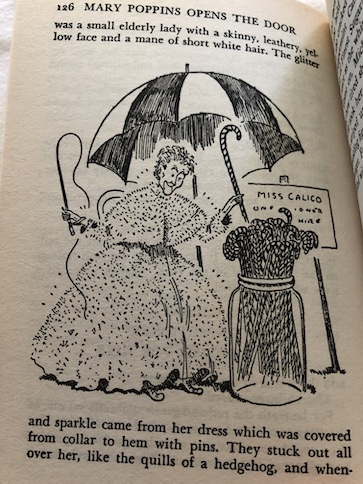
Peppermint Horses – Jane and Michael take their father’s walking sticks because they want to play horses with them, like they’re riding hobby horses. Mary Poppins gives the the walking sticks back to Mr. Banks and takes the children and Robertson Ay, who works for the Banks family, on errands. The children get tired of walking and start getting cross. Then, they see a woman named Miss Calico with what looks like a bunch of large candy canes and a sign that says she has horses for rent. The children are confused because they don’t see any horses. It turns out that Miss Calico’s candy canes are magical mounts that people can ride. Mary Poppins rents some of these peppermint horses for the children and Robertson Ay, and they ride them home through the sky, along with other people they know. Mary Poppins rides on her umbrella instead because she never uses walking sticks. The children want to keep their magical candy canes forever and continue to ride them, but they’re only rented. Miss Calico comes around at night and collects them.
High Tide – Mary Poppins takes the children to visit Admiral Boom and his wife because their parents want to borrow a bottle of port from them. They give them the port and a seashell for the children to enjoy. Michael is curious about what port tastes like, and Jane is fascinated by the seashell. She says that she would like to go see the sea.
That evening, while Mary Poppins is still having her half day out, the children hear a voice from the seashell telling them to dive in. They do and find themselves under the sea. The voice from the shell was a trout, and the trout introduces them to other sea creatures and takes them to a garden party that the creatures are having to celebrate high tide. Of course, Mary Poppins turns out to be the guest of honor.


Happy Ever After – It’s New Year’s Eve, and Michael wants to know what happens between the first chime at midnight and the last chime because he’s been told that the old year ends at the first chime and the new one starts at the last chime. Mary Poppins refuses to answer. She takes the children’s toys away from them, lines them up, and puts open books in front of them, also without explaining why, just telling the children to go to sleep.
The children wake up at the first chime of midnight and see their toys come to life. The toys lead the children to the park, where they see all sorts of storybook characters. (Friday from Robinson Crusoe is a rather uncomfortable character.) They explain that the period between the first chime and last chime of midnight on the New Year is called “the Crack”, and it’s the only time of year when characters can come out of their books, provided that they’re left open, and all be friends with each other, even if they’re enemies in their stories. It’s the only time when they truly have Happily Ever After. So, they all have a party to celebrate the Crack, and naturally, Mary Poppins is the guest of honor.
The next day, Michael asks Mary Poppins if they’ll ever have happily ever after themselves, and she says that depends on him.

The Other Door – Mary Poppins’s friends show up to say goodbye to her, although they try not to let the children know that Mary Poppins is about to leave. They all have a dance together, and Mary Poppins takes the baby home from the park before the other children. Jane and Michael realize that Mary Poppins is about to leave when her friends talk about “the door.” They rush upstairs to the nursery, but they don’t see her until Jane spots her in the reflection of the nursery in the window. The door in the reflection is the “other door” that she’d been talking about, and that’s the door that Mary Poppins goes through to leave. The children’s parents come into the room, and the children tell them that Mary Poppins is gone. Mrs. Banks is upset, but Mr. Banks dances because he likes the music from her goodbye party, which is still going on. The family thinks that they see a shooting star, but that’s Mary Poppins leaving. Still, they make a wish not to forget Mary Poppins.
 Jestress's Forgotten Books and Stories