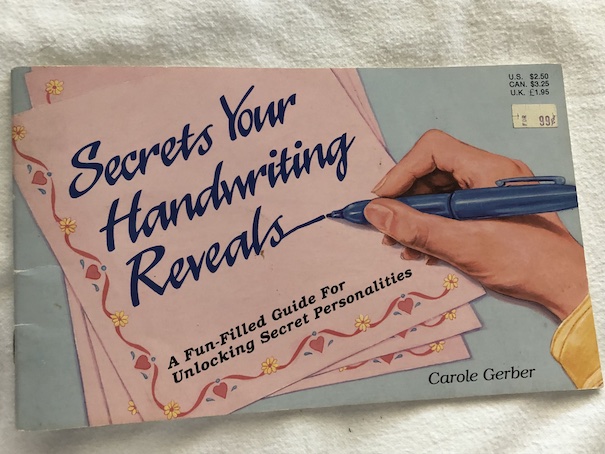
Secrets Your Handwriting Reveals by Carole Gerber, 1991.
I brought this little book at a book fair when I was a kid, and trying to analyze other people’s handwriting made me feel like a detective! As an adult, I know that graphology is considered a pseudoscience because the techniques used and the results are subjective. (Forensic handwriting analysis is different.) I don’t know how much faith I’d put in any of the tips in this book for reading someone’s personality, but as a summer activity for kids playing detective, it’s not bad.
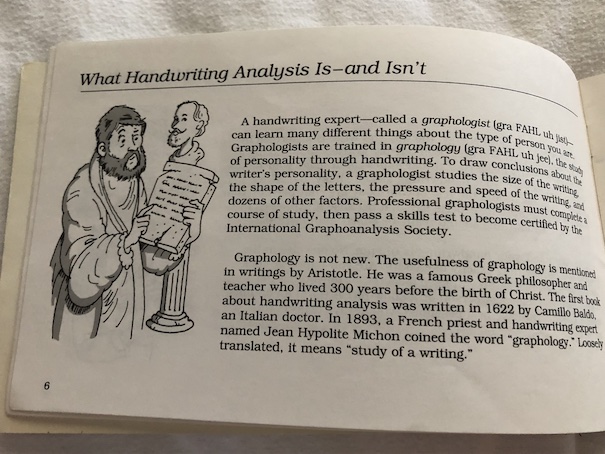
The book begins with an explanation of what graphology is and its history. Graphology has its origins in Ancient Greece, although the term “graphology” wasn’t coined until the late 1800s. The book discusses how graphology has been used in forensic situations, such as determining whether someone’s signature was forged, and how businesses sometimes using handwriting analysis as an indicator of which applicant would be the best for a job. I’m not sure how much stock I put in the second application, although the first one seems useful. The book also mentions that certain types of health problems can make a person’s handwriting shaky. I think that could be true since stable handwriting requires good muscle control, and muscle control can be weakened by disease. The book does say that a graphologist can’t diagnose disease from a person’s handwriting, but they can point out when a person seems to be weakened by a health problem.

From there, the book explains features of a person’s handwriting to watch in order to identify different personality traits, from the way the writing tilts to how consistent the connections between letters are, to the different ways that letters can be shaped.
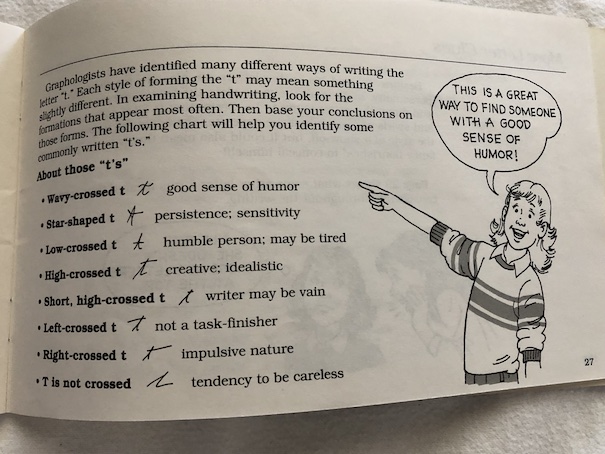
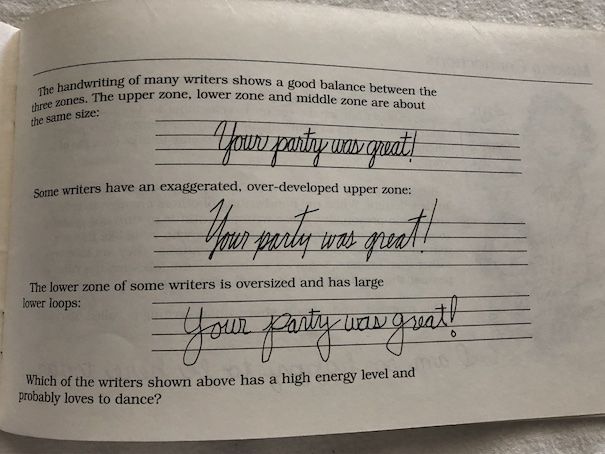
Some of what they say about different people’s handwriting makes sense, even from just a cursory glance. It would make sense to say that writing that is neat and even (not to mention showing proper spelling and grammar) is a sign of a well-organized individual, compared to writing that is sloppy and full of errors and scratch-outs.

I did notice (even as a child, I think), that some of the personality traits they point out in their sample handwriting analysis comparisons could be just as easily deduced from what the person says as what their handwriting looks like. I think that’s because the author knew what personality traits she wanted to point out and made sure that the samples were written in character.

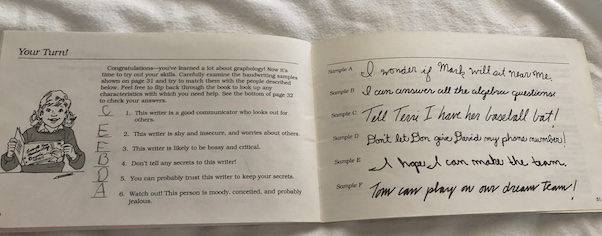
The book ends with a short quiz where readers are expected to match up handwriting samples with personality traits.
There is also a brief section at the very end that suggests that consciously changing your handwriting can help change your character. Personally, I doubt whether writing in a slightly different style by itself can help break bad habits, although I suppose if you want to be very conscious of a personal trait that you want to change, anything you do that helps keep it at the front of your mind can remind you to be more careful of your personal behavior and act differently than you might if you just weren’t thinking.

 Jestress's Forgotten Books and Stories