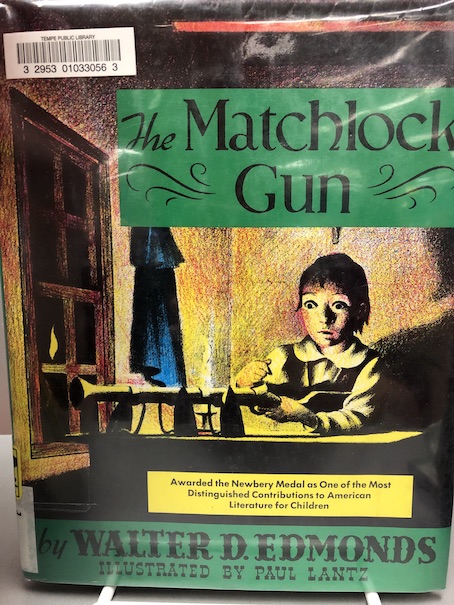
The Matchlock Gun by Walter D. Edmonds, illustrated by Paul Lantz, 1941, 1969.
Ten-year-old Edward Van Alstyne lives with his family on the mid-18th century American frontier in upstate New York, not far from Albany, during the French and Indian War. His father is captain of the Guilderland militia. Edward has had a long fascination for the large, old matchlock gun that his great-grandfather brought to America from Holland and wonders why his father never uses, preferring his smaller musket. His father shows him the old matchlock gun and explains to him how it works and how it’s old-fashioned, very large, and more difficult to use than his musket.
While Edward’s father, Teunis, prepares to go out on duty, Edward’s mother, Gertrude, worries about what will happen if Indians (Native Americans) attack while he is gone. Teunis doesn’t think that’s likely, but he says that Gertrude can take the children and go to his mother’s house. Gertrude and Edward’s grandmother do not get along because Edward’s grandmother has never approved of her. His grandmother never thought she was good enough for her son because she doesn’t come from a Dutch background, like they do, and because her family is poor. Gertrude would rather not turn to her for help except as a last resort, and Teunis doesn’t blame her.
Gertrude is still nervous after Teunis leaves, and she refuses to let Edward take some butter over to his grandmother’s house, as he often does. She doesn’t want the children going too far from the house, in case there’s trouble. Then, a family friend, John Mynderse, stops by with a message from Teunis, saying that he is fine, but the “French Indians” (the Native Americans aren’t actually French, but they’re allies of the French – I’ll explain below) have burned settlements, and he won’t be home tonight. It’s worrying news. Later, they see smoke on the horizon and worry about how far away it is, unsure of the exact distance.
Although Gertrude tries to be brave, she admits to Edward that she thinks that the fires are close. Edward asks if they should go to his grandmother’s house, but Gertrude would prefer to stay in their own house and wait for Teunis to arrive home. Privately, Gertrude has realized that the old brick house where the grandmother lives is more visible from the main road than their small wooden house. She doesn’t think that there’s anything they can do to help Edward’s grandmother, but she is hoping that she and the children will be overlooked if the Indians come through their area.
Gertrude begins coming up with a plan for defending their house, and she asks Edward if he would be afraid of firing the big, old matchlock gun. Edward wouldn’t mind firing the big gun, but it’s so big, he doesn’t know if he could manage to hold it. Gertrude says that she has a plan for that. Although they are inexperienced, Gertrude and Edward manage to get the gun loaded, and Gertrude chops a hole in the side of their house that they can fire through. Gertrude doesn’t expect Edward to actually aim the gun or hit anything. They just prop it up at the hole, and Gertrude tells Edward that, if she calls his name, he must use a candle to light the powder in the gun. When the powder is lit, Gertrude says that the big gun will go off with a huge bang and might scare off any attackers.
The Indians do come and attack the old brick house, and then, they come for the house where Gertrude and the children are. Gertrude is struck by a tomahawk as she runs for the house as the Indians approach, but she calls out to Edward, and Edward fires the gun. The attackers are killed in by the explosion from the gun, but the family’s house is set on fire. The children manage to drag their injured mother to safety, and Edward rescues the matchlock gun from the burning house.
When Edward’s father and the militia arrive, Gertrude is injured but still alive. The old brick house did not burn, as Gertrude had thought, but the barns were destroyed. The grandmother and her slaves barricaded themselves in the brick house. Edward is praised as a hero for defending his family at such a young age and for killing more Indians by himself than the adults did. (That last part is a little creepy, but they do praise him for that.)
This book is a Newbery Medal winner. It is available to borrow and read for free online through Internet Archive.
My Reaction
The Backstory
This is one of those books where I find the backstory much more interesting than the book itself. This is one of those historical novels for children written and published during World War II that looks back on American history and past conflicts, trying to reinforce historical lessons, instill patriotic feelings, and help children come to terms with the war that was happening around them at the time this book was new. This particular story takes place in the Hudson Valley in New York, not far from Albany, before the American Revolution in a community that’s largely settled by people of Dutch descent.
The family in the story is based on the real Van Alstyne family, and the incident with young Edward helping to protect his family from attackers by firing the family’s old matchlock gun really happened. The story emphasizes the family’s Dutch background. The mother of the family, Gertrude, is described as having a Palatine background, which means that her family was Germanic, but the major emphasis is on the Dutch influences in their background. There are Dutch words and phrases throughout the story.
The Foreword to the story explains the family’s history, but I actually recommend that readers save reading the Foreword last instead of reading it before reading the story. It explains not only the family’s past, but what happened to the family after the incident in the book. Little Trudy grew up and married a man named Hogle, and she became known as an excellent spinner, or spinster, in the professional sense rather that the unmarried sense. Her spinning ability was attributed to having to help her mother from a young age because her mother’s shoulder was permanently damaged from the tomahawk injury she suffered in the story. Trudy is credited as the one who passed on the story about her brother and the matchlock gun to future generations.
When interviewed about his historical novels, which were more for adults than children before he wrote this particular book for children, the author said:
“I want my readers to get out of my books a sense of the relation of history to the present day. History is often taught as a study of dead things and people; or else, and worse, from the debunking angle. What I want to show are the qualities of mind and spirit of plain, ordinary people, who after all carry the burden of human progress. I want to know about people, how they lived, what they hoped for, what they feared. I want to know what it was like to be born into this time or that, and what a man left behind when he died.”
I see the point about focusing on the lives of ordinary people because history is largely made up of daily life. Much of my historical education had this focus as well, not just focusing on the famous people or the major events, which are usually a reflection and extension of what’s happening on the ordinary and every day level. Much historical writing these days also does focus on debunking, which requires prior knowledge of what’s being debunked and why to be really effective, so I don’t think it works too well on level of children.
My personal approach to history, however, is to put things into context. I’ve given you the context of WWII, when this book was written and published, and the author’s view, but to get the full story behind this story, it helps to understand the French and Indian War. In the book, the attacking American Indians are just shown in their role as attackers, attacking innocent women and children and burning their homes. It’s a savage image that leaves a bad taste in the mouths of modern people, but it helps to understand what’s happening in the larger conflict.
In spite of its name, the French and Indian War was not fought between French people and American Indians. Instead, the French and Indian War, also called the Seven Years’ War (1754-1763), was fought between the British and the French, with the French aided by Native American allies. Both the French and the British were claiming territories for colonies in North America to support their empires, and as rivals for territory, each side was trying to assert its authority and control over certain regions. The Native Americans enter into the conflict because each side had Native American allies.
The reasons why Native Americans were willing to ally with these foreign powers and actively fight and risk their lives in the conflict were based on their perceptions of the treatment they were likely to receive from each side and the other tribes that were already allying with each side because of the war and their estimates of how the war was likely to affect their own territories and which side’s victory would be most likely benefit them. When European colonists entered North America, started their colonies, and began instigating these territorial conflicts, they were already entering a land inhabited by groups of people who had their own home territories and their own systems of alliances, relationships, and conflicts with each other. Essentially, the European colonists and this French and British conflict were destabilizing and unsettling Native American groups, and those Native American groups were trying to both work out new alliances with some of these newcomers that would grant them a greater degree of security and to push out groups of newcomers who seemed to represent the greatest threat to them and their territory. What each of these Native American groups wanted most out of this conflict was whatever they thought would best allow them to hold their own territory and put them in the strongest possible position to defend against rivals for that territory. Not all groups were eager to join this fight, but those who did believed that it was their best opportunity to protect themselves. In Walter D. Edmonds’s words, this is “what they hoped for, what they feared,” and this is what they were willing to kill and die for.
The reason why this war is important to American history is not only because it was a territorial struggle between major powers but also because it was one of the events that led to the American Revolution against Britain. The British colonist disputed having to pay Britain’s expenses for this war. The treaty and settlement that ended the war helped shape westward expansion that continued after the Revolutionary War. This war was also part of George Washington‘s early military experience, before he became the famous general of the American Revolution.
Part of what makes the Van Alstyne family’s experiences of this war both fascinating and tragic are that they belong to neither of the major sides of the war. They are not British or French. They are primarily of Dutch descent. That is emphasized repeatedly in the story. It’s how they think of themselves, and they are living among other colonists and settlers of similar backgrounds. Their misfortune is that they are living in one of the regions that is under dispute by larger powers. I think that’s part of the reason why the concept this story appealed to the author of the book. It’s about ordinary people caught up in larger events, and it shows the effect that larger conflicts have on ordinary people.
However, since the main hero of this story is a ten-year-old boy, I have to admit that it does make sense that the boy probably didn’t understand much about the larger conflict going on around him. The story only takes place over a little more than a day. His father leaves one evening, the children go to bed, the family is nervous the end day, they are attacked that night, and then, the father comes home. From the boy’s perspective, this attack on his family might have been the conflict in a nutshell. The territorial disputes between larger colonial powers was likely beyond him, which is why he doesn’t think about them during the course of the story. I still think that readers should understand it even if the characters don’t, though.
A Slave-Owning Family
One other thing that I think is important to mention is that there is slavery in the story, and Edward’s own family has slaves. In particular, Edward’s grandmother uses slaves. The slaves are not actually shown as characters in the story, but they are discussed. At one point in the story, Edward’s younger sister, Trudy, asks their mother why their grandmother has slaves and they don’t. Their mother explains that the old brick house where their grandmother lives and the land and slaves connected to it actually belong to the children’s father, as his father’s heir. So, technically, the slaves actually do belong to Edward’s father. However, their grandmother is very attached to the old brick house, so their father lets her live there and use the slaves to manage the house and estate.
A major reason why they explain all of this is so readers understand the setting of the story better and the relationship that this family has with the grandmother. Teunis built the wooden house where he lives with his wife and children so they could have some independence from his mother. He is willing to let his mother live by herself in the family’s big, old house with slaves to look after her and run the place, but it’s really better for his wife and children if they don’t live with her because of her attitudes. In particular, it’s her attitudes toward the mother of the family that make life difficult for them and leave them not wanting to get closer to her, not her attitudes about slaves. Teunis and Gertrude are willing to manage their smaller house without the help of slaves because it’s worth it to them to have to do without extra help in exchange for some separation from Teunis’s disapproving mother, which tells readers a few things about the grandmother we never see and the relationship the rest of the family has with her. Edward’s grandmother seems to be an overbearing and disapproving woman. While Teunis cares about her and her feelings, their relationship with her is better when they don’t live together in the bigger house, even though they could, making use of the household slaves themselves.
No one in the story disapproves of the idea of slavery, which also leaves a bad taste in the mouths of modern readers. Modern heroes and people who really believe in the ideals of freedom would have sympathy for enslaved people, not people actively practicing slavery itself. Since the family in the story is based on a real family, and keeping slaves was something that this real family actually did, it’s understandable from an historical viewpoint that the Van Alstynes are being described as they actually were. It’s important to acknowledge the way things actually were, even when they weren’t pleasant. But, there’s nothing that says that modern readers have like it. Just because the Van Alstynes are the main characters of this story doesn’t mean that you have to like everything about them or everything they do.
The focus of the story is a young boy who did a brave thing during an emergency situation and saved both his own life and the lives of his mother and little sister in the process. That’s ultimately what the author wanted the children of his time to take away from this story. His focus is on the boy and his family, and he doesn’t explain anything about larger social issues or even the background of the conflict they find themselves in. This is fairly short chapter book, a little less than 100 pages, and it seems aimed at younger elementary school students, not dealing with anything more complex than the main incident and adventure of the story. However, outside the story, readers can understand the wider context of things that happen in the story, and they can feel any way they want about that. If you understand the broader situation enough to have feelings about it, I think that’s a good thing.
For another review of this book, I recommend trying this one. It’s much shorter than mine, but it also has some thoughts about how people feel about historical aspects of this story.
 Jestress's Forgotten Books and Stories