What’s a Ghost Going to Do?

WhatGhostDo

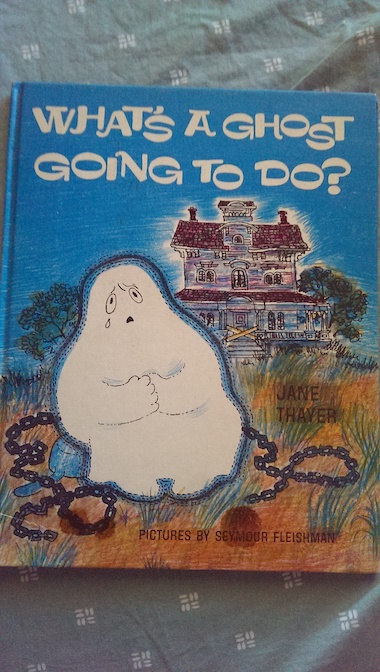
What’s a Ghost Going to Do? by Jane Thayer, 1966.

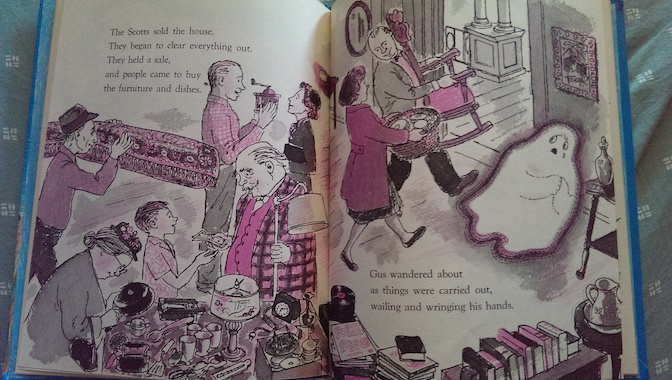
Gus is a friendly ghost who lives a quiet life alone in his old house, which is run-down and shabby, with winter visits from his mouse friend.  However, Gus discovers one day that the property is being sold.  The government wants the land to turn into a park, and if that happens, Gus’s house will be torn down!  If they decide to tear the house down, where will he go?

WhatGhostDoSale

For a time, Gus tries living with another ghost in another old house nearby, but that arrangement doesn’t work because the other ghost doesn’t like Gus rattling chains.  Then, Gus tries living in a hole with his mouse friend, but it’s really too small for him.  The only place that seems right for Gus is his old house, which is in danger of being destroyed!

WhatGhostDoHints

In desperation, Gus whispers in the ears of the man in charge of preparing the park for the government, Mr. McGovern, trying to get him to notice the virtues of his house.  Fortunately, Mr. McGovern accepts Gus’s vision of the house as a beautiful piece of the past and finds a way to restore it to its former glory so that Gus can keep his home and others can appreciate it, too.

WhatGhostDoRepairs

Gus’s house becomes a museum in the park, and Mr. McGovern also officially acknowledges Gus as the resident ghost.

The book is available to borrow and read for free online through Internet Archive. It’s part of a series.

WhatGhostDoMuseum

My Reaction

I’ve had this book since I was a little kid. I always felt sorry for poor Gus throughout the book, but the story has a nice ending, with Gus and Mr. McGovern finding a creative way to restore the house and put it to good use, filling it with antique furniture for both Gus and the public to enjoy. I haven’t read any of the others in the series yet because this is the only one I’ve ever had.

Old Black Witch

OldBlackWitch

Old Black Witch by Wende and Harry Devlin, 1963.

OldWitchChimneyA boy called Nicky and his mother are looking for a new place to live somewhere in New England.  The mother wants to buy an old cottage with the idea of turning it into a tea room.  At first, they have trouble finding a place, but finally they buy an old house that badly needs fixing up, not knowing that there is an old witch living there.

The witch (whom they call Old Black Witch, since she’s dressed all in black and sooty and doesn’t seem to have any other name) has been sleeping in the chimney of the house for about a hundred years, and they wake her the first time they try to start a fire in the fireplace.

The witch is furious to discover that the house has new owners and worried about where she’s going to live because she needs an old house to haunt.  Nicky and his mother invite her to stay and live in the attic, which has enough dust and cobwebs to satisfy her tastes, while they clean up the lower part of the house for the tearoom.

The locals have heard stories about the house being haunted, but the nice tearoom soon becomes popular with ladies in the area, especially after Old Black Witch decides to help out Nicky’s mother in the kitchen.  Old Black Witch’s blueberry pancakes are wonderful and win many fans for the tearoom.

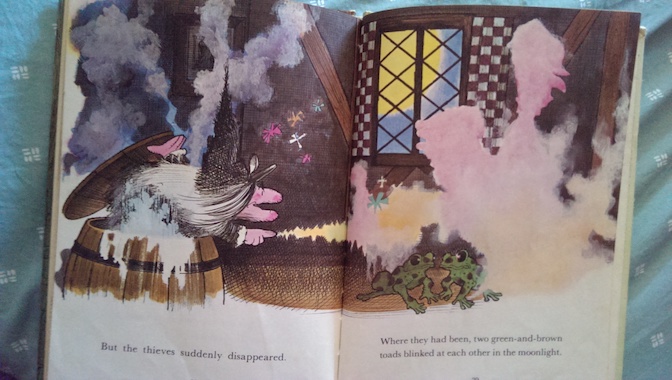
Then, one night, a couple of burglars break in.  Since Old Black Witch is kind of evil herself, she can’t really fault them for wanting to rob the place . . . until she suddenly realizes that they’re stealing from her, too, and uses her magic to fix the burglars for good and give herself the pet toads that she’s been wanting.

This book is available to borrow and read for free online through Internet Archive.

OldWitchToads

My Reaction

One of the things that I like about this story, which was a favorite of mine when I was a kid, is that Old Black Witch isn’t particularly evil although she isn’t too nice, either.  She’s as bad and disagreeable as a cranky old witch who’s lived in a chimney for over 100 years ought to be, but not so bad that she can’t make some new friends and help them out once in a while.  Friendly enough for the kids, but not too sweet to be a real witch.  It’s part of a short series, although I haven’t managed to find any of the other books yet.  Some of the pictures are in full color and some are in black and white.  Don’t ask me why she has a spoon in her hat because I’ve never been completely sure, either.  Somehow, on her, it looks good.

The back cover of the book has the recipe for the blueberry pancakes.

OldWitchPancakeRecipe

There was a short film version of this story from 1969 called Winter of the Witch.  It follows the book fairly well, but with some variations (there were no burglars).  In the film, the pancakes have the power to make people happy, and that’s what gives Nicky’s mother the inspiration to open a pancake parlor in their house.  The witch finds a new sense of purpose, although she still plans on going back to her old, wicked ways once the world is happy enough to need a good, old-fashioned scare.  I don’t think that it was ever released on dvd, but it is possible to see it on YouTube and Internet Archive.

Which Witch is Which

WhichWitch

Which Witch is Which by Pat Hutchins, 1989.

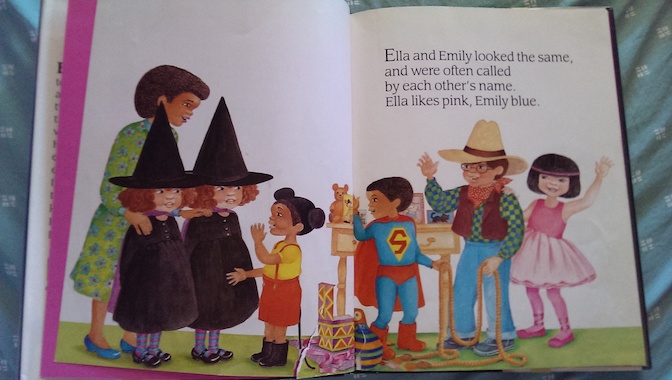
This is a cute picture book/puzzle book.  A pair of twins, Ella and Emily, are invited to a friend’s costume party, but they come dressed as witches in identical (or nearly identical) costumes.  Throughout the party, as the girls play party games, eat the party snacks, and give presents to their host, readers are invited to figure out which twin is which.

WhichWitchIntro

The main clue to the girls’ identities is that Ella’s favorite color is pink while Emily prefers the color blue.  Things that the girls have in those colors or objects that they select give away their identities

WhichWitchPresents

However, there are also other hints, like we are told what each of the girls ate at the party so that we can use the crumbs left on their plates (or the lack of crumbs) to determine which witch is which.

WhichWitchCake

The text of the book rhymes.  The illustrations are cute, and it’s a good book for teaching children how to notice details.

The book is available to borrow and read for free online through Internet Archive.

WhichWitchPlates

Felicity Saves the Day

American Girls

FelicitySummer

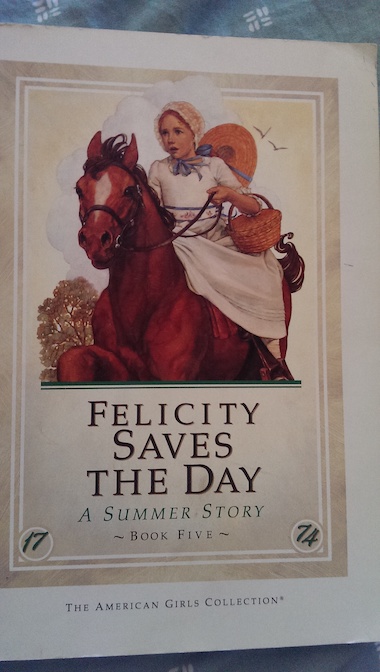
Felicity Saves the Day by Valerie Tripp, 1992.

This is part of the Felicity, An American Girl series.

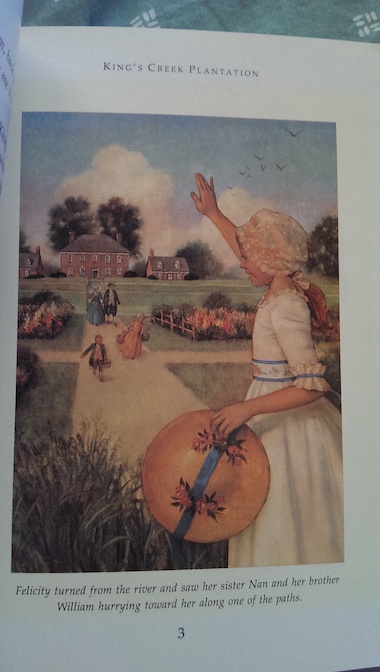
FelicitySummerPlantationFelicity’s grandfather is a wealthy man who owns the Kings Cross Plantation.  Every summer, Felicity and her family go to visit him there, and Felicity loves it.  Her grandfather teaches her a lot of things, like which plants can be used for food and medicine, and takes her for horse rides around his estate.

This year, while Felicity’s father and his apprentice Ben are minding the store at home,  Felicity has a special surprise.  As her grandfather inspects a group of horses that a friend wants to sell him, Felicity is stunned to recognize Penny, the horse she freed from an abusive owner in the first book of the series.  Penny is a little thin and dirty but otherwise well, to Felicity’s relief!  Her grandfather purchases Penny for Felicity and promises to keep her safely at his plantation so that Felicity can visit her and ride her regularly.

Felicity is happier than she’s been in a long time and writes an enthusiastic letter home to tell her father and Ben, but soon, she learns that Ben is not at home with her father.  Felicity and her siblings have set up a bird bottle, a special bottle that acts like a bird house for birds to nest in, and she checks it daily to see if there are any birds to show to her little brother.  One day, she finds a message in the bottle from Ben, pleading for help, along with a map to a place in the woods and Ben’s whistle.  When Felicity goes to the spot in the woods and blows the whistle, Ben comes out of hiding.

FelicitySummerBountyHuntersBen tells Felicity that he ran away from his apprenticeship to join the revolutionary army.  He wants badly to fight for the colonies’ freedom from England, but he had a bad fall while traveling and hurt his leg.  Felicity tries to convince Ben to let her get help for him and to return to her father to finish his apprenticeship, but Ben doesn’t want Felicity’s grandfather to find out that he’s there or why he ran away because he knows that he disapproves of the revolutionaries.  Because Ben kept her secret when she used to sneak out to see Penny, Felicity reluctantly agrees to keep Ben’s presence a secret for awhile, sneaking him some food and supplies.  She tells Ben that, while she thinks that standing up for what he believes is good, he’s going about it in the wrong way because breaking his apprenticeship was dishonest.

Then, Felicity learns that her father has placed an advertisement in the newspaper with a reward for anyone who can find Ben, and some rough-looking bounty hunters show up at the plantation to inquire about it.  Felicity knows that she must try to convince Ben to return on his own before he gets hurt worse than he already has!

A large part of the Felicity books is about taking responsibility and whether or not it’s right to break rules in the name of a good cause.  Felicity herself broke the rules to befriend Penny and later free her from a master who would probably have killed her.  This story raises the question of whether Ben’s form of rule-breaking is similar to what Felicity did or not.  Their situations and the reasons for their rule-breaking are different.  In her situation, Felicity had tried to behave as lawfully as she could until it became apparent that the only way to save Penny’s life was through rule-breaking.  In Ben’s situation, although he wants to help what he sees as a good cause, his rule-breaking isn’t strictly necessary, and he never tried to discuss his feelings with Felicity’s father and to work out an arrangement before running away because he thought that he already knew what Mr. Merriman would say.  Felicity points these things out to Ben, along with the fact that Ben is not in any real position to help the cause that he supports because he is injured, wanted, and in hiding.  He started on this venture ill-prepared and inconsiderate of the other people who depend on him back home and his own future, and while his belief in the revolutionary cause is genuine, he is also afraid of admitting his mistakes and needs to be urged to make things right.

In the back of the book, there is a section that talks about what people in Colonial America would do during summertime.  The weather in Virginia is hot and humid during the summer, and not everyone would get a chance to travel to the countryside, like Felicity’s family did.  The book talks about various ways colonists would use to cope with heat (keeping the kitchen with its fire separate from the house, eating in an open breezeway in the house, wearing lighter clothes, boys would go swimming although girls didn’t, etc.).  It also talks about life on Virginia plantations, including slavery.

Felicity Learns a Lesson

American Girls

FelicityLesson

Felicity Learns a Lesson by Valerie Tripp, 1991.

FelicityLessonGirlsThis is the second book in the Felicity, An American Girl series.

So far, Felicity has mainly been taught at home, learning to read and write and take care of basic household tasks, like cooking and sewing, from her mother.  However, Felicity’s parents have decided that it’s time for her to begin furthering her education.  Felicity fantasizes about studying Greek, Latin, and geography, like boys do in college, but girls of her time do not receive that kind of education.  Some girls take on apprenticeships, learning professions such as seamstress, which Felicity thinks might be exciting, but her father is a wealthy merchant, which means that Felicity will be educated as a gentlewoman, not as a girl preparing herself for a trade.  A gentlewoman’s education involves lessons in penmanship, fine stitchery, dancing, manners, and hostess skills.  Felicity doesn’t find that prospect as exciting.

Felicity starts taking lessons from Miss Manderly, a respected gentlewoman, in manners and the practical arts that girls from well-off families of her era were expected to know. Two other girls, a pair of sisters who have recently arrived from England, are also taking lessons from Miss Manderly, and at first, Felicity worries that they will know more than she does.  However, they are also young and have lessons of their own to learn.  The younger of the sisters, Elizabeth, becomes Felicity’s best friend.  However, Annabelle, the older girl, is disapproving.  She misses her old life in England and doesn’t think that anything in the colonies is good.

FelicityLessonAnnabelleThen, Felicity’s father declares that because of the tax on tea, he will no longer carry it in his shop. It leaves Felicity feeling conflicted about Miss Manderly’s lessons, which include the proper way to serve tea. She has started enjoying the lessons and doesn’t want to lose Elizabeth’s friendship, but she wants to support her father, too. Then, Annabelle criticizes Felicity for what her father said at one of the lessons, prompting Felicity to storm out angrily. She is doubly angry and hurt that Elizabeth didn’t try to defend her, making her doubt Elizabeth’s friendship.

At first, Felicity thinks that there is no way she can return to the lessons, but her mother convinces her that if there’s something that she really cares about (the lessons, Elizabeth’s friendship, supporting her father, etc.) she will find a way to work through the conflict rather than give up on it.  She also points out that some people aren’t as brave as others and find it more difficult to speak their minds and that Felicity should give Elizabeth another chance at friendship.  In the end, Felicity works out a compromise for her lessons using what Miss Manderly has already taught her, and Elizabeth finally finds the courage to tell Annabelle how she really feels about her behavior and the way she treats both herself and Felicity.

Each of the girls in the American Girls stories has her own personality, including strengths and weaknesses. Felicity is a spirited girl, but at first, she has a tendency to be too impatient and impulsive. Part of what she learns is the need take responsibility for her choices and to think things through before she acts.  Elizabeth, who is shy and easily intimidated by her older sister, learns that nothing will improve until she makes her true feelings known and that she has as much right as anyone else to be treated with respect.  Annabelle is a rather self-centered individual and is genuinely surprised when Elizabeth finally stands up to her.  In some ways, Annabelle is unfortunate because she does not find a friend at Miss Manderly’s like her sister does, but readers will recognize that Annabelle’s lack of friends is partly her own fault because she is deliberately antagonistic and does not try to earn Felicity’s friendship.

In the back of the book, there is a section that explains more about how children were educated in the American colonies around the time of the Revolutionary War.  Other good books on this topic are Going to School in 1776 and Colonial Crafts.

This book is currently available online through Internet Archive.
Meet Felicity

American Girls

MeetFelicity

Meet Felicity by Valerie Tripp, 1991.

MeetFelicityPennyThis is the first book in the Felicity, An American Girl series.

Felicity, or Lissie as her family sometimes call her, is the daughter of a prominent store owner in Williamsburg, Virginia in 1774.  Sometimes, her father allows her to help in the shop, which is something that she enjoys.  However, that has happened less since her father took on a new apprentice named Ben Davidson.  Ben is fairly quiet and shy, and Felicity is only just getting to know him.  She sometimes envies boys for the more exciting opportunities they have while she has to help with more routine chores, like sewing, at home.

One thing that Felicity loves more than anything else is horses.  One day, she goes with Ben while he makes a delivery to Jiggy Nye, the tanner.  Jiggy Nye has a new horse that he says he won at gambling.  However, Jiggy Nye is cruel to any animal he gets, and Felicity fears for the beautiful horse he now has.  When Felicity tries to see the horse, which she calls Penny because of the color of its coat, Jiggy Nye drives her away.

That the horse is a fine animal and that Jiggy Nye is treating it badly are obvious, but at first, there doesn’t seem to be anything that Felicity can do about it.  Then, Jiggy Nye shouts at the horse one day that it’s worthless because he can’t handle it and that he’d give it to anyone who can ride it.  Taking Jiggy Nye at his word, Felicity sets out to tame Penny.

MeetFelicityRidingEvery morning for about a month, Felicity sneaks out of the house early, dressed in a pair of breeches that she borrowed from Ben without his permission.  She goes to visit Penny and gradually gains her trust.  When Penny finally allows her to ride her, Felicity thinks that she has won ownership of her, but Jiggy Nye accuses her of theft and takes back the horse.  He denies that he ever promised to give her to anyone who could ride her, although Felicity’s younger siblings agree that they heard him say so.

Felicity fears more than ever that Jiggy Nye will kill Penny, but now that she no longer has a chance of getting her from Jiggy Nye for herself, can she find another way to give Penny her freedom?

There is a section in the back of the book that describes life in Colonial America, particularly in Williamsburg, Virginia.  It also mentions the Colonial Williamsburg living history museum.  Another book about life in Colonial Williamsburg, with photographs from the living history museum, is Mary Geddy’s Day.

This book is currently available online through Internet Archive.
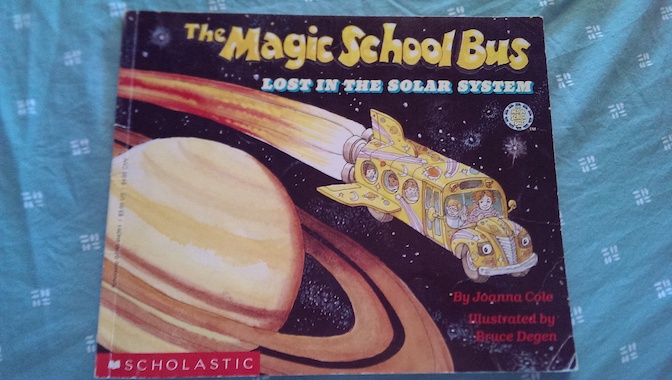
The Magic School Bus Lost in the Solar System

MSBSolarSystem

The Magic School Bus Lost in the Solar System by Joanna Cole, 1990.

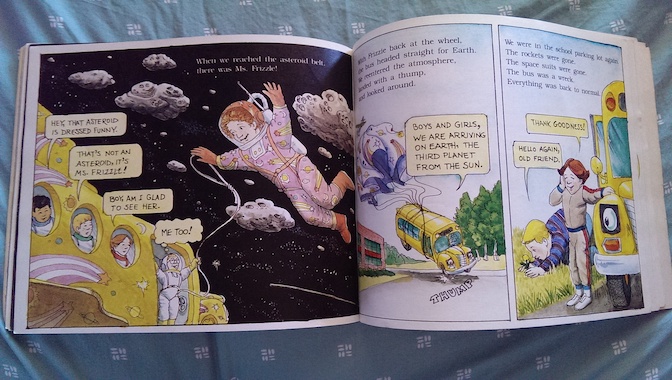
Ms. Frizzle’s class is planning a trip to the planetarium as part of their lesson about the solar system, but of course, their magic school bus has other plans.  When they get to the planetarium and find out that it’s closed for repairs, the bus sprouts rockets and takes them on a real trip through the solar system.

MSBSolarSystemBlastOff

This time, the class is accompanied by Arnold’s visiting cousin, Janet.  Janet is a show-off who brags constantly about everything, making up stories when she has nothing real to brag about.  She gets on the other kids’ nerves, but when they’re separated from Ms. Frizzle because she got out of the bus to fix a taillight broken in the asteroid field, Janet takes charge, using Ms. Frizzle’s lesson plan to continue the field trip, eventually figuring out how to turn the bus around to rescue her and get back to Earth.

MSBSolarSystemMoon

All through the book, there are facts about the sun, the moon, and the planets in the solar system from the students’ reports.  Each time they stop at a planet, a scale shows the difference between Arnold’s weight on Earth and his weight on each planet.  The book considers Pluto to be a planet because it was written before its planet status was reconsidered.

The book is currently available online through Internet Archive.

MSBSolarSystemRescue

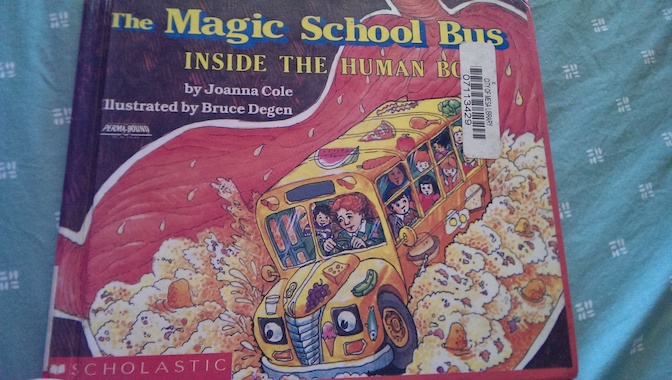
The Magic School Bus Inside the Human Body

MSBHumanBody

The Magic School Bus Inside the Human Body by Joanna Cole, 1989.

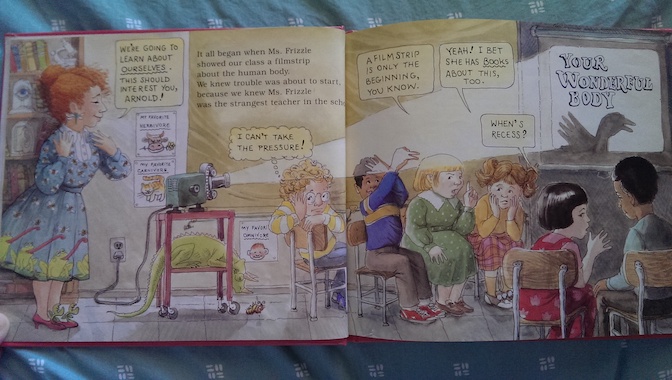
Ms. Frizzle’s class is now studying the human body, and they are going to take a trip to the science museum to see an exhibit about how bodies digest food for energy.  Of course, this is not going to be a normal field trip, but it is weirder than anything the students could have expected.

MSBHumanBodyFilm

After the class stops at a park for lunch, Arnold is accidentally left behind, and before they can go back for him, the bus shrinks small and is accidentally swallowed by Arnold.

MSBHumanBodySwallow

While his classmates take a trip through Arnold’s body, Arnold panics at being left behind and makes his way back to school by himself, accompanied by a sympathetic bird, not knowing where the rest of the class went.

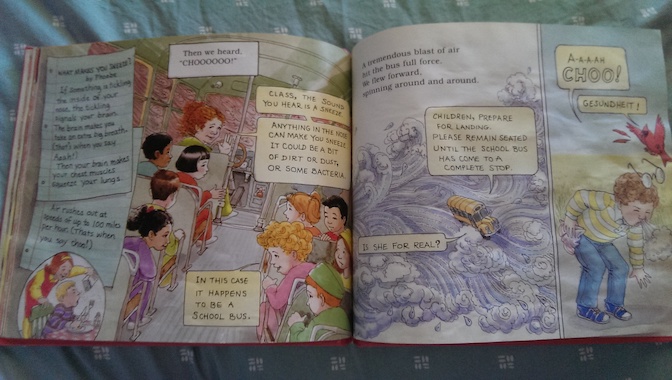
MSBHumanBodySneeze

The book ends with a section of true and false questions that point out the impossibilities of the class’s field trip inside a student’s body, but also points out that the information about the human body itself is true.

The book is currently available online through Internet Archive.

The Magic School Bus Inside the Earth

The Magic School Bus

MSBEarth

The Magic School Bus Inside the Earth by Joanna Cole, 1987.

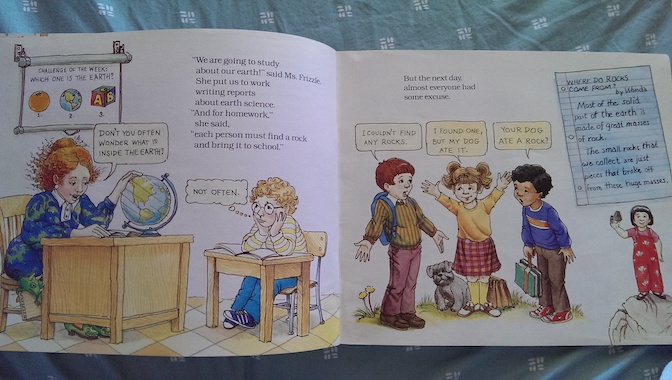
Ms. Frizzle’s class has a new student, Phoebe, who is about to discover that Ms. Frizzle is no ordinary teacher and that her class trips are nothing like any other field trip.  Ms. Frizzle’s class is studying the earth and rocks, and she assigns the students homework to find a rock and bring it to class.

MSBEarthHomework

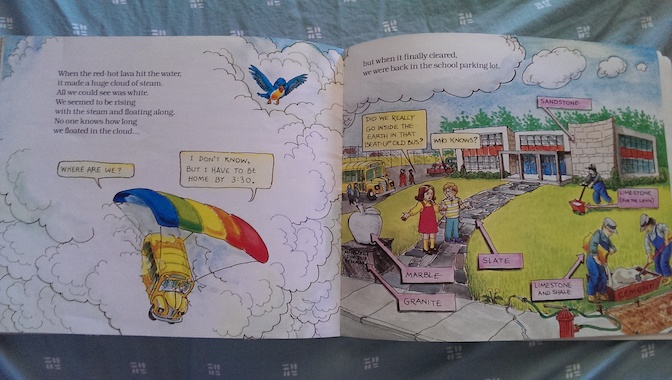
However, even though it sounds like an easy assignment, only one person actually brought a real rock to class.  The others either didn’t bring anything or brought in pieces of old Styrofoam, bits of broken glass, or chips of concrete from the sidewalk.  With only one real rock for the class’s rock collection, Ms. Frizzle decides that the class should to on a trip to collect more.

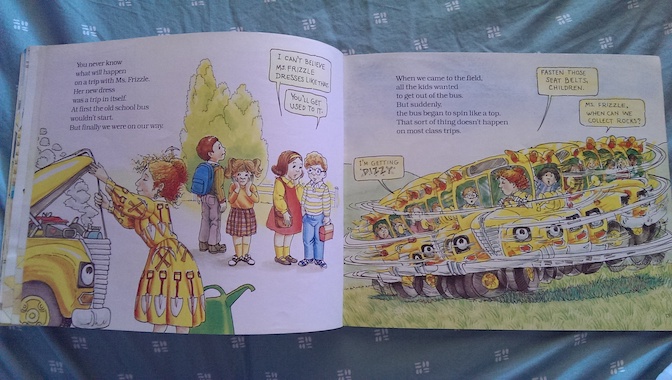
MSBEarthFieldTrip

She takes the class on a field trip to a real field, but they’re not just going to collect rocks that they find lying on the ground.  The bus changes itself into a steam shovel, and Ms. Frizzle passes out shovels and jackhammers to the students.  They start digging down into the earth, uncovering new layers of rock as Ms. Frizzle explains what types of rocks are in the layers and how they formed.

MSBEarthDigging

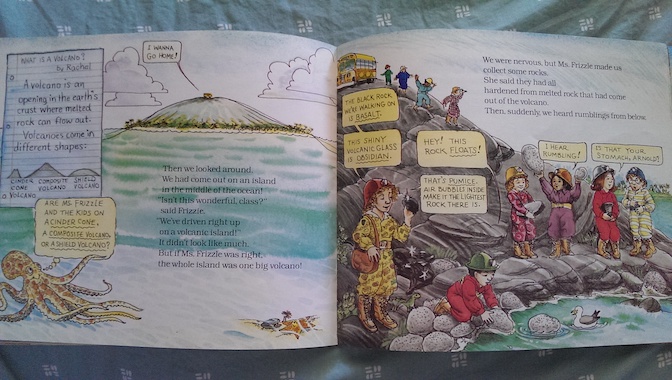
Before the field trip is over, the school bus, along with all the students, falls through the ground and into a massive cave.  They continue traveling all the way down through the center of the earth and out the other side, ending up on a volcano, where Ms. Frizzle calmly explains about volcanic rocks.

MSBEarthVolcano.jpg

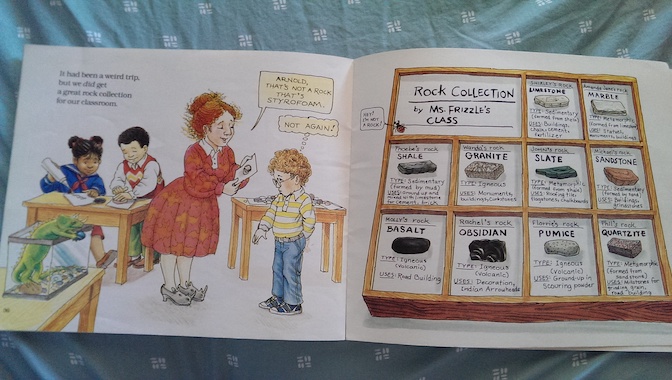
I like the picture at the end of the book, after the kids return to school, which points out that there are things all around them that are made out of the different kinds of rocks and minerals that they learned about on their trip.  Each type of rock is also shown in the class’s rock collection along with notes about the type of each rock and how it can be used.

MSBEarthReturn

The book ends with a mock phone conversation between a reader and the author and artist about the impossible things that happen in the book but noting the factual information contained in the story.  The book was featured on Reading Rainbow.  It is currently available online through Internet Archive.

MSBEarthRockCollection

Cranberry Autumn

CranberryAutumnCranberry Autumn by Wende and Harry Devlin, 1993.
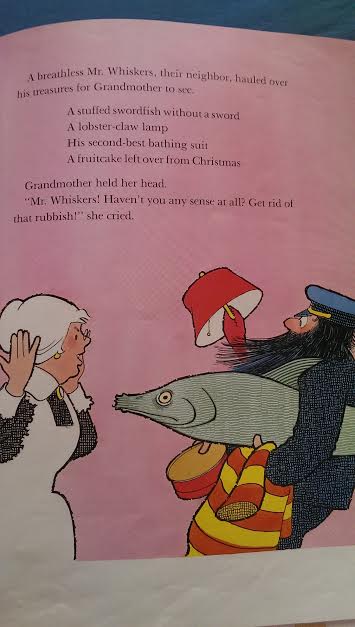
CranberryAutumnPic1School is about to start, and Maggie and her grandmother realize that they’re short of money.  Maggie needs new school clothes, and her grandmother needs a new coat.  They know that some of their neighbors could also use some more money, so Grandmother suggests that they hold a sale.  Some of them have some antiques and other interesting old items that they could sell.

Mr. Whiskers tries to help, but he doesn’t have anything really interesting to sell.  At least, nothing Grandmother thinks that anyone would buy.  He’s disappointed because he really wants to help.

Mr. Grape, a greedy and dishonest neighbor of Mr. Whiskers, attends the sale and decides that he wants a pair of beautiful antique Staffordshire china dogs that Grandmother is hoping to sell for $200.  When he devises a scheme to cheat Grandmother and get the dogs for much less money, Mr. Whiskers gets his chance to help and to turn the tables on Mr. Grape.

As with other Cranberry books, this one includes a recipe that uses cranberries: Cranberry Squares.

CranberryAutumnPic2

CranberryAutumnRecipe