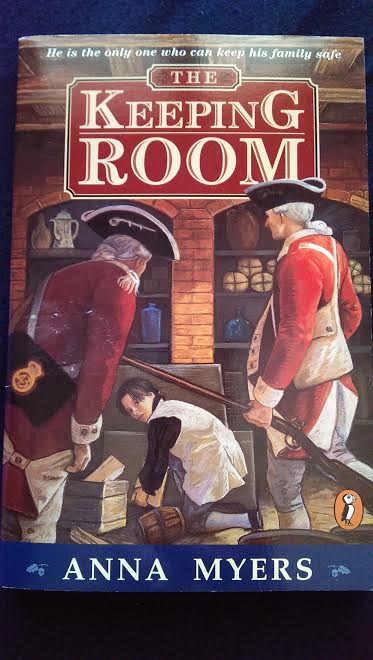
The Keeping Room

KeepingRoomThe Keeping Room by Anna Myers, 1997.

Joey was named after his father, Colonel Joseph Kershaw, a wealthy businessman in Camden, South Carolina during the Revolutionary War.  Joey is like his father in many ways.  He idolizes him and does everything as his father wishes.  When his father marches off to fight on the side of the revolutionaries, he tells twelve-year-old Joey that he must be the man of the house while he is away and look after his mother and the younger children.  Joey takes pride in his new position as man of the house, but he is soon to undergo hardships that will turn him into an older and wiser person.

Joey’s father and his troops lose their battle and are captured by the British.  Soon, the whole town is taken by the British troops, and they commandeer the Kershaw house, the biggest house in town, as their headquarters, keeping Joey and his family as prisoners.  Joey can only watch in helpless anger as the British set up gallows in his family’s garden and hang rebels, his father’s surviving troops.

Joey’s mother was a Quaker before her marriage, and so is Joey’s tutor, Euvan.  They do not believe in the violence of war or harboring hate.  Although Joey seethes with anger at his father’s imprisonment, his family’s captivity in their own home, and the death and destruction he sees around him, they make efforts to remind him that British soldiers are human too, some good, some bad, and not all monsters.  However, how can Joey see the British as anything but monsters when he has seen their cruelty, when he and his family have suffered at their hands, and when he has watched them put many good men to death?

Before the British captured the house, Joey managed to hide away his father’s pistol.  It isn’t enough to fight an army, but Joey knows that he will use it to fight if he gets the chance.

Throughout the story, Joey undergoes a transformation, not just from a boy to a man, but from his father’s little copy into his own person.  From the beginning, Joey identifies himself mainly as his “father’s son.”  He loves his father and truly idolizes him.  He wants to be just like him, and his father is grooming him to take over his businesses one day, to do everything the way he does.  Joey loves how respectful everyone is toward his father, a wealthy and successful man, and how respectfully they treat him when he is with his father.  He hangs on his father’s words and adopts all of his beliefs.  But when his father is gone, things are different.  People who were respectful of him because of his father now regard him as just a boy, a little spoiled and not really knowing or understanding much.

Joey struggles to grow into his new role as man of the house, to really be a man as his father would have wanted.  But along the way, he comes to realize that there are many things that his father didn’t really understand himself and that he was wrong about many things.

Joey’s father didn’t believe in educating women beyond basic reading and writing.  His sister Mary has defied their father’s wishes before by borrowing Joey’s books, and although he didn’t want to tattle on his sister, Joey could never bring himself to support her studies openly because he didn’t want to go against what his father wanted.  However, during their captivity, Joey comes to appreciate his sister Mary’s courage and intelligence.  She gives him great support through their harrowing circumstances. He is proud of her and realizes that she is worthy of the studies she craves.

Similarly, Joey comes to question his father’s beliefs about slavery. Although his father railed against British tyranny, claiming that he would never be a slave to them, he kept slaves of his own.  When Joey had previously questioned him about that, his father told him not to worry about it because it was part of “the order of things.”  But, Joey’s own experiences in captivity make him think differently.  He also comes to appreciate the two slaves who stood by the family to help them through their captivity, learning more about their lives and history.  Because of his experiences, he decides that he will never be a slave owner himself.

Most of all, Joey finally sees the truth of what his mother, Euvan, and even Biddy and Cato (the two slaves who remained with them) tried to tell him about hate and killing when one of the British soldiers gets killed while saving Joey’s life.

As Joey reacts to the frightening circumstances around him, doing what he can to protect his mother and younger siblings, he realizes that he must rely on himself and his own judgement, not his absent father’s, to handle the situation.  In the end, he decides that, although his still loves his father and eagerly waits his return home, he does not really want to be like his father anymore.  He has truly become his own man and is ready to stand up for the man he has become, even though his father may no longer want him to run his businesses.

This book is currently available online through Internet Archive.

Mary Geddy’s Day

MaryGeddyMary Geddy’s Day: A Colonial Girl in Williamsburg by Kate Waters, 1999.

This book is part of a series of historical picture books about Colonial America.

Mary Geddy was a real girl living in Williamsburg in 1776. In this book, she is reenacted by Emily Smith, a young interpreter at the Colonial Williamsburg living history museum. The story follows her through a single day in her life as it would have been typically experienced by girls around the beginning of the American Revolution (lessons, chores, shopping, and visiting with her friend) up until the moment when the vote for independence at the Fifth Virginia Convention was announced.

Mary Geddy’s father was a silversmith, which put them in the middle class for the times.  They had a comfortable house with a shop next door where Mr. Geddy sold his silver work.  The Geddy family also had slaves to take care of household chores.

At the beginning of the story, Mary knows that the Fifth Virginia Convention is voting on the subject of independence from Great Britain.  Mary is concerned about the prospect of war, and she knows that if the vote is for independence, she will probably lose her best friend, Anne.  Anne’s family are loyalists, and her family plans to return to England if the colonies decide to break away.

All through the day, people are speculating and worrying about what is going to happen as they go through the typical routines of their day.  Mary explains the clothing that colonial girls would wear as she gets dressed in the morning.  Then, her mother sends her out to buy eggs at the market.  Although she can see Anne there and hear some of the talk about what’s happening, Mary is kept at home for most of the rest of the day, practicing her sewing, learning to bake a pie with her mother, helping in the garden, and having her music lessons. She is learning to play the spinet.  She envies her brothers, who are allowed to help their father in his shop and therefore able to hear more of the talk than she is.

I particularly liked how they showed the coins that Mary uses when she goes shopping.  Even though Mary’s family lives in an English colony, she’s using pieces of eight, which is Spanish money.  The book doesn’t explain what currency she’s using or why, but that’s why the coins are those little triangular shapes, like little pieces of pie. Let me explain.

First, the American colonies had a currency problem.  They actually had a shortage of English currency because England didn’t want wealth to leave the English economy and go out to the colonies.  One of the measures they took to prevent wealth from leaving England was to make it illegal to export higher-value pieces of currency to the colonies.  People in the colonies needed something to replace the pieces of currency that they didn’t have or had in too short supply, so they resorted to other methods of exchange such as barter, IOUs recorded in ledgers, and currency from other countries.  They had some standard units of exchange for converting different currencies into British money because that was the way people in British colonies thought about money.  One of the most popular coins in use was the old Spanish dollar or piece of eight, which was worth eight reales (unit of Spanish currency).  However, sometimes, people wanted to use a smaller piece of currency for small purchases and transactions (like buying eggs), so they physically cut one coin into eight pie-shaped pieces (hence, “pieces of eight”), each worth only one real.  They had to do the coin cutting very carefully because the value of this type of money was based on the amount of silver in the coins themselves, and if they cut a coin unevenly, it would impact the value of the sections.  Each section of a piece of eight was called a “bit“, and two bits would be worth one-quarter of the value of the original coin, which is why some people in the US refer to a US quarter as “two bits.”  That’s what Mary is holding in her hand in the picture.  For more information, see the YouTube video from Townsends about The History of Money in America.

When they discover that the Convention voted for independence, there is celebrating in the streets, and Mary goes with her parents and brothers to see everything.  Her little sister is afraid of the noise and stays at home with the slaves.  Everyone is excited, but Mary is worried because she knows that her friend will leave and nothing will be the same again.

Throughout the book, you can see that the slaves are always a part of the family’s activities.  They do chores together, and when the family is not doing housework, the slaves are still working in the background.  Having slaves didn’t mean that the family never had to do any chores themselves, but they had to do less of them, giving them more time for other things, like music lessons and visiting with friends.  When the celebrating starts, the boy slave, Christopher, who is about the age of the Geddy children, wants to go and see what is happening himself, but he has to stay and help look after the younger girl in the family.  Although the slaves live as part of the household and seem to be on friendly terms with the Geddys (Mary speaks of them fondly, wishing that Christopher could join in the celebration and is happy that Grace, the slave who mainly works in the kitchen as the cook, seems proud of her for learning to make a pie), they have no say in making decisions and are expected to follow the orders they are given, even when they don’t want to or larger events are taking place.

In the back, there is more historical information about the period and the Geddy family.  There are also instructions for making a lavender sachet like the kind Mary and her friend Anne make and a recipe for apple pie that was used in Colonial Williamsburg, like the one that Mary learns to make in the story.

The book is currently available online through Internet Archive.

Animalia

Animalia

Animalia by Graeme Base, 1986.

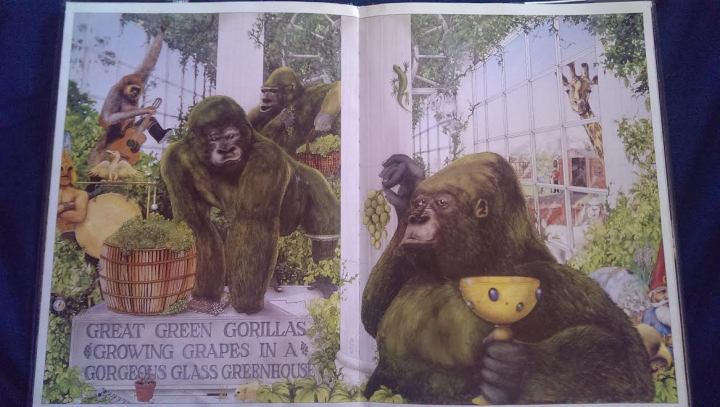
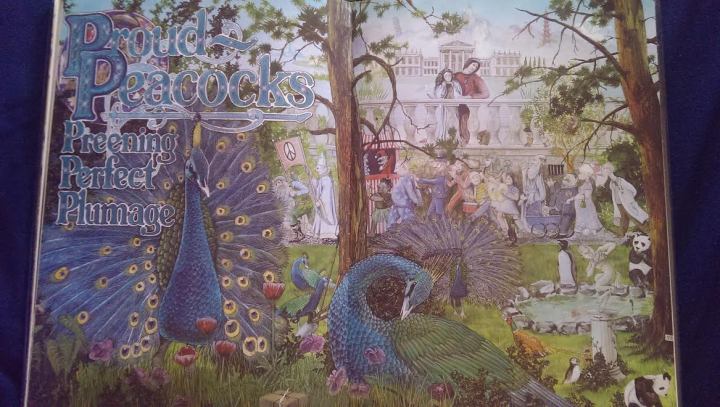
The best part about this book is the pictures.  They are absolutely beautiful and contain many small details for readers to spot.

On the surface, the book is about the alphabet, each page featuring a single sentence with every or almost every word starting with the same letter, and all of the pages are in alphabetical order.  (If you’re wondering what the author used for ‘X’, it’s a fox.  ‘X’ is an exception because all of the letters in that sentence end with ‘X’ instead of starting with it.)  The sentences and pictures are about animals, some real and some mythical.

AnimaliaGorillas

However, there is also a game that you can play with the book which is explained in a poem on the title page:

“Within the pages of this book
You may discover, if you look
Beyond the spell of written words,
A hidden land of beasts and birds.
For many things are ‘of a kind’,
And those with keenest eyes will find
A thousand things, or maybe more–
It’s up to you to keep the score.
A final word before we go;
There’s one more thing you ought to know:
In Animalia, you see,
It’s possible you might find me.”

Readers are invited to notice all of the other things in the pictures which start with the designated letter, and the author himself appears throughout the book, hiding in the pictures. There is a picture of him on the title page so you know who to look for.

The book is currently available online through Internet Archive.

AnimaliaLions

AnimaliaPeacocks

Black and White

BlackWhite

This book is unusual because there are four stories inside, being told at once, but there is one continuous storyline that joins all four of them together.  Two of the stories don’t have many words, but if you pay close attention to the pictures, the connection to the other stories becomes obvious.  The title of the book is also kind of a hint, although those colors apply to more than one aspect of the overall story.

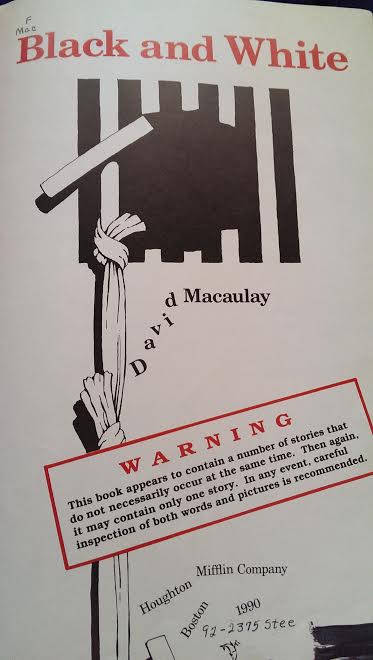
The picture at the right is from the title page, and the title page has the message that explains the concepts behind the stories. One of the fun things about this book is reading it multiple times. You can read the stories and look at the pictures of all four stories as you go through the book the first time, but if you look at each story in isolation, you can experience the continuity of each thread of the bigger stories and notice additional details.

BlackWhiteStories.jpeg

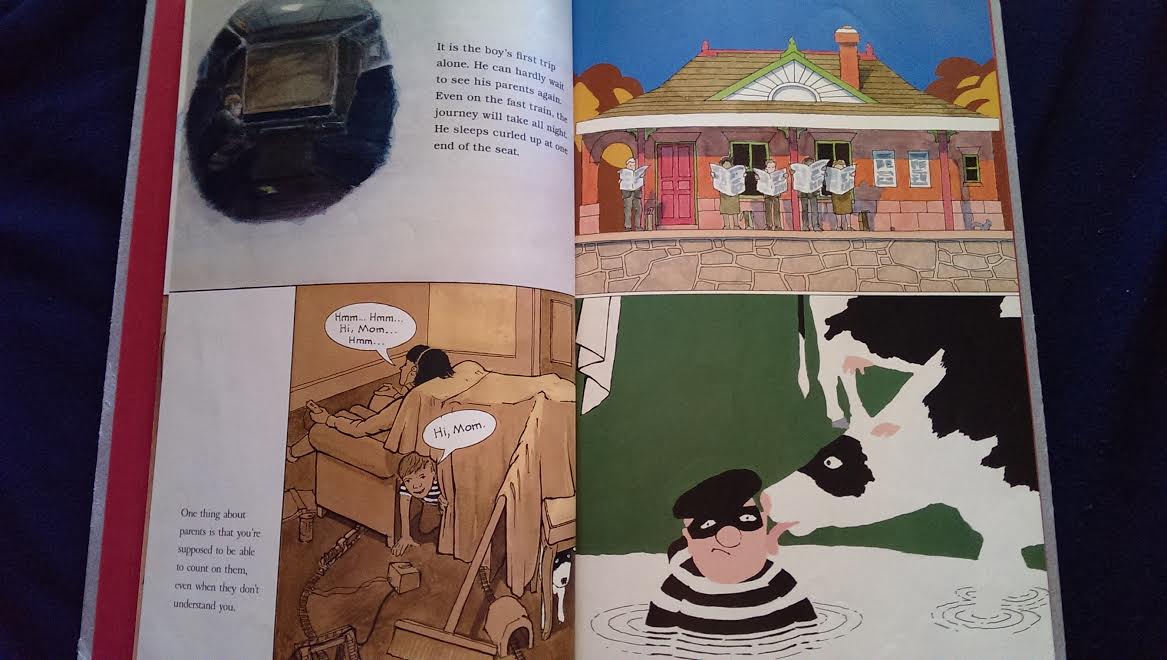
Seeing Things — A young boy takes a train trip by himself, going home to his parents.  He sleeps through most of his long journey, but during the night, he wakes up to some strange happenings.

A Waiting Game — A group of commuters waiting for their train, which has been unexpectedly delayed, find amusing ways to entertain themselves.

Problem Parents — A girl and her brother are convinced that their parents are crazy when they arrive home from their offices in the city wearing weird outfits made of newspapers and singing.

Udder Chaos — An escaped convict hides among a herd of cows.

You might be able to get some of the connections between these stories from what I’ve said and the pictures I’ve shown, but it gets funnier if you keep going through the stories, seeing where each of them lines up with the others.

The book is currently available online through Internet Archive.

BlackWhitePic1
BlackWhitePic2
BlackWhitePic3

Harvey’s Hideout

HarveysHideout

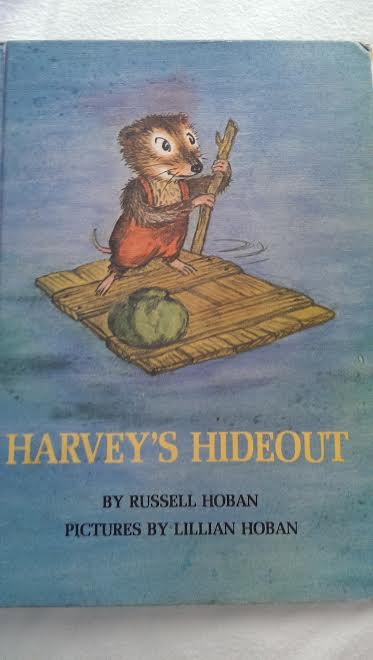
Harvey’s Hideout by Russell Hoban, illustrated by Lillian Hoban, 1969.

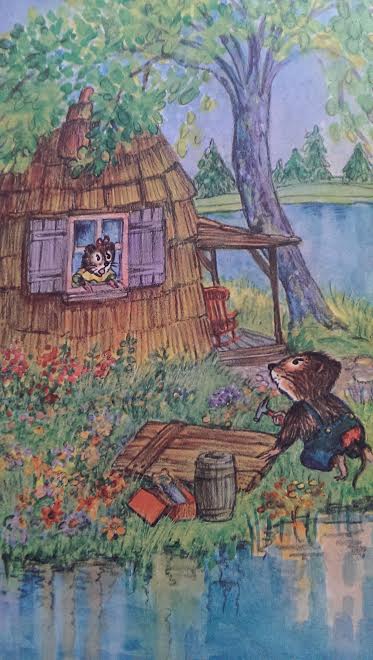
HarveysHideoutHouseSummer is difficult for the Muskrat kids this year.  Their friends are away for the summer, and Harvey and his older sister Mildred are getting on each other’s nerves.  But, there’s nothing that says they have to spend the whole summer with each other.

Harvey builds himself a raft and tells Mildred that he’s going off to meet with members of his secret club for a cookout where annoying big sisters aren’t welcome.  Mildred says that’s fine with her because she’s been invited to a party where there will be no annoying little brothers.  Harvey says that’s fine with him . . . except that it really isn’t.

The secret hideout where Harvey has been spending his time is empty except for him and the comic books he brought with him, and his cookout is for only one person.  He just made up the story about the secret club to make Mildred jealous and to have an excuse to spend time away from the house and her.  Harvey appreciates the freedom, but he’s also bored and lonely and envies Mildred, wondering who she knows who is still in town, inviting her to parties every day.

Then, when Harvey tries to make some improvements to his secret hideout, he discovers that he’s not the only one to dig a secret hideout for himself in the area.  Harvey’s unexpected discovery leads to a change in his relationship with his sister.

HarveyHideoutSecret


The book is available to borrow and read for free online through Internet Archive, and new copies are also available to buy through Plough.  If you try it and like it, consider buying a copy to own!

HarveysHideoutFriends

My Reaction

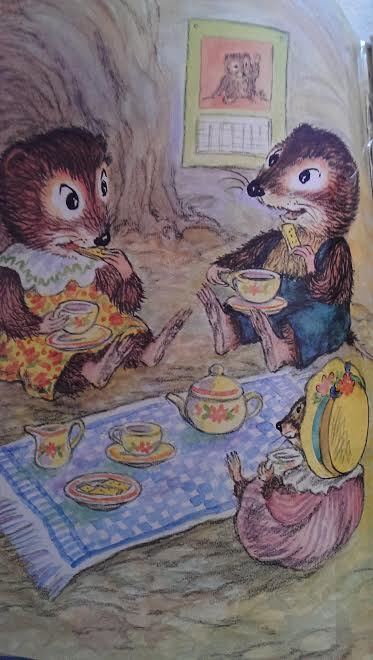
This is a nice story about sibling rivalry and cooperation.  One of the parts I like best is early on in the story when Harvey and Mildred’s father lectures them for fighting and insulting each other. I hated that part when I was a kid, but I kind of like it now because I realize what the father is actually trying to say.  He points out that there is some truth in their insults, but they’re wrong about each other at the same time.  Part of the reason they fight is because they each have their faults (Harvey can be selfish and Mildred can be bossy), but they each unfairly assume that the other is a lost cause and that they can never be friends.  It’s only when they come to realize that they’re equally lonely (Mildred has been having tea parties with just her doll) and Harvey makes the first move in offering to share what he has with Mildred that they realize that they can each be the friends they both need this summer.

When I was a kid, I wished I had a hideout like theirs!  I also love the colorful illustrations in the story.

ColSec Rebellion

ColSecRebellionColSec Rebellion by Douglas Hill, 1985.

This is the final book in the ColSec Trilogy, a sci-fi series.

In a future where Earth is controlled by an oppressive government, dissidents are exiled to distant planets to start colonies whose resources can be exploited by the government.  However, the colonists have been plotting to take their destinies into their own hands.

Cord MaKiy and his friends, once exiled colonists on the planet Klydor, have joined up with the resistance movement.  They hijack a ColSec ship and return to Earth to gather allies for the rebellion against Earth’s government, called The Organization.

Once on Earth, they turn to the societies that they came from, little groups of outcasts on the fringes of Earth’s society. Cord’s people, the Highlanders who live in the wild areas of Scotland without modern technology, welcome them, and many of the young people are interested in joining the colonies, seeing other worlds, and living in freedom. Similarly, the rebels find more friends among the Vampires, the youth gang that lives in the Bunkers (what’s left of the old subway system under London).

However, the Streeters (a youth gang in the Chicago area) are a different story. Although many of them want to escape their little hideouts in the urban jungle called Limbo, their leader, Tuller, is unwilling to give up his relatively comfortable position of power. When he betrays the rebels to the government, the others have to decide where they stand and if they’re willing to take the risks necessary to gain their freedom.

In a way, the colonists seem to gain their ultimate freedom more easily than expected, but that’s partly a product of the type of repressive government that controls Earth. It isn’t really a military dictatorship, although they do use deadly force against their enemies; it’s more of a greedy corporate structure, designed to bring vast amounts of wealth to the people at the top of the structure, while keeping the lower levels in line to do their bidding.  In the end, as Lathan had guessed in the previous book, The Organization is more concerned with profit and loss than anything else, and the rebels manage to cut them a deal after showing them that fighting would only bring heavy losses with no material gain.

There’s plenty of action in the story as the young rebels struggle to prove themselves to potential allies on Earth and flee the forces of ColSec to return to Klydor, where they issue their ultimatum.  The negotiations with Earth are summed up fairly quickly, and although there are no more books in the series, the ending sets it up for Cord and his friends to continue their life of exploration on other worlds, seeking out new places for people who want to flee the dull repression that still exists on Earth.

The Caves of Klydor

CavesKlydorThe Caves of Klydor by Douglas Hill, 1984.
This is the second book in a sci-fi series, the ColSec Trilogy.

The five remaining colonists on the planet Klydor have been exploring their new planet and trying to survive and to decide what they will do when the government department that exiled them to this planet, ColSec, sends its ship to check on their progress.  Under Earth’s repressive government, dissents are sent into exile to become colonists on alien planets so that the government can later reap the benefits of anything they find or produce.

They get worried when a ship arrives on their planet earlier than expected.  While searching for the ship to see who it is, the colonists encounter Bren Lathan, the best space explorer that works for ColSec.  It’s his job to seek out new planets for ColSec to colonize.  But, it turns out that he’s not there on an assignment for ColSec.  He’s crash-landed on the planet, apparently frightened of pursuers, who may be the people in the space ship now on the planet.

Unfortunately, it turns out that Lathan is being hunted by CeeDees (Civil Defenders, the harsh law enforcement department that Earth’s government uses to keep the civilian population in line).  Worst still, these ones are Crushers, a group known for using extreme force and not leaving survivors.  They spot Cord and Samella, and they think that the two of them killed one of their people (who was actually killed by an alien creature).  Cord and Samella manage to get awhile, stealing one of the CeeDee’s weapons.

Then, they discover that the reason that the CeeDees are after Lathan is that he is involved with a rebellion against the government of Earth, a rebellion that these colonists would very much like to join.

The themes of the story are still survival and teamwork.  The colonists often have differing opinions about how to solve their problems, but they have to work them out because they only have each other to rely on.  Lathan, who is much older than they are, doesn’t really respect them much at first or want to involve them in his plans, comes to realize that their skills and ideas are valuable and that they may be just the people he needs.

The book is available to borrow and read for free online through Internet Archive.

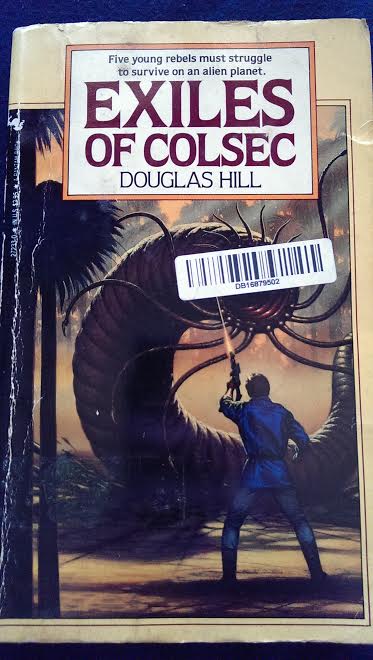
Exiles of Colsec

ExilesColSecExiles of ColSec by Douglas Hill, 1984.

This is the first book in a sci-fi series, the ColSec Trilogy.

In the future, Earth is controlled by a repressive government that sends criminals and dissidents (especially strong youths) into exile on other planets. These exiles are assigned to different planets to form colonies by ColSec (short for Colonization Section). The government then reaps the benefits of whatever resources the colonists find or produce, all while keeping them at a safe distance to prevent them from starting rebellions.

The system works very well as far as the government is concerned, but this time, things don’t go according to plan.  The ship of dissident colonists destined for the planet Klydor crashes, killing most of the people on board.  There are only six survivors, all teenagers:

Cord — A boy from the Scottish Highlands, an area more wild and uncontrolled than most areas of Earth.

Samella — From the area once known as Minnesota (or possibly Manitoba, even the people who live there aren’t sure of the old name).  She lived as part of a commune until a harsh winter brought them to the brink of starvation, and her own family sold her into slavery.  On Klydor, she begins to discover that she has ESP.

Heleth — From the Bunkers, the old Underground tunnels under Old London.  She belonged to a gang called the Vampires, who purposely dye their skin jet black to blend into the darkness of their hidden homes.

Jeko and Rontal — a pair of Free Streeters, gang members from Limbo, in the area of what was once Chicago.

Lamprey — The most dangerous of all, a homicidal maniac who quickly forces the others to do his bidding for fear that he will kill them.

These few survivors are alone on a strange world, where they will have to figure out how to continue to survive and somehow create a life for themselves . . . if Lamprey doesn’t kill them all first.  The other rebels from Earth decide that they will have to stage a rebellion within their own group to get rid of Lamprey, and Cord finds himself appointed to be their leader.

But, it turns out that they aren’t quite as alone on Klydor as they thought, and possibly the most formidable creatures on the planet might be . . . the trees.

This is largely a story of survival as the colonists work together to protect themselves from Lamprey and uncover the secrets of their new world that will allow them to survive.  Samella’s ESP is what allows them to realize the truth about the forest where they have crashed.

The book is available to borrow and read for free online through Internet Archive.

The Case of the Cool-Itch Kid

Polka Dot Private Eye

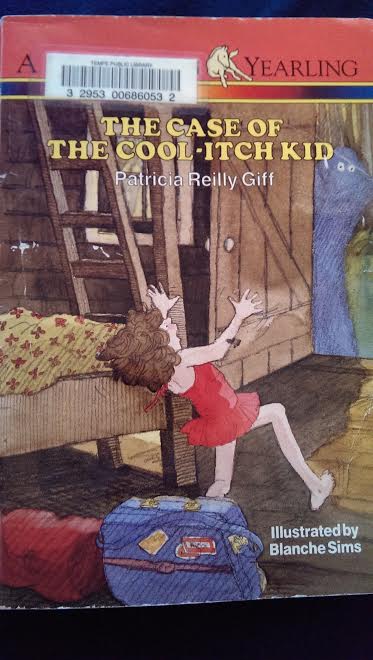
CoolItchKid#5 The Case of the Cool-Itch Kid by Patricia Reilly Giff, 1989.

Dawn heads off to summer camp!  At first, she’s not sure that she really wants to go, even though the idea of riding horses, swimming, and roasting marshmallows sounds appealing.  It turns out that there’s only one other girl from her school going, Jill Simon.  All of the other girls on the bus to camp are people she doesn’t know from another school called Coolidge (which Dawn pronounces “Cool-Itch”).

Before she leaves home, Dawn receives a package of small presents from her grandmother.  Among her grandmother’s gifts are some candy and cookies, a pin, and a small mirror surrounded by seashells that Dawn loves.  Later, after their bus stops at a rest stop, she realizes that some of these things are missing.  She particularly notices that the pin and the beautiful mirror are gone.

Who is the thief?  Could it be one of those kids from Coolidge (“Cool-Itch”)?

Dawn misses her family, especially her grandmother.  She hates the food at camp.  She’s upset about losing her grandmother’s presents.  Worst of all, she realizes that she left her Polka Dot Private Eye box at home!  How is she going to solve this mystery?

Part of the story is about the mistakes people make by jumping to conclusions.  Right from the beginning, Dawn assumes that her only friend at camp is Jill because the other kids are unfamiliar, and she thinks they’re unfriendly.  Also, she assumes that the presents disappeared because they were stolen, but actually, it’s due to a series of accidents and misunderstandings.

The book is currently available online through Internet Archive.

The Powder Puff Puzzle

The Polka Dot Private Eye

PowderPuff#4 The Powder Puff Puzzle by Patricia Reilly Giff, 1987.

Dawn is on her way to go swimming with her friend Emily Arrow when her cat, Powder Puff, is startled and jumps into a stranger’s car.  Before Dawn can do anything about it, the car drives away with her cat!

Fortunately, Dawn managed to notice a few things about the car and driver. The car is red and dented.  The driver is tall and skinny and has long, gray hair.  She was eating a jelly cookie and carrying a box and a long pole.  Her license plate had a name on it and that started with “PA,” but Dawn didn’t get to read the rest.

Emily’s father is a police officer, but he can’t trace the license plate with just the letters that Dawn was able to give him.  Instead, he has the kids make Lost Cat posters to put up in the neighborhood.  Still, that’s not enough for Dawn.  As The Polka Dot Private Eye, she should be able to figure out where her own lost cat is!

PowderPuffPicWith the help of her friends, especially Jason, Dawn uses what she knows to put together a picture of the person they’re looking for, and they try to retrace her steps through town.  Can they track down Powder Puff and get him back?

Part of the puzzle that Dawn and Jason overlook at first is the woman’s profession, which is one that the kids hadn’t really expected to find a woman doing, although Dawn spots the clues which point to what the woman was doing in the area and allow them to realize where she had to be going.  Whether more modern kids reading this book would feel the same way about the woman’s profession, I’m not sure.

The book is currently available online through Internet Archive.