Starlight in Tourrone

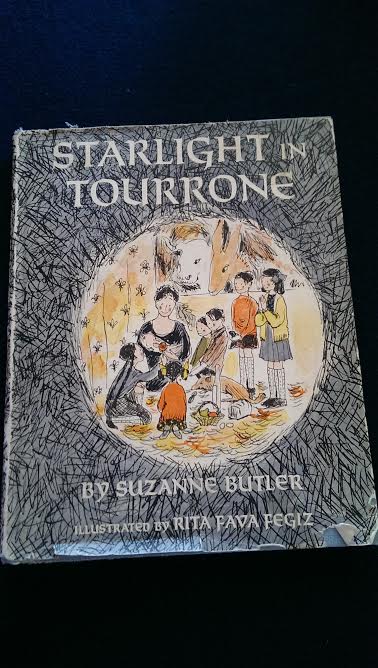
starlighttourroneStarlight in Tourrone by Suzanne Butler, 1965.

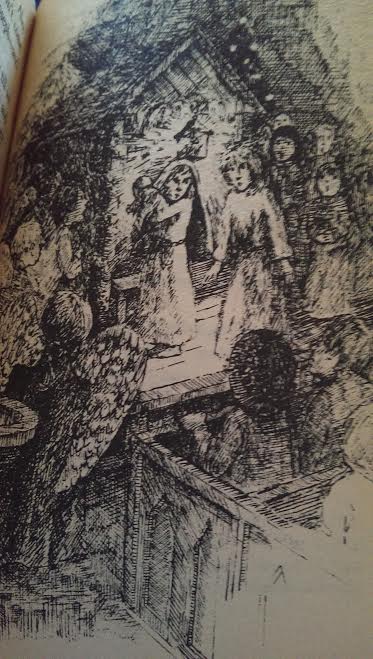
This is a story about a group of children in southern France during the middle of the 20th century, not too long after World War II, who want to stage a special Nativity scene at Christmas. One of the older men in the small village of Tourrone tells his grandchildren about how, when he was young, the village had held a live Nativity scene at the chapel on the hill with the youngest baby in the village playing the part of the Christ child and his mother playing Mary. Then, all the people in the town would climb the hill to the chapel and present gifts to Mary and the baby Jesus in a ceremony called the March to the Star.

However, these traditions have been lost because, following World War II, the village has lost much of its population, and the chapel is an unused ruin. The children and their friends, inspired by the grandfather’s stories, decide that they want to hold the March to the Star and the Nativity scene this year.
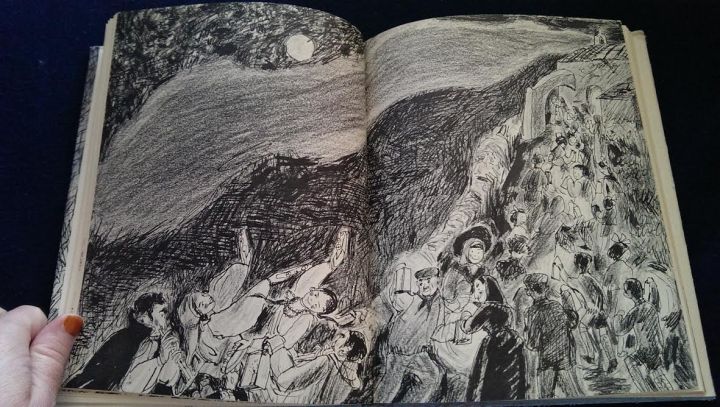
starlighttourronemarchAt first, most of the adults in the village are skeptical. Since there are no young couples living there anymore and no babies have been born there for several years, no one knows where the mother and child for the Nativity scene will come from. Many of the adults are too busy with their own problems and worries about the future to help. Still, the children continue to work faithfully on their plans, drawing in the adults in spite of themselves.

starlighttourronepreparationsstarlighttourronelanternJust as people in the village start to feel hopeful again, something happens that threatens to ruin everything, but there is still one more miracle yet to come, thanks in part to the one person who never doubted it would happen.

It’s a beautiful story about the power of faith and how miracles come to those who are prepared for them. The last page of the book contains the music for the Provencal Carol that the children sing along with the English translation.

The book is available to borrow and read for free online through Internet Archive.

starlighttourronenativity

starlighttourronecarol

The Best Christmas Pageant Ever

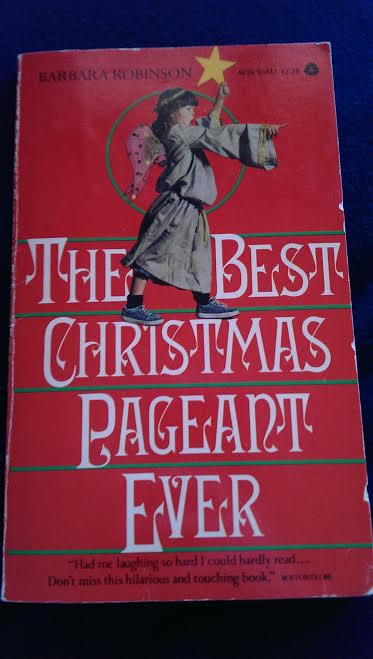
christmaspageantThe Best Christmas Pageant Ever by Barbara Robinson, 1972.

The Herdmans are the meanest, toughest kids in town.  They lie, cheat, steal, and when the mood strikes them, set things on fire.  Their father deserted the family, and their mother works all the time, so the six Herdman kids are pretty much left to their own devices, giving them plenty of opportunity to cause trouble.  Certainly, no one ever made the Herdman kids go to Sunday school.

But, to everyone’s surprise, the Herdmans suddenly show up at Sunday school in time to get cast for the annual Christmas pageant.  It wasn’t because the Herdmans suddenly found religion.  They were mostly there because they heard that there would be snacks.  Charlie told them so when they stole the dessert from his lunch at school.  In reality, Charlie exaggerated the snacks just to get back at the Herdmans.

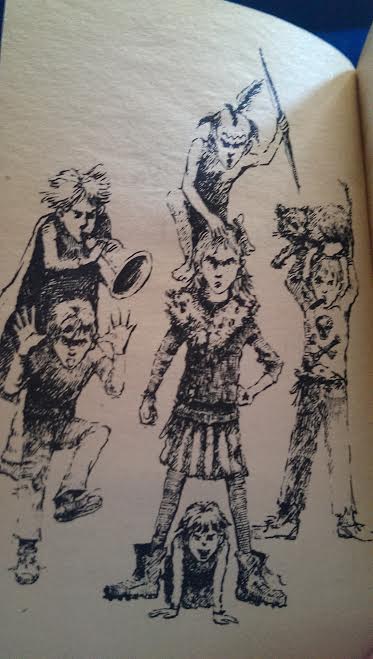
christmaspageantpic1Although the Herdmans don’t get the cake Charlie mentioned and have little interest in Jesus, they begin to be fascinated by the description of the pageant and decide to stick around.  The Herdmans love movies, and the idea of being in any kind of play strikes them as fun.  Although the Christmas pageant basically goes the same way every year, typically using the same kids for the same parts, once the Herdmans make up their minds that they want the starring roles, they manage to push and bully their way right into the center of everything.

All of the other kids in Sunday school already know the story of Christmas and how the pageant usually goes, and they’re usually bored with the whole thing, but this year, the Herdmans make the pageant so unpredictable that even the kids the Herdmans tend to pick on find it fascinating.  The Herdmans are only hearing the story of Christmas for the first time as they assume their new roles of Mary, Joseph, the three wise men, and the angel.  Because they aren’t as familiar with the story and the routine of the pageant, they end up adding their own little twists to their performance.

christmaspageantpic2At first, the more conservative adults in the church are horrified at the prospect of what the wild Herdmans might do on Christmas itself, but the minister and the lady overseeing the pageant decide to give the Herdmans a chance.  As the title says, it ends up being The Best Christmas Pageant Ever as the Herdmans unexpectedly bring out parts of the Christmas story that the other people who had taken the story for granted hadn’t really thought about much: the simple human reactions of a poor young couple who were strangers in a new town, the fear and expectation that accompany doing something great but unfamiliar and confusing, and the sense of wonder and surprise that are at the heart of the Christmas season.

Parts of the book are laugh-out-loud funny, and parts are actually touching.  While the awful Herdman kids stumble their way through the Christmas pageant, changing things, is it possible that the play is also changing them?

This is the first book in a short series about the Herdmans.  It is available to borrow and read for free online through Internet Archive (multiple copies).  There is also a movie version of the book.  Sometimes, you can find it on YouTube.

Christmas Around the World

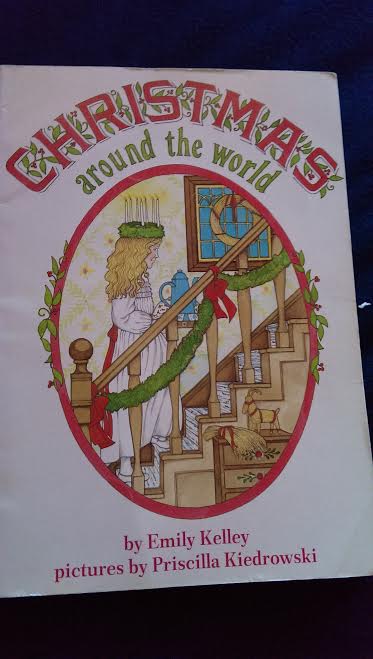
christmasworldChristmas Around the World by Emily Kelley, 1986.

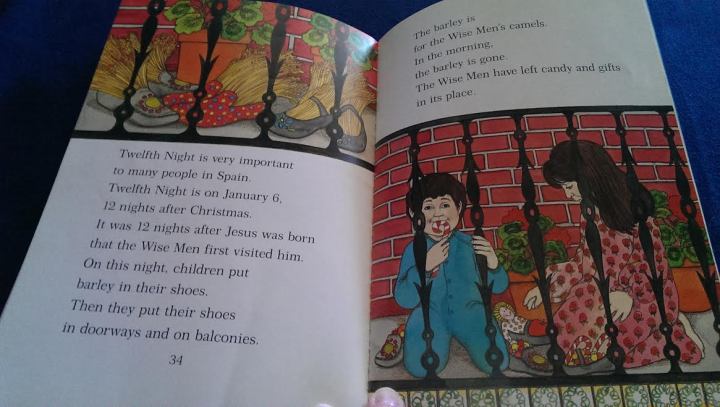
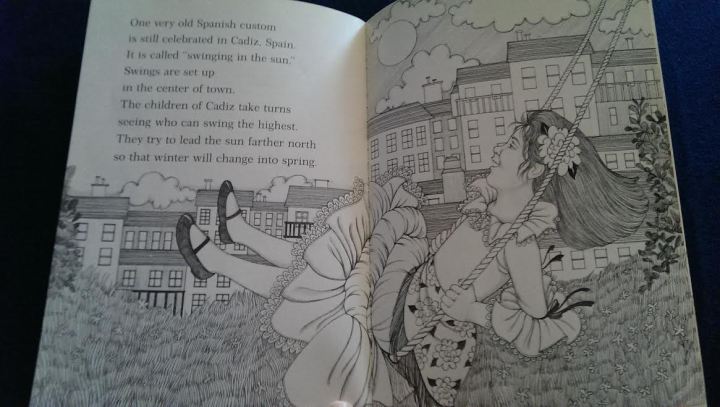
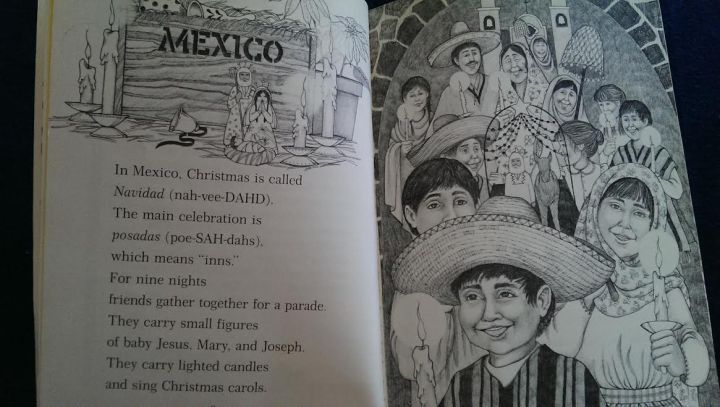
This is a non-fiction book that describes Christmas customs from various countries around the world.  There is some history and folklore associated with different Christmas traditions in every country.  The main countries described are Mexico, Iran, China, Sweden, Iraq, Spain, and Norway, although there is a section in the back that briefly mentions a few other countries.

In some countries, children leave out their shoes instead of their stockings in the hopes of receiving small presents in them.  Sometimes, the gifts are from Santa, and sometimes, they’re from someone else, like the Wise Men.  In other countries, people do not give gifts on Christmas, except maybe new clothes for the children.

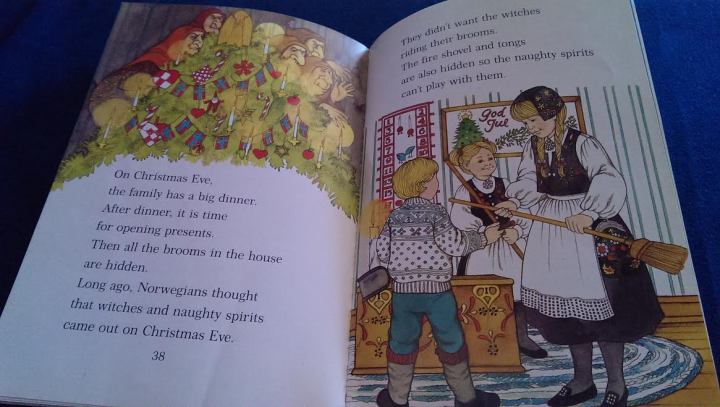
Some of the traditions described are older ones, based on folklore, like the one about hiding brooms and tools from witches and bad spirits in Norway.  In countries in the Southern Hemisphere, Christmas is associated with summer instead of winter, changing the way people celebrate the holiday.  Each country has their own special foods associated with the holiday, too.

christmasnorway

The book also describes traditions that are associated with other special days related to Christmas, such as St. Lucia Day in Sweden (December 13) and Twelfth Night, when the Wise Men came to visit Jesus (January 6).  These special days are kind of an extension of the Christmas season in different countries.

christmasspain

christmasspain2

The pictures in the book are beautiful.  Some of them are in color and some are in black and white.

christmasmexico

In the back of the book, there are jokes, a craft project, and a recipe for Christmas cookies.

The book is available to borrow and read for free online through Internet Archive.

Mystery Up the Winding Stair

Harry Hunter and his mother have been living with his grandfather in his big mansion while his father is in Japan doing work for the government. His family has owned the mansion for a long time, and it has a small museum in it containing Native American artifacts and things relating to pioneer life, including a small log cabin built in a large room up a winding staircase.

When Harry’s mother goes on a trip to see his father, Harry and his grandfather invite Harry’s cousins to visit them: Ned and his sister Lou, and Carol, whose family has only recently moved to the area.  When the children try to decide what they would like to do together, Carol suggests a treasure hunt.  Their grandfather sends them on a treasure hunt to find something that he hid himself a long time ago: a set of silver spoons made by Paul Revere and a diamond. The explanation is that the grandfather is rather absent-minded and has forgotten where he hid the treasure, although he knows that it’s somewhere in the house.

A storm leaves them all snowbound in the mansion, but they are not alone. There are mysterious footsteps, someone using a secret staircase to the attic, and signs that the bed in the cabin has been slept in. The children begin to realize that someone else is in the house with them, and this person wants the treasure for himself!

This book is out of print, but you can borrow and read it online for free through Internet Archive.  Internet Archive requires you to sign up for an account to borrow books, but the account is free, and you read the books directly in your browser.  There are no overdue fees because the books simply disappear from your virtual loan list when your time is up.  You are allowed to re-borrow books as long as copies are available (not being “borrowed” by other people).

The house the mansion in the book was based on was the old summer home of Governor Washington Hunt, located in Lockport, New York. (I learned about the house from an article about the story behind the book and an event related to the book that was held at the library in Lockport, but the site that had the article doesn’t have it up anymore. I think I saved a copy somewhere, but I’m having trouble finding it right now.)  It was called Wyndham Lawn and later became a children’s home. It’s now a private school called the Henrietta G. Lewis Campus School.  When the author, Helen Fuller Orton, was young, some of her relatives rented Wyndham Lawn from its owner, and she lived with them for a time.  In the article, the author noted that the house had been changed somewhat since the time when she lived there in the 1880s in order to accommodate the needs of the children’s home.

When I first read this book, I thought that the part about the grandfather simply forgetting where he hid an important treasure was a little cheesy, but the treasure hunt in a mansion with its own museum is fun. It’s a little spooky when the kids realize that there’s an intruder in the house with them while they’re snowbound, although it’s pretty obvious to readers of the story who the intruder was. The house really makes the story because it is a fantastic setting! It’s a very cozy mystery for winter.

I enjoyed the story and learning about the history of the real house. I also considered what Harry’s father is doing in Japan because this book was published just after WWII. I don’t think they ever explain why Harry’s father is in Japan on government work, but I’m sure he’s involved with the occupation and reconstruction of Japan after the war. It’s a subtle reference to current events at the time this story was written that’s not part of the main story but is used as part of the reason why the main story is happening.

December Secrets

The Kids of Polk Street School

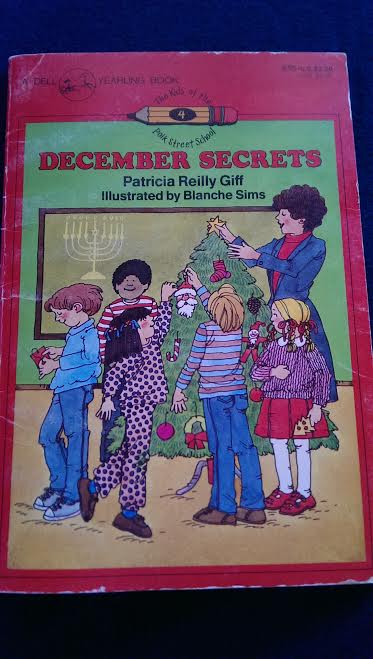
decembersecrets#4 December Secrets by Patricia Reilly Giff, 1984.

It’s December, and the kids in Ms. Rooney’s class at Polk Street School are learning about Christmas and Hanukkah.  To get everyone in the holiday spirit, Ms. Rooney has everyone choose someone else in class as their “Secret December Person,” kind of a Secret Santa-style activity.  The kids will give small presents and do nice things for the person they pick.

Emily would have picked her friend Dawn for her person, but they’ve been fighting since Emily wouldn’t let Dawn cut in front of her in line when the fire truck came to school and the kids who were first in line were allowed to actually get in the front seat.  Emily tries to pick someone else to be her Secret December Person, but her other favorite choices are taken.  When she asks Ms. Rooney who is still available, Ms. Rooney suggests Jill Simon.

decembersecretspicEmily doesn’t think much of Jill Simon because she’s fat and a crybaby.  Whenever the least little thing goes wrong, Jill tears up.  She hardly ever smiles.  But, although Emily isn’t thrilled at first to have Jill as her Secret December Person, she then thinks that she can use this as an opportunity to help Jill.  Maybe her presents will help Jill to become a happier, maybe even thinner person.

The book is available to borrow and read for free online through Internet Archive.
My Reaction

Although Emily wants to help Jill, her first attempts fall flat because she’s focusing too much on correcting Jill’s faults instead of thinking about what would really make Jill happy.  Jill becomes a happier person when Emily notices the good things about Jill and helps her to see them for herself.  The project helps Emily to become a more thoughtful person, and she also makes a surprising discovery about the Secret December Person who has been leaving thoughtful presents for her.

The reason why it has to be “Secret December Person” instead of “Secret Santa” is because there are both Christian and Jewish children in the class.  That’s why the kids learn about both Christmas and Hanukkah.  They don’t want anybody to feel left out.  The name “Secret December Person” is a little cumbersome next to “Secret Santa”, but the sentiment is nice.  I don’t recall doing anything like this as a class activity when I was in elementary school.  I remember that I was in first grade when a Jewish girl and her mother explained Hanukkah to the class.  They gave everyone small plastic dreidels to play with, and I spent the Christmas holidays that year playing dreidel with my brother for peanuts and M&Ms.  They were just little party favor dreidels, but I had a lot of fun with mine, and I still have it.  Sometimes, little presents do mean a lot.

Something Fishy at MacDonald Hall

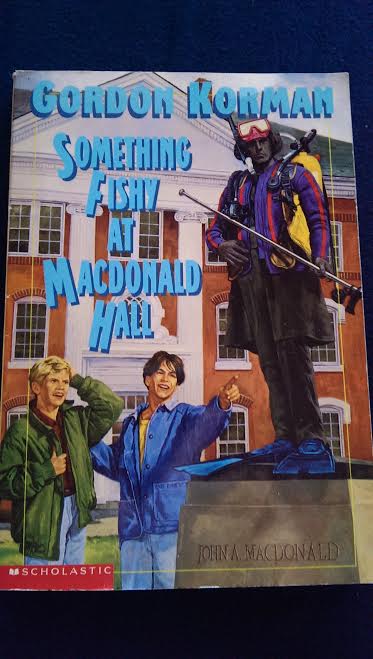
somethingfishySomething Fishy at MacDonald Hall by Gordon Korman, 1995.

Time moves on, and Boots’s little brother, Edward, is just starting school at MacDonald Hall. He’s made it clear that he thinks his older brother and his friends are “over the hill” and uncool.  Mr. Sturgeon is also feeling “over the hill” and thinking about retiring.  Being the headmaster just doesn’t seem that exciting to him anymore.

But, MacDonald Hall just wouldn’t be MacDonald Hall without strange things happening, and some mysterious person has been playing a series of bizarre pranks that rival anything Bruno and Boots have ever done.

Naturally, Mr. Sturgeon suspects them of being the pranksters, but for once, Bruno and Boots aren’t guilty.  On the one hand, they’re a little envious of the prankster’s ingenuity, but on the other, they don’t want to take the rap for something they haven’t done.

Who could the mysterious prankster be?  It is Edward, trying to prove that he’s more clever than Bruno and Boots?  Could it be Cathy and Diane, the girls at Miss Scrimmage’s Finishing School for Young Ladies?  They’ve been somewhat distant this year, for some reason.  Maybe it was Mark, who runs the MacDonald Hall school newspaper, drumming up interest in the paper by creating the phantom joker so he can write stories about it.  Elmer Drimsdale, the school genius, has been acting pretty odd since he developed a crush on a girl at the summer science fair, a girl who also happens to attend Miss Scrimmage’s.

There are plenty of suspects to choose from, and time is running out.  Bruno and Boots may be facing expulsion if they can’t figure out who is behind all the pranks!

This book is part of the MacDonald Hall Series (or Bruno and Boots series).

MacDonald Hall Goes Hollywood

macdonaldhallhollywoodMacDonald Hall Goes Hollywood by Gordon Korman, 1991.
MacDonald Hall has been picked as a location for filming a movie about a boarding school, and people are going crazy (or crazier than normal)!  Bruno hopes that he’ll be discovered and become a movie star. His attempts to insinuate himself (not very subtly) into various scenes keep getting him into trouble.

The girls at Miss Scrimmage’s Finishing School for Young Ladies all have a crush on the teen star of the movie, Jordie Jones, further annoying Bruno.  Cathy and Diane, Bruno and Boots’s friends at Scrimmage’s, are especially getting on his nerves with their wild schemes to meet Jordie in person.

Meanwhile, poor Jordie wishes that he could live life out of the limelight for awhile.  His manager worries about him excessively and never lets him do anything fun.  In spite of his many admirers, Jordie is lonely because he spends all of his time with the movie people and doesn’t have many friends his own age.  Nobody has even remembered his birthday!

Bruno and Boots discover Jordie’s woes when Bruno tries to play a mean trick on Jordie, due to his jealousy of all the attention Jordie gets.  After Jordie opens up to the guys about his problems, Bruno feels more sympathetic toward him and decides to help.  The boys invite Jordie to play poker with them (after lights out and against school rules), take him to a dance at Miss Scrimmage’s (in disguise as a prince from a made-up country), and even get him to help with a hockey game as goalie (which earns Jordie a black eye).

Jordie has been having the time of his life, but the boys still have to conceal his activities as much as possible and deal with his over-protective manager, his rabid fans at Miss Scrimmage’s, and as always, The Fish.  Mr. Sturgeon (aka The Fish), is sympathetic to Jordie because he knows that activities like these are important to his growth as a person, but the movie people crack down on Jordie’s activities because the black eye interferes with his filming.

Although Jordie is supposed to keep quiet and let his eye heal, he runs away to join Bruno and Boots and several other boys on the school’s traditional wilderness survival trip (known to the students as “Die-in-the-Woods”).  It isn’t long before Jordie is discovered among them, but before the trip is over, the others are going to be glad that he’s there.

This book is part of the MacDonald Hall Series (or Bruno and Boots series).  It is currently available online through Internet Archive.

The Zucchini Warriors

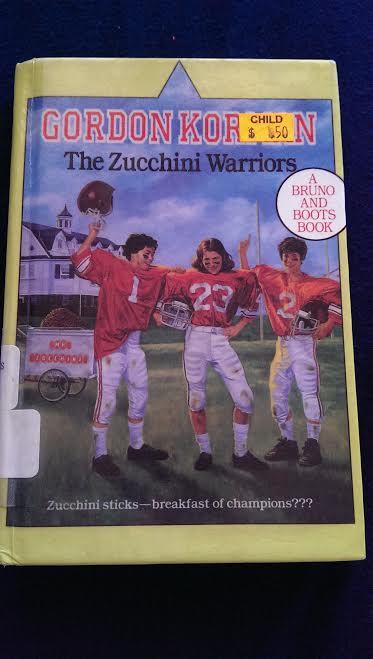
zucchiniwarriorsThe Zucchini Warriors by Gordon Korman, 1988.
One of MacDonald Hall’s former students, Hank “the Tank” Carson, has made it big with his zucchini stick snack company.  As a former football player, he also wants to create a winning football team for his old school, funded by his zucchini fortune.

Mr. Sturgeon isn’t happy to see Hank again.  He was in Mr. Sturgeon’s math class, before Mr. Sturgeon became the school’s headmaster.  Hank was always a loud, obnoxious student, and against his morals, Mr. Sturgeon gave him a passing grade even though Hank actually failed the class.  He only did it because he couldn’t stand another year with Hank as his student, although he’s felt guilty about it ever since.

The boys aren’t thrilled about the new football stadium and team, either.  What they really wanted was a new rec hall.  But, when Bruno gets up the nerve to tell Hank about it, Hank makes the kids a deal: if they get a football team together and make a decent showing with it, he’ll fund a rec hall for them, too.  Bruno, as the one who wanted the rec hall the most, becomes the driving force behind the new football team, talking the other guys into playing and even eating Hank’s zucchini sticks even though everyone at school actually hates them.

The biggest stumbling block that the MacDonald Hall Zucchini Warriors faces is that they know nothing about the game.  In fact, the only one around who’s really into football is Cathy, one of the girls across the street at Miss Scrimmage’s Finishing School for Young Ladies.  But, football is a man’s game . . . right?

This book is part of the MacDonald Hall Series (or Bruno and Boots series). It is currently available online through Internet Archive.

The War with Mr. Wizzle

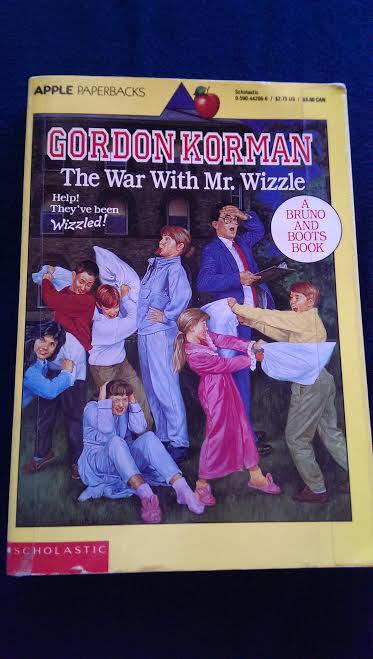
warwizzleThe War with Mr. Wizzle by Gordon Korman, 1982.
MacDonald Hall hasn’t been the same since Mr. Wizzle came.  He’s obsessed with computers and analyzing and categorizing everyone and everything.  He uses his computers to analyze the boys’ personalities, making changes to their schedules and activities based on the results.  But, no computer could ever understand the wacky and complex personalities of the students at MacDonald Hall.

Mr. Wizzle thinks he can understand everything with his computer, but he doesn’t understand the boys at all.  The boys soon get sick of being tested and analyzed and ordered around and told that they should consider changing their last names because the length is too inconvenient for the computer.  Even Mr. Sturgeon and the other faculty members are getting fed up with Mr. Wizzle, but they can’t do anything about it because the school’s board of directors are still hoping that Mr. Wizzle will modernize the school.

Meanwhile, the boys’ friends across the street at Miss Scrimmage’s Finishing School for Young Ladies are having personnel problems of their own.  Miss Scrimmage’s new athletics teacher, Miss Peabody, used to be a U.S. Marine, and she’s trying to train the girls like they’ve signed up for boot camp.  Like the boys, they would do just about anything to get rid of this new nuisance!

What ensues is a series of hi-jinks in the usual spirit of McDonald Hall as the students at each school attempt to drive out the new faculty, but along the way, the kids are forced to acknowledge that they don’t really want anything bad to happen to these new people.  It’s not that they’re bad people, they’re just not right for the types of schools and the students they’re trying to teach.  Then, a thought occurs to them: Is it possible that Mr. Wizzle and Miss Peabody might be right for . . . each other?

This book is part of the MacDonald Hall Series (or Bruno and Boots series). It is currently available online through Internet Archive.

Beware the Fish!

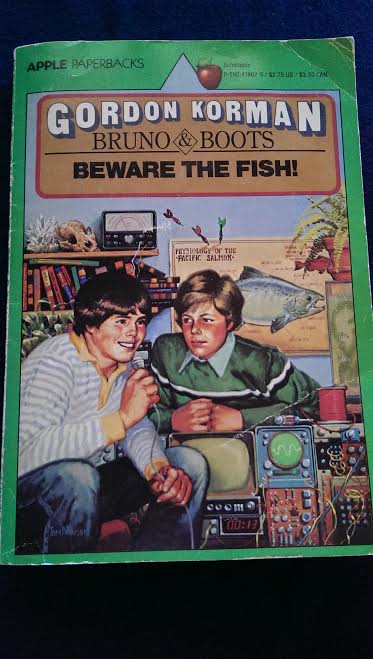
bewarefishBeware the Fish! by Gordon Korman, 1980.

In spite of MacDonald Hall’s prestigious reputation, it is continually plagued by money problems.  The students can’t help but notice all the budget cutbacks, and now, there are rumors that the school might even have to close permanently.  The last thing anyone wants is to leave MacDonald Hall.  Bruno, the school’s resident idea man and master prankster, decides to spearhead a movement to raise money and publicity for MacDonald Hall so they can save the school!

Bruno, his best friend Boots, and their other fellow students try everything they can think of to spread the word about what a great place MacDonald Hall is so that enrollment will go up and the school can earn enough money to stay open.  They enlist the help of the girls at the nearby finishing school to help them break a world record.  The school’s science whiz, Elmer, shows the boys some of his inventions in the hope that one of them will make the school famous.

Unfortunately, as usual, nothing turns out as planned.  World records are extremely difficult to break, and Elmer’s inventions backfire.  One of his inventions backfires in such a way that it comes to the attention of the local police, and even the government becomes convinced that a gang of terrorists may be operating somewhere in the vicinity of MacDonald Hall.

The boys try to keep their activities secret from their headmaster, Mr. Sturgeon (or, as the boys nickname him, “The Fish”), while government agents snoop around, looking for the head of the organization that’s been issuing cryptic messages over television signals, a shadowy figure known only as “The Fish.”

This book is part of the MacDonald Hall Series (or Bruno and Boots series).  It is currently available online through Internet Archive.