Flossie and the Fox by Patricia C. MicKissack, pictures by Rachel Isadora, 1986.
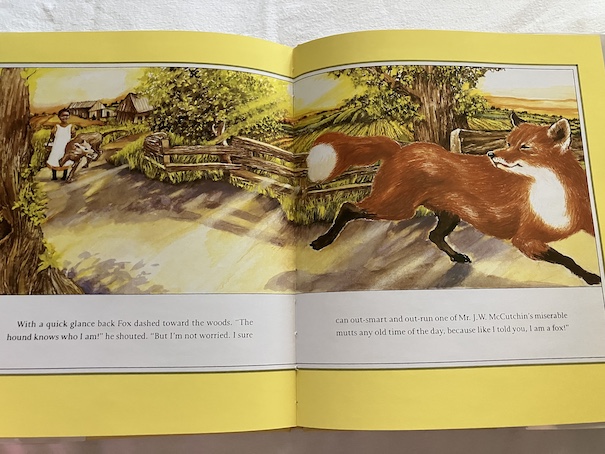
Little Flossie Finley’s mother asks her to take a basket of eggs to Miz Viola because a fox has been troubling her chickens, and they’re too scared to lay eggs. The fox is a sly creature, and he always seems to outwit the hounds.
Flossie doesn’t remember ever seeing a fox before, and her mother tells her that foxes will do just about anything to get eggs. Flossie isn’t sure what she’ll do if she meets the fox, but she remembers what her mother says about how “a fox be just a fox.” She decides that doesn’t sound too scary.
On the way, Flossie does meet the fox. The fox talks to her, and Flossie can tell that he wants the eggs she’s carrying. However, Flossie refuses to be impressed by the fox and tells him that she doesn’t even believe that he’s a fox because she’s never seen one before. The fox is surprised that she isn’t intimidated by him and tries to prove to her that he’s a real fox.
For everything the fox says to try to prove his identity, Flossie has an answer to deny it. He points out his thick fox fur, but Flossie says that rabbits also have thick fur. His pointed nose also doesn’t mean that he’s a fox because rats also have pointed noses. A cat they meet verifies that the fox is a fox, citing his yellow eyes and sharp claws, but since the cat also has yellow eyes and sharp claws, Flossie says that isn’t proof of being a fox. Even his characteristic bushy tail isn’t firm proof because squirrels also have bushy tails.
There is one being who knows for certain that the fox is a fox – the hounds that chase foxes. Flossie knows that as well as the fox does.
My Reaction
The author’s note in the front of the book says that the author enjoyed listening to stories told by her family when she was young, and the story in this book is one that she remembered from her youth. She particularly wanted to tell this story in a rural Southern dialect, like the one her grandfather used when he used to tell stories.
I enjoyed this fun story where a clever girl tricks a classical trickster. She knows that the fox is really fox, but she uses the similarities between the features of a fox and the features of other animals to pretend like she doesn’t and to keep the fox attempting to convince her until she reaches a point where the fox can no longer pursue her. Knowing the author’s connection to this folk tale style story adds an element of coziness, imagining the author hearing the story as a little girl herself.
The time period of the story is indefinite, but from the characters’ clothes, it looks like it might be some time during the late 19th century or early 20th century.
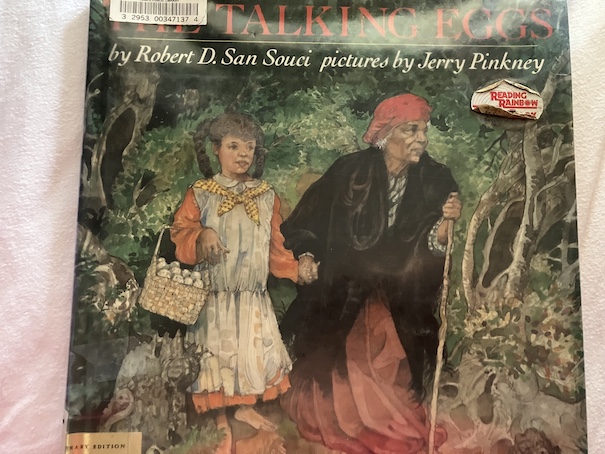
The Talking Eggs by Robert D. San Souci, pictures by Jerry Pinkney, 1989.
There was a poor widow who lived on a small farm with her two daughters, Rose and Blanche. Rose was the widow’s favorite daughter because she was so much like her mother. They were both mean and bad-tempered, and they had grand dreams of becoming rich someday, although neither of them had the slightest idea how to accomplish that. Blanche, on the other hand, was a sweet girl, and her mother made her do all the work while she and Rose just sat on the porch, talking about all of their grand dreams.
One day, when Blanche goes to fetch water from the well, an old woman approaches her and begs her for a drink. Blanche gives her some water, and the old woman thanks her, telling her that she will be blessed for her kindness.
However, when Blanche gets home, her mother and sister yell at her for taking so long. They hit her, and Blanche runs away into the woods. Then, she meets the old woman again. She explains to the old woman what happened, and the old woman invites her to come to her house. However, she cautions Blanche not to laugh at what she sees there. Blanche promises that she won’t laugh.
The old woman is no ordinary woman, and everything at her house is strange. Some of these strange things are amusing, some are amazing, and some are just plain weird and a little alarming. The animals are all strange, with chickens of different colors and cows with curly horns. Then, inside the house, the old woman removes her head and puts it in her lap to brush her hair. Then, the woman produces a fancy stew from just one old bone. After supper, they go outside and watch rabbits in fancy clothing dance.
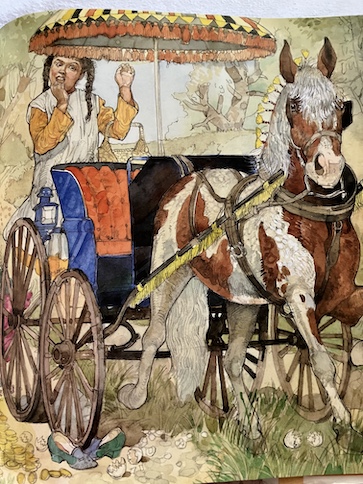
In the morning, the old woman tells Blanche to go out and gather some eggs before she goes home. Blanche is allowed to take any that tell her to take them and to leave ones that say not to take them. Blanche does as she is told, although the ones that tell her to take them are the plain-looking eggs, and the others are covered in jewels. The old woman tells Blanche to throw the eggs over her shoulder, one at a time, and when she does so, the eggs break and wonderful things burst out of them – fancy clothes, coins and jewels, and even a horse and carriage.
By the time Blanche gets home, she has many beautiful clothes, money, and luxurious things. Blanche’s mother pretends to be nice to her when she returns, but it’s only so Blanche will tell her where she got all the rich things. That night, when Blanche is asleep, her mother talks to Rose, telling her that she should also befriend the old woman and get the same rich rewards as Blanche. Then, they will steal all of Blanche’s things and head to the city to live the rich life that they’ve always dreamed of.
Of course, lazy and bad-tempered Rose isn’t as kind or hard-working as her sister. She ignores the old woman’s instructions and does everything she shouldn’t do. When she tries to force the old woman to give her riches, the old woman’s magic gives her and her mother their just desserts.
There is a note at the beginning of the book that this story comes from a Creole folktale that appeared in a 19th century collection of folktales from Louisiana by Alcee Fortier. It resembles folktales from Europe was probably adapted from fairy tales brought to Louisiana by French immigrants. It reminds me of the Mother Holle story, where a kind, well-behaved, hard-working girl is rewarded for following Mother Holle’s instructions, while her spoiled sister is punished for laziness and disobedience.
The old woman in this story is a similar figure to Mother Holle, with strange powers and magical objects, but there is no explanation of who she might be. The fact that she can remove her head just to brush her hair shows that she’s supernatural, but we don’t know if she’s supposed to be a witch or some other supernatural creature.
Personally, I don’t think I would laugh at any of the things in the old woman’s house. I think the strange animals sound more amazing than comical. I think I’d really be impressed by the different-colored chickens and the cows with the weird horns. I have to admit, though, that if someone takes off their head, my first reaction would probably be to run for it.
Mirandy and Brother Wind By Patricia C. McKissack, illustrated by Jerry Pinkney, 1988.
It’s springtime, and “Brother Wind” (the wind personified) is striding through the valley. Young Mirandy is getting ready for the junior cakewalk, and she imagines that, if Brother Wind was her partner, she would be sure to win the cakewalk. Her mother says that anyone who can catch the Wind can make him do whatever they want, so Mirandy decides that she’s going to catch Brother Wind before the cakewalk and make him dance with her!
That’s easier said than done. Mirandy doesn’t know how to catch the Wind, and her grandmother doesn’t think such a thing is possible. She asks different people what to do, and she tries different ways of catching him. She tries catching him in a quilt, but he gets away.
Then, Mirandy tries visiting Mis Poinsettia, the conjure woman (a sort of witch or woman with magical knowledge), and she asks her if she has a potion that would help. Mis Poinsettia’s advice is to trap the Wind in a bottle of cider, but that doesn’t work, either.
Eventually, Mirandy manages to trap Brother Wind in the chicken coop. Once she has Brother Wind, he has to give her a wish. However, on the night of the cakewalk, Mirandy realizes that there is someone else she wants for a partner besides Brother Wind, and she asks Brother Wind for help in a different way from the one she had planned.
My Reaction and Spoilers
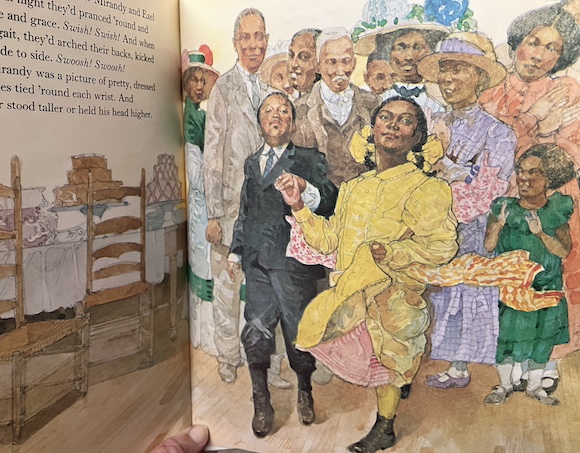
I thought this was a charming picture book, with bright, colorful illustrations that really conveyed that sense of lightness and air in the presence of Brother Wind! The old-fashioned clothing of the characters is part of the charm, and I like this sweet introduction to the concept of a traditional cakewalk. Cakewalks were a kind of traditional African American dance contest with a cake as a prize for winning. The people participating are dancing as they parade around the room, which is a little different from the cakewalks or candywalks that some modern people do at school or church carnivals as a kind of raffle game. In the game version, the players are just walking, not dancing, and they stop on numbered spots whenever the music stops, winning prizes if the number of their spot is drawn. For Mirandy, winning the cakewalk isn’t a matter of stopping in the right place but actually dancing well.
All through the book, there is a boy who likes Mirandy, but Mirandy doesn’t think of him as a dance partner because she has her heart set on Brother Wind as the perfect dance partner, and the boy is kind of clumsy. Mirandy really wants to win the contest, so it’s important to her to have the best partner she can. However, when one of the other girls at the cakewalk talks badly about the boy and his clumsiness, Mirandy can’t stand to hear him being insulted. She boldly declares that the boy will be her partner, and they will win in the contest together … with a little help from Brother Wind.
After the Sun Sets by Miriam Blanton Huber, Frank Seely Salisbury, and Mabel O’Donnell; illustrated by Nellie H. Farnam and Mary Royt; 1938, 1953, 1962.
This was my favorite book of fairy tales when I was a kid! I gave away my copy years ago and regretted it, but I was thrilled to find another copy later at an antique/vintage mall.
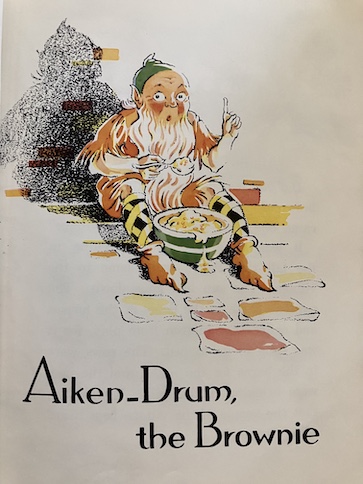
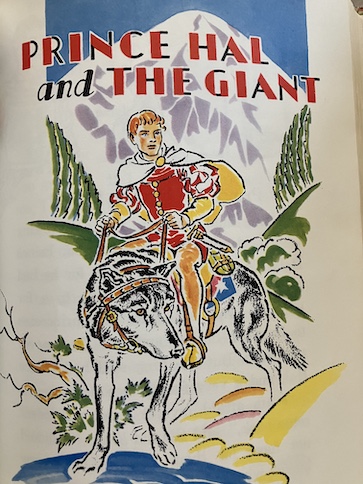
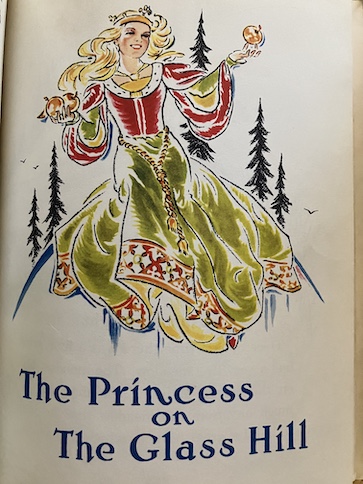
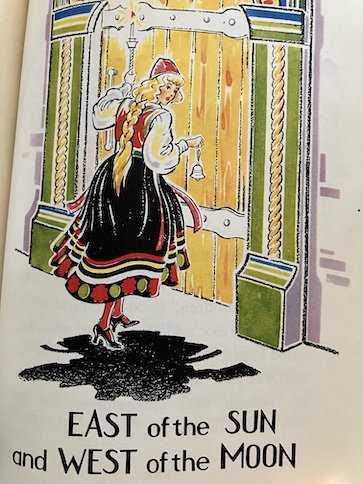
The collection includes some popular fairy tales that you can find in other fairy tale collections, like Cinderella, Brier Rose (the Sleeping Beauty story), and Hansel and Gretel. It also has some stories that are less commonly known these days, like Aiken-Drum, the Brownie and Prince Hal and the Giant. When I was young, my favorite stories in the book, the ones I read over and over, were Snow-White and Rose-Red, The Princess on the Glass Hill, and East of the Sun and West of the Moon.
One of the things that makes this collection unique is that it includes a section of poems at the back of the book. I love the one called Cinderella’s Song, and it was one of the reasons why I missed this collection so badly. I don’t think I’ve seen that poem in any other book.
The illustrations in the book are beautiful! I loved them as a child, and I still find them enchanting as an adult. Some are in black-and-white, but some are in full color.
I didn’t realize it when I was a kid, but this book is actually the third book in a series, The Wonder-Story Books, and it was a unit in The Row, Peterson Basic Reading Program. I have the 1962 edition, but the book is actually older than that. Its copyright was renewed multiple times.
The book is available to borrow and read for free online through Internet Archive. There is also an earlier edition of this book available through Internet Archive, and it doesn’t have the section of poetry included, so the poetry might only appear in the 1962 edition.
Stories:
Aiken-Drum, the Brownie
Aiken Drum is a Brownie, a magical little man who likes to do chores for other people for little reward. Reward a Brownie too much, and he will leave.
Pat and the Fairies
Pat joins the fairies in a dance, and they loan him a pair of shoes when his wear out. When he later comes to return the shoes, he gets a wonderful reward. A greedy shoemaker tries to join the fairies in their dance and borrow a pair of shoes to get the same reward, but the fairies punish him when he tries to cheat them.
Change About
A husband grumbles about how little his wife accomplishes in the course of a day while she minds the house and their child and he works out in the fields. The husband and wife decide to switch places for a day to prove which of them works harder, and the husband has a surprise about what really happens at home while he’s away.
Cinderella
A girl who is abused by her stepmother and stepsisters receives magical gifts from her fairy godmother so she is able to attend the prince’s ball.
Snow-White and Rose-Red
A widow and her two daughters let a gentle talking bear spend the winter with them so he won’t freeze, but this bear is under a spell.
Snip, The Tailor
A tailor sets out to make his fortune. He uses his wits to defeat a pair of giants and win a castle and half the kingdom from the king.
Brier Rose
This is the Sleeping Beauty story. A young princess is cursed by a bad fairy. When she hurts her hand on a spindle, she and everyone in her castle falls asleep for a hundred years.
Prince Hal and the Giant
Prince Hal is the youngest of a king’s seven sons. The other six have left home to find brides and have never returned home. No one knows what happened to them. Prince Hal sets out to find what happened to his brothers. He finds out that they and their brides have been turned into stone statues in the house of a giant. Prince Hal must find a way to save them and the princess who has become the giant’s latest captive.
Hansel and Gretel
A pair of children are abandoned in the woods, and they find a strange house made of gingerbread. They are almost eaten by the witch who lives in the house.
The Princess on the Glass Hill
Every year on Midsummer Night, the hay disappears from a farmer’s field. Each of his sons tries to find out why, but each of them is frightened by the strange things that happen, until the youngest son faces the phenomenon and discovers a strange horse with a coat of mail that fits him perfectly. The same thing happens twice more so that the youngest son acquires three fine horses and three sets of mail. He keeps them secret at first, but later, he uses them to perform an amazing feat and ride to the top of a glass hill to win the hand of a princess.
East of the Sun and West of the Moon
A white bear comes to a family with many children and says that he will make them rich if the eldest daughter, Freda, will come with him. At first, she doesn’t want to go, but when she does, he takes her to a magical castle. Unfortunately, she disobeys the bear’s instructions while she’s there. He is under a witch’s spell, and Freda must find a way to undo the damage she’s caused and break his spell, following him to the witch’s castle by riding the winds, east of the sun and west of the moon.
Stories in Poetry:
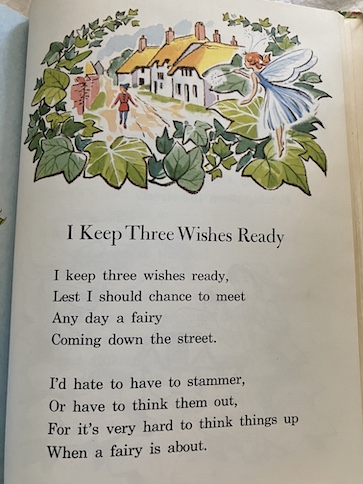
I Keep Three Wishes Ready by Annette Wynne – It’s good to know what you want to wish for, just in case you get the chance.
At the Zoo by A. A. Milne – There are many fascinating things to see in a zoo!
Some One by Walter de la Mare – Someone knocked at the door. Who?
Little Nut Tree by Mother Goose – A traditional rhyme about a magical tree. One of my favorites!
The Duel by Eugene Field – The gingham dog and the calico cat have a fight.
Queen Mab by Thomas Hood – About the fairy queen and how she gives pleasant dreams to children.
Cinderella’s Song by Elizabeth Madox Roberts – Cinderella confides her secret to her cat.
Trees by Harry Behn – Trees are wonderful things!
The Story of the Baby Squirrel by Dorothy Aldis – A child finds a baby squirrel and raises it. When it grows up, it runs away, but they think he’s probably still living with the other squirrels nearby. They sometimes see a squirrel who seems to be saying hello to them.
The Hens by Elizabeth Madox Roberts – It sounds like the hens are talking, but what are they saying?
Roads by Rachel Field – Roads might lead anywhere and to all sorts of wonderful things!
Washington by Nancy Byrd Turner – About George Washington. This one seems like an odd inclusion to me, adding a poem about a historical figure to a collection that has more fairy tale themes.
The Girl Who Loved Caterpillars adapted by Jean Merrill, illustrated by Floyd Cooper, 1992.
This story is a rendition of a 12th century folktale from Japan.
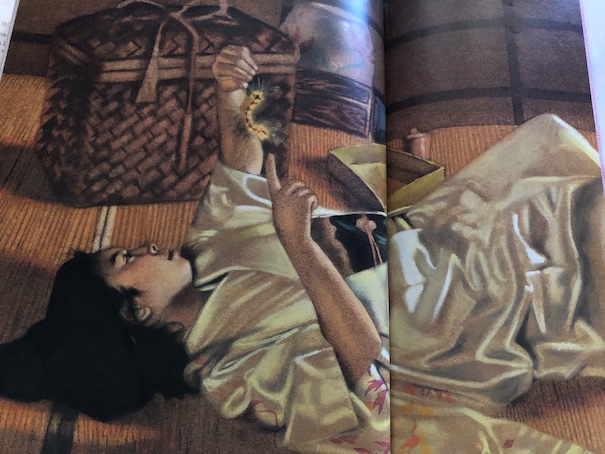
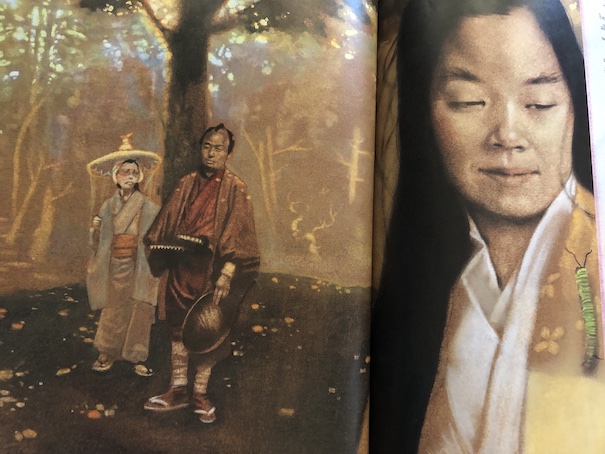
Izumi is the daughter of an important man, a provincial inspector who serves the emperor in Kyoto. Court life is full of elegance, and Izumi is a pretty and clever girl. Her parents have high hopes that she might become a lady-in-waiting or marry a nobleman, but she is mainly known for one thing: her peculiar love of caterpillars.
A beautiful and elegant woman who lives nearby is known for her love of butterflies, and she is considered to be The Perfect Lady. She has all of the skills that a noblewoman could aspire to, and Izumi’s parents think of her as a great role model for their daughter.
However, Izumi doesn’t see the appeal of beautiful butterflies. After all, they come from caterpillars, and caterpillars are much more interesting. Izumi also loves worms, toads, insects, and other things that most people would find unappealing. She likes to keep them as pets and observe how they live and grow. Izumi’s parents don’t approve of the lower-class boys who bring Izumi new creatures for her collection, and nobody else understands her fascination with these creatures.
Izumi just loves the natural world. To her, court life and the beauty standards for women there are too artificial. She also believes in reincarnation and the idea that any person might have been one of these unusual creatures in a past life or could be one in the next. Her parents love her, and they understand how she feels when she explains her reasoning to them, but they also worry about her future. If she doesn’t conform more to the standards of the court and develop more “normal” interests, will she ever make a desirable marriage? People at court gossip about Izumi and her odd tastes.
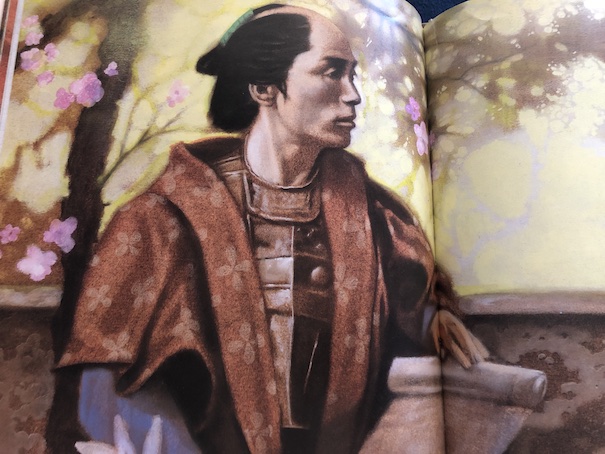
However, the rumors about Izumi reach a young nobleman who is as clever as Izumi, and he is fascinated at the idea of a pretty girl who isn’t afraid of the creeping creatures of the Earth.
The book is available to borrow and read for free online through Internet Archive.
My Reaction
I remember this story from when I was a kid! When I was a kid, I didn’t bother to read the Afterword of the book, which explains more about the origins of the story. Izumi’s story actually seems to be part of a much longer story about court life in Medieval Japan. The original author of the story is unknown, and Izumi’s part of the story is incomplete. It ends with the promise that what happens next will be revealed in the next chapter, but the rest of the story is unknown. We don’t know if she ends up marrying the nobleman who has developed a fascination with her or not.
I have a theory, based on a comment that Izumi made, comparing caterpillars to their adult forms and asking why people are only interested in the adult forms, that Izumi’s love of caterpillars is based both on her young age and perhaps a hidden affinity for children. Perhaps Izumi will grow to love butterflies as well as she grows up and be viewed as more of a butterfly herself, or maybe the nearby lady who loves butterflies will admit to a secret love of caterpillars as well. None of us stay young, and we all evolve as we grow, but part of us always remembers being in those early, awkward stages. Maybe everyone has a secret soft spot for the young, even when they’re fuzzy or grubby crawling things, and a desire to see them become the best form of themselves.
Whatever her future brings, readers get the impression that Izumi is happy and at peace with herself as she is, whether anyone else agrees or not. We can hope that the young nobleman will also love her for the person she is, but Izumi seems to believe that being true to her own nature is the way to achieve inner peace.
In other times and places, as the Afterward observes, Izumi might have been a scientist, naturalist, or philosopher. The traits that make her seem odd for her time and place are actually desirable ones that could make her more successful in other circumstances. In the early 21st century, Izumi’s sense of individualism and her value of the natural world would probably win her many friends. People who enjoy the aesthetic of Goblincore would probably relate to her feelings about caterpillars and other crawly creatures.
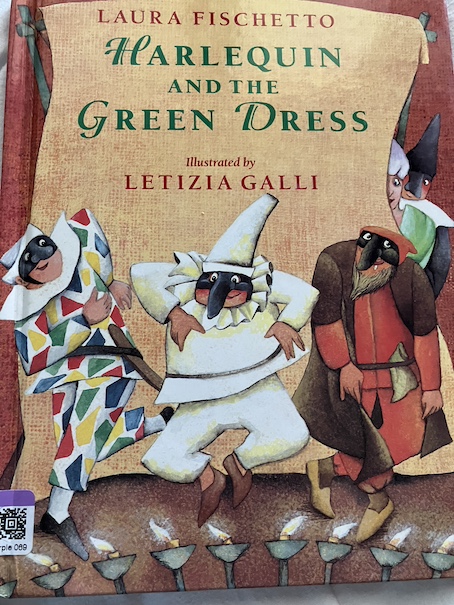
Harlequin and the Green Dress by Laura Fischetto, illustrated by Letizia Galli, 1994.
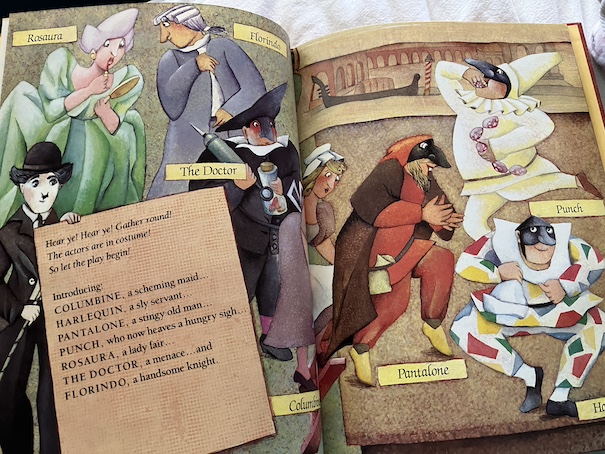
What I love about this book is that it’s a fun introduction to commedia del arte and its stock characters! A figure that looks like Charlie Chaplin holds a card that summons readers like guests to a play and introduces our characters like this:
Columbine – “a scheming maid …”
Harlequin – “a sly servant …”
Pantalone – “a stingy old man …”
Punch – “who now heaves a hungry sigh …”
Rosaura – “a lady fair …”
The Doctor – “a menace … and”
Florindo – “a handsome knight.”
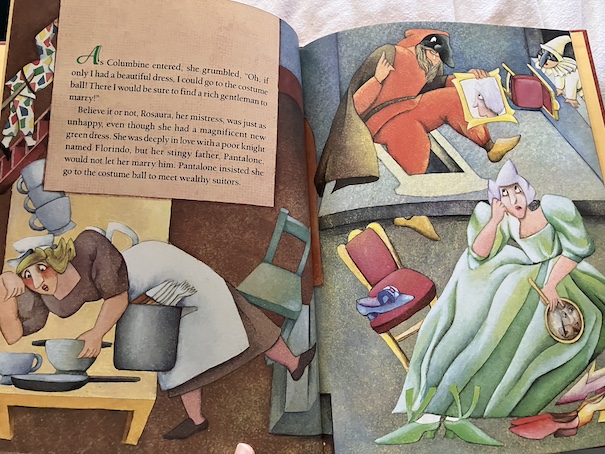
There is going to be a costume ball. Rosaura, a wealthy young lady, has a beautiful green dress to wear, but she is unhappy because her father, Pantalone, refuses to let her marry the man she loves, Florindo. Florindo is a poor knight, and Pantalone hopes that Rosaura will meet a wealthier suitor at the costume ball.
Meanwhile, Rosaura’s maid, Columbine, wishes that she had a beautiful dress so that she could go to the costume ball herself. She thinks that, if she went to the ball, she might also meet a rich man.
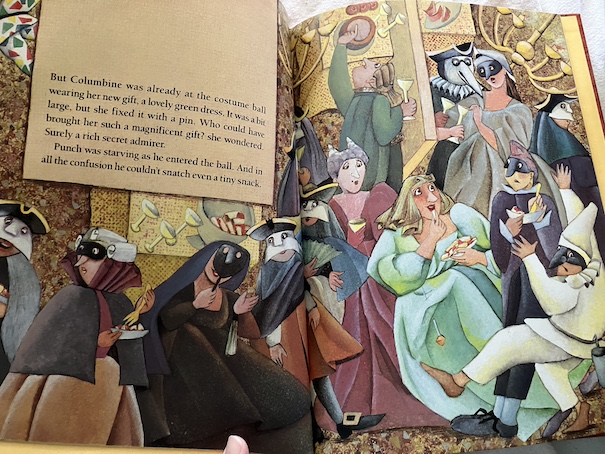
Harlequin is in love with Columbine, and he wants to do something that would impress her. He decides to borrow Rosaura’s dress and give it to Columbine as an anonymous gift so that Columbine can to go to the ball, but unbeknowst to him, Florindo is coming up with a scheme that will allow Rosaura to run away with him and get married. Florindo enlists his servant, Punch, to pretend to kidnap Rosaura, to provide a reason for her sudden disappearance. He tells Punch that he will know Rosaura at the ball because of her magnificent green dress, not knowing that Columbine has already received the dress from Harlequin and is wearing it at the ball.
Chaos ensues when Punch abducts Columbine, thinking that it’s Rosaura and that she’s just playing along with Florindo’s plan. When Punch says that he’s taking her to her suitor, Columbine assumes that he’s taking her to the secret admirer who gave her the dress.
In the meantime, poor Rosaura is having hysterics because she can’t find her dress and can’t go to meet her suitor. When Harlequin discovers what a mess all the scheming has caused, he comes up with another scheme to straighten out everything. Can he reunite Rosaura with Florindo, convince Pantalone to allow their marriage to take place, make her that Punch gets all the snacks he wants, and make things right with Columbine?
My Reaction
I love books that introduce lesser-known topics, and I imagine that few young readers would know anything about commedia del arte. For kids who are old enough to appreciate a little theatrical history and expand their cultural horizons, this is a fun introduction to an art form that they may have never seen before!
My first introduction to the stock characters was in Agatha Christie movies because Agatha Christie was fond of commedia del arte and put references to it into some of her stories, like The Affair of the Victory Ball. There is a section at the back of this book that explains the historical background of this type of theater and more about the characteristics of the stock characters.
I did think that the story in the book jumped around oddly in some places, and the role of The Doctor wasn’t very well explained. I think part of the reason was that the action would be easier to understand if we were watching it on stage rather than reading it in a book. The pictures are also chaotic and a little difficult to follow. I think they’re meant to convey the shifting scenes and the fast and chaotic movements of the characters as they go about their various schemes. The story itself is meant to be chaotic and action-filled because of all the characters’ schemes and counter-schemes. The action and visual jokes would probably make more sense seeing them performed rather than hearing them described.
I did like the part at the end, where we see the actors taking their bows and some of them removing their masks because the story was a play the entire time. The story isn’t meant for readers to see the characters as real people and events that are actually taking place. It’s all been a stage play the entire time. The pictures also indicate that it was always a play, with its flat scenery, objects at strange angles, and characters that seem to be separated from each other by thin walls. It’s all a bit unreal because it is unreal.
To get around some of the chaotic nature of the story and make it more fun for kids, I think this is a good book to read aloud with a lot of enthusiasm and maybe even act out rather than just telling it, encouraging young listeners to get involved in the story and the imaginary world of the theater.
The Mysterious Giant of Barletta by Tomie dePaola, 1984.
This story is adapted from an Italian folktale. There is a note in the beginning about the town of Barletta and the statue that stands in front of the San Sepolcro Church. According to the note, nobody knows who the statue is supposed to represent, which is why there are stories about it. This one takes place during the Middle Ages, the 11th century.
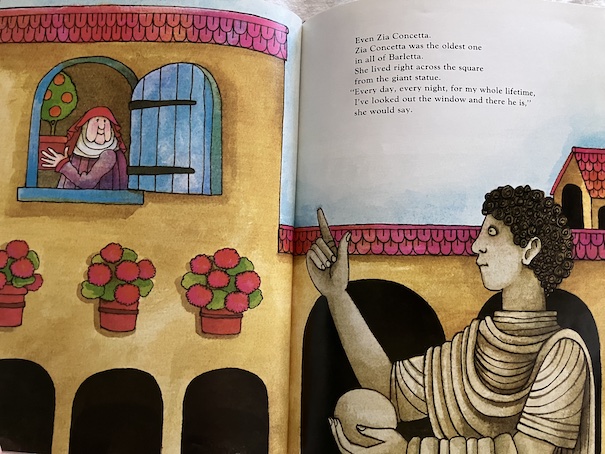
Because no one knows who the statue is supposed to be, the people of Barletta call it, “The Mysterious Giant.” No one even knows for sure how long it has been there. It has been there for as long as anyone can remember, including Zia Concetta, the oldest person in Barletta. People are accustomed to gathering around the statue to meet each other, and many of them will give the statue a friendly greeting or wish it good night.
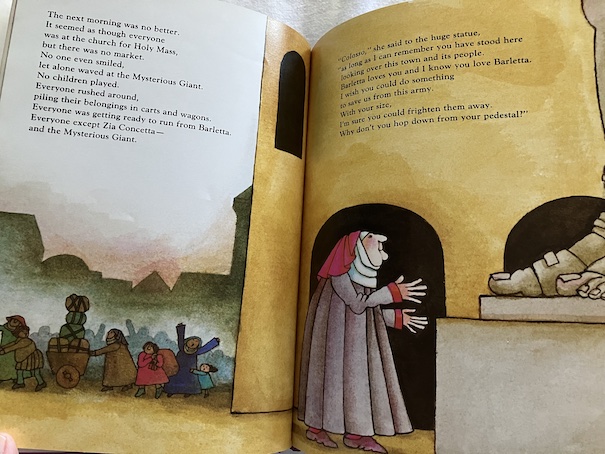
However, one day, the town is threatened by an invading army. The people of Barletta are unprepared for invaders, and many of them prepare to flee, not knowing what else to do. Zia Concetta appeals to the statue to save their town.
The statue hears Zia Concetta’s request, and it comes to life, climbing down from its pedestal. Together, he and Zia Concetta come up with a plan to discourage the invaders.
When the invaders arrive, they see the statue, sitting by itself outside the city, crying. When they ask the giant statue why it’s crying, it says that the other boys at school are mean to him because he’s smaller than everyone else. When the invaders hear that everyone else in Barletta is bigger than the giant statue, they decide that they don’t want to meet the rest of the townspeople and leave!
The book is available to borrow and read for free online through Internet Archive.
My Reaction
I always like books that reference folklore! The theme of someone who is large pretending like they’re much smaller than other people to scare off an attacker is one found in other folktales. For example, in Fin M’Coul (a version of which was also written and illustrated by Tomie dePaola), Fin M’Coul, who is a giant, pretends to be his own baby to make an enemy think that his father must be larger and more fierce than he actually is.
I particularly liked this story because, unlike other folktales, it has a real setting and a definite landmark, the statue that is sometimes called the Colossus of Barletta. The way it is drawn in the book isn’t exactly as it appears in real life. In real life, it holds a cross in the hand that is raised, although the cross was not part of the statue originally. It probably originally held a spear or a flag standard. It is about three times the size of an adult human, which isn’t as large as it is shown the book. As in the book, it isn’t certain exactly who the statue is supposed to be, although it appears to be the statue of an emperor. He appears to be a middle-aged man wearing a jeweled diadem. The reason why nobody knows exactly who it was supposed to be is that it wasn’t originally made or displayed in Barletta. It was probably originally looted from Constantinople by the Venetians. There is a story from Barletta that it was once lost in a shipwreck on the way from Constantinople and washed up on the shores of Barletta in 1309, where some of its bronze was used for casting bells for a monastery. Then, in the 15th century, the statue was restored and displayed in front of the church. That, by itself is a fascinating story, although it isn’t explained in the book.
Princess Hyacinth by Florence Parry Heide, illustrated by Lane Smith, 2009.
For reasons nobody understands, Princess Hyacinth is not affected by gravity, and she floats upward anytime she is not restrained or weighted down.
It’s a real problem because, while it’s difficult enough when she floats up to the ceiling of the palace, if she were allowed out of the palace without something weighing her down, she would simply float away.
Princess Hyacinth’s parents go to great lengths to make sure that she is always secured to something or weighed down with special weighted clothes and a very heavy crown.
Of course, being weighted down all of the time makes life difficult for Princess Hyacinth, too. She wishes that she could go outside and play and swim with the other children, but she can’t because she can’t be outside without the weights. There is one boy in particular who comes by her window with a kite with a crown on it and says hello to her, but it would be difficult for her to go out and play with him.
Then, one day, when Princess Hyacinth is particularly bored and tired of being weighted down, she persuades a balloon man to tie a string to her and let her float among his balloons. At first, it’s fun, floating along as the balloon man walks through the park, but then, the balloon man is startled by a dog and accidentally lets go of her!
As Princess Hyacinth floats upward into the sky, she is thrilled because she has never felt so free in her life, but where will it end? How high can she go, and is there any way for her to get back? Fortunately, there is a way for her to get home, with the help of a friend!
The book is available to borrow and read for free online through Internet Archive (multiple copies).
My Reaction
This story reminded me of a much-older story from the 19th century, The Light Princess, but this picture book is much, much less serious than that book. In The Light Princess, the princess is cursed, and the story is about breaking this curse that has afflicted her all of life. In this book, there is never any explanation about why Princess Hyacinth isn’t affected by gravity, and she is never cured. Instead, she makes a friend who helps her find a way to live with her condition and enjoy it.
I liked the art style in this book. I found it amusing that the king, queen, and palace guards are drawn in the style of the face cards in a deck of playing cards. Princess Hyacinth is a cute little girl, and when she’s wearing her heavy princess gear, you can almost feel the weight of it on her. In the end, there are still times when she has to be tied down, but she seems more normal, less weighted down, because she has found someone to help her deal with her condition.
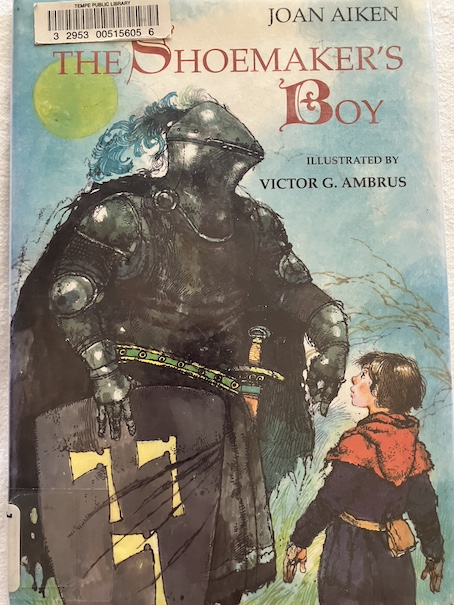
The Shoemaker’s Boy by Joan Aiken, illustrated by Victor G. Ambrus, 1991, 1994.
Jem’s father is a shoemaker, and Jem is learning his trade. However, things take a bad turn when his mother suddenly becomes ill. It’s a strange kind of illness. She sleeps all the time, can’t eat, and is hardly breathing. The doctors can’t seem to help her, so Jem’s father decides to go on a pilgrimmage to St. James in Spain and pray for his wife to get better.
While he’s gone, Jem has to mind the family business and look after his mother. Jem’s father has a reputation as a incredible shoemaker, with people coming to see him even from other kingdoms, and Jem is worried that he won’t be able to maintain the business on his own because he’s still learning the trade. However, since nothing else seems to help his mother, it seems like his father’s holy pilgrimage is their last hope.
While his father is away, Jem tries his best, but he finds it difficult to keep up with the orders that come in for shoes. He falls behind on his work, and money is running short. Then, one day, he has a strange encounter with three little men, who are only the size of young children. They are all dressed in green, and they ask Jem for the three silver keys. Jem doesn’t know what they’re talking about, but the men say that they were sent to ask him for them because someone was supposed to leave the keys with him. Jem says that nobody has left any keys with him, and suddenly, the little men vanish! At first, Jem thinks that maybe he imagined the whole thing, but this is just the beginning of a series of strange happenings.
Late that night, there is a knock on the door, and when Jem answers it, he is confronted by a knight wearing black. The knight says that he wants Jem to make him a pair of boots because he’s heard that the boots from this shop are the best. Jem doesn’t want the knight to be disappointed, so he explains to him about his father being away and that he is not as good as his father at making boots. The knight appreciates his honesty and says that he will try Jem’s work anyway. He promises Jem an excellent fee for his services if the boots are ready by morning, and to Jem’s surprise, he also asks Jem if someone has left three silver keys for him. Jem tells him that nobody has left any keys with him, and the knight says that someone may leave them by the time the boots are ready, and he asks Jem to take good care of them.
Jem works on the boots through the night, and he’s making good progress when, in the middle of the night, a second knight arrives. The second knight is dressed in white. This knight doesn’t want any boots or shoes. Instead, he asks Jem to take care of a little packet for him while he runs an errand. He says that he has heard that Jem is very trustworthy, and he says that if he doesn’t return by morning, Jem can keep the packet. Jem agrees that he will take care of the packet and make sure no one else touches it.
The rest of the night is very strange. While Jem works hard on finishing the last boot, he hears strange sounds outside, and he thinks that he can hear the little men and the black knight calling out for the mysterious keys. What does it all mean? Are the keys in the packet left by the white knight, and if so, what are they for?
The book is available to borrow and read for free online through Internet Archive (multiple copies).
My Reaction
This is a short, easy beginning chapter book, and it’s a nice story with a Medieval setting, written in the style of an old fairy tale. The story leaves a few questions unanswered at the end. We never really find out who the two knights are or who the little men are, although there are implications that they are supernatural. I think that they also have religious significance, tying them to Jem’s father’s pilgrimage. The contents of the white knight’s packet are not obvious, but it is the solution to Jem’s main problem. When Jem’s father returns home, he also has some information about Jem’s mysterious visitors, although he doesn’t have all the answers, either. Readers know enough at the end to appreciate that Jem made the right decision when he handled the packet and that his experiences were partly a test of his character.
The book mentions Jem’s father putting a scallop shell on his cap when he’s about to begin his pilgrimage. The scallop shell is a symbol of St. James, one of the original Twelve Apostles. The place where Jem’s father was going on his pilgrimage, the shrine of St. James at Santiago de Compostela in Spain is a real place that has been a popular site of religious pilgrimages for centuries. After Jesus was crucified, His disciples traveled to other places to spread the word about Jesus and gain new converts to the new religion of Christianity. St. James went to what is now Spain, and after teaching there, he eventually returned to Jerusalem. It isn’t entirely clear what happened to his body after he died, but one of the stories is that his followers brought his body back to Spain and buried it at the site now known as Santiago de Compostela. St. James is now the patron saint of Spain, and pilgrims who visit Santiago de Compostela often collect a scallop shell as a souvenir of their journey. Actually, that is the one complaint that I have about this book. In the story, Jem’s father puts on a scallop shell as he begins his journey, but in real life, Medieval pilgrims usually used the shell as a sign of completion of their journey.
The Reluctant Dragon by Kenneth Grahame, illustrated by Michael Hague, 1983.
This picture book, with its illustrations, is from the 1980s, but the story by Kenneth Grahame is much older, from 1898. It was always a short story, originally published in a collection called Dream Days. In the original version, there’s an opening part that isn’t included in this picture book, where a girl name Charlotte finds large footprints from a reptile, and a man tells her the story of the dragon.
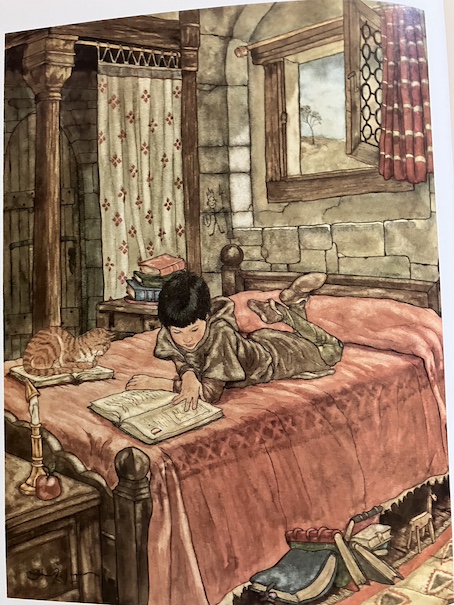
There is a shepherd whose son loves to read, borrowing books from a friendly member of the gentry who lives nearby. Not all parents from their class value book learning, but the boy’s parents appreciate it and support their son for spending time reading. One day, the shepherd comes home and tells his wife and son that he’s had a terrifying experience. While he was out with his flock, he heard a strange snoring nose, and when he went to investigate, he found a frightening-looking creature with scales, with its head sticking out from the cave.
The shepherd’s son isn’t as alarmed as the shepherd. He merely identifies the creature his father saw as a dragon. He knows about dragons because he’s read about them, and he’s thought for some time that the cave was probably a dragon’s cave. Rather than being surprised or alarmed about the dragon, his father’s discovery merely confirms what the boy already suspected, that a dragon might have lived in the cave once and that it would be a suitable dragon’s home. Furthermore, the boy says that dragons are quite sensitive creatures, so he might look in on this one at some point.
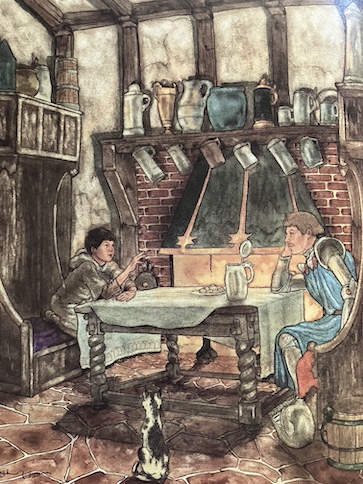
When the boy goes to visit the dragon, the dragon tells him he won’t put up with any rough stuff, like hitting or throwing stones. The boy says he wasn’t going to do any of that, and the two of them start to talk. The dragon hasn’t been staying in the cave for very long, and he’s not sure if he’s going to stay or not. It’s a nice place, but he’s not sure if he’s ready to settle down or not. He admits that he’s lazy, compared to other dragons. Other dragons do things like rampaging, chasing knights, and eating damsels, but this dragon would just prefer a quiet life with regular meals and time to snooze and make up poetry. The boy and the dragon talk about poetry and how it seems like nobody else around them appreciates it the way they do or understands why they like it.
However, the boy can see that there would be problems with the dragon settling in this area. Dragons and humans just don’t mix, even though this dragon isn’t interested in rampaging or doing the other things that would be likely to make enemies of the local population. Once word has gotten around that there’s dragon here, there are bound to be people who will try to hunt it with spears and swords because they’ll only see the dragon as a monster. The dragon has trouble grasping the idea that he could even potentially pose a risk to the human population or that anybody might see him as a danger.
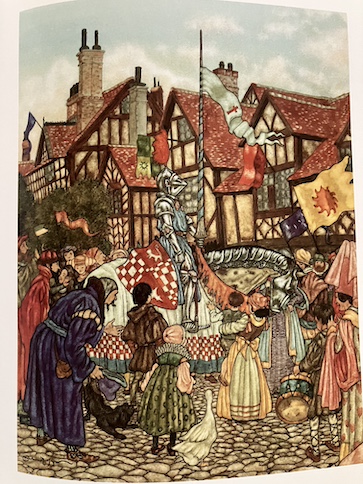
Eventually, word does get around that there’s a dragon living in the cave. The people in the village are both thrilled at this exciting thing happening to their village and plotting to rid their land from this supposed scourge, although the dragon has spent the entire time with his poetry and hasn’t been scourging anything. The village attracts the attention of St. George, the famous dragon slayer, and he comes to deal with the apparent problem.
The boy goes to the dragon and warns him that St. George is in town and that he’s got to prepare to face him and fight. Everyone in town is expecting him to, and they’re all excited about it because it’s the most exciting thing that’s ever happened there. However, the dragon says that he doesn’t like violence, and he doesn’t want anything to do with St. George. The boy worries that, if the dragon won’t take the threat seriously and fight, St. George will simply kill him, but he can’t seem to impress on the dragon just how much danger he’s in.
The boy tries to go to St. George and explain the truth about the dragon, but St. George doesn’t take him seriously at first. Everyone else in the village has been telling him tales of horror about the terrible things the dragon has been supposedly doing. The boy explains that the people in the village aren’t telling the truth because the truth is that they only want a fight. This is a quiet, boring little village, the villagers want excitement, and fights are a primary source of excitement for them. They don’t care at all that the dragon doesn’t like fighting and doesn’t want to be involved; they just want to stir things up with their stories and give St. George a reason to go over the dragon so they can watch the entertainment. When the boy explains that, right now, the villagers are taking bets on the upcoming fight, and so far, they’re favoring the dragon to win, St. George begins to think that maybe he’s been too quick to believe the villagers. He agrees to go with the boy to meet the dragon and talk things over.
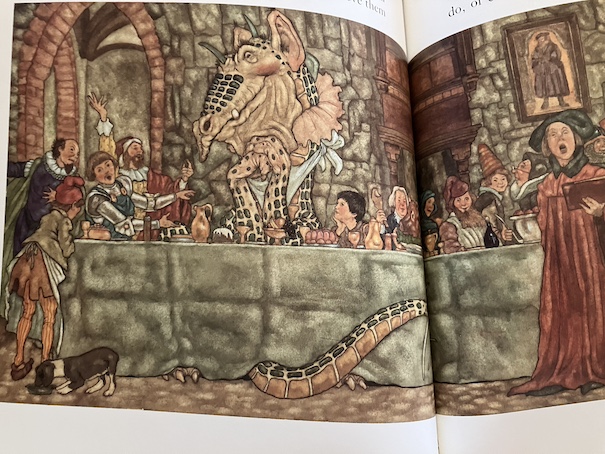
Both St. George and the boy think the best thing might be to have a fight and get it over with because that’s how things typically go with dragons, and it’s what everyone is expecting. St. George even says that he wouldn’t have to hurt the dragon much in the course of the fight, as long as it looks good to the spectators. The dragon isn’t thrilled with the plan because he still doesn’t like violence, and he doesn’t want to be hurt or even kind of hurt. The boy realizes that the dragon won’t be getting out of the experience, either. St. George would get the glory for the fight, but what’s in it for dragon? Fortunately, the dragon knows what he wants – to be the guest of honor at the victory banquet!
The book is available to borrow and read for free online through Internet Archive. The original story of The Reluctant Dragon was made into a cartoon film (with some slight changes to the story) by Walt Disney in 1941, and it was used as a vehicle for a film tour of the new Walt Disney Studios in Burbank, California.
My Reaction and Spoilers
This story is fun because it’s sort of a parody on folktales, especially St. George and the Dragon, subverting everyone’s expectations. The dragon in this story isn’t particularly fearsome and just likes poetry and a peaceful life, and the villagers, who are supposedly being terrorized, are actually the bloodthirsty ones. St. George is rather disappointed when he realizes that the villagers have been duping him with their stories, but he also realizes that they have to find a way to give the people what they want while sparing the dragon and making it so the dragon won’t be victimized later. Although the boy feels like they have to have a fight of some kind to appease the villagers, he also doesn’t want his dragon friend hurt, and he realizes that they have to consider what the dragon really wants.
The three of them work out a way to give the villagers a good show during their “fight” without the dragon getting really hurt. Then, St. George declares that the dragon has been defeated, and there is no need to cut off his head as the villagers have asked because the dragon has seen the error of its ways and repented, so there is no further need for vengeance. St. George’s victory speech also makes it clear to the villagers that he won’t put up with any more stories about the dragon’s terror because he knows that they can’t be true, that they should drop their prejudices because it’s pretty clear that they don’t know everything even if they act like they do, and that it’s wrong to make up stories about things that haven’t actually happened just for the excitement of doing so. I particularly like that last part of his speech/lecture: “And he warned them against the sin of romancing [in the sense of dramatizing and romanticizing things], and making up stories and fancying other people would believe them just because they were plausible and highly coloured.”
I feel like this is a lesson that more people could stand to remember this modern era of conspiracy theories, social media, and Internet rumors. Yeah, I’m particularly thinking of the stories about immigrants eating animals in Ohio. I’m never going to let that one go because everyone who fell for that and helped spread it was acting like the villagers in this story. They were irresponsible and attention-seeking, causing trouble and danger for people who did nothing to deserve it just for their own excitement and hysteria. It doesn’t help if people based some of their belief on old stories about other groups of immigrants eating pets. That actually makes it much worse because I know those stories were debunked decades ago, so they have even less of an excuse to fall for that now.
If you’re thinking at this point that the matter of rumors of pet-eating immigrants is unrelated to the story, I would argue that it fits in very well because, in both the story and in the real-life rumors, social acceptance is a major issue. The dragon wants to be socially accepted so he and stay in the cave that he now considers his home. He wants to be left in peace to compose his poetry but at the same time have the ability to have company and join in local festivities so he won’t feel too lonely. The problem is that the village people have their own expectations and plans to use the dragon as their personal source of excitement, uncaring about whether that costs the dragon his life or if it costs the knight his life while attempting to kill the dragon. They honestly don’t care who gets hurt or even killed as long as they get to see it, knowing that the stories they invent to tell St. George are necessary to make it all happen. Immigrants also want social acceptance and to be allowed to live their lives peacefully and go about their business in their new homes. People sometimes tell wild stories about them, things they made up themselves, knowing that they’re untrue and uncaring about the consequences for other people, for their own purposes.
The very first time I heard of the Springfield pet-eating hoax, I immediately thought of Janie’s Private Eyes, which I reviewed here years ago and contained references to similar accusations about immigrants. I read Janie’s Private Eyes when I was a kid, and since it dealt with the dangers of rumors and prejudice, specifically rumors about immigrants eating pets, I grew up figuring that these were things that adults should just understand and that only had to be explained to kids, who hadn’t heard about them yet. I don’t suppose everyone has read Janie’s Private Eyes, but I always thought, surely, by adulthood, they would have read something or had somebody clue them in at some point.
There was just no chance of me ever being impressed about humors of Haitian immigrants supposedly eating pets as an adult after hearing about long-debunked rumors about Chinese immigrants supposedly eating pets and Vietnamese immigrants supposedly eating pets and Mexican immigrants supposedly eating pets (I live in a border state, so other parts of the US may or may not have gotten around to that one). After all, how many sets of immigrants can you hear this about before it just becomes eye-rolling routine, like those dumb chain emails that used to be popular in the early 2000s or those supposedly shocking but highly improbable kidnapping stories you’re supposed to warn every young woman in your life about but which are almost direct rip-offs of badly-misspelled fan fiction from Wattpad that was written by teens around that same time period? In all those cases, they’re the some wild stories, just retold with a few minor details and the names of the characters changed.
Stories do matter. The ones we hear when we’re young live in our heads and influence the way we look at things when we’re older and how we respond to some of the questionable things that other people are bound to tell us later in life. In a way, I think it really helps to hear some of this bunk when you’re young, under circumstances where you can tell it’s bunk or with someone cluing you in, so you can get some of these ideas out of your head earlier in life and be better able to tell what’s old-fashioned, sensationalist bunk from someone playing up for attention when you’re an adult. I think that The Reluctant Dragon, although it can be taken in a lighter fashion as parody or satire by people who know the type of stories that are being parodied, also offers the opportunity to talk about the power of stories, how they change people’s views and motivate people to action, and the serious consequences of rumors.
Maybe some of the people spreading the Internet rumors really were ignorant and gullible, easily alarmed and manipulated by a wild story, and maybe some of them just wanted in on the excitement to get attention for themselves and never cared whether it was true or not as long as they could latch on to the attention the story was getting and make themselves part of it. I’m pretty sure that the people starting them and passed them on wanted excitement and attention. There is a certain thrill to passing on rumors, feeling special because you “know” something other people don’t know yet and maybe even wanting praise as well as attention for passing the story along. Maybe some of those people also wanted to get some kind of petty revenge on the immigrant population by saying something bad about them, they expected that people would believe them if they made the stories seem dramatic and plausible (like St. George said in the story), and like the villagers in the story, they did not think or care about what would happen to the people who were the subjects of their libel.
It’s the same sort of thing with most social media rumors, which often contain little truth and can do a lot of harm by people believing them and continuing to spread them, which is why I’m against them all in principle. I urge everybody, when you hear any sensational story through Facebook or any form of social media, to pause and do a little fact-checking before you send that story to anyone else. If you can’t verify it or if you find evidence against it, make no other comment on it other than a link to the evidence against the story (if possible) and a message saying that you don’t want to see any more rumors or conspiracy theories. (At least, I sincerely hope you don’t. I’m telling you, they’re only trouble, and real people get hurt because of fake news.)
In real life, I doubt most people, being told off, even in a nice way, for making up stories and getting caught in lies, would behave with as much grace as the villagers in the story. In real life, people get defensive when they know they’ve been caught and “fight back”, but the villagers just accept it as part of the excitement they wanted and focus on getting to the party they know they’re going to have. During his speech, along with his other admonishments, St. George lets the villagers know, subtly, that he’s discovered that they’ve also been staging animal fights and that this practice is going to have to end, and the villagers all know that he’ll personally be checking on that. At the end of St. George’s speech, there is “much repentant cheering”, and they all go to enjoy the banquet. If people are feeling a little awkward about their behavior or the situation, they’re still determined to enjoy themselves and this remarkable event as much as possible. Everyone relaxes at the banquet because the major event is over, everybody has had a taste of excitement and the spectacle they were craving, and St. George’s speech is over, so there’s nothing left for anybody to plan or worry about. Everybody has a good time at the party, and the dragon is pleased that he’s been accepted into society, so he will be allowed to stay in this peaceful place and even have some company, which was what he really wanted.





















 Jestress's Forgotten Books and Stories