The Plain Princess

The Plain Princess by Phyllis McGinley, 1945.

I would dearly love to see this book in print again!  It’s a charming modern fairy tale about a young princess who learns what beauty and happiness really mean.
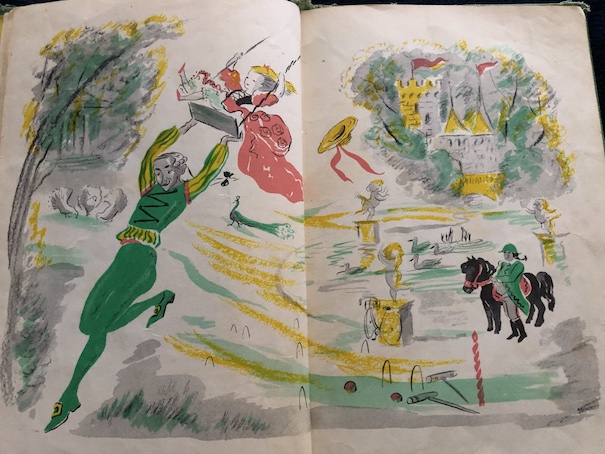
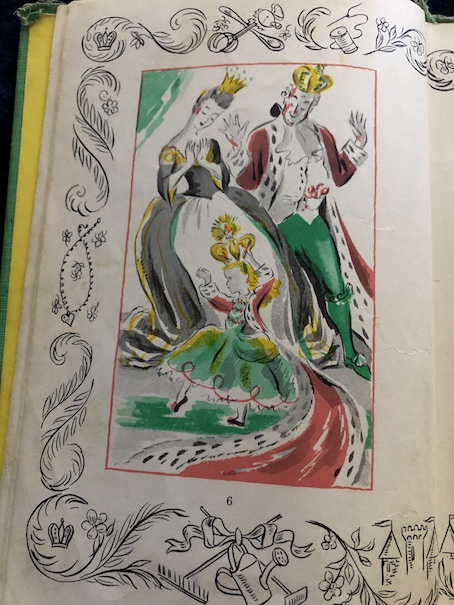
Esmeralda is the only child of the king and queen, and she has just about everything that a girl could want. The author paints a pretty picture of Esmeralda’s charmed life at the castle and all of the beautiful things she has.
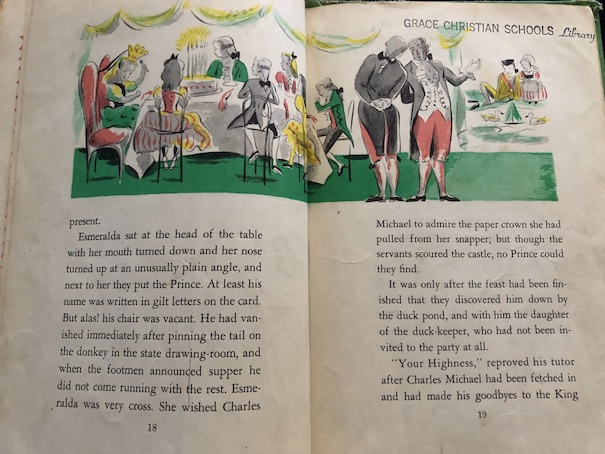
However, Esmeralda has one serious problem: she is plain. In her kingdom, in order for a girl to be considered beautiful, her nose must turn down, her mouth must turn up, and her eyes must have a twinkle in them. Esmeralda’s appearance is exactly the opposite. It is a serious problem because her plainness causes people to lose respect for her, and the prince that she is betrothed to refuses to take much of an interest in her.

Although her parents consult the finest physicians and wizards available, none of them can provide any solutions for Esmeralda’s condition. It is only after the king places an advertisement in the newspaper that a widow, Dame Goodwit, with five daughters of her own comes to the castle and offers a solution. However, she insists that Esmeralda must come and live with her family for nine months. At first, Esmeralda is distressed at leaving her home and living in much simpler circumstances that she is accustomed to, but the reasons soon become as plain as the princess herself.

As Esmeralda interacts with and becomes friends with Dame Goodwit’s daughters, Annabelle, Christabelle, Dulcibelle, Floribelle, and Echo, she comes to see herself and her old life at the castle differently.  At Dame Goodwit’s, she is expected to take care of herself and her belongings by herself, for the first time in her life.  She is given chores to do and becomes responsible for herself in ways that she never was before.  She also comes to see that, even though Dame Goodwit’s daughters are not princesses, in many ways, they are more knowledgeable and accomplished than she is, able to do many things that Esmeralda has never even tried before.  Little by little, Esmeralda learns and tries new things, even coming to enjoy her time with the family and becoming especially fond of little Echo, the youngest girl.  Her new experiences change her, her behavior, her attitudes, and eventually, even the way she looks.

The book is available to borrow and read for free online through Internet Archive.
My Reaction

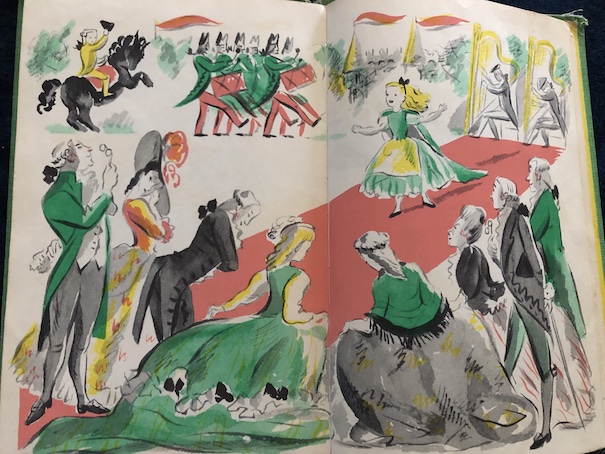
In spite of the fairy tale atmosphere, there isn’t really any magic in the story, as the widow herself points out. The real magic of the story is in the lessons that Esmeralda learns: that beauty and change come from within and that the way we see ourselves and those around us is important. For those who might be concerned at the emphasis on “beauty” and “plainness”, it soon becomes apparent that the outward signs of beauty really stand for positive character traits: humility, pride in one’s own talents and accomplishments, and unselfish caring for other people. The book also has some very pretty illustrations, some of which are wide scenes taking up two pages. It’s a beautiful book and a beautiful story for any young girl.

I don’t think that the book was ever made into a movie, but there are multiple versions that are stage plays (the link is to a video clip from a stage version of the story), including some that are musical.  I have seen a script for one of them that has added religious themes that weren’t in the original book, but the site has since been removed.  I’m sure that the script still exists, I’m just not sure where to find it now.  Some of the narrator’s and characters’ dialog was taken directly from the original book, but the religious parts were added.  As I recall, it implied that the princess’s personality changes came through the grace of God or developed as her religious side also developed, but I can’t remember now exactly how they said it.  I think it may have included some Biblical quotes related to the personality traits the princess acquires.  At one point, it was the only script that I could find available for free online.  There are other play versions that are available for purchase elsewhere, such as Dramatic Publishing and Steele Spring Stage Rights.

The Case of the Haunted Health Club

HauntedHealthClubThe Case of the Haunted Health Club by Carol Farley, 1991.

This is the third and last book in the Flee Jay and Clarice Mysteries.

The story begins with Flee Jay talking about how she fell in love with mystery stories when she was younger after she found a mystery for adults that had accidentally been shelved in the children’s section of the library.  Although the book was about a murder where the body was hidden inside a snow man and was really too scary for a girl her age, she was captivated by it, wondering what was going to happen next.  It was a shame that the librarian caught her reading it, so she never got to find out how it ended.  But, it does inspire her to find part of the solution to this mystery, a part that stumps even Clarice.

The mystery that confronts Flee Jay and Clarice this time concerns a fortune teller and her nephew.  The fortune teller used to live in their town, and the girls’ parents even went to her to have their fortunes told when they were teenagers.  Now, she’s returned along with her nephew in order to revive the health club that her late husband owned when they were living in this town.  When the girls go by the health club to take a look at it, they find the fortune teller unconscious on the floor.  She says that there must have been something in the tea she was drinking and that “the spirits” have been trying to convince her not to get involved with the health club.

HauntedHealthClubPicFlee Jay thinks this is spooky, but Clarice doesn’t believe in spirits.  In order to investigate further, the two girls accept part time jobs helping the fortune teller and her nephew to clean up the building so they can move in new exercise equipment.  “The spirits” continue sending warnings in the form of red dye in the Jacuzzi and threatening messages.  Clever Clarice uses logic to point out how most of these things were accomplished but is surprised when Flee Jay reveals something that she overlooked.
Although I like the first two books in the series better, the ending of this one makes it worth reading.  Clarice may be the genius who usually reveals the solution to the mystery, but Flee Jay is a girl detective after all!

This book is currently available online through Internet Archive.

The Case of the Lost Lookalike

LostLookalike

The Case of the Lost Lookalike by Carol Farley, 1988.

“I want to swoop in and spout out the answers to baffling mysteries while everyone around me blinks in befuddlement.  I want to reveal the amazing solutions to puzzles while everyone gasps in admiration.  Except the criminal, of course, who gasps for other reasons.”
— Flee Jay Saylor

This is the second book in the the Flee Jay and Clarice Mysteries.

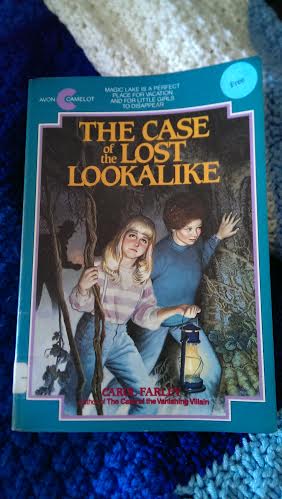
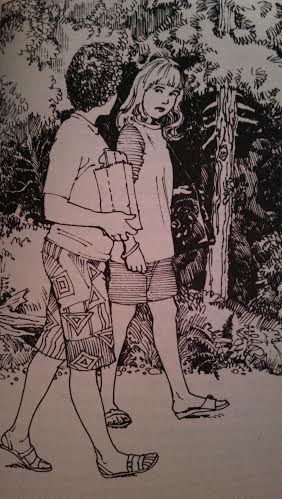
In The Case of the Lost Lookalike, Flee Jay and Clarice are spending the summer at a lake with their aunt, and someone there says that Clarice is the very image of a little girl named Caroline who was apparently kidnapped 40 years ago.  Little Caroline disappeared from her own bedroom one night after her mother died under rather suspicious circumstances.  Most people assume that Caroline is dead, too.  The girl’s father is now a strange recluse who lives on an island in the middle of the lake.

LostLookalikePic

But, as the girls puzzle over this old mystery, other mysterious things begin to happen.  A woman produces pictures of the missing girl which look nothing like Clarice.  Then, her shop is broken into, and the pictures of Caroline disappear.

When someone persuades their aunt to let the girls visit the old recluse on the island, the man’s reaction is surprising, and they come to realize that Caroline’s disappearance might not be the real issue at all.  Clarice takes some frightening risks to get to the bottom of the mystery!

My Reaction

In a way, this story is two mysteries in one because Clarice figures out what really happened to Caroline when she disappeared years ago at the same time that the girls unravel the mystery that is affecting people who live in the small town by the lake now.  The mystery of what happened to Caroline would not have resurfaced at this particular time if someone else hadn’t brought up the issue as a distraction from something else.

What I like best about this series is the sense of humor and the way that Flee Jay says things as she narrates the story: “I mean, new cottages and magic lakes are terrific and all that, but nothing can ever take the place of a peanut-butter, brown sugar, and banana sandwich.”

The Case of the Vanishing Villain

The Case of the Vanishing Villain by Carol Farley, 1986

As you can see, my copy of this book has been … well-loved.

This is the first book in a series about two sisters, Flee Jay (short for Felice Jennifer) and Clarice Saylor. Twelve-year-old Flee Jay wants to be a detective, just like in the books she’s read, but her pretty younger sister is a child genius who has more aptitude for it. Clarice is somewhat eccentric for a ten-year-old, but she is also intelligent and logical and has a memory for details and obscure facts. Throughout the series, the two of them kind of compete to solve mysteries. Although Clarice usually comes up with the solution before Flee Jay, it usually takes the two of them together to get to the bottom of things because Flee Jay is an average kid who behaves like an average kid and helps Clarice understand how average people behave.

The story begins with an explanation and a request for help from Flee Jay. She and her genius younger sister, Clarice, were taking an early morning ferry from Michigan to Wisconsin to visit their grandparents when a series of strange events connected with an escaped convict took place. Clarice managed to solve the mystery, but Flee Jay wants readers to go through the events as they happened to see whether any normal person could have solved the mystery like Clarice did.

From that point on, Flee Jay describes what took place from the moment they arrived at the ferry until just before the ferry docked at its destination. She introduces all of the strange passengers on the ferry, including a family of three women who may have unwittingly brought the convict on board, a woman with an annoying barking dog, a bearded man with a guilty secret, and the overly-attentive ship’s steward, Mr. Woolsey, who is keeping an eye on the girls during the trip.

VanishingVillainPic

From the moment that Flee Jay learns about the escaped convict from Clarice, who “accidentally” overhears the police and Mr. Woolsey talking about him through a vent while standing in the sink in the ladies’ room next to Mr. Woolsey’s office, Flee Jay wants to be the one to find him. At first, they don’t really know whether he’s on the boat or not, but when the boat is underway, a woman screams that there was a strange man in her stateroom, and then, they’re pretty sure. Flee Jay and Clarice take it upon themselves to consider all the hiding places and to question the other passengers. Of course, Clarice produces the solution to the puzzle, but she does credit Flee Jay with inspiring her. According to Flee Jay, she just figured things out because she’s nosy, but that’s left to the readers to decide.

Join eccentric 10-year-old genius Clarice and her long-suffering sister as they try to put the pieces together to keep the convict from getting away right under the noses of the authorities!

The book is written with humor and is fun to read. The clues fit together neatly, and the black-and-white pictures, list of characters, and map of the inside of the ferry help readers understand the action.

The book is currently available through Internet Archive.

Forgotten Books and Stories

Remember that book you read as a kid?  You know the one.  It had that guy in it.  Or maybe it was that girl. Actually, it was probably both.  And there was a mystery to solve!  They went on an adventure.  There was something magical about it.  And it all ended happily!  I think.  Anyway, it was something like that.

But, after all these years, it’s hard to remember exactly how it all went.  Now, the book is out of print.  You could probably find it somewhere, if you remember what it was.  Maybe you’d like a copy, or maybe you’d just like to remember exactly how it went.

There are a number of sites on the Internet now where you can submit descriptions of a book you’re looking for, as much as you can remember about it, and see whether or not anyone recognizes it.

This site is more the opposite.  I haven’t read all the books in the world, but I’m a notorious book hoarder, and I have a particular interest in children’s literature.  This is mostly an opportunity for me to talk about old favorites.  These aren’t the kind of books that are on award lists (for the most part), and most of them are long out of print, forgotten or half-forgotten by everyone except for me and a few other people who had fun reading them years ago.  Take a moment to think back on stories you loved as a kid, the ones that made you dream of being a detective, a dancer, an astronaut, or maybe a wizard, or maybe just made you wish you could go back in time to another place . . .

Most of the books I liked when I was young were mysteries, fantasies, or historical novels.  I might offer some spoilers if someone else remembers the story and wants to know how it ends or just wants more information about it.  If someone wants to recommend a book for discussion, let me know!