The Pharaohs of Ancient Egypt by Elizabeth Payne, 1964, 1992.
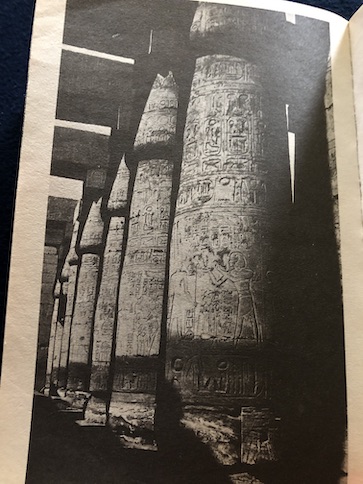
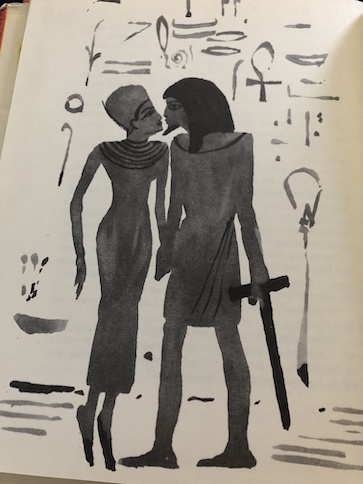
This is a book for kids about the lives of Egyptian pharaohs, including Hatshepsut, Akhnaton, and Rameses the Second. It also includes details of Ancient Egyptian history, daily life, and religion. I would put the difficulty level of the book around the middle school level. It’s a chapter book with very few pictures and more dense writing than others I’ve read in the same series. It’s one of the Landmark Books (called Step Up Biographies in earlier printings).
Egypt is among the world’s oldest civilizations, having a long history, extending over thousands of years. The Ancient Egyptians created a powerful legacy that has influenced other civilizations for millennia.
In the early days of Egyptian civilization, groups of small villages that early settlers had established along the Nile joined together to form kingdoms. At first, there were three of them:
The Bee Kingdom in Lower Egypt — at the Nile delta, on the Mediterranean
The Reed Kingdom in Middle Egypt — near the site of modern Cairo
The Hawk Kingdom in Upper Egypt — near the rapids that lay between Egypt and the Nubians to the South
If you’re wondering why “Lower Egypt” was in the northern part of Egypt and “Upper Egypt” was in the south, it’s because the Ancient Egyptians weren’t concerned about north and south with regard to their kingdoms. They lived along the Nile, their major source of water and transportation, and when they thought about the relations between cities and kingdoms, they were most concerned about whether they were upriver or downriver. So, “Upper Egypt” was the kingdom farthest upriver, and “Lower Egypt” was the one that was farthest downriver. The Nile just happens to flow from south to north.
Then, around 3200 B.C., the Hawk King known as the Scorpion conquered the kingdom in Middle Egypt. His successor Menes (also called Narmer), who ruled both Middle and Upper Egypt, conquered Lower Egypt as well, turning Egypt into a single nation with a single king. However, there were still rivalries between Upper and Lower Egypt, and the people in different regions spoke different dialects.
The Ancient Egyptians believed that their kings, called Pharaohs, were half-human and half-god. Part of the reason for this belief may have been because the Egyptians believed that a partially-divine ruler could help ensure that life in the Nile Valley could continue smoothly by appealing to his godly relations and partly because, if the king wasn’t completely human, he could be considered above the rivalries between the different regions and remain a unifying figure for the Egyptian people, no matter which region he had come from originally.
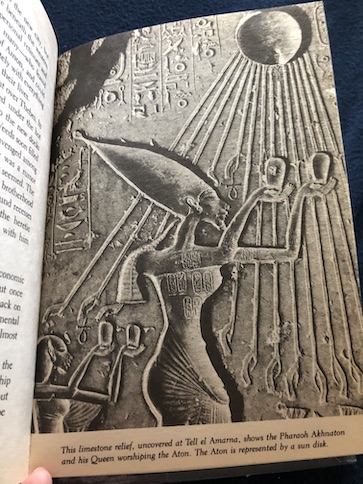
Although most Ancient Egyptians were polytheistic, like other ancient civilizations, there was one pharaoh who believed in only a single, all-powerful god. This pharaoh was Akhnaton, the father of Tutankhamen. (The book refers to Tutankhamen as a younger half brother of Akhnaton, but later sources say that he was Akhnaton’s son, although there is still some dispute about that. Either way, the two were related, and Tutankhamen was Akhnaton’s successor.) Akhnaton worshipped the sun, calling the sun god Aton. Part of the reason for this conversion to the worship of a single sun god instead of the many gods of the Ancient Egyptian pantheon may have been due to a power struggle between the pharaoh and the High Priest of Amon. However, Akhnaton seemed to genuinely believe in the Aton and was devoted to it, establishing a new capital city and outlawing worship of other gods. Unfortunately, his health was frail, and worship of the Aton didn’t extend beyond his death around the age of 42, with Egyptians returning to worship their old gods. Tutankhamen, who had been born Tutankhaton, changed his name and moved the capital away from Akhnaton’s city. Tutankhamen’s reign was short. He died in his late teens. (The cause of his death has never been precisely determined, although it seems likely that it was a combination of ill health, possibly a congenital condition due to inbreeding in the royal family, malaria, and a physical injury.) Tutankhamen’s main source of fame is his tomb, found largely intact in November, 1922.
Dynasties of Egyptian Pharaohs ruled Egypt for thousands of years, although in the later centuries of Ancient Egypt, foreign rulers moved in and took control for long periods. Then, in 332 B.C., Alexander the Great conquered Egypt, bringing it under Greek and Macedonian control and ending the reign of Egyptian Pharoahs forever.
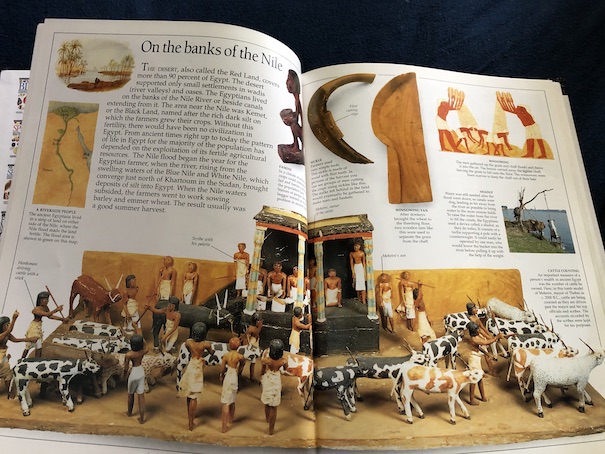
I love the way this book, like others in the Eyewitness series, shows photographs of artifacts so readers can not only read about how people lived but see the objects that they used. Each photograph in the book has a caption to explain what it is.
The book begins with an explanation about the origins of Ancient Egyptian civilization thousands of years ago, before there were pharaohs. Then, it explains about the geography of Egypt and the Nile and how the Nile floods and fertile lands along the river made Egyptian civilization possible.
The book then explains the concept of the Egyptian king as a “pharaoh.” The title of “pharaoh” comes from an Ancient Egyptian word meaning “great house”, referring to the palace where the king lived, so the king was the one who lived in the “great house.” However, the pharaoh was more than just the an important man living in a palace; he was also regarded as being a god. Most Egyptian rulers were male, although queens also sometimes ruled and were also regarded as divine. The book shows pictures of statues depicting pharaohs and explains a little more about some of the most famous pharaohs and queens. Then, it goes on to discuss life in the royal court.
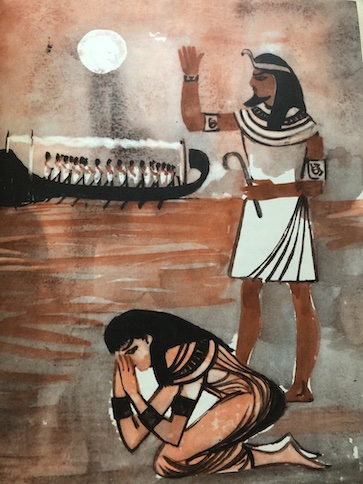
Of course, no book about Ancient Egypt is complete without a discussion of mummies and tombs. Much of what we know about Ancient Egypt comes from what the Ancient Egyptians left in their tombs because Ancient Egyptians believed in life after death. They developed methods of preserving their bodies after death, and they stocked their tombs with things that they wanted to have with them in the next life. The book explains the embalming process, what pyramids and royal tombs were like, who the Egyptian gods and goddesses were, and what Egyptians believed about the journey to the afterlife.
I liked how the book not only explains different types of gods and goddesses in Ancient Egypt but also the roles of priests and temples in Egyptian society, types of religious rituals, and the role of religion and magical rituals in Ancient Egyptian medicine.
As the book covers a wide variety of different topics in Egyptian society, including scribes and writing, weaponry, and trading. I particularly like the parts focusing on daily life, like what Egyptian homes were like and some of the tools and details of different trades, like carpentry. The book has details about foods Ancient Egyptians ate, what music and dancing were like, and types of clothing and jewelry they had.
One of my favorite sections in the book is about toys and games in Ancient Egypt. We don’t know all of the details of games that were played in Ancient Egypt, but we do know that they had board games because they were found in tombs. Children’s toys were whimsical and included moving parts. Some of the games children played are similar to ones that children play today, like versions of leapfrog and tug-of-war and spinning tops.
The book is available to borrow and read for free online through Internet Archive (multiple copies, including some in different languages)
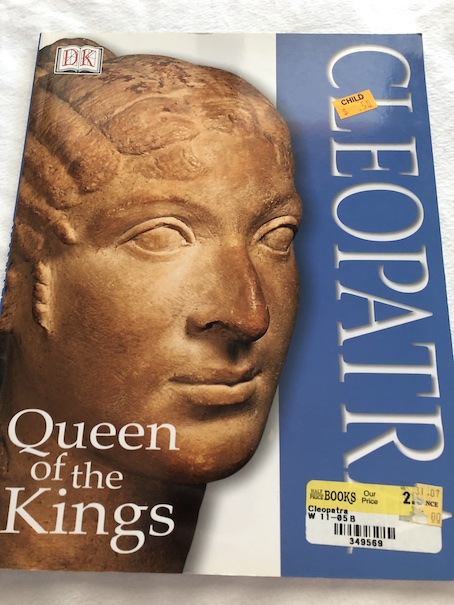
Cleopatra: Queen of the Kings by Fiona MacDonald, illustrated by Chris Molan, 1998, 2003.
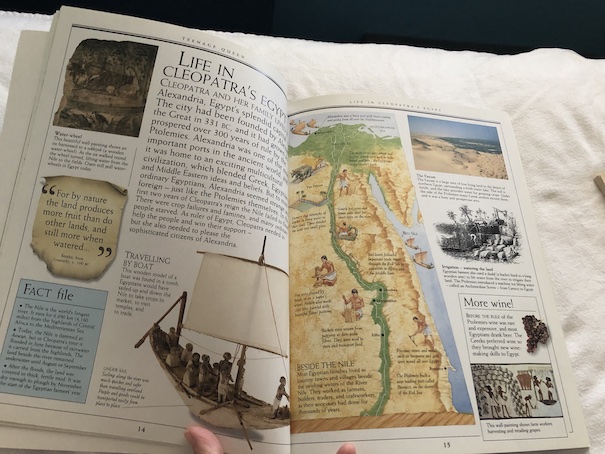
I always like books from DK Publishing because they have great illustrations, and they do a good job of helping to explain nonfiction topics, including different periods of history. However, one thing that’s important to realize is that you really have to read all of the small text that accompanies even the small pictures in order to get the full story. If you don’t, you may miss important details. Although this is a picture book, the detailed nature of the information and some of the dark subject matter make it inappropriate for young children.
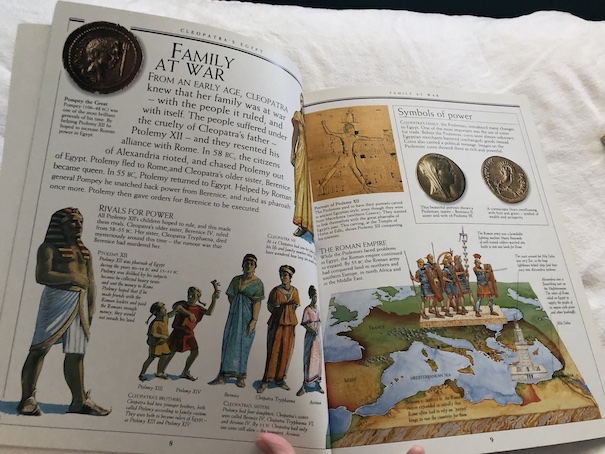
This particular book is about the life of Cleopatra, the famous Egyptian queen. The queen we know as simply Cleopatra was actually Cleopatra VII. She was part of a dynasty of Egyptian rulers who were originally from Macedonia, a region of Greece. This dynasty was known as the Ptolemaic Dynasty because all of the kings in the dynasty were named Ptolemy, including Cleopatra’s father, Ptolemy XII. There were certain names that were repeated in every generation of the family and even within generations, like Ptolemy (Cleopatra’s two brothers both had this name), Cleopatra (Cleopatra also had a sister who was also named Cleopatra), and Arsinoe (Cleopatra’s younger sister). The book doesn’t fully explain why they came from Macedonia, but one of Cleopatra’s ancestors, Ptolemy I, was a Macedonian nobleman and a friend of Alexander the Great. Ptolemy I went with Alexander the Great on his military campaigns. Through his service to Alexander the Great, Ptolemy I was made the Greek governor of Egypt, ruling from the city Alexandria, which had been established by Alexander the Great. Alexandria was an important port city as well as the seat of the royal family. It was a gathering place of traders, scholars, and people from different cultures in Egypt, although average Egyptian citizens viewed it more as city of foreigners, just as the royal family itself was also foreign. That’s an abbreviated explanation of the family’s history, but it helps to understand that, while the family ruled Egypt for generations, they remained culturally Greek. The book mentions that most of the members of Cleopatra’s family only spoke Greek and that Cleopatra departed from the norm by learning to speak Egyptian.
Cleopatra was born into tumultuous times in the history of Egypt and her family. Her father was known as a cruel ruler who taxes his people heavily and sent large amounts of money to Rome, attempting to befriend Roman leaders and bribe them not to invade Egypt. In 58 BC, Alexandrian citizens had enough of Ptolemy XII and the way he catered to Rome, and they revolted, forcing Ptolemy XII to flee the city for Rome. Cleopatra was only fourteen years old at the time. Members of the family were left behind in Alexandria when Ptolemy XII fled, and Cleopatra’s oldest sister, Berenice claimed the throne in her father’s absence. The Ptolemies were always focused on maintaining their power, even in the face of competition or opposition from family members, and they were not afraid to fight or even kill each other to maintain control. Berenice may have murdered another of her sisters during her time as queen because she died under mysterious circumstances. However, when Ptolemy XII returned to Egypt a few years later, he had Berenice executed as a rival for the throne. By then, Cleopatra was the oldest surviving child of the family, with only her youngest sister and her brothers still alive.
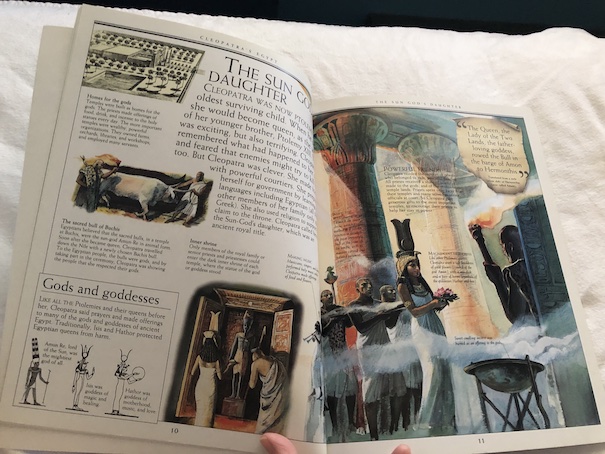
A few years later, Ptolemy XII died, and Cleopatra acted quickly and prudently to secure both her life and her power. Her younger brother, Ptolemy XIII, had a claim to the throne, but he was still only twelve years old, and Cleopatra was eighteen. Asserting her authority over her child brother, Cleopatra took the throne as the oldest remaining offspring of Ptolemy XII and married her brother in order to turn her brother from a rival for power into a further source of her own authority. She could then rule on her brother’s behalf as his wife as well as his older sister. (Other Egyptian rulers had married close relatives for reasons like that. Tutankhamen was similarly the result of an incestuous royal relationship.) As queen, Cleopatra called herself the Sun God’s Daughter, an old royal title that tied her image to rulers of the past and the gods of Ancient Egypt.
From the beginning, being queen was a difficult task for Cleopatra. There were famines in Egypt during the beginning of her reign, and Cleopatra had to manage a response that would satisfy the citizens that she was doing her job as ruler. Family rivalries were also an ever-present danger. Cleopatra knew that she had enemies in her court, including people who favored her brother over her. As her brother got older, he became dissatisfied with the way his sister was ruling without sharing power and authority with him. For a time, Ptolemy XIII forced Cleopatra to flee Egypt and go to Syria. Cleopatra took her sister Arsinoe with her, both to protect her from their brother and to prevent her from trying to seize power herself. (In the Ptolemy dynasty, either could be a possibility. When family members weren’t in danger from each other, they could be a danger to each other.)
In the meantime, Julius Caesar came to Egypt to collect a debt that he claimed that Cleopatra’s father had owed him. He arrived during the power struggle between Cleopatra and Ptolemy XIII, and he decided that it would be for the best to try to mediate peace treaty with the two of them. He wanted to meet with both Cleopatra and Ptolemy XIII together, but Cleopatra knew that there was a risk that she might be killed if she showed up for a meeting. Yet, she did want to meet with Caesar because she recognized that he could be an important friend and source of protection for her. She ended up visiting Caesar in secret. According to legend, she had herself delivered to Caesar’s room in a rolled-up carpet. Caesar was charmed by Cleopatra and became her ally. When the news of their alliance spread, it tipped the balance of power in the royal family. Caesar learned that Ptolemy XIII’s adviser was plotting against him and had him executed. Ptolemy XIII fled with Arsinoe to join the Egyptian army and was later killed and found dead in Alexandria’s harbor. Getting rid of her brother/husband and his advisers secured Cleopatra’s position. She had one remaining brother, Ptolemy XIV, who was only eleven years old at the time, so she married him, too, further solidifying her power. As her ally (and possible lover), Caesar provided her with guards for her safety.
Cleopatra had a son named Caesarion, who was rumored to be Caesar’s son as well. However, Romans feared that Julius Caesar would proclaim Caesarion as his heir. They didn’t want him as the future ruler of Rome, citizens were appalled at the way Arsinoe was paraded through the streets as a war prize, and people generally began to fear that Caesar was becoming too powerful. In 44 BC, Caesar was assassinated by a group of senators. Cleopatra was in Rome when Caesar was killed, and she fled back to Egypt with her son. Around this time, Ptolemy XIV disappeared, and he may have been murdered by Cleopatra. With a son to inherit her throne, Cleopatra no longer needed Ptolemy XIV. However, her Roman protector was now gone, and Cleopatra still had enemies at court. Cleopatra’s remaining sibling, Arsinoe, sided with Caesar’s enemies and plotted against her sister and Caesarion.
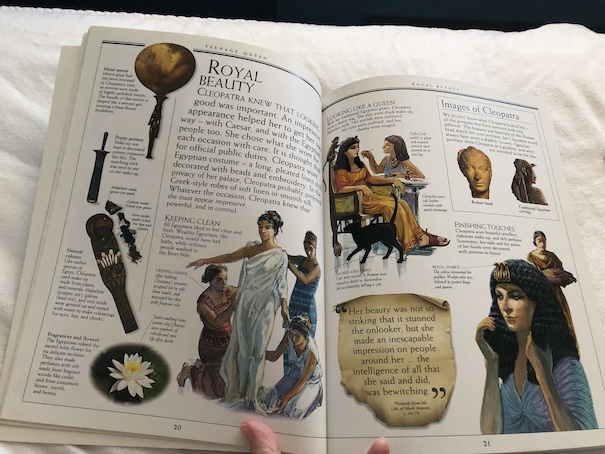
Nobody knows exactly what Cleopatra looked like (statues and carvings of her don’t always look alike, and they may have been idealized images of her), but she took care of her appearance as part of her image as queen. Apparently, Cleopatra was more striking than beautiful, and what struck people about her the most was her intelligence and personality. Her charm was one of her most important tools in winning allies, and she used it again to win over a new ally to replace Caesar. She found a new ally in Marcus Antonius (also known as Mark Antony), one of the candidates to replace Caesar in Rome.
Mark Antony needed the control of Egypt and its resources and the support of Cleopatra for his own political purposes. To win his support for her purposes, Cleopatra began a romantic relationship with Mark Antony that eventually became a major part of the legends around Cleopatra. Although Mark Antony already had a wife in Rome, he became devoted to Cleopatra and fathered a set of twins with her and, later, a third child.
When Caesar’s nephew, Octavian, learned that Antony had divorced his wife and was conspiring against him, he declared war on Egypt to take down both Antony and Cleopatra. Cleopatra and Antony’s forces were defeated at the Battle of Actium although the two of the escaped. Feeling that the end was probably near, Cleopatra had stoneworkers hurry to complete her tomb. She began experimenting with poisons, and she and Antony swore to each other that they would die together. When Antony’s soldiers turned against him and refused to fight, Antony was disgraced and forced to flee. He ended up taking his own life by stabbing himself. Cleopatra had retreated into her own mausoleum, planning to die, but Octavian allowed her to remain there as a prisoner while she arranged Antony’s funeral. The exact cause of Cleopatra’s death has never been confirmed, but according to legend, she arranged her own death by the bite of an asp and sent a note to Octavian, asking that she be buried with Antony.
It’s a tragic end to a story that was full of treachery and family rivalries from the very beginning. Octavian refused to allow any of Cleopatra’s children to assume the throne of Egypt, ending the reign of pharaohs forever. Rome took control of Egypt, and Cleopatra’s children were sent to be raised by Antony’s first wife in Rome, Octavia (who was also Octavian’s younger sister). Caesarion tried to flee to Syria, but he was caught and executed by Octavian’s orders. No one knows what happened to Cleopatra’s other two sons because they disappear from historical records after this point, so they may have died young (or were murdered, given how things went in the powerful circles in which they lived). However, Cleopatra’s daughter survived, grew up, and eventually married the King of Mauretania, a region in North Africa. The book mentions that she had a son that she also named Ptolemy, but it doesn’t mention that this Ptolemy was the last king of Mauretania and was assassinated by Caligula. Caligula and Ptolemy were distant relatives of each other because Ptolemy of Mauretania was a grandson of Antony, and Caligula was descended from both Antony and Octavian. In many ways, it seems like this family’s greatest misfortunes were themselves and each other. Fortunately, the death of death of Ptolemy of Mauretania didn’t end the family line. It’s unknown whether or not Cleopatra has living descendants today, but Ptolemy of Mauretania did have a sister (the details of her life are unknown) and a daughter named Drusilla, who apparently grew up, married, and continued the family line. Further down the family tree, relationships and offspring become harder to trace.
Something I particularly liked about this book was the separation between the legends of Cleopatra and the her known history. As with other ancient historical figures, the history and legends go hand-in-hand, and it can become difficult to separate the two. The book is pretty open about which parts of her life are known, what can’t be firmly established, and which parts of her story come to us from legend and may or may not be reality. The final section in the book discusses the known facts and fiction about Cleopatra and possible confusions between her and other Cleopatras in her family (which may be another reason why not all of the images of Cleopatra look alike). It also explains the information about Cleopatra in Plutarch‘s biography of Mark Antony and how his stories inspired Shakespeare’s play and modern movies about Cleopatra.
The book is available to borrow and read for free online through Internet Archive.
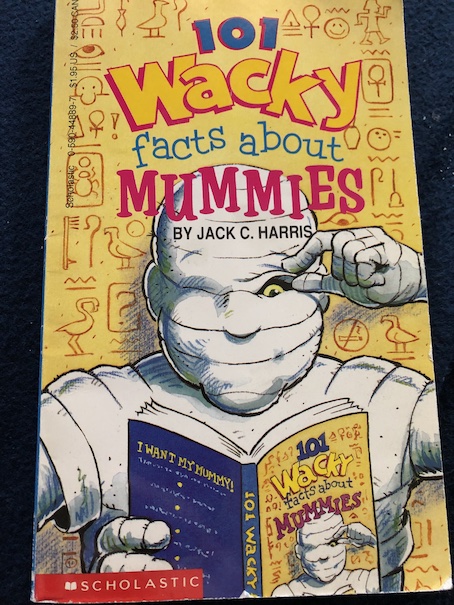
101 Wacky Facts About Mummies by Jack C. Harris, 1991.
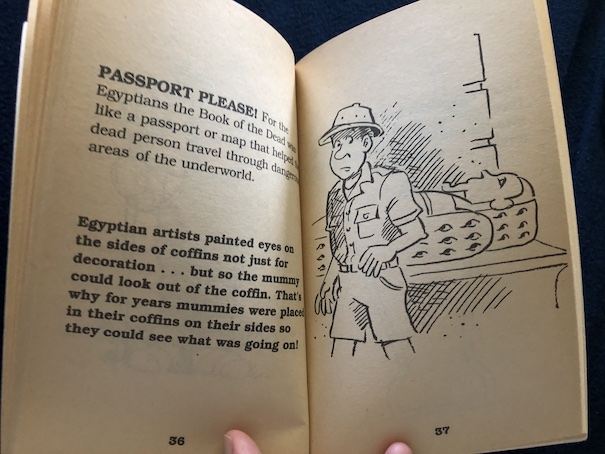
This is a book of fun facts about mummies, particular ones from Ancient Egypt, but also ones from other parts of the world. Some of the facts and trivia have to do with the way mummies are made, and others have to do with the discoveries of mummies in modern times.
Here’s just a sampling of the kinds of facts the book offers about mummies in each section:
Will the Real Mummy Please Lie Down? – Basically introduces what mummies are and basic methods for making them and mentions that they’re thousands of years old and that many still have fingernails and toenails.
Egyptians: The Mummy-Making Masters – Facts specifically about Egyptian mummies, including the fact that the Ancient Egyptians never wrote a guide to how to make mummies and few sources have been found with any description of the process, so no one knows precisely what combination of preservatives they used.
Wrap Session! – More about how Egyptians made mummies, including how they removed bodily organs and stored them separately from the body, probably throwing away the brain because they thought that the heart was more important, believing it to be where intelligence and memory were stored. Sometimes, mummies were also painted in different colors to indicate if they were male or female – males were painted red, and females were painted yellow. Fingernails and toenails might also be capped with gold.
The First Mummy-Wrappers – This section is about the Egyptians who embalmed mummies. It was a profession that was generally passed down through families, and they lived in a special area of their city because other people didn’t want to live near people who handled dead bodies for a living. However, the embalmers often had servants or slaves who would be made to do the worst parts of the embalming.
Tomb It Make Concern – This section is about the construction of pyramids and tombs. Because they took years to construct, pharaohs would start the construction of their own tombs immediately on taking the throne.
Farewell, Mummy Dearest – This section talks about funerals, mourners, and what Egyptians believed about the afterlife.
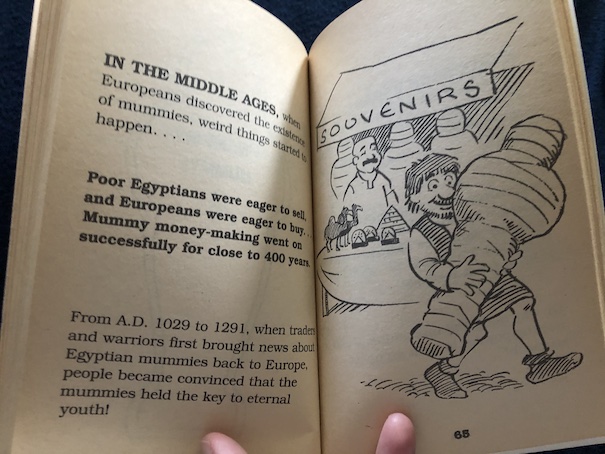
I Want My Mummy! – This section discusses things later people did because they were fascinated by ancient mummies. Sometimes, poor Egyptians would dig up mummies to sell or create fake mummies to satisfy demand. Sometimes, mummies were used in medicines because people believed that the secrets of their preservation could be used to heal the living or help them maintain their youth. During the 19th century, some people would hold “mummy unwrapping” parties, where they would show off and unwrap a mummy they had purchased.
The Chinchorro Connection – This section is about South American mummies.
Natural Beauties! – There are natural conditions that can preserve human bodies, like the cold in high mountains and the acids in peat bogs.
Better Left Shut: The Tomb of King Tut – King Tut’s tomb is one of the most famous Ancient Egyptian tombs because it was relatively undisturbed when modern people found it.
The Curse of King Tut’s Tomb – A series of strange and unfortunate events that happened around the time of the discovery of King Tut’s tomb led to the rumor that the tomb was cursed.
The book is available to borrow and read for free online through Internet Archive.
The First Book of Tales of Ancient Egypt by Charles Mozley, 1960.
The book begins with a section “About this book” that introduces the stories, but I felt like it could have said a little more. The introductory section points out how amazing it is that these folktales and myths from Ancient Egypt have survived thousands of years to reach us, but there’s a bit more to the story than that. For a long time, people were unable to read texts written in Ancient Egypt because knowledge of ancient writing was lost when Egyptian culture changed and developed new writing systems. Modern people eventually regained the lost knowledge of Ancient Egyptian writing when the Rosetta Stone was discovered because the Rosetta Stone contains the same message written in three different systems of writing – Ancient Greek, Ancient Egyptian hieroglyphics, and Ancient Egyptian demotic script. Because European scholars knew Ancient Greek at the time the Rosetta Stone was discovered, they were able to use the Ancient Greek portion of the stone to learn how to read the rest of it. It took years of study for them to fully understand not only the message on the stone in all three writing systems but to learn to apply the rules of Ancient Egyptian writing to other messages and carvings and decipher what each of them meant. Even in modern times, scholars are still working on translations of Ancient Egyptian writing and publishing new books of Ancient Egyptian stories that modern people have not read in English. It’s not just that these stories have survived for thousands of years to reach us; it’s also that people worked very hard to learn exactly what did survive for those thousands of years and make it possible for ordinary people to understand it. This book for children would not have been possible without many years of scholarly research.
The pictures in the book are sometimes monochromatic in different colors and sometimes full color.
The book is available to borrow and read for free online through Internet Archive.
The stories in the book are:
The Magic Crocodile – When King Khu-fu is bored and nothing seems to please him, his sons tell him stories to amuse him.
In his first son’s story, in the distant past, during King Nebka’s reign, magic was commonplace, and King Nebka had a young magician named Uba-na-ner at his court. At first, the magician was very happy, but then, the woman he was going to marry ran off with another man. Angry, the young magician made a magical crocodile out of wax and sent it to attack his former fiance’s new husband. After the crocodile killed the new husband, the magician’s former fiance went to the kind and accused the magician of murder. Faced with the king’s questions, the magician confessed what he had done. The magician expressed remorse and turned over the box where he kept the wax crocodile. The king pardoned him because of his remorse but hid the box with the wax crocodile so it couldn’t be used again. That seems to be letting a magical murderer off lightly, and King Khu-fu doesn’t find the story very interesting.
In the second son’s story, there is a powerful wizard named Zaza-man-khu in the reign of King Sene-fe-ru. When Sene-fe-ru is feeling down, he asks Zaza-man-khu for something to cheer him up. Zaza-man-khu suggests a boating trip on the palace lake, rowed by singing maidens. At first, the trip is pleasant, but then, something happens that upsets all of the maidens, and they stop singing and start crying. Soon, everyone is crying so hard that it’s difficult for the king or his wizard to find out what’s wrong. It turns out that one of the maidens lost a precious jewel in the water, and it was some kind of lucky amulet. Now, she’s worried that something bad will happen to her, and all of the other girls are crying in sympathy with her. The king promises that he will give the maiden plenty new jewels if she stops crying, but she says that she needs that particular amulet, and none of the other maidens will start rowing the boat again until they figure out what to do. The king’s wizard is able to retrieve the lost jewel by parting the waters in the lake so he can walk out across the bottom of the lake and find it. King Khu-fu finds the story mildly interesting and says that it would be impressive if there was such a wizard in their time.
King Khu-fu’s eldest son says that he knows of such a wizard, a man named Didi, who is supposed to be 110 years old. Interested at last, King Khu-fu says that he wants to meet Didi. According to stories about Didi, he can restore life to a person or animal after it’s been beheaded, but how far will they make him go to prove it?
Isis and the Secret Name of Ra – This story explains the origins of the goddess Isis. In the beginning, Isis is not a goddess but a clever young woman. Although she is clever and has extensive magical knowledge, it isn’t enough for her. She wants to learn the secret name of the sun god Ra (Ra isn’t the secret name itself) to gain power over the whole world. People call Ra by many different names, but Isis is aware that he has one secret name that no one knows and from which he derives his power. Isis creates a magical snake that bites Ra, and Ra experiences pain for the first time. Isis offers to help heal him from the bite (that she caused), but she says that she needs to know Ra’s secret name. Ra says that if she knows the name, she will also become immortal, and Isis says that she’ll try to bear it (wink, wink). So, Isis becomes immortal and heals Ra from the poisonous snake wound.
After she becomes a goddess, Isis continues living as a mortal woman for awhile, but then she marries King Osiris. Osiris is a great king who teaches his people how to farm, and Isis teaches them healing arts. Their kingdom is great and peaceful, and Osiris and Isis have a son they name Horus. For a long time, no one, not even Osiris, knows that Isis is actually an immortal goddess. However, Isis’s powers allow her to sense evil and deception from Osiris’s jealous brother, Set. Osiris can’t believe that his brother is evil. Then, Set tricks Osiris into getting into a chest and throws him into the river and drowns him.
When Isis realizes what has happened, she realizes that she has the power to restore Osiris to life. At first, Isis is unsuccessful in her attempt to bring Osiris back to life because too much time has gone by since his death, but Thoth, the god of wisdom, has pity on her and Osiris and raises Osiris to serve as king of deserving spirits among the dead.
King Setnau and the Assyrians – King Setnau is a gentle and peaceful king, so even though Egypt has enemies, he does not try to improve Egypt’s army. Although most citizens love King Setnau, his generals don’t. When the King of Assyria decides to invade, seeing Egypt as easy prey, the angry Egyptian army refuses to obey the king and fight for Egypt. In despair, King Setnau prays at the temple and then tells his people about the army’s refusal to obey him. The ordinary citizens decide that they will be the king’s new army themselves. They are untrained and have mostly improvised weapons, and Egypt’s official army doesn’t take them seriously. However, King Setnau is appreciative of their loyalty and prays the he will be a suitable leader to them so they can save their kingdom. In the end, they are successful with a little help from the gods and a swarm of field mice.
The Wonder Child – King Usi-ma-res has a son who is a wise sage, Sat-ni. However, Sat-ni is unhappy because he and his wife have been unable to have a child, and they want one more than anything. Sat-ni’s wife prays for a child, and finally, she gives birth to a son, Se-Osiris. Se-Osiris turns out to be remarkably intelligent and learns very quickly. As he progresses in his studies, he begins learning magic, and by the age of twelve, he is already a master magician.
One day, a man from Ethiopia comes to the pharaoh’s court with a challenge: he has a sealed book and he wants to see Egyptian wizards attempt to read the book without breaking the seal. The pharaoh consults with all of his wizards and magicians about the book challenge, and Sat-ni says that he suspects that the book and its contents are protected by some kind of spell that will prevent the Egyptian wizards from reading it. However, Se-Osiris insists that he can read the book. To demonstrate, he proves to his father that he can read any book from his father’s library even though he has never seen it before while his father holds it sealed in another room. Pleased and amazed with his son’s skill, Sat-ni brings Se-Osiris to court to answer the challenge.
At first, the Ethiopian man sneers at the young boy who claims that he can answer his magical challenge, but the pharaoh says that it’s a sign of how great Egyptian magic is that even a twelve-year-old Egyptian can answer any challenge that Ethiopia could set. In front of everyone, Se-Osiris reads the book without even touching it, telling an ancient story about three Nubian magicians and their boasting of the ways that they would punish the King of Egypt for the amusement of their king and how the King of Egypt gets revenge.
However, the story doesn’t end there. The mysterious Ethiopian turns out to be the spirit of one of the magicians from the story in the book, who was disgraced through the magic of the Egyptian magicians and who has come back to settle the score. Se-Osiris must now face him in a magical duel.
The Thief and the King’s Treasure – King Rhamp-si-ni-tes loves gold and treasure more than anything. He loves it so much, he allows criminals and corrupt official to buy their way out of trouble. The king compromises law and justice in the land, thinking only of getting more gold and jewels. He neglects the state of his kingdom and even his own daughter. Soon, the king also becomes paranoid, constantly afraid that someone might take some of his beautiful treasures. Finally, the king hires an architect to design a safe place to keep his treasure, a vault no thief could enter.
However, the king is a terrible ruler and also a dishonest man. He pays the architect only a fraction of the money he promised him, so the architect clever engineers a secret entrance to the treasure vault so he and his sons can enter any time they want and help themselves to the money that the king owes them and all of his other subjects.
For awhile, it works, but then, the king notices that someone has been taking some of his treasures. He has some metal workers build a terrible mantrap that traps one of the architects sons. When it becomes clear that he is hopelessly trapped and their whole family may suffer the king’s wrath once he realizes who has been stealing from him and how it was done, the trapped son tells his brother there is only one, terrible solution – his brother must cut off his head. The trapped brother will die anyway because the king will have him killed, but if his brother removes his head, no one will be able to identify him, and the rest of their family will be safe. Reluctantly, his brother does as he asks.
However, the fact that the head was removed from the body tells the king that the dead thief must have had a confederate. He has his guards display the body of the thief publicly on a hill and watch for anyone who shows grief at seeing it. The dead man’s mother quietly grieves at the loss of her son, and when she says that she wants to see her son properly buried, his brother figures out a clever way to retrieve the body.
The king is enraged, but his neglected daughter decides that she also wants to find the thief, seeing it as her chance to secure her future in spite of her father’s neglect. She promises her father that she can find the thief but only if he promises her that she can have whatever she wants afterward. The king promises, not realizing that the one thing that the princess wants is to marry the thief.
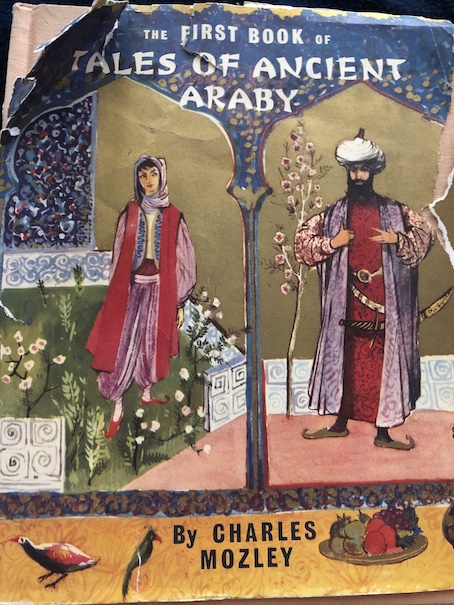
The First Book of Tales of Ancient Araby by Charles Mozley, 1960.
I’ve had this book for years, and one of the questions that I’ve had about this book is why is it Ancient “Araby”? Why “Araby” instead of “Arabia”? According to Wikipedia, “Araby” is an archaic name for Arabia, which explains it, I guess. This book was published in 1960, and I don’t think people were using “Araby” back then, but the book is trying to sound ancient.
The stories in the book are based on those from the collection of folktales called One Thousand and One Nights, in which Scheherazade tells stories to the murderous king who is her husband, but they’re simplified for children. The introductory section to this book says that . The book doesn’t explain, but the original stories in the book were rather racy.
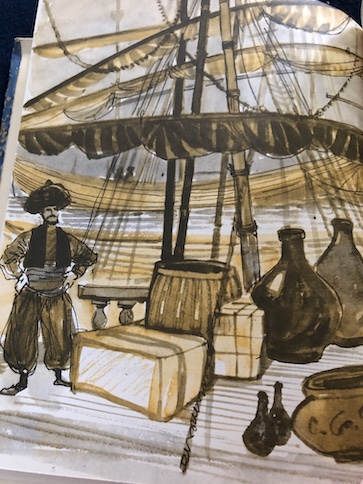
The book has pictures for each story, but some are in black-and-white, some are monochromatic with a color other than black, and some are in full color.
The book is available to borrow and read for free online through Internet Archive.
The book contains the following stories:
Scheherazade – When the sultan’s wife betrays him, he not only has her executed but loses his mind with hatred for all women because he believes that they are all untrustworthy. He begins a murderous series of weddings, where he has his wives all executed the day after the wedding, so they can never betray him. (It’s dark stuff, but this story wasn’t originally intended for children). All of the unmarried women in the kingdom are terrified that they’ll be next, and the sultan’s vizier is beside himself because he doesn’t know how to stop the sultan and has an obligation to obey the sultan’s commands to bring him new brides. Then, his eldest daughter, Scheherazade, requests that her father send her to the sultan as his next wife. At first, the vizier doesn’t want to send her because it’s certain death to marry the sultan, but Scheherazade tells him that she has a plan to put an end to the weddings and executions. Every night, she starts to tell a story but leaves it unfinished, so the sultan keeps putting off her execution to hear the end of the story. This continues for 1,001 nights, until the sultan realizes that he’s actually happy with Scheherazade and no longer has any desire to execute her or any other woman. The rest of the stories in the book are among the ones that Scheherazade told the sultan. (The Scheherazade story is a frame story, a story that contains other, internal stories or creates the basis for the other stories.)
Aladdin and the Wonderful Lamp – A poor boy and his widowed mother are approached one day by a man claiming to be the brother of the widow’s dead husband, the boy’s uncle. At first, he is very nice to them, bringing them to live with him and providing them with everything they need. However, one day, he stakes the boy, Aladdin, to retrieve a strange old lamp from a series of treasure caves, giving him a ring to protect himself. Before the boy returns to the man, he comes to the realization that the man isn’t really his uncle but an evil magician who is just using him to get the lamp. The boy and his mother discover that there is a genie living in the lamp who will do their bidding and provide them with all they need. They use the lamp not only to provide for themselves but to make it possible for Aladdin to marry a princess. The evil magician almost ruins everything when he tricks the princess into giving him the lamp, but Aladdin and the princess get it back through some trickery of their own.
Ali Baba and the Forty Thieves – Ali Baba marries a kind but poor woman and makes his living as a woodcutter, while his brother, Kassim, marries a disagreeable woman from a wealthy family and becomes an wealthy merchant. One day, while cutting wood in the forest, Ali Baba sees a large group of horsemen. They are robbers, and they have a secret hideout nearby. Ali Baba hides and watches how they open the entrance to their secret cave with the magic words “Open, Sesame!” After the thieves stash their loot and leave, Ali Baba realizes that he can use their secret words to enter the cave himself and see what they left. He helps himself to some of the stolen loot. He and his wife decide to stash the second-hand loot and spend it a little at a time, ensuring their family’s security. However, Kassim’s wife finds out about their loot and tells Kassim, and Kassim damands that Ali Baba tell him where he acquired so much money. When Ali Baba explains about the thieves and the treasure cave, Kassim wants to go there and loot the place himself, but Ali Baba thinks it’s too dangerous to go back again because the thieves will be angry and will probably kill them if they get caught. When Kassim goes anyway and is caught and killed, Ali Baba must arrange a deception to prevent the thieves from learning who Kassim was and everyone else from learning how Kassim met his death so the thieves won’t take revenge on the rest of the family with the help of a clever slave girl, Morgiana.
The Fisherman and the Genie – A fisherman pulls a strange bottle from the sea that contains a genie, but to the fisherman’s shock, the genie threatens to kill him when he frees him from the bottle. The fisherman asks why he would do such a thing when the fisherman did him a favor, and the genie explains that he was imprisoned in the bottle by King Solomon for sins against Heaven. At first, the genie thought that he would reward whoever freed him, but as his imprisonment grew into hundred and hundreds of years with no rescue, he became increasingly enraged and decided to kill whoever released him. However, the genie decides to grant the fisherman one wish before death. The fisherman asks him to prove that he can actually fit into the bottle and imprisons the genie there again. He refuses to let him out again until the genie swears he won’t kill him. The genie promises the fisherman anything he wants, but the fisherman is a modest man and only asks that he always be successful as a fisherman. He gets his wish, and he uses the money he acquires from his success to build a better life for his family.
Sinbad the Sailor – When Sinbad’s father dies, he leaves Sinbad a considerable amount of money, but Sinbad quickly squanders most of his inheritance. When he realizes his foolishness, Sinbad uses what he has left to set himself up as a merchant sailor. However, this decision takes him on a series of wild adventures, from being nearly drowned to befriending a king to a hair-raising encounter with a roc (a giant bird that’s big enough to carry a grown man).
The Twice-blessed Arab – This is a legend about the origins of horses and camels.
The Story of Little Mukra – Little Mukra is a dwarf, and his father, fearing that the rest of the world will laugh at him and treat him cruelly for his size, hides him for his early life. When Little Mukra is sixteen years old, his father dies and the rest of his relatives declare that they don’t want him, so Little Mukra decides to go out and seek his fortune. One day, while Little Mukra is hungry, he hears an old woman calling for someone to come to eat. It turns out that she’s talking to her cats, but he persuades her to let him eat with the cats because he’s starving. The woman hires him as a servant to take care of her cats. It gives Little Mukra a place to live, but the problem is that the woman blames him for damage that the cats cause while the lady isn’t looking. The clever cats are always perfectly behaved when she’s watching but not when they’re alone with Little Mukra. Little Mukra escapes this situation with the help of the lady’s dogs, who are not so pampered as her cats and reveal to Little Mukra a paid of magical slippers that can make him run fast, securing him a position as the king’s special courier.
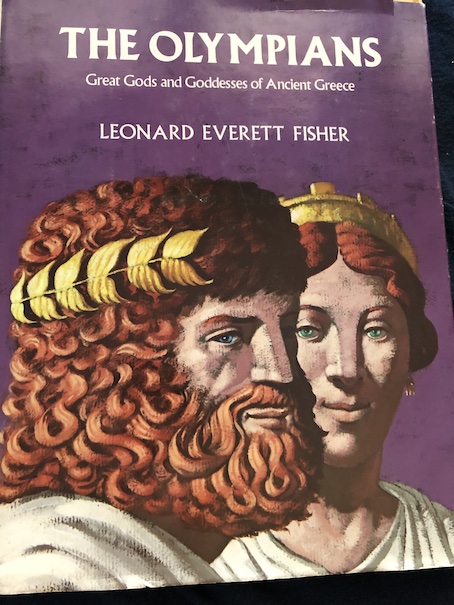
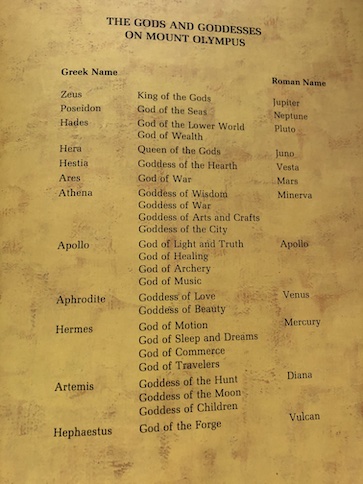
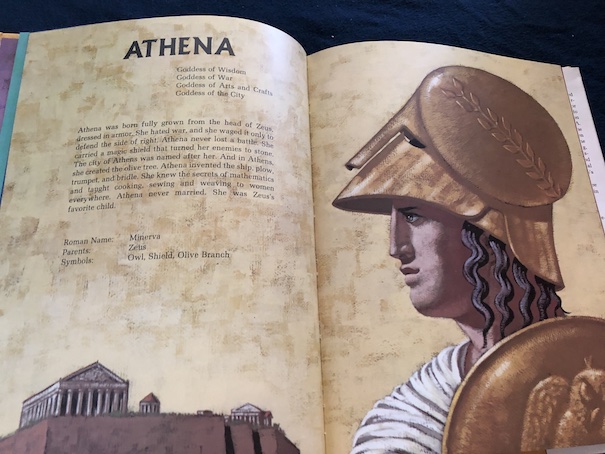
This picture book was my very first introduction to mythology when I was a kid! The book presents profiles of twelve Greek/Roman gods and goddesses. The Ancient Greeks and Romans worshiped the same gods and goddesses, but they used different names for them. At the beginning of the book, there is a list of gods and goddesses that gives both their Greek and Roman names. However, the rest of the book mainly uses the Greek names because the emphasis is on Greece. The gods and goddesses were called the Olympians because their legends state that they lived on Mount Olympus in Greece. It’s useful to know the Roman names, though, because the planets in our solar system were given the Roman names of gods.
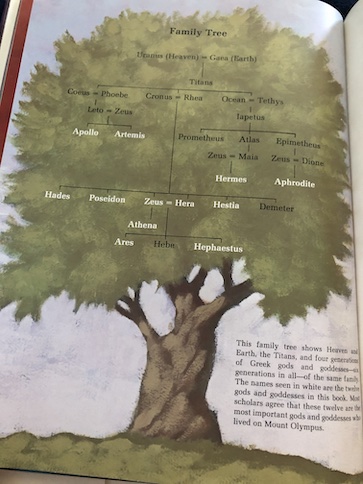
The back of the book has a family tree because all of the gods and goddesses were canonically related to each other. As a kid, I just accepted that. I don’t remember questioning it. The names of the gods and goddesses in the book are written in white.
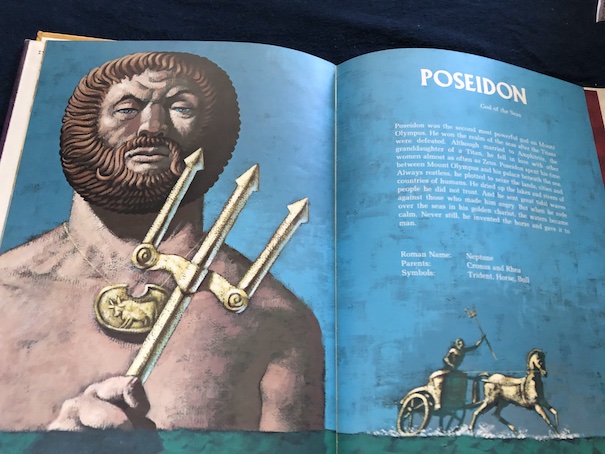
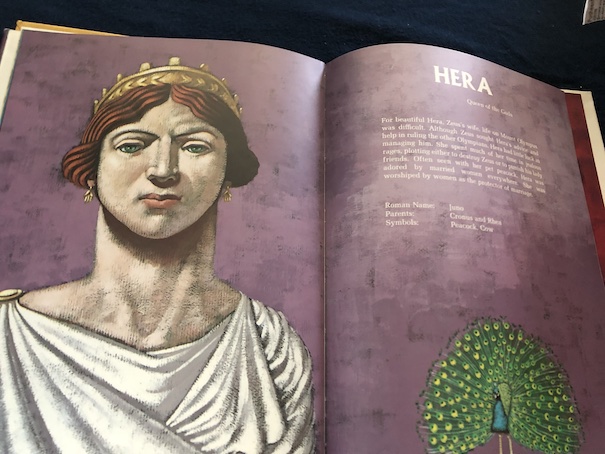
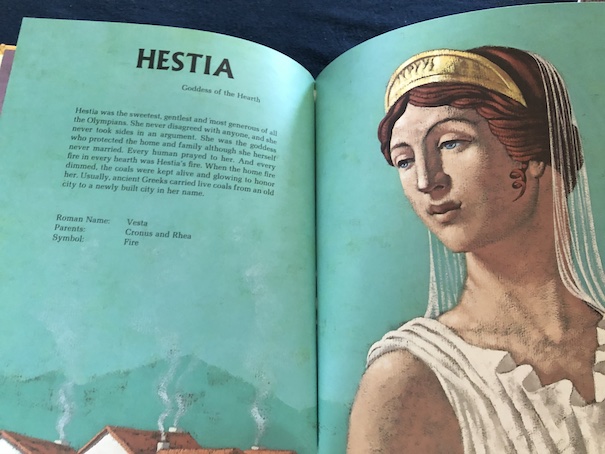
Each god and goddess in the book has a page of information and a full-page, full-color picture. Their profiles explain their personalities, their roles among the gods, and symbols that are commonly associated with them.
The pictures in the book are colorful. Although the faces of the gods and goddesses have a somewhat chiseled appearance, I like them.
When I was a kid, I think I had a fascination for Artemis and Apollo because they were twins, and I found twins fascinating. Because I was a girl, I generally liked the female goddesses better than the male ones. I think I sometimes tried to imagine which one I would be if I could pick one. I think, for a time, I liked Athena because she was the goddess of wisdom and was represented by owls, and I also happen to like owls.
As I was rereading the book this time, I became more interested in the page about the goddess Hestia. As the goddess of the hearth and home, she might not seem as exciting and well-known as the others, but I like her picture, and her profile has some interesting facts. It mentions that Ancient Greeks would carry live coals from an old city to a new one that had been recently built in her honor.
The book is available to borrow and read for free online through Internet Archive (multiple copies).
How Did They Live? Greece edited by Raymond Fawcett, 1951, 1953.
This is a non-fiction book, part of a series about life in the past, but it’s told in the form of a story where the readers are visiting a man living in ancient Athens named Simonides. The story is told from the point of view of “we” as “we” visit Simonides, and he shows us around Athens.
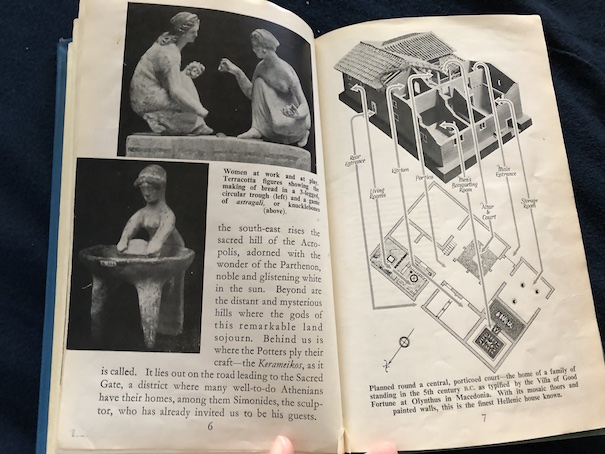
At the beginning of the story, Simonides meets us at the Temple of Hephaestus. The book provides a map and a description of the city so we know our way around. Simonides is a sculptor, and he lives in a nice house in an area of the city with well-to-do people. The book provides a map of the interior of Simonides’s home. His house is bigger and nicer than those of poorer people, and he also owns slaves. (The women playing a game on this page are playing Knucklebones, a precursor to modern Jacks but played with animal bones.)
Athens, like other cities in Greece at this time, is actually a city-state, an independent state with its own government, separate from other Greek city-states. Simonides explains that he served in Athens’s army when he was younger. Now, as a sculptor, he works with an artist producing public art in Athens. During a war with Sparta, many homes and buildings were badly damaged, so they’ve been rebuilding what was ruined and creating new public monuments.
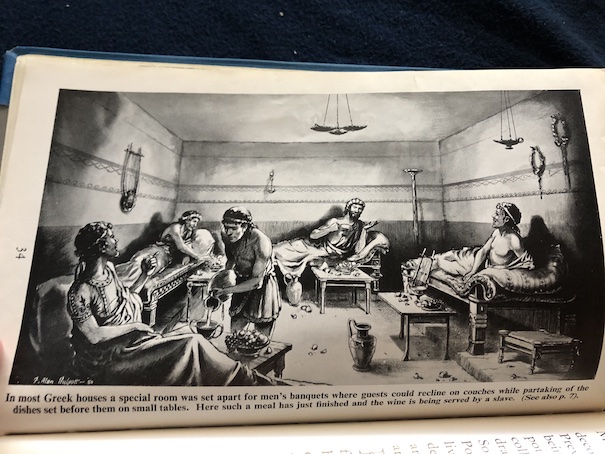
Simonides takes his guests into a special dining room, where we can relax. Guests are only allowed into areas of the men’s quarters of the house. The women’s quarters are strictly private, and we are told that the women in Athens spend most of their time at home, tending to household tasks. Usually, they only go out for special occasions, like festivals or plays. The Athenian women do not have the rights to property and having a say in public life that the men do. However, women from wealthy families lead comfortable lives and authority with in their houses. The book puts it, “Besides running the household she has her little vanities and the universal feminine interest in dress and adornment to help her and, in spite of her seclusion, she contrives to keep herself pretty well informed about what is going on in the city.” The part about the “little vanities” seemed a little insulting to me because I personally don’t like vain and shallow women who can’t think outside of the clothes closet, and I know plenty of women who aren’t in clothes and fashion. It seems like one of those cases where interest in these things might not really be “universal” but it’s something that women do because there just isn’t that much else for them to do. If they had more options of other activities, some of them might have found other things to do. The book goes on to describe various styles of women’s dress, hair, and makeup.
As the guests, we are invited to spend the night at Simonides’s house, and the next day, slaves bring us water to wash in and a breakfast of pieces of bread in wine. Then, we visit the agora (marketplace) with Simonides. There are people hanging around, socializing with friends, and the book describes the tunics and mantles they wear. After Simonides makes his purchases, he has his slaves carry them home. As we wander through the public meeting places, Simonides explains about the local philosophical groups that meet there, like the Stoics. We even meet Socrates as a young man.
After the shopping and visiting the public meeting places, we return to Simonides’s house for the midday meal of fish, vegetables, fruit, and bread. After the meal, Simonides’s wife, Hestia, explains more about the lives of women and children in Athens. As explained before, women have fewer rights than men, and female children do not receive as much education and training as boys do. Children younger than seven are all raised in the women’s quarters of the house. They play with toys like rattles, dolls, balls, spinning tops. Girls like to play on swings and see-saws and learn to dance, while boys play with kites, hoops, and hobby-horses. They all listen to stories like Aesop’s Fables to learn moral lessons. At the age of eight, boys begin to go to school, and at the age of eighteen, they join the army. Meanwhile, girls are taught to handle domestic tasks.
After that, we make a visit to the Acropolis to see the Parthenon, which is the Temple of Athena. The carved figures in the pediments of the building tell stories from the life of Athena. That evening, Simonides invites some friends to the house for a dinner party in his banquet room, where people eat while reclining on couches.
The next day, we learn about pottery and how it is made. The book describes the types of pictures and designs painted on pottery and says that the style with red figures painted on a black background is a newer style. Before, black figures were painted on a red background.
Toward the end of the book, we attend the Panathenaic Festival, which is meant to honor Athena. The festival includes athletic competitions and music and literature contests. There is a procession of important public officials and animals to be sacrificed to Athena. We (the guests) ask Simonides to explain more about the religion and gods of Ancient Greece, and he does. Religion is an important part of public life in Athens, but the book includes a suggestion that Simonides might not actually believe in the gods and goddesses of Ancient Greece: “We do not ask Simonides if he himself believes in these gods. But we have an idea that, like many other Grees, he may not do so, for he suggests that a knowledge of the gods has been handed down from the poets of old and the sculptors have clothed the ancient myths in beautiful forms.” That’s not much of an explanation, although I suppose it’s reasonable that people would believe in the religion of Ancient Greece to varying degrees, and there would have been at least some disbelievers. That’s found in pretty much every religion. There are also people around the world in modern times who engage in religious traditions less out of personal belief than out of civic or cultural participation (like this description of Shinto in modern Japan), which is the implication about the people in this story.
The book ends with a visit to Olympia to see the ancient Olympic Games.
My Reaction
I love books that explain daily life in different time periods, and I thought this one was pretty well done. It covers a few days in the life of Ancient Athens and also does a good job of explaining the wider society of Athens. Most of the perspective is on a fairly wealthy family and their slaves. I found parts about the descriptions of the lives of women and slaves distasteful, but the descriptions and attitudes of the people seem pretty accurate for the time and place. My feelings were more about not liking the lifestyle and circumstances than about disagreeing with the author. There are more details about the raising and schooling of children and about food and clothing than I’ve included in this description.
I particularly liked the maps of the city and the interior of the house. I also liked the way they included Greek words and explained their meanings, like kerameikos (pottery, note the resemblance to the word “ceramics“). Even though I took a philosophy class in college and learned about the Stoics, I didn’t remember the professor explaining that the origin of the word “Stoics” was the stoa, the public gathering place like a covered porch where they would meet.
I was confused for a moment when the book explained that Simonides doesn’t bow when he meets people “as we would do.” As an American, I wondered, “Who’s ‘we’?” Americans aren’t in the habit of bowing to random people we meet on the street, either. I checked, and the book was printed in England. British spellings in the book (“honour” vs. “honor”) also confirm that this is a British book. I didn’t think that people in England in the 1950s bowed to people either, except maybe during important events with royalty and nobility. The most I would ordinarily expect would be a nod or bow of the head to acknowledge other people, and people in the US do that, too.
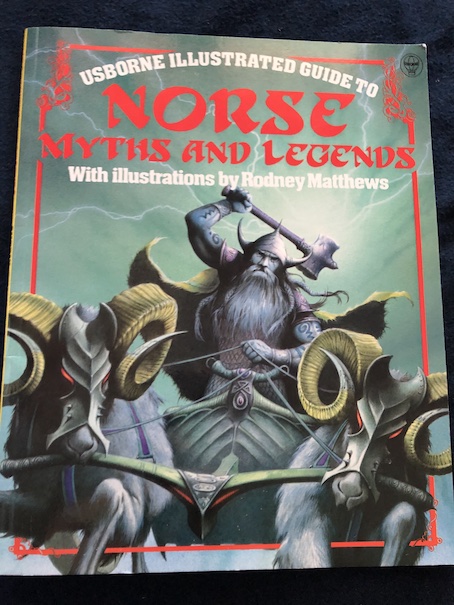
Usborne Illustrated Guide to Norse Myths and Legends by Cheryl Evans and Anne Millard, illustrated by Rodney Matthews, 1986.
I like this book because, before it begins telling the myths and legends, it first gives an introduction to the history, territory, and religion of the Norsemen. By “Norsemen“, the book means not only people living in Norway but Scandinavians and people of Scandinavian descent speaking related languages and living in various areas across Europe. The Norsemen include, but are not limited to, the Vikings, who were specifically seafaring traders, mercenaries, and pirates/looters as opposed to farmers and fishermen.
There is still much about the history of the ancient Norsemen that we don’t know because, for much of their history, they did not have their own system of writing and relied on oral stories for passing down historical and cultural knowledge. The Norse myths were originally oral stories before they were written down. The introduction also explains that there is one myth in the book, the story of Sigurd and the Nibelungs, that was originally a German legend but was later adopted by Scandinavians.
Norse mythology is somewhat unusual because, while Norsemen were polytheistic, like other ancient groups, and their gods and goddesses had human emotions and relationships, like the gods and goddesses in Greek and Roman mythology, Norse gods were not immortal. Norse gods could be killed, like human beings, which meant that any risks they took had genuinely serious stakes for them. In fact, the legends predict that, at a future, world-ending event known as Ragnarok, most of the gods will be killed.
Although this particular book doesn’t mention it, the qualities of Norse gods being able to perform incredible deeds while still being mortal makes them rather like our modern concept of a superhero. Thor and Loki were both made into comic book characters by the time this book was written, and characters and events in Norse mythology have helped to form the 21st century Marvel Cinematic Universe.
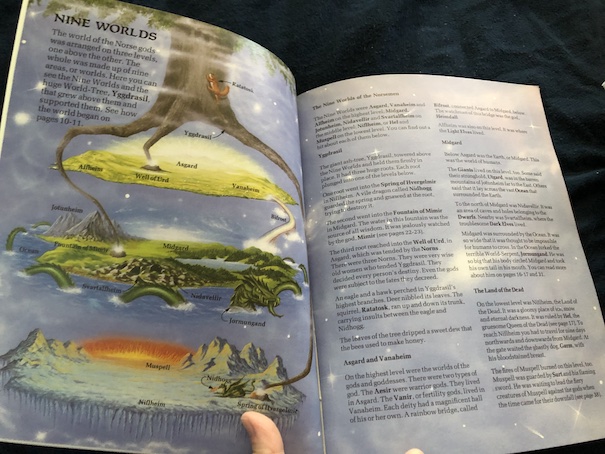
In Norse mythology, the gods and goddesses lived in a multilevel universe made up of nine lands or “worlds.” The highest level of their universe contained Asgard (home of the warrior gods), Vanaheim (home of the fertility gods), and Alfheim (home of the light elves). The middle level contained Midgard (our world, where humans live, connected to Asgard by a rainbow bridge), Jotunheim (home of the giants), Nidavellir (home of the dwarves), and Svartalfheim (home of the dark elves). The lowest level held Niflheim (land of the dead, dark and icy, ruled by a fearsome queen named Hel) and Muspell (where the creatures who will attack the gods at Ragnarok live). All three levels of this universe were kept in place by the roots of a giant ash tree called Yggdrasil.
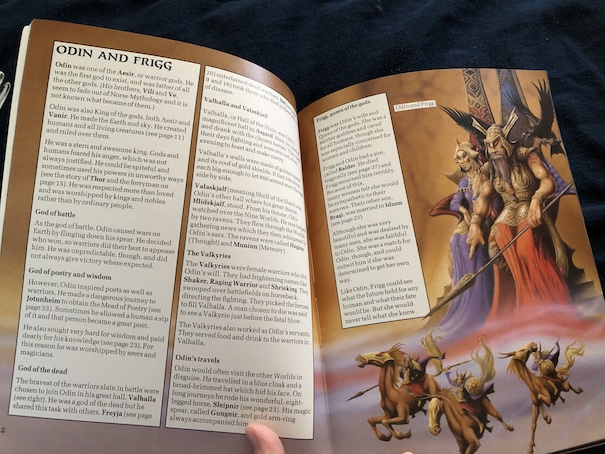
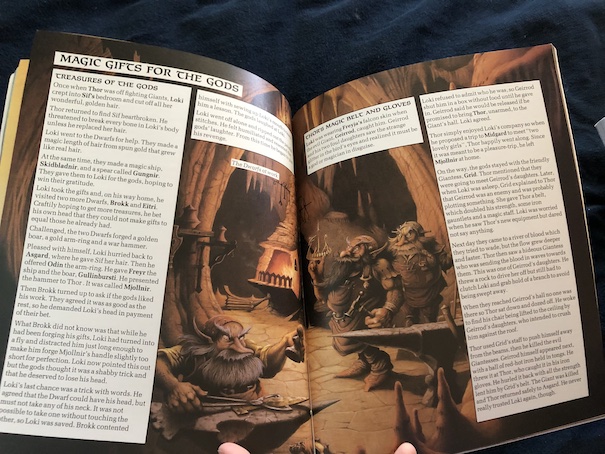
The book has pages dedicated to specific gods and goddess, explaining their histories and roles in Norse mythology. Odin, for example, was the king of the gods, who created the world and humans and was the father of the other gods. His wife’s name was Frigg, and she was a mother goddess figure. Thor was the thunder god and the god of law and order. Unlike other gods, he mostly relied on his strength instead of magic or tricks, but he did have magic weapons, including his hammer, Mjollnir, which would always strike its intended target and return to Thor after. Freyja was one of the fertility gods, and she was the goddess of love and beauty. She later also became a goddess of death and was responsible for starting wars among humans. Loki technically wasn’t a god because his parents were fire-giants, not gods, but he was a close friend and sworn brother to Odin, so he was able to live in Asgard, too. Loki is known for being a trickster figure.
After the book profiles some of the gods and goddesses and other notable figures in Norse mythology, it tells some of the myths and legends associated with theses figures. One story that particularly interests me is “The Curse of the Ring” because this story and other aspects of Norse mythology provided some of the inspiration for Tolkien’s Lord of the Rings. Before it inspired Tolkien, this same story was also made into an opera by Wagner.
In “The Curse of the Ring”, Odin, Loki, and Honir kill an otter who turns out to be the son of a magician who sometimes turns one of his sons into an otter to go fishing for the family. (Maybe not the safest choice of fishing methods.) The gods offer to compensate the magician with enough gold to fill the otter skin. Loki goes to get the gold from a dwarf named Andvari, who has a famous hoard. Andvari has no choice but to give Loki the gold he wants, but Loki notices that Andvari also has a gold ring on his finger, and Loki demands that Andvari give him the ring, too. Angry at having his ring stolen, Andvari curses the ring so that it will bring misery and destruction to anyone who wears it. When Loki brings the promised gold to the magician, the magician also sees the ring and wants it. Loki warns him about the curse on the ring, but the magician insists that he wants it anyway.
The curse on the ring comes true when one of the magician’s other sons, Fafnir, kills his father for his gold. Fafnir takes all of the gold instead of giving his other brother, Regin, a share of the inheritance and turns himself into a dragon so he can protect his hoard of gold from anyone who tries to take it. Regin raises their nephew, Sigurd, to kill Fafnir and avenge his grandfather. However, the curse of the ring and the gold doesn’t end there. Regin tries to kill Sigurd so he won’t have to share the gold with him, and Sigurd has to kill him in self defense. After Sigurd rescues a Valkyrie named Brynhild, and they fall in love, they both fall victim to treachery from Queen Grimhild of the Nibelungs. Wanting Sigurd’s gold, she gives him a love potion that makes him fall in love with her daughter, forgetting about Brynhild. Queen Grimhild’s son also wants to marry Brynhild. Abandoned by her lover, Brynhild marries him, but driven mad with by Sigurd’s abandonment of her, Brynhild arranges for Sigurd to be murdered and then kills herself, setting off a continuing chain of murder and revenge after her own death that destroys the royal family of the Nibelungs.
The book ends with a “Who’s Who” section with information about various characters and creatures in the Norse myths.
The book is available to borrow and read for free online through Internet Archive.
#13 The Mystery of the Gingerbread House by Elspeth Campbell Murphy, 1997.
Sarah-Jane lives near a couple whose names are Jack and Jill. They live in an old Victorian gingerbread style house. They have been fixing up the old house, and Sarah-Jane has been acting as a messenger, carrying samples of wallpaper to them from her mother, who is a decorator.
Sarah-Jane brings her cousins to see the house, and Jill shows them an old photograph that she and her husband found of the children who used to live in the house a hundred years ago and a friend of theirs. When the kids first arrived at the house, they startled someone who was working in the parlor. However, Jack and Jill insist that it was not either of them. They look in the parlor and are surprised to see that someone has continued the work they were doing, removing some of the old wallpaper that needs to be replaced. Why would someone sneak into the house to continue their work?
Someone has learned an important secret about the house and something hidden inside, and they are trying to find it before Jack and Jill stumble across it in their renovation work.
The theme of this story is Proverbs 25:13, “A trustworthy messenger refreshes those who send him. He is like the coolness of snow in the summertime.”



























 Jestress's Forgotten Books and Stories