The FunCraft Book of Print & Paint by Heather Amery and Anne Civardi, 1976.
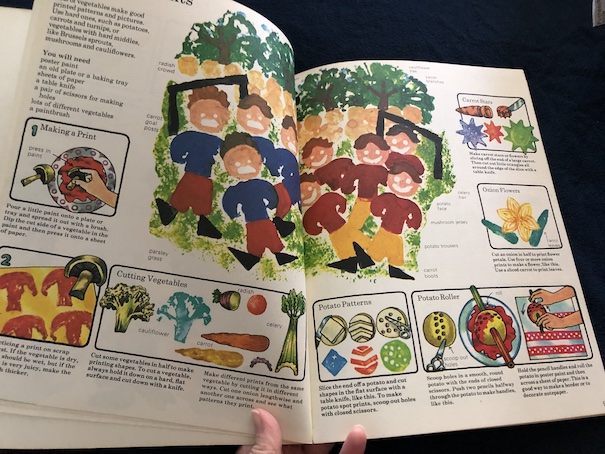
This is the American edition of a British book, and it’s part of a series of craft and activity books. When I was a kid, I was really into crafts, but I didn’t do even half of the crafts in the craft books we had. This particular book is interesting because I first thought that it was going to be about painting pictures, and it is, but it’s specifically about making “prints” with paint. Basically, the crafts involve using various objects, from leaves and veggies to your own hands and fingers as stamps to make pictures and designs.
I remember once taking part in an activity at our local library that involved making pictures with stamps make from cut potatoes, like the book shows in the section about vegetable prints. Our potato stamps weren’t as elaborate as the ones shown here, and it’s interesting that they thought of using other veggies to get some different shapes as well.
The range of objects and techniques that the book uses in making prints is also interesting. It points out that you can make some interesting patterns by painting on a page and folding it over or using string coated in paint to make swirls. There are tips for making using tools like stencils and rollers to make designs.
The book also includes some painting techniques, like how to mix colors, and some tips for how to enhance pictures you’ve made, like painting over parts of a picture with glue and then shaking on some powdered colors. It gives suggestions for different powdered colors, like colored sand, salt, or sugar or using powdered spices or cocoa from your kitchen (more expensive, but it will give your artwork a scent).
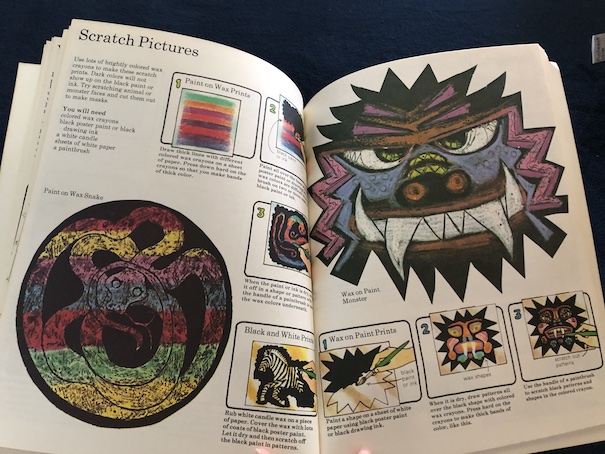
One of my favorite suggestions was a technique that I did like a lot when I was a kid, making scratch pictures with a simple form of sgraffito. You can buy kits and specially prepared paper for doing this today, which didn’t exist when I was a kid (at least, not anywhere where I could buy it). Instead, I had to do it the old-fashioned way, using the technique in this book – drawing a rainbow of colors on paper, covering of it with black, and then scratching the black off to make rainbow pictures and patterns.
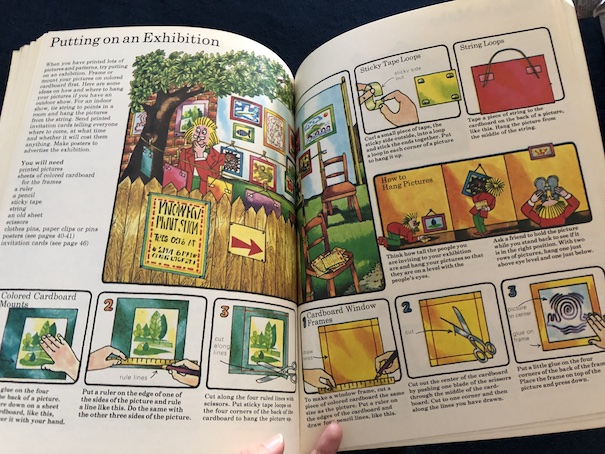
There are too many tips and techniques for me to cover everything in detail. The last few pages cover uses of the techniques for specific projects, how to make prints on cloth, and how to have an exhibition of the pictures you’ve made.
The book is available to borrow and read for free online through Internet Archive.
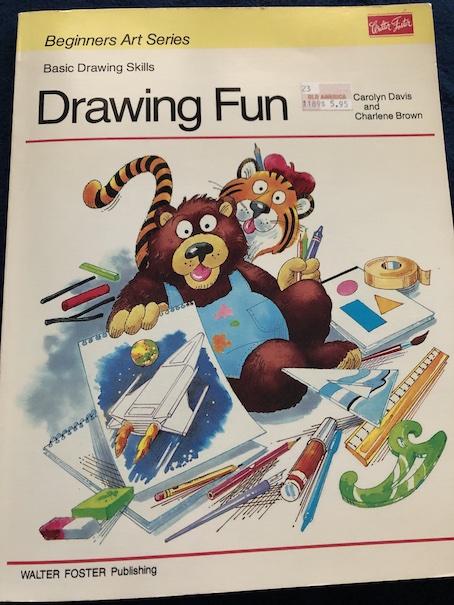
Drawing Fun by Carolyn Davis and Charlene Brown, 1988.
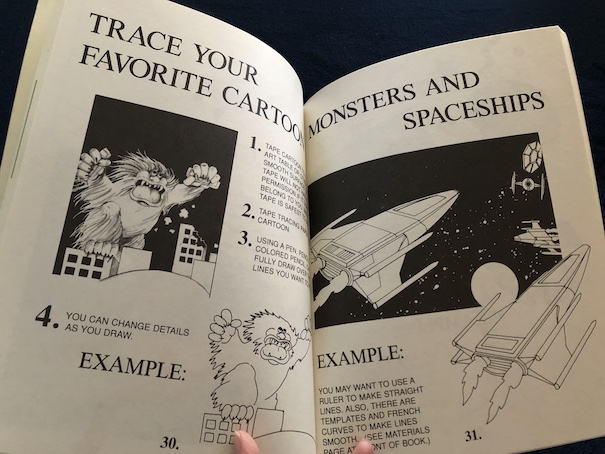
This book is part of the Beginners Art Series, and it teaches children basic drawing skills. The book is designed for readers to try out drawing techniques on their own as they read along and starts with a page that explains the materials they will need.
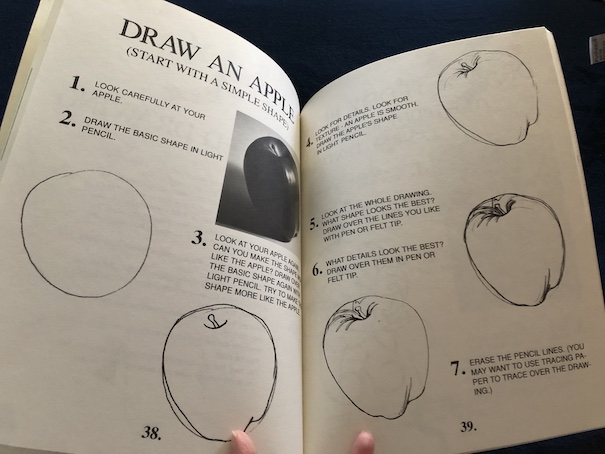
Because this is a beginning guide, the book begins by explaining that all objects and, therefore, all drawings, are made up of basic shapes. One of the keys to learning how to draw is studying the basic shapes and how they can be combined to create more complex shapes and drawings.
When beginning to draw, the reader should begin by sketching out the general shapes that make up what they’re drawing and then fill in the details.
Many of the drawing activities in the book focus on tracing shapes, drawings, and photos to learn how they are formed and practice drawing skills.
As the book continues, the techniques become more advanced and the drawings become more detailed. It gradually teaches readers how to use shadows and shading to make their drawings appear more realistic and three-dimensional. The subject matter of the drawing exercises ranges from basic apples to more interesting subjects, like teddy bears and people.
The book also explains how to use perspective in drawing to further add a three-dimensional quality.
I like this book because I think it’s a good introduction to a fun, artistic hobby, giving readers good beginning techniques.
The book is available to borrow and read for free online through Internet Archive.
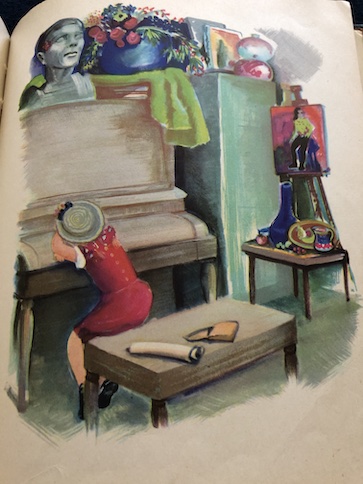
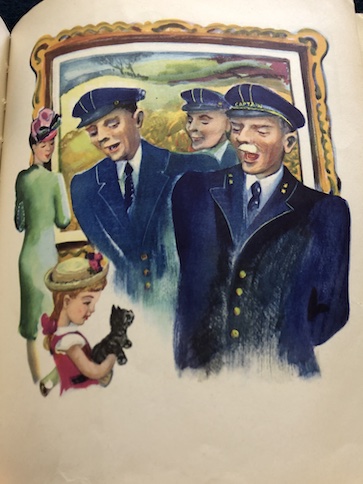
Patty wants to paint a picture of her kitten, Happy, to hang in her room. However, she has trouble creating a painting that truly satisfies her. Her first attempt doesn’t really look like her kitten. Patty is taking an art class at a local museum, and her mother suggests that she take her picture of Happy to her teacher and ask her how to make it better. Through Patty’s efforts to paint a realistic picture of her kitten, she comes to learn more about art.
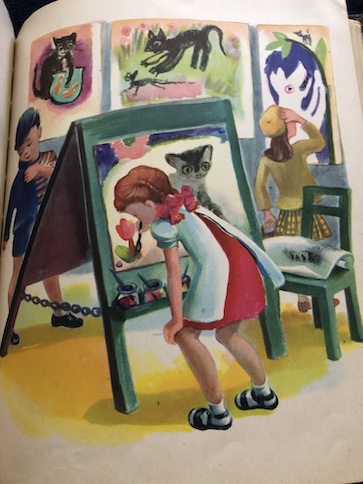
Patty’s teacher suggests that Patty actually bring her kitten to class so that everyone can observe and paint him. When Patty takes her kitten to her art class, the whole class looks at Happy, pointing out parts of the the cat, like his whiskers and his little padded feet with retractable claws. Every part of Happy, including the shape of his eyes and his powerful back legs that are good for jumping, is suited to making him a good hunter because cats often hunt for their food. Studying the form of the cat helps the children understand how to draw him.
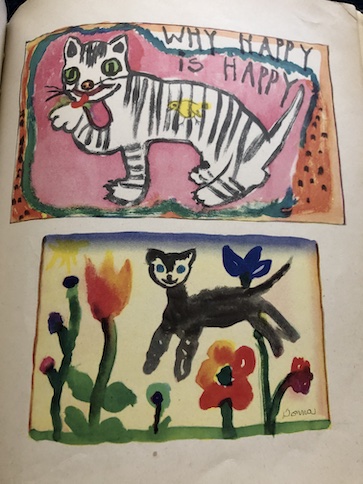
The fun part of the book is when Patty studies all of the different ways her friends in class draw the kitten, seeing how everyone looks at the kitten differently and uses different art styles, some drawn better than others because all the artists are children. The children’s pictures in the book look like pictures that would be painted by real children.
The children in the art class paint the cat in different ways and different imagined settings, indoors and outdoors, depending on their interests and how they see the cat and his personality. The boy who drew Happy in a cartoon style, with a bird in his stomach and a caption, wants to be a cartoonist, which is why his style was a good choice for his painting. Patty, on the other hand, wants her painting to be realistic for the way she sees her kitten.
The book explains how Patty learns new art techniques to make her painting look more realistic. She studies the lines that people use in their paintings and compares them to her cat, seeing that curved lines for the cat’s body make him look more realistic. Patty’s teacher points out that one of the mistakes that she’s made in her first efforts is giving Happy a body more the size of an adult cat than a kitten. A kitten’s body looks smaller when compared to the size of the head. To make her picture more realistic, Patty has to learn to draw her kitten’s body parts and features in the right proportions. Patty also notices that the edges of another girl’s cat painting look fuzzy because she’s painting in watercolor and the edges of her painting are wet and running. Patty likes the fuzziness of that painting, so she decides to use that technique on purpose to make more realistic, fuzzy fur. Her teacher shows her how to use that technique with more control by putting a wet blotter under her paper. I like how the book describes Patty’s observations of both her kitten and other people’s pictures and how she uses them to improve her own painting.
At one point in the story, Happy disappears from the art class, and Patty is afraid that she’s lost her kitten forever. Fortunately, she finds Happy hiding in the art room, taking a nap, and he is fine.
In the end, Patty produces a painting that satisfies her because it really looks like her kitten, the way she sees him.
This is one of those vintage children’s books that I would like to see in print again! It’s a nice story, and I really liked the way the book examines the different ways that people look at art and the styles they use. There’s no wrong way to paint something, but the book explains how learning different techniques can help artists to express themselves and their vision the way they want. Patty knows when she’s doing well at her painting when the picture she paints looks more like the vision she has of her kitten.
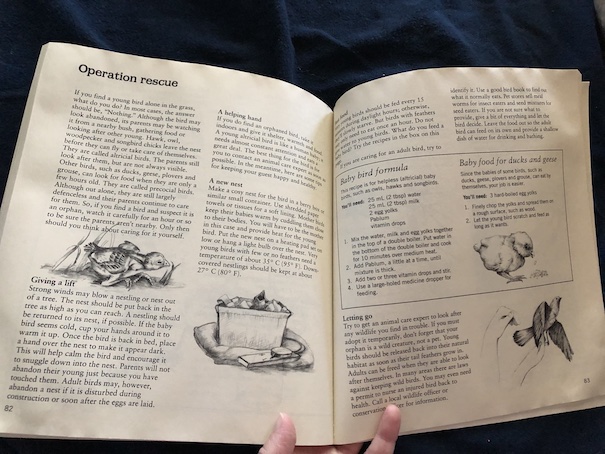
Bird Wise by Pamela M. Hickman, illustrations by Judie Shore, 1988.
This is a beginning guide to birds and bird watching for kids. I thought that the guide was very helpful with nice, detailed illustrations. The book explains the appearance, biology, and lives of birds and offers activities to help readers understand and interact with birds.
The first section in the book is about the appearance and body parts of birds. It explains how different birds have differently-shaped beaks and feet and different types of feathers and how the differences help each type of bird eat the foods they like and live in the places where they live. One of the activities for this section is about how to start a feather collection. The book also explains that different birds have different styles of flying.
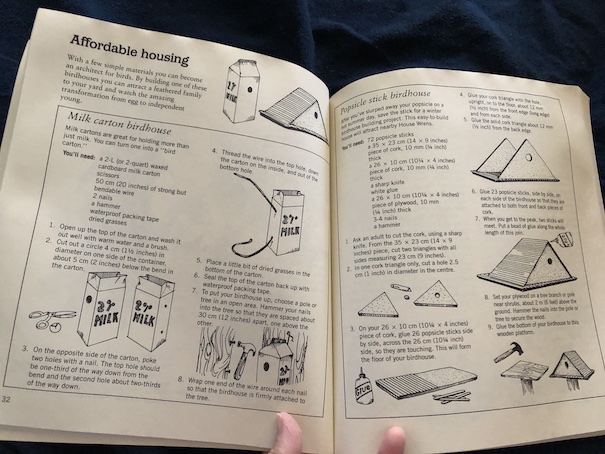
The section about how birds live explain about different types of bird nests and how they migrate and raise their young. The book explains different methods for making bird feeders and bird houses.
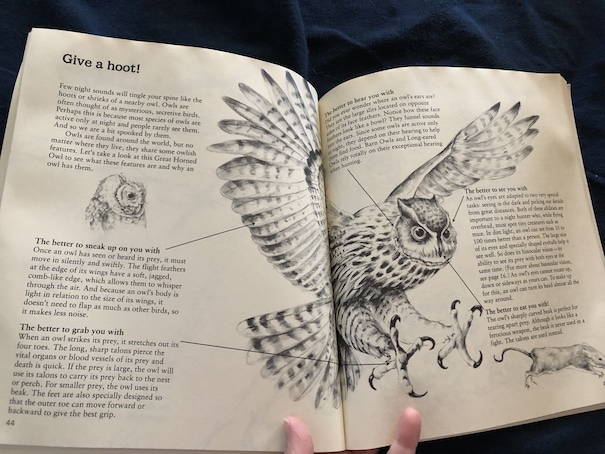
The book profiles certain specific types of birds, including owls (there is an activity about dissecting owl pellets, which I had to do when I was in elementary school), gulls, hummingbirds, and woodpeckers.
In the section about bird watching, the book offers tips for what to look for to identify a bird’s type. It also explains how to make bird blinds to avoid being seen and how to recognize types of bird songs.
The book also contains other helpful information, like how to care for injured birds and how to plant a garden that will attract birds. It also includes a board game that emphasizes some of the lessons about birds in the book.
Overall, I was pleased with the range of information in the book. It was interesting and well-presented.
The book is available to borrow and read for free online through Internet Archive.
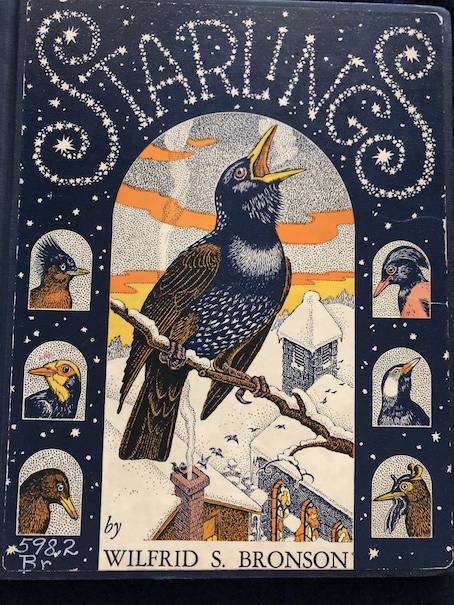
The title of the book tells you what it’s about; this is a children’s picture book about starlings. That sounds pretty straight-forward and even a little dull, but there is more to learn about starlings than I imagined, and the author of this book has an imaginative way of explaining information. I love books that cover odd topics in detail, and I enjoyed the whimsical quality of this book. The pictures are detailed black-and-white drawings, some with captions like comics. Most of them explain the anatomy of the birds or their habits, but they have some unique ways of expressing educational information.
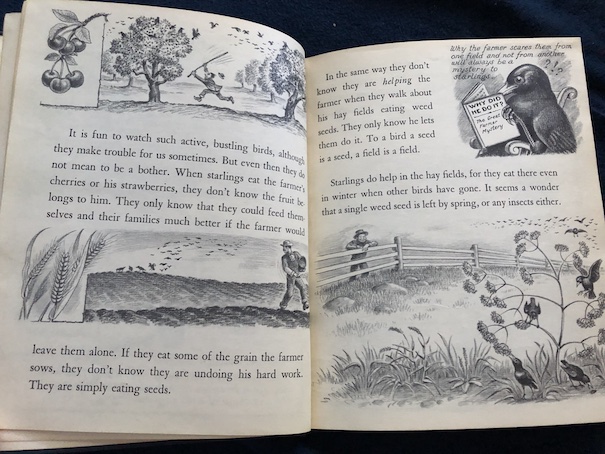
The book begins by describing the singing of starlings and then explains how farmers view starlings. Starlings can be a pest to farmers when they eat their fruit or the seeds the farmers are trying to plant, but they can also be helpful when they eat weed seeds and prevent weeds from coming up in the farmers’ fields. Of course, the birds don’t know when they’re helping or hindering because, as far as they’re concerned, they’re just there to eat any food that happens to be available at the moment. I like the little picture of the bird reading a mystery book, trying to figure out why farmers don’t mind when they eat some seeds and try to scare them away from others. That’s an example of the whimsy I was talking about.
The book continues describing what starlings eat and places where they like to roost, and it explains how they affect people living in cities (mainly, messing up their cars). There were times when people in cities considered them such a nuisance that they would shoot them, and some poor people hunted them for food. Actually, the entire reason why we have starlings in the US is that people over-hunted other types of birds (there is a disturbing picture of hunters with piles of dead birds at one point in the book), and birds are an important part of the ecosystem. Even though they can annoy farmers when they eat seeds and fruit, they also eat bugs that are pests to crops.
I was really struck by the passage that explained how starlings were first brought to the United States and why they were brought here:
“Some people think that starlings have no right to food or nesting-places because they are not ‘American birds.’ Yet all the starlings you see were born in America. So were their parents and grandparents and great-great-grandparents and all their relatives clear back to 1890. In that year their ancestors were caught in Europe and brought in cages to America. So many American birds had been killed at that time by our own ancestors that our crops were growing wormier and wormier each year, while insect pests grew worse and worse. So starlings were imported to help us fight the insects. They were freed in Central Park in New York City and left to look out for themselves.”
This explanation uses simplified language for children, and it also oddly evokes imagery of human beings. We don’t normally refer to animals as “foreigners” because animals don’t speak different human languages or have allegiances to foreign governments like people from other countries do. When we talk about new species that have been introduced to an environment where they did not originally belong and quickly spread out and multiple, we usually call them “invasive species.” In that case, the ecological concern is that the new invasive species will disrupt the balance of the natural environment and crowd out native species, but the author is trying to point out that the situation with the starlings was different. The starlings were introduced to the environment in the US on purpose, not by accident, and it was done specifically because they were meant to a solution to a problem. The environment had already been disrupted by humans who had moved into areas where they had not lived previously and where they killed too many of the native species themselves without regard to what that would do to the natural environment and their own farming. The introduction of the starlings was meant to restore a balance that had been lost. However, the people who had originally caused the problem didn’t see it that way, seeing the starlings as pests because they were “foreign.” While birds in general may occasionally be a nuisance because they don’t understand human priorities, they still perform useful functions for human beings as they go about their lives, just being the birds they are – eating annoying weed seeds and bugs and scavenging food from what humans throw out.
“People who think that starlings should be starvelings because they are ‘foreigners’ should remember that these American-born birds save much of what they themselves throw away and are still helping us to fight insects as they did in 1890.”
I understand what the author is trying to explain about balance in the ecological system, but I was struck by the human imagery that the passage evokes: “Foreigners” who came to New York City, not unlike immigrants fresh off the boat from Ellis Island during the 19th century, set free to make their way in a strange environment among people who often regarded them as worthless pests, disliking them while still using the useful services they provided. The comparison still fascinates me. At first, I wasn’t sure that the author meant to make that broader comparison here. I thought he probably used that language just to simply the ecological concepts for children’s understanding, but the author does make another comparison a little further on:
“So let’s be fair. If American-born starlings are foreigners, then so are all people in America except the Indians (Native Americans). So are many kinds of birds, animals, and plants. Our ancestors brought them here from other countries. But if all these creatures, and ourselves, are American now, then so are the starlings. Yes indeed!”
So get off your high horse, starling-haters.
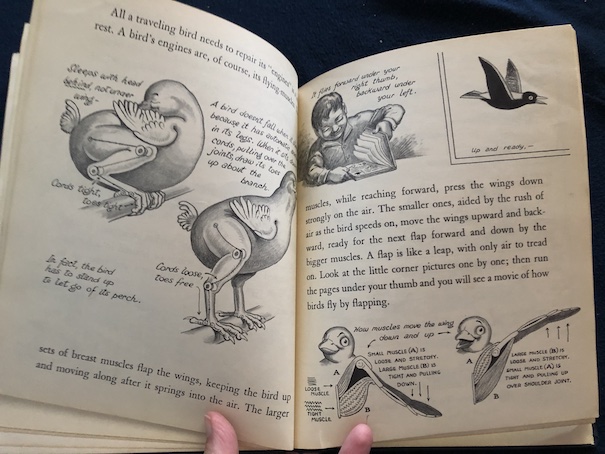
At several points in the book, the author compares birds to airplanes, explaining their muscles and flying mechanisms like machinery. I liked the page where the author compares different planes and helicopters to types of birds (cruisers being like gliding eagles and albatrosses, fast-turning speed planes like starlings and swallows, and hovering helicopters like humming birds). The parts that describe how birds cling to branches as they sleep and how their wings move look accurate and helpful. The part about how a bird creates eggs is hilarious. The text about the formation of the egg inside the bird isn’t bad. It completely skips over the subject of the fertilization of eggs (understandably), and the picture show the bird as a kind of egg-making factory with little men assembling the parts of the egg in stages instead of showing a bird’s reproductive anatomy.
In the upper right corners of this section of the book, there are little squares with a flying bird because part of the book is meant to be uses as a flip book to see a bird flying. The page shown above with the boy flipping through the book shows how to use the flip book portion.
There is a section of the book that explains how baby birds develop in the egg and eventually hatch.
There is also a section in the book that shows how adult starlings will prepare a nest for their eggs and how they raise their babies.
As I was reading the book, I wondered who the author, Wilfred S. Bronson, was. Bronson was an artist specializing in natural history, and he wrote and illustrated other books for children about animals and natural history. In the years before he wrote this particular book, he served in the US Army during World War I and painted murals for the Works Progress Administration (WPA) during the Great Depression. He also participated in expeditions to gather specimens and create illustrations of wildlife for botanical gardens and museums.
I haven’t found a copy of this particular book to read online, but it was republished in 2008 and is still available from Amazon.
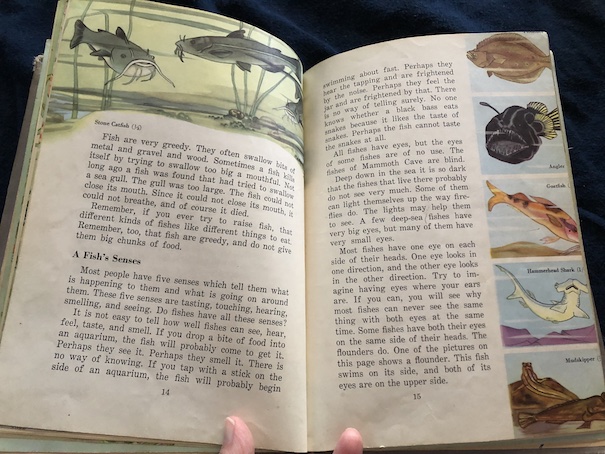
This is a reprint of an earlier book, and it’s interesting because this was part of an educational science series. The author was from the University of Chicago, and the accuracy was verified by Walter H. Chute, the Director of the John G. Shedd Aquarium at the time.
As a child, I was never particularly interested in fish. My mother had a fish tank with pet fish, but I lived pretty far from large bodies of water and never went fishing. For years, this book, probably purchased at one of the many used book sales my family attended over the years, went unread. However, as an adult, I like reading children’s books about very specific topics because they often include some fun and usual facts.
The book begins by explaining to child readers how goldfish are similar to and different from human beings. It seems pretty straight forward, but they point out some thoughtful similarities and differences. Both fish and humans need to breathe, but they do it in different ways, which is why humans drown in water and fish effectively drown in air. The book also points out that goldfish cannot move their heads independently of their bodies in the way that humans do.
In the section called “The Story of the Goldfish”, the book explains how wild goldfish were first kept as pets in China and Japan. Wild goldfish actually have a variety of colors, but hundreds of years ago in China, people liked the yellow or gold ones best as pets, and they began deliberately breeding fish with these colors, which is how they came to be known as “goldfish.”
The book defines “fish” as creatures with gills, fins, and backbones but no arms or legs. It uses this definition to separate fish from other aquatic creatures like whales (no gills, actually a mammal with lungs), jellyfish (no fins, gills, or backbone), crabs (gills but no fins, arms and an exoskeleton instead of a backbone), and starfish. It also explains the difference between fish that live in salt water vs. fish that live in fresh water.
The book explains what different types of fishes eat, how they’re born (most hatch from eggs), how they defend themselves, and how they migrate. In one section, the book explains how fish have some or all of the five senses that humans have (sight, hearing, smelling, taste, and touch), but they have them to different degrees and use them in different ways.
The book presents information about some specific types of fish, and it even mentions that some types of fish are endangered species. I usually associate environmental messages with the late 20th century, but this book discussed the over-fishing of sturgeon and the ecological dangers of erosion caused by deforestation on river banks and factory waste dumped in water in the mid-20th century.
The book ends with a list of tips for observing fish.
The book presents a pretty comprehensive beginner’s guide to fish in general, and I really appreciated the mentions of environmental issues. My one criticism is that the book could use more pictures and especially bigger pictures. All of the pictures are in full color, but most of them are rather small, just in the corners or edges of the pages, which are mostly full of text. I just think that larger pictures would be more appealing and more child-friendly. There are even places where the edges of the pictures and their captions are cut off by the edges of the book (as shown in two of the pictures of pages above), which looks clumsy and annoying. The book seems pretty authoritative, but I think it could have been presented better. I’m not sure how people who originally read this book looked at it, but I didn’t like the size and positioning of the illustrations.
I couldn’t find an online edition of this vintage nonfiction children’s book, but I did find online editions of other nonfiction books for children by the same author through Internet Archive.
Bells by Elizabeth Starr Hill, illustrated by Shelly Sacks, 1970.
I love books about oddball topics, so a children’s picture book about the history of bells was irresistibly intriguing.
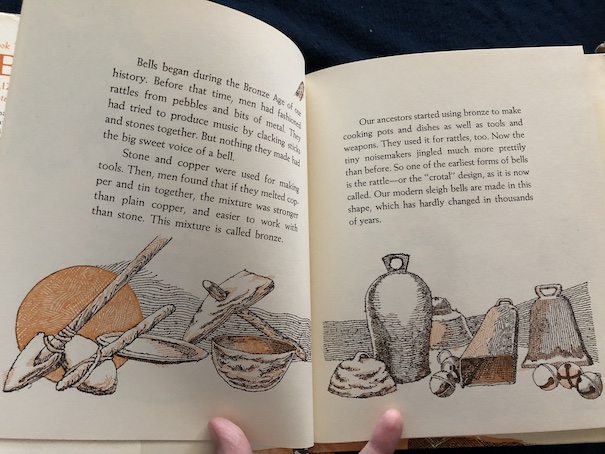
The book begins with the origins of bells in the Bronze Age. People had made rattles of various kinds before the Bronze Age, but after they learned to make bronze, an alloy of copper and tin, they discovered that they could make metal rattles with a much prettier sound. These metal rattles/early bells were made in the “crotal” design, which is the same shape as today’s jingle bells or sleigh bells. Other shapes of bells, like gongs and the classic bell shape may have been inspired when people realized that pleasant sounds could be made by banging bronze utensils against bronze dishes and bowls.
Bells have been used for thousands of years and have served many purposes. The oldest bell that has been found (at the time the book was written) was over 3000 years old and came from the area near Babylon. King Solomon of Israel used to have bells to frighten away birds from the roof of his temple. The Spartans were able to infiltrate a walled town in Macedonia because the sentry wore a bell on his uniform that helped them to keep track of where he was, but in other instances, nets with bells attached to them were used to warn of the presence of enemies. Bells have also been frequently used in religious services.
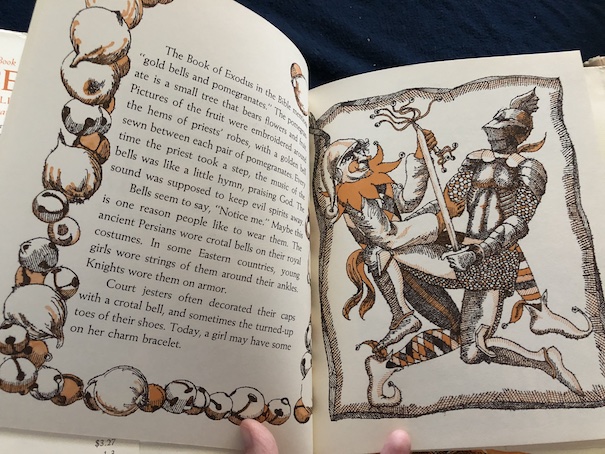
Sometimes, people wear bells to call attention to themselves. The classic jester’s cap with crotal bells (jingle bells) attached to it is meant to be attention-getting.
Bells can be made of many different materials, from different types of metal bells to glass bells to clay bells. There are even wooden ones, although they make more of a clunking sound than a ringing. People used to make bells by hammering pieces of metal into shape, but then they developed ways to cast bells in molds, which is how bells are made today.
There are many superstitions that have been attached both to the making of bells and their use. The book describes the Bilbie family, who famously made bells in Medieval England. The Bilbies were superstitious and consulted astrologers to determine the best times to make their bells. They also always rang bells for the first time on full moons. Various people have believed that ringing bells frightens away demons and witches.
The parts about superstitions and legends are my favorites. In particular, there is a legend in England about a town that was completely buried during an earthquake. The people in the town always rang their church bells at Christmas, and the legend is that if you go to a particular spot and put your ear against the ground, you’ll still hear them ringing the bells. However, the book says that there’s actually a scientific explanation behind the phenomenon. People who have put their ears to the ground at that spot have heard bells ringing, but they’re actually the bells from a nearby town, not one underground. The ground actually conducts sound very well, even better than sound waves moving through the air, so a person standing upright might not hear the bells ringing from another town, but someone who put their ear to the ground could hear the conducted sound vibrations. It’s not unlike the phenomena experienced by people who put their ears to the rails on railroad tracks to listen for the train. There are also stories of people having heard the approach of herds of animals, like buffalo, coming toward them in this way. The book doesn’t mention it, but “keep an ear to the ground” is actually an expression for watching and listening for signs of things that are going to happen because people noticed that vibrations in the ground could be indications of something coming toward them.
The book also describes some famous bells, like the Liberty Bell, Big Ben (Big Ben is actually the name of the bell in the clock tower, not the clock tower itself, although people informally think of the clock tower as Big Ben) and Tsar Kolokol, the largest bell in the world.
There are also a few nursery rhymes that mention bells (although the book doesn’t give any background information about the rhymes) and some information about change-ringing and carillons.
The book annoyed me a little in the way it kind of jumps around, telling some history, then some legends, then some more history, and then more legends. It’s a very easy read, and the information is interesting, but it’s a big disjointed. It sometimes feels more like a list of facts and short stories than one cohesive story. It might help if there were headings or chapter divisions in the book to organize the information, but there aren’t.
The book is available to borrow and read for free online through Internet Archive.
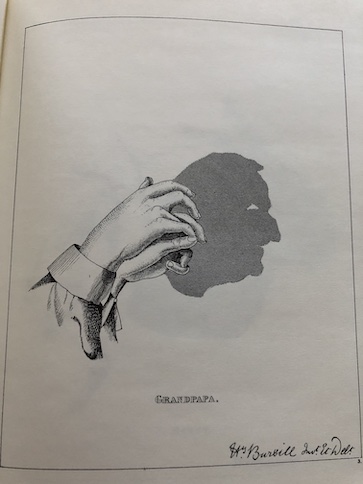
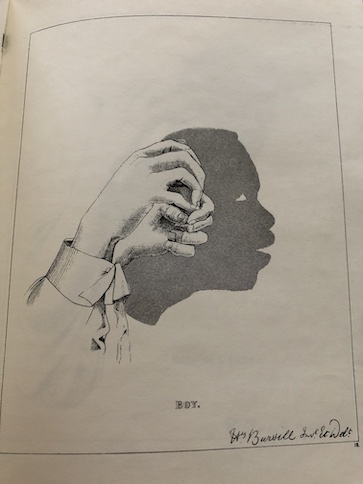
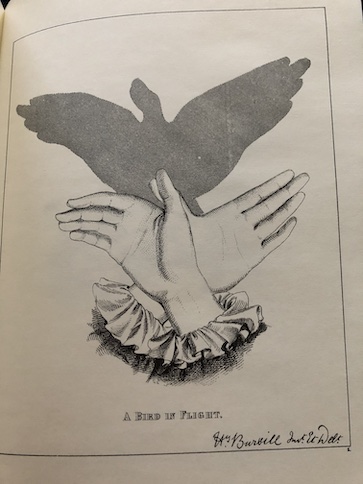
Hand Shadows to be Thrown Upon the Wall by Henry Bursill, 1859, 1967.
When I first read and started playing with this book as a kid, I didn’t stop to read the preface in the book or look at the publishing date, so I completely missed the fact that this is a reprint of a book from the late 1850s. The author, Henry Bursill (link repaired 9-11-24), was a professional artist
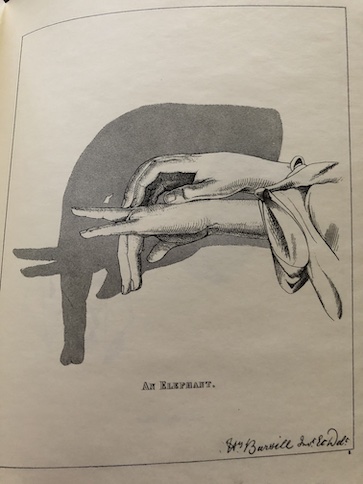
In the preface, Bursill refers to a well-known print from the early 19th century called The Rabbit on the Wall, which shows a father making shadow figures on the wall with his hands to amuse his children. Bursill says that there have been other books about hand shadows before his, but he emphasizes that his book is not the same as theirs because he has worked out his own hand shadows through experimentation. He says that it will take some practice for people making hand shadows to get them perfectly, but he encourages people to practice and not be afraid to work out new hand shadows of their own through experimentation. Bursill did the illustrations for the book himself, and he says that he began sketching some of the designs during his time as an art student and that he would amuse some fellow students by making hand shadows on the wall of his studio.
Other than the preface, the only words in the book are the captions on each of the pictures. I’ve tried some of the hand shadows in the book, and I had a more difficult time than the preface makes it sound. The only ones I’ve really been able to do well were the bird and the greyhound. I haven’t given up on mastering some of the more difficult ones someday, though!
Cat’s Cradle String Games by Camilla Gryski, 1983.
Back when I was in middle school, I went through a phase where I was really into cat’s cradle. I’m one of those people who like to have something to fiddle with in their hands, and it was easy to carry a loop of string in my pocket. If I lost the string, I could always make another string loop and carry that. This was the book that I used to teach myself how to make cat’s cradle string figures.
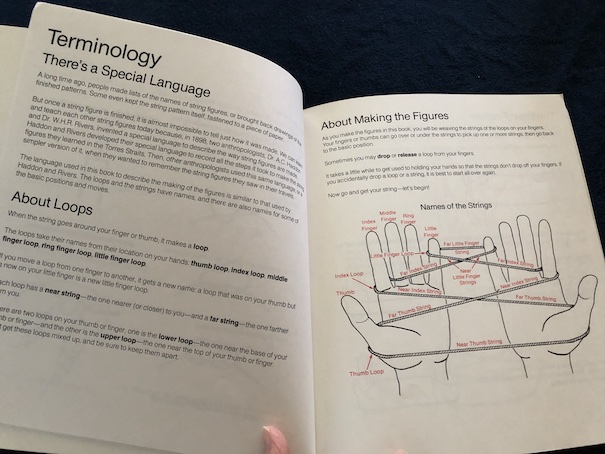
The book begins with a section that explains the terminology of making string figures and how to start out with the string in a basic position on the hands.
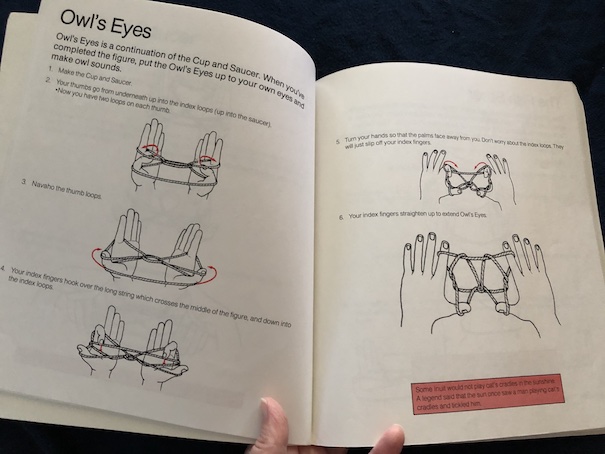
From there, the book covers how to make various string figures. As the book demonstrates how to make different figures, it explains a little about which cultures use them. Cat’s cradle and similar string games are played around the world, and different cultures have had different names for some of the same figures. For example the “cup and saucer” figure can be called a saki cup or maybe a house if it’s held upside down.
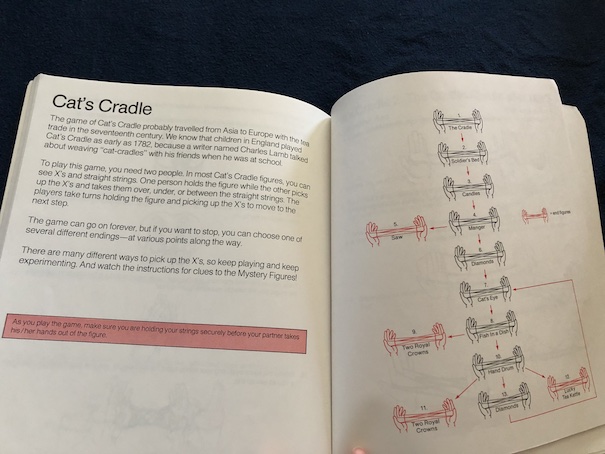
Some figures can be made independently of each other, but what turns making string figures into the game of cat’s cradle is the fact that some figures can be turned into other figures in a sequence. The book demonstrates the sequence of making figures involved in playing a game of cat’s cradle. It’s a game for two players with the players each taking the string from each other to form each of the figures. The game ends when one of the players forms one of the ending figures that doesn’t lead to any other figure.
The book is available to borrow and read for free online through Internet Archive.
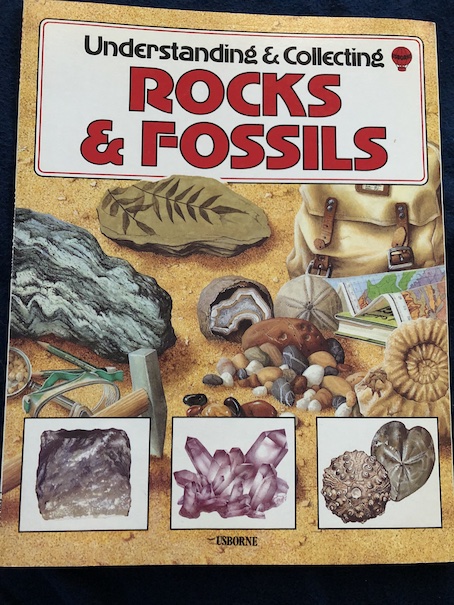
Understanding and Collecting Rocks and Fossils by Martyn Bramwell, 1983.
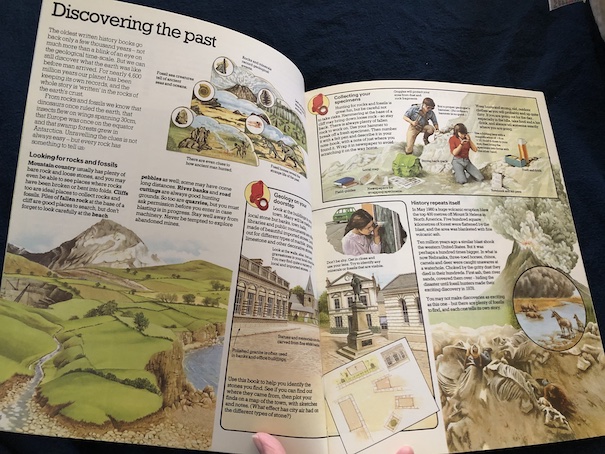
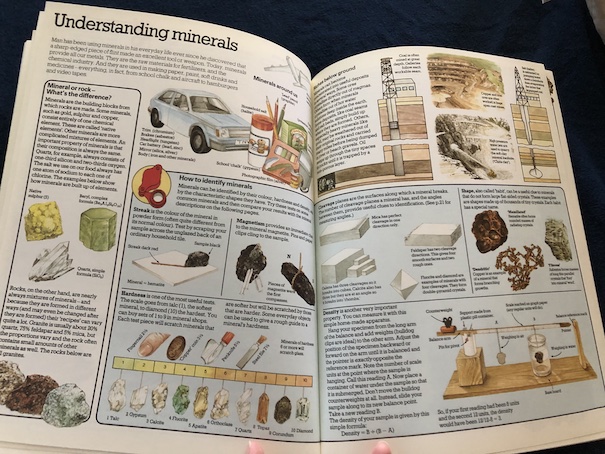
This book is part of a series of beginning hobby guides for kids. It explains how to collect and study rocks and fossils and some of the deeper aspects of geology. The book emphasizes that studying geology helps us to understand the story of the Earth and the forces that have shaped our landscapes and formed the rocks and minerals we use. All through the book, there are suggested activities and experiments for readers, marked with the symbol of a red magnifying hand-lens.
The book explains some the large geological forces, like how the continents move and the plates that make up the Earth’s crust shift. Then, it explains the different types of rocks, igneous, sedimentary, and metamorphic, with examples of each type.
One of the sections I found particularly interesting is the one that explains about how to identify different minerals and what they’re used for. The activity on that page explains how to identify a mineral based on a series of factors, like whether or not it’s magnetic, the color of a streak it might leave when scraped against tile, and its hardness, which you can test by seeing what implement will scratch it.
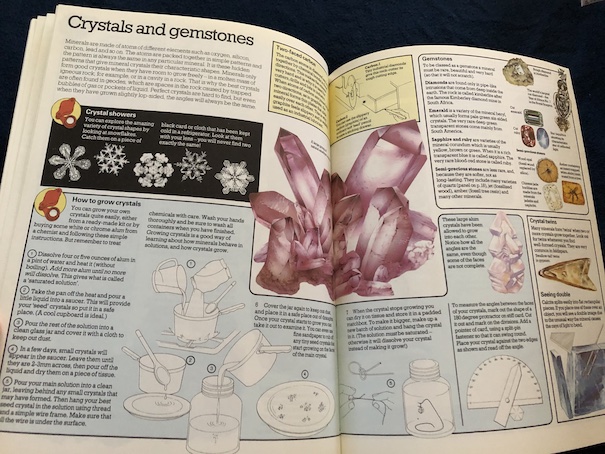
I also liked the section about crystals and gemstones. There are instructions for growing your own crystals.
The section about fossils explains how to collect fossils, clean them, make plaster molds of them, and identify what organisms made the fossils. The book explains how fossils are made and had a timeline of past eras on Earth and the creatures that existed in each era.
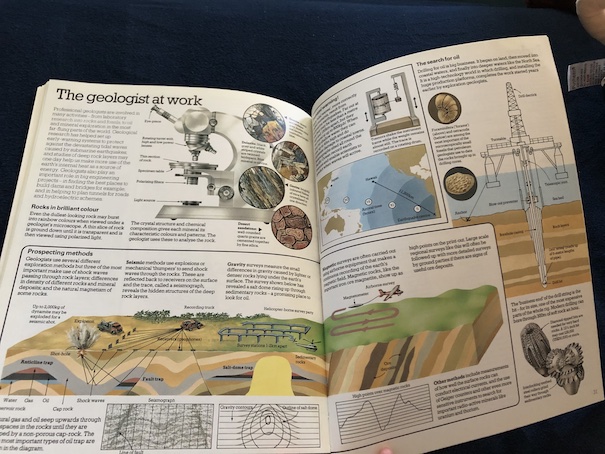
The last section of the book explains the types of work that geologists do and the types of geological surveys they carry out to predict earthquakes and tsunamis and finding useful deposits of ore, minerals, oil, and natural gas.
There’s quite a lot of information to take in. Even though this is a pretty beginner guide to rock collecting and geology, I would say that the book would be better suited to older children than younger ones.

























 Jestress's Forgotten Books and Stories