Of Two Minds

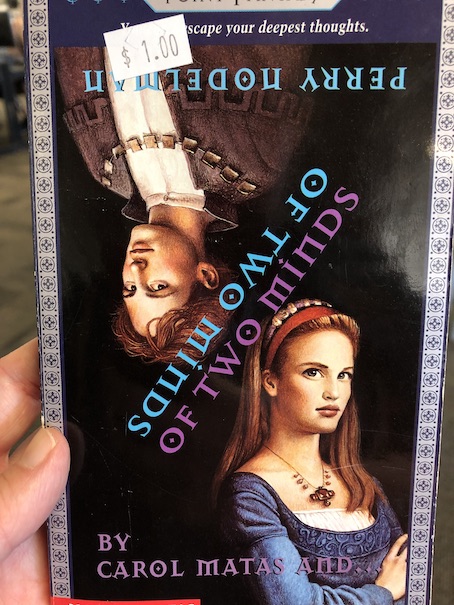
Of Two Minds by Carol Matas and Perry Nodelman, 1995.

Princess Lenora lives in a world where people can make things from their imaginations real just by thinking about them. This is a common “gift” that everyone in her country has, but the thing that really upsets Lenora is that people aren’t allowed to use their “gift” whenever they want to. Lenora’s parents are frequently upset with her for disrupting their calm, orderly world with her wild fantasies. They remind her that the reason why they have these rules was that their world was in chaos before people learned how to use their “gift”, and the chaos was only resolved when everyone agreed to maintain the same reality so they could all live in a safe, stable world that makes sense. They call this maintaining “the balance.” However, Lenora thinks that this stable world is boring and laments that there are never any technological developments or anything really interesting or exciting, like in the fantasy books she reads.

At this point, I pause to reflect that, in real life, we don’t have a world where people can change the nature of reality just by picturing something, and in spite of living every day in a common reality, our world still doesn’t completely make sense, people can have very different interpretations of things that are happening as if they lived in completely different realities of their own making, the idea that everyone could agree on one shared reality to create for any length of time sounds unbelievable, and when “exciting” things happen in world events, they are often not “interesting” or pleasant. Lenora is a teenage girl who doesn’t have a lot of experience yet in worlds that her people maintain in order to stay safe and sane or that she has not created herself and had control over. That’s about to change.

While everyone in Princess Lenora’s world has mental “gifts” that allow them to make imaginary things real, Lenora’s abilities are stronger than most, and her parents worry that her powers are getting much stronger. Lenora has trouble resisting the urge to imagine things and make them real, and although she loves doing it for the excitement and sense of power it gives her, it’s starting to scare her because it feels like her fantasies are starting to control her instead of her controlling them. Her fantasies have started to take darker turns, and frightening things are starting to become real, and she’s not even sure if they’re really coming from her mind or not. Because Lenora is turning seventeen years old, her parents are in the process of arranging a marriage for her to a prince from a neighboring kingdom, and they hope that marriage will help settle her down. However, Lenora isn’t so sure about the marriage or her increasingly difficult to control powers. When she talks to the healer, Lufa, about it, Lufa says that it’s not unusual for young people to experiment with their mental powers and that Lenora’s disturbing fantasies are coming from a dark part of her own mind that she will have to learn to control. She offers to spend some time working with Lenora and helping to develop her control.

Meanwhile, Prince Coren, Lenora’s betrothed, is having his own doubts about the impending wedding. In the first place, he thinks that he isn’t very handsome and isn’t sure that Lenora is going to like him. In the second place, he doesn’t really like change. Change makes him very nervous, although he doesn’t like the way things are in his kingdom and has felt for some time that things really need to change. People in his kingdom, like in Lenora’s, have special mental gifts, but they work in somewhat different ways. The people in Lenora’s kingdom, Gepeth, have the ability to change the nature of reality with their imaginations but often restrain their abilities in order to live in a common reality. In Coren’s kingdom, people have the ability to make things they imagine look and seem real, but they cannot actually change the nature of reality itself. They don’t bother to restrain their abilities at all, preferring to live in their imaginations. They don’t bother to keep their homes and buildings in good repair, just imagining that they live in opulent mansions and sleep in soft beds when their buildings are actually crumbling and they sleep on the ground. More than anything, Coren wants to build and enjoy something real instead of living in this imaginary world that he knows is not real at all. Also, Coren’s people have the ability to read each other’s minds, and they do it all time. The mostly talk to each other directly in their minds, not out loud or face to face, and they’re also in the habit of snooping and eavesdropping on each other’s thoughts. Coren tries not to be so obtrusive, and while his parents have some concerns about him marrying a girl who can’t speak mentally, Coren finds the idea a relief. Still, he’s not quite sure what to expect of Lenora or sure that she’s going to approve of him.

As Coren and his family approach Lenora’s kingdom, and he thinks and worries about meeting Lenora, he begins accidentally joining Lenora’s thoughts and fantasies. He begins getting a taste of what goes on in Lenora’s thoughts and imagination, and for a person who craves stability as much as he does, it’s unsettling.

It turns out that, although Lenora’s parents have mentioned marriage to her before, she has not been informed that her intended husband is on his way until he actually arrives. She is shocked and angry when her father suddenly springs Coren on her without warning, and Coren’s parents are dubious about this marriage when they discover that Lenora was not even informed that it was going to take place. They read the Lenora’s father’s mind and learn about Lenora’s previous antics with her powers. Coren begins having serious doubts about this marriage, and so do his parents, although they kind of admire Lenora’s imagination since they live in their imaginations much of the time.

Lenora, in a desperate panic to escape this unwanted marriage, tries to figure out what to do. She thinks about imagining a change in the world so that she won’t have to get married, but she knows that her father is still powerful enough to stop her. Then, she thinks about creating a world of her own with her imagination that she can jump into, but strangely, Coren ends up playing a role in everything she imagines. Even though she doesn’t want to like Coren, she feels strangely drawn to him. Since she can’t seem to escape thinking about Coren, she decides to physically run away and visit other countries, but she’s caught before she gets out of the palace.

Lenora’s father informs her that, because of her reckless behavior and increasing powers, they’ve arranged for her to marry Coren the very next day, and after their marriage, they will go to live on an island their kingdom controls with guards to prevent her from leaving or using her powers to escape. Lenora and Coren are to live on the island until after the birth of their second child, in the hopes that Lenora will settled down and get control of herself through her family responsibilities.

It seems like Lenora is trapped, but during the wedding ceremony, a portal to another world opens up. Lenora feels like someone, although she doesn’t know who, is offering her a chance at escape and decides to take it. However, as she goes through his portal, Coren tries to stop her, sensing that it’s dangerous, and he’s pulled in with her. The two of them find themselves in a world with an unknown creator, and for the first time in her life, Lenora’s powers don’t seem to work, so she can’t get them home. At first, Lenora is charmed by this seemingly perfect world full of interesting people and with the promise of newfound freedom. However, Coren is dubious and, although his powers are also gone, has the troubling feeling that they are in danger. What is this world, and who wants them there? If they’re ever going to return to their own world, they will have to face a dangerous enemy … and the darkest corners of Lenora’s own mind.

The book is available to borrow and read for free online through Internet Archive. It’s the first book in a series.

My Reaction

I first read this book when I was in my early teens, back in middle school, and I think that’s the right age group for this book. Princess Lenora is a daydreamer, like many teenage girls, but unlike most teenage girls, she has the ability to make the things she daydreams about become reality with just a thought. It’s pretty normal for people to imagine all kinds of things, just as passing thoughts, even dark things. If Lenora lived in our world with fanfiction.net, FictionPress, and Wattpad and similar sites for amateur writers, my guess is that she’d be spending much of her time writing stories to post online, like fan fiction and creepypasta, and few people would think anything of it because she would have friends doing the same thing. In a few years, they would probably either graduate to newer sites, like Inkitt, start their own blogs, work on getting books published, or just get busy with their lives, college, and career and let the hobby go for awhile. Instead, because Lenora lives in a world where people’s imaginations change the shape of reality itself, Lenora’s unchecked imagination poses a real threat to people around her and the fabric of reality itself.

Lenora’s parents try to rush her into marriage and family life in the hope that it will curb her dangerous tendencies and teach her some self-control (like people getting married too young never backfires horribly) and get her over this self-insertion fantasy stage she’s in, but in a way, that’s exactly the problem. Many of Lenora’s fantasies, especially the dark ones are about control. I didn’t think of that much when I first read the book as a young teenager. Mostly, I just liked the concept of a world where people could change reality just by thinking about things and the exploring the concept of what that ability could lead to. Much of the story is about that, but also, many of Lenora’s darkest fantasies are about power and control, things that she both resists in her daily life and craves for herself. A lot of teenage rebellion is about control – who has power over whom and where the boundaries lie.

Teenagers are at that phase of life where they’re almost legal adults. Physically, they can do most of the things that full adults can do, like drive cars and get themselves around town to go places they want to go, but yet, they can’t legally consent to certain things, and they’re still required to ask their parents’ permission before making even basic decisions about their weekend plans, and their parents are often telling them what they think they should do for their futures in the way of jobs and education. It can be a frustrating experience, knowing that you have the ability to go out, have adventures, and explore what life has to offer but yet not really being allowed to get out there and do things. There are practical reasons why teenagers can’t act on every whim that enters their heads. For one thing, life requires money. There are few things that don’t cost anything, and you need some time to build resources. For another, people won’t hire you for just any job because you showed up and said you wanted to try it. Most jobs require a certain level of education and/or experience, and teenagers just haven’t had time to acquire it yet. They have to find lesser jobs first and continue their education or get some professional training. Also, when it comes to marriage and other deeply personal decisions, there are serious life consequences to the choices you make. Adults hope by making young people wait for things and build their lives gradually, they’ll get a better sense of who they are, the lives they want to lead, and the consequences of the decisions they’ll make. It doesn’t always work because I’ve seen even older adults make some pretty weird decisions, but that’s largely the goal.

People have a tendency to try to control those who don’t seem to have the ability or desire to control themselves, and that’s really the phase that Lenora is in. Lenora’s young powers are growing, and she wants to test them and see what she can do with them, to explore her deepest thoughts and express herself and make her mark on the world, but her parents and the society she lives in actually can’t let her do that as much as she wants because of what it would do to everyone around her and the very world they live in. Most people, teenagers or not, have some private thoughts or fantasies that they would never want to share with the world, but Leonora’s fantasies become the world around her. They don’t stay private because they don’t stay only in her mind. When Lenora’s fantasies come to life, she pulls real people into them, giving them a genuine stake in having some say over them and trying to limit or stop them. It’s not just that she disrupts people’s lives and inconveniences them, but she can put them in very real danger and actually poses a threat to their very existence. Lenora doesn’t fully consider what her flights of fantasy do to other people, such as when she temporarily sends her mother into a gray void at the beginning of the book so she can pretend that she has the family’s castle to herself or when she briefly considers a fantasy where her parents would be living in poverty at her mercy and charity so she could control them instead of the other way around, until she finds herself at the mercy of someone she can’t control. Sometimes, people don’t understand what they put others through until they have to live it themselves. You’d think, with as much of an imagination as Lenora has, she could put herself in someone else’s place, but she doesn’t develop that kind of empathy until she sees what it’s like to deal with a person who completely lacks it.

If Lenora could have a creative outlet for her energies, getting her ideas out on paper, writing stories to share, or exploring her visions through art, her life would be different, and she probably would feel less frustration. The purpose of imagination and daydreaming are to let people explore concepts and consider different things that might happen, both good and bad, without acting anything out in the real world. It gives people a chance to think things through and consider what could happen without risking bad consequences from actually doing anything. I’m not a very adventurous person in real life. I don’t like camping or hiking, I’m afraid of heights, and there are things that I actually can’t do physically. But, I don’t mind vicariously experiencing things through stories, where I can have a safe kind of adventure. However, Lenora has that problem where, if she imagines things too hard, they become real. Her people call it a “gift”, and she doesn’t always see it as a problem, but it really is because it removes that important safety net between thinking and acting, and when Lenora’s darker thoughts take over, it poses a danger to everyone. Since Lenora has fantasy books that she likes to read, it does seem like her people have a sense of creative writing and the arts, and there are times when Lenora considers things that she could make real but doesn’t, so her people can apparently control their thoughts enough to pick and choose what to make real and what to leave as fiction. It seems that Lenora does have the option of writing stories as a creative outlet, but this craving for a sense of power and control and the ability to make some real change in the world are what keep Lenora from just writing fan fiction and tempt her to play with the nature of reality itself.

Spoiler:

The spoiler for this story is that Lenora’s greatest enemy is another version of herself, the dark version from the back of her mind who can’t be controlled, who doesn’t care about other people, and insists on getting everything his way. (Lenora’s dark version is a man, the idea being that this Lenora turned herself into something completely opposite to what she used to be in order to have a more powerful image.) What Lenora and Coren both need to find is the Balance that Lenora’s society tries so hard to maintain. She comes to have more respect for the people and worlds that she has created, seeing them as real beings with feelings instead of playthings to be cast aside when she becomes bored of them.

Coren also turns out to be a nice counterpart to Lenora. In the beginning, all he wants is a safe, stable, comfortable life in the real world instead of the world of imagination, where his parents live. In the end, he realizes that he needs to find a balance between the two himself. Although Lenora’s imagination is what gets them into trouble, he comes to realize that not all of what she created is bad. Lenora (and even her dark side) comes up with genuinely good ideas. Coren’s praticality and Lenora’s flair for adding a dash of excitement and color to life complement each other well, and in the end, they decide that they love each other. They would make good life partners because of their ability to bring out positive traits in each other and provide some balance to each other’s lives, but the book ends with them deciding that they want to get to know each other better before actually getting married, which is a practical thought.

In the Circle of Time

In the Circle of Time by Margaret J. Anderson, 1979.

This is the second book in the In the Keep of Time Trilogy. There are a couple of characters from the first book that appear in this one, but most are new.

Robert lives on his family’s farm outside of a small town in Scotland.  He loves to draw, but his father doesn’t think much of Robert’s art.  He wants Robert to take over the family farm when he’s grown, especially since Robert’s older brother, Duncan, disappeared two years earlier.  Everyone assumes that Duncan just got tired of the farm and ran off to the city to find work, but Robert has trouble believing that.  Duncan always loved Robert and looked after him, and Robert can’t believe that Duncan would just run off without even telling him.

One day, Robert goes to the ancient circle of stones that stands near his town, known as the Stones of Arden, to draw before school.  There, he happens to meet Jennifer, an American girl who has recently moved to the area because her father is working in the nearby city.  Jennifer has an interest in archeology, and she points out to Robert that there are depressions where there used to be stones in the middle of the circle that aren’t standing anymore.  She persuades Robert to help her do a little digging to see if they can find them.  As they dig, a strange fog comes in, and Jennifer sees a vision of dark-haired people also digging.  However, no one is really there because the ground where they were digging is undisturbed.  Robert doesn’t see the people, but he believes Jennifer when she tells him what she saw.  There are a lot of strange stories about the stones, and Robert has heard many of them from his grandfather.

Jennifer, although spooked by what she saw, refuses to believe any superstitious stories.  She persuades Robert to come back to the stones with her so that she can take another look at them.  However, when they do, the strange fog comes, and the kids suddenly find themselves many years in the future.

The kids learn where (or when) they are when they meet a boy named Karten, who was digging in the spot where Jennifer had seen him digging in her earlier vision.  He tells them that the year is 2179 (two hundred years after the book was written).  The kids can suddenly hear the sound of the ocean from the stones when they couldn’t before, and when they ask about it, Karten tells them that the polar ice caps melted in the 21st century, raising the level of the ocean and bringing the water much closer to the stones.

The future is a harsh place, and Karten fears the people he calls “the Barbaric Ones.”  The Barbaric Ones are people from “across the sea” who, as Karten and his people explain, “have retained the ways of people who lived long ago. They are interested in wealth and machines and factories.” The problem is that resources are in short supply, so the Barbaric Ones kidnap people to use as slaves, gathering as much of the scarce resources as they can to sustain their standard of living.  Karten and his people don’t want to fight the Barbaric Ones if they can avoid it because they have lost people who tried to fight them and because they believe in the values of love and trust above all.

Jennifer is quick to insist that she and Robert return to the stones where they entered this strange and disturbing future, but Robert persuades her to stay awhile and meet more of Karten’s people. Karten particularly tells them about an older woman who told him before about other people from the past who came to their time (the kids from the first book in the series), and Robert is hopeful that this woman will not only be able to tell them how to get home but maybe also what happened to his brother, Duncan. Robert has started to suspect that when Duncan suddenly disappeared, he may have come to the this time period the same way he and Jennifer did and may still be there.

The book is available to borrow and read for free online through Internet Archive.

My Reaction:

I don’t generally go in for dystopian novels because I find them depressing. The real world has enough problems without trying to imagine new and worse ones. However, I do find it interesting that this book, which was written a few years before I was born, has a vision of the future that specifically addresses things that are of major concern to people in the early 21st century. It imagines that the polar ice caps have melted and the sea level has risen. Many of the old coastal cities are gone, and there are new cities and communities in areas where there weren’t before.

Because of what’s happened, the world’s population has separated into two parts that have different ways of coping with the situation. The “Barbaric Ones” are much more technology-oriented, but what makes them barbaric is the way they exploit other people to serve their purposes and support the lifestyle that they want to maintain, which is much harder to maintain in this new future. Karten’s people, on the other hand, have developed a more old-fashioned, communal style of living. In fact, it’s unusually communal, to the point where young children are raised collectively by the adults of the community, nobody really knowing or caring about who their birth parents are. When children are nine years old, they select families they want to join, usually because of similar interests they have, and are raised as children of that family. Karten also likes art, and so he joined a family of artists.

These two types of societies are extreme in their views and lifestyles, polar opposites of each other, and neither is really the sort of society that Jennifer or Robert want to be part of. Jennifer is unnerved that people in Karten’s society don’t really know or care who their parents are and just kind of pick families for themselves without attachment to their birth parents. It just seems unnatural to her. Karten explains that their view is that children belong to the community as a whole. If everyone is part of the same big community, what does it matter who they live with? Their concept of marriage or partnership is never fully explained, but there don’t seem to be any rules or even social conventions about who can live with whom. One girl, called Lara Avara, tells Jennifer that her chosen parental figures/mentors are a pair of women, which surprises Jennifer, who thinks of family in terms of mothers and fathers, one of each per family. However, the future people have a different concept of family that seems to be centered more around sharing personal interests, with no particular conventions around how the family should be shaped. The chosen parental figures/mentors raise the younger members who chose to join their family, teaching them skills and professions they have mastered, according to their interests. It is not explained in the story if these older women are or were married or lovers, and it doesn’t seem to be important to any of the characters in the story, either. Lara Avara just tells Jennifer, “There cannot be rules deciding whom you love and from whom you learn.” I see one disadvantage to not knowing who one’s parents and full-blooded siblings are because there would be no way to ensure against incest, which is worrisome because that tends to bring out certain genetic health problems and weakens the genetic pool of the community, especially if it goes on for generations (unless this society has thought of that and just doesn’t mention their solution during the course of the story – maybe the elders of the community who remember who has the same birth parents and who doesn’t will intervene if siblings try to match up with each other). In some ways, Robert is attracted to this style of life because it would make things easier for him. In his own time, his family undervalues his artistic gifts and his unpleasant, temperamental father forces him to do hard physical labor on the family farm. There are times when Robert would love to exchange his problematic family for one that would help him hone his craft and appreciate his personal talents.

For awhile, Jennifer worries that Robert likes these future people so much that he wants to stay there, and she’ll be stuck in the future with him. Unlike Robert, Jennifer is close to her family and happy in their time, and she wants to go home. The two of them are accidentally separated from each other when a character from the previous book in the series (Ollie) brings Robert back to their own time without Jennifer, through the tower that the previous set of characters had used for their time travels. As Robert figures out how to rescue Jennifer from the future, he discovers the truth about Duncan, who has not traveled through time at all (although it looked like that was the way the story was going to go) but really did run away from home, as people thought he did. Like Robert, Duncan was also unhappy about their home life. Although Duncan is better suited to the farm work than Robert, he also found life there stifling, constantly having to work for their father and deal with his angry moods. Their father’s attitude problems are what makes the farm life difficult for both boys, and Duncan also seems to have been feeling overworked and unappreciated. Although life as a teenage runaway has been difficult for Duncan, he has at least managed to find work (paid, unlike the farm work he was doing for his father, and payment is a monetary form of appreciation as well as providing the worker with a living) and the freedom to begin building a life of his own.

Rescuing Jennifer means returning to the stone circle where their time travels began. After Jennifer returns home to their time, she and Robert talk about their experiences. They feel badly that they were not able to help the future people more with their problems and dangers, but Robert says that maybe what’s important is what they’ve learned from the experience themselves and how it’s changed them. Their problems (just like Robert’s brother, Duncan) have always been in their own time, and they have to live their lives in the present. What they do in the present may also change the future and help make it a better place. By the end of the book, Duncan returns to his family’s farm to tell his parents that he’s all right. Duncan will not work on the farm again, as he once did, but he decides to take a new job nearby and help out on the weekends, which will make things easier for Robert. Their family has some healing to do. A talk with Robert’s grandfather also reveals that other members of Robert’s family have traveled through time in the stone circle, and although Robert’s grandfather did his time traveling many years earlier, the vision he got of the future was actually after Robert and Jennifer’s adventures. They can tell that it was further along in time by the people and things he saw, and it reassures them that their future friends will be all right in spite of everything.
The Lost City of Faar

Pendragon

The Lost City of Faar by D.J. MacHale, 2003.

Press and Bobby have followed Saint Dane to the territory of Cloral, a world completely covered by water and occupied by peaceful people who live in floating cities.  Of course, with Saint Dane on the loose, things aren’t going to stay peaceful for long.  An entire city of people are killed when they eat poisoned food, and it looks like Cloral’s entire food supply may be in danger. 

Saint Dane is commanding a group of pirates raiding cities for their food supplies.  Among the dead is Cloral’s last Traveler, and his successor is his son, Spader, who has no idea what the Travelers are or what kind of dangerous mission awaits him.  Spader takes his father’s dead very hard and vows revenge upon Saint Dane.  As Bobby, Press, and Loor, who Bobby introduces to Spader in order to help explain who Travelers are, acquaint Spader with his new duties as the Traveler of Cloral, they try to convince him that preserving the peace of Cloral is more important than seeking revenge.  Spader is hot tempered, and they try to teach him to use peaceful means to combat Saint Dane, who has superior strength, anyway. 

Before he died, Spader’s father left behind one clue to the solution of their problems: a reference to the lost city of Faar, apparently the last city on dry land on Cloral. According to legend, it sank many years ago, but its advanced civilization may not have been completely destroyed. Centuries ago, the water level of Cloral rose, and the people of Faar realized that their city would soon be underwater.  They built a dome to protect their city, and they have been secretly helping the people in the floating cities by tending to their underwater farms and sharing technology with them.  However, they have been afraid to openly reveal themselves to the rest of Cloral because they were worried about their culture becoming contaminated. 

When Press, Bobby, and Spader tell them that Saint Dane knows where they are and is on his way to destroy them, most of the people flee the city.  The dome is broken, and it looks as though they will be unable to retrieve the equipment that the people of Faar were going to give them to save Cloral’s food supply.  However, the one person who remained in Faar and was killed was talking about making Faar “transpire.” Bobby, wanting to fulfill the dead man’s mission, activates the machinery to make it happen.  It turns out that the people of Faar have made it possible for their city to detach from the ground and float to the surface, like the other cities of Cloral.  Faar and its people have now rejoined the rest of Cloral, and they are able to retrieve the machinery they need.  Sadly, Spader tries to chase down Saint Dane as he escapes through the flume, and Press is killed saving him.  Spader volunteers to accompany Bobby on his mission to stop Saint Dane.

Throughout the books, Bobby, like Spader, has to come to terms with the fact that his life and his entire identity are not what he has always thought they were. Other Travelers also go through the same process as they learn about what it means to be a Traveler and to accept the mission of the Travelers. All through the series, there are other revelations about the nature of the Travelers themselves and how they came to be.

The book is available to borrow for free online through Internet Archive.

The Merchant of Death

Pendragon

The Merchant of Death by D.J. MacHale, 2002.

Bobby Pendragon is a normal fourteen-year-old boy, or at least he thought he was.  One day, his mysterious Uncle Press shows up at his house right before he’s supposed to leave for an important basketball game at school and tells him that he needs his help and that Bobby must come with him right away. 

Although Bobby doesn’t know what is going on, he goes with his uncle and begins a terrifying journey to another world.  His uncle reveals to him that they are both Travelers, members of a select group of people who can use gateways called flumes to travel across time and space to other worlds.  Worlds everywhere are in chaos, and an evil Traveler called Saint Dane is manipulating events to cause more chaos and destruction.  On the world of Denduron, the decadent Bedoowan society is oppressing the Milago miners, and thanks to Saint Dane, their world is about to erupt in warfare unless Bobby and his uncle can stop it.

Bobby and his uncle are separated for a while when some Bedoowans capture Uncle Press, and Bobby meets up with fellow travelers Osa, Loor, and Alder.  Osa, the most experienced Traveler, is killed trying to protect Bobby, and Bobby makes some mistakes that make the situation worse, including having his friends back home send him some items that are advanced technology to the people of Denduron. 

The Milago have discovered an explosive mineral called Tak, and they are using it to build a super weapon to wipe out the Bedoowan.  Saint Dane is trying to increase tensions between the two groups of people so that they will use this weapon, which will lead to the destruction of their world … unless Bobby and his friends can stop it.

This series reminds me a little of old movie serials, like Flash Gordon, where the good guys must defeat an evil overlord, free people from oppression, and bring peace to warring groups.  However, like with Flash Gordon’s evil nemesis, Ming the Merciless, Saint Dane has a way of escaping even when our heroes have put a stop to his plans. By the time matters are straightened out with the Bedoowans and the Milago, Saint Dane has escaped to another world, and Bobby and his companions must find him and stop him from causing further destruction.

The book is available to borrow for free online through Internet Archive.

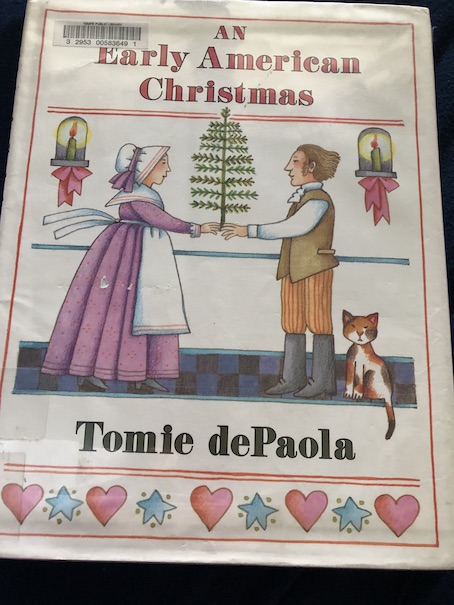
An Early American Christmas

An Early American Christmas by Tomie dePaola, 1987.

A note at the beginning of the book explains the story behind the book, which is based on the history of early Colonial America. Although Christmas is now a popular American holiday with lavish celebrations, many early colonial groups didn’t celebrate Christmas much at all. Even among Christian groups, Christmas was not regarded as a major holiday. In particular, groups like the Puritans, Presbyterians, Quakers, and Baptists tended to avoid celebrating Christmas, seeing it as a frivolous sort of celebration. However, there were other groups, like Catholics, Lutherans, and Episcopalians, who did celebrate the holiday in a festive fashion. The author of this book imagines what it would have been like for a family that celebrates Christmas if they moved to a New England community that didn’t during the early 1800s. In particular, he used New Hampshire as his inspiration.

The beginning of the story describes a New England town that doesn’t celebrate Christmas with decorations or songs. Then, a new family comes to the village. They were originally from Germany, and they had lived in Pennsylvania before coming to the village. (This would make them Pennsylvania Dutch.) They are usual because of their festive Christmas celebrations.

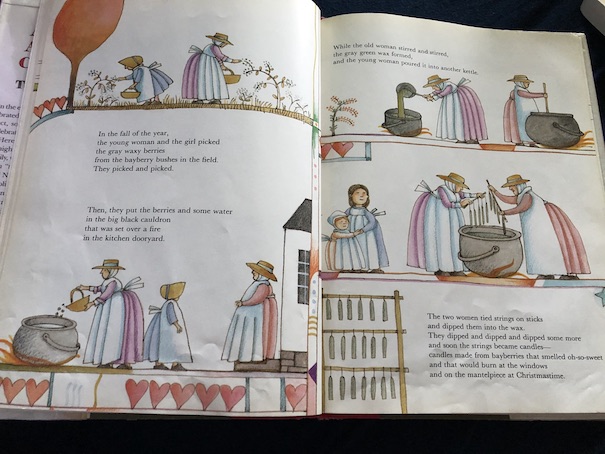
They begin planning for their Christmas celebration in the fall. The women and girls pick bayberries and use them to make candles. They say that bayberry candles bring good luck when they’re burned on Christmas.

The men and boys gather the crops that they will need for their feast. The grandfather of the family carves figures for their manger scene.

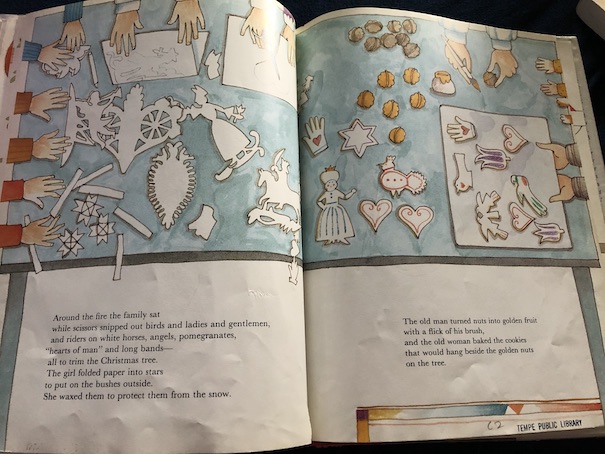
In December, the whole family makes paper decorations and specially-shaped cookies. I liked the variety of baked goods that they show in the pictures. They pick out a tree and make strings of popcorn and dried apples.

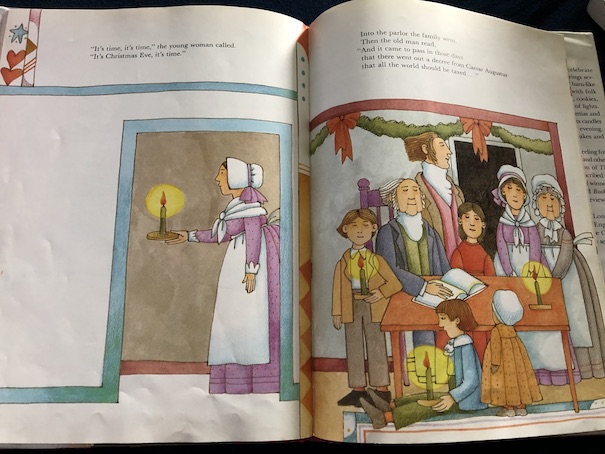
On Christmas Eve, they read the story of Jesus’s birth and decorate their home with all of the decorations they have prepared.

As the years go by and other people in town see what the Christmas Family is doing, they begin to celebrate Christmas, too.

The book is available to borrow and read for free online through Internet Archive.

Christmas in a Pandemic

Once in awhile, I feel like circumstances require me to make some comment about current events. Christmas this year is weird. There’s no denying that. This year has been dominated by the Coronavirus Pandemic, an event unforeseen at this time last year. In fact, the very first book post I made when this year began focused on the Influenza Pandemic of 1918, and I didn’t do it on purpose. I just happened to be reading Charlotte Sometimes around Christmas last year because it was a book many people said was good, and I’d been meaning to get around to reading it. I didn’t know on New Year’s Day 2020 that it was going to turn out to be weirdly appropriate.

So, everyone’s lives this year have been affected by the current pandemic. Many people aren’t going to spending Christmas like they did last year. Not everyone can travel to visit relatives, and some people, sadly, will be missing people who were with them last year. It’s okay to be sad about it. Circumstances aren’t good, and it’s okay to have feelings about it. It’s okay to be sad or angry and get those feelings out. Christmas tends to bring out strong feelings even in ordinary years because it’s the last major holiday before the New Year. It’s an event that not only marks a major Christian event, but also kind of caps off the year. It’s a time when people take a pause, and when people pause, they also tend to think. They think about what’s happened during the last year, where they are in their lives, where they expected to be, and what they expect or hope for during the next year. When I was in high school, a teacher warned us that it’s normal for some people to get depressed around this time of year, even though it’s usually considered a happy time. There are different reasons for that. Sometimes, it’s partly the weather, if you live in a place that gets dark and snowy around this time of year, but quite often, it’s about personal expectations. We all have expectations about our lives and how we think events are going to go, and it’s disappointing and sometimes frightening when things don’t go according to plan. Some people feel like they’ve failed when things in life don’t work out the way they wanted them to, and that’s depressing. They feel like they should have been able to control things better in the year leading up to Christmas and have the expectation that Christmas should be this perfect day where everything goes smoothly and everybody is perfectly happy. But, that’s not really how life goes, and not everything in life can be helped. Everyone encounters circumstances beyond their control that occasionally derail their plans, and that’s okay because it’s human, and that’s something that’s at the heart of the Christmas story, too.

For those who believe in the Christmas story, Jesus was born in a stable because there was no room at the inn for his parents to sleep in. There was literally nowhere else to go for them but the street, and the stable was a step up from that because it at least had some straw to lie on instead of the hard ground. It looks cute in nativity scenes with all the animals around, but anybody who’s been in a real stable or barn knows that they are smelly. Stables are for animals to live in, and animals poop. That’s one of the reasons why barns and stables have straw on the floor, to make it easier to clean up the animal poop and pee as well as providing animal bedding. In nativity scenes, Mary typically looks unusually clean in white and blue robes for someone who just gave birth while lying in a pile of straw. In real life, straw probably would have gotten all over her clothes and into her hair. This wasn’t a hygienic maternity ward with clean white sheets and soft pillows. It was a glorious event, but far from “perfect”, and even calling it “ideal” would be stretching it a little. It was what it needed to be for the people involved and the circumstances they were in. This is a story about people making something wonderful happen because they were doing the best they could with what they had in difficult circumstances. In a way, that’s part of what’s compelling about this story. If it had been a normal birth where everything went as one would expect, with no complications or unusual circumstances, it wouldn’t be special, would it? Everything about this story centers on the fact that this birth was unusual, not anything anybody would have expected. It was all surprising, from a prophetic star overhead to angels telling shepherds about the birth to wise men showing up with gifts to a homicidal king who starts looking for the baby, forcing the family to flee, to who this baby turned out to be. Nothing about this situation was normal. If it had been, we probably wouldn’t have a major holiday to celebrate it, and it wouldn’t be a story worth telling.

By the way, that’s my grandmother’s old Nativity set in the picture, and if you look at it closely, it’s also far from perfect. That picture isn’t the greatest, but also the figures are a mixture of pieces from different sets that my grandmother probably bought on sale or at a garage sale because she did things like that. You can kind of tell that it’s not just one set from the different styles of the figures and the bases that don’t match each other. Some are stamped “Made in Japan” and some are labeled “Made in West Germany.” Yep, West Germany. Some of the figures are broken. The guy in the back on the left is missing a hand, and some of the animals have to lean on something to keep from falling over. The angels aren’t in the picture, but they’re on top of the box that contains the scene, and one of them is missing a wing. We still use this set every year because we’ve had it for years and are attached to the pieces, even the broken ones. It’s possible to love something that isn’t perfect.

There are all kinds of expectations, and the type that really makes Christmas special is the expectation not that things will be perfect but that we will be pleasantly surprised by what happens. Pleasant surprises come when circumstances aren’t perfect, but good things still happen, and we have something to celebrate anyway. This is true even in the middle of a pandemic. So, forget what this year and this holiday were “supposed” to be! A lot of things have happened this year that nobody wanted (no matter what the conspiracy theorists say). It’s been hard for everyone, but there is some comfort in realizing that, no matter what you’ve been through this year, there are people around the entire world who have been going through the same thing with you every step of the way. You’re far from alone, and during this last week of the weirdest year of our lives, there are still some things to be glad about and some time to arrange a few last-minute treats for yourself and some nice surprises for other people.

Remember the Little Things

Life is in the details, and even in the midst of every insane thing that’s happened this year, there are still some little things that have gone right. Did you learn something new this year? Revive an old hobby during quarantine? Reconnected with an old friend online? Take care of some things you’ve been meaning to do but just never got around to doing until you just couldn’t get out to doing anything else? If you did, celebrate it! If you didn’t, you’ve still got about a week to do whatever it is you want to do before the year ends and then celebrate it!

Since my family started quarantining, I’ve gotten used to Zoom (which I’d been meaning to learn how to use and this year, I really had to). I managed to complete an internship remotely, and I’ve finished my final class to get the degrees I wanted. My dog has finally let my brother pet her because he’s been around more, and she’s finally started to trust him more. These are things that make a difference to me, and if you think about it, there may be things that you did that have changed your life for the better while you were worrying about larger events. Even just managing your life through a major pandemic is an accomplishment by itself. Think about the positive things you’ve done, big and small. Maybe write them down so you can see them and remind yourself of the good you’ve done.

I can’t say that I accomplished everything I wanted to do this year … or, even half of it. But, that happens every year. I just roll over all my uncompleted projects to the next one and add some more as the year goes on. It’s routine. It doesn’t matter how long I live, I’m the kind of person who thinks of more to do than I’m ever going to find time to do, and I’m used to that. As the year comes to a close, take a little time to appreciate the things you have done instead of brooding about what you didn’t or couldn’t. There is satisfaction in knowing that you’ve done things and taken care of what you needed to do. If, like me, your to do list is never-ending, then take a moment to appreciate being an ideas person with a constant supply of interesting projects and that you’ll never lack for direction in your life.
Celebrate an Old Tradition or Start a New One

Traditions can be a source of comfort, even if you’re not sharing them with the people you normally would. Traditions connect people with the past and the people who have shared those traditions before. They also remind us that there have been other Christmases before, and there will be more to come. This is just one year out of many. Whatever your situation is/was this year, it will probably be different by this time next year. Take comfort in that, and take some time do the things that you’ve enjoyed doing on Christmases before.

Watch some of the movies that you’ve liked on Christmases past, or if you’re just not feeling it this year, try something different. A simple Google search will show you just how many Christmas-themed movies there are to choose from. You don’t even have to watch something Christmas-specific, if you don’t feel like it. If it would make you happier to watch Star Wars tomorrow, do that instead. (I’d rather watch that than It’s a Wonderful Life any Christmas. Even though it has a happy ending, I find it wrenching to go through to get there.)

Most of my blog is about books, specifically nostalgic ones. Revisit some childhood favorites, or check out some of the ones I’ve reviewed! Most of the ones I’ve reviewed are also available online through Internet Archive, so if you don’t have them, you can get them with a couple of mouse clicks. (Internet Archive requires you to sign up to borrow books online and read them in your browser, but it doesn’t cost any money, and you might also find some old favorites there that I don’t know about yet.) Read them with your kids or just by yourself to relive the nostalgia!

Favorite books from Christmases past (plus more on my list of Christmas books):

Merry Christmas from Eddie (1986)

The adventures of a group of neighborhood children, leading up to Christmas. This are just calm, slice-of-life adventures that make nice bedtime reading, like the one about Eddie’s cookie mix-up and the time he played Santa for his family and how a toy horse became a zebra in the school’s toy drive.  One of the Betsy and Eddie books by Haywood.

The Best Christmas Pageant Ever

The Herdmans, the worst kids in town, unexpectedly show up at Sunday school (mostly to raid the snacks) and become interested in the Christmas pageant.  What will happen when the Herdmans decide that they want the starring roles?  Part of The Herdmans Series. This humorous book brings up what I mentioned earlier about the situation in the First Christmas not being perfect, and there’s also a movie version.

Merry Christmas, Amelia Bedelia

Amelia helps Mr. and Mrs. Rogers get ready for Christmas while they go to pick up Aunt Myra, who will be spending the holiday with them. As in all of her books, Amelia goes through her to do list taking absolutely everything literally, from “trimming the tree” by clipping its branches to “stuffing the stockings” with the same kind of stuffing that she would use to stuff a turkey.  Part of the Amelia Bedelia Series.

The Biggest, Most Beautiful Christmas Tree (1985)

The chipmunk children are disappointed because Santa has trouble finding their house among the other trees in the forest, so the animals decide to turn their home into a big, decorated Christmas tree.  A Little Golden Book.

The Nutcracker (1816, 1987)

A young girl receives a magical nutcracker for Christmas and learns how to break the spell that has changed him from a human prince. By E.T.A. Hoffmann, retold by Anthea Bell.

The Polar Express (1985)

A boy rides a magical train on Christmas Eve and goes to the North Pole to meet Santa and receive the first gift of Christmas.

Starlight in Tourrone

Children in a small village in France revive an old Christmas tradition that brings life back to their town.

Christmas Around the World

This book explains Christmas customs in various countries around the world. I’ve read it and reread it around Christmas since I was a kid! If you like this book, I also recommend the Anglophenia YouTube video about Christmas in Britain.

Some other books that I haven’t reviewed yet on my blog are:

The Night Before Christmas

A picture book of the famous poem with beautiful pictures and some historical information about the poem in the back.

A Little House Christmas: Holiday Stories from the Little House Books

This is a collection of the Christmas scenes from different books in the Little House on the Prairie series. There are some good Christmas stories in those books, where people often had trouble getting together, and the family had their own, homemade fun and enjoyed simple pleasures.

Christmas Cookbook

Christmas recipes from around the world!

Many people feel nostalgic about special foods and treats around Christmas. Even if you can’t get together and eat with as many people this year, you can still enjoy old favorites, and baking special Christmas cookies and making candy and other treats can be a good activity and something you can enjoy with children.

Of course, a classic Christmas activity is making a gingerbread house. Or, if you’re like me, using the shortcut of making one out of graham crackers or pop tarts. (Remember, it doesn’t have to be perfect, it just has to be fun. It’s always a little messy, and you’ll notice mine has old Valentine candy on it because it’s more fun to read candy hearts than eat them.) If you don’t have proper piping bags for the icing, you can always do what I do and put the icing in a sandwich bag or freezer bag and snip off one corner.

If none of these activities sound like your traditional activities, or if you don’t feel like doing what you ordinarily would do, consider starting a new tradition! Make a new kind of craft or try a new recipe you’ve never tried before. All traditions were new once, and if you like it, it might just catch on.

Be Good to Yourself

Whatever you decide to do this year, do things that make you happy. Christmas is a day to celebrate, to enjoy what you have and give yourself a special treat. Ask yourself what would make you the happiest and make it a point to do things that you enjoy. Read a favorite book (whether it’s about Christmas or not), eat your favorite snacks, have a bubble bath, make a pillow fort with the kids (or, heck, just make one for yourself – who’s gonna know?), run around in the park, drink hot chocolate, play games, whatever you like. Give yourself permission to relax for one day.

Even if you’re spending Christmas alone this year, there are still things you can do to be happy. Take advantage of the freedom of being alone to watch movies, listen to music, or eat foods you like but nobody else really does. Call people and wish them Merry Christmas. If you haven’t sent everyone a card yet, this is a good time to do that.

Surprise Someone

Hopefully, you’ve done all of your Christmas shopping, but there’s still time to surprise someone with something special. If it’s not a gift, it can be just something nice that you do for someone. Call or write to someone you haven’t talked to in awhile and let them know you’re thinking of them. Call into a local radio station and request a song you can dedicate to someone else. Arrange to do yard work for someone to help them even if you can’t have close personal contact with them. Seeing that you can do little things to help people and make them smile may make you smile, too.

If you want a sense of accomplishment, do something to help someone else or make plans to do it for the New Year. There are many groups to donate to, from pet shelters to organizations that help foster children. Do a little research and find out what’s happening in your community and look for a cause you’d like to support. You could donate money to help the homeless or make toys out of no-sew fleece for the local pet shelter. If you’re feeling lonely, there are even some organizations (like this one) that will match you up with a pen pal, like a home-bound senior, who could also use some companionship and emotional support. To find these groups, Google “write to the elderly” and add in your location to find a senior pen pal near you. Consider ways to connect with your community and the people in it, even if you can’t exactly gather yet. Nothing lasts forever, and by the time the pandemic eases, you may have made some new friends by connecting with a good cause.

Merry Christmas!

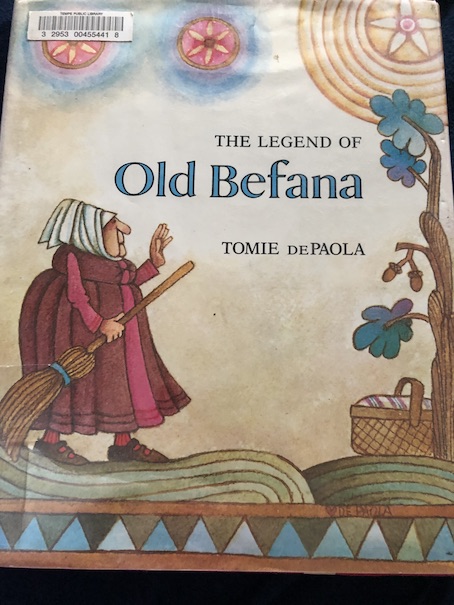
The Legend of Old Befana

The Legend of Old Befana by Tomie dePaola, 1980.

The story is based on a Christmas story from Italian folklore. According to Italian tradition, Old Befana visits the houses of children on January 6th, the Feast of the Three Kings, and leaves treats and gifts. Legend has it that she is on an eternal search for The Christ Child.

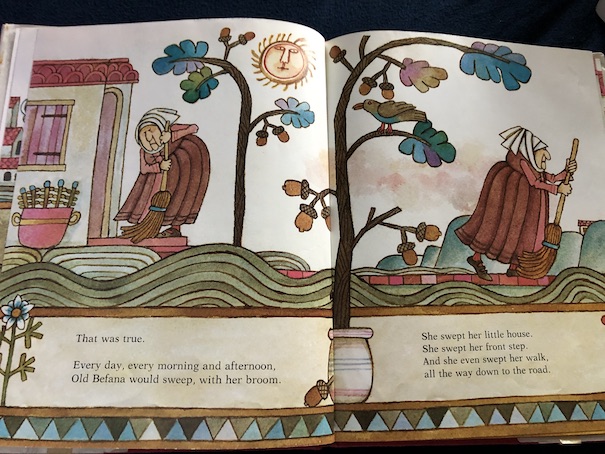
Old Befana is a strange old woman who living in a village in Italy. She is a grumpy woman who spends almost all of her time sweeping. Sometimes, she bakes good things to eat and sings lullabies, although she lives alone, so there’s no one for her to bake for or sing to. People think that she is crazy.

One night, Old Befana wakes up to see a bright light. There is a dazzlingly bright star in the sky, and it makes it difficult for her to sleep.

The next day, as she is doing her usual sweeping, she hears the sound of bells. A strange and beautiful procession comes over the hill. Among the procession are three men in royal robes.

The three kings stop and ask Old Befana if she knows the way to Bethlehem. She says that she has never heard of the place. The kings say that they are looking for “the Child,” but Old Befana doesn’t know what child they mean. They explain to her that this Child is a king and that His appearance was signaled by a bright star in the sky.

Old Befana confirms that she has also seen the star. A boy among the procession tells Old Befana that they are bringing gifts to the Child because He has come to change the world. The boy urges Old Befana to come with them, but old Befana says that she is only a poor woman and continues her sweeping.

After they leave, however, Old Befana continues thinking about what they said, and she starts to think that maybe she should go see the Child. She bakes all kinds of cookies and candies as gifts. She also decides to take her broom so that she can sweep the Child’s room because His mother will be tired. However, she stops to do her usual sweeping before she leaves her home.

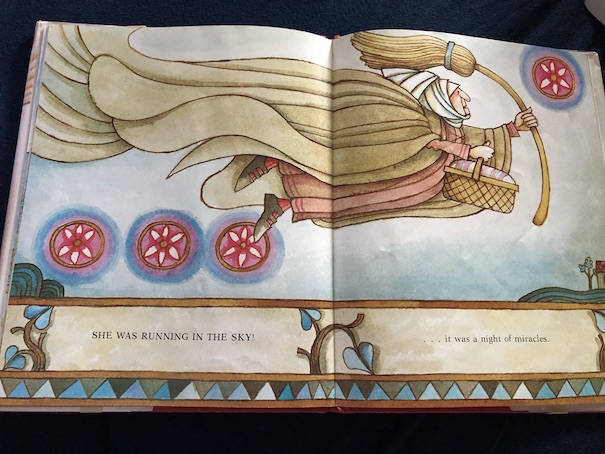
By the time she is finished with her sweeping, the procession is so far ahead that she is unable to catch up to them. Just as Old Befana laments that she cannot catch up to the procession, the angels declare that, “This is the night of miracles.” Suddenly, Old Befana can run fast, even running across the sky.

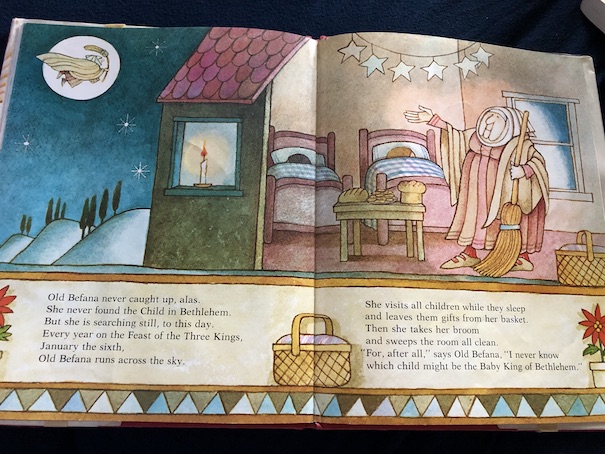
Unfortunately, Old Befana still doesn’t know the way to Bethlehem or who the Child is, so she doesn’t get to see the Christ Child. However, she still continues her search. Every year on January 6, she runs across the sky, carrying her broom and her basket of treats. At every house she finds with a child, she sweeps the room clean and gives the children gifts and treats because she never knows for sure which of them might be the Child she is seeking.

The book is available to borrow and read for free online through Internet Archive.

The Clown of God

The Clown of God by Tomie dePaola, 1978.

The book begins with a note that the story is based on an old French legend, although the story actually takes place in Italy.

A young boy named Giovanni has no parents and must live as a beggar, but he knows how to juggle. He juggles fruit and vegetables in the marketplace, and the produce sellers give him food in exchange for drawing people’s attention to their wares.

One day, Giovanni sees some actors putting on a play, and he asks for a job with the troupe. After he demonstrates his juggling ability, they agree to take him on in exchange for food and a place to sleep.

Over time, Giovanni’s juggling act becomes more elaborate. Eventually, he becomes famous in his own right and leaves the troupe to become an entertainer for many important people.

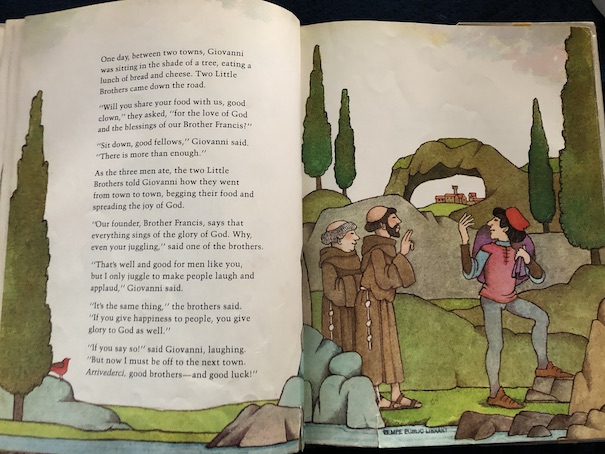
During his travels, he meets two monks, who ask him if he is willing to share his food with them. He agrees, and they tell him about Brother Francis, the founder of their order. (St. Francis of Assissi. They are Franciscan monks.) They say that everything in the world is a sign of God’s glory, even Giovanni’s juggling. Giovanni says that he never thought of it like that before. He just likes making people happy with his performance. The monks say that making people happy is a way of glorifying God.

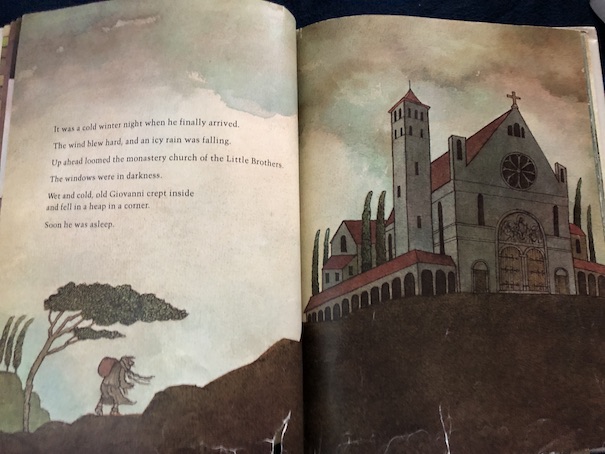
Giovanni continues his performances, but as he gets older, people get tired of his act, and one day, he actually drops one of his juggling balls. For a time, he has to live as a beggar again. However, he eventually finds his way to the monastery where the Franciscan monks live.

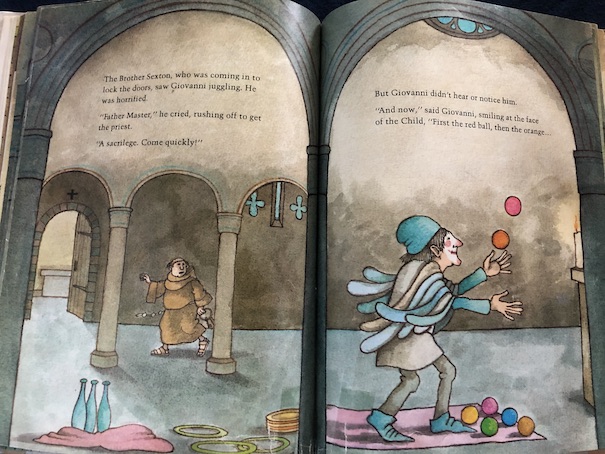
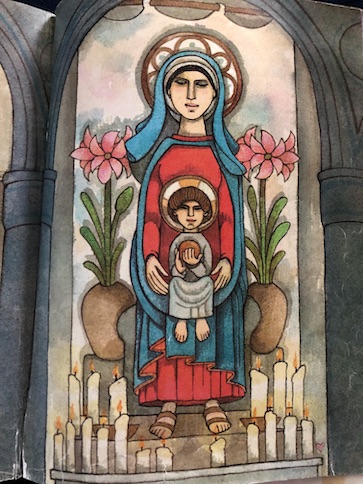
He arrives at the monastery at Christmas, and there is a special procession where people are offering gifts to the Christ Child, placing them in front of a statue of Jesus and Mary. Giovanni is struck by how serious the Christ Child looks in the statue, and so he decides to perform the act that used to make everyone smile.

When one of the monks sees him juggling in front of the statue, he thinks that it’s a sacrilege and calls the priest to come see what Giovanni is doing.

The story is sad because Giovanni’s exertion in giving the best performance of his life causes him to have a heart attack and die. However, the priest and the monk notice that, suddenly, the statue is smiling and holding Giovanni’s special golden ball.

The story is about using talents to the fullest. The juggler’s talent, as the monks said, was a gift from God. For as long as he could, he used it to make people happy, and when he was too old to do so anymore, he gave his last, finest performance for Jesus.

The book is available to borrow and read for free online through Internet Archive.

The Puppy Who Wanted a Boy

The Puppy Who Wanted a Boy by Jane Thayer, illustrated by Lisa McCue, 1958, 1985.

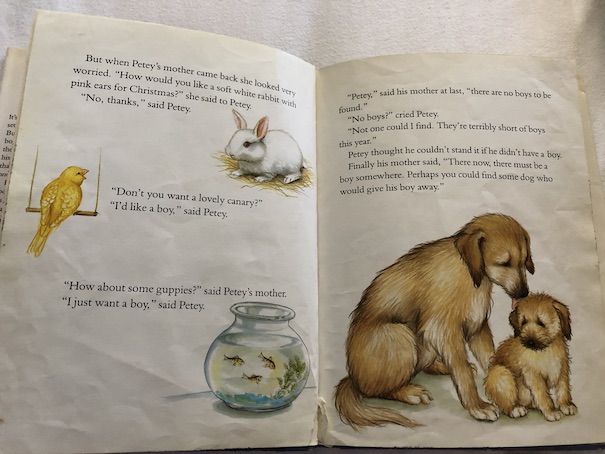
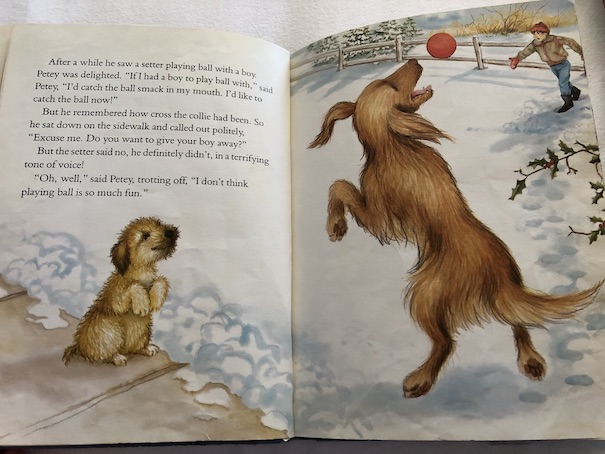
A puppy named Petey tells his mother that he wants a boy for Christmas. His mother says that he might get one if he’s good, and when Petey is a good puppy, his mother tries to find one for him.

Unfortunately, Petey’s mother just can’t seem to find a boy for Petey anywhere. She suggests trying to see if any other dog is willing to part with his boy. However, no other dog wants to give up his boy.

Eventually Petey comes to an orphanage with a sign that says Home for Boys. Petey decides that if the boys have no parents, maybe they could also use a dog. It’s Christmas Eve, and most of the boys are inside are singing Christmas carols, except for one boy, sitting by himself outside.

Petey jumps into the lonely boy’s lap, and the boy loves him right away. When a lady comes to check on the boy, the boy asks if he can bring the puppy in, and she says yes.

All of the boys in the home love Petey and want to keep him. The lady says that Petey can stay if his mother lets him, and Petey knows that she will. Instead of getting just one boy for Christmas, Petey found fifty!

The story was first published in 1958, but my edition is from 1985 and has different illustrations. In the older book, the puppy looked like a beagle.

The book is available to borrow and read online through Internet Archive (multiple copies).

Clifford's Christmas

Clifford

Clifford’s Christmas by Norman Bridwell, 1984.

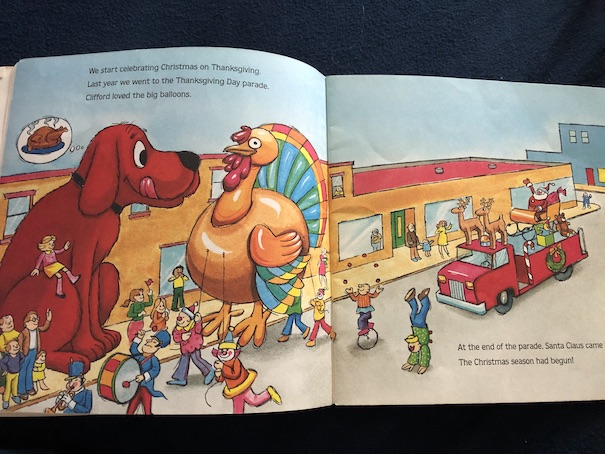
Christmas is coming, and Emily Elizabeth and Clifford are ready to celebrate! Emily Elizabeth talks about how the Christmas season begins with Thanksgiving. (That’s not how everyone regards it, but it is a common way to mark the season in the United States. The day after Thanksgiving, Black Friday, is considered the start of the Christmas shopping season, with people looking for bargains on Christmas presents.)

When it starts to snow, Emily Elizabeth, Clifford, and their friends have fun playing in the snow. They get a Christmas tree, prepare their stockings, and participate in other holiday activities leading up to Christmas. Clifford even gets a kiss under mistletoe!

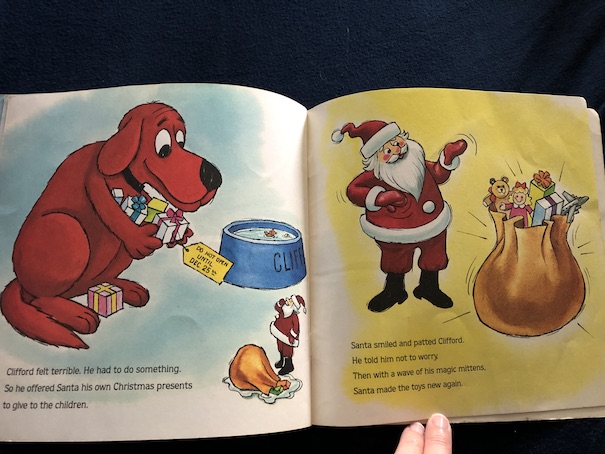
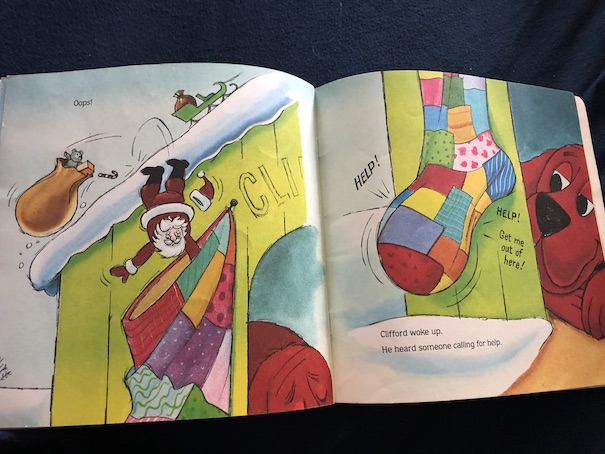
When Santa comes, he lands on the roof of Clifford’s dog house and accidentally falls into Clifford’s stocking, dropping his sack of toys. Clifford has to rescue him.

The toys fall into Clifford’s water bowl, but Santa fixes them with his magic. No harm done, and it’s a Merry Christmas after all!

This is just a cute Christmas story with a popular children’s books character. I loved the Clifford books when I was a kid, but I have to admit that they don’t look as good to be now as an adult. The entire plot of Clifford books revolves around Clifford’s enormous size, which is the very idea of the series. However, the plot of this is light, the problem is both caused and immediately solved by Clifford’s large size, and I think I’m just not interested in the usual trope of Famous Character Saves Christmas In Some Way anymore. I think that some Christmas stories with popular characters are still good, but for them to work, they usually have to have deeper, more clever, more interesting plots. This book isn’t bad, but I just didn’t think it was particularly great.

The book is available to borrow for free online through Internet Archive.