Day and Night

Day and Night by Roger Duvoisin, 1960.

Night is an owl who likes to go out hunting for food at night, and Day is a poodle who lives with family called the Pennyfeathers. Because Day is usually only out during the day and sleeps in the family’s house at night, they don’t usually meet. However, by chance, Day rescues Night from a fox.

Night is grateful, and the two of them become friends. However, because they are normally active at very different times, they can’t easily meet to talk to each other.

They sometimes leave each other little treats, like a bone with some meat or something from one of Night’s hunts.

They also begin meeting at the kitchen door at night to talk to each other.

However, Day’s barking and Night’s hooting is too loud, and they start keeping the Pennyfeathers awake at night. At first, they can’t figure out why Day keeps barking every night, but their son, Bobby, sneaks out one night and sees the way Day seems to be talking to the owl.

Bobby correctly realizes that Day and the owl are friends and that they’re just trying to talk to each other. To solve the problem, Bobby builds a dog house for Day so that Day can comfortably sleep outside and talk to his owl friend without disturbing everyone.

Day likes the new dog house, and Night meets him there every night so the two friends can talk whenever they want.

My Reaction

This is a cute picture book that I’ve liked since I was a kid. I like the way that Day and Night talk to each other and some of Day’s misconceptions about what his humans are thinking. When Mr. Pennyfeather yells at them to be quiet, Day tells Night that he thinks Mr. Pennyfeather is barking at the moon.

Some of the pictures are in black-and-white and some are in color. It seems to be common in older picture books to have a mixture of black-and-white and color images. I think it might partly have been done to save money on printing.

Owl Babies

Owl Babies by Martin Waddell, illustrated by Patrick Benson, 1992.

Sarah, Percy, and Bill are three owl babies who live in a tree with their mother. One night, they wake up and can’t find their mother. They think it over, and they decide that she has probably gone out to get food for them.

They wait for her and try to be brave, but they get worried that she isn’t coming back. Then, suddenly, their mother does come home!

The little owls are happy to see their mother, and their mother reminds them, “You knew I’d come back.”

It’s common for children to worry when their parents go away without them, wondering if they will ever come back. The story reminds young children that, even when mommy has to go away for a while, she will still come back home.

The book is available to borrow for free online through Internet Archive.

Spot Visits the Hospital

Spot

Spot Visits the Hospital by Eric Hill, 1987.

Spot’s friend Steve, who is a monkey, is in the hospital with a broken leg. Spot and some of their other friends decide to go visit him and take some presents to cheer him up.

Steve likes their presents, and Spot and his friends sign Steve’s cast. They play in the hospital’s playroom, where they have toys, games, and books for child patients.

Spot’s friend Helen decide to play doctor, and she puts a bandage on Spot’s leg, as if his leg is broken, like Steve’s. They start pushing Spot around in a stroller, like it’s a wheelchair.

Their friend Tom hides, and they all go looking for him, finding him in an x-ray room. In real life, they would probably get in trouble for goofing off around the x-ray equipment, but in the book, nobody catches them doing it. I think the reason why the book has this episode in it is to have a reason to show readers the x-ray equipment and explain how the doctors used it to examine the break in Steve’s leg.

Spot is fascinated by what he sees in the hospital and tells his mother that he might like to be a doctor someday.

This story could encourage children who find the idea of studying medicine and helping people interesting, but it also makes a visit to the hospital seem less scary for children who may worry about what happens there and what all the big machinery, like the x-ray machines, are for.

The book is available to borrow and read for free online through Internet Archive.

Spot Goes to the Beach

Spot

Spot Goes to the Beach by Eric Hill, 1985.

Spot’s parents take him to the beach to spend the day there. When they get to the beach, Spot wants to get a sailor hat from a stand selling beach equipment, and his father also buys him some beach toys.

Spot plays with a beach ball, builds sand castles, and buries his father in the sand.

Spot and his father later go fishing, and Spot falls in the water, but Spot is fine because he’s wearing a pool float.

Before they leave the beach, Spot also makes a new friend, another puppy!

This is just a cute book for children about the fun things that they can do at the beach.

Like other Spot books, this book is a lift-the-flap picture book. The British version of the title is Spot Goes on Holiday. It’s available to borrow and read for free online through Internet Archive (multiple copies).

Spot Goes to School

Spot

Spot Goes to School by Eric Hill, 1984.

Spot is going to school for the first time. His mother drops him off at the school, where he meets his teacher, Miss Bear.

Spot and his animal friends participate in typical kindergarten activities. They sing a song while their teacher plays the piano (although Spot hides because he can’t sing), and they play dress up in the classroom playhouse.

They play on the playground and show what they brought for show-and-tell. Spot roughhouses with a friend during storytime, and he loves painting pictures with his friends. When school is over, Spot doesn’t even want to go home because he’s had so much fun!

Like other Spot books, this is a lift-the-flap book. It is available to borrow and read for free online through Internet Archive (multiple copies), but to be honest, it’s not as much fun to read electronically because you can’t experience the lift-the-flap effect.

Where’s Spot

Spot

Where’s Spot? by Eric Hill, 1980.

This is the first modern lift-the-flap book for children, inspired by the author’s young son, who was playing with some sheets of papers on which he had drawn some concepts for an advertisement. There was an earlier style of lift-the-flap book from the 18th century, but this first book in the Spot the Dog series led to the popularization of modern lift-the-flap books for children.

Spot’s mother, Sally, notices that her puppy hasn’t eaten his dinner. She doesn’t know where he is, so she goes looking for him.

Sally searches for Spot all around their house, looking behind a door, in a closet, inside a clock and piano, under the stairs, and under the bed. In each place, she finds different animals (no explanation, there are just a lot of animals in this house).

Finally, the turtle hiding under the rug suggests that Sally check the basket, which is where she finally finds Spot.

The story is very simple, and the lift-the-flap concept is what really makes it work. The interactive element is fun, as if the readers are participating in a game of hide-and-seek with the characters. Kids enjoy being surprised by the different kinds of animals hiding all over the house. I loved it when I was a kid!

The book is available to borrow and read for free online through Internet Archive (multiple copies), but to be honest, it’s not really a good book to read online because the lift-the-flap effect doesn’t carry over.

Dragons, Dragons, and Other Creatures that Never Were

Dragons, Dragons, and Other Creatures that Never Were by Eric Carle, 1991.

This is a collection of poems and quotations about various mythical creatures from around the world. The poems and quotes come from various sources. Some are by famous authors and some are nursery rhymes and pieces of folklore. The quote about the leviathan is from The Book of Job.

The illustrations are what really make the book interesting. They are bright and colorful, and the middle section of the book folds out to reveal a particularly long picture of a Chinese dragon.

Although there are common mythological creatures, like dragons, unicorns, yetis, the phoenix, there are also less common ones that some children may not have even heard of, like the giant bird called the roc, the two-headed amphisbaena, the kappa, and the bunyip.

Most of the descriptions of the creatures are in the poems themselves and in the accompanying pictures, but there is a glossary in the back that explains more about what each creature is and where it is from.

The book is available to borrow and read online for free through Internet Archive (multiple copies).
In the Night Kitchen

In the Night Kitchen by Maurice Sendak, 1970.

This is a very surreal children’s picture book about a strange dream that a boy has one night.

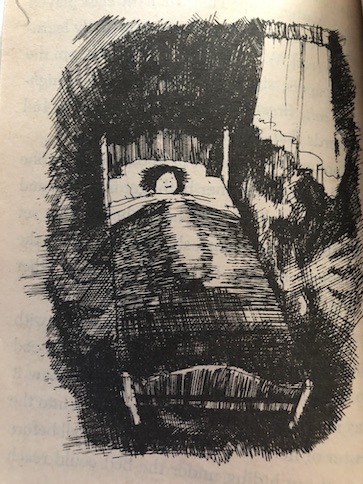
One night, a boy name Mickey is trying to sleep when he hears a strange thumping sound. He yells for the person making it to be quiet, and he suddenly finds himself falling out of bed.

He continues falling through the floors of his house and loses his pajamas. (Mickey is naked for most of the book, and at times, you can see his private parts in the pictures. The rest of the time, he is covered in batter. This is a very strange book.)

Mickey falls into a bowl of batter in the Night Kitchen, and the cooks mix him into the batter and try to bake him into a cake. However, Mickey climbs out of the oven and into some bread dough, which he shapes into an airplane.

The cooks cry out for milk for the cake they want to bake, so Mickey grabs their measuring cup and flies off in his bread dough airplane to find some.

He dives into a giant bottle of milk, losing the batter that was covering him. Mickey gets a cup of milk and pours it into the batter. The cooks are happy and bake their cake.

Then, Mickey slides down the side of the bottle and ends up in his own bed and in his pajamas again.

Apparently, the whole thing was a dream, but it’s a very odd dream. I didn’t like Mickey being naked in the pictures because I don’t see any particular reason why he should be. This would still be an odd, surreal dream even if he was wearing his pajamas through the whole adventure. It’s not terrible, but I did find that part a little unsettling and unnecessary. The rhymes in the text of the story were cute. I think it would sound nice read aloud.

The book is available to borrow for free online through Internet Archive (multiple copies).

The 13th Clue

The 13th Clue by Ann Jonas, 1988.

This picture book is almost entirely pictures. The pictures present clues to a treasure hunt and reveal the true story of the book.

The book begins with a diary entry. At first, we don’t know who is writing it, but this person writes about what a bad day it’s been. We know that the person must be a kid because they mention school, and I guessed that it was the person’s birthday because people sang to them at school. But, she thinks that others have forgotten her birthday. The diary entry breaks off when the person notices a light going on in the house when, supposedly, no one else is home.

From this point on, until the very end of the book, the text is presented in the form of clues for our birthday kid (who turns out to be a girl, as shown in shadows and a reflection in water in later illustrations) to follow that lead to the place where her friends are waiting to give her a surprise party. Readers can figure out the clues along with the girl, some of which are easier and more direct than others.

I love puzzle books, and I thought that it was interesting how we don’t even know who the main character of the book is, only finding that out as the book continues. I liked the challenge of figuring out the clues as the book went along, although none of them were particularly difficult. They aren’t written in any kind of code, just kind of hidden in plain sight, most of them using objects that are part of the rest of the scene. Some of the letters of words are jumbled and have to be unscrambled. I’m sure it would seem harder to children.

This is a pretty easy book, but not one that would be suitable to read to children who can’t read themselves. There are no solutions provided to the puzzles, but that’s okay because, first of all, they aren’t very hard, and second, there are no opportunities for the reader to make choices based on the puzzles, so there is nothing for the reader to get wrong. The end of the story is obvious. Most of the fun is just studying the pictures to see the cute ways her friends decided to hide their “secret” messages. The hardest message to spot is the one written in the hillside.

The book is available to borrow for free online through Internet Archive.

The Girl in the Window

Kiley Mulligan Culver lives in a fairly small town, Meander, in the southern United States.  Although not much usually happens in their small down, about a year before the story begins, a little girl named Leedie Ann Alcott was kidnapped.  The crime literally hit Kiley very close to home because she and her father (Kiley’s mother died when she was a baby) live on the Alcott family’s estate.  The Alcott mansion was once a plantation, and Kiley and her dad, who is an author, live in the old house that once belonged to the plantation’s overseer, so they know the Alcott family well.  Mr. and Mrs. Alcott are divorced, and Mr. Alcott lives in another state.  Mrs. Alcott owned a children’s clothing shop in town, Kiley would sometimes babysit or play with Leedie Ann, who was younger than she was.  In some ways, Leedie Ann was kind of like a little sister to Kiley.  At the time she disappeared, Leedie Ann was four years old, and Kiley was about nine.  Mrs. Alcott never received a ransom note for Leedie Ann, but everyone is sure that her disappearance was a kidnapping, not just a child wandering off.

A year later, when the story begins, Leedie Ann has still not been found, and no one knows what happened to her.  After Leedie Ann disappeared, her mother closed her clothing shop, and a strange gypsy woman named Pesha came to stay with her.  Pesha is mysterious and secretive, and no one knows why Mrs. Alcott has her staying with her, although they seem to be holding seances.

Then, one evening, Kiley looks up at the Alcott mansion and sees Leedie Ann Alcott standing in the window of her old room! But, before she can do anything, another, shadowy figure closes the drapes on the window.  By the time that Kiley can tell her father what she’s seen, Leedie Ann is gone.  Her father goes to the Alcott house to ask Mrs. Alcott if everything is all right and if she needs anything, and everything seems to be normal (or what passes for normal at that time).  Kiley’s father thinks that Kiley imagined the whole thing, but Kiley knows that she didn’t, and she is sure that she wasn’t mistaken and that it was really Leedie Ann.

Kiley tells her friend, Sarah, about what she saw and persuades her to help find out whether Leedie Ann is really in the Alcott house or not.  Sarah is nervous about it, but she agrees to go along with Kiley’s plan to go to the Alcott house and ask to use the bathroom, pretending that she has been waiting for Kiley to meet her at her house but that she just can’t wait anymore.  While Sarah is supposedly using the bathroom, she’s supposed to check Leedie Ann’s room upstairs.  Kiley can’t do this herself because she wouldn’t have the same excuse that Sarah would and because Mrs. Alcott would know that Kiley knows where the downstairs bathroom is and that she would have no reason to go poking around upstairs.

When Sarah follows through on Kiley’s plan and checks Leedie Ann’s room, she tells Kiley that she did see Leedie Ann there!  However, Pesha saw her spying and made her leave the house.  Kiley and Sarah think that perhaps Pesha has both Mrs. Alcott and Leedie Ann under a spell and is holding them prisoner in their house.  But, what can the girls do to help them?

Kiley comes up with a daring plan to trick Pesha into revealing what she knows about Leedie Ann Alcott by writing an anonymous letter to her as if she already knew that Pesha was involved in her disappearance, but the plan backfires.  The police reopen the inquiry into Leedie Ann’s disappearance (don’t ask me why they didn’t notice that the letter appeared to be written by a child), but Kiley accidentally implicates an innocent person.  Adults in town are nervous, and Sarah’s mother doesn’t want Kiley to see her anymore.  Just as Kiley thinks things can’t get any worse, Pesha asks for her help, offering a charm to help restore Kiley’s friendship with Sarah in return.  Pesha claims that her only purpose is to use her psychic abilities to help Mrs. Alcott find Leedie Ann and that what Kiley believed was Leedie Ann in the window was actually a mannequin left from Mrs. Alcott’s clothing store that Leedie Ann had always begged to have as a life-size doll for herself.  Is Pesha really as innocent as she claims to be?  Can Kiley trust her?  What about Mrs. Alcott?  Above all, where is Leedie Ann Alcott?

Although Kiley may have made a big mistake, the reopening of the kidnapping case does bring to light the real secret behind Leedie Ann’s disappearance.

The book is available to borrow and read for free online through Internet Archive.

One of the side plots in the story is about how differences between people can lead to mistrust because people sometimes get a false impression.  Kiley knows that her friends’ mothers don’t really approve of her because she is being raised by her father alone.  Some of her friends’ mothers, especially Sarah’s because she’s overprotective, think that Kiley is a wild child because she doesn’t have a mother to look after her, and they worry that Kiley will be a bad influence on their daughters.  Kiley does sometimes get into trouble because she’s a little daring and a little impulsive, but those are more personal character traits rather than the result of growing up without a mother, and some of her escapades are undertaken in the name of helping someone, like trying to find Leedie Ann.  Her friends’ mothers don’t understand Kiley’s intentions, though, and they never ask enough questions to find out what is really going on.  It seems oddly cold behavior from mothers to me.  Where I grew up, other people’s mothers would have taken more of an interest in a motherless child, purposely checking up on her and wanting to have her hanging around where they could keep an eye on what she was doing.  If they push her away, then she’s even less monitored than she was before.

However, Kiley realizes that everyone’s suspicions about Pesha, including her own, were also based largely on the fact that Pesha is different from everyone else.  For awhile, Kiley helps Pesha to hide from the police because Pesha fears their inquiries.  The two of them get to know each other better.  Pesha is actually a Holocaust survivor. Pesha has the tattoos on her body that the Nazis used to put on prisoners in their concentration camps (I’ve see those tattoos in real life, and I recognized them from the book’s description before Kiley understood what they were) and she tells Kiley about a place in Germany where her family was and terrible things happened.  Besides Jewish people, gypsies were also targets of the Nazis during the Holocaust and were sent to concentration camps along with them.  Pesha fears the police because she fears being locked up again, something that Mrs. Alcott tells to the police to explain Pesha’s sudden disappearance.  Knowing this helps Kiley to become more sympathetic to Pesha and more determined to help straighten out the mess that she helped to cause, eventually discovering the real whereabouts of Leedie Ann in the process.

Something that bothered me about the adults in the story, pretty much all of them, is their lack of interest in asking questions and taking charge.  Even after Kiley’s father realizes that she was helping Pesha to hide from the police, he doesn’t ask enough questions about why she was doing it.  He simply reports Pesha to the authorities and orders Kiley to stay out of it, just like he simply told her to stop imagining Leedie Ann Alcott and making up stories back when Kiley first saw the girl in the window.  Kiley’s father didn’t want to ask the awkward questions to verify what Kiley saw, so it was easier to assume that she didn’t see anything.  Part of that is a plot device, so that Kiley has a reason to dig for the truth herself, but it also figures into the way other adults, like Sarah’s mother, treat Kiley and how they approach the whole inquiry into Leedie’s disappearance.  Instead of checking on what motherless Kiley is doing and helping her father to supervise her, they want to just shrug her off as a problem they don’t want to deal with, figuring that someone else will handle it because they don’t want to get involved.  Then, when Sarah’s mother finds out about Sarah helping Kiley to write the letter that reopened the investigation, she refuses to tell the police the truth about it, allowing the investigation against Pesha to go forward even when she knew it was groundless, just because she didn’t want to get involved.  Disbelieving adults/adults not wanting to get involved is a trope of children’s mysteries because the adults’ non-involvement provides a reason for the children to investigate, but I still find it annoying and irresponsible.

Pesha’s innocence is finally established when Kiley finds the courage to admit what she did in front of everyone at Pesha’s court hearing.  Kiley comes to realize that a quality that she and her father both have is honesty.  Her father didn’t try to hide it when he discovered that Kiley was harboring a fugitive the way Sarah’s mother tried to hide the truth to avoid becoming involved and to hide her child’s involvement, and that’s something to be proud of.  The aftermath of her confession also gives Kiley the opportunity to spot the tell-tale clue of Leedie Ann’s current whereabouts, and Leedie Ann is safely returned to her mother.