The Daring Book forGirls by Andrea J. Buchanan and Miriam Peskowitz, 2007.
This is an activity/hobby book for children, especially for girls, but really, full of activities that boys could enjoy, too. It’s often sold in sets with a companion book, The Dangerous Book for Boys. These books follow in the tradition of earlier activity/hobby books like The American Boy’s Handy Book and The American Girl’s Handy Book by the Beard siblings. Some of the activities in these modern books are similar to ones included in historical children’s activity/hobby books, but there are some notable differences. Although The Daring Book for Girls includes sports and outdoor activities, it has more scientific and academic information than The American Girl’s Handy Book.
The differences between these books show changes that have taken place in society, the activities that adults want to promote for children, and the types of activities that children can actually use in the 120 years between the times when the two books were published. For example, 19th century how-to books for girls tended to include instructions for making several different types of decorative embroidery stitches. In this book, there is just one paragraph dedicated to sewing stitches, tacked into the end of the section about different types of knots, and the stitches they show are very simple stitches that can be used for basic repairs to ripped clothing. The authors of the 19th century activity books for girls seemed to be trying to introduce girls to genteel and practical pastimes and healthy physical activities. The authors of The Daring Book for Girls explain in their introduction that they wanted to introduce 21st century girls to more nostalgic pastimes that don’t involve today’s technology, like cell phones, video games, and the Internet because they feel like modern childhoods are too high-pressure and push kids to grow up too fast.
I like to explain the contents of books so that people will know whether they would like to read them in more detail. It’s difficult to describe the contents of The Daring Book for Girls succinctly because the contents are extensive, and they are not grouped into convenient categories. Like in The Dangerous Book for Boys, it’s more like reading a very long magazine with isolated articles, although some of the articles are related to each other. It did strike me that more of an effort was made in this book to put some related topics next to each other. For example, Building a Campfire is immediately followed by Campfire Songs, and Reading Tide Charts is immediately followed by Making a Seine Net for fishing.
Because it would be difficult for me to explain everything in this book without basically copying the entire table of contents, which would take quite a lot of space to do, I’ll just hit some of the highlights by describing them in sections that the book doesn’t have but which explain the types of activities and information covered in this book. All of the types of activities that I describe below are included in the book, but there is also more in the book than I could take the time and space to describe in detail.
Useful Skills and Knowledge
There are instructions for different types of knots and stitches, tips for assembling a useful toolbox that can be used to building things or making repairs, how to change a tire, how to write a letter, and basic first aid.
There are two sections with phrases, idioms, and terms of endearment in French and Spanish. These sections are more for fun and getting girls interested in learning languages than a functional guide to speaking a language. However, there are other sections with information that will be useful in school, like the sections of Math Tricks, Greek and Latin Root Words, and Books That Will Change Your Life.
As expected in a book for girls, there are tips and information related to clothes and hair styles, like How to Tie a Sari and Chiton, Putting Your Hair Up With a Pencil, Tying a Bandana, and Japanese T-Shirt Folding. However, I disagree with the advice in the section called The Daring Girls Guide to Danger about high heels. Most of that section is about doing things that are a little scary but can lead to greater confidence, like standing up for yourself or someone else, riding a roller coaster, or seeing a scary movie, but I don’t like the advice to wear high heels. Their logic is that it gets easier with practice, which may be true for most people, but I have to say that I’m in my 30s, and the only type of heels I’ve ever been able to wear without turning an ankle are low and thick. Otherwise, I have to wear flats, and I’m not the only woman who says that. Wearing high heels for extended periods is hard on the feet and can lead to foot problems later in life, so I favor being practical. In my opinion, some things just aren’t worth getting used to, and girls would be better off in the future for not starting that now.
In spite of the authors’ assertion that they don’t want girls to grow up too fast, there are some tips and information that are focused on gaining grown-up skills and preparing for a career, like public speaking, learning Roberts Rules of Order to conduct meetings, learning how to negotiate a salary, and understanding financial information like stocks, bonds, and interest. The section about how to have a lemonade stand not only contains recipes for the lemonade and other treats to sell but how to calculate profits.
There is also advice for girls about how to talk to boys. Some of it is the kind of advice that I wish that boys would be given about talking to girl. For example, the book says, “Some girls are told that boys are different” and that girls need to be into things that boys like in order for boys to like them. I think that, sometimes, boys and girls are taught too much to think of each other as homogeneous groups, that all boys like certain things like sports and all girls like certain things like dolls and romantic movies, and that they each need to do certain things, talk about certain things, or not talk about certain things in order to get people to like them. I think kids should be taught to think of each other more as individuals with individual personalities and interests, whether they’re boys or girls, and not to try to do things that they think are pleasing to all boys or all girls. Nobody really needs to please everyone anyway. No girl needs to get all boys to like her, and no boy needs to get all girls to like him. It’s enough to learn how to bond with people you like. If you want someone to like you, ask them about the things they personally like and tell them about the things you personally like. That’s how you find people who are compatible with you. As the book says:
“Many things are said of boys: Boys like sports, boys are messy, boys don’t have any feelings, boys like trucks, boys don’t like girly things, boys like to run around and eat gross food. Whatever the specific generalization, the point of these notions about boys is to set them apart from girls as being entirely different.
Similar statements are made about girls: Girls like pink, girls like flowers, girls are neat and clean, girls are frivolous, girls are emotional. Are any of these things true about all girls? Of course not. But, it’s easier to think about boys and girls as being entirely different than it is to think about boys and girls as having lots of common ground.”
The book says that, depending on how a girl feels about boys, she could ignore them, be friends with them, or even consider romance with them, but “Wherever you are on the spectrum of how you feel about boys, do treat all of your friends, boys and girls, with kindness. This has gone out of fashion, and that’s a sad mistake. Overall, the truth is that there’s no great mystery about boys. Boys are people, and like all people, they are complicated. And that’s what makes being friends with other people interesting: you get to learn about how other people think and act, and, in the process, learn a little bit more about yourself.”
One of the stereotypes about boys is that they aren’t as good with relationships as girls are, but I think that this is partly due to the advice that they’re given about relationships. After comparing the advice about girls given in The Dangerous Book for Boys and the advice about boys in The Daring Book for Girls, I think that both boys and girls should take the advice in The Daring Book for Girls.
Games
The book provides rules and tips for outdoor games, including Four Square, fourteen variations of Tag, Hopscotch, Tetherball, and Jump Rope (which includes jump rope rhymes, and there are separate sections for Double Dutch and Chinese Jump Rope). There are card games, like Hearts and Gin. There are also rules for playing Jacks, Darts, and Hand Clap Games.
There is a special section about slumber party games, which includes the classic Truth or Dare and a couple of games of the spooky variety, Bloody Mary and Light as a Feather, Stiff as a Board. Young girls often like to do spooky things to scare each other when they’re staying up late at night. Boys don’t usually do this stuff, but girls often do when they’re unsupervised at sleepovers or summer camp. The spooky types of “games” are really psychological tricks, and they seem much less mysterious and scary when you know how they work (Bloody Mary makes use of the “Strange Face Illusion“, which is admittedly still an eerie sensation when you’re an adult who knows what to expect and that it’s all a trick of the mind), so they tend to be at their maximum popularity when girls are in their tween and early teen years, old enough to get a little thrill from doing something a bit scary but not yet old enough to have learned why they work and have the mystery taken out of them. The book explains a little about the concept of levitation and the superstitions surrounding it for Light as a Feather, Stiff as a Board, and it ends by calling the effect a “magic trick, a phenomenon based in real-world explanations and techniques”, but it doesn’t go into details about the real-world explanation behind it, so it doesn’t ruin the sense of mystery for the girls who want to try it. There is also a section of advice for telling ghost stories that is separate from the slumber party section, but good for sleep-overs and camp-outs.
Sports and Exercise
The book provides rules for basketball, netball, softball, and bowling.
It also explains five basic karate moves, some basic yoga, and how to do cartwheels and back walk-overs.
Outdoor Activities
There are sections with activities related to camping out, like Sleep Outs, how to build a campfire, campfire songs, two ways to make a sit-upon, how to paddle a canoe, and how to go hiking, climbing, and bird watching. As I mentioned above, the book also explains how to read a tide chart and how to make and fish with a seine net.
There are also instructions for making clubhouses and forts, setting up a tree swing, rollerskating, and how to make traditional daisy chains and ivy crowns.
Science and Technology
The book explains some natural and scientific concepts, such as weather and the Periodic Table of Elements.
There are instructions for creating projects of the type that would be good for a science fair, like a Lemon-Powered Clock, things to do with Vinegar and Baking Soda, how to demonstrate capillary action with paper flowers, and how to make a lamp, lantern, or flashlight with batteries.
History and Geography
The book covers the Bill of Rights and the 50 states of the United States and also has some information about Canada. There are also sections about the countries of Africa and the South Sea Islands.
All of the historical people or interesting people from around the world described in the book are women. The section about pirates describes famous female pirates from history. There is a section about female scientists and inventors and one about famous female Olympic athletes, and there are several sections about famous Queens of the Ancient World. There is a section about Modern Women Leaders from around the world and one section about what modern princesses are like and what they do, giving girls a more realistic reference for what princesses are beyond the usual fairy tale images. There are also stories and mini biographies about interesting and inspirational historical women, like Joan of Arc, and others that are related to other topics that the book covers. For instance, the section about first aid is followed by short biographies about Clara Barton and Florence Nightingale.
Spies and Secret Codes
The book discusses female spies from history, and there is some information about secret codes, but much of the sections about spies discusses assembling a spy team, the types of roles required for a team, and the skills that the members should have. There is also a section about “Spy Lingo”, terms and code words that spies use.
Arts and Crafts
The book has information and instructions for writing in italics, making a quill pen, painting with watercolors (even doing it “on the go”), pressing flowers, making friendship bracelets, making a cloth-covered book, making your own paper, making paper airplanes, making cootie-catchers (origami fortune tellers), and making God’s-Eyes.
There are some projects that involve wood working, like making a peg game, a willow whistle, and a scooter.
Stunts and Random Skills
The book explains how to read palms (this could go with slumber party ideas, although they’re not grouped together in the book, because young girls often like to speculate about the future, especially their future love lives, or do spooky things to scare each other when they’re staying up late at night) and how to pull Three Silly Pranks of the kind that are common at summer camps (like short-sheeting a bed).
Dangerous Book for Girls Badges
This is the final part of the book. Since many of the activities in the book are the kind done at summer camps or in scout troops, the book offers suggested “badges” you can award yourself and your friends for doing the activities. Even though the activities in the book are not sorted into specific categories, there are six categories of badges offered: Sports and Games, Girl Lore, Adventure, World Knowledge, Life Skills, and Arts and Literature. The book doesn’t specify what activities you should master to award yourself these badges, leaving that up to the reader. My copy says that if you go to their website, you can print out these badges, but that website no longer exists. I don’t know if later printings say something different. Fortunately, a site reader found an online pdf of the badges that still works, so you can print off copies for yourself or for a group of kids. Thanks, Mike!
If you’re looking for something to do with the kids during coronavirus lock-downs (I first published this post in May 2020) and/or over summer vacation, this book has plenty of ideas, and you can even make up your own “badges”, using their ideas, my category suggestions, or anything else you would like to do yourself.
If you would like some suggestions to get you started or give you some goals to aim for, I think I would award badges like this (of course, these are just my suggestions):
Sports and Games – Learn the rules to at least two games and/or sports from the ones in the book. They can be any two games you like, indoor or outdoor or one of each. I don’t think winning at the games is necessary. It’s more important that kids know how to play games and how to teach other people to play so they can use the games with their friends.
Girl Lore – This is a good category for the sleepover-related activities. To earn this badge, someone could either try each of the sleepover games or activities or practice story-telling skills with a camp-out or sleepover type story or by telling a story about one of the famous women described in the book.
Adventure – This badge has a lot of possibilities, but I would suggest either using it for practicing outdoor or camping skills or for doing activities that are new and challenging. If you don’t want to go on a hiking, bird-watching, or camping trip, you can challenge yourself or your group to do three things you’ve never done before, in the spirit of adventure. They can be activities in this book (like the spy activities), suggestions from the section called The Daring Girls Guide to Danger (like watching a scary movie or riding a roller coaster or trying a new food), or going to a place you’ve never been before, etc.
World Knowledge – Study one of the sections in the book about countries of the world or historical events or people and tell someone else what you’ve learned.
Life Skills – Pick a skill to study and demonstrate to someone else, like knots and stitches or the clothing and hair tips, or assemble a first aid kit or tool kit and discuss the purpose of each of the items included. Alternatively, study and discuss the sections about job skills and how you can use them in your life.
Arts and Literature – Try at least one of the arts and crafts activities from the book and/or read at least one of the books from the list of Books That Will Change Your Life. Show off what you create and talk about the book you read.
As a bonus suggestion, if you’re doing these activities with a group or over an extended period of time, like the entire summer, you can award badges multiple times for different levels of achievement. Completing one of the activities related to a badge theme could be Level 1, and doing another would be Level 2, etc. That way, if someone doesn’t like a particular activity category, like the outdoor or camping activities, they can put their focus into achieving more in a category they like better. At the end of the summer, you could offer recognition to members of the group who achieved the highest levels for each category and/or people who found particularly creative ways to use their skills. You could even include an extra Overachiever award for people who tried everything!
The purpose of badges and awards like this is really to encourage kids to try new things, to set personal goals, and to persevere, so whatever you do with the badges should keep these purposes in mind. If you use the badges, keep the badges fun and celebratory of achievements or at least attempts at trying new things! As long as it’s fun, like a game, kids will want to continue.
The book is available to borrow and read for free online through Internet Archive. There is also a sequel to this book called The Double-Daring Book for Girls which contains similar types of activities and is also available through Internet Archive. There are no badges with the sequel book, but if you like that format for marking achievements, you can either reuse the badges from this book or make up some of your own.
The Dangerous Book for Boys by Conn Iggulden and Hal Iggulden, 2006, 2007.
This is an activity/hobby book for children, especially for boys, but really, full of activities that girls could enjoy, too. It’s often sold in sets with a companion book, The Daring Book for Girls. These books follow in the tradition of earlier activity/hobby books like The American Boy’s Handy Book and The American Girl’s Handy Book by the Beard siblings. Some of the activities in these modern books are similar to ones included in historical children’s activity/hobby books, but there are some notable differences. Although The Dangerous Book for Boys includes sports and outdoor activities, it has more scientific and academic information than The American Boy’s Handy Book.
The differences between these books show changes that have taken place in society, the activities that adults want to promote for children, and the types of activities that children can actually use in the 125 years between the times when the two books were published. The motives of the authors of these books were similar, all of them wanting to produce the type of activity/hobby book that they would have liked to have when they were young and didn’t have, not because other hobby books didn’t exist exist when they were young but because they were looking for something that they hadn’t found in the hobby books of their youth. In the 1880s, Daniel Beard set out to write a hobby book for American boys because many of the hobby books of his youth were poorly written and/or came from England, using words that were not used in American English or recommendations for London shops where boys could buy equipment, which were of no use to an American boy. His book, The American Boy’s Handy Book, promoted do-it-yourself hobbies, particularly ones related to outdoor activities and suitable for children who lived near woods and lakes or rivers where they could do things like go fishing, sail boats that they made themselves, or build log cabin playhouses. However, 21st century society is much more urban/suburban, and it can be difficult or impossible for modern children to do something the things that Daniel Beard recommended. The Dangerous Book for Boys was written for 21st century children, who might need a bit of nudging to get off their computers and video game systems now and then and maybe a little academic help or something to ignite an interest in history or science, but are no less interested in learning something new and interesting or something fun to do with their friends. One thing that I hope readers come to understand from these books is that the world is full of things to do. There is more to do in life than anyone will have time to do in a single lifetime, and far, far more than can be contained in any one book. The Dangerous Book for Boys (published first in the UK and later in the US) contains things that 19th century Daniel Beard might have found very interesting but didn’t exist during his time, so they never even occurred to him as possibilities, and there are bound to be more things coming in the future that people either haven’t thought of yet or are quietly working on right now, planning the books and activities of the future. There’s always something to do. People just need time to do things and the willingness to get started.
I like to explain the contents of books so that people will know whether they would like to read them in more detail. It’s difficult to describe the contents of The Dangerous Book for Boys succinctly because the contents are extensive and they are not grouped into convenient categories. It’s more like reading a very long magazine with isolated articles, although some of the articles are related to each other. It’s just that related topics are not put next to each other. For example, the information about reading star maps comes much later in the book than the introduction to astronomy, and information about the solar system comes even later, with many other sections in between. There are also some sections of trivia/interesting information, history, or academic topics which were purposely split into different numbered sections and distributed throughout the book, like Questions About the World (explaining natural phenomena like the seasons, the tides, and why the sky is blue), Famous Battles (divided into sections starting with ancient battles and then more modern ones), Extraordinary Stories (about the lives and accomplishments of famous men, including the Wright Brothers and Robert the Bruce), and Understanding Grammar (a more academic section).
Because it would be difficult for me to explain everything in this book without basically copying the entire table of contents, which would take quite a lot of space to do, I’ll just hit some of the highlights by describing them in sections that the book doesn’t have but which explain the types of activities covered in this book. All of the types of activities that I describe below are included in the book, but there is also more in the book than I could take the time and space to describe in detail.
Useful Skills and Knowledge
The book has sections explaining how to do first aid, how to tie different types of knots, how to wrap a package with brown paper and string, and how to make cloth fireproof.
I was somewhat amused by the section about how to talk to girls. Most of it is good advice, like maintaining a clean appearance and not being vulgar or overdoing it with jokes. Lesson #1 is “It is important to listen.”, which is always true. The part that I thought was funny was in the introduction: “You may already have noticed that girls are quite different from you. By this, we do not mean the physical differences, more the fact that they remain unimpressed by your mastery of a game involving wizards, or your understanding of Morse Code.” To that, I say, “Are you kidding?!” I used to have Morse Code memorized from playing the Nancy Drew computer games by Her Interactive, and I know from my fascination with activity books like this that the reason why Morse Code looks the way it does is that Morse wisely decided to make the letters of the alphabet used the most often the shortest to form. I used to play World of Warcraft, and I played every one of the available factions, but then I got more interested in physical board games and board game history. My female friends continued much longer, although they ended up switching to Final Fantasy. I’ve played both D&D and Call of Cthulu and liked them both. The more wizards, the better, as far as I’m concerned!
I always think that advice about what girls like often fails to take into account that girls are individuals with different interests and hobbies, no matter what their age. Not all woman like to wear high heels (which are stupid, annoying shoes that are bad for your feet, especially those with the dumb, skinny heels that always make me turn my ankle), and some either never wear makeup or consider it an annoying hassle that they feel obligated to do to because other people expect it. Some girls wear their hair long because they like the feminine look or like to experiment with different types of artistic braids and hairstyles, and some girls chop their hair short because they’d rather just quickly run a comb through it and forget about it. Some women, like me and my friends are geeks, who love books, play video games and role-playing games, know various types of computer programming or maker hobbies, study history, and would gladly do most of the activities in books like this. Some girls are into sports and working out. There are even some girls who are into things like hunting and even taxidermy and wished that they could have joined the Boy Scouts instead of learning to sew and bake cupcakes in Brownies. People in general can have many and varied interests. Even though this book was written for boys of the 21st century, I don’t think that the authors are really in touch with women and girls of the 21st century and understand the range of topics that many of them find interesting. Although, I think that the authors’ attitudes about girls’ interests aren’t just due to them growing up in the 20th century themselves. Guys have often tried to figure out what women like and what women want, and they frequently get it wrong because they approach the question from the wrong angle. Chaucer tackled the problem of what women want way back in the Middle Ages, and he figured it out. What women like most is often what men like most: having things their own way. What that means varies from person to person because of our different interests, but in some form or other, that’s what we all want. So, don’t try to figure out what “girls” like; just ask a particular girl what she likes. Guys don’t need to try to please all the girls in the world at once, just the one they’re with. Most people will tell you who they are and what they’re interested in, given the chance (or maybe a Facebook or Instagram page), and when a boy finds a girl who likes things that he also likes or is willing to do things that he likes to do, he’s found a good one.
Aside from random, useful life skills, there is also academic information in the book that would be useful to school, like standard and metric measurements, the sections about how grammar works, the origins of words, Latin phrases, quotes from Shakespeare, the Ten Commandments, and poems that boys should know and books that boys should read.
Games
I count games differently from sports because sports tend to be outdoor activities and require a certain level of physical skill, and games tend to be more general, require less physical skill, and can be played indoors. This book includes some pen-and-paper games, marbles, chess, role-playing games, poker, and table football.
Sports
The book has the rules for soccer and stickball. It also discusses famous baseball players and rugby.
Outdoor Activities
These are activities to do that are related to the outdoors and nature and things to make related that are related to outdoor activities, including fishing, building a treehouse, making a bow and arrow, how to hunt and cook a rabbit, how to tan an animal skin, making a go-cart, and learning various methods of navigation and different types of trees.
Science and Technology
The book describes various topics related to science, like astronomy, insects and spiders, cloud formations, and fossils and dinosaurs. There are also instructions for making projects that would probably make good science fair projects, like a battery, an electromagnet, a periscope, a pinhole projector, and crystals.
History and Geography
There are sections about US geography (I don’t know if the original UK version had this or if it focused on the geography of the UK), Early American History, the Declaration of Independence, the Golden Age of Piracy, descriptions of the Seven Wonders of the World (both ancient and modern), the sections about Famous Battles from history, and a Brief History of Artillery.
Spies and Secret Codes
There are sections about the codes and ciphers that spies use, the Navajo Code Talkers’ Dictionary from World War II, the US Naval Flag Codes, and how to make secret inks.
Crafts
The book explains how to build a workbench, how to grind an italic nib for italic writing, and how to make marbled paper, making paper airplanes and paper hats, boats, and water bombs (these are little origami boxes that you fill with water and splat when you throw them at something – I’ve made them before).
Stunts and Random Skills
These are just random things that are fun to know how to do, like juggling, skipping stones, coin tricks. There is also a section about teaching tricks to dogs.
Dangerous Book for Boys Badges
This is the final part of the book. Since many of the activities in the book are the kind done at summer camps or in scout troops, the book overs suggested “badges” you can award yourself and your friends for doing the activities. Even though the activities in the book are not sorted into specific categories, there are six categories of badges offered: Carpentry and Woodworking, Direction and Navigation, Hunting and Fishing, Nature Exploring, Science and Experiments, and Astronomy and the Solar System. The book doesn’t specify what activities you should master to award yourself these badges, leaving that up to the reader. My copy says that if you go to their website, you can print out these badges, but that website no longer exists. I don’t know if later printings say something different.
If you’re looking for something to do with the kids during coronavirus lock-downs and/or over summer vacation, this book has plenty of ideas, and you can even make up your own “badges”, using their ideas, my category suggestions, or anything else you would like to do yourself.
The book is available to borrow and read for free online through Internet Archive. I’ve also learned that the book has inspired a tv series, which is available through Amazon Prime. You can see the trailer on YouTube.
The American Girl’s Handy Book by Lina Beard and Adelia B. Beard, 1887.
This is a Victorian activity book for girls, focusing particularly on outdoor seasonal activities and celebrations. Earlier, I covered The Girl’s Own Book, which is a similar type of Victorian activity book for girls, but there are important differences between the two. For one thing, they were published over 50 years apart, which means that the girls who read this book when it was new would likely be the granddaughters of girls who had grown up with The Girl’s Own Book. For another thing, this book is organized by the seasons and has a more outdoor focus. There is a reason for the somewhat different focus of this book, but I need to explain a little about the authors.
Lina Beard (“Lina” was short for Mary Caroline) and Adelia Beard were sisters. Their brother, Daniel Beard, was the author of The American Boy’s Handy Book, published a few years before The American Girl’s Handy Book. Like their brother did in his book, Lina and Adelia set out to make a book of activities specifically for an audience of American children, taking into account the sort of environment that the children would live in and the language they would use. In the preface to the book, they say that they had the idea to write a book of activities for girls after the publication of their brother’s book, thinking about times when they have heard girls wish for an activity book of their own whenever a new one for boys appeared. (There were previous activity/how-to books for girls, like The Girl’s Own Book, but their comments indicate that there were more books of this type for boys than for girls.)
Both Lina and Adelia would later be founding members of the Camp Fire Girls, the first major scouting organization for girls in America, during the 1910s, while Daniel Carter Beard was one of the founders of the Boy Scouts of America. (Camp Fire Girls was founded before the founding of the Girl Scouts. Today, it is now a co-ed scouting organization simply called Camp Fire.) Their family believed in appreciating nature and the benefits of exercise and outdoor life, and these concepts are reflected in the activities in of the Handy Books.
However, even though they valued exercise and healthy outdoor activities for girls and the subtitle specifically mentions “outdoor fun”, this book has plenty of indoor activities for girls as well. This is probably partly because they would have appealed to girls of the period and their parents, but it’s also because the book takes the realities of weather into account. An ideal time for forming walking clubs and enjoying the beauties of nature would have been in the spring, but not so much in the heat of summer, when making fans and playing relatively sedentary games would have helped keep them cool, and not in the winter, when things were covered in snow and girls would have to take their exercise indoors and work on indoor crafts and needlework. Overall, the The American Boy’s Handy Book has more outdoor activities than The American Girl’s Handy Book, but the Beard sisters also wrote other activity books, some of which have even more of an outdoor or camping focus.
Contents of the Book
The activities in this book are organized by season, and I liked the organization much better than the organization in The Girl’s Own Book. The organization by season is the same as in The American Boy’s Handy Book. Within each section, there are more specialized sections, focusing on particular pastimes and holidays in each season.
Spring
The holidays that appear in this section are April Fool’s Day, Easter, and May Day. May Day isn’t a major holiday in modern times, but schools in the 19th century commonly had May Day celebrations.
The recommended outdoor activities for spring are lawn tennis (this section includes instructions for making your own lawn tennis net), forming a walking club, and picking and preserving wildflowers. The wildflowers section is the longest section in this part of the book, and it has a surprising array of methods for preserving wildflowers, including crystallizing them.
Summer
The holidays in this section are Midsummer Eve and the Fourth of July. Midsummer Eve isn’t a common holiday for modern girls to celebrate, but the Midsummer activities of the 19th century involve fortune telling.
Summer provides many opportunities for outdoor activities. There are tips for holding various types of picnics and decorating a seaside cottage, and there are suggestions for using plants in art and making dolls out of corn husks and flowers. However, summer is also very hot, and in the days before air conditioning, people would have also wanted ways to relax and keep themselves as cool as possible in the heat. The summer section of the book has instructions for making fans and hammocks and playing relatively quiet games.
Autumn
This section begins with suggestions for celebrating Halloween and ends with Thanksgiving. The Victorian era was the beginning of Halloween parties as we know them today. There would have been games for children and romantic divination games for young adults, particularly young women and girls.
The Thanksgiving section offers tips for putting on a kind of Thanksgiving play, but it’s not historically accurate by any means, and the American Indians aren’t portrayed well. The whole thing is more like a series of joke skits.
The nature themes in the Autumn section focus on nutting parties and making decorations from autumn foliage. A nutting party is a sort of walking party and picnic, where the girls enjoy the beauties of nature, gather chestnuts, and roast and eat the nuts afterward.
Most of the autumn activities focus on various types of art, including drawing, painting in oil and water colors, making picture frames, making clay and wax models, making plaster casts, and painting china.
I was fascinated by the arts and crafts information because I always enjoyed arts and crafts, but I’d like to draw your attention to one activity that doesn’t quite fit with the others in this section: making a tin-can telephone. This fascinates me because telephones were a relatively new invention at the time this book was written, but the tin can variety apparently weren’t far behind.
Winter
This section begins with Christmas activities and games and tips for making homemade presents. The other holiday celebrations included are New Year’s Eve, a special Leap Day party (for years with Leap Days), and Valentine’s Day.
Most of the activities in this section are indoor activities, like studying heraldry and making your own coat of arms with suggested symbols, doing needlework, making book covers and scrap books, and making things from stuff that otherwise would be thrown away. (They didn’t have the term upcycling back then, but that’s basically what this activity was about.) There are a couple of sections about decorating a room, decorating windows and mantle pieces and making and decorating furniture.
There is also a section with recipes for different types of candy.
For exercise, there is a section about doing indoor exercises. There is also a section about creating booths for a fair, which surprised me because I wouldn’t have thought of that as a winter activity. Then again, people can begin planning early for later events.
The American Boy’s Handy Book by Daniel Beard, 1882.
This is a Victorian activity book for boys, focusing particularly on outdoor seasonal activities. It was not the first book of its kind during the Victorian era, but the author explains in the preface that he wanted to create a book of sports, games, and activities that would be better than the ones that he knew from his own youth, with instructions that were well-written, complete, and easy to follow, particularly written for American boys, without some of the foreign phrases found in other books or tips that would be impossible for them to use, like recommendations for shops in London that sell equipment for the various activities and pastimes.
The book is now public domain and available to read for free online through Internet Archive.
Historical Background
Daniel Beard wasn’t just an author who had an interest in providing useful guides to fun activities for American boys; he was also a social reformer who was one of the founding members of the Boy Scouts of America. Before the Boy Scouts of America was founded in 1910, there were other, smaller scouting organizations throughout the United States, and Daniel Beard had founded one of these groups in 1905, which he called the Sons of Daniel Boone. This group later went through a couple of name changes before Beard joined the Boy Scouts of America and merged his group with theirs.
The Beard family in general believed in the benefits of exercise, appreciation of the natural world, and healthy outdoor activities for youth people, both male and female. Daniel’s sisters, Lina and Adelia, would later be founding members of the Camp Fire Girls, the first major scouting organization for girls in America, during the 1910s, a cause which Beard also supported. (Camp Fire Girls was founded before the founding of the Girl Scouts. It had the opportunity to merge with the Girl Scouts at one point but didn’t. Today, it is now a co-ed scouting organization simply called Camp Fire.) A few years after the publication of The American Boy’s Handy Book, Lina and Adelia published their own book of activities specifically for American girls called The American Girl’s Handy Book, which had somewhat of an outdoor focus but not as much as The American Boy’s Handy Book or some of the other books that they would later write. These were not the only books that the Beards published, and they would later go on to write more books about activities and wilderness skills for boys and girls.
Contents of the Book
The activities in this book are organized by season, which makes sense because of the largely outdoor focus of the activities. Within each section, there are more specialized sections, focusing on particular pastimes in each season. The American Girl’s Handy Book follows the same seasonal organization, but The American Boy’s Handy Book doesn’t mention holidays as much as The American Girl’s Handy Book. There is only one holiday section in this entire book, and the holiday is the Fourth of July. Later editions of the book also have some extra notes and projects in the back.
My copy of the book has a foreword written in modern times, part of which notes that some of the activities in the book are not really recommended for modern children because they are not suitable for kids living in urban or suburban environments and because some of them are outright dangerous and involve fire. At least, children should not attempt these activities without close supervision and help. Some 19th century people managed to play with fire and not hurt themselves, partly because more of them lived in the countryside, away from houses that could be set on fire, and like the author of this book, also lived in places in the Midwest and East Coast that see a lot of rain, keeping plants and fields from drying out and becoming more flammable, and could also be near lakes, ponds, and rivers. However, not everyone lives in those types of places these days. (If you want an indication of what could possibly go wrong with trying some of the more flammable activities in the book, consider what’s happened with some of the more flammable or explosive gender reveal parties in modern times. Consider your environment before deciding whether these activities are feasible.) Also, not everyone from the 19th century or 20th century pulled off these activities unscathed, and it’s the ones who did get hurt or caused serious damage that make the concern. The writer of the foreword describes how a 19th century boy lost a leg attempting the fire balloon activity with his friends years before this book was published. (The fire got out of control, and his leg was badly burned when he tried to put the fire out.) That being said, there are many interesting activities in this book that are perfectly harmless and fire-free and that kids from any era can try, even those who don’t live in the countryside.
Spring
The spring section is mainly about making and flying kites and going fishing. The kites section explains how to make different types of kites in different shapes, like people, frogs, butterflies, fish, turtles, and dragons. One of these designs, called The Moving Star, involves attaching a lit lantern to the tail of a long kite. This kite is meant to be flown at night, so the light will bob in the air. It’s an interesting concept, although the instructions mention that certain types of lanterns are likely to just set fire to the kite. (I think I know how the author knows this.) The book provides instructions for making a custom lantern that will work better. This custom lantern featured a candle that is stuck between nails that are supposed to hold it in place, and it is supposed to be covered with red tissue paper (which is also sure to catch fire if that candle gets loose and falls over while it’s flying around). I’ll admit that the effect is probably neat, if you can pull it off without setting fire to something, but setting something on fire seems to be a likely outcome. This is one of the activities which wouldn’t work well for modern kids, especially if they live in places with highly flammable brush or dead grass and weeds or in the middle of areas with a lot of houses or apartments that would be set on fire if the flying lantern gets out of control (which is, apparently, a distinct possibility). Of course, thanks to modern technology, a battery-operated light could be an option.
There is also a section about war kites, which can be used for kite fighting.
The rest of the spring section is about different methods of fishing, how to make fishing tackle, and how to keep aquariums.
Summer
The summer section has more variety, although many of the activities are ones that modern boys can’t do if they live in an urban or suburban environment. There is more information about fishing in this section and how to make and sail different types of boats. I thought that the water telescope, which can be used to look at things under water, was really interesting. The book provides two sets of instructions for making a water telescope, one wooden and one metal.
There is also information about different types of knots and how to tie them, blowing soap bubbles with a clay bubble pipe, and how to camp outside without a tent. The section about soap bubbles mentions “an aged negro down in Kentucky” whom the author knew as a child called “Old Uncle Cassius.” Uncle Cassius used to smoke a corn cob pipe, and he liked to amuse the children by blowing soap bubbles. The reason why the author brings up the subject of Uncle Cassius is that he had a particular trick where he would blow smoke-filled bubbles by filling his mouth from smoke from his own pipe before blowing some through the bubble pipe. The term “negro” is a bit archaic now, and I wouldn’t recommend smoking in general, but the author’s memories of Uncle Cassius seem to be fond ones, which is nice. The book doesn’t say whether or not Cassius was a slave, but the author was born in 1850, so my guess is that Cassius was either a slave or had been one earlier in life.
The section about soap bubbles also describes how children can use the gas from the gas lighting in their homes to blow bubbles, another activity that modern children can’t do.
As I mentioned before, fire is important to certain activities in this book. For Fourth of July, there are instructions for making a special kind of balloon that rises with heat produced by fire. They’re sort of like sky lanterns, made of paper. However, instead of having a place to set a small candle, these balloons have a “wick-ball”, which is a ball of rolled-up wick string, the kind used in an oil lamp, which is then soaked with alcohol and set on fire. The author notes that other people who make this type of balloon use small sponges instead, but he doesn’t think they’re as good because they don’t burn long, and as they burn out, the balloon comes back down, near where it started. He prefers to make a wick-ball so that it will continue burning and float out of sight. (I can’t help but notice that the sponge balloons, not burning for long and coming down nearby would also probably be easier to control and monitor for fire risk than the wick-ball balloons, which will float off to God-only-knows-where and get caught on who-knows-what before fully burning out.) The author says that he used to experiment with these as a child and has notes about which shapes are unsafe. Generally, it’s best to make them large and round, without a long neck at the opening. (As I said, the modern foreword in my copy notes that these types of balloons are actually dangerous and that kids have been injured trying to use them. This is why you don’t tend to see this type of activity suggested in modern children’s hobby books. Try it only at your own risk and remember that you’re responsible for any fires you start in the process. If you live in an urban setting or an area with a high risk of wildfires, don’t do it at all.)
There is quite a lot of information about activities involving real birds, like collecting bird nests and raising wild birds. (The modern view is that wild animals should be left wild and not kept as pets.)
There are also instructions for different types of hunting and how to make hunting weapons, including blow guns. In Meet Samantha from the Samantha, An American Girl series, she mentions that she read the instructions for how to make a boomerang in The American Boy’s Handy Book and that she wants to make and sell boomerangs to raise money to buy a new doll until her grandmother talks her out of it because that isn’t a proper activity for young girls. This is the part of the book where the boomerang instructions are, p. 190. Meet Samantha doesn’t say why Samantha was reading The American Boy’s Handy Book instead of The American Girl’s Handy Book in 1904, but that passage is mainly there to show the difference between what were considered acceptable activities for girls vs. acceptable activities for boys.
Autumn
The autumn section is much shorter than the previous two sections. It has information about trapping animals and practicing taxidermy. There is also a section about how to keep and train a pet dog. (Remember, that’s a commitment for life, not just for autumn.)
The part that I liked the best was the section about how to be a “decorative artist.” It teaches boys about photographic paper, how to make shadow pictures, and how to enlarge and reduce images.
Winter
The winter section has both indoor and outdoor activities, and the outdoor activities are designed for places with snow. (The author was born in the Midwest and lived on the East Coast of the United States, so these are the environments he considers for his outdoor activities.) He describes snowball fights, snow forts and houses, snow statuary, different types of sleds and sleighs, snow-shoes, and how to fish in winter.
For the indoor activities, there are instructions for making puppets and a script for a puppet show version of Puss-in-Boots. There are also tips for making costumes for people, so children could perform their own theatricals.
I particularly liked the sections about how to make and use magic lanterns and how to make different types of whirligig toys. The magic lantern was a kind of early slide projector. The whirligigs were homemade toys that would spin.
This is an early Victorian era book for girls (first published shortly before the beginning of the Victorian era in 1837 and reprinted during the era), giving instructions for games, activities, and handicrafts. I bought my copy, a reproduction of the original, at a historical museum in Indiana while I was visiting relatives, but it’s also available through Amazon (including a Kindle edition) and for free online through Internet Archive (multiple copies). Different editions of the book have slightly different arrangements of the content.
Usually, I put the information about where to find the book at the end of the end of the review, and I give historical details after the plot summary in order to cut down on spoilers. However, in this case, I’m going to do it the other way around because it will help you to understand more about what this book is and what it’s not. I know you’re interested in the activities in the book, but first, you’re going to get a brief history lesson.
To really understand the goals of this book, it helps to understand who the author was.
About the Author
The author, Lydia Maria Child has a fascinating history. She was an American author, teacher, and journalist from Massachusetts. She was also an abolitionist and an advocate for women’s rights and the rights of Native Americans, disapproving of the concept of white supremacy and the United States’ policy of westward expansion. She wanted to expand the rights of women, but she believed that the end of slavery would have to come first, and her husband supported these beliefs as well. Child said that she didn’t believe in all-female societies. She believed that men and women should work together in equal partnership. Her beliefs about both women’s rights and slavery caused controversy in her time, but she was also a popular author, writing both fiction and nonfiction during the 1820s through the 1850s. Oddly, the one piece of her writing which is most familiar to modern people is a Thanksgiving poem which was later made into a song: Over the River and Through the Wood (1844, originally titled The New-England Boy’s Song about Thanksgiving Day). (Note: In the song, they’re going to grandmother’s house, but in the original poem, it said they were going to grandfather’s house. Now you know!)
The Girl’s Own vs. The Boy’s Own
As you might have guessed, there was a Boy’s Own before there was a Girl’s Own. Actually both of these phrases, or variations on them, have been used for different types of publications, particularly during the 19th century. However, I want to explain that The Girl’s Own Book and the earlier The Boy’s Own Book: A Complete Encyclopedia of all the Diversions, Athletic, Scientific, and Recreative, of Boyhood and Youth by William Clarke (published in England in 1828 and in the US in 1829) were both older and not connected to later children’s magazines with similar titles like Boy’s Own Magazine (19855 to 1890), The Boy’s Own Paper (1879 to 1967). Both The Girl’s Own Book and The Boy’s Own Book were reprinted during the 19th century and helped to inspire later books and magazines for children with similar themes. (Later, I’m going to be covering some of the children’s activity books and how-to guides that came after these books for some comparison. I’m not going into much detail on The Boy’s Own Book yet because I haven’t gotten hold of a copy to do it.)
The full title of The Boy’s Own Book: A Complete Encyclopedia of all the Diversions, Athletic, Scientific, and Recreative, of Boyhood and Youth explains basically what the book was about. It was a guide to boys’ sports, games, and activities to provide boys with wholesome fun and entertainment and some useful skills. The Girl’s Own Book basically does the same thing for girls. As the title suggests, it has more of a feminine focus than The Boy’s Own Book, but remember that the author believed in the equality of men and women and the expansion of women’s rights and education. What I’m trying to explain is that, even though this book was first published just before the beginning of the Victorian era and read and reprinted during the era, it’s not all about tea parties, proper dress and manners, and sewing stitches or the stuffy parts of Victorian society that modern people often think of. (Although there are sewing stitches in this book. That was pretty much a given.)
The author believed in exercise and healthy outdoor activities as well as practical indoor activities. There are quiet indoor activities, which would be necessary, given that the author lived in a place where it snows in the winter, and everyone would need to find ways to entertain themselves and keep busy indoors, but the book is not confined solely to that. In the preface to the book, Lydia Child describes how she tried to include a wide variety of activities and notes that, by trying to provide a selection that would appeal to a wide audience, she knows that she will not please everyone, but she explains her goals in doing so:
“Some will say there is too large a proportion of games; others will smile at the directions for sewing and knitting; some may complain that the frequent recommendation of active exercises will tend to make their children rude and disorderly; others will think too much is said about gracefulness and elegance; some will call the conundrums old, others will say they are silly, and others, that they should have been entirely excluded. I knew I could not avoid numerous criticisms, and therefore, I did not write with the fear of them before my eyes. In this land of precarious fortunes, every girl should know how to be useful; amid the universal dissemination of knowledge, every mind should seek to improve itself to the utmost; and in this land of equality, as much time should be devoted to elegant accomplishments, refined taste, and gracefulness of manner, as can possibly be spared from holier and more important duties. In this country, it is peculiarly necessary that daughters should be so educated as to enable them to fulfill the duties of a humble station, or to dignify and adorn the highest. This is the reason why I have mingled a little of every thing in the Girl’s Own Book.”
In other words, people often have different priorities about they want to spend their time and what they think is best for children. It was as true back then as it is today. Lydia Child tried to provide a variety of activities for a well-balanced approach (which I think sounds like a good idea), but she knew that there was always the chance that people would disapprove of at least some of what she recommended because of their own tastes and priorities. It also says something about Lydia Child’s priorities that, even while wanting greater equality for women, she still prizes gracefulness and elegance and wants to girls to maintain good manners, finer feelings, and a sense of femininity in their activities. However, she is not so narrow in her views of grace and femininity that she would excluded outdoor games and exercises for girls. Again, she tries to maintain a balance, although her balance isn’t quite the same as the modern view because tastes have changed over time.
As you read through the book, it becomes obvious that Lydia Child had city girls in mind as well as girls who lived in the countryside. During the 19th century, because of increasing industrialization, more people were moving to towns and cities for new employment opportunities. With these growing urban environments, parents were concerned that their children engage in wholesome pastimes and healthy exercise, learn useful skills, and have some knowledge of outdoor skills and nature, no matter where they lived. These concerns are reflected in this book and would continue to be reflected in later children’s activity books of the 19th century and into the 20th century. Although, some of the health and exercise advice is overly cautious compared to today’s standards.
So what about modern children? Would any of these activities appeal to modern girls and their families? In some cases, I think so. I think that the section that would be the most interesting to children, is the very first section, which is about games. There are many Victorian parlor games that are still played today, although some of them are played in different variations. Actually, I’ve been surprised at how many Victorian talking games or guessing games have become popular games to play on long car trips.
Other parts of the book contain outdated information and would probably be more of interest to adults who are interested in historical attitudes and habits of the Victorian era. In spite of Mrs. Child’s apparent egalitarian attitudes and anti-slavery attitude, there are a couple of parts of this book that are racially problematic, and I’ve made notes regarding them. I wouldn’t call them shocking, but I would say that some there is a short story near the end of the book that I found particularly distasteful and inappropriate for modern children.
I think that probably the best use of this book with children would be to select certain games or exercises for them to try and use some of the information in the book to explain what it was like to grow up in the 19th century.
Contents of the Book
The table of contents for my copy of the book (as in others I’ve seen) is organized more like an index than a table of contents. I mean that the activities are sorted alphabetically, not in the order in which they actually appear in the book, although the page numbers are given, so you can find them. However, as you read through the book, the contents are actually organized into sections which are not mentioned in the table of contents. Oddly, there are occasional bits and pieces inside different sections or between them that don’t seem to belong, probably because the author just couldn’t find a better place to put them. Some sections end with a poem related to the subject of the section. There are some illustrations, but they are small, and I wish that there were more of them to better explain some of the concepts in the book.
It would take too long to describe everything in this book in detail, so I’m just going to give some examples of the contents of each section. The lists below are not complete lists, just examples of what you’ll find in each section.
Games
This section in my book begins immediately after two songs are provided – Hot Cross Buns and Little Nancy. Some of the online copies I’ve seen go straight to the games without the songs. Again, this isn’t the complete list of games because there are just too many to describe, but these are some examples. This is a very long section, and there are many other games besides what I describe here. There are both outdoor games and indoor games.
The Butterfly and the Flowers – A short play to perform.
How Do You Like It? When Do You Like It? And Where Will You Put It? – A guessing game. I covered a variation of this game on my Historical Games site, in the Victorian section. (Yes, I know this is a game that could easily have a lot of innuendo because of the phrasing, depending on the mentality of the players, but this is intended to be a completely innocent game for children. How you play is up to you.)
Mr. Red-Cap – This game is basically the same as Who, Sir? Me, Sir?, except that version uses numbers in place of the names of the players, and in Mr. Red-Cap, all of the players call themselves by color of cap, like Mr. Red-Cap, Mr. Blue-Cap, etc.
Cries of Paris – The players pretend to be street peddlers in Paris, crying out their wares to sell. The author suggests that this can be used to practice French lessons for children learning the language. One player calls out to the peddlers, asking each in turn for something related to their wares (like a type of fruit from a fruit seller, a type of flower from a flower seller, or a type of fish from a fish seller). When a peddler’s name is called, they have to give the appropriate cry for their wares, then tell the first player that they don’t have whatever the player requested, and then name another player for that person to ask. If anyone forgets to cry their wares or if the asking player gets confused and asks someone for something that isn’t related to their profession or repeats the same request twice, that player has to perform a forfeit (a common feature of Victorian parlor games, something like the dares from a game of Truth or Dare).
The Musical Oracle, or Magic Music – One person leaves the room, and the other players decide on something that player should do when she comes back in. When the player comes back into the room, one of the other players begins playing some music on the piano, as the absent player tries to guess what the other players want her to do, the piano player tries to give the absent player hints by playing faster or louder when the person is close to guessing what to do and more softly when they’re guessing wrong.
Buz! – Now a classic car game for modern children. The players take turns counting up from one, but they have to replace every seven and every number that is a multiple of seven with “buz!”
Thus Says the Grand Mufti! – Similar to Simon Says.
I Spy! – This game is not the same as the modern I Spy car game, where you have to spot something that starts with a certain letter. The rules for 19th century I Spy are basically the same as modern Hide-and-Seek.
Hide and Go Seek! – Nope, this isn’t the same as I Spy or modern Hide-and-Seek. It’s actually more like Hunt the Thimble. One person leaves the room while the others hide some small object, like a thimble or handkerchief. Then, the player who left the room comes back in and starts looking for the object, while the others use a system of “hot” and “cold” to give hints to where it is.
Blind Man’s Buff – As the book notes, this game really is ancient. It’s been played for literally thousands of years, in one form or another. The rules are simple. One person is blindfolded and tries to grab hold of the other players, who dodge around the blindfolded person. If the blindfolded person grabs someone, she has to guess who she’s caught. If she guesses correctly, that person and the blindfolded person change places. If she guesses wrong, she has to let the person go and try again.
Shadow Buff – I included this one partly so I could include the following quote from the instructions: “This is the best kind to play in winter’s evenings. It is so quiet and safe that it disturbs no one: and good little girls will never play noisy games, without first ascertaining whether it will be pleasant to parents and friends. Thinking of the wishes and feelings of others, even in the most trifling things constitutes true politeness; and those who are habitually polite at home, will be so when they are abroad without any effort.” I think I can hear some snide remarks and snickers from modern people off in the distance. I don’t really mind this sentiment (except for the misplaced commas, which I copied as they appeared in the book). Personally, I think a lot of life’s stupidest problems and pettiest arguments could be avoided entirely by a little forethought for others’ feelings and a little direct communication (like actually asking somebody if they’re okay with something instead of just guessing or assuming they are), and these things do become habit the more you do them.
But, getting back to the actual game, all you need to play it is a white cloth (like a curtain, sheet, or table cloth) and a light source. Hang the white cloth up like a screen and have one person sit facing it. The light source is behind this person, and so are the other players (although I’ve heard of other versions where you can arrange this differently.) The other players have to walk between the seated person and the light source so that their shadows are cast on the white cloth. The seated person, without turning around to look at the other players, has to guess whose shadow is being cast on the cloth. The other players can make this harder by putting on hats or shawls or making cloth turbans for themselves or walking in strange ways in order to confuse the guesser.
French and English – This is basically tug-of-war without the rope. Divide the players in half and have the leaders of each team hold hands in the middle, over a line marked on the ground. The object is to pull the opposing team over the line. Games of London Bridge or Oranges and Lemons often end with a similar tug-of-war.
Lydia Child says, “This game being merely a trial of strength, may be thought unsuitable to little girls; but I know that families of brothers and sisters are very fond of it.”
Instructive Games
These are specifically games that are meant to teach something.
Geographical Game – This basically describes a map-based jigsaw puzzle, although the book doesn’t use that term. They paste a map onto wood and then cut it into pieces. This section also offers variations on the concept, like making little holes in the map boards in which you can put pegs with the names of cities in order to help children learn the locations of important cities.
The rest of this section describes games with different educational themes in which the movement of counters is controlled by a numbered teetotum (spinning top). From the description, I think that these are themed board games like the Game of Goose (which did exist), but I wish that there were pictures in this section to help explain.
Games of Memory
These are not meant to be educational games. In fact, Lydia Child goes on a rant about how memorizing words without understanding the sense behind them means nothing. Remember that Mrs. Child was also a teacher. She states, “I have known little girls who could remember anything you gave them to learn; but who in fact knew nothing. I have seen scholars who knew every word of their lessons, but did not know what the words meant.” I have to admit that I remember from my own student days that some students would just memorize things for the tests and promptly forget them afterward because they never really understood any of it and didn’t really care; it was just a required class, not one that they actually wanted to take. Lydia Child isn’t wrong.
As for the memory games here, most are about repeating phrases that are just nonsense or a rhyme that are part of the game, like The House That Jack Built. There are also some tongue twisters. Interestingly, she also includes similar games in French, which could be used to practice French lessons.
Forfeits
As I explained, this is a common feature of 19th century games, where someone has to perform a funny stunt, kind of like the dares in Truth or Dare, if they lose or make a mistake during a game. This section gives some particular examples of forfeits, similar to the ones I have listed on my Historical Games site.
Active Exercises
Lydia Child believed in healthy exercise for girls, but with some reservations. People back then were more cautious and protective of girls in terms of physical exercise. Again, I can’t list everything under this section because it would be too long, so this is a sample.
Swinging – This is one of the sections which sounds overly cautious by today’s standards. Making sure that the ropes are strong and that the seat is secured well is good advice when setting up a swing, but there is also a warning against racing on the swings, trying to swing higher than other girls (“a very foolish ambition”). I can see the sense that kids might fall off when swinging too high, but the warnings that I got as a child were against jumping off the swings in mid-air, which this book doesn’t even consider.
Jumping Rope – Mrs. Child believes that jumping rope is healthy as long as it is not carried to excess. She says that she has known girls to burst blood vessels after jumping an excessively high number of times (in the hundreds) because they challenged each other and kept gong even though they were really too tired. I’ve never seen that happen myself, but I suppose it’s possible. I came from a generation that was more likely to go inside and collapse in front of the tv when we got tired, but people could do many strange things when that wasn’t an option. In general, I would say, if you’re getting really tired while doing anything, and you can tell that you’re reaching your limits, it’s time to stop. Don’t just keep going to see what happens.
La Grace – This is an activity that I’ve often seen girls doing at living history museums. They use pairs of sticks to toss and catch a small hoop decorated with ribbons. As the book notes, this game is also called The Graces or The Flying Circle.
Snow-Balling – Lydia Child doesn’t really describe this activity very much, so I suppose it’s pretty self-explanatory: making snow balls. Mrs. Child says, “I like this exercise, because it is played in the open air. Endurance of cold is a very good thing: it makes the constitution hardy. But, rudeness and violence must never be allowed in this, or any other game: little girls should never forget that they are miniature ladies.”
Bow and Arrow – Mrs. Child says that archery is popular in England and that she hopes that more Americans adopt the hobby. “Of all things in the world, health is the most important. I fear our little girls do not take sufficient exercise in the open air.”
Calisthenics – “This hard name is given to a gentler sort of gymnastics suited to girls. The exercises have been very generally introduced into the schools in England, and are getting into favour in this country. Many people think them dangerous, because they confound them with the ruder and more daring gymnastics of boys …” These are simple exercises, like arm circles and toe touches. There are also a number of exercises to be done with a baton and instructions for using a horizontal bar (swinging from it by the hands and even letting go and catching it again) and a triangle (a bar suspended by strings attached to each end).
Dancing – “Many people object to dancing, because they consider it a waste of time; but I believe it is only wrong when too much time is given to it, to the neglect of more important duties. Children must have exercise; and dancing is healthy, innocent, and elegant.”
Baskets
This is exactly what it sounds like, how to make different types of baskets. The baskets are made with a variety of materials besides the typical straw baskets, including beads strung on wire, moss and, in a kind of odd science experiment, alum crystals coating a basket made of wire or willow.
Tacked on at the end of the basket-making section is a short section called “Witchcraft with Cards.” This has nothing to do with the occult or with baskets in any way. It’s more of a prank or magic trick, demonstrating how to arrange all of the cards in a deck of 52 cards so that you can memorize the order of all of them by using a mnemonic phrase and amaze your friends.
Ornaments
How to make decorative objects and how to decorate ordinary objects, like how to make regular glass tumblers look more like decorative china, how to make fancy paper or cardboard fans, how to cut paper in lace patterns, and how to decorate scrap boxes (boxes pasted with cut out pictures, like the one that Samantha makes in the American Girls book Samantha’s Surprise).
Puzzles, Riddles, Charades
This section contains riddles, both in English and French, and puzzles like rebuses, logogriphs, and anagrams and explains how to solve them. The answers to them are provided in a different section.
I had a moment of worry when I noticed that a couple of riddles mentioned Jews because I was afraid that they might turn out to be anti-Semitic jokes, but when I checked the answers, they just turned out to be really corny puns. (Ex. “Why is Mr. Bradford’s brewery like a Jewish tavern?” “Hebrews drink there. (He brews.)” Ha, ha.) Not great, but nothing really insulting or demeaning.
Automata
This section, in the form of a conversation between a girl and her aunt, explains different types of mechanical automata (which is the correct plural of automaton, as it carefully points out) that have been made in countries all over the world.
Needle-Work
This section gives tips for basic sewing and mending (Mrs. Child has some definite criticism for girls who don’t know how to properly assemble a garment and who resist learning) and also explains different types of needle crafts, like embroidery and knitting. There are several suggested beginning sewing projects, like different types of bags and pin cushions. I was amused by the notes on some of the projects, noting which ones Mrs. Child considers too much trouble to be worth the result. In fact, the section about embroidery says, “This is nearly out of fashion; and I am glad it is: for it is a sad waste of time. I call it a waste, because things so much more beautiful can be produced with so much less trouble than used to be bestowed upon tent-stitch, print-stitch, &c.” However, she does go on to discuss a type of embroidery that she does recommend and gives tips for working embroidery.
I think that the entire needlework section would have benefited from more detailed instructions and more pictures, but I also had the feeling that Mrs. Child assumed that the girls reading this would have been familiar with at least the basics of the concepts involved and/or would have their mothers to help guide them through any projects they decided to try. Therefore, much of this section is devoted to providing inspiration and advice for choosing projects to undertake and admonitions against bad working habits.
Bees
This section gives information about bees, describing how they live in colonies with a queen, except for certain types of solitary bees, and what their hives are like. It also describes what the stings of bees look like under a microscope, how bees do not sting unless threatened and die after stinging, and how to treat a bee sting. There is no activity associated with this section. It’s just interesting information.
Silk Worms
Like the section about bees, this section provides factual information. It describes the lives of silk worms and how people in China harvest the silk. I don’t know enough about it myself to know how accurate the information is, but the section ends with a commentary about Chinese children working in the silk trade: “The Chinese children are much employed in the manufactories (sic) of silk. Indeed, they are brought up always to be busy about something or other. A gentleman just returned from Canton, told me he never saw the children at play there; that they all look like little old men and women, whose minds were mighty full of business. I should like to send them a book of games — shouldn’t you? I think ‘all work and no play, makes Jack a dull boy.'”
This passage reminds me of Mrs. Mortimer’s Countries of the World Described series, which is full of the hearsay of travelers, a bit gossipy but with less of a condescending tone than Mrs. Mortimer. I don’t doubt the existence of child labor in China at this point in history, although sending a book of games is a rather simplistic approach to the problem, sounding rather naive. The US was using child labor at this time, too, and in the later photography of Lewis Hine (who was born 40 years after this book was written), which explored and exposed the conditions of working children, it does appear that child labor prematurely ages children. There were laws restricting the use of child labor in the US during the 1830s, when this book was written, but these laws didn’t stop the practice entirely, and they were not always enforced, partly because public opinion actually supported child labor, especially for children from poor families. Rural children regularly worked on their families’ farms, so rural families saw nothing wrong with children in other communities also working (although under very different conditions), and poor families did depend on the help of their children to make ends meet. This situation would continue to exist in the US for decades after this book was written, but it’s worth noting that some people were already becoming concerned about the problem.
On Keeping Animals
Mrs. Child advises only keeping domesticated animals, such as dogs and cats as pets. Children of this time sometimes tried to trap and keep small wild animals, like birds and squirrels, as pets (and I’ve read other guides which give advice for doing this), but Mrs. Child recommends against this, saying that wild animals are unhappy as pets. Mrs. Child tells girls who have wild pets to set them free because they will be happier and thrive better in their natural environment. She also recommends consulting an experienced person about how to properly feed animals because animals can die from eating the wrong foods.
Gardening
Mrs. Child recommends gardening as a good, healthy hobby and advises girls to do all or most of the work of their garden themselves so that they can truly call it their own. She says that girls should know the names of all of the plants in their garden and offers tips for caring for flowers.
May Morning
This section explains the history of the May Day holiday and gives tips for celebrating. This holiday used to be more popular in the US during the 19th century and early 20th century, and it was celebrated in schools. Mrs. Child remembers receiving flowers and verses of poetry from students on May Day, which she enjoyed. I’ve also seen old photographs of schools in my home town with students gathered around a May pole. Some US communities still hold May Day celebrations, but the celebrations are not as wide spread, and in other areas, it’s largely forgotten.
Miscellaneous
This section has short pieces if fiction, included two very short moral tales that were translated from Spanish to English, a poem about a kitten, a longer story about the adventures of an orphan girl called Mary Howard, and a fairy tale style story.
The Mary Howard story is one of those stories that features island “savages.” In spite of Mrs. Child’s otherwise progressive views for her time, this story has uncomfortable racial attitudes. Young Mary Howard’s wicked uncle tries to pay a sailor to drown her so that he can steal her money, but the sailor finds that he can’t bring himself to do it and instead takes care of her for a few years in New Zealand, where they live among “savages”, who treat her kindly, but the sailor worries about her future and the chief’s desire to marry Mary, even though she is still a young child. (Racist stories are often very concerned with dark-skinned “savages” wanting to marry blue-eyed white girls of varying ages.) Eventually, the sailor manages to help Mary connect to people who really love her in England, and she grows up to be a beautiful and accomplished young lady, unlearning the “rude habits” that she had acquired among the “savages.” I’m kind of surprised at finding this story in the book because it doesn’t seem like it would fit well with Mrs. Child’s otherwise progressive views for her time, but then again, maybe her views weren’t fully progressive in all areas or she simply thought that this would be something that would appeal to her audience because these elements were common features of popular literature of the time. It’s hard to say, but I thought modern readers should know about this story, so they can skip it or be prepared to encounter it or talk about it with their children.
I wasn’t entirely happy with the fairy tale, either. It’s called The Palace of Beauty. There are two princesses, Rose and Marion. Rose is beautiful, well-behaved, and praised by everyone. Marion is ugly (“dwarfish, dark-skinned, and deformed”) and bitter about all the praise that Rose receives. Her bitterness and jealousy cause her to misbehave and treat Rose badly. However, one day, she hears that Rose wandered into a magical fairy castle as a very young child and that the fairy queen dipped her in a special fountain, and that’s the secret of Rose’s beauty. Desperate to improve her situation, Marion seeks out the fairy castle herself. When Marion finds the fairy queen, she asks her for help to become as beautiful as Rose. The queen agrees, provided that Marion performs certain tasks. First, Marion must speak kindly to her sister for a week. Then, she must treat her sister as she would want to be treated herself (The Golden Rule) for a month. Then, Marion must refrain from entertaining wicked or envious thoughts for three months. The tasks are not easy for Marion, but she perseveres, growing pleased at the improved relationship between herself and her sister and pleased at finally receiving praise from others for her behavior as the note the changes she makes. When Marion has trouble maintaining good thoughts, she asks Rose for advice, and Rose says that reading the Bible and praying helps her, so Marion does that. The final test is for Marion to be good for an entire year just for the sake of being good, not in anticipation of the reward she expects to receive from doing it. This is the hardest task of all because Marion has wanted to be beautiful for so long, but finally, she succeeds. The reward is to realize that she no longer needs the magical fountain at all because her good character has made her into the beautiful person she really wanted to be.
I appreciate the moral of the story, which is that a good character and kind behavior can make a person a truly beautiful person. I’ve already reviewed a 20th century story, The Plain Princess, with similar themes. However, between the two, I prefer The Plain Princess because it was more clear in that story that the princess’s apparent “plainness” was based solely on her spoiled demeanor and uncaring behavior, and in this story, it’s not as obvious. The Plain Princess was merely a bit plain and frowning, not described as “dwarfish, dark-skinned, and deformed”, as Marion is. I don’t think that a person can become actually “deformed” due to a bitter personality, and the more I think about it, the more I’d like to see some accountability and lessons learned for the people around Rose and Marion for slighting Marion due to her “deformity” and “dark skin.” They’re really part of the problem. I think anybody would be a little bitter if they’d spent their whole lives being treated like a second-class citizen for just not being as pretty as someone else, and Rose has really had it easy her entire life for always being the favored one. Remember that Rose had help from the fairy queen when she was very small and has been heaped with admiration and praise her entire life, so she hasn’t really gone through the same trials of circumstance and character that Marion has. Rose is treated like a superior person who already has all the answers, but she hasn’t lived Marion’s life or endured the same struggles with self-identity; she’s just very privileged and had it easy from the beginning. The Plain Princess had a different tone. Nobody in that story was really ugly, and none of the changes in the princess herself were so unbelievably radical as a person suddenly becoming not deformed. Equating beauty and goodness is always a bit problematic because those qualities really don’t relate to one another in real life, and there are many examples of beautiful people with terrible characters and cruel, unethical behavior, partly because these beautiful people have acquired a sense of entitlement, thanks in part to the early favoritism they have experienced because of their looks. (Check out some of the people involved in the college cheating scandal and listen to the way some reporters described the clothes that some of these people wore to court to answer their fraud charges and then tell me that you don’t see the connection. Should guilt be determined or sentencing influenced on what was worn and who wore it better, and does any of that change or make up for what these people actually did?) The only time that I think this comparison can really work is if the conditions of “beauty” in the story are specifically named as being qualities associated with good behavior, like a kind smile and a nose that points down instead of up at the world, like in The Plain Princess. A story that tries to make skin color and/or unfortunate physical deformity into a moral issue just doesn’t do it for me.
Maxims for Health and Gracefulness
Mrs. Child is all about health and developing good, healthy habits. This section has tips and advice for maintaining good health, like getting up early, washing your face, brushing teeth twice a day, maintaining good posture, and keeping hair neat. She recommends giving children clothing that allows them to move easily, and says:
“Walking and other out-of-door exercises, cannot be too much recommended to young people. Even skating, driving hoop, and other boyish sports, maybe practised to great advantage by little girls, provided they can be pursued within the inclosure (sic) of a garden, or court; in the street, they would of course be highly improper. It is true, such games are rather violent, and sometimes noisy; but they tend to form a vigorous constitution; and girls who are habitually lady-like, will never allow themselves to be rude and vulgar, even in play.”
Mrs. Child is still somewhat progressive in her views of what types of athletics are appropriate for girls, but still within certain limits considered lady-like and appropriate for the time.
The oddest advice in this section is to keep children’s hair shorter until they are about nine or ten years old, and the reasoning seems to be based on an old wives’ tale, although Mrs. Child oddly tries to debunk a different old wives’ tale at the same time: “Physicians have agreed that it is better to keep the hair cut until the child is nine or ten years old. An abundance of hair at an early age, is apt to produce weak eyes, paleness, and head-ache; besides, the idea that hair is made coarse by frequent cutting in childhood, is entirely unfounded.”
The moral maxims at the end of the book have a particularly Christian and Biblical focus, and Mrs. Child ends by praising the German customs of even children giving presents at Christmas because it is an opportunity to encourage children to use their ingenuity to make presents to pleasantly surprise others.
This is the first book in a series about two best friends growing up in Minnesota around the turn of the 20th century. The stories in this book and the rest of the series are based on the author’s own childhood experiences with her best friend.
At the beginning of the book, Betsy meets her best friend, Tacy (short for Anastacia), for the first time after Tacy’s family moves into a house nearby when the girls are both about five years old. Tacy is very shy and doesn’t want to talk to Betsy at first. It isn’t until Betsy’s fifth birthday party, a short time later, that the girls really get to know each other and become friends. After that, they are inseparable, almost to the point where people begin to think of them as one person, Betsy-Tacy.
Each of the chapters in the book is a short story. Some of them are about everyday things, like how Betsy would make up stories about her and her friend, how the girls would play dress up and paper dolls, or how they would have a “store” and sell bottles of colored sand to their friends. Some of the stories are touching, as the girls help each other through some of the most important times of their young lives. Betsy, the more out-going one, helps shy Tacy through the trauma of their first day of school. Tacy, who has many brothers and sisters, reassures Betsy that everything will be alright when Betsy’s younger sister is born. Both girls struggle to come to terms with the death of Tacy’s baby sister.
At the end of the story, the girls make a new friend when a family moves into the chocolate-colored house with the stained glass window that the girls had always admired.
In the 60th anniversary edition of the book, there are pictures of the author and her best friend, Bick, who is the model for Tacy in the stories, and pictures of the author’s family. There is also a description of the author’s early life and how the stories were based off her recollections of her own childhood.
This book is available to borrow for free online through Internet Archive.
The Most Wonderful Doll in the World by Phyllis McGinley, 1950.
Dulcy is a little girl who is rarely satisfied by anything. She has a big imagination, and is always wishing for something better than what she has. Dulcy has an impressive collection of dolls, but even though she loves all of her dolls, she can’t help but think sometimes that some of them would look better with a different hair color or with different clothes or with some other small detail changed. No matter how good something is, it’s never completely perfect.
Then, one day, an elderly friend, Mrs. Primrose, gives Dulcy a doll named Angela. Dulcy likes Angela, although her immediate thought is that Angela would be even better if she had dark hair instead of blonde, finding a tiny fault as she always does. But, by accident, Dulcy loses Angela on the way home. She sets Angela’s box down when goes to help rake leaves into a bonfire, and when she goes to retrieve her, she can’t find her.
Once Angela is gone, Dulcy’s attitude changes. Dulcy is upset about the loss of Angela, realizing that Angela really was a precious and special doll. Her mother offers to get a replacement doll that looks like Angela, but Dulcy can’t imagine that any doll would be as special as Angela. As Dulcy describes the doll to her mother, she says that Angela was blonde with a blue dress and pinafore and eyes that could open and close. Those aren’t terribly unusual qualities for a doll, but Dulcy also adds that Angela had shoes with heels and could say “Mama” and “Papa” and sing Rockabye Baby. Those are more unusual, and Dulcy’s mother agrees that she probably won’t be able to find a doll that does all that.
However, readers soon begin to notice that Angela becomes increasingly wonderful each time that Dulcy describes her. When her father offers to buy her another doll, Dulcy adds that Angela could also walk and wave her hand. Dulcy tells her teacher about Angela’s little purse and gloves. She tells her friend Margery about Angela’s raincoat and umbrella.
The more Dulcy thinks about and talks about her wonderful doll, the less satisfied she is with her other dolls. None of them can compare to the amazing Angela! When her Aunt Tabitha gives her a skating doll, suddenly the missing Angela acquires the ability to skate as well. No doll that Dulcy has or ever could have could compare to the missing Angela!
Other children at school are fascinated by Dulcy’s descriptions of Angela and all of the marvelous things Angela had and Angela could do, which get more and more wonderful every time Dulcy tells the story. Then, people start getting tired of hearing about Angela. Dulcy’s friends don’t like hearing that their dolls aren’t as good as Angela, and people stop giving Dulcy dolls as presents because she always says that they’re not as good as Angela.
Then, one day, when Dulcy is playing with a new girl in the neighborhood, they find the box with the missing Angela. When Dulcy sees how the real Angela compares to the one that she dreamed about and imagined when she was lost, Dulcy comes to a greater understanding of the power of her imagination and the need to appreciate things being just the way they are.
Dulcy doesn’t completely give up imagining things and dreaming of perfection, but she does learn that part of growing up is remembering the difference between what she imagines and what is real. She realizes that when she was moping about the doll she didn’t have, she kept herself from having fun with the dolls she did have and discouraged people from giving her other nice dolls. Dulcy saves all the of the amazing qualities that she dreamed of for Angela and gives them to an imaginary doll called Veronica. Dulcy keeps Veronica as her perfect doll in her imagination, and she knows that Veronica is imaginary. As long as she can have her imaginary doll to be as amazing and perfect as she wants, she can be happy with her other dolls being just the way they are, and they make her happy, too.
The book is a Caldecott Medal winner. It is available to borrow for free online through Internet Archive.
William’s Doll by Charlotte Zolotow, pictures by William Pene du Bois, 1972.
A boy named William wants a doll to play with, like the one the girl next door has. Other boys make fun of him and think he’s a little strange, calling him a “sissy,” but he likes the idea of having a doll to love that he could treat like it was a real baby.
William’s father buys him toys that boys usually like, like a basketball and a train set. William likes the train set and gets pretty good at basketball, but he still wants a doll of his own.
When his grandmother comes to visit, William tells her about wanting a doll, and she decides that it’s a good idea and gives him one. William’s father worries about it, but the grandmother reassures him that there’s nothing to worry about. William’s desire for a doll is a fatherly instinct, not because he’s a “sissy.” William likes having something small to love and care for, like a father would for a real baby, and it’s a good thing for a boy to learn the gentleness and responsibility that he would need to know as a future father.
The book is available to borrow and read for free online through Internet Archive.
Further Thoughts and My Opinion
The book has two messages. First, not everyone feels bound by gender when it comes to the things that they like, and there’s no reason to feel like they should. Sometimes, people feel pressure to like what their friends like or what society think that they should like and to deny that they like certain things because they’re worried that people will think that they’re weird or uncool, which can be an uncomfortable position to be in. Speaking as a childless adult who likes, collects, and reviews children’s books, I know how that is. If it was going to stop me, I wouldn’t have maintained this blog for almost four years, and I wouldn’t have more than 600 books reviewed here, not to mention what’s hanging around my room right now. I’m not even halfway though my personal collection yet.
When you think about it, it does seem kind of unfair that even people who support a little girl’s right to play with traditional boys’ toys, like toy cars, can sometimes get uneasy about the idea of a boy playing with a doll. People weren’t always so understanding when girls wanted to do “boy” things, like play sports, and there are times when they could be a little more understanding about boys who sometimes want to do “girl” things, too. Some people might consider cooking to be more of a girl’s hobby than a boy’s hobby, but some of the most famous chefs in the world are men, and what woman wouldn’t be impressed by a boyfriend who can cook a romantic dinner? People might think that sewing is a girl’s hobby, too, but many professional tailors and leather workers are men as well, and there are some guys who make their own costumes for historical reenactments. To some people, poetry might sound girly and too sentimental for a boy, but try telling that to Shakespeare, Robert Louis Stevenson (who wrote, among other things, poems for children), Percy Shelley (“Look on my works, ye Mighty, and despair!”), and all of the other famous men who have been authors and poets. Sometimes, people just aren’t looking at the big picture. I think that, partly thanks to books like this, people have been loosening up a little on some of the “shoulds” in life – what they think people “should” do or “should” like.
No one in the story says anything about sexual orientation, although that may be part of the father’s worry and possibly the root of the “sissy” accusations. In the story, William is too young to be concerned about sexual relationships, and his wish for a doll has nothing to do with who he might want to date or marry in the future. He has very specific reasons for wanting a doll, which he explains, and they have nothing to do with sex or romance. I’m not going to speculate about William’s potential orientation because it’s outside of the range of this story, and actually, I think that the story is stronger if his orientation is completely unrelated to his wish for a doll. If the other boys and William’s father think that the doll automatically points to homosexuality, they may be overstepping. Part of the grandmother’s point is that emotions like love and caring go beyond the idea of sex, and gentleness and nurturing qualities are good things to encourage. Also, William’s efforts to stand up for what he wants, even knowing that others don’t agree with him, could be seen as a first step to becoming his own man. Who’s really more of a “sissy,” the guy who lets his friends lead him around by the nose and tell him what to think because he’s scared of being called a “sissy,” or the guy who will stand up and defend his baby, taking care of it no matter what?
The grandmother’s explanation leads to what I think is the second message, that having gentle, loving, and nurturing qualities doesn’t make a boy less of a boy or, by extension, a man less of a man. These are human emotions, and all humans have some desire for these feelings. These are the feelings that real relationships are built on: closeness, gentleness, and nurturing. These are qualities that women look for in husbands. These are also qualities that make a man a good father, which is ultimately what William wants to be when he grows up. Children have male parents as well as female parents, and it’s fine for William to want to be a good parent someday.
We don’t know, at the end of the story, how long William’s interest in the doll will last. Children sometimes go through phases where they’re really interested in something, and a few months later (maybe sooner, depending on the kid’s attention span), they put it aside when something new comes along. William is trying out a concept in his life, which is a large part of growing up, and once he’s tried it out, he may either build on it or move on to other things. Given William’s interests and character, I think he will probably remember the feelings he’s had and the lessons he’s learned even after he puts the doll aside. When he’s a little older, perhaps he’ll earn some extra money by babysitting younger kids in the neighborhood. Maybe he’ll combine his varied interests and end up coaching a kids’ basketball class at the local community center. He might end up being a teacher as well as a father, since he likes the idea of nurturing young children.
People who grew up in the 1970s may remember the story of William’s Doll from the cartoon and song on Free to Be… You and Me. There was also a short live action film of the story. In the live action film, it was a grandfather who bought William a doll, and the grandfather reminds the father that he also had a doll for awhile when he was small, reminding him that children grow and change, and this phase in William’s life is just part of his path of growing up. The short film was later parodied on Rifftrax.
Sal is a little girl whose mother takes her to pick blueberries one day. The mother wants to can the blueberries for winter.
Sal gives in to temptation and eats the blueberries as she picks them.
Meanwhile, a mother bear and her baby come to eat blueberries.
Both Sal and the Little Bear lose sight of their mothers, and when they go looking for them, Sal accidentally finds the mother bear, and the little bear accidentally finds Sal’s mother.
Eventually, the mother bear realizes that Sal is following her when she hears the blueberries plunking into Sal’s pail. Sal’s mother realizes that a small bear is following her when he eats blueberries out of her pail.
Fortunately, nothing bad happens. The mothers just look around for their respective children and figure out where they are by the sounds they make. Then, the mother bear leaves with her baby, and Sal and her mother take their blueberries home.
At first, I was worried about Sal being with the mother bear and how Sal’s mother would react to the mother bear when she saw it, but the two mothers never meet in the story, and the children are fine.
The book is a Caldecott Honor Book. It is available to borrow for free online through Internet Archive (multiple copies).
Harold and the Purple Crayon by Crockett Johnson, 1955.
Harold loves drawing things with his purple crayon. In fact, everything in the story is a creation of Harold’s, drawn with his purple crayon.
First, Harold decides that he wants to go for a walk in the moonlight. He draws a moon and a path that he can follow.
Along the way, he decides to draw a forest with an apple tree. However, he makes the mistake of drawing a dragon to guard the tree, and it frightens him.
Harold’s hand shakes, and he accidentally draws water and falls in. Fortunately, he also draws a boat and sails to a beach where he can have a picnic lunch.
After a series of adventures, Harold decides that he wants to go home, but he has trouble finding his home. He looks for his bedroom window, and then realizes that his window should look out on the moon, which is still in the sky.
After drawing his window and bed, Harold goes to sleep.
The story is rather surreal. We never see Harold’s real home or any other people who are not drawn by Harold. All we see in the story is Harold and the things he draws with his purple crayon. This is a story about the power of imagination, and at the end, we can only imagine Harold’s real life because we never see him return to it.
The book is available to borrow for free online through Internet Archive (multiple copies).
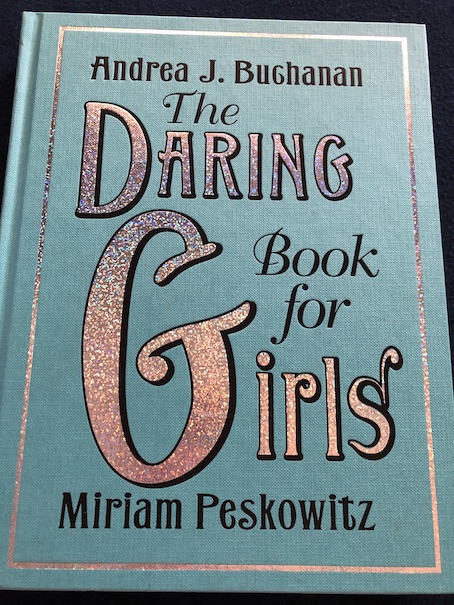


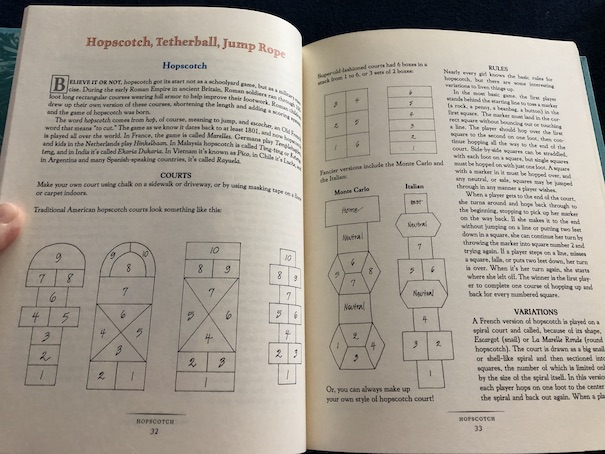


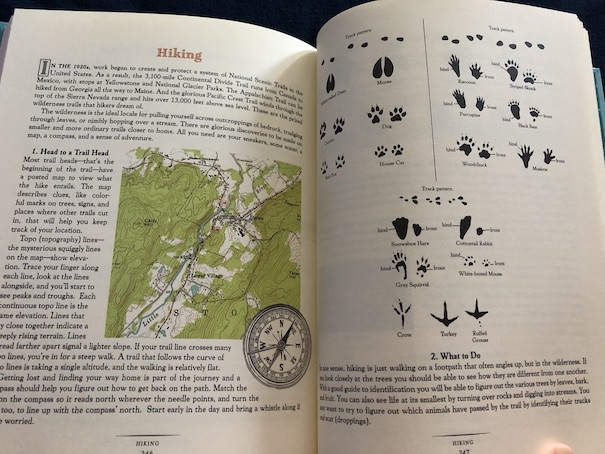

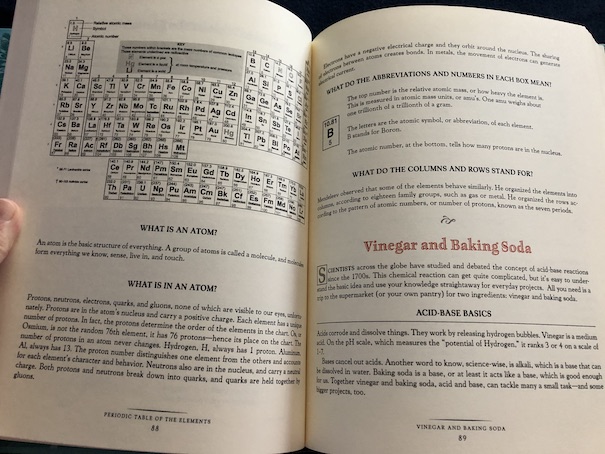


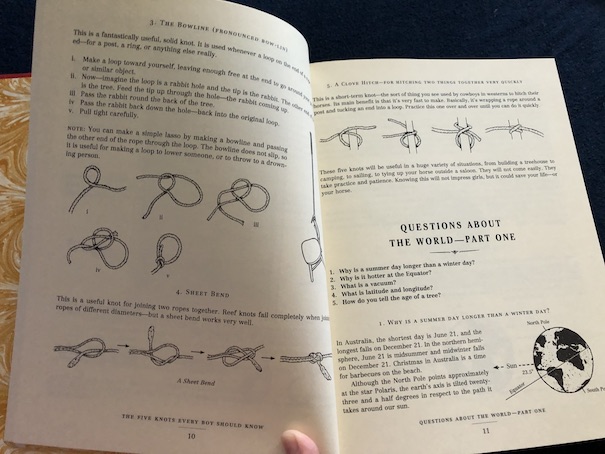

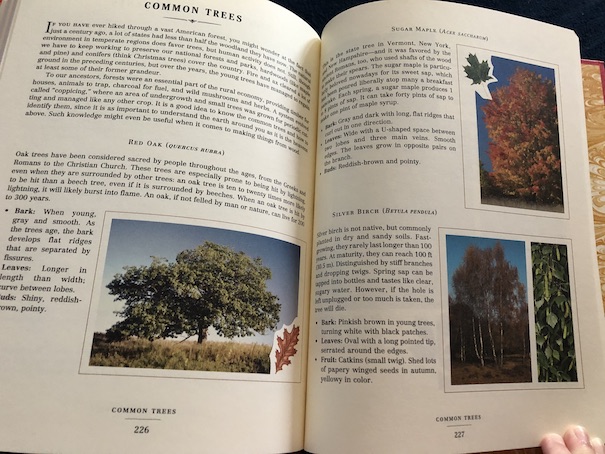

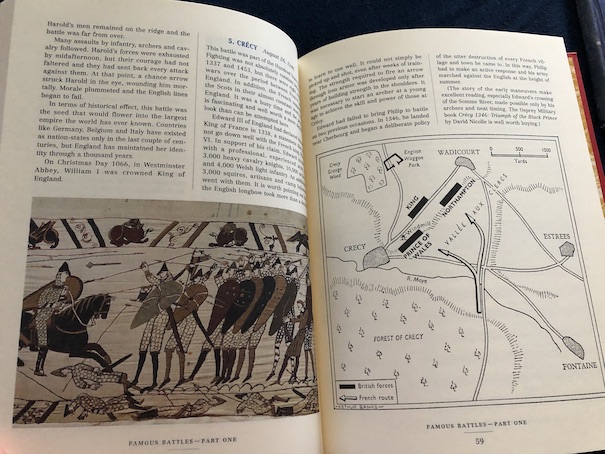

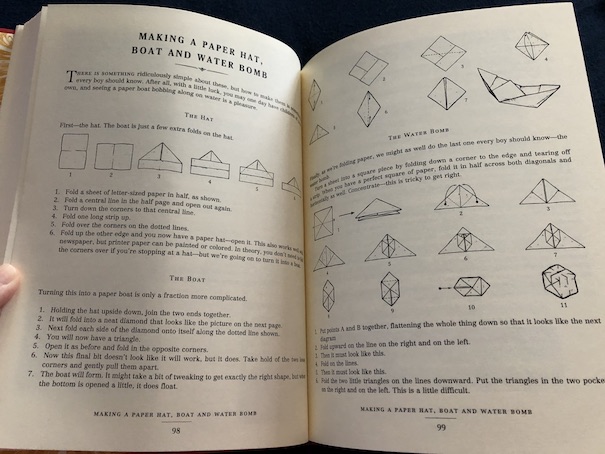

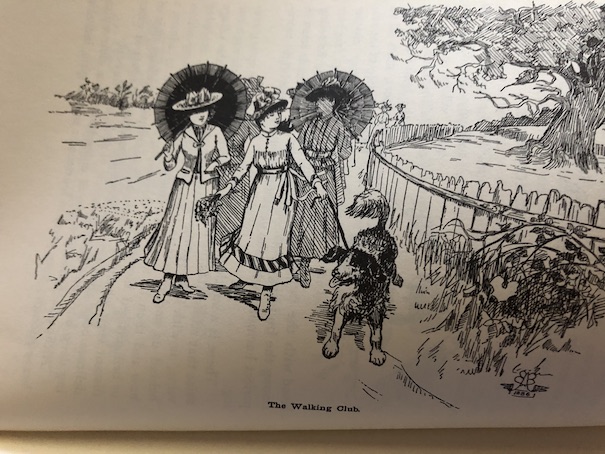
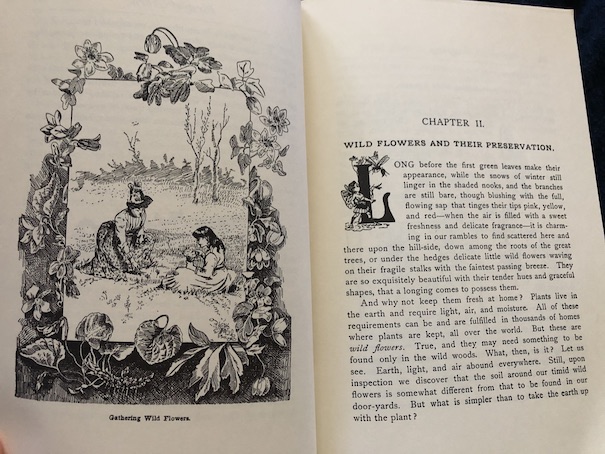
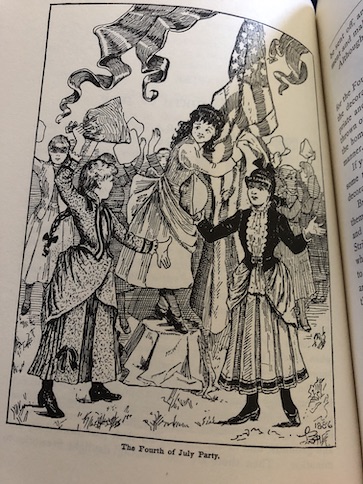
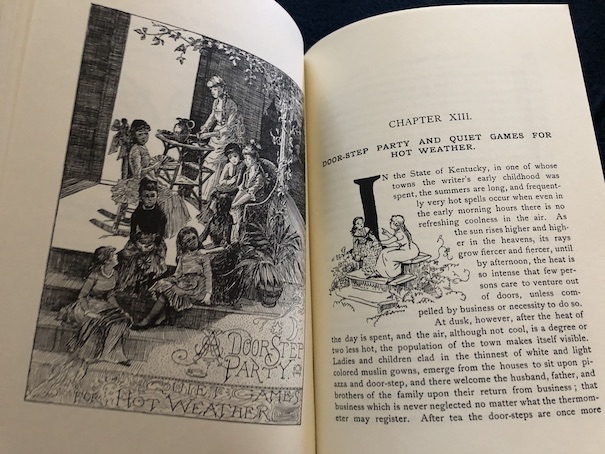
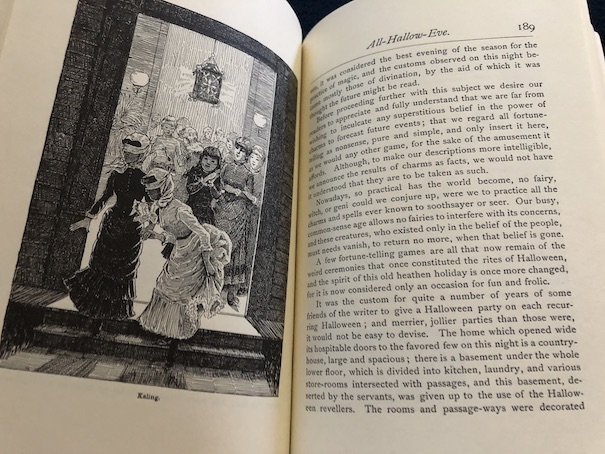
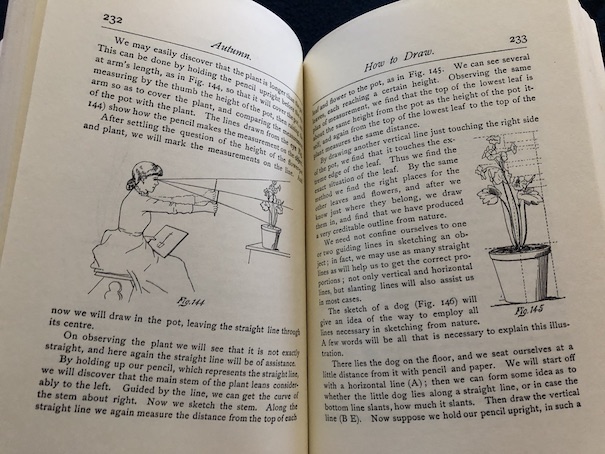


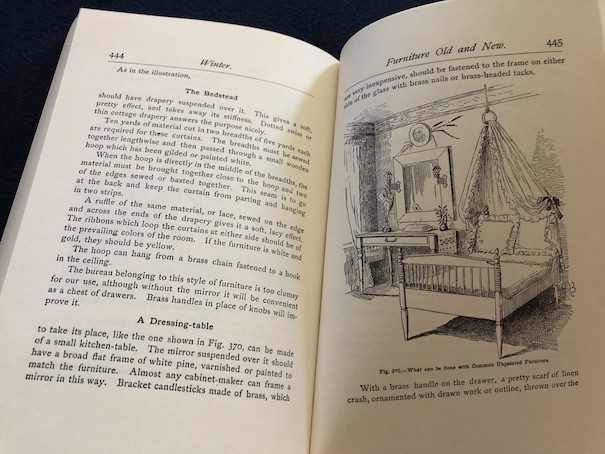


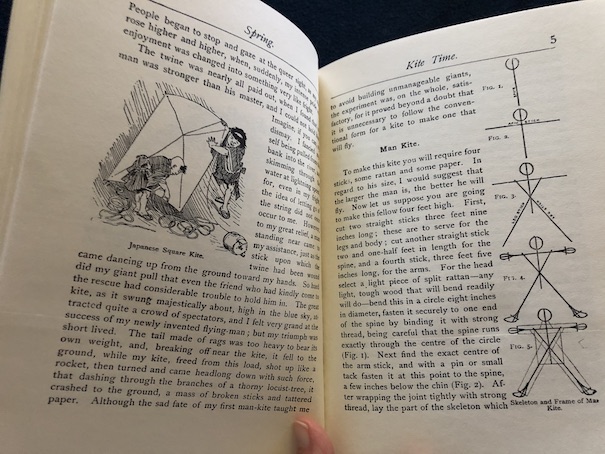
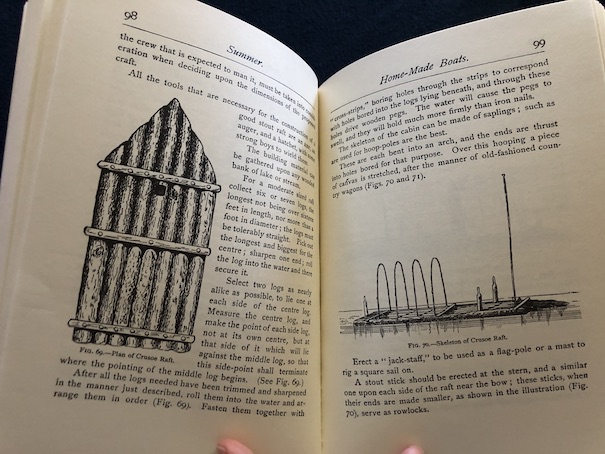
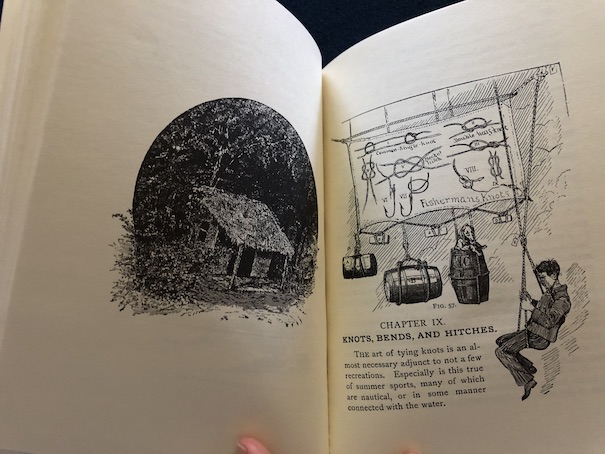


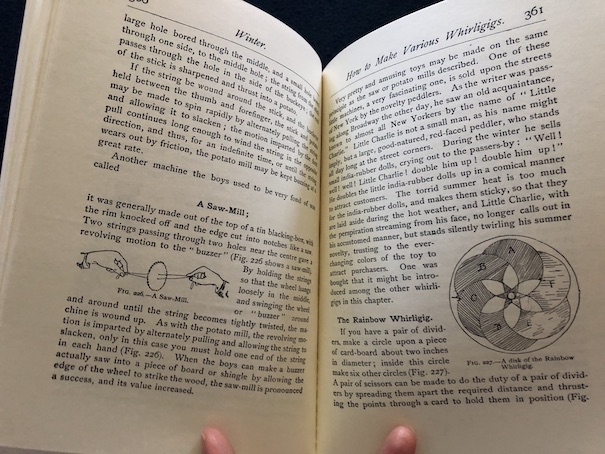
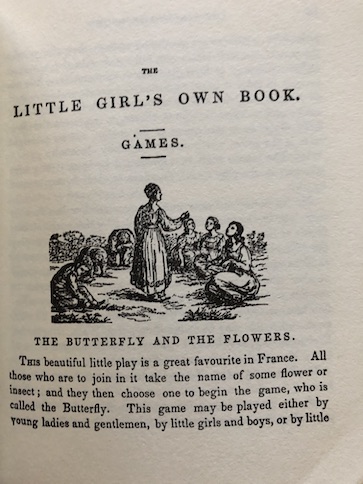
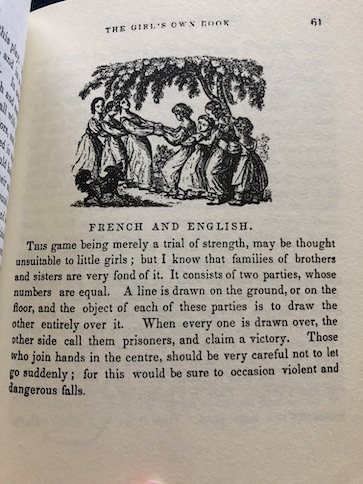
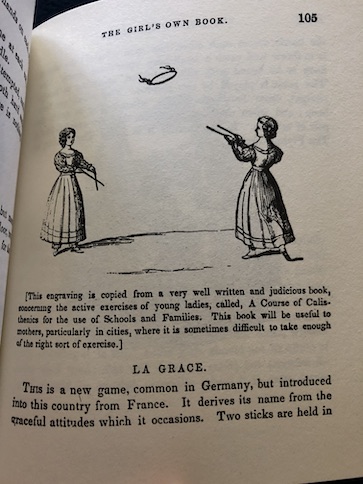
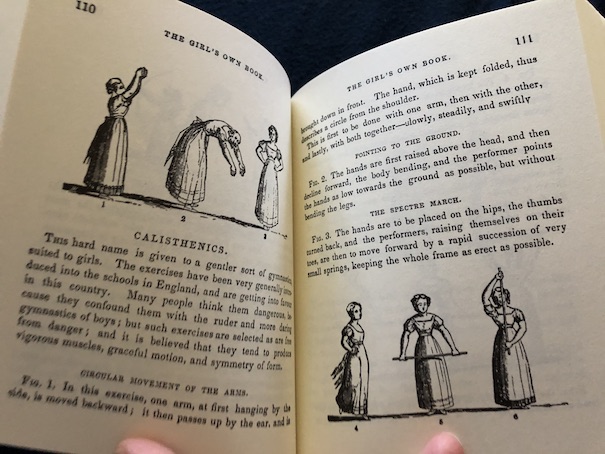
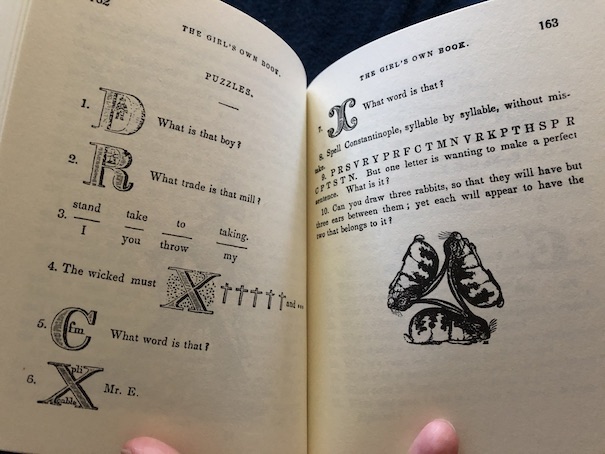



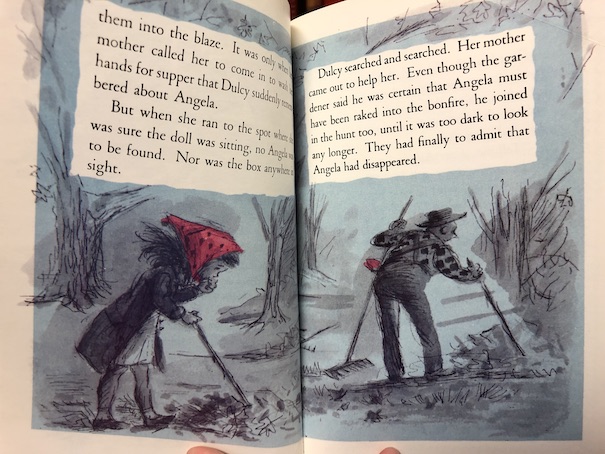


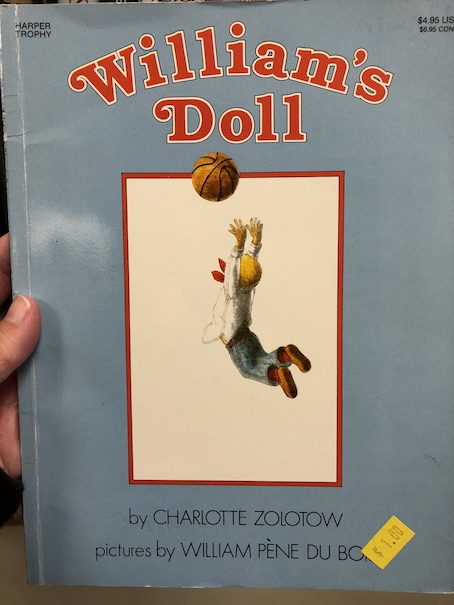
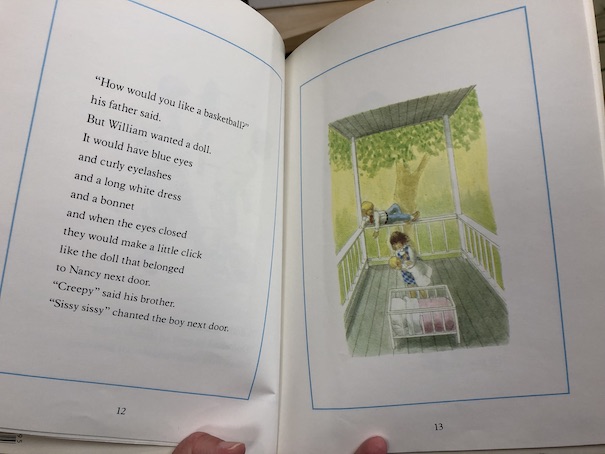

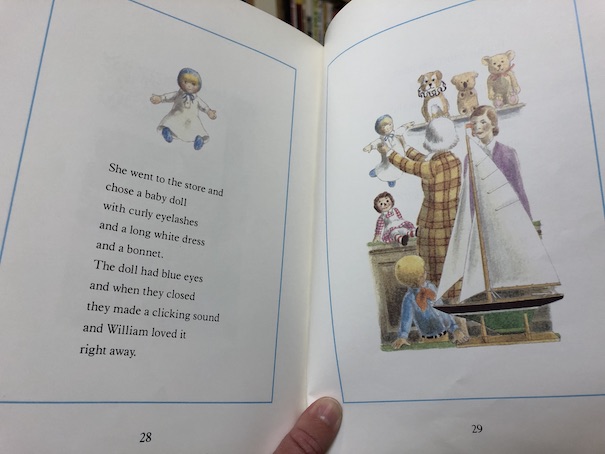



 Jestress's Forgotten Books and Stories