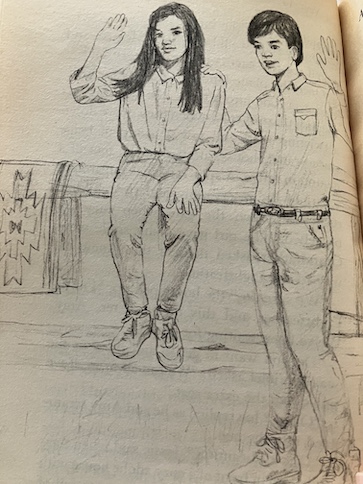
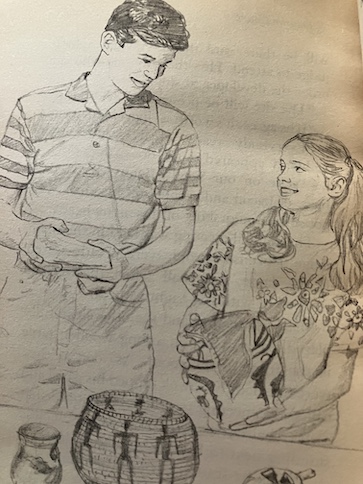
The Invisible Island

The four Guthrie children (Dit, Allen, David, and Winkie – short for Winifred) find it difficult to play in their family’s apartment, where they always have to be careful not to disturb the neighbors. One rainy day, while their mother is at a dentist appointment, the children act out a scene from The Swiss Family Robinson, where they’re throwing the animals overboard from the shipwreck to swim to the desert island when they accidentally break part of the floor, which is also the same as breaking part of the ceiling for the neighbors underneath. When they get a knock at their door, shortly after, they figure that the neighbors have come to complain.

However, it turns out that their visitor is the neighbors’ cousin, who is staying with them. The children explain about The Swiss Family Robinson, the shipwreck, and how they were throwing particularly heavy ducks overboard from their wrecked ship. The neighbors’ cousin is a good-natured man who enjoys talking to the children. When the children’s mother comes home, she apologizes for the damage and explains that she and her husband are currently looking for a new house with more room for the children to play, but they haven’t found a place yet. The cousin says that he comes from a smaller town himself, Anchorage, Connecticut, and he might be able to help them find a place to buy there.

The Guthries do rent a house in that town that has some land attached to it, and the children are excited about the move. They want to be able to camp out on their land, like castaways from their favorite book. When they stop in town to buy some supplies before heading to their new house, they are surprised that there don’t seem to be any children around. The shopkeeper explains that there’s a measles epidemic going around town, and most of the children have it right now. He asks the Guthries if their children have had measles before, and their mother says they have … except for the youngest, Winkie. She decides that, for safety’s sake, she should keep the children close to home until the epidemic is over, and the kids should wait to try to make some new friends in town.

The children are hoping to find some new friends, but there’s plenty to do at their new house in the countryside to keep them occupied for a while. On their first day there, they are delighted to find out that there’s a brook and a lake on their property. The children convince their father to come exploring with them, and he has them help him to make a map of the area, knowing that they will want to camp out later. After walking around a piece of land that’s bordered by the lake and the brook, they realize that it’s actually an island because it is bordered on every side by water. The lake is on one side, the brook on another, and there are two more brooks or streams on the other sides that separate it from the land around it and make it into a sort of oblong-shaped island. They call it “The Invisible Island” because it isn’t obvious that it is actually an island until someone walks all the way around it and realizes that it’s actually surrounded by water on all sides. As far as they know, nobody else besides them is even aware that it’s an island.

The children’s mother has some reservations about the children camping out on the island, but the children agree to some safety rules and bringing along some practical camping supplies. They make a raft to carry their supplies across the water to the island. The children begin calling their new house “The Wreck”, imagining that they are rescuing supplies from a shipwreck, like The Swiss Family Robinson. They create a hiding place for their tents, and they find a spring on the island, although their father won’t let them drink from it until he has the water tested to make sure that it’s safe.

The children have enough supplies to camp on the island for a week, and they begin having an idyllic summer, with little adult supervision. They swim and bathe in the lake, using colorful soap on a rope that Winkie found when the family bought supplies at the store in town. They feed the birds, explore, and pick wild strawberries. They get ideas for how castaways are supposed to act from The Swiss Family Robinson and The Mysterious Island.

Their parents do come to visit them and check on them, playing along with the shipwreck theme by calling themselves friendly “savages” when they visit the camp. Their father helps the children to bring stones from a quarry to build a hut. Their mother tells them that she has started to meet the neighbors, and they have some nice children who could make good friends for the Guthries, once they’re out of quarantine from the measles. Both the nice man who helped them find the house to rent and the local doctor have nieces and nephews. The children don’t care that their mother thinks the children are well-mannered. They’re more concerned about whether or not they’ll be adventurous types, who would have fun with them on their special island. They think that they would hate to share their island with “apron-string children” who would be too tied to their parents and home and wouldn’t appreciate the independence and adventure the island allows. The truth is that the children have been enjoying their freedom on the island so much that they’re not sure that they want to give it up yet to make friends with the local children, and in a way, they’re grateful to the quarantine for giving them this time to explore by themselves.

However, there are some strange things that the children have started to notice about the island. One day, Winkie’s soap on a rope disappears and reappears in a different place, strangely looking less used than when they last saw it. The children’s wishes also seem to be granted by a mysterious, unknown person. When they wish aloud for a book about castaways that they haven’t read before and book about birds so they know more about the birds they’ve been seeing, they soon find a wooden box that contains books matching that exact description. When they wish that they had more strawberries, they suddenly find more strawberries in their icebox that they can tell came from a store instead of the wild strawberry patch. Winkie has a bizarre encounter with a “dryad”, and the footprint of a 6-toed giant suddenly appears on the beach. Maybe they’re not as alone on the island as they thought, but who else is there with them?

The book is available to borrow and read for free online through Internet Archive (in audio form!)

Copies of this book are difficult to find now. It’s become a collector’s item, and copies go for hundreds of dollars on Amazon at the time of this writing. It’s a shame because it’s really a charming story, and I think it would really appeal to fans of Cottagecore. If I hadn’t found a copy on Internet Archive, I couldn’t even talk about this book at all.

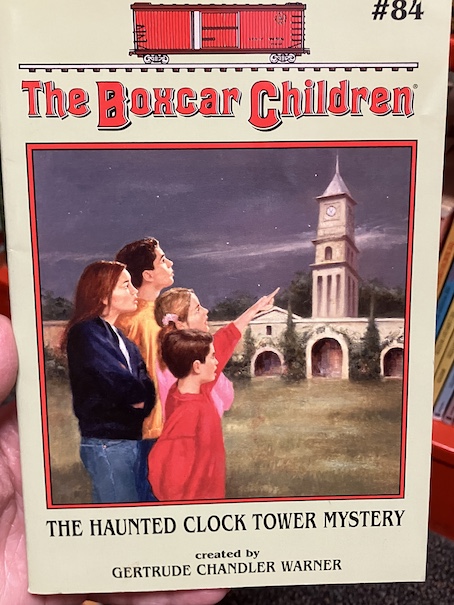
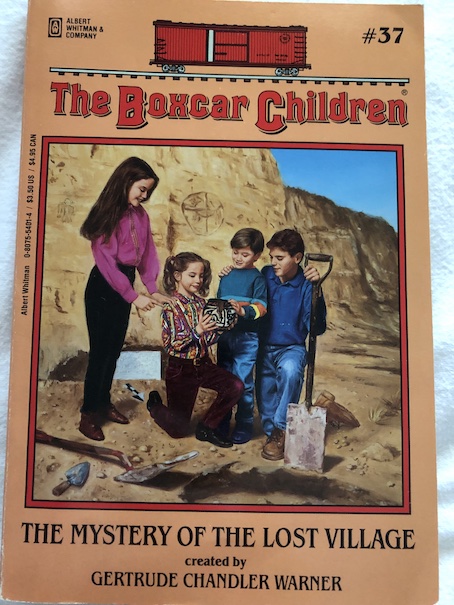
There were many children’s book series published in the mid-20th century about children having adventures in the countryside and independent of their parents and guardians, like The Boxcar Children series or many of the books by Enid Blyton. Some of these books and series seem a little more realistic than others. Most require the children’s families to be at least middle-class or wealthy to be able to set the children up for their adventures. Some books, particularly the ones by Enid Blyton, feature parents who are preoccupied with their own problems or activities and seem less concerned with the children’s welfare than about getting the kids out of their hair. I thought The Invisible Island had a good balance of independence for the children and adult supervision.

The adults in this book know that the children have been camping before, so they have some basic camping skills, and they come to visit the children about every two days, to see how they’re doing and make sure they aren’t having any problems. The kids pride themselves on their independence (they brag that they’re “not apron-string children”), but at the same time, their parents do regularly check on them and are aware of developments on the island, sometimes more so than the children realize. The children confide to their parents some of the strange things they’ve noticed on the island, but not everything because they’re enjoying their adventure so much that “the castaways” don’t want to be “rescued.” Eventually, readers come to understand that the parents know who’s been hanging around the island and that the children are not in any danger.

Adults will probably realize pretty quickly that some of the neighbor children are also camping out in the area, and that these children are the ones moving things around, giving them things, and staging fantastical stunts, like the appearance of the “dryad” and the giant’s footprint. It’s just that they can’t introduce themselves to the Guthrie children yet because the quarantine is still on, and they have to stay mostly separate. As the quarantine ends, they’re able to let the Guthrie children see them and interact with them more, although the game doesn’t completely end until the official end of the quarantine and the surprise party they hold to celebrate. The book ends with the children and their new friends making plans for more adventures that summer.

One of the great things about this book is that it’s one of those children’s books that reference other children’s books. There are other vintage children’s books like this, where the child characters take their inspiration for their games of imagination from their favorite books. The books are named throughout the story, and presumably, child readers from the time when this book was originally printed, would also know these stories and identify with the children’s pretend play. The main favorite book of the Guthrie children is the classic The Swiss Family Robinson, which inspires them not just to camp out but to turn their camping trip into one big game of imagination in which they’re shipwrecked. Most of the things they do in the story are based around that concept, although some fantasy elements also creep in, like fairies and dryads and granted wishes, because the children also enjoy fantasy books and poems. The new friends they make in the area turn out to enjoy similar stories, so some of the mysterious incidents they stage are also based on those stories, further appealing to the children’s imaginations as well as their sense of adventure.

I wasn’t completely sure if the book that their new friends gave to the Guthrie children was meant to be a real book because there are many books with titles like The Smuggler’s Island, and I had trouble locating a book from before 1948 with that exact title. Since the other books and poems they reference are real, The Smuggler’s Island might be real, too. If anybody knows what it is and who wrote it, please let me know. On the other hand, that book, because the children say they’ve never read it before, might just be invented by the author to represent that general genre of children’s fiction.

Other real books, stories, and poems referenced by this story include The Mysterious Island by Jules Verne (which is a sequel to both his Twenty Thousand Leagues Under the Sea and In Search of the Castaways), The Hunting of the Snark by Lewis Carroll (at one point, David recites the lines from the poem, “His intimate friends called him “Candle-ends”, And his enemies “Toasted-cheese”), and the poem Overheard on a Saltmarsh by Harold Munro (which was the inspiration for the dryad scene because it contains a nymph and a goblin and a necklace of green glass beads).

The concept of a quarantine probably would have made this an excellent story for the coronavirus pandemic, but the setting is idyllic and enchanting for any time. The children are clever in the way they set up their camp, trying to keep it as secret as possible. Their island also includes a spring (which is safe to drink from) and a cave, and they start building a stone hut in this book.

There’s only one thing I can think of to complain about in this book, and that’s the concept of the “savages.” When the parents describe themselves as “savages” when they visit the children, they’re playing on themes from earlier vintage books with islands and shipwrecks. “Natives” and “savages” in those stories can either be helpful or, more commonly, threats to the castaways. I’ve complained about this before in previous book reviews with similar themes because there are stereotypes around these generic “natives” and “savages”, and modern children should be taught not to talk about people in those ways. However, there is no malice behind it in this story. The characters aren’t making fun of anyone or disparaging anybody for being “primitive.” It’s just that they’re playing a game of imagination built on these earlier stories, and they’re using this concept as a plot device to work themselves into the story as something other than visiting parents, preserving both the children’s sense of independence and the imaginary world of the children’s game. Anybody who can understand that should be fine with this book.

My only other complaint is that this book is so rare and so long out of print. I really do think it would appeal to modern audiences, especially fans of cottagecore.

Swallows and Amazons

Roger Walker is staying at a farm near a lake for the summer holidays in 1929 with his mother and siblings. His father is away on a ship, a destroyer, and the family write letters to him. The children are particularly waiting for a reply from their father because they’ve asked him for permission to do something special, and their mother says that they will be allowed to do it if their father agrees. What they want is permission to sail the family’s sailboat, the Swallow, by themselves and to camp out on an island in the middle of the lake. They are all thrilled when their father agrees that they can do it! Roger is especially thrilled because, until their littlest sister, Vicky, was born, he was the baby of the family, and he was often left out of things that the older children were allowed to do.

There are a couple of conditions on the permission for the children to go sailing and camping by themselves. The first is that the two oldest children, John and Susan, are in charge. Roger and their other sister, Titty, will have to follow their orders. Before the children can camp out, their mother also makes them tents to use, shows them how to set up the tents, and takes them on a sailing trip so she can make sure that the children know what they’re doing. The excited children prepare for their sailing and camping expedition, giving themselves sailing roles, working out ship’s articles, and gathering supplies. John will be the captain of their ship, while Susan will be the mate and cook. Roger is a cabin boy, and Titty is an able seaman.

When the children go to the island, they find a nice place to set up their camp and a harbor for their boat. Surprisingly, they also discover signs that someone else has been on the island before them, but they don’t know who that is. They begin to think of the mysterious people who have been there before as “Natives” of the island, and they also start to think of their mother and other adults who help them as “Natives.” Their mother plays along with it, as if she’s part of one of the stories the children have probably been reading. When their mother comes to bring them some supplies, the children also mention seeing a man with a parrot on a house boat. The man helping their mother, Mr. Jackson, says that the man often has his nieces with him, but they don’t seem to be with him this time. The children’s mother tells the children where to go to pick up milk, and she says that she wants the children to talk to her every couple of days so she will know they’re all right and so they can pick up more provisions from her.

The children continue with their camping and fishing, and they continue to notice the man on the houseboat, who they think of as being like a “retired pirate” with his parrot. They also notice that he has a small cannon on his houseboat. One day, the children spot another boat approaching the island, sailed by a pair of girls. The children hide and watch the boat. Then, it sounds like the cannon on the boat goes off, and the “retired pirate” is on the deck, appearing to shake his fist at the girls in the boat. The children from the Swallow think that the man on the houseboat might be firing at the girls! The girls also run a flag with a skull and crossbones on it up their mast. The girls are being pirates! The children try to follow the girls’ boat, the Amazon, to see who the girls are and where the boat docks, but they lose track of the Amazon.

The lady who gives the children their milk talks to them when they come to get their supplies. She tells them not to bother Mr. Turner, the man on the houseboat. The children realize that Mr. Turner thinks of them as a nuisance, although they don’t know why. The crew of the Swallow takes it as the “retired pirate” stirring up the “Natives” against them. Then, someone steals their boat, the Swallow, and the children are set upon by the pirate girls at their camp!

There is a battle at the camp between the Swallows and the Amazons, but one of the Amazons asks for a “parley.” The crew of the Swallow confronts the Amazons about the theft of their boat, and the Amazons confront the Swallows about the campers trespassing on “their” island. The crew of the Amazon says they’ve been coming to this island for years, and they’re the ones who built the little fireplace the Swallows found when they started setting up camp.

During their “parley”, the children sort of continue their imaginary roles as explorers and pirates in their talk, but they also reveal some of their real backgrounds. The two girls from the Amazon explain that Mr. Turner on the houseboat is their Uncle Jim. At least, they say that sometimes he’s their uncle and is nice to them. They’ve been visiting the island for years, and their uncle is the one who gave them their boat. However, this year, their uncle is a hostile “native” and their enemy. The Swallows say that Mr. Turner has apparently been complaining about them to the local adults, “stirring up the natives” against them, so he is their enemy, too. The Amazons, Nancy (real name Ruth) and Peggy (Margaret) Blackett, suggest a truce between the Amazons and the Swallows and an alliance against their shared enemy, the “pirate” Jim Turner, characterized as a Captain Flint type character. If the two crews are allied, it won’t matter who technically “owns” or controls the island because they have a shared mission against their enemies, particularly Uncle Jim, aka “Captain Flint.” The Amazons admit that they really have wanted to be allies all along. The Swallows agree to this plan, and the two crews sign a treaty with each other.

As the two crews celebrate their new alliance, the Amazons explain how their uncle came to be their enemy. Usually, their uncle likes playing with them when they visit during the summer, sailing and exploring with them and teaching them things he knows about sailing. However, this year, he’s writing a book about his travels, and he doesn’t have time for them. He gets upset when they disturb his work, and the girls’ mother has told them to leave him alone when he’s working. The girls feel betrayed that he isn’t paying attention to them and gets annoyed by them. The day when the crew of the Swallow thought the man on the houseboat fired his cannon at them, the girls say that it wasn’t the cannon. They set off a firecracker when Uncle Jim was asleep as a prank, and that’s why he was shaking his fist at them as they fled in their boat.

It sounds like the Blackett girls have been a nuisance to their uncle because they’re hurt that he’s not spending time with them, and they’re trying to get his attention. Still, the Swallows enjoy their new alliance with the Amazons. Each of the crews has some experience sailing, the Amazons having learned what they know from their uncle and the Swallows having been taught by their father. John is impressed by what the Amazons teach them, but there are a few things that they know that the Amazons don’t. The two crews learn from each other, and they begin planning war games with their two ships to practice for a battle with their sworn enemy. In between, they enjoy their camping and exploring activities.

It turns out that Mr. Turner on the houseboat has been blaming the children from the Swallow for his nieces’ pranks with fireworks, which is why he’s been complaining about them to local people. When Mr. Turner leaves a complaining note at the Swallows’ camp, John realizes why he resents them. John knows that he could tell Mr. Turner the truth about who had the fireworks, but he doesn’t want to tattle on the Amazons because of their alliance and because Mr. Turner is angry and offensive and accuses him of being a liar when he insists that he and his siblings didn’t do what he’s accusing them of doing.

The Swallows and the Amazons start a daring war game with each other, a contest for them to try to capture each other’s ship. The winning crew will have their ship declared the flagship of the fleet! The Swallows attempt to capture the Amazon after dark, but their attempt is foiled because the Amazons sneak out of their house and head for the island that night. Titty, left alone on the island to mind their camp, realizes that the Amazons are on the island and decides on a risky plan to take their ship herself!

However, the children aren’t the only marauders abroad that night. When Titty takes the Amazon, she overhears some men in another boat. Some charcoal burners told the children from the Swallow earlier that Mr. Turner should make sure that he locks up his houseboat securely because they’ve heard some talk that someone might try to break in, but they never delivered the message because Mr. Turner accused John and his siblings of setting off the fireworks, and they forgot they were going to tell him what the charcoal burners said. The men that Titty overhears are suspicious, and they seem to be hiding something. After the Swallows win the mock war, the Swallows tell the Amazons what the charcoal burners said, although the Amazons are reluctant to tell their uncle to lock up his boat because they want to stage their own raid on it.

The Walker family will be heading home in only three more days and bad weather may be coming, so the children have to hurry to make the most of their adventures as Swallows and Amazons. Titty tells her siblings about the men who seemed to be hiding something, and she thinks it’s some kind of treasure. Her older siblings think that she probably dreamed about hearing men hiding something because she fell asleep on the Amazon, but Titty persuades Roger to come with her to find the treasure.

The book is available to borrow and read for free online through Internet Archive. This is the first book in a series, and it’s been adapted for film and television multiple times.

The author of the story, Arthur Ransome, named the character of Roger after Roger Altounyan, who he met when the real-life Roger was a child, visiting grandparents in the Lake District of England with his sisters. (Real-life Roger Altounyan later became a doctor and pharmacologist, known for a pioneering treatment for asthma.) The names of the fictional Roger’s siblings are also based on the real-life Roger’s siblings. The name “Titty” is odd, but it’s actually a nickname. The real-life Roger had a sister, Mavis Altounyan, who was called “Titty” as a nickname after a children’s story, Titty Mouse and Tatty Mouse by Joseph Jacobs. The character of Titty is sometimes called “Kitty” in some adaptions of the story.

Although the story explicitly states the year as 1929 when the Swallows and Amazons sign their treaty with each other, most of the book could take place at just about any time during the 20th century and into the 21st century because the children are dedicated to camping and sailing and don’t use any form of technology that would firmly date the book. The book has a timeless quality, and it’s the sort of independent adventure that many children dream of having!

The books in this series have been popular in Britain since they were first published, and they have also inspired other books for children on similar themes, having outdoor adventures with minimal adult help or interference. Enid Blyton wrote several series for children on these themes after Swallows and Amazons was published, such as The Famous Five Series and Enid Blyton’s Adventure Series, and Elinor Lyon started her Ian and Sovra series in the 1950s, explicitly stating that she wanted to write books with similar adventures for children but with child characters who weren’t as competent as the children in Swallows and Amazons. The children in Swallows and Amazons are very knowledgeable about sailing and camping and seem to do almost everything right, and Elinor Lyon thought it would be more realistic if the children in her stories didn’t entirely know what they were doing but somehow managed to muddle their way through anyway. There are also similar books by American authors written after Swallows and Amazons, like The Invisible Island by Dean Marshall.

The children in the story take their inspiration for their imaginary play from books they’ve read, like Robinson Crusoe and Treasure Island. All of the children in the story seem familiar with sea stories and books about exploration and island adventures, and they make references to aspects of them and use those aspects when they’re playing. For example, they refer to adults and anyone who is unfamiliar to them as “Natives” and “savages”, and they call their bottles of ginger beer “grog”, while tea is “hot grog”, lemonade is “Jamaica rum”, toffee candy is “molasses”, and tins of corned beef is “pemmican”, living out their fantasy that they’re sailors exploring unknown territory. Later, they compare Jim Turner, the man on the houseboat, to Captain Flint and call him that for most of the story. Some of the language that the children use, like “natives”, “savages”, and the phrase “Honest Injun” are racially out of date and can have some offensive connotations. The children probably got those phrases from the books they’ve been reading, and they seem to think of them innocently, as part of their imaginary play, living out the stories they’ve read, but modern readers should be aware.

Just William

William Brown is an imaginative young boy who gets into trouble in various ways. People often don’t understand why William does the things he does because they don’t know what books he’s been reading or movies he’s been watching that inspire him to his various escapades.

William isn’t an example of how anybody should behave. He frequently lies to get his way, and he and his friends have formed a kind of club that they call the Outlaws, and they play at being outlaws. William is a scamp and a troublemaker, who sometimes means well and sometimes doesn’t because, after all, he thinks of himself as an outlaw. His family well know what William is like and the scrapes he’s likely to get into unsupervised, yet he is often left unsupervised and even given some responsibilities, which inevitably go horribly wrong.

This is the first book in a series, and each chapter in the book is a short story. Most of the books in the series are also collections of short stories. The stories are funny, but there are some things modern readers should be aware of, especially before sharing them with modern children.

This vintage British children’s series is well-known, although it has faced criticism for the ways the children in the stories treat animals. There are multiple incidents in this book – from the things the kids do with their pets when they have a circus to the lizard William accidentally kills in his pocket to the pet rat that gets killed when William tries to teach it to be friends with his dog.

There are also instances of inappropriate racial language, especially related to Native Americans because William finds them fascinating, at least in the way that books and movies portray them. At one point in this book, William pretends to be an American Indian, and the girl his brother likes plays along with him. William darkens his face with cork for the game, and the language they use with each other is stereotypical of old stories and movies with American Indians, like “paleface”, “red Indian”, and “squaw.” Various people use the phrase “Honest Injun” in the story.

The Just William series has been popular in Britain for decades, and stories from it have been made into films and television series multiple times.

William has a little extra money, so he buys some candy and goes to the picture shows. (These are silent pictures because of the time period, and William notes how exaggerated the actors’ facial expressions and gestures are.) William is inspired by the movies he’s seen, and he spends the rest of the day acting out what he’s seen, producing some embarrassing results because real life aren’t like movies.

William’s older brother, Robert, has a crush on a girl. Robert gets their mother to invite her to tea, but he worries that William will mess things up because William often does. Their mother says that William will need to have tea with the family, but William is under strict instructions to spend the rest of the time playing outside and staying out of the way. However, the girl turns out to be a good sport who likes children, and she joins William in a game of pretend, where they pretend to be American Indians. Robert is disappointed that the girl seems to like William better than she likes him.

William gets into trouble at home, and feeling hurt and misunderstood by the just criticisms of his latest escapades with a balloon and inspired by a book that he’s been reading, he decides that the thing to do is to set out into the world to seek his fortune as a poor but deserving young man. He figures that everyone will be sorry when he gets rich with gold nuggets (like in the story) and won’t share them. Deciding that he will start out as a beggar and approaching a wealthy house to beg, William is mistaken for a boy who is supposed to be a new servant and gets his first taste of domestic labor. It turns out that being a poor but deserving young man requires more work than William is willing or able to do.

William gets a crush on his teacher and tries everything he can think of to impress her, including (gasp) actually studying for a change. Unfortunately, his teacher definitely doesn’t feel the same way about him.

William and his friends, a group called the Outlaws, decide to hold a circus. Aunt Emily, a hypochondriac relative who’s been making an unwelcome long stay with the family becomes an unwitting side show as the “fat wild woman” when William charges viewers to see her sleep and snore loudly. When the aunt wakes up and catches William and his guests, it ends her visit, but William’s father is actually relieved.

William is bored on a rainy day, his family members all have something to do, and he doesn’t know what to do with himself. His mother’s suggestions are all boring ideas, his siblings have friends over, and his father just wants to be left alone. William asks his mother if he can have a friend over, but she says it’s too late to ask anybody. His family is all relieved when the rain is finally over, and they can send William outside to play.

However, William is still thinking about the idea of having friends over and having a party. His father emphatically refuses to consider the idea of William having a party, but later, a lesson at school about double negatives convinces William that his father’s refusal can actually be taken as approval. He knows the rest of his family will be going to visit an aunt soon, so he invites the children from his class at school to a party while his family is gone. The cook refuses to believe that William really has approval to have all of those children over, so she locks them outside, but William turns the party activity into a storming of the castle and a wild game of hide-and-seek!

When William’s mother makes him get cleaned up and try reading a book for a change, he accidentally convinces a visitor that he’s a serious and shy little darling. The visitor is a socially prominent woman who is involved with good works, and she persuades William’s mother to have him participate in one of her projects because children of their “class” are a good influence on others. William’s mother has doubts about how well that description fits William, but she is anxious to please this socially prominent guest, so she agrees to let William participate. William tries to get out of it by faking sick and pretending that he has a sprained ankle, but his family is unconvinced by his charades. However, it turns out that William’s other friends, part of a group they like to call the “Outlaws”, have also been recruited for the project. They make the meeting more interesting for the other children by teaching them a variation of William’s favorite game – one that his mother has forbidden him to play because it’s too rough.

William’s mother volunteers him to take a neighbor’s baby for a walk as a favor, in spite of William’s brother pointing out that William might not be the most responsible person to look after a baby for any length of time. Unfortunately, William’s brother refuses to take care of the baby himself, so William is left with the chore that people should know he isn’t likely to carry out responsibly. William resents his mother giving him this task on his half day off school, and he dreads what his friends will say if they see him pushing a baby carriage. Then, William gets an idea. He takes the baby along to a meeting of the Outlaws as a kidnap victim to be held for ransom. The other Outlaws are thrilled with the idea, but the baby turns out to be too much for all of them.

William is enlisted to be a page boy at a relative’s wedding, very much against his will. The bride thinks the idea of him being a page boy is sweet and romantic, but William knows all of his friends will make fun of him, seeing him dressed in the white satin outfit he has to wear. What saves the day for William is that the young girl recruited to be the bridesmaid thinks the whole thing is as sickeningly sweet as he does. When the two of them get too dirty in their outfits to take part in the ceremony, they are mercifully left at home to play their own games, and they think that’s much more fun and romantic than any wedding!

Mr. Moss, who runs the store where William buys candy, says that he’s been asking the same woman to marry him every New Year’s Day for 10 years. William thinks that’s too many years to ask anybody over and over again, and he can’t understand who would turn down somebody who owns a sweet shop. On New Year’s Day, Mr. Moss has to run to catch his train to meet the lady, so he leaves William in charge until his nephew shows up to manage the shop. Mr. Moss thinks that William will only be in charge for a few minutes, but his nephew is sick and doesn’t come. William, left in charge, takes far more candy than Mr. Moss said he could have and attempts to overcharge another customer to cover the difference while he is overwhelmingly generous to a pretty girl he likes. Then, he generously hosts his friends and makes a mess. When Mr. Moss returns around lunch time, he would be more angry except that the lady finally agrees to marry him, and in the end, William has to cope with a serious stomach ache.

A young man has a crush on William’s sister, so he recruits/bribes William to be his confederate in a scheme to impress Ethel, getting him to fake sick on a trip with his sister so the young man can step in and “rescue” them by carrying William home. However, William turns out to be more of a handful (literally) than the young man expects, and the pet white rats that were William’s bribe cause chaos in the Brown household. (One of the rats meets a sad end from William’s dog when he tries to teach the two to be friends.)

Although William’s dog, Jumble, appears in earlier stories in the book, this story is about how William acquired Jumble. Jumble the dog follows William home one day. He has a collar with his name on it but since he’s loose by himself, William thinks he’s a stray. His family tells him to take the dog to a police station to see if he has an owner, but William just can’t bring himself to leave Jumble there, so he brings him back home and tells his family that the dog followed him again. Eventually, Jumble’s owners do find him again with William. William insists that he didn’t steal Jumble, and he reluctantly asks if the family who owns him if they want him back. The girl in the family, who is William’s age, decides to give Jumble to William because she’s decided that she wants a Pomeranian instead, and the father of the family, who is an artist, sketches William with Jumble because he thinks that William has such an interesting expression.

Homer Price

Homer Price is a collection of short, humorous stories about a boy who lives in a Midwestern town called Centerburg. His parents own a tourist camp with cabins and a filling station, and Homer helps out there with odd jobs. In his spare time, he has a hobby, building radios.

Many people remember this book specifically for the episode of the doughnut machine that goes out of control. Stories in the collection have been made into tv episodes or short films three times, and two of those are based on the doughnut machine story. (Sometimes, they appear on YouTube.) There is also a sequel to this book called Centerburg Tales: More Adventures of Homer Price.

It didn’t occur to me until I started reviewing the book for this site, but it was first written and published during WWII. The war doesn’t play any part in any of the stories in the book, but it occurred to me as a fun collection of stories that its first audience of 1940s children might have enjoyed as a break from the chaos of the world around them. Various aspects of 1940s society and culture appear in the stories in humorous ways, like the comic book superhero who resembles Superman (a character introduced in comic books in 1938), lunchrooms (small diner-style restaurants), and the concepts of advertising, mass production, and suburbs with prefabricated houses.

There is one incident that readers should be aware of that concerns descriptions of Native Americans. When the town holds its 150th anniversary celebration, Homer and his friends have roles in skits about the history of the town, playing Native Americans, and part of their costume involves dyeing their skin, which would be considered tasteless and racist in the 21st century. Their skit also includes a “scalping scene” (not really described, except saying that it “had to be modified somewhat”), which would also definitely not pass modern standards in any public performance. Because this is a collection of intentionally humorous stories, I’m not sure whether the author included this stereotypical depiction of kids playing Native Americans in a tasteless way to poke fun at such depictions or not, but I though it was worth mentioning for the benefit of people sharing these stories with children, so you know that part is there.

I didn’t notice anything particularly concerning about the depiction of black people in the book. Black people are included in the stories as members of the community without too much attention to the fact that they’re black. They’re simply part of the town, and nobody makes a big deal about them being there or refers to them by any derogatory names. One black boy finds a wealthy lady’s bracelet inside a doughnut in the doughnut machine story, and the local African Baptist Church choir performs at the town celebration.

The Case of the Sensational Scent

One evening, Homer gets his usual bedtime snack of milk and cookies and leaves some milk out for his pet cat. However, a skunk wanders in and finds the milk. Homer decides to try keeping the skunk as a pet, naming it Aroma. Aroma helps to thwart a gang of robbers.

Case of the Cosmic Comet

Homer and a couple of friends are reading comics and marveling over a superhero called Super Duper (who is sort of like Superman). Later, Homer’s friend Freddy says that there’s going to be a Super Duper movie playing in town and that Super Duper himself will be there. Homer isn’t quite as enthralled with Super Duper as Freddy is because he knows it’s just fiction, and he thinks the stories are kind of formulaic, but he agrees to come to the movie. When the Super Duper’s car crashes as he leaves, they see that the Super Duper is actually an ordinary human who doesn’t really have super strength and can get hurt. Fortunately, he isn’t hurt badly, and the boys take their disillusionment well, profiting from the help they give him.

The Doughnuts

Homer’s aunt and uncle own a lunchroom, and his uncle is a gadgeteer with a weakness for buying labor-saving devices. One of these devices is an automatic doughnut-making machine. One day, Homer’s uncle is trying to fix the doughnut-making machine, and he asks Homer if he can finish fixing it and make some doughnuts for him while he runs an errand (really, he’s going to play pinochle at the nearby barber shop) because Homer is good with mechanical devices. When Homer gets some help from a patron, mixing up masses of doughnut dough from her family’s old recipe and runs the machine, Homer has trouble turning off the machine. It just keeps making more and more doughnuts! What are they going to do with all these doughnuts, and will they ever get the machine to stop?

Mystery Yarn

Miss Terwilliger is locally known as a great knitter. She’s taught most of the local women how to knit, and everybody also loves her fried chicken. She has two admirers who would like to marry her, the local sheriff and Homer’s Uncle Telly, but she just can’t make up her mind which she would like to marry. When the Sheriff and Homer’s Uncle Telly compete to see which of them has the largest collection of string, the Sheriff arranges for the two of them to unroll their giant balls of string at the local fair to prove which of them has more string. They also decide that whichever of them win the contest will also win Miss Terwilliger … until they discover that Miss Terwilliger also collects string and is determined to enter the contest … and she just might be beat them both. All’s fair in love and string collecting, and to the winner go the spoils!

Nothing New Under The Sun

A strange man comes to town. He seems a little odd and kind of shy. The sheriff is a little concerned about who he might be. The stranger himself just makes an odd comment about having been away from people for a long time. The stranger might be a shy eccentric, but the sheriff is concerned that he might be some kind of fugitive. The sheriff talks to various people around town, and they all offer their advice about how to judge a person’s character and what they think about the stranger. Various people say that he reminds them of someone from a story, and the town librarian identifies the character they’re thinking of as Rip Van Winkle. Could this stranger really be an old man who fell asleep for 30 years in the mountains, like in the story? If so, what’s with the bizarre vehicle the stranger has? When Homer finally persuades the man to show him his car and tell him who he is, the story turns out to be stranger than fiction: he’s a man determined to literally “build a better mousetrap” and turns out to be a kind of modern-day Pied Piper.

Wheels of Progress

Centerburg is celebrating its 150th anniversary with a public celebration and the creation of a new suburb with mass-produced, prefab tract houses (the kind made fun of in the song Little Boxes by Malvina Reynolds, which “all look just the same”). The identical nature of the houses turns into a nightmare when the street signs aren’t ready in time for the grand opening celebration, confusing the townspeople.

Fun fact: The original name of the town is revealed to have been “Edible Fungus” after the edible fungus that kept the original settlers who founded the town alive. The choir in the story sings a song about it.

The Incredible Adventures of Professor Branestawm

Professor Branestawm is a classic absent-minded professor. He’s is a balding man who wears several pairs of glasses, one of which is for finding the other pairs of glasses when he inevitably loses them. He’s a very clever man, but everyone knows that his inventions are likely to cause chaos. He’s not an easy person to talk to, so he doesn’t have many friends. His best friend is Colonel Dedshott, who is a very brave man.

Every chapter in this book is about another of the Professor’s inventions and the adventures that the Professor, the Colonel, and the Professor’s housekeeper, Mrs. Flittersnoop, have with them and with various situations that the Professor creates with his absent-mindedness. The stories are accompanied by pen-and-ink drawings. I love the way almost every picture of the professor shows him shedding one or more of his many pairs of glasses and that the Colonel’s weapon of choice is a slingshot!

One day, Professor Branestawm invites the Colonel to his house to see his latest invention, which he says will revolutionize travel. When the Colonel arrives, Professor Branestawm explains his idea. First, he points out that, if you’re traveling somewhere, you’ll arrive in half the amount of time you ordinarily would if you travel there twice as fast. The Colonel says that makes sense. Then, Professor Branestawm says that, the faster and faster you travel, the sooner you arrive at your destination. That also makes sense. Further, Professor Branestawm says, you eventually start traveling so fast that you arrive before you even start, and if you go fast enough, you can arrive years before you start. The Colonel doesn’t really understand this, but he takes the Professor’s word for it. The Professor has built a machine that will allow them to travel that fast, and the Colonel is eager to try it. He suggests that they try going back in time to a party he attended three years earlier. The Professor insists that they take some powerful bombs with them, just in case of emergencies (don’t try to make sense of it, there isn’t any), and the Colonel has his trusty catapult (slingshot) and bullets with him.

It turns out that, rather than going to the party three years earlier, they arrive at the scene of a battle that took place in another country two year earlier. Although they already know how the battle turned out, the Professor and Colonel can’t resist joining in with their bombs and catapult, and they end up wiping out an entire army and changing the result of the battle in favor of the revolutionaries. The revolutionaries are so grateful to them for their help that they take them to the palace of their former king, put the two men on the enormous throne there, and make them the new presidents of the country. Professor Branestawm realizes that they’ve made a terrible mistake and changed history because the king’s army was the one that was originally supposed to win the battle. The Colonel, however, doesn’t care because he thinks it sounds like fun to be a president and can’t wait to do some ruling.

Of course, the ruling of the two presidents doesn’t go well. Neither one of them really knows anything about running a country. Since they blew up all the country’s troops, there are no troops left for the Colonel to review, and he ends up playing with toy soldiers. Meanwhile, the Professor really just wants to get back to his inventing. Eventually, the revolutionaries get tired of this and tell them that they’ve decided that they don’t want any presidents, so they’re giving them a week’s notice before they’re out of a job. The Professor and the Colonel try not to take any notice (ha, ha) of the revolutionaries’ attempts to dethrone them. This just leads to the revolutionaries trying to imprison them in the dungeon, so the Professor and the Colonel are forced to escape in the Professor’s machine, which takes them back to the exact time and location where they started. They arrive just as the Professor’s housekeeper brings them some tea, so they have their tea, go about their usual business, and leave it to the historians to deal with the complications of the two of them changing history.

When Professor Branestawm’s housekeeper puts a bottle of cough syrup with no stopper into the waste-paper basket, it accidentally creates a waste-paper monster! It turns out that it wasn’t really cough syrup in the bottle. It was a special life-giving formula that the professor invented. He only keeps it in a cough syrup bottle because cough syrup is the only thing that neutralizes the life-giving formula and stops it from bringing everything it touches to life, including the bottle holding it. Now that they’ve accidentally created a waste-paper monster, what can they do to stop it, especially since it seems to have the ability to use tools and is currently trying to saw down the tree where the Professor and his housekeeper are trying hide?

Professor Branestawm accidentally loses a library book about lobsters, so he goes to another library to get the same book. By the time that he needs to return the library book, he has found the first one and lost the second one. For a while, he manages to avoid library fines by continually returning and checking out the same book from both libraries because the libraries don’t notice which library the book is from. Of course, he eventually loses the first book, too. He tries to fix the situation by getting the same book from a third library and then one from a fourth library, when he loses the third book. Where will it all end? How many libraries will have to share this one book, and where on earth are all these books about lobsters going?

Professor Branestawm and his housekeeper go to the movies to see a documentary about brussels sprouts. (The housekeeper doesn’t care about brussels sprouts, but there’s a Mickey Mouse cartoon included with the feature, and she wants to see that.) When they get back, they discover that the house has been robbed! Professor Branestawm decides that he’s going to invent a burglar catcher, but the only burglar he catches is himself.

Professor Branestawm’s clock stops, so he takes it to a clock repair shop. It turns out that the clock has only wound down because the Professor has forgotten to wind it. The Professor decides that he’s going to invent a clock that will go forever and never need winding. (This story is set before clocks that don’t need winding became common.) The Professor does invent a clock that will never stop and never need winding, but he makes a critical mistake: the chimes never reset after they strike twelve. They just continue counting up and up, endlessly, with no way to stop them! Just how many times will they endlessly strike before something terrible happens?

The Professor visits a local fair and invites the Colonel to join him. The Colonel ends up winning most of the prizes for the various games, and the Professor accidentally gets left behind in the waxworks exhibit, being mistaken for a wax statue of himself. When the Professor decides that it’s finally time to get up and go home, the people who work in the waxworks think that a wax statue has come to life!

Professor Branestawm writes a letter to the Colonel, inviting him to tea, but because he is distracted, thinking about potatoes, he accidentally writes a muddled letter and then mails the paper he used to blot the letter instead of the letter itself. The message that arrives at the Colonel’s house is a backward, muddled mess, and he has no idea who sent it to him. Since it looks like it’s written in some strange language he doesn’t know, the Colonel decides to take it to the Professor to see if he can decipher it. The Professor fails to recognize the letter as what he sent and has forgotten that he sent it. Will the two of them figure out what the letter is about, or will they eventually just give up and have some tea?

Professor Branestawm’s housekeeper’s spring cleaning creates some chaos in the professor’s house, and the Colonel suggests that Professor Branetawm invent a spring cleaning machine. Predictably, the spring cleaning machine creates an even bigger mess and far more chaos.

Professor Branestawm invents a very smelly liquid that brings things from pictures to life. The things from the pictures go back to being pictures when the liquid dries. Of course, there are some things that cause big problems when they’re brought to life. Possibly the most chaotic pictures that come to life are pictures of the Professor and the Colonel and the professor’s housekeeper. Who is who and which is which?

Professor Branestawm is invited to give a talk on the radio, and the Colonel helps him to rehearse. However, because he gets mixed up, he almost misses his own talk, and when he finally gives it, he speaks too fast and discovers that the time slot for his talk is much longer than he thought it was. Listeners are confused, but everything is more or less all right when the Children’s Hour comes on.

The Professor and the Colonel are going to a costume ball. Since the Professor doesn’t know what to do for a costume, the Colonel suggests that the two of them dress as each other. This causes some confusion, and neither of them likes each other’s clothes. The Professor’s social skills aren’t even great at the best of times, and the truth is that he’d rather be inventing things at home in his “inventory” (pronounced “invEnt – ory” as in a laboratory where you invent things, ha, ha). Then, the Countess at the ball raises the alarm that her pearls are missing! Everyone is confused when they try to get “the Colonel” to find the thief, and he doesn’t seem to know what he’s doing. It takes a while for things to get sorted out, but at least the Professor and the Colonel develop a new appreciation for being themselves instead of being each other.

Professor Branestawm’s house has gotten so full of his inventions that it’s become difficult to live there, so he’s decided to move to a new house. Moving to the new house is an escapade, and when Professor Branestawm and his housekeeper get there, they discover that the water and gas haven’t been connected up yet. Professor Branestawm’s attempts to remedy the situation render the new house unlivable, so he is forced to move back to his older house.

Professor Branestawm invites his friends and various members of the community to his house for a party, where there will be tea and pancakes. Everyone is happy to go because of the promise of pancakes, but when they’re all there, Professor Branestawm reveals that the party is to unveil is newest invention: a pancake-making machine! As the library man predicts, the pancake-making machine goes wrong (just like the Professor’s other inventions), but it’s all right because the town council comes up with a new purpose for it.

Professor Branestawm takes a trip to the seaside. He asks the Colonel to join him and bring his book about jellyfish, but unfortunately, he neglects to tell the Colonel where he’s staying (partly because he forgot where he was supposed to stay and is actually staying somewhere else). When the Colonel tries to find the Professor, he accidentally mistakes an entertainer dressed as a professor for Professor Branestawm. When the entertainer isn’t acting like himself (so the Colonel thinks), the Colonel becomes worried and decides medical intervention is necessary.

The book is available to borrow and read for free online through Internet Archive (multiple copies). It’s the first book in a series about Professor Branestawm, and it was also adapted for television multiple times.

Kids won’t learn anything about real science from Professor Branestawm, but the stories in the book are funny and not meant to be taken seriously at all. Most of the stories are about some pretty silly things that don’t really mean much in the end, but when you think about it, the Professor’s antics do lead to some pretty serious consequences, from wiping out an entire army just for the fun of it (pretty horrific in real life) and changing the course of history to accidentally blowing up someone’s house with his perpetually-chiming clock. No matter what the Professor does, though, there never seem to be any lasting consequences.

Even when people around him brace themselves for when the Professor’s latest project inevitably goes wrong, everybody still thinks that the Professor is pretty clever. The Colonel always thinks the Professor is clever, and even when he knows that the Professor is bound to do something that’s going to cause chaos, he enjoys the excitement. The housekeeper sometimes goes to stay with her sister, Aggie, when the chaos and excitement get too much for her.

The stories are just meant to be enjoyed for their zaniness, and there’s no point in analyzing them much. You don’t have to worry about whether anything the Professor does makes sense or exactly how he got any of his inventions to work. You can just enjoy seeing how everything develops and watch the craziness unfold! It sort of reminds me of Phineas and Ferb’s summer projects, which cause some chaos but are ultimately funny and always disappear at the end of the day. Enjoying these stories is what they used to say in the theme song for the tv show Mystery Science Theater 3000:

“If you’re wondering how he eats and breathes
And other science facts,
Just repeat to yourself “It’s just a show,
I should really just relax …”

I can promise you that, no matter what happens in any of the stories, the Professor and his friends will ultimately be fine and will probably have a cup of tea (or “a cup of something”) afterward. This book was originally published in Britain the early 1930s, and it was read by children during the Great Depression. I can imagine that it might have given children then a good laugh and some escapism during troubled times.

Strangely, at least one of the Professor’s inventions, the clock that never needs winding, is a real invention that we have every day because time has moved on (ha, ha) since this book was originally written and published. In fact, it’s very unusual to find clocks that need to be wound these days. Of course, the part about the clock perpetually chiming more and more and blowing up when it gets to be too much is just part of the craziness of Professor Branestawm.

Danny Dunn and the Swamp Monster

Danny Dunn

Professor Bullfinch receives a cryptic message, which he says is written in the style of a telegram (he calls it “cablese” – a way of shortening messages because people pay for telegrams by the word). As Professor Bullfinch and Danny study the message further, they can draw more conclusions about the sender, who is not specified. They know it’s someone with money because the hotel it was sent from is expensive. From one of the terms used, they think the sender is a scientist, and because he sent a message written to be a telegram as a letter, he’s probably absent-minded. That description seems familiar to Professor Bullfinch.

Then, a strange man comes to the door who seems oddly distracted and confused. He greets Danny as if he were an old friend, but Danny has no idea who he is. He thinks the man is crazy, but Professor Bullfinch recognizes him as his old friend Dr. Benjamin Fenster. Of course, Dr. Fenster is the person who sent the confusing message. It turns out that Dr. Fenster meant to send that message to Dr. Ismail at the University of Khartoum, but he accidentally got it mixed up with the message he was going to send to Professor Bullfinch. Dr. Fenster is an absent-minded professor type, and he’s always doing things like that. Although, he does correct Danny when he mentions this, saying that he’s not actually a professor, and it’s not so much that he’s absent-minded so much as that he has a lot to think about and can’t think of everything at once.

Their conversation is interrupted when something goes wrong with the experiment that Professor Bullfinch and Danny were working on before Dr. Fenster arrived. A warning goes off, and Professor Bullfinch yells to Danny to shut off the machine. However, Danny can’t find the shut off switch, so he panics and pulls an electrical cord, sending an electrical current through the project before Professor Bullfinch turns off the switch. When they examine the results of the experiment, they’re surprised. Professor Bullfinch was trying to develop a new polymer, but the accident with the machine and the electrical current have turned the polymer into a superconductor and a very powerful ring magnet with a circular magnetic field.

While they’re examining the results of the experiment, Dr. Fenster wanders off, lost in thought. Danny worries if he’ll be okay, wandering around on his own, but Professor Bullfinch says that he’ll be fine. Dr. Fenster often does this when he’s thinking something through. Danny’s friends, Joe and Irene, arrive, commenting on seeing a man who was acting strangely and wondering if there’s something wrong with him. Danny explains to them who Dr. Fenster is and tells them about the ring magnet. Then, Dr. Fenster bursts back in, very excited, because he’s figured something out. He thinks the magnetic polymer ring might be the solution to a problem he’s been trying to solve.

Dr. Fenster is a zoologist, and one of his projects is to investigate accounts of legendary animals. Although many scientists tend to disregard stories of unknown animals as purely legendary, sometimes, they turn out to be previously unreported/undiscovered species. (“Undiscovered” in the scientific sense. Obviously, people have seen them, or they wouldn’t tell stories about them. These are species that haven’t been officially documented as having been discovered among the scientific community.) Investigating rare or possibly unknown species is what Dr. Fenster does.

Dr. Fenster is currently investigating reports of a creature called the lau, which apparently lives in swampy areas around the source of the Nile River in Uganda. The lau is supposed to be an enormous serpent with tentacles on its head. The legend around it says that if a person sees the lau first, the lau will die, but if the lau sees the person first, the person will die. When the others ask him if he thinks that’s real, Dr. Fenster says that he thinks that’s more metaphorical, like when someone says they felt petrified, it doesn’t mean that they literally turned to stone, or if someone says that their blood froze, it just means that they felt horrified. He thinks that the idea is that a serpent could kill a person, if they didn’t see it and disturbed it, but if the person saw the serpent first, they would kill it to avoid the threat.

The problem that Dr. Fenster has been trying to solve is how to move around the swamp and keep the area under observation during the night as well as the daytime, without possibly disturbing the creature he’s trying to find. It’s difficult to get around that swampy area in daylight, but it’s even more difficult at night, and he doesn’t want to use lights because that could frighten away the lau. He’s been thinking that he would like to mount some specialized cameras in certain strategic areas, but he couldn’t figure out how to mount them, and the cables he would have to use would be long and heavy. Having seen what the magnetic polymer can do, though, he thinks that could be the solution to the problem. It doesn’t weigh much itself, but when they test it, they discover it can support the weight of a grown man.

Dr. Fenster invites Professor Bullfinch and the children to join him on his expedition. He’s independently wealthy, and he can afford to pay for all them to come along. However, Danny’s mother has reservations about how safe this expedition is, and she can’t imagine that Joe or Irene’s parents will allow them to go on the trip, either. It takes time for Dr. Fenster to persuade the children’s families that the trip is safe enough for them. Eventually, they give in and allow the children to travel to Africa as a special Christmas present. Dr. Fenster doesn’t have any time limit on his own investigations, but the parents limit the children to only two weeks.

When they get to Africa, the first place that Dr. Fenster takes them is to Khartoum University in Sudan, where he introduces them to Professor Ismail, the Director of the Department of Zoology. Professor Ismail has helped Dr. Fenster with travel arrangements, equipment for the expedition, and the necessary government permits. Danny asks Professor Ismail what he thinks about the stories of the lau and whether it could be something like a dinosaur that has somehow survived. Professor Ismail says that many things are possible because there known oddities among animals, like the platypus, which lays eggs even though it’s a mammal. He shows them a fish called clarias lazera, which has the rare ability to leave water and live on land for a period of time.

The children get something to eat at a local cafe and talk excitedly about what the lau could really be and how its discovery could be “the most important discovery of the century.” Irene notices that a man in the cafe looks very interested in what they’re saying and follows them when they leave.

When the expedition reaches the site Dr. Fenster wants to investigate, they persuade some of the Nuer people who live there to show them where they’ve see the lau. They are initially reluctant and warn them that the lau is dangerous, but they do show them an area, and the members of the expedition start setting up cameras to watch it. As they begin exploring, they do find large trenches that are like the paths supposedly left by the giant serpents.

Dr. Fenster explains to the disappointed children that he won’t take them along to confront the lau directly, even if they do find it because of the possible danger. He and Professor Bullfinch will handle the creature, using the tranquilizer gun that Dr. Fenster brought along. They plan to have the children watch on the monitors and keep an eye on the base camp. However, the children see something unexpected when they’re looking at the monitors: the same strange man who was following them in Khartoum. Who is he and why has he followed their expedition?

When the children tell Professor Bullfinch and Dr. Fenster about him, they meet up with the man, and he introduces himself as a rare animal collector. He offers to join their expedition and help them, but Dr. Fenster refuses. One of the Nuer recognizes the man as a disreputable character who would do anything for money, and Dr. Fenster thinks he’s a poacher, who would try to capture rare animals and sell them, rather than simply study them scientifically. It seems that, aside from protecting themselves from the possibly dangerous lau while they study it, they might also have to protect the lau.

The book is available to borrow and read for free online through Internet Archive (multiple copies).

The lau is a cryptid in the real world as well as in the story, and the details Dr. Fenster offers about where it supposedly lives and historical mentions of the creature are accurate. Accounts of what the lau might actually be in real life vary. It could be a type of python or a very large fish, like a catfish. In the story, when they do find the lau, it turns out to be an enormous catfish, the kind that can live without water for a time and move on land, but it also turns out to be electrical, like an electric eel. Professor Bullfinch and Dr. Fenster decide that it’s related to the malapterurus, which is in keeping with real world theories about the lau.

The story makes some good points about known animals in the real world that are considered oddities because they have qualities that don’t normally apply to other animals of their type, like how the platypus is an egg-laying mammal. Just because something sounds unusual doesn’t mean that it’s impossible. There are wide variations among creatures in the animal kingdom. I thought it was interesting that they brought up the clarias lazera, which is a type of catfish that can live and move on land. A similar type of catfish that can live and move on land appeared in the children’s mystery book The Mystery of the Other Girl.

I’m not sure whether the accident that produced the magnetic polymer makes any reasonable scientific sense, but there a few interesting facts in the story. When they get to Africa, Dr. Fenster explains to them that there are actually two Nile rivers – the White Nile and the Blue Nile. They get their names because the soil they pass through gives them each a different color.

There are some words of another language included in the story when they reach Uganda, but I’m honestly not sure whether they’re real words or just made up to make it seem like Dr. Fenster can speak the local language. I tried putting them through Google translate to see if it could recognize them as anything, but it came out as nonsense. However, it’s supposed to be a language spoken by the Nuer people, so it might be something that Google translate doesn’t know.

Sometimes, I’m a little suspicious when I encounter obscure foreign words in old children’s books. I’ve read other old children’s books which use made-up words in place of an actual foreign language, probably because the writers didn’t know how to write something in a real foreign language but they wanted something that looked like it could be from another language. They were probably also acting with the assumption that kids wouldn’t know the difference, so it wouldn’t matter. I could be doing these authors a disservice by being a little suspicious here. Perhaps they did some extra research to learn a few phrases in a language that would be very obscure in the United States. It’s just that, having seen fakery elsewhere, it’s something I find myself looking for when I see instances of languages that would be difficult to fact-check.

Faking words in a real spoken language is less tolerated in the 21st century than it used to be, especially in a book that’s supposed to have educational qualities, so I hope they didn’t attempt to do that. Faking lesser details in a fiction book that’s supposed to have some real facts tends to cast suspicion on just how many of the other “facts” in the book are fake. This is an adventure story, not a textbook, so it’s true that some creative license is allowed. I still don’t know if their magnetic polymer concept is at all plausible, but the Danny Dunn stories are science fiction adventures, so some creative license there is allowed. However, readers like to feel that they can trust a certain amount of supporting detail to be correct. It’s also considered a cultural insult to use fake nonsense words in place of actual words from a language people really speak. Hopefully, that’s not the case here, but I wanted to point out the concept so readers can see how the use of real words strengths a story while faking them weakens it.

The story offers about the Nuer people, but I’m not sure how accurate they are. I don’t know where the authors got their information. They say that Nuer people don’t have chiefs and don’t follow orders from anybody, but according to the eHRAF World Cultures collection through Yale University, their clans do have headmen, and they also have sub-chiefs.

Danny Dunn and the Homework Machine

Danny Dunn

At the beginning of the book, Danny develops a device that allows him to do his homework and his friend Joe’s homework at the same time by using a system of pulleys and a board that holds two pens at once. (This seems like an unnecessarily complicated device, since he and his friend could accomplish the same thing just by sitting next to each other and talking over their answers as they both write them down at the same time, although Danny says that he plans to build a second pen board so Joe can work on their English homework at the same time as Danny does their math homework.) Danny thinks that it would save even more time if he could find a way to build a robot that will just do the homework for them, but Joe warns him to be careful because things often go wrong with his inventions.

Joe leaves to get more materials for their homework device, and suddenly, Danny is surprised by a tapping at the window, and he sees a girl’s face looking in at him. It’s surprising because Danny is on the second floor of his house. At first, he thinks that this girl who seems to be hovering in the air must be from outer space or something, but it turns out that she’s just an ordinary girl on a ladder.

The girl tells Danny that her name is Irene Miller and that her family just moved in next door. Her father, Dr. Miller, is an astronomer who will be working at Midston University. The reason why Irene is up on a ladder is that she’s built a weather balloon, and now, it’s stuck on the roof of Danny’s house. Unfortunately, she’s just discovered that her ladder isn’t quite long enough to reach the roof. Danny, who loves science, is intrigued by Irene’s weather balloon, and he helps Irene retrieve it by climbing out an attic window and onto the roof.

Danny shows Irene his device for doing homework, but Irene says it doesn’t seem quite honest because it’s basically like copying from someone else. Danny defends his idea, saying it’s not really cheating if the second person actually does know how to do the homework and would give the right answers anyway. He just sees it as a time-saving device. He also says that Professor Bullfinch, an inventor and physicist at the university, says that homework isn’t relevant to the learning kids do in the classroom. Danny’s father is dead, and his mother is Professor Bullfinch’s housekeeper, so Danny and his mother live with him.

Danny is surprised at how much Irene knows about science because he didn’t think girls would be into science. Irene says that there have always been female scientists, like Marie Curie, and she also wants to study physics. Although Danny has learned a lot from Professor Bullfinch, he’s a little intimidated that there are things that Irene knows that he doesn’t.

When Joe returns, he isn’t enthusiastic that Danny has made friends with a girl. When Joe is derisive about women and girls, Danny even defends Irene and how much she knows. Irene confesses to Danny that getting her weather balloon stuck on the roof wasn’t an accident. Her mother had already talked to Danny’s mother, so she knew Danny was interested in science. She purposely got the balloon stuck on the roof to get his attention and give them a reason for meeting. Joe uses that as part of his assertion that women are trouble.

Irene joins Danny and Joe’s class at school, and she starts making some other friends there. There is one boy in class, Eddie, who seems to have a crush on Irene. She’s a little flattered that he thinks she’s pretty, but she begins to feel uncomfortable with his attention because he keeps staring at her. Danny explains to Irene that people call Eddie “Snitcher” because he’s always telling on somebody for things they do, seemingly out of spite.

When Danny invites Irene to come to his house for cookies after school, Professor Bullfinch surprises them by telling them that he’s going on a business trip, and while he’s gone, he’s going to let Danny take care of his new computer. The computer is called Miniac, which is short for “miniature automatic computer.” It’s much smaller than most computers of its time. During the 1950s, computers could take up an entire room. The Miniac is about the side of a large sideboard.

Joe asks Professor Bullfinch how the Minaic works, and he explains that they can ask it questions through a microphone. The computer prints out answers with an electric typewriter. Irene asks if they can ask it a question to see how it works, and she asks the Miniac a question from their homework. Joe is amazed at how quickly the computer answers the question, and Professor Bullfinch explain a little more about how computer work, with a memory unit that stores information. He says that facts are stored on magnetic tape. (This was true at the time this book was written, although 21st century computers are constructed differently, in ways that allow them to be made much smaller than 1950s computers. What he says next about the nature of computer intelligence is still true, although I’m going to have some things to say about AI in my reaction section.)

Irene marvels at how the computer seems almost like something from science fiction (for her time) and how amazing it is to have a device that can give you the answers to everything. Professor Bullfinch explains to her that’s not quite true, and that there’s something more amazing: the human mind.

It is only a kind of supertool. Everything in this machine is inside the human head, in the much smaller space of the human brain. Just think of it — all the hundreds of thousands of switches, core memory planes, miles of wire, tubes — all that’s in that big case and in this console — are all huge and awkward compared to the delicate, tiny cells of the human brain which is capable of doing as much as, or more than, the best of these machines. It’s the human brain which can produce a mechanical brain like this one. … The computer can reason … It can do sums and give information and draw logical conclusions, but it can’t create anything. It could give you all the words that rhyme with moon, for instance, but it couldn’t put them together into a poem. … It’s a wonderful, complex tool, but it has no mind. It doesn’t know it exists.”

Danny’s assignment while the professor is away is to feed data to the computer. The professor has laid out the information and code tables that Danny will need, although the professor says that Danny can add some extra information if he comes across something new and interesting in Scientific American or one of the other science magazines he reads. Irene asks if she can help with this task because she finds it interesting, and the professor gives her permission. Before he leaves, he warns Danny not to get too carry away with his enthusiasm. He knows that Danny likes to experiment, and sometimes, he gets carried away when he has an idea, without stopping to think first. The computer is a tool, not a toy, and the professor wants him to treat it as such.

However, a few days after Professor Bullfinch leaves, Irene has a question about their homework that Danny and Joe can’t answer because they also don’t really understand the subject. Then, Danny gets the idea of asking the computer about it. Inspired by how easily the computer answers the question, Danny suggests to the others that they use the professor’s computer as a “homework machine.” After all, it can answer questions and supply them with information, and Danny thinks he could even program it to write short compositions. Irene is a bit dubious about it, but Danny amends his idea to say that the computer would “help” them with their homework.

The book is available to borrow and read for free online through Internet Archive (multiple copies).

One of the interesting things about reading a vintage book like this that focuses on the technology of its time is seeing how things have changed and how people’s perceptions of technology have changed. The kids in this book are amazed by the professor’s computer, which is cutting edge for their time, although 21st century children grow up accustomed to computers in their homes that they are allowed to use. Modern children do use computers as toys, playing computer games, and they are also tools for doing homework.

However, even though things have greatly changed in the decades since this book was written, some of the issues surrounding the ethical use of technology are still concerns in the modern world. This story brings up the issue of how much a reliance on technology to do homework borders on cheating and keeps students from gaining the skills they’re supposed to use. This has become a major issue in modern education in the 2020s, with the rise of AI technology. In the story, Professor Bullfinch says that a computer cannot write poetry, which might get a smirk from modern readers because AI has achieved compositional writing skills. What I’d like to point out, though, is that there are still limits on that. As of this writing, the ideal way to use AI in writing is as a starting point for writing and research but not as a replacement for human writers or the human mind to edit and control the content of the writing. AI also uses human writing as the basis for its compositions, not writing everything from scratch:

“… an AI writing tool will gather information based on what other people have said in response to a similar prompt. The bot will search the internet for information about what you’ve asked it to write, then compile that information into a response. While this used to come back as clunky and robotic, the algorithms and programming for AI writers have become much more advanced and can write human-like responses. … AI writers are, so far, limited in their abilities to create emotional and engaging content. Humans, by nature, are storytellers. We have been since the beginning. Robots, however, are not. They are limited by what they’re programmed to do, and AI bots are programmed to gather information and make an educated guess about what you want to hear.”

(AI Writing: What Is It And How Does It Work?, July 2023)

Computers, even those in the 21st century, which are both smaller and more efficient than the ones from the 1950s, still rely on input from human sources to do anything. AI work is not original, it only builds on what humans have given it to use. In spite of the word “intelligence” in the name “artificial intelligence”, it still “has no mind“, as Professor Bullfinch put it. It’s literally artificially intelligent. It knows nothing independently of human beings, and one of the current problems with AI is that, although it can write convincingly and sound almost human, it not only does so only because it’s basing its writing on human writing that has been supplied to it but also, it has no idea whether or not anything it says is true or not. As the Microsoft article points out, it’s only using predictive technology to guess at what you want to hear and just tell you what you want to hear. It still takes a human being to reason out how much sense AI writing actually makes or whether or not it’s accurate.

One of the current problems with AI in the 2020s is AI hallucinations. Sometimes, AI seems to make things up that aren’t true at all because the way it processes information sometimes produces errors, and by itself, AI has no way of knowing when this has occurred. It has no understanding of the subject its writing about. It’s only attempting to predict and supply what it thinks the human who supplied the prompt wants it to supply.

“AI hallucination is a phenomenon wherein a large language model (LLM)—often a generative AI chatbot or computer vision tool—perceives patterns or objects that are nonexistent or imperceptible to human observers, creating outputs that are nonsensical or altogether inaccurate.

Generally, if a user makes a request of a generative AI tool, they desire an output that appropriately addresses the prompt (that is, a correct answer to a question). However, sometimes AI algorithms produce outputs that are not based on training data, are incorrectly decoded by the transformer or do not follow any identifiable pattern. In other words, it “hallucinates” the response.”

There are currently problems with students relying too much on AI to do both their thinking and writing for them, and even professionals who rely too much on AI tools to get through their work faster sometimes fail to notice when the AI writing says things that don’t make sense or are just blatantly untrue. The AI doesn’t know what’s true or not, it’s just telling you what it thinks you want to hear, based on information given to it, put together, and rearranged in its logic programming. Because it doesn’t actually understand the information fed into it, it has no idea when it gets the story wrong. Computers are faster at processing data than a human, but actual understanding of information is still entirely a human quality. A computer cannot understand anything on behalf of a human mind because it “has no mind” of its own to do the understanding.

There have been cases where professional lawyers who have relied on AI writing instead of doing their writing themselves have been sanctioned when AI hallucinations included information that was not only inaccurate but actually fictitious, citing court cases that never actually existed. The lawyers who received disciplinary action about this did not proofread the writing produced by AI, just trusting it to do all of their writing and thinking for them. Yet, the errors jumped out immediately when actual humans read the writing.

The more complex the writing is, the more the limitations of AI become apparent. AI can sound convincing in a short article (especially if you’re not doing any fact checking to see whether it’s talking about something real or not), but it isn’t always consistent or coherent in longer writing. The drama department of one of the local colleges where I lived put on a performance of a play written entirely by AI as a kind of thought experiment, and the results were hilarious. It was a mystery play, and the script was confusingly written. The AI had trouble keeping track of which characters were currently on stage and which were not, so actors who were not actually present in particular scenes had dialogue. At one point, when the detective was questioning everybody, he even talked to the person who was murdered, and the corpse responded. The play didn’t make sense because the AI doing the writing didn’t really understand the story it was telling. It just told a story in the pattern that was requested of it. It was, technically, a complete play, and if you gave it a cursory glance, it would have looked like a fully written play. It’s just that it had absent people and dead people talking. Perhaps at some point in the future, AI can do its own proofreading and learn to catch these types of problems, but for it to do so with the accuracy of an actual human, it would have to have a human level of understanding about the world and the subject matter it writes about. That is, it would have to have real intelligence, not just artificial intelligence.

This video from Wired on YouTube features AI and machine learning professor Graham Morehead from Gonzaga University, answering common questions about the nature of AI. In the video, he explains some of the differences between how AI “thinks” and how a human brain thinks, which help explain why AI can do some things that a human being would find pretty stupid. AI often thinks in terms of two-dimensional images as opposed to the three-dimensional world we live in as humans, and it doesn’t always understand the consequences of actions because, to AI, everything comes down to simple numbers and data as opposed to a physical world where actions have context and consequences.

Overall, I think this story did a good job of evaluating the differences between the human brain and the electronic brain at a point in history where the technology was relatively new and evolving. It also did a surprisingly good job of anticipating some of the developments and problems associated with the use of artificial intelligence, although the form it takes in this story isn’t quite what we’ve seen in the 21st century, and the kids in this story encounter an issue that modern students attempting to use AI to do their homework aren’t likely to encounter.

At the end of this story (spoilers), Danny and his friends come to realize, to their surprise, that they’ve actually been doing more homework than their classmates in order to make their wonderful homework machine function. They had to teach the machine the subjects they’re studying in order to have it do the assignments because the machine doesn’t innately understand the subject matter. The kids have to supply the knowledge base for the machine learning to function, and that ultimately takes more work and study for them than simply understanding the subjects in their own minds and just doing the assignments themselves. Danny’s mother and his teacher allow the kids to continue using the machine once Danny’s mother explains to the teacher how the process works so the kids can experience how a seeming shortcut can actually take more effort.

This is a little different from the 21st century AI tools, where someone else has already done the basic programming work, and students don’t have to actually understand the subjects themselves to use the AI tools. Of course, if the student doesn’t understand the subject matter of the assignment, there’s less chance that they’ll even notice when the AI produces an AI hallucination and says something that isn’t true or doesn’t make sense. There is an incident in the book where the computer messes up and outputs something that makes no sense, and the kids have to figure out why it did that.

The kids also consider the issue of whether or not using the machine to do their homework is cheating or not. Irene has serious reservations about it at first, and their teacher and some classmates think it gives them an unfair advantage when they find out. Danny, on the other hand, defends it, thinking of the computer as just a time-saving tool, like a typewriter, although the computer is doing more for them than a typewriter does. Danny is only focused on the idea of saving time so he can do things other than homework because he’s confident in his own ability to understand the academic subjects and thinks that practicing his skills or proving his knowledge through homework is a waste of his time.

The only reason why the teacher agrees to let them continue using the computer is that Danny’s mother figures out before he does how much extra work he and his friends are doing to teach the computer how to do their homework. This becomes obvious after the teacher gives them a special assignment, beyond what was covered in class, so Danny and his friends have to work extra hard and spend far more time to understand the material themselves and then teach the computer to understand it well enough to do the work. The first assignments weren’t so hard for Danny and his friends to teach the computer how to complete because the kids are at the top of their class, and they do know the material. However, the more difficult the assignments get, and the less familiar they are with the subject matter, the harder it gets to program the computer to handle the assignments. This exposes the flaws in their system and highlights the need for them to understand the material themselves rather than depend on the computer to do their work for them or even necessarily do it more efficiently. The great use of computers is to do tasks more efficiently, but that depends on the task and whether or not the computer has accurate instructions and an efficient knowledge base to draw on to do it. Building the programming and the knowledge base takes the work of a human mind that knows what it’s doing and is willing to put in the effort to do it correctly and to troubleshoot errors.

In this book, we get a glimpse of school in the 1950s. Something that stood out to me was when the teacher mentions that the class sizes have grown considerably in recent years, meaning that she has less time to work with individual students than she used to. This was a real problem in the 1950s, due to the effects of the Baby Boom. This generation of children was much larger than previous generations, so there were shortages of teachers and class space, and teachers and students did complain that students got less individual attention. (This documentary on YouTube shows some of the overcrowding.)

The focus on science and technology in the Danny Dunn stories is also important to the 1950s because that was the beginning of the era of the Cold War technology race, exemplified by the Space Race. The capitalistic United States and its allies competed against the USSR and its allies for world supremacy following WWII, and one of the ways they did that was by trying to develop superior technology and technological skills. This need to compete in the areas of science and technology led to changes in the US public education system, emphasizing the skills that we would call “STEM” skills today (science, technology, engineering, and mathematics). Echoes of those changes still influence the way we think about education in the 21st century.

This technological and scientific focus also influenced children’s entertainment, as adults tried to encourage children to take an interest in science and technology. The Danny Dunn series is one example of this, showing children who are interested in science and new inventions and portraying them as fun and exciting. Another example was the educational tv show Watch Mr. Wizard, which was being broadcast at the time the Danny Dunn books were written and published. Watch Mr. Wizard featured the title character performing experiments in his laboratory and demonstrating scientific concepts to child visitors. It was very popular, and in the 1950s, there were science clubs for children based around this show. This show also helped inspired new generations of shows with a similar premise, such as Bill Nye, the Science Guy, which was popular when I was a kid.

The Mystery of the Goldfish Pond

Three Cousins Detective Club

Timothy’s father wants him to sing at his boss’s retirement dinner. The boss’s wife heard Timothy sing once with his choir, and she wants him to sing a special song for her husband at the start of the dinner. His cousins are invited to come along so he won’t be the only kid there. Timothy doesn’t really want to do the singing, but his parents convince him to do it anyway because the boss’s wife is so fond of him and his singing.

Timothy’s father hopes that the dinner will go well because the boss has been worried about the possibilities of competitors getting their hands on information about their new product. Earlier, the boss temporarily misplaced an important memo about it, and he was worried that someone else got their hands on it.

Timothy’s song goes well, and after the dinner, the kids are allowed to walk outside in the garden while the adults listen to a series of speeches. The gardens outside the banquet hall are beautiful, and the kids start to enjoy themselves. Then, they accidentally overhear a couple of adults talking. They can’t quite catch everything they say, but something strange is going on, and something secret is hidden somewhere in the garden.

The theme of this story is Proverbs 11:13, “No one who gossips can be trusted with a secret, but you can put confidence in someone who is trustworthy.”

The book is available to borrow and read for free online through Internet Archive.

The crime that the adults were plotting involves the theft of information. The kids have to figure out the parts of the conversation they couldn’t hear clearly to figure out where the information is hidden. I thought that the clue the children try to figure out was fairly easy. Part of the conversation the kids try to figure out sounds like “-ake -urtle”, and there aren’t many words that sound like “-urtle.”

The boss’s wife seemed eager for the children to go outside, into the garden, and tell her about it later. The kids wondered why she seemed so eager for them to go outside and what she was hoping that they would tell her afterward. It sets the stage for the kids to expect that something unusual or mysterious might happen, which proves to be the case when they overhear the important conversation. The boss’s wife says later that she suspected something might happen because she knew her husband was worried about people stealing company information, and she realized that this dinner would be a convenient place to hand it off to someone.

We never learn exactly what kind of information or new company products the adults were concerned about. We also don’t know exactly who was trying to steal the information or what happens to that person later. The part that the children care about is that they were able to stop the hand-off of the information.

The Mystery of the Eagle Feather

Three Cousins Detective Club

Timothy is excited because he has a chance to meet his pen pal, Anthony Two Trees, for the first time. Anthony is a Native American, and he will be dancing at a powwow. Timothy’s cousins get to come along on the trip, too.

Soon after they arrive, though, they learn that someone has been taking pieces of the dancers’ costumes, like fans or headdresses made of eagle feathers. Who could be taking the costume pieces and why?

The costume pieces and the eagle feathers they contain are very expensive, and the kids realize that the thief might be thinking of selling them. It is illegal to deal in eagle feathers because eagles are an endangered species. Even the Native American dancers have to write to the government in order to get eagle feathers for their costumes from eagles that died in zoos. Therefore, the costumes are expensive and require a lot of effort to put together, and losing them is a real blow. The rarity and cost of the feathers might prove to be a temptation to a thief.

The theme of the story is self-control.

The book is available to borrow and read for free online through Internet Archive.

I wasn’t sure if I was going to like this story. I understand the fascination kids have with Native Americans and their costumes and dances. I felt like that when I was a kid, too, but there’s also an element of cringe to it. The cringiness comes from kids (and even adults) who get wrapped up in the fascination of the appearance of other people’s traditions and treat them more like playing dress-up than traditions with deeper, underlying meaning and significance or depicting Native Americans as being stereotypes from old movies and books rather than real, living people.

Fortunately, I was pleased at how this story shows that Timothy’s friend, Anthony, is a regular boy who shares his interest in baseball. They emphasize that Native Americans don’t live in tepees any more, and they don’t treat the Native American characters like stereotypes. I enjoyed some of the facts the story provided about Native American dances and costumes, like the regulations regarding the use of eagle feathers.

The Mystery of the Silly Goose

Three Cousins Detective Club

As soon as they arrive home from their trip to the powwow in the previous book, the cousins are approached by Timothy’s neighbor, the snobby 13-year-old Lyddie, with another mystery. While they were out of town, someone went around the neighborhood, stealing lawn ornaments. Lyddie is concerned because her grandmother has come to live with her and her parents, and her lawn geese were stolen. One of the geese was the mother goose with a silly-looking bonnet on her head, and the others were her goslings. Lyddie’s grandmother is rather attached to the geese because they were a present from someone.

The three cousins don’t really like Lyddie because she and her friends are usually unfriendly and too concerned with being “cool” all the time. However, they feel sorry for her grandmother and agree to take the case. To their surprise, most of the lawn ornaments are actually pretty easy to find. They were hidden in some obvious places around the neighborhood. The only ones that are difficult to find are the geese. Who hid the lawn ornaments and why?

The theme of this story is Proverbs 24:3-4, “It takes wisdom to have a good family. It takes understanding to make it strong. It takes knowledge to fill a home with rare and beautiful treasures.”

The book is available to borrow and read for free online through Internet Archive (multiple copies).

Part of the mystery has to do with image, but it also has to do with sentimental attachment. Lyddie is very obsessed with image because she and her friends try so hard to maintain their cool image. Although she calls in the cousins to find the missing lawn ornaments, she only does it because her grandmother takes the loss of the mother goose so hard. Lyddie doesn’t see why the goose is so important, although she knows that her grandmother is attached to it because it was a present from someone.

The situation changes when Lyddie’s grandmother reveals the full story behind the lawn geese and her own understanding of the situation. Lyddie cares for her grandmother, and she comes to see the geese in a new light once she understands why they matter to her grandmother. It’s not the value of the geese, and it’s not about how the geese look. It’s all about the person her grandmother associates with them. Fortunately, Lyddie’s grandmother is a very understanding woman, and when the lawn ornament thief explains the issue, they work things out to everyone’s satisfaction.