#12 Cupid Doesn’t Flip Hamburgers by Debbie Dadey and Marcia Thornton Jones, 1995.
Valentine’s Day is approaching, and Eddie is annoyed by all of the hearts and girly decorations around the school. However, that’s nothing compared to Mrs. Rosenbloom, the new cook in the cafeteria at school. The first time the kids meet her, she gushes about how much she loves Valentine’s Day. Everything she serves them has a Valentine theme – lots of red foods and heart-shaped foods. Most of the other kids don’t mind the Valentine theme because the food is better than it used to be, but Eddie resolves to do something about it.
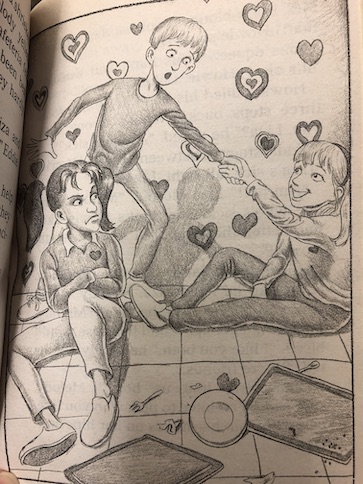
Before Eddie can do anything, Carey, a girl Eddie normally doesn’t like, suddenly develops a crush on him after eating one of Mrs. Rosenbloom’s Valentine cookies. The next day, Ben, the fourth-grade bully, gets a sudden crush on Issy after eating a Valentine cookie. Even Mrs. Jeepers and Principal Davis are falling in love! (Mrs. Jeepers is a widow.) Eddie becomes convinced that Mrs. Rosenbloom has doctored the Valentine cookies with a love potion! He thinks that she’s going to use it to take over the school!
At first, the others don’t believe Eddie, and in any case, what’s wrong with spreading a little love around? The problems start when both Melody and Liza eat Valentine cookies at the same time and both of them fall in love with Howie. The two girls, normally best friends, start fighting over Howie. Howie is embarrassed and worried that this weird love fight will break up their friendship. The two boys find themselves trying to dodge the girls while starting to worry that, if the romance between Mrs. Jeepers and the principal flourishes, Mrs. Jeepers will turn Principal Davis into a vampire. (One of the things I appreciate about this series is how it draws on real folklore and mythology. The boys are right that, assuming that Mrs. Jeepers actually is a vampire, she can’t be in love with the principal without revealing it to him and probably changing him into a vampire, too.)
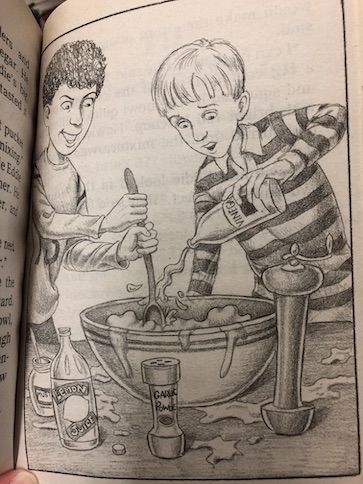
The boys come up with a plan to change Mrs. Rosenbloom’s cookie recipe for the worst, but before this escapade is over, even Eddie gets a taste of love. As with other books in this series, Mrs. Rosenbloom eventually leaves the school, and things return to normal (or what passes for normal in Mrs. Jeepers’ class).
The book is available online to borrow for free through Internet Archive.
#7 Aliens Don’t Wear Braces by Debbie Dadey and Marcia Thornton Jones, 1993.
One
day, while Mrs. Jeepers’ class is getting ready to take a science test, they
hear a strange sound, and the lights mysteriously flicker. Eddie tries to ask Howie what’s going on, but
Mrs. Jeepers sends him to the principal’s office for talking during a
test.
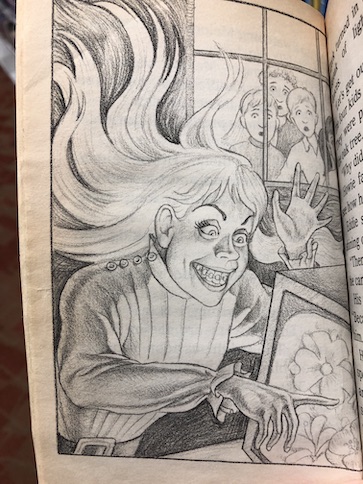
In the office, things are chaotic because the art teacher, Mr. Gibson, is missing, and the second grade teacher is there with her students, asking where the art teacher is. Eddie meets a strange, pale woman with long, white hair and braces on her teeth. She says that her name is Mrs. Zork and that she is there to apply for a teaching job. The principal asks her if she can teach art, and she says that art is her specialty, so the principal hires her as an emergency replacement for the art teacher. The principal is relieved that a substitute was so handy, but Eddie thinks that it’s a creepy coincidence.
When
Mrs. Jeepers takes her class to the art teacher, she is also surprised that Mr.
Gibson is gone and questions Mrs. Zork about it. Mrs. Jeepers says that she saw Mr. Gibson
only that morning, and Mrs. Zork tells her that he “had to leave . . .
unexpectedly.” Mrs. Jeepers tells her
class to behave for the substitute, but she also seems somewhat suspicious of
Mrs. Zork.
Mrs. Zork ignores Mr. Gibson’s previous lesson about totem poles and starts teaching the children pottery. She seems confused by ordinary expressions, like “you’re all thumbs” and “This place is a zoo.” When Mrs. Zork escorts Liza to the nurse for a nose bleed, the kids make other discoveries. A jar of green paint has suddenly turned white, and Mrs. Zork has an old newspaper clipping about a UFO and a star map with a course plotted on it. Howie, whose father works for the Federal Aeronautics Technology Station, suspects that Mrs. Zork might be an alien.
The
kids spy on Mrs. Zork while they’re at recess.
They see her watching a cartoon show on tv, and suddenly, all of the
color drains out of it. It could have
been because there was something wrong with the tv, but the kids notice that
Mrs. Zork’s braces flash pink afterward, and her hair starts to look more
blonde and her cheeks more pink. Worse
still, after Mrs. Zork admires Mrs. Jeepers’ green brooch, suddenly the brooch
(as well as Mrs. Jeepers’ hair and eyes) loses some of its color and no longer
works in its usual magical way. Eddie
sees it as an opportunity to goof off, and Mrs. Jeepers seems alarmed and
leaves the room abruptly.
The
children are worried about Mrs. Jeepers, and they can’t help but notice how the
art room is looking increasingly drained of color while their new art teacher
is getting more and more colorful. It
becomes more and more obvious to Howie that Mrs. Zork is stealing colors from
Earth!
This is one of the books where the kids get the most proof of their suspicions, actually seeing Mrs. Zork’s spaceship in her garage. Even so, Howie’s father doesn’t believe him when he tries to explain the situation to him. Mrs. Zork tries to convince the children that the spaceship is actually her pottery kiln. The kids know that somehow, they have to get their colors back to help Mrs. Jeepers and get rid of Mrs. Zork! Mrs. Jeepers may be creepy, but at least she doesn’t steal colors or give them eternal math problems, like Principal Davis.
The book is available online to borrow for free through Internet Archive.
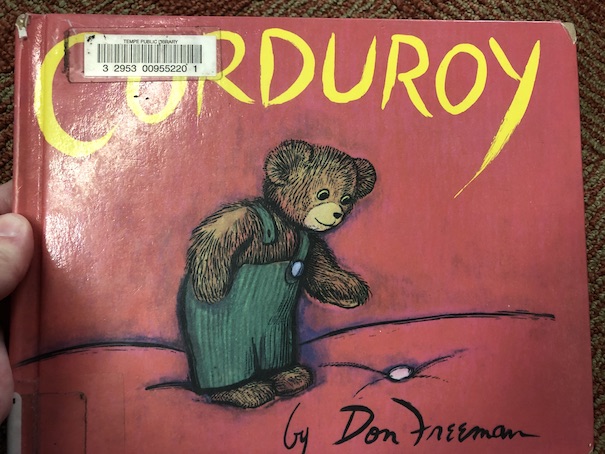
Corduroy is a small teddy bear who lives in a department store, waiting for someone to buy him and take him home. However, he is missing one of the buttons on his overalls, and it makes people reluctant to buy him.
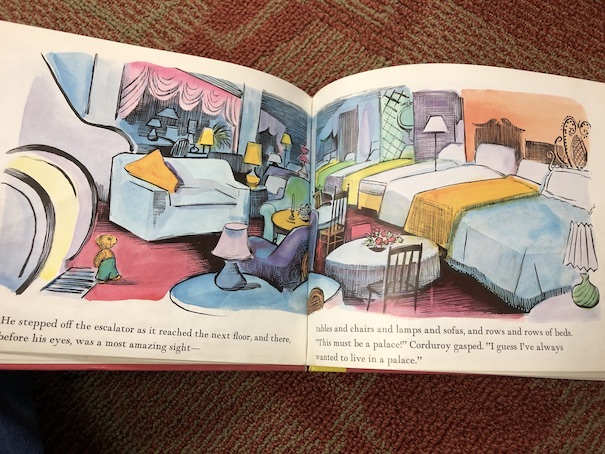
One night, after the store is closed, Corduroy sneaks out of the toy department to go looking for his lost button. After a trip up the escalator, he finds himself in the furniture department. To Corduroy, it’s like climbing a mountain and finding himself in a palace.
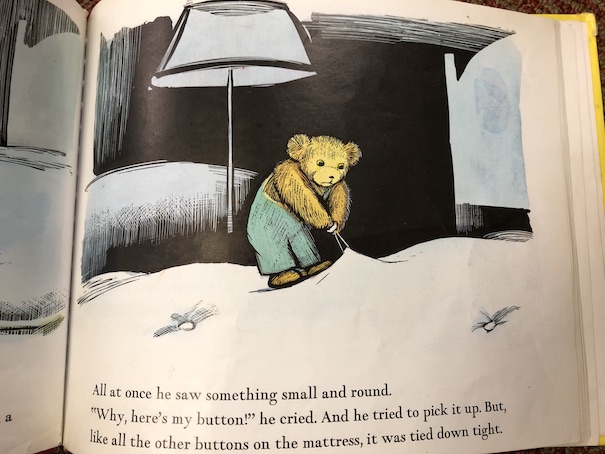
When he spots a button on a mattress, he thinks it might be his and pulls it off. By accident, he knocks over a lamp, which attracts the attention of a night watchman, who spots him and returns him to the toy department.
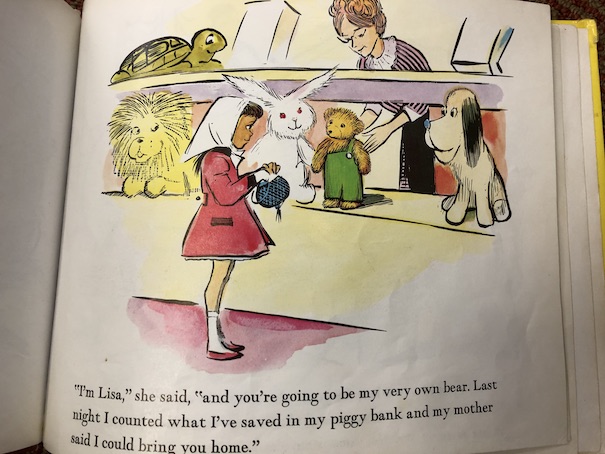
The little girl who wanted Corduroy before, Lisa, returns to the store and buys him. Lisa takes Corduroy home and sews a new button on Corduroy’s overalls. Corduroy is happy because he’s always wanted a home and a friend, and now he has both.
At first, this book was a stand-alone story, but later, the author wrote a sequel called A Pocket for Corduroy. Later, other authors continued the series.
The book is available to borrow for free online through Internet Archive.
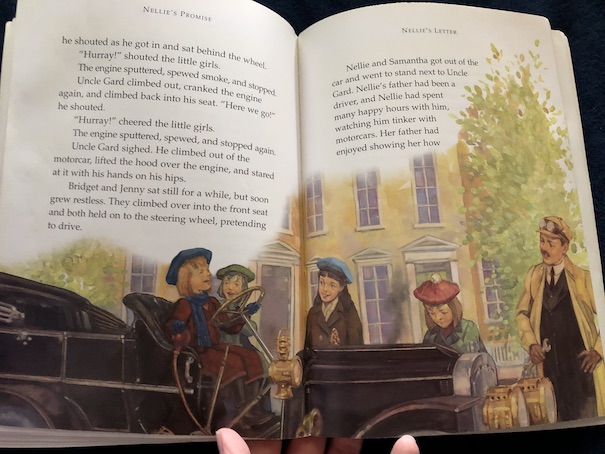
This book is a companion book to the Samantha, An American Girl series, focusing on Samantha’s best friend, Nellie. Personally, I don’t like the companion books to the main American Girls books as well as the original books, but this book does follow up on the events to the main series. At the end of Samantha’s series, Samantha’s aunt and uncle took in Nellie and her sisters, Bridget and Jenny, after their parents died. Nellie and her sisters were from a poor family and had to start working from a young age before their parents died. After their parents died, their disreputable uncle abandoned them, and they were sent to an orphanage before Samantha discovered where they were. Samantha’s aunt and uncle are wealthy, and the girls’ lives have improved considerably.
Nellie’s happiness is threatened by the sudden reappearance of her Uncle Mike. Uncle Mike sees Nellie walking down the street in her nice new clothes and wants to know what rich family the girls are living with. Nellie runs away from him, but he threatens to find out where she’s living and to take her and her sisters back, saying that it’s his right as her uncle. He says that he means to put the girls to work earning money for him. Nellie is afraid that he might be able to reclaim them from Uncle Gard and Aunt Cornelia because he is a blood relative.
At first, Nellie is afraid to tell anyone that she’s seen her uncle and that he threatened to take her and her sisters back. Before her parents died, her mother made her promise to look after her younger sisters, so Nellie makes up her mind that’s what she’s going to do.
Nellie worries about the future for her and her sisters. She feels like she doesn’t fit in with the wealthy girls at Samantha’s school, who have had very different lives from hers, and the lessons they learn are the type of lessons for fine young ladies who will marry rich men and spend most of their time raising families, overseeing a house with servants, and entertaining friends and their husbands’ business associates, not preparing for practical professions outside the home. Nellie thinks that it’s important that she have some kind of job skills because the future can be very uncertain, and she wants to know that she can provide for her sisters, no matter what happens.
Samantha senses that Nellie is unhappy, and she asks her if she likes living with Uncle Gard and Aunt Cornelia. Nellie tells her that she does, but she hesitates to explain what’s really worrying her. Instead, she lets Samantha think that she just wants to feel like she’s doing something useful for the family. Before her parents died, Nellie used to get sewing lessons at a settlement house (a place where immigrant families could go to learn English, new job skills, and other skills they would need in their new lives in the United States) run by Miss Brennan. Aunt Cornelia is involved with many good causes, and she wants to visit a settlement house and get an introduction to Miss Brennan. Because Nellie knows Miss Brennan, she can help arrange that. It’s in a rough part of town, but Nellie is more accustomed to navigating rough neighborhoods than Samantha or her aunt. It also occurs to Nellie that she could ask Miss Brennan what to do about Uncle Mike.
Miss Brennan is glad to see Nellie, and she lets her show Aunt Cornelia and Samantha around the settlement house. They have many different types of classes for children as well as adults. Nellie says that she likes the practical classes that she used to have there, and even the types of dances that they do seem more practical than the more purely artistic ones that they do at the school she now attends with Samantha. Aunt Cornelia is pleased with the classes that they offer for women, and because she is interested in women’s education, decides that she wants to help out at the settlement house. However, the visit to the settlement house leaves Samantha irritated for reasons that Nellie doesn’t fully understand.
As Nellie begins spending more time with Aunt Cornelia at the settlement house, Samantha begins spending more time with Bridget and Jenny, and Nellie becomes jealous of how Samantha seems more like their older sister than she is. However, the others still don’t know about Uncle Mike’s reappearance, and Nellie is still fearful of what he might do and what will happen to her and her sisters if Uncle Mike tries to take them away. She feels like her only option is to try to prepare herself for a better job than that of factory worker.
When Nellie finally gets the courage to tell Miss Brennan about her worries, Miss Brennan tells her that she needs to discuss the situation with Uncle Gard. Uncle Gard is a good man, but he’s also a lawyer, and he will know how to legally stop Uncle Mike from trying to take custody of the girls. However, Miss Brennan adds that, whatever else happens, Nellie will still need to make some decisions about her future and what she wants to do with her life and education. The more Nellie thinks about it, the more certain she is about what she wants to do. She wants to become a teacher, like Miss Brennan.
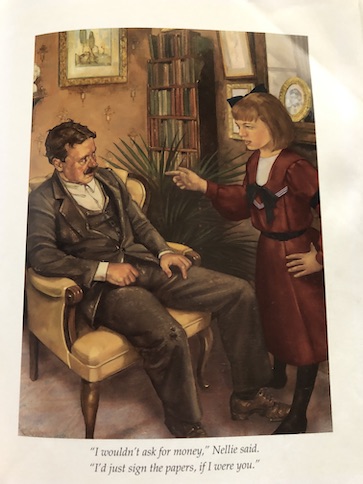
Nellie provokes more drama by applying to the boarding school in Boston where Miss Brennan said that she trained to be a teacher without talking to Aunt Cornelia, Uncle Gard, or Samantha about her decision or about her uncle. However, when the truth comes out about Uncle Mike, everyone understands that she was trying to hide and protect her sisters from him. It turns out that Uncle Gard has actually been looking for Uncle Mike because he already has the documents that he needs to legally adopt Nellie, Bridget, and Jenny, and he just needs Uncle Mike to legally release them into his custody. At first, Uncle Mike tries to extort money from Uncle Gard for the girls, but Nellie gets up the courage to tell him off, promising that if he doesn’t sign the papers and leave, she’ll tell everyone about how he stole all of their money and abandoned them to freeze the last time they were in his custody. The book ends happily, with Aunt Cornelia and Uncle Gard adopting the girls and understanding Nellie’s ambition to be a teacher. They enroll Nellie in a school in New York that teaches the skills she really wants so that she can continue living with them and not go to Boston. It also turns out that Samantha was mostly uncomfortable at the settlement house because she felt so sorry for the young children there and that spending time taking care of Bridget and Jenny was part of her way of trying to help Nellie by leaving her more free to do some of the things that she felt like she had to do. With everything out in the open, Nellie and her sisters are able to more fully become part of the family.
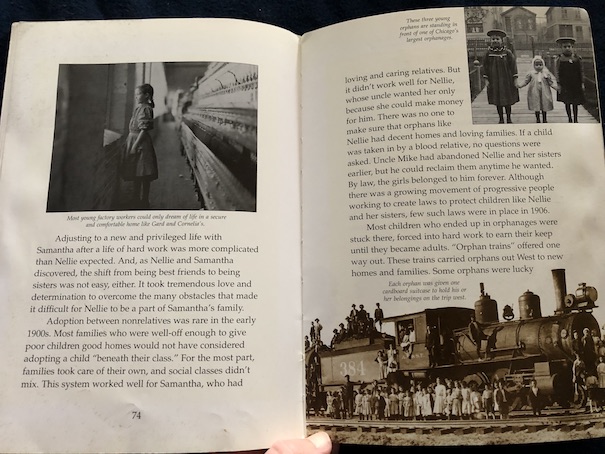
In the back of the book, there is a section with historical information about orphans and adoption in the early 1900s. There were not many laws and regulations governing care of orphans. Usually, orphans would be taken in by relatives, like Samantha was when her parents died. If a child didn’t have any relatives who were willing and able to take them, the child might be sent to an orphanage and possibly sent west on an orphan train as Nellie almost was at the end of the Samantha series. Families didn’t usually adopt children from different levels of society.
Settlement houses were important resources for poor immigrant families, and the education they received allowed immigrants to enter higher professions than servant or factory worker, which had been the primary source of income for many of them. It was common for settlement houses to help train young women to become teachers. There are still similar institutions and organizations in operation in 21st century America.
The book is available to borrow for free online through Internet Archive.
My Reaction and Further Historical Information
Part of the reason why I don’t like the companion books as much as the original American Girls series is that they tend to get more dramatic than the original books, and sometimes, I feel like the attitudes of the characters are less realistic for their time periods than they were in the original books. I think what made the original books more realistic was the restraint of the stories – they had their share of excitement and sometimes drama, but they never went overboard. The return of Nellie’s disreputable uncle struck me as both unlikely and unnecessary to Nellie’s and Samantha’s larger stories.
The historical details in this book are good. What they say about orphans of the time is basically true, although they note in the historical information section in the back of the book that Nellie’s experience of being adopted by a wealthier family was not typical of the time, and I think that’s part of what bothers me. Adoptions in general during the early 1900s were less formal than they are in modern times, and the idea of Uncle Gard hiring a private detective to find Uncle Mike and get him to sign legal documents doesn’t seem entirely realistic. I think it would have been more realistic to me the way that the last Samantha book ended, with Uncle Mike leaving and the assumption that none of the characters would see him again.
The reason why Nellie and her sisters were sent to the orphanage and why the orphanage was considering sending Nellie west on the orphan train was that no one expected that Uncle Mike would ever want to see the girls again. He’d already taken everything he could from them and left with them with no concern for what would happen to them. In the time that has passed since then, I would have expected that Uncle Mike would already have gotten into trouble that would keep him busy and out of their lives, maybe ended up in prison for being drunk and disorderly or hopping from job to job or begging for money as their little money ran out. Even if Uncle Mike had some thought of finding the girls, I don’t think it’s likely that he would have succeeded or even gotten close on his own because he is not that bright and he is not the kind of person who makes friends in places where he’s been before. I doubt that his former neighbor who took his nieces to the orphanage would have told him much if he had shown up again, looking for them. She knew that he was a drunk who abandoned the girls, and she made it clear that she didn’t like him. The people at the orphanage would have probably sent him away with no information because they would probably view the situation as closed since the girls are already placed out and Mike may not even have any proof of his identity and relationship to the girls. There is no such thing as a driver’s license during this period and many people did not even have birth certificates, so it’s possible that the people at the orphanage could simply choose to disbelieve this disreputable character and send him away. When I was watching a documentary about the orphan trains, former orphan train riders said that the orphanages that sent them west deliberately took notes from them that had their living parents’ addresses and otherwise cut off contact with living parents because they wanted the children to sever their ties to their difficult pasts and devote their attention to their new families, not maintain contact with the parents who were unable to care for them financially, so I wouldn’t expect that anyone at the orphanage in these books would go out of their way to reunite the orphaned girls with a rather shady uncle when they knew that the girls were already placed with a wealthy family and no longer their responsibility. Without help, which would be unlikely to be forthcoming, it doesn’t seem likely that Uncle Mike would be able to stumble on the girls by accident. As mentioned in Changes for Samantha, New York is a big city, people can be difficult to find if you don’t have a hint of where to look, and the wealthier part of the city where Nellie and her sisters live now is not a part of town where a guy like Uncle Mike would be likely to hang out. They could all easily live in New York City for years without meeting each other.
I feel like the situations in the story were a little contrived. By now, I would have thought that Nellie would know that Uncle Gard is a lawyer and would be the best person to ask about the laws. I don’t recall the earlier books saying what Uncle Gard did for a living, but Nellie lives with him now, and I would think that someone would have mentioned Uncle Gard’s profession by now. In the book, it oddly seems like as much of a surprise to Nellie as it is to the readers. I could believe that Nellie would go to the settlement house and do volunteer work there with Aunt Cornelia because it was already established in the previous books that Aunt Cornelia supports good causes, and although women of her level of society didn’t usually work for living, supporting good causes and charitable works would have been acceptable. Nellie’s level of knowledge seems a little odd, considering that she needed extra tutoring in basic subjects, like reading, in Samantha Learns a Lesson. In that book, Nellie never mentioned settlement house lessons, which she would have done if it hadn’t been a sudden decision to insert that this in book. Here, Nellie talks about classes that she had at the settlement house, where I would have expected to have more lessons to improve her reading, and it seems like she learned more there than she seemed to know before, even knowing a few words of foreign languages. In Samantha Learns a Lesson, one of Nellie’s skills was her ability to do math quickly handle money because she used to do the shopping for her mother, and in this book, she mentions that she helped to teach immigrants about American money, which she never mentioned before. These things are necessarily contradictory, but it all just seems a little off because they don’t quite fit into Nellie’s established character and history, and it implies that Nellie has had more education and training than she seemed to have before. It’s not necessarily impossible for a girl of Nellie’s time to know some of these things, but it’s the departure from what was already established about Nellie and her situation in life than kind of grates on me.
I think it could be reasonable for Nellie to develop the ambition to be a teacher. Even Samantha has previously some interest in that direction, having helped to tutor Nellie before. Not all women of this time went on to higher education, but those who did might attend a normal school, which is basically a college that focuses on training teachers. By contrast, the daughters of wealthy, high society families would be more likely attend a finishing school that emphasized social skills and entertaining more than academics. Both Samantha and Nellie are about twelve years old during this story and would be a little young for either of these options, but Samantha’s school seems to be more inclined toward preparing the girls for a finishing school. Given Aunt Cornelia’s interest in education and social causes and Uncle Gard’s support of it, I would expect that Samantha would be more likely to attend a women’s liberal arts college when she gets older, preparing her to marry a well-educated and culturally aware man as well as a wealthy one and probably engage in some form of social work and/or the arts in her spare time, but that’s just a guess. (I discussed some of this already in my review of Happy Birthday, Samantha. See also the book Daddy-Long-Legs for a description of what that might have been like for a girl of Samantha’s and Nellie’s time. The book was written a little later in than the time period of this book, but it’s set at about the right time for Samantha and Nellie to be old enough for college and includes characters of approximately their social backgrounds.) This book doesn’t really go into the subject, but if that’s the case, Samantha’s future might not be as different from Nellie’s as it first seems, and there might be a kind of middle path that both of them could choose. The Finch College in Manhattan, which was a fairly new preparatory school in Samantha’s and Nellie’s time, seems like it would have been a good option for both Samantha and Nellie, catering to upper-class girls while focusing on a more practical liberal arts education than the less academic finishing schools. Its founder, Jessica Finch, was a women’s rights activist and may have moved in similar circles to Aunt Cornelia. Her attempts to balance theoretical and practical knowledge sound like they would have appealed to the characters in the story. I’m not an expert on the Finch College, only having heard a little about it, but I think a school like that would present an intriguing possibility for the girls’ futures.
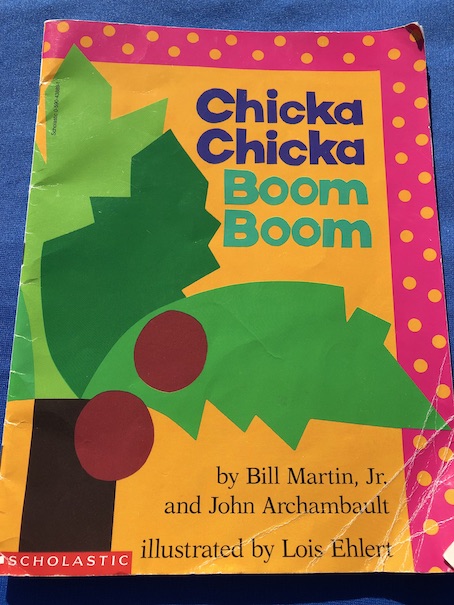
Chicka Chicka Boom Boom by Bill Martin, Jr. and John Archambault, illustrated by Lois Ehlert, 1989.
This is an alphabet book for young children, but it’s not like most alphabet books. Most alphabet books try to tie letters of the alphabet to words that young children know, to emphasize the sounds that the letters make, like in A, My Name is Alice or the letter-themed tongue twisters in Animalia.
In Chicka Chicka Boom Boom, the letters of the alphabet decide to climb to the top of a coconut tree. (Why not?) They go up the tree in alphabetical order.
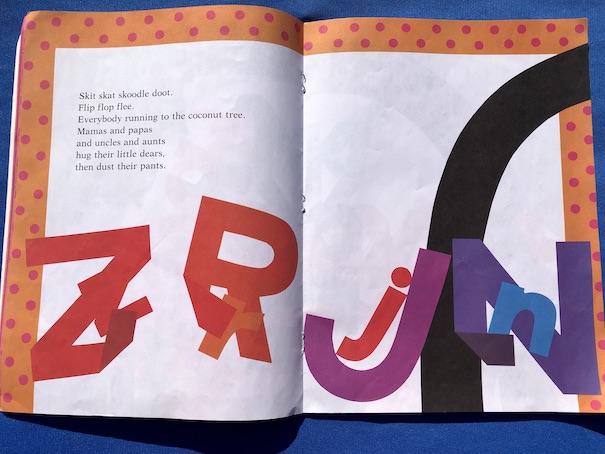
But, by the time they reach the end of the alphabet, there are too many letters in the tree, and they all fall out.
The uppercase versions of the letters are the adults of the story, like parents and aunts and uncles, and they comfort the lowercase letters who fell out of the tree.
At the end of the book, the letter ‘a’ tries to convince the others to climb the tree again.
As I said, this book struck me as unusual for an alphabet book because it doesn’t try to tie any of the letters to associated words. Mostly, it just emphasizes the order of the letters, first in the order that they go up the tree, and then in the order that they recover from falling out.
The story is told in rhyme, and the “Chicka Chicka Boom Boom” part is just sounds that fill out the story/rhyme, like it’s part of a song. At the end of the book, there’s a page with all of the letters of the alphabet, both upper and lowercase.
The book is currently available online through Internet Archive.
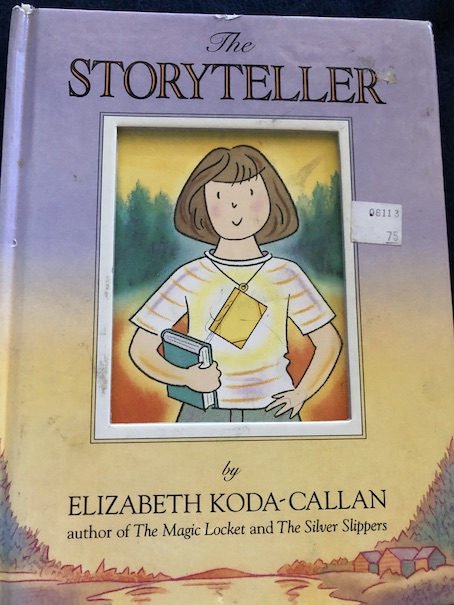
A young girl (unnamed, like in the other books in this series) who likes reading more than anything is sent to summer camp by her parents. When her parents first suggest the idea, the girl thinks that she might like camp, but then she gets worried that maybe she won’t or maybe she won’t make any friends there. She takes some of her books with her in case she needs something to do.
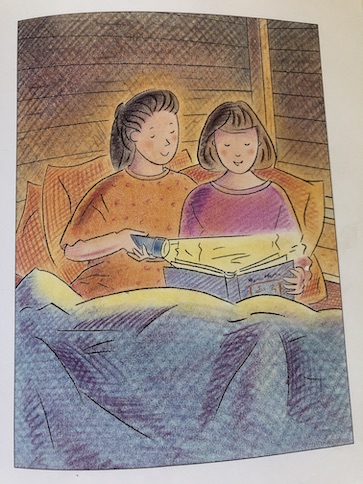
At first, it seems like camp isn’t going to be much fun after all. While the other kids seem to enjoy the typical camp activities, the girl doesn’t seem to be any good at them and doesn’t enjoy them much. However, she does make a friend, Jenny. When Jenny is homesick at night, the girl reads to her to help her feel better.
During the day, the girl keeps slipping back to her cabin to read while the other campers play volleyball because she isn’t good at the game. The camp counselor catches her reading all by herself, but she understands why the girl feels like she isn’t good at the other camp activities. To help her feel better, the counselor promises her an activity that she will be good at.
That night, while the campers are gathered around the campfire, ready to tell campfire stories, the counselor suggests that the girl read to them out of one of her favorite books. With Jenny’s encouragement, the girl reads to the other campers.
The other campers like the way the girl reads to them by the campfire, and Jenny helps the girl to improve at other camp activities. At the end of camp, the counselor gives the girl a charm shaped like a book as a reward for her storytelling skills.
All of the books in this series originally came with charms like the ones described in the stories. This book originally included a little golden book charm for the reader to wear. The hole in the cover of the book was where the charm was displayed when the book was new. The books in the series often focus on the unnamed main character (who could represent any girl reading this story – the books were aimed at young girls) developing new self confidence, and the charms were meant to be either a sign of their new self confidence or inspiration for developing it. In this case, the charm is a reward for the way the girl used her skills to make camp better for everyone while developing new skills in other activities.
The book is available to borrow for free online through Internet Archive.
A little girl (unnamed, like the other girls in this series) really wants a kitten of her own. However, the girl’s mother won’t give her a kitten because she doesn’t think that the girl is responsible enough to care for one. In the past, the girl has had a hamster and a gerbil, and she left most of the animals’ care to her mother.
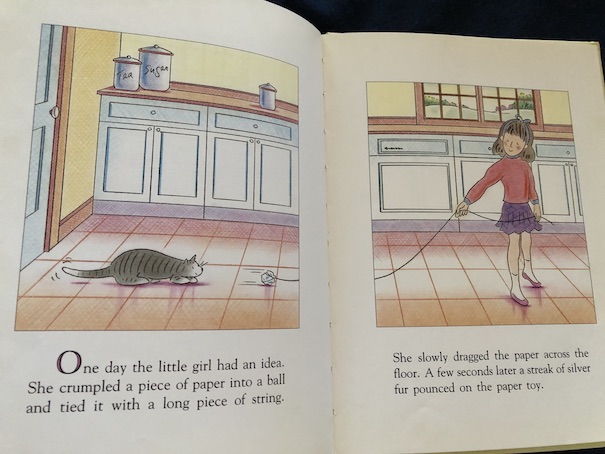
Soon, the girl gets a chance to prove that she can be more responsible. The woman next door is going away for a week, and she needs someone to look after her cat, Clover. The girl says that she would like to take care of Clover. Besides playing with Clover, the girl would have to feed her, change her water, and clean her litter box, but the girl says that she is willing to do it.
The girl loves Clover, but Clover is very shy around her at first. It takes time and patience for the girl to make friends with her and to take care of her. Once the cat gets used to the girl, the two of them have fun together.
When the neighbor returns from her trip, she is pleased that the girl took good care of her cat and gives her a silver cat charm as a memento. The girl misses Clover, now that she no longer needs to take care of her and still wishes for a cat of her own. Her wish is fulfilled when Clover has kittens, and the neighbor gives one to the girl.
All of the books in this series originally came with charms like the ones described in the stories. This book originally included a little silver cat charm for the reader to wear. The hole in the cover of the book was where the charm was displayed when the book was new. The books in the series often focus on the unnamed main character (who could represent any girl reading this story – the books were aimed at young girls) developing new self confidence, and the charms were meant to be either a sign of their new self confidence or inspiration for developing it. In this case, the charm is a reminder of the girl’s experience with the neighbor’s cat, which taught her what she needed to know to take care of a pet of her own.
The book is available to borrow for free online through Internet Archive.
The Silver Slippers by Elizabeth Koda-Callan, 1989.
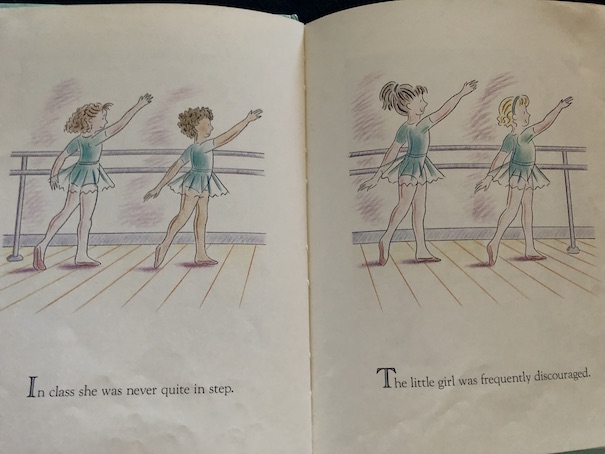
A little girl (unnamed, like the other girls in this series) wants to be a ballerina. She takes ballet classes, but she never seems quite good enough, like the ballet posters on the walls of her room. She feels discouraged because she is not perfect.
When her ballet teacher tells the class that there is going to be a dance recital and that one girl in class will be chosen to be the prima and lead the others, the girl doesn’t think that she has a chance to be chosen because her dancing isn’t good enough.
The girl tells her mother about the recital and her doubts about being chosen to be prima, and her mother tells her that it depends on how much she wants to be prima and how much she is willing to practice to improve. If the girl is willing to put in extra practice, she still has a chance to be prima. To remind her of her goals, her mother gives her a silver charm in the shape of a pair of ballet slippers.
In order to improve her dancing, the girl has to focus on her goal and give up participating in other activities to find more time to practice. However, her practicing pays off, and she gets the role of prima. On the night of the recital, she is nervous, but her silver slippers charm reminds her of her dream of being a real ballerina and gives her the courage to go on with her performance.
All of the books in this series originally came with charms like the ones described in the stories. This book originally included a little silver slippers charm for the reader to wear. The hole in the cover of the book was where the charm was displayed when the book was new. The books in the series often focus on the unnamed main character (who could represent any girl reading this story – the books were aimed at young girls) developing new self confidence, and the charms were meant to be either a sign of their new self confidence or inspiration for developing it. In this case, the charm is a reminder of the girl’s goals and how much she really loves dancing, giving her the inspiration she needs to persevere even when learning is difficult.
The book is available to borrow for free online through Internet Archive.
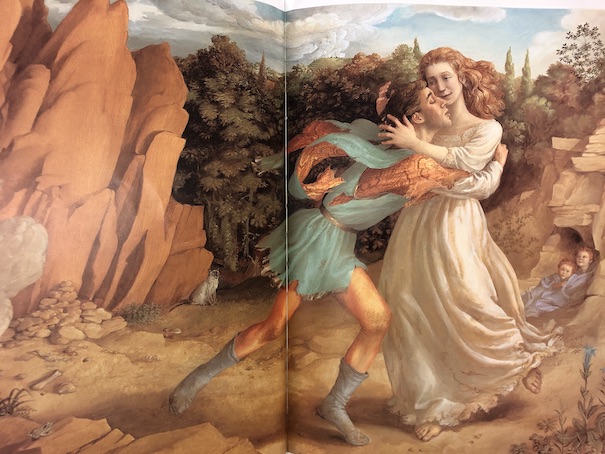
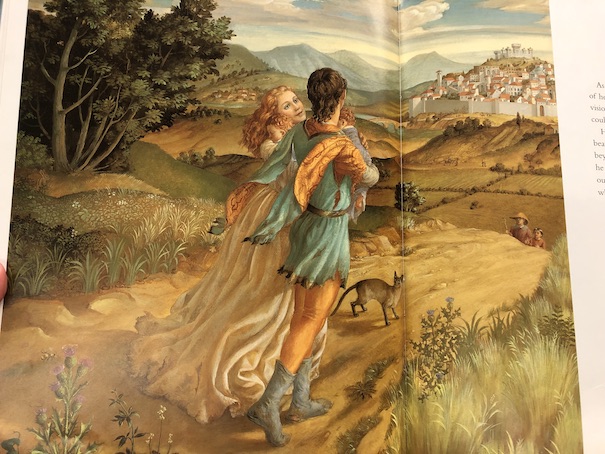
This retelling of the classic fairy tale is a Caldecott Medal winner. The illustrations are beautiful! A note in the beginning of the book explains a little more about the author’s sources for the story as well as his view about it. Instead of focusing on an evil witch who holds a young girl captive, he presents “a mother figure who powerfully resists her child’s inevitable growth.”
A
couple who have wished for children for a long time are excited to realize that
they are finally going to have one!
However, the wife finds herself with an irresistible craving for the
Rapunzel (an herb) that grows in the nearby garden of a sorceress. She is so desperate to have some that she is
able to persuade her husband to steal some for her. But, even having some causes her craving to
grow.
When the husband returns to the garden to get more Rapunzel, the sorceress catches him. He explains the situation, saying that his wife’s craving is so intense that he fears she will die if she doesn’t get some Rapunzel. The sorceress agrees that the wife can have the Rapunzel she needs, but in exchange, she demands the child when it is born. Not knowing what else to do, the husband reluctantly agrees. When the wife gives birth to a baby girl, the sorceress comes, names the baby “Rapunzel”, and takes her away from her parents.
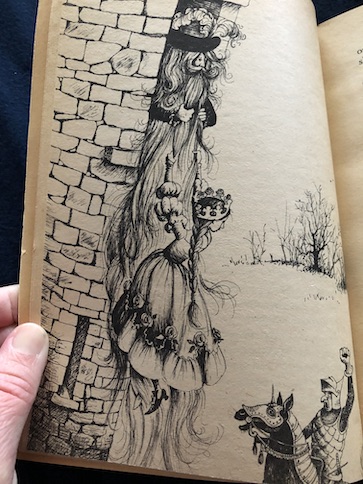
The sorceress cares for the girl and raises her. When the beautiful young girl turns twelve, the sorceress takes her to live in a tower in the forest. The tower is magical, looking narrow on the outside, but containing many beautiful and comfortable rooms. The only way in or out is through the window at the very top. The witch has Rapunzel let down her extremely long, beautiful hair so that she can climb up.
Rapunzel lives alone in the tower for years, until a prince happens to ride by and hears her singing. The prince is enchanted by the singing and asks questions about the tower at the nearest houses, learning about the sorceress and the young woman in the tower.
One
day, he sees the sorceress visiting Rapunzel and sees how she gets into the
tower. So, later, he calls to Rapunzel
himself, asking her to let down her hair.
Rapunzel is surprised and frightened at first, when she sees that her
new visitor isn’t the sorceress, but he speaks nicely to her, and they become
friendly. The prince proposes marriage,
and Rapunzel accepts. After that, he
visits her every night, without the sorceress’s knowledge.
However,
Rapunzel eventually gets pregnant, and when her clothes no longer fit her, the
sorceress realizes it. She calls
Rapunzel a “wicked child” and says that she has betrayed her. She cuts off Rapunzel’s long hair and exiles
her into the wilderness, alone.
The sorceress uses Rapunzel’s long hair to trick the prince into climbing into the tower. When he comes, she tells him that Rapunzel is gone, and he will never see her again. The prince falls from the tower, injuring his eyes. Blinded, the prince wanders alone for a year, lamenting for his lost wife.
Eventually, he finds Rapunzel in the wilderness, recognizing her singing. She has given birth to twins. Rapunzel’s tears heal the prince’s eyes, and he is able to see again. Realizing that they are near to his kingdom, he takes Rapunzel and the twins home.
The book is available to borrow for free online through Internet Archive.
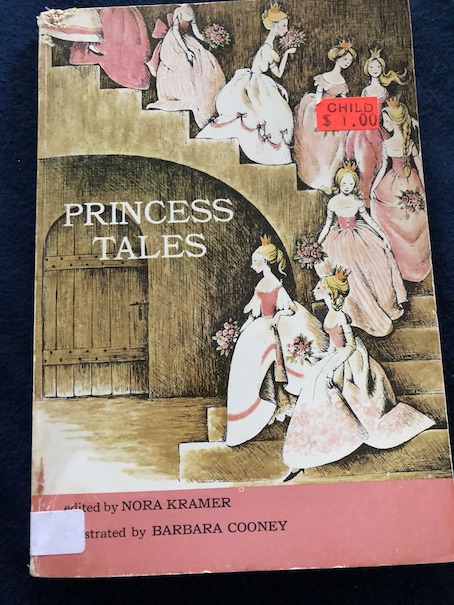
Princess Tales edited by Nora Kramer, illustrated by Barbara Cooney, 1971.
This is a collection of princess stories by various authors, including retellings of some classic fairy tales, some or all of which were printed in other locations before being included in this collection. Although I have encountered some of these stories before this collection, I liked the illustrations in this book because I like Barbara Cooney’s work.
Stories in the Book:
The Practical Princess by Jay Williams (1969) – I know this story from the story collection that is named after it, but it did appear in other printings before either of these. Princess Bedelia was given the gift of common sense as a baby, and she uses her practicality to rid her kingdom of a dragon and save herself from marriage to an evil sorcerer.
The Twelve Dancing Princesses by Virginia Haviland (1959) – A retelling of the classic fairy tale. A French kingdom with twelve beautiful princesses is mystified by how the princesses’ shoes are always worn through every morning even though the door to their room is locked every night when they go to bed. What are the princesses doing every night that ruins their shoes, and how are they doing it? Michel, a young cowherd who has recently taken a gardening job at the castle and who has fallen in love with the youngest of the twelve princesses, discovers the answer. When her sisters want to enchant Michel, as they have others who have discovered their secret to keep them from telling, Princess Lina needs to decide if she loves Michel as much as he loves her.
The Princess and the Vagabone by Ruth Sawyer (1942) – A beautiful but bad-tempered Irish princess learns a lesson in kindness when her father gets fed up with the way she treats her suitors. All of her life, the princess has dealt out criticism and insults to everyone, when she sees a suitor with whom she can find no fault, she doesn’t know what to do (never having practiced kindness or spoken nicely to anyone) and gets angry, hitting him and crying as she runs from the room. Her father, disgusted with her impossible behavior, tells her that he’s had enough, and since she has rejected all the royal suitors, he will force her to marry the next vagabone (vagabond) who comes begging at the castle. As the wife of a vagabond, the princess learns to face hardships she has never experienced before, sees for the first time how much kindness from another person can really mean, and notes positive points about others for the first time, enjoying the ragged vagabone’s song. But, there is still one more surprise when the vagabone turns out to be the perfect suitor the princess thought that she had rejected.
Melisande by E. Nesbit – A king and queen want to avoid the usual messes and curses that often result from holding a christening party for a new princess and forgetting to invite one of the fairies, so they decide that, for their daughter Melisande, they will simply hold an informal christening with no party. However, all of the fairies get mad about this and come to give curses to the princess. Fortunately, the king points out logically that, according to tradition, only one forgotten fairy can offer a bad curse to a princess after being left out of a christening party. Fairies are held to certain rules and can vanish for breaking them, so since the first fairy already cursed the princess with baldness, the others simply agree to count themselves are party guests and leave. Princess Melisande spends her childhood being bald, but the king offers her a fairy wish that he had been saving for something special so that she can wish for hair. However, Melisande foolishly wishes for her hair to grow exceedingly fast and even faster when cut. It’s far too much hair for her, even though people try to help her find uses for it, like weaving it into clothes and stuffing pillows with it. As usual in these cases, the king offers Melisande’s hand in marriage to the prince who can help her to solve her problem. At first, Prince Florizel thinks he’s found the solution when, instead of cutting the princess’s hair from her, he cuts her from her hair. However, that has the unintended side effect of making the princess grow suddenly tall! What will Prince Florizel do to get the princess and her hair to balance? (At one point, this story references Alice in Wonderland.)
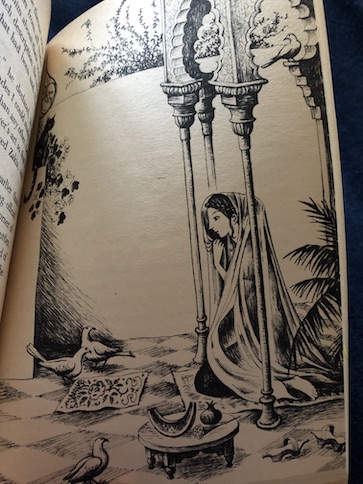
The Handkerchief by Robert Gilstrap and Irene Estabrook (1958) – At first, Zakia is not happy when her father, the Grand Vizier of Morocco accepts the sultan’s offer to marry her on her behalf. She doesn’t think that it’s fair for him to order her to marry anyone, and she doesn’t love the sultan. In response, she imposes a requirement on the marriage, that the sultan must learn a trade in case he loses his throne and has to earn a living. To the vizier’s surprise, the sultan thinks that sounds like a clever request, and the sultan learns the art of weaving. He enjoys it, and he makes a beautiful handkerchief for Zakia as a wedding present. Zakia appreciates the gift and marries him. The sultan’s ability as a weaver later saves him when he is in a desperate situation.
The Blackbird’s Song by Barbara Leonie Picard (1964) – An artist paints an unflattering picture of the king and is thrown into prison. However, the princess’s pet blackbird sings to him of the princess’s beauty and kindness, and he is able to paint a marvelous portrait of her without having seen her himself. When the princess falls in love with the artist, her blackbird and its friends help them to make their escape from her father.
Ricky-of-the-Tuft by Polly Curren (1963) – A prince is born ugly, and his mother is worried, but a fairy gives him the gift of wit and intelligence, with the ability to give that gift to someone he loves. In another kingdom, a queen has two daughters. The eldest is beautiful and the youngest is plain. However, a fairy says that the plain girl will be bright and intelligent, and people who talk to her will forget what she looks like. The beautiful girl is less fortunate because she is not intelligent. People will enjoy looking at her, but they will quickly tire of her because she does not speak intelligently and has nothing to say. To compensate the beautiful girl, the fairy says that she will be able to make the person she loves beautiful as well. When the ugly prince, Rick-of-the-Tuft, meets the beautiful princess and falls in love with her, the two of them are able to use their gifts to help each other. The story is based on a Perrault fairy tale.
The Son of the Baker of Barra by Sorche Nic Leodhas (1968) – The baker’s son, Ian Beg, is a nice boy, and sometimes a little too nice. When his father sends him to take a cake to the princess, he is stopped by old women who ask him for a taste of the cake, and he cannot refuse them. However, it turns out to be a fortunate thing. The old women are actually fairy folk, and not only do they handsomely compensate him for the cake that they eat, but they also help him when the princess falls in love with him and the king tries to get rid of him by sending him off to find a castle of his own. The king doesn’t expect that Ian Beg will be able to find a castle and supply the kind of lifestyle that a princess needs, but he doesn’t know that Ian Beg has help.




















 Jestress's Forgotten Books and Stories