Miss Bianca

Miss Bianca by Margery Sharp, 1962.

Miss Bianca is still a hero to the Mouse Prisoners’ Aid Society after the rescue of the Norwegian poet in the last book.  Bernard is a lesser hero, even though he was part of the mission, but such is the lot the organization’s Secretary.  Since the success of the rescue mission, the society is keen to perform another rescue, a deviation from the society’s usual role of merely providing comfort to prisoners.  The rescue mission that they have in mind this time is that of a little girl.  (The first Disney The Rescuers movie also featured the rescue of a little girl, but the circumstances in the book are very different.)

Patience is an eight-year-old orphan who has been abducted and enslaved by the Grand Duchess and is being held in her Diamond Palace.  The Grand Duchess is cruel, and some people think that she’s a witch.  Miss Bianca appeals to the Ladies’ Guild of the society to help free Patience.  The Ladies’ Guild doesn’t usually take part in the more exciting missions of the society.  The mice are somewhat concerned about what they will do with the child once they have rescued her because other prisoners they’ve helped have had homes to return to, but Miss Bianca assures them that they have a home in mind for the girl, a farm family in Happy Valley who have lost a daughter and would be likely to take in another girl.  The Ladies’ Guild agrees to undertake the mission.  Bernard wanted to come, too, but Miss Bianca insisted that they didn’t need his help.

The Diamond Palace is a strange place, in many different ways.  People often come to see it because it looks like it’s made out of diamonds, although it’s actually rock crystal.  It’s cold all the time, but even weirder than that, there seem to be less servants in the Palace than Miss Bianca would expect, given that the Duchess is always surrounded by ladies-in-waiting, who would be expected to have maids of their own.  It turns out that the “ladies-in-waiting” aren’t real people – they’re clockwork automatons! 

Rather than being a witch, the Duchess is simply an odious person who has so much money that she can give full reign to a nasty personality without anyone stopping her.  She’s so nasty and spoiled and used to forcing people to do what she wants that all of her previous, human ladies-in-waiting found that they just couldn’t handle her increasingly unreasonable demands, like insisting that they all stand perfectly still all day long while she sits on her throne, not even the slightest movement allowed.  No human being could possibly manage that.  When the human ladies-in-waiting all fainted after trying to keep perfectly still for forty-eight hours straight, the Duchess screamed that they all must have done it on purpose and dismissed them, replacing them with automatons.  The mechanical people are almost perfect because they always stand perfectly still until they’re needed and never complain or have human needs, but the Duchess discovers that they’re not quite perfect because there are some chores that they can’t do and she also misses seeing people react fearfully or start crying when she bullies them.  Keeping Patience as her slave gives the Duchess someone to do those chores and also someone to abuse.  The Duchess has had other child slaves before, but the others have died from the abuse, ill-nourishment, and general bad treatment.  (This is a darker story in a lot of ways from the Disney one.)

When Miss Bianca and the other mice meet Patience, she is also under-nourished and desperately lonely.  Miss Bianca sends the others back to the society to report about the automatons and stays with Patience to keep her company, trying to decide how to deal with the strange, mechanical people.  Bernard worries anxiously about Miss Bianca when the others come back without her and decides to go after her.

The Duchess’s other human servant, Mandrake, her Major-domo, is also little more than a slave.  The Duchess has evidence of a crime that he once committed and uses it to keep his loyalty.  Usually, he’s the only one who gets to go out the back door because he doesn’t trust Patience to take out the garbage without running away.  However, Patience tells Miss Bianca that the clockmaker sometimes comes in that way when he comes to wind up the mechanical ladies-in-waiting.  Miss Bianca hatches a plan that involves making the ladies-in-waiting break down.

However, to Miss Bianca’s surprise, the Duchess commands Mandrake and Patience to come with her to her hunting lodge when the ladies-in-waiting break down.  There is no opportunity for escape.  However, it turns out that the hunting lodge is actually above Happy Valley, and Bernard knows where it is.

Of course, they do get Patience safely to her new foster family.  Miss Bianca actually talks to the girl’s foster mother and tells her that Patience will probably forget about her eventually, when she grows up, but the foster mother likes the lullaby that Miss Bianca sings for Patience and promises to keep it as a family tradition.

The darker aspects of the story really bothered me, and I have to admit that I didn’t like it as well as the Disney version.  Mandrake actually reappears in another book in the series.

The book is currently available online through Internet Archive.

The Rescuers

The Rescuers by Margery Sharp, 1959.

This is the first book of The Rescuers Series.  Disney made a movie called The Rescuers based on this series, but the movie was very different from the book.  The movie involved a pair of mice who were members of a mouse version of the United Nations called The Rescue Aid Society who rescued a young orphan girl who was kidnapped for the purpose of recovering a treasure from a dangerous cave.  In the book, the prisoner the mice rescued was a poet who was being held captive in a castle.

The beginning of the first book of the series explains the purpose of the Prisoners’ Aid Society, an organization of mice that helps human prisoners:

“Everyone knows that the mice are the prisoners’ friends – sharing his dry bread crumbs even when they are not hungry, allowing themselves to be taught all manner of foolish tricks, such as no self-respecting mouse would otherwise contemplate, in order to cheer his lonely hours; what is less well known is how splendidly they are organized. Not a prison in any land but has its own national branch of a wonderful, world-wide system.”

However, the mice are daunted by their latest concern, a prisoner who is being held captive in the Black Castle, a Norwegian poet.  The Black Castle is a harsh prison, and because of the jailer’s cat, mice usually cannot reach the prisoners there.  However, the current chairwoman of the society believes that it may be possible to rescue one of the prisoners there.  She thinks that Miss Bianca is just the mouse for the job because she is the pet of an ambassador’s son and will soon be traveling to Norway with her owner.  The chairwoman sends Bernard, a pantry mouse, to Miss Bianca to recruit her for the mission.

Miss Bianca is frightened when Bernard explains the mission to her and faints.  However, it turns out that Miss Bianca is a poet, and so is the man who is being held prisoner.  Bernard uses her sympathy for a fellow poet and some flattery to inspire her to agree to help.

When Miss Bianca reaches Norway, she recruits some help from the mice in the cellar of the embassy.  In particular, a sailor mouse called Nils accompanies her to where the other mice from the Society are meeting.  There, Bernard joins them for the journey to the Black Castle.

When they reach the castle, Miss Bianca, Bernard, and Nils take up residence in an empty mouse hold in the head jailer’s quarters.  (There is a horrifying description of how the head jailer apparently pinned live butterflies to his walls to die. Ew!)  The jailer does have a horrible cat named Mamelouk, who is as cruel as his master.  At first, Miss Bianca isn’t afraid of the cat, having known a nice cat who didn’t eat mice when she was young.  After talking to Mamelouk and interacting with him, she comes to recognize his cruelty and real intentions toward her.  However, Mamelouk is an important source of information.  It is from Mamelouk that they learn that the jailers will be having a New Year’s Eve party soon and that many of them are likely to be lax in their duties.  This will be the best time for them to try to rescue the poet!

The mice do successfully rescue the poet, and Miss Bianca returns to her boy, who has been missing her. However, this is just the first of her adventures in this series!

Overall, I prefer the first Disney Rescuers movie to the book because the prison/castle seemed pretty dark for a children’s book, and I think the idea of rescuing a child is also more appropriate for a children’s book.

The book is currently available online through Internet Archive.

Five Little Peppers and How They Grew

FiveLittlePeppers

Five Little Peppers and How They Grew by Margaret Sidney, 1881.

Mrs. Pepper is a widow who lives with her five children in a little brown house.  Since her husband died when their youngest was a baby, she has supported the family by sewing.  The children try to help, but they are still very young.  The oldest, Ben, is eleven years old, and Polly, the next oldest is ten.  Their mother worries about providing them with an education, but they are barely scraping by as it is.

The family manages to get by, helping each other through crises, such as the time when everyone was catching measles.  Sometimes, they also get help from friends.

One day, when Phronsie (short for Sophronia), the youngest Pepper, about four years old, wanders off by herself, she is found by a boy named Jasper King and his dog, Prince.  They look after her until her brother, Ben, comes to take her home.  Jasper enjoys meeting the Pepper family.  He doesn’t have any siblings himself, and he thinks that it must be fun to live in a family of five.  Jasper and his father are spending the summer at a hotel in nearby Hingham, and Jasper thinks that it’s dull.  The Pepper children invite him to come visit again, saying that they will teach him how to bake like Polly does.

Jasper isn’t able to return to their house right away because he gets a cold, and Jasper’s father has been ill.  Phronsie thinks that it would be nice to make him a gingerbread man.  Together, the children make up a little basket of goodies for Jasper and his father.  The Kings are charmed by the gift, and Mr. King decides that he would also like to visit the Pepper family.  Unfortunately, due to Mr. King’s poor health and some business he has in “the city”, their visit to the area is cut short.  The Pepper children are sad that Jasper will be leaving so soon, but they invite him to return next summer.

Jasper continues to write letters to the family while he’s in the city, studying with the private tutor he shares with his cousins.  He remembers the Pepper children telling him that they don’t really celebrate Thanksgiving or Christmas because they never have enough money to buy a feast or Christmas presents.  However, he urges them to try to celebrate Christmas this year, even if it’s only in a small way.  The Pepper children make small presents for each other, like paper dolls, doll clothes, toy windmills, and whistles, and put some greenery around for decoration.  Jasper also sends the family some surprise presents.

However, Jasper’s father says that he doesn’t want to visit Hingham again because he doesn’t think that the climate there is good for him.  Instead, Jasper persuades his family to let him invite Polly for a visit.  It takes some persuasion for the Peppers to agree because Mrs. Pepper is hesitant to accept favors and Polly worries about homesickness, but they are persuaded when Jasper says that he has been unwell and that Polly’s visit would cheer him up.  In the city, Polly gets her first taste of formal education, even having a music teacher.  However, she does get homesick, so the King family sends for little Phronsie to cheer her up.  The King family is charmed by both of the girls, and Mr. King gives Phronsie many dolls to play with.

One day, when Polly realizes that she has forgotten to write a letter to their mother because she was so busy with her lessons, Phronsie decides that she will write one herself and mail it.  She doesn’t really know how to write, but she scribbles something as best she can and slips out of the house to find the post office.  She is almost run over in the street, but fortunately, Mr. King finds her and brings her home.  She isn’t hurt, but the incident worries Mr. King.

After some thought, Mr. King decides to invite the rest of the Pepper family for a visit.  The day that the rest of the Peppers arrive, Phronsie surprises a pair of thieves in the house.  The thieves get away, and the excitement from the incident makes the Peppers’ arrival less exciting than it should have been.

The Peppers fit so well into the household that Mr. King invites the family to live with them permanently.  He offers Mrs. Pepper a job as housekeeper and says that he will help the children with their education.  Mrs. Pepper accepts, and it leads to the surprising revelation that Mrs. Pepper and John Mason Whitney, the father of Jasper’s cousins, are actually cousins, making them all cousins of the King family as well.

This book is mentioned in the book Cheaper By the Dozen as a book that Mrs. Gilbreth liked to read to her children.

The book is currently available online through Internet Archive. It is part of a series.
Cheaper By the Dozen

CheaperDozen

Cheaper By the Dozen by Frank B. Gilbreth, Jr. and Ernestine Gilbreth Carey, 1948.

These are the real reminiscences of children from the Gilbreth family about their unusual childhoods during the 1910s and 1920s.  There are a couple of movies based on this book, including the 2003 movie that features the dad who is a football coach, but that story is fictional and bears almost no resemblance to the actual lives of the real Gilbreth family.  The older 1950 movie with Myrna Loy as the mother is closer.  The only parts that they have in common are that there were a dozen children in the family, and they had some unusual systems for handling their chaotic household.

The father of the Gilbreth family, Frank Gilbreth, Sr., was a motion study and efficiency expert.  He was one of the early pioneers in the field, studying the ways that people do things, whether it was routine household chores or making things in factories and trying to find ways to help them perform their tasks more efficiently.  Saving time was a passion for him, and he often used his own children and household as guinea pigs for his projects.  His wife, Lillian Gilbreth, was also a psychologist and engineer and was his partner in his work, continuing it after his death.

Part of the reason Frank Gilbreth was so interested in efficiency was that, in his early life, he worked with his hands and built a reputation as an efficient worker.  Later, he also learned that he had a heart condition that might cause him to lead a shorter life.  He had wanted a large family, and he and his wife had agreed that they wanted an even dozen of children, six boys and six girls.  He got his wish, but he was concerned about helping his children to make it as far as they could through school and giving his large household a structure that would last even after he died.

The stories in this book are mostly funny stories as his children fondly remember the things their father taught them and the usual systems in their house that were designed to keep a dozen children in order.  The stories jump around a bit in time, and it isn’t always clear exactly which children were alive at certain points in the stories.  Whenever Jane, the youngest, is mentioned, the stories take place between 1922 and 1924, and there should be eleven living children in the family at most.  Although the Gilbreths did have a total of twelve children, as they had hoped, they were all single births (no twins or other multiples), spaced out over 17 years.  Also, although this book does not mention it (the sequel, Belles on Their Toes contains a brief footnote), one of the older girls in the family (Mary) died very young of diphtheria, before her youngest sister was born, so there was no point at which all twelve children were together.  Even so, the Gilbreths always referred to their children as their “dozen,” and the stories make it sound like all twelve were together.  (This article explains a little more about Mary’s death and its effect on her family and the reasons why the books explain little about it.)

The children’s birth order isn’t specified in the stories, but for reference, these are their birth and death dates (courtesy of Wikipedia):

Anne Moller Gilbreth Barney (1905-1987)

Mary Elizabeth Gilbreth (1906–1912)

Ernestine Moller Gilbreth Carey (1908-2006)

Martha Bunker Gilbreth Tallman (1909-1968)

Frank Bunker Gilbreth Jr. (1911-2001)

William Moller Gilbreth (1912-1990)

Lillian Gilbreth Johnson (1914-2001)

Frederick Moller Gilbreth (1916-2015)

Daniel Bunker Gilbreth (1917-2006)

John Moller Gilbreth (1919-2002)

Robert Moller Gilbreth (1920-2007)

Jane Moller Gilbreth Heppes (1922-2006)

Wikipedia also claims that there was a thirteenth baby, an unnamed stillborn daughter, but this child isn’t mentioned in the books, and I don’t know for sure if that’s true.  Most of the children lived to adulthood, married, and had children of their own.

Racial Language Warning: I usually make notes about racial language in the books I review.  There are a couple of things I’d like to point out, although I also have to point out that, since this book is non-fiction, the people writing it were quoting people from memory.  Just be prepared for a few things that people said back in the 1910s/1920s that wouldn’t be acceptable in modern speech.  They aren’t central factors in the stories, but they are there.  For example, one of the children’s grandmothers used to get dramatic when threatening the children with punishment and say that she would “scalp them like Red Indians.” (I’m not completely sure if she meant that the Indians would get scalped like that or do scalping like that, but I’m guessing that she probably wasn’t being particular.)  The mother of the family also frequently used the word “Eskimo” to describe bad language or “anything that was off-color, revolting, or evil-minded.”  Most of the time in the book, she says it kind of like the way some people say, “Pardon my French” when using bad language, and her definition of bad language was pretty mild.  I’ve never heard the word “Eskimo” used in that sense anywhere else, and it makes me cringe here.  There is some pay-off to the word when a couple of pet canaries whose full names the mother had declared were “Eskimo” escaped during a boat ride, and one of the kids tries to explain to the boat captain that he’s upset about “Peter” and “Maggie” being lost but he can’t say their last names because they’re “Eskimo,” making the captain think that a couple of Alaskan natives have mysteriously disappeared over the side of his boat.  It reminded me of something similar in Fudge-A-Mania, where Fudge accidentally made people think that his lost pet bird was his crazy uncle.  When sharing this book with children, like other older books, it might be a good idea to make it clear that they shouldn’t try to imitate some of the expressions the book uses because it might cause problems and misunderstandings.  There is also a Chinese cook in one chapter who speaks a kind of pidgin English that no one should imitate, either.

Overall, these are calm, funny stories about a somewhat eccentric family that can make nice bedtime reading.  The book is currently available online through Internet Archive.

Chapters

Each of the chapters in this book talks about a different topic or period in the family’s life:

CheaperDozenShavingWhistles and Shaving Bristles

Introduces the father of the family and his experiments in motion study.  Frank Gilbreth was highly self-confident and frequently took at least some of his children (and sometimes the whole family) with him on visits to factories where he was helping to increase their efficiency.  He gave the children notebooks and pencils and had them take notes about what they saw.

To keep the household orderly and make sure that each child got ready for school on time and did their chores and homework, the parents instituted a chart that each child had to initial after completing certain routine tasks such as brushing teeth or making beds, and there was a special whistle that their father would give to get all of the children to come quickly for a meeting.  The father would sometimes take moving pictures of the children doing chores, like washing dishes, so that he could study their motions and determine if there were wasted motions that could be eliminated so that the task could be completed more efficiently.  He also used himself as a guinea pig, always trying to do daily tasks, like buttoning his coat or shaving, more quickly and efficiently.

Pierce Arrow

The family moves from their home in Providence, Rhode Island, to Montclair, New Jersey.  This chapter explains the move and also the father’s love of practical jokes.  Before taking the family to their real new house, he takes them to one that’s really old and run-down so that the new one will look that much better when they get there.  When they get their large Pierce Arrow car, big enough to carry the whole family, the father tricks each of the kids into looking for the “birdie” in the engine and then honks the horn to scare them.  He thinks it’s funny until one of the kids does the same thing to him.

CheaperDozenCarOrphans in Uniform

This chapter explains that the mother of the family was a psychologist.  While the father instituted systems and dealt out discipline, the mother was often the one who made the systems work, resolving conflicts among the children and making sure that everyone was doing what they needed to do and that they had everything they needed.  Older children also helped by looking after a designated younger sibling.

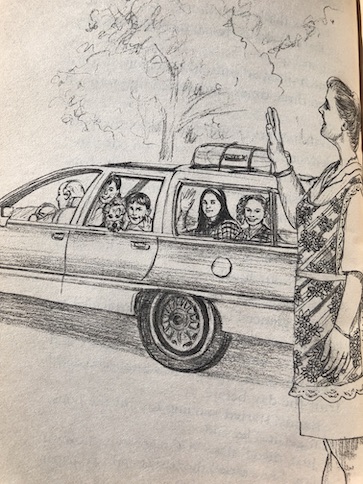
Much of the chapter explains how things often happened on family outings.  They always took roll call because there were a couple of incidents when children had been left behind by accident on earlier trips.  As a large family, they also attracted a lot of attention.  Sometimes, their father would try to get discounts on things like ticket prices and toll booths by pretending that his children were the nationality of whoever seemed to be in charge, and he was pretty good at guessing that correctly.  All of the Gilbreths were either blonde or red-haired, so Mr. Gilbreth was known to gleefully pretend that they were Irish, when in fact, their heritage was Scottish.  He always thought jokes like that were funny, but finally his wife and children put a stop to his playacting the day that the family was mistaken for an orphanage on an outing.

Visiting Mrs. Murphy

The family enjoyed going on picnics together.  While they were eating, the father would often try to squeeze in an educational lesson, pointing out things like the way ants work together, how a nearby bridge would have been constructed, or what was going on at a nearby factory.  The children learned a lot from him, especially how to notice details in the world around them, but they noted that it was their mother who often put the lessons in perspective for them by pointing out the human side of each of these things, such as describing the fat queen ant in a colony with all of her slaves (their word, I’ve usually heard them referred to as “workers”, but you get the idea) waiting on her or the workmen on a construction project in their jeans, stopping for lunch.  Their father was also pleased by the mother’s descriptions, which complemented his lessons so well.  These stories help explain how the parents worked well together as a team.

The “visiting Mrs. Murphy” was a euphemism for going to the bathroom in the woods because the family didn’t really trust public restrooms.

Mister Chairman

This chapter explains a little about Frank Gilbreth’s youth and how he got his start.  His father died when he was young, and his mother encouraged her children to get the best education they could.  However, Frank Gilbreth decided to get a job instead of going to the Massachusetts Institute of Technology like his mother planned because he was concerned about the family finances and his sisters’ education.  He became a bricklayer and drove his supervisor crazy because he always had tips for working faster and more efficiently.  Eventually, the supervisor adopted some of his suggestions, and Frank discovered his passion for motion study.  He worked his way up in construction until he became a contractor, and he was also hired to study working methods in the factories he built.  He became a wealthy man and met his wife as she passed through Boston on her way to a trip in Europe.  Lillian was from a wealthy family in California, and she had a college degree in psychology.  Although many people didn’t take female scholars seriously in those days, Frank did, and the two of them became a team, both personally and professionally.  They were both interested in the psychology of management, and they applied many of the principles from the professional world to their household and vice versa.

To help organize household tasks and make family decisions, Frank created a Family Council with himself as the Chairman and his wife as the Assistant Chairman that was similar to an employer-employee board.  For the most part, it did help to keep order in the family, but once in a while, the Chairman was overruled, including the time when the children ended up persuading their parents that they should get a family dog.

Touch System

This chapter goes into more detail about how responsibilities and chores were assigned in the family.  It also describes how the father arranged to make best use of “unavoidable delay” in the bathroom by putting Victrolas with language lessons in the children’s bathrooms, so they could learn while bathing or brushing their teeth.  He also taught them how to take baths efficiently, so that they could be in and out of the bathroom as quickly as possible.  Mr. Gilbreth took every opportunity and free moment to improve his children’s minds, including teaching them ways to perform complex math problems at the dinner table.

While working as a consultant for the Remington typewriter company, Mr. Gilbreth developed a system for teaching touch typing, and he taught it to his children.

CheaperDozenSchoolSkipping Through School

Not knowing how long he was going to live, Mr. Gilbreth was anxious to see as many of his children get through school as he could, and he had great confidence in their abilities, so he often pushed his children to skip grades in school, using persuasion and his bombastic personality to get their schools to agree.  The children’s mother, however, saw her children more as individuals who needed time to grow up emotionally and socially as well as intellectually and tempered her husband’s enthusiasm for skipping grades.

The parents also had their children attend church and Sunday School, although the father wasn’t very interested in organized religion.  Lillian volunteered for a number of church projects and committees.  Once, as a joke, a friend of hers who had eight children of her own, referred her to a birth control advocate who was looking for someone local to volunteer to promote the movement.  The friend thought that it was a great joke, and the family saw the humor and made the most of it when the advocate showed up at their house.

Kissing Kin

When the United States joined World War I, Mr. Gilbreth offered his services to the U.S. Army.  While he was working at Fort Sill, Mrs. Gilbreth took their children (they had seven at the time) to visit her relatives in California.  The Mollers were a wealthy family, and the children enjoyed being spoiled by their grandparents and their aunts and uncles after the arduous train journey there.

Chinese Cooking

At first, the children felt like they should be on their best behavior when visiting their grandparents and aunts and uncles.  However, the adults were a little worried about how subdued the children were, and constantly being on their best behavior grew more difficult for the children.  One day, when the adults made the children wear new outfits that they hated for a special party, the children finally rebelled and got them all wet by playing in the garden sprinklers.  From then on, everyone was much more relaxed and informal.

The grandparents had servants, and Billy became rather attached to their Chinese cook, Chew Wong (I’m not completely sure if “Chew” was his real name or a nickname), who was known for being somewhat temperamental.  The cook enjoyed Billy’s company also, although when Billy got troublesome, he sometimes picked him up, held him in front of the oven, and threatened to cook him.  It was an empty threat, but one day, Billy (five years old at the time) pushed the cook when he was standing in front of the oven, also joking that he was going to cook him, and the cook apparently got his hands burned.  (This incident alarmed me a bit.  It seems that the cook wasn’t badly hurt, but still, that’s the kind of problem that horseplay like that can cause, and it could have been really serious.  The cook is described as speaking a kind of heavily-accented pidgin English.)

On the way home, all of the children came down with whooping cough.  When they picked up Mr. Gilbreth, Mrs. Gilbreth told him that next time, he could take the kids to California, and she would go to war instead.

Motion Study Tonsils

The family didn’t get sick very often (and tried hard to ignore it when they did), but this chapter describes what happened when the children all came down with measles and when several of them needed to have their tonsils taken out at the same time.  Their father decided to turn the tonsil operations into a motion study experiment.

Nantucket

The family had a vacation home in Nantucket, Massachusetts that they called “The Shoe” (after the nursery rhyme about the old woman who lived in a shoe and had so many children that she didn’t know what to do).  Although the father promised the kids that there would be no lessons and studying over the summer, he still found ways to teach them things by turning the lessons into games, like when he painted Morse code messages all over The Shoe and offered prizes to the children who could solve them.

This chapter also explains about the Gilbreths’ concept of “therbligs.”  The word comes from “Gilbreth” spelled backward, and it refers to a single unit of thought or motion.  Every task a person does is composed of a certain number of therbligs.  Reducing the amount of time needed for each therblig makes a task more efficient.  They taught this concept to their children as well, putting symbols representing the different possible therbligs on the walls of The Shoe as well.

For a while, The Shoe became a point of interest on local tours.

The Rena

The Rena was a catboat that the family owned.  Their father liked to run it like he was a real ship’s captain.

CheaperDozenBabyBathHave You Seen the Latest Model?

The births of new children were a regular experience in the Gilbreth family through much of the children’s early lives.  This chapter explains how the parents approached the births.  They decided very early in their marriage that they wanted a large family, choosing the number twelve as their target on the day they were married.

Mr. Gilbreth had a lot of theories about babies which he started testing on their first child, Anne.  He refused to allow people to speak baby talk around the babies (although he caved in and did it sometimes himself) so they would learn to speak properly.  He hired a nurse who spoke German in the hopes that the baby would start learning a second language immediately, and the nurse’s horror, he once tried to see if babies have an innate ability to swim by trying Anne in the bathtub. (No, they don’t, and he was careful not to let Anne almost drown.)

Mrs. Gilbreth had her first seven children at home, finding the hospital too dull because they wouldn’t let her work on anything while she was there.  As time went on, the children in the family began to wonder more about where the babies came from, although they knew that it involved their mother spending the day in bed, the doctor coming, and sometimes hearing their mother yell (she was embarrassed that they’d noticed).  Their mother tried to explain babies to them in terms of bees and flowers, but she was too shy to give them any real, direct information about it, and their father didn’t want to discuss the subject with them at all.  This chapter also mentions that part of the family tradition was that the mother would read the book The Five Little Peppers to her children while she was recovering from a birth.  (I also reviewed this book.)

Flash Powder and Funerals

Mr. Gilbreth loved taking pictures of his children (using a frightening amount of flash powder whenever he was in charge of it) and also frequently used pictures and movies of his children as part of his projects or as promotional images.  One of the most bizarre promotions they did was when Mr. Gilbreth was hired by a company that made automatic pencils.  They took pictures and movies of the Gilbreth children burying a coffin full of regular old wooden pencils.  The kids had to bury the coffin and dig it up again multiple times while they took all the pictures and movies they wanted.  Then, when the filming was over, Mr. Gilbreth made them dig up the coffin again and use all the wooden pencils in it so that none of them would go to waste.

Sometimes, these pictures and promotions were embarrassing to the children when they were made public and classmates and teachers talked about them at school.  Some of the reporters who interviewed the family for human interest pieces made up bits of dialogue to make their stories more interesting and embarrassed the family.  (Ex. “I am far more proud of my dozen husky, red-blooded American children than I am of my two dozen honorary degrees …”)

Gilbreth and Company

This chapter explains what it was like for special visitors to come to the Gilbreth house.  Most people found it pretty strange, with so many young children and the strict household rules which the children would also try to enforce on visitors.  The chapter mentions that Mrs. Gilbreth never liked using physical punishments on the children, but Mr. Gilbreth used them regularly.  Mrs. Gilbreth kept trying to tell him that he shouldn’t spank the children on various body parts because of the harm it could do.  At one point, Mr. Gilbreth asks her, irritably, “Where did your father spank you?  Across the soles of the by jingoed feet like the heathen Chinese?”  (It was a thing, but not exclusively Chinese.)

In particular, this part of the book describes two special visitors to the Gilbreth house: the father’s older sister, the children’s Aunt Anne, who came to look after the children while the parents were out of town, and a female psychologist who was trying to analyze the children for a paper she was writing.  The children generally liked Aunt Anne, who also gave them music lessons, even though none of them had any talent for music.  However, they started playing pranks on her when she started getting too militant with them, replacing the routines that their father gave them with ones of her own.

The children were more offended by the visiting psychologist, who asked them deeply embarrassing questions (ex. “Does it hurt when your father spanks you?”) and who seemed to have an agenda to prove that, while the Gilbreth children were smart, they were socially or behaviorally abnormal for living in such a large family under unusual systems.  The children also played pranks on her, getting hold of the answers to the intelligence test that she was giving them so they could give her either abnormally correct answers or psychologically abnormal answers and purposely behaving abnormally in her presence, intentionally twitching and scratching themselves.  Eventually, the psychologist caught on to what they were doing and left in a huff.

Over the Hill

This chapter is about family entertainment.  The Gilbreths liked to go to the movies about once a week, often staying to see films twice.  (Films were silent at this point.)  The father loved the movies as much as the kids, if not more so.  The children also sometimes put on little shows or skits for their parents.  In particular, they liked to do imitations of their parents, many of which involved either taking the children places or being asked questions about what it was like to have so many children.  Mr. Gilbreth also liked to do a “Messrs. Jones and Bones” cross-talk routine like the ones from minstrel shows, where a pair of actors perform pun-based jokes, except that he would play both parts himself, putting on accents like the black-face minstrels.  (Ex. “And does you know Isabelle?” “Isabelle?” “Yeah, Isabelle necessary on a bicycle.”)  The jokes are corny puns, but it’s a little uncomfortable now that I’m old enough to know the origin of this act.  It went over my head as a kid.

CheaperDozenUnderwearFour Wheels, No Brakes

The oldest girls in the family were getting old enough to start dating in the early 1920s, around the time that flapper culture was beginning.  Their parents were fairly conservative in their habits, and the girls argued with them about being allowed to bob their hair and wear the latest fashions, like short dresses.  The parents finally broke down and allowed the girls to have their hair professionally bobbed after Anne gave herself a dreadful bob.  The father drew the line on make-up, however.

Motorcycle Mac

During the early 1920s, girls often referred to their boyfriends as “sheiks” in reference to the popular silent movie The Sheik.  The father of the family often chaperoned his daughters on dates or had one of their brothers do it, although he eased off after getting to know some of the young men better.  The younger siblings enjoyed teasing the older ones about their dates.  My favorite episode when I first read this as a kid was the time when one of Ernestine’s boyfriends climbed a tree outside of her window to spy on her, hoping to see her getting undressed, and the other siblings decided to teach him a lesson by pretending that they were going to set the tree on fire and roast him alive.  (They didn’t do it, they just threatened to.  It’s a dangerous prank, but effective.)

The Party Who Called You…

Mr. Gilbreth knew that he had a bad heart condition even before his last two children were born, and he made preparations that would help his wife to run the household efficiently after his death.  He died in his 50s while he was on his way to a series of conferences in Europe.  He had called his wife from the train station and was on the phone with her when he had his fatal heart attack.

The book ends with describing what his wife and children did after his death.  One of the things that I found most touching was the way that the children described the changes in their mother after her husband died.  They said that in their mother’s youth, she had been accustomed to other people making decisions for her, first her parents, then her husband, who guided their work and who had the idea of the large family in the first place.  In some ways, their mother had been a very nervous, anxious person, afraid of things like going out alone at night, lightning storms, and making speeches (although she did them anyway).  After her husband died, Lillian’s fears seemed to drop away because the thing that she had always feared the most, losing her husband, had happened, and she discovered that she and the children could still manage.  When Lillin’s mother suggested that she move the family out to California to be close to their relatives there, Lillian held a Family Council with the children to decide what they were going to do.  Lillian said that she planned to continue their father’s work, even going to Europe in her husband’s place to present his papers, and that would mean that the children would have to take on greater responsibilities in running the house and caring for the younger children.  The children agreed, and although money was tighter than it was before, they were able to carry on.

Mother Carey’s Chickens

MotherCareysChickens

Mother Carey’s Chickens by Kate Douglas Wiggin, 1911.

The book begins with a quote from an older children’s book, Water Babies:

“By and by there came along a flock of petrels, who are Mother Carey‘s own chickens…. They flitted along like a flock of swallows, hopping and skipping from wave to wave, lifting their little feet behind them so daintily that Tom fell in love with them at once.”

This book is very different from the story in Water Babies (which is actually a very dark book for children), but the quote is foretelling some of the events of this story, and the characters refer to the story now and then throughout the book.  Mother Carey’s Chickens is the book that the Disney movie Summer Magic was based on.  The basic premise of the story is the same between the book and the movie, but there are also many differences in details.  For example, in the movie, the Carey family had only three children, and in the book there were four.  The oldest children in the family also seem older in the movie than they were in the book, and their stuck-up cousin Julia was also much younger in the book.

When the book begins, Mrs. Carey is not yet a widow, but she has received news that her husband, a Navy captain, is ill with what appears to be typhoid.  She has to go to him, leaving her four children Nancy, Gilbert, Kathleen, and Peter, at the house with their two servants.  (Kathleen was the child who did not appear in the movie.)  She gives them some instructions to call on their relatives if they need any further help and refers to them as her “chickens” in reference to the bit of seafaring folklore that the earlier quote mentioned.  They explain that this nickname for the children was based on a joke made by their father’s Admiral back when Nancy turned ten years old.

Nancy is the eldest of the Carey children (played by Hayley Mills in the movie), and from the way that the book describes her, I suspect her to be something of a Mary Sue for the author.  Nancy has a knack for making up and telling stories, and at one point, the book says, “… sometimes, of late, Mother Carey looked at her eldest chicken and wondered if after all she had hatched in her a bird of brighter plumage or rarer song than the rest, or a young eagle whose strong wings would bear her to a higher flight!”  Nancy and her younger sister, Kathleen, are both pretty, but Nancy is definitely the center of attention and a much livelier personality.  The book is complimentary to all of the children, however.  Gilbert is described as a “fiery youth” and little Peter, the youngest, as “a consummate charmer and heart-breaker.”  Although Peter is only four years old, the book says, “The usual elements that go to the making of a small boy were all there, but mixed with white magic. It is painful to think of the dozens of girl babies in long clothes who must have been feeling premonitory pangs when Peter was four, to think they couldn’t all marry him when they grew up!”  So, the Carey children are generally idealized as children, something pretty common in older children’s literature, especially in stories that are meant to teach certain lessons or morals, as this one does.

While the children wait for their mother to return home, they are on their best behavior even more than usual, with Nancy and Kathleen having the following conversation:

“It is really just as easy to do right as wrong, Kathleen,” said Nancy when the girls were going to bed one night.

“Ye-es!” assented Kathleen with some reservations in her tone, for she was more judicial and logical than her sister. “But you have to keep your mind on it so, and never relax a single bit! Then it’s lots easier for a few weeks than it is for long stretches!”

“That’s true,” agreed Nancy; “it would be hard to keep it up forever. And you have to love somebody or something like fury every minute or you can’t do it at all. How do the people manage that can’t love like that, or haven’t anybody to love?”

“I don’t know.” said Kathleen sleepily. “I’m so worn out with being good, that every night I just say my prayers and tumble into bed exhausted. Last night I fell asleep praying, I honestly did!”

“Tell that to the marines!” remarked Nancy incredulously.

So, the kids are pretty good, but perhaps not perfect. Still, Mary Sue characters usually do have a flaw that’s not really considered much of a flaw, making them more endearing.

Even if you don’t know the story from the movie, you may have guessed that when the children’s mother returns home, it is with the news that their father has died.  With the father’s death comes many changes for the Carey family, which is the point in the story where the movie begins.  Without the father’s salary, and with all four children less than fifteen years old, the family has to cut expenses, letting the servants go.

MotherCareysChickensJuliaComingThen, the family receives word that Captain Carey’s brother is in failing health and that his business partner, Mr. Manson, is seeking to place his daughter, Julia, with a relative.  Mr. Manson has already spoken to a cousin of the family about Julia, but this cousin has refused to take her.  The now-fatherless Carey family knows that taking on another relative will be an added burden on them, but Julia has no other family and nowhere else to go, so they see it as their duty to help her.  Admittedly, none of them likes Julia very much.  They remember her as a spoiled child who was always bragging about the wonderful things that her wealthier friend Gladys Ferguson had or did.  Even now, the Ferguson family has invited Julia for a visit before she goes to live with her aunt and cousins, but unfortunately, they have no intention of adopting her or even trying to care for her until her father is well themselves.  Nancy sees them as simply spoiling Julia and preparing her for a life that the Carey family can’t possibly support.

Then, Nancy has an idea that changes everything for the family.  She reminds them all of a trip that they took to Maine years ago and a beautiful old house that they saw in a small town called Beulah.  The memories of that happy time and idyllic house and small town call to them, and Nancy and her mother wonder what happened to the house.  They decide to talk to a friend of Captain Carey’s who had a small law office in the area, sending Gilbert to Beulah to find him.  In Beulah, Gilbert learns that the Yellow House (as people commonly call it, although it also has the name Garden Fore-and-Aft) belongs to the wealthy Hamilton family, who don’t live there but have used it as a kind of vacation home.  The father of the family, Lemuel Hamilton, is in diplomatic service and lives overseas.  During the last few years, the younger Hamiltons had used the house to host house parties of other young people they knew from school, but now the young people are living all over the world, and the house has been empty.  Gilbert’s father’s friend, Colonel Wheeler, and a local store owner, Bill Harmon, describe the house’s current condition to Gilbert.  Since the younger Hamiltons renovated the barn and put in a dance floor for their parties, it’s too fancy and no longer usable for its original purpose, which is why no farming families have been interested in the house themselves.  The men say that they can rent the house to the Carey family on behalf the Hamilton family (who, after all, still have to pay taxes on the property and wouldn’t mind a little extra money to cover it) for a sum much less than the rent of their current house.  The house could use a few minor repairs, and the barn is more fixed up for holding dances than keeping animals, but that’s no problem for the Carey family.  Living there would save the family a lot of money until the children are grown and able to start earning their own livings.  Even though Gilbert is only about fourteen, he is able to rent the house on his mother’s behalf.

MotherCareysChickensHome

The entire family is pleased, except for Julia, who is still a snob.  The book explains that Julia had always been a very well-behaved little girl although neglected by her somewhat flighty mother.  (The book doesn’t say exactly what happened to Julia’s mother, although she is no longer part of Julia’s life.  She may be dead, or she may have run off a long time ago.)  Because she was an only child and always seemed the “pink of perfection” (which provides the title of a song about Julia from the movie version of the book), always seeming to say and do the right thing, her father spoiled her from a young age, giving her every possible advantage he could.  When Julia first arrives at the Yellow House in Beulah to stay with her relatives, she still prattles on about her wonderful friend Gladys and all the luxuries she has.  The book says, “She seemed to have no instinct of adapting herself to the family life, standing just a little aloof and in an attitude of silent criticism.”  So, if Nancy sounded a little too wonderful in her earlier description, understand that Nancy thinks that Julia is too sickeningly perfect and smug.  Julia’s problem, as I see it, isn’t so much that she’s too perfect as she expects the rest of the world to be too perfect.  Because she is so focused on perfection, she isn’t sympathetic enough to other people or accommodating to imperfect situations.  As the book says, “She seldom did wrong, in her own opinion, because the moment she entertained an idea it at once became right, her vanity serving as a pair of blinders to keep her from seeing the truth.”  Besides being spoiled, she is very naive and rigid in her thinking.  She thinks that she knows what’s what and how things ought to be, and that’s all there is to it.

A major part of the story deals with Julia’s adjustment to family life and the realities of the family’s situation.  At first, she thinks that Mrs. Carey should save up for college for Gilbert and a proper coming-out for each of the girls in the family to give them all the advantages that life has to offer.  She’s sure that her father will get better and be able to help pay for everything when the time comes.  However, Mrs. Carey doesn’t want to wait on that hope.  She says that she’s sure that the children will be able to make something of themselves even without the advantages.  Matters come to a head with Julia when Kathleen gets tired of Julia complaining about everything and everyone and says that if her father hadn’t lost so much of her parents’ money as well as his own, the whole family would be better off.  Julia demands to know from Mrs. Carey if that is true, and Mrs. Carey says that she and her husband did invest in her father’s business, an investment which he may never pay back, due to his poor health.  She also tells Julia:

“You are not a privileged guest, you are one of the family. If you are fatherless just now, my children are fatherless forever; yet you have not made one single burden lighter by joining our forces. You have been an outsider, instead of putting yourself loyally into the breach, and working with us heart to heart. I welcomed you with open arms and you have made my life harder, much harder, than it was before your coming. To protect you I have had to discipline my own children continually, and all the time you were putting their tempers to quite unnecessary tests! I am not extenuating Kathleen, but I merely say you have no right to behave as you do. You are thirteen years old, quite old enough to make up your mind whether you wish to be loved by anybody or not; at present you are not!”

It’s an awful thing to say to a child that she isn’t loved, but it is something of a wake-up call to Julia to realize that the way that she was behaving was making herself unlovable to the people who should have been closest to her.  When she tells Mrs. Carey that Gladys loves her, Mrs. Carey says, “Then either Gladys has a remarkable gift of loving, or else you are a different Julia in her company.” Mrs. Carey tells her to consider what the Bible says about “the sin of causing your brother to offend.” It’s probably the first time that Julia was ever criticized for anything, breaking her perfect record of apparent perfection.  Julia has greatly provoked the rest of her family and realizes that she has earned whatever bad feelings they have toward her.  She has ignored their difficulties because she was too focused on what she wanted for herself and the way that she thought that life should be, not realizing how much harder she had made things for everyone.  For the first time in her life, Julia admits that she is not perfect and asks for another chance to make things right, marking a real change in her character.  Personally, though, I think that some of this drama could have been avoided if, knowing Julia and her behavior as she does, Mrs. Carey had spoken to her when she first came to live with the family, explaining the family circumstances in a straight-forward way and making it known that she expects certain standards of behavior from Julia when she’s in her house.  Making the rules and enforcing them them from the beginning may have prevented a lot of stress and saved Kathleen from exploding emotionally.

MotherCareysChickensLatinA character that appears in the movie, Ossian “Osh” Popham, is also in the book, although instead of being the store owner, he’s a local handyman who helps the family get the house in order.  His children, also characters in the movie, are in the book, too, although I didn’t like the way the book described his daughter, Lallie Joy.  It says that “she was fairly good at any kind of housework not demanding brains” and that she “was in a perpetual state of coma,” in case you didn’t understand that she’s basically stupid.  I always hate it when stories make a character intentionally stupid.  I did appreciate her explanation of her name, though: “Lallie’s out of a book named Lallie Rook, an’ I was born on the Joy steamboat line going to Boston.” I had wondered where the name came from.

While the family continues fixing up the house to make it nicer to live in, Nancy writes a letter to the owner of the house, 50-year-old Lemuel Hamilton, who is an American consul in Germany, telling him about her family and their life at the house.  Lemuel Hamilton finds her letter charming.  Seeing the picture of her family that Nancy encloses with the letter makes Lemuel think of his own family, scattered to the four winds, the children grown or nearly grown, either away at school or starting their first business ventures in various parts of the world.  He’s lonely for the comforts of having all of his family living together and surprised at how happy this much-poorer family looks in the old house in the small town that his ambitious, social-climbing wife always thought was beneath them.  Then, it occurs to him that his sons are of an age when they’ll start thinking about marriage soon, and he wonders what wives they’ll choose and what their family lives will be like.  On an impulse, Lemuel writes to the Carey family, telling them that they can live in the house rent-free as long as they continue with the household improvements, and he also forwards Nancy’s letter to his younger son, Thomas (tying the story back to the quote at the beginning of the book), who is living in Hong Kong and who was the one who always liked the Yellow House the most.

MotherCareysChickensLetter

MotherCareysChickensTomRosesWhen Lemuel tells the Careys that they can stay in the house for as long as they like, unless his son Tom wants the house, Nancy begins thinking of Tom as a possible threat to her family’s happiness.  (She thinks of him as “The Yellow Peril” in a reference for the old xenophobic term used by people who were afraid of immigrants from Asia, since he would be coming from China, and as a pun on the Yellow House that they might be competing for. This term is also mentioned in the Disney movie.)  Of course, Tom turns out to be no threat.  Tom has been lonely pursuing his tea business in China, and Nancy’s letter and happy family life call him home to a romance that will change the lives of the Careys as well.  By the end of the book, Nancy is seventeen years old, old enough for romance and charmed by the romantic Tom.

The lessons that the story emphasizes are the importance of family relationships and togetherness over personal ambition and developing the ability to triumph over adversity instead of waiting for life advantages that may never come.  Like other books from the early 20th century, the values of hard work and cheerfulness are emphasized, and there is the implication that important people will recognize and reward these qualities when they see them.  Pretentiousness and snobbery are criticized.  A settled, happy family life is the ultimate goal.

Overall, though, I really prefer the movie to the book.  I think that cutting down some of the side plots improved the story.  Besides removing the younger daughter, Kathleen, from the story, the movie also eliminated other side characters, like Cousin Ann and the Lord siblings, Cyril and Olive, who also live in Beulah and become friends of the family.  Also, making Julia older than she was in the original book, closer to Nancy’s age than Kathleen’s, improves the sisterly relationship that the girls eventually have.

My copy of the book originally belonged to my grandmother, who was born the same year that this book was originally written.

The book is now public domain and available online through Project Gutenberg.

The Light in the Forest

LightInTheForestThe Light in the Forest by Conrad Richter, 1953.

Although this book was adapted into a live-action Disney movie in 1958, this is not a story that I would recommend for young children because of the level of violence.  I think I was in elementary school, about 10 or 11 years old, when I read it as a kid, but I wouldn’t recommend it for anyone that young anymore.  This book is bound to be controversial, but read to the end, where I discuss my reaction to it.

This story takes place in 18th century Colonial America, specifically in Pennsylvania.  Eleven years before the story begins, four-year-old John Butler was abducted by Lenape Indians and adopted by a member of the tribe as a replacement for a Lenape boy who had died.  His new “father” names him True Son and treats him as his son.  John/True Son comes to feel that his Lenape father is his true father, although he is aware that he had another father before.  Years later, in 1764, fifteen-year-old John/True Son remembers very little about his life among white people and now considers himself Lenape.  The Lenape recognize him as a full member of the tribe as well, but a recent treaty requires them to return all white people they have taken captive, including True Son.

The tribe reluctantly hands True Son over to white soldiers to be returned to his birth family, although True Son resists, even attempting to kill himself at one point to prevent it.  However, the suicide attempt is thwarted, and True Son is brought to Fort Pitt, where he is reunited with his birth father, Harry Butler.

Harry Butler takes John/True Son home to the rest of the family, but True Son refuses to acknowledge them as his family.  He pretends like he can’t understand English anymore and continues dressing like a Lenape.  The one member of the family he bonds with is his younger brother, Gordie, whom he had never met before.  Gordie is young and has no particular prejudice against Native Americans.  He finds the things that True Son does fascinating.  (The Disney film cut out the character of Gordie in favor of giving John/True Son a love interest, but I think that is a mistake because I think that the relationship between John and Gordie and how John/True Son views young children is central to the true theme of the story.  Read on.)

The family member that True Son really hates is his Uncle Wilse, who is known to have participated in a massacre against Native Americans.  Wilse thinks that John/True Son has been brain-washed by the Lenape and doesn’t really trust him.  When Wilse tells True Son that the Lenape have taken the scalps of children as well as adults, True Son denies it. The two of them argue, and Wilse slaps him.

True Son pines for his Lenape family, and when he learns that a couple of Lenape have been asking about him in the area, he manages to meet with them in secret.  One of them turns out to be Half Arrow, True Son’s cousin among the Lenape.  When Half Arrow tells him that friends of Wilse have killed a friend of theirs named Little Crane, the boys attack Wilse and scalp him in revenge.  (Not killing him, just scalping him.  It’s disgusting, but possible.  In the Disney movie, this scene is changed to a fist fight.)

True Son returns to the Lenape tribe with Half Arrow, and the tribe furthers their revenge for Little Crane’s death with a raid on a white village.  However, John/True Son is horrified when he sees the scalps of children as well as adults after the raid, proving that members of his tribe have killed innocent children and that Wilse was correct about that much.

When his tribe attempts to get True Son, posing as an ordinary white boy, to lure an unsuspecting group of white settlers into another attack, John/True Son must decide who he really is and what he really stands for.

The book is available to borrow and read for free online through Internet Archive (multiple copies).

My Reaction and Spoilers

In the end, John/True Son decides to alert the settlers to the imminent attack and warn them away because he sees children among them (in particular, a little boy who reminds him of Gordie, which is why that character is so important to the story) and can’t stand to see them killed.  His decision results in his banishment from the Lenape tribe.  At first, they were going to kill him for his disloyalty, but his adoptive father convinces them to spare his life, although he warns True Son that if members of the tribe see him again, they will consider him an enemy, so he can never become a part of their society again.  From this point on, John/True Son is on his own, and his fate lies in his hands alone.

Modern readers may be repulsed at the discussion of scalping (I know I was), and I’ve also heard arguments about whether the practice was more a Native American thing or one more often practiced by white people against Native Americans. Both sides do this in the story, but there are debates about where exactly the practice started.  My thought is that some things are just so disgusting that I can resent anyone who does them, regardless of who started it, but that’s neither here nor there.  Before anyone goes too far in that direction, I’d like to point out that we shouldn’t make the same mistake that most of the characters in the book do: overlooking the more immediate issue, which is True Son himself.

Throughout the story, John/True Son is a victim in more ways than one.  Because of his abduction at a young age, he is not only stuck in a personal identity crisis and a clash of cultures but has become a pawn in a power struggle between two societies that have each committed atrocities against the other.  In the beginning, he understands the most that the Lenape have been victimized by white people.  He comes to despise the white culture into which he was born and empathizes with the Lenapes’ attempts to strike back at the white people. Some of this might be a kind of Stockholm Syndrome (a term I didn’t know when I first read this book), but he is correct that men like his Uncle Wilse have committed great atrocities, and he wants no part of them.  However, against his wishes, he is thrust back into the culture he came from and into the middle of the conflict as a bargaining chip in a treaty.

After his time among his white family, he begins to see the conflict from both sides and to realize that not all white people are guilty of atrocities and deserve to be punished.  At the same time, True Son is forced to acknowledge that people close to him on both sides of the conflict have each done terrible things.  In the end, his sympathy is particularly for the innocent children who, like he was as a young child, have been brought into this cycle of hate, revenge, and killing without even their knowledge, having done nothing to deserve it.

We’re not quite sure what John/True Son’s life is going to be after the end of the story.  He has been rejected by the society he knows best, where he once thought he belonged, but whether his birth family and society will accept him back after what he’s done (the scalping of his uncle) is uncertain.  There is one thing that we do know: True Son has become his own man.  In a moment where he could simply have done what others asked, what they expected him to do, he made a difficult decision to stand up for what he really believed in, the protection of the innocent, regardless of their race, knowing even as he did so that there would be dire consequences for him personally.

We hope that John Butler/True Son manages to find some acceptance somewhere (probably among white society, which is hinted at the end of the book, but also probably on the fringe of it) and settle down to a more peaceful life, but we know that because of his troubled past, it isn’t going to be easy.  I would say that the overall message of the story is for people to consider the children and the generations to come and the impact that their decisions and their quarrels will have on their future and the kind of world the young people will grow up in.  John/True Son understands more about the horrors of fighting than either of the two sides involved, and he wants better for the younger children he finds at his mercy.

When you read other reviews of this book, you’ll see that there is some lingering resentment from people who were forced to read it in school.  It is a popular book for teachers to assign students to read around the middle school level (around age 12 to 14, roughly), and I have to admit that I often resented being forced to read depressing books in school myself.  This isn’t a happy story, but it is memorable and thought-provoking, and now that I’m an adult, what I remember best about the story is how John/True son feels about younger children and how he accepts the role of protecting them.

This story is based somewhat on real-life stories of abducted children from the same time period who also found themselves pawns in the struggles around them and felt conflicted when they once again came into contact with their birth families.  There are other books written on this topic, and the author of this one also wrote a book about a girl captive called A Country of Strangers.

Toby Tyler

TobyTylerToby Tyler; Or, Ten Weeks with a Circus by James Otis, 1881.

Toby Tyler is an orphan who lives with a church deacon he calls “Uncle Daniel.” Uncle Daniel isn’t really his uncle, but he raised Toby after he was abandoned as a baby. Toby doesn’t know anything about his parents. Uncle Daniel is stern with him and says that Toby eats more than he earns, making it a hardship to care for him. Toby is cared for, but life with Uncle Daniel isn’t exactly happy.

Toby has a fascination for the circus, although Uncle Daniel says that the show isn’t any good, and it’s all a waste of time and money. The circus is certainly cheap, as Toby can see from the first. When he tries to buy some peanuts, he only gets six for the penny he gives, and all or most seem to be bad. The lemonade is basically water with lemon peel in it. But, to Toby’s surprise, the man who sells the snacks at the circus, Mr. Lord, offers him a job. He says that people who work for the circus get to see the show as often as they like, and he could use a boy to help him as an assistant.

TobyTylerPicToby think that it sounds like an exciting offer, and Mr. Lord persuades Toby that the best way would be for him to sneak away at night because his Uncle Daniel might disapprove and stop him from taking the job. Not taking that as a warning, Toby agrees. Toby feels a little guilty about running away and surprisingly homesick, but he decides to stand by the agreement he made with Mr. Lord and see what possibilities life with the circus might have for him.

Life with the circus turns out to be very different from what Toby is used to and what he expects. It’s noisy and dirty, and no one seems to particularly care about Toby or his welfare. Mr. Lord also turns out to be even sterner than Uncle Daniel, not even telling Toby what he expects him to do, just expecting him to do it. Toby works hard, and Mr. Lord acknowledges that he’s better than the other boys who have helped him, but he’s still a temperamental man and hard to please. Like Uncle Daniel, he fusses about how much Toby eats. Toby also has to sell snacks inside the big top under the watchful eyes of Mr. Jacobs, who threatens him with violence if he doesn’t make sales or if people try to cheat him.

However, Toby does succeed in making a few friends in the circus. The first friend he makes is a monkey that he calls Mr. Stubbs. Mr. Treat, who plays the part of the Living Skeleton in the circus sideshow, and his wife, who is the Fat Lady, have seen Mr. Lord mistreating other boys, and they intervene to make sure that Toby is all right, giving him food when Mr. Lord doesn’t. Unlike everyone else Toby has known, Mrs. Treat lets him eat as much as he wants without worrying, saying that some people just need more food than others. Like her husband, Toby seems to have the ability to eat a lot while still being small and skinny.  Mrs. Treat herself maintains an enormous size while hardly eating anything. She says that’s just how some people are.

When Mr. Castle teaches Toby to do trick riding, his status goes up in the circus, and he is no longer under Mr. Lord’s thumb. As far as the Treats are concerned, Toby could stay with them forever. However, life in the circus isn’t what Toby had once thought it was, and Toby can’t get rid of the thought that he’s made a terrible mistake by running away from Uncle Daniel. He wants to go home and make things right with him.

In the Disney movie, Toby stays with the circus, doing well with his trick riding act and having happy adventures with his monkey friend. Unfortunately, in the book, Mr. Stubbs is accidentally shot by a hunter and dies. The book was meant to teach moral lessons about responsibility, whereas the movie was just about fun and adventure.

In the end of the movie, Toby stays with the circus even while being reunited with the people who raised him and missed him when he ran away, giving an all-around happy ending. In the book, Toby feels terrible about the death of Mr. Stubbs (although it wasn’t really his fault), and the hunter who shot him is very sorry because he hadn’t realized that he had shot someone’s pet. To make up for it, he helps Toby to get back to Uncle Daniel. At first, Toby is unsure that Uncle Daniel will want him back, but he misses his old home so much that he says he doesn’t care if Uncle Daniel whips him for running away. However, Uncle Daniel has also missed Toby since he disappeared. As stern and harsh as he could be before, Uncle Daniel genuinely cares about Toby and welcomes him back with open arms.  The ending implies that Toby’s future with Uncle Daniel will be happier than the past because they have much greater appreciation for each other now.

The book is now in the public domain and is available on Project Gutenberg.

The Lottery Rose

LotteryRoseThe Lottery Rose by Irene Hunt, 1976.

Young Georgie Burgess has been abused his entire life by his mother, Rennie, and her boyfriend, Steve (who is not Georgie’s father, whose identity is unknown, Rennie says that she is a widow).  Rennie is an alcoholic, and she and Steve (who is the source of most of the violence in Georgie’s life) once deliberately burned the side of Georgie’s face when he was a baby because he wouldn’t stop crying and they were angry that they had run out of whisky.  Sometimes, they tie him up in a closet for days at a time with no food.  Other times, they beat him, even leaving scars.  When Rennie is confronted by the school nurse about Georgie’s injuries, she claims that Georgie is a problem child who gets into fights.  Georgie’s teacher believes that because Georgie is always acting up and doesn’t appear to learn anything, although he is actually smarter than he pretends to be.  Because the other adults in Georgie’s life either do not see his condition for what it is or do not want to acknowledge the truth of it, it is a long time before he gets the help he really needs.

Georgie’s early life is bleak, and at first, his future seems equally bleak.  The only people who seem to care about him at all are the school librarian and Mrs. Sims, who works at the grocery store.  Georgie’s real love in life is flowers.   He likes to borrow a book from the school library about flowers, and one day, he enters a drawing at the store and wins a rose bush of his very own!

It’s the best thing that ever happened to Georgie, but shortly afterward, Steve beats him so badly that the police are finally called.  Georgie is taken away from his mother, and for the first time, his life becomes different.  Georgie insists on bringing his precious rose bush with him when the police take him away, and it becomes instrumental in helping him reshape his life.

For a time, Georgie has to stay in the hospital to recover from his injuries, and then he stays with Mrs. Sims.  Unfortunately, as much as Mrs. Sims and her husband care for Georgie, they can’t afford to take care of him.  Instead, Georgie is sent to a Catholic boarding school with his new teacher and guardian, Sister Mary Angela.  Sister Mary Angela assures Georgie that he will be taken care of at the school and so will his rose bush.

Georgie thinks the school is ugly, but there is a beautiful house nearby with a beautiful garden.  It belongs to Mrs. Harper, who lost her husband and one of her sons in a tragic car accident.  Although Georgie isn’t supposed to go there, he can’t help himself.  It seems like the the perfect place for his rose bush . . . and maybe even for himself.

The tragedies and descriptions of child abuse in this story make it inappropriate for young children.  This would be a good book for kids at the middle school level, probably age twelve and up.

Georgie, who has never really known kindness in his life, blossoms like a rose at the school, making new friends for the first time and coming to terms with his past.  At the same time, Mrs. Harper, who is still suffering from the loss of her husband and son and also loses her other son (a child with developmental disabilities) during the course of the book, finds her heart warmed by Georgie.  Georgie has desperately needed a mother who acts like a real mother and really loves him, and Mrs. Harper comes to realize that she also needs a boy like Georgie to love.  While he is not a replacement for the sons she has lost, he does help to fill an empty place in her life, and the two of them become the family that each of them needs.

The book is currently available online through Internet Archive.

Annie’s Promise

AnniesPromise

Annie’s Promise by Sonia Levitin, 1993.

This is the final book in the Journey to America Saga.  Annie, the youngest of the Platt girls, is more of a tomboy than her older sisters.  Her father thinks that she’s been growing up too wild in America, running around and climbing like a boy.  This summer, in 1945, while her best friend goes to visit their family’s farm in Wisconsin, Annie’s father wants her to stay home and help him with sewing for his coat business, and Annie’s mother has a list of chores for her to do.  It all sounds so boring and dreary.  Twelve-year-old Annie longs for excitement, but because of her recent appendix operation and her migraine headaches, her parents worry about her health.

Then, Annie gets the opportunity to attend summer camp.  She wants to go and do all the fun summer camp activities that other girls do, but her parents worry at first.  They worry about Annie’s health, and they don’t know who is running the camp or what they do there.  Annie’s older sisters, Ruth and Lisa, tell their parents that it’s normal for girls in America to go to summer camp and that the experience might do Annie some good.  When the family doctor says that Annie is healthy enough to go, her parents finally agree.

At first, camp is hard.  Annie faints soon after her arrival, and she worries that maybe her parents were right about her being delicate.  However, one of the counselors tells her that these things happen and that she was probably just overtired, overheated, and still suffering from the rough bus ride to the camp and that she will be fine after she rests.  Annie is physically fine, although one of the other campers, Nancy Rae, makes a big deal about the incident, calling Annie a “sickie” and other names.  Nancy Rae is a terrible bully, and Annie nearly drowns in the lake after accepting a dare from Nancy Rae to swim across it, in spite of not being a good swimmer.  Annie overhears the counselors saying that Nancy Rae should probably be sent home for goading Annie into a dangerous stunt, but they know that Nancy Rae comes from a bad home and that her father abuses her.  For her own sake, they decide to give her another chance.

However, even knowing Nancy Rae’s troubled history doesn’t help Annie when Nancy Rae keeps picking on her and a black girl named Tallahassee (Tally, for short).  Nancy Rae calls Tally and her younger brother (who is also at the camp) “nigger” and says that Annie is a “nigger-lover” when she tries to protect the younger brother from one of Nancy Rae’s tricks that could have really hurt him.  (Note: I’m not using the n-word here because I like it. I’m just quoting because I want you to see exactly how bad this gets.  Nancy Rae uses this word multiple times, and so do others when quoting her. This book is not for young children.  Readers should be old enough to understand this word and beyond the “monkey see, monkey do” kind of imitation some kids do when they learn about bad words.  The management assumes no responsibility if they aren’t.)  Nancy Rae is a thrill-seeker, who frequently does wild stunts to get attention and tries to make other girls hate Annie as much as she does.  At one point, she snoops through Annie’s things and tries to take her diary.  Eventually, she figures out that Annie is Jewish and makes fun of her for that, painfully reminding Annie of what it was like living in Nazi Germany and of her relatives, who died in the concentration camps.

Finally, Annie reaches the breaking point with Nancy Rae.  At a camp talent show, she arranges with other kids to dump horse manure on Nancy Rae’s head after she finishes singing a song.  Nancy Rae is so humiliated by the experience that she ends up leaving camp.  Annie is relieved that she is gone, but one of the camp counselors, Mary, makes her feel guilty about her revenge because she sees Annie as being stronger and more talented than Nancy Rae and wishes that she could have made Nancy Rae her friend instead, giving the bully a chance to improve herself.  (I disagree with what the counselor says, but I’ll explain more later why.)  Annie feels badly about how things turned out, but the incident blows over, and the rest of camp is a great adventure for her.

At camp, Annie mixes with different kinds of children from the ones she usually sees in her neighborhood and at school, and everything is a learning experience.  She becomes friends with Tally and gets a crush on a boy named John.  There is an ugly incident in which an assistant in the camp kitchen tries to molest Annie when he finds her alone (this really isn’t a book for kids), but the camp counselors dismiss him for what he did.  Annie and Tally talk about many things together, and Tally is very understanding.  The incidents with Nancy Rae and the kitchen assistant bring up the subjects of people who try to victimize others and how to deal with them.  Annie resents that people like that force others to be on their guard, limiting them in ways that they can behave in order to avoid being victimized, but Tally says that there’s no help for that.  As long as people like that exist, she says, protecting yourself is a necessity.  They also compare the way Annie feels when John gives her a little kiss to the repulsed and frightened way that she felt when the kitchen assistant tried to force himself on her.  Both incidents involved a kiss, but the way it was delivered and the person delivering it made each experience feel very different.  In the end, Annie’s crush on John turns into friendship rather than love as she realizes that the kiss was just a friendly gesture.  It is a little disappointing to her at first, but it is still a learning experience for her.

Annie learns that everyone at this camp has been through something bad in their lives.  Annie’s family are war refugees, but Tally’s father has been married three times, and she’s often the one to take care of the house and her younger brother, while her current stepmother cleans other people’s houses for money.  Other kids are poor or orphans or have fathers in jail.  The camp gives them a chance to get away from their problems for awhile, to make new friends, and to develop talents that they can be proud of.  Annie really blossoms at camp, learning to ride horses and work on the camp newspaper.  As Annie’s session at camp comes to an end, Mary offers Annie a position as a junior counselor for the final session of camp, helping the young children.  Annie is enthusiastic about the prospect, but family dramas at home threaten to derail her plans.  Ruth’s fiancé is shell-shocked from the war and has broken off their engagement.  Lisa is tired of arguing with their parents about every small piece of independence in her own life and has decided to move to a place of her own.  With all of this going on, and their parents upset about everything, what chance is there that they will sign the permission slip that Annie needs to become a junior counselor?

This book shows how much the lives of the girls in the Platt family have changed since they first left Germany for America.  It’s partly because they are living in a different country, partly because times and habits are changing everywhere, and partly because all of the girls are growing up and making decisions about what they really want to do with their lives.  The older girls in the family, Ruth and Lisa, are women now and thinking about careers and marriage.  As the girls suffer disappointments and changes of heart, their parents suffer along with them, and Annie realizes that she has to make up her own mind about what she really wants.  As Annie tries to decide what she really does want, her parents struggle to cope with all of the changes in their daughters’ lives and in the changing world around them.  They fight against it in a number of ways, and when things go wrong, whether it’s Annie’s illnesses or the older girls’ romantic problems, they tend to get angry or panic.  As the book goes on, it becomes more clear that what the parents really feel is helplessness.  More than anything, they’ve wanted life to be better for their daughters in their new country, and it upsets them when things don’t work out.  They want to help guide their daughters and make their futures work out for the best, but in the process, they often come across as too controlling or making the wrong decisions because they don’t fully understand the girls’ feelings or situations.

Ruth and Lisa each suffer romantic disappointment before they settle down.  Ruth had a fiancé, Peter, who went away to fight in World War II, but having seen the prisoners in the concentration camps, he has returned disillusioned and dispirited.  He was Jewish, but now comes to associate his religion and heritage with pain and suffering and wants to give it up, breaking off his engagement to Ruth in the process.  At first, Ruth is angry with him, saving that it’s like he wants to give up on his whole life, on the whole world.  The girls’ father says that he wants to kill Peter for leading his daughter on, but part of his feelings turn out to be his own feelings for somehow failing his daughter, that he is somehow to blame for allowing this disappointment.  When Lisa is upset because the young man that she’s been seeing says that he doesn’t want to get married, she argues with her parents about the course of her life and leaves home to live on her own.  Her parents see that as turning her back on their love and protection, but Lisa says that she just wants the independence that other girls have.  Even Annie feels abandoned by Lisa because Lisa was always there to comfort her as a sister and help her persuade their parents to listen to her, but Lisa says that she has to deal with problems on her own and that Annie will understand someday, when she’s in the same position.  Annie realizes that, in a way, she already is in the same position.

The one time that Tally comes to visit Annie at her house and the girls go to the beach together, Annie’s parents make a scene when she gets home because she’s left sewing all over the house and eaten more food than she should have.  Tally was going to apply for a sewing job with Annie’s father, which would have helped both of them, but Annie’s parents send her away, thinking that she’s a bad influence who encouraged Annie to goof off.  Then, Annie hears her own parents use the n-word.  It’s the final straw for Annie, and she runs away to camp.

The people at camp are glad to have her because they need her help, but being there, helping them, and thinking about her own life and future help Annie to realize what’s really important to her.  She’s been feeling bad about the hate she got from Nancy Rae and the hate that she felt from her parents with their insults to her friend.  However, her parents don’t really hate her, and in spite of what they’ve done, she doesn’t really hate them.  She realizes that, before she does anything more with the camp, she needs to go back and see them.

Annie rethinks what Nancy Rae was really about, how she was filled with hate for everyone, dealing out hatred because of all that she’d received from everyone else.  The counselors realized that she needed love more than anything, but Nancy Rae’s own hateful behavior pushed away the people who would have given her more positive attention and Annie’s revenge (although provoked) ended her camp experience.  Annie realizes that she doesn’t want to go down the same path and that she must mend her relationship with her family.

I said before that I disagreed with the counselor’s approach to the problem of Nancy Rae and what she said to Annie about her revenge.  I see what they were trying to do with giving Nancy Rae another chance, but what bothers me about it is that they act like Annie was in a much less vulnerable position to Nancy Rae and that she should have been strong enough to take what Nancy Rae dished out without hitting back, and I don’t think that’s true.  All of the kids at the camp were there because they had something troubling in their lives, some vulnerability, including Annie.  To say that Annie was more fortunate and more talented and that it should have been enough was to discount the harm that Nancy Rae was doing.  I know that the counselors were trying to make the camp experience positive for Nancy Rae, but she was making the camp experience more negative for everyone else around her and needed to be stopped.  Everyone suffers from something in life (as this book also demonstrates), but not everyone chooses to become a bully because of it.  Nancy Rae made that decision herself, within herself, and for herself alone.

Part of the problem, I think, was that there were no obvious consequences for Nancy Rae’s bad behavior, and therefore, she had no reason to stop doing what she was doing.  The lack of punishment and the inequity of the situation was what finally sent Annie over the edge with her.  Since the counselors didn’t make it obvious that Nancy Rae was in the wrong, Annie felt that she had to, and that says to me that there was a lack of responsibility and accountability.  I think that life is a balance and that both positive reinforcement (giving rewards to people who do good) and negative reinforcement (punishment for bad behavior) are necessary.  I believe in plain speaking, and if I were in the counselors’ position, I would make it plainly and specifically clear that no campers were to use the n-word, to mess with others’ belongings, or to do the other things that Nancy Rae was doing and that there would be consequences for doing so, telling them exactly what those consequences were so that no one could say that they were surprised.  I would also make it clear to Nancy Rae that I knew exactly what she was doing and why she was doing it and that it was unacceptable.  When we choose what we do and say in life, we all consider (or should consider) what we want to happen in life, and I would put it plainly to Nancy Rae how she really expects others to react to her and how their reactions would change if she did things differently.  Clearly, no one has ever told her that in her life before, and it was about time that she heard it from someone.  I suppose we could guess that the counselors may have said something of the sort to her out of hearing of the others, but I would also say the same thing to Nancy Rae’s victims.  Letting them know that I’d dealt with her adequately might head off their attempts to deal with her themselves and talking about what our behavior might lead others to do might also discourage revenge.

Also, the counselors were counting too much on the idea of friendship with Annie to get Nancy Rae to stop treating her badly, but that’s not at all the way that bullies work.  One of the primary reasons why people bully is that they know that there are a lot of people who like mean humor, and they use their bullying to bond with those people, not their victims.  Their friendships are formed on mutual contempt for the victim and the fun of humiliating that person.  They’re getting everything they want through their bullying, so there’s no reason for them to stop until someone else gives them consequences and puts an end to their bully support network.  I think that the counselors should have also talked to the people Nancy Rae was trying to bond with, explaining that they know what Nancy Rae is attempting to do and telling them that they would also be punished if they tried to help her, further cutting off one of Nancy Rae’s incentives to keep doing what she’s doing.

I’m not saying that it’s a perfect solution or that it would be guaranteed to work, just that I believe in being direct rather than letting things slide and just hoping that people will someday see the light.  Sometimes, people just need to have things spelled out for them in no uncertain terms.  If they chose to ignore what you say, then it’s on their own head, and they can’t say otherwise because you were clear and backed up your words exactly how you said you would.  I do think that the counselors were right that, in the long term, revenge never turns out well.  It often turns into a vicious cycle, as Annie later considers.  However, in this case, some proper handling in the first place, with consequences as well as words, might have headed off the situation before it got that far.

We don’t know what eventually happened to Nancy Rae by the end of the story, but I’m not sure that Annie is right to think that she wronged her.  In fact, she might have actually done her some good.  Sometimes, seeing others react badly to bad treatment can make a difference to someone’s future.  In my experience, people sometimes don’t realize that they’ve pushed another person too far until that other person finally reacts and says or does something.  Realizing that they’ve pushed someone too far can give them a reason to change because they realize that people won’t put up with their behavior forever.  Part of me thinks that maybe, at some point in the future, Nancy Rae might look back on this experience and quietly admit to herself that she had provoked it, being more careful the next time not to pick fights because she can be humiliated or excluded when people get fed up.  It might even help Nancy Rae to realize that she doesn’t have to put up with her father’s ill treatment forever because she also has the right to lose patience with bad treatment, too.  At least, I hope that this was a learning experience for her.

Annie realizes that both her parents and Nancy Rae are angry and hateful because of what they’ve suffered in their lives, but the problem is that both of them are taking it out on the wrong people.  Annie’s parents, at least, seem to realize that what they did was going too far and taking out their feelings on someone who didn’t deserve it.  By the time that Annie arrives home, they are also ready to make their peace with her and even support her return to the camp as a junior counselor, if that’s what she really wants to do.

The final days of World War II frame this story, beginning with the reports of Hitler’s death in the late spring of 1945 and ending with the bombings of Hiroshima and Nagasaki and the Japanese surrender in August.  With the end of the war comes a new chapter in the lives of the Platt family.  They’ve been through a lot together, but in spite of the girls growing up, moving out, and arguing with their parents, they still are a family.  There are no more books in the series, but Annie explains that Lisa gives up the dream she once had of being a dancer because she doesn’t think that she’s star material and because she decides that what she really wants is to get married and have children of her own.  In the end, she and her boyfriend get married, and she is happy with her life.  Similarly, Ruth, who is now a nurse, meets a new love when she visits Annie at camp and later marries him.  Annie realizes that she has found what she loves most in teaching young children, taking care of animals, and writing, and these things will form the basis of what she does with her future life.

I Am Fifteen and I Don’t Want to Die

I Am Fifteen – And I Don’t Want to Die by Christine Arnothy, 1956.

Christine Arnothy was a fifteen-year-old girl during the siege of Budapest during World War II.  In this book, she recounts her memories of that time, based on diaries that she kept.  Following the war, she worked in a bookstore in Belgium before writing her memoirs.  This book was awarded the Prix de Verities, which is a French prize for nonfiction.

When the book begins, Christine and her parents are hiding in a cellar during the siege of Budapest along with their neighbors.  It is difficult for them to keep track of the time because they must remain in the cellar and limit lights that could give their location away.  After living in such cramped quarters for many days, everyone is getting on everyone else’s nerves.  They quarrel over scarce resources and hoard things for their own families, worried that their neighbors will take too much.

For a time, a young ex-soldier they call Pista (although he has another name) comes to stay with them, and he goes out to scavenge goods for them from ruined parts of the city.  While he does this, it raises their spirits and hopes for survival.  Unfortunately, death is all around them, and Pista is eventually killed by a mine.  There are scenes in this book that would make it frightening and disturbing for young readers.  Christine is fearful for her own life, worried that she will die in the cellar that has been their shelter.

When the German and Russian soldiers arrive, there is more slaughter.  Eventually, Christine and her family are able to get out of the city and go to the villa where they had originally hoped to go to escape the bombings.  They had already stocked the villa with provisions and were allowing some refugee friends of theirs to use it.  When they arrive, they discover that their “friends,” believing that they were killed in the bombings, have appropriated their belongings and actually seem disappointed to find that they are alive and want some of the provisions that are left.  Christine reflects on how quickly morals and ethics can be put aside in wartime.  Their supposed “friends” are not so friendly when resources are scarce and their deaths would have meant that they could keep more for themselves.

Transportation has been disrupted, but they are finally able to board a train to get to a small house they own in the countryside.  They remain there for three years before deciding that they need to leave entirely.

I found the story difficult to read because of all the sad and gruesome parts, but I found it interesting that Christine reflects that the part of her that died in the cellar in Budapest was the child that she used to be.  At the end of the story, she realizes that she has become an adult and, although she is worried about the life that she may be heading for, she is ready for a new life.

The book is available to borrow and read for free online through Internet Archive (multiple copies).