Encyclopedia of Legendary Creatures

LegendaryCreatures

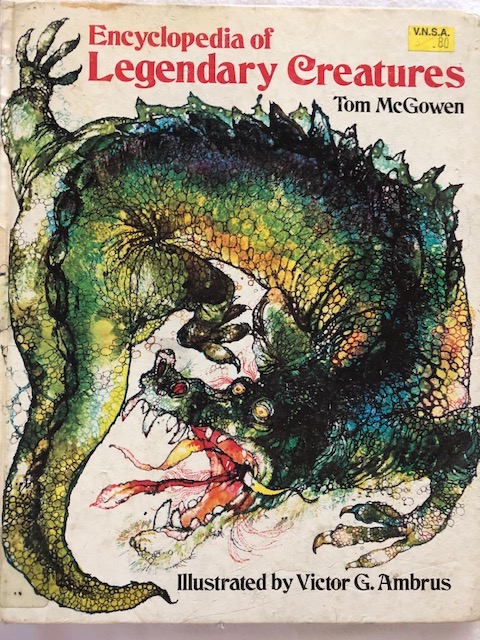
Encyclopedia of Legendary Creatures by Tom McGowen, 1981.

This book is organized into brief encyclopedia-style entries, describing legendary creatures from around the world.  Everything is in alphabetical order, not organized by country or any other over-arching categories.

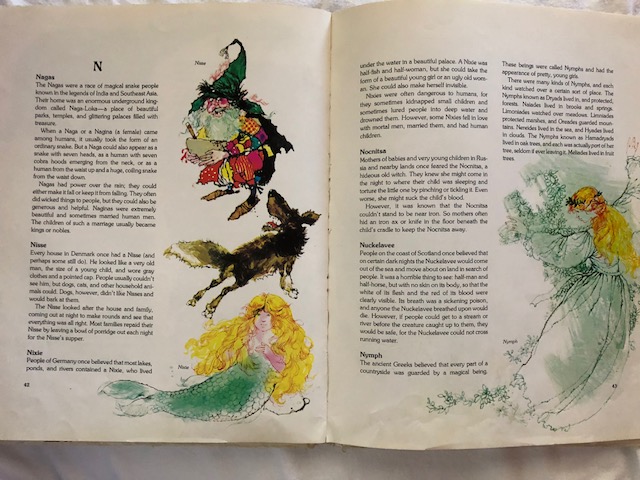
There are two things that I particularly like about this book.  One is that the mythological creatures in the book aren’t just limited to the common ones, like giants, vampires, werewolves, and unicorns (although they each have entries of their own); there are also some lesser-mentioned creatures like the Hulder Folk and the Abatwa People.  The Hulder Folk, who come from Norse folktales, look like ordinary humans, but they have tails like cows.  According to the book, they love to sing and dance, but their songs are always sad, which makes me think of country music.  They also can intermarry with humans, although their marriages are usually unhappy, which also, oddly, makes me think of country music.  The Abatwa People are part of the folklore of the Zulus in South Africa.  They are tiny people, but fierce warriors, and they get offended if people don’t treat them like they are the same size as humans.  (There are also real people in Africa called Abatwa who are pygmies.  The legendary people in this book may be connected to old legends about them, exaggerating their shorter-than-average height.)

LegendaryCreaturesNisse

The other thing that I really like about this book is the pictures.  There are many books about mythology and folklore that don’t have pictures of the creatures, and it really makes a difference being able to see what something looks like (or supposedly looks like, since these are legendary creatures) as well as read a description.

As a side note, there is an episode of the kids’ cartoon show, Arthur, where his friend, Sue Ellen, who isn’t usually frightened by scary stories, hears a strange noise that makes her think about various mythological monsters that she’s heard about in the different countries that she’s visited with her parents.  These unusual monsters, like Baba Yaga, Kappas, and Bashees, which most of her friends haven’t heard about before, do frighten her.  When I saw Kappas described in this book, it reminded me of that.

Blossom Culp and the Sleep of Death

BlossomSleepDeathBlossom Culp and the Sleep of Death by Richard Peck, 1986.

This book starts shortly after the previous book in the series ends.  After Blossom’s old history teacher was run out of town for his scandalous behavior, he was replaced by Miss Fairweather.  Miss Fairweather is a tough, no-nonsense woman who pushes her students to study hard and take history seriously.  Unexpectedly, she comes to appreciate Blossom, an outcast from a poor family, because Blossom demonstrates some knowledge of Ancient Egypt.  Little does Miss Fairweather know that Blossom’s comments in class were inspired by one of the visions that Blossom occasionally gets because of her psychic gifts.

Blossom experiences a visitation from the spirit of an Ancient Egyptian princess who says that she needs Blossom’s help.  Years ago, her mummy and some precious objects were stolen from her tomb.  The princess doesn’t seem to know exactly where her “earthly form” is now, but she’s sure that it’s somewhere nearby.  She’s very concerned because she senses that archaeologists in Egypt are digging to find her tomb and knows that when they finally reach it, they will discover that she isn’t there.  Rather than being concerned about her tomb being violated by the archaeologists, the princess senses that they are searching for her remains in order to venerate them, that if they find her mummy, they will take it to a place of great beauty where it will be treated with the utmost care and respect (a museum).  She wants that and fears that she will miss her chance at the kind of immortality that this form of glorification, care, and study will provide.  So, she asks Blossom to find her earthly remains and inform the searchers of her true whereabouts.  At first, Blossom has no idea how she can accomplish that, but the princess threatens her with a true Egyptian curse if she doesn’t try.

Then, Blossom receives a clue to the mystery in the form of a beautiful Egyptian scarab that her mother found one day while she was out scavenging.  If Blossom can find the place where her mother found the jewel, she can also find the princess’s mummy.  Fortunately, Miss Fairweather has assigned the class special projects about Ancient Egypt, and she is thrilled when Blossom says that she wants to study grave robbers.  Blossom sees this as a good way to collect some extra information about grave robbers that she can use to find the princess’s mummy as well as get a good grade in Miss Fairweather’s class.  It also proves to be an excellent way to draw Alexander Armsworth into her search for the mummy.

Alexander still denies to Blossom that he has real psychic abilities like hers, even after their previous adventures together.  He insists that it was just a phase that they were going through, one that he wants to leave behind.  He’s been busy flirting with Letty, the class snob, and he’s trying hard to get into a prestigious fraternity so that he can give Letty his fraternity pin.  Not only does Blossom think that the boys in the fraternity are a bunch of idiots who do stupid things, but the idea of Alexander giving Letty his pin as a sign of their relationship is just sickening.

Blossom is reluctant to admit her real feelings for Alexander, but the two of them are close in ways that Letty and Alexander never will be because of their shared abilities and adventures, and Blossom has a sense that their futures will be intertwined as well.  Alexander is angry that Blossom is roping her into yet another supernatural escapade, but he has to go along with her project idea because he has already gotten on Miss Fairweather’s bad side and needs to do well on the project to save his grade in class.

Along with the supernatural adventure, there is also a look into the past, the world of 1910s America as well as Ancient Egypt.  First, there are the traditions of stunts associated with Alexander’s initiation into his fraternity and the tradition of giving a girl a fraternity pin as a precursor to engagement (“engaged to be engaged”).  Then, they discover that Miss Fairweather is a suffragette, which is the reason why she left her previous teaching job.  Her feminist ideals cause problems for her in her new, small town when they become known, but with Blossom’s help, she wins over some of the influential women in town as well as a male admirer.

The book is currently available online through Internet Archive.

The Dreadful Future of Blossom Culp

DreadfulFutureBlossomCulpThe Dreadful Future of Blossom Culp by Richard Peck, 1983.

This book is part of the Blossom Culp Series.

It’s 1914, and Blossom Culp is just starting high school. Although the principal of her old school tells her that this is a chance for her to make a fresh start, it looks like Blossom’s future is going to be very much a continuation of her immediate past.  In high school, she’s still a social outcast, looked down on by girls from better-off families, like Letty, the class president.  Also, despite her principal’s assertion that Blossom’s previous forays into the occult were imaginary, the product of the mental confusion that accompanies puberty, and that she is bound to grow out of them, Blossom knows that her psychic abilities are a natural gift and will not be ignored.

Blossom begins high school friendless because Alexander Armsworth has been ignoring her lately because of his important new position as class vice-president, his infatuation with Letty, and his friendship with a couple of local hooligans, Bub and Champ. Alexander is looking forward to his role in planning the school’s Halloween Festival, telling Blossom that he’s over their earlier, childish occult escapades and the Halloween pranks he used to pull.  Meanwhile, all of the other girls in school are infatuated with their handsome history teacher, Mr. Lacy, and so is the girls’ gym teacher, much to Blossom’s disgust.  Blossom thinks that Mr. Lacy is full of himself and denies that she has any such silly crush on Alexander.

Blossom makes an unexpected friend in a girl called Daisy-Rae, a girl from the country who has brought her younger brother into town to attend school and hoped to get an education herself but has been too afraid of the big town to actually attend classes.  Daisy-Rae hides in the school during the day and lives alone with her brother at night in the old chicken coop at the abandoned Leverette house.  It is through Daisy-Rae that she learns that Alexander and his friends aren’t so above childish pranks as they claim to be.  Blossom also discovers that Mr. Lacy has been romancing her old principal.  Mr. Lacy isn’t quite what he appears to be and has some unsavory secrets in his past.

Matters come to a head when Alexander (at Letty’s urging) tries to persuade Blossom to dress up and become the fortune teller for the haunted house that the freshmen class is doing for the Halloween Festival.  The haunted house is also a fundraiser, and Letty figures that they can get extra money from people if they’re willing to pay to have their fortunes told, and who would be better for the job than Blossom?  However, Blossom isn’t one to go out of her way to please others, especially Letty, and it turns out that they’re holding the haunted house in the Old Leverette place.  For some reason, that old house makes Blossom’s mother uneasy.  She seems to think that it’s haunted, but in an unusual way.  Blossom tells Alexander that she will not agree to be their fortune teller until he agrees to check out the house with her before Halloween and find out what’s wrong with it.  She figures that, since both of them are psychic, they can learn what’s so unusual.

As Blossom learns, her abilities don’t confine themselves to the past and people who have died but extend to the future and the people who haven’t yet been born.  Inside the Old Leverette house, Blossom suddenly finds herself entering the distant future, the 1980s.  In the 1980s, the Leverette house is once again lived in, and Blossom meets a boy named Jeremy who is a lonely social outcast, like herself.  Jeremy is a computer nerd, living with his divorced mother.  He takes Blossom on a tour of their town as it is in Blossom’s future, much larger than it used to be and with many familiar landmarks missing.  However, what Blossom sees in the future gives her the inspiration she needs to solve her problems in the past and hope that things will improve.  In return, she also proves to Jeremy that he is far from alone and has had a friend for longer than he ever imagined.

The time travel to the 1980s comes off as being a little corny (or so it seemed to me), but the writing quality of the book is excellent.  The author has an entertaining turn of phrase, and the book, like others in the series, is humorous and a lot of fun to read.

Besides being a kind of fantasy story, there are some interesting tidbits of history in the book, showing how people lived in the 1910s.  Blossom explains about the things she and her classmates did at school, like wearing beanies on their heads to show which year they were (freshmen, future graduating class of 1918).  At one point in the story, Blossom takes Daisy-Rae and her brother to their first movie, a silent film with an episode of The Perils of Pauline serial.  While Blossom worries about the future, readers can get a glimpse of the past!

As for what Blossom learns about her own future, she avoids finding out too much because she’d rather not know the details.  However, there are implications that she and Alexander may eventually marry and live in his family’s old house.

The book is currently available online through Internet Archive.

The Ghost Belonged to Me

GhostBelongedToMe

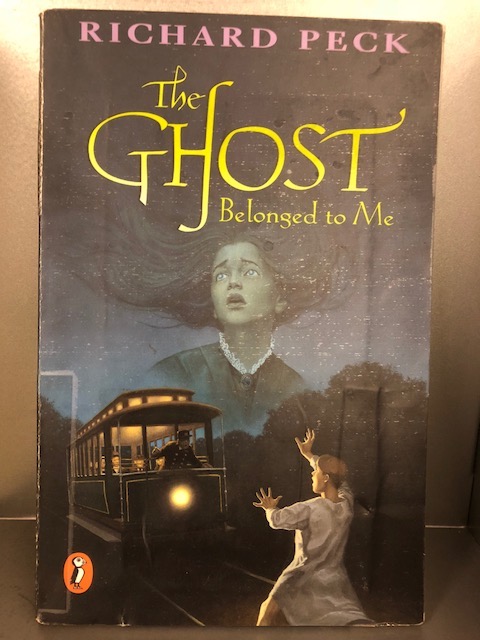
The Ghost Belonged to Me by Richard Peck, 1975.

The book takes place in the 1910s in a small town on the Mississippi River. Alexander Armsworth, a boy in his early teens, is approached by a girl from his class who tells him that the barn on his family’s property is haunted and that Alexander himself has the ability to see the “Unseen.” The girl, Blossom Culp, is a poor girl from a family of outcasts who has been known to tell tall tales, so Alexander isn’t sure he believes her at first. However, he can’t help but be curious, and when he sees a light coming from the barn at night, he decides to investigate.

Inside, he finds the ghost of a young girl who warns him of danger on the trolley tracks near his house and tells him that he must act fast to save everyone. Frightened, Alexander gets the trolley to stop and learns that by doing so, he has saved the lives of everyone on board from a disaster at the bridge further on. Naturally, everyone wants to know how Alexander knew to warn them. When Alexander explains, he is met with skepticism from his social-climbing mother and sister and unwelcome attention from news people and curiosity-seekers from town.

The ghost, who tells Alexander that her name is Inez Dumaine, is also in need of help before she can rest peacefully. Alexander will need the help of those who believe in him and the ghost to find Inez’s body and return it to her home in New Orleans.

In this first book in of the Blossom Culp series, Alexander is the main character, but the other books focus more on Blossom, who discovers that she also has the ability to see ghosts.  The book is available to borrow and read for free online through Internet Archive.

This is the movie that the Disney movie Child of Glass was based on, and the movie is available on dvd. Sometimes, you can also find it on YouTube, at least clips and reviews of it.

My Reaction

The story has sad and scary points, but those are balanced out by humorous situations. Alexander’s sister’s turmoil over the fiasco at her coming-out party is hilarious, and his mother’s change in attitude when she realizes that, instead of making them social outcasts, the ghost business actually attracts attention from one of the town’s leading citizens is a hoot. Blossom, of course, is wonderfully nosy, elbowing her way into Alexander’s life and selling tours of the haunted barn.

I was very young when I saw the Disney movie based on this book, Child of Glass (a live action movie that aired on television), and I was afraid of ghosts. However, years later, I took another look at the movie and decided to read the book that it was based on. When I did, I saw things I didn’t appreciate when I was young. The dialog and depiction of life in the early 20th century in the book are wonderful. It conjured up memories of Meet Me in St. Louis, especially the Halloween scene (which took place only about a decade earlier than this story). Unfortunately, this early 20th century setting wasn’t present in the movie version of this book because Child of Glass was placed contemporary with the time it was made, during the late 20th century.

The Disney movie was also different from the original book because it added the feature of the “child of glass” which didn’t exist in the original book. The “child of glass” was mentioned in a poem at Inez’s grave that explained how to lay her ghost to rest. At first, the Alexander and Blossom in the movie don’t know what it means, but it turns out to be Inez’s doll, which was lost when she was murdered by her wicked uncle. In the book, Inez died under different circumstances. However, the discovery of the doll in the movie uncovers the secret motive behind her murder, which is similar to the reason why Inez’s body was hidden in the book after she died in a riverboat accident.  In the book, Inez’s spirit finds rest after her body is found and taken to her family’s cemetery in New Orleans.  The Disney movie also turns this story specifically into a Halloween story, which wasn’t the case in the original book.

Who’s Haunting the Eighth Grade?

Junior High Series

JHHaunting

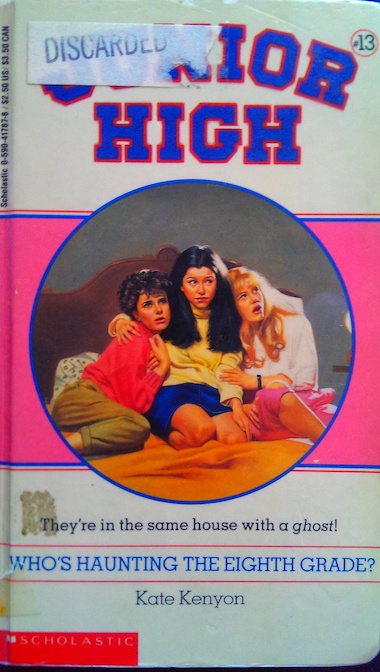
#13 Who’s Haunting the Eighth Grade? by Kate Kenyon, 1988.

A group of eighth graders are going on a field trip to see a Shakespeare play in another town, but right from the start, everything seems to be going wrong. The teachers who are accompanying them on their trip are in a foul mood and spend a good part of the trip arguing with each other, which bothers the kids because they know that the teachers have recently become engaged to each other. Then, the bus breaks down in a small town before they can reach their destination.  The entire class is going to have to spend the night somewhere in the small town.

At first, things look like they’re going to improve when the group decides to spend the night at a local bed and breakfast in a big, beautiful, old house. However, their spirits are almost immediately dampened again when they are told that the house is haunted and that anyone who tries to stay there is scared away by the ghost. Still, they proceed with their plan to stay there in order to avoid staying at the dumpy local motel, the only other choice of accommodation.

Needless to say, before the night is over, the ghost puts in an appearance, and strange things start to happen.  By then, the students have come to feel sorry for the owner of the bed and breakfast, a nice older lady who grew up in the house but can’t really afford to keep it unless she can make her inn a success. Can the eighth graders catch the ghost, stop the hauntings, save the bed and breakfast from having to close, patch up the relationship between their feuding teachers, and still make it in time to see the play?

The book takes place in the 1980s, and the kids in the story are 14 years old. They mention the decade somewhere during the course of the story, and the descriptions of the clothes and some pop culture references make the time period fairly obvious. It also has some of the stock characters that books for pre-teens and early teens in the 80s have (ex. a boy-crazy space cadet, a level-headed health nut, a class clown, and a couple of young punks). Still, even though there are some things about the book that are a bit dated, it is still pretty enjoyable. The author has a sense of humor, and she plays with the characters’ stereotypes a bit. The class clown is secretly quite sensitive and even a bit perceptive. There are also a couple of fun scenes when the girl who is only interested in boys is shocked to discover that the boys are more interested in the mystery than in her.

Heckedy Peg

HeckedyPeg

Heckedy Peg by Audrey Wood, 1987.

A mother leaves her seven children, all named after days of the week, alone at home while she goes to the market.  Before she leaves, each of the children asks her for something special, and the mother warns them not to let strangers in or touch the fire.

However, while she is gone, a witch, Heckedy Peg, comes to the house and asks the children to light her pipe for her, offering them a sack of gold in return.  At the sight of the gold, the children let her in, and she turns each of the children into a different kind of food, which she takes back to her hut in the woods.

HeckedyPegChallenge

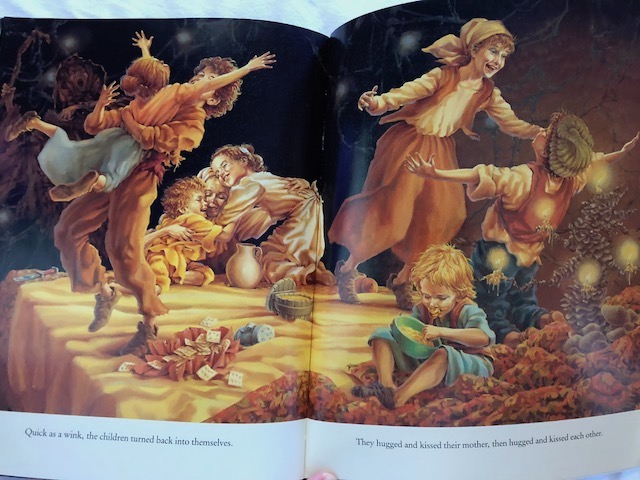
When the mother returns home and discovers that the witch has taken her children, she goes into the woods to get them back.  Heckedy Peg says that the mother can reclaim her children if she can determine which type of food on her table is which child.  At first, the mother doesn’t know what to do, but then she realizes that the things her children wanted from the market are the clues to determine their identities.

The book is currently available online through Internet Archive.

HeckedyPegAnswers

My Reaction

The pictures in the book are wonderful, but the most interesting part for me is in the note on the back, which explains that the story is based on a 16th century game that children still play which involves guessing the identities of children within a certain category of things.

I wouldn’t recommend the book for very young children because the way the children in the story were turned into food might be frightening.  Also, when the mother goes to the witch’s hut the witch refuses to let her in until she cuts off her feet, which she only pretends to do, but the idea is a little disturbing.  The part about cutting off the feet is a reference to part of the original game.

HeckedyPegCelebrate

Monster Manners

MonsterManners

Monster Manners by Joanna Cole, 1985.

Rosie Monster’s parents worry about her because she just can’t seem to understand how monsters are supposed to behave. Monsters are supposed to be fearsome. They’re supposed to growl, fight, and break things. Rosie is just the opposite. She’s endlessly polite and sweet.

MonsterMannersRosie

Rosie’s friend Prunella tries to teach her real monster manners, but no matter what, Rosie just can’t stop being polite.

MonsterMannersPrunella

It wouldn’t be such a problem for Rosie, except that she knows that her family and friends are disappointed in her.

MonsterMannersDisappointment

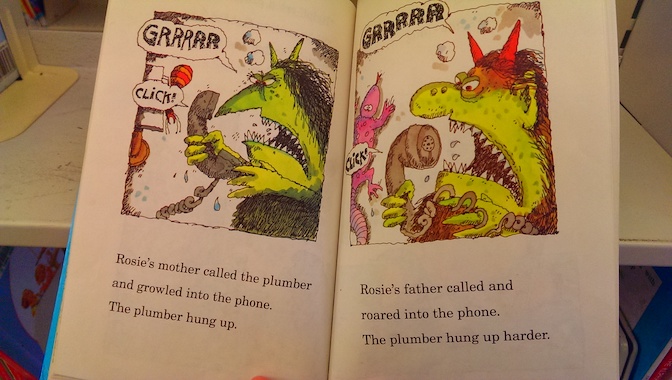
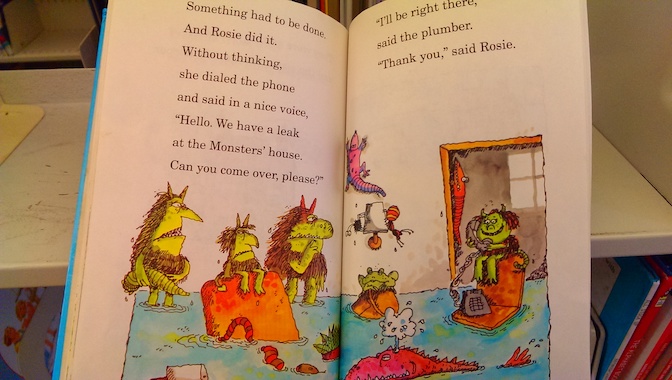
Then, a water pipe breaks at Rosie’s house. Although her parents, and even Prunella, try calling a plumber, they can’t get him to come to the house and help them no matter how loudly they growl into the phone.

MonsterMannersGrowling.jpg

It takes Rosie’s politeness to get the message across and get the help they need!

MonsterMannersPhone

A friend of mine who works in customer service wishes that more callers would be polite or, failing that, that he could just hang up like the plumber in the story.  Trying to help people who are determined to make the process of helping them harder than it has to be and who will curse and insult you for even trying is a frustrating experience.

The book is currently available online through Internet Archive.

Molly Saves the Day

MollySummer

Molly Saves the Day by Valerie Tripp, 1988.
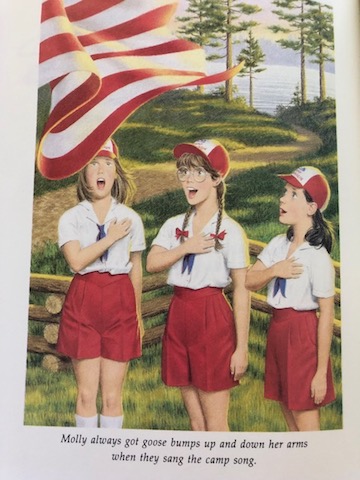
MollySummerCampMolly and her friends, Linda and Susan, are attending Camp Gowonagin over the summer.  They love summer camp because there are so many fun things to do, like nature hikes, archery, arts and crafts, and campfire sing alongs.  The only thing Molly doesn’t like is swimming underwater, although she’s embarrassed to admit it.  Susan has trouble with canoeing because she doesn’t know how to keep her canoe moving straight.  Other than that, all three girls have fun at camp and as their time at camp is coming to an end, they think about how much they’ll miss it.

Then, the counselors announce a special event for the end of camp: The Color War.  At Camp Gowonagin, the Color War is like a giant game of Capture the Flag.  The girls are randomly assigned to two teams, Red and Blue.  The Red Team will be guarding their flag on a small island in the lake near camp.  The Blue Team’s job will be to try to steal the flag from the Red Team.  The contest will take place over the course of an entire day.

MollySummerPlanMolly and Susan end up on the Blue Team, while Linda is assigned to the Red Team.  Molly and Susan aren’t really looking forward to the Color War because their team captain will be Dorinda, a bossy, competitive girl who likes to act like she’s the general of an army and this camp game is a real war.  Molly is uneasy about what Dorinda will order them to do, afraid that it might involve the thing she dreads most, swimming underwater.  The only comfort Molly takes is what her father told her before he went away to war, that being scared is okay because it gives a person a chance to be brave.

As it turns out, Dorinda’s strategy is very simplistic.  She wants the entire Blue Team to row out to the island, landing directly on the beach.  Then, while her army takes the Red Team prisoner, she will triumphantly capture the flag.  Molly says that she thinks that the Red Team will spot them easily if land on the beach and asks if there is a less obvious place where they could land.  However, Dorinda simply says that there is no less obvious place and taunts Molly about whether she would rather swim there underwater.  Molly and Susan have no choice but to follow Dorinda’s orders.

MollySummerRetreatOf course, Dorinda’s plan doesn’t work out as she thought.  The Red Team’s scout spots them right away and takes most of the Blue Team prisoner.  Only Molly and Susan are left free because Susan accidentally overturned their canoe on the way to the island.  After they manage to get back into their canoe and bail it out, they try to approach the beach, but Linda spots them and signals to the rest of the Red Team.  Molly and Susan have no choice but to return to camp to avoid capture.

Back at camp, the two of them have to decide what to do.  They are vastly outnumbered by the Red Team, and they feel betrayed by Susan treating them as her enemies.  Molly does think up a plan for freeing the rest of the Blue Team, but to carry it out, she must face what she fears the most . . . and force Linda to face something that frightens her.

MollySummerEscapeMolly and Susan (and the rest of the Blue Team, once they’re free) manage to snatch victory from the jaws of defeat, but they worry that perhaps their friendship with Linda is ruined because of the trick they play on her.  Fortunately, Linda decides to take it in the spirit of the game and shows sympathy for the girls when it turns out that their victory plan ends with the entire Blue Team getting poison ivy.

I’m with Molly and Susan in not liking overly competitive games and people, but I thought that the book handled this situation well, focusing on how the girls each had to face something that was difficult for them in order to do their jobs for their respective teams.  It was a learning experience for all of them, and part of what they learned was that facing what worried them the most wasn’t as bad as they thought it would be.

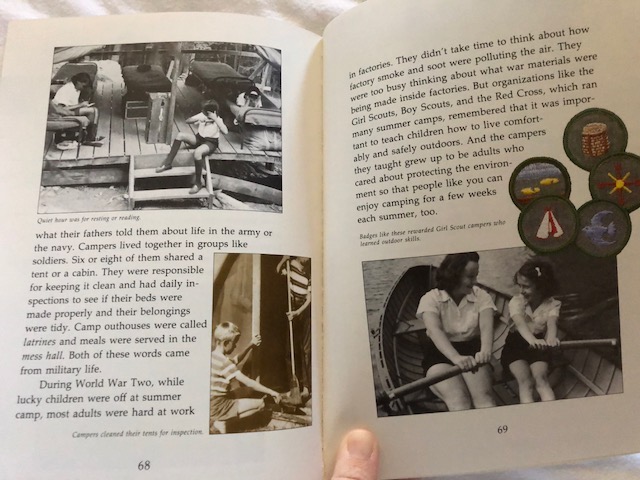
In the back of the book, there is a section of historical information about summer camps during World War II.  Because many families were separated by the war and people were discouraged from traveling much in order to save fuel and space on trains, children were often sent away to summer camps by themselves instead of going on family vacations.  The camps could be run by different organizations, such as the Girls Scouts, the Boy Scouts, or the Red Cross.  There, they would learn wilderness skills, like how to identify different plants, how to swim, and how to build a campfire.  They also had lots of fun activities, like horseback riding and arts and crafts.

The book is currently available online through Internet Archive.
MollySummerHistory

Molly Learns a Lesson

MollyLesson

Molly Learns a Lesson by Valerie Tripp, 1986.

MollyLessonHideoutIn 1944, everyone is concerned with finding ways to help the war effort.  In Molly’s third grade class at school, her teacher announces that their class is invited to participate in the Lend-a-Hand contest.  The class will be divided in half, and each half will compete against the other to find the best way to help the war effort.  The class decides to make the contest boys against girls, and Molly immediately starts trying to figure out a spectacular idea that will impress everyone.  Unfortunately, one of the other girls says that the girls in class should knit socks for soldiers, and the teacher accepts that as the goal for the girls’ team, before Molly can say anything.

MollyLessonCollectingMolly is appalled at the idea of knitting socks.  It’s partly that she had wanted to be the one to come up with the best idea, and it’s also partly because she has tried knitting before, and she knows that socks are difficult, time-consuming projects, especially for beginning knitters.  Molly is sure that the other girls are going to find it too difficult and that, in the end, they’ll have nothing to show for their project.  Her friend Susan doesn’t think that the project sounds so bad, but Linda also dreads the idea of knitting because she’s not very good at it.  Talking it over in their secret hideout in the storage area of Molly’s garage, the three girls decide that they’ll work on a secret project by themselves, something that will save the day when the other girls’ project falls through.

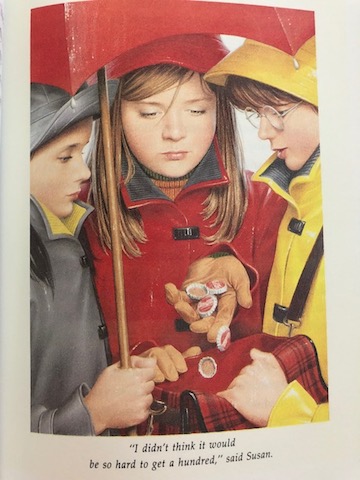
At first, the idea of doing something in secret sounds exciting.  However, coming up with a good secret project and seeing it through turn out to be more difficult than they expected.  All they can think of to do is to collect bottle tops for scrap metal, and as they go door to door in the rain, asking for them, they learn that most people have already given theirs to the Boy Scouts who were collecting scrap metal.  Tired, wet, and discouraged, the Molly and her friends decide to look in on the other girls and see what progress they’re making.

MollyLessonBlanketThe other girls are certainly a lot more comfortable, knitting inside.  However, as Molly predicted, they are finding their project harder than they thought it would be.  None of them has completed an entire sock yet; all they really have are the square shapes at the top of the sock, and they’re getting discouraged.  That’s when Molly gets a better idea: why not take the squares they’ve made and turn them into a blanket?  Simple squares are much easier to make than socks, they can make a lot of them quickly with everyone helping, and the girls who can’t knit well can sew the squares together.  A blanket is still a good war effort project because Molly’s father has told her that the hospital where he works is always in need of blankets for the wounded soldiers.  With this new idea, the other girls become much more excited, and they make more progress.

The theme of this story is that working together and sharing ideas benefits everyone more than working alone or trying to be too competitive.  Molly’s first ideas weren’t very good by themselves, and neither was the sock-knitting idea.  However, when Molly and her friends join the other girls, Molly finds a way to help them build on the idea that they already had (knitting) and take it in a better direction.  Molly and her friends also explain to the other girls about the bottle tops they were trying to collect, and some of them think of other places where Molly and her friends didn’t go for their collecting.  All of the girls working together manage to finish the blanket and collect 100 bottle tops in a single day, surprising and pleasing their teacher.

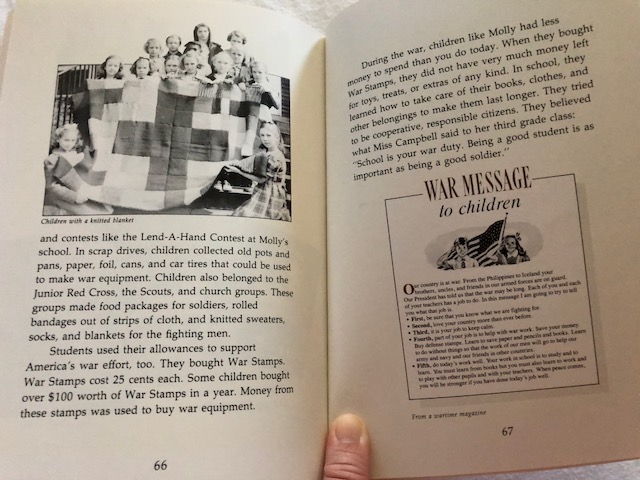
In the back of the book, there is a section with historical information about what it was like to go to school in America during World War II.  Discipline was more strict than it was in schools during the late 20th century, and there was also more separation between boys and girls.  Sometimes, boys and girls going to the same school and attending the same classes played on completely separate playgrounds, and sometimes, they even had to enter and exit the school through different doors (this is something that was also mentioned in the book Cheaper By the Dozen, which takes place during the late 1910s/early 1920s).  Teachers emphasized patriotism and taught the children about the war, why soldiers were fighting, and what life was like in other countries that were involved in the war.  It was common for schools to have drives to collect scrap metal or other materials to help the war effort.  Special projects like knitting clothing or blankets for soldiers were also popular.

The book is currently available online through Internet Archive.
MollyLessonHistory

Meet Molly

Molly, An American Girl

MeetMolly

Meet Molly by Valerie Tripp, 1986.

MeetMollyThreatMolly McIntire misses her father, who is a doctor stationed in England during World War II.  Things haven’t been the same in her family since he left.  Treats are more rare because of the sugar rationing, and she now has to eat yucky vegetables from her family’s victory garden all the time, under the watchful eyes of the family’s housekeeper.  Her mother, while generally understanding, is frequently occupied with her work with the Red Cross.  Molly’s older sister, Jill, tries to act grown-up, and Molly thinks that her brothers are pests, especially Ricky, who is fond of teasing.  However, when Molly and her friends tease Ricky about his crush on a friend of Jill’s, it touches off a war of practical jokes in their house.

MeetMollyHalloweenTrickHalloween is coming, and she wants to come up with great costume ideas for herself and her two best friends, Linda and Susan.  Her first thought is that she’d like to be Cinderella, but her friends are understandably reluctant to be the “ugly” stepsisters, and Molly has to admit that she wouldn’t really like that role, either.  Also, Molly doesn’t have a fancy dress, and her mother is too busy to make one and also doesn’t think that they should waste rationed cloth on costumes.  Instead, she suggests that the girls make grass skirts out of paper and go as hula dancers.  The girls like the idea, but Halloween doesn’t go as planned.
Everyone loves the girls’ costumes, and they collect a good number of treats in spite of the war rationing, but Ricky takes his revenge for their earlier teasing by spraying them with water and ruining their costumes and all of their treats.  When the girls get home, and Mrs. McIntire finds out what happened, she punishes Ricky by making him give the girls the treats that he’s collected, except for one, which she allows him to keep.  However, to the girls, this seems like light punishment, and they’re offended that he got off so lightly.

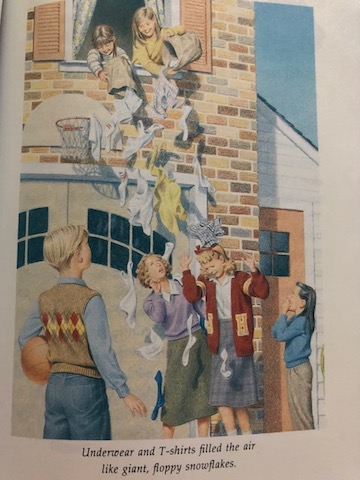
MeetMollyRevengeBecause he laughed at the girls, saying that he could see their underwear after he sprayed them with water and ruined their skirts, the girls decide to play a trick that will give Ricky his just desserts.  The next time that Jill’s friend comes to visit, the girls arrange to have Jill and her friend standing underneath Ricky’s bedroom window when they start throwing all of his underwear out the window, right in front of Ricky.  Ricky screams at the girls that “this is war!” just as their mother arrives home.

Their mother makes it clear that war is a serious thing, not a joke.  There is a real war on, and their childish pranks are wasting time and resources (like the food that Ricky ruined on Halloween – sugar is rationed, and some of their neighbors had gone to a lot of trouble to save their rations to give the kids a few treats).  She also points out that this is how real wars start, with “meanness, anger, and revenge.”  Faced with the reality of what they were doing, Molly and Ricky apologize to each other and clean up the messes that they each made under their mother’s direction.

In the back of the book, there is a section of historical information about what life was like for civilians in America during World War II.  People with relatives overseas worried about them, but people in service had to be careful about what they said in letters home, in case those letters were intercepted by enemy forces.  Some of the luxury goods that people were accustomed to having became more scarce, although the rationing wasn’t as bad in the United States as it was in Europe (this is covered more in a later book in the series) because certain types of materials had to be saved for the war effort (like the metals used to make cans for food, which is why victory gardens were important) and because factories that ordinarily made civilian goods were converted to make equipment for the armed forces.  For example, they mention that car factories were making things like tanks and airplanes and clothing factories were making tents and uniforms.  People referred to the efforts that civilians were making to save needed materials for the war as “fighting on the home front,” reminding themselves and others that the small sacrifices that they made each day, like driving their cars less to save gas or raising food for their families, helped to make a big difference for a larger cause.

The book is currently available online through Internet Archive.