 Kathleen: The Celtic Knot by Siobhan Parkinson, 2003.
Twelve-year-old Kathleen lives with her family in Dublin, Ireland in 1937. Like the rest of the world, Ireland is suffering under the Great Depression, and Kathleen’s father has been having trouble finding work. Her mother helps to support the family by working as a midwife.
One day, when Kathleen’s mother is off delivering a baby, Kathleen accidentally burns the porridge at breakfast, making her and her sisters late for school. Although they should have been marked as being on time, they are considered one minute late because the nun’s watch was fast. Discipline is harsh at the Catholic school they attend, and after a harsh lecture to Kathleen, the headmistress, Mother Rosario, calls for a conference with her mother. Kathleen is very upset about it, but Mother Rosario softens somewhat and says that she merely wants to see that everything is alright with Kathleen’s family because a nice girl like her shouldn’t be acting up. Kathleen still worries because she knows that the nuns look down on poor families like theirs and consider their authority higher than the parents of the children they teach. They are often unaware of the circumstances that families live in.
However, Kathleen’s mother isn’t fazed by the nuns’ attitude and is blunt with the Mother Rosario, telling it like it is. The headmistress does show that she has some compassion and is somewhat aware of their circumstances because she says that Kathleen’s lateness was only part of the reason she wanted this meeting. She has guessed that Kathleen’s father is looking for work, and there is a position for an assistant gardener open at the school. It doesn’t pay much, and it’s not as good as her father’s old job was before the factory where he worked closed, but he agrees to take it because it’s better than nothing.
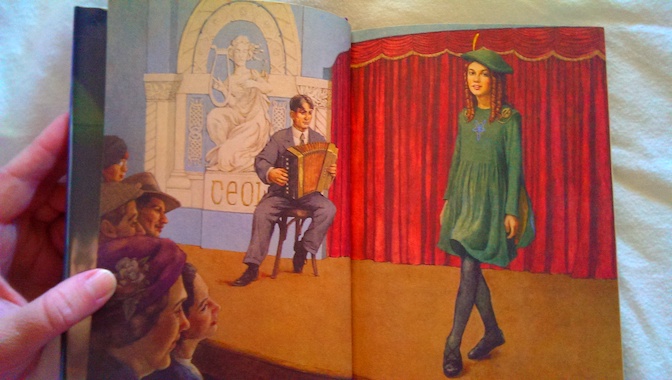
The headmistress also says that she has noticed that Kathleen is musically-talented. She likes to sing and has a good voice. Mother Rosario thinks it would be a good idea for her to take piano or dance lessons. The family doesn’t have a piano, so the headmistress suggest that Kathleen join the Irish dancing lessons because it’s a wholesome activity that reflects her heritage and that would keep her out of trouble. Kathleen’s mother isn’t big on heritage, but she agrees that dancing might be a good activity for Kathleen.
Kathleen isn’t happy about the dance lessons at first because the other girls who are involved are snobs. But, once she tries it, she realizes that she actually loves dancing. The problem is that the lessons aren’t free, like the other girls told her. At first, Kathleen feels cheated, finding out that she loves something that she can’t have after all, but her teacher says that she’s talented, so she offers Kathleen some free lessons anyway. She’s been looking for new talent so that her dancers can do well in the next dancing competition, and she doesn’t want to let a promising dancer like Kathleen slip through her fingers.
The snobby girls in class are all the more irritated when Kathleen is among those chosen to enter the next competition, but everyone also knows that there is one more obstacle for Kathleen: she doesn’t have a proper dancing costume or any money to buy one. She prays for one, even promising God that she’d become a nun if he gives her the costume she wants. Her mother has her eye on some beautiful cloth that she hopes to buy as a remnant, but the cloth gets snapped up by some of the wealthier, snobby girls, and her mother comes down with a serious illness shortly before the competition.
Kathleen begins to think that she was wicked for being so concerned about dancing and costumes when there are much more serious things in life. However, her aunt, Polly, understands how she feels and comes up with a plan to make the needed costume for Kathleen, using her favorite book, Gone With the Wind, as inspiration. Remember what Scarlett O’Hara did when she needed a new dress and couldn’t afford one?
One of the themes that runs through the story is questions and answers. Kathleen has a lot of questions about life. She knows that her mother deliveries babies for money, but she doesn’t really understand much about it, and her mother doesn’t answer the questions she asks. In fact, Kathleen notices that most of the adults she knows (with the exception of her father) brush aside her questions about the way the way the world works or the things people do because they simply don’t want to be bothered with them. They have too many concerns of their own, and they don’t really know most of the answers themselves. It kind of contrasts with the answers that Mother Rosario demands from Kathleen and immediately dismisses upon getting. Most of the time, she doesn’t really want to bother with answering questions or even dealing with the answers to questions she’s just asked. Only once does she answer a question that Kathleen had asked about St. Patrick, and Kathleen is astonished at getting an answer about something.
I have to admit that the attitudes about questions and answers from most of the adults in the story really irritated me, especially the way Mother Rosario demanded answers from Kathleen about her lateness and then dismissed everything that Kathleen said, angry that she had “answers.” I’ve met people like that before in real life, and they’re just as illogical and crazy-making as this headmistress. I’m not talking about teachers who refuse to listen to flimsy excuses like “the dog ate my homework,” but people who get angry at others who have real explanations just because they have real explanations. People who demand to know the reasons why things happen and then immediately reject any explanation offered without a real reason for doing so are obnoxious. I’ve encountered people like that before, and it’s hard to have anything resembling a meaningful conversation with them. They don’t want to talk to you; they just want to yell or lecture at you. They don’t really care what the answers or explanations are for anything, and no answer would make any difference to them because what they really want is for the other person to just feel bad. It’s an unethical one-upmanship tactic, and it loses my respect the moment I hear someone use it because I recognize what they’re attempting to do. It’s so obvious, but frustrating at the same time (Kathleen in the story wonders why Mother Rosario is trying to torture her in this way) because there’s nothing you can say to stop the other person once they start (at least, I haven’t figured it out). Kathleen’s approach was probably the most effective. She just stopped talking and prepared herself for the headmistress to hit her, which caused the headmistress to wake up a bit to the fact that the message that she was sending to Kathleen was that her only intentions were to hurt her. Fortunately, those were not her only intentions, but I have to admit that I never really had any respect for Mother Rosario after that, in spite of what she did to help Kathleen’s family. You can tell this is one of my pet peeves. One-upmanship really bothers me in all of its forms, and I have even less time for that kind of nonsense than these characters do for answering a twelve-year-old’s questions. At least you can talk to a twelve-year-old. Getting back to that, part of Kathleen’s trouble with some of her questions is that her elders often underestimate her, thinking that she’s really too young to understand anything, but the fact that she’s asking questions says that she’s really not. In fact, she might even be putting more thought into some issues than the people who have decided that some things aren’t worth thinking about in the first place.
Another theme of the story is growing up and changing goals in life. By discovering her talent as a dancer, Kathleen has found something that she would like to dedicate her life to, and if she becomes a dance teacher herself, it would give her a job to do in her future that could make her life better. Her aunt, Polly, who is twenty years old, also changes her mind about what she wants in life. As a single young woman, she likes to go out and have fun with her small earnings, hoping to meet a man as elegant as Rhett Butler. However, when her latest young man turns out to be a cad, she accepts a proposal from the very shy but much nicer young man who she had previous thought wasn’t handsome enough. Polly’s experiences make her realize that handsomeness by itself isn’t much, and she and her new husband have plans for building a life together. At first, Kathleen is disappointed because she and Polly had talked about leading a carefree life together as single ladies when Kathleen was grown, but Polly explains to her that things will be better this way and that grown-ups have to build real lives for themselves, not live on dreams alone. Kathleen is still in the process of discovering the possibilities that life might hold for her and the talents that she can use to build her life.
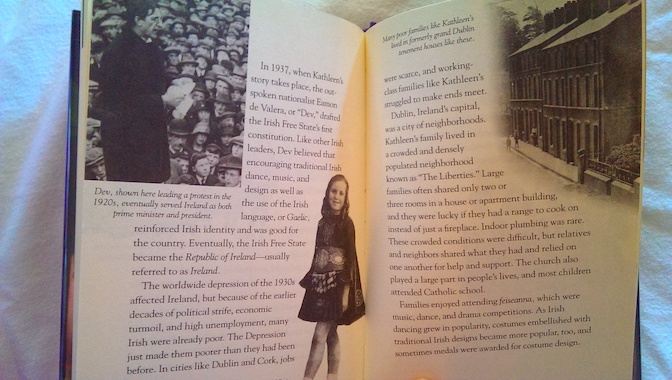
I also found the parts about Irish history and politics during 1930s interesting. One of the reasons why Kathleen’s family isn’t big on the Irish heritage movement is because her grandfather fought during World War I and wasn’t treated well as a veteran when he returned. During the meeting with Mother Rosario, Kathleen’s mother is blunt about her views on things, and Mother Rosario is surprised how much she understands of politics, showing that she looks down on poor people (possibly the source of her general rudeness and bullying tactics, even when she’s trying to be helpful – she’s decided that she’s superior and will remain so, whether she’s right or wrong), thinking that they aren’t smart enough to understand what’s going on around them. The story makes it clear that the nuns at school are often out of touch with what ordinary families go through in their daily lives. They underestimate what people know or read about, they have trouble understanding their daily struggles with money and how they are barely able to keep food on the table, and they seem unable to grasp what it’s like to be part of a family where any family member’s actions can affect all of the others. For me, they were far more aggravating than the snobby little girl characters because I usually expect adults of a certain age to have grown out of some of these behaviors.
While reading the story, I was kind of comparing Kathleen’s circumstances in Ireland in the 1930s to life in America during the Great Depression, and many of their struggles were the same. I was also kind of fascinated by Polly’s fascination with Gone With the Wind because it shows how pieces of culture and entertainment could become popular in other countries during this time.
This book is part of a series by the same publishers of the American Girls Books. There is a section in the back of the book with historical information about the period.
 A Clue in Code by Marilyn Singer, 1985.
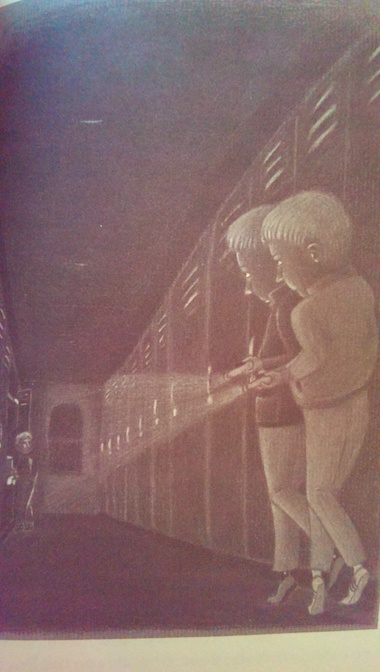 Sam and Dave decide to begin their investigation with Willie. His father is the school’s custodian, and Willie has been using a copy of his father’s key to the school to sneak around after hours. To the twins’ surprise, when they confront Willie, not only does Willie deny stealing the money, but it turns out that he’s actually been scared and upset himself. After being caught stealing the last time, his parents have been especially strict with him, sending him to bed early, limiting his time with friends, and not allowing him to watch tv or read comic books. In fact, his father tried to get rid of his entire collection of comic books by throwing them in the trash, but Willie rescued them and has been hiding them in the school, sneaking away to read them when he can. However, someone has discovered them and stolen them. Willie wants his comic books back, but he can’t report them stolen because his father thinks that they’re already gone. Worse still, his parents will be even harder on him if he ends up taking the blame for stealing the class’s trip money.
 In spite of Willie’s reputation, which he deserves, Sam and Dave think that he’s telling the truth about the thefts. Then, they happen to find a strange message that appears to be written in code after some of their classmates were throwing paper airplanes. With the help of Rita, a friend who is very good with codes, they decode the message and uncover a valuable clue that explains why the comic books were taken and leads them to the thief’s identity.
 Top Secret by John Reynolds Gardiner, 1984.
 Allen is angry that Miss Green didn’t take him seriously, and lipstick is the last thing that he’s interested in. His parents think that he should just do the lipstick project and forget about it. Even if human photosynthesis were possible, how could a nine-year-old possibly achieve such a thing? Real discoveries are made by important men, not little boys. However, Allen’s grandfather encourages him to persevere in what he wants. He says that Allen has everything that a important man would have: five good senses and a brain that he can use to think. Allen’s grandfather often thinks about strange things himself, and he encourages Allen to think all the time.
 Although Allen acts like he’s carrying out the lipstick project, with his parents’ help, he continues studying photosynthesis on the side. When Allen gets stuck on what to do next, his grandfather advises him to “think crazy,” to just let his mind explore possibilities and see what it comes up with.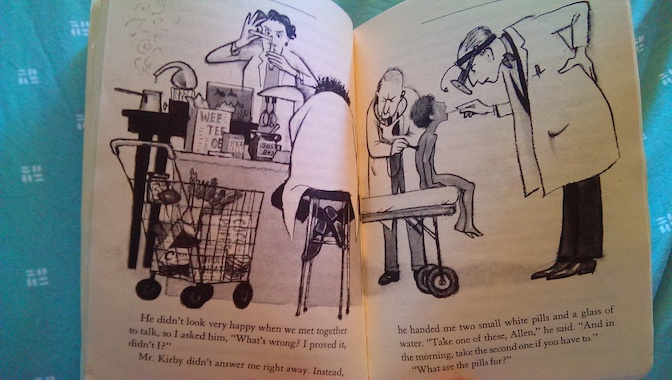
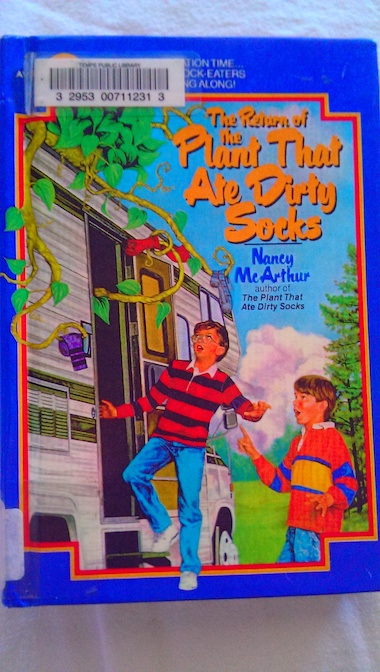 The Return of the Plant That Ate Dirty Socks by Nancy McArthur, 1990.
 The Plant That Ate Dirty Socks by Nancy McArthur, 1988.











 General Butterfingers by John Reynolds Gardiner, 1986.
 Mrs. Wilson and Walter talk to a lawyer, but he says that, since the General apparently didn’t leave a will, the estate has to go to his nearest relative, which is Ralph. As far as he’s concerned, there’s nothing they can do about, even though the General made a verbal promise to the men that they could stay in his house for the rest of their lives.
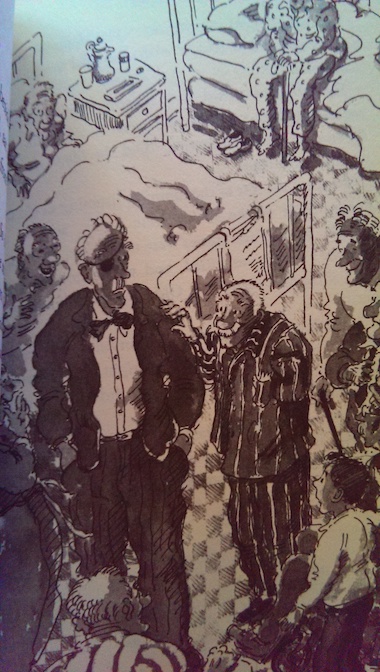 In some ways, you could feel sorry for Ralph, who is a very unhappy person. Because of his meanness and selfishness, his father spent years giving him pretty much anything that he wanted on the condition that he not come around to see him. Ralph is hurt at his family’s avoidance and disdain for him, which is why Walter, at one point, invites him to come for dinner and be their friend. However, Ralph’s motives are always selfish, and that causes him to suspect that the same is true of everyone, so he refuses their kindness. It gives the impression that he’s probably done the same for many others over the years, for the same reasons.
 Jestress's Forgotten Books and Stories