Ruth Fielding at Lighthouse Point

Ruth Fielding

Ruth Fielding at Lighthouse Point or Nita, the Girl Castaway by Alice B. Emerson (the Stratemeyer Syndicate), 1913.

When this story begins, Ruth’s friend Helen is finally being initiated into the society that Ruth and some of their friends founded at their boarding school, Briarwood Hall. In the second book of the Ruth Fielding series, when the girls started attending Briarwood, they found themselves caught between two rival social groups. One of them had the reputation for being led too much by the school faculty instead of the students themselves. Ruth, Helen, and some of the other girls craved more independence from the teachers. However, the other main social group, which was more student-led, was led by a sly bully of a girl named Mary Cox. That group had basically turned into a cult of personality centered around Mary Cox, where everyone else had to do whatever she said. The initiation into Mary Cox’s group was a mean trick, and Mary Cox, known as “the Fox” to many girls at school because of her slyness, used bullying tactics to dominate the other girls.

For awhile, Helen was a member of Mary Cox’s group, finding it exciting, but Mary Cox took exception to Ruth very soon after they first met because Ruth is more independent-minded and not easily led or intimidated by Mary. Although Ruth was one of the new girls at school and one of the youngest, she decided to assert her independence and create a new society without some of the problems that plagued the older ones. She found other interested girls who felt the same way she did, and they soon attracted more members who were similarly tired of the old groups. Ruth’s group is called the Sweetbriars, or S.B.s for short, although Ruth frequently reminds people that the group is not hers exclusively. To avoid the problem with Mary’s group, having everything monopolized by one person, Ruth established in the rules that leadership of the Sweetbriars will rotate, with no member serving as the club president for more than one year. That way, no one will have total control, and there will be opportunities for new people with fresh ideas to get more involved.

Helen, who eventually figured out what kind of person Mary was, stuck with her group for awhile anyway, out of loyalty to the membership, but since then, Mary’s group has fallen apart. Helen was one of the last to leave it, but Mary is still resentful that many of her old members have joined the Sweetbriars, including Helen.

Shortly after Helen’s initiation, Ruth and her friends are talking about taking a summer trip to a friend’s beach house. They started talking about their summer plans over the winter break, and now, they’re making the final arrangements. Mary, still looking for ways to cause trouble for Ruth and the Sweetbriars and regain her social dominance, tells Helen that the only reason she’s being invited to the beach house is because she’s now a Sweetbriar, implying that the other girls wouldn’t have wanted her around if she hadn’t joined their club. Frankly, Helen is a bit of a sucker and falls for Mary’s manipulation. She confronts the other girls about what Mary said.

The other girls all remind her that, first of all, they started planning this trip well before her initiation. Second, they are inviting people who aren’t part of the Sweetbriars. They’ve invited Madge, who is the student leader of the faculty-led social club, and she’s coming. They’ve also invited some boys, brothers of girls at the school and their friends, who attend the nearby boys’ boarding school. Helen says that Madge is also an honorary Sweetbriar, even though she’s in another club, and the other girls correctly realize that Mary’s comments to Helen were a manipulation to secure her own invitation. The girl whose family owns the beach house, Jennie Stone (nicknamed “Heavy” by the other girls because she’s “stout”), is actually one of Mary’s roommates at school, and she reminds Helen that she also invited Mary but that Mary was non-committal about accepting.

The girls debate among themselves whether or not Heavy should renew the invitation and encourage Mary to come with them. It’s pretty obvious to the girls (except maybe Helen) that Mary is being manipulative and probably has a trick up her sleeve. (They don’t call Mary “the Fox” for nothing, and if the reader has any doubts that this is a ploy, Mary is listening to this whole conversation through the keyhole.) Mercy, known for her outspokenness, thinks they should all just forget about Mary because her meanness will spoil the fun. Ruth doesn’t like Mary, either, but she can see that Helen will feel bad if they act exclusionary, and Mary will try to use that against them. Ruth tells Heavy that it’s only right for her to invite her roommate, and not only does Ruth want her to invite Mary, she insists on it.

So, Mary will be going to the beach house with the other girls, but before their trip even gets started, the situation is rocky. When the girls get on the boat that will take them from the school to the train station, Mary goofs off, teasing one of the other girls, and she ends up falling overboard. Since Mary can’t swim, Ruth has to jump in and save her. This is the second time that Ruth has saved Mary’s life since she arrived at the school. The first time, Mary credited the rescue to Helen’s brother, Tom, who also helped, but this time, Ruth gets the credit alone, and everyone witnessed it. One of the other girls says that Mary will have to change her attitude toward Ruth now, but Ruth knows that isn’t likely. Just because Mary might owe her some gratitude for the rescue doesn’t mean that Mary will like her, and Mary is the kind who would resent “owing” a person she doesn’t like.

Worse still, Ruth learns that her Uncle Jabez has lost a considerable amount of money in a bad investment, and he might not be able to afford to sent her back to Briarwood Hall! It’s a heavy blow because she’s finally settled in there and has a good group of friends. He’s become so paranoid about money again that he might also stop the money he was contributing toward Mercy’s education, which would be a double blow.

Ruth is an ambitious girl and determined not to give up on her education so easily. Raising the money for her next year’s tuition would be difficult all on her own, but Ruth knows that she has to find a way to do it over the summer. At first, she isn’t sure that she should go to the seaside with the others as planned, but Uncle Jabez surprises her by giving her some money and telling her to go. As the girls set out on their trip, Heavy also tells Ruth that Mary Cox’s family is having trouble. Mary’s father died a year ago, leaving the family with money problems, and her brother left college to tend to his father’s business affairs. Now, her brother has disappeared on a business trip, and she and her mother are worried about him. With the girls’ problems hanging over their heads, they all set off for Heavy’s family’s seaside bungalow at Lighthouse Point.

When the party arrives at Lighthouse Point in Maine, there’s a storm, and they hear that there’s a shipwreck on a nearby reef. The young people all go down to the seaside to watch the rescue efforts. At first, they think it’s all very exciting, but then, the destructive power of the storm and the real risk to the rescuers makes them realize the seriousness of the situation. They watch, horrified, as a lifeboat overturns in the storm. It seems like there won’t be any survivors of the wreck, but some people are saved.

Among the survivors is a girl who calls herself Nita. Nita, who is about the same age as Ruth and her friends, admits to being a runaway, but she is evasive about where she came from and what her situation is. The ship captain’s wife, Mrs. Kirby, is also rescued, and she says that it’s her impression that Nita was not well cared for when they first met and that Nita was trying to go to New York, possibly to stay with some relatives there. Nita says that she wants to go to New York, but she is still evasive about why, what she plans to do there, or if she knows anyone there.

In spite of her recent traumatic experience, Nita is very self-controlled, mentally sharp, and even a bit sly. The party of young people and Heavy’s Aunt Kate take Nita with them to the bungalow where they give her a bed and question her more about her past. She lets a couple of things slip, referring to a man named Jib Pottoway, who was a “part Injun” (that’s how Nita puts it, she means that part of his family is Native American, saying that “Jib” is short for Jibbeway, which is apparently either an older version or slang corruption of Ojibwe) “cow puncher” who lent her books to read. Nita apparently came east from somewhere in the western United States, having romantic notions from books about how poor girls can make friends with wealthy families in the east who can help them with their education and help them rise up in society. She’s been finding out that the realities of the east are very different from what she’s read in books, but she still has her stubborn pride. Nita says that she can move on if the others don’t want her around or if they’re getting too nosy about her past, but Aunt Kate is reluctant to let her go until she knows whether Nita is going to be able to manage on her own or has somewhere to go.

Since Nita has only the clothes she was rescued in and those are ruined, the part gets her some new clothes to wear. They notice that a somewhat disreputable man named Jack Crab seems strangely interested in Nita, as if he recognizes her from somewhere. There is an explanation later when Tom picks up a newspaper clipping that Jack Crab drops about a girl named Jane Ann Hicks, who has run away from her wealthy uncle who owns a ranch in Montana. Nita certainly first the description of the missing Jane Ann. In her uncle’s and the reporter’s words, “‘Jane Ann got some powerful hifalutin’ notions.’ She is now a well-grown girl, smart as a whip, pretty, afraid of nothing on four legs, and just as ignorant as a girl brought up in such an environment would be. Jane Ann has been reading novels, perhaps. As the Eastern youth used to fill up on cheap stories of the Far West, and start for that wild and woolly section with the intention of wiping from the face of Nature the last remnant of the Red Tribes, so it may be that Jane Ann Hicks has read of the Eastern millionaire and has started for the Atlantic seaboard for the purpose of lassoing one–or more–of those elusive creatures.” They’ve got her pegged, although the “or more” part of lassoing millionaires makes her sound more like a gold-digging adventuress than an overly-romantic teenager who’s read too many novels. However, if Nita really is Jane Ann Hicks with a wealthy, ranch-owning uncle, why would she need to find a wealthy benefactor to buy her the piano she says she wants and fund her education?

Nita runs away from the beach house, but unfortunately, she trusts the wrong person and is soon in need of Ruth and her friends to rescue her again.

The book is now public domain and is available to borrow and read for free online through Internet Archive (multiple copies) and Project Gutenberg.

My Reaction and Spoilers

Racial Language and Other Issues

I think I should start with a warning that there are some issues with racial language in this book, which is pretty common with early Stratemeyer Syndicate books. I already mentioned the word “Injun” and the newspaper article that mentions “Red Tribes” above. I also noticed that in the article that describes Jane Ann’s disappearance, it is mentioned that she was raised by her uncle alone at his ranch “for a woman has never been at Silver Ranch, save Indian squaws and a Mexican cook woman.” I’m sure they’d be thrilled to find that they don’t count. The Stone family’s cook at their beach house is a black lady called “Mammy Laura” who speaks in a stereotypical way with phrases like “lawsy massy.” (Although, to be fair, Mr. Hicks the rancher also speaks like a stereotypical cowboy, so stereotypes are being used in a very general way and not directed at any group in particular. I know, it’s still not great.)

It’s also a little uncomfortable how they keep referring to Mercy as “the lame girl” or “the cripple.” They don’t seem to mean it as an insult, more as a general description, and it’s true that it’s one of Mercy’s characteristics and a major part of her storyline in the first book. Her health has improved since then, although it’s established that she’s never going to be able to walk as well as other people and will always need some assistance, like crutches. It’s just that it feel like we’re being beaten over the head with it when they keep repeating that she’s “lame.” I think they’re trying to do it as a descriptor, trying to make the writing a little more colorful by referring to characters by some part of their appearance and not just by name, like how they keep calling Ruth “the girl from the Red Mill”, but it falls flat because it seems insensitive and shallow. First of all, this isn’t something that readers are likely to forget and need to be constantly reminded about Mercy. Second, it gives the impression that this is Mercy’s main characteristic. Mercy is the most blunt and sarcastic character among the girls, and she has quite a lot of personality, so she does have characteristics beyond her disability. Third, in the first book, they establish how much Mercy hates her disability and how bitter she was about it until she found a way to improve her situation, make friends, and move forward with her life and education. It doesn’t seem like she’d enjoy people constantly calling her “cripple” and “lame”, and it would be completely in character for her to bluntly say so if asked, so it’s a little uncomfortable when the invisible narrator of the book keeps doing it.

Heavy’s nickname is also a little irritating. She doesn’t seem to mind it, but this is a good opportunity to point out that older Stratemeyer Syndicate books do have a tendency to use characters’ weights as one of their defining characteristics. Even up through later series, like Nancy Drew, characters are often specifically described in terms like “slender”, “slim”, “stout”, etc. Typically, in Stratemeyer Syndicate stories, the slimmer characters are either the main characters or the nicer or more talented ones, while the fatter ones are either more comic relief, socially awkward, or villains. Actually, one of the things I like about Heavy is that she doesn’t fall into this pattern. Heavy is pleasant, cheerful, practical, and generous.

The Runaway

As Ruth considers Jane Ann’s position and why she would run away from her uncle, she remembers that she also considered running away from Uncle Jabez when she first came to live with him. Both Ruth and Jane Ann are orphans who depend on their uncles, who control the family finances and their education. Jane Ann’s uncle is far richer than Uncle Jabez, but he also has firm ideas about the kind of life Jane Ann is going to live as the future heiress to his ranch and what kind of education she’s going to need. He rejects the kind of education a girl would have on the east coast of the US as being too “effete” for a young woman who will someday have to manage a ranch with tough “cow punchers.” However, Jane Ann wants some of the refinements of east coast culture, like her own piano, an education, and the company of other girls her own age who share her interests, none of which are available at her uncle’s ranch. It’s true that Jane Ann has a lot of unrealistic notions about life from the books she’s been reading, but that’s largely because cheap romantic novels have been her main source of information about life outside of her uncle’s ranch. Getting an education and more interaction with the outside world would do her some good. Actually, I think Jane Ann’s problem does reflect a problem that exists even in modern education, when parents and instructors are so focused on job training and the roles they think the young are going to fill in life that they neglect the subjects that give students a broader view of life and how the world works, their roles as human beings outside of career roles, and their relationships to other human beings in the world.

When Mr. Hicks comes to the beach house later, looking for his niece, Ruth talks to him about what she knows about Jane Ann/Nita and what Jane Ann really wants. Mercy also adds some criticism because she has “a sharp tongue and a sharper insight into character”, pointing out to Hicks in no uncertain terms what a young girl needs and how she feels about things. Her criticism of the name “Jane Ann”, which seems as dull and plain to the other girls as Jane Ann thought it was herself, seems a little overdone. Jane Ann’s uncle picked that name because it was his grandmother’s name, and it is traditional for certain names to be reused in families. It’s not as romantic and modern as the girls think it should be, but it’s also simple and classic and could really belong to just about any time period, so I don’t think it’s as old-fashioned as they’re implying. I do appreciate Mercy’s straightforward talk and how she speaks her mind without being intimidated by either Hicks’s age or wealth. Mercy really is a character with a personality, which makes her different from some of the other cookie-cutter characters in Stratemeyer Syndicate books with little variation in their personalities, and she’s one of my favorites in this series.

Like other books in the series, there is an element of mystery, but the book tends to lean more toward adventure. However, as the series goes on, the stories are becoming more mystery, and this one is more mystery than previous books. There is first the question of who Nita really is. The newspaper clipping provides a clue, although it’s not a firm answer until Jane Ann’s uncle shows up, looking for her. Then, there is the question of where Jane Ann went after she left the beach house. Ruth is sure that Crab had something to do with her disappearance, but she and her friends have to do some intentional investigating and searching for Jane Ann to rescue her. In spite of some of the problematic language, I like the direction this series is heading.

At the end of the story, there is still something unresolved, and that’s how Ruth is going to pay for her boarding school. Jane Ann’s uncle offers a reward for rescuing her, but Ruth can’t bring herself to accept it because she doesn’t want it to appear that she was only helping Jane Ann for the sake of the money. Instead, she and her friends will be rewarded with a trip to the ranch where Jane Ann and her uncle live.

Odd Piece of Trivia

When Jack Crab tries to pester Nita about what her name is, Mercy bluntly tells him off using a children’s retort:

“Puddin’ Tame!” retorted Mercy, breaking in, in her shrill way. “And she lives in the lane, and her number’s cucumber! There now! do you know all you want to know, Hardshell?”

I not only appreciate that she pokes fun at Crab’s name, calling him “Hardshell“, but she brings up an interesting piece of children’s lore. The “Puddin’ Tame” retort was old-fashioned when I was a kid in the 1980s and 1990s, but it was a popular playground retort for decades, maybe over a hundred years, although I’m not sure of its actual age, and it’s possible that it’s still circulating in schools and playgrounds somewhere. When kids say it, the quick rhyme is more important than the meaning, although there are theories that “Pudding Tame” or “Pudding Tane” (as some people say it) is a reference to a devil character called Pudding of Thame.

Ruth Fielding at Snow Camp

Ruth Fielding

Ruth Fielding at Snow Camp or Lost in the Backwoods by Alice B. Emerson (the Stratemeyer Syndicate), 1913.

It’s shortly after Christmas, and Ruth and her friends, the Cameron twins, Helen and Tom, are home from boarding school. They’re excited because the twins’ father has purchased a snow camp, a kind of winter retreat in the woods, with a nice cabin that has enough room for the twins, Ruth, and some of their school friends. In fact, Mr. Cameron is allowing the young people to take a party of their friends there soon, before school starts again.

However, before they leave on their trip, Ruth and the twins have an unexpected confrontation with a neighbor’s bull that causes a boy hiding in a hollow log to be knocked into a freezing creek. They manage to rescue the boy and take him back to the Red Mill to warm up.

The boy reluctantly explains that he is Fred Hatfield and that he has run away from home, which is in Scarboro, New York, close to the snow camp. His father is dead, and he says that he has plenty of other siblings to help his mother at home. He is evasive about why he felt the need to run away, just saying that he was tired of where he was, and he’s sure his family won’t miss him. None of the adults are impressed by that explanation, saying that they’re sure that a mother would miss any of her children, no matter how many others she might have.

Ruth spots a newspaper clipping that Fred dropped, and when she picks it up and reads it, she realizes that Fred’s situation is more serious than anyone else thinks. At first, she doesn’t tell anyone else about the clipping, not sure how much she should reveal about what she knows (even to the readers). However, knowing that Fred might try to run away, she hides his trousers so he can’t leave in the middle of the night.

The next day, they tell Fred that the young people are going to the snow camp near Scarboro, and that Mr. Cameron will take Fred there on the train when he escorts his children and their friends there. As Ruth anticipates, Fred doesn’t want to go back to Scarboro. He tries more than once to run away, and one of his attempts to run and Ruth’s attempt to stop him cause them both to be separated from the rest of the party, lost in the winter woods. Fred isn’t happy with Ruth for tagging along with him and interfering in his business, and Ruth says that she’s not going to let him abandon her in the woods.

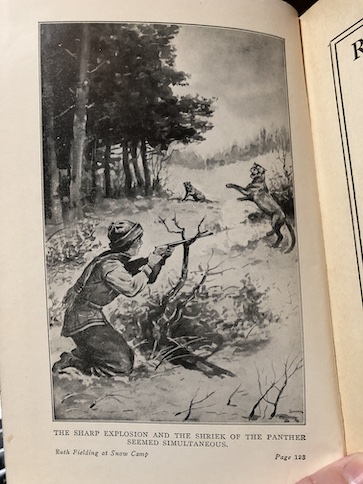
Together, they have a frightening encounter with a with a panther and get help from a hermit living in the woods. The hermit is a strange man who keeps rattlesnakes as pets, although the poison sacs have been removed. He teaches the Ruth and Fred to walk in snow shoes, and he helps them to reach the snow camp. They actually manage to get there before the rest of their party does, but Fred disappears just as they arrive.

When Ruth calls her friends in town to let them know that she’s all right and that she’s reached the snow camp, Mr. Cameron shocks her by telling her that the boy she’s known as Fred can’t possibly be the real Fred Hatfield. Mr. Cameron has learned from the local authorities that Fred Hatfield was killed in an apparent hunting accident months ago, although some people wonder if it was actually a murder. Fred’s half brother is being held by the authorities for Fred’s death. Did Fred just fake his death and run away? Or is the boy they know as Fred someone else entirely?

The book is now public domain and is available to borrow and read for free online through Internet Archive (multiple copies) and Project Gutenberg.

My Reaction and Spoilers

When we’re first told that Fred Hatfield was supposedly killed in a hunting accident, they mention that the boy’s body apparently rolled into a river after being shot, making it seem like Fred could still be alive, but then we’re told that the boy’s body was recovered from the river. That means that either Fred is actually dead and this new runaway Fred is an imposter or some other boy has been killed and Fred is just letting everyone think that the dead boy is him. Either way, there is a runaway boy whose identity needs to be established and a dead body whose identity also needs to be confirmed, and the circumstances of that death also need to be established. What really happened during that fateful hunting trip?

I liked the premise of this book because it’s much more of a mystery than the previous two books in the series. However, as an early Stratemeyer Syndicate book, there isn’t much deliberate investigation of the mystery. Most of the story is more adventure-oriented, and the characters learn the truth of the mystery almost by accident and through Fred’s eventual confession. In between, the characters have some outdoor winter fun. The girls make some homemade candy, which the boys spoil with a prank, causing some boy/girl rivalry. The girls get lost in a bad snow storm while trying to prove that they can be as daring and innovative as the boys when it comes to having fun and end up having to rescue Fred as well, which is when the solution to the story is revealed.

The solution is pretty much what people thought it was, which is a bit of a let down. At first, I thought that there might be more of a plot twist. Even the true identity of the dead body isn’t very exciting. Fred was labeled as a bad boy in the beginning, and that turns out to be true, but his half brother also admits that he was pretty hard on Fred at home because he’s smaller and not as physically strong as his older half brothers. They criticized Fred for not keeping up with the physical work they were doing and called him lazy, but realistically, Fred can’t do all the things they do, and his half brothers realize that they have to acknowledge and accept that. They say that they’re going to try to find him a different kind of work that he can do.

It’s not a bad ending, but I’d like to see a little more deliberate investigation from Ruth Fielding. I would have liked to see Ruth Fielding talk to other members of Fred’s family and maybe have one of them produce a picture of Fred to help establish his identity. Then, I’d like to have Ruth and her friends find Fred more deliberately than accidentally. The story isn’t bad the way it is, and there’s plenty of adventure, but as a mystery fan, I usually prefer more deliberate detective work.

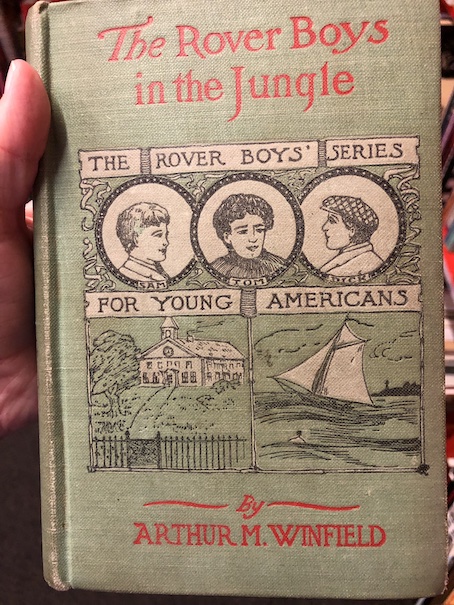
The Rover Boys in the Jungle

The Rover Boys

The Rover Boys in the Jungle by Arthur M. Winfield (aka Edward Stratemeyer), 1899.

My Foreword

I wasn’t particularly eager for this book after the first one in the series. I didn’t think the Rover Boys was as much fun as later Stratemeyer Syndicate books and there are some instances of racial language that are uncomfortable to explain. However, this is the book where the boys actually go to Africa in search of their missing father, and it resolves one of the major problems that the first book in the series set up, and I wanted to see it end.

As the book says at the beginning, the boys’ father went to Africa before the beginning of the series to look for gold mines and hasn’t been heard from since. The boys don’t know if their father is alive or dead, and meanwhile, the boys’ enemies from the first book in the series are still hanging around. The Baxters were put in prison for attempting to kidnap Dora at the direction of Josiah Crabtree in the book immediately before this one, but Dan Baxter escapes early in this book, and Crabtree is still around somewhere. The introduction and first chapter to the book brings readers up to date on developments from the previous books, sort of like the introductions to episodes of movie serials that didn’t exist at the time these books were written. Books in this series really need to be read in order, and if you skip any, like I did, you really need the introduction to bring you up-to-date.

The Story

There is a new boy at school, Hans Mueller, who is from Germany. This book was written before World War I, so there is nothing critical or derogatory about Germans, but the boys decide to tease Hans a little by playing up myths of the Wild West to scare him. They tell him that the school will be teaching them how to fight Indians (Native Americans) and that he’ll have to learn how to scalp people. Hans doesn’t know what they’re talking about at first, and when they explain it to him, he’s alarmed. (Good, Hans. That’s a sign of sanity.) Hans says that the only time he’s seen American Indians was at a traveling Wild West show that came to Germany, and he thought they looked scary. The other boys have a laugh about spooking poor Hans and drop the matter.

I mentioned in my last Rover Boys review that early Stratemeyer Syndicate books had archaic racial language and sometimes questionable racial attitudes that was later rewritten when various series were reissued. This early series hasn’t been revised. This first scene with Hans isn’t really so much a slur against Native Americans as prank with the boys playing up Wild West stories, but the book is just starting out.

Hans becomes the boys’ friend, but they prank Hans again later, scaring him with Tom wearing a Native American costume as he threatens to scalp him to continue their earlier joke, and they use the term “red man.” (We haven’t even gotten to Africa yet, so I was cringing at this point at what might be in store.) When Hans realizes that it was all just a prank, he tries to get the better of Tom by taking away the gun that Tom was using as a prop to scare him, and Tom tells him that the gun is too old to fire and isn’t dangerous. He just found it in the barn, and it’s all rusty. Tom tells Hans to pull the trigger and see that it won’t fire, which is the dumbest thing that anybody can do with a random old gun they just found somewhere. The gun explodes in Hans’s hands, knocking both Hans and Tom unconscious and scraping them with shrapnel. The other boys are scared, but they finally manage to bring them both around. Tom is horrified when he realizes what happened, saying that he’s been playing with that gun for awhile and pulled the trigger a dozen times himself, which is why he thought that the gun was unloaded and harmless (meaning he did the dumbest thing that anybody can do with a random old gun they just found somewhere repeatedly because, up to this point, dumb luck was on his side). He is shocked to realize that he’s lucky that he hasn’t shot somebody before and that he and Hans weren’t killed by the exploding gun. He apologizes to Hans and promises that this is the end of the pranks. Tom was always the lead prankster in earlier books, but he grows up a little here, realizing that reckless pranks have consequences.

At school, the boys participate in a kite flying contest, and Sam is almost pulled over the edge of a cliff by his kite. (Seriously.) Dora tells Dick that her mother had a dream that Crabtree tried to shoot him in a forest. (Prophetic?) The boys also have a run-in with Dan Baxter, who is still lurking around and swearing revenge.

Then, the boys turn their attention to a thief at school. Sam witnesses someone, who is probably the thief, sneaking around at night. Unfortunately, he didn’t see the person’s face, only describing this person as tall. Captain Putnam comes to believe that Alexander “Aleck” Pop, a black man who works for the school, is the thief because he receives an anonymous note that says he’s guilty. Sam doesn’t trust the anonymous note and tells the Captain so, saying that he can’t believe anyone as good-hearted as Aleck is would be a thief. However, the Captain insists that Aleck’s belongings be searched, and some of the objects that have been stolen turn up among his stuff. It’s a pretty obvious frame, and Alexander protests that he’s innocent, but Captain Putnam doesn’t believe him. There’s some ugly racial language used during this part. The word “coon” is used twice, and when the students at the school discuss the situation, one says the n-word. Fortunately, our Rover boy heroes aren’t the ones using that language, and Tom even tells the boy who used the n-word that he’s just resentful against Aleck for catching him doing something he shouldn’t have done earlier. The boy who used the n-word, Jim Caven, is portrayed as mean and unreasonable, and he gets into a fight with Tom in which he almost hurts him very badly. I was uncomfortable with the language in this scene, although I was somewhat reassured to see that it was used to characterize the ones using the worst of it as being the bad characters. My reassurance wasn’t complete because that’s not the only questionable racial language in the book.

Captain Putnam sends someone to escort Aleck to the authorities. He says that he supposes that the boys think he’s being too harsh with him, but he’s also suspicious of Aleck because he knows that members of his family have been in trouble with the law, too. The boys say it isn’t fair to blame him for things his relatives did and that they still don’t think he’s guilty. However, Aleck escapes before they reach the authorities, and they hear rumors that he went to New York City and boarded a ship to go overseas somewhere. The boys are sad, thinking that maybe they’ll never see him again. (You know they will.)

It’s not much of a surprise when the Rover boys later learn that Jim Caven has sold some things that match the description of other objects that have been stolen. Apparently, he’s been the thief all along and deliberately framed Aleck to get revenge on him. (I partly expected that the thief might be Dan Baxter, considering that he’s escaped from jail and is hanging around somewhere, probably needing money.) When the other boys confront Jim Caven, he flees into the woods. The other boys explain the situation to Captain Putnam, and he searches Jim Caven’s belongings, finding the rest of the stolen items. (You know, they could have just conducted a general search of the school and everyone’s belongings before this. This is a military academy, so a surprise dorm inspection wouldn’t be out of character, and it would have settled the matter much earlier.) Aleck’s name is cleared, but since he’s fled, they don’t know how to find him and tell him. Captain Putnam is sorry that he didn’t believe Aleck before.

However, they don’t have much time to consider it because the boys are soon summoned home by their uncle because he’s had news of their father. A ship captain has written Uncle Randolph a letter saying that his crew rescued a man who was floating on a raft off the Congo River. The man died soon after they brought him aboard their ship. They don’t know who the man was, but he was carrying a letter from the Rover boys’ father saying that he found a gold mine in Africa but was taken captive by King Susko of the Bumwo tribe (not a real African tribe, I can’t find anything about it) in order to prevent him from telling the secret of the mine to outsiders. Specifically, the tribe is afraid that the English and French colonizers will come to loot the mine and kill them. (Actually, a depressingly reasonable fear.) Anderson Rover explains in the letter that they don’t understand Americans. (That wouldn’t help, Anderson. Your boys attend a school run by a man who served with General Custer, and if this tribe knew what happened to Native Americans when gold was discovered on their land, they wouldn’t be reassured at all.) Anderson Rover is in fear of his life and asks his brother Randolph to come and rescue him if he can, but the letter is dated a year ago, so his family still doesn’t know if he’s alive now or not.

Uncle Randolph tells the boys that he wants to go to Africa to find his brother and asks Dick to come with him, as the oldest of his nephews. Dick, of course, agrees to go, but Tom and Sam refuse to be left behind. They decide that all of them will go.

On the ship to Africa, they meet an English adventurer named Mortimer Blaze, who is going to Africa for big game hunting. Tom asks him what will happen if the big game decides to hunt him instead, and he just says that it will be a “pitched battle.” (Doesn’t sound appealing to me.) When they talk about the people in Africa, they use the word “native” a lot and not in a flattering way. The general attitude seems to be that the “native” Africans are not very civilized (I was expecting they would say that because of the time period of this book), and Mortimer Blaze tells stories about tribes of people who are either very tall or very short. (I think he’s really referring to people from folktales, which I covered in the Encyclopedia of Legendary Creatures.) At one point, the characters say that the warm climate is the reason why Africa hasn’t made more progress toward civilization, that the warmth makes people want to be lazy. The adults in the story shock the boys by saying that not only is there no Christianity but that people there don’t really believe anything in particular, putting them even behind people Christians would consider heathens. They also make a shocking comment at one point about unwanted children being fed to crocodiles. They conclude that “civilization” can’t come soon enough to Africa, even if it has to be forced in with weapons. (Wow. I knew there was bound to be a lot of generic “native” and “savage” talk when I started this book because of the time period, but these matter-of-fact slights and accusations sound like they came straight out of Mrs. Mortimer’s books about Countries of the World Described, which heaps criticism and accusations of violence and immorality on pretty much all of the people of the world. Mrs. Mortimer’s books are much older than any Stratemeyer Syndicate books, and I wonder if Edward Stratemeyer read them in his youth. It wouldn’t surprise me because the attitudes match, and here he is, passing it all on to the next generation of kids in the form of an exciting adventure story.)

In a stroke of good luck, they end up rescuing Aleck, who was stranded at sea from the ship he boarded during his earlier escape. Aleck is glad to see the boys again, and they tell him that his name has been cleared and the real thief was caught. Aleck is glad to hear that, but he’s worried when he finds out that the ship that picked him up is headed for Africa. Aleck reflects that he always heard that his ancestors came from the Congo region of Africa, but he doesn’t really want to go there because he’s used to life in America and wouldn’t know what to do in Africa. (The Rover boys and Aleck go on for awhile about how great the United States is, and I know they were trying to sound patriotic, but the way they said it felt oddly like a sales pitch to me. I felt like saying, “You don’t need to sell me on the place. I already live here.”) The boys explain how they’re going there in search of their father. Aleck decides that he’d rather join their expedition than stay on the ship, and he offers his services as a valet. Uncle Randolph and the boys are glad to accept his help, and Uncle Randolph says it might be useful to have a black man with them who they know and trust in case they need someone to blend in with the native population and spy for them.

In a surprising twist, the boys also run into Dan Baxter on their arrival in Africa. When they ask him what he’s doing there, he says that he got drunk and was Shanghaied onto a ship, forced to work as a sailor. He was treated cruelly on the ship and ran away as soon as he had the chance. Now, he’s alone and has no money and no way home. The Rover boys feel sorry for him and give him money for him to buy his passage back to the United States. Dan Baxter asks to join their expedition, too, and they consider it as a sign that Dan is starting to reform because of his expedition. However, Dan is still a bully and an opportunist, and when he gets a counter-offer from someone else who is willing to hire him to make trouble for the Rovers, he accepts that instead, still holding a grudge against the Rovers because his father always told him that Anderson Rover stole a mine from him years ago that would have made them rich.

When I reviewed the first book in this series, I complained about the various unresolved story lines and miscellaneous villains still running around at the end of the story, still left to work on their individual plots against the Rover boys and their friends. In this book, every unresolved story line and villain from the first book collides with each other in Africa. Not only is Dan Baxter in Africa coincidentally at the same time as the Rovers, but Josiah Crabtree is also in Africa, for completely unrelated reasons from either the Rovers or Dan Baxter. He does attempt to kill Dick, but Dick survives. He is even rescued from a lion by one of his brothers.

So, is there true resolution with the main villains of the story, Dan Baxter and Josiah Crabtree? Not really. I looked up summaries of other books in the series, and even after they get some comeuppance, they continue to come back in sequels.

What is resolved by the end of the story is that the Rovers find their father alive. They rescue him from the village where he was being held captive, taking some of the women and children from the village with them as hostages to keep the village warriors from attacking them. They say privately that they wouldn’t have really hurt the women and children, but they tell the men that they’ll kill them if they don’t let the rescue party go. (This was another shocking part for me because I wouldn’t have thought of any of the usual Stratemeyer Syndicate heroes doing this. Somehow, I can’t picture the Hardy boys going this far, taking women and children hostage and threatening to kill them.) Once the rescue party is sure that they’re safe, they release their hostages and head for home. Anderson Rover says that he did find a gold mine, and someday, he’ll come back and loot it, er, mine it, but right now, all he wants to do is go home with his boys. It would be heartwarming if I didn’t know that he’s going to come back someday for gold on land that belongs to someone else who would never willingly sell it to him, and his boys are talking revenge on the king of the tribe that held their father captive.

This book is in the public domain and is easily available online in various formats through Project Gutenberg and Internet Archive (which has an audiobook).

My Reaction

I already gave much of my reaction to this book during the description of the plot because much of my reaction had to do with the racial language of the book. I knew there were going to be problematic portions before I even started, but frankly, there were too many of them for me to go into detail on all of them. What I described gives the broad strokes. I won’t say the book is deliberately trying to be insulting to black people. Aleck is portrayed as a good character who was wronged by a white boy by being framed for theft. However, there is a kind of casual racism in the story, like the casual references to how “uncivilized” Africa is and the characters’ off-hand supposition that it’s probably due to the climate there. I wouldn’t say that the characters or author hate black people (except maybe the non-Christian ones who feed children to crocodiles, which sounds like things Mrs. Mortimer accused various people of doing in the worst parts of Countries of the World Described), but I would say that there is a kind of condescension and dismissiveness that everyone, characters and author, seems to take for granted.

I can’t recall any of the characters using the phrase, “you know how they are”, but that’s the vibe I was getting. I got the feeling like the characters were saying things to each other and the author was saying things to his child readers with that sort of knowing tone, like “we all know these things.” No. “We” don’t. I know that Stratemeyer probably got a lot of this from a combination of old minstrel shows and Mrs. Mortimer or something very similar because I’ve seen Mrs. Mortimer‘s books, and I know how she talks. I also know why she says the things she does, and I’m not putting up with her attitude, even when it’s coming from someone else. Maybe the Rovers boys as characters and their child audiences would have read her books or similar ones before and nodded along with what Stratemeyer says because it confirms “information” they’ve seen before, but I’ve had more than my fill of wild accusations and crazy conspiracy theories, and I have no more patience left for any of it.

Mrs. Mortimer portrayed her book series as a factual introduction to world geography and the habits of people in different countries, but the truth behind her criticism, condescension, outspoken rudeness, and many of the wild accusations she makes about badly-brought-up children, dead bodies floating in rivers or just left in the street (depending on nationality), or the “antics” of “savages” around the world is her religious agenda (and, I think, probably some personal emotional and self-esteem issues, but that’s just a guess). She used missionaries with their own agendas as references for anecdotes in her books and tried to make people of various religions around the world sound evil and crazy on purpose to emphasize why “the Protestant” is the best religion (her words – she was specifically Evangelical and downright pushy about it). I would say that she also never hated black people … except maybe non-Christian ones, who as I recall, she claimed didn’t know what religion they were and were given to “antics”, dancing around and yelling or something. She wasn’t too clear on that point, probably because she didn’t know what she was talking about herself. On the other hand, she seemed inclined to be sympathetic to black people in the US who were victims of ill treatment, probably because they were Christian and most likely Protestant, which would have made all the difference in the world to her. She probably would have been okay with Aleck because he’s a Christian who was born in the US and has definitely never fed a baby to a crocodile in his life. She did not approve of the the concept of slavery at all and wouldn’t have tolerated physical cruelty of anyone due to race, which is to her credit, but none of that stopped her from spreading stories and rumors of violent savagery and teaching children that anyone who believed anything other than Protestant Christianity was “ignorant”, “savage”, and “wicked”, all words she actually used in describing people from various countries around the world because that’s what she wanted young children to “know” about other people. Mrs. Mortimer’s religious prejudices probably would have gone over the heads of the children who were these books’ original readers, especially if it echoed the talk of the children’s parents, but that’s how we end up with generations of children who grow into adults with casually racist ideas, thinking nothing of it, throwing around racist language without a clue or a care for the consequences. It’s in the book because it’s what “we” all “know”, dear Mrs. Mortimer said as much before, and Stratemeyer is just saying what “we” were all thinking, right? I think that’s about how that goes.

Let me bring you into the real world. If readers want to know what was really happening in Africa during the 19th century, there are far better sources. Africa is an entire continent, and there were many complex events happening all over, particularly related to European colonization. Outside forces were claiming territory in Africa, not so much for benefiting the people there and bringing them “civilization” as accomplishing their own personal aggrandizement and enrichment. (You know, rather like a man who is already rich in his own country coming to find and claim a gold mine that’s on someone else’s land because he’s addicted to the thrill of the hunt and acquisition and uses that thrill to hide from his own personal problems that he doesn’t want to face at home, like dealing with the loss of his wife and the raising of his boisterous sons. Just saying.) There were wars, famine, and disease in various parts of Africa during this period, partly due to internal power struggles among different African groups and leaders. I don’t know if anybody ever fed anyone to a crocodile on purpose, but infanticide is part of the dark side of humanity that comes out when times are desperate and hopes of survival in general are low. It’s a symptom of a society that’s suffering, and societies have suffered in that way many times around the world. If someone is likely to die soon after birth anyway, the hopeless parents might say, why even try? I suppose some might be tempted to say that having a religion that forbids killing children would help, but it hasn’t always, and having food also helps. I don’t blame 19th century missionaries for attempting to help people, but those who came in with a sense of self-importance, deciding ahead of time what would help without understanding the situation they were walking into, often didn’t help. Missionaries sometimes ended up getting killed in the middle of the unrest and power struggles. Some were even actively deceptive, using trickery and their position to gain advantages for themselves or the governments they represented at the expense of the people they were supposedly trying to help. But, the 19th century wasn’t all war, famine, and exploitation in Africa. The missionaries who were serious about doing some good and set up practical schools did provide useful centers of learning that helped educate future leaders and professional people and gave them tools they could use to build the lives they wanted. African societies did continue to build their own nations and identities. Overall, the colonization of Africa was more of an intrusive, disruptive force, providing additional hardships and obstacles to success more than solutions to any problems that Africa had before, not the glorious “civilizing” force that prevents people from feeding children to crocodiles that the book described.

So, now that I’ve talked about the historical and cultural influences behind the more uncomfortable parts of this book, I think it’s pretty obvious why early Stratemeyer Syndicate books had to be rewritten and revised in the mid-20th century. I knew this book was going to be cringe-worthy in places, but I have to admit that I was surprised at just how bad certain parts got. I hadn’t even considered that the word “coon” might appear. I never heard that word growing up and didn’t even know what it meant until I was in college, so I was pretty taken aback that a just-for-fun book for kids would use it, even one from the late 19th century. I suppose having grown up with the tamer, revised versions of books from the Stratemeyer Syndicate, I underestimated what the older series were like. I can only hope that I’ve made it pretty clear for people reading this review what the problems with this series were.

I debated about whether or not to even post this review, but I’ve talked about some uncomfortable books before (and said many highly critical things in my earlier rant about Mrs. Mortimer, my favorite example of a very popular bad influence in children’s literature – if you only know about her from The Peep of Day, you haven’t seen anything yet, even though the first chapter of that book is one of the most disturbing things I’ve ever read that was intended for small children). I’ve been planning a page discussing Stratemeyer Syndicate series books because they have been an important force in American children’s literature for so long, and it seemed only right to talk about their first series. So, now I’ve talked about it, and nobody else has to suffer through this book if they don’t want to. I found the characters, language, and situation aggravating, and the rewards for perseverance were inconsequential. This is certainly not something to spring on suspecting people, especially modern children, who might try using certain words for the attention-getting shock value without really understanding what they mean. I would say that this series should be primarily for adults interested in the history of children’s literature and others who know what they’re reading, understand what’s behind it, and can draw the line between fictional book and real life.

I’m not sure if I want to read any further books in this series because the unresolved problems of the stories get on my nerves, and there will probably be further issues with racial language, and I’d just have to repeat all the same explanations I’ve already given. I’m not saying a firm “no” to the rest of this series because there are indications that some people would like to see more coverage of them, but if I do any more, it’s probably going to be awhile and will only be delivered in small doses.

I wasn’t quite expecting to have these Mrs. Mortimer flashbacks from this book, but in honor of that experience, I might as well say that even though I’m leaving the Rover boys behind for now, I’m planning to go read many other useless novels “about people who have never lived”, which Mrs. Mortimer despised, and because I have access to some of them in audio book format, I can listen to them while knitting something completely unnecessary just because I want to. (If you read my rant/review about Countries of the World Described, you know what I’m talking about.) I’m not going to do it just because it would annoy Mrs. Mortimer. It’s something that I enjoy and do routinely anyway. I would do it even if it was something I thought Mrs. Mortimer would actually like. It’s more that knowing that she would have disapproved and can’t do anything about it makes me feel like we’re even because that’s the way I feel about her books and others like them.

The Rover Boys at School

The Rover Boys

The Rover Boys at School by Arthur M. Winfield (aka Edward Stratemeyer), 1899.

The three Rover boys, Richard, Thomas, and Samuel (called Dick, Tom, and Sam), live with their aunt and uncle in the country, but they learn that they are going to be sent to boarding school. The boys have been restless on the farm because they used to live in the city.

The boys’ father, Anderson Rover, is a mineral expert and made his fortune in mining. The family had lived in New York, so the boys are accustomed to city life. The boys’ mother died of a fever when they were young. After his wife’s death, the boys’ father traveled restlessly because of his grief, leaving the boys at boarding school in New York. Then, he had the notion to go to Africa and left the boys with their Uncle Randolph. The boys and their uncle haven’t heard from him since, and they worry that something has happened to him.

When the boys first arrived at the farm, they enjoyed the outdoor life of the country, but there isn’t much variety to the activities, and the boys start getting to trouble when they get bored. Their Uncle Randolph spends all of his time in studying scientific farming, and he can’t understand why the boys can’t take an interest in the subject or at least give him some peace and quiet for his work. The boys aren’t too impressed because, so far, their uncle doesn’t seem too successful at it. Richard (Dick) is the oldest of the three boys and is often quiet and studious, so he gets along better with Uncle Randolph than the others. He is 16 at the beginning of the series. Thomas (Tom) is fun-loving, likes to play pranks, and is 15 years old. His pranks are part of the reason why the boys are driving their uncle and aunt and their cook crazy. Samuel (Sam) is 14 years old and athletic.

Uncle Randolph doesn’t know much about kids or young people, so boarding school seems like the ideal solution. The boys’ aunt and uncle think that the boys need some discipline. They do, but the boys are also looking forward to seeing something of the world and having some adventures, so the prospect of going to boarding school sounds exciting to them. They’ve been to boarding school before, but they think it would be exciting to go to a military academy.

Before the boys leave the farm, Dick is attacked by a tramp, who steals his watch and pocketbook (wallet). The boys chase him and get the wallet back, but Tom almost drowns and Sam is almost swept over a waterfall while they try to pursue the tramp, who escapes in a boat with the watch. The boys are sad about the loss of the watch, which belonged to their father.

Tom gets a letter from his friend, Larry Colby, to say that he’s going to be attending the Putnam Hall Military Academy soon, and Larry’s father has recommended the school to the boys’ uncle. Uncle Randolph says that he’s decided to take the suggestion. The boys think it sounds exciting, and they’re glad that they’ll be going to school with someone they know. Uncle Randolph says that the headmaster of the school, Captain Victor Putnam, is a former military man who has a reputation for being kind to his students but strict on discipline, so it sounds like what the boys need.

Later in the story, they explain that Captain Putnam is a graduate of West Point and that he used to serve under Major General Custer, helping to put down Indian uprisings (Native American) until he was injured in a fall from his horse. For this book’s original audience of boys living in the late 19th century, this probably would have sounded exciting and noble, but not to people from the early 21st century. However Captain Putnam would have looked at it, quelling Native American uprisings would be essentially admitting to being part of their oppression because they weren’t uprising for nothing, and that fall from his horse is probably the only reason why he would even still be alive at the time of this story, given what eventually happened to Major General Custer. Because Custer had been a Civil War hero, people were shocked and saddened by his sudden and violent death. As with many people who die young, they romanticized his past and exaggerated his story, turning him into a legend for young people to live up to. Eventually, the romanticism wore off, and the reality stayed (he was the bottom of his class at West Point, not a student parents would really want their kids to emulate, and there were darker sides to his life and personality than most people in the 1800s would have known and which wouldn’t be appropriate talk for children), which is why his modern legacy isn’t as great as people a hundred years or more ago would have thought. Captain Putnam doesn’t look as exciting and heroic as advertised by association, but it’s enough to know that the Rover boys would have thought that it sounded impressive because of what their elders would have told them and so would their earliest readers, for similar reasons.

Before the boys leave for school on the train, Tom plays one last trick on the unpleasant station master by throwing a firecracker into some trash that the station master was burning, setting the mood for the boys’ eventual arrival at school.

After the train ride, the boy have to continue part way by boat. On the boat, they meet three pretty girls (how fortuitous) and a bully who also goes to their new school, Dan Baxter. The bully is harassing the girls by continuing to try to talk to them when they want him to leave them alone. Dan doesn’t say anything shocking to the girls, it’s more that he’s off-putting because he’s rather pushy and full of himself and can’t read a room to see that he’s making the girls uncomfortable because of the way he talks. It’s awkward. The Rover boys step in and try to get Dan to leave the girls alone, making an enemy of Dan. The girls (Dora Stanhope and her two cousins, Grace and Nellie Laning, who belong to prosperous farming families in the area) are grateful for the intervention and think that the Rover boys are better behaved than Dan is. The boys talk to the girls about their new school and learn that they don’t live far from the school, although they don’t mix with the students there much because the students at Putnam Hall don’t leave the campus very often. The boys hope that they’ll have the chance to see the girls again while they’re at Putnam Hall. (You know they will.)

Tom’s Putnam Hall experience starts off with a bang … literally. As the boys arrive at the school, Tom decides to give the other students a “salute” by scaring them with another of his firecrackers. That’s when Tom gets his first taste of military discipline from the Head Assistant Josiah Crabtree, the second in command at the school and the strictest disciplinarian in the place. Most of the school would have given the prank a pass, especially from a new boy, but Josiah Crabtree takes exception to Tom’s attitude and doesn’t accept his excuse that he doesn’t need to answer to Crabtree because he has only just arrived at the school, isn’t an official student yet, and shouldn’t be subject to the school’s rules. (Tom may have thought that military school would be exciting, but it’s pretty clear that he doesn’t have the first clue what military discipline is about.) Crabtree marches Tom off and locks him in the guard room to wait for Captain Putnam to return to the school and administer his discipline. This is actually in Tom’s favor because Captain Putnam understands that his students are still boys, and therefore, he isn’t as strict with them as he would be full adult soldiers.

Josiah Crabtree’s ultra-strictness has caused him to be not well-liked by other students at the school. When he and Tom discuss Tom’s prank while waiting for Captain Putnam, Tom continues to argue the point that he is not yet a student at the school and that Crabtree has no right to lock him up like he has. Tom tells him that he wants to be released to stay at the hotel in town so he can contact his guardian because he may not wish to join this school after all, threatening to tell his uncle of his mistreatment. Crabtree is correct that setting off a fire cracker to scare people isn’t the best way to start off on the right foot with the faculty (I wouldn’t have liked it if someone did it to me, and this is a school where people learn to fire real guns, so you can’t have people who treat firearms and explosives like toys), but Tom’s point that immediate imprisonment before he’s even really joined the school and been notified of the school’s rules is a valid criticism, and he is not so committed to the school at this point that he can’t leave if he wants to. If Tom makes false imprisonment a public issue, it would damage the reputation of the school. That threat is worrying to Crabtree, who knows that he has already rubbed others the wrong way and made a few enemies of his own.

Tom runs away from Crabtree and hides in the forest outside the school. He plans to walk into town, but along the way, he spots a campfire. He listens in on the conversation of the men sitting by the campfire. He discovers that one of them is the tramp who stole their father’s watch before, and he listens to the men discussing some clandestine “mining deal.” When they catch Tom spying on them, Tom confronts the man called Buddy about stealing his father’s watch. Buddy and his friend deny it, and Tom fights with them before running away and getting help at the Laning farm, where he meets Grace and Nellie again and the family gives him a room for the night. When he explains his story to the family, he learns that Josiah Crabtree has been courting Dora Stanhope’s widowed mother because she owns a sizeable farm and has money from her first marriage.

In the morning, Tom returns to the school and makes his case to Captain Putnam, arguing as he did the night before that he had not yet officially joined the school before Josiah Crabtree imprisoned him and confiscated and searched his luggage. Captain Putnam makes it clear to Tom that certain things, like fire crackers, are forbidden at the school, and he will have to accept that if he’s serious about being a student there. Tom asks what the point is of him joining the school if he’s going to have marks against him before he’s even had a chance to properly start, and Captain Putnam says that if Tom still wants to join, he’s willing to let bygones be bygones and let him start school with a clean slate. Captain Putnam sees Tom as intelligent and spirited even though he’s undisciplined, and is willing to give him a chance. Tom accepts and joins the school, although Crabtree is still annoyed at Tom getting away with his prank and running away the previous night. When Tom rejoins his brothers, he tells them about seeing the thief who stole the watch, and they discuss how awful it would be for Dora if the martinet Crabtree became her stepfather.

Because The Rover Boys is an early Stratemeyer Syndicate series, there is more adventure and the general friendships and rivalries of life at a boarding school than there is mystery. The boys and their friends get used to the routines, rules, and drills of military school, getting into fights with the bullies, playing sports, and pulling stunts with their friends. However, there are villains in the story with secrets for the boys to learn. Josiah Crabtree hasn’t been honest with Dora Stanhope’s mother, trying to use pressure to get her to marry him so he can use her money and property for his purposes … including money and property entailed for Dora under her late father’s will. Crabtree claims to have money of his own, bur shows no evidence of it. Although, who has been giving the bully, Dan Baxter, large sums of money and for what purpose? What about the watch thief and his friend? Why do they keep hanging around?

By the end of the book … not too much is resolved, compelling readers to continue on to the next book in the series to find out what happens.

This book and others in the series are now public domain and are easily available online in various formats through Project Gutenberg and Internet Archive (including audiobook).

My Reaction

I never read any of this series of books when I was a kid, but having grown up with other Stratemeyer Syndicate books, like Nancy Drew, Hardy Boys, and the Bobbsey Twins, I was curious about this first series produced by the Syndicate. I picked several of the books to get a feel for the series, and I had several reactions. First, the Rover Boys, like other early Stratemeyer Syndicate series, is almost but not quite a mystery series. It has some elements of suspense, but the little mysteries and secrets of the villains in the story come secondary to physical adventures and the drama of boarding school life for much of the book. In fact, the action kind of breaks for stories about football and baseball games the boys play at school, which don’t really have anything to do with the villains’ plots and are just part of school life. Although, the bully Dan Baxter loses favor with other boys at school when they discover that he actually placed a bet against the school’s own football team before a game, which seems pretty disloyal. I also suspected at first that at least some of the villains’ threads would be connected, but really, they have very little to do with each other, which was disappointing.

Stratemeyer Syndicate books have a pattern of ending chapters on cliffhangers in order to keep kids reading to find out what happens, which begins to show in this book, and often, the mystery/suspense elements in early stories help to set up these cliffhangers while the plot is more about the characters’ lives. Personally, I prefer stories that are more definitely mysteries, where the characters are making active efforts to solve problems and discover the villains’ secrets instead of just randomly stumbling on information. This particular story kind of annoyed me because the entire book ends on a cliffhanger. In fact, the only problem/mystery that gets resolved in the story is that Dick eventually gets his watch back. The other villains are still hanging around. At the end of the book, Crabtree is still hanging around, in spite of multiple interventions, trying to get Dora’ mother to marry him and turn over Dora’s inheritance from her father. The bully, Dan Baxter, left the school, but is apparently hanging around with Crabtree. It also turns out that Baxter’s father is secretly an old enemy of the Rover boys’ father and thinks that Anderson Rover cheated him out a mine years ago and still has the paperwork to prove it, possibly carrying it with him to Africa, for some reason. The Rover boys’ father is also still presumably lost somewhere in Africa, doing who-knows-what there. All of these problems are left hanging, apparently to be resolved in later books with other problems probably being added along the way. The only thing that I felt really certain about at the end of the book is that Dick is probably going to marry Dora in the future because he is already trying to be her protector, and his brothers will probably marry her convenient cousins, Grace and Nellie, in some order.

Second, I was bracing myself throughout the story to watch for its use of racial language. One thing to watch with old Stratemeyer Syndicate books is racist language and attitudes. In the 1950s and 1960s, with the beginning of the Civil Rights Movement, the Syndicate revised and updated its different series. They changed and removed outdated language, including racial terms, and also updated references to culture and technology. The version of this particular book that I used for my review is the old public domain version. I already talked about Captain Putnam’s service with Major General Custer and how people at the time would have felt about that compared to modern people, but there is also a black man called Alexander who works at Putnam Hall. He doesn’t have a very big role in the story, but I wanted to talk about him because of the way the book describes him. The book describes him using the words “colored” and “Negro”, which are outdated now although acceptable for the time period (that’s why they’re part of the names of the National Association for the Advancement of Colored People (NAACP), which was founded in 1909, and the United Negro College Fund, founded in 1944). However, during the Civil Rights Movement, people wanted to distance themselves from terms that were used during periods of high discrimination, so they began shifting to the use of “African American” as the specific term and “black” as the generic. This is the sort of language update that the Stratemeyer Syndicate books received in later reprintings.

Later in the book, one of the boys’ friends jokingly imitates a “Negro minstrel” in an old minstrel show (an entertainment people of this time would have been familiar with which included caricatured characters of black people), saying “That’s the conundrum, Brudder Bones. I’se gib it up, sah!” (“Brudder Bones” was a stock character in one of those shows, although I don’t know much about it because I’ve never seen a real minstrel show. I think there was a similar reference to the name “Bones” as a minstrel show character in the book Cheaper by the Dozen as well.) This is another cultural element that would be removed from later Stratemeyer Syndicate books and that also appeared in other older children’s books that were written prior to the Civil Rights Movement, including at least one of the Little House on the Prairie books. These references get a bad reaction in modern times because this type of caricature is a mean style of humor that probably wouldn’t have lasted very long against anybody who had the authority to complain about it at the height of its popularity. To put it another way, it’s the kind of humor where someone is definitely being laughed “at”, not “with,” and some even included songs with descriptions of horrifically violent things happening to black people masked as comedy. If you’ve never seen this kind of reference to minstrel shows before, you are not missing anything for having grown up without it. There’s nothing inherently funny in the friend’s little joke, and it wouldn’t mean anything to anybody who didn’t know what the reference referred to. It seems to be one of those things that only becomes amusing when someone recognizes the source of the reference, and as I said, I’m not even sure exactly who “Bones” was supposed to be, other than some kind of stock character. I vaguely know what the reference is from, but not enough to connect with it in the way the original audience might have, and anyone younger than I am probably wouldn’t recognize even that much. I don’t want to put undue emphasis on this line in the book because it was only one line, and the Rover boys weren’t really into it either because they were worried about a problem they had at the time that wasn’t really funny, but I thought that I should explain the background of this comment and point it out as another reason why the Stratemeyer Syndicate books needed revising.

When referring to their father, who is still missing in Africa, the boys also worry that maybe he was killed or taken prisoner by “savage” tribes. “Tribes” in many children’s books of this period are described as “savage.” The exact location their father was trying to reach is not specified, just somewhere in Africa where there is a jungle, although a later book in the series has more about it.

Some general old slang in this book really dates it, like the use of the word “fellows” instead of “guys” and the word “peach” for “tattle” or “tell on” someone. Even later Stratemeyer Syndicate series, like the Hardy Boys, use language that would sound dated to modern people, like the word “chums” for “friends.” These old slang terms were also changed and removed from later reprintings.

There were also some features of this story that took me by surprise. Pranks and stunts are regular features of boarding school stories, but I was surprised at some of the roughness of the boys at the school as well as some of the punishments. At one point, the boys realize that Crabtree has pushed Dora’s mother to marry him, and they’re on their way to town to get married immediately. The Rover boys tell their friends and get them to swarm the carriage, pretending that it’s part of a game they’re playing, trying to delay or disrupt their trip to town and their wedding plans. The boys cause an accident with the carriage that causes Mrs. Stanhope to get a broken arm and a cracked rib. They’re lucky nobody broke their neck. It’s a pretty violent way to interfere, even though they’re trying to save Mrs. Stanhope and Dora from Crabtree’s machinations.

One thing I did enjoy was the description of the game of Hare and Hounds (also called Paper Chase) that came right before the carriage scene. I’d never heard of the game before, but apparently, it’s been a popular game in British schools for centuries. Probably, the reason I’ve never seen it played is because the playgrounds and yards of the schools I attended wouldn’t have been large enough to make a really good game. One person plays the role of the “hare” and is given a head start, leaving a trail of bits of paper behind him as he goes. The other players are the “hounds”, and they try to find the hare by following the trail of paper bits, like they were hounds following a scent. The object of the game is for them to catch the hare before he reaches a designated finishing point. At a school where you can see pretty much the entire playground and everyone on it at once, there wouldn’t be any point in following a trail or any real challenge to the game, but it sounds like an interesting game to play if you can find a large enough space for it.

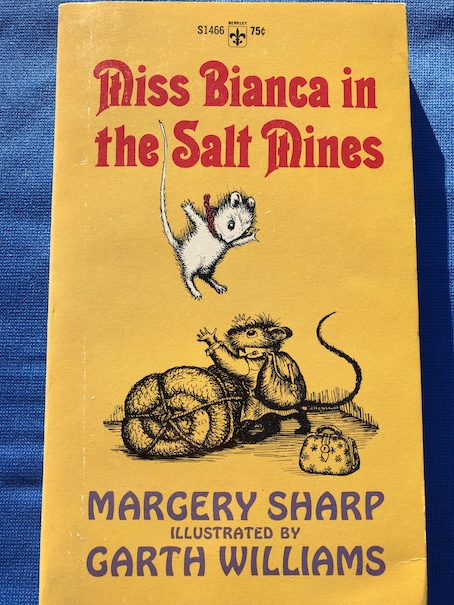
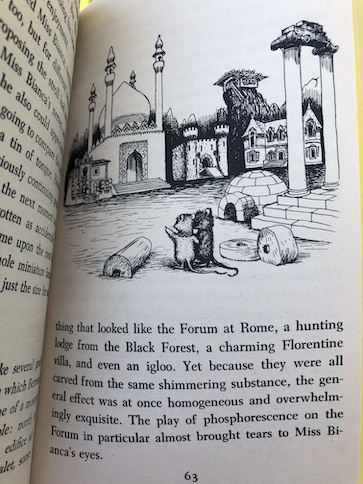
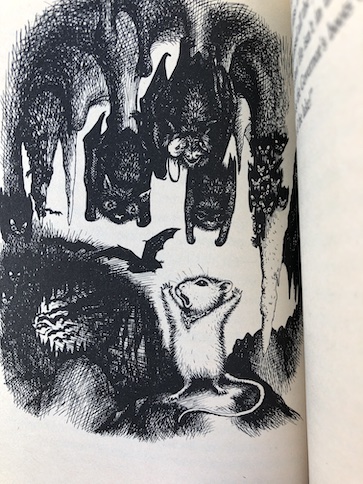
Miss Bianca in the Salt Mines

Miss Bianca in the Salt Mines by Margery Sharp, illustrated by Garth Williams, 1966.

This book is part of the Rescuers series.

When this story begins, Miss Bianca, who is Perpetual Madam President of the Mouse Prisoners’ Aid Society, is evaluating candidates for the Tybalt Stars award, which is given for mice who are brave in the face of cats. Bernard, the secretary of the society, is helping her. Each of the candidates is undeniably brave, but Miss Bianca notices that each of them also had a self-serving motive behind their bravery, which seems disappointing for a benevolent society. When they stop for lunch and Bernard goes to fetch some salt for them, he finds a note in the salt that says, “Someone please get me out of the salt mines.” The note is signed “Teddy (age 8).” Naturally, Miss Bianca is eager to help the poor boy! Bernard is a little more doubtful about the mission because the salt mines are about a thousand miles away, extremely dangerous, and extremely well guarded. Nevertheless, the Mouse Prisoners’ Aid Society cannot refuse to help a prisoner, and neither can its President.

Soon, Miss Bianca has members of the society trying to learn anything they can about a missing boy named Teddy, but apparently, no one has reported a boy by that name or age as missing. Bianca uses the lessons of the boy who owns her to learn more about the salt mines and how to get there. In order to get to the salt mines, they’d have to go by train, and it’s a very dangerous route. At the next meeting of the society, Miss Bianca asks for volunteers to go rescue Teddy, but everyone is reluctant to go, and many members of the society don’t like it that Miss Bianca doesn’t even seem to have any facts about Teddy or his situation that could help them. Miss Bianca says that, even though she can’t be more specific about Teddy’s background or how he came to be in the salt mines, the important fact is that he shouldn’t be there, and he needs help getting out. Since no one else wants to volunteer for the rescue mission, Miss Bianca says that she’ll go herself, and of course, Bernard insists on coming with her.

To Miss Bianca’s surprise, her biggest opponent, a curmudgeonly mouse called the Professor (his real name is George) who teaches mathematics, also volunteers to join the mission. Bernard and Miss Bianca are even more surprised when the Professor insists on bringing his friend Caerphilly along. Caerphilly is very elderly, but he’s also a professor of geology. Caerphilly has never actually been to the salt mines before, but he’s always wanted to see them and study them. Bernard and Miss Bianca aren’t sure that Caerphilly is up to handling the dangers that they’re likely to encounter on the mission. Miss Bianca reminds Caerphilly that this is supposed to be a rescue mission, not a scientific expedition. Caerphilly is unconcerned, saying that they can handle the rescue, and he’ll handle the science. Miss Bianca says that the Professor should warn his friend just what risks a rescue mission involves, but the Professor is also unconcerned, saying that the geology department at the university thinks too much of itself, and he wouldn’t mind seeing his friend chased by bloodhounds. (Some friend he is.) Miss Bianca is concerned both because of the danger and because their self-serving motives are just what she was concerned about before.

In spite of that, they decide to proceed with the mission, bringing the two professors. They take some time to make their preparations. Bernard and Bianca research the trains they’ll need to take. The Finance Committee allows them to take along the society’s Treasure – there’s only one, a single gold coin they found in a ruined building. Teddy might need this to pay for his train fare after they get him out of the mines. The Ladies’ Guild also knits mittens for the unfortunate boy because the salt mines are reportedly very cold. Miss Bianca tells the boy she lives with not to worry if he doesn’t see her for a week or so because she’s going to be writing an epic poem and needs privacy.

As they finally set out on their mission, the Professor is pessimistic, but the train journey is uneventful. When they arrive at the salt mines’ train station, it’s a very bare and gloomy building. Bernard finds a wooden door with some steps heading down.

At the bottom of the steps, they find themselves in an underground cavern filled with stalactites and stalagmites. There is also an underground lake surrounded by crusts of salt. The Professor realizes that they have entered the salt mines through a disused and forgotten entrance. In the distance, they hear the sounds of prisoners mining the salt.

It’s a long walk to the active part of the mine, but along the way, they make an important discovery – a mouse-sized city carved out of salt! Each of the buildings in the miniature town are unique and resemble famous buildings from around the world. Miss Bianca thinks that the buildings were probably carved by prisoners who made buildings to resemble the places where they used to live. It’s the perfect place for the mice to stay, though.

Bernard, inspired by this strange place, tries to write a poem for the first time in his life, which isn’t very good. Miss Bianca tries to be nice about it, but he can tell that she doesn’t like it. Bernard is upset enough to try to drown himself (that part of the story struck me as rather shocking, although it’s handled so matter-of-factly as just a product of the weird atmosphere of this place), but he can’t because he just floats in the salt water. It seems like most of the members of the expedition temporarily forget about Teddy. Only Miss Bianca isn’t affected by this strange little town because she lives in a porcelain pagoda at home that her boy gave to her, so these buildings are very much like what she already knows.

Fortunately, the expedition gets some help from some friendly bats who live in the mines. The younger bats in the group say that they’ve seen little Teddy serving the governor of the salt mines, who tends to stay apart from most of the prisoners because the prisoners have attacked him before. This is fortunate news because it means that Teddy is closer to the little salt town than they thought, and it won’t be as difficult to find him as they anticipated. He’s on an island in the middle of the lake of salt water, and that’s not too difficult to reach because Bernard has already proven that it’s easy to float in salt water.

Once they find Teddy, they also have to get him onto a train to get him away from the salt mines, which may not be as easy.

The book is available to borrow and read for free online through Internet Archive (multiple copies).

My Reaction and Spoilers

I generally prefer the plots of the Disney movies to the original books in this series, but this was still a fun story. I was a little disappointed that they never actually used the two professors’ specialties. I thought at first that they would use the geology professor to spout some interesting and useful facts about caves or mines, but they didn’t, and there was nothing in the story where a mathematics professor would be particularly useful. It just seems like a missed opportunity there.

There were some funny moments in the story. I liked the part where one of the bats, not really seeing Bianca clearly because bats are near-sighted, comments to another that, whatever it, if it moves, you should salute it, and if it doesn’t, you should paint it. Bianca takes that as a sign that this particular bat has completed his National Service, also noting that being near-sighted isn’t a barrier for bat National Service because, if it was, no bat would be able to participate.

In a twist at the end of the story, it turns out that Teddy used to live with his uncle and that Teddy’s uncle is the tutor for the boy that Miss Bianca lives with. Once Teddy is restored to his uncle, he comes to the house with his tutor and becomes friends with Miss Bianca’s boy.

Run Away Home

Run Away Home by Elinor Lyon

Run Away Home by Elinor Lyon, 1953.

When I first read this book, I didn’t have a copy of it because copies are collector’s items, and many of them are too expensive for me to afford, but after I read this book online, I managed to find a physical copy at an affordable price! I didn’t read this book as a child, but it’s exactly the kind of book I would have loved with atmospherically magical places (although no real magic), mysterious memories, and an orphan with a hidden past. This book was my introduction to the the Ian and Sovra series, although it’s the third book in that series. It’s available to borrow and read for free online through Internet Archive.

Thirteen-year-old Cathie lives at St. Ursula’s Home for Female Orphans in Birmingham, England. She has lived there ever since she was a young child and was found wandering the streets of London after a bombing raid during World War II. When she was found, she was wearing only a nightgown and clutching a locket that held a picture of a dark-haired woman and some dried flowers. She was unable to tell anyone her full name, only calling herself something that sounded like “Cathie.” (Hint: It “sounded like” Cathie. It wasn’t actually “Cathie.”) There was a label attached to her clothes, but it was torn. It only had the first part of her name (“Cat”) and the words “Passenger to” followed by what looked like the beginning of a place name that started with the letter “K” followed by “via” and what looked like the beginning of King’s Cross. If the label had been intact, there would have been no trouble identifying the child at all. The authorities made inquiries for her family or anyone who could identify her, but no one came forward. The conclusion was that her parents must have been killed in the bombing raid and that she had no other living relatives. Her family, whoever they were, was probably not from London because she was found near some railway station hotels, which had been destroyed. Most of the people staying there were killed, and the hotel records were also destroyed, leaving no further clues to Cathie’s identity. Cathie was sent to the orphanage and given the full name of Catherine Harris, but she knows that isn’t her real name. She has no recollection of the traumatic night of the bombing, but she has a vague sense that she has a real home and family somewhere else and a desperate need to discover her real identity.
One day, while reading a poem by Wordsworth aloud, a description of the seaside awakens a memory in Cathie of her early childhood. She’s had dreams of the seaside before, but she’s never been to the seaside since coming to the orphanage. Her memory of it is so clear that she’s sure that it’s not a dream but a place she’s actually been in the past, perhaps even the place where she used to live. She clearly remembers playing in the white sand on the beach, but she just can’t remember where the beach is.
When Miss Abbott, the headmistress of the orphanage, chides her for stopping her reading of the poem aloud, Cathie is upset that she disrupted her vision and her attempts to remember and screams, throwing the book across the room. Later, when she is called to the headmistress’s office to explain her fit of temper, she explains about the memory. The headmistress once again tells her the story of the night when she was found and shows her the locket and label that were found with her. The authorities honestly tried everything to locate her family and learn her original name, but since all attempts failed, the headmistress tells Cathie that she’s going to have to reconcile herself to not knowing. They’re not even completely sure whether the locket is Cathie’s or not because she was carrying it instead of wearing it, so it might have been something that she just found in the rubble after the bombing and picked up.

The headmistress says that she’s known other girls before whose birth names and parents were unknown, and it’s common for them to imagine some grand past or wealthy relations, pretending that they’re the long-lost daughters of a duke or something, but she wants Cathie to be more practical than that. Her parents are almost certainly dead, and if Cathie had any living relatives, Miss Abbott thinks they would have claimed her before. Miss Abbott thinks it’s unlikely that Cathie will ever get the full story of her past, no matter what she may or may not remember from a seaside holiday. Even if she somehow managed to locate the beach she’s thinking about, Cathie’s parents are dead, and there would be no one waiting for her there. Miss Abbott wants Cathie to focus on the here and now, applying herself to making a future for herself and making friends with other girls. Miss Abbott says that family isn’t everything because even blood family members aren’t always supportive to each other, but learning how to make and keep supportive friends will ensure that Cathie won’t be lonely. She says that Cathie will have a much easier time making and keeping friends if she improves her attitude and learns to keep her temper. It’s actually not bad advice if it’s really impossible for Cathie to learn about her past or if she genuinely has no relatives, but Cathie has a strong sense that isn’t the case for her.

Cathie can’t stop wondering about her memory of the sea and her mysterious past. She’s sure that the locket really did belong to her, but she can tell that the picture in it is much too old to have been her mother because of the woman’s hairstyle, which looks like styles from about 100 years earlier. The woman is standing in front of some mountains, and Cathie wonders if those mountains are a real place as well. She keeps thinking that, if she can get away from the orphanage and see other places, maybe she could find the place she remembers and learn who she really is.

As punishment for her temper tantrum, Cathie is sent to do some mending work for Miss Langham, who owns a big house nearby, instead of going to the pictures with the other girls. Cathie doesn’t mind too much because they were going to see a movie that she didn’t really want to see, and she also likes sewing and Miss Langham. While the two of them have tea in Miss Langham’s garden, Cathie brings up the topic of mountains, and Miss Langham mentions that she likes mountains, too. When she was younger, she used to go for mountain hikes. Cathie shows Miss Langham some embroidery work that she’s been doing with a floral design based on the little flowers in her locket, which look like silver buttercups. Miss Langham recognizes the flowers as Grass of Parnassus, which grows in marshy places, but not in Birmingham. She says that she used to see those flowers when she was younger and went hiking in the mountains in Scotland.

For the first time, Cathie realizes that she might not be English at all. If she had come from somewhere else, that might explain why no one in England knew who she was. The place that she’s remembering might be somewhere in Scotland. If she had really been a passenger from King’s Cross station in London, the train that brought her there might have been the Flying Scotsman, which Cathie knows comes to that station. Cathie tries to think of a place in Scotland that starts with ‘K’, which might have been where she was originally from. Feeling increasingly stifled by the strict rules of the orphanage, the lack of privacy at the orphanage, the bleak city, and Miss Abbott’s attempts to get her to stop dreaming about her past, Cathie begins plotting how she can run away to Scotland and start looking for the secrets of her past.

The next time she sees Miss Langham, she shows her the locket with the flowers, and Miss Langham confirms that the flowers are Grass of Parnassus. She also notices something that no one else who has looked at the locket has noticed – the little ribbon that’s holding the flowers together has a tartan pattern (a special kind of plaid pattern). When Cathie looks closer, she sees that the woman in the picture in the locket is wearing the same tartan. Cathie is excited because she realizes that this is confirmation that she was originally from Scotland. Even better, Miss Langham tells her that there are tartans that are specific to certain families or clans. Miss Langham doesn’t know enough about tartans to recognize which clan’s tartan is in the locket, but Cathie realizes that if she can find someone who can identify tartans, she has the key to learning who her family is! (Yes, the tartan pattern in the story is a real tartan, and it is one of the tartans shown on the tartan site page I linked. I checked after I knew what family to look for. But, it’s tricky to figure it out based only on the description in the book because some clan tartans share color combinations. To really identify which is which, you’d have to actually see and recognize the patterns of the colored lines and squares in the tartan. There are no pictures in the book.)

Miss Langham begins to like Cathie and sends an invitation to the orphanage to invite her to spend a few days with her in her home. Since Cathie has been pretty well-behaved lately, Miss Abbott decides to let her visit Miss Langham for a few days, although she has some misgivings because she can tell that Cathie has been acting oddly, as if she were keeping a secret. This visit to Miss Langham is critical because it gives Cathie the means to go to Scotland and try to find her home and family.

When Cathie goes to Miss Langham’s house, she isn’t there. Instead, Mrs. Riddle meets her and apologizes to her on Miss Langham’s behalf. The visit is canceled because Miss Langham’s brother is ill, and Miss Langham has gone to see him. There was no time to inform the orphanage of the change in plans before Cathie left because they don’t have a telephone. Cathie is bitterly disappointed because she had been looking forward to the visit, but Mrs. Riddle gives her some tea and cake and a note that Miss Langham left for Cathie. The note tells Cathie where to find some money that Miss Langham left for her to pay for purchasing the embroidered place mats that Cathie had been making with the Grass of Parnassus design. Suddenly, Cathie realizes that she now has money that no one else knows about. Her clothes already packed in her luggage for a few days away, including some holiday clothes that are different from the orphanage uniform, and no one is expecting her back at the orphanage for days because they all think that she’s with Miss Langham. Her opportunity to escape has come!

Feeling obligated to let everyone know that she isn’t dead when they discover that she’s missing, she adds a note of her own onto Miss Langham’s note that asks her to tell Miss Abbott that she has gone back to the place where she came from. Cathie thinks that, when the message reaches Miss Abbott, Miss Abbott will assume that Cathie has gone to London, the place where she was found as a young child. But, she has a few critical days to reach Scotland before her disappearance will even be discovered. She changes into her plain holiday clothes and goes to the train station in Birmingham. After she gets on the train, she uses her sewing things to remove the distinctive red trim on her coat so it won’t look like it’s part of an orphan uniform anymore.

The first place she goes is Derby, and she decides to hitchhike further north from there to save some money. She gets a ride from a truck driver (lorry driver, this is a British book), but he gets concerned that she might be a runaway or in some kind of trouble. He notices that the name she gives him isn’t the same as the one written on her luggage, a detail that Cathie had forgotten. At least, the driver has no bad intentions toward her and is kind enough to be genuinely concerned for her welfare. He tries to take her to a police station in Sheffield, but Cathie slips away from him and hides in the back of his truck, so he’s tricked into taking her further. When she gets the chance, she gets out and hides in the back of another truck that takes her almost to the border of Scotland. When this driver discovers her, she makes up a story about hitching rides to Scotland because she’s going there for a job in Edinburgh. She decides to take a train the rest of the way to Edinburgh, but by this time, Miss Abbott has already discovered that Cathie is not with Miss Langham. At first, Miss Abbott does think that Cathie might be going to London because of her note, but the police report of a possible runaway in Sheffield gives Miss Abbott the idea that Scotland might be Cathie’s intended destination. Cathie narrowly avoids being picked up by the police as she falls asleep in the waiting room of the train station because they think that she’s already left on an earlier train.

Once Cathie successfully reaches Edinburgh, she isn’t quite sure what to do next, but she enjoys being in the city, feeling like Scotland is the right place for her to be. Then, she spots a boy and a girl who are about her age, noticing that the boy is wearing a tartan kilt (but not the tartan in Cathie’s locket). When the boy, Ian, trips and drops the parcels he’s carrying, Cathie helps him. She makes friends with Ian and Sovra (the girl), and they invite her to come with them to see Edinburgh Castle. They notice that she speaks with an English accent and ask her about where she’s from. She confides in them about running away to find where she’s from, hoping that the answers lie in Scotland. Ian and Sovra are thrilled by Cathie’s story.

Ian and Sovra Kennedy don’t actually live in Edinburgh but on the west coast of Scotland. They’re only in Edinburgh temporarily to help their Aunt Effie. The name of their town is Melvick, and they live in a house called “Camas Ban”, which they tell Cathie means “White Bay” because of the white sand on the beach there. More than ever, Cathie is sure that she’s headed in the right direction!

Ian and Sovra catch the train home while Cathie returns to the cafe where she ate breakfast, searching for her locket, which she lost earlier. By the time she finds it and returns to the station, they are already gone, but Cathie asks about other trains to Melvick. There is going to be another train to Melvick early in the morning, and Cathie is told that it goes straight through to Melvick via Kinlochmore, with no changes necessary. Kinlochmore is the first Scottish place name Cathie has heard that starts with a ‘K’, and from the description of the area that Ian and Sovra gave her, which include a beach with white sand and mountains, Cathie is convinced that is where the secrets of her past can be found!

Cathie is on the right trail for finding the answers that she seeks, but getting caught is still a concern. The police and Miss Abbott are still looking for her, and she’s running out of money. Ian and Sovra help her and hide her in their secret hidden cottage (from the first book in the series), but unbeknownst to all of them, they’ve actually met Cathie before. Cathie really is remembering the beach near their home, and while she doesn’t remember the two of them, there was a time when they were all there, back before Cathie’s parents were killed in the Blitz and Cathie was known by her real name … Catriona, or as her parents used to call her, Catri.

My Reaction and Spoilers

One thing that I appreciated about this story is that there are no evil characters in it. None of the strangers Cathie meets wish her harm, and they even try to help her, although she dodges some of their help because it would take her back to the orphanage instead of allowing her to move forward on her mission. The orphanage where Cathie lives isn’t terrible. It’s kind of like a boarding school, so she is being educated, and she is not starved or beaten there. The worst Cathie can say about it is that the discipline is somewhat strict and she never has real privacy from the other girls.

Miss Abbott is the closest that Cathie comes to having an antagonist, and she does give Cathie punishments early in the story for the emotional and discipline problems she has while trying to revive her memories and reconnect with her past. In modern times, I think most caregivers would recognize the emotional turmoil Cathie is experiencing and be more patient and supportive to help her work through her feelings and memories, but Cathie’s orphanage doesn’t seem to offer professional counseling. Miss Abbott isn’t trying to harm Cathie. She does repeat the story of Cathie’s past when she asks her to, and when she lectures her on her behavior or gives her punishments, it’s not blind, unfeeling discipline; she explains her reasons to Cathie and tells her not just what she doesn’t want her to do but how she wants her to act and why. Miss Abbott is strict, but she actually does care what happens to Cathie and is trying to do what she thinks is best for her. The only reason why she doesn’t want Cathie to pursue the past in the beginning is that she thinks that it’s hopeless, and she’s pretty clear about that. She’s seen other girls pine for families they just don’t have or who are never going to reclaim them, for whatever reason. She thinks that there just isn’t enough information for Cathie to reconnect with her past and that she has no living relatives to find. Thinking about what she’s lost and will never find could just lead to more frustration, anger, and depression for Cathie. Even if she could find the beach she once visited as a young child, what would she do if there’s no one there waiting for her? Miss Abbott wants Cathie to reconcile herself to her loss and focus on the present and the future, building skills and relationships with the people around her, because she thinks that is what will lead Cathie to a better life. Cathie admits that Miss Abbott is nice, but she likes to plan other people’s lives, and she didn’t like the life that Miss Abbott had planned for her. In some books, that might actually be the moral of the story, learning to reconcile with the past and move forward without getting all of the answers, but this is is a sort of mystery/adventure story, so Cathie is on the path to finding the answers she seeks. It is a pretty calm, relaxing sort of adventure story, though, because no one is trying to harm Cathie, and the only threat is that they will put an end to her inquiries and take her back to Birmingham.

I liked the part of the story where Ian and Sovra are talking about which of the adults in their family and community would be most likely to give Cathie away to the authorities if they found out about her, and Ian says that even the two of them might turn Cathie in if they were a lot older. Cathie demands to know what he means by that, and Ian explains that it has to do with priorities. Kids and adults have different priorities. The biggest concern for the adults would be that Cathie is running around unsupervised and might get into all kinds of dangerous situations on her own, with no adult to supervise and take care of her. They would feel like they have to reign her in for her own good, and they’re also probably angry with her for causing them worry about her. However, Ian says, explaining the priorities that he and Sovra share with her as children, “You see, we know what’s more important. It doesn’t matter a bit if people are worried about you and rushing around looking for you. It does matter a lot for you to find out who you are.” Maybe he and Sovra would feel differently about it if they were older than Cathie and directly responsible for her safety, but as friends and equals in age, they put their concentration on helping her to accomplish her mission instead. It’s not that the kids and adults have different understandings of the situation. Both understand what Cathie is trying to do and both know know that there are risks involved in what Cathie is doing, but the main difference between them is that the children think that it’s still possible for Cathie to accomplish her mission to find out about her past, and the adults in Cathie’s life have already given up on that possibility and are just concerned with keeping her safe.

One of my early thoughts about the book was that Cathie’s parents might not necessarily be dead, since we don’t know in the beginning why Cathie was in London during WWII or how she got there. However, they really were killed in the bombing attack the night that Cathie was found, and they really are dead. For a long time, Cathie’s other relatives have assumed that Cathie/Catri died with them because the place where she was found wasn’t the place where they expected her to be and where they had been making inquiries for her and her parents. When they never heard from any of them again and they found out that there also had been a bombing in the area where they were supposed to be around the time when they disappeared, they had assumed that the whole family had been killed. Not everyone who died in bombing raids was able to be identified, so there were times when families weren’t notified of deaths and had to assume them from the circumstances and lack of contact from their relatives.

Stories about mysterious orphans with unknown pasts are staples of children’s literature and make great topics for mystery stories, but one of the fascinating things about this particular story is that it’s the kind of thing that could and did happen around the time of WWII. The time period really makes this story because it’s not only plausible that an orphan could go unidentified for a long period of time, but this is just the time and place where that would actually make sense. England was a war zone in World War II. It wasn’t actually invaded, but it was bombed frequently. People were killed, and children were separated from their parents in the chaos. In this era of chaos and sudden death, children were sometimes born out of wedlock to parents having a wartime fling and grew up without knowing who their parents were, or at least not knowing who their fathers were. That could account for some of the other children at the orphanage with unknown parents, but not Cathie. Some children were abandoned by desperate parents or were accidentally left when arrangements for unofficial adoptions suddenly fell through. Those are all things that really happened around that time, but that isn’t Cathie’s story, either.

In modern times, DNA evidence can help solve mysteries of this type, and it has helped to solve some past mysteries for people who were adopted as children, but back in the 1940s and 1950s, that wasn’t an option. Also, in modern times, Internet news stories and televised communication methods would also have helped the story of the found girl travel further, making it more likely that it would reach her relatives or someone who knew them. During this time, they would have been relying solely on newspapers and radio, and there might not have even been a picture to accompany a news story about the found child that would help someone recognize her. Modern methods don’t always solve every mystery, but they can help a great deal. That’s why this story really only works for this time period – a time when chaotic events happened that separated families and orphaned children and when modern investigative tools were unavailable.

Early in the story, I had thought that Cathie might have been about to head on her way out of London to somewhere else at the time of the bombing as a child evacuee because many children were sent away from London for safety from the bombings around that time. That wasn’t the case with Cathie, but it would have been a plausible explanation for the tag on her clothes. Child evacuees were known for having tags with their names attached to their clothes, and some children never returned home to their families when the war ended because their parents had died or had abandoned them. However, that’s not the case in this story, either. At the time her parents were killed, young Catri was actually traveling with her parents en route to another destination. The stop in London was unplanned, and they never made it to the place where they were supposed to be because of the bombing. It was just a case of bad luck and being caught up in the larger chaos of the war happening around them. The story does provided details of exactly how that happened, but since the book is available online, I decided not to include some of that information to preserve some suspense for people who want to read the story.

The special magic of this book isn’t just that Cathie discovers her identity, but how she does it. Readers know that when Cathie sets out on her journey, she’s likely to find some answers or at least a new home that will be better for her than the orphanage because the title of the book is “Run Away Home.” But, in the beginning of the story, readers are not quite sure how Cathie will do it and exactly what waits for her at the end of her journey. It’s the journey toward the truth and her special connection to the other children who help her that make the story satisfying. Little by little, Cathie uncovers pieces of the past. There are some lucky coincidences where she connects with people who were already connected to her and who can explain the past to her. When she comes to Melvick, Ian and Sovra hide her in a shieling or hut that they found hidden behind a waterfall in the first book of this series, which is a magical place to stay. For the first time in her life, Cathie has time alone where she can explore the beach and nearby mountains, and she enjoys the peace and serenity of the countryside more than the big city where she had been living. The characters in the book mention that, during WWII, parts of the west coast of Scotland were blocked off to visitors, except people who lived there or had relatives in the area, due to military exercises. The fact that Cathie definitely remembers being there during that time tells her and others that she either lived there or had family there, and it wasn’t just a one-time beach holiday.

At one point, Alastair Gunn and Dr. Kennedy figure out that Cathie is some sort of runaway, and Ian is physically punished for hiding her. I thought at that point in the book, Alastair handled the situation clumsily, saying too soon that Cathie can’t stay hiding there without first questioning her more closely about what she’s doing there and where she came from. I habitually ask a lot of questions, and it seemed to me that the adults in the book act too soon without finding out what they need to know about the situation. In their place, I would have wanted to get the situation straight before declaring anything or punishing anyone. At that point, the adults hardly know what the kids have been up to. By the time Miss Abbott arrives in Melvick, there is no need for her to return to the orphanage. Just when Cathie is thinking that she’ll have to reconcile herself to not knowing about her past and build a new future in the new home she’s been offered, the final pieces of the puzzle of her life fall into place, and Cathie gets the answers she’s been looking for. Even Miss Abbott is satisfied that Cathie has finally found the home she’s been looking for. After this book, Cathie becomes one of the major characters in this series.

I also liked this book for explaining the meanings of some Gaelic terms and place names. The Scottish characters do use some words that American readers might not be familiar with, like “dreich” and “havering,” but their dialogue is still easy to understand. The book doesn’t go overboard with trying to write to show the characters’ accents, which can get confusing and annoying in some books. The Scottish characters use “och” as an expression sometimes, but they don’t overdo it.

The House in Hiding

The House in Hiding by Elinor Lyon, 1950.

This is the first book in the Ian and Sovra series, which takes place in Scotland.

Ian and Sovra Kennedy are brother and sister, and they live by the sea in western Scotland. Their father is the doctor in their small town. One day, after Ian and Sovra have been asking their dad to rent a boat for them so they can explore some of the islands just off the coast where they live, their father tells them that he has bought a boat for them. It’s just a small boat for rowing, but it’s theirs, and it gives them the freedom to explore that they want. There is one island in particular that they want to explore, the one they call Castle Island. Its real name is Eilean Glas, which means “Gray Island”, but they like to call it Castle Island because there’s a square-shaped rock in the middle of the island that looks somewhat like a castle. However, their visit to this particular island has to wait for the end of the book because other events intervene to distract them.

When the children come back from trying out their boat for the first time, they hear their parents arguing about how to accommodate some house guests. Their father’s fishing friend wants to come for a visit. He was going to rent rooms in town for himself, his wife, and their daughter, but the innkeeper has had a stroke and can’t handle guests right now. So, Dr. Kennedy has offered to host the family, but the Kennedy house isn’t very big. If the guests use the children’s rooms, Ian and Sovra will have to camp out in the bothy, which is an old hut in back of the house. Ian and Sovra sometimes camp there anyway for fun, but it does get damp when it rains. Mrs. Kennedy doesn’t like the idea of the children sleeping there if the weather gets bad, but the children think that it sounds like fun and tell their mother that they’ll be fine and that they want to do it.

Dr. Kennedy’s friend is named Tom Paget. Dr. Kennedy doesn’t like Mrs. Paget, although it isn’t completely clear why. All he says about her is that she likes to wear a cloak and paint with water colors, which doesn’t sound very objectionable by itself. (I was actually a little irritated at Dr. Kennedy because he makes repeated comments about how much he doesn’t like Mrs. Paget without offering any more information than that. If she’s just a little eccentric in her style of dress and likes art, so what? I found the parts in the book where they get nitpicky and really down on her irritating.) Their daughter Ann is about the same age as Ian, and because Dr. Kennedy hasn’t yet met her, he’s not sure what she’s like until the family arrives, although he makes a point of saying, to his children, directly, that he hopes Ann isn’t like her mother. (Nope, no further information about why, and Dr. Kennedy sounds rather rude.) Dr. Kennedy’s comments about Ann and her mother leave Ian and Sovra feeling unenthusiastic about their guests, so they plan to spend most of their visit staying out of their way and possibly avoiding Ann, too, if she turns out to be like whatever her mother is like. (Way to go, Dr. Kennedy. Let’s start this whole experience off on a bad foot with everyone primed to hate your house guests, shall we?) Ian thinks that their whole camping outside the house experience would be even more fun if they were further from the house, so they won’t have to deal with the guests poking their noses into the bothy to see where they’re staying or worrying about whether Ann will want to join them because that would be bad for vague reasons.

Ian and Sovra start camping out in the bothy before the guests actually arrive to get things in order. However, they accidentally set fire to the bothy during an accident with their camp fire. With the bothy burned, where are Ian and Sovra going to camp out while the guests use their rooms? Their parents won’t let them have a tent because it won’t be dry enough if it rains. Fortunately, an important discovery that Ian and Sovra make turn this misfortune into an adventure.

While their parents worry about finding them another place to stay during their guests’ visit, the kids go exploring further in their boat. Their boat gets caught in a whirlpool and is drawn around the back of a waterfall, where they find a hidden cave. More importantly, someone else discovered this cave a long time ago. There are stone steps carved into the rock and a metal ring set into the wall for tying up boats, showing the children that this is an intentional landing spot. When they go up the stone steps, they discover an old, abandoned cottage hidden in a green hollow. (They call it a shieling.) The old cottage is in remarkably good condition for being abandoned for a long time, and Ian thinks that if they clean it up, it would be the perfect place for the two of them to stay during the guests’ visit. Sovra thinks that their parents aren’t likely to agree because the cottage is too far from their own house and rather isolated, and the landing place behind the waterfall is too dangerous. However, Ian is sure that there’s a better landing place somewhere else, if they approach from another side. Upon further exploration, the kids find a collection of cottages that were once a tiny village, older than the shieling they found and abandoned for a long time. The little abandoned village does have a landing place, and they decide that was probably how the people who once lived in the shieling got to where they built their home. They have to be careful, though, because the area is surrounded by a bog that might contain quicksand, and they’re not sure how to get across or around the bog. In the end, they decide that the waterfall entrance is actually the best way to reach the shieling, and they learn to navigate the currents around the waterfall safely.

The children’s father finally gives them permission to camp out in the old shieling, although their mother still has misgivings because the parents aren’t completely clear on exactly where the children will be camping and haven’t seen it yet themselves. The children describe the shieling to their father and tell him that it’s over near Lochhead, another town nearby. Dr. Kennedy is satisfied from their description that the house will be safe to camp in and says that they can communicate with them daily by sending them a message by the postal van from Lochhead, and if they need anything, the parents will send it to them by the same van the next day. Their mother is still uneasy, but since their father is convinced that it will be fine, she finally agrees to let them go. Ian and Sovra are thrilled at having this secret house all to themselves, but Ian says that they will need to keep it a secret and be careful not to leave signs that they’re there, just in case someone still owns the old house and doesn’t want them there, even if they’re not using the house themselves right now.

The children’s discovery and use the shieling is not only the beginning of this story but also the rest of the series. The children’s secret hiding place not only provides them with a secret place of their own but also leads them to some important discoveries about their own family and other people. This book in particular focuses on the missing chieftain of the Gunn clan, who has been presumed dead, but it takes awhile for that mystery to enter the story.

While Ian and Sovra are enjoying their freedom in their secret house, the Pagets arrive with their daughter, Ann. Mrs. Paget turns out to be a somewhat eccentric woman, sometimes overly enthusiastic about little things, raving about them with some cutesy talk. She often elaborates her daughter’s name from Ann (which is what it really is) to the longer Annabel or Annabella (neither of which is her actual name) and referring to the absent Ian and Sovra as the “dear little children.” (Yeah, it’s kind of an annoying cutesiness, but I still think that Dr. Kennedy shouldn’t have been maligning her before she arrived.) Mrs. Paget isn’t just a hobby painter; she has actual shows of her work and has been successful at selling her paintings. When she arrives, she tells the Kennedys that she wants to find the best places in the area to paint, and she’s particularly interested in things like old castles, old bridges, and waterfalls. (I think you can see where this is going.) The Kennedys mention that there are abandoned villages in the area.

Mrs. Paget thinks that sounds exciting and asks about the history of these villages. The Kennedys say that they don’t know the full story behind them, but Donald, the old man they bought the boat from, might know. They think that the people who used to live there probably moved to the bigger cities to find work or something. (This is something that actually did happen to small villages in Scotland in real life. If you’d like to know more about the circumstances and see pictures, I suggest looking at Hirta Island. Although it looks like a pretty spot, living conditions there were harsh, and after a young woman died there who might have been saved if she had lived near a city with a hospital, the people decided that it was too isolated, and they didn’t have the population levels and support they needed to stay there.)

Poor Ann is bored and disappointed by the absence of Ian and Sovra. (Yeah, thanks again, Dr. Kennedy, for all the negative talk that made them not want to even meet poor Ann and be friends with her. In his first message to the children after the guests arrive, Dr. Kennedy makes fun of Mrs. Paget’s sandals, which he says are “made of pink string” and says he doesn’t know why Mrs. Paget wants them to meet Ann. Oh, I don’t know Dr. Kennedy. Let’s all think hard about this. Could it possibly be because Ann is lonely, there are no other kids in the area, and she could use a friend? Why is Dr. Kennedy so mean and weird about this? He’s an adult, for crying out loud! Ian and Sovra think that it would be “frightfulness” if they have to meet Ann and actually “be nice to” her if she’s like her mother. Keep in mind that they still don’t even know what Mrs. Paget is really like because they haven’t met her, and oh, noes, how awful to be nice to somebody who’s a little strange or eccentric during a temporary visit. What a family!) Ann often finds family holidays boring because she’s an only child. When her mother is busy painting and her father is busy fishing, Ann has very little to do and nobody to talk to. Ian and Sovra know that the Pagets have arrived, but they try to avoid meeting them, both because they think that they won’t like the Pagets, not even Ann, and because they want to keep the house where they’re staying a secret.

The very first time Ian sees Ann, he tries to run away from her and ends up falling and getting hurt. Ann tries to help him, although he resists at first, partly because he is afraid that if his mother finds out that he’s hurt, she’ll put an end to the camping trip. Ian messes up Ann’s name, calling her “Animosity,” and I’m not sure if he did it on purpose or because he actually has a head injury from his fall. (Actually, it was probably on purpose because he does it repeatedly from this point on in the story. No, Ian, “animosity” is what your family cultivates for other people and what I’ve been feeling each time your dad criticizes Mrs. Paget behind her back.) Ann messes up Sovra’s name, asking if Ian is saying “Sofa”, but I cut her more slack because Sovra is a more unusual name, and she’s not doing it deliberately. She’s just asking if she heard that right. Ian does explain that although Sovra mostly spells her name “Sovra” for school, her name is really supposed to be the Gaelic word “Sobhrach”, which means “Primrose.” Same name and pronunciation, but different spelling. Ann likes the name for being unusual. Ann goes to get some water for Ian, and while she’s gone, Sovra finds Ian and helps him into their boat. By the time Ann gets back, they’re gone.

Sovra worries about whether Ian has given away their secret to Ann. Ian says he doesn’t think so, but he has been rambling and not thinking straight since he hit his head, so he can’t be sure. He’s dizzy and disoriented and definitely showing signs of having a concussion. He should be checked out by a doctor, who happens to be his dad in this area. However, Sovra takes Ian back to the shieling. Ann worries about where Ian disappeared to, but she realizes that he couldn’t have gone anywhere by himself in his condition, so someone else must have come and helped him. She doesn’t mention what happened when she returns to where her mother is painting by the abandoned village because she doesn’t know where Ian is and can only assume that someone took him somewhere to get help. Both she and her mother spot smoke rising from the hollow where the shieling is, and Ann wonders if that could be Ian and Sovra’s campsite, although she isn’t sure. When Ian and Sovra get another note from their parents, it says nothing about Ian’s injury, so they realize that Ann didn’t tell the adults about it, and they begin to think more highly of her for keeping their secret. (Yeah, as if that was the smartest or most caring thing she could have done. But, these are kid priorities. You’d think with a father who’s a doctor that they’d know better than to be too cavalier about head injuries, though.)

However, soon, there are other things on the kids’ minds. When Ian went to go see Donald about a bung for their boat, he noticed that Donald has a special two-handled cup called a quaich, and his quaich has a symbol on it that’s the same as a symbol that was carved into the hearth of the shieling. Ian and Sovra wonder if that means that Donald actually owns the shieling. When they ask him about it, he tells them that the symbol is a juniper sprig and it’s the badge of the Gunn clan. Donald questions them about why they want to know, and they carefully say that they’ve seen the symbol carved somewhere else. Donald realizes what they’re talking about, and he tells them that he once helped to build the little house where they’re staying. Years ago, his cousins lived in the little abandoned village, and he found that secret cave behind the waterfall himself when he was young. He’s the one who created the secret landing place and stone steps. The Gunns once owned the village and the land around it, but the head of the family, Colonel Gunn, died without children. Since then, Kindrachill House, the bigger house where Colonel Gunn lived, has been empty. Colonel Gunn did have a nephew named Alastair, but everyone believes that he died somewhere in the Far East. Alastair used to live in the shieling where Ian and Sovra have been staying. Donald gives the kids permission to continue staying there, since it seems that the original owner isn’t coming back. He also tells them that there’s a superstition in the Gunn family that, when Kindrachill House is empty, the heir to the estate will not arrive until someone lights a fire in the hearth. Ian wonders if they really have to light a fire only in the hearth at Kindrachill to make the legend come true or if it would count that they’ve been lighting fires in the hearth at the shieling, where Alastair used to live and where he carved his family’s crest in the hearth. Sovra says that it doesn’t really matter since Alastair’s dead and can’t come back … but is that really true?

When things in the shieling are moved around when Ian and Sovra aren’t there, they assume that Ann has found their hideout. They know that she’s been looking for it. Later, she admits to them that she has been there, having figured out a way to get there that Ian and Sovra don’t even know about, but she didn’t move all of the things that have been moved. Someone else who knows about the shieling has been there. They know it’s not Donald because he has trouble walking and can’t make the trip to the shieling by himself. So, who else could it be?

The book is available to borrow and read for free online through Internet Archive (multiple copies).

My Reaction and Spoilers

The location of the story gives it an almost timeless quality. The children spend much of their time in nature, with few references to modern technology, so the story could take place in many time periods. However, the book is set contemporary to the time when it was written, in the mid-20th century, after WWII. That time period is especially important in the third book in the series. This first book in the series could take place during many possible decades, but the third book can only be set during the 1950s because WWII is important to that story.

There is a slight element of mystery to the story, but the kids aren’t actively trying to solve the mystery element. Mostly, it’s a kind of adventure story with elements of slice-of-life about how these kids spend their summer in an exciting location with a somewhat mysterious history. Little pieces of the situation are gradually revealed to the characters during their adventures. Kids like stories about other kids who have adventures without adult supervision, and parts of the story are about the fun things they do, setting up house in the old cottage and enjoying themselves in and around the secret hideaway.

The Kennedys’ Attitude Problems

I have to say that I didn’t like the attitudes of any of the Kennedys. I actually read the third book before this one, and I liked the characters better in that book. In this book, both the parents and the kids seem to be some kind of snobs. They’re negative and mean about Mrs. Paget and her daughter for little reason. Granted, I don’t like cutesiness much, but Mrs. Paget just seems to be a mildly eccentric artist who dresses a little oddly and acts overly enthusiastic about some things. I didn’t think there was any call for a medical man like Dr. Kennedy, who should be at least somewhat understanding about human nature because of his profession, to be so mean about the way Mrs. Paget dresses or try to discourage his children from being nice to Ann. There’s almost a mean girl exclusiveness quality to the Kennedys’ behavior. Most of the men I know have little knowledge about women’s clothes, but Dr. Kennedy sounds like a middle school mean girl, nitpicking the way the poor woman dresses. He even writes about it in the notes that he sends to his kids during their camping trip. The pink rope sandals bother him so much that he wants to put that in writing to his kids who aren’t even there and who should be polite to this guest when they actually meet. Dude, you live a “simple” life in a cottage near a small town on the coast of Scotland. You’re not exactly in a high society fashion district, and there are few people around to see or care what anybody dresses like. So what if she likes to wear cloaks with sandals? It’s an odd clothing choice because it seems to indicate that she’s dressing for two different types of weather at once, but it’s harmless. Calling the landscape “delicious” and the children “dear little children” (“dear” seems overly generous to me, but Mrs. Paget doesn’t know any better) might seems a little sappy, but again, so what if she’s somewhat sappy and romantic in her speech? Calling her daughter Ann by much longer names which she could have just named her in the beginning, like Annabel or Annabella, is also a little odd, but if Ann doesn’t seem to care, why should anybody else? Families do sometimes have odd nicknames for kids, and it’s not the worst I’ve ever heard. Going from a shorter name to a longer one is the opposite of what most nicknames do, but again, it’s just harmless eccentricity. None of the things Mrs. Paget does seem really that bad. Mrs. Paget doesn’t do anything rude or mean, and she seems like a pretty unobtrusive guest. Mostly, she just wants to find pretty spots where she can sit most of the day and work on her paintings while her husband fishes, so if they don’t like her cute, sappy talk, they don’t have to hear it much. She only seems to return to the Kennedy house to eat and sleep, and that’s literally the least a host can provide a house guest.

The Kennedys are fine in the scenes when they’re just by themselves, but when their guests are around, they’re barely holding back inner meanness and rudeness for the guests that seems completely undeserved. That was a constant source of tension for me while reading the book. When Mrs. Paget is asking about beautiful spots in the area with enthusiasm and interest in their history, Dr. Kennedy is thinking about the best way to answer her questions quickly so he can just talk to her husband (about fishing, I guess), like he just wants her to shut up. The men are going to go off fishing together, during which they’ll have hours to talk about anything they want, and Dr. Kennedy thinks it’s such an imposition to talk to Mrs. Paget for a few minutes when they first arrive about the area where he lives and its history, for which Mrs. Paget has only expressed admiration and interest. Mrs. Kennedy also seems oddly defensive to Mrs. Paget about the “simple” life they lead, which she seems to think is too simple for Mrs. Paget, but Mrs. Paget reassures her that isn’t the case, that she thinks the area is charming and the children’s camping trip sounds like fun. Mrs. Paget seems overly enthusiastic about how great it all is. Whether she’s really that enthusiastic on the inside, I couldn’t say, but at least she speaks positively and makes an effort to show interest. She is definitely interested in the artistic possibilities of the area and sincerely curious about its history. She follows up her curiosity by asking Donald about what he knows, which shows effort.

Meanwhile, the Kennedys are trying to hide their negativity, which seems to spring from ideas they have about Mrs. Paget that aren’t born out in real life. There’s little indication of how the Kennedys got these ideas except their own inner negativity and insecurity. When I was a kid, my mother would tell me to be nice to other people and to make visitors feel welcome, and even if I wasn’t having fun with particular visitors, to remember that their visit was only temporary and make the best of it until it’s over. You can feel any way you want, but you still have to behave yourself. Being nice to a temporary guest is not a terrible imposition, and putting up with a less-than-ideal guest is completely bearable and encourages return hospitality. The Kennedys don’t impart these lessons to their children, and the father seems to particularly discourage this thinking. This is the type of family that breeds little bullies, people who think that generally being nice to people is a terrible burden to endure. It really struck me as pretty rotten for Dr. Kennedy, a grown man in a position of trust and responsibility for the welfare of people in their community, to try to discourage his children from meeting and being nice to Ann, a lonely child who never did anything to Dr. Kennedy and doesn’t deserve this bad treatment from him, smearing her reputation and making it difficult for her to make friends. Why is Dr. Kennedy trying to get his kids to be mean to Ann instead of telling them to be kind to a guest and make friends?

Of course, I really know why the Kennedys have to be this way. It’s a plot device. Their reasons for not liking Ann and her mother don’t have to be fair or make complete sense because it’s the results that matter. It’s all to set up part of the conflict of the story. If Dr. Kennedy was nicer about Mrs. Paget and encouraged his kids to be nice to Ann, they wouldn’t be so worried about having Ann around or joining them on their camping trip. Ian wouldn’t have been so worried about Ann seeing him that he tried to run from her, fell, and got that concussion. If the kids were friendlier with each other, Ann wouldn’t have needed to get a ride from a stranger or might have told them about the man she met who gave her a ride and who turns out to be important. Quite a lot of the problems the kids encounter would have been different or simplified if characters were nice with each other and worked together more. It’s a theme that appears often in literature, and actually, quite a lot in real life, too. It doesn’t make it any less annoying for me.

Character Development

The parts where I thought Ian and Sovra were at their best were when they were completely by themselves. They seem to have a good brother-and-sister relationship and know how to function as a team. Even when one of them messes something up and they criticize each other, they still have each other’s back and work together to clean up their messes. However, I never really got to like Ian and Sovra as people during this book because of their meanness and snobbishness, which is ironic because they later say that they don’t like Ann because she thinks that she’s better than they are. This seems to be a retroactive decision by the author because she doesn’t show that trait right away. It seems to surface later in the story, long after Ian and Sovra have decided that they don’t like Ann and need to avoid her and think it would be frightful to be nice to her.

My favorite characters in the story are thoughtful Ann and kind Alastair. Yes, Alastair does appear in the story. He’s not dead. Ann is the first to meet Alastair on his arrival back in the area, and he helps her when Ian and Sovra have been mean to her, stealing her shoes so she can’t follow them back to their secret house from the beach and leaving her to limp back to the Kennedy house over rocks with a hurt foot. Ann vents to Alastair about her troubles with the Kennedys without knowing who he really is, and he tells her that he’s sorry that she’s having such a bad time and that the Kennedys have been unpleasant to her. Finally, a voice of reason and compassion in the story! Ann doesn’t mention this encounter with Alastair to anybody at first because she doesn’t know who he is, that they all think he’s dead, or that his return has any special meaning.

Little by little, Ian and Sovra do start to feel guilty about the way they’ve treated Ann and start looking at her differently, noticing the things she does well and acknowledging some of the skills and knowledge she has. Eventually, Sovra does apologize to Ann for stealing her shoes. When Ann is seasick the first time they take her out in their boat, she admits that she’s not as used to sailing as they are, which makes her seem less superior than Ian and Sovra thought she was. Ann even apologizes for talking like she knows everything when she doesn’t, but I still thought it was weird because that wasn’t the impression that I was getting from her until after Sovra and Ian started saying that’s what she was doing. The apologies they each give each other and their mutual acknowledgement of each other’s faults and strengths help them come to a better understanding of each other and resolve their conflicts.

Ann also proves to Ian and Sovra that she does know things that even they don’t know about the shieling and the area around it because of the questions her mother asked Donald about the history of the area. Donald told Mrs. Paget that there was once a pathway between the abandoned village and the shieling that was lost years ago, apparently swallowed up by the bog, and nobody knows quite where it is now. However, this summer has been drier than normal in the area, and Ann realizes that the path might have been exposed again by the lower water levels in the bog. She carefully observes the area from a high vantage point when they go hiking in the mountains until she spots where the path goes and marks it on her map. Then, the next time her mother goes to the village to paint, she scouts for the beginning of the path from the ground, finding a series of stepping stones through the bog.

When Ian and Sovra ask her later how she got to the shieling when she didn’t know about the waterfall entrance, she explains to them what she did, and they ask her to show them where the path is. I liked this part because Ian and Sovra were smug earlier about Ann’s map, saying that they didn’t need any local maps like that because everyone knows where everything around here is anyway, and their big source of pride with Ann was that they know more about the area than she does. (They thought that her explanations of what’s on her map when they asked her to show it to them earlier was just her trying to be “superior” to them.) They do know a lot from living there for their whole lives, but the problem is that they count too much on that sometimes and don’t think to ask the questions Ann and her mother do because Ann and her mother are aware of what they don’t know and are actively trying to learn.

I also liked it that when Ian and Sovra finally let Ann join them camping at the shieling, they also let her take over the cooking. Earlier, they took exception to her father saying that she’s an excellent cook because they saw it as bragging and acting superior, but Ann really is good at cooking and likes doing it, and Sovra admits that she isn’t terribly good at it and doesn’t really like it herself. I was relieved when the characters stopped worrying about who was superior to who and who was acting superior when they shouldn’t and just let people do what they’re good at and interested in doing, acknowledging when someone does something well without adding a kind of put-down onto it, like Ian and Sovra did earlier.

Alistair

Getting back to Alastair’s return, he eventually shows up at the shieling and talks to the children, explaining what happened to him. He says that he tried to talk to them before, but they weren’t at the shieling the last time he stopped by. His plane was wrecked in the Pacific (They don’t say that it happened during the war, so it might not have been. I thought they might have been implying that he was a pilot in the war, but that would play with the timing of later books in the series.), as they heard, and he spent some time living with a native group on an island. The natives were friendly enough and helped him, but it took him awhile to learn enough of their language to really communicate with them and figure out how to get to a place where he could arrange passage home. That was when he first learned that he’d been declared dead. Since then, he’s been reestablishing his identity and checking on the estate that he’s inherited. By the time that Alastair finally shows up at the shieling and introduces himself to the children, they’ve heard that Kindrachill House is supposed to be sold to pay the mortgage. When they ask Alastair about it, he confirms that he doesn’t have the money he needs to pay the mortgage. He almost didn’t come back to the area at all because he didn’t think there was anything there for him. However, it turns out that he’s an art lover, and when he went to a showing of Mrs. Paget’s paintings in Glasgow, he saw the painting she did of the old village and how she included the smoke rising from the shieling where Ian and Sovra were staying. That made him want to return to his old cottage and see who was there. So, the legend about a fire in the hearth bringing the Gunn heir home comes true.

There is an argument among the four of them whether Ian and Sovra should get the credit for Alastair’s return because they lit the fire in the hearth at the shieling or whether Mrs. Paget should get the credit because her painting is what drew it to Alastair’s attention, but it’s a good-natured debate. There is still the problem of the mortgage that needs to be paid, but Ian, Sovra, and Alastair find the solution to the problem when they finally go take a look at Castle Island, and Ann rescues them when they accidentally maroon themselves there. Since Ian was the first to spot the solution to their problem, Alastair thanks him by giving him the shieling so he and his sister can use it whenever they want. Alastair is able to save Kindrachill House and takes up his role as chieftain of the Gunn clan, which sets up the other stories that follow in this series.

My Favorite Parts

The best parts of the book for me were its timeless quality and the location. A secret house, forgotten by everyone, accessed by going behind a waterfall and climbing a hidden stone stairway is just the sort of place I would have loved as a kid. Even as an adult, I love the idea of a secret hideaway in a picturesque spot. The location and atmosphere are what I recommend to other readers the most. The imagery of the setting is wonderful, and it’s a great place to escape to mentally, if you can’t get to such a spot physically.

I also like books that bring up interesting facts and bits of folklore for discussion. At one point in the book, Ian explains singing sand to Sovra, which is dry sand that makes a sound when people walk on it under the right conditions. (This YouTube video demonstrates what singing sand can sound like on Prince Edward Island.) A less pleasant but still informative part is when Sovra breaks the necks of the fish they catch to kill them quickly. I’m not sure if I’ve heard of other people doing that when they fish or not. It makes sense when they explain it, but I know very little about fishing. I’ve never lived near bodies of water and haven’t gone fishing, and I get squeamish about things, so I’ve never asked.

On a day of heavy mists, Ian and Sovra are also fascinated with how muffled and mysterious the land looks and talk about how it probably inspired stories they’ve heard about ghosts and “second sight” and doppelgangers (although they say it as “doublegangers”). Ian explains how doppelgangers are like “the wraith of someone who’s still alive, so there are two of them.” This piece of folklore is why we refer to people who bear a strong resemblance to each other without being actual twins as doppelgangers. (Some people also call them “twin strangers.”)

Sidney’s Ghost

Sidney’s Ghost by Carol Iden, illustrated by Paul Galdone, 1969.

Nine-year-old Sidney Robinson’s best friend is a girl named Megan McKenna. The two of them have many interests in common, including fishing, cars, ghost stories, and horses. Megan’s father owns a stable, and Sidney envies Megan for having her own pony. Because Megan’s father sells horses to other people, the kids are used to seeing horses come and go. When Megan’s father can’t find a buyer for a horse, he’ll try to sell it at public auction. However, if he can’t sell a horse at auction at all, he sometimes sells it to the slaughterhouse, where they use the horse parts for glue and dog food. It’s sad, but the kids accept this as part of life until Megan’s father acquires a retired police horse whose former owner died, and Sidney realizes that he can’t let this beautiful black horse suffer this terrible fate.

The horse, officially named Sergeant O’Hara but called Uncle Charley by Megan’s family is a beautiful animal with a gentle temperament. Sidney wishes that he could persuade his parents to buy the horse for him. He is easy to ride and obeys commands, and he has an excellent history of his time as a police horse.

Megan’s father isn’t completely honest as a horse seller. The book goes into some detail about how he prepares horses for sale, painting on dapples and filing their teeth down to make them seem younger than they really are. Even Sergeant O’Hara gets this treatment, although Sidney worries that it hurts the horse. (I looked it up, and it turns out that it can be beneficial to file the sharp points off of a horse’s teeth, which is called teeth floating. However, this is something that should only be done by someone who has been trained to do it because it can hurt the horse to file the teeth down too much.)

Sidney and Megan love to watch the horse auctions and pretend they’re bidding on the horses, but Sergeant O’Hara is auctioned off as planned. Megan’s brother Michael let him loose in the paddock when he was supposed to be watching him, and he got all dirty, so he isn’t fit to be shown. Then, to Sidney’s shock, Megan tells him that her father is planning to just sell Sergeant O’Hara to the slaughterhouse instead of trying again at the next auction. If Sidney and Megan are going to save poor Sergeant O’Hara’s life, they’ve got to do something, fast!

Megan tells Sidney that she’s thought of a plan to save Sergeant O’Hara. The two kids sneak out and take the horse in the middle of the night and hide him in an old barn. As they go to hide the horse, they see a shadowy figure near the barn. Megan is afraid, and Sergeant O’Hara wants to chase the figure because of his police training, but Sidney stops him.

However, even with the horse safely in the barn where hardly anybody ever goes, there is the very real worry that they’ll be caught. The horse will need exercise, so Sidney will have to go ride him at night or when they’re sure nobody else will be around. Still, they feel like they need to come up with an additional plan in case the horse is spotted. Then, Sidney takes a hint from the way Mr. McKenna painted dapples on a horse earlier and suggests that they could paint Sergeant O’Hara a different color so he won’t be recognized. Megan thinks that’s a great idea, and they decide to paint him white, like the Lone Ranger’s horse, Silver.

They get the painting supplies from Sidney’s father’s hardware store, but Sidney grabs a can of paint labeled “Super Glo – White.” It turns out that it’s not just a really bright white; it’s a glow-in-the-dark white. The kids don’t figure it out until they’ve already painted half of the horse. When Sidney sneaks out to feed and exercise Sergeant O’Hara again, he’s frightened when this big, glowing thing comes out of the darkness at him. Somehow, the horse got out of the barn and scared him by running out in the dark, glowing. Sidney realizes after a moment of panic that’s what happened. Because they only painted half of the horse before they stopped, one side of Sergeant O’Hara is glowing white, and the other is pitch black. When the horse gallops back and forth, he looks like a glowing ghost that vanishes with each turn. It’s a neat effect, but having a ghost horse certainly isn’t inconspicuous.

One night, Sidney accidentally frightens his old teacher, Miss Winthrop, when she’s walking home from visiting a friend. Soon, she spreads the story of her ghost sighting all over town. Most people think that she’s getting a touch of senility in her old age, but Mr. McKenna thinks it over and notices Sidney’s comings and goings in the area. When he goes to the old barn to investigate what Sidney’s been doing. Seeing the horse and the glow-in-the-dark paint, he realizes what happened. He appreciates that Sidney and Megan wanted to save the horse and sees the humor in their unintentional ghost act.

Since the kids feel that strongly about wanting the horse and are taking good care of him, Mr. McKenna decides to let them continue to do so, but there’s still one thing that nobody has answered: Who was that mysterious figure they saw around the barn? The answer comes when this mysterious person sets fire to the McKenna’s stables and Sergeant O’Hara has the opportunity to show his skills as a police horse.

My Reaction

When I first read this book as a kid, I was expecting it to be a mystery. It kind of is, but the mystery isn’t about the horse or about any ghost. There are hints from the very beginning of the story that there is a thief in the area, but the story doesn’t really focus on that until near the end. Sidney and Megan hear people talking about a prowler, and they do see the mysterious prowler around the barn, but they’re too busy with their plans to save the horse to pay too much attention. Fortunately, their horse and his ghostly appearance help them to catch the the thief, and the reward money for catching him straightens out a lot of problems so Sidney can keep Sergeant O’Hara.

The gimmick of the “ghostly” painted horse has stayed in my mind for years since I first read this story, but it’s not the only memorable part of the book. One of the things that I remembered best about this book from when I read it as a kid was the difference in Sidney and Megan’s homes and families. The book puts some emphasis on the difference in their family lives, and it’s shown when each of the kids has dinner at each other’s home. Megan has several siblings, and their house is always noisy and boisterous. Sidney is Sidney is a fussy eater at home, but he just eats what’s put in front of him at the McKennas’, like the other kids do. Megan gets a rap on the knuckles from her father for starting to eat before Grace is said. One line from the book that stuck with me for years was when Megan’s brother, Frank, says Grace with this joking prayer: “We thank the Lord for the next meal – we’re sure of this one.” I still think of this whenever someone says Grace aloud.

By contrast, dinner at the Robinson house is much calmer, quieter, and more formal. Sidney is an only child, and his father owns a hardware store, so the Robinsons can afford nicer things. Megan is impressed at the nice tile in the bathroom, and the table is set with embroidered placemats and matching cloth napkins. Megan accidentally bites into one of the cloves in the ham, and when it burns her mouth, she spits the bite of food into her cloth napkin, feeling terribly guilty about it because the napkin really seems too nice for that sort of thing.

I could identify with the feelings the children have about being in houses where people have different habits. There were times when I was young when I felt a little out of place because they were either more formal than I was accustomed to being or more boisterous than I feel comfortable being. People always feel more comfortable with what they’re used to.

My Father’s Dragon

My Father’s Dragon by Ruth Stiles Gannett, illustrated by Ruth Chrisman Gannett, 1948.

This is a fantasy book where the author tells a story about her father’s adventures rescuing a dragon when he was a boy.

It all starts when the boy, Elmer Elevator, brings home an alley cat that he found. However, his mother doesn’t like the cat and doesn’t want Elmer to keep her. When he tries to feed the cat secretly, she throws the cat out and punishes Elmer. The boy and the cat take a walk in the park together, and the boy confides his wish to learn how to fly airplanes when he grows up. The cat says that he doesn’t have to wait until he grows up to learn how to fly.

The cat explains that she has traveled a great deal, and not too long ago, she visited the Wild Island, which is inhabited by wild animals. The island is divided in half by a river inhabited by crocodiles. Normally, the animals have to take the long way to get around the river to avoid being eaten by the crocodiles, but a few months before the cat visited the island, a baby dragon fell of his cloud and landed next to the river with an injured wing. The other animals on the island captured the poor baby dragon, and when his wing healed well enough for him to fly, they started forcing him to carry passengers and cargo over the river. They work the poor baby dragon too hard and mistreat him. The cat made friends with the little dragon and wanted to help him but didn’t know how because she couldn’t untie the rope that holds the dragon prisoner. The cat suggests to Elmer that the dragon would probably be happy to give him a ride if he helps to free him, and Elmer decides to do just that. Besides, he’s angry with his mother for mistreating the cat and doesn’t mind leaving home for awhile.

The cat decides that she’s too old to travel, so she stays behind, but she helps Elmer to prepare for the trip. Elmer stows away on a ship to the nearby Island of Tangerina and gets to the Wild Island by climbing over the rocks between them. When he reaches the Wild Island, he decides to look for and follow the river, but he has to be careful of the animals on the island.

Elmer is found by some tigers who say that they’re hungry and curious to know what little boys taste like. However, remembering some of the cat’s advice, he offers the tigers some chewing gum because (apparently) tigers love it. He also tells them that it’s special chewing gum that will change colors when they chew it, and then, they’ll be able to plant it in the ground to grow more chewing gum. The tigers fall for it and forget about Elmer, who sneaks away.

Elmer also has a dangerous encounter with a rhinoceros after he drinks from his “weeping pool.” The rhino wants to toss Elmer into his pool to drown him, but Elmer asks him what he has to weep about. The rhino says that he’s upset that his tusk is no longer as white and pretty as it used to be, and Elmer gives the rhino his toothbrush and toothpaste. The rhino lets Elmer go and begins using the toothbrush to clean his tusk, but by now, the boars have realized that there is someone on the island who doesn’t belong.

Elmer continues onward, helping a lion with a messy mane and a gorilla with fleas and befriending the crocodiles by offering them all lollipops, until he finally finds the dragon and rescues him. They fly away from the island together, but it’s not the end of their adventures.

There’s a reason why the author and illustrator’s names are very similar but not identical. If you read their short biographies, they explain that the illustrator was the stepmother of the author.

This book is a Newbery Honor Book, and it’s also the first in a trilogy about Elmer and the dragon and their adventures together. It’s available to borrow and read for free online through Internet Archive (multiple copies).

Peter and the Wolf

Peter and the Wolf by Walt Disney Productions, 1974.

This is the picture book version of Disney’s cartoon from 1946 based on Peter and the Wolf, which was originally a musical symphony for children, written by Sergei Prokofiev in 1936 for the Central Children’s Theatre in Moscow.

Young Peter lives with his grandfather near a forest in Russia. Peter’s grandfather warns him to stay away from the forest because there are hungry wolves there, but Peter thinks that he can catch a wolf himself. One day, while his grandfather is asleep, Peter sneaks out of the house to go catch a wolf.

Along the way, Peter’s friend, Sasha the bird, also warns him that there really are dangerous wolves in the woods and that he can’t hope to catch one with his toy gun. Peter insists that he’s going to try anyway, and Sasha says he’ll go along and help.

As they venture further, they are also joined by Sonia the duck. Ivan the cat tries to eat Sasha, but Peter makes him let Sasha go. Then, suddenly, a wolf appears!

The wolf chases Sonia, and at first, the others think he actually caught and ate her. They manage to catch the wolf by the tail. Sasha attracts some help from some passing hunters.

At first, the hunters want to shoot the wolf, but Peter asks them to take the wolf to the zoo instead, realizing that the wolf was just hungry. It tuns out that Sonia is safe after all, and they all take the wolf to show Peter’s grandfather.

The book is available to borrow and read for free online through Internet Archive (multiple copies).