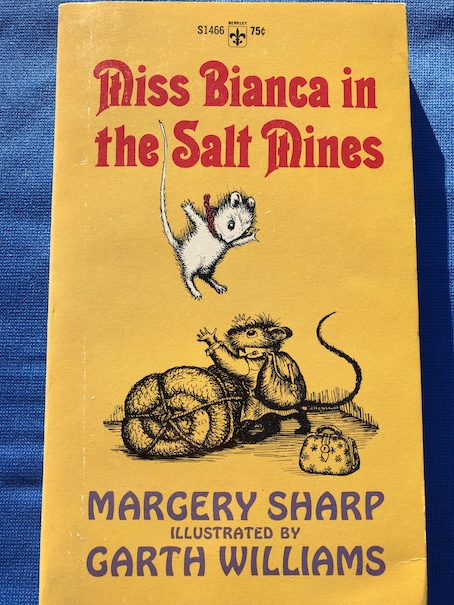
Miss Bianca in the Salt Mines

Miss Bianca in the Salt Mines by Margery Sharp, illustrated by Garth Williams, 1966.

This book is part of the Rescuers series.

When this story begins, Miss Bianca, who is Perpetual Madam President of the Mouse Prisoners’ Aid Society, is evaluating candidates for the Tybalt Stars award, which is given for mice who are brave in the face of cats. Bernard, the secretary of the society, is helping her. Each of the candidates is undeniably brave, but Miss Bianca notices that each of them also had a self-serving motive behind their bravery, which seems disappointing for a benevolent society. When they stop for lunch and Bernard goes to fetch some salt for them, he finds a note in the salt that says, “Someone please get me out of the salt mines.” The note is signed “Teddy (age 8).” Naturally, Miss Bianca is eager to help the poor boy! Bernard is a little more doubtful about the mission because the salt mines are about a thousand miles away, extremely dangerous, and extremely well guarded. Nevertheless, the Mouse Prisoners’ Aid Society cannot refuse to help a prisoner, and neither can its President.

Soon, Miss Bianca has members of the society trying to learn anything they can about a missing boy named Teddy, but apparently, no one has reported a boy by that name or age as missing. Bianca uses the lessons of the boy who owns her to learn more about the salt mines and how to get there. In order to get to the salt mines, they’d have to go by train, and it’s a very dangerous route. At the next meeting of the society, Miss Bianca asks for volunteers to go rescue Teddy, but everyone is reluctant to go, and many members of the society don’t like it that Miss Bianca doesn’t even seem to have any facts about Teddy or his situation that could help them. Miss Bianca says that, even though she can’t be more specific about Teddy’s background or how he came to be in the salt mines, the important fact is that he shouldn’t be there, and he needs help getting out. Since no one else wants to volunteer for the rescue mission, Miss Bianca says that she’ll go herself, and of course, Bernard insists on coming with her.

To Miss Bianca’s surprise, her biggest opponent, a curmudgeonly mouse called the Professor (his real name is George) who teaches mathematics, also volunteers to join the mission. Bernard and Miss Bianca are even more surprised when the Professor insists on bringing his friend Caerphilly along. Caerphilly is very elderly, but he’s also a professor of geology. Caerphilly has never actually been to the salt mines before, but he’s always wanted to see them and study them. Bernard and Miss Bianca aren’t sure that Caerphilly is up to handling the dangers that they’re likely to encounter on the mission. Miss Bianca reminds Caerphilly that this is supposed to be a rescue mission, not a scientific expedition. Caerphilly is unconcerned, saying that they can handle the rescue, and he’ll handle the science. Miss Bianca says that the Professor should warn his friend just what risks a rescue mission involves, but the Professor is also unconcerned, saying that the geology department at the university thinks too much of itself, and he wouldn’t mind seeing his friend chased by bloodhounds. (Some friend he is.) Miss Bianca is concerned both because of the danger and because their self-serving motives are just what she was concerned about before.

In spite of that, they decide to proceed with the mission, bringing the two professors. They take some time to make their preparations. Bernard and Bianca research the trains they’ll need to take. The Finance Committee allows them to take along the society’s Treasure – there’s only one, a single gold coin they found in a ruined building. Teddy might need this to pay for his train fare after they get him out of the mines. The Ladies’ Guild also knits mittens for the unfortunate boy because the salt mines are reportedly very cold. Miss Bianca tells the boy she lives with not to worry if he doesn’t see her for a week or so because she’s going to be writing an epic poem and needs privacy.

As they finally set out on their mission, the Professor is pessimistic, but the train journey is uneventful. When they arrive at the salt mines’ train station, it’s a very bare and gloomy building. Bernard finds a wooden door with some steps heading down.

At the bottom of the steps, they find themselves in an underground cavern filled with stalactites and stalagmites. There is also an underground lake surrounded by crusts of salt. The Professor realizes that they have entered the salt mines through a disused and forgotten entrance. In the distance, they hear the sounds of prisoners mining the salt.
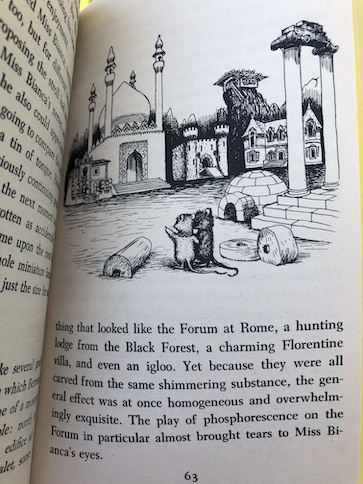
It’s a long walk to the active part of the mine, but along the way, they make an important discovery – a mouse-sized city carved out of salt! Each of the buildings in the miniature town are unique and resemble famous buildings from around the world. Miss Bianca thinks that the buildings were probably carved by prisoners who made buildings to resemble the places where they used to live. It’s the perfect place for the mice to stay, though.

Bernard, inspired by this strange place, tries to write a poem for the first time in his life, which isn’t very good. Miss Bianca tries to be nice about it, but he can tell that she doesn’t like it. Bernard is upset enough to try to drown himself (that part of the story struck me as rather shocking, although it’s handled so matter-of-factly as just a product of the weird atmosphere of this place), but he can’t because he just floats in the salt water. It seems like most of the members of the expedition temporarily forget about Teddy. Only Miss Bianca isn’t affected by this strange little town because she lives in a porcelain pagoda at home that her boy gave to her, so these buildings are very much like what she already knows.
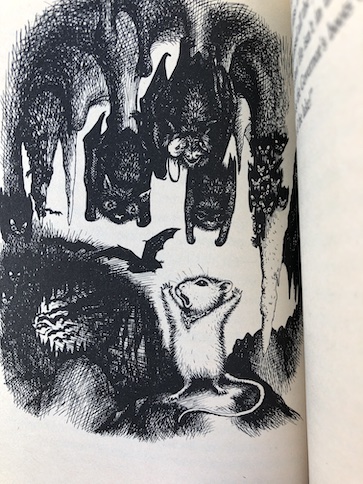
Fortunately, the expedition gets some help from some friendly bats who live in the mines. The younger bats in the group say that they’ve seen little Teddy serving the governor of the salt mines, who tends to stay apart from most of the prisoners because the prisoners have attacked him before. This is fortunate news because it means that Teddy is closer to the little salt town than they thought, and it won’t be as difficult to find him as they anticipated. He’s on an island in the middle of the lake of salt water, and that’s not too difficult to reach because Bernard has already proven that it’s easy to float in salt water.

Once they find Teddy, they also have to get him onto a train to get him away from the salt mines, which may not be as easy.

The book is available to borrow and read for free online through Internet Archive (multiple copies).

My Reaction and Spoilers

I generally prefer the plots of the Disney movies to the original books in this series, but this was still a fun story. I was a little disappointed that they never actually used the two professors’ specialties. I thought at first that they would use the geology professor to spout some interesting and useful facts about caves or mines, but they didn’t, and there was nothing in the story where a mathematics professor would be particularly useful. It just seems like a missed opportunity there.

There were some funny moments in the story. I liked the part where one of the bats, not really seeing Bianca clearly because bats are near-sighted, comments to another that, whatever it, if it moves, you should salute it, and if it doesn’t, you should paint it. Bianca takes that as a sign that this particular bat has completed his National Service, also noting that being near-sighted isn’t a barrier for bat National Service because, if it was, no bat would be able to participate.

In a twist at the end of the story, it turns out that Teddy used to live with his uncle and that Teddy’s uncle is the tutor for the boy that Miss Bianca lives with. Once Teddy is restored to his uncle, he comes to the house with his tutor and becomes friends with Miss Bianca’s boy.

Ben and Me

Ben and Me by Robert Lawson, 1939, 1967.

I remember reading this book in elementary school. It’s about Benjamin Franklin’s friendship with a talking mouse (fictional, of course), and how his mouse friend helped inspire him in his work.

The book begins with the author saying that this manuscript, supposedly written by Amos the mouse, was found in a small compartment in a room in an old house that was being renovated. The little compartment was furnished with miniature pieces of Colonial style furniture. The author goes on to say further that the manuscript has been authenticated as being early American and that the National Museum of Natural History has confirmed that the handwriting of the manuscript was done by a mouse. (I’d love to see comparisons of different animals’ handwriting and hear their explanation of how the handwriting of a mouse differs from the handwriting of other members of the rodent family, but trust us, kids, this is all very scientific.) The author says that this account of Benjamin Franklin’s life differs from the stories told by later scholars, but he trusts the descriptions of this mouse who was so close to Benjamin Franklin. (Yeah, sure, why not?)

In the “manuscript”, Amos says that he’s writing not long after the death of his friend, Benjamin Franklin, and some people have attempted to write about the life of Benjamin Franklin, but Amos isn’t satisfied with their accounts of his life and wants to write the truth himself. (Benjamin Franklin also wrote a famous autobiography, but they don’t mention that. I know that this is a story about a talking, writing mouse, but I’m just saying.) Amos says that, much as he liked Ben Franklin, Franklin was kind of stupid at times and that, as Franklin’s secret adviser, he was actually the source of many of Franklin’s greatest ideas.

Amos says that he was born into a large family of poor church mice. Then, during the winter of 1745, food grew scarce, and as the oldest of his siblings, Amos decided to set out to seek his fortune and maybe a way to help provide for the rest of his family. It’s a cold night, and lured by the smell of cheese, Amos finds his way into the house where Ben Franklin lives. He finds Franklin sitting and sneezing in a chilly room near a small fireplace. Ben is trying to write, but because of the sneezing, he’s not making much progress. Amos, cold and tired, climbs up on Ben and curls up in his fur cap and goes to sleep.

When Amos wakes up in the morning, the fur cap is hanging on the bedpost, and the room is still cold. Amos talks to Ben, recommending that he put more wood on the fire. Ben doesn’t question why a mouse is talking to him and just retorts, “Waste not, want not.” Amos points out that there will be plenty of waste and extra expenses if the cold makes him sick. Ben agrees with that and decides to use more wood on the fire. Then, Amos points out to him that the fireplace would be more effective at heating if it was in the middle of the room, explaining how his family used to gather around a hot chestnut to warm themselves. Ben is intrigued by the idea, and they discuss how a fireplace could be located in the middle of the room and how to handle the smoke from the fire. Ben excited sets to work building the stove according to Amos’s suggestions. His first attempt is a bit crude, but the stove works much better at heating the room than the fireplace did, and Ben is pleased. He shares some bread and cheese with Amos, and the two of them become friends.

Ben begins writing about the design of the stove as if he had created it all by himself, but Amos points out that Ben had acknowledged his contribution. Amos doesn’t care about getting fame or public credit for his contribution, but he needs food and has a large family to help provide for, so he and Ben work out an agreement: in exchange for Amos’s companionship and help, Ben agrees to leave regular supplies of food at the church for Amos’s family and to provide Amos and any descendants he may have food and a home in his fur cap. Ben sews some special compartments in the fur cap so that Amos has secure places to sleep and store a little food. There’s also a little compartment near Ben’s ear where Amos can quietly whisper suggestions to Ben.

Life with Ben isn’t easy. Amos hates it when Ben goes swimming and leaves his cap on the ground. One day, a dog steals the cap (along with Amos), and Ben has to chase the dog in order to get the cap and Amos back. Ben promises not to take the cap off his head ever again.

Amos also doesn’t like Poor Richard’s Almanack and doesn’t consider the facts or maxims it offers to be worth much. Ben points out that people do use his paper and its predictions of sunrise, sunset, and high and low tide, and the money the paper makes helps support them both. It also seems weird to Amos that Ben attributes everything to do “Poor Richard” when there is no such person. Amos starts substituting his own name for “Poor Richard” in the paper, and he also changes some of the predictions of times for the tides. It turns out that this is one area where Ben knows better than Amos because Amos predicts the wrong time for high tide and some ships are stranded. Confronted by the angry men from the ships, Ben points out that the paper with the wrong time says “Amos” instead of “Poor Richard”, so it can’t be his work. The angry people realize that Ben is right, and Amos realizes that he shouldn’t interfere with the paper.

Amos also hates it when Ben starts to experiment with electricity and Ben shocks him. He tells Ben to leave him out of his electrical experiments. However, Ben continues his experiments with a group of other interested people, disappointed that Amos doesn’t seem to understand what he’s trying to accomplish. Amos finally reads Ben’s writings about electricity and his experiment, and when a boy Ben got to assist him at one of his meetings uses Ben’s electrical device to shock the governor, Amos urgently whispers to Ben to stop the boy. Ben doesn’t consider the experiment to be a failure because it very effectively demonstrated how electricity affects human beings, although some people, including the governor, start avoiding Ben after the experience.

Then, Ben starts wondering if lightning and electricity are the same thing. Amos says he doesn’t care because both to those things should be avoided, whether they’re the same or not, and Ben says that he has “no vision.” Ben’s first experiment with lightning rods is frightening, even terrifying Ben to the point where he modestly refuses to take credit for the invention. In spite of that scare, Ben continues to wonder about the nature of lightning. He starts taking Amos with him while he flies kites for fun, and he rigs up a little car on the kite string for Amos so Amos can ride on the kite and come down when he wants to. Ben suggests that Amos that he could get a better view of lightning and describe it to him if he stays on the kite during a storm, and Amos refuses to consider it, but one day, Ben tricks him into doing it anyway. Amos is angry at Ben for making him suffer through the storm while he took shelter in a shed and refuses to discuss what he experienced with him. Burned with electrical shocks from the storm, Amos returns to his family at the church, where they dress his wounds, and he rests.

Ben comes to see Amos about their earlier agreement. Amos tells him that the electrical experiments were never part of the agreement and he will never return to him while he is doing these things. Ben agrees to stop all of the electrical experiments, and he and Amos write a new agreement with each other.

At this time, troubles are arising between England and the Colonies, and Ben is concerned. He tells Amos that he needs his skills for gathering information and asks him to accompany him to England to present the Colonies’ case before the King and Parliament. Amos initially agrees to go, but he backs out of the voyage when he sees that Ben has attached lightning rods to the ship. Pointing out to Ben that the lightning rods are a violation of their agreement, he returns to the church and lets Ben go to England alone.

While Ben is gone, Amos hears the people of Philadelphia talking about current events, like the stamp taxes, and how they feel about them. Amos finds himself siding with the colonists and wanting to do something to help, and he realizes that Ben is his best chance for helping to accomplish something. When Ben returns from England, Amos rejoins him, and he goes with Ben to the committee meetings he attends, including the one for writing the Declaration of Independence. Amos helps Ben by gathering information from other people. Amos meets another mouse named Red, who comes to Philadelphia with Thomas Jefferson and starts preaching revolution to the mice in town. Amos borrows some of the pieces of writing from Red’s Manifesto and tells them to Ben, who in turn, tells them to other members of his committee so they get included in the Declaration of Independence.

Then, George Washington says that the Colonies could really use some help and support from another country. Amos persuades Ben to suggest France. George Washington accepts the suggestion, and Amos accompanies Ben to France to ask for help from the French government. Ben enjoys the attention he gets from the ladies in France, frequently dining with his admirers. Amos is afraid of the ladies’ pet dogs and cats, though, so he persuades Ben to put most of his attention on a woman who doesn’t have cats. It turns out that this lady also has a mouse who lives with her named Sophia. Sophia is actually married, but her husband has been exiled to the United States, and her children are being held in the palace of Versailles. Amos wants to help Sophia, but he’s not sure how until after the Revolutionary War ends and Red arrives in France with Thomas Jefferson. Amos explains the situation to Red, and Red is more than eager to help assemble a force to stand up to the oppressive aristocratic French mice.

The mouse battle that follows terrifies the human French court, but the mice successfully rescue Sophia’s children. Ben suddenly finds himself a social outcast for bringing mice to the royal court, so he’s ready to return home, bringing Sophia and her children with them. Ben is welcomed home as a hero by the humans. Sophia is reunited with her husband, and Amos remains a friend of the family. Three of Sophia’s oldest children marry Amos’s three youngest siblings, tying their families together.

The story ends with the mice giving Ben a nice, new hat for his birthday. Ben keeps the old one just as a house for Amos to live in, but Amos is mostly retired, his time occupied by teaching his young nieces and nephews.

The book is available to borrow and read for free online through Internet Archive (multiple copies). There is also a Disney film based on the book that is also on Internet Archive (about 21 minutes long).

My Reaction

I remembered liking this story when I was a kid, but I’m not as fond of it now. I don’t like books with intentionally stupid characters, and in this case, the intentionally stupid character is a real, historical person, which doesn’t seem fair. I know it’s supposed to seem humorous, but it just doesn’t seem to hold up after all these years.

I also hated the part where Ben intentionally kept the poor mouse up in a kite for half an hour during a terrifying storm. It’s just so cruel, even though it’s supposed to humorous. What can I say? I have a soft spot for cute, fuzzy animals, and I just don’t like to think of any little animal suffering, even if it’s in blatantly ridiculous circumstances.

I had forgotten about the Disney cartoon, although I think I remember seeing that when I was a kid, too.

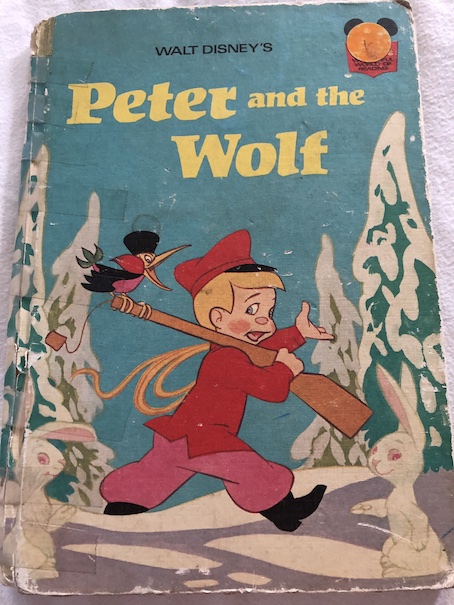
Peter and the Wolf

Peter and the Wolf by Walt Disney Productions, 1974.

This is the picture book version of Disney’s cartoon from 1946 based on Peter and the Wolf, which was originally a musical symphony for children, written by Sergei Prokofiev in 1936 for the Central Children’s Theatre in Moscow.

Young Peter lives with his grandfather near a forest in Russia. Peter’s grandfather warns him to stay away from the forest because there are hungry wolves there, but Peter thinks that he can catch a wolf himself. One day, while his grandfather is asleep, Peter sneaks out of the house to go catch a wolf.

Along the way, Peter’s friend, Sasha the bird, also warns him that there really are dangerous wolves in the woods and that he can’t hope to catch one with his toy gun. Peter insists that he’s going to try anyway, and Sasha says he’ll go along and help.

As they venture further, they are also joined by Sonia the duck. Ivan the cat tries to eat Sasha, but Peter makes him let Sasha go. Then, suddenly, a wolf appears!

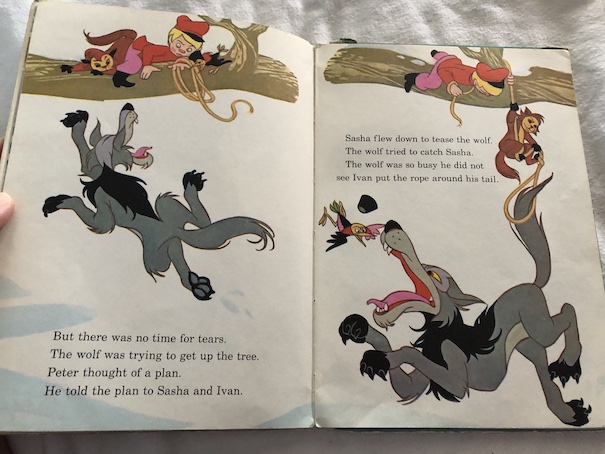
The wolf chases Sonia, and at first, the others think he actually caught and ate her. They manage to catch the wolf by the tail. Sasha attracts some help from some passing hunters.

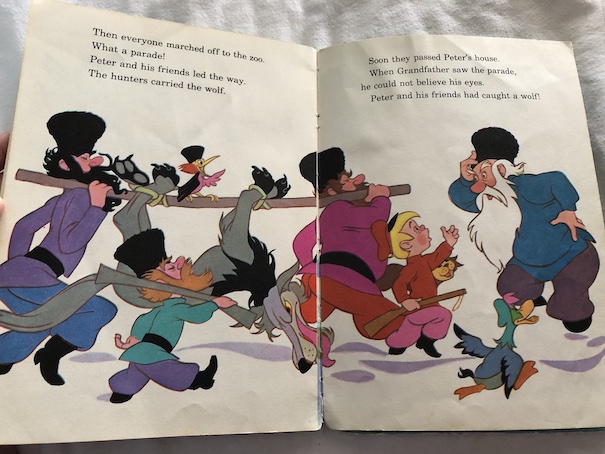
At first, the hunters want to shoot the wolf, but Peter asks them to take the wolf to the zoo instead, realizing that the wolf was just hungry. It tuns out that Sonia is safe after all, and they all take the wolf to show Peter’s grandfather.

The book is available to borrow and read for free online through Internet Archive (multiple copies).

Stone Soup

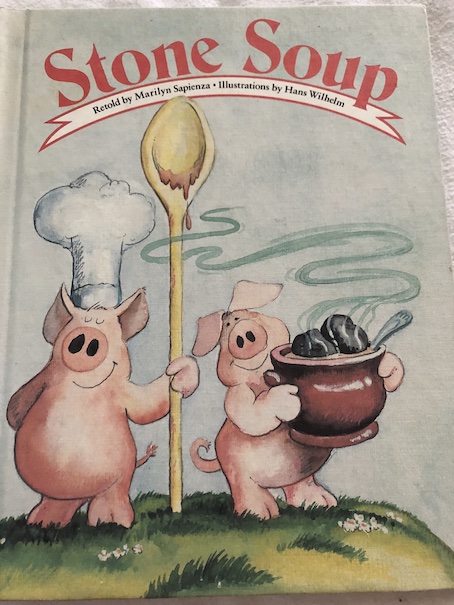
Stone Soup retold by Marilyn Sapienza, illustrations by Hans Wilhelm, 1986.

This is a retelling of a traditional folktale, sometimes called Stone Soup and sometimes Button Soup (and other names). The basic story is the same, but sometimes, it uses a stone and sometimes a button. All of the characters in this particular version of the story are represented by animals. Some of the pictures are in color, and some are black-and-white.

Max and Molly are backpacking across country, and they are getting tired and hungry when they spot a village. Hoping to get something to eat there, they decide to approach the villagers and ask for food.

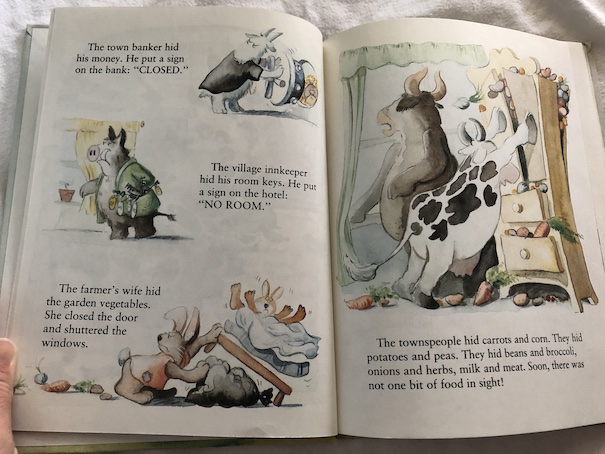
However, the villagers are not friendly, and the last thing they want is to share their food or anything else with strangers. As soon as they see Max and Molly coming, they quickly hide their food and anything else the travelers might want them to share. (I’m not sure why the innkeeper closes his hotel as soon as he sees potential customers coming. You can’t stay in the hospitality industry very long like that.)

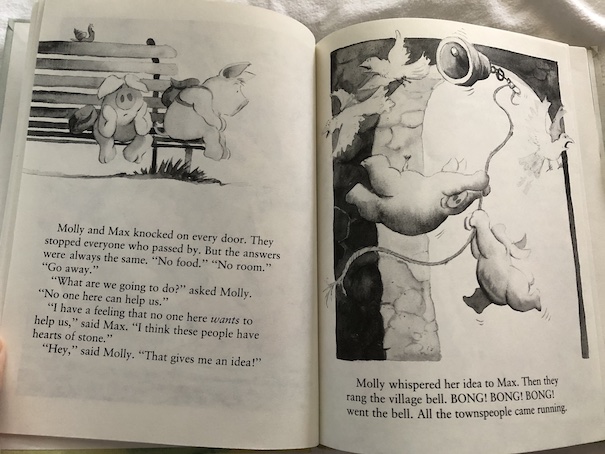
When Molly and Max get into town, all of the villagers pretend like they’re starving and refuse to help Molly and Max. However, they see through the villagers’ act and come up with a plan of their own.

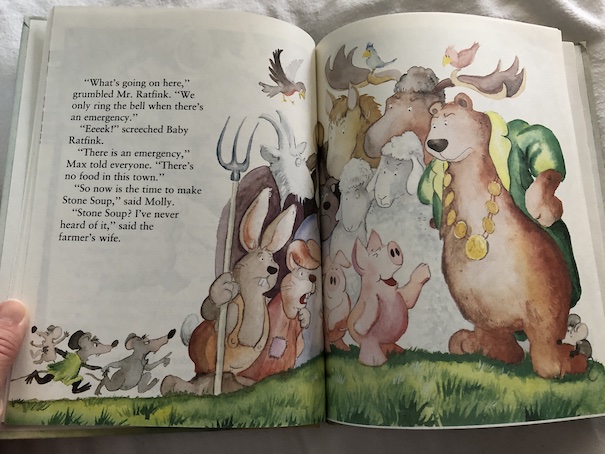
They ring the village bell to call of the people in the village. At first, the villagers are irritated because the bell is only for use in emergencies, but Molly and Max say that having no food is an emergency and that they have a plan to solve it. They are going to teach the villagers to make Stone Soup.

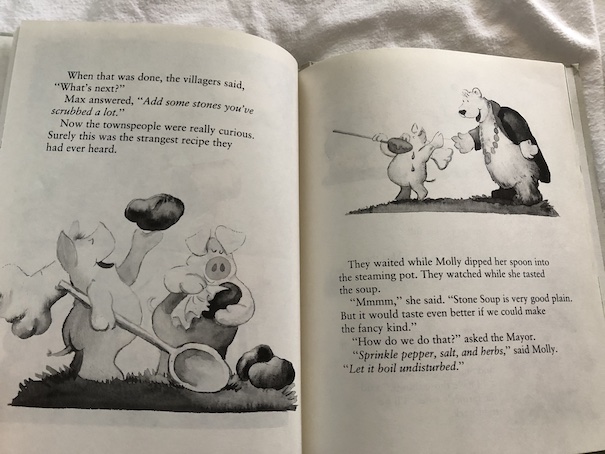
The villagers say that they’ve never heard of Stone Soup, and Molly says that it’s a secret recipe that she’s willing to share. It starts with a pot of hot water and some stones. Molly makes a show of tasting the “soup” and says that it’s good, but it’s even better if you make “the fancy kind.”

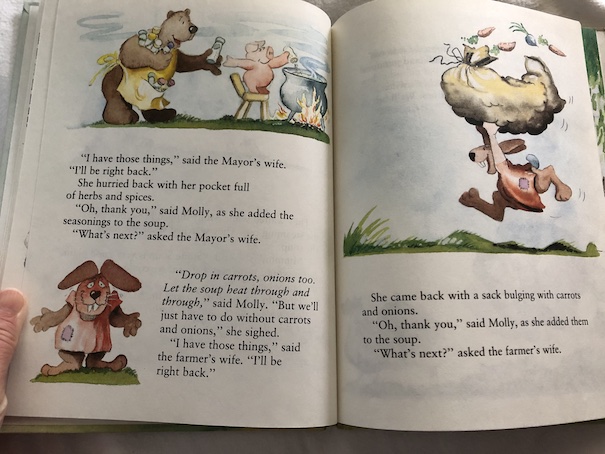
When the villagers ask how to make the fancy kind, she asks for some salt, pepper, and herbs. After the mayor’s wife supplies those, Molly asks for some carrots and onions. When she says that she supposes that they’ll have to do without them, the farmer’s wife steps up and offers some.

Little by little, Molly and Max coax the villagers into supplying other ingredients, almost without realizing what they’re doing. In the end, the Mayor of the village says that it’s the best soup he’s ever tasted, and it’s amazing, considering that it was only made with stones and water.

The moral of the story is that everyone benefits when people are wiling to share. Everyone gets a share of the soup, but when they start serving it, the villagers also provide other food to eat alongside it, and they all have a feast. The innkeeper gives Molly and Max a room for the night, and when they leave in the morning, they remind the villagers to “Share Stone Soup with everyone.”

In the back of the book, there is the complete recipe for Stone Soup, with rhyming steps. It doesn’t have details, like amounts and cooking times and temperatures, but I suppose someone could use these general guidelines to make an improvised soup. Really, I think the meat should be precooked if you’re adding it as a final ingredient. Otherwise, the veggies would be overdone before the meat is fully cooked.

There are many different versions of this story that have been made into picture books. I haven’t been able to find a copy of this particular book available to read online, but you can find various versions other versions of the same story online through Internet Archive.

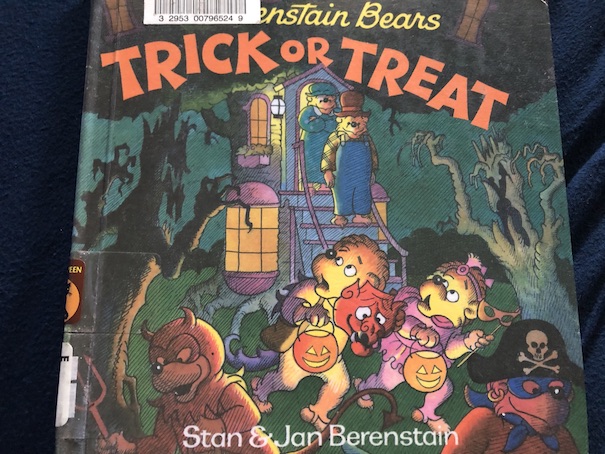
The Berenstain Bears Trick or Treat

The Berenstain Bears

The Berenstain Bears Trick or Treat by Stan and Jan Berenstain, 1989.

“Even little bears
expect a good fright
when they go out for treats
on Halloween night.”

Brother and Sister Bear are looking forward to trick-or-treating on Halloween night with their friends. Sister is going as a ballerina, and Brother is dressed as a monster. When Brother jumps out at Mama in his monster costume, she pretends to be frightened, and when he takes off his mask, Mama comments that “appearances can be deceiving.” Sister asks what that means, and Mama explains that “things aren’t always what they look like.”

This is the first year that Brother and Sister will be allowed to go out trick-or-treating without their parents. They plan to trick-or-treat with friends, and they talk about the houses that they plan to visit. The one house in the neighborhood that they don’t want to visit belongs to Miz McGrizz. Miz McGrizz’s house looks spooky, and the kids think that she might be a witch. Mama tells them that’s nonsense and that Miz McGrizz is a nice person.

As the young bears set out to trick-or-treat with their friends, some of the bigger, tougher cubs in the neighborhood try to talk them into joining them in some pranks. First, they want to decorate Miz McGrizz’s house with toilet paper.

However, before the cubs can do anything, Miz McGrizz comes out of her house, and seeing the cubs, tells them that she’s ready for them. Although the kids are frightened at first, it turns out that Mama really was correct about Miz McGrizz. Miz McGrizz is just a nice old lady who has a special treat for the cubs who are brave enough to visit her house.

In real life, trick-or-treaters shouldn’t go into the houses of people they visit unless they know them very well, but in this case, it’s not so bad because the cubs’ mother approves of Miz McGrizz and would be fine with the children visiting her.

The book is available to borrow and read for free online through Internet Archive (multiple copies).

Trouble at School

The Berenstain Bears

Trouble at School by Stan and Jan Berenstain, 1986.

“When a problem at school
Is kept secret too long,
It can grow ’til a cub
Thinks that everything’s wrong!”

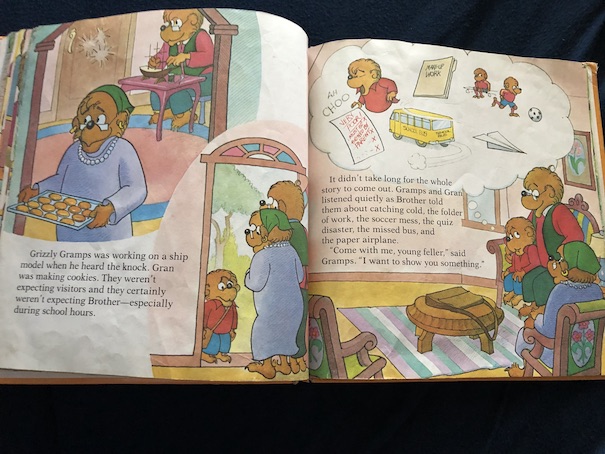
Brother Bear runs into problems at school after he catches a bad cold. While he’s recovering from his cold, he is allowed to watch tv and read comic books. His teacher sends home a packet of schoolwork for him to do, but he ignores it and forgets about it.

He doesn’t remember the packet of work until he’s better and going back to school. However, he soon becomes preoccupied with the news that Cousin Freddie has taken over his position on the soccer team during his absence.

When his teacher gives a quiz on the new lesson in division, Brother fails it. Brother is supposed to show the quiz to his parents and have them sign it, but his parents become preoccupied with Sister, who is now sick, and Brother doesn’t show them the quiz.

The next day, Brother is so upset about his bad grade and what’s happening on the soccer team that he doesn’t go to school. He makes his quiz into a paper airplane and throws it away.

Then, Brother gets the idea of going to see his grandparents for help. He explains the entire situation to them. His grandfather tells him a story that helps put the situation in perspective.

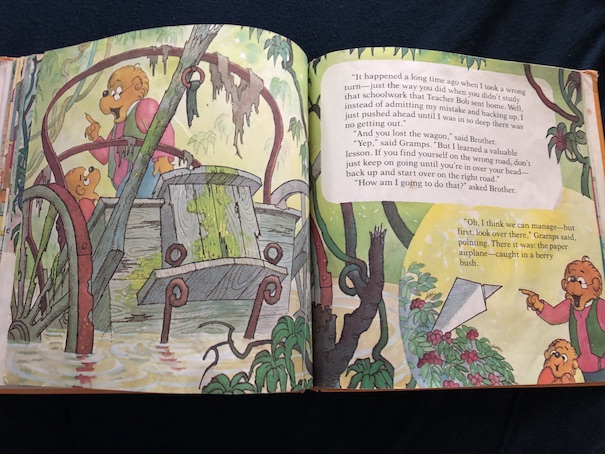
There was a time when Gramps did something wrong, and instead of admitting his mistake, he just kept going and made the problem worse, like Brother did by ignoring his schoolwork and not telling his parents about his problems at school. Gramps says that it’s best to admit when you’ve made a mistake so you can do what you need to do in order to turn the situation around.

They find the quiz that Brother threw away and go home to tell Brother’s parents about his school problems. They’re not happy about the situation, but they tell Brother that “It’s never too late to correct a mistake,” and Gramps proves to Brother that he can do division by having him divide a bag of cookies among the family members.

When Mama takes Brother back to school, he learns that nobody else in class did very well on the quiz, so the teacher is letting them do a retake. Now that Brother realizes what division is really about, he does much better. At the soccer game that afternoon, Brother also gets a chance to retake his old position on the team. If he hadn’t gone to school that day, he would have missed these chances to make things right, but because he did go and took the second chances that he was offered, things were much better by the end of the day.

Adults reading the story will recognize that the reason why Brother’s parents are supposed to sign his failed quiz is because that is how the teacher draws parents’ attention to problem areas that their children have so they can make sure that they can pay extra attention to the child’s homework and help him with his problem areas. It’s not about shaming or punishing the child but getting the child the help he needs to understand the subject. By hiding the bad quiz from his parents, Brother was avoiding the help that his parents were supposed to provide and making the situation worse. Parents can be disappointed when their children bring home bad grades, but this is a situation where parents would rather know than not know if their children are struggling with something because they generally want to help their children when they need it.

The lesson of the story is a good one. Anyone can occasionally make mistakes, have problems, or just plain fail at something, but the people who succeed in the end are the ones who face up to their problems and do what’s necessary to make them right. Some people feel overwhelmed when confronted by problems, but the best thing they can do is admit that there is a problem and that they’re feeling overwhelmed and get help from someone else. Brother could have just told his parents and gotten help with division immediately, as soon as he realized that neglecting his make-up work had left him behind in class. At first, he was too embarrassed and worried to do that, but he did manage to turn things around by talking to his grandfather about his problems and taking the help and advice that he offered. Making mistakes or even failing something doesn’t have to be scary or overwhelming because there are always things you can do to make the situation better and people who are able to help.

The book is available to borrow and read for free online through Internet Archive.

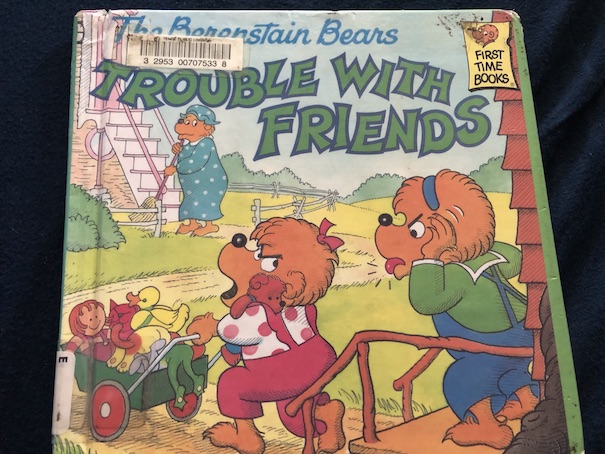
The Berenstain Bears and the Trouble with Friends

The Berenstain Bears

The Berenstain Bears and the Trouble with Friends by Stan and Jan Berenstain, 1986.

“When making friends,
the cub who’s wise
is the cub who learns
to compromise.”

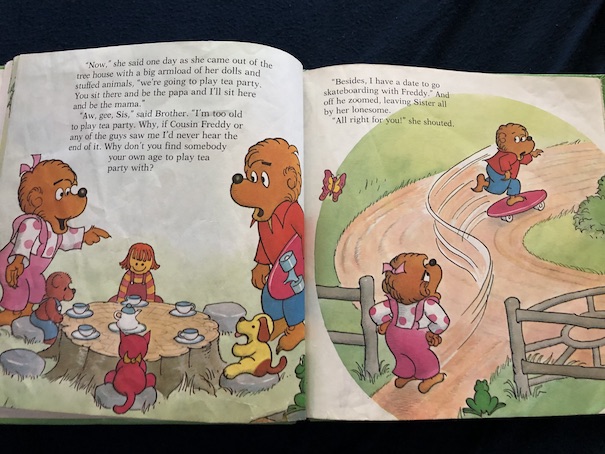
Brother and Sister usually play pretty well together, but Brother is two years older than Sister, and he doesn’t always want to play girls’ games like tea party and house. Brother likes to hang out with Cousin Freddy, but Sister doesn’t have a friend who lives close enough to play with her after school.

Then, one day, a new family moves in down the road, and they have a girl who’s Sister’s age. The new girl’s name is Lizzy, and she likes to do many of the things that Sister likes to do. The girls start playing together right away. Sister thinks that Lizzy is fun, but a little bossy … kind of like Sister herself.

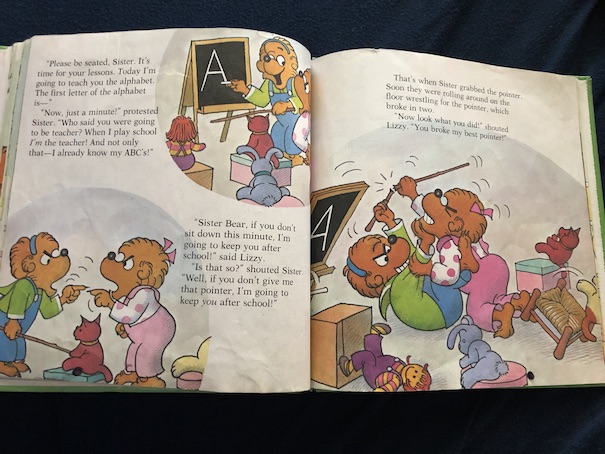
Later, Sister takes some of her stuffed animals to Lizzy’s house so they can play school. However, the girls argue over who is going to play the part of the teacher. Both of them want to play the teacher, and during their argument, they break Lizzy’s pointer stick.

Sister goes home angry, but Mama Bear reminds her of the reasons why she might want to make up with her new friend. Getting along with people can be difficult, but there are many things that are difficult to do alone. Having friends can be a lot of fun, certainly much more fun than sitting home and being lonely. If Sister wants to make up with Lizzy, she needs to accept her for the person she is and recognize that she can be a bit bossy herself sometimes. Both of the cubs need to give a little, let each other have their way sometimes, and care about each other’s feelings.

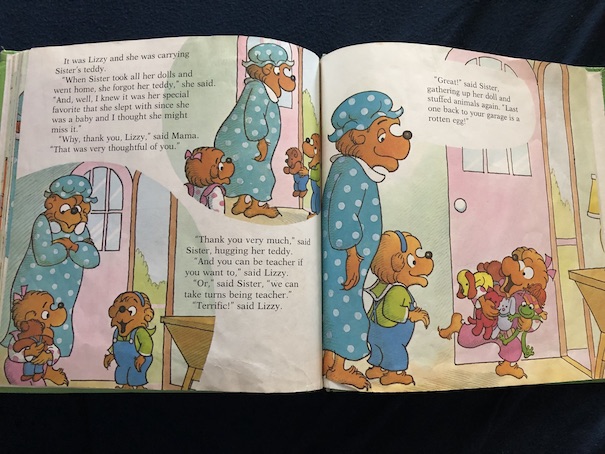
Lizzy drops by to return Sister’s teddy bear, which she left behind. She remembers what Sister told her about her teddy bear and why it’s important to her, showing that she does care about Sister’s feelings. The girls make up and agree to compromise and take turns being the teacher when they play school. Both the girls realize that getting along with friends means considering each other’s feelings and being willing to compromise.

The book is available to borrow and read for free online through Internet Archive (multiple copies).

Day and Night

Day and Night by Roger Duvoisin, 1960.

Night is an owl who likes to go out hunting for food at night, and Day is a poodle who lives with family called the Pennyfeathers. Because Day is usually only out during the day and sleeps in the family’s house at night, they don’t usually meet. However, by chance, Day rescues Night from a fox.

Night is grateful, and the two of them become friends. However, because they are normally active at very different times, they can’t easily meet to talk to each other.

They sometimes leave each other little treats, like a bone with some meat or something from one of Night’s hunts.

They also begin meeting at the kitchen door at night to talk to each other.

However, Day’s barking and Night’s hooting is too loud, and they start keeping the Pennyfeathers awake at night. At first, they can’t figure out why Day keeps barking every night, but their son, Bobby, sneaks out one night and sees the way Day seems to be talking to the owl.

Bobby correctly realizes that Day and the owl are friends and that they’re just trying to talk to each other. To solve the problem, Bobby builds a dog house for Day so that Day can comfortably sleep outside and talk to his owl friend without disturbing everyone.

Day likes the new dog house, and Night meets him there every night so the two friends can talk whenever they want.

My Reaction

This is a cute picture book that I’ve liked since I was a kid. I like the way that Day and Night talk to each other and some of Day’s misconceptions about what his humans are thinking. When Mr. Pennyfeather yells at them to be quiet, Day tells Night that he thinks Mr. Pennyfeather is barking at the moon.

Some of the pictures are in black-and-white and some are in color. It seems to be common in older picture books to have a mixture of black-and-white and color images. I think it might partly have been done to save money on printing.

Spot Visits the Hospital

Spot

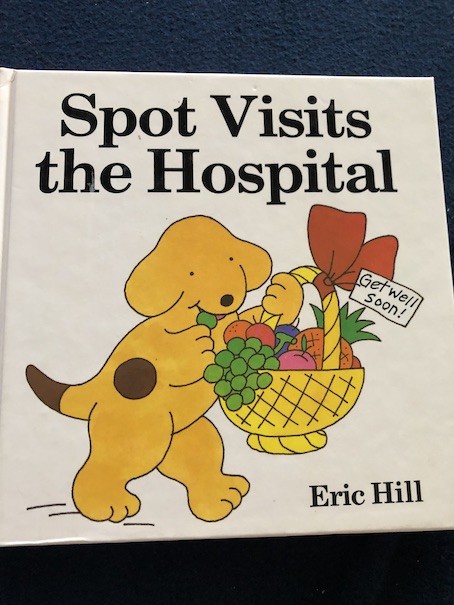
Spot Visits the Hospital by Eric Hill, 1987.

Spot’s friend Steve, who is a monkey, is in the hospital with a broken leg. Spot and some of their other friends decide to go visit him and take some presents to cheer him up.

Steve likes their presents, and Spot and his friends sign Steve’s cast. They play in the hospital’s playroom, where they have toys, games, and books for child patients.

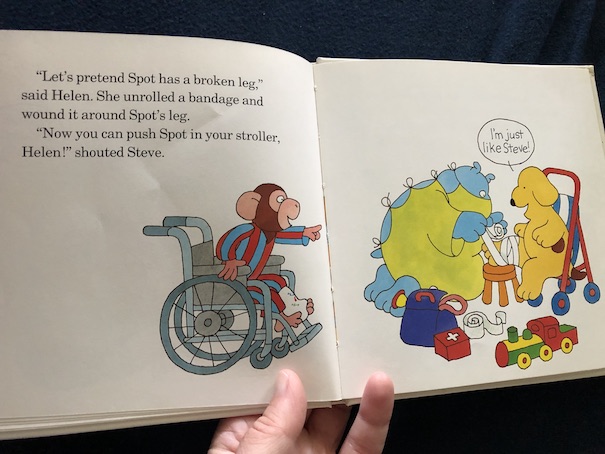
Spot’s friend Helen decide to play doctor, and she puts a bandage on Spot’s leg, as if his leg is broken, like Steve’s. They start pushing Spot around in a stroller, like it’s a wheelchair.

Their friend Tom hides, and they all go looking for him, finding him in an x-ray room. In real life, they would probably get in trouble for goofing off around the x-ray equipment, but in the book, nobody catches them doing it. I think the reason why the book has this episode in it is to have a reason to show readers the x-ray equipment and explain how the doctors used it to examine the break in Steve’s leg.

Spot is fascinated by what he sees in the hospital and tells his mother that he might like to be a doctor someday.

This story could encourage children who find the idea of studying medicine and helping people interesting, but it also makes a visit to the hospital seem less scary for children who may worry about what happens there and what all the big machinery, like the x-ray machines, are for.

The book is available to borrow and read for free online through Internet Archive.

Spot Goes to the Beach

Spot

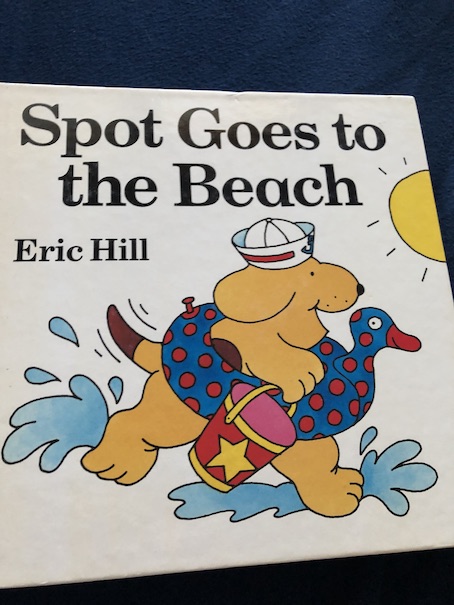
Spot Goes to the Beach by Eric Hill, 1985.

Spot’s parents take him to the beach to spend the day there. When they get to the beach, Spot wants to get a sailor hat from a stand selling beach equipment, and his father also buys him some beach toys.

Spot plays with a beach ball, builds sand castles, and buries his father in the sand.

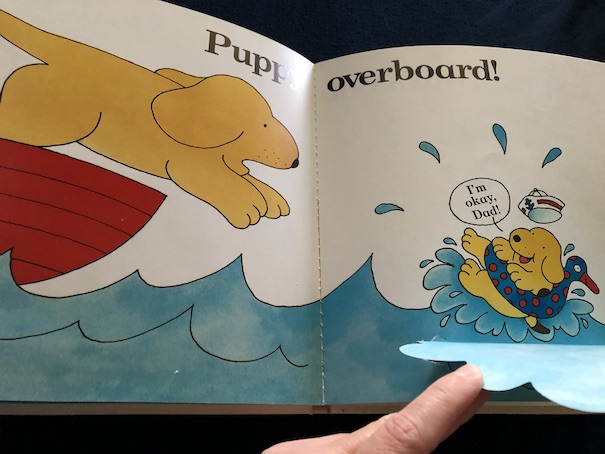
Spot and his father later go fishing, and Spot falls in the water, but Spot is fine because he’s wearing a pool float.

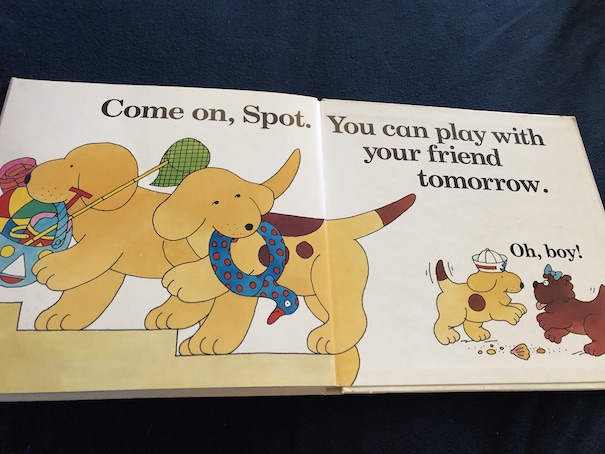
Before they leave the beach, Spot also makes a new friend, another puppy!

This is just a cute book for children about the fun things that they can do at the beach.

Like other Spot books, this book is a lift-the-flap picture book. The British version of the title is Spot Goes on Holiday. It’s available to borrow and read for free online through Internet Archive (multiple copies).