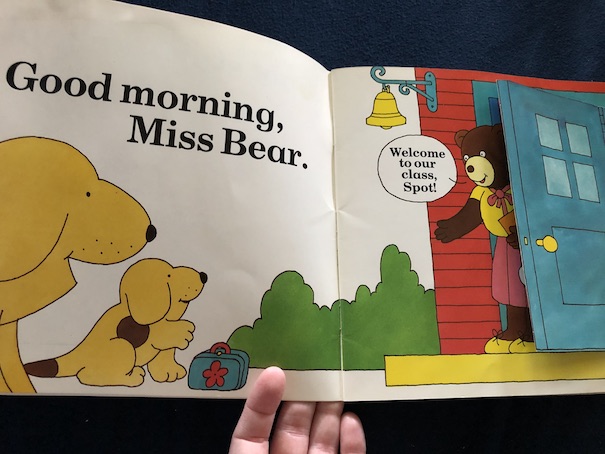
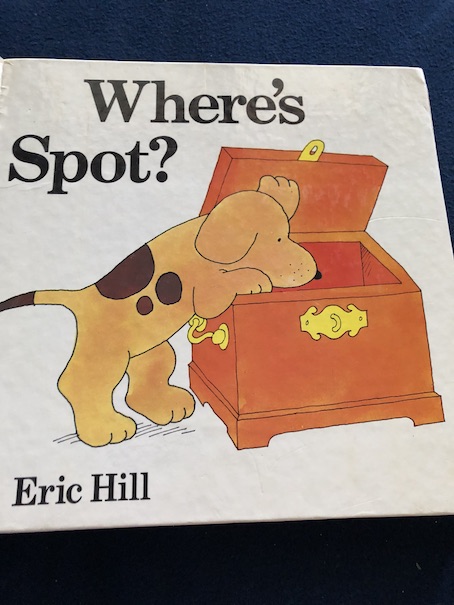
Spot is going to school for the first time. His mother drops him off at the school, where he meets his teacher, Miss Bear.
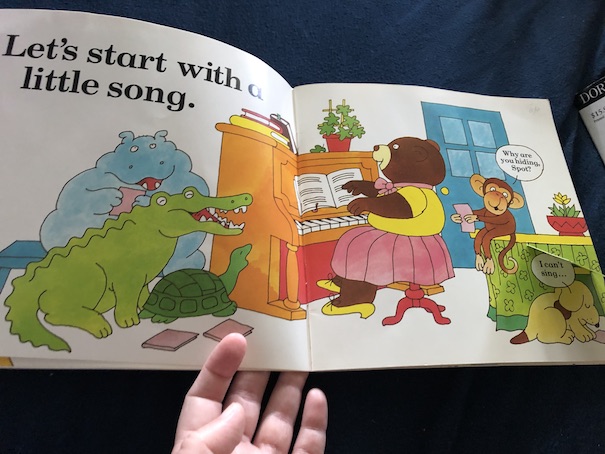
Spot and his animal friends participate in typical kindergarten activities. They sing a song while their teacher plays the piano (although Spot hides because he can’t sing), and they play dress up in the classroom playhouse.
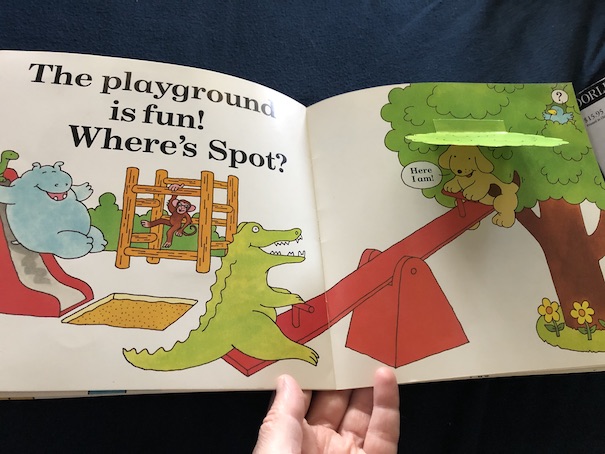
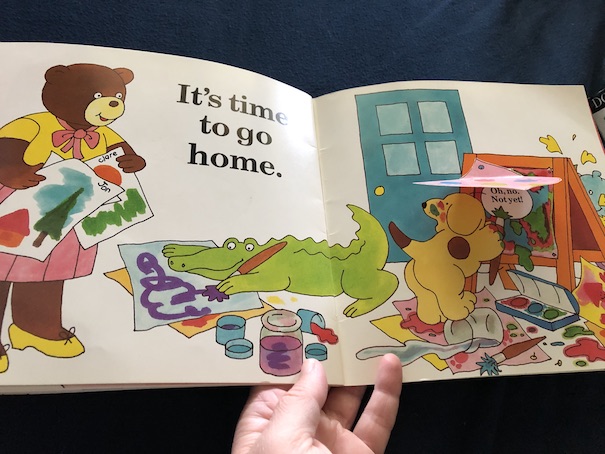
They play on the playground and show what they brought for show-and-tell. Spot roughhouses with a friend during storytime, and he loves painting pictures with his friends. When school is over, Spot doesn’t even want to go home because he’s had so much fun!
Like other Spot books, this is a lift-the-flap book. It is available to borrow and read for free online through Internet Archive (multiple copies), but to be honest, it’s not as much fun to read electronically because you can’t experience the lift-the-flap effect.
This is the first modern lift-the-flap book for children, inspired by the author’s young son, who was playing with some sheets of papers on which he had drawn some concepts for an advertisement. There was an earlier style of lift-the-flap book from the 18th century, but this first book in the Spot the Dog series led to the popularization of modern lift-the-flap books for children.
Spot’s mother, Sally, notices that her puppy hasn’t eaten his dinner. She doesn’t know where he is, so she goes looking for him.
Sally searches for Spot all around their house, looking behind a door, in a closet, inside a clock and piano, under the stairs, and under the bed. In each place, she finds different animals (no explanation, there are just a lot of animals in this house).
Finally, the turtle hiding under the rug suggests that Sally check the basket, which is where she finally finds Spot.
The story is very simple, and the lift-the-flap concept is what really makes it work. The interactive element is fun, as if the readers are participating in a game of hide-and-seek with the characters. Kids enjoy being surprised by the different kinds of animals hiding all over the house. I loved it when I was a kid!
The book is available to borrow and read for free online through Internet Archive (multiple copies), but to be honest, it’s not really a good book to read online because the lift-the-flap effect doesn’t carry over.
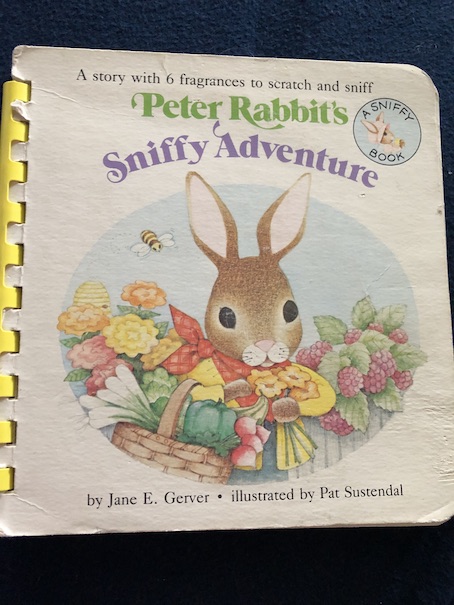
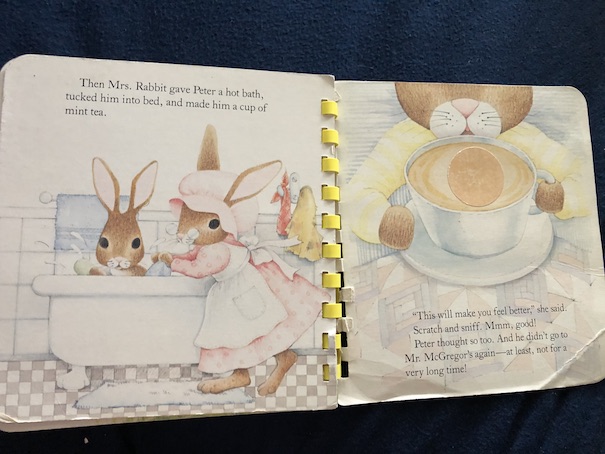
Peter Rabbit’s Sniffy Adventure by Jane E. Gerver, illustrated by Pat Sutendal, 1984.
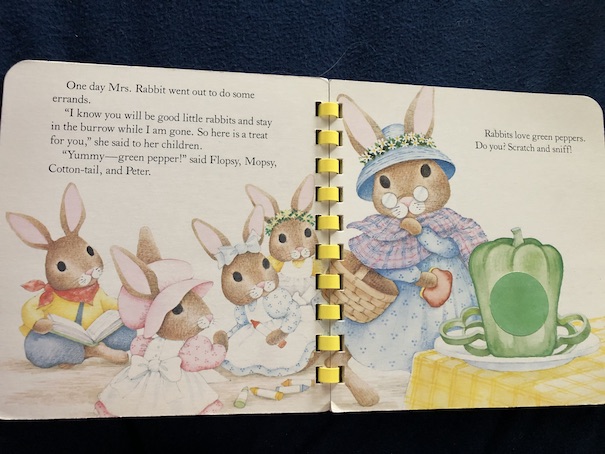
Sniffy books, or scratch-and-sniff books, were popular during my early childhood in the 1980s, and they are still being made today. Scratch-and-sniff books are picture books with special patches that release a scent when they’re scratched. Kids like interactive books, so it can be fun for them to scratch a flower or some food in a picture and then smell it. I know from my old books that these scented patches eventually wear out, although I’m amazed that some of them still have a scent more than 30 years after the books were originally made. I had expected that the ones that my brother and I liked and scratched the most would be the ones that would eventually wear out the fasted, but it also depends on the strength of the original scent. The milder, more subtle scents are often more difficult to smell decades later. Scratching a little harder can sometimes help. If you look carefully at the pictures of our old book, you can see where the round scent patches are on the illustrations.
This book is based on The Tale of Peter Rabbit by Beatrix Potter. It’s meant as a continuation of Peter Rabbit’s adventures.
Peter Rabbit lives with his mother and three sisters. One day, Mrs. Rabbit leaves her children alone while she goes to run some errands, giving them a green pepper to eat while she’s gone.
Then, Peter’s cousin, Benjamin comes by and asks Peter to come with him and visit Mr. McGregor’s garden. Peter is reluctant to go because of the trouble that he got into the last time, but Benjamin finally persuades him to come.
In Mr. McGregor’s garden, the bunnies eat raspberries, get into a sawdust pile, and stop to pick some flowers. Peter’s clothes become more dirty, stained, and torn through their adventures.
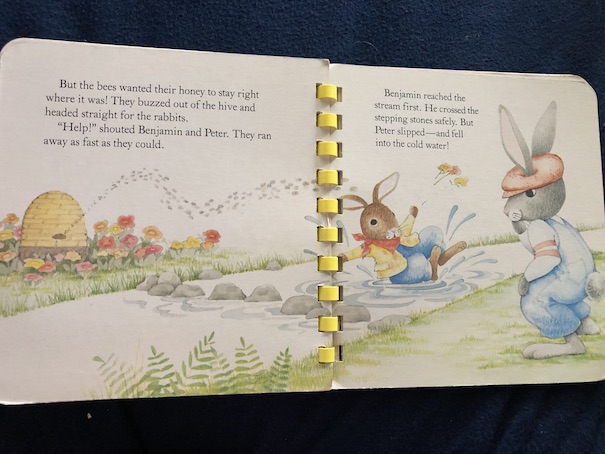
Then, Benjamin spots a beehive and suggests that they get some honeycomb to take home. They end up angering the bees, and Peter falls in a stream as they run away.
When he returns home, Peter is a mess, and he apologizes to his mother for going to Mr. McGregor’s, promising not to do it again. His mother gives him a bath and puts him to bed with a cup of mint tea.
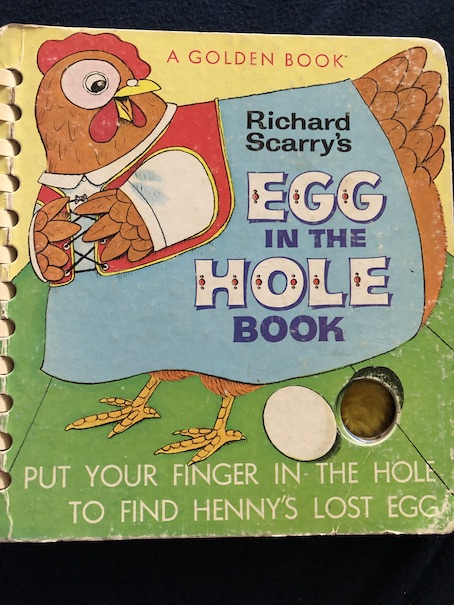
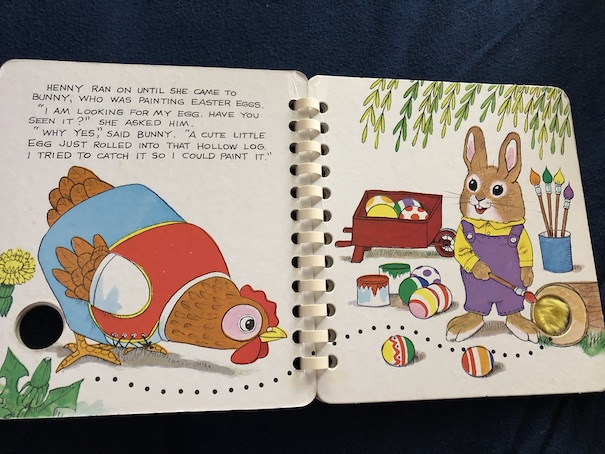
This is a board book with a very special feature: a hole that goes all the way through the pages to the back of the book. There is something yellow, soft, and fuzzy in the hole, and it becomes obvious as you read the book what it is.
Henny lays an egg in the barn’s hayloft, but she loses it when it rolls through a hole. The anxious chicken immediately chases after it.
Down below, Billy Goat tells her that the egg fell on the ice cream that he was going to eat for dessert and then rolled out the window.
From there, Henny follows the egg’s path along a rain gutter, out a down spout, through a fence, into a hollow log, and eventually, into a hole in the ground.
When Henny fears that her egg is lost in the hole, a mouse comes out to tell her that the egg broke, but it has hatched into Henny’s new baby chick! (The yellow, soft, fuzzy thing.)
My brother and I used to like this book when we were little kids. I think of it as a kind of Easter story because of the bunny painting Easter Eggs, although the book isn’t really about Easter. Baby chicks are also often associated with Easter. It’s cute how the egg’s path is marked by little dots as it rolls across the barnyard, and the gimmick with the holes in the pages is clever.
The book is available to borrow and read for free online through Internet Archive (multiple copies). Of course, you can’t quite enjoy the effect of the hole feature with the electronic copies.
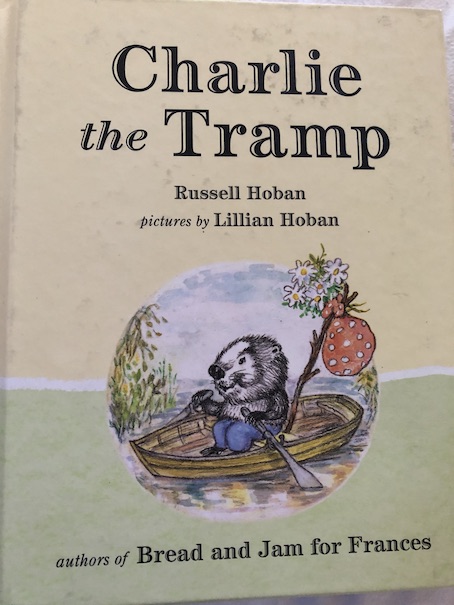
Charlie the Tramp by Russell Hoban, illustrated by Lillian Hoban, 1966.
Disclosure: I am using a newer edition of the book, published by Plough Publishing House. Plough sent a copy to me for review purposes, but the opinions in the review are my own.
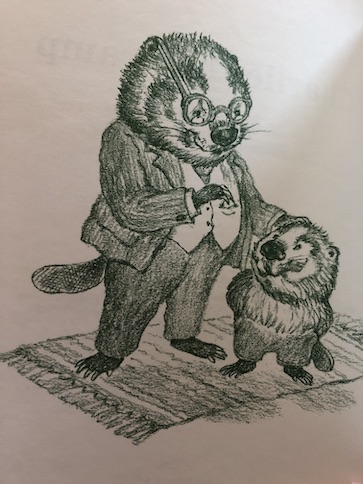
One day, when Charlie Beaver’s grandfather comes to visit, his grandfather asks him what he wants to be when he grows up. The grandfather assumes that he knows the answer to the question because everyone in the family is a beaver, and beavers naturally do beaver work. (Beaver is apparently both species and profession in books where beavers talk and wear clothes.) However, Charlie stuns his family when he declares that he wants to be a tramp.
Few families would be happy to hear a child say that he wants to be a tramp. Charlie’s grandfather says that he’s never heard a child want to be tramp, and his mother says that she doesn’t think he means it. However, Charlie thinks that being a tramp would be good because he wouldn’t have to learn how to chop trees or build dams or other routine jobs. Charlie thinks that tramps have a lot of fun and just work now and then at little jobs when they need something to eat. Charlie thinks that the little jobs would be much more fun than the ones his father really wants him to do. Charlie’s grandfather says that kids these days just don’t want to work hard.
However, Charlie’s parents decide that if he wants to be a tramp, they’ll let him try it out. Charlie makes himself a little bundle with some food, and his parents let him sleep outside, telling him to come back for breakfast. Both the father and grandfather quietly admit that they both wanted to be a tramp when they were his age, so it’s not just kids these days.
Charlie has some fun, roaming the countryside, sleeping under the stars, and enjoying his freedom. In the morning, he comes home and does some chores to earn his breakfast, lunch, and dinner. In between, he goes out to roam the countryside again.
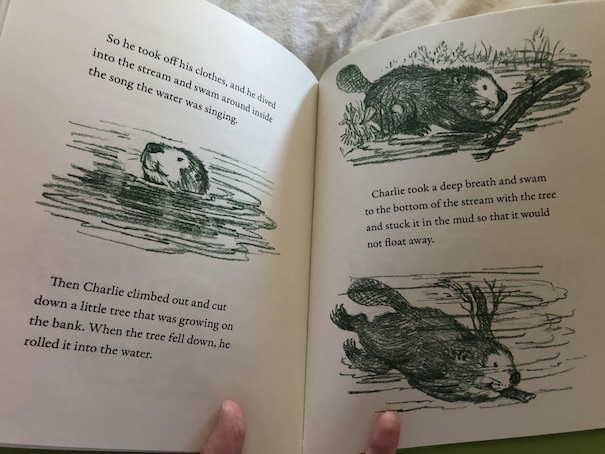
Charlie begins to notice that something keeps waking him up in the night, an odd sound that he can’t identify at first. Eventually, he realizes that it’s the sound of a nearby stream. For some reason, the trickling sound of the stream seems nice but makes him feel restless. It inspires him to swim in the stream and begin building his own dam, working through the night.
When Charlie sleeps through breakfast, his family comes looking for him and admires the good job that Charlie did on his dam and the pond that he has created. When they ask him about why he was making a dam when he was trying to be a tramp, Charlie says that he likes doing both and can do either sometimes. His family is satisfied that Charlie is a good worker, and his grandfather says, “That’s how it is nowadays. You never know when a tramp will turn out to be a beaver.”
It isn’t that Charlie expects to go through life without doing work because he insisted on working to earn his meals even when he was being a tramp. It was more that Charlie wanted the freedom to decide when he wanted to work and what kind of work he was going to do. However, he is a beaver and has a beaver’s instincts. In the end, he sees the appeal of doing a beaver’s work, building dams, enjoying it because he made the dam himself in the way he wanted to make it. I think it shows that when a person has the knowledge and ability to do something and the interest in doing it, they will eventually use their skills, perhaps in surprising ways. I remember reading some advice to writers that said that people write because “they can’t not do it,” and that’s true of many aspirations in life. Sometimes, when people know what they really want to do with their lives, they can’t resist doing it, and sometimes, people realize what their aspirations are when they find something that they can’t resist doing. Charlie is a beaver because it’s a part of who he is, and he can’t not do it. As he grows up, he will continue growing into that role, just as human children eventually grow up to be the people they are going to be.
This book is available to borrow for free online through Internet Archive, but it’s also back in print and available for purchase through Plough. If you borrow the book and like it, consider buying a copy of your own!
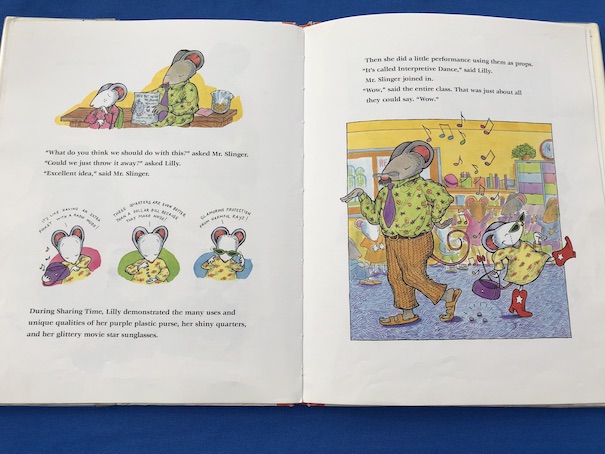
Lilly’s Purple Plastic Purse by Kevin Henkes, 1996.
Lilly loves going to school, and she especially loves her teacher, Mr. Slinger. Everyone in class thinks that he’s great, and he inspires a lot of them, including Lilly, to want to be teachers themselves.
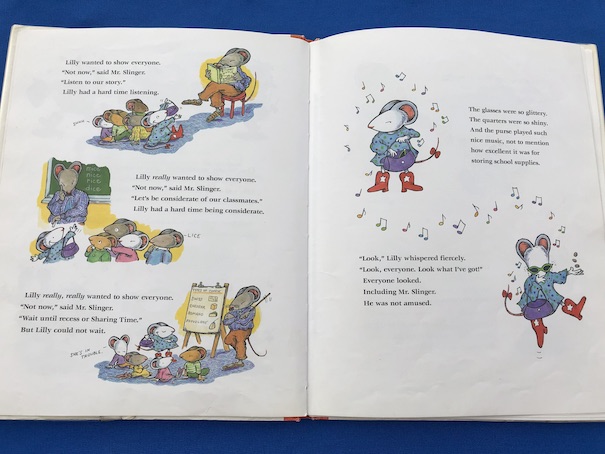
One day, after a special shopping trip with her grandmother, Lilly gains a some special new treasures: movie star sunglasses, some quarters, and a purple plastic purse that plays a tune when she opens it. Eager to show off her new things to her friends, Lilly brings them to school. However, she just can’t wait until recess or Sharing Time to show everyone. She keeps trying to draw attention to these things while the teacher is talking and opening the purse so it keeps playing its tune.
Finally, after repeated warnings, Mr. Slinger is forced to confiscate Lilly’s purse with its other treasures. Lilly is hurt and feels betrayed by her favorite teacher. Sad and angry at having her treasures taken from her, she draws a mean picture of her teacher as a purse thief, leaving the picture where she knows he will find it.
However, Mr. Slinger isn’t as mean as Lilly thinks that he is when he takes her purse. After he gives the purse back to her, she discovers a nice note from him inside, telling her that tomorrow will be a better day, and there’s even a little bag of snacks. Now, Lilly feels guilty about her mean picture. It’s too late to get it back, and she worries that her teacher will never forgive her.
The story is really good at showing how Lilly’s emotions change through the course of the day and how her sadness and anger grow more urgent the more she thinks and worries about them. It’s a good story to use when talking about feelings with young children (through the course of the story, Lilly is happy, excited, sad, betrayed, angry, guilty, worried, and embarrassed – some of these are stated explicitly and some are more implied) and how to deal with emotions. Adults can talk to children how one kind of emotion can lead to another (like how Lilly’s sadness turns to anger at her teacher for making her feel sad by confiscating her purse) and how some ways of dealing with emotions are better than others. It is both creative and appropriate that Lilly used her drawing ability to both insult her teacher and, later, apologize to him.
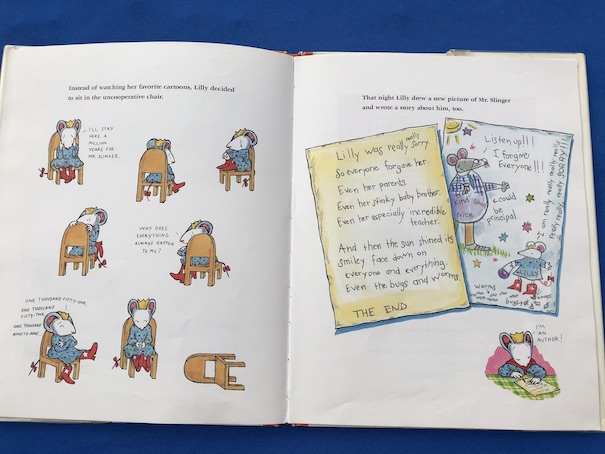
Fortunately, both Lilly’s parents and her teacher are very understanding. Her parents reassure her that her teacher will forgive her. Lilly draws a new, nicer picture of her teacher to go with her apology to him, and her parents give her some snacks to give to him as well. He does forgive her, and she finally gets to show everyone her amazing purple plastic purse at Sharing Time (being careful not to disturb anyone with them at other times.
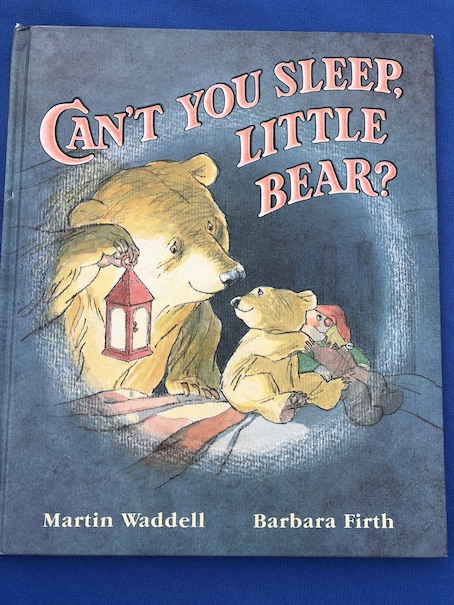
Can’t You Sleep, Little Bear? By Martin Waddell and Barbara Firth, 1988.
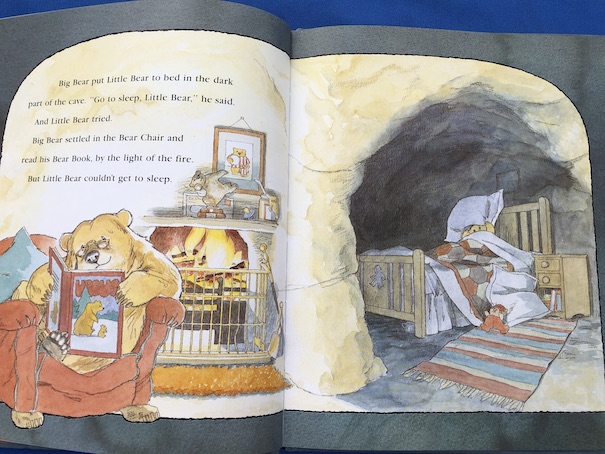
Big Bear and Little Bear live in their Bear Cave. (Big Bear is apparently the father of Little Bear, but they don’t call him that.) After Big Bear puts Little Bear to bed at night, Little Bear has trouble sleeping. Little Bear says that he can’t sleep because he’s afraid of the dark.
Big Bear gives Little Bear a lantern, but that doesn’t work. Little Bear says that the lantern isn’t big enough. Big Bear tries to bring two larger lanterns, but neither of those helps, either.
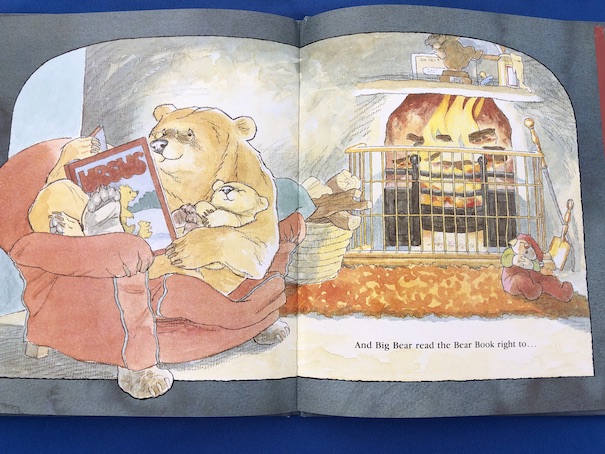
Little Bear says that the dark beyond the cave bothers him. To prove to Little Bear that the darkness outside isn’t scary, Big Bear takes him outside.
Outside, he shows Little Bear the moon and the stars, so he’ll know that it’s not completely dark. Little Bear falls asleep in Big Bear’s arms.
This is one of those cute bedtime stories that can help to reassure young children at bedtime. Sometimes, it is a big, scary, dark world out there, but it’s not always as dark as it seems when you take a second look, especially if you’re with someone you can really trust. Because the bears appear to be father and son, it also makes a nice father/son story.
The book is currently available online through Internet Archive. There is also an animated version of this story. I haven’t seen it for sale (if anyone knows where to get it, let me know), but it sometimes appears on YouTube (link repaired July 18, 2024).
Bear really loves the moon and decides that he would like to give the moon a birthday present. The problem is that he doesn’t know when the moon’s birthday is. He tries asking it, but it doesn’t answer.
Deciding that he needs to get closer to the moon to talk to it, Bear goes to the mountains to ask the moon when its birthday is. In the mountain, Bear hears his own echo and thinks that it is the moon answering him. When Bear tells the moon that his birthday is tomorrow, the “moon” replies that its birthday is tomorrow. Bear is pleased, especially when the moon echoes his wish for a hat for its birthday.
Bear buys the moon a hat and puts it on top of the moon by putting it in a tree. The following morning, the hat is on Bear’s doorstep, and Bear accepts it as the moon’s present to him.
When the wind blows poor Bear’s hat away, Bear goes to the mountains again to apologize to the moon for losing the hat. It’s okay, though, because Bear and the moon still love each other.
Bear never realizes that what he’s hearing is his own echo. It’s sweet although somewhat silly. If you wonder what happened to the hat in the end, it’s shown on the back cover of the book, holding a bird’s nest.
The book is currently available online through Internet Archive. (When you borrow a book from Internet Archive, you have to set up an account, but it’s free.)
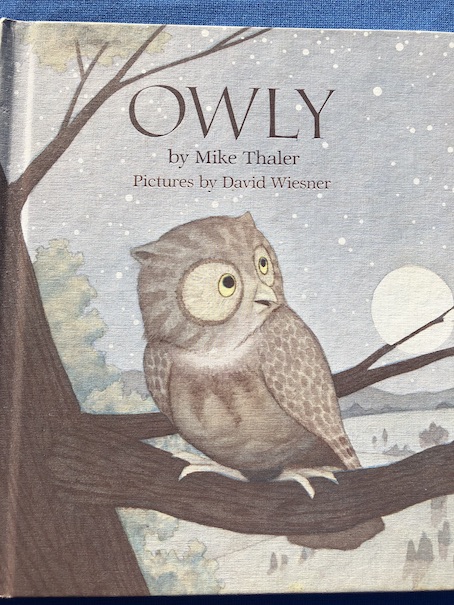
Owly is a curious young owl. He is always asking his mother questions, like how many stars there are in the sky or how high the sky is.
Owl’s mother tells him to go and see these things for himself, but there are too many stars in the sky to count, and he can’t fly high enough to reach the sky.
The story continues with Owly’s questions and attempts to find the answers, but all of his questions are unanswerable because they involve amounts too big to count or measure.
In the end, Owly and his mother talk about how much they love each other, and they compare it to the number of stars in the sky and the other things that couldn’t be counted or measured.
This is one of those children’s books where the story leads up to how much the parent loves the child (and vice versa). I’ve seen other books where the author sets up a cute way to talk about how much parents love their children, and sometimes, the set up is pretty obvious in this type of story. However, the message is still sweet, and this gentle story might make nice, calming bedtime reading. The pictures are as gentle and calm as the story itself.
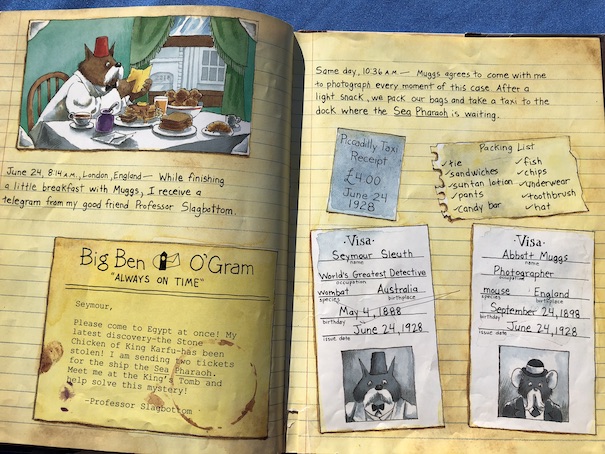
Seymour Sleuth, an Australian wombat living in London, introduces himself as “the greatest detective in the world.” His friend, Abbott Muggs, a mouse, is a photographer who assists him in his cases and documents them. When the story begins, Seymour receives a telegram from his friend Professor Slagbottom, who is working on an archaeological site in Egypt. Someone has stolen one of their finds, the Stone Chicken of King Karfu, and he needs Seymour’s help to find it! Seymour and Muggs head for Egypt!
King Karfu was a wealthy pharaoh and a wonderful cook, and the Stone Chicken may provide clues about the Lost Treasure of King Karfu, the nature of which is unknown. When they reach the dig in Egypt, Professor Slagbottom explains that he was researching a message in code on the outside of the Chicken when it was stolen. The suspects are the other people on the dig, who may be trying to steal King Karfu’s Treasure.
Seymour interviews the suspects one at a time and considers their connection to clues found at the scene of the crime. As an adult, I figured out who the culprit was pretty quickly, but for the benefit of child readers, Seymour provides notes about the clues and suspects to help them understand the connections. The pictures in the story also provide important clues. After Professor Slagbottom’s decoder is stolen, Seymour realizes who the thief is.
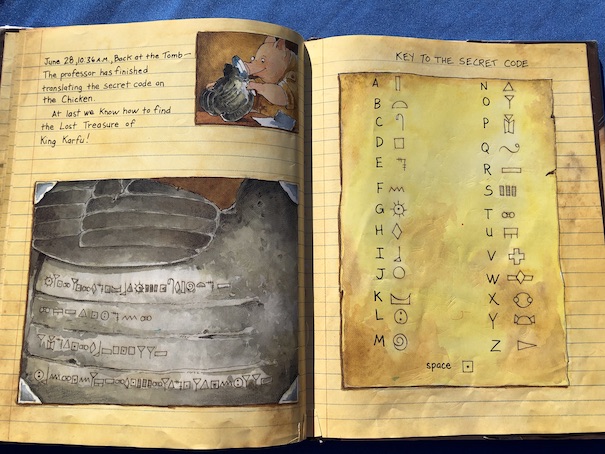
After they get the Stone Chicken back, readers can use the decoder provided to solve the code and learn where the Treasure is. It turns out that the Treasure is actually a recipe, written in the same substitution code – for peanut butter and jelly sandwiches!
I always like mysteries that involve codes and puzzles, and this cute animal mystery would be fun and challenging for young kids. With the key provided, it would be a good introduction to substitution codes for kids who have never seen them. There is one other book with Seymour Sleuth, The Mystery of the Monkey’s Maze. The author, Doug Cushman, is also the author of the Aunt Eater Mysteries.
The book is currently available online through Internet Archive.






















 Jestress's Forgotten Books and Stories