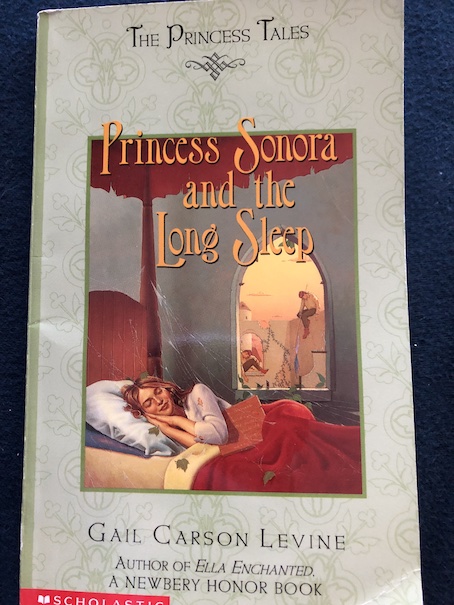
Princess Sonora and the Long Sleep by Gail Carson Levine, 1999.
This story is a retelling of the classic fairy tale, Sleeping Beauty. It’s part of a series of other retellings and re-imaginings of classic fairy tales called The Princess Tales.
When Princess Sonora was born, her parents invited the usual fairies to give her gifts. They do this because it can be dangerous to anger fairies, although fairies’ gifts are a risky proposition at the best of times. Unfortunately, there are two complications with the fairies who give Princess Sonora gifts. First, one of the fairies decides to top a previous fairy’s gift of intelligence by making Princess Sonora ten times as intelligent as any other human on earth. As a result, Princess Sonora is an unnaturally intelligent baby who begins to talk almost immediately and is smart enough to understand the second problem that arises.
Her parents neglected to invite a particular fairy because they’d heard a rumor that she was dead. Of course, the fairy shows up anyway, angry at the lack of invitation, and immediately curses Princess Sonora. As in the original Sleeping Beauty story, the curse is that, someday, Princess Sonora will prick her finger and die. Also, as in the original story, the last fairy who hadn’t yet given a gift uses her gift to soften the curse so that, instead of dying, Princess Sonora and everyone else in and around her castle will fall asleep for 100 years. She can’t completely remove another fairy’s spell because that might provoke a fairy war, but this change to the curse gives the family hope. She promises that Princess Sonora will meet an eligible prince when she wakes up. Princess Sonora, being an unnaturally intelligent baby who can talk, also gives her own feedback and suggestions on the situation, to her parents’ amazement. Her parents decide to try to prevent the curse from coming true by hiding anything that can prick Princess Sonora, but baby Princess Sonora has already realized that this will be impossible. She knows that the curse will come true someday, and as she lies in her cradle, she begins to make plans to prick herself on purpose, someday when she can choose just the right moment.
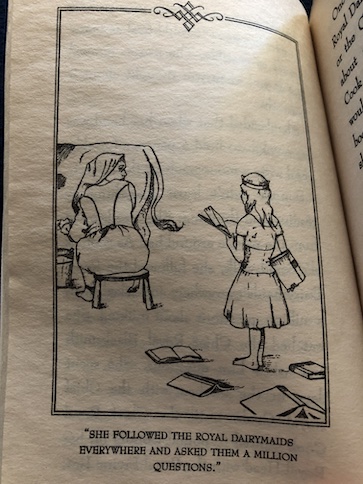
Being smart is generally a good thing, but Princess Sonora’s unnatural intelligence makes her a very peculiar girl in a number of ways. For one thing, she loves books and is always reading, even as a baby. She grows up to be a very studious girl. That’s not so bad, but Princess Sonora carries it to extremes. She also refuses to sleep. It’s partly because she knows that, at some point, she’s going to spend 100 years sleeping, so there’s no point in wasting more time asleep. She’s also afraid of sleep because she doesn’t know where her mind will go when she sleeps, and with her massive intelligence, she loves her mind and doesn’t want it to go away. Instead of sleeping, she just reads all night or thinks about things. Because of her intelligence, curiosity, and constant reading, Princess Sonora knows the answers to many questions, but people often find it irritating because they don’t want to hear her long explanations or all the ways she knows for people to do their jobs better. People start saying to each other, “Princess Sonora knows, but don’t ask her.” Princess Sonora wishes that other people would be more interested in what she has to say, but she knows better than to force the issue.
When Princess Sonora turns 14 years old, her parents begin looking for a prince she can marry, assuming that she doesn’t prick herself and fall asleep for 100 years first. They choose Prince Melvin, from a large and wealthy kingdom nearby. It seems like a smart match, but Princess Sonora knows it isn’t a good one. Prince Melvin has also received gifts from the fairies, and while they include positive qualities, like honesty and bravery, they don’t include intelligence. Prince Melvin isn’t very smart and wouldn’t appreciate any of the things Sonora knows or has to say. He would marry her anyway because he’s Honest and Traditional, but Sonora knows that she wouldn’t be happy. When she meets him, he’s very dull. The fairies made him a Man of Action, not of thought. He’s decided that thinking gets in the way, so he has few ideas and certainly no interesting ones. Sonora begins to think that the right time for pricking her finger might be coming soon. Pricking her finger doesn’t quite go as she had planned, but the curse works.
When Princess Sonora and everyone in the castle is put to sleep for 100 years, they are half-forgotten. Princess Sonora becomes a kind of legend, and the saying “Princess Sonora knows, but don’t ask her” becomes a common saying when someone doesn’t know the answer to something, with few people knowing who Sonora really is or why you’re not supposed to ask her what she knows. That is, until a prince with curiosity and a thirst for knowledge, someone who really needs Sonora’s knowledge to solve a problem, seeks her out for the answers he really needs. When Sonora wakes, she finally meets a prince needs a princess like her and is truly happy to hear what she has to say!
My Reaction
I liked this story when I first read it as part of a collection of other stories in the same series. Gail Carson Levine, who is also the author of Ella Enchanted, often writes stories themed on fairy tales but with her own twists. Princess Sonora’s extreme intelligence and fear of sleep weren’t part of the original fairy tale, although they fit this story nicely. I found the scene with the fairies giving Sonora gifts a little disturbing. When one of the fairies gives her the gift of beauty, the baby physically changes, and it is described as being painful. It is a theme in other stories by Gail Carson Levine that the magical gifts fairies give often have unfortunate side effects. Some of them really turn out almost like curses, but in this case, it turns out to be just what Sonora really needs and leads her to the person who really needs her. Even after people stop getting gifts from fairies when they’re babies, they still have quirks, and Sonora’s quirks fit with Prince Christopher’s quirk for curiosity!
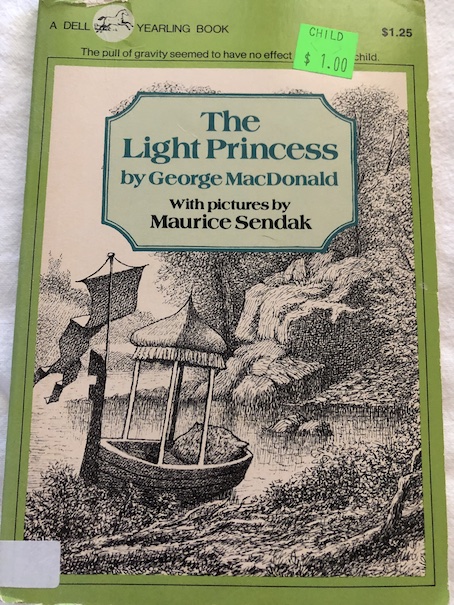
A long time ago, a king is irritated with his queen because they have no children. The queen tells him to be patient, and she eventually gives him a daughter. The king is very happy, but he makes a critical mistake. He forgets to invite his own sister to his daughter’s christening. It would be embarrassing for anybody to forget to invite a family member to an important event, but it’s a serious problem in his case because his sister is a wicked witch. She has a nasty temper and is vindictive. So, she decides to show up for the christening anyway and get her revenge by putting a spell on the baby princess. From that moment on, the baby is weightless, no longer bound by gravity.
It doesn’t take the little princess’s parents long to realize who has caused this strange malady in their child. It’s not all bad. Her nurses find her very easy to carry around, and people in the palace have fun playing ball with the princess as the ball, and the little princess herself seems to find all of this delightful. However, there is always the fear that she could blow away by accident, which does happen once, when she is blown out of a window and into the garden. Her parents continually worry about her future. At the queen’s urging, the king attempts to go to his sister and apologize about forgetting her invitation to the christening and ask her to lift the spell on the princess, but his sister denies all knowledge of the spell. The king knows she’s lying, but as long as she continues to deny it, there isn’t much he can do.
The problem goes much deeper than the princess having difficultly keeping her feet on the ground literally. She also has difficulty keeping her feet on the ground mentally. Her lack of gravity extends to an inability to see the “gravity” or seriousness in any situation. She laughs all the time, at everything, even when nothing is funny, although there is no real depth of feeling to her laughter. Even though she laughs all the time, she never smiles, leaving it open to question whether she ever really feels happiness or any emotion at all. She certainly doesn’t understand genuinely serious or catastrophic situations or other people’s emotions. When her mother cries, the princess just thinks that she’s making funny faces and odd sounds because she can’t seem to understand what crying means or the emotion behind it.
When the princess gets older, her parents talk to her about her condition, but the princess refuses to take it seriously. They try to ask her about what she feels. The princess says that she doesn’t feel anything, except that she sometimes feels like she’s the only one who has any sense, and then, she bursts into a wild, inappropriate fit of laughter. When they ask her if there’s anything she wants in life, all she can think of is to have someone tie a string to her and fly her like a kite, and then, she bursts into laughter again.
Since it’s useless trying to get through to the princess, the king and queen try consulting others, but nobody can agree on a solution. They consider metaphysics and philosophy. They recommend education and bloodletting. Her parents wonder if she would acquire some gravity if she fell in love, but the princess can’t seem to fall into anything … until the day she falls into the lake.
There is only one thing that the princess seems to love at all, and that’s the lake near the castle. When they take the princess out in a boat one day, she falls into the lake, and when she is in the water, she has gravity. She loves the water and loves swimming. She seems to have a better temperament when she is in the water, and she behaves better after a swim. Since water seems to affect the princess, they begin to consider that the cure to her problem might be to make her cry – a way of producing water that requires a grave emotion. However, nothing seems to make the princess cry. She is too flighty. (This book is full of puns related to gravity and flying, and they’re all given in a grave, direct manner.)
Then, one day, a prince tries to rescue the princess from the lake because he thinks she’s about to drown. When he pulls her from the water, she loses her gravity, and she angrily tells him to put her back in the lake. Unsure of how to do it when she’s weightless, the prince grabs hold of her and jumps into the lake with her. The princess is surprised and delighted because she has never truly fallen before. Now, she has fallen in with the prince … maybe in more ways than one.
However, even though the princess is starting to feel something for the prince, she has trouble understanding what she feels, not having felt much of anything for most of her life. When the lake suddenly begins drying up, the princess’s condition starts getting worse. The prince, who has truly begun to care about the princess, is willing to sacrifice himself to save the lake and the princess. It is only when the princess is confronted with the full reality of the prince’s sacrifice on her behalf that she is able to fully feel something and break free of her curse.
This book is now in the public domain, and you can read it online in your browser at Lit2Go. It is also accompanied by audio readings of each of the chapters.
My Reaction
Like other Victorian era children’s stories, there is a moral to this one, but it’s phrased in a unique and fun way. I remember liking this story the first time I read it as a kid, but I forgot about all of the puns involving “gravity”, which can refer to the force that makes things fall to earth or a state of serious emotion. The princess in the story lacks both, so she is very literally “flighty” and “can’t keep her feet on the ground.” Both of those terms are related to the idea that serious people have more emotional gravity, and unserious people lack it. For most of the book, the princess is an unfeeling air-head. I also missed the mention that the king doesn’t like puns, which may tacitly explain why his sister chose to make her curse in the form of a pun, knowing that her brother wouldn’t understand it.
The book notes that real happiness requires some emotional gravity because the person has to have enough emotional depth to understand their real emotional state and react appropriately to their emotions. That’s why the book describes the princess as never seeming happy, even when she laughs insanely at everything. She has no emotional depth or understanding. She doesn’t feel very much emotionally, and she has trouble understanding even her own limited emotional range. People often have trouble telling the difference between her laughing and screaming. Either way, it’s just a lot of loud noise with no real feeling behind it, and it’s pretty disturbing. It’s only when confronted with the apparent loss of the man she loves that the princess is able to feel a definite emotion. Fortunately, it all ends happily for our prince and princess. At the last minute, she decides to sacrifice her lake to save him, and finally, cries for the first time in her life, and that breaks her spell.
People don’t like to feel negative emotions, and some will use all kinds of defense methods to avoid what they’re feeling, but negative emotions (within reason, not taken to excess) are important to emotional health. People need to feel their full emotional range, and negative emotions often act as safety features in our lives. They tell us when we’re in an unsafe or unhealthy situation or when we’ve done something wrong, and they motivate us to do whatever is necessary to fix the situation. The princess’s habitual reaction to anything and everything is crazed and unfeeling laughter, but that’s not what she needs. She needs real feeling and honest tears to restore both her physical and emotional gravity. The princess, staring at the prince as he is about to die is literally staring death in the face and feeling the “gravity” of it. Contemplating the impending death of the prince and understanding for once the seriousness and finality of it, the princess experiences sadness and loss, and through that, she comes to understand love and sacrifice. Only when she has been through all of that is the princess truly able to be happy with her prince and his recovery. The princess has a difficult time adjusting to her new gravity, in more ways than one. She has to learn to walk for the first time because she always floated easily through life before, and sometimes, she falls down and hurts herself. She sometimes complains about it, but it’s still worth it because she has gained the ability to fully feel and to love and be loved.
During the story, none of the main characters actually have names. They are only referred to by their titles: king, queen, princess, and prince. Their names aren’t as important as their roles in the story.
There is a more modern story called Princess Hyacinth: The Surprising Tale of a Girl Who Floated from 2009 that uses the concept of a princess who is unaffected by gravity, but in a different way. It’s a picture book, and in that story, the princess isn’t cured of her lack of gravity. Instead, she learns how to make the most of it.
The Princess and Curdie by George MacDonald, 1883.
This is the sequel to The Princess and the Goblin, but it isn’t as well-known. Personally, I prefer The Princess and the Goblin, but it’s worth explaining what this book is like and how this two-book series ends.
When we last met Curdie, he was living in a cottage in the mountains and working in the mine with his father. At the beginning of this story, he is still there and still working in the mine. Most of the goblins who inhabited the mines were drowned at the end of the previous book. The beginning of the story briefly recounts the previous adventure and how the king offered Curdie a position in his guard after he helped to rescue the princess and fight the goblins. Curdie turned down the position to remain with his parents, and the king accepted his decision because he approved of the boy’s loyalty to his family. Since then, the king took Princess Irene away with him, and Curdie has missed her.
Since the old, castle-like manor house where the princess spent her earliest years flooded at the end of the story, Curdie has wondered what happened to the great-great-grandmother the princess always spoke of. Nobody ever saw her leave the house, but then again, nobody but the princess and her father ever saw her at all. Curdie’s mother says that she once saw a mysterious light, like the kind Princess Irene said that her great-great-grandmother had, but Curdie still thinks maybe the princess just dreamed that she had a great-great-grandmother, even though he once followed the magical string that the great-great-grandmother gave her.
As Curdie grows up, he believes in fewer things than he once did and focuses more on being a miner than on the little things he once noticed in the upper world. The book describes him as becoming mentally dull and more rigid and common in his thinking. Like other common and mentally-dull people, he is starting to follow the path of being so afraid of being fooled into believing something foolish that he is at risk of making a fool of himself because he is unable or unwilling to think about things deeply, consider possibilities, and believe things that he should:
“There is this difference between the growth of some human beings and that of others: in the one case it is a continuous dying, in the other a continuous resurrection. One of the latter sort comes at length to know at once whether a thing is true the moment it comes before him; one of the former class grows more and more afraid of being taken in, so afraid of it that he takes himself in altogether, and comes at length to believe in nothing but his dinner: to be sure of a thing with him is to have it between his teeth. Curdie was not in a very good way then at that time.”
Curdie’s parents worry about this change in him and find themselves wistfully thinking about how he was when he was younger. Curdie no longer makes up the songs and verses he used to because it is no longer necessary to scare the goblins away. He seems to have lost much of his former creativity, imagination, and mental flexibility because he has not been exercising them, and with them, he has been losing his critical-thinking and analysis skills and his ability to look outward and see the big picture of life and other people.
One day, Curdie makes a bow and arrows, and he uses them to shoot a pigeon. As he watches it die, he is horrified at what he has done. He suddenly remembers what the princess said about her great-great-grandmother keeping pigeons, and he feels terrible that he has killed something so lovely. His remorse stirs his heart and brings back the memories and feelings of the boy he used to be. Then, the pigeon moves, and he realizes that it is still alive, and he sees the globe of light of the great-great-grandmother. Curdie hurriedly takes the injured pigeon to the old castle. The door is open, so he goes inside and follows the sound of a spinning wheel to find the princess’s great-great-grandmother, seeing her for the first time.
Curdie admits what he has done to the great-great-grandmother and gives her the bird. The two of them discuss right and wrong, and Curdie comes to realize that he has done a great many wrong things for some time because “I was doing the wrong of never wanting or trying to be better. And now I see that I have been letting things go as they would for a long time. Whatever came into my head I did, and whatever didn’t come into my head I didn’t do.” In other words, Curdie has fallen into the habit of being thoughtless, and this is the first time in a long time that he’s paused to think about things he’s been doing or could have been doing instead. He realizes that he has even been grumbling about his work and not adequately helping his parents, and even though he noticed that they’ve been seeming unhappy and he suspected it had to do with him, he never once asked them how they felt or why.
After they have this talk and Curdie realizes the real problems behind the things he’s done and is genuinely sorry for them, the lady tells him not to worry because the pigeon will recover now, and she will take care of it. She merely gives him the caution to “Do better, and grow better, and be better. And never kill anything without a good reason for it.” Curdie offers to destroy his bow and arrows, but the lady tells him not to because there are bad things that need to be killed and that the bow and arrows may be useful someday. She also tells him that there are people who tell stories about her and laugh about her, and she asks that Curdie not laugh with them or side with them.
Curdie goes home and tells his parents what happened. They believe him and say that he should do what the lady says. The next day, when the other miners are telling stories about the lady, saying that she’s an evil witch, Curdie has to fight to hold his tongue. When they press him for what he thinks, he only says that he thinks that, if they’re going to tell stories about her, they’d better be sure that they’re true because she wouldn’t like to be slandered. The others laugh at him for being afraid of her or for wanting to defend her.
The lady appears to Curdie and his father again later. She tells them that they have the blood of the royal family in their veins, and she hints that there is a special destiny in store for Curdie. Curdie tries to ask her some questions about who she really is and about her changing appearance, but all she says is that she has many names and can appear in many different forms, and even different people see her differently. She tells Curdie to come see her alone in her tower the next night.
When he sees her the next time, the lady asks if he is ready for a difficult trial. She says that it will hurt and that it will require trust and obedience, but it will be good for him. When Curdie tells her to command him, she tells him to put both of his hands into her fire. He does it quickly, trying not to think about it, and it does hurt at first. However, it stops hurting, and when he takes his hands out of the fire again, he discovers that they are softer than they were before. The roughness and callouses from his work in the mines are gone. The lady tells him that his hands have changed more than that. She says that he will now be able to feel when he touches the hand of a man who is actually a beast on the inside, but he will lose that gift if he uses it for a selfish purpose. To demonstrate the gift, the lady calls a strange creature called Lina to them, and when Curdie feels the creature’s paw, it feels like a child’s hand. Although the creature appears strange and menacing, it’s actually good and gentle on the inside.
The lady tells Curdie to tell his parents that he must go to the king’s court the next day. She has given his father an emerald that they can use to see if he is all right during his travels because its appearance will change if he isn’t. The lady also sends Lina with Curdie to help him on his journey. Curdie is a little uneasy about that because he can tell that Lina is one of the goblins’ creatures, but Lina is genuinely helpful to him, and he becomes fond of her.
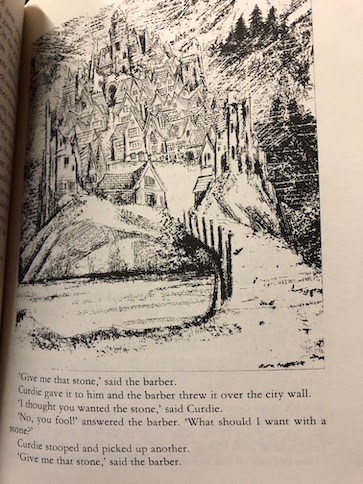
When they finally reach the king’s city, Curdie meets the king’s baker. The baker stumbles on a stone sticking up out the street and curses the king for not maintaining that road. Curdie argues that the baker himself bears some responsibility for watching where he’s going, especially since he says that he’s tripped on that stone before and knows it’s there. However, Curdie has his pickaxe with him and sees an easy way of dealing with the problem. He breaks up the rock that’s sticking out of the road, but a piece of it flies out and breaks the barber’s window. The barber comes to complain about it, and he insists that Curdie pay him more than the window is actually worth. Curdie gives him what he thinks is a fair price, and he feels the animal paw in the barber’s hand, showing what kind of man the barber is and that Curdie’s gift is still working.
There are other cruel, hard-hearted, immoral, and brutish people in this city, and sadly, some of the nicer people tend to be on the receiving end of the malicious gossip of the others. Curdie and Lina are taken in by a woman who is rumored to be a witch simply because she prefers to live quietly and not gossip like the others. Of course, everyone immediately begins gossiping about Curdie and his strange animal companion. The local magistrate believes the slander of a couple of people whose dogs Curdie had to kill because they were trying to kill him and Lina. These people claim that the dogs were harmless and Curdie killed them for no reason. When the magistrate and his soldiers come to arrest Curdie, he says that he’ll surrender, but he refuses to restrain Lina so they can kill her. Lina chases off the crowd that’s gathered to watch, but then, she vanishes herself, and Curdie is arrested. Fortunately, Curdie manages to escape and reunite with Lina. Then, he and Lina find their way into the king’s cellar and kitchen. There, he finds that the king’s servants are drunk and passed out. His touch tells him that these people are beasts inside. Going further into the palace, he finds the king’s chamber, and there, he meets Princess Irene again.
Princess Irene recognizes Curdie again immediately. It’s been less than two years since they last saw each other. She was about eight years old then, so she can’t be more than ten years old now, but Princess Irene seems older than she should be because of everything that’s been happening in the king’s palace. Her father has been ill for a year and is not in his right mind. Princess Irene thinks that the entire kingdom is concerned for him because that’s what the lord chancellor has told her, but Curdie knows that isn’t true because he hasn’t heard a word about there being anything wrong with the king outside of the palace. Princess Irene says that the king has also asked for Curdie, and his staff claimed that they tried to send for him but couldn’t find him. Curdie knows that definitely isn’t true because, until he started his journey to the king’s palace, he had been living in the same cottage where he always lived, and no one from the palace tried to find him or sent him any message.
It’s obvious that there are wicked people in the palace. These people are responsible for the king’s current condition, and they’re trying to keep the public from finding out what’s been happening. With his gift of telling who is a beast on the inside, can Curdie help Princess Irene to find and deal with the conspirators and restore the king to his right mind?
The book is public domain now. It is available to read online through Project Gutenberg (multiple formats) and Internet Archive (multiple copies). You can also listen to a LibriVox audio reading online through YouTube or Internet Archive.
My Reaction and Spoilers
As with the first book, royalty is used to represent people with the best morality in the story. Curdie and his family have royal blood because they are more wise and moral than other people around them. It feels a bit classist to think that royalty is supposed to be morally superior to everyone else just because they were born into a particular family. That certainly isn’t how these things work in real life. Just think of Prince Andrew. However, this type of comparison does fit with the fairy-tale setting of the story.
In spite of whatever royal blood he has, Curdie isn’t perfect. He was falling into bad habits until he realizes that he has done a terrible thing by shooting the pigeon, which causes him to seek out the great-great-grandmother Princess Irene told him about and to do some soul-searching about his behavior. During the time when Curdie is being thoughtless and falling into bad habits, he is portrayed as being too common, like the other men working in the mine. However, I would argue that the bad habits of the miners, like their wild, gossipy stories and rude joking and teasing, are not because they lack royal blood but because they lack thought. Curdie and his father say as much when they’re talking in the mine. The other miners are being thoughtless, and they’re simply not making any effort to be more thoughtful. More than any royal blood, Curdie proves himself worthy by his ability to be thoughtful about other people, and he gets that ability by wanting to improve himself and making the effort to do what it takes to improve.
A large part of this book comes off as a lecture about morality, but that’s not unusual for a Victorian era children’s book. The Princess and the Goblin had some of that, too, but this book has much more. That might be part of the reason why this book seems like it’s less well-known than the first book, but the ending of the book is also strange and kind of depressing.
As one might expect in a fairy-tale story of this kind, Princess Irene marries Curdie (not immediately, because they’re still children, but eventually), and the two of them are said to rule their kingdom wisely for many years. It seems like a happy ending because, thanks to Curdie’s ability to sense the true nature of people, they are able to surround themselves with the best people, and the city becomes less wicked under their rule. However, the story doesn’t end there. In the final paragraphs of the book, it says that Curdie and Irene had no children to inherit the crown. Without a blood heir to the kingdom, someone else was chosen to rule instead, and this person was wicked and greedy, so the royal city went back to being wicked. In fact, this new king was so greedy and stupid that he had his people mining continuously, right under the city itself, to bring him riches. They eventually completely undermined the entire city, so the city physically collapsed in on itself, destroying it completely and killing everyone there. I guess that’s meant to explain why this fairy tale kingdom no longer exists, but that’s quite an ending to this story! With this royal family apparently having some kind of magic about them, it seems incredible that their kingdom would have gone this way, but then again, maybe the author just didn’t want to write about them anymore.
Note to the wise: Wherever your source of wealth comes from, for the love of all that is good in the world, don’t mine your support beams! They serve a purpose and need to stay there for a reason.
The Twelve Dancing Princesses retold and illustrated by Ruth Sanderson, 1990.
This is a retelling of the classic German fairy tale collected and published by the Brothers Grimm in 1812. There are various retellings of this story, some changing the number of princesses and some giving the characters different names. This one is actually closer to the Andrew Lang version from The Red Fairy Book, published in 1890.
A king with twelve daughters has a strange mystery to solve. All twelve of his daughters sleep in the same room every night. The door to their room is always locked, but every morning, the girls’ shoes are completely worn out, like they’ve been dancing all night. The girls claim that all they do at night is sleep, but that doesn’t explain what happened to their shoes.
The king is confused and troubled by this odd mystery, so he promises the hand of one of his daughters in marriage to the man who can solve the mystery. A series of princes attempt to solve the mystery by sleeping in a room next to the princesses, but in the morning, each of the princes has mysteriously disappeared and the princesses’ shoes are still worn out.
With the mystery getting more mysterious and more urgent, with the princes’ disappearances, a commoner named Michael decides that he wants to try to solve the mystery. A woman Michael meets recommends that he take a job as a gardener’s helper at the castle and see if he can spot something that would give him a hint. The mysterious woman gives Michael a cloak that will make him invisible so that he can follow the princesses and see what they do.
Michael first meets the princesses when the gardener sends him to give a bouquet of flowers to each of them. He catches the attention of the youngest princess, Lina. Lina’s sisters tease her about admiring a simple garden boy, but Michael also likes Lina.
Because he is a commoner, Michael doesn’t think that he can go the king directly and ask to investigate the mystery of the princesses, so he decides to use his magic cloak to spy on them secretly. When he’s invisible, he slip into their room before the princesses are locked in for the night and hides. After everyone thinks that the princesses have gone to bed, they get dressed as if they’re going to a dance, putting on their new dancing shoes. The eldest princess opens a special trap door in the floor, and they all leave secretly, with Michael following them.
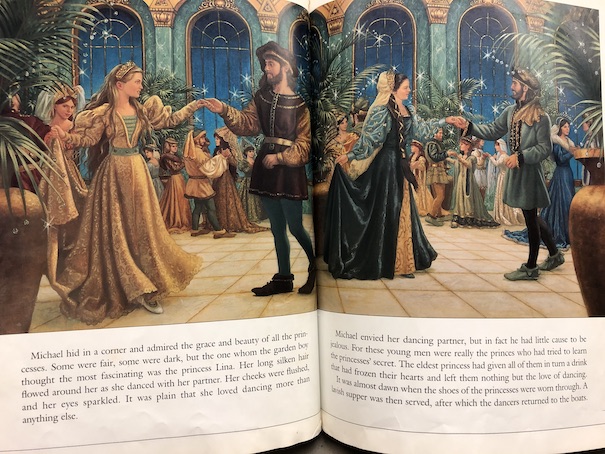
Michael follows the princesses through magical woods to a lake where the captive, now enchanted, princes wait to take the princesses to a magical palace in boats shaped like swans. There, the princesses dance with the princes all night, wearing their shoes to pieces.
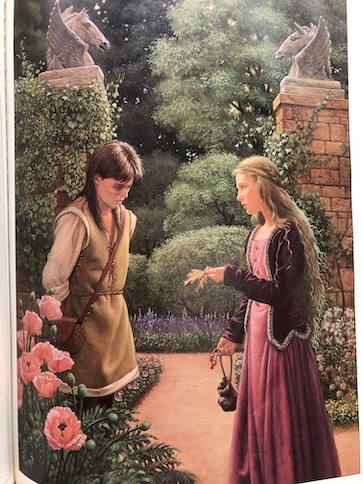
Lina suspects that someone followed them because Michael accidentally stepped on her skirt a couple of times, and Michael confirms her suspicion when he places a branch from the magical woods into her bouquet of flowers. At first, Lina tries to bribe Michael into keeping their secret by offering him money, but he refuses. She asks him if he plans to tell the king and collect his reward by marrying one of the princesses, but Michael says he won’t. Lina tries to ask him why, but he doesn’t want to answer. The truth is that Michael loves Lina and doesn’t want to get her into trouble or force her to marry him if she doesn’t return his affections.
Eventually, Lina tells her eldest sister, the one who is controlling all of the magic behind their escapades, about Michael and what he knows. Lina’s sisters want to have Michael thrown in the dungeon to keep him quiet, but Lina is horrified and says that if they do that, she’ll tell their father the truth herself. Instead, they decide to openly invite him to their next dance and offer him the magical drink that would enchant him like they did with all of the other princes. Michael overhears their plan and decides that he will see if Lina really loves him. If can’t appeal to her heart, he’ll drink the drink and be enchanted.
When Lina prevents Michael from drinking the enchanted drink at the dance because she loves him and can’t stand to see him turned into a mindless magical slave, the spell is broken on all of the other princes. They all return to the castle, and the magical palace crumbles behind them. When they reveal the truth to the king, he makes Michael the heir to the kingdom with Lina as his wife.
I’ve heard many different versions of this story before, but there are always so many unanswered questions. Just how did the eldest princess come up with this whole magical dancing scheme in the first place? Where did she even learn to do magic? How come the princesses are never tired even though they dance every night instead of sleeping? (Well, I guess that could just be magic because magic can fill many plot holes.) Why did the king just keep giving the girls new dancing shoes when they kept wearing them out every night? My parents would have just stopped giving me things that I repeatedly broke, telling me that I can’t have new stuff if I can’t take care of the old. They’d probably say something like, “I don’t know what you’re doing with those shoes every night, but whatever it is, you’re not going to do it anymore because you won’t have them.” But, fairy tale characters just aren’t that practical, and if they were, the story would have ended much sooner. In fact, why didn’t the king himself just sit up for one night with his daughters and see for himself what they did or split them up and put them in different rooms of his castle to put an end to their hijinks? Just what is the king going to do with the eldest princess, now that he knows that she’s some kind of witch or enchantress? Did her powers break completely when Michael broke her spell? Also, what was the deal with the mysterious woman Michael met on the road, who gave him the invisibility cloak? How did she figure into this, or was she just some random, magical being or enchantress who, coincidentally, just happened to have a magical cloak that she could spare? The story doesn’t really say.
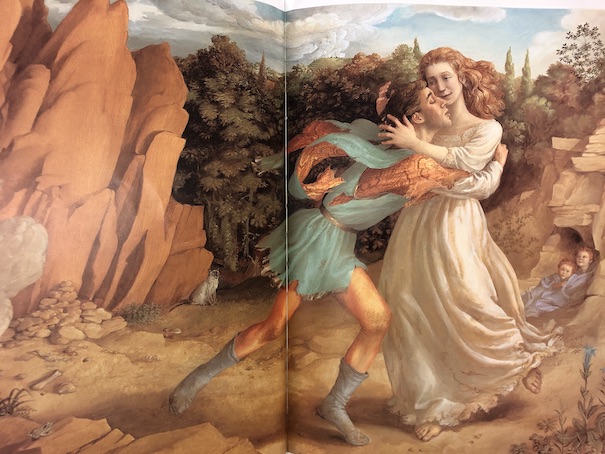
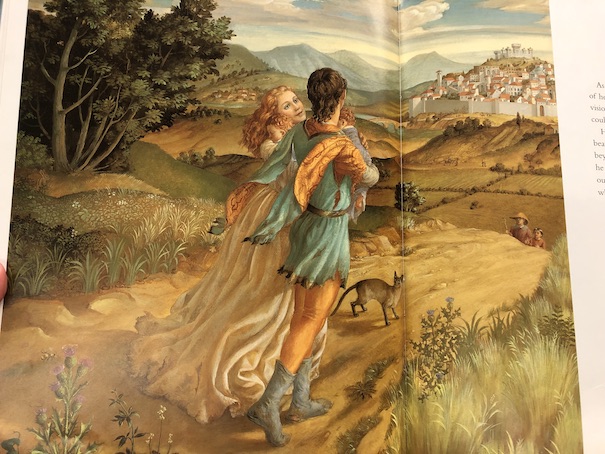
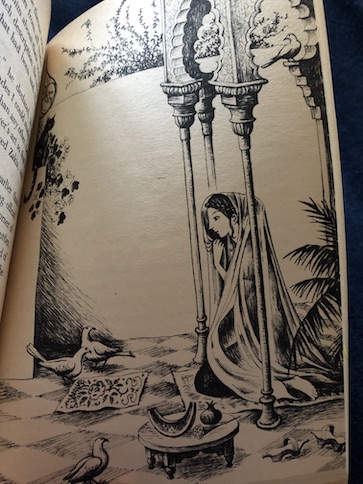
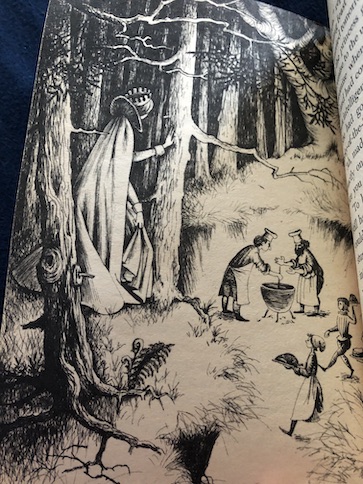
I love the pictures in this book because they are beautiful and detailed, but the art style is a little unusual. Instead of having every picture appear in its entirety on a page, some pictures wrap around to the next page, either giving a hint of what’s coming or a taste of what was on the previous page. Sometimes, I found myself wanting to see the whole picture at once, but I can see how the illustrator was trying to make scenes in the story kind of flow into each other.
The book is available to borrow for free online through Internet Archive.
The Elves and the Shoemaker story adapted by Lucy Kincaid, illustrated by Gillian Embleton, 1981.
I loved to read this folktale when I was a kid! This particular copy was made specifically for beginning readers with large type and a section in the back that shows key words in the story with little pictures to explain what they mean. Aside from my nostalgic associations with this book, I also really enjoy the detailed, realistic pictures.
There was a shoemaker who worked very hard but never seemed to get much money for the shoes he made. He and his wife are on the verge of starvation, and he only has enough leather to make one final pair of shoes.
Before going to bed, he cuts out the leather for the last pair of shoes, planning to sew them in the morning. However, in the morning, he discovers that someone else has already sewn the shoes together, and the shoes are very fine quality. The shoemaker has no idea who finished the shoes for him, but they did an excellent job, and he is able to sell them for enough money to buy food and enough leather for two more pairs of shoes.
Once again, he cuts out the leather for the shoes, and again, in the morning, he discovers that someone else has sewn the shoes together. The shoes are excellent, and he is able to sell them for enough to buy leather for four more pairs.
This continues night after night, and the shoemaker’s business begins to prosper, but he and his wife wonder who is helping them. One night, they hide and watch to see who will come to do the sewing. As they sit up, waiting, they see a pair of small elves who enter through the window and begin sewing the shoes together.
The shoemaker and his wife want to thank the elves for their help. Noticing that the elves are wearing ragged clothes and have no shoes of their own, they decide to make the elves their own sets of clothes and shoes.
On Christmas Eve, they put the elves’ new clothes on the table where the shoemaker usually puts the shoes that need to be cut and watch to see what the elves do. The elves are overjoyed to see the new clothes, realizing that they are presents for them. They immediately put the clothes on and dance around with happiness, singing that they don’t need to work anymore.
That is the last time the shoemaker and his wife see the elves, but the shoemaker’s business continues to prosper.
In the Harry Potter series, J.K. Rowling used the device of gifts of clothing ending a house elf’s service to a particular household, but she didn’t invent that concept. It was already a feature of folktales like The Elves and the Shoemaker, which was one of the folk tales collected by the Brothers Grimm.
This book is available to borrow and read for free online through Internet Archive. There are also many other versions of the same story.
This retelling of the classic fairy tale is a Caldecott Medal winner. The illustrations are beautiful! A note in the beginning of the book explains a little more about the author’s sources for the story as well as his view about it. Instead of focusing on an evil witch who holds a young girl captive, he presents “a mother figure who powerfully resists her child’s inevitable growth.”
A
couple who have wished for children for a long time are excited to realize that
they are finally going to have one!
However, the wife finds herself with an irresistible craving for the
Rapunzel (an herb) that grows in the nearby garden of a sorceress. She is so desperate to have some that she is
able to persuade her husband to steal some for her. But, even having some causes her craving to
grow.
When the husband returns to the garden to get more Rapunzel, the sorceress catches him. He explains the situation, saying that his wife’s craving is so intense that he fears she will die if she doesn’t get some Rapunzel. The sorceress agrees that the wife can have the Rapunzel she needs, but in exchange, she demands the child when it is born. Not knowing what else to do, the husband reluctantly agrees. When the wife gives birth to a baby girl, the sorceress comes, names the baby “Rapunzel”, and takes her away from her parents.
The sorceress cares for the girl and raises her. When the beautiful young girl turns twelve, the sorceress takes her to live in a tower in the forest. The tower is magical, looking narrow on the outside, but containing many beautiful and comfortable rooms. The only way in or out is through the window at the very top. The witch has Rapunzel let down her extremely long, beautiful hair so that she can climb up.
Rapunzel lives alone in the tower for years, until a prince happens to ride by and hears her singing. The prince is enchanted by the singing and asks questions about the tower at the nearest houses, learning about the sorceress and the young woman in the tower.
One
day, he sees the sorceress visiting Rapunzel and sees how she gets into the
tower. So, later, he calls to Rapunzel
himself, asking her to let down her hair.
Rapunzel is surprised and frightened at first, when she sees that her
new visitor isn’t the sorceress, but he speaks nicely to her, and they become
friendly. The prince proposes marriage,
and Rapunzel accepts. After that, he
visits her every night, without the sorceress’s knowledge.
However,
Rapunzel eventually gets pregnant, and when her clothes no longer fit her, the
sorceress realizes it. She calls
Rapunzel a “wicked child” and says that she has betrayed her. She cuts off Rapunzel’s long hair and exiles
her into the wilderness, alone.
The sorceress uses Rapunzel’s long hair to trick the prince into climbing into the tower. When he comes, she tells him that Rapunzel is gone, and he will never see her again. The prince falls from the tower, injuring his eyes. Blinded, the prince wanders alone for a year, lamenting for his lost wife.
Eventually, he finds Rapunzel in the wilderness, recognizing her singing. She has given birth to twins. Rapunzel’s tears heal the prince’s eyes, and he is able to see again. Realizing that they are near to his kingdom, he takes Rapunzel and the twins home.
The book is available to borrow for free online through Internet Archive.
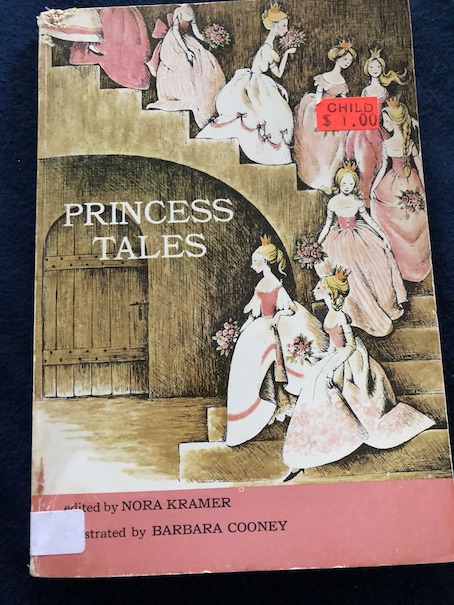
Princess Tales edited by Nora Kramer, illustrated by Barbara Cooney, 1971.
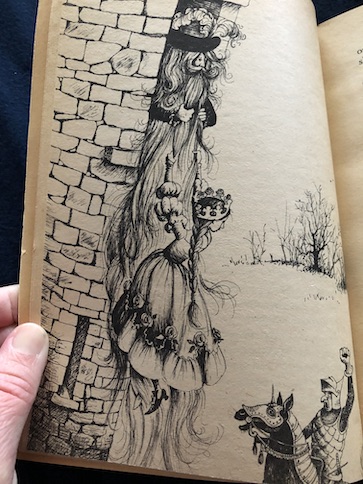
This is a collection of princess stories by various authors, including retellings of some classic fairy tales, some or all of which were printed in other locations before being included in this collection. Although I have encountered some of these stories before this collection, I liked the illustrations in this book because I like Barbara Cooney’s work.
Stories in the Book:
The Practical Princess by Jay Williams (1969) – I know this story from the story collection that is named after it, but it did appear in other printings before either of these. Princess Bedelia was given the gift of common sense as a baby, and she uses her practicality to rid her kingdom of a dragon and save herself from marriage to an evil sorcerer.
The Twelve Dancing Princesses by Virginia Haviland (1959) – A retelling of the classic fairy tale. A French kingdom with twelve beautiful princesses is mystified by how the princesses’ shoes are always worn through every morning even though the door to their room is locked every night when they go to bed. What are the princesses doing every night that ruins their shoes, and how are they doing it? Michel, a young cowherd who has recently taken a gardening job at the castle and who has fallen in love with the youngest of the twelve princesses, discovers the answer. When her sisters want to enchant Michel, as they have others who have discovered their secret to keep them from telling, Princess Lina needs to decide if she loves Michel as much as he loves her.
The Princess and the Vagabone by Ruth Sawyer (1942) – A beautiful but bad-tempered Irish princess learns a lesson in kindness when her father gets fed up with the way she treats her suitors. All of her life, the princess has dealt out criticism and insults to everyone, when she sees a suitor with whom she can find no fault, she doesn’t know what to do (never having practiced kindness or spoken nicely to anyone) and gets angry, hitting him and crying as she runs from the room. Her father, disgusted with her impossible behavior, tells her that he’s had enough, and since she has rejected all the royal suitors, he will force her to marry the next vagabone (vagabond) who comes begging at the castle. As the wife of a vagabond, the princess learns to face hardships she has never experienced before, sees for the first time how much kindness from another person can really mean, and notes positive points about others for the first time, enjoying the ragged vagabone’s song. But, there is still one more surprise when the vagabone turns out to be the perfect suitor the princess thought that she had rejected.
Melisande by E. Nesbit – A king and queen want to avoid the usual messes and curses that often result from holding a christening party for a new princess and forgetting to invite one of the fairies, so they decide that, for their daughter Melisande, they will simply hold an informal christening with no party. However, all of the fairies get mad about this and come to give curses to the princess. Fortunately, the king points out logically that, according to tradition, only one forgotten fairy can offer a bad curse to a princess after being left out of a christening party. Fairies are held to certain rules and can vanish for breaking them, so since the first fairy already cursed the princess with baldness, the others simply agree to count themselves are party guests and leave. Princess Melisande spends her childhood being bald, but the king offers her a fairy wish that he had been saving for something special so that she can wish for hair. However, Melisande foolishly wishes for her hair to grow exceedingly fast and even faster when cut. It’s far too much hair for her, even though people try to help her find uses for it, like weaving it into clothes and stuffing pillows with it. As usual in these cases, the king offers Melisande’s hand in marriage to the prince who can help her to solve her problem. At first, Prince Florizel thinks he’s found the solution when, instead of cutting the princess’s hair from her, he cuts her from her hair. However, that has the unintended side effect of making the princess grow suddenly tall! What will Prince Florizel do to get the princess and her hair to balance? (At one point, this story references Alice in Wonderland.)
The Handkerchief by Robert Gilstrap and Irene Estabrook (1958) – At first, Zakia is not happy when her father, the Grand Vizier of Morocco accepts the sultan’s offer to marry her on her behalf. She doesn’t think that it’s fair for him to order her to marry anyone, and she doesn’t love the sultan. In response, she imposes a requirement on the marriage, that the sultan must learn a trade in case he loses his throne and has to earn a living. To the vizier’s surprise, the sultan thinks that sounds like a clever request, and the sultan learns the art of weaving. He enjoys it, and he makes a beautiful handkerchief for Zakia as a wedding present. Zakia appreciates the gift and marries him. The sultan’s ability as a weaver later saves him when he is in a desperate situation.
The Blackbird’s Song by Barbara Leonie Picard (1964) – An artist paints an unflattering picture of the king and is thrown into prison. However, the princess’s pet blackbird sings to him of the princess’s beauty and kindness, and he is able to paint a marvelous portrait of her without having seen her himself. When the princess falls in love with the artist, her blackbird and its friends help them to make their escape from her father.
Ricky-of-the-Tuft by Polly Curren (1963) – A prince is born ugly, and his mother is worried, but a fairy gives him the gift of wit and intelligence, with the ability to give that gift to someone he loves. In another kingdom, a queen has two daughters. The eldest is beautiful and the youngest is plain. However, a fairy says that the plain girl will be bright and intelligent, and people who talk to her will forget what she looks like. The beautiful girl is less fortunate because she is not intelligent. People will enjoy looking at her, but they will quickly tire of her because she does not speak intelligently and has nothing to say. To compensate the beautiful girl, the fairy says that she will be able to make the person she loves beautiful as well. When the ugly prince, Rick-of-the-Tuft, meets the beautiful princess and falls in love with her, the two of them are able to use their gifts to help each other. The story is based on a Perrault fairy tale.
The Son of the Baker of Barra by Sorche Nic Leodhas (1968) – The baker’s son, Ian Beg, is a nice boy, and sometimes a little too nice. When his father sends him to take a cake to the princess, he is stopped by old women who ask him for a taste of the cake, and he cannot refuse them. However, it turns out to be a fortunate thing. The old women are actually fairy folk, and not only do they handsomely compensate him for the cake that they eat, but they also help him when the princess falls in love with him and the king tries to get rid of him by sending him off to find a castle of his own. The king doesn’t expect that Ian Beg will be able to find a castle and supply the kind of lifestyle that a princess needs, but he doesn’t know that Ian Beg has help.
The Enchanted Forest by La Comtesse de Segur, translated by Beatrice Schenk de Regniers, 1856, 1974.
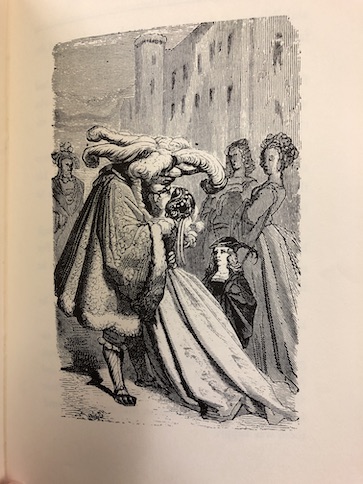
This is an English translation and retelling of one of La Comtesse’s stories. I can’t read French, and I’ve never read the original version of the story, but the translator, Beatrice Schenk de Regniers, had a note in the book that she altered the story slightly from its original version.
King Goodheart has a lovely little daughter named Goldenhair, who he loves very much. Unfortunately, his wife dies, and his people urge him to remarry. His new wife, Queen Meanette, is as mean as her name sounds, and she does not like Goldenhair at all. The King, realizing this, does his best to keep her away from his daughter and puts his daughter in the care of some trusted servants.
Meanette, still jealous of the love and attention the King gives Goldenhair, plots to get rid of her. One of the princess’s attendants is a boy who takes her out in her little carriage in the garden every day. The boy is greedy for sweets, and the queen bribes him into tricking the princess into going into the enchanted forest. People who go into the forest have been known to disappear forever. When the princess becomes lost in the forest, she is befriended by a cat who takes her to a palace where he lives with a doe. They are very kind to her, but Goldenhair still longs for a way to return home.
One day, while Goldenhair is living with the cat and the doe in their palace, a parrot comes and claims that he knows a way that the princess can return home. He insists that she leave the palace, against the doe’s wishes, and pick a single rose that grows in the forest. What the girl doesn’t know is that the parrot is an evil wizard in disguise. When the girl picks the rose, the doe’s palace is destroyed, and the evil wizard reveals himself.
Thinking that she has killed her friends, Goldenhair wanders, lonely and miserable, through the forest. Then, a large tortoise comes and tells her that her friends are still alive and that she can find out what happened to them if she’s willing to take a long journey on the tortoise’s back without saying a single word the whole time. Goldenhair does so and arrives at a fine palace where she learns that the doe was really Fairy Kindheart and the cat was really her son, Prince Charming. They had been turned into animals by the evil wizard, and they had been freed when the princess picked the rose. However, the princess had then fallen under the spell of the evil wizard, and the other trials were necessary to free her. Fairy Kindheart takes the princess home to her father, who is overjoyed to see her. The King marries Fairy Kindheart, and Goldenhair marries Prince Charming, and they all live happily ever after.
The book is currently available online through Internet Archive.
My Reaction and Further Information
The life of La Comtesse de Segur, the original author of this story, is almost like a fairy tale itself. Her first name was Sophie, and she was born in 1799 in Russia. Her father was a Russian Count, and she grew up with her seven siblings on his vast estate. However, even though her family was wealthy, her mother believed that children shouldn’t have life easy. Sophie and her brothers and sisters had to sleep on small, hard beds and were never given much food to eat or any sweets. When she was 18, Sophie went to live in France, and she married a French Count named Eugene de Segur. It was not a particularly happy marriage, but she had four daughters and four sons and many grandchildren. She wrote stories for them and became the most popular children’s writer of her time in France. She died in 1874, but her stories are still popular with children in France.
I found the story of La Comtess’s life even more interesting than the story in the book, although the story in the book isn’t bad. It seems like a pretty obvious variation on the story of Snow White, but it is a charming story.
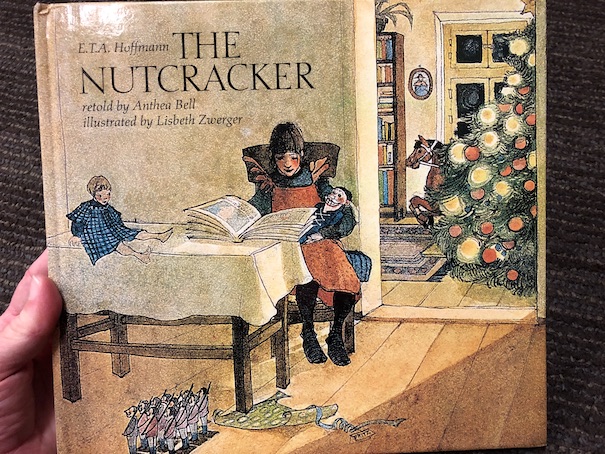
The Nutcracker by E.T.A. Hoffmann, retold by Anthea Bell, 1816, 1987.
The reason for the two dates of this book is that the original Nutcracker story was written by a German writer, E.T.A. Hoffmann, in 1816, as the novella The Nutcracker and the Mouse King. Some places, including the back of this book note different publishing dates for the original story because it was published more than once during the 1810s, as part of different story collections. This article gives more details about the original version of the story and different publications. Since then, it has been retold many times and in many different forms, including the famous ballet based on the story. In ballets and plays, the name of the heroine is often Clara, but in this picture book, as in the original story, the heroine’s name is Marie.
In the beginning of the book, which is set in the 19th century, Marie and her brother Fritz, are opening their Christmas presents on Christmas Eve. (The book explains that opening presents on Christmas Eve is a German tradition. A friend in Germany also explained that to me once because, in Germany, presents are supposedly brought by the Christ Child, not by Santa Claus. Since then, I’ve read that explanation may vary, depending on whether the household is Catholic or Protestant.) The children receive many wonderful presents, including a toy castle from their godfather, Mr. Drosselmeier. Marie’s favorite present is a nutcracker that looks like an odd little man. When Fritz is too rough with the nutcracker and breaks it, Marie takes care of it.
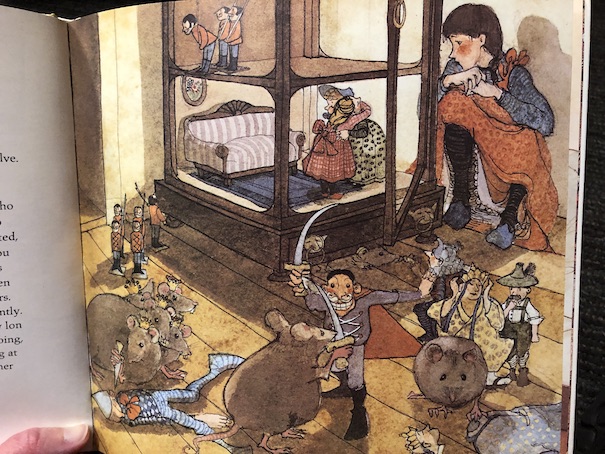
Marie stays up late, and when she finally puts the nutcracker away at midnight, she is astonished to see an army of mice coming out of the floorboards. The leader of the mouse army is the Mouse King, who has seven heads. The Nutcracker leads an army of toys against the mouse army. The mouse army appears to be winning, so, to save the Nutcracker, Marie takes off her shoe and throws it at the mice. Then, her arm hurts, and she apparently faints.
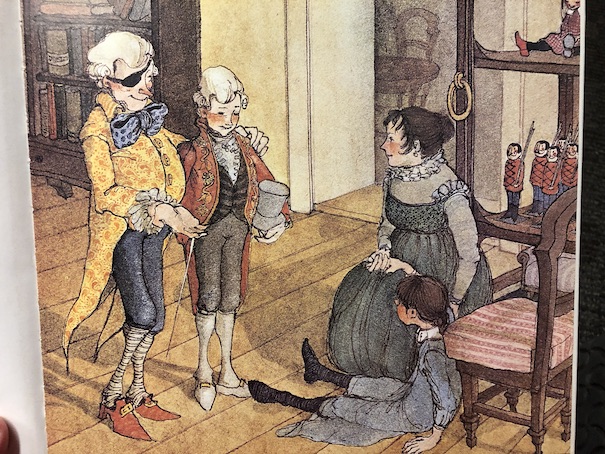
When Marie wakes up, she is in her own bed, and her mother tells her that she apparently put her arm through the glass door of the toy cabinet, cutting herself badly. When Marie tries to tell her mother about the battle between the toys and the mice, her mother and the doctor think that she’s ill and confine her to her bed for a few days. Mr. Drosselmeier repairs the Nutcracker and returns it to Marie, telling her the reason why nutcrackers look so strange and ugly, calling it The Tale of the Hard Nut.
Year ago, there was a royal banquet given by the King and Queen who were the parents of Princess Pirlipat. A mouse who claimed to be the queen of Mousolia demanded some food from the banquet as the Queen was preparing it. The King was angry that the mouse took some of the food and wanted revenge. The King asked his Court Watchmaker, who was also named Drosselmeier, to build some mousetraps to catch the mouse queen’s seven sons. When the sons were caught, the mouse queen vowed that she’d take her revenge on Princess Pirlipat. Princess Pirlipat was a pretty baby, but the mouse queen turned her ugly. The King took out his anger on the Court Watchmaker, ordering him to find a way to change Princess Pirlipat back to normal and threatening to behead him if he failed. After consulting the Court Astronomer, the Court Watchmaker learned that the key to breaking the spell on the princess was a special nut, which had to be cracked by being bitten by a man who filled certain special requirements, which all happened to be met by the son of the Watchmaker’s dollmaker cousin. The King had promised that the person who could break the spell could marry his daughter, but the mouse queen interrupted the last part of the ritual, causing the young cousin to turn ugly himself. When pretty Princess Pirlipat saw her rescuer turn ugly, she didn’t want to marry him anymore. The Court Astronomer said that the only way to break the spell on the young man was for him to defeat the new Mouse King – the mouse queen’s youngest son – and for him to find a woman who would love him regardless of his appearance.
Marie knows that the story is true because she has seen the Mouse King herself. She loves the Nutcracker and wants to help him. The Nutcracker returns to visit Marie during the night and makes repeated demands of her for her candy and toys. Marie knows that, no matter what she gives him, the Mouse King will keep returning to demand something else. The Nutcracker tells her that he needs a sword to fight the Mouse King. They borrow one from a toy soldier, and the Nutcracker successfully defeats the Mouse King, giving Marie his seven golden crowns.
As a reward for helping him, the Nutcracker takes Marie to the land where he is from, leading her there through a magic staircase in an old wardrobe. The Nutcracker’s land is beautiful, filled with candy and sweets and gold and silver fruit. (The Christmas Wood that they pass through reminds me of the woods in the wardrobe in The Lion, the Witch, and the Wardrobe.) The Prince Nutcracker’s home is Marzipan Castle in Candy City, where his beautiful princess sisters live. They welcome Marie and the Nutcracker home.
Then, suddenly, Marie wakes up, as if it were all a dream. However, Marie knows that it wasn’t a dream because she still has the Mouse King’s crowns. Marie tells the Nutcracker that she loves him. There is a sudden bang, and Marie faints. When she wakes up, she is told that Mr. Drosselmeier’s nephew has come to visit them. The nephew is the Nutcracker, restored to human form and now a handsome young man, thanks to Marie’s love. Marie later marries the nephew, and the two of them rule magical Kingdom of Sweets.
There is a section in the back of the book that explains a little more about E.T.A. Hoffmann and the original version of the Nutcracker story.
This book is available to borrow for free online through Internet Archive.
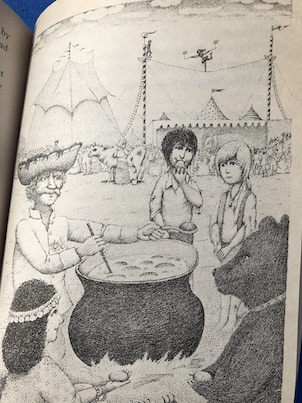
Jemmy is an orphan who lives in the royal castle as the prince’s new whipping boy. Prince Horace, or Prince Brat, as the prince is commonly called, is known for constantly misbehaving, playing mean pranks, and refusing to do his lessons (he tells his tutor that he doesn’t need to learn how to read because he could always get someone else to do his reading for him). However, in their land, it is illegal for anyone to use any kind of physical force or punishment on a prince. Instead, the royal family employs a whipping boy to take the prince’s punishments for him. As you can imagine, seeing someone else whipped in his place does little to correct the prince’s bad behavior. In fact, the prince usually likes the spectacle of the whipping boy yelling. He doesn’t like it that, unlike the others, Jemmy never yells when he’s whipped.
Jemmy
was recruited for the role of whipping boy off the streets, where he survived
by being a mudlark and rat catcher.
There are benefits to living in the palace, even if his purpose in being
there is to take the prince’s punishments.
Jemmy gets food to eat and nice clothes to wear and attends the prince’s
lessons with him, where he pays attention when the prince does not. Jemmy actually loves the books and learning
he receives.
After
about a year, though, the prince suddenly comes to Jemmy in the middle of the
night and tells him that he’s running away from home and wants Jemmy to come
with him as a manservant. When Jemmy
asks him why he wants to leave, the prince says that he’s bored. Jemmy wonders why Prince Brat wants him to
come along instead of a friend, but then he realizes that, as nasty as he is,
Prince Brat doesn’t have any real friends.
When the two of them are outside of the palace, Jemmy is tempted to run off and leave Prince Brat to fend for himself, but before he can make up his mind about it, the two boys are taken prisoner by bandits, Cutwater and Hold-Your-Nose Billy (named for all the garlic he eats).
Prince
Horace tries to pull rank on the bandits, telling them who he is and ordering
them to go away. It’s a mistake. When the bandits see the royal crest on the
saddle of the horse that the boys are riding, they decide that they can
probably get a good ransom for the prince.
Since neither of the bandits can write, they try to make the prince
write his own ransom note, but of course, Prince Brat can’t write because he’s
refused to learn.
Jemmy, seeing an opportunity to turn the situation around, offers to write the note instead. As Jemmy suspected, when the bandits realize that he can write and Horace can’t, they start assuming that he’s actually the prince and that the two boys have switched places. After writing the note, Jemmy suggests that they let the “whipping boy” (Horace) take it to the castle, thinking that not only will Horace get safely away but that he’ll be rid of Horace after that.
To
Jemmy’s surprise, Prince Horace ruins the whole scheme by refusing to return to
the castle. Jemmy tries to reason with
him, but Horace says that he won’t go home until he’s ready. The boys to manage to slip away on the
bandits, and Horace insists on following Jemmy even though Jemmy wants to be rid
of him.
Although Jemmy can’t understand why, Horace says that he’s having the time of his life. For once in his life, he doesn’t have people fussing over him and telling him to keep his clothes clean. Horace has found palace life stifling and boring, and he feels like his father hardly notices him or cares. Part of the reason why Horace acts up is to get his father’s attention. Jemmy is surprised by these insights into the prince’s life and character, and he is also surprised that, when he finally gets the chance to slip away and leave Horace behind, he can’t do it. He knows that Horace isn’t used to life outside the palace, and Jemmy worries about what might happen to him if he’s left alone, although he tells himself that Horace could always return to the castle.
Before their adventures are over, Horace gets to experience what it’s like to do chores for himself and even to be whipped by the bandits, when they think he’s the whipping boy. Being whipped himself shows Horace what he has subjected others to on his account. Jemmy is surprised that Horace bears the punishment without crying or complaining, something which Horace says that he learned from watching Jemmy, who made it a point to take whippings with quiet dignity. Horace also learns what other people really think of him when a woman at a fair comments on the prince’s disappearance, using the “Prince Brat” nickname and saying that the young prince is a “terror” and bound to be a terrible king when he’s older. Usually, people are careful about what they say in front of the prince, and Horace is shocked to find out how disliked he is because of his bad behavior. However, Horace’s new experiences and realizations bring a change in his outlook and personality that make him more sympathetic and likeable. There is also the realization that what Horace really needs in his life isn’t a whipping boy to take his punishments for him but someone who can be a real, honest friend with him, like Jemmy.
In the
end, Jemmy becomes the prince’s companion, not his whipping boy, so that the
prince will be less lonely and stop acting out to get attention. The king promises that Horace can keep Jemmy
as his companion and his responsibility as long as Horace himself can behave responsibly
and do his lessons as he should.
Although the country and characters in the story are fictional, the practice of keeping a whipping boy so that princes wouldn’t have direct physical punishment was a real practice. Even today, the term “whipping boy” can stand for a person who takes blame or punishment in the place of someone with higher rank or authority, even when the person of higher rank is the one at fault. For example, if a business manager or CEO makes a bad decision and orders one of his employees to do something they shouldn’t and the employee gets the blame for it as if what they did was their idea and not the boss’s, that employee can be considered the “whipping boy.” Another example would be if a stepchild in a family was given blame or punishment in place of a biological child because of favoritism on the part of the punishing parent (similar to the crude saying “beaten like a red-headed stepchild“). In fact, depending on the circumstances, a “whipping boy” might not even be a person, but a thing or a concept that is blamed instead of the person or thing that is the true cause of a problem, such as blaming “modern society” or “kids these days” for an individual’s bad habits or behavior, “the government” or “the system” for a business’s bad decisions or policies, or “millenials” for practically everything they’ve been blamed for by older people. It is similar to the concept of the “scapegoat” or “fall guy” but with the connotation that the person who is really at fault, the one who is trying to avoid blame or punishment, succeeds because of higher rank, authority, seniority, or some other form of favoritism among those who will assign blame or punishment.
This book is a Newbery Medal Winner and is available online through Internet Archive (multiple copies).
There is also a movie version of the book, sometimes called Prince Brat and the Whipping Boy. The movie follows the concept of the original story pretty well, but it elaborates more on Jemmy’s life before he became the whipping boy and on how Horace feels neglected by his father. In the movie, Jemmy is pressed into service as whipping boy by the king’s soldiers, who don’t bother to find out if he has any other family. Although Jemmy is an orphan in both the book and movie, in the movie, he also has a younger sister he looks after, and part of what he wants to do when he leaves the palace is to find her. The boys together learn that the younger sister was arrested for attempting to steal a handkerchief in Jemmy’s absence, and they have to rescue her from prison, a side adventure that didn’t occur in the book. In the movie, Horace also explains to Jemmy that his mother died in a riding accident when he was young and that his father pays more attention to affairs of state than he does to him. Horace is shown multiple times trying to get his father’s attention, only to be brushed off because his father is too busy. In the movie, the king almost declares war on another country, thinking that Horace was kidnapped over a border dispute, something that didn’t happen in the book. In both the book and the movie, Jemmy’s new friendship with Horace brings about a change in the prince. At the end of the movie, both Jemmy and his sister are taken in to the palace as companions for Horace. Sometimes you can find this movie or clips of it on YouTube. Although it was originally released on VHS, it is currently available on DVD.

















 Jestress's Forgotten Books and Stories