In the Circle of Time

In the Circle of Time by Margaret J. Anderson, 1979.

This is the second book in the In the Keep of Time Trilogy. There are a couple of characters from the first book that appear in this one, but most are new.

Robert lives on his family’s farm outside of a small town in Scotland.  He loves to draw, but his father doesn’t think much of Robert’s art.  He wants Robert to take over the family farm when he’s grown, especially since Robert’s older brother, Duncan, disappeared two years earlier.  Everyone assumes that Duncan just got tired of the farm and ran off to the city to find work, but Robert has trouble believing that.  Duncan always loved Robert and looked after him, and Robert can’t believe that Duncan would just run off without even telling him.

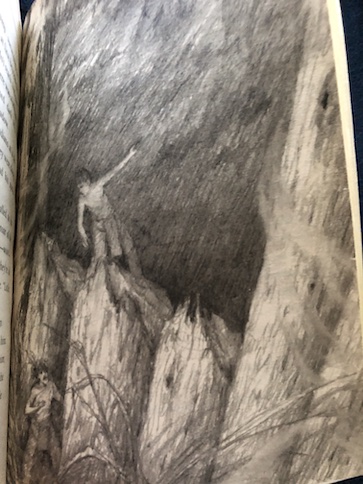
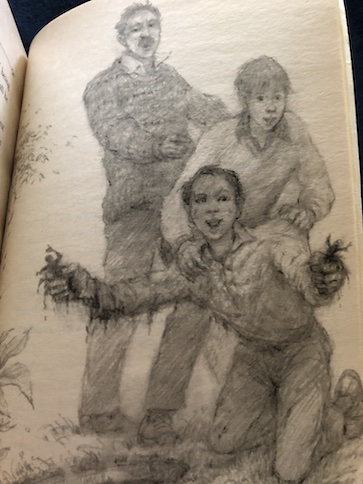
One day, Robert goes to the ancient circle of stones that stands near his town, known as the Stones of Arden, to draw before school.  There, he happens to meet Jennifer, an American girl who has recently moved to the area because her father is working in the nearby city.  Jennifer has an interest in archeology, and she points out to Robert that there are depressions where there used to be stones in the middle of the circle that aren’t standing anymore.  She persuades Robert to help her do a little digging to see if they can find them.  As they dig, a strange fog comes in, and Jennifer sees a vision of dark-haired people also digging.  However, no one is really there because the ground where they were digging is undisturbed.  Robert doesn’t see the people, but he believes Jennifer when she tells him what she saw.  There are a lot of strange stories about the stones, and Robert has heard many of them from his grandfather.

Jennifer, although spooked by what she saw, refuses to believe any superstitious stories.  She persuades Robert to come back to the stones with her so that she can take another look at them.  However, when they do, the strange fog comes, and the kids suddenly find themselves many years in the future.

The kids learn where (or when) they are when they meet a boy named Karten, who was digging in the spot where Jennifer had seen him digging in her earlier vision.  He tells them that the year is 2179 (two hundred years after the book was written).  The kids can suddenly hear the sound of the ocean from the stones when they couldn’t before, and when they ask about it, Karten tells them that the polar ice caps melted in the 21st century, raising the level of the ocean and bringing the water much closer to the stones.

The future is a harsh place, and Karten fears the people he calls “the Barbaric Ones.”  The Barbaric Ones are people from “across the sea” who, as Karten and his people explain, “have retained the ways of people who lived long ago. They are interested in wealth and machines and factories.” The problem is that resources are in short supply, so the Barbaric Ones kidnap people to use as slaves, gathering as much of the scarce resources as they can to sustain their standard of living.  Karten and his people don’t want to fight the Barbaric Ones if they can avoid it because they have lost people who tried to fight them and because they believe in the values of love and trust above all.

Jennifer is quick to insist that she and Robert return to the stones where they entered this strange and disturbing future, but Robert persuades her to stay awhile and meet more of Karten’s people. Karten particularly tells them about an older woman who told him before about other people from the past who came to their time (the kids from the first book in the series), and Robert is hopeful that this woman will not only be able to tell them how to get home but maybe also what happened to his brother, Duncan. Robert has started to suspect that when Duncan suddenly disappeared, he may have come to the this time period the same way he and Jennifer did and may still be there.

The book is available to borrow and read for free online through Internet Archive.

My Reaction:

I don’t generally go in for dystopian novels because I find them depressing. The real world has enough problems without trying to imagine new and worse ones. However, I do find it interesting that this book, which was written a few years before I was born, has a vision of the future that specifically addresses things that are of major concern to people in the early 21st century. It imagines that the polar ice caps have melted and the sea level has risen. Many of the old coastal cities are gone, and there are new cities and communities in areas where there weren’t before.

Because of what’s happened, the world’s population has separated into two parts that have different ways of coping with the situation. The “Barbaric Ones” are much more technology-oriented, but what makes them barbaric is the way they exploit other people to serve their purposes and support the lifestyle that they want to maintain, which is much harder to maintain in this new future. Karten’s people, on the other hand, have developed a more old-fashioned, communal style of living. In fact, it’s unusually communal, to the point where young children are raised collectively by the adults of the community, nobody really knowing or caring about who their birth parents are. When children are nine years old, they select families they want to join, usually because of similar interests they have, and are raised as children of that family. Karten also likes art, and so he joined a family of artists.

These two types of societies are extreme in their views and lifestyles, polar opposites of each other, and neither is really the sort of society that Jennifer or Robert want to be part of. Jennifer is unnerved that people in Karten’s society don’t really know or care who their parents are and just kind of pick families for themselves without attachment to their birth parents. It just seems unnatural to her. Karten explains that their view is that children belong to the community as a whole. If everyone is part of the same big community, what does it matter who they live with? Their concept of marriage or partnership is never fully explained, but there don’t seem to be any rules or even social conventions about who can live with whom. One girl, called Lara Avara, tells Jennifer that her chosen parental figures/mentors are a pair of women, which surprises Jennifer, who thinks of family in terms of mothers and fathers, one of each per family. However, the future people have a different concept of family that seems to be centered more around sharing personal interests, with no particular conventions around how the family should be shaped. The chosen parental figures/mentors raise the younger members who chose to join their family, teaching them skills and professions they have mastered, according to their interests. It is not explained in the story if these older women are or were married or lovers, and it doesn’t seem to be important to any of the characters in the story, either. Lara Avara just tells Jennifer, “There cannot be rules deciding whom you love and from whom you learn.” I see one disadvantage to not knowing who one’s parents and full-blooded siblings are because there would be no way to ensure against incest, which is worrisome because that tends to bring out certain genetic health problems and weakens the genetic pool of the community, especially if it goes on for generations (unless this society has thought of that and just doesn’t mention their solution during the course of the story – maybe the elders of the community who remember who has the same birth parents and who doesn’t will intervene if siblings try to match up with each other). In some ways, Robert is attracted to this style of life because it would make things easier for him. In his own time, his family undervalues his artistic gifts and his unpleasant, temperamental father forces him to do hard physical labor on the family farm. There are times when Robert would love to exchange his problematic family for one that would help him hone his craft and appreciate his personal talents.

For awhile, Jennifer worries that Robert likes these future people so much that he wants to stay there, and she’ll be stuck in the future with him. Unlike Robert, Jennifer is close to her family and happy in their time, and she wants to go home. The two of them are accidentally separated from each other when a character from the previous book in the series (Ollie) brings Robert back to their own time without Jennifer, through the tower that the previous set of characters had used for their time travels. As Robert figures out how to rescue Jennifer from the future, he discovers the truth about Duncan, who has not traveled through time at all (although it looked like that was the way the story was going to go) but really did run away from home, as people thought he did. Like Robert, Duncan was also unhappy about their home life. Although Duncan is better suited to the farm work than Robert, he also found life there stifling, constantly having to work for their father and deal with his angry moods. Their father’s attitude problems are what makes the farm life difficult for both boys, and Duncan also seems to have been feeling overworked and unappreciated. Although life as a teenage runaway has been difficult for Duncan, he has at least managed to find work (paid, unlike the farm work he was doing for his father, and payment is a monetary form of appreciation as well as providing the worker with a living) and the freedom to begin building a life of his own.

Rescuing Jennifer means returning to the stone circle where their time travels began. After Jennifer returns home to their time, she and Robert talk about their experiences. They feel badly that they were not able to help the future people more with their problems and dangers, but Robert says that maybe what’s important is what they’ve learned from the experience themselves and how it’s changed them. Their problems (just like Robert’s brother, Duncan) have always been in their own time, and they have to live their lives in the present. What they do in the present may also change the future and help make it a better place. By the end of the book, Duncan returns to his family’s farm to tell his parents that he’s all right. Duncan will not work on the farm again, as he once did, but he decides to take a new job nearby and help out on the weekends, which will make things easier for Robert. Their family has some healing to do. A talk with Robert’s grandfather also reveals that other members of Robert’s family have traveled through time in the stone circle, and although Robert’s grandfather did his time traveling many years earlier, the vision he got of the future was actually after Robert and Jennifer’s adventures. They can tell that it was further along in time by the people and things he saw, and it reassures them that their future friends will be all right in spite of everything.

The Case of the Weeping Witch

The Case of the Weeping Witch by E. W. Hildick, 1992.

This is one of the McGurk fantasy mystery books.

The kids are studying the history of their New England town in school. McGurk studies witchcraft trials, and he is outraged at how innocent people could be charged with witchcraft on little evidence and sentenced to death. When their teacher tells them that she has learned that a young girl was once put on trial for witchcraft in their town 300 years ago, McGurk convinces the others to try to use their “little black boxes” from the previous book in the series to go back in time and try to save the girl.

The girl, Hester Bidgood, is thirteen years old and turns out to be the goddaughter of Gwyneth, one of their friends from their last fantasy adventure. Gwyneth is now very old, but she remembers them and welcomes them into her home. A man in their community, Jacob Peabody, is trying to pressure Gwyneth into selling him her property. He is the one who brings charges of witchcraft against Hester. Hester calls herself an “investigatrix,” meaning that she is a detective, like the kids in the McGurk organization. She knows some disreputable things that Peabody has done, and Peabody wants to keep her quiet as well as force Gwyneth to give up her property. The McGurk organization is determined to save Hester, but they must be careful not to make anyone think that they might also be witches.

Of course, that turns out to be difficult because all of the modern-day members of the McGurk Organization have magical black boxes.

The book is currently available online through Internet Archive.

Spoiler:

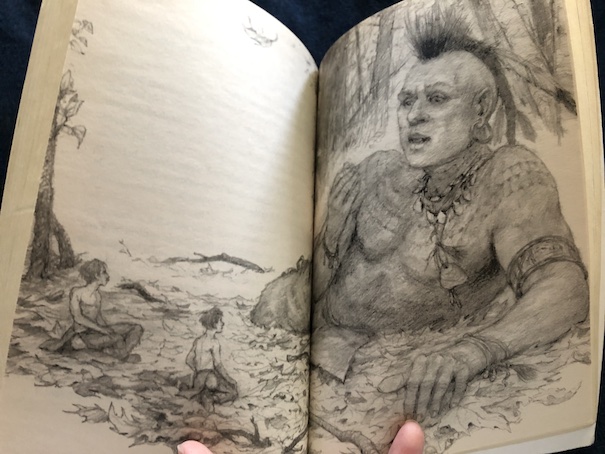
Hester has a friend called Rob McGregor who was captured and raised by Indians when he was young. Although he now lives with his grandparents, he still has habits and skills that he learned from the Indians, and Hester likes to call him by his Indian name, Blazing Scalp (because of his red hair). I expected that Rob would turn out to be some ancestor of McGurk’s, just like the last book had a definite McGurk ancestor, because he has that distinctive red hair, but if there’s a connection, it isn’t definite.

Rob knows that Hester has learned that Peabody earned his fortune by cheating at cards and that he is hiding a mysterious guest in his house. Rob saves Hester when the people in the town try to conduct the water trial, seeing whether she will float or sink in water to determine whether or not she is a witch. Then, Rob and Hester hide in Rob’s secret lodge in the swamp while the McGurk organization tricks the man hiding in Peabody’s house into revealing himself.

The man, who has been going by the name Mica Holroyd, is really Matthew Hopkins, a former witch hunter who has been charged with witchcraft himself and is now a fugitive from the law. Once everyone in town realizes that Peabody is dishonest and harboring a fugitive, they know that the charges against Hester were false. Peabody and Hopkins are both sent back to England, never to return. When the McGurk organization returns to its own time, they learn that Rob and Hester eventually married and that the town gave Hester property that used to belong to Peabody as compensation for accusing her of witchcraft. Hester started a home for orphans and elderly people, which is now a retirement community in the kids’ town.

There is another book in the series which focuses on Rob and Hester alone, without the members of the McGurk Organization.

The Case of the Dragon in Distress

The Case of the Dragon in Distress by E. W. Hildick, 1991.

The McGurk organization start getting interested in the Middle Ages when they acquire a round table, which reminds them of King Arthur’s Round Table, and they begin studying the Middle Ages in school. Shortly after that, Brains buys a set of walkie-talkies at a fire sale. At first, they don’t work, but Brains tinkers with them until he can get them to send and receive. The strange thing is that they only seem to work well at night.

One night, the organization decides to test them, and somehow, they are transported into the Middle Ages. A strange voice speaks to them through their “little black boxes” and sends them on a quest that takes them to the castle of Princess Melisande the Bad. The castle is supposedly guarded by a dragon, but it is really a couple of servants in a dragon costume. Like many others in the castle, they are prisoners of Princess Melisande, who appears young and sweet, but is actually evil. She uses the dragon story to lure brave men to the castle so that she can imprison them and drink their blood. She has leeches put on them, and then she eats the leeches. That is how she maintains her youth, even though she is ancient. Among her prisoners are the king’s son, Prince Geoffrey, and the young chief of the McGurk clan from Ireland, who may be a distant ancestor of Jack P. McGurk.

When the members of the McGurk Organization arrive at the castle, everyone is amazed by their strange appearance, modern clothes, and the little black boxes that talk. Even Princess Melisande is in awe of them, but the McGurk in her prison is weakening, and she may be planning to replace him with the McGurk from modern times.

The book is currently available online through Internet Archive.

My Reaction and Spoiler:

The two servants who were pretending to be the dragon, Gareth and his sister Gwyneth, are also time travelers, but they are from the 17th century. They were brought to the Middle Ages after drinking a potion that was supposed to cure them of a fever. In their own era, they live close to the castle where they are now imprisoned, and they know that there is a secret passage that leads out of the castle from the dungeon. The kids develop a plan to sneak out of the castle under the dragon costume, but they are caught and thrown in the dungeon. They try the secret passage, not knowing if the path goes all the way through. It does, and they make it to the king’s camp. When they tell the king that Princess Melisande has his son, the king plans to storm the castle and free the prisoners. McGurk says that their mission is accomplished, and the voice from their little black boxes says that it’s time for them to go home. Everyone wakes up in their own beds, as if nothing had happened. They believe that the walkie-talkies are responsible for what happened, but they aren’t quite sure if they actually went back in time or merely dreamed that they did. There is some evidence that they really went back in time, but it isn’t answered definitely.

I liked this book as a kid, although it’s a little bizarre because most of the books in this series are just mysteries involving a group of neighborhood friends that take place contemporary to when the books were written. There is usually nothing magical or supernatural about the books in this series, and it’s kind of a weird departure from the usual format. There is another book after this one that continues their time traveling adventures.

The Key to the Indian

The Key to the Indian by Lynne Reid Banks, 1998.

This is the final book in the Indian in the Cupboard series. At the end of the previous book, Omri’s father learned the secret of Omri’s special cupboard and key, that it brings small plastic figures to life.

At the beginning of this book, Omri’s father suddenly announces to his family that he wants to take them on a camping trip. It seems like an impulsive decision because this isn’t something that the family usually does, and Omri figures that it must have something to do with the secret that the father and son now share concerning their small friends from the past.

After Omri’s father discovered his secret, the two of them had a serious talk, and Omri explained to him all about his past adventures and the very real consequences that they’ve had, both in the present and in the past. They need to consider carefully what they’re going to do because Little Bear has asked them for help with some trouble that his tribe in the past is having with the British. Knowing the history of the interactions between Europeans and Native Americans, both Omri and his father know that something serious is about to happen to Little Bear and his people, but how can they help? Omri explains to his father that they have the ability to go back into the past themselves, but in order to do that, they need to find something big enough to hold both of them, and someone else would have to turn the key for them to send them and bring them back.

Omri’s father later admits to him privately that he thought up the camping trip as a way for the two of them to disappear for a couple of days without anyone asking questions. Although he proposed the camping trip, he plans to arrange for him and Omri to have a private trip by themselves, discouraging the others from going along. Omri’s father also thinks that he’s figured out what they can use to send themselves back in time – the family car. It’s big enough to hold both of them, it locks with a key, and there’s even an LB in the license plate number, which they take as a hopeful sign. But then, Omri realizes that there’s a problem with that scheme. Even though the car locks with a key, it’s not the kind of lock that an old-fashioned skeleton key could open. They need a key with a different shape, something flatter. They decide that they need the help of Jessica Charlotte, who made the last key. Fortunately, Omri has a way to talk to her because he has the plastic figure of Jessica Charlotte.

When Omri brings Jessica Charlotte back, he finds that she has attempted to drown herself in a river (an event hinted at in the last book) because of her guilt at accidentally causing her sister’s husband’s death. Omri brings back a WWII Matron who has helped them before to treat Jessica Charlotte. When Jessica Charlotte recovers, she thinks at first that she must have died and that Omri is part of her afterlife. Omri assures her that it’s not the case, that she’s still alive. She is still lamenting over having caused Matt’s death and ruined her sister and niece’s lives, but Omri explains to her that he’s Lottie’s grandson. Jessica Charlotte feels better, hearing that Lottie grew up, married, and had children, so her life wasn’t completely ruined. Omri can’t bring himself to explain how Lottie was killed in a bombing during WWII, but he asks for her help to create a new key. Aunt Jessie, as she asks to be called, agrees to help Omri, and he and his father give her their car key to duplicate.

However, when Aunt Jessie returns with the key, they realize that they’ve miscalculated. When a person comes from the past with anything they make or bring with them, it’s always small, like the miniature people themselves. Aunt Jessie’s key is a duplicate of the key they gave her, but it’s small, too small to use in the car. Omri and his father aren’t sure how to get around this problem, so they decide to go on the camping trip with Omri’s brother Gillon, just camping like normal, while they think it over.

It turns out that something magic happened to the car key while it was in the past with Aunt Jessie. When Omri’s father turns the key in the car, Omri suddenly finds himself in the past, but not the past he was hoping to visit. Because they brought some things that belonged to his Great-Grandfather Matt with them on the camping trip, Omri suddenly finds himself in India, during the time that Matt was living there. Omri is inside a puppet in a marketplace, and his great-grandfather buys him. Also, to Omri’s shock, Gillon is also inside a puppet that his grandfather has.

Their mother eventually rescues them by opening the car and turning the key. She was alarmed because it seemed like her husband and sons all passed out in the car. Omri and his father don’t have a real explanation for her, not wanting to explain that the car key is now magic. (She decides that there must have been an exhaust leak, and they were all overcome by fumes.) Gillon was knocked unconscious when his puppet was dropped on its head, and his mother takes him to the hospital, using her spare car key. (When Gillon recovers, he thinks it was just a weird dream he had because of the car fumes.) Meanwhile, Omri and his father talk about the situation, and Omri’s father reveals that, while the boys were taken to India, he ended up in Little Bear’s time because he was carrying some wampum belonging to Little Bear.

So, know they know that it’s possible for them to use their car key to go back in time, but if they try it a second time, who will turn the key for them to bring them back at the appropriate time? The only other person who can come with them on their “camping trip” who knows their secret and can be trusted to help them is Omri’s friend, Patrick. However, Patrick isn’t happy that he’s only there to help Omri and his father go back in time and that he won’t be going himself. He does agree to help them, but unfortunately, he has plans of his own while Omri and his father are occupied elsewhere.

The book is available to borrow and read for free online through Internet Archive (multiple copies).

My Reaction:

Although Omri’s father wonders at first whether it’s a good idea to try to help Little Bear because of the risk of changing the past and affecting the future, Omri has learned that it’s not quite as simple as that. During his previous adventures, he has felt an irresistible pull to use the cupboard and the key, even when he wasn’t always sure it was a good idea, and there are indications that Omri’s interactions with people in other time periods seem fated to happen. He did save Jessica Charlotte’s life when she tried to drown herself, and other things Omri has done seem to fit with wider events.

When Omri and his father are figuring out how to help Little Bear with his problems with the British in his time, they do some research about Little Bear’s time and talk about the ways that 18th century British people treated Native Americans. Knowing what Little Bear is likely to face, they feel like they have a responsibility to help him as best they can. When Little Bear explains in more detail what his people have been suffering at the hands of the British and other settlers, Omri feels guilty, knowing that he’s also British, while at the same time knowing that he was not responsible for things that happened before he was born. This is something that people still struggle with today, hearing about difficult periods of history and knowing that their ancestors (or at least other members of their society, if not literally their direct ancestors) played a role in making life difficult for others, setting up situations where real people suffered or were killed. The best Omri can do is to help Little Bear make the best possible decisions to ensure the survival of his people. Of course, being able to help with that much is part of the time traveling fantasy of this story. Real people can’t actually go back in time and intervene to influence others and change the course of history.

The books in this series aren’t for young children, and as the series progresses, they get more serious in subject matter. There is discussion of suicide, not just with Jessica Charlotte’s attempt to drown herself but when Little Bear explains that his first wife killed herself after being raped by white men. There is violence in the story when the Native American village is attacked and people are shot. Overall, the story is pretty straight-forward in the way in confronts the dark sides of history. Omri and his father advise Little Bear to take his clan to a place where they know that they will be relatively safe and among other Iroquois, but they know and admit to Little Bear that even that won’t solve all of their problems and that there will be other hardships in the future. It’s an imperfect solution to a massive problem, but Omri senses that it is best choice that they could make and that Little Bear and his family will live the safest possible life because of the decision they made, and their descendants will survive.

Omri and his father struggle with knowing that things are going to be hard for Little Bear’s people no matter what choices they make. There is no magical solution to everyone’s problems in the story, and the book doesn’t offer a firm moral or solution to Omri’s guilty feelings when he sees firsthand how badly Native Americans were treated (a form of “white guilt“, although the book doesn’t use that term). Overall, I would say that the book confronts the dark parts of history and human guilt on a very individual level. Omri and his father can’t solve the large issues completely because they can’t control them. They can’t control the past, and they can’t control other people, not even the people who come through the cupboard as miniature ones, like living toys. Everyone is an individual with their own choices to make, and every choice, even the wrong ones, changes the course of history.

After Omri saves Jessica Charlotte’s life, she realizes that what she thought was a dream before she stole her sister’s earrings was real, that she saw and spoke to Omri, and that he could have warned her about what would happen if she went through with her theft, how Matt would have died and how everyone’s lives would be changed for the worse. However, Omri did choose not to warn her because not everything was changed for the worse. After Lottie’s father died and her family lost their money, Lottie still grew up, fell in love, got married, and had a daughter. It’s true that she did die young in World War II, while her daughter was still an infant, and changing the theft of the earrings might have changed that in some way, but not without changing other things. Omri has discovered that changing things about the past, even seemingly small things, can change larger parts of history, and his psychic gift seems to guide him toward making only choices that help the flow of history instead of working against it. If he had prevented the theft of the earrings, his great-grandfather might have lived longer and so might Lottie, but if that happened, would Lottie have ever met the man she eventually married and had Omri’s mother? Omri’s father wouldn’t be happy without his wife and sons, and if Omri never existed, would some of the other things he did that impacted history have happened? Also, if Lottie hadn’t died in the bombing during WWII, would someone else have been where she happened to be and died in her place? The bomb that killed her would have fallen anyway because that was part of someone else’s choices, a person who never enters this story and whose decisions can’t be controlled. Time and history and the ripple effects caused by individual choices are complex. Omri has his psychic gift to guide him, and even his father, who admits that he never used to believe anything he couldn’t see for himself, comes to trust it.

People without this sort of magical gift have only themselves to rely on to make the best choices they can to make the world as good as possible, even in the face of others’ bad decisions. I think that a large part of the choices that Omri makes in the story and dealing with “white guilt” in real life come down to the combination of frustration and the acceptance of choices made by other people who can’t be controlled. Modern people might hate what happened in the past and feel badly if people related to them were part of it, but we don’t have the option to change things that have already happened. There comes a point where you have to accept the knowledge that you can’t control others, no matter how much you might want to make better choices on their behalf. The only person you can control is yourself.

I’m a white person, descended from colonial settlers in America, and I don’t actually see “white guilt” as a negative thing. I see it as a human thing. If you can feel real emotion at someone else’s plight, a wish that bad things didn’t really happen, or a feeling that what happened shouldn’t have happened and an honest desire to change even the unchangeable past for the better, it means that you’re a real, thinking, feeling human being with a sense of right and wrong, and there’s nothing bad about that at all. Feelings are just tools, to give us hints of what we need to do or how we need to behave in our lives. Feelings aren’t always completely accurate, but sometimes, they give us hints of things that need to be fixed or clues that whatever we did before didn’t really work, that we made the wrong choice or did the wrong thing. I think what upsets and confuses other white people about “white guilt” is the conflict between loving ancestors and wanting to be proud of them and admitting that some of them had a real dark side and did some pretty awful things. Some people have trouble dealing with that, thinking that it’s impossible to feel two things at once, loving someone and being angry with them for things that they’ve done, but it really is possible. Two things can be true at once, and you can have mixed feelings about many things.
Feelings are complex, as complex as people are, and I think it’s as possible for a person to both like and hate another person for the things they’ve done as it is to both like a sweater for the way it looks but not want to wear it because it’s itchy and uncomfortable. I think that’s about the best advice that I can actually offer to other white people trying to make sense of that feeling. Sure, that sweater looks pretty impressive. It has a nice color and a cheerful pattern, and you might think it would look impressive on you if you wore it, but honestly, it’s better if you just leave it on the mannequin. It’s overpriced, out of style, and won’t look at all impressive when it makes you constantly want to scratch all of the places where it itches. Let it go.

“God, grant me the serenity to accept the things I cannot change,
courage to change the things I can,
and wisdom to know the difference.”

The Serenity Prayer

The frustrating thing about feelings about the past and about other people’s lives is that we can’t fix those particular things. In real life, we can’t go back in time, and we can’t even “fix” other people in our own time because that’s something they have to do themselves, if they’re going to do it. You can suggest things to other people, but there’s always a point where they have to make the decisions themselves. But, the good news is that, if you can’t control other people, nobody can completely control you! The way I see it, the most useful thing about this “white guilt” is remembering that this is something we don’t want. Maybe there’s something charming about the rosy, nostalgic view of the past, but honestly, you wouldn’t be happy living there, and if you actually had to live with your ancestors, you’d probably discover that you wouldn’t see eye-to-eye on a lot of things and maybe wouldn’t even get along at all. So, why would you want to try to carry their old baggage with you into your life and spend your life and your precious time constantly trying to explain or excuse their bad choices? You’ve got your own to life.

Give credit where credit is due for both the good and the bad things, and let our ancestors’ records speak for themselves. You won’t accomplish anything for twisting your feelings into knots for trying to protect the feelings of the dead and justify their actions. They don’t even feel anything anymore. They are dead. Let them rest. We don’t want to add to bad things that have been done in the past and to keep having things in our lives to feel guilty about, and that’s okay because there are new choices to be made every single day. Put your focus there. You have a present to live and a future to plan. Knowing about the past is interesting and informative, but the past isn’t where we really live. Admire it like a nice sweater on a mannequin, take note of the price tag, and move on. We don’t have to make the same old choices that have made people, including ourselves, unhappy just because that’s the way things have been before or because we feel like we have something to prove about our ancestors. They had their chance to make the choices in their time, for good or bad (and frequently, some of each, but you can’t help that), and now, it’s our turn to make the choices because this is our time.

Speaking of bad decisions, Patrick almost gets Boone and Ruby killed because of his recklessness when he brings them back while Omri and his father were with Little Bear, which he did just because he was bored and felt left out of their magical adventure, which wasn’t really pleasant and fun for them anyway. Boone and Ruby both make it clear how they feel about that, and Omri also makes it clear that this is the end of the magic for him and Patrick. Boone and Little Bear have their own lives to live, and Omri’s gift tells him that it’s time to let them get on with living their lives without interference. Omri still has the cupboard and the key, but he no longer feels the pull he felt before to use them because he has played his part in history and in the lives of his little friends, and there is nothing more he needs to do. He doesn’t feel the need to lock these things away as he did before because he already knows that he will never feel the urge to use them again. When something’s over and the moment has passed, you just know.

Before the end of the story, Omri’s mother admits to him that she knows all about the little figures and that the cupboard brought them to life, although she never actually saw any of them herself. She has also inherited the family gift and is aware of what the cupboard does, even though she has not used it herself. All along, she’s been pretending that she didn’t know what was going on, although she really did. She’s a little sorry that she didn’t see the little people herself, but she knew that not interfering was the right thing to do. She thinks that letting the magic go and not using the cupboard again are the right decisions, and she doesn’t want Omri or his father to tell Omri’s bothers about the magic because, if they do, it will never end, and it’s really time for it to all end. This really is the final book in the series.

The Mystery of the Cupboard

The Mystery of the Cupboard by Lynne Reid Banks, 1993.

This is the fourth book in the Indian in the Cupboard series. It’s also the longest book in the series and the one that reveals the most about the history of the magical key and cupboard and how their secrets tie into the secrets in Omri’s own family. It was my favorite book in the series when I was a kid!

Omri’s parents have surprised him by telling him that they’re planning on moving to a new house again. Omri wasn’t exactly happy with their last move, and his room and other parts of their new house were damaged after his last adventure with time travel, when his friend Patrick brought back a tornado with him. However, now that the house has been repaired and he’s settled in, Omri doesn’t like the idea of having to pack up and leave and get used to a new place again. His parents want to move to the country, but it’s not even the area where Patrick now lives. Instead, they’re planning to move to a house that his mother has just inherited.

The house Omri’s mother has inherited belonged to an older cousin of hers she never actually knew. He didn’t leave his house specifically to her; it’s just that he died and left no will, and Omri’s mother happens to be the nearest living relative his lawyers could find. When they finally see the house and find out how much land is attached to it, it turns out to be much better than Omri expected.

There are just two things that concern Omri. The first is the package that he asked his father to store at a bank for him – the magical cupboard and key. Although Omri asked his father to put them in a bank deposit box to keep them safe and prevent himself from being tempted to use them again because it’s too dangerous, he doesn’t like the idea of them being too far away from where he’s living. His father promises to have them transferred to a bank near their new home. The second thing that worries him is that his cat mysteriously disappears soon after they move into the new house. (The cat is okay, she just sneaked away to have kittens.) His parents say that she’s just roaming her new territory and might be a little angry for being moved from her old home and that she’ll come back to Omri once she’s settled in, he still worries about her.
One night, he think he hears his cat crying and goes looking for her. He doesn’t see her, but he stumbles on something that was hidden in some old thatch that fell of the roof of the house. It turns out to be a metal box and a notebook belonging to someone named Jessica Charlotte Driscoll, written in 1950. Omri doesn’t know who she is, but the notebook is a story of her life, in which she describes incredible things happening to her which her family doesn’t believe. Omri wonders if she could be a relative of his, and the name Charlotte reminds him of his grandmother, Lottie. He never knew his grandmother and his mother doesn’t even remember her mother because she died in a bombing during WWII, when she was very young. The woman who wrote the notebook couldn’t have actually been his grandmother because she would have been dead for several years by 1950, but perhaps it was a family name.

Omri questions his mother about the cousin who owned the house and her family’s history. Jessica Charlotte turns out to be the sister of Omri’s great-grandmother, his mother’s great-aunt. Great Aunt Jessica Charlotte was the younger sister of his mother’s grandmother. After her mother was killed in the war, Omri’s mother was raised by her grandmother. Omri’s mother had asked her about her younger sister when she was a girl, but her grandmother didn’t like to talk about her. Apparently, Jessica Charlotte had been an actress with a somewhat scandalous past. However, the cousin who used to own this house was Jessica Charlotte’s son, Frederick. Frederick never married, and although Omri’s mother thought that Jessica Charlotte had lived abroad somewhere, it’s possible that she lived at this house for a time.

Much of the story is told through entries in Jessica Charlotte’s notebook. When Omri begins to read the notebook, written toward the end of Jessica Charlotte’s life, he learns, to his shock, that Jessica Charlotte was the original owner of the magic cupboard and that she had her own Little People who visited her from other times and were her friends. After Omri reads that, he questions Gillon, the brother who gave him the cupboard, and he admits that he didn’t really find it in an alley, like he said. He actually found it in the basement of their old house with a bunch of other junk. He just didn’t have the money to buy Omri a birthday present at the time, and Omri had kind of a fascination for secret drawers and boxes, so Gillon thought that he might have some fun with the old cupboard, and he made up the story about mysteriously finding it to make it more interesting. (I suspect that the author was just retconning this part to make it agree with the idea that the cupboard was passed down through Omri’s family, but I like the way this comes out, so I’m okay with that.)

The notebook further explains that Jessica Charlotte had been envious of her older sister because she was prettier, luckier, and often seemed favored by everyone. However, in mocking the young men who came to court her older sister, Jessica Charlotte discovered that she had a talent for mimicry, which led her to become an actress, although her family thought that it was a disreputable profession and disapproved. Jessica Charlotte also discovered that she was psychic and sometimes had visions of the future. She eventually left home and became an actress. Her sister, Maria, still visited her secretly sometimes, against their parents’ wishes.

After awhile, Jessica Charlotte became pregnant with Frederick, which was when she first came to the old house where Omri’s family now lives. She didn’t have any money and couldn’t work while pregnant, and because she was unmarried, she would have been considered shameful if people knew. At that time, the house was a farmhouse belonging to a relative of Frederick’s father. By that point, Jessica Charlotte realized that her boyfriend wasn’t a good person and wasn’t going to be a good father to their son, but he did arrange for this relative of his to help her through her pregnancy. Frederick was born in the house, and because he was illegitimate and sensed his mother’s complicated feelings about him and the circumstances of his birth, he and his mother were never as close as they really should have been.

Meanwhile, Maria got married and had a daughter, Lottie, who was Omri’s grandmother, the one who was killed in the war. Jessica Charlotte says that she did something that wronged Maria and Lottie, and Omri stops reading the diary for a time, but he decides that he really has to continue and know the full story.

Over the years, Jessica Charlotte lived a hard life, supporting Frederick through a mixture of acting and other odd jobs, including fortune telling because of her psychic abilities (although she never used her gift to see into the future for herself or anyone close to her because she was afraid she might see something bad happen to them and be unable to stop it). Meanwhile, Maria was living a very comfortable life with her husband and daughter. Even after their parents died, Maria still had Jessica Charlotte visit secretly because of her tainted reputation, and she never wanted to meet Frederick or talk about him because his birth was the cause of her sister’s scandal. Still, Jessica Charlotte continued to see her sister and became fond of Lottie.

However, Maria was basically a pampered snob who didn’t understand her sister’s life and hardships and also had a streak of self-centeredness. One day, when Lottie was a young child, Maria said that when Lottie was older, she didn’t want her to see so much of her aunt, implying that Jessica Charlotte would be a bad influence on her. Jessica Charlotte was deeply offended by that, but she was also fearful about losing the last family members who were still speaking to her. She had lost so many of her other relationships that she still felt the need to be close to Maria and Lottie as much as she could and visit their pampered and comfortable little world, enjoying occasional tastes of their happier and more comfortable lives.

Yet, Jessica Charlotte’s jealousy for Maria’s pampered life and anger at her callousness continued to eat at her. One day, when Maria was showing her all of her nice jewelry, Jessica Charlotte got the urge to steal a beautiful pair of earrings. First, Maria was being, at the very least, thoughtless and callous for showing off all of her nice jewelry to her much poorer sister, who could never have things like that herself. Maria not only had no concept about what her sister’s life was like outside of her occasional visits, but she purposely never asked her about how she was doing, how her son was doing, or even where they were living, how they were getting by, if they needed anything, or if she could help them in any way. She didn’t know because she didn’t want to know any of these things, and the fact that she didn’t want to know any of that indicates that she knew enough to understand that their circumstances weren’t pleasant. To show off all of her pretty things like that just seems like rubbing it in. Second, Jessica Charlotte had been in need for so long that she saw all of the pretty jewels as symbols of Maria’s comfortable life, something she hungered for herself. The pair of earrings weren’t something that Jessica Charlotte wanted just for the sake of having them but because of what they represented to her, the life that she couldn’t share in and which she knew that Maria would soon shut her out of when she declared that her visits with her young niece would have to stop soon.

Jessica Charlotte planned out the theft in advance, making a duplicate key for her sister’s jewelry box and thinking that her sister would just assume that she’d mislaid that one pair of earrings somewhere. Unfortunately, when Maria noticed that the earrings were gone, she thought Lottie had done something with them, and when she kept insisting that Lottie tell her where they were, Lottie got upset and ran out of the house into the street. Matt, Maria’s husband and Lottie’s father, chased after her and was hit by a cab and killed. Jessica Charlotte felt terrible when she heard the news because she hadn’t meant for anyone to get hurt, but there was nothing she could do to take it all back.

Omri knows how Maria and Lottie’s lives went after that point because of what his mother told him about their family history. After Matt died, Maria and Lottie didn’t have very much money to live on, just a little pension, and then their house was burgled, and many of Maria’s nice things were stolen, including the rest of her jewelry, so she couldn’t sell them for extra money. Maria had to move to smaller, cheaper lodgings and get a job for the first time in her life in order to support herself and her daughter, living a life closer to what her sister had been doing. When Lottie was grown and married, she and her husband helped to support her mother, but after they were killed in WWII, Maria took in Lottie’s daughter (Omri’s mother) and had to keep working in order to raise her. Although they were now living in more equal circumstances, the two sisters did not become close again because of Jessica Charlotte’s guilt about what she’d done. Jessica Charlotte ended up buying the old house in the country where her son had been born and told her sister that she was going to live abroad, never telling her exactly where. She had not expected to see Maria again anyway since Maria was planning to cut her out of her daughter’s life before Jessica Charlotte stole the earrings, and after Matt died, Jessica Charlotte couldn’t bring herself to face Maria. Jessica Charlotte lived in the country house until her death in 1950.

When Jessica Charlotte became too weak to write any longer, shortly before her death, she had Frederick finish the story in the notebook. Aside from the difficult feelings between Frederick and his mother because of the circumstances of his birth and the rough and poor childhood he endured, Frederick also says that the two of them don’t really get along because they are very different types of people. When he was grown, Frederick went into business as a metal smith, eventually owning his own factory that made toy soldiers and other metal toys. During WWII, the government had him convert his toy factory to manufacture munitions. He wasn’t happy about it, but it did make him fairly well-off. After the war, Frederick had hoped to go back to making metal toys, but plastic was coming into vogue as the material of choice for toys, and Frederick couldn’t stand the stuff. He thought that the newer plastic toys were cheap and shoddy compared to his detailed works of art in metal. (It was kind of true.) There were basically two choices before Frederick: convert to making the cheap plastic toys he hated or switch to making different types of metal products. He switched to making metal boxes and cabinets.

Frederick never really believed in his mother’s supposed psychic powers, but when he was upset about plastic ruining his metal toy business, he admits that he let his mother talk him into participating in a silly ritual. He was so angry and upset that his emotions were ruining his health, so his mother told him to build something to put his feelings into and shut them away. Frederick built Omri’s magical metal cupboard. When he was finished making it, his mother had him visualize cleansing himself of all of his anger and hatred of plastic and shutting that feeling away in the cupboard. To his surprise, his mother shut and locked the cupboard with a different key from the one that he’d made to put in the cupboard’s lock (her key to her sister’s jewelry box). He thought that this ritual was kind of crazy at first, but he did feel better after he did it. He felt weak for a time, but then he recovered. He still didn’t like plastic, but not to the point where it harmed his health anymore.

Jessica Charlotte had said her son had also inherited her psychic “gift”, even though he didn’t believe in it. Apparently, his strong feelings about plastic produced a kind of magic spell or curse that affected the key and the cupboard and created the effect of bringing plastic toys to life. Jessica Charlotte discovered this herself because her son had given her a set of plastic figures in order to demonstrate to her how these little figures were inferior to his metal ones. Jessica Charlotte put them in the cupboard and brought them to life, and these little friends of hers brought her some happiness in her final days. Frederick thought that her mother was imagining that she was talking to fairies or something and never found out about his mother’s little friends or the magic of the cupboard.

When Jessica Charlotte realized that she was dying, she used the cupboard to send her little friends back to their own time periods, except for one little maid named Jenny, who refused to go back because she’d had a terrible life in her own time. Instead of making her go back, Jessica Charlotte confided in one of the workmen fixing the thatch on her roof and gave Jenny to him. This man, Tom, was lonely because his wife left him for someone else, so Jenny was good company for him for many years, until one day, she simply turned back to plastic suddenly. When Omri finds Tom as an old man and introduces himself as Jessica Charlotte’s distant nephew, Tom explains all of this to him, saying that all he can think of is that Jenny’s physical body must have died in her own time after having been in an apparent coma for years. He buried her little plastic figure respectfully. Tom is also the one who sent the cupboard and key to Maria after Jessica Charlotte died along with a note dictated to him by Jessica Charlotte, hinting at the nature of the cupboard and key and tacitly admitting to the theft of the earrings, so Maria knew the truth of the theft before her own death.

Omri comes to realize that the metal box that Jessica Charlotte left behind, and which was sealed with wax, must contain her collection of little figures. When his friend, Patrick, comes to visit him at his new house, Omri explains the whole situation to him, and Patrick suggests that Omri’s magic key will probably open this metal box, too. Of course, he also points out that if Omri opens the box with that special key, it will bring the figures inside to life, just as it has with the cupboard and Omri’s old trunk. Omri sees Jessica Charlotte’s old figurines as a way of finishing her story and feels compelled to bring them back to life one last time, although he knows that bringing figures to life always comes with complications, and he will have no way of knowing who or what the figures are until the box is open.

When Omri gets the chance to talk to Jessica Charlotte’s little friends, he not only learns more about his great-great-aunt’s past and the history of the cupboard but also sees an opportunity to change the past of his mother and great-grandmother by preventing the robbery that made them poor. But, if he meddles in the past, what will that mean for his future?

The book is available to borrow and read for free online through Internet Archive (multiple copies).

My Reaction:

This is my favorite book in the Indian in the Cupboard series. I suspect that the author of the series didn’t originally have an explanation for why the cupboard and key were magic, but that’s just a guess on my part. The explanation behind the magic in this book makes sense, and those parts that didn’t quite mesh with the earlier books (like Omri’s brother’s original explanation of finding the cupboard in an alley) were briefly explained. Sometimes, when book or movie series try to explain something magical or a mysterious secret they’ve left hanging, it turns into a let-down because the explanation feels rushed or implausible or fits clumsily into the earlier parts of the story, but this one was pretty smooth, intriguing, and also opened up some new story possibilities.

In previous books, Omri and Patrick both did impulsive things with the cupboard that put their small friends, themselves, and other people in danger, but in this book, both of the boys seem to have matured. Although Patrick thinks of Jessica Charlotte as a bad person and a thief for stealing her sister’s earrings, Omri tries to explain to him that she was a much more complex and conflicted person than that. Yes, Jessica Charlotte was a thief, but her motives were beyond mere greed, and it wasn’t long before she regretted what she’d done and the lasting hurt that she’d caused her family. In considering Jessica Charlotte’s theft and the theft that the burglar who was one of Jessica Charlotte’s little friends later committed against Maria, partly out of personal greed and partly as retribution against Maria on Jessica Charlotte’s behalf, Omri and his mother both come to terms with their family’s history. Patrick, who in previous books had been the more impulsive one when he and Omri interacted with the little people from the past, acts as a restraining influence in this book when Omri is tempted to change his family’s past for the better by preventing the thefts that left his great-grandmother without money. Patrick is the one who makes it clear to Omri that, just as Jessica Charlotte’s theft of a single pair of earrings radically changed the lives of her sister and niece, if Omri tries to stop those events from happening, he might change his family’s past so much that he might accidentally prevent himself or even his own mother from being born in the first place. After Omri tells the thief to give back the jewel box he stole, Omri worries that he’s gone too far, but it turns out that one request was actually fated to happen, just as it turns out that Jessica Charlotte later realized that she had met Omri briefly in what she thought was a dream when he brought her plastic figure to life. Not all of Omri’s “meddling” with the past was really meddling but was actually part of what was fated to happen and has already had an effect on the past even before he knew it.

At the end of this book, something that Omri has alternately dreaded and wanted to happen: his father discovers the secret of the cupboard and meets Omri’s small friends. In books, there is usually this assumption that if parents ever find out about their children’s magical adventures, they will end because the parents will put a stop to them or somehow, the magic will be ruined. However, in this case, the magic is not ruined, and there is one more book in this series where both Omri and his father take part in the magic.

The Secret of the Indian

The Secret of the Indian by Lynne Reid Banks, 1989.

This is the third book in the Indian in the Cupboard series.

This book immediately picks up where the last book in the series left off, with Omri injured after witnessing the battle in Little Bear’s time and he and Patrick and their small army having just fended off the gang of local hoodlums who had tried to break into Omri’s house and rob it. Omri’s parents return home from the party they had attended and are appalled to see Omri hurt, although the story of the burglary covers up the real reason for Omri’s injuries, which the boys don’t think they can tell Omri’s parents. Omri still can’t adequately explain how part of his head got burned, but he makes up a story about him and Patrick trying to light a bonfire and accidentally getting burned. His parents are occupied, alternately angry with the babysitter who was supposed to come and didn’t and with themselves for leaving before they were sure that she had arrived. The police come to question the boys and inform the parents that the reason why the babysitter didn’t come was that she was mugged that night. Omri knows who the thieves are, but hesitates to turn them in.

First, Omri needs to deal with Little Bear and his band of warriors. Some of them were killed in the battle, and others are injured. Patrick and Omri bring the Matron who treated Little Bear before to life to help them, but although she does her best, she says that her skills aren’t adequate to help them all and that they need a real surgeon. The Matron is sharp and tells the boys that it’s useless to insist that this is all just a dream because she knows that, strange as this situation is, it’s all real and that the death and pain she’s witnessed around her are real. The boys explain to her about the key and cupboard that bring plastic figures to life, and she asks them if they can get a doctor. It’s Sunday, so the boys can’t just go buy one, but the Matron came from a set owned by Patrick’s cousin, Tamsin, and there were other medical professional figures in it. When Patrick’s other cousin, Tamsin’s twin, Emma, comes to Omri’s house to see Patrick, Omri is forced to let her in on the secret and recruit her to help him.

Meanwhile, Patrick has gone back in time with Boone the cowboy. In Boone’s time, Patrick is tiny, the size of the figures in his own time. Unfortunately, Patrick made a terrible mistake by going back to Boone’s time with Boone as a plastic figure. That meant that Boone became a real person in the chest, trapped under Patrick’s body and almost smothered to death and needs to be treated by the Matron in order to survive.

In Boone’s time, tiny Patrick ends up in the company of Ruby Lou, a woman who likes Boone. Patrick knows that Boone is unconscious in the desert and helps Ruby Lou to find him. The doctor in their time doesn’t know what’s wrong with Boone and can’t figure out why he’s unconscious, suggesting only that they let him rest for the present and recover. Ruby Lou presses Patrick for answers, and he explains everything to her about how they travel through time using the magic key and how Boone has just left his full-size body behind to go into the future in the form of a little figurine. It’s an incredible story, but Ruby Lou believes him and expresses concern about getting Boone back safely. But soon, they’re all in trouble when there’s cyclone threatening.

Also meanwhile, Mr. Johnson, the headmaster of Omri’s school, has learned about Omri’s story that won the contest. Back in the first book of this series, Mr. Johnson actually saw Little Bear. At the time, he thought that he was hallucinating, but Omri’s supposedly fictional story has now convinced him that he really saw what he saw. He demands that Omri tell him the truth about his “Red Indian.” (Omri corrects him, saying that it isn’t right to say “Red Indian” and that they prefer to be called “American Indian” or “native American”, but Mr. Johnson angrily insists that he’s always said “Red Indian” and will continue to do so, establishing him as an unsympathetic villain in the story.) Mr. Johnson is relieved to know that he wasn’t hallucinating before, but since Omri is reluctant to explain anything, he decides to call Omri’s mother. When she answers, she demands that Omri tell her where Patrick is because his mother is frantically looking for him.

Of course, Omri knows that Patrick is still in the trunk in his room, in a coma-like state because he’s still in the past and there are living miniature people in his room who will also be discovered if people start searching. Can Omri fix everything in time to rescue Patrick and his little friends and prevent their secret from being exposed?

The book is available to borrow and read for free online through Internet Archive (multiple copies).

My Reaction

Although the story takes place immediately after the previous one left off, the rules of the magic in this world have changed a little. Before, when a person from Omri and Patrick’s time went back to the past, they kind of became part of the scenery. This time, when Patrick visits the Old West, he is there as a tiny person, although no figurines of the boys exist in the past. What this book does emphasize is that the magic key does change real people from modern times into little people into people in another time and real people from other times into tiny people in modern times. At this point in the series, it’s all still mysterious why the key is magic and why the little cupboard in particular only seems to affect plastic items and people. Some of those explanations come in the next book.

I did like the parts where other people, including Patrick’s cousin Emma and Mr. Johnson in the present and Ruby Lou in the past, catch on what’s happening with Omri and Patrick and their plastic figures. In so many children’s books, the magic absolutely depends on secrecy. In this series, Patrick and Omri both know that they don’t want most people to know their secret because they don’t want people either interfering or thinking that they’re crazy. With Patrick disappearing mysteriously and other things happening because of their interactions with the little people from the past, it makes sense that people would start noticing that the boys have become involved in something really strange, even thought some of them don’t know what it is. However, the magic still works for them even when other people find out and the people who could pose a threat to their activities either never find out the truth or are distracted or apparently discredited.

At the end of this book, Omri becomes more serious about the risks of the cupboard and decides that he wants the key put away, to be give to his future children in the event of his death. However, there are other books in this series to come, so they do use the key again.

The Return of the Indian

The Return of the Indian by Lynne Reid Banks, 1986.

This is the second book in the Indian in the Cupboard series.

Omri’s family has moved to a new house, but Omri doesn’t like it. The new house is bigger than the old one, but the neighborhood around it is a bit run-down and shabby. Most of the kids in the area go to the state school (public school in the US), but Omri attends a private school, and his school uniform makes him stand out from the other kids. The other kids in the neighborhood view him as an outsider and like to push him around, especially the group of bigger boys who like to hang out near the arcade. Omri is a little afraid of the local bullies, but he doesn’t like to show it. Instead, he remembers how brave his small American Indian friend, the one who came to life from his plastic figurine, was with him, even though Omri was many times bigger than he was. Still, Little Bear was a real warrior, who knew how to fight. Ormi wishes that he could fight like an American Indian or maybe a cowboy, like Boone. If he could do that, he wouldn’t have any reason to fear the local bullies.

Patrick, Omri’s best friend, is also living in a new house in the country and is now going to a different school because his parents have divorced. (The story indicates that Patrick’s father was abusive, hitting his wife and children.) When the two of them meet again, Patrick denies remembering their plastic figures that came to life. That bothers Omri, although he thinks that Patrick really does remember but doesn’t want to admit it because talking about things like that would make him seem weird when he’s trying to fit in with his new home.

Then, Omri wins a writing contest for a story that he wrote about his plastic Indian. He’s thrilled, although he also feels a little guilty because the contest was supposed to be for fiction, and his magical adventures with Little Bear were real. Although, his story is his own work, even if he didn’t exactly make up Little Bear.

Ever since his adventures with Little Bear the previous year, Omri has asked his mother to keep the key to the cupboard “safe” for him. Really, he has wanted to remove the temptation to bring Little Bear to life again. After their previous adventures, they had all decided that it would be better for Little Bear and Boone to remain in their own lives in the past. Yet, having won this contest, Omri has the sudden desire to see Little Bear again and tell him all about it. His mother usually wears the key as a pendant around her neck, and one day, when she takes it off, Omri decides that he’s going to use it.

However, when he brings Little Bear and his wife, Bright Stars, back to life from plastic, he finds that time has moved forward for Little Bear, just has it has for him. Little Bear is badly injured, having been shot by a soldier. Bright Stars begs Omri for help. Since Omri once brought a WWI medic to life to help with a wound before, he tries it again. Unfortunately, this time, all Omri gets is an empty pile of the medic’s clothes. Shocked, Omri realizes that this is a sign that the medic was killed in action. Time moved forward for him since their last encounter, and the medic, Tommy, who was a real person in the past, was killed during the war.

Still desperate to help Little Bear, Omri rushes to see Patrick at his aunt’s house and explains the situation. At first Patrick tries to pretend that the figures coming to life was just their imaginations, but when Omri impresses on him that Little Bear is in trouble and needs help, Patrick takes him seriously and comes up with a solution. One of his cousins got a set of plastic figures for her birthday, and they all have different professions. Among them, there is a nurse and two doctors. If they borrow one of those figures, they will have medical help. The cousin finds them messing with her toys and fights with them, so they have to rush off in a hurry, taking the nurse figure instead of one of the doctors, but she’s better than nothing.

After the nurse, known only as Matron, gets over the shock of finding herself very small, Omri explains Little Bear’s condition to her. She’s reluctant to try to operate on him herself because she’s not a surgeon, but since there is no one else to help, she does so anyway. Omri gives her Tommy’s medical bag so she’ll have the implements she needs. She manages to help Little Bear, and Little Bear recovers.

Although Patrick says that his mother got rid of most of his plastic figures when he stopped playing with them, he still has the cowboy, Boone, because he was special. Patrick uses the cupboard to bring him back to life, and they explain to him about Little Bear. When Little Bear is well enough to talk, he explains that his village was attacked by French soldiers, and many of his people are dead. Boone spots Omri’s collection of plastic figures, with soldiers from different periods and suggests sending them back with Little Bear to fight the French. Patrick is all for it, but Omri points out that there are problems with that. All of those figures aren’t just toy soldiers; they represent real people from history. They all come from different periods of history, and they all have their own goals and personalities. They would all be shocked at finding themselves in an unexpected place and a completely different time period than their own, and there’s no telling how these armed people might react. What would a Medieval knight, who might be on his way to the Crusades, understand about American Indians from the 18th century, and why would he be willing to fight on their behalf? Which side would a member of the French Legion pick? They wouldn’t be able to even speak to all of Omri soldiers because they come from different countries and speak different languages, and even if they choose modern British soldiers using modern weaponry, what would that mean for history? They don’t belong in the 18th century, and because they’re real people, they would be killing other real people and might get killed themselves.

Patrick thinks that Omri thinks too much, but Ormi knows that Patrick is too impulsive. Patrick does impulsively bring some modern soldiers to life, and they almost shoot everyone because they’re in the middle of a battle. Patrick quickly turns them back to toys and apologizes. Then Omri has another idea: they can’t explain to people from other time periods that Little Bear needs their help to fight in the French and Indian Wars, but they could appeal to other American Indians. Finding allies for Little Bear is fine, as long as they’re the kind of allies who could reasonably appear in Little Bear’s time and understand and be willing to aid him.

There are complications in this plan when Little Bear says that he wants modern weapons his people can use and a modern soldier to teach them how to use them. Omri has misgivings about this but gives in to Little Bear’s request. While Little Bear goes back to his time with his new allies and weapons, the boys worry about what’s happening in the battle and Bright Stars, who is still in their care, gives birth to Little Bear’s son. Boone suggests to Omri that, if he’s concerned about how the battle is going, there might be a way to go back in time and see it.

Ormi has an old wooden chest in his room, and Boone suggests that he could see if the key fits the box and use it to send himself back to Little Bear’s time. Not only does Omri help Little Bear and the others, but this odd army also helps Omri when the local bullies try to rob his house in the middle of the night.

The book is available to borrow and read for free online through Internet Archive (multiple copies).

My Reaction:

I read the first book in this series when I was in elementary school as part of a class assignment. There are parts of this series I like, but parts I don’t.

I like the way Omri thinks about the little people from his cupboard. He remembers that all of the plastic figures are only plastic when they’re toys, but as soon as they come to life, they are real people, pulled out of their own lives and into his, and they have a responsibility to them. He feels terrible when he realizes that his old friend, the WWI medic called Tommy, died during the war because he wasn’t just a toy, he was a real person who helped them when they needed him, and Omri realizes that he probably died not long after they returned him to his own time. Patrick is less thoughtful, but he does wonder if their interaction with him played a part in his death, and Omri thinks it probably didn’t because his full-sized body must have remained in the past and would have died anyway. When they last talked to him, Tommy said that he’d heard the sounds of an attack, and that could have been the attack that killed him. When Omri sends Little Bear back with his new allies and weapons, Omri feels guilty because he realizes that he’s basically playing God, sending real people to kill other real people in past, but he goes through with it because he feels committed to it at that point, having assembled and armed this fighting force and promised it to Little Bear.

I didn’t like some of the stereotypical stuff about cowboys and American Indians. This is one of those books where they try to write characters speaking with an accent, and that always feels awkward to read, and I’m not sure that everything Omri says about American Indians is true. At first, Omri says that American Indians gave birth alone, so he’s not too worried about Bright Stars. When I read that, I wasn’t sure if any American Indian tribes had that as a custom, so I looked it up. Apparently, there is some basis for that happening, although sometimes women would also help each other, and since most of the white people who said that Native Americans gave birth alone were men and wouldn’t have been involved in assisting the birth anyway, they may not have been fully aware of who else would have been involved. When Bright Stars starts giving birth, Omri remembers hearing that, when women give birth for the first time, it can take a long time for the baby to arrive, and he wonders if that’s true of American Indians as well as white women. That question made me cringe a little. As an adult white woman, I would assume it probably is because there many aspects of the human condition that are just universal, but again, Omri’s a boy who doesn’t have any relevant life experience experience, and even I can’t swear what Native American births are like, so I suppose I can’t fault him for wondering.

This is the book that establishes that the key used with the cupboard is magic by itself. It seems to fit in any lock and can send people back in time. When they’re sent back from the present day, Omri observes that the person sent to the past is cold and motionless in the chest, which scares him. Also, the boys observe that when they go to the past, they seem to be part of the scenery, part of the paintings on the side of Little Bear’s teepee, unable to speech or move by themselves, just watching what happens. It’s odd, but in stories where there’s magic, there are still rules, and as the boys experiment more with the key, part of the rules start becoming more clear to the readers.

The Indian in the Cupboard

The Indian in the Cupboard by Lynne Reid Banks, 1980.

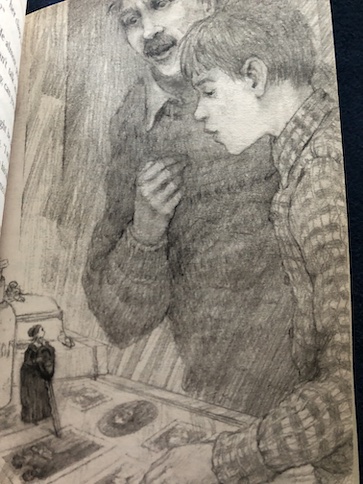
Omri thinks that he’s starting to get tired of collecting and playing with plastic figures when his friend Patrick gives him a plastic American Indian figure that he doesn’t want anymore for his birthday. At first, Omri doesn’t think much of the Indian figure because it’s just a used plastic figure that doesn’t match any other figure sets he has, so he’s not sure how he can use it in his games. Then, his brother Gillon gives Omri a wooden cupboard that he rescued from an alley. Omri likes the cupboard, and his mother lets him have an old key that happens to fit the cupboard so he can lock it. His mother says that the key used to belong to her grandmother’s jewelry box, which fell apart years ago. As Omri tries to decide what he wants to keep in the cupboard, his mother suggests putting his American Indian figure in it because she found it in the pocket of his other pants. Omri puts the toy in the cupboard and locks it. Later, he hears sounds coming from the cupboard, and when he opens it, he discovers that his toy Indian figure has come to life!

Omri is startled to see that the Indian has come to life, and the tiny Indian is afraid of him. The Indian pricks him with his tiny knife and threatens to hurt him if he comes closer. The Indian insists that he’s not small, it’s Omri who is big. When Omri’s mother comes into the room, Omri quickly shuts and locks the cupboard so his mother won’t see that his toy has come to life. Later, when he opens the cupboard again, the Indian is just a plastic toy again. Omri is sure that he didn’t imagine the figure coming to life, but he’s not sure why that happened or why it’s just a toy again now.

Then, that night, after Omri locks the Indian in the cupboard again, he comes to life once more. This time, when Omri opens the cupboard and talks to the Indian, he asks the Indian what happened. The Indian replies that nothing happened, he just went to sleep. Then, he asks Omri for food and a blanket. Omri asks the Indian more about himself and learns that the Indian is named Little Bear and is the son of an Iroquois chief. He offers Little Bear a plastic teepee from his collection of toys to sleep in, but Little Bear recognizes that it’s not a real teepee and besides, Iroquois sleep in longhouses, not teepees. Omri can’t provide a longhouse, so he makes a better-looking teepee out of sticks and a piece of felt, so it’s at least not plastic. Little Bear accepts it.

Omri begins to realize that either his new cupboard or the key that he’s been using with it or both are magical and can bring toy figures to life. He begins doing experiments to see how it works and what else he can make real. The plastic teepee becomes a real one after being locked in the cupboard, but a metal toy car doesn’t change at all, making Omri realize that, for some reason, the cupboard only works with plastic toys.

Omri tells Little Bear that he’s in England now, not America, and Omri discovers that Little Bear approves of the English because the Iroquois fought with the English against the French and the Algonquins. Omri asks Little Bear if he also fought, and Little Bear brags about what a fighter he is and how many scalps he’s taken, but adds that they were French and not English. It sounds kind of stereotypical, but the author is referring to real battles that took place during the 17th century and 18th century around the Great Lakes area, during the French and Iroquois Wars and the French and Indian War, giving Little Bear a rough time period and location. This is meaningful not only for historical reasons, but also because it indicates that Little Bear isn’t just a toy with no personality or history. As far as Little Bear is concerned, he’s a real person with a past and memories and a life beyond being Omri’s toy. In fact, he doesn’t really know anything about being a toy sometimes in Omri’s time period. Omri also realizes that Little Bear’s history makes him a real person, somehow pulled more than 200 years into the future in miniature form, instead of just a toy brought to life.

Still, Omri delights in having adventures with Little Bear, introducing him to things Little Bear otherwise wouldn’t have. When Little Bear says that he’s never hidden a horse before because the Iroquois don’t have them in his time, Omri brings one of his plastic horses to life so Little Bear can ride. When Little Bear gets hurt, Omri brings a WWI medic from his set of toy soldiers to life so he can treat the wound. The medic, Tommy Atkins, is alarmed when he sees Omri and confused when he’s asked to treat an American Indian, but he does so anyway, deciding that it’s all just a dream. Omri lets him think so and then puts him back in the cupboard to send him home.

Omri does some research about Iroquois to learn more about Little Bear and his history. Patrick wonders about Omri’s obsession with the little toy figure he gave him, but Omri is reluctant to tell him. Then, when Omri buys another Indian figure, an old Indian chief, and brings it to life, the poor old man goes into shock at the site of Omri and dies. Omri feels terrible about causing the old man’s death, coming to recognize that the old man was also a real person, sometime and somewhere, and he wouldn’t have died if Omri hadn’t put him in the cupboard and brought him into his time as a miniature person. Then, Patrick gives Omri a plastic cowboy figure. Omri doesn’t want it because he doesn’t want the cowboy to come to life and hurt or kill Little Bear. Patrick is impatient, saying that’s how the game of cowboys and Indians goes and that’s what people do with figurines of cowboys and Indians, have them fight. That’s when Omri realizes that he needs to explain to Patrick that it’s more than just a game and there are real people involved.

Patrick is stunned when Omri shows him Little Bear, and when Omri tells him about the dead chief, he comes to realize that this game is serious. In spite of that, Patrick asks Omri to let him bring just one figure to life. At first, Omri tries to prevent Patrick from bringing another figure to life because the situation is already complicated enough, but Patrick does so anyway when Omri leaves him alone in his room … and the figure that Patrick picks is the cowboy.

Having an American Indian and a cowboy both in Omri’s room, even in miniature form is just as much trouble as Omri feared it would be. The two of them pose a very real threat to each other, and Omri tries to do his best to help them get along with each other. To make things more complicated, Little Bear says that he wants a wife, and the boys take him to the store to pick out a female American Indian from the plastic figures. The school principal sees the figures, but fortunately, decides that he’s just unwell and hallucinating. Meanwhile, Omri has to impress on Patrick that their little people are actually people and not toys simply to be played with. Of course, there’s only one way to ensure that their new little friends will be able to safely continue their lives: send them home!

Personally, I would have ended the game and sent Little Bear home as soon as I realized that he could die, like the chief in the story, but the boys keep their miniature living people for much longer. In fact, this is the first book in a series, and the boys have further adventures with Little Bear, Boone the cowboy, and other figures/people.

This book was commonly used in schools when I was a kid, and it might still be. When I was a kid, my teacher didn’t go into detail about Little Bear’s time period or explain about the context of his life and the conflicts with the French and Algonquin that he described. Now, as an adult, I have more context for understanding what he’s talking about. I also appreciate the author of the book pointing out that different types of Native Americans lived in different types of homes in the past, something that Omri didn’t understand at first, and I liked that Omri started doing his own research to better understand the Iroquois. The book never gives an exact date to Boone the cowboy or Little Bear’s time periods, but by context, Boone has to be more than 100 years younger than Little Bear, from sometime in the late 19th century. I appreciate having some historical details added to a fantasy story about toys coming to life, but the book isn’t very specific, focusing more on the complications involved in keeping miniature people from the past alive and secret in Omri’s bedroom.

There is also a movie version of this book. The book is available to borrow and read for free online through Internet Archive.

Aria Volume 6

Aria Volume 6 by Kozue Amano, 2005, English Translation 2011.

This is the sixth volume of the second part of a fascinating manga series that combines sci-fi, fantasy, and slice of life. The series takes place about 300 years in the future, when Mars has been terraformed and renamed Aqua (because of all the water on its surface). The human colonies on Aqua are designed to resemble old-fashioned cities on Earth (called Manhome here). The people of Aqua prefer a much slower pace of life than people on Manhome, and aspects of life on Aqua more closely resemble Earth’s past.

The series is divided into two parts. The first two books are the Aqua volumes and introduce Akari Mizunashi, the main character, a young girl who came to Aqua to learn to become a gondolier in the city of Neo Venezia (which resembles Venice). Female gondoliers, called Undines, give tours of the city, giving Akari plenty of time to admire the beauty of her new home and meet interesting people. The two Aqua books are the prequel to the main series, Aria. Aqua covers Akari’s arrival on the planet, her introduction to life on Aqua, and the beginning of her training. The main Aria series show Akari’s continuing training, her progression to becoming a full Undine, her evolving relationships with her friends, and as always, her delight in learning more about her new home and admiring its beauty.

The series has received some criticism for being slow and lacking danger and adventure, but that is not really the point of the series. The main purpose is to show people how to appreciate the small pleasures of life. The sci-fi and fantasy elements (the spaceships, advanced environmental controls, intelligent Martian cats, and even the occasional appearances of the legendary Cait Sith) are mainly background to the stories about the magic of friendship and simple pleasures. Each volume contains a few short stories about Akari and her friends and the little adventures they have on a daily basis and the life lessons they learn. It’s a great series for relaxing when you’re stressed out.

Unfortunately, although this book is only about halfway through the series, this is the last book of the series that I actually own because the others haven’t been printed in English yet, although I think that additional volumes will be published in English.

The stories included in this volume are:

Orange Days

Athena comes to visit Alicia at Aria Company, and the trainees’ mentors reminisce about how they first met when they were trainees.

Akira was just as prickly and competitive when she was young as she is as an adult. Although trainee Akira said that she was just observing the “losers” at Aria Company, she kept coming around and became friends with Alicia. When she heard about a new trainee at Orange Company with an amazing singing voice, Akira wanted to seek her out, worried about the competition.

While she was telling Alicia about it, the two of them accidentally had a collision with young Athena’s gondola, which is the first time either of them had seen her. Athena was knocked over by the collision, so the other two girls treated her to lunch, partly to make it up to her and partly because Akira wanted to pump her for information about the new trainee at Orange Company, not knowing that Athena herself was the new trainee.

However, Athena didn’t answer their questions about the new trainee. Even back then, she was a person of few words, and she just made a drinking straw crawly snake to amuse President Aria. Still, Athena became friends with Alicia and Akira, joining them in their practice sessions, like Akari, Aika, and Alice share their practices together. Alicia and Akira only discovered that Athena was the trainee with the amazing voice when they decided to practice singing canzones one day.

The mentors end their reminiscences by saying that it seems hard to believe that, now that their training is over, they are so busy that they hardly have time to see each other. When they were trainees, it felt like they would always practice together every day, but now, their lives are different. These comments make the present trainees uncomfortable because they realize that the same thing is likely to happen to them when their training is complete. Alice, Aika, and Akari have come to value each other’s friendship and companionship, and they find it difficult to imagine being without each other.

However, Alicia and Athena tell the girls to not worry too much about it. Time is always moving forward, and it’s true that things will change for them, but that’s not entirely a bad thing. Even though they sometimes miss their training days when they spent so much of their time together, they are also happy with their current lives. They enjoy their careers, and they like helping to train new Undines. In fact, helping to train the next generation of Undines helps them to connect to their own pasts because the young Undines remind them of their own training days. Alicia’s advice is to enjoy where you are and what’s currently happening around you as much as you can. Life will eventually move on, and things will change, so you might as well make the most of where you are now and enjoy it to the fullest, so you will be ready to move on to the next stage of your life and enjoy that as well. Athena says, “Fun times really aren’t meant to be compared. Just enjoyed.”

The young trainees are still affected by the story of their mentors’ friendships and the changes in their lives. Aika points out to Akari that their lives aren’t changing just yet, but the girls have come to a greater realization that their lives will eventually change.

It’s just like how, when people are young and in school, surrounded by the same other students every day, it can be hard to imagine that there will come a day after you graduate when you won’t all be working at the same place and you won’t all be eating lunch together every day. As you get busy building careers and families, it will be harder to see each other and keep in touch. However, that’s not entirely a bad thing. As some people like to say, “You can’t begin the next chapter of your life if you keep rereading the last one.” There are many things in life to enjoy and accomplishments to be made, and like Alicia and Athena explain, you might as well enjoy where you are right now and make the most of it so you won’t look back with regret when it’s time to move on.

Venetian Glass

Akatsuki’s elder brother comes to Aria Company to hire Akari to transport some delicate Venetian glass. Akari is excited because this is the first time that anyone has specifically hired her, although, because she isn’t a full Undine yet, Alicia will have to accompany her on her errand.

When they go to pick up the glass, Akari sees glass-blowing and Venetian glass for the first time.

One of the workers from the glass factory seems kind of surly, but he accompanies them while they transport the glass and explains the history of Venetian glass and what makes it so special.

The reason why the glass worker is so surly is that he feels like a lot of people don’t appreciate his craft. He and his master put their heart and soul into their work, but people say that their “Venentian glass” is fake because it’s made in Neo-Venezia, not in the real Venice, which sank beneath the ocean years ago. The worker laments that the craftsmen who left the sinking city were scattered across Earth before making their way to Neo-Venezia and that details of their craft have been lost over time. Neo-Venezian glass will never be quite the same as the original Venetian glass, and people will never look at it the same way, which the worker finds depressing.

However, one of Akari’s great strengths is finding the beauty in everything and bringing it out for other people to see. She tells the worker that the glass is kind of like Neo-Venezia itself. It’s true, it’s not the original Venice, only re-created in its image. Some aspects of it are the same, but it’s also a different place, on another planet. To some people, that might make it seem like a fake city, just an imitation of the original, but Akari doesn’t think that the real vs. fake concept matters because she loves the city for the beautiful treasure it is. Similarly, Akari thinks that Neo-Venezian glass is a treasure by itself and likes it for what it is, regardless of what the original was or what others say about it.

The worker finds Akari’s viewpoint inspirational and is enchanted by Akari herself, remarking that she’s also a unique treasure. Akatsuki’s brother jokes that Akatsuki might have a rival now for his affection for Akari. Akari knows that Akatsuki has had an unrequited crush on Alicia, so she doesn’t think too much about it. Although it’s true that Akatsuki has a crush on Alicia, Akatsuki’s brother is also correct that Akari inspires greater feelings in others than she realizes and Akatsuki values Akari more than he lets on, maybe more than even he realizes himself. Akari is unique because of her unusual way of looking at things, and her optimistic point of view influences others.

Snow White

One day, while they’re practicing together, Akari asks Aika what kind of adult she wanted to be when she was a kid. Aika, who has admired and even hero-worshipped Alicia ever since Alicia was kind to her when she was a young child, says that she’s always wanted to be an elegant woman like Alicia. Akari says that she wants to be like Alicia, too, but Aika criticizes her for wanting to copy her ambition and says that it’s not likely that Akari would ever be as elegant as Alicia because she still does kid-like things, like collecting stuffed animals.

Their discussion causes Akari to wonder what sort of adult Alicia wanted to be when she was a little kid, and she asks Alicia about it while they’re out walking one day. Instead of answering her directly at first, Alicia demonstrates by starting to build a snowman and pointing out how the people around them react to it.

Each time Alicia and Akari start to make a large snowball for the base of the snowman, different adults stop and help them to make it a bit bigger.

Alicia says that she noticed people like this when she was a child. There are always adults who, when seeing a young girl making a snowman, feel compelled to help her because she can make a much bigger snowball with their help. That’s the type of adult Alicia always wanted to be.

Alicia genuinely enjoys not only her career as an Undine but her role as a teacher and mentor in Akari’s life and in the lives of her friends, helping them to develop in their trade and to become better Undines because of her influence.

Stray Cat

Alice finds a tiny stray Martian cat one day while waiting for Akari and Aika to meet her for practice. The cat’s mother doesn’t seem to be around, and Alice doesn’t know whether the little cat is lost, orphaned, or abandoned. When Aika arrives for practice, she finds both Alice and Akari lying on the ground next to the cat because it looks so happy lying in the sun that Alice thinks they should also try it.

Although Aika warns Alice that she won’t be able to keep the cat because she lives in a dorm at Orange Company and isn’t allowed to keep pets, Alice becomes attached to the cat, names it Maa, and hides it in her room.

At first, she is afraid that her mentor, Athena, will be angry with her, and Aika scares her by saying that Athena will probably kill the cat because she doesn’t like cats. However, Alice loves Maa because she misses the previous president cat of Orange Company, who recently passed away, and Maa reminds her a little of him.

When the secret gets out, and Alice is confronted by Athena about the cat, Alice is scared because Athena is holding a knife for slicing fruit and runs away to leave the tiny Maa where she found him, thinking that it might be the only way to save his life. However, she finds herself unable to abandon Maa and returns to get him, only to find him missing from the box where she left him. In a panic, she spends all night searching the city with her friends to try to find Maa.

However, when they finally give up the search, they discover that Athena has Maa. When she had tried to talk to Alice before, she wasn’t angry. She followed Alice to the place where she left Maa and retrieved him and has been waiting for Alice to return to Orange Company. In Alice’s absence, Athena has persuaded Orange Company to keep Maa as their new company president. Like the other cats used as the presidents/mascots of gondola companies, Maa also has blue eyes.

A Night on the Galactic Railroad

When Akari hears the sound of a train at night, she imagines that it’s a magical train like one she read about in a book, A Night on the Galactic Railroad by Kenji Miyazawa.

Aika has a more practical explanation for what it is, that the sounds of freight trains are more noticeable at night, when everything is quiet, but Akari discovers the truth when President Aria gives her a special train ticket.

It turns out that the mysterious train is a train of cats. (Guess who the conductor is?) Akari could use the ticket from President Aria to ride the train, but instead, she gives it to a sad little kitten who lost his ticket.

Because Akari doesn’t board the train, she never finds out where the train was going. The next morning, it all seems like a strange dream, except both Akari and President Aria have the stamps on their foreheads that Cait Sith gave them.

A Parallel World

President Aria accidentally finds a parallel world in which all the people he knows who are girls are boys and vice versa. Frightening!

President Aria has always wanted to find a gateway to another world, but everything seems so strange that all he wants to do is get back to his world.

He ends up returning to the world he knows when someone tosses him too high in the air while playing with him. Did any of it really happen, or was he just dazed from when he fell?

This one isn’t one of my favorite stories in this series because I think that the premise is kind of goofy. The characters don’t really look all that different when their genders are switched. Most of the difference is in hair styles, and the uniforms of the Undines have pants when they’re normally just long dresses.

Aria Volume 5

Aria Volume 5 by Kozue Amano, 2004, English Translation 2009.

This is the fifth volume of the second part of a fascinating manga series that combines sci-fi, fantasy, and slice of life. The series takes place about 300 years in the future, when Mars has been terraformed and renamed Aqua (because of all the water on its surface). The human colonies on Aqua are designed to resemble old-fashioned cities on Earth (called Manhome here). The people of Aqua prefer a much slower pace of life than people on Manhome, and aspects of life on Aqua more closely resemble Earth’s past.

The series is divided into two parts. The first two books are the Aqua volumes and introduce Akari Mizunashi, the main character, a young girl who came to Aqua to learn to become a gondolier in the city of Neo Venezia (which resembles Venice). Female gondoliers, called Undines, give tours of the city, giving Akari plenty of time to admire the beauty of her new home and meet interesting people. The two Aqua books are the prequel to the main series, Aria. Aqua covers Akari’s arrival on the planet, her introduction to life on Aqua, and the beginning of her training. The main Aria series show Akari’s continuing training, her progression to becoming a full Undine, her evolving relationships with her friends, and as always, her delight in learning more about her new home and admiring its beauty.

The series has received some criticism for being slow and lacking danger and adventure, but that is not really the point of the series. The main purpose is to show people how to appreciate the small pleasures of life. The sci-fi and fantasy elements (the spaceships, advanced environmental controls, intelligent Martian cats, and even the occasional appearances of the legendary Cait Sith) are mainly background to the stories about the magic of friendship and simple pleasures. Each volume contains a few short stories about Akari and her friends and the little adventures they have on a daily basis and the life lessons they learn. It’s a great series for relaxing when you’re stressed out.

The stories included in this volume are:

Mailman-San

When Akari’s mailman friend has a hole in his gondola, he tries to hire Alicia to help him deliver the mail. However, Alicia is busy, so she allows Akari to help him instead, even though she’s only a trainee.

Akari gets to visit the post office and spends the day helping the mailman deliver the mail. During the course of the day, Akari thinks about the number of letters that people in Neo Venezia send and wonders why they send physical letters instead of e-mail. The mailman explains to her that physical letters feel different from e-mail, and Akari understands.

People in Neo Venezia like the feel of doing things the old-fashioned way, often because the old-fashioned ways have more of a personal touch. The mailman tells Akari that she has really become a part of Neo Venezia.

Canzone

Alice’s mentor, Athena, is also one of the three greatest Undines on Aqua, the Three Water Fairies, like Akari’s and Aika’s mentors. However, Alice has little patience for her because she is clumsy outside of a gondola. Alice hates clumsiness and weakness, even punishing her own left hand for not being as strong as her right.

Akari is concerned about Alice when she sees what she’s doing to her left hand, and she has a sleepover with Alice to learn more about what’s happening with her. That’s when she meets Athena for the first time, although she had earlier seen her in her gondola, singing an enchanting canzone. Athena’s singing ability is one of the reasons why she is so famous as an Undine.

Akari observes the little things that Athena does for Alice, like singing to her at night, and points out to Alice that her left hand helps her more than she realizes.

Alice doesn’t believe it at first, but the next day, she begins to notice that Akari is right. While Alice eats with her right hand, her left hand holds her bowl. When she writes with her right hand, her left hand is holding the page. Her left hand isn’t inactive or useless; it’s been providing support that allows the right hand to do its job.

This revelation also causes Alice to see her mentor in a different light. Like her left hand, clumsy Athena has also been giving Alice quiet support that Alice often fails to notice. Alice reflects on how Athena’s singing comforted her when she first arrived at Orange Company and was homesick. Alice asks Athena why she sings to her, and Athena tells her that she’s just singing as she pleases, that she doesn’t need a reason to sing, that songs don’t really need to be noticed or thanked, and that she should just let the song do its work. However, Alice gains a new sense of gratitude toward her mentor and begins to treat her much better.

The Night of the Meteor Shower

Akari and her friends find out that there is going to be a meteor shower, and Aika suggests that they invite Al the Gnome to watch it with them.

Of all the boys the girls know, Aika likes Al the best. Al isn’t temperamental like Akatsuki or spacey like Woody. Aika is kind of fascinated by how he looks younger than they are even though he’s older and also talks like an old man or an old-fashioned gentleman.

Plus, after living in the underground city, Al has really good night vision, which is helpful as the girls search for a good place to view the meteor shower, away from the lights and crowds of the public square.

Aika finally suggests that they go up on the roof of one of the Himeya Company buildings, which has an excellent view.

Akari explores the rooftops a little on her own, leaving Aika and Al alone together. When Al, whose work as a Gnome is managing the gravity of Aqua, talks to Aika about gravity and attraction and how the gravity of Aqua pulls, the meteors in, she understands a little more about the attraction she feels for Al.

Margherita

Aika’s mentor, Akira, is tough, but she genuinely cares about her students. After a day of training in which many things go wrong, she finds a way to show the trainees how much she appreciates their hard work.

Akira has Aika, Akari, and Alice show her how they would handle a real customer, from helping them into the gondola to giving them a pleasant tour with interesting information. However, she is critical of the way they do things and particularly, some of the safety regulations they forget, like speed limits, not warning other approaching boats of their presence, and allowing themselves to be stuck when high tide comes and makes it impossible for them to pass beneath certain bridges.

Akira says that the reason why she’s being tough is that, when the girls become full Undines, they will be completely on their own in their boats with their customers, with no one else to help them. When there’s a problem or when they make a mistake, it will be their job to fix the situation themselves with their own skill and ingenuity.

When they become stuck on a section of canal because of the rising tide, Akira challenges them to find a way to solve the problem themselves. They find a side waterway that’s been closed off, and take the gondola through that way.

Akira rewards the trainees by taking them to a pizza parlor for a Margherita pizza. (Named for a queen, it’s topped with tomatoes, basil, and olive oil.) The trainees ask her why she didn’t punish them for making a serious mistake in their practice, and she tells them that there would be no point in punishing them because they realized what they did wrong and made an effort to improve, learning from their experience.

I quibble a bit with the teaching method just telling the students to find a way to fix the problem themselves without guidance. It kind of works here because Aika and Akari are now journeyman Undines and have had basic training and experience of the waterways of Neo Venezia to call on, but you can’t do this sort of thing with real beginners who haven’t had that grounding. I’ve had teachers who have tried, and I know the frustration of having them expecting me to call on a grounding I hadn’t received. When I was a kid, I felt terrible about those situations, like I was an idiot, but as an adult, who has since had gaps in my early education filled, I’ve come to realize that the fault wasn’t with me but with the teachers who had not taught me what to do but still expected me to somehow already know. I couldn’t figure out what to do because I didn’t know enough about what I could do yet. You can’t progress well in your education or training for anything without having someone explain the basics to give you the right grounding to build on. You can’t do algebra without knowing your basic operations. You can’t understand how to cook from memory or improvise a dish without first learning how to follow basic recipes. Akira’s approach to letting the students figure out the solution to a problem themselves calls attention to what the girls already know and encourages them to use it, but when that doesn’t work in real life, when you just don’t know what to do at all, it’s time to take a step back and reacquaint yourselves with the basics. You can figure out what to do if you know what’s possible to do, but I’d like to point out that if you don’t know what’s possible, you need some help and guidance to learn.

Shadow Chasing

Akari never minds waiting for people because there are always interesting things and people to watch. One day, when Alicia has to attend a Gondola Association meeting at a famous cafe, Akari says that she and President Aria will just wait for her instead of heading home.

Akari drinks lattes and watches the people going by, just enjoying the ambiance of the square.

There is a man there who seems familiar to Akari, and the two of them begin talking to each other about people watching in the square. The man introduces Akari to the custom of “shadow chasing”, where the restaurant employees move the cafe’s tables into the shade as the shadows move.

Akari reflects on the history of the cafe, Caffe Florian, which she says is actually the same cafe that once stood in the original Venice (which, in Akari’s time, is now submerged beneath the ocean), having been dismantled and moved years ago.

It turns out that her new friend is actually the manager of the cafe.