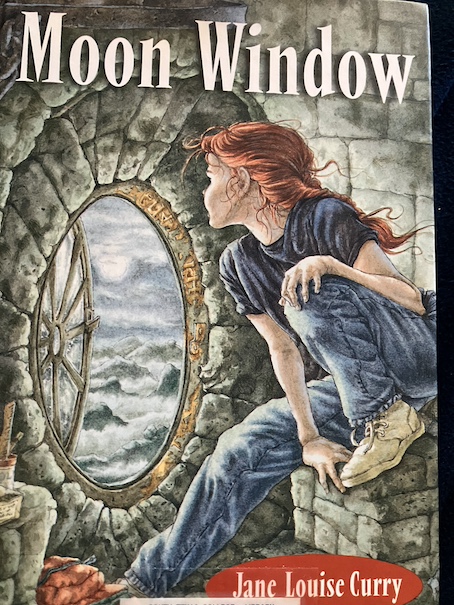
Moon Window

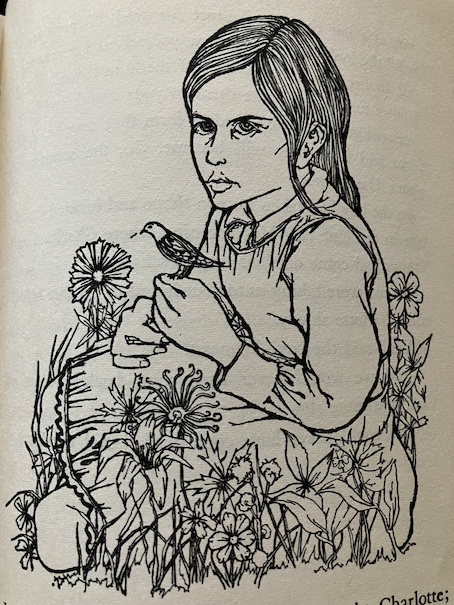
Joanna Ellen Briggs (usually called JoEllen or Jo) lost her father five years ago, when he died in a car accident. Since then, it’s just been her and her mother. Jo has adjusted to the loss, and she and her mother have been happy together. At least, that’s what Jo keeps telling herself. Now, her mother is getting remarried, and Jo feels like her life has been completely turned upside down. Her new stepfather, George, is a nice man, but Jo can’t stand the idea of her life changing. George is a law professor, and Jo’s other relatives like him, but Jo is afraid of what this marriage will mean for her. She and her mother will be moving to George’s house in Boston, and she is afraid that nothing will ever be the same again.

At the heart of her worries is the fear of losing her mother, just as she lost her father. The truth is that Jo has never fully adjusted to her father’s death. She participates in a wide range of classes and activities, but it’s not because she really loves any of these subjects or activities. Her gymnastics, choir practice, piano lessons, and the host of other classes and hobbies that she pursues with so much energy and perfectionism are to keep her mind occupied so she won’t have to think about her father or her worries about what might happen to her if something happens to her mother. Ever since her father died, there has always been the lingering fear of something happening to her mother, and that’s why Jo fears change in her life. She has settled into a routine that makes her feel relatively safe and keeps her from thinking too much about what might happen in the future. George’s entry into their lives has broken the routine, will bring even more changes, and has caused Jo’s tightly-controlled feelings to creep to the surface.

Even during the wedding, Jo privately hopes something will happen that will stop the ceremony and keep all of these frightening changes from happening, but nothing does. However, Jo’s grandmother has noticed how upset Jo is, even though Jo tries to keep a blank face and hide her feelings. Her grandmother realizes that Jo is bottling up her emotions, and she sees the moment when Jo finally lets loose, just as her mother and George leave on their honeymoon. Instead of throwing birdseed after the car, like everyone else, she turns and throws her little bag of birdseed at one of George’s young nephews, hitting him in the eye.

Originally, the plan had been for Jo to stay with George’s brother and his family while her mother and George are on their honeymoon. However, because of her bad behavior toward George’s nephews, the boys’ mother refuses to have her as a guest. Jo’s grandparents hurriedly consider other arrangements for Jo. They would take her themselves, but they will soon be traveling to a conference they are attending. Jo’s grandmother laments about Jo’s behavior and moods, and that reminds her of Witch Ellen, an ancestor in an old painting at Winterbloom, the old house where her frail great-aunt lives. Granty Nell, as they call her, is actually a distant cousin and is over 100 years old, but she loves children. Jo’s grandmother remembers that one of Jo’s cousins recently visited Granty Nell at Winterbloom and had a wonderful time. Winterbloom is a strange old house near Walpole, New Hampshire, but Jo’s grandmother has fond memories of the place, and Granty Nell has live-in help, so she won’t be dealing with Jo alone.

Granty Nell accepts Jo as a visitor, but Jo is stunned that she has so suddenly been dumped with a relative she doesn’t even know, in an old stone house in the middle of the woods. At first, Jo plans to run away and go back to the apartment where she and her mother have been living and stay there until her mother comes to get her so her mother will regret leaving her and think twice about ever leaving her again. However, Winterbloom is no ordinary place, and leaving is much more difficult than Jo realizes.

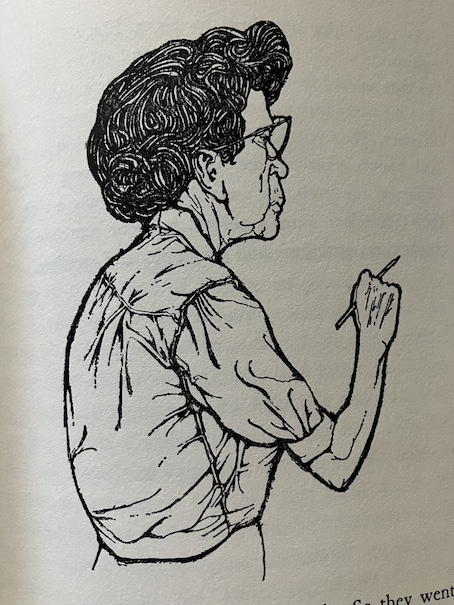
Granty is unexpectedly sharp in spite of her age, and she can read Jo like a book, noting her thinness and chewed fingernails. She speaks openly to Jo about her feelings about her new stepfather on her first day at Winterbloom. Granty lets her speak and doesn’t criticize her feelings. Instead, she tells Jo a little about the house and their ancestors, and she offers to let her explore the house and choose one of the guest bedrooms for herself. When she decides which room she wants, she can tell the housekeeper, Mrs. Craig. Mrs. Craig’s husband Thomas and son Tom take care of the grounds and garden of Winterbloom. The three of them live in a little cottage nearby, so only Granty and Jo will be living in the big house.

As Jo explores the old house alone, she notices that the furnishings are rich but old and shabby. She wonders why Granty hasn’t replaced them because she is supposedly wealthy. Each of the bedrooms has a fireplace that has an iron Franklin stove fitted inside and wardrobes instead of closets. The furnishings are all old-fashioned and a little shabby, but there is something in every room that catches Jo’s attention, like an interesting painting or an embroidered stool. In spite of herself, Jo finds herself liking things or becoming intrigued by them, although she is still determined to run away. Then, while exploring the attic, she finds an old turret room with a round window, the kind that her mother likes to call a “moon window.” Jo tries to open the window, but she discovers that someone has painted it shut. She manages to pry it open anyway, using a knife that she finds in Granty’s desk drawer. Outside the window, there is a large tree, good for climbing. Jo realizes that, with her gymnastics skills, it would be easy for her to climb down the tree and escape when it’s time for her to run away.

Thinking that she’ll probably only stay for one night before running away, Jo chooses the yellow bedroom, the one with a high bed with yellow brocade curtains that has a step stool for climbing into it. Granty tells her that is the room where her grandmother stayed when she came to visit Winterbloom when she was young. Winterbloom is undeniably charming, in spite of its shabbiness, and Jo can’t help but think that the dining room, with its tapestries and long, candlelit table looks like it’s set for a fairy tale feast.

To Jo’s surprise, Granty tells her a little of her own history at dinner. Like many of the women in their family, Granty’s first name is Ellen, although the younger generations think of her as Granty Nell. Jo had assumed that Granty had grown up at Winterbloom, but actually, she originally lived in New York. Like other young girls in the family, she also came to visit Winterbloom as a child when the woman that she once called Granty lived there. When Granty Nell was 17 years old and having one of her visits to Winterboom, both of her parents died in a flu epidemic. (I thought at first that she was referring to the 1918-1919 Influenza Epidemic, but later events in the story show that the dates don’t line up. Her parents must have died earlier.) As an orphan, she continued living at Winterbloom with her Granty until the following September, when she went away to college. She was a schoolteacher for a time until her Granty died, leaving her Winterbloom and all of her money, on the condition that she change her last name to Macallan, which is the family’s maternal surname. Granty Nell wasn’t originally happy about having to change her name, but she did it anyway because she loved Winterbloom. Jo wishes that someone would give her a house to live in so she wouldn’t have to live with George. George’s house in Boston is very modern and definitely not charming. Granty Nell tells her to be careful about what she wishes for because, since she returned to Winterbloom, she hasn’t traveled very far from it, and there are many interesting places she has never seen. Clinging too much to one particular place can keep a person from moving on to other, more exciting places.

Although someone (possibly Mrs. Craig or Granty) has tried to make the yellow room more cozy for Jo by moving all the things that she admired in the other rooms into that room, Jo is still determined to run away. She almost resents how comfortable Winterbloom is for her, making it difficult for her to leave. Early in the morning, Jo slips out through the moon window in the attic and climbs down the tree from the house. She originally planned to ride her bike the two miles from Winterbloom into town because her grandparents left her bike there for her to use, but she can’t find the bike when she reaches the ground. She assumes that the Craigs must have moved it and that she’ll have to walk to town to catch the bus.

However, during her early morning walk to town, it slowly begins to dawn on her that something isn’t right. She overhears some children talking about a cannon, which is strange. Then, she has an encounter with a man on horseback, who talks like he’s a local doctor who’s been out to see patients. Since when do doctors ride around on horses to see their patients? Jo becomes more uneasy, and when she reaches the town, she realizes why. The town doesn’t look the way it did when she passed through it with her grandparents. Suddenly, there is no Interstate highway, and there is a covered wooden bridge that isn’t there anymore in Jo’s time. Somehow, it looks like going through the window has sent Jo back in time, although she’s not sure when or if that’s really what is happening. Disoriented and terrified, Jo returns to Winterbloom and climbs back up to the moon window, leaving her knapsack hidden in some bushes to retrieve later.

The next day, Jo tries to tell herself that what happened early that morning was only a dream, but there are hints that it wasn’t. Not only is her bike exactly where she left it, like it never moved, but the bush where she left her knapsack isn’t there anymore, and there’s no sign of the knapsack. Jo searches the area to check if she was just mistaken about where she left the knapsack, but it really isn’t there. When Granty suggests that they go into town for lunch, Jo sees that the gate to Winterbloom isn’t the same in the present as it was in the past, and the road to town is paved while the road she walked along in the early morning wasn’t. Yet, there are aspects of the countryside that are eerily familiar, which indicates that what she experienced wasn’t just a dream. She might have been able to dream about the road and town as they were in the past, but she shouldn’t have been able to accurately dream about features of the area that she hadn’t seen before and that have been there for a long time.

Their trip to town is cut short because Granty becomes ill. Young Tom, who is driving them, says that Granty suffers from agoraphobia, which is why she gets ill or panics when she gets too far from Winterbloom. This is part of the reason why she has not traveled very far since she inherited the house. Granty later says that this isn’t entirely the case, but through many years of living at Winterbloom, it has become more and more difficult for her to leave it.

Jo still plans to run away, and she realizes that she left her flashlight in her knapsack, wherever that is now. She decides to search the attic for something she can use instead. In spite of herself, she finds the old clothes in the trunks in the attic charming and decides to try wearing some of them. Then, at the bottom of one of the trunks, she finds her knapsack! The knapsack isn’t the way it was when she last saw it, though. It has clearly aged, and so have the things inside. The flashlight no longer works, the clothes are yellowed with age, and the leather and rubber on her hiking boots has hardened and cracked. It’s like they’ve been stored in the attic for more than 100 years! The boots are wrapped in a newspaper, now deteriorated, but when Jo examines it, she finds the date of July 1809 and references to some of the people and things she encountered during her early morning excursion. Now, Jo is really scared.

Jo races to the turret room and looks out the moon window, but what she sees frightens her more. Although it’s afternoon in Winterbloom, it’s dark outside the moon window. More than that, there’s no tree outside the window, and the countryside that she sees isn’t the woods that surround Winterbloom. Jo recognizes what she sees as the same scene in a painting in her room at Winterbloom. The moon window is no ordinary window. It looks out on different times and places.

Once she gets over her fear, Jo is intrigued at this “window of time” and wants to know more about how it works. She even thinks that, if she can learn to control it, she might be able to go back in time to just the right moment to keep her mother from getting married again, which she thinks will solve all of her problems. However, the next time she tries the window, she finds herself meeting a young Granty Nell in 1897, when she was just a girl about her age called Nell, which is short for Ellen. Nell catches her sneaking around in a dress that looks very much like her dress. (Really, it’s the same dress, just aged about 90 years because Jo found it stored in the attic and tried it on.) Jo attempts to explain to her who she is and how she got there, taking Nell to the turret room in the attic and showing her the moon window. Jo is curious where the moon window will lead if they go through it in the past, wondering if it will take them to the future, but it ends up leading them further into the past. Jo and Nell end up in 1764, when the house was first being built. They are both caught sneaking around by a young Indian (Native American) and the stonemason who is building the house for Ellen Hawke. Ellen is a common name for women in their family, and this Ellen was the one who created Winterbloom and the one for whom all the other Ellens were named, including JoEllen. She is also considered a “wise woman”, and she is the Witch Ellen who appears in a painting at Winterbloom. Jo recognizes the stonemason’s last name as her grandmother’s maiden name, making her wonder if they are also somehow related. She wonders if maybe the stonemason will marry Ellen Hawke, making him her distant ancestor.

As Jo begins to consider people’s complex relationships across time, it occurs to her that, if she and Nell aren’t careful, they might accidentally change something in the past that will endanger their own existence. For the first time, she also begins to wonder what might happen if she successfully changes things so her mother never meets or marries George. Is it possible that she would be preventing the potential birth of a half-sibling, and if so, is that what she really wants to do?

Back in the present day, Granty Nell begins remembering an incident from her youth that she always thought of as a dream with a girl named Joanna and a trip back in time, and she begins connecting it with some strange questions Jo has been asking her. Years ago, Granty Nell had removed the furnishings from the turret room (the ones which Jo had delighted in and are now her the Yellow Bedroom that she is using) and scattered them through the house. She had the moon window painted shut and kept the door to the turret room locked, sensing that the moon window was magical and dangerous. Now, in spite of Nell’s precautions, things are coming full circle, and Jo is doing what Nell realizes she has done before.

Although Granty Nell loves having Jo at Winterbloom, she begins to realize that she must get Jo away from the place as soon as possible, before Jo becomes trapped in the same web that has kept Nell herself tied so tightly to Winterbloom all these years. Solving the mysteries of Winterbloom and the spell it has on the other Ellens in the family means exploring the past of the first Ellen, Witch Ellen.

The book is available to borrow and read for free online through Internet Archive.

I enjoyed this story and its atmosphere! I think fans of Cottagecore would enjoy Winterbloom, with its old-fashioned, comfortable shabbiness and rooms with quaint, magical touches. This is also one of those books that mentions what the characters eat. I’m not much of a foodie, but there were a couple of things that interested me about their meals at Winterbloom. I find it interesting when books mention unusual dishes or foods that they call by unfamiliar names. At one point, they have what Granty calls “Indian cake” for lunch. It’s described as a type of corn bread, so I think it’s named for Native Americans rather than Indians from India. (I ask that question almost every time I see “Indian” in writing, unless it’s specified.) I’d never heard of that before, so I tried looking it up, and from the description, I think it might be similar to this recipe for a corn bread pound cake from 1827. I’m not 100% sure it’s the same thing, but it seems reasonable because it’s described as both a corn bread and a cake. As charming as Winterbloom is, though, it also has a dark side that Jo must confront.

Jo’s immediate problem is obvious from the beginning of the story. There have been many other children’s books about children adjusting to changes in their lives, including the remarriage of a parent. It’s understandable that children who are accustomed to having only one parent might cling to that parent and be afraid of changes that might cause them to lose that parent or experience less of that parent’s attention and affection. Although adults might say that coming to love someone else doesn’t mean loving other people less, but Jo already knows that, when her mother spends more time with George, she spends less time with Jo. Her mother still loves her, but Jo feels neglected and forgotten, fearful of what this will mean for her future and her relationship with the only parent she has left. Even before her mother married George, there were times when her mother was so preoccupied, thinking about George, that she forgot to get breakfast for Jo or buy groceries, as she normally did, making Jo nervous about her mother still providing for her through this relationship with George. I’m sure that her mother doesn’t mean to give Jo this feeling. It’s just part of the awkwardness of making a major change in their lives and adjusting to a new normal. I’ve reviewed others on this theme before, including The Haunting at Cliff House, which also features time travel.

There are a couple of things that make this story different from others that I’ve read. One that surprised me at first is that Granty Nell knows about the magic of the window. In many books for kids that involve magic and time travel, the adults don’t know what’s going on and never learn. The magic or time travel is meant to give the children in the stories perspective on their lives and problems and teach them lessons, not to do anything for the adults. Typically, the adults either don’t know what’s going on, while the children learn about the magic or face their problems on their own, or the adults don’t find out what’s been happening until after the child has resolved the situation, like Rose in The Root Cellar, which is about an orphan adjusting to a new life with her relatives. In this story, Granty Nell has known about the magic of the moon window since she was young, when she first met Jo on one of her time travel excursions. At first, Nell thought that Jo was a dream, but through her years with the house, she came to understand the dangers of the window and the hold that the house can have on people, particularly on young girls named Ellen, who are coping with the loss of a home or a parent.

It isn’t obvious right away, but this is also a story about generational trauma, but with a magical/supernatural twist. Like other Ellens in the family, the first Ellen, Ellen Hawke (maiden name Ellen MacAlpin, also called Ellen MacAllan or Witch Ellen) also suffered the lost of her father and home early in life. The family’s ancestral home, Castle MacAlpin in Scotland, was destroyed by fire, and her father died in the fire. Ellen wanted to save him, but she couldn’t. The MacAlpins were unusual people, who possessed real magic, and Nell thinks that they might actually be descended from elves. After her father died, Ellen married, and later in life, after her husband died, she went to New Hamsphire to start over. People were always nervous about her and her magical abilities, so whenever it looked like people might be about to put her on trail for being a witch, she would move and start over.

Like Granty Nell, Witch Ellen has also lived an unnaturally long life, and (spoiler) she is still living secretly in Winterbloom. At least some of the other Ellens in the family were also her, pretending to be one of her own descendants. When she came to New Hampshire, she built a new version of the home that she had lost, which is Winterbloom. The shabby, old-fashioned belongings in the house are actually a clue to the house’s true problem. Granty can’t change things too much, even when she wants to, because Witch Ellen won’t let her. The house is a monument to her old life, and she can’t let go of it. However, Ellen eventually discovered that Winterbloom was a poor substitute for her lost home. It’s undeniably a charming house, but it’s not the original castle, so it just couldn’t be the same and would never feel the same to Ellen.

When Jo finally speaks to Witch Ellen directly, she admits that, rather than bringing her solace, Winterbloom haunts her because it can’t be what she wants it to be. Witch Ellen tells Jo that, for a long time, she has been waiting for a descendant of hers to undo a terrible mistake that she made years before, which has kept her bound to the house. That is, assuming that Witch Ellen is telling the truth.

For most of the book, readers don’t know what’s behind the magic of the house or if the witch in the family is in control of what’s happening. I expected at first that Witch Ellen would be a sympathetic character who would help Jo to understand the magic and maybe teach her something to help her cope with her situation, but that isn’t the case. Jo must confront the question of whether the mission that Ellen gives her would really break the spell of Winterbloom or if the curse of Winterbloom was always Ellen’s inability to accept life as it came and to try to control the outcomes. Ellen was always a controlling person, and her own children left her and Winterbloom years ago because she frightened them. Witch Ellen was never satisfied with her life, even the parts that were really good, because she couldn’t let go of the old home that she lost. Her new home, the men she married, and even her own children were never good enough for her because she was clinging to her memories of her old life and her plan to get it back. It was an obsession with her, and it has guided everything she has done. When Ellen became Nell’s guardian as her “Granty”, she began controlling her, keeping her bound to Winterbloom all these years to accomplish what she wanted. When Nell wouldn’t do it, Ellen began searching for another descendant who would, which is why she keeps inviting other young descendants to visit Winterbloom.

Jo is capable of doing what Ellen asks, but she has begun to see Ellen’s selfishness for what it really is. Ellen is prepared to sacrifice the lives and futures of her descendants to change the past, without regard for what that would mean for anyone else. Jo is different because she can see the bigger picture, and she does care about other people. She worries about her future, and that’s why she is afraid of the changes brought by her mother’s remarriage, but she has come to see that there are limits to what she’s prepared to do about that because of her concern for the welfare of other people. Jo realizes that she doesn’t want to be trapped at Winterbloom forever or to endanger her very existence and the existence of other people in her family to accomplish Ellen’s mission.

In many books about children coming to accept stepparents, the children come to suddenly love the stepparents at the end of the book, or at least find something about them to appreciate or an ability to see things as the adults around them do. That isn’t the case with this book. Maybe Jo will come to appreciate George once she becomes more accustomed to him and her new life, but for now, she has come to see that trying to control other people’s lives can be truly damaging, not just to them but also to other people around them and even to herself, and that it isn’t healthy to remain stuck in the past. Although accepting change can be difficult and can sometimes mean accepting bad outcomes along the way, Jo comes to see that she would rather keep moving forward in life and letting others move forward.

If something bad hadn’t happened in their family centuries before, maybe none of them would even exist now. Maybe accepting her mother’s marriage to George will one day mean accepting a younger half-sibling and having to share her mother with George and that sibling, but Jo recognizes that this half-sibling has the right to exist as much as she does. The half-sibling is only a potential idea at this point, not a firm reality, but the knowledge that there could potentially be one someday causes Jo to think about the effect that her decisions can have on people, including possible future generations. Letting her mother, George, and the potential half-sibling have their lives will mean having to make some changes to her own life, but Jo sees that it also allow her room to consider new possibilities for her own life in the future and to keep moving forward. The contrast between having the ability to move forward and being stuck in the past is enough to convince Jo to stop fighting her mother’s marriage and to focus on moving forward and seeing what life holds.

This is one of those children’s books that also references other children’s books. Because generations of children have visited Winterbloom, Jo finds old children’s books on the shelves there, like The Five Children and It by E. Nesbit and a Nancy Drew book from the 1930s. When Jo reads The Five Children and It, she reads a part about how people can make themselves wake up at a particular time without an alarm clock by really focusing on the time they want to wake up before they go to bed. I haven’t read this book yet, but I have done that before, made myself wake up at a particular time because I had it in my mind that was when I wanted to get up. It does seem to work at least sometimes, although The Five Children and It says that it only works if you really, really want to wake up at that particular time. If you don’t really want to get up, it won’t work. When Jo reads the Nancy Drew book, she tells Granty that she’s surprised that Nancy Drew is that old, and Granty tells her how the Nancy Drew books are periodically rewritten to update them with the current time and habits, changing language and technology to be current. This is true, and I’ve talked about that on this site before. As this story notes, in the original books, people were driving roadsters and using typewriters, and in the updated versions, they have sports cars and computers.

The Silver Nutmeg

It’s late summer, and it’s very hot. The well is dry, so Anna Lavinia has to go to the spring whenever they need water, and the paw-paws are falling off the trees even though they’re not ripe yet. Anna Lavinia is spending most of her time outside, singing songs from her favorite book Songs from Nowhere, because her mother is making the green paw-paws into preserves, and it’s a smelly process. Nothing seems like it’s going right, and even Anna Lavinia’s animal friends are grumpy because of the heat.

Anna Lavinia looks at Dew Pond Hill through the hole that her father recently made in the garden wall. He made it because he’s been thinking that Anna Lavinia has been too cooped up, and he wants to “broaden the horizon for her” and give her a new “point of view” in a very literal sense. Anna Lavinia thinks that she already has many points of views on many issues, but she does like the new vista that her father has opened up for her.

Things seem to improve on this very hot day when Uncle Jeffrey comes to visit. Uncle Jeffrey deals in spices, and he brings herbs and spices with him to replenish the family’s supply. Uncle Jeffrey also likes to collect samples of flowers and leaves, which he keeps pressed in a book with labels of their names (if he knows them) and the places where he found them. This time, Anna Lavinia notices a special purple flower in his book that she has never noticed before. There are no notes about it in the book, but she is sure that it is something special.

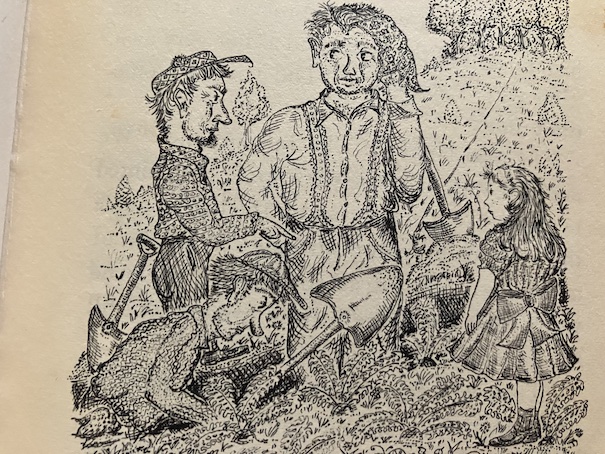
Then, she notices three men digging for something by the dew pond on the hill and decides to go see what they’re doing. Uncle Jeffrey warns her against going to the dew pond because he says that dew ponds are always bewitched. However, her mother thinks that’s nonsense and sees nothing wrong with Anna Lavinia going to look at the dew pond. When Anna Lavinia talks to the diggers, they joke with her at first that they’re digging a hole to go to exotic places on the other side of the world, but then, they admit that it’s just a ditch for water. They want to drain the dew pond! Anna Lavinia is upset about that, and they explain that they need the water to grow their parsnips. They say that this won’t be the end of the dew pond because they plan to fill in the ditch, and the pond will eventually fill up again. However, they really need the water now.

Anna Lavinia goes to look at the dew pond and enjoy it while she can, thinking how awful it is that it’s going to be drained just when her father created a new view of it for her. While she thinks about it, she tosses a few acorns in the water. Then, suddenly, one of them jumps back out of the water at her! Strangely, the acorn also seems completely dry. Curious, Anna Lavinia tosses in another acorn. This time, when it flies back at her, it has a note pinned to it that says, “Please don’t throw acorns at me.” When Anna Lavinia looks into the water, she doesn’t see her own face reflected back at her. Instead, she sees a blond boy in a green sweater. She looks around, but she doesn’t see anyone else by the dew pond but herself. When she calls out to the boy to ask where he is, he says that he’s on the other side of the pond – the underside!

The boy says his name is Tobias, and he’s playing with a boat on the pond. Anna Lavinia asks if he can come up to her through the pond, and he says he could but he promised his mother that he wouldn’t. However, she can come through the pond to him, if she likes. He says that, for her to get through, the water must be completely still, no ripples, and that she must jump in as hard as she can. Anna Lavinia asks what will happen if she doesn’t do it right, and Toby tells her that she’d probably just get all wet and get a scolding from her mother. Anna Lavinia debates about it because Toby is upside down compared to her, and she’s not sure how gravity will work on the underside of the pond. Toby says that the right side up depends on your point of view and there is no gravity where he is. He shows her a net in a tree where she can jump and teases her about being afraid. Deciding that it’s a small risk, Anna Lavinia jumps in along with her pet lizard, which she calls a thobby.

It works just like Toby said it would, and Anna Lavinia lands safely in the net. Once in Toby’s land, she experiences a strange sensation that they call “the tingle.” (It’s not a dirty thing, although I did raise an eyebrow at first.) This sensation is a kind of force that Toby says flows through the ground in his land, and it’s what keeps objects from just floating around all the time in the absence of gravity. If you lift an object off the ground, it will float around in the air because there is no gravity, but once it’s in contact with the ground or in contact with another object that’s in contact with the ground, it will stay where it is, held in place by this force, until someone or something else causes it to move. Toby describes it as being like a kind of magnetism.

With Toby’s help, Anna Lavinia experiments with this lack of gravity. Toby explains that people can’t fly in his land, although birds can fly through the air with their wings. People do lose contact with the ground if they skip or jump, but it’s usually not a big deal because they can sort of maneuver themselves in the air until they can get back down to the ground or grab hold of something that’s grounded. It’s impossible to fall.

All of Toby’s world is the underside of our world, and the ground they’re walking on is the inside of the ball that is the Earth. Because it’s the inside of the Earth, it’s dimmer than the outside world. The light that comes through comes through bodies of quiet water, like the dew pond. Toby says that, while people from this inside world can go to the surface area through any still pond, they typically don’t. For one thing, they find it difficult to deal with the gravity of the outside world, and it will turn them bandy-legged if they stay too long. For another, people who left used to be banished by their own people if they returned, so those who have gone to the outside world have often stayed. Toby’s Aunt Cornelia still misses the man she had planned to marry. After the two of them quarreled about his desire to see the world, he vanished, and Aunt Cornelia thinks that he probably went to the outside world, never to return. Things have changed now so that people who left are now allowed to return, so Aunt Cornelia hopes maybe her sweetheart will come back, but Toby doesn’t think there’s much hope of that.

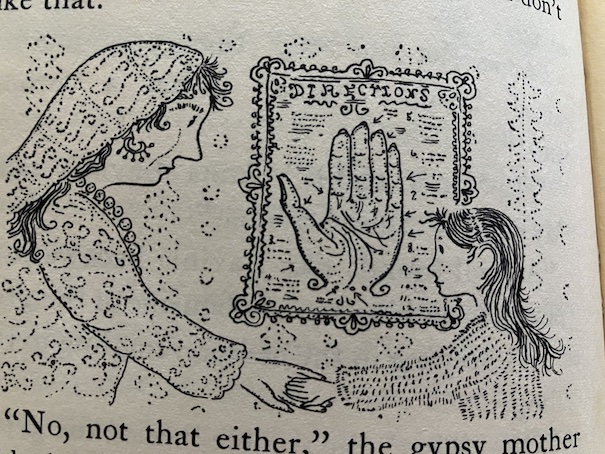
When the children hear a baby crying, Anna Lavinia insists on finding the baby and seeing why nobody seems to be tending to him. It turns out that the donkey pulling a gypsy wagon has pulled the wagon over a cliff, which isn’t as dire as it sounds, since nothing in this land can fall. However, the wagon is now stuck sideways on the side of a cliff, and things from the wagon have been tossed around and are hanging in mid-air, including the baby in his basket. Toby and Anna Lavinia rescue the baby, and his grateful mother offers them a reward for their help. She gives Toby a tambourine, and she tells Anna Lavinia’s fortune. The fortune comes out strangely backward because Anna Lavinia is from the outside world, but from what they gypsy sees, it looks like Anna Lavinia is going to do something to make an old man happy.

Anna Lavinia has a lovely visit with Toby and Aunt Cornelia, but then, she suddenly remembers that the men are going to drain the dew pond today! By the time she and Toby return to the dew pond, it’s dry! With the pond dry on her side, Anna Lavinia can’t get home … unless still waters run deep.

This book is the sequel to an earlier book called Beyond the Pawpaw Trees, which first introduced the character of Anna Lavinia.

The book is sweet and would probably appeal to fans of Cottagecore. The characters sing songs and recite rhymes throughout the story, which might appeal to young children. I was a little divided over whether I liked having the story interrupted by the songs and rhymes, but the songs and rhymes really are a part of the story and add to its charm. It’s a little like Alice’s Adventures in Wonderland, where a girl goes to a magical land, where things don’t work as they do in the ordinary world.

In Alice’s Adventures in Wonderland, there’s a lot of random nonsense, and that’s fun, but I liked that this particular story uses a kind of pseudo-scientific focus on magnetism and gravity. Neither the magnetism nor gravity works the way it does in the real world, and it adds a kind of science-fiction twist to the fantasy world in the story. Even with this almost science-fiction twist, we still have that old-fashioned, cottagecore style fantasy atmosphere that’s charming and whimsical rather than technical. I haven’t read the first book in this series, but I understand that it uses similar concepts. Nothing really stressful happens in the story, and it would make a nice bedtime story.

My one complaint is that there are some stereotypical gypsies and comments about gypsies in the book. They are always referred to as “gypsies” and not Romany or any other name, and for some reason, they make a point at the beginning of the story that gypsies always go barefoot. I’m not sure what the point to that was except to establish that gypsies have eccentric habits. It’s not unusual for children’s books from the mid-20th century to have stereotypical gypsies as characters, although it might rub people from the 21st century the wrong way.

The Summer Birds

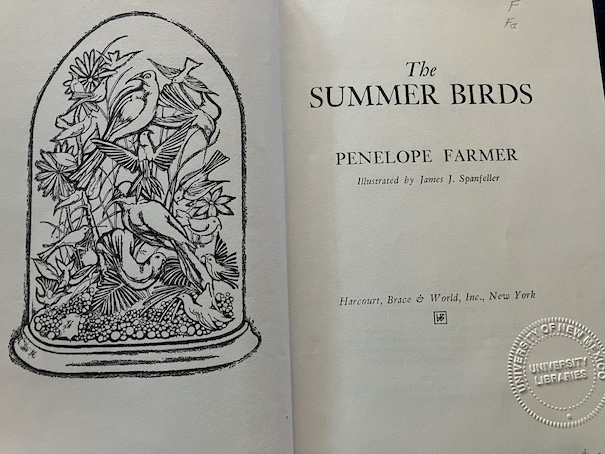
The Summer Birds by Penelope Farmer, 1962.

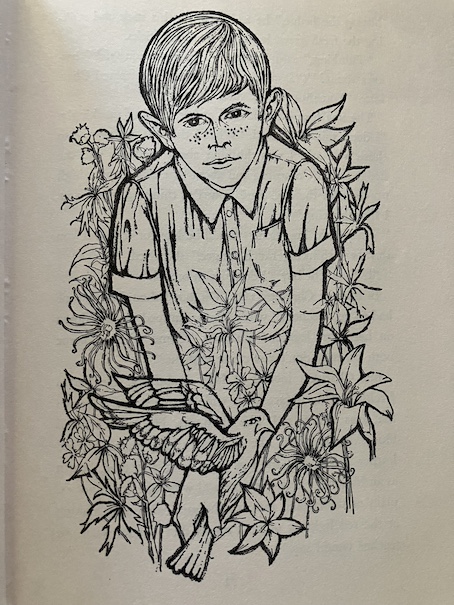
Aviary Hall is an old, Victorian-era house in a small village in England. It doesn’t really have an aviary, although there are hummingbirds on display in a glass case in the drawing room. Like other houses of its type, it has greenhouses and a walled kitchen garden. Twelve-year-old Charlotte Makepeace and her younger sister, ten-year-old Emma, live there with their grandfather. Every morning, they walk to school, and they admire the birds in the area, wishing that they could fly like that themselves. One morning, they meet a strange boy on their way to school. Charlotte is cautious about meeting strangers, but Emma talks to the boy. Charlotte says that they should hurry, or they’ll be late for school. The boy says that he doesn’t go to school, so Emma invites him to come with them to their school. Charlotte isn’t sure what their teacher would think of the strange boy showing up, but they have to go or they will be late.

However, when they arrive at school, Charlotte gradually begins to realize that nobody seems to notice the new boy except for her and Emma. Other people just look past him, and nobody asks who he is. It’s like they can’t even see him. As the lessons at school continue, Charlotte’s attention wanders, and she finds the heat of the room uncomfortable. Then, the boy invites Charlotte to come away with him, promising that he will teach her more than she will learn in class.

At first, she thinks that people will notice if she leaves, but they don’t. She and the boy run away from the school, and Charlotte feels wonderfully free, like a bird. The boy asks Charlotte if she would like to fly like a bird. Charlotte doesn’t see how that’s possible, but they says that it is and shows her that he can fly. The boy teaches her some exercises to make sure she’s strong enough. Charlotte can’t fly at first, just falling to the ground when she tries, but when the boy urges her to continue trying, she gradually realizes that she is staying in the air longer and longer. They have a wonderful time on this adventure.

The boy is very mysterious about who he is although he asks many questions about Charlotte and her home and family. Charlotte asks the boy if the other kids from school can also learn to fly. The boy says that they have to learn one-by-one, but he will teach them individually, and it has to be a secret.

Then, suddenly, Charlotte finds herself back at school. No one has noticed that she was gone, not even Emma. At first, Charlotte wonders if it was all just a dream, but she discovers that she still has the ability to fly and has to be careful not to let other people see her feet leave the ground when she kicks her feet. Emma can tell that Charlotte has a secret, and she’s irritated when Charlotte refuses to tell her what it is. However, Charlotte knows that Emma will learn soon enough.

Emma learns to fly the next day, and gradually, other children at school also start to be able to see the boy and get their own flying lessons. Charlotte’s best friend, Maggot (a nickname, not her real name), seems particularly accepting of the strange boy and his strange powers of invisibility and flying. She seems to understand things about him, maybe even more than Charlotte does, saying that her uncle has told her about such things.

Their teacher discovers what they’re doing when she catches one of the children flying, and she questions them about it. The children don’t want to admit anything to her because they call swore an oath to keep it a secret, but the mysterious boy says that their teacher is all right and reveals himself to her. He explains that he taught the children to fly, and their teacher is surprisingly accepting of that. She asks if she can also learn, but the boy explains that he can only teach children. The teacher regretfully says that she suspected that might be the case, and the children begin to consider that their ability to fly might also fade with age. The teacher invites the boy to join their class for the rest of the term and seems to quietly support their flying adventures.

When school lets out for the summer, the children continue their flying adventures, still a secret from their parents. The boy, who has still not told anyone his name, is very strange, and not just because he can fly. Charlotte sees him eating insects, which he says he loves, and he doesn’t seem to understand things about school and ordinary houses. During an argument among the boys in the group, who don’t want to be bossed by the mysterious boy without reason, one of the boys, Totty, challenges the mysterious boy about who he really is, where he really comes from, and how he came by his flying magic. The other children are afraid to challenge the mysterious boy because they know that he is strange, they worry that there may be something evil about his magic (although they doubt it), and they fear losing the ability to fly.

The children decide to settle the conflict with a special challenge. If the mysterious boy wins the challenge, he wants to stay with them for the rest of the summer, being their leader and not explaining anything about himself. If Totty wins, the mysterious boy says he will explain who he really is and then leave, although he will let the children keep their ability to fly until the summer is over. The mysterious boy wins the challenge, but at the end of the summer, he makes them all an offer that could change their lives forever.

The book is the first book of the Aviary Hall Trilogy, although it isn’t as well-known as Charlotte Sometimes, which is the third book. It is available to borrow and read for free online through Internet Archive (multiple copies).

My Reaction and Spoilers

Although Charlotte and Emma are sisters, this is the only book in this short series in which they both appear together. Each of the other books focuses on each of the girls separately. Charlotte Sometimes, the best-known book in the series, is set when Charlotte goes away to boarding school, and the second book in the series, Emma in Winter, takes place while Charlotte is away at school, focusing on Emma, who is left at home. All three books focus on growing up and issues of personal identity, although they do it in somewhat metaphysical terms and with fantasy elements.

Charlotte Sometimes focuses on personal identity as Charlotte finds herself traveling back and forth through time, trading places with another girl who attended her school in the past. At times, Charlotte feels like she’s losing her identity as Charlotte and becoming more like the other girl. One of the things I liked about The Summer Birds was getting a glimpse of Charlotte just being in her own identity all the way through the book. The beginning of the book makes it clear that the other children at school think that Charlotte is a prig (someone who is rigidly well-behaved to the point of being obnoxious), but it also clarifies that it’s because she feels compelled to look after Emma and set a good example for her.

The two girls live with their grandfather Elijah, who is obsessed with astrology, and an elderly, lazy housekeeper. The book never really explains what happened to their parents, but it seems that Charlotte and Emma are orphans. It is established in Charlotte Sometimes that their mother is dead, and this book mentions that their father was a sailor. Their grandfather likes girls to be well-behaved, and Emma is anything but, so Charlotte keeps trying to teach Emma how to act to keep their grandfather happy and trying to smooth things over with their grandfather when Emma misbehaves. In Emma in Winter, Emma has to face up to the realities of her personal behavior and other people’s reactions to her behavior without Charlotte running interference or taking responsibility on her behalf. That’s her coming-of-age moment, and it leads her to become more mature, personally responsible, and better-behaved herself and to appreciate what Charlotte was trying to do for her.

Although each of the books in this short series can be read independently of each other, I think reading all of them adds some depth and understanding to the characters. Charlotte was always a very responsible and cautious person in Charlotte Sometimes, showing that there is continuity to her character, but knowing the history of why is that way makes her more understandable. Although the other children sometimes consider Charlotte a drag for pointing out things that they shouldn’t be doing, it’s Charlotte’s serious nature that causes the other children to question the offer that the mysterious boy makes them at the end of the summer.

We also get to meet Charlotte’s best friend in her home town in this book, a girl called Maggot, who never appears and is never even mentioned in Charlotte Sometimes. The reason why she doesn’t appear in later book is that she is the only one who decides to accept the mysterious boy’s offer at the end of the book, leaving with him to be forever young as a bird. Charlotte is tempted by the offer, but she realizes that accepting it would mean giving up everything else and everyone else in their lives. The children would be happy for a while in their freedom as birds, but they would eventually miss their parents, and their parents would grieve for them because they would never be able to return. Although the other children don’t always listen to her, she is able to persuade them that this is really a serious matter that is about their very lives, forever, not just a brief summer lark. In the end, Maggot is the only one who can accept the offer because she is the only one who has no one left in the village to miss. She is an orphan and lives with an uncle who pays little attention to her. It is implied that he would hardly notice if she left, whereas Charlotte and Emma’s grandfather really would miss them, even if he sometimes doesn’t like their behavior. Maggot was also always the most birdlike, and she probably knew that the boy was really a bird before the others did because her uncle is a gamekeeper.

There are still some questions left unanswered at the end of book, but that is typical of this series. Readers might have guessed that the boy was really a bird all along, but we still don’t really understand his magic or see what happens in the village after Maggot leaves with him. We don’t know for sure that Maggot’s uncle doesn’t miss her or try to look for her, what the other villagers decide happened to Maggot, or if the teacher ever tells anyone what she knows about the children flying or if she understands what happened to Maggot herself.

Overall, it’s a pretty slow-paced book. Most of the story feels like pretty low stakes until the part at the very end, where the boy offers to let the other children come with him to be young birds forever. Then, it becomes a serious question of whether they are willing to continue with their normal lives, growing up and losing their flying magic, or if they’re willing to give up everything and everyone they know and love forever to keep it. Even though most of the story is peaceful, I had the feeling from the beginning that there might be a sinister turn somewhere because the boy’s behavior didn’t always seem straight-forward and friendly, and he was definitely keeping secrets. I had the feeling that the mysterious bird boy wanted something from them or was going to try to get them to do something they shouldn’t eventually. It’s an interesting premise, although I still think that Charlotte Sometimes is the best in the series. Events in this book are also mentioned in Emma in Winter, when characters in the story discuss them with each other, showing that all of the local children still remember their flying adventures together and that the events in this book didn’t just happen in their imagination.

The Enchanted Castle

Two brothers and two sisters spend most of their time at boarding schools. The boys go to a school for boys, and the girls go to schools for girls, so the only times when they are together are when they are home for school holidays or visiting at the house of a kind, single lady who lives near to their schools. Although the children’s parents are grateful for their single friend for hosting the children as guests from time to time, the children find it difficult to play at her house because everything is so neat and proper, and they don’t feel quite at home. Then, during one school break, one of the sisters, the one who makes it home first, comes down with measles. With their sister sick, the other siblings can’t go home, which is a great disappointment, and their parents have to make other arrangements for them. When the children tell their parents that they don’t want to visit the single lady for the entire school holiday, the parents arrange for the boys, Gerald and James (called Jerry and Jimmy), to board at their sister Kathleen’s school. It will be fine for them to be there because Kathleen (called Cathy) is the only student remaining at the school during the holiday, and there will only be one teacher there to supervise them, the school’s French teacher.

This arrangement suits them better than going to the single lady’s house, although they think that they ought to find something special to do during the school holiday. Kathleen suggests that they write a book, but the boys aren’t thrilled by the idea. They would rather do something outdoors, like playing bandits. However, they are a little concerned about the French teacher’s supervision. Fortunately, Gerald is good at charming grownups, when he wants to. Through a combination of flattery and small, thoughtful favors to the teacher, he gets on her good side, and he manages to convince her that he and his siblings would like to have some time to themselves to play and explore outside, maybe in the woods. The French teacher understands that what they really want is some freedom from supervision, but she agrees to give them some time to themselves.

The children don’t actually know if there are any woods in the area, but they decide to do some exploring and see if they can find an adventure of some kind. They end up getting lost during their exploring, but they find it exciting. When they sit down to rest, they find a cave and decide to explore it. The cave turns out to be a tunnel that leads them to a beautiful garden with a lake with a decorative waterfall and swans. The children imagine that it’s the garden of a magical castle. Going a little further, they find a thimble with a crown on it and a thread tied to it. It looks like the kind of thimble that might belong to a princess.

When they follow the thread, they find a young girl in a beautiful dress who looks like she might be a princess. She looks like she’s asleep, so she looks like an enchanted princess or Sleeping Beauty. Jimmy doesn’t really believe that she’s a princess, but the others aren’t so sure, and anyway, it makes a fun game to pretend that she is. Since Jerry is the eldest of the children, Cathy thinks that Jerry should kiss her to wake her up. Jerry refuses, so Cathy says Jimmy should do it. Although Jimmy is sure that she’s really just an ordinary girl dressed like a princess, he says he’ll kiss her to prove he’s braver than Jerry and that he should be the leader for the rest of the day.

When Jimmy kisses the girl’s cheek, she opens her eyes and says that she has been asleep for 100 years. She insists that she’s a real princess and asks them how they got past the dragons. Jimmy still doubts that, even though she shows them a mark where she pricked herself on a spindle, just like in the Sleeping Beauty story. She invites them to come back to the castle and see her beautiful things. The children say that they are hungry, so they go with her go get something to eat.

When they get to the “castle”, the princess brings them bread and cheese to eat with some water. This seem depressingly ordinary, and the princess apologizes, saying that was all she could find. However, she claims that the food in the castle is magical, so it can be whatever they want. The children imagine that it’s roast chicken and roast beef, but all they get is bread and cheese. Cathy doesn’t want to admit at first that it’s just bread and cheese because (like with the Emperor’s New Clothes), there is an implication that there is something wrong with her if the magic doesn’t work for her. Jimmy isn’t discouraged by that, so he asks the princess if it’s a game, but the princess denies it, insisting that the food is magical.

Then, the princess takes the children to a hidden door behind a tapestry. The room inside has paneled walls and blue ceiling with stars painted on it. The princess calls it her “treasure chamber”, but the room is completely empty. The princess acts surprised when the children say that they can’t see any treasure, and they refuse to believe it’s because they’re magical or invisible. The princess has the children close their eyes while she says some magic words. When they open their eyes, suddenly, there are shelves with jeweled objects on them. The children have no idea how the princess accomplished this trick, so they start to believe that maybe she can do magic.

The princess suggests that they all put on some of the jewels and be princes and princesses, too. It’s amusing for a while, but the boys start getting tired of dressing up, and they’re still a little skeptical about who the princess is. They suggest that they go play outside, but the princess insists that she’s actually grown up and doesn’t play children’s games, and she has the others help her put all the treasures back in their proper places. She tells the children that various pieces of jewelry have magical property. Jimmy asks her if that’s really true or if she’s kidding, but the princess insists that it’s true. Jimmy asks her to demonstrate how the magic works. The princess says that she will try on the magic ring that makes her invisible, but only if everyone closes their eyes and counts first.

When the children open their eyes, all of the shelves of jewels are gone and so is the princess. Jimmy says that it’s obvious that the princess just went out the door of the room. When they close their eyes and count again, Jimmy keeps his eyes open and sees the princess hiding behind a secret panel. When he tells the others, the princess says that he cheated. The weird thing is, even though they hear the princess say that he cheated, they still don’t see her. They tell her to stop hiding and come out, but she says that she already has. She says that if they want to pretend like they can’t see her, that’s fine, but the children seriously can’t see her. When the princess realizes that they’re serious that she’s actually invisible, the princess suddenly gets scared. She tries to shake the boys and get them to say that she’s not invisible, and Jerry catches hold of her, still unable to see her. She tells them that it’s time for them to go because she’s tired of playing with them.

Jerry makes the princess look in a mirror to prove that she’s invisible, and the princess gets very upset. Cathy sensibly tells her to just take the ring off, but the princess says it’s stuck. She admits that the whole thing, up to this point, was just a game of pretend. She says that the treasure shelves were hidden behind some paneling, and she just moved it with a hidden spring. She never expected that any of it was actually magical. The truth is that the girl’s aunt works at the house as a housekeeper and that her name is Mabel. She was just playing at being an enchanted princess because the rest of the household is away at the fair, and she happened to hear the other children coming through the hedge maze, so she roped them into her game.

Since one of the objects that Mabel claimed was magical was a buckle that would undo magical spells, Cathy suggests that she try the buckle. Mabel says that’s no good because she only made up that it was magical, but Cathy points out that she also made up the part about the ring being magical, and it turned out to be true, so she might as well try the buckle. Mabel would, but they accidentally locked the key inside the room and can’t get in now.

The children sit down to think about the situation. Since they can’t think what to do, the other children think maybe they should leave and go get their tea, but Mabel insists that they can’t just leave her invisible like this. Instead, she suggests that she go with them to tea and leave her her aunt a note. While they have tea, maybe they can think of something else to help Mabel. In her note, Mabel says that she’s been adopted by a lady in a motorcar and is going away to sea. The others say that’s lying, but Mabel says that it’s fancy instead of lying and that her aunt wouldn’t believe her if she said that she was invisible.

When they return to Kathleen’s school, they have tea and supper. They let Mabel have one of the three plates laid out for them, and Jerry and Cathy share one between them. Fortunately, the French teacher isn’t eating with them and doesn’t see an invisible person eating, but the children don’t know how they’re going to handle breakfast the next morning. They say that Mabel can stay the night with them, sharing Cathy’s bed and borrowing a nightgown. Mabel says that she can get some of her own clothes from the house tomorrow because no one will be able to see her and that she’s starting to see some possibilities for being invisible.

In the morning, the maid who comes to wake Kathleen sees Mabel’s discarded princess dress on the floor and asks Kathleen where it came from. Kathleen makes an excuse that it’s for playacting, which means that she and her brothers will have to figure out some kind of play to put on with it. Mabel thinks that acting sounds exciting, but Kathleen reminds her that she’s still invisible, so no one can see her perform anything.

The children feel bad about Mabel’s lies in the note to her aunt, and they insist that they should go and tell her the truth. Mabel doesn’t think this is a good idea because her aunt won’t believe her, but she reluctantly agrees. When they try to talk to her, the aunt doesn’t really want to listen to them, thinking that it’s just another one of Mabel’s pranks. She says that maybe Mabel was changed at birth and that her rich relatives have finally claimed her. They try to tell her that Mabel is with them, only invisible, and the aunt tells them not to lie to her. They ask about Mabel’s parents, and the aunt says that she’s an orphan. The children think that Mabel’s aunt is crazy because she doesn’t seem concerned about her and doesn’t want to hear anything they have to say, but Mabel says that she thought that her aunt might act that way because she spends so much time reading novels and can imagine anything.

In the meantime, Mabel has had some thoughts about what she can do. She says that she might be able to continue living in the house where her aunt works because the place is supposed to be haunted, so she can play ghost herself. However, the others think that she should stay with them. They just need a way to get some money to buy extra food for her.

Sine the fair is still going on, Mabel suggests that Jerry put on a magic show at the fair to get some money. The others say that Jerry doesn’t know any magic tricks, but Mable points out that it doesn’t matter when he has an invisible friend who can move things around, unseen, and make things disappear. Jerry dresses up as a conjurer from India (in a way that would be considered equal parts cheesy and offensive by modern standards because it involves black face), and he puts on the magic show with Mabel’s help. It’s incredibly successful, and toward the end of it, Mabel feels the ring coming loose. She takes it off and gives it to Jerry, who ends the act by vanishing himself.

Now, Mabel is visible again, and it seems like they’ve solved their problem, but now, they have a new one. The ring is now stuck on Jerry’s finger, and he is the one who’s stuck being invisible. Although Mabel can now go home, she insists on staying with the other children and taking part in their next invisible adventure.

Jimmy says that, if he was invisible, he would turn burglar. The girls point out that would be unethical, so Jerry decides that he will be a detective. There are advantages to a detective being invisible. Then, Mabel remembers that the treasure room is still locked from the inside, and they have to do something about it. Jerry says that, as an invisible person, he can sneak in easily enough through a window. When he does this, he ends up foiling a robbery by actual burglars, although he also ends up letting them escape from the police because he knows that conditions in prisons are horrible and can’t bring himself to send anyone there.

After his adventure, the ring comes loose from his finger while he’s in bed, and the maid at the school, Eliza, finds it and decides to “borrow” it for an outing with her fiance. When her fiance can hear Eliza’s voice but not see her, he thinks that he’s taken some kind of strange turn or fit, possibly because he’s been in the sun too long. The children convince him to go home and lie down while they deal with Eliza. They take Eliza on a little adventure of her own because they’re beginning to see that the ring doesn’t come off someone’s finger until its purpose is fulfilled. Afterward, they manage to convince Eliza that it was all a strange dream that she had because she felt guilty about taking the ring without permission. The children also think that the ring’s power might be diminishing and could be completely spent because it seems like its effect has been lasting shorter and shorter amounts of time every time it’s used. However, this is really just the beginning of the ring’s magic, and it can do much more than they think it can.

At this point, they feel a little guilty that they haven’t spent much time with the French teacher, who is supposed to be looking after them, so the buy her some flowers. She is pleased with the gift, and they have a little party with Mabel as their guest. They find out that the French teacher has artistic abilities, although she rarely has time to draw these days because she’s so busy teaching. Mabel also tells them more about the man who owns the house where her aunt works. Although the house is grand, the man who owns it doesn’t really have enough money to support it and live there full time with a full staff because his uncle wrote him out of his will for falling in love with a girl he didn’t approve of. It’s sad because he also never married the girl because she was sent away to a convent, and although he did try to find her, he never did. Mabel, whose knowledge of convents comes from the scandalous gothic novels that she and her aunt read (much like the kind the main character reads in Jane Austen’s Northanger Abbey), speculates that the girl might be bricked up in a wall by now because that’s the kind of wicked thing that happens in books. The French teacher tells her that real convents aren’t like that and that the women who live there are good and take care of girls without parents, although they can also be strict, and the girls aren’t allowed to leave. She says it in a way that implies that she was one of those girls raised in a convent.

Since the children had claimed earlier that they were going to put on a show of some kind with the princess outfit, they decide to go ahead and perform for the French teacher and Eliza. To fill out the audience for their performance, they make a bunch of stuffed dummies, which the French teacher finds amusing. The children use the ring as a prop in their play, although none of them put it on, and Kathleen wishes that the dummies were alive so they could have better applause from the audience. To the children’s amazement and the French teacher’s and Eliza’s terror, the dummies (which the children think of as “Ugly-Wugglies”) do come to life and start clapping. In a panic, the children debate what to do. Jerry realizes that the ring is actually a wishing ring and is responding to the children’s wishes, so he wishes on the ring that the dummies were not alive, to undo Kathleen’s wish, but it doesn’t work.

To Jerry’s surprise, the dummies begin speaking to him, although their speech isn’t clear because they don’t really have proper mouths. They ask him for a recommendation to a good hotel or suitable lodgings. The dummies don’t seem to know what they are, and they are behaving like respectable, aristocratic people. Jerry tells them that he can show them to some lodgings, if they will wait for him a little. He makes some excuses to give himself time to reassure the French teacher and Eliza that the effect with the dummies was just a trick pulled by the children with string, and he recruits Mabel to help him find a place for the dummies. He does this in an insulting and condescending way, and Mabel tells him off for that, but she agrees to help him. They decide to hide the dummies somewhere on the grounds of the big house where Mabel and her aunt live, thinking that the magic will wear off eventually and that the dummies will turn into dummies again by morning. The dummies turn nasty when Jerry and Mabel try to shut them away, and they are helped by a strange man.

The strange man demands an explanation from the children about the angry people they’ve shut away, but the children don’t want to explain. The man says, if they won’t tell him what’s going on, he’ll simply have to let the people out and ask them, but the children are afraid of what the dummies will do if they’re released. The man assumes that the imprisoned people are other children and this is all some children’s game, so Jerry and Mabel decide that they have to tell him the truth, even though they know it all sounds crazy. They can tell that the man doesn’t really believe him. The man thinks maybe Jerry has a fever or something, and he says that he’ll see the children home. Jerry can tell that the man plans to open the door after the children are gone, and he warns him not to do that. He insists that the man wait until tomorrow to open that door and to wait for them to meet him to see it opened because, by then, they’re sure that the dummies will just be dummies again. The man reluctantly agrees.

When the children arrive the next day, they discover that the man didn’t wait for them to open the door, and he is now lying unconscious and injured, apparently attacked by the dummies. The dummies are gone except for the most respectable dummy, who seems concerned about the unfortunate man on the ground. Mabel runs for smelling salts to revive the unconscious man, and Jerry looks around to see where the other dummies are. They find that the other dummies have turned back into piles of old clothes, and only the one living dummy is left. He seems to be becoming far more real. The children revive the unconscious man, who turns out to be the new bailiff. The bailiff assumes that the strange visions he had were because he was injured accidentally. After the children are sure that he’s all right and send him on his way, they try to figure out what to do with the remaining living dummy.

The remaining dummy seems to have developed a life of his own and is quite a wealthy man, although the children aren’t sure that this will last because the ring’s magic never seems to last very long. Jimmy says that he wishes he was wealthy, and the other children are horrified to see him age quickly, turning into an elderly, wealthy man. Jimmy doesn’t seem to remember who they are, and he refuses to turn the ring over to them when they ask for it, trying to stop his wish. He acts like the dummy is an old acquaintance of his, and he just wants to go to the nearest railway station with his dummy acquaintance.

Jerry sends the girls home to make some excuses for his and Jimmy’s absence, and he follows the now-elderly and wealthy Jimmy on the train to London. There, he learns that Jimmy and the living dummy have somehow acquired business offices, staff, and backstories. Other people seem to have somehow known the two of them for years (a warping of reality that makes Jerry’s head swim because neither of them existed in their current state before) and say that they are business rivals. Jerry pumps a boy who works at one of the offices for information, claiming that he’s a detective and is trying to reunite the elderly Jimmy with grieving relatives. The boy’s advice is that it will be difficult to get through to elderly Jimmy but that he might use the living dummy’s rivalry with elderly Jimmy to arrange things. The living dummy (now known as U. W. Ugli) helps Jerry to get control of the ring, and he wishes himself and Jimmy back to the house where Mabel lives.

Jimmy is restored to his younger self, and the children debate about what to do with the ring. They can see that it has some dangers. Mabel says that she ought to put it back in the treasure room, where she found it. However, while they’re in the treasure room, they begin to wonder if any of the other pieces of jewelry are magical, since the ring became an invisibility ring after Mabel pretended it was. Mabel can’t remember exactly what she said any of the other pieces of jewelry did because, at the time, she was just playing pretend and making things up. Then, something occurs to Mabel. She realizes that the ring only became an invisibility ring because she said it was one, and it turned into a wishing ring when they started calling it that. She says that proves that the ring does whatever they tell it to do, changing its powers to match whatever they say. To prove the point, she declares that the ring will now make people tall, and when she puts it on her finger, she is suddenly unnaturally tall.

Mabel’s experiment did prove the point, but they now have to hide Mabel until the effects wear off. The children get a picnic from Mabel’s aunt and go to hide out in the woods overnight. However, Mabel complicates things when she turns the ring into a wishing ring, and then, she accidentally turns herself into a statue. The children have a nighttime adventure with some living statues, learning that all statues apparently have the ability to come to life at night. They can also swim, so they have a nice swim and a feast. The statue of Hermes tells the children that “‘The ring is the heart of the magic … Ask at the moonrise on the fourteenth day, and you shall know all.'”

Then, the children learn that Lord Yalding, the man who owns the big house, is planning to come, and that he is thinking of renting the house to a wealthy American. Mabel’s aunt is busy, getting the house ready for Lord Yalding and the American. However, it turns out that the children have already met Lord Yalding without realizing it, and with the ring and the treasures in the hidden treasure room, they have the power to secure his future and reunite him with his lost love … if only they can figure out how to manage the ring’s power without causing any more chaos.

The book is now public domain and available to borrow and read for free online through Project Gutenberg and Internet Archive (multiple copies), including an audio recording from Librivox. The story was made into a BBC television miniseries in 1979, but it’s difficult to find a copy these days. As of this writing (April 2024), the only dvd release was in Australia in 2013. Sometimes, clips of it appear on YouTube.

For the first part of the book, it isn’t obvious that there will be any real magic in the story. At first, the children are all just playing pretend with each other, and even when Mabel turns invisible, it’s possible to believe that the children might still be playing pretend and letting their imaginations run away with them. Because the adults don’t seem that concerned about Mabel, I thought that they might have been humoring the children in their game, but the children later realize that the ring has the effect of muting people’s concerns for the one wearing it, even if they’re doing something bizarre or dangerous. That ends when the person takes off the ring, and people become more concerned about them and where they’ve been. The magic in the story is real, and as the story continues it involves too many other people, even adults and various bystanders, for it to just be a game.

Throughout the book, various adults experience the effects of the magic ring and witness things that the children do with it. They come up with various explanations for what they’ve witnessed, so they can disregard it, but they unquestionably experience magical events along with the children and have some consequences from the children’s adventures. While Jerry retrieves Jimmy from London when he accidentally turns himself old and wealthy, they never do retrieve the living dummy, so U. W. Ugli remains doing business there until his magic finally wears off. His employees don’t seem to know what he is and have memories of having worked for him for years, so they report him missing when he finally disappears, and the notice appears in the newspaper.

There’s a lot of humor in the story as the children experiment with the magic, deal with the consequences of their adventures, and try to invent excuses to explain away the inexplicable. There are times when they do try to tell adults the truth about what they’ve been doing and what’s happening, but most of the time, the adults don’t believe them. Sometimes, they feel a little bad about lying to adults and making up stories, but they have to resort to that because nobody really believes the incredible truth.

When the children start telling Lord Yalding the stories of their magical adventures and about the treasures they’ve found in the house, they are unable to prove what they say at first. Lord Yalding gets a chance to experience the magic himself, he thinks that he’s going crazy. At the proper time, the ring’s magic reveals itself to Lord Yalding, his love, and the children so they can all see the true magic and learn the ring’s history, which is a story of magic and tragic love. Lord Yalding comes to understand that he is not crazy and that the magic is real. His lover makes one final wish that turns the wishing ring into a wedding ring. The magic ends, and the castle and grounds are changed because of it, becoming less grand and more ordinary, but Lord Yalding and his bride are able to have their happy-ever-after.

I thought it was interesting that the author provided a backstory for the magic ring, explaining where it came from and its effect on the house and its grounds. I didn’t think there were many clues to that backstory provided along the way, and some buildup to the explanation would have been nice. However, I recognize that the author didn’t have to provide any explanation for the magic at all. Many other fantasy stories don’t offer explanations for magical objects, leaving that up to readers’ imaginations, because the focus is more on the effects of the magic rather than its origins.

As far as we know, the children’s other sister, the one who was sick with measles in the beginning, never finds out what her siblings have been doing during this particular school break. The children remain close to Lord Yalding and his wife, and they host them at their house during school breaks afterward. In fact, it sounds like they spend more time with Lord and Lady Yalding than they do with their parents.

Overall, I enjoyed the story. E. Nesbit’s fantasy stories are children’s classics, and they have influenced other children’s fantasy books that came after them, especially Edward Eager’s Tales of Magic series.

Although the original story is now public domain, there are different versions of this book because there are simplified forms of the story for younger children, and some newer editions have removed some of the problematic parts of the story. Some of E. Nesbit’s books contain problematic racial language or stereotypes or have children doing things that would be unacceptable by modern standards. In this book, such incidents are relatively mild, and their absence wouldn’t materially change the character of the story.

For example, when Jerry dresses up an conjurer from India, he uses black face as part of his costume. In the 21st century, use of black face is considered derogatory toward people with dark skin. In a way, Jerry’s costume is played for comedy because it’s made from pieces of his school uniform, and someone points out that he’s left out spots in his skin makeup. Nobody believes that he’s a real conjurer from India, although they are impressed by his act because they can’t figure out how he accomplishes his tricks.

There is also some anti-Catholic sentiment, although the children seem to say certain things because they’ve gleaned them from sensational novels or things other people have said, and the author does correct for it. The first instance of this comes from Mabel’s concept of the dark deeds done in convents, which she has apparently learned by reading gothic novels. I’ve read some old gothic novels myself, and the idea that sinister things happen in secrecy in convents and abbeys was a popular concept from 18th and 19th century literature. It’s partly due to anti-Catholic sentiment and, probably, because the idea of a closed society that isn’t open to the general public makes for a compelling setting for dark secrets, somewhat like the way secret societies and boarding schools have become the setting for sinister happenings and dark deeds in Dark Academia literature. However, the other does have the character of the French teacher contradict this view of convents with a more benevolent and realistic one, that the people in them are caring but strict. There is one other comment that Jimmy makes in the story when he’s arguing with Mabel, when he seems to be implying something about Jesuits, a branch of Catholic priesthood:

“If you’d been a man,” said Jimmy witheringly, “you’d have been a beastly Jesuit, and hid up chimneys.”

I wasn’t entirely sure what this comment meant, although I think it might be a reference to the ways Catholics hid priests in priest holes, little hidden rooms, when they were at risk for arrest, torture, and even execution in Elizabethan England. Some of these little hiding places were in fireplaces, which I think is what the reference to hiding in chimneys means. At the time, the children were arguing about bravery, so I think Jimmy is implying that Mabel is the type to run and hide in the face of danger. (That might actually be the best option when there’s real danger. Just saying.) If I’ve understood his meaning, that makes Jimmy’s comment more of a slur against Mabel’s bravery than against Jesuits, although he does still call the Jesuits “beastly”, and he’s implying that’s a bad thing to be.

When you read public domain versions of the story online, they will have these elements in the story because they were part of the original book. However, if you find a physical copy in a library, it may or may not have these elements, depending on the printing. If it was printed during the late 20th century or any time during the 21st century, there is a good chance (although not completely guaranteed) that it’s a revised version and may have these parts written out or at least toned down.

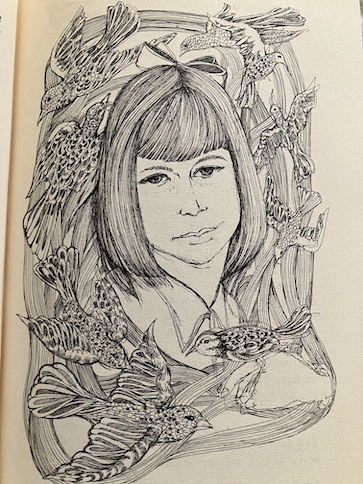
The Pinhoe Egg

The Pinhoe Egg by Diana Wynne Jones, 2006.

This is the sixth and final book in the Chrestomanci series.  In this series, there are many different dimensions, and in each of those different dimensions, there is a copy of every person.  Different versions of our world can differ dramatically in their history across the dimensions, and individual people’s lives can differ dramatically between the dimensions. There is one person in each generation who has no duplicates in any of the other dimensions.  This person is called the Chrestomanci.  All of the talents, abilities, and lives that would have been spread across the other dimensions are now centered on that one person, giving that person, literally, nine lives.  The Chrestomanci fills an important role, being better able than anyone else to travel across the dimensions, and he acts to keep a balance between them and make sure that the different worlds keep their proper course.

Marianne Pinhoe and her brother, Joseph, are used to Gammer (their grandmother) telling them and everyone else in their family what to do. Gammer is the matriarch of the magical Pinhoe family, and Marianne, as the only girl born into the family in the last two generations, is expected to eventually succeed her. Joseph has magical abilities, too, but he often pretends that he can’t do things so the rest of his family won’t force him into their magical businesses. He really has a fascination for machines and would rather work with them than do magic, so he does his best to convince the rest of his family that he’s a “disappointment” to them (something that other family members appear to have done when they had interests outside the family). However, Gammer still rules the roost and she has plans in mind for both Marianne and Joseph.

One day, she calls Marianne and Joseph to her house and tells Joseph that she’s got him a job as boot boy at Chrestomanci Castle over the school break. Joseph is angry because he had other plans for the school break and doesn’t want to be a boot boy. Gammer tells him that it’s important for him to go to Chrestomanci Castle because she wants him to act as a spy there. The Pinhoe clan doesn’t live too far from the castle, and for generations, they have been careful to conceal their identities as witches from whichever Chrestomanci happens to be in charge at the time. Gammer says that if Chrestomanci (whom they carefully refer to as the “Big Man” because saying his title aloud calls him) ever found out about them, he and his crew of enchanters would (gasp!) force them to obey rules and regulations and not just use their magic any way they like whenever they feel like it. (If you’ve read all the of previous books in the series, you can see that people like the Pinhoes are part of the reason why rules exist in the first place and why just letting them do whatever they want could be a complete disaster that could tear apart the worlds someday, but oh noes, not rules and regulations and being told not to do insane things that would lead to the destruction of the worlds! We’re not talking petty micromanagement here. Basically, this is a huge red flag, right up front, that the Pinhoes are up to seriously shady stuff that may lead to people dying and/or already have involved people dying.) Gammer wants Joseph to be at the castle to find out if the Big Man has caught on to them or looks like he might be going to. (At this point, we don’t know exactly what activities they’re afraid he’s going to catch onto, but that will become more clear later.) Joseph is still angry and tells Gammer that she can’t make him do it, but something happens that changes everything.

While Marianne and Joseph are still at Gammer’s house, the Farley family comes calling, and they’re angry with Gammer, too. They say that she has somehow betrayed them, particularly Dorothea Farley. After an argument with them, suddenly Gammer seems to lose all of her reason! When she speaks, she doesn’t seem to make any sense, as if she’s completely lost her mind. Marianne thinks that the Farleys cast a spell on Gammer, but she can’t prove it. The rest of the family thinks that the strain of the argument with the Farleys just sent Gammer over the edge because she’s so old. They’re unsure whether or not Gammer is going to recover from this incident or not and how long that might take. They temporarily hire nurses to look after her, but Gammer drives them away by using her magical powers to throw things at them like a poltergeist.

The family members all argue about what to do with Gammer, and in the end, they decide that she must go live with Dinah and her husband because gentle Dinah seems like she’s the only one who can handle her. Some of the relatives argue about who will get Gammer’s house since she will no longer be living there, and Marianne’s father reveals that the house actually belongs to him and that he was just letting Gammer live there. He thinks that the house is too large for his family and that the sensible thing to do is to sell the house and use the money for Gammer’s care and other practical uses. Moving Gammer to Dinah’s house is difficult because she uses her magic to resist it, but they eventually accomplish it. In the meantime, Joseph still has to go to Chrestomanci Castle because all of the arrangements are already made and the rest of the family insists that he do it.

While all this is happening, The Chant family is just returning from their holiday in the south of France (which was in Mixed Magics), and they have no knowledge of what’s been happening with the Farleys and the Pinhoes. Julia and Janet have been reading a horse story for girls and have become obsessed with horses and the idea of owning horses of their own. Chrestomanci asks them if they wouldn’t prefer to have bicycles (Roger says he would and Chrestomanci immediately agrees he can have one), but the girls insist that they must have horses. Millie is sympathetic because she wanted a horse of her own when she was young, and they do have stables at Chrestomanci Castle. Chrestomanci reluctantly agrees and purchases a horse for the girls, with the understanding that they will learn to take care of it properly.

However, when the horse arrives, it turns out that Janet is terrified of horses when she actually meets one, and the horse only likes Eric “Cat” Chant. Initially, Cat thought that all of the horse talk was boring, but he feels a strange kinship for Syracuse the horse, and if he doesn’t take care of him, Chrestomanci might follow through on his threat to have Syracuse turned into dog food. (Chrestomanci is also secretly afraid of horses.) Cat finds riding difficult at first, but he enjoys it and becomes fond of Syracuse. Julia and Janet swear off horses in fear and disappointment and get bicycles, like Roger, so Cat becomes Syracuse’s owner.

One day, while riding Syracuse, Cat has a disturbing encounter with Mr. Farley, the gamekeeper. Mr. Farley has placed spells in the territory around his family’s property to keep people away so their magical activities won’t be noticed by anyone, especially the people at Chrestomanci Castle. Since Cat has been riding around the countryside on his horse, Mr. Farley has become paranoid about Cat snooping around. The Pinhoes have some similar worries.

Then, Jason, one of Chrestomanci’s associates, returns to the castle after having been away for years. Jason brings his new wife, Irene Pinhoe, with him. Jason is a plant expert, and he also has some plant samples. Janet and Julia are both heart-broken that Jason is married because they both had enormous crushes on him, and they are sure that Irene is going to be perfectly awful and that they won’t be able to stand her. However, when Cat meets Irene, he thinks that she seems rather nice. She’s an artist and designer, and Cat can tell that she’s using magic in her drawings. Irene admits that her father was some kind of enchanter, and she may have inherited some of his ability, although she seems oddly embarrassed about it and says that she doesn’t know much about her father’s work. Jason and Irene invite Cat to accompany them while they have a look at a house that they’re planning to buy in the area.

Gammer is still not in her right mind, and at Gammer’s request, Marianne has to look after her cat, Nutcase. This is difficult because Nutcase is hard to control, and he somehow manages to get around the spells that Marianne tries to use to control him. After Nutcase kills a bunch of baby chicks belonging to Dinah, Dinah’s husband threatens to kill Nutcase if he comes near their chickens again. Marianne tries, mostly unsuccessfully, to keep track of Nutcase and keep him out of trouble.

One day, while trying to find Nutcase, she shows up at the house that Jason and Irene are trying to buy while they are there with Cat. It happens to be the old Pinhoe house, the one Marianne’s family is selling, and the Pinhoe family would prefer a Pinhoe to buy it. It helps that Irene is a Pinhoe, and Marianne thinks that she is just like the princess that she imagined in a story that she’s writing. Jason is fascinated by the variety of magical herbs in the Pinhoes’ neglected garden, and he’s sure that he really wants the house, too.

Cat is intrigued by Marianne when they first meet because he can tell that she has powerful magical abilities. Marianne asks Cat to help her find Nutcase, and he agrees. While they’re looking for Nutcase, Cat comments to Marianne how powerful her magic is and that she should trust it more. Cat is surprised at himself for being so bold, and Marianne is surprised at how well Cat has read her.

While they look for Nutcase in the attic, Cat senses that there is something important and magical hidden there, protected by spells, and he feels compelled to figure out what it is. As they investigate further, they find a strange, large egg. Marianne says that she doesn’t really know what kind of egg it is but that Gammer told her that it was a silly joke of her grandfather’s because he claimed it was an elephant’s egg. Cat senses that it’s very important, and he asks Marianne if he can have it. Marianne decides it’s okay if Cat keeps it because nobody else ever really seemed to care about it, and the house needs to be cleaned out when they sell it.

During the night, Cat gets a visit from a large, winged creature that says it’s the egg’s mother. The mother says that a spell prevents her from reclaiming her egg, but she sensed that the egg was moved, so she came to see that it was safe. When the egg hatches, it turns out that it’s a griffin. Cat needs Millie, Crestomanci’s wife, to help with the hatching and caring for the griffin. Crestomanci questions Cat about how he got the egg, and Cat explains that it came from the Pinhoes’ old house, which seems to intrigue Crestomanci.

When Marianne’s uncles learn that Marianne gave the egg to Cat and that it’s hatched, they’re furious with her. They had put the egg in the attic themselves and placed spells on it to prevent it from hatching, although they had never told Marianne about it before.

In the mean time, Marianne has been learning that this isn’t the only secret that her family has been hiding and that things in her family are not what she’s always believed they were. Strange things are happening in the nearby village. First, someone places a bad luck spell on all the Pinhoes. Every member of the Pinhoe family falls victim to various accidents until they find the source of the spell buried in the garden of the old Pinhoe house and destroy it. Then, there’s a plague of frogs and a sudden epidemic of whooping cough that affects everyone in the county.

What Marianne comes to realize is that these curses are being cast by Gammer, who still seems to not be in her right mind. What the other relatives have been taking to be harmless, nonsense mutterings and odd little things that she does to entertain herself have actually been magic spells. The curses have been mostly directed at the Farley family, although because Gammer isn’t really in her right mind, some of them have gone astray and affected other people in the area, including the Pinhoes.

However, when Marianne tries to tell her family what Gammer is doing, nobody believes her. Marianne comes to realize that the Pinhoes themselves have also been under one of Gammer’s spells for their whole lives that cause them to view Gammer with reverence and to make excuses for bad things she does. For some reason, this spell no longer seems to be working on Marianne, even though the other members of her family are still affected. Whe’s beginning to see that Gammer has done some pretty awful things and that her own father has been taking more care of the Pinhoe family than Gammer ever has, even though Gammer has been taking the credit as the family’s leader. Because of Gammer’s spells, none of the rest of the family will listen to anything Marianne tries to say about what Gammer has been doing, and they think that it’s just malicious slander. Worse still, Marianne is in disgrace with them because she gave the griffin egg to Cat.

What is the true story behind the griffin egg, and why are the elder Pinhoes so worried about it? Marianne knows that there is a griffin and a unicorn on the family’s coat of arms. What kind of feud does Gammer have with the Farley family, and are the Farleys really responsible for her present condition? With Gammer’s spells on everyone, how can Marianne get anyone to believe her enough to help her get the answers she needs? Her family has tried hard to avoid getting the attention of Chrestomanci or anyone at Chrestomanci Castle, but they may be the very people Marianne needs now.

My Reaction and Spoilers

I love the Chrestomanci series, and I enjoyed reading this book, although the ending seemed a little confusing and fell a little flat to me. I’m starting out with some minor spoilers, including some for previous books in the series. The major spoilers are at the end. The premise of a magical family with secrets is intriguing and fits well with the rest of the series. At first, Marianne believes everything that her family says and accepts that she will probably be the one to eventually take over Gammer’s position as head of the family. However, Marianne comes to realize that members of her family aren’t what she always thought they were, and some of them are hiding dark secrets. This is also a theme in the Chrestomanci series. Other characters in the series have also discovered that members of their families were hiding dark secrets and have been been betrayed by them. In previous books, the current Chrestomanci was used and betrayed by his uncle when he was young, and Cat’s own sister used him and tried to have him killed.

When Marianne allows Cat to take the griffin egg from their family’s old house, and she begins investigating strange things happening to people in the area, she realizes that her grandmother, who seems like she isn’t in her right mind, is the cause of at least some of it. Her family is unable to accept the truth about Gammer and turns against Marianne. It turns out that even her own father has been hiding secrets from her mother and his children and that, years ago, he was involved in a terrible crime against his own father. When the terrible secrets of the Pinhoe family are finally revealed, some of the Pinhoe marriages break up because the Pinhoe wives realize that their husbands have done some terrible things and have lied to them for years about it. Although Marianne’s parents stay together, Marianne’s mother has to come to terms with the truth about her husband’s past and his lies, and she also realizes that she should improve her children’s education and her own education.

In the end, someone else takes over as the leader and adviser of the Pinhoe family, rather than Marianne, but Marianne doesn’t mind because she’s really too young for the role, and she also realizes that her talents lie elsewhere. Like other young characters in the series, she and her brother are invited to continue their magical education at Chrestomanci Castle with the Chant family children. Marianne’s father is against his children studying with the posh people at the castle because he thinks that they’re trying to be too good for their own family, and Chrestomanci tells him that the only way they’ll be too good for their family is if he decides they are and keeps telling them they are. If that’s the message their father feeds them, then someday, they’ll probably believe it and think that their family has rejected them for being better than they are. Marianne’s father grudgingly allows the children to study at the castle because he can’t stop them and also because he and his brothers have lost face in the community because their past wickedness to their own father has been revealed.

Chrestomanci puts a stop to the feud between the Pinhoes and the Farleys by revealing some of their secrets and by having his assistant take away the Farley family’s magic. He does not take away the Pinhoes’ magic, but he wants to study their unique magic style because it has to do with the life force of living things, and Cat also seems to have a talent for it. This unique style of practicing magic is one of the secrets that the Pinhoes have been trying to keep to themselves, but there are also deeper and darker secrets they’ve been hiding, some of which didn’t really make sense to me.

What is eventually revealed is that Marianne’s grandfather, who supposedly died years before, is still alive. He was imprisoned in an area that contains and hides various mythological creatures, and his own sons were the ones who imprisoned him there in an injured state, while they told the whole community and even their own spouses that he was dead. They did it because Gammer, the grandfather’s wife, and Mr. Farley told them to kill their father. They couldn’t bring themselves to actually murder him, so they just crippled and imprisoned him. The reason why they did it was because he was studying the mythological creatures and brought the griffin egg out of the hidden territory. For generations, the family has believed that it was their duty to keep the mythological creatures imprisoned and secret, so they panicked and tried to stop the grandfather when it looked like he was going to expose everything. This is the major secret of the Pinhoes that they were always afraid someone would discover.

Chrestomanci and his people reveal that the family has a hidden history where they were supposed to be the caretakers of the mythological creatures but their mission got corrupted under the influenced of a particularly fanatic religious group, which convinced past generations that the mythological creatures were “abominations” and that they needed to hide their magical abilities. This doesn’t entirely make sense because, in past books, and even in this one, the local clergy knows and accepts magic. Chrestomanci and his family regularly attend church.

The explanation that readers are given is that the past group of religious fanatics was eventually driven out by other groups that came in later, but there’s not much of an explanation of how that works. We don’t know who these fanatics were supposed to be, and the chain of events is only vaguely explained. The Pinhoes aren’t entirely convinced that any of it is true, and because there aren’t a lot of details provided and not much groundwork was laid for this revelation, I wasn’t really impressed with it, either. It also bothered me that the Pinhoes and their mission to hide mythological creatures are very local, just in the village near Chrestomanci Castle, but for reasons that are also never explained, it seems like there aren’t any other mythological creatures, like griffins and unicorns, anywhere else in England or in any other countries. Were all these mythological creatures, their entire populations, only located in this one, particular village or did this one particular village hide all of them from everywhere in the world just in their little, hidden region? Real life animal populations are generally wide-ranging, so if we accept the idea that unicorns and griffins are real and once lived out in the open, I find it hard to believe that these local families were hiding all of them just in their little woods and that nobody, anywhere else, had a clue about it before or any populations of the same creatures elsewhere. Even if all of the other mythological creatures that once existed everywhere else in the world were wiped out by “fanatics” or other causes, it seems like there should still be evidence of it somewhere, like historical accounts or archaeological evidence. If there are plant experts who study magical plants in this series, it would make sense if there were also animal experts who studied magical animals.

There are just too many plot holes here, and all of this is just kind of dumped on the readers at the end without much build-up. It would have made more sense if the children had some kind of historical lessons that included the history of these “fanatics” or the apparent destruction of mythological creatures or something to set this up before the final revelation, but we didn’t really get that. It felt more like a sudden info dump at the end.

The situation with the Pinhoe family in the book seems meant to illustrate how family stories with a very narrow focus and no outside fact checking can lead to serious misconceptions and how militantly clinging to particular ideas simply because it’s “what we’ve always done” is toxic because it can lead to a warped view of history and the places of individuals in it. The Pinhoes have not just been trying to hide their activities from the authorities, but they’ve also been shielding themselves (both intentionally and unintentionally) from anyone or anything that might put a new perspective on their activities. They’ve been worried about the authorities trying to stop them or interfere with their activities, but at no point did they consider that there might be some sound reasons why the things they’ve been doing are pretty strange and out of bounds.

In a way, I think that the message of the story does have some relevance in the real world. Misconceptions about history and historical propaganda can lead people to do some inappropriate and toxic things. I’m pretty sure that I’ve mentioned somewhere before that I resent the United Daughters of the Confederacy for their textbooks, which were largely propaganda for their personal familial pride. When you have an organization based entirely around the concept of being part of certain families involved in a particular event on a particular side, and the nature of that involvement would seem dubious to people not on that particular side because it implies either support for and/or active participation in an unsavory activity (in this case, owning slaves), you have a group of people with a vested interest in telling a version of the story that puts themselves in a positive light and possibly others in a more negative light to make themselves look better by comparison, regardless of the historical accuracy (much of which, in their case, can be easily debunked by primary sources). “Their” traditional version of the story, the one from the textbooks they produced in past decades, puts Northerners into the role of aggressors, frames the concept of slavery as some kind of noble social service project. Ever heard someone ask if the slaves were grateful that they were given jobs or heard slavery described as a kind of unpaid “job training”? People do, and the propaganda of the United Daughters of the Confederacy is a major reason why. One of their tactics was to make slavery sound like a form of indentured servitude that people to pay off a debt and that could work their way out of once they learned job skills, but in real life, slavery never ends and the people in it never had a debt to pay to the people who owned them. Their works have portrayed black people as varying degrees of incompetent and aggressive, needing to be looked after and controlled. As someone with an interest in children’s literature and a degree in history, I seriously resent this organization, its written works, and the “Catechism” based on their historical fan fiction (my term – the more scholarly one is “pseudohistorical narrative“) that they still make children recite in the 21st century (still touted on their website).

The reason why I’m going on this tangent about United Daughters of the Confederacy and their textbooks is that it’s a real life example of a similar situation to the one that the Pinhoes have during the story. For one thing, there is a generational disconnect because, while the older generations in the Pinhoe family cling to their family’s lore about what their mission is and the secrets the family keeps, they haven’t entirely passed on that legacy to the younger generation yet. There is an enchantment over members of the family that makes them obedient to Gammer, makes them look at her in glowing terms, and makes them disregard bad things Gammer does. However, for reasons that are also not fully explained, Marianne has somehow been exempt from this spell. (I think it might be because, initially, it was assumed that she would be taking over the role of Gammer someday, but it just isn’t really explained.) The older members of the family also cannot fully explain certain things to the children in the family because that would mean revealing what they did to Marianne’s grandfather. Because the direct chain of the narrative was broken, Marianne and her brother don’t look at the family and the things they do in the same way as their elders do. Marianne gave away the griffin egg because the adults tried to act like it was unimportant, to deflect interest from it, giving Marianne the impression that the egg really didn’t matter. Because Marianne has been exempt from her family’s stories about what they consider their mission to be and isn’t under the spell that controls how family members feel about Gammer, she is more open to investigating the situation and seeing the flaws in the things that her family has been saying and doing.

It’s a little like how generations who grew up reading the “textbooks” produced by the United Daughters of the Confederacy have a very different view of history from younger generations or even older people who grew up reading anything else. It sometimes leads to generational conflict as older generations cling to old family stories and the “textbooks” they read in school, and younger generations have more exposure to other ideas through a different set of textbooks and other people’s very different family stories through the Internet and other, modern forms of mass media. The issue of what Americans think about the Civil War isn’t the only time we’ve had this sort of disconnect between how professional historians explain things and how amateurs writers explain them. There was also a panic in the 1920s about how the American Revolution was explained in school textbooks and whether they were sufficiently patriotic. I have some training as an historian because I have a bachelor’s degree in history, but I admit that I didn’t go on for a masters or PhD, so I have some respect for people who are more expert in particular branches of history than I am and are responsible in citing their sources. I have no patience for people who do not reference primary sources or are deliberately misleading. I don’t expect perfection, but honesty and the highest degree of accuracy possible are important when other people depend on you for information.

In the book, Marianne’s father views her different understanding of the family and their situation as being malicious and rejecting her family, thinking herself “better” than they are for thinking that they’re wrong in their understanding of the past. Marianne comes to understand that they’ve done wrong things in defense of that historical understanding, including the way they’ve treated any family members who have disagreed with them in the past. They have been downright cruel, even to their own family members, to protect what their family has always believed and what they’ve always done, and they deliberately shut out any outside influences and interference because, on some level, they are aware that other people would stop them if they knew everything they’ve been doing. They try to keep their activities secret to avoid any interference and consequences from the authorities, and they deride younger generations for getting information or perspective from any outside sources that could offer reality checks. There are people in real life who get defensive about their understanding of history, although the Pinhoes are both a magical and extreme version of that phenomenon, and I still think that their story was explained a little clumsily toward the end of the book. I think more could have been done to build up to that ending, with more hints earlier in the story and some better, more detailed explanations toward the end. Still, I think I get the point that the author was trying to make.

I’m not saying that the author meant this book to be about the United Daughters of the Confederacy. That’s just one of my associations of this type of phenomenon of skewed historical perspective and a toxic level of attachment to family lore as a way of justifying otherwise unacceptable behavior. There are other groups of people who have done similar things, and I think it was the general behavior that the author wanted to examine in a magical setting, removed from any particular real-life group. In fact, I think that’s part of the reason why I was left with the impression that the history of the Pinhoes and their area was poorly-explained and lacked details about which group of fanatics set them on this path generations ago. I think the author didn’t want to involve real history or seem too accusing of any real groups, which would provoke emotional reactions from readers, based on their own understanding of history. (Admittedly, I’m pretty accusing of the United Daughters of the Confederacy, and I know that may rub some people the wrong way, but I’m far from the only person who has issues with their “mint julep textbooks“, the issues with the books and their version of history still exist, and I still stand by my criticism.) It occurred to me that the fanatics who dictated that magic and magical creatures were “abominations” might be early Christian missionaries or Catholics before the Protestant Reformation, but the timing of events in the explanation seemed a little vague to me, so I think, as readers, we are not supposed to care about who they were, specifically, but to see the results of what they did, which lasted for generations. From there, we can reflect on what this type of phenomenon might look like in our own societies and the need to accept some outside input for fact-checking purposes.

Conrad’s Fate

Chrestomanci

Conrad’s Fate by Diana Wynne Jones, 2005.

This is the fifth book in the Chrestomanci series.  In this series, there are many different dimensions, and in each of those different dimensions, there is a copy of every person.  Different versions of our world can differ dramatically in their history across the dimensions, and individual people’s lives can differ dramatically between the dimensions. There is one person in each generation who has no duplicates in any of the other dimensions.  This person is called the Chrestomanci.  All of the talents, abilities, and lives that would have been spread across the other dimensions are now centered on that one person, giving that person, literally, nine lives.  The Chrestomanci fills an important role, being better able than anyone else to travel across the dimensions, and he acts to keep a balance between them and make sure that the different worlds keep their proper course.

Conrad lives in the 7 series of worlds in Chrestomanci’s universe. His family owns a bookshop. Well, technically, his Uncle Alfred owns the bookshop. He started it with Conrad’s father, but he says that Conrad’s father needed a large amount of money before his death, so he sold Alfred his half. When he was young, Conrad and his older sister, Anthea, imagined that their father probably lost a large amount of money at the casino. Conrad likes that idea because he’s a bit of a risk-taker himself and likes doing adventurous things, like rock climbing. Uncle Alfred tells them that they’re wrong about their father gambling. He says that he thinks that the aristocrats at the mysterious Stallery Mansion stole a large amount of money from their father. He doesn’t explain any more about how that happened, but he cautions Conrad not to be such a risk-taker because he has bad karma.

Conrad doesn’t understand what karma is, and his sister explains that karma is sort of like fate, but it’s the consequences of good or bad deeds committed in previous lives coming back to affect the present life. She thinks that the only way to clear bad karma is to correct for the misdeeds of the past. Conrad is intrigued and asks if it’s really possible for people to live more than once, but everybody else is busy with things they’re trying to do, and nobody will give him a straight answer. Conrad can’t help but wonder what this could all mean for his karma and his fate.

One day, while Conrad is looking for a book in the shop that is part of a series he’s been reading, he realizes that the books in the series have changed titles, and although he can tell that the basic stories are the same, some of the details are different. When Conrad asks his uncle about it, Uncle Alfred is very angry. He says that it’s the fault of the aristocrats at Stallery Mansion. Uncle Alfred explains that the aristocrats at Stallery Mansion make themselves richer by very literally playing the possibilities. They use powerful magic to evaluate different possible realities and make little shifts in the nature of reality itself to make things go the way they want them to go for their business interests, so they can turn bigger profits. The problem is that any little change in reality can have a ripple effect, changing many other details of life around them, from the titles of books to the color of everyone’s mailboxes. Not everyone notices these magical changes in reality because they use mind games to fool people into thinking that whatever changes they made were always like that. (It’s a weird combination of gaslighting and the Mandela Effect.) They also use powerful enchantments around their area to stop people from sensing what they’re doing, so powerful that they disrupt computers and television sets. Uncle Alfred is a magician himself, so he can tell what they’re doing, and he despises them for their manipulations.

However, Uncle Alfred is greedy and manipulative, too. Conrad discovers how greedy and manipulative he is after his sister leaves home to go to university. Both his mother and uncle are angry at her for leaving because she had been doing much of the work around the house and bookshop, and they had never had to pay her to do it. Anthea knows they’ve been taking advantage of her, and that’s the reason why she knows that she needs to leave and build a life of her own. Conrad misses her after she goes, and his uncle has to actually hire another girl and (gasp!) pay her to work for him. He frets constantly about how much it costs to actually pay someone wages in exchange for work. The other girl, Daisy, tells Conrad that his uncle isn’t hard up for money at all. The bookshop is very successful, and with what it brings in, Uncle Alfred could afford to pay her much better than he does. He just doesn’t want to do it because he’s so stingy. All of the money he brings in, he spends on himself. For the first time, Conrad becomes aware of how much money his uncle spends on fine port and tailored clothes. His mother is also two-faced, spending all of her time writing books about the oppression and subjugation of women while making Conrad do all the cooking in Anthea’s place. Conrad’s not very good at cooking, but his mother won’t cook anymore because she doesn’t want to be subjugated as a woman. She’s not above subjugating her own children for her benefit, though.

Conrad realizes that he has to use the techniques that Daisy uses to get his mother and uncle to stop exploiting him as badly as Anthea. He stops cooking and refuses to make any more food until his uncle agrees to give him things he wants as payment, like a bicycle. He notices that other kids at school get presents from parents without having to work for them or bargain for them, like he does, but he supposes that it’s all part of his bad karma.

Uncle Alfred has been blaming all of the changes that have taken place since Anthea left on Conrad’s bad karma. Conrad isn’t sure whether he lived a past life or not, since Anthea said that she didn’t believe in past lives, but since he keeps getting into trouble in various ways, he suspects that his karma might really be bad. He also starts blaming his bad karma for any accident he has (which all sound like perfectly ordinary accidents that could happen to anybody, really), and he starts feeling like maybe he deserves it all somehow for past sins. He asks his uncle what he could have done that could cause his karma to be bad. His uncle says he doesn’t know and that he’ll try to figure it out with magic.

When Conrad is getting old enough to go to high school, Conrad realizes that he’s going to have to use some kind of persuasion or negotiation to get his uncle to let him go on with his education. He wants to learn magic himself, but he knows that his uncle will probably want him to work in the bookshop for free, like Anthea did. His plan is to offer to work part time for his uncle in exchange for the money to attend high school with his friends when word spreads that Count Rudolph of Stallery Mansion has died. His heir is a 21-year-old man, and he only has a younger sister. People speculate that both of them will have to marry soon to ensure that their family line will continue. Sure enough, there is an announcement that the new count, Robert, will marry soon. People say that the old count’s wife is a controlling person and that she will control her son and his new wife, too. For some reason, the news upsets Uncle Alfred and his group of magicians.

Then, when it’s time for Conrad to leave his school and declare whether or not he’s going on to high school, his mother shocks him by telling him that he can’t go to high school because he already has a job at Stallery Mansion. Conrad demands that his Uncle Alfred explain what this job at Stallery Mansion is and why he signed him up for it. His Uncle Alfred says that he has learned through his magic that, in Conrad’s previous life, he was supposed to kill a wicked person, and he failed to do it, so this person continued their wickedness and has been reborn as an equally wicked person. Uncle Alfred says that this person’s current incarnation is someone at Stallery Mansion and that he got Conrad a job as a servant there so he can take care of the mission he failed to do in his previous life … to kill the person he is supposed to kill. Uncle Alfred says that this is the only way that Conrad can clear his bad karma and go on to live his own life. If he doesn’t, fate will take retribution on him by killing him before the year is out. Conrad isn’t sure whether to believe Uncle Alfred or not, but Uncle Alfred’s magician friends all say the same thing to Conrad, that they can read his bad karma and that it will hang over him and may kill him soon if he doesn’t clear it. As horrible as it is, twelve-year-old Conrad resigns himself to going to Stallery Mansion as a servant with a mission to kill some unknown evil person to save his own life.

When he goes for his interview at Stallery Mansion, Conrad is hired on as a page boy along with another boy, who is taller, handsomer, and very well-dressed. This other boy calls himself Christopher Smith, although Conrad is sure that “Smith” isn’t really his last name. At first, Conrad regards Christopher as a professional rival, but Christopher assures him that he isn’t interested in competing to move up the ranks of the servants. In fact, he admits that he is here for another purpose, and as soon as he’s found what he’s looking for, he will leave. Both Conrad and Christopher have their own intrigues.

Of course, Christopher is really Christopher Chant, who is currently in training to be the next Chrestomanci in his world. He is in Conrad’s world to find Millie, who has run away from boarding school because the other girls there were bullying her, and she didn’t feel like she was learning anything. Christopher had tried to tell their guardian, Gabriel DeWitt, who is the current Chrestomanci, that Millie was miserable, but he wouldn’t listen. After Millie disappeared, DeWitt still wouldn’t listen when Christopher tried to tell him that Millie was no longer in their world, so he went in search of her himself. He knows that she’s somewhere close, somewhere in Stallery Mansion, but he can’t find her, and he’s very worried. It feels like she’s trapped somewhere, but Christopher isn’t sure where.

Conrad is moved by Christopher’s story and offers to help him find Millie. Then, Christopher also witnesses the changes in reality that Conrad has seen and sees how someone at Stallery has been playing with probabilities. When Conrad confides in Christopher about his bad karma from a previous life, Christopher is sure that what his uncle told him isn’t true, no matter what his uncle and his uncle’s friends said. Together, Conrad and Christopher must confront the mysteries of Stallery: who is changing the nature of reality at Stallery and how, where is Millie and why can’t they find her, what is the truth about Conrad’s fate?

The book is available to borrow and read for free online through Internet Archive (multiple copies).

My Reaction and Spoilers

I really liked seeing young Christopher Chant in this adventure, while he’s still learning how to be the Chrestomanci. As an adult, Christopher is always very sure of himself and able to handle just about anything, but here, he’s still young and not always sure of himself. He has high self-confidence from knowing that he’s a powerful, nine-lived enchanter, but in this story, he runs up against things that he doesn’t completely know how to handle. He puts on a show of knowing what he’s doing, but both Conrad and Millie know that there are times when he’s just bluffing or muddling his way through.

I also enjoyed seeing Christopher’s relationship with Millie develop more. They were both children in The Lives of Christopher Chant, but they have known each other for years now. It’s pretty clear that Christopher has strong feelings for Millie from the way he desperately searches for her when she’s lost. Millie knows that he’s powerful, but she also knows his faults from growing up with him. She knows that there are times when he’s lazy and doesn’t want to bother learning something, so he just bluffs his way through. He’s also grown accustomed to getting his way with things. When Millie first told him that she was unhappy at school, he wanted to run away with her so they could live alone on an island together, and Millie realized that was a terrible idea. She likes Christopher, but she doesn’t want to live alone on an island or have him constantly dictating what they’re going to do. That was why she took matters into her own hands and ran away on her own. Since Christopher is a teenage boy, I can guess why he wants to be alone on an island with the girl he likes, and even Conrad realizes that Christopher is trying to be like a knight errant to Millie by single-handedly charging to her rescue. Christopher really does love Millie, and he’s trying to be her hero and help her in romantic ways.

Christopher is a little full of himself and still has some growing up to do, but both Conrad and Millie admit that they like him in spite of his faults. The fact that they know both his good and bad points and still like him makes their relationships with him stronger. Christopher’s faults, like his superior attitude and fussiness about his clothes are minor in the face of bigger issues. He’s on the side of good, where other people in the story definitely aren’t, and although he is powerful, he never abuses those powers. Millie respects Christopher, and he does his best to look after her. At the end of the story, Conrad says that Christopher and Millie are engaged to be married, and Christopher trusts Millie with the ring that contains one of his extra lives.

When Conrad and Christopher start working at Stallery Mansion, they both learn about the divided world of a wealthy mansion with servants, with areas where the family lives and the areas where the servants live, like that shown in Upstairs Downstairs, Gosford Park, and Downtown Abbey. The boys have to learn to make themselves unobtrusive, like they’re pieces of furniture, except when they’re needed to do something for the family. They also learn to be observant and to anticipate the needs of the people they serve. Conrad has some experience with housework and cooking from home, but when Christopher arrives, he has little or no idea how to do certain things because there are staff at Chrestomanci Castle to take care of the chores. Christopher isn’t exactly humbled by his time as a servant, but he does gain the experience of working a regular job and doing menial chores, like polishing shoes. It is a learning experience for him.

I thought it was pretty obvious from the beginning that Uncle Alfred and his friends were villains and that they made up the idea of Conrad’s bad karma to manipulate him into doing their bidding. Fortunately, both Christopher and Anthea help to convince Conrad of the truth before he does anything horrible. Anthea has also discovered that her father was the real owner of the bookshop, not their uncle, even has a half partner. When he died, he left it to their mother and to his children after her. Uncle Alfred has been using memory spells of his own to manipulate everyone into believing that he owns the bookshop. Anthea only realizes it after being away from his influence for a few years and meeting Conrad again at Stallery.

What Christopher realizes about Stallery Mansion is that it’s built on a probability fault, a place where several different probabilities happen to meet. The mansion keeps shifting between different probabilities, and the reason why they have trouble finding Millie is that she has gotten trapped in one particular probability. They can’t reach her until the mansion is in her particular probability. Part of the peculiar shifting of the mansion through probabilities seems to happen naturally because of its location, but both Christopher and Anthea realize that someone is helping it along. Unraveling the mystery of who is responsible reveals some further secrets about Conrad’s family and Conrad himself. Conrad has magical abilities and ends up receiving training from de Witt along with Christopher.

While Christopher and Millie learn a few things from their experiences, Gabriel de Witt also admits at the end of story that he has learned a few things about the way he was treating both of them. As their guardian, he takes his job of educating them and preparing them for the future seriously, something that he berates Conrad’s mother for neglecting for her own children. However, he confesses that he has neglected the emotional well-being of his wards and that he is partly responsible for them running away. When Millie complained about her school and Christopher told him off for ignoring Millie’s unhappiness, Gabriel brushed it off as teenage melodrama, but he later admits that he should have taken their complaints more seriously. After Millie ran away, he did what he should have done in the first place and went to the school to see the conditions there for himself, and he admits that Millie was right that it wasn’t a good school. He promises Millie that he will find her a better school where she can finish her education. He still makes it clear to Christopher that he was behaving like a hothead by running off himself and taking unnecessary risks, but the two of them eventually forgive one another. Later books show that Christopher and Millie still have respect and affection for Gabriel as adults. Gabriel de Witt isn’t always a perfect guardian and he doesn’t always understand young people, but he does care about his young wards and wants the best for them, which contrasts with the way Conrad’s mother and uncle were just using him and his sister with no thought to their well-being or future.

Mixed Magics

This book is part of the Chrestomanci series. Although most of the books in the series are longer novels, this book is a collection of four shorter stories, all set in the universe of Chrestomanci, where there are multiple dimensions with other worlds and series of worlds. The Chrestomanci is a powerful enchanter with nine lives (or, at least, he starts out with that many – he leads a dangerous life, or lives). The Chrestomanci’s job is sort of like the ultimate law enforcement for magic. He prevents the misuse of magic and stops evil magicians, especially ones who disrupt the balance between the worlds. The stories in this book focus on different characters, some of which were introduced in earlier books in the series. Of course, the Chrestomanci plays a part in every story. The book was published in 2000, but some of the stories were published in the 1980s in other sources.

I really like these stories because some of them clear up issues that were unresolved in other books in the series. Like Cat, I assumed that Christopher Chant became the Chrestomanci on the death of Gabriel DeWitt, his predecessor, who was introduced in The Lives of Christopher Chant. But, it turns out that Chrestomanci isn’t always a job for life. Gabriel DeWitt actually retired from the job and had years of happy retirement. One of the stories in this book shows Gabriel DeWitt at the end of his lives. He had several left at the end of his career, more than either Christopher Chant or Eric “Cat” Chant (who is Christopher Chant’s young cousin and the next nine-lived enchanter in line to be Chrestomanci) has now. (The Chants seem to have a tendency to lose lives faster than other Chrestomancis both because they are more reckless in their youth than DeWitt was and because their own relatives have either actively killed them more than once or put them in extreme danger for personal gain. They are a complicated family.) We get to see that even nine-lived enchanters don’t live much beyond the age their human bodies can manage. When they get very old, they repeatedly die of old age, over and over, until they use up the last of their remaining lives.

The book is available to borrow and read for free online through Internet Archive (multiple copies).

Following the adventures in Charmed Life, the Willing Warlock had his magical powers removed by Chrestomanci. With no way to pursue his usual work in magic, he turns to a life of crime. Unfortunately, he’s terrible at crime. He tries to steal a car and is almost caught by the police. He holds up a post office with a toy pistol and uses the money to pay a magician to send him to another world where he can have his magic again. When he reaches the new world, he can do magic again, and he attempts to continue his life of crime. It turns out that he isn’t any better at crime in the new world, though. He accidentally steals a car that also has a bossy little girl and an angry dog in it. There are some things that are worse than prison!

This book starts after the events in The Magicians of Caprona. Chrestomanci invited Tonino Montana to visit England and have some training at Chrestomanci Castle. However, Cat Chant and Tonino don’t get along when they first meet. Cat resents Chrestomanci making him responsible for Tonino, who is younger. His cousins and Janet think Tonino is nice, and Chrestomanci is interested in learning more about Tonino’s unique abilities. Cat knows that he has no real reason to resent Tonino, but he does because Tonino is now the center of everyone’s attention. As the next Chrestomanci and the youngest of the children who normally live at the castle, Cat has become accustomed to everyone paying attention to him and looking after him instead of the other way around. He doesn’t really want someone to be his responsibility.

It gets worse when Gabriel DeWitt, the former Chrestomanci, says that he wants to meet Tonino. The current Chrestomanci can’t go to see him just now, so he sends Cat to DeWitt with Tonino. Cat has met Gabriel DeWitt before, but he finds it difficult to talk to him because DeWitt is a very old man and an old-fashioned one, and Cat has to be on his very best behavior around him. When he first learned about being a Chrestomanci, Cat assumed that the new one didn’t take over until the previous one was dead, but Gabriel actually retired from the job when Christopher Chant’s training was complete, and he was ready to take over. However, now that Gabriel has gotten very old and sick, his remaining extra lives are leaving him as he repeatedly dies of old age. It’s alarming to Cat, who doesn’t want to watch him die. Yet, it’s important for Cat to see DeWitt one more time because DeWitt has something important to tell him.

DeWitt believes than an evil enchanter called Neville Spiderman is stalking him and that he’s trying to get hold of both Christopher’s and Cat’s extra lives. Everyone else thinks that DeWitt is imagining things because of his poor health. Neville Spiderman lived long before DeWitt himself, and everyone believes that he’s dead. DeWitt insists that Neville Spiderman has the ability to travel through time and tells the boys to warn Christopher of the danger.

However, as the boys take the train back to Chrestomanci Castle, their memories suddenly leave them. They become confused about exactly who they are and where they are going. All Cat remembers is that he’s supposed to look after Tonino. A stranger takes charge of them and delivers the boys to a strange house in London, where they are told that they are apprentices who have just arrived from the poor house.

The owner of this house is Neville Spiderman, who tells them that his workshop exists outside of normal time. He has managed to keep himself alive much longer than a normal person, and he is working on a spell to turn himself into a ten-lived enchanter in an attempt to become more powerful than any Chrestomanci. Part of the trouble is that he needs to know which of the boys is Eric Chant, and with their memories affected, neither of the boys is entirely sure, either. They can tell that they’re in danger and that Spiderman is planning to kill one or both of them. Spiderman needs two more souls from nine-lived enchanters to complete his collection. All that Cat remembers for certain is that he’s supposed to look after Tonino as the boys struggle to remember who they are and how to use their powers.

In this story, we learn that Tonino’s mother, Elizabeth, who was originally from England, was one of the children with magical abilities who were brought to Chrestomanci Castle to study and act as companions to Christopher Chant, the current Chrestomanci, at the end of The Lives of Christopher Chant. We also see Mordecai and Rosalie, two other characters from that book.

Although Carol Oneir is young, she is already famous for her dreams. She has the ability to control her dreams and make it possible for wizards to bottle her dreams and sell them for other people to enjoy. Then, on the night when she is about to have her 100th dream, she is unable to do it. Days go by, and she cannot seem to dream at all. Carol is very upset, but the doctors can’t seem to find anything wrong with her. Carol’s father is an old school friend of Chrestomanci’s, so he asks Chrestomanci if he can help Carol. After the adventure in the previous story, Chrestomanci is vacationing in the south of France with his family, and he asks his old friend and his wife to bring Carol to him there.

When Chrestomanci insists on talking to Carol alone, he discusses her methods for dreaming and her past dreams, evaluating them like a reviewer would a series of books. In a way, that’s what Carol’s dreams are, like stories or books meant to be enjoyed by other people while they sleep. Chrestomanci realizes that part of Carol’s problem is that she’s too self-conscious. Her dreams have all been made public, her mother constantly monitors her and urges on her success, and she is often interviewed for newspapers for details of her life. There are some private thoughts that Carol has had that she can’t bring herself to tell anyone, and something is happening in her 100th dream that she can’t even bring herself to tell herself.

When Carol tries to dream once more, she learns that all of the characters in her dreams are on strike. Her characters are angry with her for their living and working conditions. They get no time off, some of them get killed off in her dreams, her main hero and heroine don’t really want to marry each other, and none of them get credit or compensation for their work. Carol has completely misunderstood her characters. She has underestimated how real they are, and she has cast them in the wrong roles, ones that are really unsuited to their true personalities. They all need some time to be themselves and relax between story dreams. When it comes right down to it, so does Carol. She’s as much in a rut as her characters, and she also needs some time to develop her own personality and understanding of other people and to come up with new story concepts. Everyone needs a vacation and some privacy sometimes.

Carol’s characters drink alcohol in this story, something that shocks Carol herself because she never allows them to do that in the course of her dreams. Her dreams are meant primarily for girls her age, so they’re age-appropriate, but the alcohol use is part of the characters showing Carol that they have their own independent personalities and need time to themselves to do more adult things outside the setting of her dream stories.

The world of Theare is extremely orderly. Even their heaven and gods are very precise, with everyone knowing their rule and following detailed rules. Then, one day, the gods learn that the prophesied Sage of Dissolution has been born! According to the prophecy, this Sage will question everything and break down the order of this carefully-ordered world. The gods are fearful of the chaos this will bring, so they decide that they must put a stop to it by finding and killing the Sage before he can grow up and start asking his questions.

I’ve always found the different ways fantasy books approach the subject of religion interesting. Some fantasy authors try to ignore the issue altogether because they don’t want religious beliefs to disrupt the fantasy elements or change the way people look at them. Others try to invent or adopt religions that match the fantasy elements. The universe of Chrestomanci is based on the concepts of parallel worlds, different dimensions, and alternate realities, which leaves quite a lot of possibilities open. Religion or religious concepts enter into all or most of the books at some point. There’s a world that’s supposed to be “our” world, where things work like they do in real life, and Chrestomanci’s related world, where the religions that we know exist alongside magic, accepted as normal by their society. There are churches and cathedrals and clergy, and Chrestomanci himself seems to be a Christian, as established in earlier books. He attends church and is friendly with clergy members. When he was younger, he once thought that his mother might want him to grow up and become a missionary because of the way she talked about missionaries, and he says that he doesn’t believe in the “heathen” gods and goddesses of other worlds, initially not even believing that the girl he ends up marrying is really the avatar of a goddess in the world where she was born. It was eventually proved in The Lives of Christopher Chant that the goddess was real, at least within that particular world, although that story kind of hints that much of the magic Millie did was her own magic as a powerful enchantress, not necessarily the goddess’s. I’m still not sure whether Millie is still supposed to be one of the goddess’s incarnations or not, but since she’s living an independent life in another world now, it no longer seems to matter, except that her magic is very powerful. In this story, Christopher Chant, regardless of what his inner beliefs are, is not afraid to tell actual gods what he thinks of their plans when they’re in the wrong.

This particular story establishes the idea that, in this universe, religion and heaven and gods or goddesses are all individual to each individual world. Each world has its own Heaven and at least one god or goddess, and these are distinct from those in other worlds, so what’s true about each of these varies depending on the world where the story is set. (There may not be an over-arching God of the entire universe in this fictional universe, or if there is, there is no explanation of that.) In this particular story, all the religious rules point to order, and the gods themselves love rules. They are terrified of the concepts of disorder and chaos. However, when they decide that they’re going to eliminate the Sage of Dissolution, they have a problem. They’re not really sure which of the worlds he’s in or where exactly he will be asking all of his questions. They search and search, but they can’t seem to find him.

Then, one of the gods, Imperion, takes a break and visits the mortal woman he loves, Nestara. He is devoted and faithful to her, and he loves the small son they already have, Thasper. Thasper was very slow to learn to speak, but now that he has … he has started asking questions. To his shock, Imperion realizes that Thasper is the Sage of Dissolution. It’s just that nobody realized it until he gained enough ability to speak to start asking his questions. Imperion can’t bring himself to kill his own son, so he decides to take him to another world, out of the reach of the other gods. He tells Nestara that the other gods have approved of making Thasper a god, too, and he must take him to be the cupbearer of the Great Zond, the highest god. He puts Thasper into a sphere of forgetfulness to make him stop asking questions and makes sure to take Thasper to a world with kind people who will raise him. When he admits to the other gods what he’s done, they are satisfied that the problem of the Sage is settled and that he will not interfere with their orderliness.

Thasper spends several years in his sphere of forgetfulness, not aging, but when someone finds him, the spell ends. As soon as he is out of the sphere, he starts asking questions again. The people of this world don’t mind answering his questions, but they can tell that he’s not from their world. After a little experiment, they figure out that he is from Theare and that he was probably sent to their world because someone found him too disruptive. They return him to Theare and, through magic, convince a woman who has just lost her own son, that Thasper is her son. She and her husband take him in and raise him. He still pesters everyone with questions, and his new mother does her best to answer them.

Then, one day, Thasper receives a message from Chrestomanci (delivered by Cat, who is starting to travel through other worlds as part of his Chrestomanci training), who tells him that his situation is an odd one and that he should call him when he finally meets himself face-to-face. Thasper doesn’t know what means at first. For several years, Thasper develops a fascination for the rules of his world. Rules make an interesting intellectual exercise, and Thasper enjoys thinking about them and making up new games with new rules, the more complicated, the better. Then, Thasper begins seeing messages around town that ask questions and make him think about rules in new ways. All of the messages are signed the Sage of Dissolution. Fascinated, Thasper keeps trying to meet up with the Sage of Dissolution and see him in person, but it seems like he always just misses him. He is going to need Chrestomanci’s help to catch up with himself! At that point, Chrestomanci tells the gods how they would have brought about their own end if they had succeeded in defeating their own prophecy. Of course, seeing the gods for himself answers some of Thasper’s questions, but he can still ask others.

Thanksgiving on Thursday

Magic Tree House

There is a letter to the readers at the beginning of the book, where the author briefly describes the history of the Thanksgiving holiday and how it started as a three-day harvest festival and didn’t become a regularly-celebrated holiday until President Lincoln declared it as a national holiday of thanksgiving to be celebrated annually on the last Thursday in November in 1863. The separate prologue to the book explains that Jack and Annie have started learning magic, and they’ve been going on a series of missions to find different types of magic.

It’s Thanksgiving, and the children know that they will be leaving for their grandmother’s house soon, but they can’t resist going to the tree house to see if there’s another message from Morgan. There is a message that tells the children that they are about to find a new kind of magic. A book in the tree house takes the children back in time to the first Thanksgiving in the American colonies.

They read about the Pilgrims and the voyage of the Mayflower, and they realize that they are now in 17th century Plymouth. Annie remembers how her class at school put on a play about Thanksgiving, and she gets excited, thinking about how they’re about to meet some of the people they studied in school. She dashes off, eager to get a look at them, although Jack thinks they should pause and work out a plan before they approach anyone. Unfortunately, Jack gets caught in a hunting snare.

A group of people, Pilgrims and Native Americans, come to see what got caught in the snare, and they find Jack and Annie. When they question the children, Jack isn’t sure exactly what to say, so he tells them that they came from “a village up north” and that they’re here to learn how to grow corn. Remembering something else from the book, he claims that his parents sailed to the colonies with Captain John Smith when he and Annie were babies. Captain Standish says that Squanto knew Captain John Smith and that he might remember them. To the children’s surprise, when Governor Bradford asks Squanto if he remembers two babies called Jack and Annie who sailed with Captain John Smith, he says he does. Jack wonders if he’s mistaking them for two other children from the past.

The children witness the arrival of Chief Massasoit and his men. Priscilla tells the children that they were invited to join the harvest festival (something that historians debate), but they weren’t expecting such a large group, and they wonder if they’re going to be able to feed everyone. The Wampanoag say that they will go hunting to provide more food, but the Pilgrims say that they will also gather more food.

Jack and Annie are invited to join the food-gathering efforts, although it’s difficult for them because they’re not used to hunting and fishing, like 17th century children would be. Annie thinks it won’t be so bad because they’ve helped their parents prepare for Thanksgiving before, but the types of food at this harvest festival are very different from the “traditional” Thanksgiving food the children would have expected, and the methods of preparing them are old-fashioned. Jack and Annie find themselves trying to catch eels and find clams and trying to tend things cooking over an open fire. The children’s efforts don’t go well, and at first, they’re afraid that they’ve ruined the feast, but the magic they came to seek saves everything.

The magic that the children find is called the “magic of community.” Even though Jack and Annie think that they haven’t contributed much, and they burnt the turkey they were trying to cook, their mishaps haven’t ruined the feast because the entire community was helping all the time. Because everyone contributed something, there is enough for everyone. Besides learning how the first Thanksgiving was different from the holiday they know, Jack and Annie learn about cooperation, how people share and support each other.

At one point, Jack asks Squanto why he says that he remembered them. Squanto seems to realize that Jack and Annie aren’t quite what they said they were, but he says it wasn’t really them that he was remembering. He explains a little about his own past and what it felt like to be an outsider in a strange place, reminding the children to remember that feeling and to be kind to others in the same situation.

I liked the author’s noted about the history of the Thanksgiving holiday. For another book that explains the first Thanksgiving feast from the point of view of both the Pilgrims and their Wampanoag guests, I recommend Giving Thanks by Kate Waters.

Kokopelli’s Flute

Kokopelli’s Flute by Will Hobbs, 1995.

Tepary Jones, called Tep for short, has always been fascinated by the ancient cliff dwelling known as Picture House. One night, he goes there with his dog, Dusty, because he think it would be a great place to watch a lunar eclipse. However, he and Dusty aren’t there alone. Tep witnesses a couple of looters illegally digging for valuable artifacts. The looters uncover the burial of a medicine man and begin taking some of the things he had buried with him. They damage the site before they leave, but Tep discovers that they have left behind an unusual artifact, a small flute made of polished bone. When Tep picks up the flute, he feels compelled to play it. Not wanting to leave the flute behind in case the looters return, Tep takes it home with him.

That night, Tep has a strange dream that he turned into a packrat, like one of the literal packrats he saw up at Picture House. However, he soon realizes that this was not just a dream. Ever since he played the flute, he finds himself turning into the animal he saw the first time he did so. Tep returns the flute to the body of the medicine man and reports the looting to the authorities, hoping that, once the body is respectfully reburied, whatever magic or curse is afflicting him will end. Unfortunately, it doesn’t.

Tep still finds himself turning to the packrat at night, having uncontrollable urges to go out and explore and find food, and it’s dangerous because animal predators and even his own parents are after him. Rodents in the house are a serious concern because they can carry hantavirus, which causes dangerous respiratory infections in humans. After his mother catches sight of him in packrat form, Tep’s parents start setting out traps. His dog, Dusty, seems to know him even when he’s a rodent and helps to protect him, but Tep knows that he’s going to have to stop this transformation somehow, before either his parents catch him or a predator eats him!

Tep’s parents are academics and researchers who study ancient agriculture and cultivate varieties of seeds on their farm that require little water to grow. To buy himself time from his parents’ efforts to catch the packrat, Tep makes the argument that the packrat is a part of the ecosystem and that it might be performing an important role in the environment, like birds that help propagate seeds by eating them and then depositing them in new places. Tep brings up the fact that there are some seeds that really need to be processed in a bird’s digestive system before they can grow. It’s a thoughtful argument, but the looming threat of hantavirus in their community still means concern about the presence of rodents. Hantavirus is serious, even fatal, and people in their community have already fallen victim to it.

Tep returns to Picture House to try to find the flute again to break whatever spell is affecting him, but he can’t find it. He only hears what he thinks is the sound of someone playing the flute, and he’s not sure if he really hears it or if he’s imagining it. Then, a stranger comes to the farm, a man who appears to be a humpbacked Native American or possibly someone from Mexico or Central America. He calls himself Cricket, and Tep’s family thinks that he’s probably just another migrant worker. Tep shows Cricket around the farm and explains the different types of seeds they cultivate and how they can be used to keep particular varieties of plants alive for their drought-resistant or pest-resistant qualities. Cricket doesn’t say much, but he seems to approve of the idea of cultivating more varieties of seeds. When he helps Tepary to plant seeds, Tep notices that he uses a planting stick, like Native Americans traditionally did.

Of course, Cricket is no ordinary farm worker. Tepary notices his unusual ability with plants and animals, and one night, Cricket speaks with Tepary while he’s in his packrat form. Cricket knows more of what’s been happening than anyone because he is one of the legendary figures from Native American folklore known as Kokopelli. Kokopelli was a legendary humpbacked flute player known for bringing seeds to people, and Cricket says that he still visits people like Tep’s family, who are interested in the past, who cultivate the land, and who keep seeds alive. Tep appeals to him for help with his transformations, and Cricket says he will help, if he can, although he notes that Tep seems to have been managing well. Cricket says that Tep can use the flute to reverse his condition, but only if he knows the right notes to play on it. If he plays the wrong notes, he could change into something else and make his condition worse. The clues to the notes are contained in the pictures on the walls of Picture House.

Tep manages to use his animal form to play a trick on Coyote in the tradition of old trickster tales and to rescue his dog from the looters. Then, Tep’s mother contracts hantavirus. Cricket says that ancient people also suffered from the disease, and they used an herb to cure it. Nobody grows that particular herb anymore, but there should still be some contained in the medicine bundle buried with the old medicine man at Picture House. To save his mother and break the spell on him, Tep must return there to find the medicine man’s bundle and the flute.

The book is available to borrow and read for free online through Internet Archive (multiple copies).

My Reaction

I vaguely remember having read this book when I was a kid, around the time when it was first published in the 1990s. It stuck in my mind because it takes place in the Southwestern United States, where I grew up, and it was also the first time that I had heard about hantavirus, which is a serious concern in real life. I couldn’t remember exactly how the book ended, though.

Reading it as an adult, I understand more about the parents’ work and the commentary about interrelated aspects of the ecosystem than I did as a kid. I understood some aspects of environmentalism and ecosystems as a kid because those were topics that we discussed in science classes at school in the 1990s, but admittedly, science wasn’t my best subject, and I’ve had more time to grasp certain concepts since then.

There are agricultural researchers in real life who do what Tep’s parents are doing, trying to cultivate seeds for drought-resistant crops, which are important in places like the area where I live, that are very dry for much of the year, and are becoming even more important due to climate change. That type of research takes time to cultivate generations of plants and to propagate seeds with desirable qualities. Modern researchers also take information and inspiration from past agricultural practices to enhance modern techniques (paleoethnobotany or archaeobotany). When Tep is talking to Cricket, he explains why it’s important to keep growing a different varieties of crops because some varieties are more resistant to different types of problems that others, like drought-resistant crops or pest-resistant crops. One of the dangers of huge, corporate farms is that they produce too few varieties of particular types of crops, focusing on the most popular ones, leaving them vulnerable to being almost completely wiped out by particular disasters. People need to keep growing older and less popular varieties of crops to keep the plant varieties alive and keep producing seeds for new generations so agriculture as a whole will have those varieties to draw on for the plant qualities they need to cope with changes in the environment and/or particular plant diseases.

One of the reasons why I liked this book is that it references the legend of Kokopelli. Because I grew up in the Southwestern United States, I grew up seeing images of Kokopelli along with other Southwestern Native American symbols. Kokopelli is often used as a decorative image in Southwestern art, although not everyone who has or uses the decoration knows the legends behind it. Kokopelli is described in somewhat different ways in different stories, but he is generally a fertility figure who travels from village to village, bringing changes to the seasons and promoting good harvests. He is also a trickster figure and represents human fertility. In some stories, human women get pregnant everywhere he visits, including by Kokopelli himself, an aspect of the character that does not appear in this particular book because it’s not kid-friendly. There is a theory that the legends might be based on traveling Aztec merchants who arrived seasonally, carrying sacks of seeds and other goods to trade on their backs, giving them that hunched appearance.

The book frequently uses the word “Indian” instead of Native American. It seems to be meant in an informal way rather than a disrespectful one, although I found it irritating because it can be a bit confusing. When Tep uses it in relation to the Native American ruins nearby, context tells readers that he means “Native American”, but when he uses it when he talks about places around the world that use the seeds his family produces, it becomes more confusing. At one point, he uses the word “Indian” and then talks about an order his parents have received from Pakistan, so did Tep mean Native Americans or people from India the country in that context? I heard the word “Indian” used a lot in relation to Native Americans when I was growing up, and sometimes, I even have the urge to use it out of old habits, but I don’t really like using that word anymore. It’s not so bad if you say “American Indian”, but just saying “Indian” by itself is often confusing. I generally agree with the modern convention of saying “Native American” or using the name of a specific tribe, if you know the name to use, both because it sounds more respectful and because it really makes a difference in the clarity of the sentence. It’s just not as effective if someone immediately has to ask, “Wait a minute, do you mean ‘American Indian’ or ‘Indian from India’?”, and when it’s in writing, there isn’t even a live person there to ask.

Mummies in the Morning

Magic Tree House

This time, Jack and Annie use a book in the magic tree house to travel back in time to Ancient Egypt. Jack has a fascination for mummies and pyramids, and Annie can’t wait to see them up close. When the children arrive, they witness what appears to be a royal funeral procession, but the people seem to vanish awfully quickly. Annie wonders if they could have been ghosts, although Jack thinks that’s nonsense. He thinks it was probably just a mirage, although he has reason to rethink that later.

The children follow a mysterious black cat into a pyramid. Annie is eager to see a mummy, but the children are startled when they see what appears to be a walking mummy that drops a scepter. Jack realizes that what they saw wasn’t a real mummy but probably a tomb robber in disguise. He reads in their book about Ancient Egypt about the problem of tomb robbers.

Then, the children encounter a real ghost! She is see-through, and objects pass through her. Fortunately, the ghost is nice instead of scary, and she explains to the children that she needs their help. She is the ghost of an Ancient Egyptian queen, and she has been unable to progress to the afterlife because she cannot find her copy of the Book of the Dead, which is supposed to guide her through the obstacles on the way to the afterlife. She knows that her brother, who designed her tomb, hid the book to protect it from tomb robbers and left clues for her in the symbols carved on the walls of her tomb. However, her brother apparently forgot that her vision was always bad, and she can’t read the symbols. (Apparently, poor vision doesn’t improve after death.) Jack would be willing to loan her his glasses, but since she’s incorporeal (not a word used in the book, but basically, she no longer has a physical presence and can’t use physical objects), the glasses wouldn’t stay on her face.

Instead, she asks the children to describe the symbols on the wall to her so she can interpret them. Together, the children and the ghost use the clues to find the scroll containing the Book of the Dead. After that, Jack and Annie have one more task: escaping the maze-like tomb!

The ghost in the story is a non-scary ghost, but there’s enough mild creepiness and mystery to satisfy kids who enjoy a little creepiness in their stories. Toward the end, they have to put the scroll in the sarcophagus with the queen’s mummy, which both grosses out and fascinates the children.

The historical information was good, although translating Egyptian hieroglyphics is much more complicated than the book indicates. In the book, the symbols are meant to literally depict specific objects, which some hieroglyphics can, but others are used to represent sounds to spell out words or names. I think the story just kept things simple for kids.

I liked the part where the kids get lost in the pyramid because pyramids were build with false hallways and dead ends to confuse tomb robbers. Everything work out fine in the end!