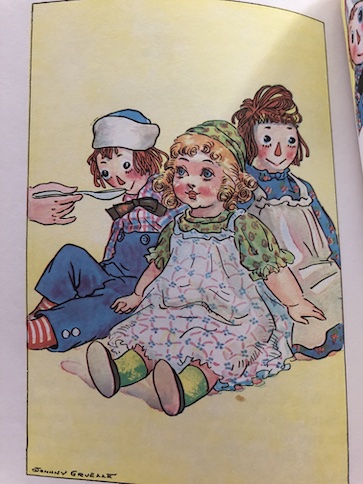
Raggedy Ann and Andy and the Camel with the Wrinkled Knees

Raggedy Ann and Andy and the Camel with the Wrinkled Knees by Johnny Gruelle, 1924.

This book is part of the original Raggedy Ann series by its creator, Johnny Gruelle. Unlike earlier books in the series, this book is a single long adventure rather than a collection of short stories.

Raggedy Ann and Andy are lying in their doll bed in Marcella’s playhouse one night when they see a strange man sneaking up to the big house. They see him reach through a window, steal something, and run away. Wondering what just happened, they run to the house and talk the other dolls. The other dolls say that the thief just stole the French doll!

Raggedy Ann and Andy try to follow the man to rescue the French doll, but they can’t catch up to him because he flew away! As they try to figure out what to do, a fairy comes along. They explain the situation to the fairy, and the fairy says that they can fly if Granny Balloon Spider weaves a balloon for them. So, they go to Granny Balloon Spider weaves them a silken balloon, and they sail away into the air.

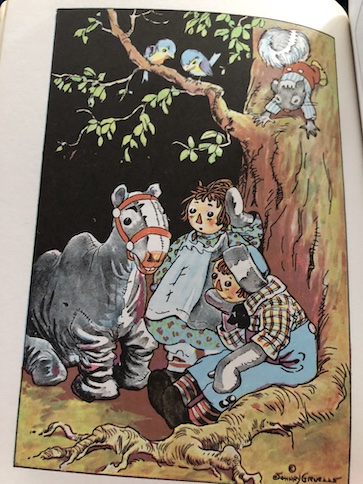
When Raggedy Ann and Andy decide it’s time for them to get off the balloon, they grab hold of a tree limb and untie the silken strings that have them tied to the balloon. When they jump down from the tree, they meet an old stuffed camel with wrinkled knees. They explain their situation to the camel, and the camel says that the man who took the French doll sounds like the one who kidnapped him from his owner, a small boy. The camel escaped from the man, but he thinks he could find him again, except that it was dark when he ran away, so he could find his way better if he couldn’t see.

Raggedy Ann and Andy tie a handkerchief around the camel’s eyes and climb on his back. At first, the camel just goes around in circles, but Raggedy Ann and Andy realize that he needs to run backward to retrace his steps, and then, they start getting somewhere.

Along the way, they meet a girl named Jenny who is trapped in a patch of snap dragons. The snap dragons won’t let her go. When they try to help her, Raggedy Ann and Andy get trapped by the snap dragons, too. They don’t know what to do until a tired old horse comes and rescues them.

Jenny explains that she was searching for her brother, Jan, who was kidnapped by a magical creature called a Loonie. The tired old horse says that he knows where Jan is now, so they decide to rescue Jan before continuing their quest to find the French doll.

The Tired Old Horse leads them to the tree where the Loonie lives, and the Camel recognizes it as the place that he escaped from. They discover that the Camel as the ability to get inside the magical tree when he’s blindfolded, and he carries the others inside. From there, they find a trap door that leads to Loonie Land.

In Loonie Land, they are captured and brought before the king of the Loonies, who is a very silly king. The king insists that they won’t let Jan go until they answer three riddles. The riddles are very silly and make little sense, but Raggedy Ann and Andy figure out that the king doesn’t know the answers himself, so as long as they give him some kind of answer, they will be answering the riddles. The king is astonished that they are able to come up with answers and tries to insist that he has to ask them three more riddles, but Raggedy Ann and Andy insist that they’ve fulfilled the bargain already and that they’re going to take Jan. Raggedy Andy tweaks the king’s nose, and the king summons his looniest knight to fight them.

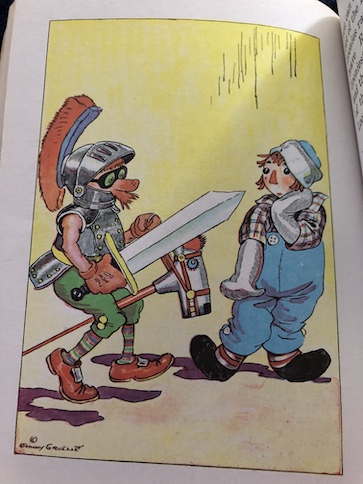
The looniest knight comes riding up on a hobby horse, but he’s afraid of Raggedy Andy and pretends that his hobby horse is acting up and that it has thrown him off. Since Raggedy Andy has “vanquished” the looniest knight, the king decides that they can take Jan and go.

With Jan rescued, they are able to resume their quest to find the French doll. Going further, they meet Winnie the Witch. The witch says that the man with the French doll bought some magic medicine from her, but he gave her a lead dime. Since he cheated her, the witch says that the magic medicine she made for him won’t work. The tired old horse asks if she has some medicine that will make him less tired. When he has her medicine, he becomes more energetic.

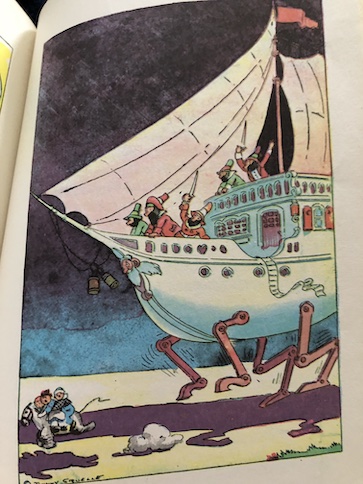
When they ask the witch how to find the man with the doll, she has them close their eyes and count to ten. When they open their eyes, they find themselves outside the tent of the man who took the doll. It turns out that Babette, the French doll, was kidnapped by pirates! Getting away from them is also going to be difficult because the pirates have a jumping house boat!

The book is available to borrow and read for free online through Internet Archive (multiple copies – including an audiobook). The LibriVox audiobook is also available on YouTube.

My Reaction and Spoilers

This story is cute, and I’m sure that it would be amusing for young children. Actually, I found it amusing as an adult because there are some silly jokes in the book that adults can enjoy, like how Raggedy Andy keeps talking while trying to tell the camel that he shouldn’t talk because Raggedy Ann is trying to think. At one point, the camel also gets confused about why the French doll is French when she has a china head. (Ha, ha. Groan!) One of my favorite parts was the part with the king of the Looneys and his nonsense.

The ending is also pretty silly. The tired old horse convinces the pirates to reform by offering them lollipops. It turns out that the pirates are actually a bunch of girls in disguise! These girls apparently had a deprived childhood, but they always liked to read stories about pirates and pretend that they were pirates. When they had a chance, they bought this magical jumping ship and started playing out their pirate fantasies, trying to get all the things that they didn’t have when they were younger, which is why they’ve stolen toys and are easily bribable with candy.

The story has a happy ending where the pirates help Raggedy Ann, Raggedy Andy, and the French doll get home. They reunite Jenny and Jan with their parents, and it turns out that the camel once belonged to Jan’s father. Jan’s father is happy to see his old toy and gives the camel to Jan.

Raggedy Andy Stories

Raggedy Andy Stories by Johnny Gruelle, 1920.

This book is part of the original Raggedy Ann series by its creator, Johnny Gruelle. The first book in the series was just about Raggedy Ann, but this book introduces a boy doll named Raggedy Andy. The explanation behind Raggedy Ann and Raggedy Andy (according to the book, not real life) is that the two dolls belonged to a pair of childhood friends. One girl owned Raggedy Ann, and the other girl owned Raggedy Andy. At the beginning of this book, Raggedy Andy arrives by mail to join Raggedy Ann and the other dolls in Marcella’s nursery, supposedly sent to the author by the daughter of the woman who owned Raggedy Andy.

Every night when the humans in the house go to sleep, Raggedy Ann and Raggedy Andy and the other dolls and toys come to life and have adventures. Each chapter in the book is its own short story. Some of the stories have morals to them about being generous and making others happy. Santa Claus and the Easter Bunny also make appearances.

These stories can make good bedtime stories for young children because there is nothing at all stressful about them. The book makes it clear from the very beginning that dolls cannot be hurt, so whatever they go through in their adventures, no real harm is ever done.

The book is available to borrow and read for free online through Project Gutenberg (multiple formats) and Internet Archive (multiple copies – including an audiobook). The LibriVox audiobook is also available on YouTube.

Stories in the Book:

How Raggedy Andy Came

The package with Raggedy Andy arrives, and the author is sees that Raggedy Andy and Raggedy Ann are glad to see each other again. The dolls cannot talk to each other in front of humans, but the author senses that they have things to say to each other, so he leaves them alone together.

The Nursery Dance

Raggedy Andy is brought to Marcella’s nursery with Raggedy Ann and Marcella’s other toys. When Marcella plays with her toys, she talks for them, but the toys have private thoughts of their own that they can’t say in front of her. After Marcella goes to bed, the toys begin to move about on their own and talk to each other. Raggedy Ann introduces Raggedy Andy to the other toys. Raggedy Andy has been stored in a trunk for a long time. Although, he was friends with a family of mice during that time, he is glad to be among other toys again.

The Spinning Wheel

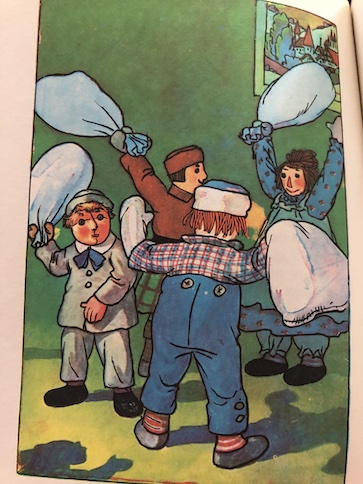
The dolls in the nursery have a pillow fight and get feathers all over the floor. They clean up the feathers, but one of Raggedy Andy’s arms fall off in the right. (This doesn’t really hurt him because, as the book explains, Santa Claus gives the toys he makes a special wish that prevents them from being hurt by anything.) Raggedy Andy says that his arm has been loose for a while. The dolls say that maybe Raggedy Ann could sew it back on, but they need to find a needle and thread first. The dolls go on a daring expedition to the sewing room to get them. As Raggedy Ann repairs Raggedy Andy’s arms, she tells the dolls about another time when she repaired Raggedy Andy’s arm.

The Taffy Pull

Raggedy Andy suggests to the other dolls that they have a taffy pull. At first, the others think it’s a new kind of game, but Raggedy Andy explains that it’s a way to make candy. This is a good time for them to do it because Marcella and her parents are away, visiting relatives, so there is no one home to notice the dolls using the kitchen.

(This story actually contains a pretty good description of making homemade taffy, although the dolls aren’t hurt by touching hot, sticky candy, and a human child would be.)

The Rabbit Chase

Marcella’s dog, Fido, knows that the dolls can talk and also talks to them. One night, Fido hears a strange scratching sound. He wants to bark at it, but the dolls don’t want him to bark because it will wake the humans. They let Fido outside so he can see what the sound is. It turns out to be a rabbit, and the rabbit tries to hide from Fido by running into the house and hiding in the nursery. Raggedy Ann tells Fido to leave the rabbit along and asks the rabbit why it was scratching at their house. The rabbit explains that he is an Easter Bunny, and he only came to leave a basket of Easter Eggs for the children of the house.

The New Tin Gutter

When the house gets a new tin gutter, the dolls have fun sliding down it until a couple of penny dolls get lost down a drain pipe. Then, Raggedy Andy gets stuck trying to rescue them! The other dolls don’t know how to get them out and are afraid that they are lost forever. Then, it starts to rain, and when Marcella’s father notices that the drain seems plugged, he calls some workmen to figure out why the drain won’t work. The adults assume that Marcella must have put Raggedy Andy down the drain pipe when she was playing.

Doctor Raggedy Andy

Marcella sometimes likes to pretend that her dolls are ill and gives them medicine made out of water and brown sugar. However, one day, she leaves the French doll lying in bed after giving her medicine, and the medicine hardens so that her open-and-close eyes are stuck closed. The other dolls try to figure out how to help her, but it’s Raggedy Andy who figures out what to do.

Raggedy Andy’s Smile

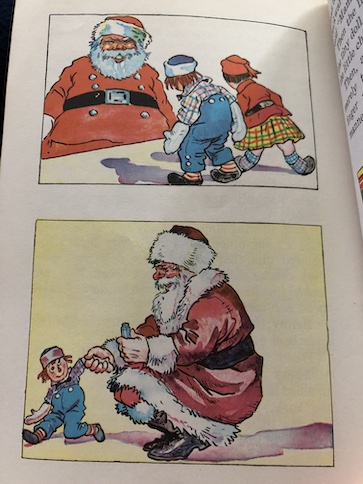
Raggedy Andy’s smile is wearing off because Marcella’s little brother fed him orange juice. (Little Dicky isn’t sorry that he did this because he is only two years old, and as the book notes, two-year-olds don’t have many sorrows.) Raggedy Andy still feels like the happy doll he is even with only half a smile left, but Raggedy Ann says maybe they should wash Raggedy Andy’s face. The others don’t think it will do much good. They go downstairs and are surprised to see a man there. Immediately, the dolls act like they can’t move because the don’t want the humans to know that they come to life. However, this isn’t an ordinary man. This is Santa Claus! Santa Claus fixes Raggedy Andy’s face and smile and also gives the other dolls new painted faces and repairs other problems the dolls have.

The Wooden Horse

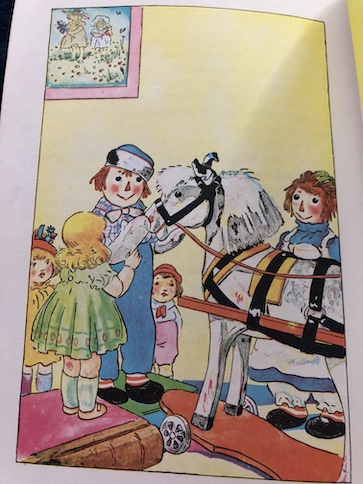
The children of the house get a new wooden horse on wheels for Christmas with a wooden wagon hitched to it. The horse takes some time figuring out how to move because he wasn’t used to moving when he was on a shelf in a toy shop. When the horse figures out how to move, he gives rides to the other dolls and toys. The other dolls think that the horse has more fun than anybody because people who make others happy are happier themselves.

Making ‘Angels’ in the Snow

Raggedy Andy has been away from the other dolls for a while because he got wet and frozen playing with Marcella in the snow at her grandmother’s house and needed to dry out and warm up. The others ask him how it happened, and he tells them about going sledding with Marcella and making snow angels. Then, Marcella left him outside on her sled, so he got frozen. In spite of this, Raggedy Andy thinks that it was an exiting time!

The Singing Shell

Marcella brings home a seashell from her grandmother’s house. At first, the dolls aren’t sure what to think of it. When the dolls listen at the mouth of the shell, they hear a whispering sound. As they listen, the whispering tells them the story of the shell and how it came from the ocean. The shell was found by a diver, who sold it to Marcella’s grandmother when she was young. The shell also sings, and the dolls enjoy hearing it sing.

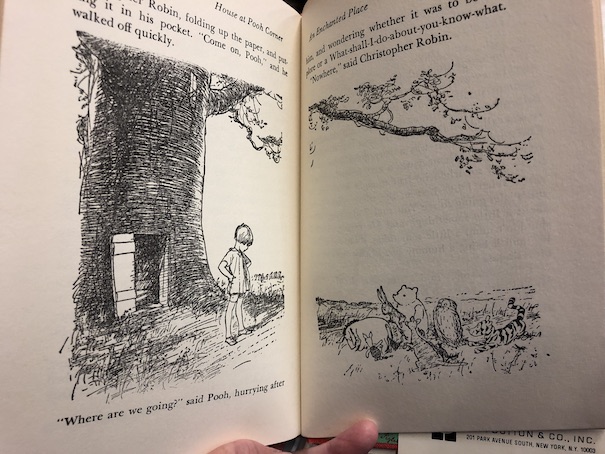
The House at Pooh Corner

Winnie-the-Pooh

The House at Pooh Corner by A. A. Milne, 1928.

This is the last book in the original Winnie-the-Pooh series. Although other authors later wrote other stories about Winnie-the-Pooh and his friends, at the end of this book, Christopher Robin goes away to school and has to leave his toys and animal friends behind. It’s implied that his friends will continue to live and play in the woods without him and that they’ll all continue to be friends, but the ending is a little bittersweet because Christopher Robin realizes that he’s growing up and that things are going to be changing.

Each chapter in the book is its own short story. I didn’t read the original Winnie-the-Pooh stories when I was a child, but I was already familiar with many of the stories in this book from the cartoon versions that I saw on tv when I was young. I still think of the Pooh Sticks game whenever I cross a foot bridge (although, living in Arizona, few of the ones I cross have water under them). I also still joke about what Tiggers like best from time to time. (Tiggers apparently like everything best until they actually try it, and then they discover that they don’t really like it at all, not unlike the way my dog feels when she begs for food I’m eating that she wouldn’t really like if she actually got some.)

The book is available to borrow and read for free online through Internet Archive (multiple copies).

Chapters:

Ch. 1: In Which a House is Built at Pooh Corner for Eeyore

On a snowy day, Pooh gets the idea of building a house for Eeyore because he’s the only one who doesn’t have a house. However, Eeyore had built a house for himself, and strangely, it has disappeared. When Eeyore gets Christopher Robin to help him investigate, they realize that Pooh and Piglet have mistakenly taken the materials Eeyore used for his house and used them to build a new house for Eeyore in a different location. But, the new location is better because Pooh and Piglet built the new house in a warmer part of the woods, and they did a better building job. Eeyore thinks that the wind blew it to its new spot, and the others let him think that.

Ch. 2: In Which Tigger Comes to the Forest and Has Breakfast

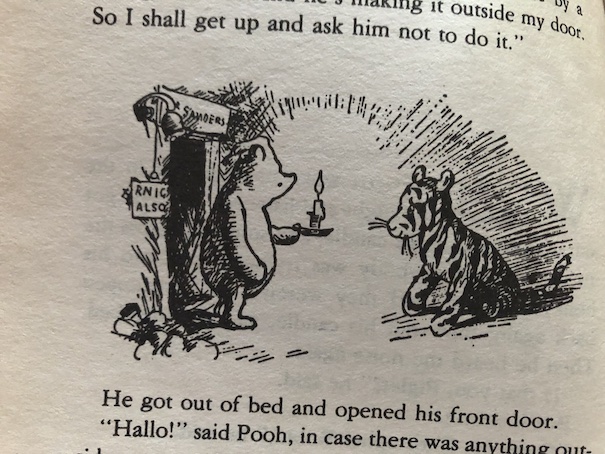
Pooh is woken up suddenly in the night by a strange noise. It’s Tigger, a very bouncy kind of tiger. They’ve never met before because he’s new to the woods, but Tigger knows Christopher Robin, so Pooh invites him to breakfast in the morning. However, Tigger doesn’t like the honey that Pooh serves for breakfast, so they go to see Piglet to see if Tigger likes acorns for breakfast. However, Tigger decides he doesn’t like those, either. They continue visiting friends to find things that Tigger will like. They finally find something Tigger likes when Tigger samples little Roo’s medicine, extract of malt, so Tigger decides that he will live with Kanga and Roo.

Ch. 3: In Which A Search is Organized, and Piglet Nearly Meets the Heffalump Again

Rabbit tells Pooh that he is organizing a search and tells him where to search without telling him what they’re supposed to be searching for. Confused, Pooh decides to look for Piglet to ask him what they’re supposed to be searching for. It turns out that Piglet has accidentally fallen down a hole, and Pooh falls into the same hole while looking for him. Pooh remembers that they dug holes like that as traps for Heffalumps, and they worry that they’re in a trap that the Heffalumps set for them. Fortunately, they accidentally find the person Rabbit was originally looking for.

Ch. 4: In Which It Is Shown that Tiggers Don’t Climb Trees

Tigger brags about all the things that Tiggers are good at doing, but it turns out that they’re not as good at climbing trees as he claims. Tigger and Roo get stuck in a tree, and the others have to help them get down.

Ch. 5: In Which Rabbit Has a Busy Day, and We Learn What Christopher Robin Does in the Mornings

Rabbit finds a note from Christopher Robin, but he has trouble reading it and figuring out what it means. Rabbit tries to figure out what Christopher Robin does every morning, and Eeyore tries to explain education to Piglet.

Ch. 6: In Which Pooh Invents a New Game and Eeyore Joins In

Pooh invents a game that involves tossing pine cones and sticks into the river next to a bridge and seeing which of them is the first to come out the other side of the bridge. While he and his friends are doing that, they find Eeyore floating on his back down the river because Tigger bounced him in. The others have to figure out how to rescue him.

Ch. 7: In Which Tigger is Unbounced

Rabbit has decided that Tigger’s bouncing has gotten out of control and that he needs to be taught a lesson. He tells Pooh and Piglet that they should take Tigger to a part of the woods he hasn’t been before, get him lost, and leave him there for awhile. Rabbit’s reasoning is that they can then rescue Tigger, and Tigger will be so grateful to them for rescuing him that he won’t be so bouncy. Pooh and Piglet have doubts about this plan, but they agree to help Rabbit. However, it turns out that Tigger’s don’t get lost, but Rabbit does, and Rabbit turns out to be the one who is grateful for a rescue.

Ch. 8: In Which Piglet Does a Very Grand Thing

One very windy Thursday, Pooh and Piglet decide to go around and visit their friends, wish them a happy Thursday, and have snacks with them. While they are visiting Owl, Owl’s tree falls over because of the wind. When the tree crashes, they’re trapped inside, and they have to figure out how to get out. Their plan requires Piglet doing something brave, which isn’t easy for such a small, timid animal.

Ch. 9: In Which Eeyore Finds the Wolery and Owl Moves Into It

With Owl’s tree down, Owl has to find a new place to live. Eeyore thinks that he’s found the perfect place: Piglet’s house. It’s a great house, but with Owl living there, where will Piglet live? Pooh says if Piglet’s house had fallen down, Piglet would come and live with him, so that’s what he can do now. Piglet is happy about living with his friend Pooh, so he decides that it’s okay for Owl to live in his house.

Ch. 10: In Which Christopher Robin and Pooh Come to an Enchanted Place, and We Leave Them There

All of the animals know that Christopher Robin is going away somewhere soon, although they’re not quite sure where he’s going and why. The story doesn’t exactly say it,but it’s implied that Christopher Robin is going away to boarding school. All of the animals say goodbye to him, and Eeyore writes a poem for the occasion. Christopher Robin and Pooh have a quiet walk and talk together. While Christopher Robin realizes that he’s growing up and things are going to be changing, the two of them agree that they’ll never forget each other, no matter how old they get. They’ll always have their favorite place and continue to go there, and some part of them will always be playing together.

Something Upstairs

Something Upstairs cover

Something Upstairs by Avi, 1988.

This story begins with a famous quote:

Those who cannot remember the past are condemned to relive it.

Santayana

It’s an appropriate quote for the story, which is about memory and a repeated wrong that has led to a seemingly endless cycle of violence. The story is framed as having been told to the author by the boy who actually had this frightening adventure.

Kenny Huldorf is unhappy when his parents decide to move the family from California to Rhode Island. Kenny was happy in California, the weather was much better there, and the streets and buildings in Rhode Island all seem small and old. The house they move into is called the Daniel Stillwell House, and it was built in 1789. Right from the beginning, the house gives Kenny a strange feeling, like there’s something or someone there when there shouldn’t be anyone or anything.

Kenny starts to feel better when his parents give him the big, renovated room with the private bathroom in the attic of the house. He likes that room, but there are two smaller rooms off the attic that haven’t been renovated, and they give Kenny a strange feeling. His parents think they were probably old servants’ quarters. One of them has a stain on the floor that makes Kenny think of death, and even more frightening, Kenny gets an odd sense that, somehow, it’s a death he may be responsible for. For a time, Kenny tries to tell himself that it’s nothing but an old stain and occupies himself with unpacking and getting settled. Since school hasn’t started yet, Kenny gets bored and does some exploring of the area. He starts wondering about the history of the town and the house.

Then, one night, Kenny hears a strange sound from the room with the stain. When he goes to investigate, he sees a pair of ghostly, glowing hands reaching up out of the stain on the floor. The hands pull the rest of the ghostly person out of the floor, and Kenny can see that it’s the figure of a boy. When the boy tries to reach out to him, Kenny reacts defensively, and the ghost boy seems frightened and vanishes. The next day, Kenny asks his parents if they believe in ghosts. His father says he doesn’t but that Providence is a very old town and a lot of things have happened there over the years. His mother later says that she doesn’t really believe in ghosts either, but she believes that places have memories. Kenny’s parents conclusions seem to be that Kenny is sensing the general history of the town, but Kenny feels that it’s something more specific than that, that the ghost he saw is a specific person from a specific incident in the history of the house.

The family was given a scrapbook with a list of former owners of their historic home, so Kenny decides to do some research about the past owners and see if he can learn more about where the ghost came from and who it is. When he arrives at the local Historical Library, Kenny is surprised to find out that someone there is expecting him. He is directed to the office of an historian named Pardon Willinghast. Willinghast tells Kenny that he keeps track of the owners of historic homes, which is how he and others at the library recognized his last name, and he expected that someone from the Huldorf family might come to ask about the house. Kenny gives him the list of past owners and asks what Willinghast can tell him about them. Willinghast looks at the list of names and says that there probably won’t be much about them in the library but that he’ll do some research and see what he can find. Kenny also gets the idea to have the local pharmacy test a sample of wood from the stained floor to find out what the stain is.

The next time Kenny sees the ghost, he tries to talk to the ghost boy and ask him who he is. The ghost has trouble talking but manages to communicate one word: “slave.” The pharmacy tells Kenny that the stain on the wood is human blood. They can tell that the stain is more than 100 years old, which is why they haven’t reported it to the police, like they’d have to with a recent blood stain. When Kenny talks to Willinghast again, he wants to know about people who lived in his house over 100 years ago who might have owned slaves, which limits the scope of his investigation to the first three families who owned the house. Willinghast is oddly vague in his reply, and when the subject of abolitionists comes up, he makes vague references to “agitators” and people who want to “rush history.” When Kenny tries to ask him about a murder that may have occurred in the house, Willinghast becomes agitated himself and tries to discourage Kenny from inquiring further. He says that if a slave was murdered, it probably wouldn’t even have been reported in a newspaper because it wouldn’t have been considered important.

However, now that Kenny understands that a young slave was murdered in his house and is still haunting it, he can’t leave the situation alone. He continues trying to communicate with the ghost boy, and the ghost gradually finds it easier to talk to him. He says that his name is Caleb and indicates that he is tied to the stain on the floor. He can’t seem to move very far from it. He says that he’s a memory of what happened there. He is aware that he was murdered, but he doesn’t know who did it because he was killed in his sleep. He senses that he was killed by someone who wanted to keep him a slave because he and other black people were trying to free themselves from slavery. Kenny asks Caleb if there’s anything he can do to help him, and Caleb asks him to find his murderer. Kenny asks how he can do that when the murder happened so long ago.

Then, the attic changes, and Kenny finds himself back in the past, in Caleb’s time. Kenny looks out the window and sees a strange man in a black cape watching the house. As he explores the town, he witnesses a public argument about slavery and someone asks him to deliver a note. The next morning, Kenny is back in his own bed, in his own time. When Kenny talks to the ghost again, he describes what he saw in the past, and Caleb recognizes these events and people as being part of the circumstances that led to his death. He has trouble believing that Kenny really cares about what happened to him so long ago. He says that white people have broken their promises to him before, but Kenny insists that he does care and that he wants to not only solve his murder but prevent it so Caleb can finally be free from haunting that room.

However, that’s going to be even more difficult than Kenny thinks. On his next trip into the past, he discovers who their true enemy is: Pardon Willinghast. Willinghast isn’t just an historian. Almost like Caleb, Willinghast is memory, a piece of the past that keeps coming back to haunt the people who live in Caleb’s old house and who have tried to help Caleb before. Willinghast has figured out that if someone from the future comes to the past and they lose something they’ve carried with them or if they get hurt or change themselves in some way, they can get stuck in the past, seeming like ghosts to the people there. (Or, so he says.) He has used this knowledge before against other people who have tried to help Caleb, blackmailing them into helping him instead. Now, he has the lucky key chain that Kenny always carries with him. Until Kenny gets this key chain back, he’s stuck in the past, and Willinghast won’t return it until Kenny does what he wants. In fact, he implies that Kenny is already doing what he wants, leaving Kenny to wonder if he’s accidentally leading Caleb into a trap while trying to help him escape from one.

Kenny set out to help Caleb, but he’s in danger of becoming a part of the same cycle of murder that has been repeated over and over for almost 200 years. As Kenny tries to help Caleb, he knows he’s being manipulated by Willinghast into playing a role in a very old story, but since he doesn’t have a copy of the script, he struggles to figure out what has to change to break the cycle. Can he find a way to break cycle and escape without either himself or Caleb losing their lives?

Th book is available to borrow and read for free online through Internet Archive (multiple copies).

My Reaction and Spoilers

This is a book that I remembered from when I was a kid, but strangely, I’m sure that I never heard the end of it back then. I’m having trouble remembering exactly why I never heard the end. I think it might have been one that a teacher was reading aloud, and maybe I was absent the day she finished it. Either that, or I started reading it myself and chickened out before the end because I was spooked.

This book poses a kind of “gun-to-your-head” type of decision, forcing both Kenny and the readers to consider what they would do if they were forced to make a choice between two horrible options. In this case, Kenny is put into the position of being pressured into committing a murder or being trapped forever in the past. Willinghast committed the original murder, and he tells Kenny that the only way he’ll return his keychain to him and let him go home is if he shoots Caleb himself this time. Willinghast is confident that he can force Kenny to do what he wants because he’s done the same to others before him. Other past owners of the house have tried to help Caleb before, but Willinghast has manipulated each of them into betraying Caleb and shooting him instead. These are the betrayals that Caleb referred to earlier. Willinghast claims that each of these people has lost their memory of what they’ve done when they return to their own time, so Kenny won’t have to worry about feeling guilty about killing Caleb. But, if Kenny gives in, he knows that Caleb will remain a ghost, and someday, someone else will also be in Kenny’s position, another pawn in Willinghast’s sick game of endlessly repeated murder. As long as Willinghast gets his way, not only is Caleb going to be his perpetual murder victim, but every person who tries to help will continue to be victimized and forced to participate in his bloody crime.

There is also a deeper theme to this story. Violence begets violence, and hate begins hate. Murder, revenge, hatred, and yes, also slavery and racism, are part of violent cycles that draw other people into them long after the original deed was done. People are haunted by the past in many ways … especially those who feel like they’ve got something to prove about it. It’s a theme that’s been very much on people’s minds in the early 21st century, and there are many, like Kenny, who are unwilling to be pulled into going along with violence, murder, racism, and everything that goes with it just to save some past people’s public images or some modern people’s egos.

Willinghast has correctly realized that the reason why he’s able to come back is because he’s a part of Caleb’s memory as his original murderer. Every time Caleb’s ghost tries to solve his murder and change the past, Willinghast gets reawakened to interfere. In his role posing as the historian, he rewrites the accounts of Caleb’s death in the archives to trick the people trying to help him. He’s not about truth but manipulation, much like the pseudo-historians who resurface to tell “their truth” when certain controversial topics come up. He has a vested interest in lying to cover up his own shameful deed and to force others into helping him get things his way. Willinghast does not care either about accurate history or about the welfare of future generations; he only uses them to cover up his own misdeeds. He’s used other people to repeat his dirty work before, and he’ll do it again, blaming Caleb each time for bringing it on himself by trying to survive instead of just accepting his own murder and staying dead … unless things are different this time around. The violence ends when someone finally says no and refuses to play along. So, what Kenny is really looking for, in this situation where he seems to be given a choice between two horrible options, is a third option that allows both him and Caleb to escape.

Because the story is framed as one being told by Kenny to the author later, readers know from the beginning that Kenny finds another solution to the problem that doesn’t include murdering Caleb or being trapped in the past as a ghost. The suspense comes from the readers wondering how he’s going to do that. Kenny’s solution isn’t entirely peaceful (spoiler) because he ends up shooting Willinghast, but that could be seen as an act of self-defense, not only saving himself but also Caleb and all of Willinghast’s future victims. It seems like eliminating Willinghast was the only way to end the cycle of murder because it wasn’t really Caleb’s attempts to save himself or bring his murderer to justice but Willinghast’s attempts to cover up his crime that kept the cycle going. Willinghast blames Caleb for trying to avoid being murdered, but the truth is that it’s his original act of murder that created this situation from the beginning and his continual cover-up and recruitment of unwilling abettors that has kept the cycle going. Readers can debate whether there was another way to solve the problem, but once Willinghast is gone, the cycle is broken.

Some might also point out that the reason why Willinghast targeted Caleb in the first place was that Caleb shot one of Willinghast’s associates first, but the reason why Caleb did that was that Willinghast’s associates were violently targeting a black neighborhood, and Caleb was trying to hold them off. Once again, violence begets violence until someone decides not to participate. In the end, Kenny commits a violent act, but the cycle ends because he gets the one person who was at the center of all of the other violence from the beginning. Kenny also remembers everything that happened when he returns to his own time, which brings up a point that I’ve already mentioned but I’d like to explain in more detail: Willinghast is a liar.

The only reason why Kenny knows, or thinks he knows, that Willinghast has power over him and can prevent him from returning to his own time as long as he holds one of his belongings is because Willinghast says so. Nobody else in the story says that, and frankly, Willinghast is a known liar. He was never a real historian. He’s only another ghost from the past masquerading as one to trick people into doing his bidding. He fakes historical records to manipulate people. He is an admitted murderer. He said that Kenny wouldn’t remember what happened in the past when he returns to his own time, so he wouldn’t have to feel guilty about shooting someone, but Kenny remembers everything. This didn’t occur to me when I first encountered this story as a kid, but looking at it now, I can’t help but think, why the heck should Kenny believe anything that Willinghast says about how the time travel works?

At the point in the story where Willinghast tells Kenny that he’s trapped in the past as long as he has his key chain, Kenny already been to the past once and returned from it without either Willinghast’s help or interference. Kenny did not get to the past by Willinghast’s power, but through Caleb’s memories. Willinghast was counting on Kenny to be frightened and confused so that he would rely on his word for what’s going to happen to him in the past and feel like he had something real to lose for not going along with his plans, but even as I read the story, I doubted him. I think what he said about Kenny needing his key chain to return home might have just been another of Willinghast’s lies. I don’t recall seeing anything in the story that proved that Willinghast was right, and it seems that none of his other victim/accomplices put his lies to the test to find out. There is no one else trapped in the past as a ghost because we never see any such people in the story. So, if that hasn’t actually happened to anyone before, how would Willinghast or anyone else know that such a thing was even a possibility?

The fact that Kenny remembers shooting Willinghast also suggests that everything Willinghast said may have been a lie. He claimed that none of the other time travelers retained their memories, so Kenny wouldn’t remember if he shot Caleb. If Kenny wouldn’t remember shooting Caleb, how would he be able to remember shooting Willinghast? Unless Willinghast needs to be alive after Caleb’s death to rewrite people’s memories, it sounds like the idea that Kenny wouldn’t remember what happened in the past was a lie. We never see or hear from the other people Willinghast manipulated, so we don’t know for sure that they had no memories or guilt over what happened. That could be another subject for debate among readers, but from what I saw in the story, I’m thinking that Willinghast should be considered a liar on everything he said. I think the real trap wasn’t that Willinghast was holding Kenny in the past so much as Willinghast was making Kenny believe that he was. Although he tried to make Kenny believe that he only had two choices, Kenny himself found a third one. Perhaps there were other possible choices, but we know that there was at least one more option than Willinghast led Kenny to believe he had.

Because there are violent themes in this story, it isn’t for very young kids, but it does combine some historical details with excitement for kids who enjoy scary stories. There is also some use of the n-word on the part of the villains in the story, so be warned. The story is thought-provoking on the subjects of history and personal choices.

In the end, after Kenny has finished telling his story to the author, he says that he knows that Caleb survived the room where he was murdered before and no longer haunts it. Caleb ran away after Willinghast was dead, but Kenny doesn’t know where he went after that or what happened to him. He finds himself worrying that the violence caught up with him again somewhere else and that maybe he’s just haunting a different house now because the memory of all that was done to him will never end. This is the final question the story leaves readers. Is that how it really is? Is there an end to the wrong, or are Caleb and others like him still ghosts who haunt us all?

This story reminds me somewhat of a YouTube video made by Kaz Rowe in 2022 about the history of ghost hunting. While talking about the history of belief in ghosts and our society’s fascination with ghosts and ghost stories, Kaz Rowe points out that many of our historical American ghost stories focus on moments when our society failed and innocent or vulnerable people suffered. The ghosts that haunt our society often represent unresolved situations – unpunished crimes, unacknowledged injustices, perpetuated wrongs, and tragedies that can’t be undone. There is a feeling that there was more that our society could have done and should have done to prevent needless death and suffering, and that’s probably true. Perhaps some of these problems were the result of people who thought (or convinced others) that they only had one option or just one choice between two bad options – black-and-white thinking, if you will – so they made terrible choices, never considering or choosing to acknowledge that there might be other ways. One of the difficult parts of studying history is considering the choices not made and the things people of the past left undone. It does create an unsettling a sense of the unresolved, that the past is still with us and haunting us today. What Kaz Rowe was talking about is that part of the interest in communicating with ghosts is that sense of the unresolved. There were people in the past who needed help and didn’t get it, people whose voices weren’t heard when they needed someone to listen, and people who suffered when no one seemed to care. When people reach out to ghosts, they seem to be saying that, even if no one heard them or cared about them in their time, someone does care now and wants to hear what they have to say. We don’t have the ability to go back and change the past, like the character in the story, but there may be the hope that caring and listening can, in some way, offer peace to the ghosts of the past because someone finally understands what they went through and how they felt.

Do I think Caleb and others are still haunting us? Yes, after a fashion, I think so. There is the haunting feeling of a past that can’t be changed or entirely made right. Caleb isn’t haunting Kenny’s house anymore, but he is haunting Kenny’s mind because of the shared trauma of what they went through and Kenny’s lingering fears about Caleb’s life after the events.

In that sense, I would say that maybe the ghost hunters have it right. Maybe the best thing to do with the ghosts of the past is not to be afraid of them but to pay attention to them and see them and their situations for exactly what they were. The haunting in the back of our minds comes from our inability or unwillingness to see what we can sense is there and is begging to be seen. That feeling comes from the human impulse to investigate and understand. It’s the unknowables and uncertainties in life that are the most frightening. When you know, even when you know the worst, you stop worrying so much about it. There are no more unanswered questions and things that just don’t add up, the questioning little voices in your head fall quiet, and the ghosts have nothing more to say because they’ve been heard and seen.

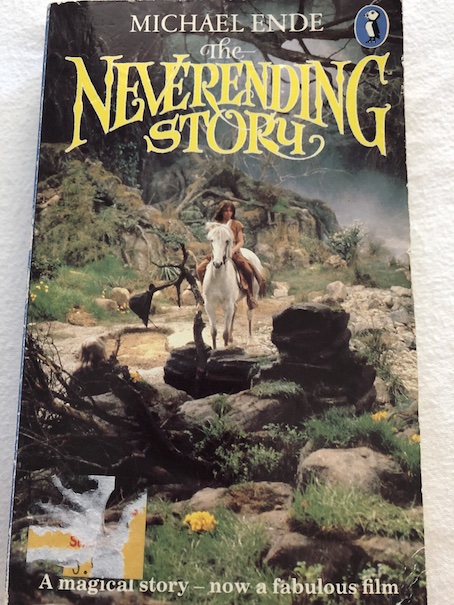
The Neverending Story

The Neverending Story by Michael Ende, 1979, 1983.

Bastian Balthazar Bux has problems. He’s smaller and fatter than the other boys, no good at sports or fighting, and not even a particularly good student.  Because of this, other kids tease him, bullies chase him, and the one time that he tried to talk back to them, the mean kids shoved him into a trash can, so he was afraid to ever try it again.  One day, on the way to school, he seeks sanctuary from his bullies in an old bookshop that belongs to Carl Conrad Coreander.  Bastian loves books more than anything.  In fact, his love of books and his imagination are his only apparent strengths at this point in his life.

Coreander doesn’t like children, and as soon as he sees Bastian, he makes it clear that the boy isn’t welcome in his shop, that he doesn’t carry books for children, and that he won’t sell Bastian any books for adults. Coreander says that children are just noisy and make messes and ruin books.  Bastian protests that not all children are like that, and the two them talk about why Bastian is there and why the other children bully him.  Bastian says that one of the reasons why the other kids think he’s odd is that he likes to make things up, like imagining places and characters and odd names. He rarely shares these things because nobody else seems interested. Coreander asks what his parents have to say about all of this, and Bastian reveals that his mother is dead and his father doesn’t take much interest in him or things that happen to him in his daily life.  Coreander is rather condescending to Bastian but also strangely interested in some of the details about him and his life.

When Coreander gets up to take a phone call, Bastian finds himself looking at the book that Coreander was reading when he came into the shop.  It’s called The Neverending Story, a title which captures Bastian’s imagination at once because he always hates it when a book he likes ends. The book seems to call to Bastian, and he suddenly feels like he has to have it.  Because Coreander has already made it clear that he won’t sell any books to Bastian, Bastian simply snatches up the book and leaves the shop with it.

After he’s out of the shop, Bastian suddenly feels guilty for stealing the book, even though he still feels compelled to have it and read it. He knows that he can’t take the book home with him because, even though his father doesn’t notice much, he would notice if Bastian showed up at home when he’s supposed to be at school.  Bastian knows that he’s already terribly late for school, but he can’t bring himself to go to class, especially not with a stolen book.  Desperately, he tries to think of a place to go.  Then, he remembers that his school has an attic.  Hardly anybody goes up there, and even those who do don’t go there very often.  He can hide there for a while and read.

Without giving much thought to how long he’s going to hide and what he’s going to do for food when he gets hungry, Bastian hurries up to the attic of the school, locks himself in, and starts to read The Neverending Story.

From this point on, most of the book is the story in the book Bastian stole, but at the same time, it’s also a story about Bastian himself.  There are periods when things in the story remind Bastian of things happening in his life or times when he pauses to think about what his class at school would be doing at this time without him, things that he’s glad to be missing himself.  However, gradually, Bastian himself starts to enter the story.

The Neverending Story Begins

The story in Bastian’s book takes place in the magical land of Fantastica.  The first characters we meet are messengers who are on their way to see the Childlike Empress who rules the land.  Within that land are many fantastical people and creatures who inhabit countries of their own, but strange things are happening here that have nothing to do with the usual magic of Fantastica.  A small group of messengers who happen to meet each other talk about what they’ve observed and why they need to talk to the Childlike Empress.  Whole sections of their countries and even some of the people and creatures who normally inhabit them have simply disappeared.  By “disappeared”, they mean that nothing is left in their place.  Whenever people try to look at the areas that used to be there, they see absolutely nothing, as though they have all gone blind when looking in their direction.  Nobody knows why this is happening, and people are panicking.

The Childlike Empress lives in a beautiful tower.  When the messengers arrive there, they discover that so many messengers have arrived from every corner of Fantastica that they have to make appointments and wait their turn to talk to the Childlike Empress.  Everyone seems to have the same problem, and to make matters worse, word has spread that the Childlike Empress is ill, and the doctors can’t seem to understand the nature of her illness and have no idea what to do to help her.  The messengers wonder if the Childlike Empress’s illness could have something to do with all the strange things that have been happening.  All of the creatures in the kingdom know that the very existence of their kingdom depends on the well-being of the Childlike Empress.  If anything ever happened to her, the rest of them would simply cease to exist.

At this point in the story, Bastian is reminded of his mother’s death and stops to think about her.  He remembers being at the hospital with his father while his mother was undergoing an operation to try to save her life, but unfortunately, it was unsuccessful.  After that point, Bastian’s father changed, becoming mentally and emotionally withdrawn, so it seems as though Bastian not only lost his mother completely but also part of his father.  His father continues to look after him physically and even gives him nice things, like a bicycle, but he rarely takes much notice of his son’s day-to-day life, making Bastian feel almost like he isn’t there himself.  His father no longer talks to him about ordinary, everyday things, and he’s always preoccupied with his grief.

The doctors trying to treat the Childlike Empress say that she doesn’t have any obvious symptoms of illness.  For some reason, she simply seems to be fading away, making it seem likely that her malady is tied to the fading away of Fantastica itself.  Chiron the centaur, the greatest of the healers, says that the Childlike Empress has said that someone must go on a quest to find the solution to her problem. She doesn’t say what the solution is, but she has chosen the hero who will go on this quest by name and has given Chiron her medallion to give to this hero.  The Childlike Empress’s amulet, Auryn, takes the form of the twined snakes (it’s a sort of elaborate ouroboros) that appears on the cover of the book that Bastian is reading.

Chiron takes the medallion to the Greenskins, a people who resemble nomadic Native Americans who hunt purple buffalo, to find the hero called Atreyu.  Atreyu turns out to be a 10-year-old boy, and Chiron is upset at first that a child so young has been given this important mission.  Even though he is doubtful that a child could save the Childlike Empress, he has to trust the empress’s decision.  He explains the situation to Atreyu and his people, and Atreyu sets off on his quest, although he has little to go on.

Bastian comes to identify somewhat with Atreyu, who is an orphan, raised communally by his people.  In a way, Atreyu is like what Bastian himself wishes he was.  Atreyu is also an orphan, but where Bastian feels neglected by his remaining parent and has no one else to rely on, Atreyu is regarded as the “son of all” his people, with everyone raising him.  Bastian wishes that he could feel like he could rely on everyone around him to care about him.  Atreyu is also strong and brave, which Bastian is not, or at least, he doesn’t feel like he is.

Atreyu travels far and asks everyone where he stops if they know how to help the Childlike Empress, but no one does.  However, in a dream, a purple buffalo tells him that he must visit an ancient woman called Morla, who lives in the Swamp of Sorrows.  She is the oldest creature in Fantastica, and she will know the answer.  Atreyu loses his beloved horse in the Swamp of Sorrows because the horse is overtaken by a dreadful depression and cannot save himself from being dragged down into the swamp.  (This was the worst part of the movie version of this story for me as a kid although somewhat less traumatic in the book.)  Atreyu is protected from the depression by the Childlike Empress’s amulet and is able to reach Morla.

Morla turns out to be a giant and ancient tortoise.  She does know the answer to the problem, but Atreyu has trouble persuading her to explain it at first because Morla is so old that she has come to feel like life is meaningless and doesn’t really care if she and everyone else disappears or not.  Fortunately, Atreyu’s arguments with her revive enough of her interest for her to talk to him. Morla says that the Childlike Empress has always been young because her life isn’t measured by time like others’ lives.  The Childlike Empress’s life is measured by names.  She has had many, many names over the years, most of them forgotten now, and even Morla doesn’t know what her current name is.  In order for her life and existence to be renewed, the Childlike Empress needs a new name.  Atreyu asks Morla how she can get one, and Morla says that she doesn’t know who can give her a new name, only that it can’t be anyone from Fantastica.  Atreyu must visit the Southern Oracle to find the answer.

At this point, Bastian thinks it’s too bad that he can’t give the Childlike Empress her name because thinking up unusual names is something that he’s really good at, and this might be the one place where his talent has a use and people who would welcome it.  However, the things that are happening in the story are so scary that Bastian is also grateful that he is safe where he is, just reading about them.

Bastian reads that Atreyu wanders out of the swamp on foot. He doesn’t know where he’s going, and he lost all of his supplies with his horse.  Then, Bastian hears the clock chime and knows that school is out for the day. As the other children leave the school, Bastian has to decide what to do. He knows that he really should go home and own up to his father about stealing the book, but when he gets up to go, he has the feeling like he has to keep reading, to finish what he’s started, like Atreyu, who is still fulfilling his mission in spite of hardship.  Bastian feels a little proud of making a difficult decision because he’s not running away from his responsibilities so much as continuing a quest of his own.  He knows that he must finish that book. Indeed, he must because the existence of Fantastica now depends on him.

As he continues reading and following Atreyu’s adventures, Bastian begins to feel more like the story isn’t just a story, that there is something more to it. When Atreyu reaches the Oracle, which communicates only through rhyme, it tells Atreyu that nobody in Fantastica can give the Childlike Empress a new name because the truth is that all of them are only characters in a book who exist as they are because of the needs of the story.  The people of Fantastica didn’t invent their world, they don’t create it as it exists, and they don’t have any real power to change anything, even a name.  All of those powers belong to humans who live in what they call the “Outer World.”  The Oracle says that generations of human children have read the book that contains all of Fantastica, and they are the ones who have used their powerful imaginations to give the Childlike Empress new names, over and over.  The problem is that the book has not been read by anyone for too long and children tend not to believe in stories like theirs anymore, so it has been too long since the Childlike Empress was given her last name. The memories of all the names she’s been given have faded, so she is losing her ability to maintain her existence and the existence of all of Fantastica.  They need a human child with the ability to believe in Fantastica and think of a new name to rename the Childlike Empress.  They need Bastian … if Bastian can manage to believe in himself as the hero of his story.

The book is available to borrow and read for free online through Internet Archive (multiple copies, plus a computer game about it and the theme song from the movie). It was originally written in German, and the version I have is the English translation. There is a movie version from the 1980s that is very well-known among people who were young then and fantasy fans. There are also two movie sequels that aren’t as well-known.

My Reaction and Spoilers

I saw the movie version of this book long before I ever got hold of a copy and way before I was old enough to read a book that long.  The movie was big in the 1980s, when I was a young child, and it has a magical and very 1980s theme song that was also used as a cultural reference in the show Stranger Things.  I’m actually attached to that song because it’s one of the sounds of my early childhood. For reference, I’m younger than all the Stranger Things kid characters are supposed to be, even Erica, but old enough to have memories of the time period of that show. The mall scenes in that show are practically right out of my childhood. Those electronicized ‘80s songs, bright-colored clothes and clothes with paint splatter designs, Cold War with two Germanies – East and West – these things were all part of my early life, and that is the time period when this book was popular and the movie was new.  As Stranger Things points out, things like fantasy books and movies and playing Dungeons and Dragons were all considered part of nerd culture back in the day.  To a certain extent, they still are, but Harry Potter brought a renewed interest in and popularization of fantasy books in the late 1990s.

The story is about the power of imagination and the roles that fantasy play in human lives.  The story actually gets deep in places about the philosophy of stories and how people use them.  It explains that humans fear stories, particularly fantasy stories, because, when fantasy characters get out in the real world and take over people’s minds, they can cause madness and delusions or be used as lies by unscrupulous people to fool and manipulate others.  They don’t use the word “propaganda”, but that’s part of what they imply, and it’s a fitting concern for the Cold War era when this story was written.  Madness can also be a real risk for people who can’t separate reality from fantasy, as shown in Bastian’s further adventures in Fantastica, described below.  Humans are creatures that live and function in the real world, and while we sometimes venture into the realm of fantasy and stories, we can lose ourselves if we don’t know how to keep the two separate in our minds.  So, what’s a human supposed to do?

The book suggests the idea that people can’t simply avoid fantasy entirely for fear of the effect that it might have on them, like people who refuse to allow children to read fantasy books.  Even though people like that might think they’re smart for avoiding “lies” and “delusions”, but the problem with that is that there are many types of delusions that people have, even in their everyday lives, and people who are convinced that they’re being thoroughly realistic and avoiding any sort of fantasy actually make themselves vulnerable to lies and delusions of other kinds.  Anybody who’s lived through the era of accusations of “fake news” should be able to grasp that concept.  A real world fact is that people use stories of all kinds to explain and understand the world around them.  We all use stories, and those stories have shades of emotion and varying degrees of elements of fiction.  The principal of Fantastica is that fantasy is fine when people approach it as fantasy, coming to it willingly in the full knowledge that it is fantasy.  Even in fantasy stories there can be elements of realism, such as the reality of human emotions, but people can pick out the real bits from the fictional ones when they know what they’re dealing with and are willing participants, not having it pushed at them by people who are actively seeking to trick them. 

People with broad, real-world knowledge, who are used to stories of various kinds in the real world, get accustomed to distinguishing between different types of stories and recognizing fictional elements from false ones.  There have been a couple of times when I’ve actively pointed out to people on my neighborhood website who shared “shocking” stories about horrific kidnapping attempts of kids or young women that those stories were false.  The local police have even said that they were false, but I knew that they were even before getting that confirmed with the local police.  How?  I’ve seen them before, or ones very much like them.  Honestly, they were basically the type of kidnapping stories that appear on Wattpad, the infamous Internet home of badly-misspelled stories of that ilk, and because I read fanfiction, I’ve seen them before in all their grammatically-incorrect glory.  I recognized elements of the fake stories from ones that I read before in the full knowledge that they were completely fictional and probably written by teenagers, most of whom don’t understand how chloroform actually works.  I could see their ridiculously complicated premises anywhere and go, “Yep, it’s one of those stories.”  The people attempting to share these stories as shocking things that their neighbors need to know about have probably never read Wattpad or any similar amateur fiction and equally don’t know how chloroform works.  They just experienced a feeling of shock when reading these stories on Facebook (yes, that is where they said they got them) and did what they automatically do when they feel shocked about something, passed it on to someone else without asking someone more knowledgeable.  Some of the other people reading their posts on the neighborhood website called the local police to check their stories, but the original posters did not do that before posting them. It seems that never crossed their minds.  I’m telling you this because I’m pointing out that I’m immune to this particular kind of shocking fake kidnapping story because I’ve seen it before, I’m familiar with the general format, and I actually did look up what chloroform does and how it works because I was curious.  I’ve sort of inoculated myself against this sort of story.  I don’t feel shocked when I see it.  I roll my eyes. 

I’m not saying that it’s completely impossible to fool me on anything because human beings are limited, and I can’t say that I’ve heard every story out there, but I’ve heard quite a lot of them.  I’m a voracious, long-term reader in different genres, fictional and non-fiction, badly-written and award-winning.  I don’t fear fiction or fantasy or even “fake news” because I’ve seen it before in various forms.  I know how to verify information and already have reliable sources of information lined up on various subjects.  Above all, I have the knowledge that I’m always responsible for myself and in control of myself and that no amount of fiction or “fake news” can ever make me do anything without my consent.  Even people under hypnosis can’t be made to do anything that is truly against their will or morals, and I’m pretty comfortable with my sense of self and what I’m willing or not willing to do.  (By the way, I got the Pfizer vaccine back in April 2021 and the Moderna booster in December 2021, and I’m perfectly fine. It’s not poison, unlike some of those idiot horse cures some people try when they’re so afraid of being tricked by some people that they leave themselves open to being tricked by other people, who can see their real fears. It’s also not magnetic.  I used to stick coins to my skin way back in elementary school in the early 1990s, although I preferred the trick where you roll a coin down your forehead and nose. Sticking coins to your skin works because of sweat, not magnetism, like that trick of sticking a spoon to your nose because you licked it first. This is a digression, but honestly, how does anyone get out of childhood without knowing how that works? I wasn’t aware that anybody who had ever been to school with other kids in their childhood hadn’t seen this stuff before.) Fear is one element I know that can cloud people’s perceptions about what’s real and what’s not, and while I’m naturally a nervous person in a lot of ways, this isn’t something that scares me at all.  I’m not afraid of being tricked.  I never was.  I was a fan of magic tricks at a young age, and that led me to read about magic and the tricks that people use. None of them scare me because I’ve done them before myself and know how they work.  It’s like that with fiction, too.  Been there, done that, seen it, know it, and I urge other people to do the same.  This kind of mental vaccination works as well as the other kind.  At least, it always has for me.

Book vs. Movie

There are many incidents in the book that are not in the movie, although some appeared in the first movie sequel.  In fact, the original movie really only covers about the first half the book.  Rather than ending with Bastian giving the Childlike Empress her new name, Moon Child, while she and Atreyu are at the Ivory Tower where she lives, Bastian hesitates because he’s not sure what he’s supposed to do, if he’s really chosen the right name, if he’s really going to enter Fantastica and how, and above all, if a small, weak boy like himself can really be a hero.  Seeing that his indecision could ruin Fantastica forever, the Childlike Empress finds a way to put the story into a loop, repeating over and over, making it truly a never-ending story until Bastian finally names her.

After Bastian names her, Moon Child gives him the last grain of sand from Fantastica, like in the end of the movie, so he can rebuild it.  At first, Bastian isn’t sure how, but she explains to him that he can do it with his wishes. He has as many wishes as he wants, and he can wish for anything and everything.  Bastian feels overwhelmed at the thought that he can think of anything, and that makes it difficult to think of anything because he doesn’t know where to start. Yet, Bastian must make wishes to rebuild Fantastica.  From here, I’ll basically describe Bastian’s continuing adventures in Fantastica, although I’m going to leave out a lot of detail and individual incidents and characters because there’s far too much to describe:

Bastian’s Continuing Adventures

To get him started, Moon Child asks Bastian what made him hesitate before to name her.  Bastian explains how he doesn’t look or feel like a hero should. He thinks that heroes should be like princes, handsome and strong, not small, weak, and fat like himself.  With this first wish, Bastian becomes a handsome prince.  Moon Child gives Bastian the Auryn, which gives him the power to control things in Fantastica and yet keep him safe from all dangers at the same time.  Using it, Bastian makes himself strong and brave as well as handsome, and his wishes take him on new adventures through new lands, creating things as he goes.

Then, his wish for companionship leads him to find Atreyu.  He is glad to be reunited with him, but Atreyu remembers Bastian’s real appearance because he saw him in a mirror before.  By now, Bastian’s memories of his former self are fading.  The people of Fantastica appreciate Bastian’s ability to make new stories because they lack that ability themselves, but it starts getting out of hand.  Bastian’s creations start getting out of his control, and Atreyu realizes that Bastian is losing more and more of his memories, forgetting who he really is and what his home is really like.  As Bastian loses touch with his real self, he also gets confused about what he really wants, and his confusion is causing his wishes to produce uncontrollable results. To make matters worse, Bastian is losing his desire to return home along with his memories of home.  His friends are distressed because they know that Bastian must return home in order to inspire other children to come to Fantastica.  If he doesn’t, other children won’t come and give Moon Child new names in the future, and Fantastica will be in danger once again.  Basically, Bastian has lost of the plot of his own story.

Persuaded by his friends, Bastian makes a wish that will help him figure out what to do: he wants to see the Childlike Empress/Moon Child again.  Although Atreyu and Falkor wanted him to make a new choice to guide their quest, they’re not convinced this is the right one because one of the rules of Fantastica is that nobody can see her more than once.  Bastian says that he thinks he’s different because he’s human and not from Fantastica, and he’s already seen her more than once.  As they continue their journey, Bastian continues losing more and more of himself, getting offended with his friends because they treat him like a child, forgetting that’s what he actually is.

At one point, an evil character separates Bastian from his friends by feeding his vanity.  As Bastian loses more and more of his memories, he becomes uncertain about whether or not he really wants to continue his journey to see Moon Child, forgetting his original reason for wanting to see her.  They do finally arrive at the Ivory Tower, but the Childlike Empress is not there, and nobody knows where she is.  At the evil character’s urging, Bastian tries to make himself emperor in her place, thinking that she has left Fantastica forever and that the reason she gave him Auryn is because she wanted him to be her successor.  However, the other residents of Fantastica know that it’s not right.  Atreyu and Falkor end up leading the forces of Fantastica against Bastian to get the amulet, return his memories, and put things right.  I don’t like stories where people turn against their friends like Bastian does because it’s pretty uncomfortable.  In this case, many people are killed in the battle against Bastian, Bastian wounds Atreyu, and the Ivory Tower collapses.

At first, Bastian blames Atreyu for his own failures and tries to go after him to get revenge, but along the way, he stumbles on a town occupied with former emperors and empresses of Fantastica.  A little monkey explains to Bastian what the town is and who the people there are.  All of the people in the town were people who tried to take over Fantastica but lost their minds in the effort.  They’re humans and have lost their memories and now do crazy things.  Because they’ve lost their minds and memories, they’re unable to wish themselves home.  This is what happens to humans who lose their desire to go home to the real world.  Readers can look at it as people who become detached from reality and live in a madness based on fantasy.  Humans need reality to keep themselves grounded and sane, and they need their memories and their pasts to help themselves build a future.

The monkey shows Bastian how he taught the crazy ex-emperors a game where they spell words with alphabet blocks.  Most of what they create is gibberish, but the monkey says that, when they’ve played for a hundred years or so, they’ll occasionally spell out a poem, and since they play endlessly, they’ll eventually spell out all of the works of literature, poking fun at the theory that monkeys pounding endlessly on typewriters could do the same thing.  Bastian is horrified and questions the monkey about how he can avoid this fate.  Auryn is a liability because it’s removing the memories that Bastian needs to return home, yet the monkey says that Bastian will need Auryn in order to return home.

As Bastian journeys further, he finds a land where people always work together and use the word “we” instead of “I.”  It’s inspiring in a way, but Bastian is troubled because, in a land where nobody is distinctive or special, everyone is easily replaceable in the work force, and nobody seems to really love anybody else as an individual.  Here, Bastian realizes that his true wish, one that he has long forgotten, is not to be the strongest or handsomeness or most powerful but simply to be loved.  He wants to be loved for the person he really is, even with all of his imperfections.  The problem is that Bastian is uncertain now about who he really is because he’s changed so much since he came to Fantastica and has lost his memories of who he used to be.

Journeying further yet, Bastian meets a singing woman.  He has a strange feeling like he wants to run to her, hug her, and call her “Mama,” but he knows that this woman is not his mother.  He remembers that his mother is dead, and she was a very different woman from this one.  This is a plant woman who grows fruit herself.  The strange woman gives him some fruit to eat and begins telling Bastian a story.  The story she tells is Bastian’s own story, the story of how he came to Fantastica, how he gave the Childlike Empress her name, and how he had made wishes that were both good and bad and lost himself along the way.  The house where the woman is called the House of Change, which not only changes itself but changes people who are there.  The woman says that Bastian’s problem is that he always wanted to be someone else other than what he was, but at the same time, he didn’t want to change himself.

During his time in the House of Change, Bastian becomes like a child again, and the plant woman, Dame Eyola, is motherly to him, fulfilling the need for love that Bastian has had for so long.  He feels guilty about all the things that he’s done since he arrived in Fantastica, but Eyola comforts him and advises him to seek the Water of Life.  However, when he does, she cautions him that it will be his last wish.  Bastian is afraid because he knows now that every time he wishes, he will lose a part of himself.  Still, Dame Eyola fills up him with her motherly love, and Bastian finds himself needing less love himself and wishing that he also had the ability to love someone.  This is his last wish.  With that wish, Bastian forgets his parents, his last memory aside from his own name.  Dame Eyola says that Bastian will be able to give that kind of love to others when he has drunk the Water of Life, and he will only be able to return to his own world when he brings some of that Water of Life back to his world with him.

To get to the Water of Life, Bastian must pass through a picture gallery of forgotten dreams and find one of his own forgotten dreams.  His wish is to love someone, but to do that, he must choose someone in particular to love and forget the last person he still remembers – himself. 

Bastian has to dig to find his forgotten dream because it’s buried, but when he finds it, it’s a dream of his father, sad and trapped in ice, begging him to help free him.  Bastian’s troubled relationship with his father has been at the heart of most of his feelings, but now, he finds himself wanting to help his father.  He now has the power to reach the Water of Life.  There is another problem that he has to deal with before he can reach the Water of Life, and he encounters Atreyu and Falklor again. 

The Water of Life is inside Auryn itself, and Bastian reaches it when he finally takes it off.  When the three of them get to the Water of Life, he has trouble reaching it because he’s lost all memory of himself.  However, Atreyu speaks on his behalf as a friend because he remembers who Bastian really is.  Bastian sheds all of the changes that he’s gained in Fantastica, becoming fully himself again and actually being happy with himself for the first time, able to truly love himself and love other people.  Bastian wants to bring some of the Water of Life to his father.

There is some consternation when the white snake of the Auryn realizes that Bastian has left uncompleted stories in Fantastica.  It wants Bastian to stay in Fantastica and finish them all, but Bastian says he’ll never get to go home if he does that.  However, Atreyu and Falkor promise to complete all of the unfinished stories on Bastian’s behalf, and the snakes of Auryn allow Bastian to go home.

Bastian finds himself in the school attic once again.  He’s not sure how long he’s been there, but his clothes are still wet, like they were from the rain when he started reading.  Bastian remembers that he should return The Neverending Story to the bookshop, but he can’t find it.  It seems like the book has disappeared.  He decides all he can do is talk to the owner of the bookshop and explain the situation.  As he walks through the school, he can’t find anybody and worries that he’s completely alone in the world.  He’s forgotten that it’s Sunday, and there’s no classes on Sunday.  Since the school building is locked, he has to let himself out through a window and climb down some scaffolding, a fear that would have been terrible for him before his adventures in Fantastica.

Bastian goes home and sees his father, who is glad to see him.  His father hugs him.  He’s been worried about him and wants to know where he’s been.  Bastian learns that he’s only been missing for a day.  Bastian explains the whole entire story to his father, and his father listens in a way he hasn’t before and actually understands.  When his father holds him on his lap and cries, Bastian knows that his father has received the Water of Life.  His father says that things are going to be different between them from now on.  At this point, Bastian’s adventures might seem like the imaginings and dreams of an unhappy and neglected boy and his father’s changes as the realization that both he and Bastian experienced loss and that Bastian badly needs his love.  However, the story isn’t quite over yet.

The next day, Bastian feels compelled to visit Mr. Coreander and explain to him about the book.  When he does, Mr. Coreander questions him about which book he took.  Bastian tells him, but Mr. Coreander says that none of his books are missing.  He denies ever having had a book called The Neverending Story.  Bastian insists that he’s telling the truth, and Mr. Coreander says that he’d better tell him the whole story.  Bastian once again tells the whole story.  When he’s finished, Mr. Coreander says that Bastian isn’t a thief because the book he took wasn’t from his shop.  He says that the book is from Fantastica and it has now moved on to another reader.  Mr. Coreander admits that he knows about Fantastica, and the book that Bastian read is only one door into it.  Mr. Coreander didn’t read that one, but he has read others, and he also gave the Childlike Empress a name.  He says that maybe Bastian will find other books that will return him to Fantastica.  When Bastian says that he was told that he could only meet Moon Child once, Mr. Coreander reveals a secret that only humans know: humans can see the Childlike Empress again if they give her a different name.  People can only see her once under each name she has, but humans can name and rename her again and again.  Mr. Coreander appreciates that he can discuss Fantastica with Bastian because there aren’t many people who have experienced what they’ve experienced, and Mr. Coreander thinks that Bastian will guide others to Fantastica and all of them will also bring back the Water of Life.

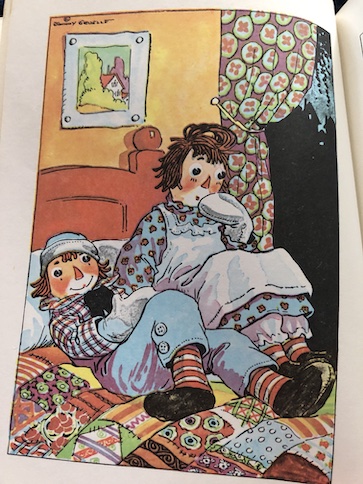
The Phantom Tollbooth

The Phantom Tollbooth by Norton Juster, 1961.

Milo is a boy who never really knows what he wants or what to do with himself.  He is always bored because he doesn’t really know the purpose or point of doing anything.  Nothing he learns in school interests him because he can’t see what he could ever do with the knowledge.  He never bothers to read the books he has, play with his toys, or learn to use his tools because he just doesn’t have the imagination to appreciate them or what he could do with them.

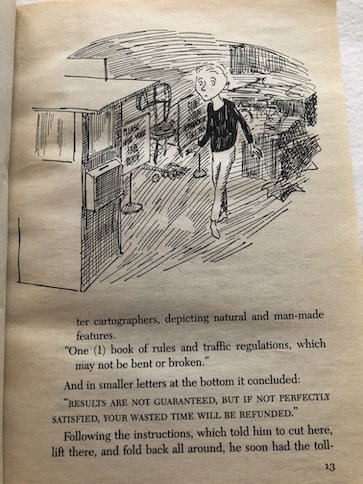
One day, when Milo gets home from school, he finds an unexpected package.  It’s not his birthday or Christmas, but the package is definitely intended for him because it has his name on it: “For Milo, who has plenty of time.”  There is a list of items contained in the package: 1 tollbooth (which must be assembled, according to the directions), 3 precautionary signs (“to be used in a precautionary fashion”), some coins for the tollbooth, a map (with no familiar places on it), and a driver’s rule book (which must be obeyed).  Interestingly, it promises that if Milo is not satisfied with his tollbooth experience, his time will be refunded.  Since Milo doesn’t think he has anything else to do anyway, he decides that he might as well unwrap the tollbooth and set it up. 

Although Milo thinks that the map is purely fictional and that the tollbooth is just a playset, he decides that he might as well select a destination on it for his trip through the tollbooth.  He closes his eyes, puts a finger on the map, and selects a place called “Dictionopolis.” He gets in the toy car, puts a coin in the tollbooth, and goes through it.

To his surprise, Milo suddenly finds himself driving down a real highway, no longer in his own apartment.  He sees a sign pointing the way to a place called Expectations, and he stops to ask a man about it.  At first, he thinks he’s talking to a weather man, but the man corrects him, saying that he’s really the “Whether man.”  Part of his job is to hurry people along, even if they have no expectations.  Nothing the Whether Man says to Milo makes sense to him, so he decides that he’d better just get going.

As Milo drives down the highway, he gets bored and starts daydreaming.  As his mind wanders, the scenery gets duller and grayer, the car slows down, and eventually, the car stops and won’t move further.  Milo looks around and wonders where he is.  It turns out that he’s in the Doldrums, the home of the Lethargarians.  They tell him that thinking isn’t allowed there.  Milo says that’s a dumb rule because everybody thinks.  The Lethargarians say that they never think and Milo must not have thought either because, if he had, he wouldn’t be there.  People usually get to the Doldrums because they’re not thinking, and once they’re there, nobody is allowed to think.  They refer Milo to the rule book that came with the tollbooth.  Milo looks in the rule book and sees that is a rule.  There are also limits on laughing and smiling in the Doldrums.  Milo asks the Lethargarians what they do if they can’t think or laugh.  They say that they can do anything as long as they’re also doing nothing.  Mainly, they do things like daydreaming, napping, loafing, loitering, and wasting time.  They say it gives them a full schedule and allows them to get nothing done, which they consider an important accomplishment.  Milo asks them if that’s what everybody here does, and they say that the one person who doesn’t is the Watch Dog, who tries to make sure that nobody wastes time.

At that point, the Watch Dog shows up.  The Watch Dog looks like a dog, but his body is an alarm clock.  The Watch Dog asks Milo what he’s doing, and is alarmed when Milo says that he’s “killing time.”  It’s bad enough when people waste time, but killing it is horrible!  (The book is full of these kinds of puns. It’s just getting started.)  Milo explains how he got stuck in the Doldrums while he was on his way to Dictionopolis and asks the Watch Dog for help.  The Watch Dog explains that if he got there by not thinking, he can also get out by thinking and asks to come along because he likes car rides.  Milo agrees, and the two of them get in the car.  Milo thinks as hard as he can (which the book notes isn’t easy for Milo because he’s not used to thinking and doesn’t do it too often).  Gradually, as Milo thinks of various things, the car begins to move.  The faster Milo thinks, the faster the car goes.  Milo learns that it’s possible to accomplish a lot with just a little thought.

The Watch Dog’s name is Tock because his older brother is named Tick. However, their names are a mistake because his older brother only makes a tock sound, and Tock only makes a tick sound.  It’s a source of pain and disappointment.  Tock tells Milo about the origin of time and why Watch Dogs find it important to make sure that people use time well.  He says that time is the most valuable possession because it always keeps moving.

When they arrive at Dictionopolis, the gatekeeper won’t let them in immediately because Milo doesn’t have a reason for being there.  Nobody gets let in without a reason.  Fortunately, the gatekeeper always keeps a few spare reasons lying around, and he decides to let Milo have one.  The one he selects is “WHY NOT?”, which the gatekeeper considers a good, all-purpose reason for doing anything.  (I don’t know. I’ve heard that one followed up by an angry “I’ll tell you why not!” before.)

As readers have probably guessed, Dictionopolis is all about words. When Milo enters the city, he finds himself in the marketplace, which is called the “Word Market.”  The ruler of Dictionopolis is Azaz the Unabridged, and when Milo is welcomed to the city by the members of the king’s cabinet, they do so in multiple ways, using synonyms.  Milo asks them why they don’t just pick one word and stick with it, but they’re not interested in that.  They say that it’s not their business to make sense and that one word is as good as another, so why not use them all?  (That isn’t true, but the story tells you why not later.)  They go on to tell Milo that letters grow on trees here, and people come from all over to buy all the words they need in the Word Market in town.  Part of the cabinet’s duty is to make sure that all of the words being sold are real words and have real meanings because people would have no use for nonsense words that don’t mean anything and that nobody will understand.  The cabinet doesn’t seem to care about whether or not the words are being used in a way that makes sense as long as they’re real words. (If you’re familiar with business speak or buzzwords, you’ve probably noticed that much of it works on a similar principle.)  Putting the words into a context that makes sense isn’t their job.  (Later, you meet the person who had that job.)  However, the cabinet does advise Milo to be careful when choosing his words and to say only what he means to say.  They excuse themselves to get ready for the banquet and say that they’ll see Milo there later, although Milo doesn’t know what banquet they’re talking about.

Milo and Tock explore the Word Market.  Milo is fascinated by the variety of words available.  He doesn’t know what they all mean, but he thinks that if he can buy some, he can learn how to use them.  He chooses three words he doesn’t know: quagmire, flabbergast, and upholstery. (I’m surprised he didn’t know the last one because, surely, he has upholstered furniture in his apartment.)  Unfortunately, Milo quickly realizes that he has only one coin with him, and he’ll need that coin to get back through the tollbooth.  Eventually, he finds a stall selling individual letters for people who like to make their own words.  The stall owner gives them some free samples to taste. They taste good to Milo, and the stall owner tells them that sets of letters come with instructions.  Milo doesn’t think he’s very good at making words, but the Spelling Bee, a giant bee, begins showing him how to spell words.  However, the Humbug, a grumpy bug, tries to tell Milo not to bother learning.  The Spelling Bee tells Milo not to listen to the Humbug because he just tells tall stories and doesn’t actually know anything, not even how to spell his own name.

The Spelling Bee and the Humbug start fighting and knock over all the word stalls around them. There is a big mess, all the words get scrambled, and it takes some time before everyone sorts everything out.  By that time, the Spelling Bee is gone, and when the policeman comes, the Humbug blames everything on Milo and Tock.  At first, it seems like Milo will get off lightly because the policeman (who is also the judge) gives him the shortest “sentence” he can think of (“I am”).  Unfortunately, he’s also the jailer and takes Milo and Tock to prison for 6 million years.

In the prison, Milo and Tock meet the Which.  At first, Milo thinks that she’s a “witch”, but she says many people make that mistake.  The Which is King Azaz’s great-aunt, and her job used to be to make sure that people correctly chose which words to use and didn’t use more words than necessary. (A problem that Milo noticed in the market.)  The Which explains that she was thrown into prison because she got too carried away with her job and became too miserly with words. Word economy is good (and something I struggle with), but rather than promoting brevity, the Which started promoting silence instead,. It got so bad that people eventually stopped buying words and the market was failing, so the king had to put a stop to it.  The Which says that she understands now where she went wrong, and Milo asks her if there’s anything that he can do to help her.  The Which says that the only thing that would help her would be the return of Rhyme and Reason.  When Milo asks who they are, she tells him the story of the founding of the Kingdom of Wisdom.

Years ago, the King of Wisdom had two sons, and he was proud of both, but one of them had an obsession with words, and the other had an obsession with numbers.  The king didn’t realize how bad their conflict was growing, and it got worse over time. One day, the king found a pair of abandoned infant twins.  The twins were both girls, and the king had always wanted daughters as well as sons, so he adopted them and named them Rhyme and Reason.  Everyone loved Rhyme and Reason, and they had a talent for resolving problems and disputes. When the king died, he left his kingdom to both of his sons and left instructions for them both to look after Rhyme and Reason. The word-obsessed son, Azaz, established a capital city of his own, Dictionopolis, and the number-obsessed son, the Mathemagician, established the city of Digitopolis.  Rhyme and Reason remained in the city of Wisdom and acted as advisers to the brothers, mediating their disputes.  This system worked until the brothers got into their worst fight over whether words or numbers are most important.  They took this dispute to Rhyme and Reason, who said that both are of equal importance. This satisfied most people, but both brothers were angry because they had wanted the girls to make a definite choice between them. In their last joint act, they banished Rhyme and Reason to the Castle in the Air. Since then, there has been continued fighting between the two brothers and their respective cities, the city of Wisdom has been neglected, and there’s been no Rhyme or Reason to any of it. (Ha, ha.)

Milo says that maybe they could rescue Rhyme and Reason from the Castle in the Air. The Which says that would be difficult because there’s only one stairway to the castle, and it’s guarded by demons. Milo remembers that there is also the matter of them being stuck in prison for 6 million years. The Which says that being in prison isn’t really a problem. Although the policeman/judge/jailer likes putting people in prison, he doesn’t care much about keeping them there, so Milo and Tock can leave when they like, and he probably won’t notice. (Sounds like he’s not very good at the “jailer” part of his job.)  The Which points out a button on the wall, Milo presses it, and a door opens.

When they step outside, the king’s cabinet members come to take him to the banquet that they mentioned earlier. They have Milo and Tock step into their wagon and tell them to be quiet because “it goes without saying.” (Ha, ha.) They take Milo and Tock to a palace shaped like a book, where they meet King Azaz and join the banquet.

The banquet is a pun-filled meal where everyone has to literally eat their words and have half-baked ideas for dessert.  (Half-baked ideas look good, but you shouldn’t have too many because you can get sick of them. Tock says so.)  Nothing makes sense, and even the king realizes it, which gives Milo the opportunity to suggest bringing back Rhyme and Reason.  The king isn’t sure that’s possible, and the Humbug, of course, volunteers Milo and Tock for the job.  The joke turns out to be on him because the king volunteers the Humbug to assist Milo.  Reaching Rhyme and Reason will be a perilous journey, and possibly the most difficult part will be getting the Mathemagician to agree to let them do it.

The book is available to borrow and read for free online through Internet Archive (multiple copies). There is also a movie version of this book (mostly animated but part live action) with songs. You can see a trailer for it on YouTube.

My Reaction

The Phantom Tollbooth is a fantasy story, but like many fantasy stories, it’s also a morality story.  It’s a little like Charlie and the Chocolate Factory, which aims to correct children’s bad habits.  Milo’s boredom problems are due to his lack of thought for the things he could do and imagination to figure out how to make use of what he has.  His adventures after he goes through the Phantom Tollbooth help him to see things differently and to learn to use his mind creatively.

However, I wouldn’t say that the story is too preachy.  A couple of parts started to feel a little like a lecture, but it’s set in a fantasy land that feels a little like Alice in Wonderland.  There’s a healthy dose of nonsense that keeps things interesting and fun.  The book is peppered with puns and peopled by a fascinating variety of characters.  There’s the boy who can see through everyone and everything, who teaches Milo to look at things from an adult perspective and helps him to realize the benefit of keeping his feet on the ground (both of those are also puns). There’s the man who is the world’s shortest giant, the world’s tallest midget, the world’s thinnest fat man, and the world’s fattest thin man all at the same time.  Basically, he’s just an ordinary guy who’s noticed that people think of him in different ways when they compare him with themselves.

I was first introduced to this story when I was in elementary school, as many people were.  Our teacher read it to us and showed us the cartoon version.  Parts of songs from that version still get stuck in my head, almost 30 years later.  (“Don’t Say There’s Nothing To Do the Doldrums …”) The part of the story that stuck with me the longest was the Dodecahedron, a shape with twelve sides. If you’ve seen the twelve-sided dice used for Dungeons and Dragons and similar role-playing games, those are dodecahedrons. In the book, the Dodecahedron is talking character as well as a shape, but I remember it because our teacher gave us paper cut-outs to make our own dodecahedrons. I made two of them, and I might still have one somewhere.

Marianne Dreams

Marianne has been looking forward to her birthday because her parents have promised her that when she is ten years old, she will be old enough to have riding lessons. She and her family live in town, so she doesn’t have easy access to horses, like children in the country do. Her special birthday present is going to have her first lesson at the local riding stable. Her birthday is wonderful, and the riding lesson goes very well, even if some of the more spectacular things that she had imagined before didn’t happen. Marianne would be perfectly happy except, at the end of the lesson, she is more tired than usual and feels achy. By lunchtime, she is feeling definitely ill, and she has a fever.

Marianne’s birthday illness quickly turns into the worst illness she’s ever had. Because of her illness, Marianne has to be confined to her bed for weeks, and she loses track of time. About three weeks after her illness began, she begins to feel a little more like herself and has more awareness of time and what’s happening around her. When she was at her worst, it was hard for her to be interested in anything or focus on anything, but now, she can think clearly enough to be bored and look for something to entertain herself. Marianne’s mother allows her to look through her grandmother’s old workbox, which mostly contains old needlework tools and an array of buttons, ribbons, beads, and other odds and ends that are interesting to look through and sort.

Among the things in the workbox, Marianne finds an old pencil. She immediately likes the look of the stubby old pencil and has the sense that it would be fun to use for drawing, so she picks up her drawing book and begins to draw a picture of a house with a fence around it and some flowers. Marianne’s drawing isn’t particularly great, not as good as what she pictured in her mind’s eye when she started it, but it is the start of something very special.

Although she is starting to feel better, Marianne’s doctor tells her that she is going to miss the whole rest of this term at school. He prescribes strict bed rest for her for the next six weeks. The doctor doesn’t actually say what’s wrong with Marianne, but he tells her that if she doesn’t rest, she could harm herself in a way that would last for the whole rest of her life. Even though she’s bored and says she’d rather be harmed or permanently ill than have to spend more weeks in bed, her doctor is firm with her that this is the way things are. He’ll see that she follows his instructions and recovers whether she likes it or not. Her condition is not contagious, so she can have visitors, but she must remain in bed and rest.

Marianne is sure that these weeks of bed rest are going to be horrible and boring, but soon, something strange begins to happen. She starts having dreams about the house that she drew with that special pencil. When she finds herself in the country with the house, the house is a little misshapen, and it unnerves her. The house is located on an empty, windy prairie, and Marianne can’t even get into the house because she didn’t draw a door handle on the door or put anyone inside the house who could let her inside.

Marianne realizes that she could easily remedy these things by adding more to her drawing, so when she wakes up, she adds a knocker and handle to the door. She also draws a boy looking out one of the windows of the house. The boy seems a little sad when she draws him, but she isn’t sure how to fix his expression, so she just leaves it. Although Marianne isn’t sure whether she’ll ever dream of the house again, she does. In her next dream, the door has the knocker and handle, just like she drew, and there is a sad-looking boy at one of the windows of the house. Marianne waves to the boy and asks him to let her into the house, but he can’t. The boy is upstairs in the house, and there aren’t any stairs down to the ground floor. Marianne asks the boy how he got up there without any stairs, but he says he doesn’t know. Marianne insists that she needs to get into the house, and the boy says that he needs to get out. Marianne gets angry at the boy and the situation, which seems impossible. However, this is not the end of the dreams, and the boy isn’t just a figment of her imagination.

Marianne’s mother hires a temporary governess to tutor Marianne at home so she doesn’t fall too far behind in school. Marianne doesn’t like the idea of the governess at first, but Miss Chesterfield turns out to be friendly, and her visits and lessons add variety to Marianne’s days. When Marianne asks Miss Chesterfield about her career as a governess, she learns that, unlike governesses in books, Miss Chesterfield doesn’t live with her clients. Instead, she tutors different children in their homes, visiting each for a couple hours at a time. All of the children she tutors are children who are behind in their studies or who are studying special subjects that aren’t covered at their school or whose circumstances prevent them for going to school for a time, like Marianne. One of the other children being tutored by Miss Chesterfield is a boy named Mark, who has been left partially paralyzed from a severe illness and can’t walk. Marianne asks Miss Chesterfield if Mark will be able to walk again someday, and she says that it’s likely he will if he takes care of himself in the next couple of months and does what his doctor says.

However, as with Marianne, obeying the doctor’s orders isn’t easy for Mark. While Marianne wishes that she could just be up and about instead of resting like she should, Mark is just the opposite. He loves being at home with his books, and he has trouble pushing himself to start getting up and moving again, which is what his condition really requires. Mark needs to do physical therapy to strengthen his body and retrain his muscles, but it’s difficult and painful. Marianne is sympathetic to Mark because she knows what it’s like to be ordered to do something she doesn’t want to do even though it’s for her own good. She wishes that the two of them could switch places for a time so he could do at least some of her bed resting for her, and she could have the chance to get up and move around. Miss Chesterfield says that she thinks the two of them are better off being themselves and doing what each of them needs to do.

Marianne continues to feel the urge to draw in her spare time. She discovers that she’s unable to erase anything that she’s drawn, but she can continue to add to the picture. She adds more to the background so the house won’t seem to be in such an empty void, and on the opposite page in her drawing book, she draws the interior of the house, adding the stairs that the boy said were missing. This time, when Marianne dreams of the house, she finds herself in the interior, which is mostly empty because she hasn’t drawn furniture yet. She explores the house and finds the boy sitting on a window seat, looking outside, like he did before. The boy has noticed that the world outside the house has changed since Marianne drew hills and a tree. The two of them talk about their situation, trying to understand how they came to be in the house, and Marianne tells the boy that, now that there are stairs, he can go outside. The boy tells her that he still can’t because he can’t walk. He explains to Marianne about how he’s been ill for a long time, and he has special exercises he’s supposed to do to help his muscles, but it still isn’t definite whether he’ll be able to walk again or not. That’s when Marianne realizes that she’s talking to Mark, the same Mark that Miss Chesterfield told her about.

The two children could be dream companions for each other, but Marianne becomes more temperamental the longer she’s cooped up. One day, in a fit of anger because Mark made Miss Chesterfield late to see her and ruined her special surprise present for Miss Chesterfield’s birthday, Marianne turns the house in her drawing into a prison and the rocks outside into monsters that watch the house. Marianne thinks it would be a fitting punishment for Mark to be a prisoner in their dream house, but the problem with that is that Marianne still goes to the house when she’s asleep, too. Whenever she’s there, she’s also in a scary prison, surrounded by rock monsters.

It takes Marianne an embarrassingly long time to realize that everything she adds to her drawing changes the environment of the dreams that both she and Mark share, and even when she realizes that’s the case, Mark has a difficult time accepting it. It seems like, when the kids are in the dream world, they have some trouble remembering the waking world and making connections between the two, although Marianne has more memory of her waking life than Mark does, probably because Mark is more seriously ill. While Marianne has control of the special pencil and more ability to alter the world of their dreams, she can’t change everything, and the two children will have to work together to overcome their obstacles and escape the house. The house is useful for them during their recovery, but they quickly realize that it’s also a dangerous place, and they can’t stay there forever. Although Marianne didn’t draw a way for the rocks with the eyes to move, they are moving, and they’re getting closer all the time.

The book is available to borrow and read for free online through Internet Archive (multiple copies). In 1988, the story was made into a movie called Paperhouse. Paperhouse is a much darker version of the original story, though. There was a much earlier television mini-series from 1972 based on the book called Escape Into Night, which was much more faithful to the original story, although in that version, Marianne had a broken leg from a riding accident instead of being ill. All six episodes of Escape Into Night are currently on YouTube. I don’t know of any other way to watch it if you live in the US. There are dvds available on Amazon, but they’re region coded. For sci-fi fans, I swear that the rock monsters in Escape Into Night also sound like Daleks from the original Doctor Who. The book was originally published in Britain, and the movie versions are also British. There is also a sequel to this book called Marianne and Mark, where the two children from this book meet as teenagers in real life instead of in the dream world.

My Reaction and Spoilers

To begin with, I’d like to explain that, while the concept of a drawing coming to life somewhat reminds me of Harold and the Purple Crayon, this is definitely a more serious book with greater depth. The children in the story are dealing with some serious and frightening problems, both in the real world and the dream world.

I love the way that the pictures in the book alternate between Marianne’s drawings and the children’s “real” experiences. First, we get to see what Marianne draws, and then, we get to see how her drawing comes to life in the children’s dreams. Marianne’s drawings are child-like, with crooked houses, misplaced windows, and stick figures. The dream drawings are as misshapen as Marianne’s drawings, but at the same time, they are more three-dimensional, as the children perceive them when they’re inside them in their dreams.

The book never explains exactly why Marianne is sick or what might happen to her if she doesn’t rest, although I have a couple of ideas. There are illnesses which can leave people severely weakened for long periods of time, and they have to rest or suffer lasting organ damage. When my aunt was young, she was extremely ill with valley fever. That’s probably not the illness Marianne has because valley fever comes from a fungus found in the soil in certain parts of the Americas, but I don’t think it’s found where Marianne lives in Britain. I mention it because I think that it’s similar in severity to Marianne’s illness. Most people who get valley fever don’t have it severely. In fact, most long-term residents of the area where I live have had it at some point in their lives, and it’s often mistaken for a mild flu. However, once in a while, someone has a much more serious case, like my aunt did. My aunt had to spend weeks at home, resting, and a tutor came to the house to help her with her schoolwork until she recovered enough to return to school. Even then, she had certain restrictions. Valley fever is hard on the lungs, so she couldn’t over-exert herself. For a period after she returned to school, she still tired quickly from ordinary activities, she could not take physical education classes, and she even had to use the elevator at her school (which was reserved only for those who needed it) instead of taking the stairs to classes like most of the other students. If my aunt had pushed herself too hard before she had fully built back her strength and stamina, she might have damaged her lungs permanently. I think that the doctor in this book is warning Marianne that her condition is similar, that she might cause herself some form of lasting organ damage if she doesn’t rest and let herself fully recover.

In Marianne’s case, I suspect that Marianne’s illness could potentially damage her heart because her doctor is concerned that she not get angry or over-excited, but that’s just a guess. Illnesses like that are relatively uncommon, but they do happen in real life. Depending on the condition she has, it’s possible that Marianne’s extended bed rest might also be shortened by more modern treatments, if this story happened during the 21st century. It’s difficult to say without knowing what her ailment is, but I think it’s worth pointing out that this story was written during the 1950s, which is also coincidentally the time period when my aunt had her illness in her youth.

In the movie version of the story, Paperhouse, they say that Marianne had glandular fever, but since the book never specifies, some readers have speculated that she might have had rheumatic fever, since the symptoms fit the description of her illness. I tend to think rheumatic fever is more likely because it can potentially cause a risk to the heart, and that seems to be the concern in the book, the reason why Marianne has to rest and be careful to avoid long-term damage to herself until she is fully healed. In Paperhouse, Mark is described as having muscular dystrophy, but the book actually says that Mark has polio. The first polio vaccine was developed by Jonas Salk in the early 1950s, although it took a few years for it to come into widespread use, so it’s plausible that Mark could have caught the disease before he had a chance to be vaccinated.

My parents were both in elementary school during the 1950s, and they remember getting their polio vaccinations and the boosters that they gave to kids in an edible form on sugar cubes. Other people who were young around that time period may have similar memories. Although I never saw a child or young person with polio when I was a kid, probably because all the kids I knew were vaccinated, my parents say that it was a real menace when they were young, and the serious consequences of the disease were a real fear. While my mother was still young, her aunt contracted polio as an adult. Her aunt survived having polio, but there were lasting effects. Even people who recover their strength after having polio while young or relatively young can have it come back on them when they’re older as post-polio syndrome. My mother remembers her aunt before she became ill, but by the time I met my great-aunt, she was an elderly lady in a wheelchair because of the condition. That’s part of the reason why my family believes in the benefit of vaccines in general. We’ve noticed definite improvements between generations because of them.
The characters in the story experience some personal growth from their ordeals. I liked it that, in the beginning of the story, Marianne considers some of the old-fashioned stories she’s read where girls suffer from severe illnesses or ailments that keep them in bed for long period of time. It is a common trope of 19th century and early 20th century books that characters’ lives and personalities are changed by illness because dealing with the illness and the restrictions imposed on them because of it teaches them patience and understanding. (See What Katy Did in the Carr Family series from the late 19th century for an example.) Marianne wonders if she’ll experience the same type of transformation or if she’ll still be the same Marianne she always was after her ordeal is over. Both Marianne and Mark have things they need to learn in order to overcome their respective problems. Miss Chesterfield’s belief that it’s best for them both to learn to manage their problems rather than envying each other is the correct one.

Marianne has to learn about emotional control. During her period of forced rest, Marianne’s temper gets worse because she’s frustrated with her situation, and her doctor warns her that she’s going to have to learn to keep calm because fits of temper are as bad for her health as physical over-exertion. Marianne needs to learn to relax, to not try to push herself or situations to move faster than they need to go, and to keep her temper even when she’s frustrated. When she realizes that the things she draws on paper with the special pencil have real consequences for Mark, who is also struggling through his illness, Marianne also becomes more compassionate and considerate, trying to find creative ways to help Mark through her drawings. It takes some trial and error, but Marianne does become a more thoughtful person. When it’s finally time for Marianne to get out of bed and start to strengthen herself again, she experiences some of what Mark has been struggling with, and it increases her understanding of his situation.

Meanwhile, Mark has to learn to push himself a little harder and to persevere even in the face of hardship. Miss Chesterfield has noticed that, while Mark will work and study hard at things he likes or things that are easy for him, he has a tendency to give up too soon or only make half-hearted efforts at things that are difficult or don’t come naturally to him. While his body is getting the the medical attention it needs, his spirit needs some stirring so he can find the inner strength to keep going with his efforts to restore and improve his physical health. He explains to Marianne how he feels, being physically weak and dealing with the uncertainty of whether or not the exercises he’s been given to do are even going to make a real difference or not. Because his condition is serious, even things that his doctor says are likely to help aren’t completely guaranteed to help. These feelings of uncertainty are a heavy burden for Mark to bear and another obstacle that he has to overcome. He finds it hard to continue making an effort when he knows that it might not make a difference in the long run. He needs to remind himself that, while trying his best may not be enough to help him walk again, doing nothing at all guarantees that he will lose that ability. A chance at improvement is better than no chance at all. Marianne provides support and encouragement for Mark, and seeing the results they experience from their efforts in the dream world encourages the children to do what they need to do in the waking world.

Although the book has fantasy themes, I thought that the descriptions of the children’s struggles in the real world and Marianne’s feelings about her illness were very realistic. Mark and Marianne have to use some different tactics when battling their illnesses because they have different problems. I think the book makes a good point that what’s necessary for one person’s situation isn’t always the same for another’s. Some people need to push themselves a little harder and tackle problems head-on while others need to develop a little more creativity and patience to work around their problems. In the end, Marianne and Mark do both. The children are an inspiration to each other, helping each other every step of the way.

A Pattern of Roses

Tim Ingram has been feeling depressed since his parents decided to move from London to an old house in the country that they’re fixing up. It’s hard for him being separated from his friends and living in this overly-quiet place, where it seems like nothing ever happens, but the truth is that he was depressed even before his family moved. A large part of Tim’s problem is not knowing what he wants out of life. He works hard in school to get good grades, and his school has a reputation for getting its students into good universities, but it all seems so futile because Tim doesn’t know what he really wants to study or what he’ll do when he gets out of school. His father quit school early and went to work, working his way up the ladder in an advertising firm and becoming monetarily successful. However, Tim doesn’t feel like he has either the wit or self-confidence for starting off from practically nothing and working his way up in a direction he’s not even sure he wants to go. His father’s plans and suggestions for the future don’t excite him or make him happy. They actually make him feel more stressed and depressed when he thinks about them. His father is in a position to just give him a job with his company, so Tim does have a guaranteed job if he can’t think of anything else, but advertising doesn’t appeal to Tim. He’s not sure what does appeal to him. He fears and dreads the future, specifically his own future. He doesn’t know what to do with himself, and in this new place, it seems like there isn’t a lot he can do.

Tim has also been arguing with his parents, discovering that he has different interests and priorities in life than they do. While they’re enthusiastic about expanding onto this country house with a new and stylish modern wing, Tim prefers the older part of the house and its simpler style. He thinks the modern additions his parents made look ugly and out-of-place, ruining the natural beauty of the countryside. His parents feel like he’s unappreciative of their standards and the sort of lifestyle they’ve worked hard to build, and his mother even goes so far as to call him “perverse and awkward.” He kind of feels that way, too. Tim often feels like he’s a nobody, not very outstanding at anything. His ambitious parents are disappointed in him because they’ve invested so much in his education to show him off as another one of their achievements in life, and he doesn’t think he’s much to show off. He’s even a little disappointed with himself because, not only does he not seem to live up to his parents’ expectations, he doesn’t even have it in him to stand out as a rebel or a troublemaker, like some of his friends. He’s not an aggressive person, and it’s just not his nature to fight or get into trouble, and that makes him feel like even more of a nobody. If he neither excels at meeting people’s expectations or at deliberately flouting them, what is he? Who is he? Where does he fit in? With all of this, Tim hasn’t been feeling well, and he fakes being sicker than he is so he doesn’t have to get out of bed and deal with any of it. Since he’s been unwell, he’s also excused from school until after Christmas, leaving him with nothing to do in this countryside house but lie in bed and think about all the things that are worrying him.

Then, one day, the builder who’s been working on their house finds an old tin box hidden in the chimney of the room that Tim has chosen for his bedroom. The box catches Tim’s attention. It looks like a very old biscuit (meaning cookie, this book is British) tin decorated with a faded pattern of flowers. The builder opens the box and is disappointed to see that it just contains papers, not anything that looks really valuable. However, Tim is curious and insists that he wants to see the papers.

The papers are drawings, quite old and done in black crayon. Most of them are landscapes and buildings, but there is also a girl, who is labeled “Netty.” Netty’s name is written in a heart, so the artist must have loved her. The date on one of the drawings is February 17, 1910 (the story seems to be contemporary with the time when it was written in the early 1970s because Tim thinks that was 60 years ago), and to Tim’s surprise, the author signed with his initials: T.R.I. Tim’s full name is Timothy Reed Ingram. Tim is intrigued that the artist who lived so long ago had the same initials and apparently lived in his room.

The builder, called Jim, asks Tim if he likes to draw or knows anything about art. Tim gets good grades in art, but he’s not very self-confident about his abilities. Still, he knows enough to tell that the artist wasn’t particularly great at his art. There are places where he got the proportions of his drawings wrong, but Tim is impressed that they convey a lot of feeling. Even though the drawing of Netty isn’t perfect, Tim feels like he can tell what kind of girl she was. She looks like she’s in her early teens and has a kind of proud, somewhat naughty or daring look. Tim asks the builder if he knows anything about the artist or the people who lived in the house back in the 1910s. The builder says that was before his time, but he thinks that he remembers hearing that the family name was Inskip, and he says that he could ask his father if he knows more. Tim wonders why the drawings were hidden in the chimney and begins to imagine what the first T.R.I was like, picturing a boy close to his own age.

Tim is surprised at how real the boy he imagines seems because he’s often found it difficult to imagine old people as once having been young. He’s seen old men and known that they were part of the generation that fought in WWI but is unable to picture them as once having been soldiers. In fact, he knows that his own father flew a Spitfire during WWII, but even though he knows it happened, he has trouble picturing that of the middle-aged advertising manager his father has become. Yet, somehow, T.R.I. seems incredibly real to him, someone he can connect with, even more so than his own father. Details of this past boy’s life flash through Tim’s head without him knowing quite where they came from. However, Netty seems even more real to Tim because of her picture.

When Tim’s mother makes him get out of bed and go visit the local vicar to get a copy of the parish magazine, Tim has a strange vision of the boy artist he imagines as being named Tom Inskip passing him in the lane. It’s so real that Tim feels like Tom is actually there. As he pauses to look around the churchyard, he spots some beautiful purple roses by a gravestone. Taking a closer look, he sees that the grave has the initials T.R.I., a birth date of March 1894, and a death date of February 18, 1910. Tim is shocked to realize that the artist was not only a little less than 16 years old when he died, just a little younger than Tim is now, but that he also died the day after he drew that last picture. It seems like the boy’s death was sudden and unexpected, more like an accident than a long illness.

Tim doesn’t meet the vicar, but the vicar’s daughter, Rebecca, spots him in the churchyard and asks him if he’s all right. Tim just says that he’s there to get a parish magazine. Rebecca isn’t too cheerful or friendly, and she just gives him one and sends him on his way. Tim later learns that Rebecca is the youngest of the vicar’s children and the only one still in school. Her older siblings are all grown up and have jobs working for good causes and charity organizations.

Tim talks to Jim the builder about the grave he saw, and Jim is interested. He suggests that, since T.R.I. is buried in the churchyard, there will be church records about who he was and how he died. Tim has another vision of the boy, and the boy says, “Find out. But be careful it doesn’t happen to you.”

Tim returns to the vicarage and talks to Rebecca about T.R.I. Rebecca says that she doesn’t believe in ghosts and that she thinks the visions he’s had are just his imagination. However, Tim’s guess that the artist’s first name was Tom turns out to be correct. His full name was Thomas Robert Inskip. The records don’t say how he died, but Rebecca suggests that Tim ask an old local man called “Holy Moses.” The old man says that he remembers Tom Inskip but he doesn’t know what happened to him because he left the village to work somewhere else and didn’t come back until after Tom was dead. When Moses shows them an old photograph of all the children at the local school, Tim recognizes Tom instantly as the boy from his visions and strangely even knows the name of Tom’s friend, Arnold, standing next to him in the photograph, without being told.

From this point forward in the story, scenes with Tom alternate with scenes with Tim. Tom’s scenes start with the day the photograph was taken, when Tom was eleven years old. It was also the day that Tom first met the new vicar of the parish, Reverend Bellinger, a fire-and-brimstone kind of preacher, very different from the gentle man who was the last vicar. Like Tim, Tom was bright, imaginative, and artistic, but he was not much of a worrier. Tom fails to impress the new vicar because he is not very good with religious knowledge and often doesn’t pay attention. Tom loves to draw, but after he gets out of school and starts working, he finds that he doesn’t have time anymore. The vicar’s daughter, however, is kind and encourages him to draw because it’s a talent from God and must be used. People often underestimate her and don’t appreciate her because she has a disability, so she understands what it’s like not to have the opportunity to use and develop her talents to the fullest. It’s only sad that a tragic accident cuts Tom’s life short before they can see what he might have developed into, although when Tim and Rebecca manage to contact the people who knew and remember Tom best, one of them points out that, if Tom hadn’t died when he did, he might have been sent off to fight and die with the other young men during WWI, and with his gentle soul, he might have suffered more from the war than he did from the accident that took his life, when died young in an act of self-sacrifice.

Tim’s scenes involve his parents and school discussing his future, asking for little input from him, not caring about how he feels or what he wants. Tim actually does love art, and his art teacher thinks he should go further with it, but his teacher realistically acknowledges that, with Tim’s good grades in his other classes, his family and the school will want to push him into more lucrative and higher-status fields. But, does Tim really care about money and status as much as his parents? Is that really what he wants?

Gradually, Tim begins to consider the idea of the legacies people leave behind. Few living people remember that there was once a boy named Tom Inskip who died young, and after those people are gone, no one will remember. It occurs to Tim that few people would likely remember either him or his father as advertising workers. If all you care about is just getting money to afford the good things in life, any job could do, and there are many well-paying jobs that make little lasting or meaningful impact on the world. On the other hand, if what you want is to leave a lasting and meaningful legacy, you have to think a little deeper and maybe sacrifice some material gain. Money comes, and money goes, and one coin or bill looks like another, but what lasts as long and has as much individual character as a collection of imperfect but evocative drawings hidden away in an old tin box?

The question of what Tim wants to do with his life becomes the question of what Tim wants to leave as his life’s legacy. The quietness of the country, rather than being the torture it initially seemed, gives Tim a chance to think and really consider what he wants. Through his search for Tom’s past and consideration of Tom’s legacy, Tim finds a new vision of his own future that makes him more hopeful instead of more frightened and that may lead him to find what one of Tom’s friends called Tom’s “perfect spiritual grace.”

The book is available to borrow and read for free online through Internet Archive (multiple copies). Some US versions of the book are titled So Once Was I.

That alternate title is fitting for the theme of the story. Tom was once a living boy with choices to make in his future, much like Tim is now. That phrase also appears in the story as part of an epitaph from another tombstone, which I’ve also seen elsewhere. That same epitaph has been used in different forms in real life. It refers to the inevitability of human mortality – all those living will someday die, like every other generation before. As one of my old teachers used to say, “Nobody gets out of life alive.” But, I would also like to point out that the sentiment also refers to growing up. Every adult used to be young (although Tim has trouble picturing it), and every child will someday be an adult (if they live to grow up – Tom was unfortunate). Every person in a profession of any kind was once a student and a beginner, struggling to learn and find or make their place in the world, and every student will one day find or make some place for themselves and try to make a mark on the world. Change is inevitable. Time passes, people grow and change, and everyone moves on in one way or another. Tim won’t always be a student with his parents controlling his education. He will eventually grow up, graduate, and become an adult. That part is inevitable. What else he becomes is up to him and whatever opportunities he seeks and finds for himself. His future legacy is still in the making.

There is also a made-for-television movie version that is available to rent cheaply online through Vimeo. The movie version is notable for being Helena Bonham Carter’s first movie role. She played young Netty.

I found this story very sad, particularly Tom’s death, trying in vain to rescue beloved hunting dogs but drowning along with them in an icy lake when they all fell in. The death of the dogs was as traumatic as Tom’s, and it is described in awful detail. I also hated a part earlier in the story, where one of the dogs kills a pet cat. I love animals, and that was hard to take. It’s all a tragedy, but Tim’s story has a more hopeful ending. Besides leaving behind a box full of drawings, Tom’s effect on Tim’s life becomes a part of his legacy. Even though they lived in different periods of time, Tom and his life story helps Tim, who has been going through a personal crisis, to realize what’s really important and what he wants out of life.

Through much of the book, both Tim and Rebecca are in a similar situation when it comes to their future lives and their family’s expectations for them. As Tim gets to know Rebecca, he discovers that she has hidden depths and is inwardly quite sensitive. She often uses a blunt and abrasive manner to keep people at a distance and hide how sensitive she really is. Like Tim, she is also unimpressed by the money and business-oriented priorities of the modern world and Tim’s parents, preferring things with an old-fashioned, natural beauty – things that, sadly, are often cleared away by modern people in the name of money, business, and being modern. Yet, Rebecca also doesn’t feel like she fits with the lives that her family lives. She doesn’t have the patience to deal with the people her family tries to help, many of whom are nasty and ungrateful instead of kind and appreciative of the help they get, and she feels like her parents don’t have time for her because they spend all of their time helping everyone else. Rebecca is considering a career in social work, but it’s mostly because it’s what her parents want and expect of her. As they compare their family lives, Tim and Rebecca both realize that neither of them quite fits their families’ lifestyles and expectations. They both feel pressured. Their families are also extremes: extreme business and high-achievement vs. extreme charity. Tim and Rebecca are looking for a happy medium that neither one of them knows how to achieve. They feel overwhelmed by a world full of choices, their parents’ expectations, and their own uncertainty about what path to choose.

It occurs to them that a boy like Tom in the 1910s would have limited choices in life and expectations from his family and community. Tom died young, but if he hadn’t, he probably would have been expected to do what other young men in his community did, which was mostly farming or joining the army. In some ways, Rebecca thinks life was probably much easier for those who had no choices than it is for modern people with many more choices and little to no guidance about how to use them. Tim and Rebecca aren’t really bound to their parents expectations because there is less social stigma with being different in their time, but being young, inexperienced, and uncertain of their options in life, they aren’t sure what to do with their relative freedom. They feel trapped, but not in quite the same way as each other and in a different way from people in the past.

Perhaps all people have limits and obstacles no matter when or where they live, and nobody is ever fully in control of their destiny because they are subject to limits in knowledge, ability, and available options. Maybe not everybody is even really suited to where they end up in life. They learn that the man who was the vicar in Tom’s time was more of a bully than a loving and charitable man. Tim’s art teacher comments that he used to work in a job similar to Tim’s father before he found his calling teaching art. Having followed two different professions in his life and seen the people who thrive in each, he thinks that Tim’s personality fits better in the art world than the business world, but he can also see that Tim is going to have to learn to fight and stand up for himself to get where he really needs to be.

But, happiness in life depends on more than fighting or earning money. May, the vicar’s daughter, who is still alive and has lived a happier life than anyone expected after the death of her father, says that one of Tom’s greatest gifts was “perfect spiritual grace.” She explains that Tom never asked a lot out of life and was satisfied with what he had. His life was tragically short, but he enjoyed it to the fullest as long as he lived. Tim thinks that Tom might have gotten less satisfied with his limited prospects in life if he had lived longer, but it’s difficult to say. However, May’s description makes Tim realize that he wants that same sense of “perfect spiritual grace”, making the most of the opportunities open to him and being satisfied that he pursued those opportunities to the best of his ability.

Life has a way of taking many people in directions that they never expected. People often don’t know what they want to do with their lives when they’re young, some of us still question our career choices when we’re older, and many of us end up doing things we didn’t expect or entering fields we didn’t originally study. Tim’s new home and new acquaintances and the inspiration that he receives from Tom’s life story cause him to consider different directions that his life might take. Tim finds a job in the country as the local blacksmith’s assistant. Blacksmithing appeals to Tim’s creative side, and there is enough demand for specially-crafted decorative metal objects that Tim is confident that he can build his own business around it. He’s confident enough about it that he finds the ability to stand up to his parents and insist on the future he really wants. He probably won’t make as much money at it as his father does in his advertising firm, but he’ll be independent and creating real things that will leave the lasting legacy that he now craves. He hopes that, along the way, he’ll also find the “perfect spiritual grace” that Tom had.

Tim also comes to realize that the company that his father built was his father’s act of creation, and that’s why he takes so much pride in it, wanting Tim to continue it as his legacy. However, Tim also realizes that what his father did with his life was his decision, done for his own reasons and his own sense of fulfillment, and he doesn’t need to stifle his own creative urges to validate his father. Tim is adamant that he wants to create something of his own, to know the satisfaction of that kind of creation for himself. His parents are angry with him, seeing his decision as throwing away all that they’ve given him and all they say that they’ve sacrificed for. Still, Tim points out that the lifestyle that his parents chose was their choice, not his. He didn’t ask them to do any of it, they did it because it was what they wanted to do, and he wants the right to make his own choices. It affects their relationship, but Tim already had the feeling that their relationship was strained because of his parents’ expectations for his future, which were making him unhappy. When they argue about it, it becomes apparent that his parents have been emotionally manipulative, and having a say in his own future isn’t an unreasonable thing for Tim to ask for, even though his parents claim that it is. His parents really have been selfish and even neurotic, planning to use Tim as something to show off, ultimately depending on him to make themselves feel successful and fulfilled and validating their life choices. They make it clear to him that their support for him hinges on him doing exactly what they want him to do. Their love is conditional and transactional. In an odd way, it feels like a relief to Tim to have it all out in the open and to take control of his destiny in spite of their opposition. Whether or not his parents will eventually accept Tim’s decision and independence or whether they will remain estranged is unknown.

I don’t think I’d read this book again because of the sad and stressful parts, but it does offer a lot to think about. I’d also like to point out that this story is not for young kids because of the subject matter, and there are also instances of smoking and underage drinking.

Mary Poppins in the Park

Mary Poppins in the Park by P. L. Travers, 1952.

This Mary Poppins book is supposed to take place during the first three books in the series. It’s a collection of incidents that take place in the park. Each chapter is a short story, and each of the stories can stand alone.

I thought that the stories were fun, but there are a few instances of racial language that I didn’t like in the original version of the book. At various points throughout the original version of book, Mary Poppins chides the children for things they’re doing by calling them “Blackamoors”, cannibals on an island, or “Hottentots. ” In other words, she’s implying that they’re being “savages.” I know that notions of “savage natives” appear in other old children’s books, but I don’t think it’s a good idea to give modern children these ideas, and I don’t like it that Mary Poppins uses racial words as insults for the children in the story. Fortunately, later printings of this book rewrote these scenes to remove inappropriate racial language.

When I was writing this review, I told my brother the plot of one of the stories in the book,Lucky Thursday, and we had a good laugh over it. It was a pretty funny story to read. My brother asked whether the story was supposed to have a moral or teach children anything. I thought about it, and I suppose that part of the moral could be “Be careful what you wish for”, but in the end, I don’t think any real lessons were learned.

The book is available to borrow and read for free online through Internet Archive (multiple copies).

Stories in the Book:

Every Goose a Swan – When everyone seems to be daydreaming and pretending that they’re someone they’re not, Mary Poppins tells the children a story about a vain goose girl and the others around her who have grand ideas about who they think they really are. When someone points out the realities of being the people they like to think they are, they all decide that maybe it’s better to just be themselves.

Faithful Friends – Miss Andrews, a neighbor of the Banks families, has been advised to go traveling for the sake of her health by her doctor. Before going away, she asks the Banks family to look after her “treasures” during her absence. Mrs. Banks puts them in the nursery because she knows that Mary Poppins will look after them, although Mary Poppins is a little put out by this extra duty. The “treasures” turn out to be a collection of random knickknacks, battered and incomplete. The children are particularly interested in a pair of hunters with lion friends, but one of them is mostly missing, and they think that the lion missing his hunter looks rather sad. By coincidence (apparently), they meet a couple of policemen who are reminiscent of the hunters. One of them used to live near a jungle but had to return home because he lost a foot, like the knickknack hunter. He’s been sad since he got back because he says he’s missing a friend. However, he gets his friend back when a loose lion suddenly appears in the park. When children get home, the missing hunter is back in the knickknack, and the lion looks happy.

Lucky Thursday – Michael is unhappy because the other children got to go to the park while he had to stay home with a cold. The only interesting thing that happens is that he sees a strange cat out the window. Michael goes to bed in a bad mood, but the next day, all sorts of lucky things begin happening. However, it turns out that it’s not quite as lucky as he thinks. First, he doesn’t take care of some of the nice things he receives and loses them. Then, the mysterious cat leads him on what seems like a magical journey from the park to a castle of cats, and he is told that everything he’s received has been because he wished on the Cat Star the night before. Part of what he wished was just disgruntled grumblings, though, and part of the cats’ idea of fun and games is to make Michael answer riddles. If Michael answers the riddles correctly, he’ll get to marry one of the cat princesses, and if he doesn’t, he’ll have to work in the kitchen of the castle with other children who made foolish wishes. Michael does answer the riddles correctly, but he doesn’t want to marry a cat, and he has a desperate struggle to escape from the castle of the cats. He only manages to escape when he blows Mary Poppins’s whistle.

The Children in the Story – The park keeper isn’t very happy about the fair set up near the park because it always leaves such a mess. Mary Poppins and the children are also in the park, and Jane is reading aloud from The Silver Fairy Book. She and Michael start talking about the princes in one of their favorite stories. Then, the three princes come out of the story to see Jane and Michael. The princes say that Jane and Michael are the children in the stories they read, and they’ve entered their own book to visit them. They say that they’ve visited generations of other children before.

The princes have brought their unicorn with them, and when adults around them start noticing that there’s suddenly a real unicorn in the park, they start panicking and arguing among themselves about whether the unicorn belongs in the zoo, in a museum, or as a sideshow at the fair. The adults seem to feel like the princes and unicorn are vaguely familiar, but they can’t seem to remember why. Most adults forget about the princes when they get older, but not all. Bert the matchman remembers, and it turns out that Mary Poppins has also been nanny to the princes.

The Park in the Park – The children are playing in the park on a hot day. Jane is making little figures out of plasticine and a little park for them all. Michael is hungry, and the baker figure comes to life and gives him pie. The children get to know the other figures, and Jane is amazed that the characters have lives that she didn’t create for them. The figures don’t seem to remember that Jane made their little world, and Jane and Michael are astonished to realize that they have now become child-size in the little park she created.

Hallowe’en – On Halloween, as the children are heading home with Mary Poppins with nuts and toffee apples, they meet the strange Mrs. Corey and her tall daughters. The children are told to be careful of stepping on shadows and that they should take care of their own shadows so they don’t run away. Mary Poppins hurries the children home and to bed, but the children find leaves that seem to be invitations to some kind of party. The children look outside and see shadows without people in the garden. The children follow the shadows, including their own, to the park. There, they see the shadows of everyone they know and even nursery rhyme characters. Mrs. Corey, her daughters, and Mary Poppins are there, and they explain that it’s the night before Mary Poppins’s birthday, and that’s what the celebration is about. They all dance with the shadows until Mrs. Boom arrives, upset, because her husband is distressed that his shadow is missing. Soon, other people also arrive to reclaim their shadows.

Mary Poppins Opens the Door

Mary Poppins Opens the Door by P. L. Travers, 1943.

This Mary Poppins book was written during World War II, and the author has an acknowledgement in the first chapter that things have changed because of the war. Like other Mary Poppins books, each chapter is its own short story, and the first one takes places on Guy Fawkes Day. A note at the beginning explains what Guy Fawkes Day is, and it also mentions that people haven’t celebrated it since the war began. However, the author says that she is sure that the situation is only temporary and that people will celebrate it once again after the war is over.

Sadly, people reading older versions of Mary Poppins books also have to be warned about the racial language. The stories are magical, but at the same time, one of the most grating things about the original printing of this book is that characters have a tendency to use racial language or racial terms as insults. When characters, even Mary Poppins, are irritated with each other, they’ll call people things like “Hottentot“, “black heathen”, “Blackamoor“, and similar things, implying that these people are behaving like “savages.” Some of the words the books use would be considered offensive by themselves, but it’s worse when they’re specifically used as insults. These incidents don’t take place in every story, but they happen throughout the original printing of this book, and they’re also found in other old Mary Poppins books. On a somewhat lighter note, I liked the character of Mrs. Clump, even though she’s an antagonist in one of the stories, because she used “vampire” and “pirate” as insults. If someone is going to use insults, I like them imaginative and funny like that. Fortunately, later reprintings of this book revised or removed the inappropriate racial language, so some people who grew up with the revised versions may not have even been aware that they were ever there.

This is the third time that Mary Poppins returns to the Banks household to be the children’s nanny. In the previous two books in the series, she came suddenly and left suddenly, without warning. Mrs. Banks finds it upsetting that Mary Poppins comes and goes so unexpectedly because she never knows if she can count on her to be with the children or if she will disappear suddenly. All the same, Mrs. Banks is always grateful when Mary Poppins comes because she’s so good at putting the household in order.

The book is available to borrow and read for free online through Internet Archive (multiple copies).

Stories in the Book:

The Fifth of November – Mr. Banks is in a bad mood and declares that he won’t be home for dinner that night, upsetting his wife and children because it’s Guy Fawkes Day, and the family wants him to help set off fireworks. He won’t even shake hands with the chimney sweep, even though that’s supposed to be good luck. Part of the trouble is that the family is missing Mary Poppins, and they haven’t found anyone to replace her, leaving the house in disorder. Mrs. Banks considers hiring Mr. Banks’s old governess, but the children beg her not to because they know how strict she is. The discussion is interrupted by the chimney sweep. Mrs. Banks doesn’t remember scheduling the chimney sweep for the day, and the household staff panic at the idea of having to clean up after the chimney sweep. The chimney sweep offers to take the children to the park and set off some fireworks to give the household time to prepare for him, and the children eagerly accept. The chimney sweep and the park keeper set off fireworks with the children. For some reason, though, there are no sparks from the last rocket, and they can’t figure out why. As everyone else starts heading home, the children see something odd in the sky, a strange spark. It gets larger, and the children recognize it as Mary Poppins.

The children are overjoyed to see Mary Poppins again, and she takes them home. Mrs. Banks is also glad to see Mary Poppins again even though she’s still irritated at the way that Mary Poppins comes and goes suddenly without word or warning. Mr. Banks’s mood improves as well. Mary Poppins immediately starts making herself at home and putting things in order. She measures the children, but instead of learning their heights, she learns about bad habits they’ve developed. The children ask Mary Poppins if she’s going to stay with them this time, and she says that she’ll stay “until the door opens.” Jane is upset because the nursery door opens all the time, but Mary Poppins tells her that she means “the other door” without explaining what that means.

Mr. Twigley’s Wishes – When Mrs. Banks says that she needs to find a piano tuner, Mary Poppins recommends her cousin, Fred Twigley. She takes the children to Mr. Twigley’s house to see him. Mrs. Clump, the housekeeper, tries to send them away, but Mary Poppins pushes in anyway. Mr. Twigley has locked himself in a room. When Mr. Twigley finally lets Mary Poppins into the room with the children, they can’t see him at first. When Mary Poppins asks him what’s going on, Mr. Twigley explains that he’s been “wishing” and that he’s hiding from Mrs. Clump. He makes himself visible again and explains that, at certain times and under certain conditions, he has the ability to make seven wishes that come true. It’s a tricky business because it’s easy to waste wishes on whims and random thoughts. Mrs. Clump is scheming to marry him because she wants him to use his wishes to give her what she wants, and Mr. Twigley doesn’t want to marry her. When Mrs. Clump tries to come see him, Mr. Twigley suddenly wishes that he was somewhere safe, and he finds himself on one of the music boxes that he’s been making. Then, suddenly, the children also find themselves on music boxes. Mrs. Clump brings a policeman to deal with the chaos, and Mr. Twigley also traps Mrs. Clump and the policeman on music boxes. Mrs. Clump promises that she won’t try to force Mr. Twigley to marry her anymore if he lets her go. What Mrs. Clump had wanted Mr. Twigley to wish for her was a golden palace, so he shrinks her, turns her into a mechanical woman, and puts her into a music box golden palace.

The Cat that Looked at a King – Michael has a toothache the day after his birthday, and Mary Poppins says that it’s because he’s eaten too many sweets. Michael angrily tells Mary Poppins not to “look at him like that.” Mary Poppins says that “Even a cat may look at a king,” and the children and Mary Poppins talk about what the phrase means and if it’s true. A china cat from the mantelpiece comes to life and runs off. Mary Poppins tells the astonished children that the cat has gone to see the queen.

Mary Poppins begins telling the children a story about a king who thought that he knew practically everything, but he kept wondering about all sorts of random things that he doesn’t know. He would think of all sorts of random questions and then send his subjects out to find the answers for him. He kept everyone so busy with finding out random information and writing it down that ordinary tasks would be neglected. The queen feels neglected by the king, the kingdom is poor, buildings are crumbling because they aren’t being maintained, and the castle is infested with mice. Then, a cat comes to the castle and hunts the mice. Then, it sits on the king’s desk and stares at him. The king asks him what he’s doing, and the cat says that he wants to look at him. The king says the cat can look at him, and when the cat has had a good look, the king asks the cat what he thinks. The cat doesn’t think much of the king, and the king is offended because he thinks that his great knowledge deserves more admiration than that. The cat says that it knows everything, and the king says that’s impossible because even he doesn’t know everything. The cat says that cats know everything, and the king challenges the cat to prove it. The cat agrees to the challenge but sets the condition that whichever of them wins gets to govern the kingdom. As the king asks questions, the cat replies as if they’re all riddles. The king says that he’s not being serious and is missing the point, and the the cat says that all questions must have a point and his ridiculous questions don’t have one. The king is unable to answer any of the cat’s questions, but the queen, a page, and the prime minister can, so the cat says that he has the right to rule the kingdom with the help of the people who could answer the questions.

However, the queen, the page, and the prime minister all refuse to serve the cat because they are all dedicated to the king. The king repents of his foolish pride in his supposed knowledge and says that he’s not sure of who he is really anymore. The cat tells the king to look at him, and the king sees his own reflection in the cat’s eyes. When he sees himself, the king remembers that he’s actually King Cole, a merry old soul, and that he has no need of all these useless facts he’s been obsessing about. The cat says that he will let King Cole have the kingdom back if he can be allowed to visit the queen sometimes, and they agree.

The Marble Boy – Mary Poppins takes the children to the park, and although she doesn’t want to admit it, she is irritated that an old man is sitting in her favorite seat, reading a book. When the man closes the book and gets up, a statue of a boy with a dolphin suddenly leaps down from its pedestal and begs him not to stop reading yet because he’s been reading over the man’s shoulder and wants to finish the story. The shocked man apologizes but says that he has to get home to tea. The marble boy asks him if he can have the book, and the man is reluctant to part with it because he’s been wanting to read it for years, but he finally hands it over and leaves.

Jane and Michael ask the marble boy who he is and how a statue can read and jump off its pedestal. The boy says that his name is Nelius. He is an ancient statue from Greece that was separated from the rest of his family. He is often lonely, but he likes observing people in the park and reading over their shoulders. Mary Poppins, who Nelius says he knows because she’s an old friend of his father, tells Nelius to get back on his pedestal, but Nelius begs her to let him play with Jane and Michael awhile longer. Mary Poppins agrees that he can play with the children for the afternoon, but then, he has to get back on his pedestal before he’s missed.

Nelius enjoys spending time with Jane and Michael and going to the book stall with them. However, he does attract unwanted attention. Mrs. Lark sees his dolphin and thinks that he’s cruelly removed a fish from the water, and she says that she’s going to report him. Various people worry because Nelius is running around naked, so Mary Poppins gives him her jacket to wear. At the end of the afternoon, Nelius gives Jane the book the man gave him, asking her to let him read it over her shoulder, and he gives Michael some money that the man at the book stall gave him to buy clothes. By now, people have noticed that the statue is missing, and the mayor is demanding that the park keeper explain the situation.

Peppermint Horses – Jane and Michael take their father’s walking sticks because they want to play horses with them, like they’re riding hobby horses. Mary Poppins gives the the walking sticks back to Mr. Banks and takes the children and Robertson Ay, who works for the Banks family, on errands. The children get tired of walking and start getting cross. Then, they see a woman named Miss Calico with what looks like a bunch of large candy canes and a sign that says she has horses for rent. The children are confused because they don’t see any horses. It turns out that Miss Calico’s candy canes are magical mounts that people can ride. Mary Poppins rents some of these peppermint horses for the children and Robertson Ay, and they ride them home through the sky, along with other people they know. Mary Poppins rides on her umbrella instead because she never uses walking sticks. The children want to keep their magical candy canes forever and continue to ride them, but they’re only rented. Miss Calico comes around at night and collects them.

High Tide – Mary Poppins takes the children to visit Admiral Boom and his wife because their parents want to borrow a bottle of port from them. They give them the port and a seashell for the children to enjoy. Michael is curious about what port tastes like, and Jane is fascinated by the seashell. She says that she would like to go see the sea.

That evening, while Mary Poppins is still having her half day out, the children hear a voice from the seashell telling them to dive in. They do and find themselves under the sea. The voice from the shell was a trout, and the trout introduces them to other sea creatures and takes them to a garden party that the creatures are having to celebrate high tide. Of course, Mary Poppins turns out to be the guest of honor.

Happy Ever After – It’s New Year’s Eve, and Michael wants to know what happens between the first chime at midnight and the last chime because he’s been told that the old year ends at the first chime and the new one starts at the last chime. Mary Poppins refuses to answer. She takes the children’s toys away from them, lines them up, and puts open books in front of them, also without explaining why, just telling the children to go to sleep.

The children wake up at the first chime of midnight and see their toys come to life. The toys lead the children to the park, where they see all sorts of storybook characters. (Friday from Robinson Crusoe is a rather uncomfortable character.) They explain that the period between the first chime and last chime of midnight on the New Year is called “the Crack”, and it’s the only time of year when characters can come out of their books, provided that they’re left open, and all be friends with each other, even if they’re enemies in their stories. It’s the only time when they truly have Happily Ever After. So, they all have a party to celebrate the Crack, and naturally, Mary Poppins is the guest of honor.

The next day, Michael asks Mary Poppins if they’ll ever have happily ever after themselves, and she says that depends on him.

The Other Door – Mary Poppins’s friends show up to say goodbye to her, although they try not to let the children know that Mary Poppins is about to leave. They all have a dance together, and Mary Poppins takes the baby home from the park before the other children. Jane and Michael realize that Mary Poppins is about to leave when her friends talk about “the door.” They rush upstairs to the nursery, but they don’t see her until Jane spots her in the reflection of the nursery in the window. The door in the reflection is the “other door” that she’d been talking about, and that’s the door that Mary Poppins goes through to leave. The children’s parents come into the room, and the children tell them that Mary Poppins is gone. Mrs. Banks is upset, but Mr. Banks dances because he likes the music from her goodbye party, which is still going on. The family thinks that they see a shooting star, but that’s Mary Poppins leaving. Still, they make a wish not to forget Mary Poppins.