The Princess and Curdie

The Princess and Curdie by George MacDonald, 1883.

This is the sequel to The Princess and the Goblin, but it isn’t as well-known. Personally, I prefer The Princess and the Goblin, but it’s worth explaining what this book is like and how this two-book series ends.

When we last met Curdie, he was living in a cottage in the mountains and working in the mine with his father. At the beginning of this story, he is still there and still working in the mine. Most of the goblins who inhabited the mines were drowned at the end of the previous book. The beginning of the story briefly recounts the previous adventure and how the king offered Curdie a position in his guard after he helped to rescue the princess and fight the goblins. Curdie turned down the position to remain with his parents, and the king accepted his decision because he approved of the boy’s loyalty to his family. Since then, the king took Princess Irene away with him, and Curdie has missed her.

Since the old, castle-like manor house where the princess spent her earliest years flooded at the end of the story, Curdie has wondered what happened to the great-great-grandmother the princess always spoke of. Nobody ever saw her leave the house, but then again, nobody but the princess and her father ever saw her at all. Curdie’s mother says that she once saw a mysterious light, like the kind Princess Irene said that her great-great-grandmother had, but Curdie still thinks maybe the princess just dreamed that she had a great-great-grandmother, even though he once followed the magical string that the great-great-grandmother gave her.

As Curdie grows up, he believes in fewer things than he once did and focuses more on being a miner than on the little things he once noticed in the upper world. The book describes him as becoming mentally dull and more rigid and common in his thinking. Like other common and mentally-dull people, he is starting to follow the path of being so afraid of being fooled into believing something foolish that he is at risk of making a fool of himself because he is unable or unwilling to think about things deeply, consider possibilities, and believe things that he should:

“There is this difference between the growth of some human beings and that of others: in the one case it is a continuous dying, in the other a continuous resurrection. One of the latter sort comes at length to know at once whether a thing is true the moment it comes before him; one of the former class grows more and more afraid of being taken in, so afraid of it that he takes himself in altogether, and comes at length to believe in nothing but his dinner: to be sure of a thing with him is to have it between his teeth. Curdie was not in a very good way then at that time.”

Curdie’s parents worry about this change in him and find themselves wistfully thinking about how he was when he was younger. Curdie no longer makes up the songs and verses he used to because it is no longer necessary to scare the goblins away. He seems to have lost much of his former creativity, imagination, and mental flexibility because he has not been exercising them, and with them, he has been losing his critical-thinking and analysis skills and his ability to look outward and see the big picture of life and other people.

One day, Curdie makes a bow and arrows, and he uses them to shoot a pigeon. As he watches it die, he is horrified at what he has done. He suddenly remembers what the princess said about her great-great-grandmother keeping pigeons, and he feels terrible that he has killed something so lovely. His remorse stirs his heart and brings back the memories and feelings of the boy he used to be. Then, the pigeon moves, and he realizes that it is still alive, and he sees the globe of light of the great-great-grandmother. Curdie hurriedly takes the injured pigeon to the old castle. The door is open, so he goes inside and follows the sound of a spinning wheel to find the princess’s great-great-grandmother, seeing her for the first time.

Curdie admits what he has done to the great-great-grandmother and gives her the bird. The two of them discuss right and wrong, and Curdie comes to realize that he has done a great many wrong things for some time because “I was doing the wrong of never wanting or trying to be better. And now I see that I have been letting things go as they would for a long time. Whatever came into my head I did, and whatever didn’t come into my head I didn’t do.” In other words, Curdie has fallen into the habit of being thoughtless, and this is the first time in a long time that he’s paused to think about things he’s been doing or could have been doing instead. He realizes that he has even been grumbling about his work and not adequately helping his parents, and even though he noticed that they’ve been seeming unhappy and he suspected it had to do with him, he never once asked them how they felt or why.

After they have this talk and Curdie realizes the real problems behind the things he’s done and is genuinely sorry for them, the lady tells him not to worry because the pigeon will recover now, and she will take care of it. She merely gives him the caution to “Do better, and grow better, and be better. And never kill anything without a good reason for it.” Curdie offers to destroy his bow and arrows, but the lady tells him not to because there are bad things that need to be killed and that the bow and arrows may be useful someday. She also tells him that there are people who tell stories about her and laugh about her, and she asks that Curdie not laugh with them or side with them.

Curdie goes home and tells his parents what happened. They believe him and say that he should do what the lady says. The next day, when the other miners are telling stories about the lady, saying that she’s an evil witch, Curdie has to fight to hold his tongue. When they press him for what he thinks, he only says that he thinks that, if they’re going to tell stories about her, they’d better be sure that they’re true because she wouldn’t like to be slandered. The others laugh at him for being afraid of her or for wanting to defend her.

The lady appears to Curdie and his father again later. She tells them that they have the blood of the royal family in their veins, and she hints that there is a special destiny in store for Curdie. Curdie tries to ask her some questions about who she really is and about her changing appearance, but all she says is that she has many names and can appear in many different forms, and even different people see her differently. She tells Curdie to come see her alone in her tower the next night.

When he sees her the next time, the lady asks if he is ready for a difficult trial. She says that it will hurt and that it will require trust and obedience, but it will be good for him. When Curdie tells her to command him, she tells him to put both of his hands into her fire. He does it quickly, trying not to think about it, and it does hurt at first. However, it stops hurting, and when he takes his hands out of the fire again, he discovers that they are softer than they were before. The roughness and callouses from his work in the mines are gone. The lady tells him that his hands have changed more than that. She says that he will now be able to feel when he touches the hand of a man who is actually a beast on the inside, but he will lose that gift if he uses it for a selfish purpose. To demonstrate the gift, the lady calls a strange creature called Lina to them, and when Curdie feels the creature’s paw, it feels like a child’s hand. Although the creature appears strange and menacing, it’s actually good and gentle on the inside.

The lady tells Curdie to tell his parents that he must go to the king’s court the next day. She has given his father an emerald that they can use to see if he is all right during his travels because its appearance will change if he isn’t. The lady also sends Lina with Curdie to help him on his journey. Curdie is a little uneasy about that because he can tell that Lina is one of the goblins’ creatures, but Lina is genuinely helpful to him, and he becomes fond of her.
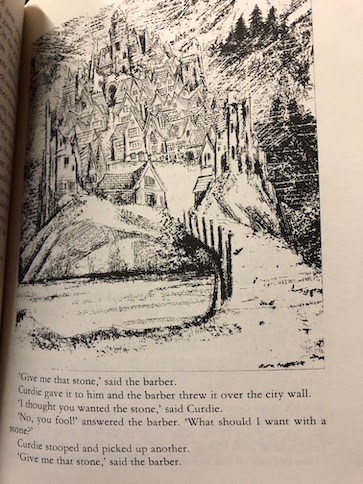
When they finally reach the king’s city, Curdie meets the king’s baker. The baker stumbles on a stone sticking up out the street and curses the king for not maintaining that road. Curdie argues that the baker himself bears some responsibility for watching where he’s going, especially since he says that he’s tripped on that stone before and knows it’s there. However, Curdie has his pickaxe with him and sees an easy way of dealing with the problem. He breaks up the rock that’s sticking out of the road, but a piece of it flies out and breaks the barber’s window. The barber comes to complain about it, and he insists that Curdie pay him more than the window is actually worth. Curdie gives him what he thinks is a fair price, and he feels the animal paw in the barber’s hand, showing what kind of man the barber is and that Curdie’s gift is still working.

There are other cruel, hard-hearted, immoral, and brutish people in this city, and sadly, some of the nicer people tend to be on the receiving end of the malicious gossip of the others. Curdie and Lina are taken in by a woman who is rumored to be a witch simply because she prefers to live quietly and not gossip like the others. Of course, everyone immediately begins gossiping about Curdie and his strange animal companion. The local magistrate believes the slander of a couple of people whose dogs Curdie had to kill because they were trying to kill him and Lina. These people claim that the dogs were harmless and Curdie killed them for no reason. When the magistrate and his soldiers come to arrest Curdie, he says that he’ll surrender, but he refuses to restrain Lina so they can kill her. Lina chases off the crowd that’s gathered to watch, but then, she vanishes herself, and Curdie is arrested. Fortunately, Curdie manages to escape and reunite with Lina. Then, he and Lina find their way into the king’s cellar and kitchen. There, he finds that the king’s servants are drunk and passed out. His touch tells him that these people are beasts inside. Going further into the palace, he finds the king’s chamber, and there, he meets Princess Irene again.

Princess Irene recognizes Curdie again immediately. It’s been less than two years since they last saw each other. She was about eight years old then, so she can’t be more than ten years old now, but Princess Irene seems older than she should be because of everything that’s been happening in the king’s palace. Her father has been ill for a year and is not in his right mind. Princess Irene thinks that the entire kingdom is concerned for him because that’s what the lord chancellor has told her, but Curdie knows that isn’t true because he hasn’t heard a word about there being anything wrong with the king outside of the palace. Princess Irene says that the king has also asked for Curdie, and his staff claimed that they tried to send for him but couldn’t find him. Curdie knows that definitely isn’t true because, until he started his journey to the king’s palace, he had been living in the same cottage where he always lived, and no one from the palace tried to find him or sent him any message.

It’s obvious that there are wicked people in the palace. These people are responsible for the king’s current condition, and they’re trying to keep the public from finding out what’s been happening. With his gift of telling who is a beast on the inside, can Curdie help Princess Irene to find and deal with the conspirators and restore the king to his right mind?

The book is public domain now. It is available to read online through Project Gutenberg (multiple formats) and Internet Archive (multiple copies). You can also listen to a LibriVox audio reading online through YouTube or Internet Archive.

My Reaction and Spoilers

As with the first book, royalty is used to represent people with the best morality in the story. Curdie and his family have royal blood because they are more wise and moral than other people around them. It feels a bit classist to think that royalty is supposed to be morally superior to everyone else just because they were born into a particular family. That certainly isn’t how these things work in real life. Just think of Prince Andrew. However, this type of comparison does fit with the fairy-tale setting of the story.

In spite of whatever royal blood he has, Curdie isn’t perfect. He was falling into bad habits until he realizes that he has done a terrible thing by shooting the pigeon, which causes him to seek out the great-great-grandmother Princess Irene told him about and to do some soul-searching about his behavior. During the time when Curdie is being thoughtless and falling into bad habits, he is portrayed as being too common, like the other men working in the mine. However, I would argue that the bad habits of the miners, like their wild, gossipy stories and rude joking and teasing, are not because they lack royal blood but because they lack thought. Curdie and his father say as much when they’re talking in the mine. The other miners are being thoughtless, and they’re simply not making any effort to be more thoughtful. More than any royal blood, Curdie proves himself worthy by his ability to be thoughtful about other people, and he gets that ability by wanting to improve himself and making the effort to do what it takes to improve.

A large part of this book comes off as a lecture about morality, but that’s not unusual for a Victorian era children’s book. The Princess and the Goblin had some of that, too, but this book has much more. That might be part of the reason why this book seems like it’s less well-known than the first book, but the ending of the book is also strange and kind of depressing.

As one might expect in a fairy-tale story of this kind, Princess Irene marries Curdie (not immediately, because they’re still children, but eventually), and the two of them are said to rule their kingdom wisely for many years. It seems like a happy ending because, thanks to Curdie’s ability to sense the true nature of people, they are able to surround themselves with the best people, and the city becomes less wicked under their rule. However, the story doesn’t end there. In the final paragraphs of the book, it says that Curdie and Irene had no children to inherit the crown. Without a blood heir to the kingdom, someone else was chosen to rule instead, and this person was wicked and greedy, so the royal city went back to being wicked. In fact, this new king was so greedy and stupid that he had his people mining continuously, right under the city itself, to bring him riches. They eventually completely undermined the entire city, so the city physically collapsed in on itself, destroying it completely and killing everyone there. I guess that’s meant to explain why this fairy tale kingdom no longer exists, but that’s quite an ending to this story! With this royal family apparently having some kind of magic about them, it seems incredible that their kingdom would have gone this way, but then again, maybe the author just didn’t want to write about them anymore.

Note to the wise: Wherever your source of wealth comes from, for the love of all that is good in the world, don’t mine your support beams! They serve a purpose and need to stay there for a reason.

The Princess and the Goblin

“But, Mr. Author, why do you always write about princesses?”
“Because every little girl is a princess.”
“You will make them vain if you tell them that.”
“Not if they understand what I mean.”

The Princess and the Goblin, Chapter 1: Why the Princess Has a Story About Her

This is an enchanting fairy tale-type story about a princess. One of the best parts comes at the beginning of the book, when the reader supposedly interrupts the author as he starts to tell the story, asking him why he likes to tell stories about princesses. The author explains that princess stories remind every little girl that she is a princess, that they are all the daughters of kings (apparently in the sense that any man can be the king of his family with all the dignity and wisdom that implies, and it reflects well on them when their daughters behave well, as if they were raised with the manners of royalty), even if they sometimes forget that and behave in very un-princesslike ways. He wants to remind them that they are all princesses and can behave with the grace and dignity of princesses, and he can also pamper them a little because, in the course of the story, he can give them every beautiful thing he wants all the little princesses of the world to have. There’s kind of a behavioral caution in that explanation, but also a sweet sentiment. Even if you’re just an ordinary girl, you can still act with royal dignity and grace, and through the story, you can vicariously enjoy all the riches and adventure that a fairy tale princess can have.

The princess in the story, Princess Irene, is about eight years old, being brought up in a castle or manor house in the countryside because her mother was not physically strong when she was born and is now dead. She is largely raised by her nurse and only sees her father, the king, occasionally. Her father spends his time traveling between his castles and manors, visiting various parts of his country to make sure that everything is in order. Princess Irene cannot go with him because she is still too young to travel that much.

There are caverns under and around the castle-like manor house where Princess Irene lives. There are mines in the area, and the caverns are inhabited by creatures like kobolds or goblins. The story says that there are legends that these creatures once lived above ground, but having some quarrel with requirements imposed on them by the king or human society, they retreated underground to live there in secret. From generations of living underground, they have become physically altered into deformed creatures, but they have also acquired arcane knowledge and delight in playing mischievous tricks. Because of fears of the goblins coming out at night, Princess Irene is kept safely indoors before the sun goes down and has never seen the night sky by the age of eight.

One rainy day, Princess Irene is sitting in her nursery, bored. She has many fabulous toys (so amazing that the author of the book declines to describe them and cautions the illustrator against attempting to draw them, so readers can imagine any fabulous toys they like), but Irene in not in any mood to be amused by anything. Princess Irene is restless and doesn’t even quite know what she wants. When her nurse leaves the room, Irene takes the opportunity to run off and explore parts of the castle she has never before explored. She runs up some stairs into a passageway full of doors. She continues running through the passageways with doors leading to rooms with nobody in them until she becomes lost and confused. The corridors are empty, and there is no sound but the rain. One of my favorite quotes from this book says, “It doesn’t follow that she was lost, because she had lost herself though.” Just because Princess Irene doesn’t know where she is or where she’s going doesn’t mean that she isn’t heading in the right direction, where she needs to be.

Frightened, Princess Irene tries to find her way back to the nursery. Eventually, she finds her way to a room where she hears a humming sound. When Irene enters the room, she finds a beautiful old lady with silver hair sitting at the spinning wheel. Irene isn’t sure how old the lady is because she seems almost ageless. The lady notices that she’s been crying and asks her why, and Irene explains that she is lost. The lady is kind to her, washing her face and hands, and she introduces herself as Irene, too. She says that she is the princess’s great-great-grandmother and that Princess Irene was named after her. Princess Irene wonders why she’s never seen her before, and the elderly Queen Irene says that no one else knows that she is here. She shows Princess Irene the pigeons she keeps and promises that Princess Irene will see her again. Then, she guides the little girl to the stairs back to the nursery.

When Princess Irene is back in her nursery, her nurse is relieved because she’s been looking for her. The princess explains that she was with her great-great grandmother, but her nurse doesn’t believe her. Princess Irene is offended that her nurse thinks she made up the whole story. The next day, Princess Irene tries to find the old lady’s room again, but she can’t. She almost starts to wonder if she did just dream about her.

After the rain is over, the princess and her nurse spend some time outside. They wander farther than they should, and the nurse realizes in a panic that they cannot get back to the castle before the sun sets. The nurse grabs the princess’s hand and begins running for home. She becomes even more panicked when the princess thinks she sees little men and hears a sound like laughing. In their haste and panic, they get lost. The princess doesn’t understand why her nurse is so panicked because no one is supposed to scare her by telling her about the goblins.

Fortunately, they meet up with Curdie, a young miner boy. It scares the nurse that Curdie is singing about goblins, but Curdie says that goblins can’t stand singing. Goblins don’t bother Curdie because he’s used to them and doesn’t let them frighten him. This is the first time Princess Irene learns about the goblins. When the nurse tells him who the princess is, Curdie says that they wouldn’t have gotten lost if they weren’t frightened and that it was a bad idea to say the princess’s name because the goblins might have heard and will recognize her if they see her again. Curdie guides them back to the castle before anyone realizes that they are missing. Irene likes Curdie and wants to give him a kiss for helping them, but the nurse stops her. Curdie tells her that there will be another time, and she can keep her promise of a kiss later.

Curdie can tell that the goblins are angry with him for interfering with their pursuit of the princess by their behavior toward him the next day. It doesn’t bother him much because he knows exactly how to deal with them. Goblins are intimidated by songs and rhymes, probably because they can’t make any themselves. Miners who are good at remembering songs and rhymes or making new ones for themselves don’t need to worry about the goblins, and Curdie has a talent for this sort of thing.

While Curdie is in the mine after the other miners have left, he overhears a goblin family talking, and he learns some useful things. First, he finds out that goblins’ feet are a vulnerable point on their body. Their heads are very hard, but their feet are very soft, and they have no toes. The only one who wears shoes is the goblin queen, and the goblins say that’s because the goblin king’s first wife wore shoes, and the second queen doesn’t want to seem inferior to the first. The goblin king’s first wife was a human woman, who died giving birth to their son. Second, the goblins are building new homes further away from where the miners have been mining. Third, the goblins are planning some kind of disaster against the miners. Curdie secretly follows the goblins to find out where the goblin palace is and learn more of their plans. At the goblin palace, he hears them discussing their plans. They don’t offer many new details, but it is clear that they are planning some sort of revenge against humans.
Princess Irene finds her way to her great-great-grandmother’s room again one night. This time, the old Queen Irene shows Princess Irene what she is spinning. She is spinning spiderwebs to make something for Princess Irene. She heals a wound on the princess’s hand and invites her to spend the night with her. When Princess Irene wakes up, she is back in the nursery, but she now believes that it wasn’t just a dream.

Later, the princess is frightened by a horrible goblin creature that enters her nursery through a window that the nurse left open when it was getting dark. Terrified, Princess Irene runs out of the castle into the darkness (somehow missing the extra guards that her father left at the castle for her protection). Fortunately, her great-great-grandmother sends her a magical lamp that guides her back to the castle. There, she gives the princess the present that she has finished making: a ball of finely-spun spider silk. She also gives Princess Irene a ring with a fire opal. She tells the princess that these things will guide her to safety any time that she is frightened.

The magical spider silk thread helps Princess Irene to find Curdie when he is captured by the goblins. Curdie has been trying to learn more about the goblins’ plans. Curdie discovers that the goblins are planning to kidnap Princess Irene as both a hostage and a bride for their half-human, half-goblin prince. Worse still, if their plot to abduct the princess doesn’t work, they plan to flood the mines and drown the miners!

This book is in the public domain. It’s available to read online through Project Gutenberg (multiple formats) and Internet Archive (multiple copies). You can also hear a LibriVox audio reading of this book online through YouTube and other audio recordings at Internet Archive. The story was made into an animated movie in 1991, and you can see it online through Internet Archive. There is only one sequel to this book, The Princess and Curdie. Personally, I think the original is better than the sequel.

This is a classic children’s fantasy story! The princess is sweet, the villains pose a real threat, and the story doesn’t shy away from the goblins’ evil. When they’re describing what to do with the princess when they get her, they talk about how they’re going to make her toes grow together so she’ll be like them. As princess stories go, this one isn’t as sparkly and pink as many modern princess books. Still, as the author notes in the beginning, this story allows all little girls to think of themselves as princesses and imagine themselves going through the adventure with Princess Irene.

As with many other Victorian era children’s stories, there are moral lessons in this one. The author periodically reminds readers about how princesses should behave with bravery and should keep their promises. There are also various other morals in the story, like the value of hard work and duty to others, learning to understand other people and give them the benefit of the doubt, and having the courage to admit mistakes and make them right. All of these values are described as being noble, and it’s implied that Curdie might have princely blood for exhibiting these values. The book uses royalty or the behavior of princesses and princes as a sort of metaphor for moral behavior.

Princess Irene’s great-great-grandmother is never fully explained. At one point, Princess Irene brings Curdie to see her, but he can’t see her, even when the princess is sitting on her lap. However, the king himself goes to see her without the princess. The princess knows that’s where he’s going because he’s heading in that direction. He is aware that the old Queen Irene is there, but he doesn’t share that knowledge with anyone else. When Curdie tells his mother that the princess tried to show him her great-great-grandmother but nobody was there and he thought that she just made it all up, his mother tells him that there is something very odd about the royal family. She says that they’re not sinister, but there are rumors and implications that there is something magical about them or that they are not quite normal humans. At the end of the story, we never get a firm answer about what Queen Irene really is. When I first read this book, I thought that she might be a ghost because, as an ordinary human, she shouldn’t be alive anymore, and I figured that she only shows herself to members of her own family. However, that doesn’t fully explain her magic, and from what Curdie’s mother says, maybe she’s some kind of fairy or elf or maybe a powerful sorceress, who can either live forever or for a long period beyond the normal human lifespan.
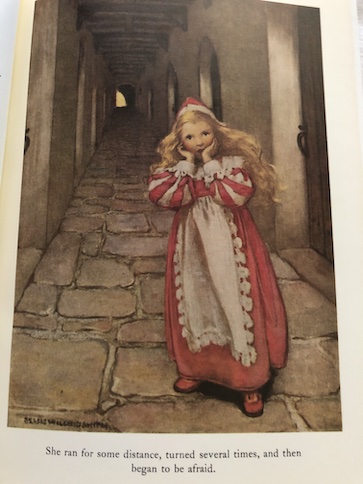
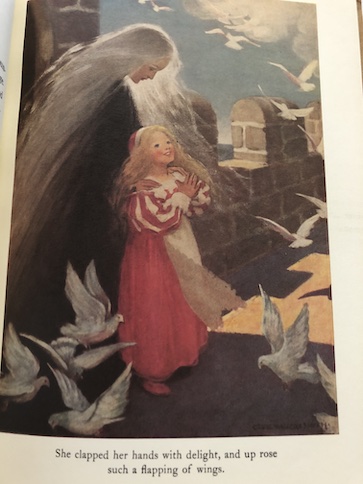
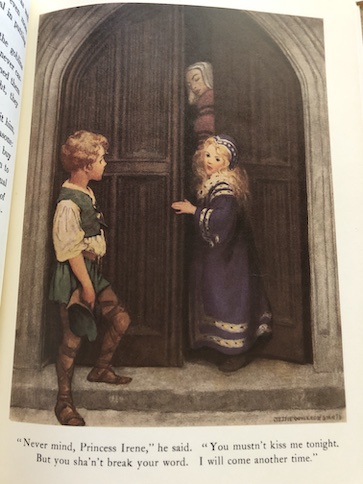
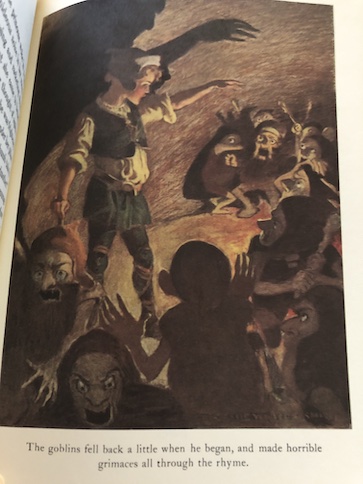
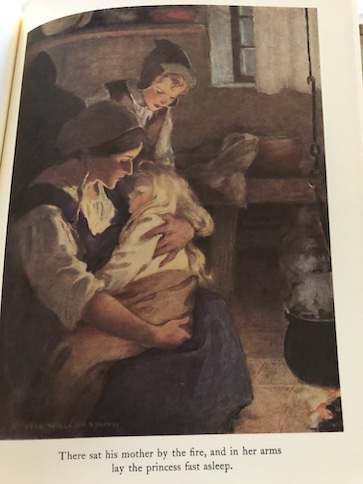
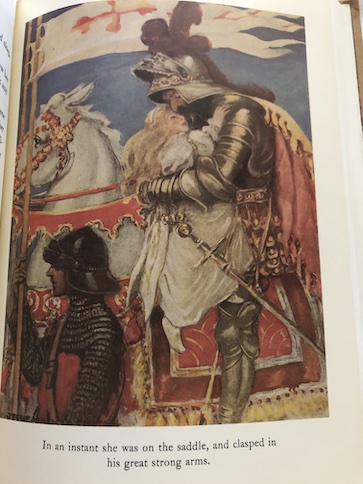
One of the parts that I always liked best about this book is the illustrations. They’re charming and magical! These particular illustrations were made by Jessie Willcox Smith, a famous illustrator of children’s books in the early 20th century, in 1920.
And This is Laura

And This is Laura by Ellen Conford, 1977.

Twelve-year-old Laura Hoffman feels out of place in her family. Her other three siblings are over-achievers. They all have particular talents and interests and earn awards for them or just have the ability to impress people. Laura gets good grades in school, but apart from that, she doesn’t seem to have any unique talents or interests. She doesn’t think there’s anything about her that would earn an award or impress anybody. Laura feels depressingly average next to the other members of her family.

It isn’t that her family is pressuring her to achieve anything in particular or to be like them or do what they’re doing. It’s just that Laura wishes that she had something more interesting and distinctive about herself. Other people who know Laura’s siblings keep comparing her to other members of her family. When she joins the drama club at school, one of her teachers seems a little disappointed that she’s not quite as good at acting as her older sister is. Laura’s friend, Beth, tells her that she’s good, but Laura feels like she’s never good enough, never as distinctive as she should be.

By contrast, Beth’s family is much more conventional. She only has one younger sibling, not three siblings, like Laura. Her mother is a lawyer, and their house is always neat and stylish. Laura’s house is noisy and chaotic, and she describes their household clutter as looking like a rummage sale. Laura thinks of herself as being a more ordinary, conventional person, and it occurs to her that she feels more at home in a conventional house. When Beth comes to visit Laura’s house, Laura worries at first that Beth will think her family is too weird. However, Beth is charmed by their eccentricity. In fact, Laura feels a little hurt at how interesting Beth finds the rest of her family. Laura worries that she’ll always be boring and ordinary compared to everyone else. However, Laura has a special talent that even she doesn’t realize that she has.

While Beth is having dinner with Laura and her family, Laura’s mind wanders from the chaotic conversation at the dinner table. She suddenly finds herself having a vision of her scientist father in his laboratory. She sees him meeting a man in a white shirt and then acting excited, like he’s just had an important discovery. The vision feels strange to Laura different from a daydream. When it’s over, she hears her father saying that he has a lot on his mind, and Laura absent-mindedly tell him that he’ll figure it all out tomorrow, after the man with the white shirt comes. Suddenly, everyone stops eating and stares at her, wondering what she meant, but even Laura herself isn’t sure. She’s aware that she knew her father was working on some difficult problem because he was juggling hard-boiled eggs earlier (something her eccentric father does whenever he needs to think), but she’s never had visions like that before and doesn’t know who the man in the white shirt is or what her vision really means. She just thinks it’s nice that everyone seemed to notice her.

There must be something to Laura’s visions because her father later tells her that he figured out his problem just like she said she would. Beth is intrigued by Laura’s apparent ability to predict things and tries to help her have another vision. Laura sees Beth on a stage with flowers at her feet and takes that to mean that she’ll be the star of the drama club play. However, Laura isn’t sure that her visions are always true because, when Beth tries out for the lead, she only gets the second best part in the play.

Another odd thing about Laura’s ability is that the girls realize that it doesn’t work well in a quiet environment, like Beth’s house. Laura gets visions when she’s surrounded by noisy chaos and starts to feel like she’s either outside of the situation or wants to be outside of it.

At first, Laura likes feeling special and noticed because of this unusual ability she seems to have, but it soon starts to worry her. She’s not sure that she can always trust her visions to be right or her ability to interpret them. She also begins to realize that it’s not so much that people are starting to notice her as a person but to pay attention to her ability, which is different. It starts to make her feel even more out of it than before.

Then, Laura has a terrifying vision where her younger brother, Dennis, is missing and her mother is frantic with worry. Is that vision real? Is something really going to happen to Dennis, or is there another explanation? The vision wasn’t clear on what would happen to Dennis, and if it is a real vision, can Laura do anything to protect her little brother?

The book is available to borrow and read for free online through Internet Archive.

My Reaction and Spoilers

This story starts off like many other kids’ books I’ve read, where a character feels out of place in their family or wishes that they had some talent that would make them stand out from their siblings. Then, it takes a turn for the mysterious when Laura begins to have visions that make it seem like she can predict the future. At first, Laura enjoys the feeling of being special and noticed, but then, her visions start to frighten her.

Another girl at school, Jamie, hears her talking about it with Beth, and she tells Laura that she’s fascinated by people with psychic abilities. She’s read about it before, and she points out to Laura that not being right all the time or not knowing what a vision means at first doesn’t mean that she isn’t gifted. When she explains to Laura how alarming visions can have perfectly innocent explanations because visions can be metaphorical, Laura feels better.

Jamie persuades Laura to give psychic readings to classmates for money, but the idea of turning her newfound ability into a business doesn’t feel right to her. Sometimes, she sees things that she doesn’t like, things that frighten her. It’s bad enough to predict that a classmate will fail a class, but another vision suggests that a classmate will die. He doesn’t die, but he does get into a car accident, and that’s bad enough. Laura realizes that it’s horrible to see that bad things will happen without having a way to do anything about it. Also, instead of being pleased and proud of her, her family finds the whole business unnerving and all of the kids who come to see her for psychic readings too chaotic, even for them.

There are also the disturbing visions that Laura keeps seeing about Dennis. She takes her friends and her old sister, Jill, into her confidence. Jill says that she will keep a close eye on Dennis to make sure nothing happens to him. Dennis does disappear during the story, and people worry about him, but nothing bad happens to him. Nobody in this story dies, and Laura uses her visions to figure out where Dennis is.

Toward the end of the book Laura talks to her parents about whether or not they’re proud of her because of her psychic abilities. They have a family talk about what it means to be proud of someone. The parents say that they’re not proud of their children for being talented because they don’t see themselves as being directly responsible for their talents. They love all of their children simply because they’re their children, and they’re good people, who do what they think is right and care about others. As far as talents and accomplishments go, the parents see their role as parents as making resources available to their children so they can develop whatever talents they have to the fullest, whether that means letting them have music lessons or encouraging them to try out for the school play. Whatever talents the children have are simply what they were born with, and their achievements are signs that they’re making use of what they have. The children accomplish what they work for themselves, and they’re doing it because they love doing it, not because the parents require it. What makes the parents proud of their children is when they find out what they’re good at and what they love doing. It doesn’t matter to them what their children’s talents are or how their talents compare to each other’s; they just want all of their children to find fulfillment in what they do.

In fact, her mother says that she thinks part of Laura’s trouble is that she’s good at too many things. She’s always gotten good grades in every class, so none of her subjects seems to stand out. If she only got mediocre grades in most subjects and good grades in just one, she would feel like she had a particular talent for that one subject. When she gets equally good grades for everything, nothing stands out to her as her special talent. Rather than being “boring” and “ordinary”, as Laura thinks of herself, she’s actually well-rounded and multi-talented.

Her parents have always been confident that Laura would find her own interests and talents in life. She just feels unaccomplished next to her siblings because, except for Dennis, her siblings are older than she is and have had more time to figure out what their interests are and build up accomplishments. Laura is also a good, caring person, who has been using her talent to help other people to the best of her ability. She looked into everyone else’s future but her own. Her parents say that having a lovable and loving daughter means more to them than any number of impressive accomplishments would be. Whatever anyone else in the world thinks about Laura and her abilities, her family loves her for who she is, not her abilities.

I like the parents’ attitudes, and it seems that the rest of Laura’s family feels the same way, especially her older sister, Jill. I enjoyed how supportive Jill was about both Laura’s psychic abilities and about her acting. When Laura tells Jill that she’s thinking about quitting the drama club because her teacher seems disappointed that her acting isn’t as good as Jill’s, Jill persuades her not to quit. Jill tells Laura that she would understand if she wanted to quit the drama club because she discovered that she really didn’t like drama after all, but she doesn’t want her to quit because she thinks she isn’t good enough. Jill says that Laura is good but that she just needs a little more coaching. She wants her sister to see that she is more talented and capable than she thinks and to make the best use she can of her talents, all of them.

There were a few instances of mild swearing in the book and one semi-dirty joke. When Laura thinks that she’s hopeless at acting because her teacher is disappointed that she’s not like her sister and says that she’s going to give up the drama club, Jill insists that Laura read the role for her so she can see what her performance is really like. Laura doesn’t really want to, but Jill insists that she stand up and read it properly because “You can’t act lying down.” Laura quips that “You can if you’re in an x-rated movie”, and Jill wryly tells her that she’s too young for that. The joke only works if the reader knows what an x-rated movie is, so it would probably go right over the heads of anyone too young to understand it.

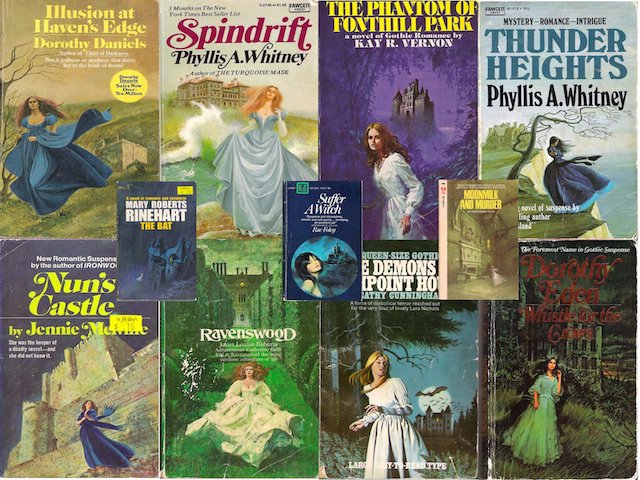
One part of this book that I thought was amusing was when Laura explains about her mother’s writing career. When her mother was younger, she played bit parts in movies, and now, she writes gothic romance novels and westerns. Laura doesn’t like the westerns, but she’s read a couple of the gothic romances, and she has noticed that her mother’s gothic romances are very formulaic – “heroines who go to live in crumbling old castles where dark family secrets are buried and everyone acts strangely and the heroine finds herself in Terrible Danger.” That is a concise and accurate description of that entire genre of books. Her mother says that’s part of the challenge of writing gothic romance – writing the same story over and over in different ways so readers can hardly recognize that it’s the same story at all.

The reason why that’s funny to me is that, years ago, my brother and I were sorting through some old books, and we found our mother’s old collection of gothic romance books. I was immediately struck that all the covers on the books looked alike. They weren’t completely identical, but they all had young women in dresses running away from crumbling old manor houses or castles while looking scared. Sometimes, the heroine had a blue dress and sometimes a red one. (More often than not, the dress was blue, but sometimes, there would be a girl in red, pink, or white. Other colors were rare.) There were a few where it looked like it was even the same girl or the same castle viewed from a different angle. I thought it was so funny, I picked up a couple more with very similar covers from a thrift store and made a couple of digital collages with them that I turned into backgrounds for my computer screen. The same story, told over and over in different ways. You can’t judge a book by its cover, but these covers do explain a genre. I’m not saying it’s not a fun genre, only that I find it funny. Whoever did the covers for these books was undertaking the same sort of challenge that writers like Laura’s mother did in writing them.

Little Witch's Big Night

Little Witch’s Big Night by Deborah Hautzig, illustrated by Marc Brown, 1984.

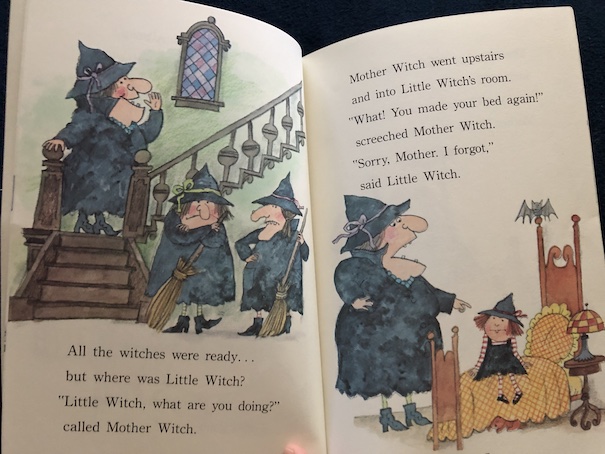
On Halloween night, all the witches in Little Witch’s family are busy getting ready for their big broomstick ride. However, when Mother Witch sees that Little Witch has cleaned her room and made her bed, something too nice for a witch to do, she punishes her by telling her that she will have to stay home.

Because Little Witch is left at home, she is there to answer the door for three trick-or-treaters dressed as an astronaut, a devil, and a pirate. Since she doesn’t have any treats to offer them, she offers to give them rides on her broomstick.

The trick-or-treaters have a great time as Little Witch has her broom do tricks and she shows the pirate a real pirate ship.

The trick-or-treaters have so much fun that they promise to come back next year. Little Witch resolves to be good all year so that her mother will punish her again and make her stay home from the Halloween flight, so she will be there to meet her new friends when they come back.

However, when the other witches come back, Mother Witch says that she missed Little Witch on the flight and that she will get to come on the flight next year. Little Witch asks if she can bring some friends with her, and Mother Witch says that will be fine, as long as Little Witch isn’t too good.

This was one of my favorite Halloween books when I was a child, and so is one of the other books in the series, Happy Birthday, Little Witch. The first time I read these books, I read them out of order, but you really have to read the books in order to understand Happy Birthday, Little Witch because it turns out that Little Witch still doesn’t understand the idea of trick-or-treating or that human children wear costumes on Halloween. She really thinks that she met a small astronaut, pirate, and devil on Halloween, and that makes it difficult for her to find them when she wants to invite them to her birthday party. The Little Witch in this series isn’t the same as the Little Witch in the Little Witch Craft Books.

The book is available to borrow for free online through Internet Archive.

Blackbeard’s Ghost

Blackbeard’s Ghost by Ben Stahl, 1965, 1976.

This is the novel that the live action Disney film Blackbeard’s Ghost from 1968 was based on. My copy is a later edition designed as a tie-in with the Disney movie, based on the cover, but it contains the text of the original story.

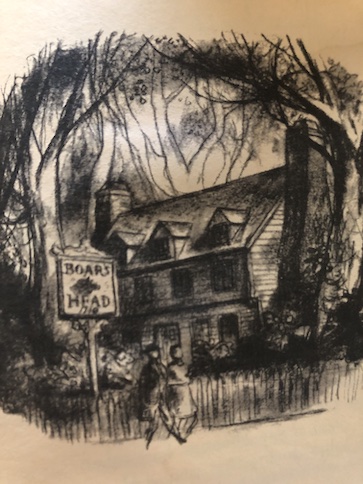
The story begins with a prologue that explains how Blackbeard the pirate evaded execution for piracy by offering to collect tolls from ships on behalf of the colonial governor, Governor Eden, in the town of Godolphin. However, instead of collecting tolls from the ships, he decided to use his position for his own benefit. Knowing that he would eventually need a source of stability on land instead of spending the rest of his life at sea, he looted wood from various ships and used it to build a tavern for himself called the Boar’s Head. He hired a woman rumored to be a witch, Aldetha, to tend the tavern for him. In the end, though, Blackbeard was killed by someone who wanted to collect the bounty on him for piracy. After his death, the poor woman who tended his tavern was burned at the stake for witchcraft.

(Note: The witch burning is historical inaccuracy because no witchcraft executions in North America involved burning, at least not in English-controlled parts of the American colonies. Accused witches in North America were typically hanged. None of this story is meant to be historically accurate, but I always feel compelled to point that out in stories that make that mistake. The town of Godolphin and the Boar’s Head Tavern are fictional. In real life, Blackbeard did receive a pardon from the real Governor Eden in Bath, North Carolina, and he was eventually killed in 1718 in a battle with Lieutenant Robert Maynard and his crew, as he did in this story. However, in the book, the tavern is now owned by a descendant of Maynard’s, and in real life, Maynard didn’t have any children.)

Most of the story takes place in the 20th century, when two 14-year-old boys, J.D. and Hank, talk about how the old Boar’s Head Tavern is about to be torn down because the former owner sold it, and there’s going to be a gas station built on the land instead. They think it’s a shame because they’ve heard ghost stories about the place and think the old tavern is fascinating. The boys go to watch the workmen tearing down the old tavern, but the workmen haven’t made any progress so far. Although they’d love to loot some of the expensive woods from the old tavern, they just can’t seem to dismantle the building. They’ve been able to dismantle some of the newer additions to the building, but somehow, they can’t seem to touch the original structure. The site has been plagued with mysterious accidents. Their equipment fails, heads fall off the ends of their hammers, and workmen keep getting injured in small accidents, not enough to seriously hurt anyone but enough to keep them away from their work for days at a time.

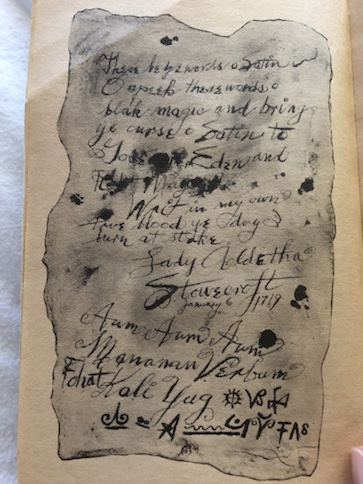
When J.D. and Hank see the workmen leaving the building in frustration soon after arriving, they decide to go inside and look around to satisfy their curiosity and see if there’s anything of value that they can salvage before the tavern is demolished. They don’t find much of value, but they do find their way into Blackbeard’s secret dungeon under the tavern. There, they find a piece of old parchment with a satanic curse written by Aldetha. (So, apparently, people were actually right about her being a witch. Plot twist!) Inspired by this creepy message from the past, the boys realize that they can make money from other kids by capitalizing on the ghost stories about the old tavern and holding seances to contact the spirits. They don’t really believe that seances are real, but they figure that, if they can get enough ghost-story fans to come to their seances, they can make a profit from this enterprise.

Of course, the boys’ seance awakens the ghost of Blackbeard. Blackbeard is invisible to everyone except for the boys, but he’s a solid ghost, who can manipulate physical objects. The boys quickly realize that Blackbeard can be a dangerous ghost, and he’s not at all happy when he finds out that a descendant of the man who killed him wants to have his tavern torn down.

The book is available to borrow and read for free online through Internet Archive. The Disney movie is available to buy or rent through YouTube or Amazon Prime. There is also a sequel to this book called The Secret of Red Skull, which involves spies and is also available online through Internet Archive.

My Reaction and Spoilers

There is some humor in this book because only the boys are able to see and hear Blackbeard, but by the end of the story, adults become aware of Blackbeard’s ghost, too. The boys’ history teacher is helpful in finding a way to appease the ghost by helping him to negotiate to buy back his tavern using his hidden treasure. When it becomes obvious both to Maynard and the company he tried to sell the tavern to that it’s haunted, they’re willing to accept pirate gold in exchange. The company also sees that it can use the building for public relations purposes by sponsoring a pirate museum in the old tavern. It’s good news for the teacher, too, because he gets to be the director of the museum. There, he can show off his collection of pirate memorabilia and indulge his love of pirate history. The tavern continues to be haunted by the ghosts of Blackbeard and his witch friend, leaving the story open for the sequel.

As expected of Disney films, the Disney movie version of the story is quite different from the book. In the movie, the person who can see the ghost is a college track coach who is staying in the old inn, which is still being operated by elderly descendants of Blackbeard’s old crew. There is a track meet in the movie that never appeared in the book, and at the end of the movie, Blackbeard disappears, having been freed from his haunting by performing a good deed.

I prefer the concept of the boys being the ones who accidentally summoned Blackbeard’s ghost, but the boys got on my nerves at first. In the early part of the book, they bickered a lot and didn’t seem to like each other enough to be best friends, although they seemed to be friendlier with each other later, when they were both trying to figure out what to do about Blackbeard. I think the teacher character was my favorite. He takes the matter of the ghost in stride, coming up with a practical solution that helps everyone.

Jessamy

Jessamy by Barbara Sleigh, 1967.

I couldn’t find a copy with its dust jacket intact.

Jessamy is a British orphan who is being raised by her two aunts, Millicent and Maggie. The two aunts aren’t really raising her together, though. Jessamy lives with Aunt Millicent during the school year, and she goes to stay with Aunt Maggie during school holidays. Truth be told, Aunt Millicent (her mother’s sister) and Aunt Maggie (her father’s sister) don’t really like each other, and they have different priorities and goals for Jessamy’s future. Aunt Millicent is doing her best to help Jessamy be pretty and popular, making sure that she wears a retainer to straighten her teeth and only allowing her to associate with “nice” children (apparently meaning ones from “good” families in the sense of social connections, who mostly don’t like Jessamy – Jessamy is usually not allowed to play with the children she actually likes and who like her). On the other hand, Aunt Maggie doesn’t care about beauty or popularity and just wants Jessamy to be well-behaved. Jessamy is confident that she is disappointing both of her aunts in all of these qualities. Her aunts are fond of her, but they are also occupied with their own lives. Aunt Millicent has her work, and Aunt Maggie has two children of her own, so Jessamy really has only half of their attention at any particular time.

However, Jessamy’s usual bouncing between her aunts is interrupted one summer when Aunt Maggie’s children, Jessamy’s older cousins Muriel and Edgar, catch whooping cough. Jessamy hasn’t had whooping cough herself, so she wouldn’t have any immunity. Rather than bring Jessamy into the household and have her end up sick, too, Aunt Maggie realizes that she has to find another place for her to stay until the other children are better. Jessamy can’t go back to Aunt Millicent because Aunt Millicent is leaving on a business trip, so Aunt Maggie arranges for Jessamy to stay with Miss Brindle, who is the caretaker of a large old house known to locals as Posset Place.

Miss Brindle is an older woman and is not used to spending time with children. Although Jessamy doesn’t really get along with her cousins, she isn’t sure if she’s going to like staying with Miss Brindle. However, Miss Brindle isn’t bad. She isn’t fond of Muriel or Edgar, either, and she says right up front that she’s glad that Jessamy seems different from her cousins. She also says that she’s going to treat Jessamy like an adult because she doesn’t know much about children, which suits Jessamy fine.

Miss Brindle tells Jessamy a little about the history of the old house. Posset Place was built in 1885 by a man named Nathaniel Parkinson, who made his money from producing a cough syrup called Parkinson’s Expectorant Posset. The house is largely empty now, except for the housekeeper’s quarters, where Miss Brindle now lives. Miss Brindle spends her time making sure the rooms are kept clean and well-aired.

Miss Brindle lets Jessamy explore the house a little before supper, and in particular, Jessamy is fascinated by the empty nursery. She finds herself imagining the children who used to live there and the toys and books the nursery once held. Then, she notices markings on the wall where the children’s heights were recorded, and she sees that one of the children was also named Jessamy. She tries to ask Miss Brindle about it, but Miss Brindle isn’t aware that there were any names written on the nursery wall.

During the night, Jessamy wakes up, still thinking about seeing her own name written on the wall of the nursery. She could have been mistaken, but it bothers her to the point where she feels like she has to go look at it again. Taking her flashlight, she goes upstairs again to look at the names. However, this time, the nursery is not empty, like it was before. There are clothes hanging on the wooden pegs on the wall and a line of shoes on the floor. When she checks the old measuring marks, she sees that there are fewer marks than she remembered before, but one of the names is definitely Jessamy, and the year next to that name is 1914. Jessamy lives in 1966 (contemporary with when the book was written), but the day in 1914 is the same day that she came to stay with Miss Brindle – July 23rd.

Then, to Jessamy’s surprise, she suddenly realizes that she is holding a lit candle instead of her flashlight. At first, Jessamy thinks that she must be dreaming, but then, an angry young woman comes and tells her that she should be in bed because she’s ill, not running around with a candle. The woman threatens to tell her aunt about this. When the woman lights her lamp, Jessamy sees that the nursery is now fully furnished.

It seems that Jessamy has gone back in time to 1914 and has been mistaken for the Jessamy who lived in the house in the past. The woman, who is Miss Matchett, the parlor maid, says that the other children named in the height markings – Marcus, Fanny, and Kitto – are all asleep and that it’s nearly midnight. The Jessamy of the past is the niece of the cook-housekeeper, which is why she is allowed to be with the children of the house. Jessamy’s head hurts, and she realizes that there is suddenly a bandage around it. Miss Matchett says that she fell out of a mulberry tree.

Jessamy realizes that the housemaid is only awake at this late hour and fully dressed because she had just returned from slipping out of the house secretly. When she points it out, Miss Matchett admits that she sneaked out to see her gentleman friend, and she says that if Jessamy doesn’t tell on her for doing that, she won’t tell her aunt that she was out of bed. Jessamy agrees, and Miss Matchett leads her back to her bed in the housekeeper’s quarters.

When Jessamy wakes up in the morning, she expects to find that everything that happened in the nursery during the night was a dream, but it isn’t. The room is the same one Miss Brindle gave her in the housekeeper’s quarters, but the bed and furnishings of the room are different. Jessamy is woken by a woman she’s never met before, not Miss Brindle.

This woman is the past Jessamy’s aunt, who tells her that she has had approval to stay on as the cook-housekeeper for the Parkinson family with Jessamy living with her. Not every household would accept a housekeeper with a young niece to raise, but as Nathaniel Parkinson himself says, the Parkinsons are not an ordinary family. Nathaniel Parkinson is a self-made man, from a humble background in spite of his current fortune, so he doesn’t put on airs, like other men of his current class. His granddaughter, Miss Cecily, at first disapproves of Jessamy, thinking that she might be too “common” (like the friends Jessamy’s Aunt Millicent disapproves of) and that she might not be a good influence on the children of the house, her younger siblings, who she is helping to raise. However, past Jessamy’s aunt defends her, and Nathaniel Parkinson says that she might actually be good for other children. He thinks Fanny has been acting too fine, and Kit could use the company of another child his age.

Jessamy is happy when she learns that past Jessamy has made friends with the Parkinson children and has really become part of the household. She is told that Fanny still thinks of her as being just the niece of a servant, but Kit (aka Kitto) is her special friend. Jessamy also likes this 1914 aunt better than her 1966 aunts because she seems nicer and more her kind of person. The realization that this is not a dream but that she has really traveled back in time is worrying, but Jessamy tells herself that she will somehow find her way back to her own time and that she should enjoy 1914 as much as she can while she can.

From the housemaid, Sarah, Jessamy learns that the Parkinson children live with their grandfather because their parents were killed in a carriage accident. Miss Cecily, the oldest girl in the family, takes care of her younger siblings and tries to manage the household while her oldest brother is away at Oxford. Miss Cecily is still learning about the running of a household, so past Jessamy’s aunt, Mrs. Rumbold, has to help her.

Jessamy also learns that she fell out of a tree house that she and Kit built together and that Fanny, who was also in the tree house at the time, was particularly upset by her accident. Fanny confesses to Jessamy that the reason she fell was because she pushed her. She hadn’t meant to push her out of the tree house or for her to fall, but the two of them were having an argument at the time. Fanny felt guilty about her getting hurt, but she’s still angry that Jessamy will be staying on at the house. She thinks that her grandfather and older sister decided to let her and her aunt stay partly because they felt badly about her getting hurt. Although Fanny is grateful that Jessamy didn’t tell on her for causing her accident, she still isn’t happy that Jessamy will be living with them. Fanny does put on airs, but she openly admits that she does it because everyone seems to be against her. Girls at school teasingly cough around her all the time because her grandfather made his money with his cough syrup, and since Jesssamy came, she feels like her brothers always side with Jessamy instead of her. Fanny has been in trouble before for bad behavior, and her brothers know that their grandfather has said if she does it again, he’ll send her to boarding school. Jessamy thinks that the idea of boarding school sounds exciting, but her brothers say that Fanny would hate it.

In spite of the drama with Fanny, Jessamy enjoys her time in 1914 and the other people there. She has the feeling that something important happened in 1914, and she remembers what it was when Nathaniel Parkinson and Kit talk about the possibility of war with Germany. Jessamy realizes that the coming war is going to be World War I and that it is going to start soon. Harry, the oldest boy in the Parkinson family, is back from Oxford, and he talks about how exciting it would be to be a soldier if there is a war, but Nathaniel Parkinson isn’t excited, understanding more about the nature of war than his grandchildren. Harry’s grandfather wants him to finish college, but Harry is in debt and wants to take his future into his own hands. Harry runs away, and at the same time, a valuable antique book belonging to his grandfather disappears. Jessamy doesn’t like to think that the pleasant young man stole his grandfather’s book, but what other explanation is there?

Just when Jessamy is getting caught up in the events in the Parkinson household and is concerned about the future of the past Jessamy and her aunt, Jessamy finds herself once again in 1966. Is it still possible for her to return to 1914 or learn what happened to the people she’s grown so fond of? Jessamy also begins to wonder who is the current owner of this old house and Mrs. Brindle’s employer? Learning the answers to those questions also explains a few things about Jessamy’s own family and past and gives her the one thing she really wants most.

The book is available to borrow and read for free online through Internet Archive (multiple copies).

My Reaction and Spoilers

This story is a combination of fantasy and mystery, a combination that I always like. In some ways, this story reminds me of Charlotte Sometimes because the time switching takes place between similar eras, but there are some notable differences between the two books. Charlotte Sometimes took place at a boarding school, and Charlotte went back in time to the end of WWI, not the beginning. There was also no mystery plot in Charlotte Sometimes beyond Charlotte trying to figure out how and why she is switching places with a girl in the past. Also, in Charlotte Sometimes, it isn’t clear whether Charlotte influenced or changed anything in the past, but Jessamy definitely does. The modern Jessamy had to be the one to solve the mystery because she has access to information that the past Jessamy didn’t have.

In the past, Jessamy begins investigating the mysterious theft of the valuable book. Although she knows that Harry isn’t the type to steal from his grandfather, it takes a second visit back in time for her to discover who the real thief is and to clear Harry’s name. Unfortunately, she is unable to actually find the stolen book in the past to return it to its first owner. It is through a new friend that she makes in 1966 that she learns what really happened to the book and is able to return it to the current owner of the house … an old friend of hers from 1914.

Along the way, Jessamy also learns a few things about the history of her own family. She realizes at the beginning of the story that Jessamy is an unusual name, which is why she is surprised that the girl in the past is also called Jessamy. It turns out that Jessamy is a name that is passed down through her family. She is not a direct descendant of the past Jessamy, as I first suspected, but the past Jessamy is a relative of hers. She also comes to understand that her family used to be more grand, but during the past, they fell on hard times. This is also important to the story because class differences figure into the plot.

Everyone in 1914 is concerned about class differences, but in different ways. Nathaniel Parkinson is actually the least concerned with class because he has actually shifted to a higher class during his lifetime, making him aware that people from different classes are really just people, only in different circumstances. His granddaughters are more class conscious, although both of them also soften on that after getting to know Jessamy better. Even the servants are also class conscious, with some of the servants putting on airs because they’re above other types of servants.

Something that surprised me in the story is the realization, toward the end of the book, that class differences are partly the reason why Aunt Millicent and Aunt Maggie don’t get along. Aunt Millicent’s efforts to make Jessamy more pretty and popular and have her be friends with certain people are social-climbing efforts, partly because Aunt Millicent is aware of their family’s past and wants the family to climb up from their humbled circumstances. Aunt Maggie’s disapproval of Aunt Millicent seems to come somewhat from her disapproval of Millicent’s efforts at social-climbing or trying to act like she’s more grand than she actually is. It isn’t stated explicitly, but it is heavily implied. We don’t meet Millicent in the book, but from her description, I suspect that she disapproves of Aunt Maggie because she thinks of her as being too “common.” From the characters’ descriptions of Maggie’s children, it seems like people who don’t like them think of them as being “common” or uncreative, indicating that this branch of Jessamy’s family is rather prosaic, being typical in a rather dull way.

The objective reality is probably that Jessamy’s two aunts are not very far apart in their social status, but they have different attitudes toward their social status. Aunt Maggie doesn’t care much about it. She fits in well where she is, she doesn’t care about moving up in society, and she just focuses on the children behaving well within their social status. Aunt Millicent, however, has a high opinion of who she is and where the family ought to be in society, and she is focused on moving up. Jessamy doesn’t really fit with either of her aunts’ philosophies of life. What she really wants is the chance to make real friends and fit in somewhere with people who like her and who like the sort of things she likes. She gets the opportunity at the end of the story when the current owner of the old house becomes her benefactor and arranges for her to attend boarding school, which she has said is something that she’s always wanted to do. At boarding school, Jessamy will be out from under the direct supervision of both of her aunts and will have the opportunity to develop independently and make new friends who suit her, rather than her aunts.

Even Fanny finds boarding school beneficial. We don’t know exactly how her life ended up in the 1960s, but when Fanny realizes that she’s caused problems for the past Jessamy in more ways than one and that she needs to admit the truth to her grandfather and older sister, her character develops for the better. She begins to develop empathy and compassion for the past Jessamy, looking beyond feeling sorry for herself to feeling something for another person she has directly harmed, and she reforms her character. She accepts the consequences for her actions, even though she was afraid to do so before, and it leads her to better things because the consequences are not as bad as she thought and actually help her. Although she was initially afraid of being sent away from her family, when her grandfather decides that she needs the discipline and sends her to boarding school, she discovers that she actually likes it. Going to boarding school allows her to get away from the girls who were bullying her at her local school and make new friends, and she develops some self-confidence from the experience, turning into a young lady who helps her older sister in her volunteer work for the war effort.

One final thought I had is that every time I’ve ever read a book with a sickness like whooping cough in it, I feel like it really dates the book. I know this book does have a specific date by design, and I know people still catch whooping cough in the 21st century if they haven’t been vaccinated (get your tetanus shot – in the US, the tetanus shot includes the whooping cough vaccine), but to me, this type of illness feels like a time travel back to my parents’ youths by itself. My parents and their siblings had whooping cough when they were young, but I’m almost 40 years old and have never seen a case of it myself.

Half-A-Moon Inn

Half-A-Moon Inn by Paul Fleischman, 1980.

Aaron is unable to speak and has been mute since birth, so he has to communicate with people mainly through writing messages he writes on a small chalkboard. His father was a sailor who died at sea, so he lives with only his mother. One day, his mother, who is a weaver, is planning to go to the market at Craftsbury so she can tell the cloth that she’s made. Usually, Aaron goes with her, but since he’s about to turn twelve years old, his mother decides that he’s old enough to stay home alone. His mother has always been protective of him because of his inability to speak, and Aaron is nervous at being alone at home overnight. Still, he agrees to stay home and look after the house while his mother is gone.

His mother warns him not to go far from the house until she returns home because they live far from the nearest town, and there are wild animals and brigands in the woods. She promises Aaron that she will bring him a special present for his birthday when she returns home.

However, his mother doesn’t return when she promised she would. Aaron begins to worry about her, thinking that she might have had trouble on the road because of the snow. Since he has traveled the road to Craftsbury with her before, Aaron decides to head to Craftsbury himself and see if he can find his mother on the way and help her. He assembles a pack with some supplies, and ignoring his mother’s instructions to stay at the house, he sets out to look for her.

The journey is more complicated than Aaron imagines, partly because, when he meets other people, not all of them know how to read the messages Aaron writes, making it difficult for Aaron to explain that he cannot talk and that he is looking for his mother. A ragman gives him some food and a ride on his wagon, but Aaron is frustrated because the man doesn’t understand what he writes or the pictures he draws.

The ride on the wagon takes a worrying turn when the ragman takes Aaron on a route he doesn’t recognize. When they come to an inn, the ragman drops off Aaron. Aaron thinks that he can stay the night at the inn and continue his journey on his own in the morning. Unfortunately, the woman who keeps the inn, Miss Grackle, can’t read Aaron’s notes, either.

Miss Grackle says that she’ll let him stay the night in exchange for a few chores, like lighting fires in the fireplaces, and Aaron nods that he accepts. He tries to show Miss Grackle the drawing he made of his mother, but she still doesn’t understand. Eventually, Miss Grackle comes to understand that Aaron can’t speak, but he still can’t seem to explain to her where he is going or why.

To Aaron’s surprise, Miss Grackle tells him in the morning that she looked into his dreams during the night. Through his dreams, she saw his mother and his home. She says that she knows he’s far from home and not likely to be found by anyone looking for him, if there is anyone looking for him. She has taken his belongings and boots, and she tells him that he will be staying at the inn, working for her and that he will now answer to the name of Sam, like the last boy she had.

Aaron has become Miss Grackle’s prisoner at the inn, unable to leave on his own without his boots! Miss Grackle is a thief, stealing from her guests, and she is confident that Aaron won’t be able to tell anyone about it. At first, Aaron thinks that he can get some help from one of the guests staying at the inn, but he encounters the same problem he’s had all along: he can’t talk to explain anything to anyone. The guests don’t even pay attention to him, Miss Grackle intercepts messages that he tries to write, and even when he manages to sneak a message onto the inn sign, other people can’t read it because they don’t know how to read. What can he do? How can he escape and find his mother?

The book is available to borrow and read for free online through Internet Archive (multiple copies).

My Reaction and Spoilers

This story is an adventure story that takes place at an indeterminate location and an indeterminate point in history, when people traveled by horse and wagon. It’s not a long story, but it is an intriguing one where a clever boy manages to outwit sinister villains. It reminds me a little of The Whipping Boy in setting, but there was no magic in that story, and there is in this one.

The atmosphere of the story seems like a fairy tale or folk tale. The evil, thieving innkeeper has a potion of some kind that she uses to put her guests to sleep and look into their dreams, which is how she saw Aaron’s dreams. The reason why she looks into people’s dreams is so she can learn more about who they are and where they come from. She’s looking for people who are more wealthy and important than they seem so she can hold them for ransom instead of just robbing them.

Miss Grackle’s magic apparently comes from her parents. Her mother was the one who came up with the method of looking into people’s dreams and robbing them. Her father was honest, and his determination to enforce honesty is the reason why Miss Grackle can’t run the inn by herself. Miss Grackle needs Aaron to light the fires in the inn because no fire will light in the hearths there if it is lit by a person who has been dishonest, and Miss Grackle has never been honest with anyone. Aaron finds a way to turn Miss Grackle’s greedy schemes to his advantage and escape. With Aaron gone and the only other person left in the inn as dishonest as she is, the villains are left to their fate in a snow storm that lasts for days.

Raggedy Ann and Andy and the Camel with the Wrinkled Knees

Raggedy Ann and Andy and the Camel with the Wrinkled Knees by Johnny Gruelle, 1924.

This book is part of the original Raggedy Ann series by its creator, Johnny Gruelle. Unlike earlier books in the series, this book is a single long adventure rather than a collection of short stories.

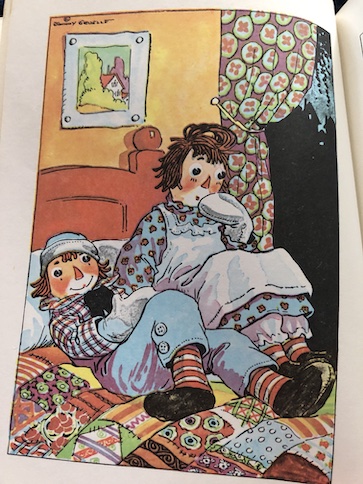
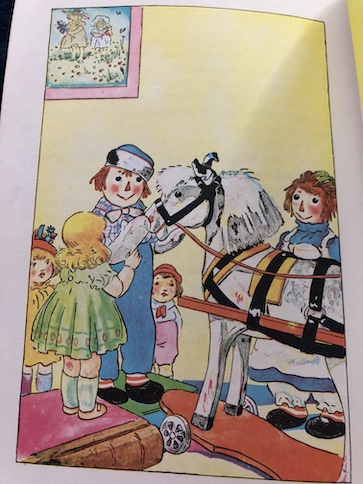
Raggedy Ann and Andy are lying in their doll bed in Marcella’s playhouse one night when they see a strange man sneaking up to the big house. They see him reach through a window, steal something, and run away. Wondering what just happened, they run to the house and talk the other dolls. The other dolls say that the thief just stole the French doll!

Raggedy Ann and Andy try to follow the man to rescue the French doll, but they can’t catch up to him because he flew away! As they try to figure out what to do, a fairy comes along. They explain the situation to the fairy, and the fairy says that they can fly if Granny Balloon Spider weaves a balloon for them. So, they go to Granny Balloon Spider weaves them a silken balloon, and they sail away into the air.

When Raggedy Ann and Andy decide it’s time for them to get off the balloon, they grab hold of a tree limb and untie the silken strings that have them tied to the balloon. When they jump down from the tree, they meet an old stuffed camel with wrinkled knees. They explain their situation to the camel, and the camel says that the man who took the French doll sounds like the one who kidnapped him from his owner, a small boy. The camel escaped from the man, but he thinks he could find him again, except that it was dark when he ran away, so he could find his way better if he couldn’t see.

Raggedy Ann and Andy tie a handkerchief around the camel’s eyes and climb on his back. At first, the camel just goes around in circles, but Raggedy Ann and Andy realize that he needs to run backward to retrace his steps, and then, they start getting somewhere.

Along the way, they meet a girl named Jenny who is trapped in a patch of snap dragons. The snap dragons won’t let her go. When they try to help her, Raggedy Ann and Andy get trapped by the snap dragons, too. They don’t know what to do until a tired old horse comes and rescues them.

Jenny explains that she was searching for her brother, Jan, who was kidnapped by a magical creature called a Loonie. The tired old horse says that he knows where Jan is now, so they decide to rescue Jan before continuing their quest to find the French doll.

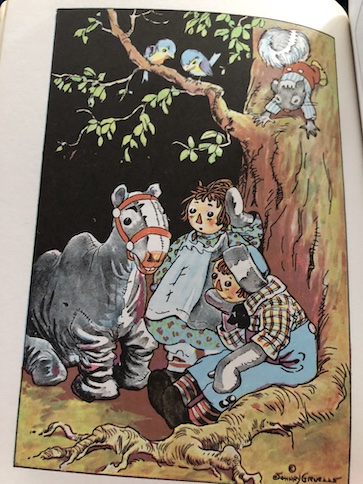
The Tired Old Horse leads them to the tree where the Loonie lives, and the Camel recognizes it as the place that he escaped from. They discover that the Camel as the ability to get inside the magical tree when he’s blindfolded, and he carries the others inside. From there, they find a trap door that leads to Loonie Land.

In Loonie Land, they are captured and brought before the king of the Loonies, who is a very silly king. The king insists that they won’t let Jan go until they answer three riddles. The riddles are very silly and make little sense, but Raggedy Ann and Andy figure out that the king doesn’t know the answers himself, so as long as they give him some kind of answer, they will be answering the riddles. The king is astonished that they are able to come up with answers and tries to insist that he has to ask them three more riddles, but Raggedy Ann and Andy insist that they’ve fulfilled the bargain already and that they’re going to take Jan. Raggedy Andy tweaks the king’s nose, and the king summons his looniest knight to fight them.

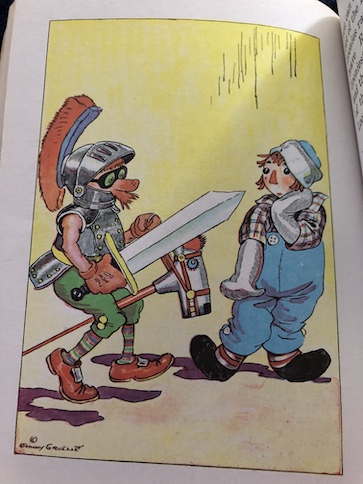
The looniest knight comes riding up on a hobby horse, but he’s afraid of Raggedy Andy and pretends that his hobby horse is acting up and that it has thrown him off. Since Raggedy Andy has “vanquished” the looniest knight, the king decides that they can take Jan and go.

With Jan rescued, they are able to resume their quest to find the French doll. Going further, they meet Winnie the Witch. The witch says that the man with the French doll bought some magic medicine from her, but he gave her a lead dime. Since he cheated her, the witch says that the magic medicine she made for him won’t work. The tired old horse asks if she has some medicine that will make him less tired. When he has her medicine, he becomes more energetic.

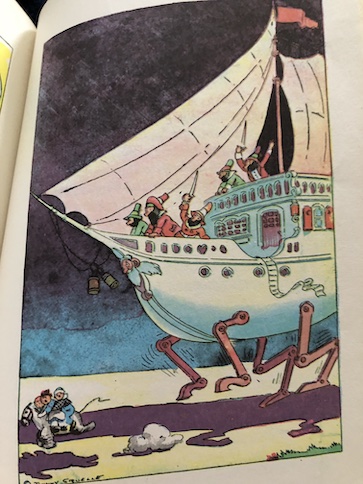
When they ask the witch how to find the man with the doll, she has them close their eyes and count to ten. When they open their eyes, they find themselves outside the tent of the man who took the doll. It turns out that Babette, the French doll, was kidnapped by pirates! Getting away from them is also going to be difficult because the pirates have a jumping house boat!

The book is available to borrow and read for free online through Internet Archive (multiple copies – including an audiobook). The LibriVox audiobook is also available on YouTube.

My Reaction and Spoilers

This story is cute, and I’m sure that it would be amusing for young children. Actually, I found it amusing as an adult because there are some silly jokes in the book that adults can enjoy, like how Raggedy Andy keeps talking while trying to tell the camel that he shouldn’t talk because Raggedy Ann is trying to think. At one point, the camel also gets confused about why the French doll is French when she has a china head. (Ha, ha. Groan!) One of my favorite parts was the part with the king of the Looneys and his nonsense.

The ending is also pretty silly. The tired old horse convinces the pirates to reform by offering them lollipops. It turns out that the pirates are actually a bunch of girls in disguise! These girls apparently had a deprived childhood, but they always liked to read stories about pirates and pretend that they were pirates. When they had a chance, they bought this magical jumping ship and started playing out their pirate fantasies, trying to get all the things that they didn’t have when they were younger, which is why they’ve stolen toys and are easily bribable with candy.

The story has a happy ending where the pirates help Raggedy Ann, Raggedy Andy, and the French doll get home. They reunite Jenny and Jan with their parents, and it turns out that the camel once belonged to Jan’s father. Jan’s father is happy to see his old toy and gives the camel to Jan.

Raggedy Andy Stories

Raggedy Andy Stories by Johnny Gruelle, 1920.

This book is part of the original Raggedy Ann series by its creator, Johnny Gruelle. The first book in the series was just about Raggedy Ann, but this book introduces a boy doll named Raggedy Andy. The explanation behind Raggedy Ann and Raggedy Andy (according to the book, not real life) is that the two dolls belonged to a pair of childhood friends. One girl owned Raggedy Ann, and the other girl owned Raggedy Andy. At the beginning of this book, Raggedy Andy arrives by mail to join Raggedy Ann and the other dolls in Marcella’s nursery, supposedly sent to the author by the daughter of the woman who owned Raggedy Andy.

Every night when the humans in the house go to sleep, Raggedy Ann and Raggedy Andy and the other dolls and toys come to life and have adventures. Each chapter in the book is its own short story. Some of the stories have morals to them about being generous and making others happy. Santa Claus and the Easter Bunny also make appearances.

These stories can make good bedtime stories for young children because there is nothing at all stressful about them. The book makes it clear from the very beginning that dolls cannot be hurt, so whatever they go through in their adventures, no real harm is ever done.

The book is available to borrow and read for free online through Project Gutenberg (multiple formats) and Internet Archive (multiple copies – including an audiobook). The LibriVox audiobook is also available on YouTube.

Stories in the Book:

How Raggedy Andy Came

The package with Raggedy Andy arrives, and the author is sees that Raggedy Andy and Raggedy Ann are glad to see each other again. The dolls cannot talk to each other in front of humans, but the author senses that they have things to say to each other, so he leaves them alone together.

The Nursery Dance

Raggedy Andy is brought to Marcella’s nursery with Raggedy Ann and Marcella’s other toys. When Marcella plays with her toys, she talks for them, but the toys have private thoughts of their own that they can’t say in front of her. After Marcella goes to bed, the toys begin to move about on their own and talk to each other. Raggedy Ann introduces Raggedy Andy to the other toys. Raggedy Andy has been stored in a trunk for a long time. Although, he was friends with a family of mice during that time, he is glad to be among other toys again.

The Spinning Wheel

The dolls in the nursery have a pillow fight and get feathers all over the floor. They clean up the feathers, but one of Raggedy Andy’s arms fall off in the right. (This doesn’t really hurt him because, as the book explains, Santa Claus gives the toys he makes a special wish that prevents them from being hurt by anything.) Raggedy Andy says that his arm has been loose for a while. The dolls say that maybe Raggedy Ann could sew it back on, but they need to find a needle and thread first. The dolls go on a daring expedition to the sewing room to get them. As Raggedy Ann repairs Raggedy Andy’s arms, she tells the dolls about another time when she repaired Raggedy Andy’s arm.

The Taffy Pull

Raggedy Andy suggests to the other dolls that they have a taffy pull. At first, the others think it’s a new kind of game, but Raggedy Andy explains that it’s a way to make candy. This is a good time for them to do it because Marcella and her parents are away, visiting relatives, so there is no one home to notice the dolls using the kitchen.

(This story actually contains a pretty good description of making homemade taffy, although the dolls aren’t hurt by touching hot, sticky candy, and a human child would be.)

The Rabbit Chase

Marcella’s dog, Fido, knows that the dolls can talk and also talks to them. One night, Fido hears a strange scratching sound. He wants to bark at it, but the dolls don’t want him to bark because it will wake the humans. They let Fido outside so he can see what the sound is. It turns out to be a rabbit, and the rabbit tries to hide from Fido by running into the house and hiding in the nursery. Raggedy Ann tells Fido to leave the rabbit along and asks the rabbit why it was scratching at their house. The rabbit explains that he is an Easter Bunny, and he only came to leave a basket of Easter Eggs for the children of the house.

The New Tin Gutter

When the house gets a new tin gutter, the dolls have fun sliding down it until a couple of penny dolls get lost down a drain pipe. Then, Raggedy Andy gets stuck trying to rescue them! The other dolls don’t know how to get them out and are afraid that they are lost forever. Then, it starts to rain, and when Marcella’s father notices that the drain seems plugged, he calls some workmen to figure out why the drain won’t work. The adults assume that Marcella must have put Raggedy Andy down the drain pipe when she was playing.

Doctor Raggedy Andy

Marcella sometimes likes to pretend that her dolls are ill and gives them medicine made out of water and brown sugar. However, one day, she leaves the French doll lying in bed after giving her medicine, and the medicine hardens so that her open-and-close eyes are stuck closed. The other dolls try to figure out how to help her, but it’s Raggedy Andy who figures out what to do.

Raggedy Andy’s Smile

Raggedy Andy’s smile is wearing off because Marcella’s little brother fed him orange juice. (Little Dicky isn’t sorry that he did this because he is only two years old, and as the book notes, two-year-olds don’t have many sorrows.) Raggedy Andy still feels like the happy doll he is even with only half a smile left, but Raggedy Ann says maybe they should wash Raggedy Andy’s face. The others don’t think it will do much good. They go downstairs and are surprised to see a man there. Immediately, the dolls act like they can’t move because the don’t want the humans to know that they come to life. However, this isn’t an ordinary man. This is Santa Claus! Santa Claus fixes Raggedy Andy’s face and smile and also gives the other dolls new painted faces and repairs other problems the dolls have.

The Wooden Horse

The children of the house get a new wooden horse on wheels for Christmas with a wooden wagon hitched to it. The horse takes some time figuring out how to move because he wasn’t used to moving when he was on a shelf in a toy shop. When the horse figures out how to move, he gives rides to the other dolls and toys. The other dolls think that the horse has more fun than anybody because people who make others happy are happier themselves.

Making ‘Angels’ in the Snow

Raggedy Andy has been away from the other dolls for a while because he got wet and frozen playing with Marcella in the snow at her grandmother’s house and needed to dry out and warm up. The others ask him how it happened, and he tells them about going sledding with Marcella and making snow angels. Then, Marcella left him outside on her sled, so he got frozen. In spite of this, Raggedy Andy thinks that it was an exiting time!

The Singing Shell

Marcella brings home a seashell from her grandmother’s house. At first, the dolls aren’t sure what to think of it. When the dolls listen at the mouth of the shell, they hear a whispering sound. As they listen, the whispering tells them the story of the shell and how it came from the ocean. The shell was found by a diver, who sold it to Marcella’s grandmother when she was young. The shell also sings, and the dolls enjoy hearing it sing.

The House at Pooh Corner

Winnie-the-Pooh

The House at Pooh Corner by A. A. Milne, 1928.

This is the last book in the original Winnie-the-Pooh series. Although other authors later wrote other stories about Winnie-the-Pooh and his friends, at the end of this book, Christopher Robin goes away to school and has to leave his toys and animal friends behind. It’s implied that his friends will continue to live and play in the woods without him and that they’ll all continue to be friends, but the ending is a little bittersweet because Christopher Robin realizes that he’s growing up and that things are going to be changing.

Each chapter in the book is its own short story. I didn’t read the original Winnie-the-Pooh stories when I was a child, but I was already familiar with many of the stories in this book from the cartoon versions that I saw on tv when I was young. I still think of the Pooh Sticks game whenever I cross a foot bridge (although, living in Arizona, few of the ones I cross have water under them). I also still joke about what Tiggers like best from time to time. (Tiggers apparently like everything best until they actually try it, and then they discover that they don’t really like it at all, not unlike the way my dog feels when she begs for food I’m eating that she wouldn’t really like if she actually got some.)

The book is available to borrow and read for free online through Internet Archive (multiple copies).

Chapters:

Ch. 1: In Which a House is Built at Pooh Corner for Eeyore

On a snowy day, Pooh gets the idea of building a house for Eeyore because he’s the only one who doesn’t have a house. However, Eeyore had built a house for himself, and strangely, it has disappeared. When Eeyore gets Christopher Robin to help him investigate, they realize that Pooh and Piglet have mistakenly taken the materials Eeyore used for his house and used them to build a new house for Eeyore in a different location. But, the new location is better because Pooh and Piglet built the new house in a warmer part of the woods, and they did a better building job. Eeyore thinks that the wind blew it to its new spot, and the others let him think that.

Ch. 2: In Which Tigger Comes to the Forest and Has Breakfast

Pooh is woken up suddenly in the night by a strange noise. It’s Tigger, a very bouncy kind of tiger. They’ve never met before because he’s new to the woods, but Tigger knows Christopher Robin, so Pooh invites him to breakfast in the morning. However, Tigger doesn’t like the honey that Pooh serves for breakfast, so they go to see Piglet to see if Tigger likes acorns for breakfast. However, Tigger decides he doesn’t like those, either. They continue visiting friends to find things that Tigger will like. They finally find something Tigger likes when Tigger samples little Roo’s medicine, extract of malt, so Tigger decides that he will live with Kanga and Roo.

Ch. 3: In Which A Search is Organized, and Piglet Nearly Meets the Heffalump Again

Rabbit tells Pooh that he is organizing a search and tells him where to search without telling him what they’re supposed to be searching for. Confused, Pooh decides to look for Piglet to ask him what they’re supposed to be searching for. It turns out that Piglet has accidentally fallen down a hole, and Pooh falls into the same hole while looking for him. Pooh remembers that they dug holes like that as traps for Heffalumps, and they worry that they’re in a trap that the Heffalumps set for them. Fortunately, they accidentally find the person Rabbit was originally looking for.

Ch. 4: In Which It Is Shown that Tiggers Don’t Climb Trees

Tigger brags about all the things that Tiggers are good at doing, but it turns out that they’re not as good at climbing trees as he claims. Tigger and Roo get stuck in a tree, and the others have to help them get down.

Ch. 5: In Which Rabbit Has a Busy Day, and We Learn What Christopher Robin Does in the Mornings

Rabbit finds a note from Christopher Robin, but he has trouble reading it and figuring out what it means. Rabbit tries to figure out what Christopher Robin does every morning, and Eeyore tries to explain education to Piglet.

Ch. 6: In Which Pooh Invents a New Game and Eeyore Joins In

Pooh invents a game that involves tossing pine cones and sticks into the river next to a bridge and seeing which of them is the first to come out the other side of the bridge. While he and his friends are doing that, they find Eeyore floating on his back down the river because Tigger bounced him in. The others have to figure out how to rescue him.

Ch. 7: In Which Tigger is Unbounced

Rabbit has decided that Tigger’s bouncing has gotten out of control and that he needs to be taught a lesson. He tells Pooh and Piglet that they should take Tigger to a part of the woods he hasn’t been before, get him lost, and leave him there for awhile. Rabbit’s reasoning is that they can then rescue Tigger, and Tigger will be so grateful to them for rescuing him that he won’t be so bouncy. Pooh and Piglet have doubts about this plan, but they agree to help Rabbit. However, it turns out that Tigger’s don’t get lost, but Rabbit does, and Rabbit turns out to be the one who is grateful for a rescue.

Ch. 8: In Which Piglet Does a Very Grand Thing

One very windy Thursday, Pooh and Piglet decide to go around and visit their friends, wish them a happy Thursday, and have snacks with them. While they are visiting Owl, Owl’s tree falls over because of the wind. When the tree crashes, they’re trapped inside, and they have to figure out how to get out. Their plan requires Piglet doing something brave, which isn’t easy for such a small, timid animal.

Ch. 9: In Which Eeyore Finds the Wolery and Owl Moves Into It

With Owl’s tree down, Owl has to find a new place to live. Eeyore thinks that he’s found the perfect place: Piglet’s house. It’s a great house, but with Owl living there, where will Piglet live? Pooh says if Piglet’s house had fallen down, Piglet would come and live with him, so that’s what he can do now. Piglet is happy about living with his friend Pooh, so he decides that it’s okay for Owl to live in his house.

Ch. 10: In Which Christopher Robin and Pooh Come to an Enchanted Place, and We Leave Them There

All of the animals know that Christopher Robin is going away somewhere soon, although they’re not quite sure where he’s going and why. The story doesn’t exactly say it,but it’s implied that Christopher Robin is going away to boarding school. All of the animals say goodbye to him, and Eeyore writes a poem for the occasion. Christopher Robin and Pooh have a quiet walk and talk together. While Christopher Robin realizes that he’s growing up and things are going to be changing, the two of them agree that they’ll never forget each other, no matter how old they get. They’ll always have their favorite place and continue to go there, and some part of them will always be playing together.