Fin M’Coul retold and illustrated by Tomie de Paola, 1981.
This is a retelling of a classic Irish folktale. The story is fun and silly, but one of the parts of this story I like the best is the introduction of the Giant’s Causeway – a real place with a magical look. There’s a geological explanation of this rock formation, but this story introduces the folkloric explanation.
In ancient times, when Ireland was inhabited by giants and magical creatures, a giant named Fin M’Coul lived on Knockmany Hill with his wife, Oonagh. One day, as he is building a causeway between Ireland and Scotland, Fin M’Coul hears that another giant, Cucullin, is coming.
Cucullin has a fearsome reputation, and he has beaten up many other giants, just to prove how strong he is. So far, Fin M’Coul has been able to keep out of his way, but Cucullin is now looking for Fin M’Coul to beat him. In fact, he’s so close that there’s no time for Fin M’Coul to get away.
Fin M’Coul goes home to his wife and asks her what he should do. Oonagh says that he won’t have any peace until he gets this confrontation with Cucullin over with, but Fin M’Coul doubts that he could be a match for Cucullin in a fight. Oonagh decides that they’re going to have to defeat Cucullin with cunning rather than strength.
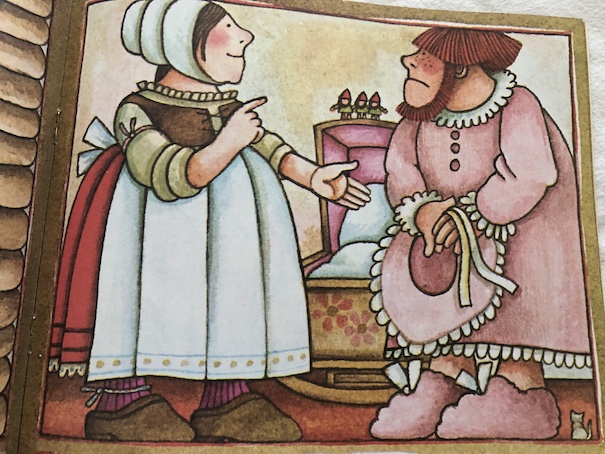
She quickly does a special charm to bring them success, and then, she begins setting the scene for the trick they’re going to play on Cucullin. She makes up a giant cradle and makes her husband dress in baby clothes and sit in the cradle. It’s ridiculous, but Oonagh has a plan.
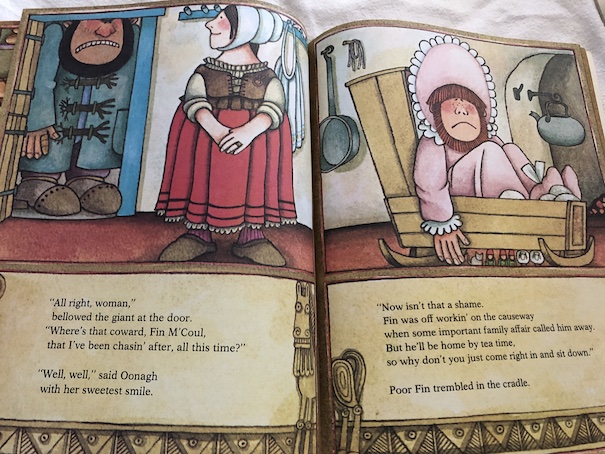
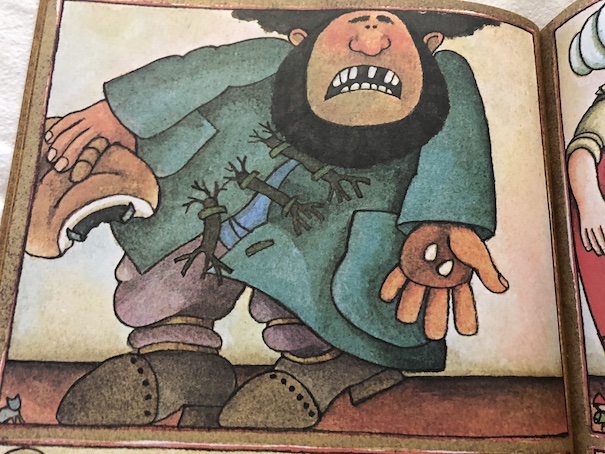
When Cucullin comes, Oonagh tells him that her husband isn’t home, but she invites him to come in and wait with her and her “baby.” Not only is the “baby” astonishingly large, even by giant standards, but Oonagh carefully convinces Cucullin of the baby’s unusual strength. She tricks him into thinking that the “baby” can eat bread and cheese that’s rock hard while giving Cucullin bread with a frying pan in the center and a real stone instead of cheese. Not only does Cucullin break his teeth on these things, but if Fin M’Coul’s “baby” can eat these things, how much stronger could Fin M’Coul be?
Oonagh’s tricks allow Fin M’Coul to get the upper hand against Cucullin and defeat him once and for all!
There is a brief section in the back of the book that explains a little about the background of the legend. I love the pictures in this version of the story. Tomie de Paola books always have fun illustrations, but if it weren’t for the little people and animals in the pictures with the giant characters, you might almost forget that the main characters in the story are all giants.
The book is available to borrow and read for free online through Internet Archive.
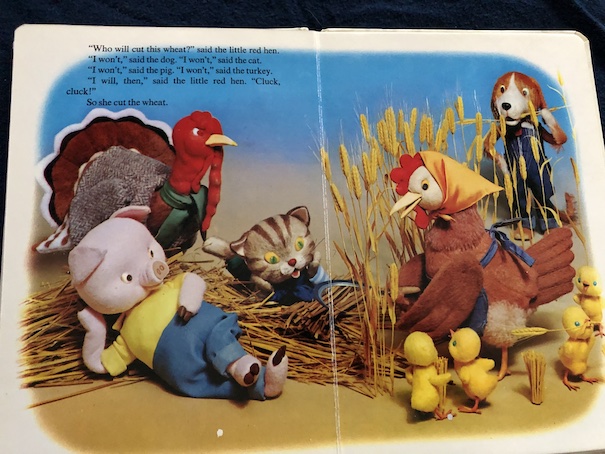
The Little Red Hen pictures by Tadasu Izawa and Shigemi Hijikata, 1968.
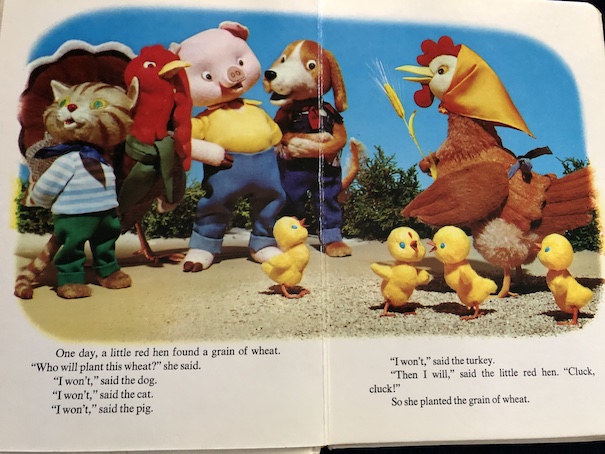
This cute picture book is part of a series of Puppet Storybooks. What makes it distinctive from other picture books is that the pictures are all photographs of tableaux with detailed puppets. The story is a retelling of the classic Little Red Hen folktale.
A hen finds a grain of wheat, but no one is interested in helping her plant it, so she does it herself. When it’s time to harvest the wheat, none of the other animals will help her, so she also cuts the wheat herself.
Because no one wants to help her, she takes the wheat to the mill to be made into flour and bakes it into bread all by herself.
When she has the nice loaf of bread that she has made, all of the animals who didn’t want to help before suddenly come to help her eat it. However, since none of them helped with making the bread, the Little Red Hen eats the bread herself with her chicks.
My Reaction
I’ve had this book since I was a little kid, and I always liked the pictures! The puppets are detailed and posed in realistic ways. The picture on the cover of the book is a 3D hologram, and I was fascinated by it as a young child. It was one of the first holographic images that I saw as a child!
(In my defense, I might not have been the one who scribbled crayon on that cover image. I was pretty good about not drawing on books when I was little, and most of my childhood books were used, so that scribble might have happened before I got it. I don’t remember anymore, so it’s hard to deny it completely, but according to my memory, my messy scribbles were done on the back wall of my closet, behind my clothes, because I knew that drawing on walls wasn’t allowed, and I was realized that if you’re going to draw on the wrong surface, it’s best to do it where nobody’s going to see it and complain. I was sneaky like that.)
While my copy of this book was printed in English, the books in the series were originally written, illustrated, printed, and bound in Japan. I never noticed that when I was a kid because I never bothered to look at the names of the illustrators and had no interest in where it was printed, but I found it interesting as an adult. It makes me think that there are probably also versions of this book written in Japanese, but I’ve never seen any.
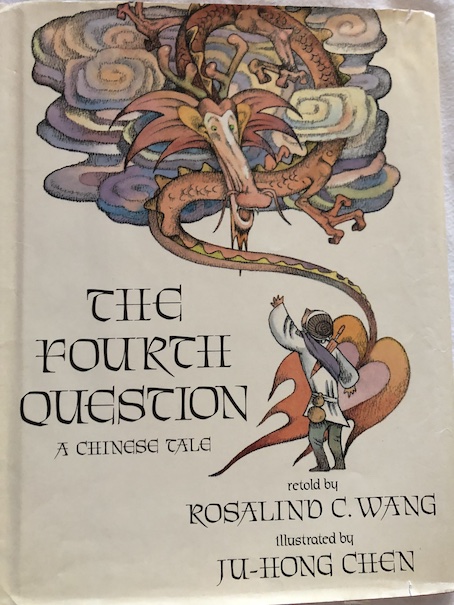
The Fourth Question retold by Rosalind C. Wang, illustrated by Ju-Hong Chen, 1991.
This is a retelling of a Chinese folktale.
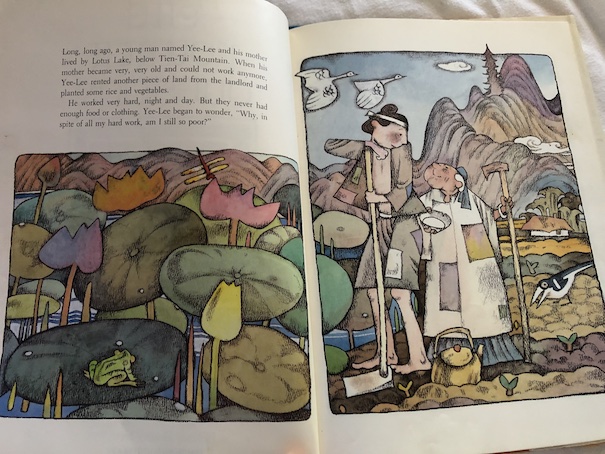
There was once a poor young man, Yee-Lee who lived with his mother. Even though Yee-Lee works very hard, he can barely make enough money to keep him and his mother alive. He wonders why he has so little money even though he works so hard and decides to go to the Wise Man of Kun-lun Mountain to seek the answer and his advice so he and his mother can have a better life.
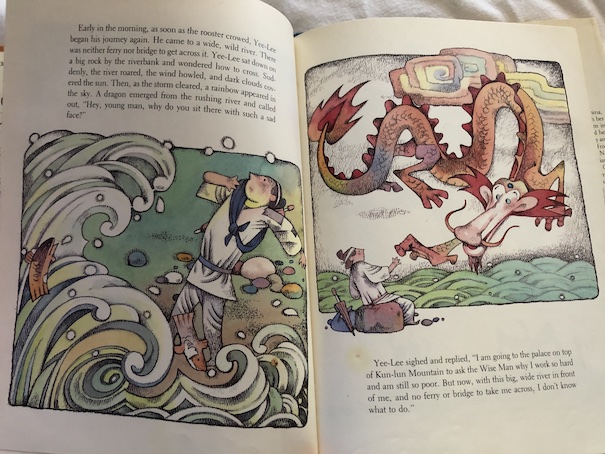
It’s a long way to reach the Wise Men, and along the way, he encounters other people who also needed help. A kind old woman who gives Yee-Lee some water and food has a daughter who is unable to speak and wants to know how to help her. An old man has a tree in his orchard that won’t bear fruit, and he can’t figure out why. A dragon who helps Yee-Lee to reach the mountain cannot manage to fly to heaven even though he has lived a good life. Yee-Lee has sympathy for all of these people and the dragon and appreciates the help they give him, so he promises that when he reaches the Wise Man, he will seek the answers to their problems as well.
However, when Yee-Lee finally reaches the Wise Man, he is told that he is only allowed to ask three questions during his visit. It’s a problem because Yee-Lee now has four questions to ask, the three that he promised to ask for others plus the original question that he wanted to ask for himself. He has to decide which of the questions will go unanswered.
Yee-Lee’s question is important to him, but when he thinks about the other people who are now depending on him to come back with answers for him, he reluctantly decides to forget his own question and answer theirs. However, in solving the problems of others, Yee-Lee finds the solution to his own problem. Like the heroes of other folktales, Yee-Lee is rewarded for his good deeds!
The book is available to borrow and read for free online through Internet Archive.
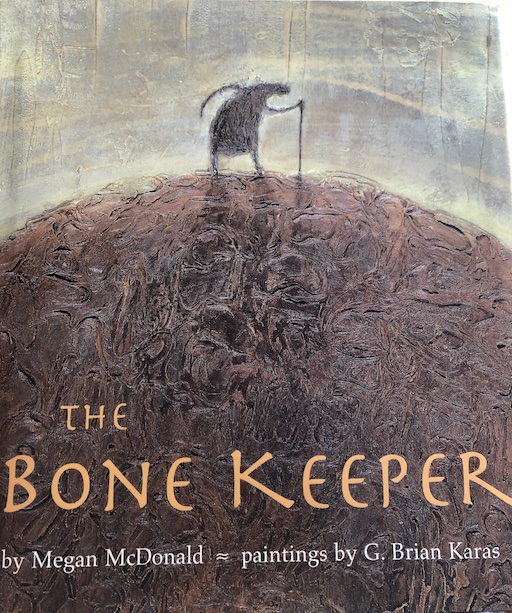
The Bone Keeper by Megan McDonald, paintings by G. Brian Karas, 1999.
The story in this picture book is written as an unrhymed poem and illustrated with paintings that resemble paintings on a cave wall.
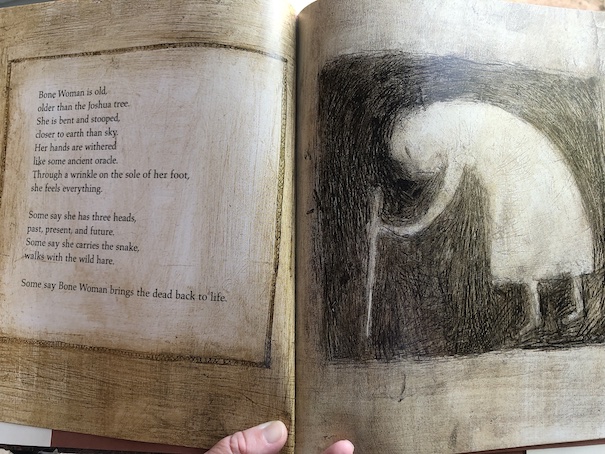
Bone Woman is a strange old woman. She is ancient, legendary, may have powers to bring back the dead, and lives in a cave full of bones.
She spends her time searching for bones in the desert sand. She collects the bones, studies them, and arranges them to form complete skeletons.
When she manages to complete a skeleton, she performs a ritual to bring the creature back to life!
The book is available to borrow and read for free online through Internet Archive.
My Reaction
This is one of those picture books that I think would actually be appreciated more by adults than by children. The poetry and art style seem more sophisticated than the styles that children seem to prefer. Most of the pictures are not very colorful, using a lot of grays and browns and black, although the art style is unusual and fascinating, looking like paintings and drawings scratched into rock.
I think kids could understand the action of the story – a strange old woman who lives in a cave collects bones, assembles them into skeletons, and can use them to bring animals back to life. It’s a strange story, partly because there is no explanation about why she is doing this.
One of my regrets about this book is that it doesn’t explain the background of this story. I had expected that there would be a section at the back of the book that would explain more, but there isn’t. From the context – the pictures, the style of the story, the names that the woman is called, and the fact that the artist thanked the Phoenix Public Library and the Heard Museum (both places that are familiar to me) in the dedication – adults can figure out that this is a story from folklore, but it’s not immediately clear what kind of folklore. Anyone who doesn’t already know the story might be confused. I didn’t know this story when I read the book, so I had to look it up.
The story of the Bone Woman has been told and referenced in other books. The story of La Huesera (the Bone Woman) is a Mexican folktale. Sometimes, it’s also called La Loba (the Wolf Woman) because that is the animal that she particularly wants to resurrect. The Bone Woman is a “wild woman” or a “crone” who uses a kind of natural magic to bring life to lifelessness and restoring what was lost.
The First Book of Tales of Ancient Egypt by Charles Mozley, 1960.
The book begins with a section “About this book” that introduces the stories, but I felt like it could have said a little more. The introductory section points out how amazing it is that these folktales and myths from Ancient Egypt have survived thousands of years to reach us, but there’s a bit more to the story than that. For a long time, people were unable to read texts written in Ancient Egypt because knowledge of ancient writing was lost when Egyptian culture changed and developed new writing systems. Modern people eventually regained the lost knowledge of Ancient Egyptian writing when the Rosetta Stone was discovered because the Rosetta Stone contains the same message written in three different systems of writing – Ancient Greek, Ancient Egyptian hieroglyphics, and Ancient Egyptian demotic script. Because European scholars knew Ancient Greek at the time the Rosetta Stone was discovered, they were able to use the Ancient Greek portion of the stone to learn how to read the rest of it. It took years of study for them to fully understand not only the message on the stone in all three writing systems but to learn to apply the rules of Ancient Egyptian writing to other messages and carvings and decipher what each of them meant. Even in modern times, scholars are still working on translations of Ancient Egyptian writing and publishing new books of Ancient Egyptian stories that modern people have not read in English. It’s not just that these stories have survived for thousands of years to reach us; it’s also that people worked very hard to learn exactly what did survive for those thousands of years and make it possible for ordinary people to understand it. This book for children would not have been possible without many years of scholarly research.
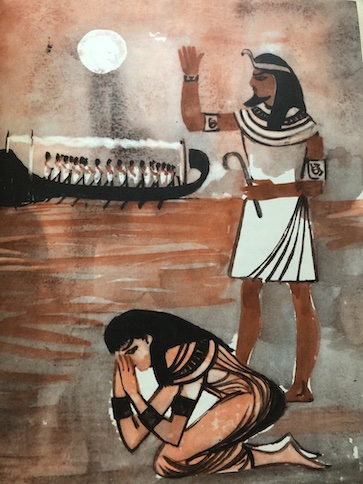
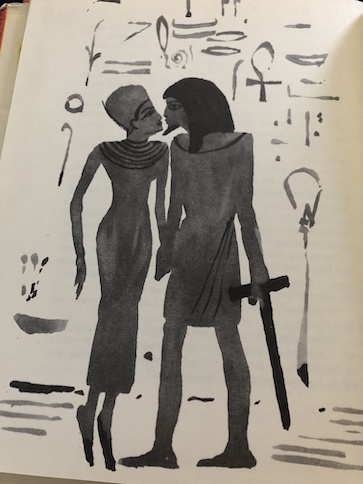
The pictures in the book are sometimes monochromatic in different colors and sometimes full color.
The book is available to borrow and read for free online through Internet Archive.
The stories in the book are:
The Magic Crocodile – When King Khu-fu is bored and nothing seems to please him, his sons tell him stories to amuse him.
In his first son’s story, in the distant past, during King Nebka’s reign, magic was commonplace, and King Nebka had a young magician named Uba-na-ner at his court. At first, the magician was very happy, but then, the woman he was going to marry ran off with another man. Angry, the young magician made a magical crocodile out of wax and sent it to attack his former fiance’s new husband. After the crocodile killed the new husband, the magician’s former fiance went to the kind and accused the magician of murder. Faced with the king’s questions, the magician confessed what he had done. The magician expressed remorse and turned over the box where he kept the wax crocodile. The king pardoned him because of his remorse but hid the box with the wax crocodile so it couldn’t be used again. That seems to be letting a magical murderer off lightly, and King Khu-fu doesn’t find the story very interesting.
In the second son’s story, there is a powerful wizard named Zaza-man-khu in the reign of King Sene-fe-ru. When Sene-fe-ru is feeling down, he asks Zaza-man-khu for something to cheer him up. Zaza-man-khu suggests a boating trip on the palace lake, rowed by singing maidens. At first, the trip is pleasant, but then, something happens that upsets all of the maidens, and they stop singing and start crying. Soon, everyone is crying so hard that it’s difficult for the king or his wizard to find out what’s wrong. It turns out that one of the maidens lost a precious jewel in the water, and it was some kind of lucky amulet. Now, she’s worried that something bad will happen to her, and all of the other girls are crying in sympathy with her. The king promises that he will give the maiden plenty new jewels if she stops crying, but she says that she needs that particular amulet, and none of the other maidens will start rowing the boat again until they figure out what to do. The king’s wizard is able to retrieve the lost jewel by parting the waters in the lake so he can walk out across the bottom of the lake and find it. King Khu-fu finds the story mildly interesting and says that it would be impressive if there was such a wizard in their time.
King Khu-fu’s eldest son says that he knows of such a wizard, a man named Didi, who is supposed to be 110 years old. Interested at last, King Khu-fu says that he wants to meet Didi. According to stories about Didi, he can restore life to a person or animal after it’s been beheaded, but how far will they make him go to prove it?
Isis and the Secret Name of Ra – This story explains the origins of the goddess Isis. In the beginning, Isis is not a goddess but a clever young woman. Although she is clever and has extensive magical knowledge, it isn’t enough for her. She wants to learn the secret name of the sun god Ra (Ra isn’t the secret name itself) to gain power over the whole world. People call Ra by many different names, but Isis is aware that he has one secret name that no one knows and from which he derives his power. Isis creates a magical snake that bites Ra, and Ra experiences pain for the first time. Isis offers to help heal him from the bite (that she caused), but she says that she needs to know Ra’s secret name. Ra says that if she knows the name, she will also become immortal, and Isis says that she’ll try to bear it (wink, wink). So, Isis becomes immortal and heals Ra from the poisonous snake wound.
After she becomes a goddess, Isis continues living as a mortal woman for awhile, but then she marries King Osiris. Osiris is a great king who teaches his people how to farm, and Isis teaches them healing arts. Their kingdom is great and peaceful, and Osiris and Isis have a son they name Horus. For a long time, no one, not even Osiris, knows that Isis is actually an immortal goddess. However, Isis’s powers allow her to sense evil and deception from Osiris’s jealous brother, Set. Osiris can’t believe that his brother is evil. Then, Set tricks Osiris into getting into a chest and throws him into the river and drowns him.
When Isis realizes what has happened, she realizes that she has the power to restore Osiris to life. At first, Isis is unsuccessful in her attempt to bring Osiris back to life because too much time has gone by since his death, but Thoth, the god of wisdom, has pity on her and Osiris and raises Osiris to serve as king of deserving spirits among the dead.
King Setnau and the Assyrians – King Setnau is a gentle and peaceful king, so even though Egypt has enemies, he does not try to improve Egypt’s army. Although most citizens love King Setnau, his generals don’t. When the King of Assyria decides to invade, seeing Egypt as easy prey, the angry Egyptian army refuses to obey the king and fight for Egypt. In despair, King Setnau prays at the temple and then tells his people about the army’s refusal to obey him. The ordinary citizens decide that they will be the king’s new army themselves. They are untrained and have mostly improvised weapons, and Egypt’s official army doesn’t take them seriously. However, King Setnau is appreciative of their loyalty and prays the he will be a suitable leader to them so they can save their kingdom. In the end, they are successful with a little help from the gods and a swarm of field mice.
The Wonder Child – King Usi-ma-res has a son who is a wise sage, Sat-ni. However, Sat-ni is unhappy because he and his wife have been unable to have a child, and they want one more than anything. Sat-ni’s wife prays for a child, and finally, she gives birth to a son, Se-Osiris. Se-Osiris turns out to be remarkably intelligent and learns very quickly. As he progresses in his studies, he begins learning magic, and by the age of twelve, he is already a master magician.
One day, a man from Ethiopia comes to the pharaoh’s court with a challenge: he has a sealed book and he wants to see Egyptian wizards attempt to read the book without breaking the seal. The pharaoh consults with all of his wizards and magicians about the book challenge, and Sat-ni says that he suspects that the book and its contents are protected by some kind of spell that will prevent the Egyptian wizards from reading it. However, Se-Osiris insists that he can read the book. To demonstrate, he proves to his father that he can read any book from his father’s library even though he has never seen it before while his father holds it sealed in another room. Pleased and amazed with his son’s skill, Sat-ni brings Se-Osiris to court to answer the challenge.
At first, the Ethiopian man sneers at the young boy who claims that he can answer his magical challenge, but the pharaoh says that it’s a sign of how great Egyptian magic is that even a twelve-year-old Egyptian can answer any challenge that Ethiopia could set. In front of everyone, Se-Osiris reads the book without even touching it, telling an ancient story about three Nubian magicians and their boasting of the ways that they would punish the King of Egypt for the amusement of their king and how the King of Egypt gets revenge.
However, the story doesn’t end there. The mysterious Ethiopian turns out to be the spirit of one of the magicians from the story in the book, who was disgraced through the magic of the Egyptian magicians and who has come back to settle the score. Se-Osiris must now face him in a magical duel.
The Thief and the King’s Treasure – King Rhamp-si-ni-tes loves gold and treasure more than anything. He loves it so much, he allows criminals and corrupt official to buy their way out of trouble. The king compromises law and justice in the land, thinking only of getting more gold and jewels. He neglects the state of his kingdom and even his own daughter. Soon, the king also becomes paranoid, constantly afraid that someone might take some of his beautiful treasures. Finally, the king hires an architect to design a safe place to keep his treasure, a vault no thief could enter.
However, the king is a terrible ruler and also a dishonest man. He pays the architect only a fraction of the money he promised him, so the architect clever engineers a secret entrance to the treasure vault so he and his sons can enter any time they want and help themselves to the money that the king owes them and all of his other subjects.
For awhile, it works, but then, the king notices that someone has been taking some of his treasures. He has some metal workers build a terrible mantrap that traps one of the architects sons. When it becomes clear that he is hopelessly trapped and their whole family may suffer the king’s wrath once he realizes who has been stealing from him and how it was done, the trapped son tells his brother there is only one, terrible solution – his brother must cut off his head. The trapped brother will die anyway because the king will have him killed, but if his brother removes his head, no one will be able to identify him, and the rest of their family will be safe. Reluctantly, his brother does as he asks.
However, the fact that the head was removed from the body tells the king that the dead thief must have had a confederate. He has his guards display the body of the thief publicly on a hill and watch for anyone who shows grief at seeing it. The dead man’s mother quietly grieves at the loss of her son, and when she says that she wants to see her son properly buried, his brother figures out a clever way to retrieve the body.
The king is enraged, but his neglected daughter decides that she also wants to find the thief, seeing it as her chance to secure her future in spite of her father’s neglect. She promises her father that she can find the thief but only if he promises her that she can have whatever she wants afterward. The king promises, not realizing that the one thing that the princess wants is to marry the thief.
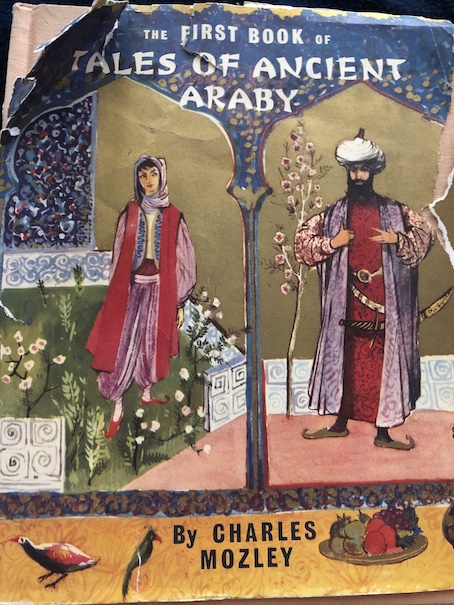
The First Book of Tales of Ancient Araby by Charles Mozley, 1960.
I’ve had this book for years, and one of the questions that I’ve had about this book is why is it Ancient “Araby”? Why “Araby” instead of “Arabia”? According to Wikipedia, “Araby” is an archaic name for Arabia, which explains it, I guess. This book was published in 1960, and I don’t think people were using “Araby” back then, but the book is trying to sound ancient.
The stories in the book are based on those from the collection of folktales called One Thousand and One Nights, in which Scheherazade tells stories to the murderous king who is her husband, but they’re simplified for children. The introductory section to this book says that . The book doesn’t explain, but the original stories in the book were rather racy.
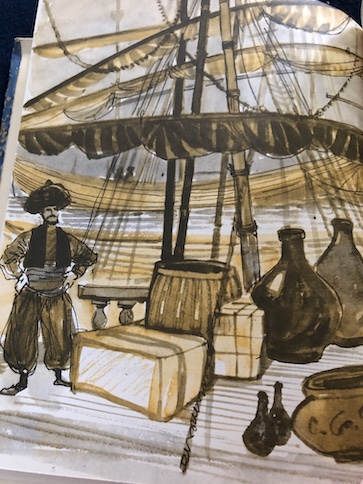
The book has pictures for each story, but some are in black-and-white, some are monochromatic with a color other than black, and some are in full color.
The book is available to borrow and read for free online through Internet Archive.
The book contains the following stories:
Scheherazade – When the sultan’s wife betrays him, he not only has her executed but loses his mind with hatred for all women because he believes that they are all untrustworthy. He begins a murderous series of weddings, where he has his wives all executed the day after the wedding, so they can never betray him. (It’s dark stuff, but this story wasn’t originally intended for children). All of the unmarried women in the kingdom are terrified that they’ll be next, and the sultan’s vizier is beside himself because he doesn’t know how to stop the sultan and has an obligation to obey the sultan’s commands to bring him new brides. Then, his eldest daughter, Scheherazade, requests that her father send her to the sultan as his next wife. At first, the vizier doesn’t want to send her because it’s certain death to marry the sultan, but Scheherazade tells him that she has a plan to put an end to the weddings and executions. Every night, she starts to tell a story but leaves it unfinished, so the sultan keeps putting off her execution to hear the end of the story. This continues for 1,001 nights, until the sultan realizes that he’s actually happy with Scheherazade and no longer has any desire to execute her or any other woman. The rest of the stories in the book are among the ones that Scheherazade told the sultan. (The Scheherazade story is a frame story, a story that contains other, internal stories or creates the basis for the other stories.)
Aladdin and the Wonderful Lamp – A poor boy and his widowed mother are approached one day by a man claiming to be the brother of the widow’s dead husband, the boy’s uncle. At first, he is very nice to them, bringing them to live with him and providing them with everything they need. However, one day, he stakes the boy, Aladdin, to retrieve a strange old lamp from a series of treasure caves, giving him a ring to protect himself. Before the boy returns to the man, he comes to the realization that the man isn’t really his uncle but an evil magician who is just using him to get the lamp. The boy and his mother discover that there is a genie living in the lamp who will do their bidding and provide them with all they need. They use the lamp not only to provide for themselves but to make it possible for Aladdin to marry a princess. The evil magician almost ruins everything when he tricks the princess into giving him the lamp, but Aladdin and the princess get it back through some trickery of their own.
Ali Baba and the Forty Thieves – Ali Baba marries a kind but poor woman and makes his living as a woodcutter, while his brother, Kassim, marries a disagreeable woman from a wealthy family and becomes an wealthy merchant. One day, while cutting wood in the forest, Ali Baba sees a large group of horsemen. They are robbers, and they have a secret hideout nearby. Ali Baba hides and watches how they open the entrance to their secret cave with the magic words “Open, Sesame!” After the thieves stash their loot and leave, Ali Baba realizes that he can use their secret words to enter the cave himself and see what they left. He helps himself to some of the stolen loot. He and his wife decide to stash the second-hand loot and spend it a little at a time, ensuring their family’s security. However, Kassim’s wife finds out about their loot and tells Kassim, and Kassim damands that Ali Baba tell him where he acquired so much money. When Ali Baba explains about the thieves and the treasure cave, Kassim wants to go there and loot the place himself, but Ali Baba thinks it’s too dangerous to go back again because the thieves will be angry and will probably kill them if they get caught. When Kassim goes anyway and is caught and killed, Ali Baba must arrange a deception to prevent the thieves from learning who Kassim was and everyone else from learning how Kassim met his death so the thieves won’t take revenge on the rest of the family with the help of a clever slave girl, Morgiana.
The Fisherman and the Genie – A fisherman pulls a strange bottle from the sea that contains a genie, but to the fisherman’s shock, the genie threatens to kill him when he frees him from the bottle. The fisherman asks why he would do such a thing when the fisherman did him a favor, and the genie explains that he was imprisoned in the bottle by King Solomon for sins against Heaven. At first, the genie thought that he would reward whoever freed him, but as his imprisonment grew into hundred and hundreds of years with no rescue, he became increasingly enraged and decided to kill whoever released him. However, the genie decides to grant the fisherman one wish before death. The fisherman asks him to prove that he can actually fit into the bottle and imprisons the genie there again. He refuses to let him out again until the genie swears he won’t kill him. The genie promises the fisherman anything he wants, but the fisherman is a modest man and only asks that he always be successful as a fisherman. He gets his wish, and he uses the money he acquires from his success to build a better life for his family.
Sinbad the Sailor – When Sinbad’s father dies, he leaves Sinbad a considerable amount of money, but Sinbad quickly squanders most of his inheritance. When he realizes his foolishness, Sinbad uses what he has left to set himself up as a merchant sailor. However, this decision takes him on a series of wild adventures, from being nearly drowned to befriending a king to a hair-raising encounter with a roc (a giant bird that’s big enough to carry a grown man).
The Twice-blessed Arab – This is a legend about the origins of horses and camels.
The Story of Little Mukra – Little Mukra is a dwarf, and his father, fearing that the rest of the world will laugh at him and treat him cruelly for his size, hides him for his early life. When Little Mukra is sixteen years old, his father dies and the rest of his relatives declare that they don’t want him, so Little Mukra decides to go out and seek his fortune. One day, while Little Mukra is hungry, he hears an old woman calling for someone to come to eat. It turns out that she’s talking to her cats, but he persuades her to let him eat with the cats because he’s starving. The woman hires him as a servant to take care of her cats. It gives Little Mukra a place to live, but the problem is that the woman blames him for damage that the cats cause while the lady isn’t looking. The clever cats are always perfectly behaved when she’s watching but not when they’re alone with Little Mukra. Little Mukra escapes this situation with the help of the lady’s dogs, who are not so pampered as her cats and reveal to Little Mukra a paid of magical slippers that can make him run fast, securing him a position as the king’s special courier.
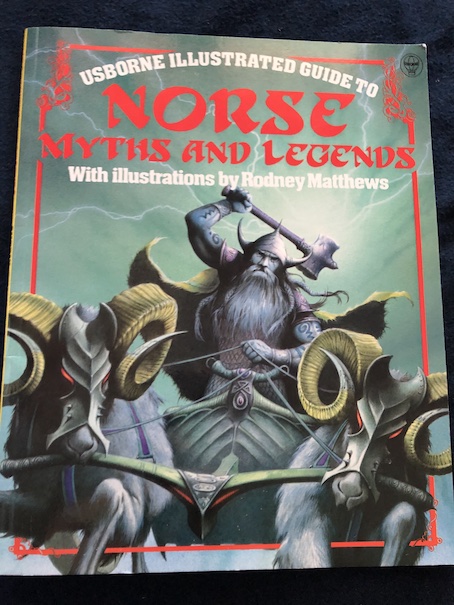
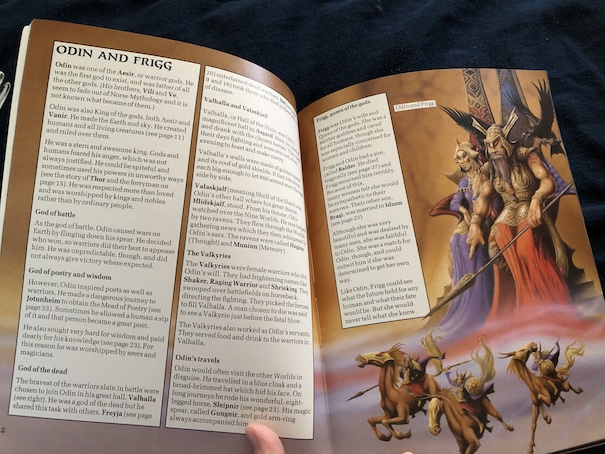
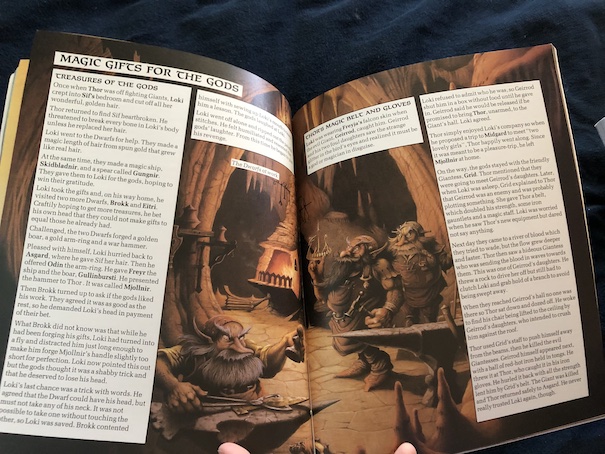
Usborne Illustrated Guide to Norse Myths and Legends by Cheryl Evans and Anne Millard, illustrated by Rodney Matthews, 1986.
I like this book because, before it begins telling the myths and legends, it first gives an introduction to the history, territory, and religion of the Norsemen. By “Norsemen“, the book means not only people living in Norway but Scandinavians and people of Scandinavian descent speaking related languages and living in various areas across Europe. The Norsemen include, but are not limited to, the Vikings, who were specifically seafaring traders, mercenaries, and pirates/looters as opposed to farmers and fishermen.
There is still much about the history of the ancient Norsemen that we don’t know because, for much of their history, they did not have their own system of writing and relied on oral stories for passing down historical and cultural knowledge. The Norse myths were originally oral stories before they were written down. The introduction also explains that there is one myth in the book, the story of Sigurd and the Nibelungs, that was originally a German legend but was later adopted by Scandinavians.
Norse mythology is somewhat unusual because, while Norsemen were polytheistic, like other ancient groups, and their gods and goddesses had human emotions and relationships, like the gods and goddesses in Greek and Roman mythology, Norse gods were not immortal. Norse gods could be killed, like human beings, which meant that any risks they took had genuinely serious stakes for them. In fact, the legends predict that, at a future, world-ending event known as Ragnarok, most of the gods will be killed.
Although this particular book doesn’t mention it, the qualities of Norse gods being able to perform incredible deeds while still being mortal makes them rather like our modern concept of a superhero. Thor and Loki were both made into comic book characters by the time this book was written, and characters and events in Norse mythology have helped to form the 21st century Marvel Cinematic Universe.
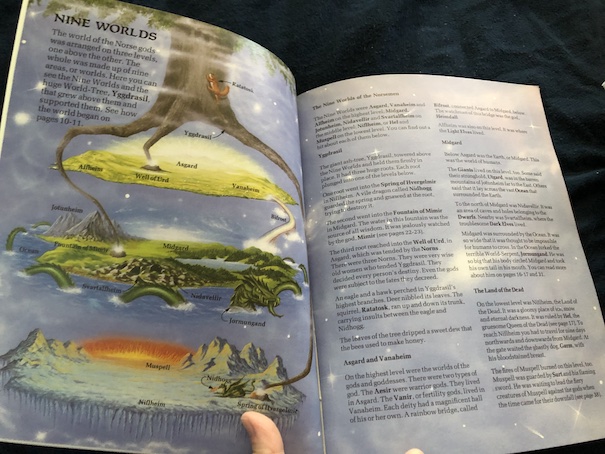
In Norse mythology, the gods and goddesses lived in a multilevel universe made up of nine lands or “worlds.” The highest level of their universe contained Asgard (home of the warrior gods), Vanaheim (home of the fertility gods), and Alfheim (home of the light elves). The middle level contained Midgard (our world, where humans live, connected to Asgard by a rainbow bridge), Jotunheim (home of the giants), Nidavellir (home of the dwarves), and Svartalfheim (home of the dark elves). The lowest level held Niflheim (land of the dead, dark and icy, ruled by a fearsome queen named Hel) and Muspell (where the creatures who will attack the gods at Ragnarok live). All three levels of this universe were kept in place by the roots of a giant ash tree called Yggdrasil.
The book has pages dedicated to specific gods and goddess, explaining their histories and roles in Norse mythology. Odin, for example, was the king of the gods, who created the world and humans and was the father of the other gods. His wife’s name was Frigg, and she was a mother goddess figure. Thor was the thunder god and the god of law and order. Unlike other gods, he mostly relied on his strength instead of magic or tricks, but he did have magic weapons, including his hammer, Mjollnir, which would always strike its intended target and return to Thor after. Freyja was one of the fertility gods, and she was the goddess of love and beauty. She later also became a goddess of death and was responsible for starting wars among humans. Loki technically wasn’t a god because his parents were fire-giants, not gods, but he was a close friend and sworn brother to Odin, so he was able to live in Asgard, too. Loki is known for being a trickster figure.
After the book profiles some of the gods and goddesses and other notable figures in Norse mythology, it tells some of the myths and legends associated with theses figures. One story that particularly interests me is “The Curse of the Ring” because this story and other aspects of Norse mythology provided some of the inspiration for Tolkien’s Lord of the Rings. Before it inspired Tolkien, this same story was also made into an opera by Wagner.
In “The Curse of the Ring”, Odin, Loki, and Honir kill an otter who turns out to be the son of a magician who sometimes turns one of his sons into an otter to go fishing for the family. (Maybe not the safest choice of fishing methods.) The gods offer to compensate the magician with enough gold to fill the otter skin. Loki goes to get the gold from a dwarf named Andvari, who has a famous hoard. Andvari has no choice but to give Loki the gold he wants, but Loki notices that Andvari also has a gold ring on his finger, and Loki demands that Andvari give him the ring, too. Angry at having his ring stolen, Andvari curses the ring so that it will bring misery and destruction to anyone who wears it. When Loki brings the promised gold to the magician, the magician also sees the ring and wants it. Loki warns him about the curse on the ring, but the magician insists that he wants it anyway.
The curse on the ring comes true when one of the magician’s other sons, Fafnir, kills his father for his gold. Fafnir takes all of the gold instead of giving his other brother, Regin, a share of the inheritance and turns himself into a dragon so he can protect his hoard of gold from anyone who tries to take it. Regin raises their nephew, Sigurd, to kill Fafnir and avenge his grandfather. However, the curse of the ring and the gold doesn’t end there. Regin tries to kill Sigurd so he won’t have to share the gold with him, and Sigurd has to kill him in self defense. After Sigurd rescues a Valkyrie named Brynhild, and they fall in love, they both fall victim to treachery from Queen Grimhild of the Nibelungs. Wanting Sigurd’s gold, she gives him a love potion that makes him fall in love with her daughter, forgetting about Brynhild. Queen Grimhild’s son also wants to marry Brynhild. Abandoned by her lover, Brynhild marries him, but driven mad with by Sigurd’s abandonment of her, Brynhild arranges for Sigurd to be murdered and then kills herself, setting off a continuing chain of murder and revenge after her own death that destroys the royal family of the Nibelungs.
The book ends with a “Who’s Who” section with information about various characters and creatures in the Norse myths.
The book is available to borrow and read for free online through Internet Archive.
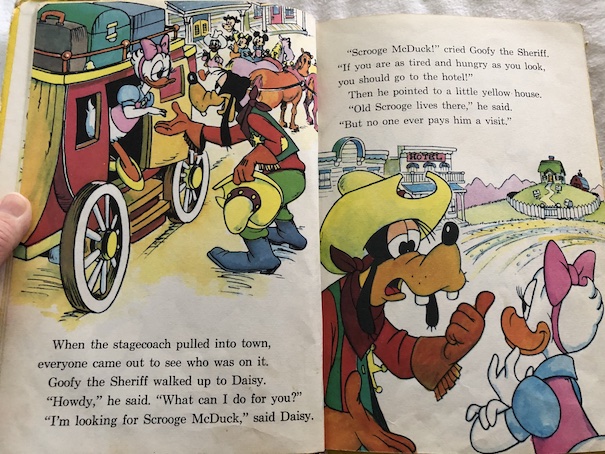
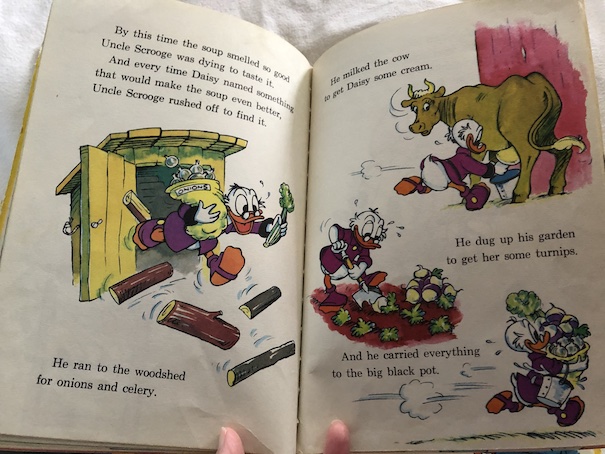
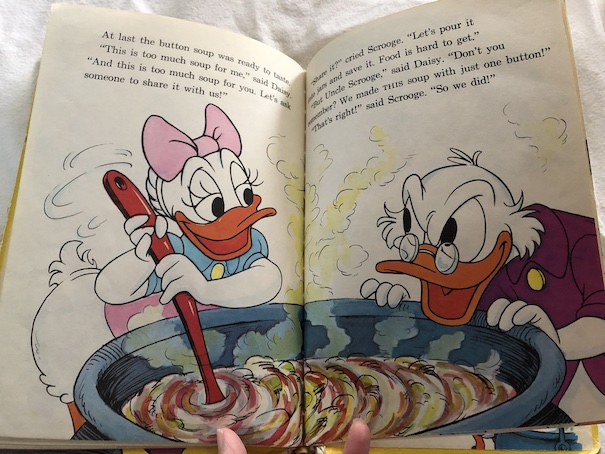
This is a retelling of a traditional folktale, sometimes called Button Soup and sometimes Stone Soup. The basic story is the same, but sometimes, it uses a stone and sometimes a button. All of the characters in this particular version of the story are represented by Disney characters.
Scrooge McDuck’s niece, Daisy, is coming to visit him. The Sheriff welcomes her when her stagecoach comes into town, but seeing how tired and hungry she is, he warns her that she’s not going to find much comfort at her uncle’s house because Scrooge is stingy. However, Daisy says that she is sure she can handle Uncle Scrooge.
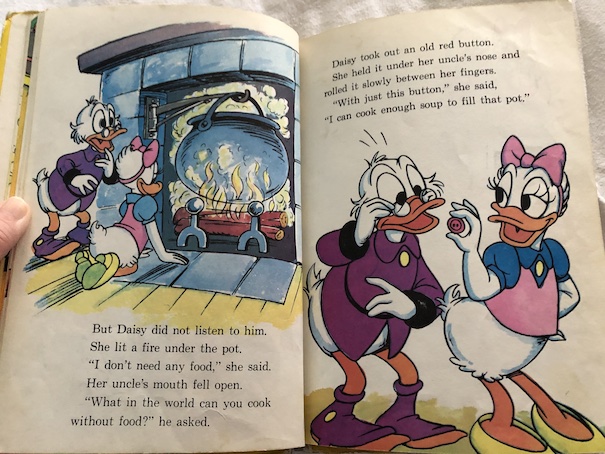
When she gets to Scrooge’s house, he’s not happy to see what he has unexpected company and tries to deny that he has any food to share. Daisy knows that Scrooge isn’t really that poor, so she takes out a big pot and begins making soup. Scrooge asks her what she’s planning to cook without food, and Daisy claims that she can make a whole pot of soup with just one button.
Scrooge is curious to see what Daisy’s button soup is like, so when she asks him for a little salt and pepper, he gives it to her. Then, she says that she once made the soup with an old soup bone, and Scrooge gives her a soup bone, too.
Each time that Daisy suggests another ingredient, Scrooge rushes to get it for her, eager to see what Daisy will do with the soup, which smells better and better as they go. (The pictures also show just how much food Scrooge is hiding. In reality, most of that would spoil before he could use it all, since he’s only feeding himself.)
When the soup is ready, Daisy points out that there is more than they’ll ever eat, so they should invite some other people to share it. Scrooge wants to save the soup in jars instead, but Daisy points out that it’s easy to make more because they did it with just one button.
They end up inviting the whole town to share the soup, and Scrooge is pleased that he has such a clever niece.
This book is available to borrow and read for free online through Internet Archive along with other versions of the story.
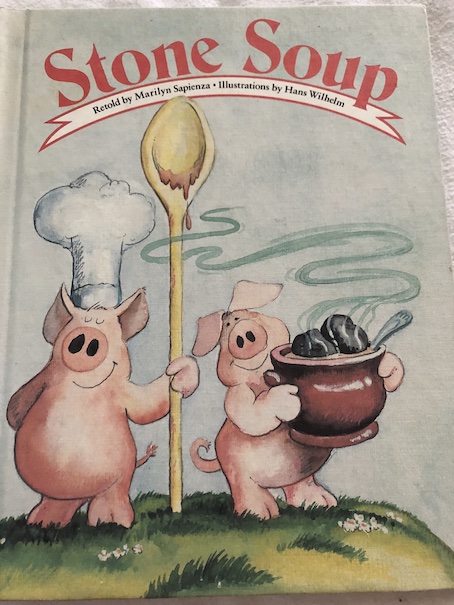
Stone Soup retold by Marilyn Sapienza, illustrations by Hans Wilhelm, 1986.
This is a retelling of a traditional folktale, sometimes called Stone Soup and sometimes Button Soup (and other names). The basic story is the same, but sometimes, it uses a stone and sometimes a button. All of the characters in this particular version of the story are represented by animals. Some of the pictures are in color, and some are black-and-white.
Max and Molly are backpacking across country, and they are getting tired and hungry when they spot a village. Hoping to get something to eat there, they decide to approach the villagers and ask for food.
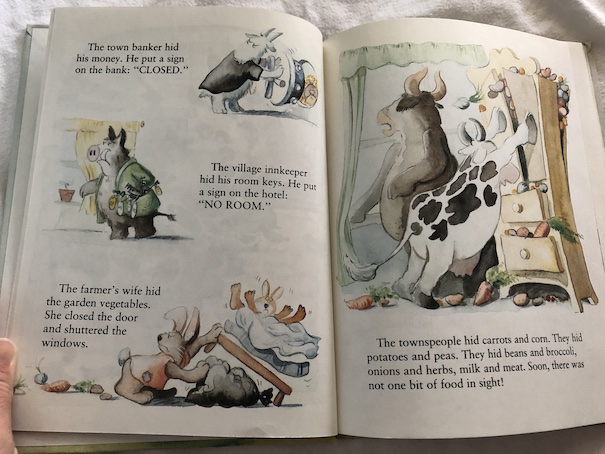
However, the villagers are not friendly, and the last thing they want is to share their food or anything else with strangers. As soon as they see Max and Molly coming, they quickly hide their food and anything else the travelers might want them to share. (I’m not sure why the innkeeper closes his hotel as soon as he sees potential customers coming. You can’t stay in the hospitality industry very long like that.)
When Molly and Max get into town, all of the villagers pretend like they’re starving and refuse to help Molly and Max. However, they see through the villagers’ act and come up with a plan of their own.
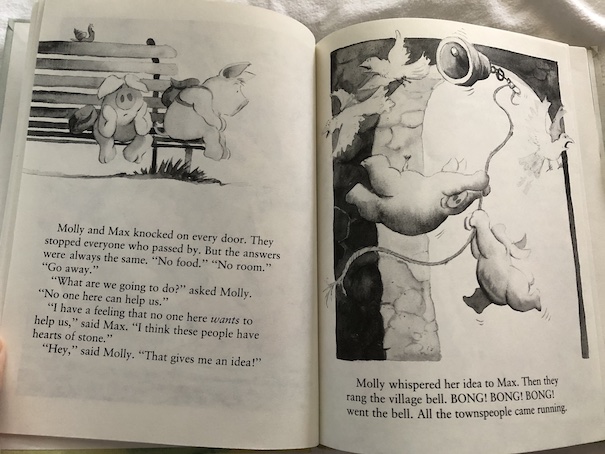
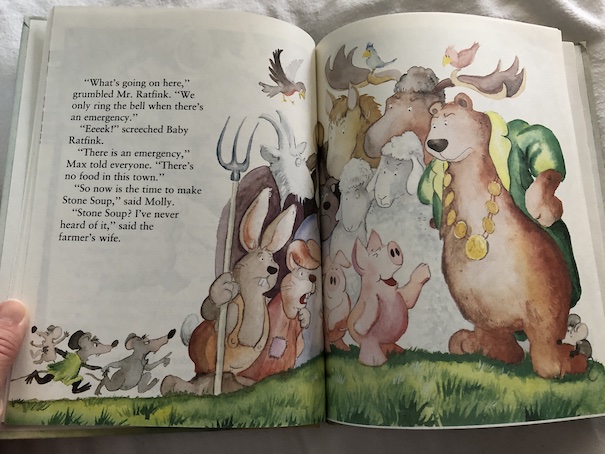
They ring the village bell to call of the people in the village. At first, the villagers are irritated because the bell is only for use in emergencies, but Molly and Max say that having no food is an emergency and that they have a plan to solve it. They are going to teach the villagers to make Stone Soup.
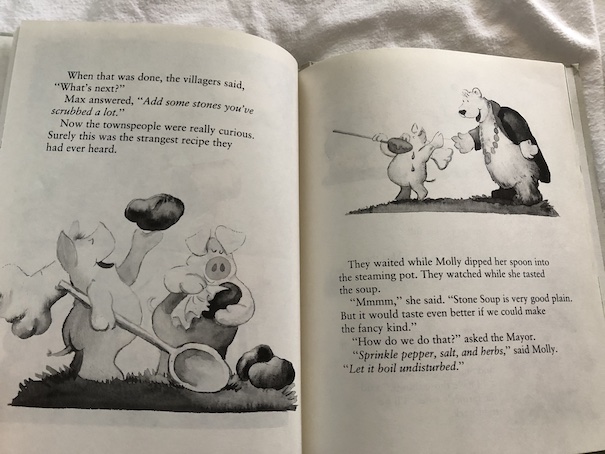
The villagers say that they’ve never heard of Stone Soup, and Molly says that it’s a secret recipe that she’s willing to share. It starts with a pot of hot water and some stones. Molly makes a show of tasting the “soup” and says that it’s good, but it’s even better if you make “the fancy kind.”
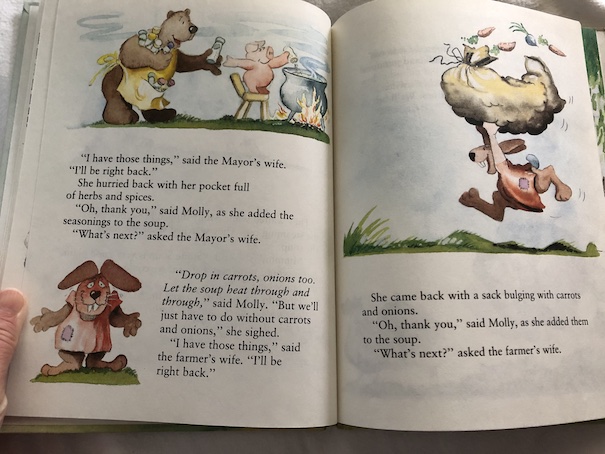
When the villagers ask how to make the fancy kind, she asks for some salt, pepper, and herbs. After the mayor’s wife supplies those, Molly asks for some carrots and onions. When she says that she supposes that they’ll have to do without them, the farmer’s wife steps up and offers some.
Little by little, Molly and Max coax the villagers into supplying other ingredients, almost without realizing what they’re doing. In the end, the Mayor of the village says that it’s the best soup he’s ever tasted, and it’s amazing, considering that it was only made with stones and water.
The moral of the story is that everyone benefits when people are wiling to share. Everyone gets a share of the soup, but when they start serving it, the villagers also provide other food to eat alongside it, and they all have a feast. The innkeeper gives Molly and Max a room for the night, and when they leave in the morning, they remind the villagers to “Share Stone Soup with everyone.”
In the back of the book, there is the complete recipe for Stone Soup, with rhyming steps. It doesn’t have details, like amounts and cooking times and temperatures, but I suppose someone could use these general guidelines to make an improvised soup. Really, I think the meat should be precooked if you’re adding it as a final ingredient. Otherwise, the veggies would be overdone before the meat is fully cooked.
There are many different versions of this story that have been made into picture books. I haven’t been able to find a copy of this particular book available to read online, but you can find various versions other versions of the same story online through Internet Archive.
The Elves and the Shoemaker story adapted by Lucy Kincaid, illustrated by Gillian Embleton, 1981.
I loved to read this folktale when I was a kid! This particular copy was made specifically for beginning readers with large type and a section in the back that shows key words in the story with little pictures to explain what they mean. Aside from my nostalgic associations with this book, I also really enjoy the detailed, realistic pictures.
There was a shoemaker who worked very hard but never seemed to get much money for the shoes he made. He and his wife are on the verge of starvation, and he only has enough leather to make one final pair of shoes.
Before going to bed, he cuts out the leather for the last pair of shoes, planning to sew them in the morning. However, in the morning, he discovers that someone else has already sewn the shoes together, and the shoes are very fine quality. The shoemaker has no idea who finished the shoes for him, but they did an excellent job, and he is able to sell them for enough money to buy food and enough leather for two more pairs of shoes.
Once again, he cuts out the leather for the shoes, and again, in the morning, he discovers that someone else has sewn the shoes together. The shoes are excellent, and he is able to sell them for enough to buy leather for four more pairs.
This continues night after night, and the shoemaker’s business begins to prosper, but he and his wife wonder who is helping them. One night, they hide and watch to see who will come to do the sewing. As they sit up, waiting, they see a pair of small elves who enter through the window and begin sewing the shoes together.
The shoemaker and his wife want to thank the elves for their help. Noticing that the elves are wearing ragged clothes and have no shoes of their own, they decide to make the elves their own sets of clothes and shoes.
On Christmas Eve, they put the elves’ new clothes on the table where the shoemaker usually puts the shoes that need to be cut and watch to see what the elves do. The elves are overjoyed to see the new clothes, realizing that they are presents for them. They immediately put the clothes on and dance around with happiness, singing that they don’t need to work anymore.
That is the last time the shoemaker and his wife see the elves, but the shoemaker’s business continues to prosper.
In the Harry Potter series, J.K. Rowling used the device of gifts of clothing ending a house elf’s service to a particular household, but she didn’t invent that concept. It was already a feature of folktales like The Elves and the Shoemaker, which was one of the folk tales collected by the Brothers Grimm.
This book is available to borrow and read for free online through Internet Archive. There are also many other versions of the same story.


























 Jestress's Forgotten Books and Stories