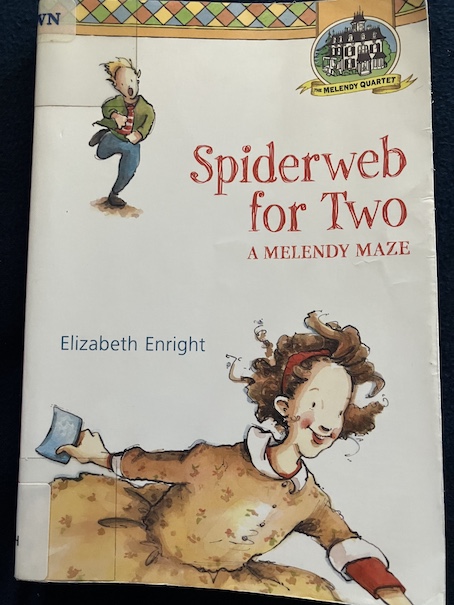
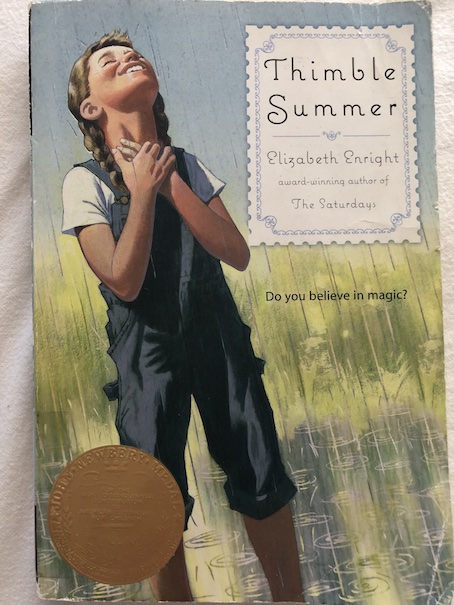
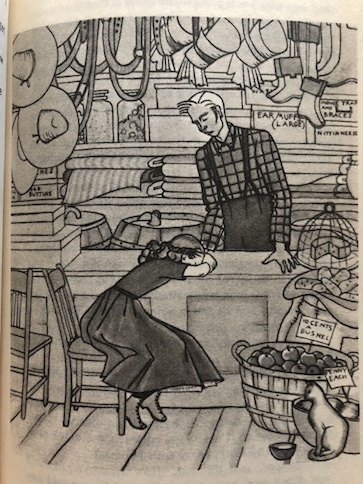
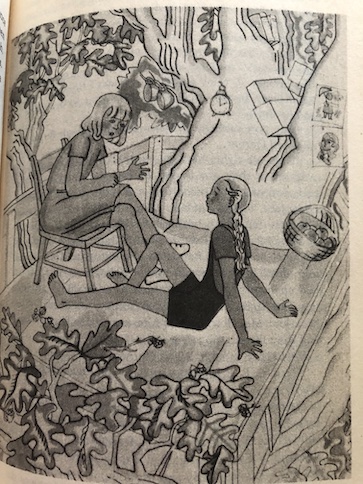
Randy Melendy is feeling morose because the three older Melendy siblings (Mona, Rush, and their adopted brother Mark) have all gone away to school. Rather than attending the local school as they used to, Rush and Mark have gone away to boarding school for the first time this year, and Mona is attending a school in New York City, where they used to live. Since Mona has started acting professionally on the radio, she’s been commuting back and forth from the family’s house in the country to her acting job in the city. This year, her father decided that, rather than continuing to commute back and forth, it would be best for her to remain in the city and go to school there, staying with a family friend, the wealthy Mrs. Oliphant, who is fond of the children. That leaves only Randy and her younger brother, Oliver, at the big Melendy house in the country, known as the Four-Story Mistake.
Since Randy is accustomed to having her very active siblings around her, always doing something interesting, Randy thinks that life is going to be boring and lonely from now on. She recognizes that the older siblings going away to school is just the first step in growing up and moving away from the family. She knows the next likely steps for them are college and marriage, and they will likely never really live all together again, at least not all the time. The housekeeper, Cuffy, tries to reassure Randy that she still has Oliver for company, but Randy isn’t reassured. Oliver is a few years younger than she is, and she doesn’t think they have much in common or much that they would like to do together. However, the two of them are about to be involved in a special shared adventure.
Cuffy sends Randy and Oliver to get the mail, and they are surprised to find an envelope addressed to the both of them in handwriting they don’t recognize. Inside the envelope is a poem that seems to be some kind of puzzle or riddle – the first clue to a treasure hunt! The mysterious letter writer tells them to keep it a secret, and the clue seems to point to a place where the shadow of a tree falls.
It takes Randy and Oliver a little time to decide which tree is supposed to cast the shadow, and their treasure-hunting is delayed by rain. However, when they dig in the correct spot, they find a tin box. Inside the box, there is a little golden walnut box with another clue. This time, the clue indicates that the next clue is being held by someone who loves them, although they don’t know it. It takes some effort for Randy and Oliver to solve this one. At first, they think it’s probably Cuffy or Willy, and searching their pockets or getting them to reveal what’s in their pockets without the kids explaining why they need to know is tricky. Eventually, it turns out that the next clue is hidden on the collar of Isaac the dog.
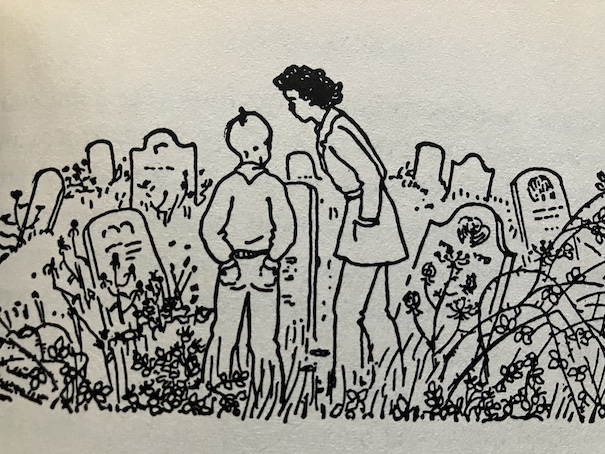
The treasure hunt continues in this way for the whole rest of the school year. The clues are written as poems on blue paper and send them various places around their own house, the houses of people they know, and various other landmarks, including a grave yard! Randy and Oliver figure out that this treasure hunt must be something their older siblings have created to keep them busy and entertained during their absence. The treasure hunt breaks off periodically when their siblings are home from school for Christmas before resuming after Christmas with another letter.
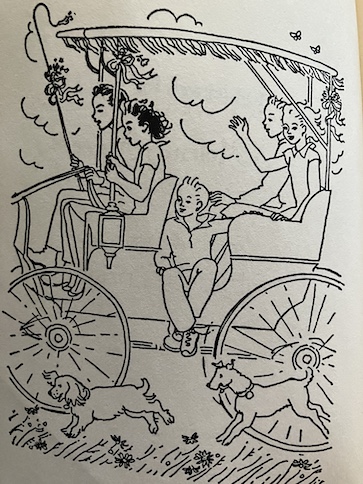
In between solving the riddles of the treasure hunt, Randy and Oliver do get to spend some time with their siblings. Over Christmas, the family decides to go caroling and visiting friends. For Easter, the girls make Easter bonnets, and Rush makes a special one for their horse. Randy and Oliver never discuss the treasure hunt with their siblings, though, because secrecy is part of the game.
Sometimes, Randy and Oliver get into trouble following clues, and sometimes, they accidentally make the hunt tougher than it has to be because they misinterpret where they’re supposed to go next. Eventually, the hunt leads them to a special surprise from an old family friend, and everyone shares in the surprise!
My Reaction and Spoilers
I liked the treasure hunt in this book because I always like books with treasure hunts that have riddles to solve and clues to follow. I’ve read other reviews of this book online, and other people remember this book fondly for the treasure hunt, although it does have a different feel from the other books in the Melendy Quartet, for several reasons. It’s partly because only two of the Melendy siblings are present for most of the story, although the others do appear sometimes and make their presence felt, even when they’re away. Readers will probably figure out before Randy and Oliver that their absent siblings have set up this treasure hunt for them to keep them busy and give them something to think about so they won’t be too lonely without the others.
This is also the only book in the series that doesn’t make references to WWII because it’s the only book in the series written after the war ends. The war wasn’t a main part of the plot of the other books, but it was always present in the other stories, with the children taking part in activities to help the war effort. The war also affected the attitudes of the children, making them want to do their parts for their family as well as their country. This book never mentions it once, and the focus is on how the children are growing up.
Randy knows that seeing her siblings go away to school is just the first step to them all growing up and moving away. When the older siblings come home for Christmas, they’re already showing signs that they’ve been doing more growing up during the few months they’ve been away from home. When Mona comes home for Christmas, she has a new haircut and is wearing lipstick, and Rush’s voice is starting to change. Eventually, Randy and Oliver will do these things, too, but for now, they’re the ones left behind as kids at home. Through their shared adventures with each other without their siblings, they grow closer to each other than they were before. Oliver was too young to join Randy and the older siblings on some of their previous adventures, but he is growing up, too, and he’s now able to join Randy in shared activities. During the course of their treasure hunt, they have adventures in the countryside, like the siblings did in other books.
Like other books in this series, there are also stories within stories. Sometimes, the main story departs from Randy and Oliver when other people tell them stories about exciting or interesting episodes from their own lives. This books has stories about how Cuffy saved a boy from drowning when she was young, their father’s search for a lost dog, and Mrs. Bishop remembering when she first noticed the patterns of snowflakes.
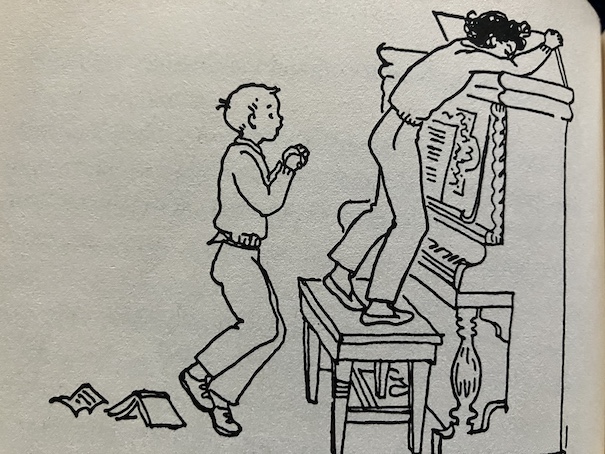
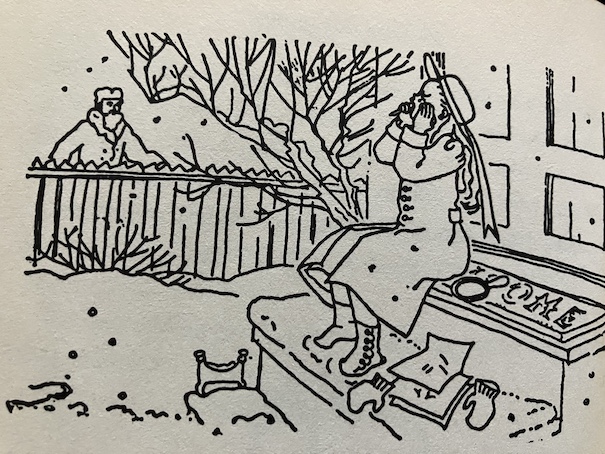
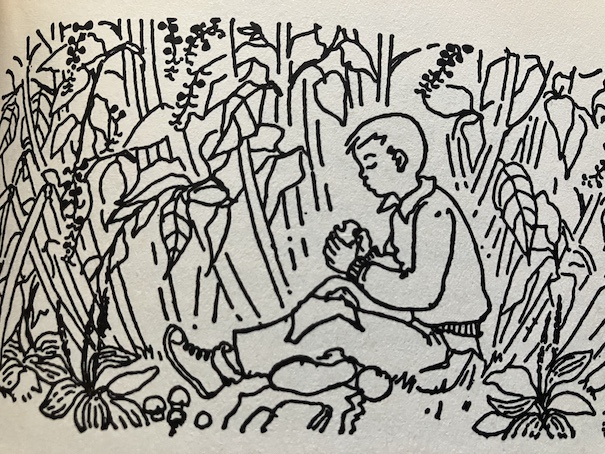
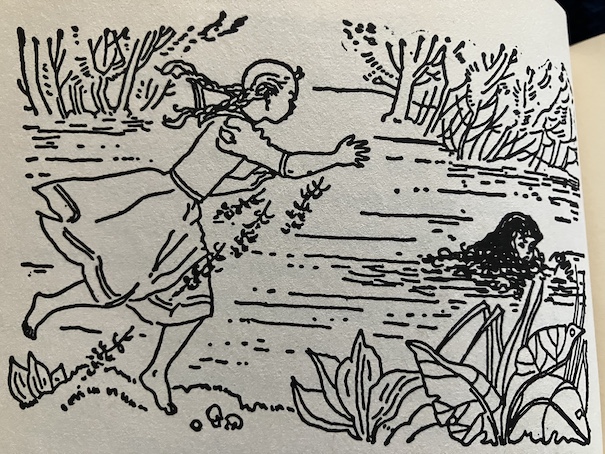
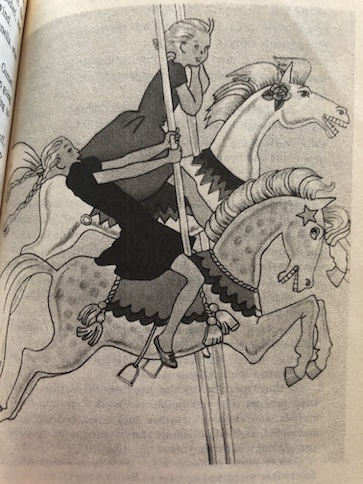
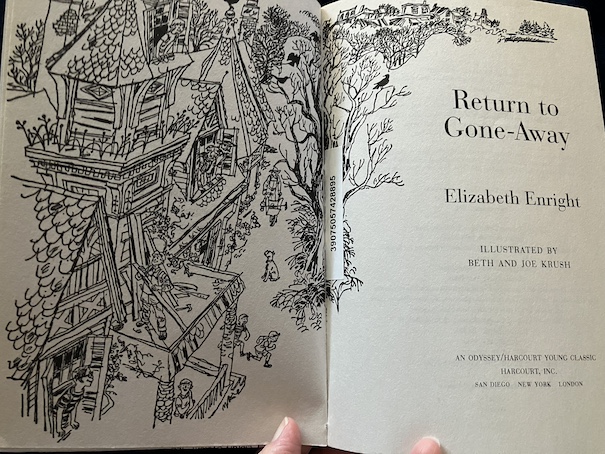
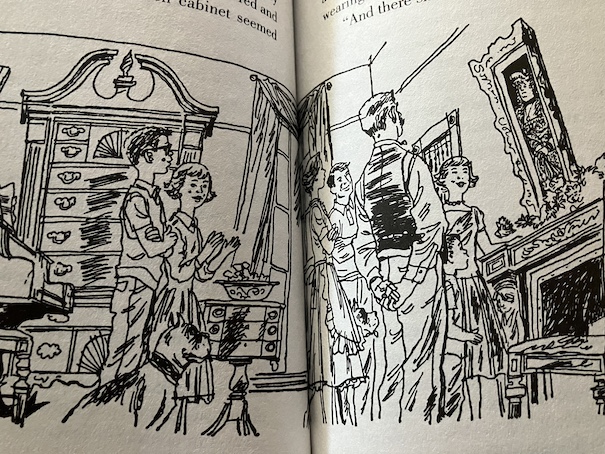
There’s only one full page picture in the book. The other illustrations are smaller ink drawings at the beginnings of chapters.
It’s summer, and the four Melendy children have some big plans! They’ve already started building a dam to make the swimming area on the property of their new house bigger. Their father, who travels frequently, giving lectures, tells them that he’s going to be away for most of the summer. He has to work hard to provide for his big family, and he has also taken a government job that will help the war effort. Mr. Melendy isn’t going to be a soldier because he’s a little old for that and the father of four children. He says that he can’t tell the children about his job, but it will keep him away in Washington for long periods of time. While he’s away, the children will be in the care of the housekeeper, Cuffy, and the handyman, Willy. They will also largely be left to entertain themselves, which is something they definitely know how to do.
Aside from swimming and enjoying themselves this summer, the kids decide that they should also do something useful, to help the war effort. Because of the war, patriotism is running high, and the children feel like they should take on some serious responsibilities. They’ve held events to help the war effort and bought bonds before. This summer, Rush and Randy decide that they’re going to go door to door, collecting scrap metal. Their collecting efforts help them to further get to know their neighbors, and they make friends with the Addison children and a nice, older man named Mr. Titus, who likes to spend his time fishing and baking things and invites the kids to join him sometimes.
However, there is a nasty man called Orin who yells at the children and scares them away when they come to ask him for scrap metal. Soon after this unpleasant incident, Rush and Randy meet Mark, the nice boy who lives with Orin. Mark is an orphan, and he lives with Orin because he’s a distant cousin. Orin’s wife was a nice lady, and Mark liked her, but she died a couple of years before. Orin is mean to everybody, and he mainly sees Mark as a source of unpaid labor on his farm. The Addison children, who know Mark from school, confirm that all of this is true. Orin doesn’t even let Mark go to school very often because he wants to keep him working most of the time. Their teacher and the school superintendent both tried to go see Orin and insist that Mark go to school regularly, but Orin is a violent and frightening man. He chased them both away and sent his mean dogs after them. Nobody really knows what to do about Orin, and most people are afraid to try. He also locks Mark in his room to keep him from running away, although Mark has found a way out and sneaks out sometimes.
The Melendy children feel sorry for Mark, although they try not to be too pitying so they won’t make Mark feel too self-conscious. Rush and Randy start meeting with him secretly to go swimming and fishing and hunt for arrowheads left by the Iroquois who used to live in the area. Rush and Mark also play at being soldiers on a secret mission and go stargazing. Mark knows about the constellations, and the boys watch the Perseid meteor shower in August.
Then, Mark reveals to Rush that Orin and his few friends are making illegal alcohol in a still. They do it because it costs less than buying alcohol. Orin’s friends include a couple of brothers who live in the woods and hardly ever come to town and a man who’s been suspected of bank robbery and murder although nobody was ever able to prove it. The boys spy on Orin and his friends at their still one night, and they hear Orin talking about selling his farm and maybe getting one of the new defense jobs. His friends ask him what he’ll do with Mark if he moves out, and Orin says that he’ll probably just turn him over to the county. One of his friends say that giving Mark to the county might not be so easy because they’ll ask questions, but Orin says he’s thinking of changing his name. The suspected criminal says that he might take Mark because he has trouble keeping workers around his place. Mark tells Rush that he’d rather run away that go live with that criminal, and Rush says that Mark can come stay with his family. The men almost catch the boys listening because the boys are wearing citronella to keep the mosquitos away, but the boys manage to get away before the men catch them.
Rush tells Mark that he’ll talk to his father to see if Mark can stay with the Melendy family or if he knows what else Mark can do. Then, a series of events happen that change everything. First, Cuffy has to go away for awhile to take care of an injured relative, leaving the children even more to their own devices, with Willy and the older children in charge. Then, the in the middle of the night, Rush wakes up to realize that something is on fire. It turns out that Orin’s farm is burning! Rush wakes Randy, and the two of them hurry down to Orin’s farm to see if Mark is safe. They find Mark hurrying to get the animals out of the barn, and neighbors and firefighters are already working on the blaze, but it’s a loosing battle. They manage to save the animals, but both the house and barn are destroyed. Willy, who was also there to help fight the fire, take the Melendy children and Mark back to the Melendy house. Later, Willy informs them that they have discovered that Orin was still in the house and was killed in the fire. (A short flashback informer readers, although the characters in the story don’t know it, that Orin accidentally started the fire when he returned home from his still, drunk, and passed out in the kitchen with a lamp too close to a wall calendar.)
Mark was never fond of Orin because Orin treated him badly, but without Orin, Mark’s custody is in doubt. Mark doesn’t have any other relatives. He’s still only 13 and not old enough to live alone. Rush decides to call his father to ask if Mark can live with them. Mr. Melendy tells Rush to keep Mark at their house for now, and when he returns home from Washington, he’ll straighten things out.
The Melendy children make Mark welcome at their fascinating house, the Four-Story Mistake, and Mark begins to enjoy all the new experiences they give him. He gets to try their books, enjoying classics like Tom Sawyer, Robin Hood, Eight Cousins, and various fairy tales. Mark also likes listening to Rush playing music on his piano. Above all, Mark gets the new experience of living with a family that really cares for him. Mark becomes part of the Melendy family’s idyllic summer, but the children worry about whether or not their father will allow them to stay with them permanently.
This book is different from the earlier two books in the series because, while the other adventures were all just treated as fun adventures without anything truly tragic happening when things go wrong, this book actually contains some serious issues. Mark is an orphan living with a violent and abusive guardian who frightens all of the local adults who have tried to intervene on Mark’s behalf. Mark’s guardian is also involved with some seriously shady people and illegal activities. The sudden death of Mark’s guardian frees him from the abuse but also leaves his future in doubt. This is the darkest book in the Melendy series. The book doesn’t shy away from Mark’s feelings and the sadness of Orin’s death, even though he was an awful person. Fortunately, because the tone of this series is optimistic, things work out for the best.
Of course, Mr. Melendy agrees that Mark can stay with the family, but in a realistic touch, adopting him isn’t as simple for the family as taking in a stray dog. Some of the local farmers offer Mark a place working on their farms, including the disreputable man and possible criminal who was one of Orin’s friends. Social service agencies want to know about the home and family Mr. Melendy has to offer Mark before they decide whether or not to allow Mark to remain with them, and a social worker comes to interview him. The social worker sees a taste of the family’s boisterous children and eccentric hobbies (at one point, Mona enters the room, practicing the part of Ophelia from Hamlet), but she is charmed by them and sees that Mark loves being with them, and she decides that the Melendy family will be good for him. There is extra legal work for Mr. Melendy to officially adopt Mark after Mark is allowed to stay with them as a ward or foster child, and the local bank is also interested in Mark’s custody because Orin had a mortgage on his farm, and there are financial issues to be arranged.
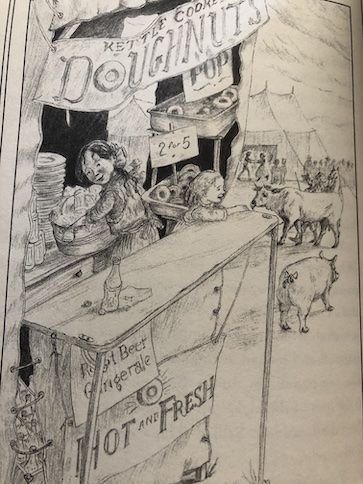
In the end, the bank claims Orin’s property because of the mortgage, but Mark inherits the animals because he’s Orin’s only relative. Mark keeps a few animals that can live on the Melendy property, and the Melendys help him sell the others in an auction held on their property. They turn the livestock auction into a fair to raise money for the war effort. Some of them make baked goods to sell, Mona dresses up as a fortune teller, and they hold a talent show with other children from school.
The element of raising money for the war effort continues a theme from earlier books in the series and emphasizes the point that this book was set contemporary to the time when it was written, during WWII. I find books that were written during major events and that take those events into account interesting because it shows how people felt about those events and what they wanted children to understand about them. The kids sometimes make references to the war in casual conversation in a way that seems realistic for a child’s observations, such as when they describe someone as having “teeth like a Japanese general”, although I know that what they’re probably referencing is anti-Japanese propaganda cartoons at the time rather than actual pictures of them. That isn’t mentioned in the story, but I’ve seen those cartoons before, so I can envision what kind of teeth the kids in the story are probably picturing.
The Lighter Side
In spite of the dark parts of the story, the book still has qualities of idyllic life in a big house in the country and the outdoor fun the children have. Some of the images in the story would fit well with cottagecore themes today, such as Mona weaving a strawberry plant in her hair. Oliver collecting caterpillars and watching moths. On Oliver’s 8th birthday, the whole family, including Mark, goes on a picnic to a cave that Mark knows.
There is also a theme around cooking and baking in the story. Mona develops an interest in cooking and baking, and Mr. Titus teaches her recipes and helps her and Randy when they experiment with canning vegetables from the garden. Mona had told her brothers to leave her and Randy alone in the kitchen when they were canning because it was women’s work, and Rush thinks it’s funny that it’s Mr. Titus who rescues them when the job gets too much for them and it becomes obvious that the girls don’t know what they’re doing. Mr. Titus tells the kids at one point that, when he was younger, he was a little embarrassed about his interest in cooking because it didn’t seem like men’s work, but now, he doesn’t care anymore, and he just appreciates doing what he really loves to do.
Another fun note is that the Melendy children like to play a game they call the Comparison Game. One child leaves the room, and the others think of a person they all know or know about. When the other child returns to the room, the others say whether they thought of a male or female person, and the other child starts asking them what that person is like. The child who left the room earlier asks the others what color the person is like, what animal the person is like, what type of weather the person is like, etc., until the child can guess which person they’re talking about by the comparisons made about the person.
The Four-Story Mistake by Elizabeth Enright, 1942.
The Melendy family is moving out of their brownstone in New York and going to live in a house in the country. The children aren’t happy about moving because they’ll miss their old home. They’re sure that no other house would ever be as good as their old one.
However, when they arrive at the house in the country known as the Four-Story Mistake (because it was originally supposed to have four stories but the original owner ran out of money and only could manage three floors and a cupola at the top), they are fascinated and charmed by its size and peculiarities. For the first time, each child in the family can have their own room instead of having to share, and there’s also a room that they can turn into an office (really a playroom), like the children had at their old house. Their father takes them up into the cupola and points out the different directions the windows face and how they resemble the outlooks of each of the children. He reminds Randy, the one who misses the old house the most, of the importance of looking ahead.
The children start to enjoy exploring their new house and the countryside around it. Seven-year-old Oliver finds a secret room in the cellar with some old things that belonged to past children who lived in the house. He keeps it to himself for a while, enjoying his secret, but he gradually lets the other children in on it. It takes Randy more time to learn how to ride her bicycle than the others, but she is thrilled when she finally masters it. However, the others are still doing better than she is. When she is separated from them on a bike ride and crashes in town, knocking herself unconscious and getting a cut on her head, she causes a stir. She is tended to by a traffic cop and his wife, who have a house full of plants and a pet alligator named Crusty, among other pets.
Gradually, the children settle in at the house and start feeling more at home there. They start making friends at the nearby school, and Rush builds a tree house with help from the family’s handyman, Willie. One day, when Rush is home with a sore throat and a fever, he gets restless and sneaks out of the house to hide in his tree house. He falls asleep and gets trapped there during a storm when the ladder falls, and he can’t get down. Eventually, his family realizes that he’s missing and rescues him, but he ends up with a case of bronchitis from the hours he spent in the tree house in the rain. Even that isn’t so bad, though, because they bring him food and let him read in bed until he gets better.
As winter starts, the kids play in the snow and use the sleds that Oliver found in the secret basement room. They also discover a hidden door behind some wall paper upstairs. It leads to a hidden room with blue wall paper that they had never noticed before even though they realize that they should have noticed that there were windows on the outside of the house that should have told them there was an extra room. The children decide to keep the hidden room secret from the adults until they can explore it themselves. Inside the room, they find a portrait of a girl labeled “Clarinda.” The kids secretly clean up the room and try to learn who Clarinda was. It takes some time before they learn what happened to Clarinda, but it’s a fascinating and inspirational story rather than a tragic one.
Meanwhile, WWII is still going on, and Mona comes up with a plan to help the war effort. She enlists the other kids to help collect scrap materials, learn to knit, and buy war bonds. They’re a little dubious about some of Mona’s plans, but they get more interested when she says that she wants to put on a play and charge admission to raise money. Mona is writing the play herself. It’s a fairy tale type story called The Princess and the Parsnip. Of course, Mona will also play the leading role as their resident actress. She almost quits the play when she accidentally gives herself a bad hairdo, but fortunately Cuffy helps her fix it. In fact, the play is such a success and Mona does so well that she gets her first real acting job – a role in a radio play.
Her father knows that she’s young, and he talks to her seriously about accepting the job. He makes sure that Mona understands that an acting career will involve hard work and some odd hours. He expects her to keep up with her school work and also take some time to be a real person and family member and not to put on airs. Mona acknowledges that and is really happy when she gets the part.
Rush becomes a little temperamental when Mona gets her job, and he admits to Randy that it’s because he feels bad that he isn’t making real money, like Mona is. The war has been on his mind, and he feels like he wants to do something serious and important and to also feel like he’s earning money for the family. The problem is that he can’t think of anything he can do. Out in the countryside, there aren’t as many job opportunities, so he feels useless. Then, Randy gives him a suggestion: he can teach piano lessons. Rush has always had a special talent for the piano, and they know that there hasn’t been a music teacher in town since the last one left to get married. Rush isn’t sure he likes the idea, but Randy says that if he isn’t interested in the job he could do best, maybe he wasn’t really serious about wanting a job at all. Thinking it over, Rush decides to give it a try, and he’s actually more successful at it than he expected. He almost quits after a particularly difficult student causes him to lose his temper and hit the other boy, but a talk with the boy’s father straights things out between them.
The book covers most of the children’s first year at their new house, with changing seasons and changes in the children’s lives. They have a Christmas with homemade Christmas presents and a few special surprises from their father and Mrs. Oliphant (a wealthy woman who’s an old family friend). There are adventures with ice skating, and in the spring, Randy finds a diamond at the brook. They acquire some new pets, including Crusty the alligator, who becomes another of their Christmas presents, having outgrown the bathtub where he was living with the policeman. Crusty later escapes and takes up residence in the brook before apparently migrating to Pennsylvania. Besides Mona and Rush finding their first jobs, the children begin showing other signs of growing up. Mona attends her first dance, although the children make a point that they’re not too grown-up yet. By the end of the book, the children are well-settled in their new home and are starting to become comfortable with the changes in their lives that come with moving and starting to grow up.
This story starts out as a story about kids adjusting to moving to a new house but also turns into a humorous story with Cottagecore elements. The house in the country known as the “Four-Story Mistake” is the stuff of many children’s dreams. It’s large enough for every kid to have their own room plus the room they call the “office”, which is a play room or activity room that all the kids in the family share. Their fabulous house has plenty of rooms to explore, including a cupola and a hidden room with a mysterious backstory.
One of the things I like about this book and others in the series is that there isn’t anything tragic or upsetting in the stories. They’re good books to relax with. When the kids hear the story of the secret, hidden room in their house, there’s an element of drama to the story (one of the stories-within-the story that often appear in this series), but nothing truly tragic. At first, I had thought maybe the original owner of that room had died young, and her family had sealed it up out of grief, but that’s not the case. It turns out that she had dreams of becoming a dancer, so she ran away to pursue her dreams. Her father disowned her and closed up her room after she left, but she actually did achieve her dream, so things worked out for her, and the Melendy kids find that inspiring.
There are woods and a stream nearby, so the kids have outdoor adventures. Even when something goes wrong and the kids have a hard time, like when Rush is sick and gets trapped in his tree house during a storm, it doesn’t end too disastrously, and the hardships are treated more as part of their exciting adventure. Even though Rush suffered during the incident, and Rush’s illness gets worse from being out in the storm, he kind of enjoys the fussing he gets afterward and the time when he’s allowed to stay in bed, reading, while he recovers.
The part where Rush lost his temper with a piano student and hit him surprised me, although how the student’s father reacted to it was even more of a surprise. I think most modern parents would be angry about Rush using physical violence against the other boy, no matter how he was provoked, but that’s not how the father in the story feels. The father knows his son very well, and he understands how he provoked Rush into losing his temper. He also knows why the son was being provoking. The boy wanted Rush to quit as his piano teacher because the boy doesn’t really want to take piano lessons at all. He’s only having piano lessons because his mother wants him to learn to play the piano. Rush handles his loss of temper as professionally as he can, admitting to the boy’s father what happened and offering to resign from the job, but the boy’s father, knowing his son and his son’s motives, refuses to accept that offer. If the father allowed his son to get away with provoking someone else to a fight and then rewarded him by giving the son what he wanted (the end to the piano lessons), the son would learn a bad lesson, that he could get what he wants by behaving badly and being too difficult to handle. It isn’t a good idea to give a kid the idea that acting out gets rewards because it provides an incentive for the kid to continue acting out to get his way.
Instead, the father acknowledges Rush’s professional authority as the piano teacher and says that the boy’s mother wants the piano lessons to continue. Because Rush is the professional authority here, he authorizes Rush to use whatever methods he deems necessary to deal with his student. The father says that he will have a word with his son about this. We never hear exactly what he says to his son, but the son at least grudgingly behaves himself from that point onward, so it seems that the father made it clear to him that bad behavior wouldn’t get him what he wants. It’s true that hitting people isn’t good, but neither is provoking people to a violent reaction, and I was glad that the father acknowledged the provocation and didn’t let it slide. Considering the context of the situation and the character and motives of the people involved, the father’s solution to the problem seems to have been an effective one.
There are coming-of-age elements in the book, partly because the kids are settling into a new home, but also because they’re generally growing up. Some children’s book series have characters who never age, but the Melendy children do age throughout their series. In this book, the two oldest Melendy children get their first jobs, and Mona attends her first dance. I did like it how, after Mona gets home from the dance, she and her siblings run outside to have fun because they want to make the point that they’re not too grown-up yet.
As in the first book in the series, WWII is happening in the background because the series is set contemporary to the time when it was written. The children undertake activities to support the war effort, and their knowledge that the war is happening does cause them to think a little more seriously about life, about doing their part, both for their country and their family. I thought it was an interesting choice for the author to write about children’s thoughts concerning the war while it was happening and the outcome of the war was still unknown. The author seems to be promoting children taking part in civilian activities to support the war, like raising funds, buying war bonds, and collecting useful scrap materials. I think that was probably the attitude of many adults in the 1940s, wanting children to make themselves useful and to show patriotism, and I can see those motives in the choice to let the war be part of the children’s reality. With the story’s other themes of moving, exploring the countryside, growing up, and finding fun and adventure in a new home, I can see how the author could have chosen to focus on those elements and left the time period of the story vague, but I appreciated how the author faced the reality of child readers, acknowledging the war and giving them suggestions for how they could handle their feelings through useful support activities. The countryside in the story isn’t a place where the children hide from the troubles of the world around them but where they can find their own way dealing with them creatively.
The four Melendy children live in a brownstone townhouse in New York City during the early 1940s. Their mother is dead, but they get along well with their father, and their housekeeper, Cuffy, is a motherly woman and helps look after the children. Each of the children has their own responsibilities in the house and distinctive talents and ambitions in life. Mona is the eldest at age 13, and she wants to be an actress. Rush, age 12, wants to be a mechanical engineer and a pianist. Miranda, who is 10 years old and usually goes by the nickname “Randy”, loves dancing and painting. Oliver, the youngest at 6 years old, wants to be a train engineer.
The children have a room at the top of the house which is a sort of playroom, although they call it the “office.” It has the children’s toys and books and plenty of things that they’ve gathered for their various hobbies, activities, and experiments. However, one rainy Saturday, the kids are bored. It isn’t that they don’t have anything to do. It’s more that the day is so wet and miserable that they have trouble getting interested in anything. While they debate different things they could do or wish they could do and complain about the weather and the size of their allowance, Randy comes up with an interesting idea.
Each of the four children has something that they wish they could do, but they’ve never been able to afford to do it because it costs more than the allowance they receive. Randy suggests that they form a kind of Saturday club. Every week, they will pool their allowances, and one of them will use the collected money to do something they’ve always wanted to do. To make it worth the investment from the others, they all have to agree that they won’t just blow the money on something they could do any time, like buy a bunch of candy. Each child’s special Saturday should be something really exciting and worthwhile. All of the kids are interested and have ideas about what they could do if they had a lump sum equal to four allowances and one free Saturday to do whatever they want by themselves.
When they explain the plan to their father and Cuffy, they agree that the children can do what they like with their allowance money, including taking turns pooling it and sharing it with each other. They also agree that the children can go off by themselves for their adventures as long as they agree to some basic safety rules. Over the next several Saturdays, the children take turns having their own special days with their pooled allowance money.
Randy is the first one to have her turn. As an art lover, she goes to an art gallery. To her surprise, Randy also sees an elderly woman she knows, Mrs. Oliphant, who is an old friend of the Melendy family. Mrs. Oliphant is a kind woman, but the Melendy children never thought of her as much fun. Randy loves the art and the ways the paintings make her feel, almost as though she could step into them and experience what the people in the paintings are experiencing. There is one particular picture that interests her, a picture of a girl who looks like she’s the same age as Randy is now. Randy finds herself wishing that she could meet the girl in the painting, like the girl might be someone she could have been friends with.
Then, Mrs. Oliphant approaches Randy and asks her about whether or not she likes the painting. Randy is surprised when Mrs. Oliphant tells her that it was painted 60 years ago and that she was the girl in the picture. Randy’s artistic afternoon takes an unexpected turn when Mrs. Oliphant invites Randy to have a snack with her, and she tells Randy about her youth in Paris, when she was a lonely only child being raised by a strict father, elderly aunts, and a governess. The artist who painted her was a friend of her father’s, who thought that she looked like a little princess. It was at the inspiration of the artist that young Mrs. Oliphant snuck out of her house to visit her first carnival when her overprotective family wouldn’t let her go, and she was kidnapped for ransom by a gypsy fortune teller. Fortunately, she was found again by the artist at another carnival where the fortune teller was performing. The artist persuaded her father to let him paint her after the rescue. Randy loves that exciting story and is surprised at how romantic and fascinating Mrs. Oliphant really is. Mrs. Oliphant invites her to visit her sometime and see some of the fascinating things that she’s collected over the years, and she buys a little box of petite fours (fancy little cakes that the children have never had before) for Randy to take home to her siblings.
When it’s Rush’s turn for a special Saturday, he decides that he wants to go see an opera because he loves music. He goes to see Wagner’s opera Siegfried (part of a series of operas based on the Nibelungenlied epic poem that helped inspire Tolkien‘s The Lord of the Rings), about a hero and a magic ring made by dwarves and a fearsome dragon. On the way home, Rush rescue’s a stray dog and brings him home. He tries to clean up the dog before showing him to his father and Cuffy, but the dog gets loose before he’s done washing him. Fortunately, the dog manages to charm the rest of the family, so the family gains a pet.
Mona’s turn is next. She really hates her long braids, so she decides to use her Saturday for her first trip to a beauty parlor and asks for a hair cut. She isn’t really sure that her father or Cuffy would approve of it, but nobody has told her not to (because she didn’t ask). At the beauty parlor, they ask her if she’s really sure that she wants a hair cut because her braids are almost down to her waist, but she insists. While she works on Mona’s hair, the stylist tells her a story about how she and her brother ran away to New York as children and how she got into the beauty business.
When she’s finished, Mona is impressed with how beautiful she looks, and she even lets the stylist paint her nails. However, the reception she gets at home is about as bad as Mona might have expected. Her father and Cuffy are pretty conservative on the subject of girls’ hair and makeup. They disapprove of her trying to be too grown up and not consulting them about her hair, and they want to get the nail polish off her fingers as soon as possible. Even her siblings think that she’s been too daring with her appearance.
When Cuffy sees how upset Mona is about their criticism and disapproval, she comforts her, and she admits that the hair cut is actually practical because it will be easier to wash and brush shorter hair than long hair. Mona’s father admits that he might also get used to the hairstyle and come to like it. He further admits that it can be hard for parents sometimes, when they see signs that their children are growing up. Randy also says that Mona really does look like a movie star.
The children continue taking turns with their special Saturdays. Oliver, being only 6 years old, can’t go out into the city alone, like the others can, so the others spend their Saturdays at home with him whenever it’s his turn. Then, on one of Oliver’s Saturdays, he disappears. Sneaking out of the house by himself, he takes the money that he’s saved and asks a policeman the way to the circus, which is at Madison Square Garden.
While his siblings panic when they realize that Oliver is missing, Oliver has a great time at the circus, watching all the animals perform and buying cotton candy and other treats. However, when it’s time to leave, Oliver gets lost on his way home, and he starts feeling sick from everything he’s eaten. He gets a ride home from a friendly policeman on a horse, and looking back on it, Oliver decides that was the best part of his day. He decides that maybe, instead of being a train engineer, he’ll become a policeman on a horse when he grows up.
After Oliver’s circus adventure, the siblings decide that they want to do a shared adventure, so they go on a picnic. Their new dog, Isaac, later saves them from a disaster caused by a careless mistake that could have killed them all at home. The children’s father decides on some home repairs, and the children realize that they won’t be able to go away for their usual summer trip and that they’ll have to economize on their Saturday adventures. Fortunately, Mrs. Oliphant has an idea for a summer adventure for the family. She owns a lighthouse, and she invites the Melendy family for a summer visit!
I like this series because it’s set contemporary to the time when it was written, in the early 1940s. This first book sets the time period with a comment about a mark on the floor left by one of the children trying out roller skates on Christmas 1939 and one of the children commenting that a stain on the wall looks a lot like Hitler because it looks like a man’s face with a mustache. (One of the other children comments that he’s going to turn the stain into a bearded man, like George Bernard Shaw, because he doesn’t want to see Hitler.) Toward the end of the book, the children talk about the war a little with Cuffy. The war has definitely been going on because they mention bombs and blackouts in London, and Randy asks Cuffy what it was like when the world was peaceful. Cuffy says that it seemed lovely, at least on the surface, but the peace didn’t last. There was another bad war before this one, and a peaceful time in between the two wars when people could travel freely. When Mona was a baby, their parents took a trip through Europe, and Cuffy was there to look after Mona. Because the children live in New York, they never see the war directly, but they’re aware that it’s happening, and they have feelings about it.
Apart from the historical war references, this book is just generally fun to read. It’s fun to see what each of the children does when they have a little money and the freedom to go where they want and do what they want in the city. The kids have minimal adult supervision on their adventures, and it’s the sort of thing that kids today might dream about doing. In general, kids love stories about other kids with the freedom to do what they want to do, although because this family likes the arts and culture, many of their chosen activities, like going to an art gallery or an opera, are things that many other children might not think to do. I was thinking that, probably, one adventure that many kids in my area could do or might do unsupervised might be to get their hair cut and/or nails done in some fancy way, like Mona did.
I was a little surprised that the father of the family reacted as strongly as he did to Mona having shorter hair because shorter hair for women and girls had become more acceptable by the 1940s. I think that regarding short hair as scandalous was more common when the style was new in the late 1910s and the 1920s (see the story Bernice Bobs Her Hair by F. Scott Fitzgerald from 1920). On the other hand, the real issue here seems to be that the father and Cuffy think that Mona is trying to act too old for her age (which is a way of saying too attractive or too sexy for a girl who is still too young to date). The father somewhat admits that it can be a shock to a parent to see how much his daughter is growing up. In that case, it’s not so much about short hair in general but now grown-up and attractive Mona looks in a more adult hairstyle.
Something else I’ve noticed about books in this series is that they frequently contain mini-stories told by other characters to the Melendy children. In this book, we get the story told by the hairdresser about how she and her brother ran away to the city when they were young and the story of Mrs. Oliphant’s adventures when she was kidnapped by a gypsy as a child. Children kidnapped by gypsies is a theme in vintage children’s books, although this is considered a stereotypical depiction in the 21st century. The stereotype of the child-stealing gypsy was probably based in prejudice, the use of community outsiders as scapegoats, and erroneous conclusions drawn from observing family members who do not physically resemble each other. (For example, I remember being told as a child that two blue-eyed parents would not produce a brown-eyed child because blues eyes are a recessive gene, yet it actually does happen, although it’s relatively rare. It’s just that human genetics are complex and produce more variations or throw-backs to earlier generations than some people might expect.) The main character in another book by a different author, The Girl in the Window, challenges the prejudices of adults in her community when they start to blame the disappearance of a local girl on a gypsy.
This is the second book in The Invisible Island series. It begins with the arrival of the Lennox family and their two children, Hugh and Barbie. The Lennox family has been staying with various relatives since the father got out of the army, but now, they’ve found a house to rent in the small town of Anchorage, Connecticut. The children are looking forward to having a yard to play in, and the mother wants to have a garden.
Unfortunately, when they arrive they are shocked to see that the house they were going to rent has been destroyed by fire. Their landlord, Mr. Prentice, is also on the scene, and he regretfully tells them that the fire just happened, although they don’t know the cause, and that there are no other houses in the area to rent. At first, they think that they will have to go back to staying with relatives, but Mrs. Lennox says firmly that they won’t. The family has had enough of staying with relatives, and they desperately need a place of their own. It’s summer, so her idea is that they can camp out on the property of the burned house for a few months while they look around for another place to rent. The children are excited about the idea of a camp-out. Mr. Prentice says that he wouldn’t have any problem with the family camping on the land, and he returns their rent deposit to them, saying that they can stay at his house that night and get some camping equipment the next day.
While Hugh and Barbie are exploring the area and looking for their cat, who ran off, they meet the children from the first book in the series. Hugh is about the age of David Guthrie, and Barbie is about the same age as Winkie Guthrie, the youngest of the children who play on the island they call “The Invisible Island.” Since the previous book in the series, they have finished their stone hut, and it has a grass and sod roof and four built-in beds for the four Guthrie children. Mr. Guthrie is an architect, and he helped the children build the house.
Hugh and Barbie admire the hut, and they say that they wish they had a stone house like that because it couldn’t catch fire. They explain to the other children what happened to the house that their family was going to rent, and they ask the children if they would consider renting the stone hut to their family until they can find another place to live. Mr. Lennox isn’t really happy about the idea of camping in tents because he lived out of tents when he was in the army.
At first, the Guthrie children and the Leigh children aren’t sure that they want to rent out their stone hut. They spend a lot of time there, and they’ve been trying to save up money to add improvements. The hut really belongs to the Guthries, who built it, but they want to add an extra room for the Leighs. However, after thinking it over, they realize that they can earn more money as rent from the Lennox family than they can by just doing chores, and while the Lennox family stays in the hut, they can camp out on other parts of their little island, like the woods that they call “Sherwood Forest.”
Since the little hut is just a one-room hut with no bathroom or other amenities, the children aren’t sure at first whether the Lennox adults would want to stay there or not. However, staying in a stone hut does sound better than in a tent, where they would also have no bathroom or amenities. Mr. Lennox is also intrigued by the pond, where he can go fishing. The children and the Lennox family talk things over with Mr. Prentice and the Guthrie children’s parents, and they all agree to renting the stone hut to the Lennox family.
The Lennox family still isn’t sure whether or not they’ll find another house for sale or rent in the area. They want to stay in the area because Mr. Lennox has a job nearby and Mrs. Lennox knows that some of her ancestors used to live in the area, although she doesn’t know much about them. However, Anchorage is a small town, and most of the houses already have people living in them. There is only one empty house in the area, but the owner has always refused to rent it or sell it. Mr. Prentice explains that the owner believes that there is a treasure in the house or nearby, a necklace that once belonged to a queen, and she’s been looking for it for years. Mr. Prentice doesn’t think that there really is a necklace or, if there once was, it’s probably long gone, but the owner insists that it exists and is still there, somewhere.
The children are fascinated, and they ask Mr. Prentice to tell them the story of the queen’s necklace. He says that during the time of Queen Elizabeth (Tudor), the ancestors of the Winthrop family who owned the house did something for Queen Elizabeth that caused her to reward them with a golden necklace that was passed down through the family for generations. When the Winthrops came to the colonies in America around 1650, they brought that necklace with them. However, when they came to this area and settled there, they had problems with the local Indians (Native Americans).
Mr. Prentice says that he can’t blame the American Indians for resenting strangers coming and taking over their lands and hunting grounds or for them trying to stand up for their rights, but the situation escalated with increasing violence. David Guthrie protests that American Indians scalped people and that, if he’d been there at the time, he’d “show them.” Mr. Prentice explains that was exactly the problem – everybody who was there at the time thought he’d “show them”, and that’s why the violence escalated. As for the scalping, Mr. Prentice says that white people committed their share of atrocities, too, and when David is older and learns more about it, he might not feel so proud of his side in this battle. (I thought that was an amazingly honest and self-aware interlude about European colonization and its effects on Native Americans for a book written in the late 1940s, when cowboy and western shows were becoming popular, and American Indians were mainly portrayed as violent enemies to be defeated. I was a little concerned at first when “Indians” entered the story, but I was relieved that the author took this attitude.)
Continuing with the local legend, Mr. Prentice explains that the colonists received warning one day that the local tribe was going to attack. In preparation for the attack, some families hid valuable items that they didn’t want stolen or destroyed in the coming battle. Some people buried valuables, and others hid their valuables in wells or caves. Presumably, the Winthrops hid their necklace, called the Queen’s Chain, during this time, but nobody really knows what happened to it. The colonists fled the area, and the American Indians burned the entire village to the ground. Every man-made structure was destroyed during this attack. Although people later returned to the area and rebuilt the town, it’s unknown what valuables they retrieved or when or if they ever retrieved them from their hiding places. Because all the buildings and some of the trees were burned, many landmarks were destroyed, so some people might not have found their hidden valuables again, even if they managed to return to look for them.
Mr. Prentice is related to the Winthrop family, and so is his cousin, Lizzie, who currently owns the rebuilt house known as the Winthrop house. Lizzie is firmly convinced that the Queen’s Chain is still there, somewhere. She thinks it was never hidden during the attack that destroyed the first house and was passed down through the family but hidden by a later generation, which is why she won’t sell or rent the house. Mr. Prentice, on the other hand, thinks that the necklace is lost forever. He thinks that either the necklace was hidden with other valuables that were never retrieved after the attack or that the family found the necklace and sold it to get money to rebuild the farm that was destroyed. Mrs. Prentice, on the other hand, sides with Lizzie, saying that nobody in the Winthrop family would have sold the necklace because it was part of a family trust.
The children are fascinated by the story, and they immediately begin thinking about searching for the necklace themselves. They talk to Miss Lizzie about the story Mr. Prentice told them and use some of the descriptions that she gives them of the old Winthrop property and the plants that once grew in their herb garden to see if they can pinpoint the exact location of the original house and the hiding place that the Winthrops might have used for their valuables. Even though everything manmade was destroyed in the attack, some plants have a way of coming back, and the remains of the old herb garden might still be there, even almost 300 years later.
The treasure hunt takes on greater importance when the Guthrie children learn that their family might not be able to buy the island from Mr. Prentice. Mr. Prentice is also the Guthrie family’s landlord, and the family has been saving up to buy their house from him. They had also hoped to be able to buy the island where the children have been spending so much time, but Mr. Prentice is reluctant to sell it. Lumber is valuable, and he’s thinking of cutting down the pine trees on the island to sell the wood. The children are horrified at the thought that their beloved “Sherwood Forest” might be cut down! Perhaps, if they can find the missing treasure, they can persuade Mr. Prentice to sell the land to them and Miss Lizzie to rent her house to the Lennox family.
The book is available to borrow and read online through Internet Archive (in audio form!).
My Reaction and Some Spoilers
There isn’t as much imaginary play as “castaways” in this book as their was in the first book in the series, but the theme still shows up in some ways. The kids still go camping on the island. They use tents when the Lennox family is living in their hut. The children’s search for treasure also offers plenty of outdoor adventure, and I really enjoyed the element of mystery in the story.
The children approach the treasure hunt from the assumption that the necklace is still hidden wherever the Winthrops hid their valuables. They do find that spot and recover some relics of the 17th century, but the necklace is not among them. Readers probably won’t guess exactly where the necklace has really been hidden, but there are a few clues to notice along the way. Mrs. Lennox says at the beginning that her ancestors were from this town, even though she doesn’t know much about them. I had guessed that they might have a connection to the Winthrops, especially when Miss Lizzie explains that the name of the girl who hid the family’s valuables before the attack was Elizabeth, and there are other Elizabeths in the family. Besides Miss Lizzie, Mrs. Lennox is called “Betty” when her husband addresses her by her first name, and Betty is another nickname for Elizabeth. When Barbie recognizes something that Miss Lizzie has as being like something her family owns, Miss Lizzie realizes that the Lennox family is related to her. By comparing what each of them has and what Miss Lizzie knows about their family, they figure out what really happened to the necklace. It not only solves the mystery of the necklace, but once Miss Lizzie realizes that the members of the Lennox family are relatives, she’s happy to have them living in the old Winthrop house.
The problem of what will happen to the children’s island and the trees on it is solved when the children win a bet with Mr. Prentice. In the first book, the children called their island “The Invisible Island” because it isn’t obvious at first that it really is an island, surrounded by water on all sides. So far, the children have kept the knowledge to themselves and their parents. When the children accidentally refer to the island in Mr. Prentice’s presence and realize that Mr. Prentice isn’t aware that it’s really an island, they start to explain. Mr. Prentice can’t believe that there’s actually an island on his land, and he says that he will give up ownership if they can prove that it’s really an island. The children easily demonstrate that it’s truly an island, showing him all of the waterways and bodies of water around it, and Mr. Prentice says that they’ve won. The Guthries end up with control of the island and the trees on it.
The four Guthrie children (Dit, Allen, David, and Winkie – short for Winifred) find it difficult to play in their family’s apartment, where they always have to be careful not to disturb the neighbors. One rainy day, while their mother is at a dentist appointment, the children act out a scene from The Swiss Family Robinson, where they’re throwing the animals overboard from the shipwreck to swim to the desert island when they accidentally break part of the floor, which is also the same as breaking part of the ceiling for the neighbors underneath. When they get a knock at their door, shortly after, they figure that the neighbors have come to complain.
However, it turns out that their visitor is the neighbors’ cousin, who is staying with them. The children explain about The Swiss Family Robinson, the shipwreck, and how they were throwing particularly heavy ducks overboard from their wrecked ship. The neighbors’ cousin is a good-natured man who enjoys talking to the children. When the children’s mother comes home, she apologizes for the damage and explains that she and her husband are currently looking for a new house with more room for the children to play, but they haven’t found a place yet. The cousin says that he comes from a smaller town himself, Anchorage, Connecticut, and he might be able to help them find a place to buy there.
The Guthries do rent a house in that town that has some land attached to it, and the children are excited about the move. They want to be able to camp out on their land, like castaways from their favorite book. When they stop in town to buy some supplies before heading to their new house, they are surprised that there don’t seem to be any children around. The shopkeeper explains that there’s a measles epidemic going around town, and most of the children have it right now. He asks the Guthries if their children have had measles before, and their mother says they have … except for the youngest, Winkie. She decides that, for safety’s sake, she should keep the children close to home until the epidemic is over, and the kids should wait to try to make some new friends in town.
The children are hoping to find some new friends, but there’s plenty to do at their new house in the countryside to keep them occupied for a while. On their first day there, they are delighted to find out that there’s a brook and a lake on their property. The children convince their father to come exploring with them, and he has them help him to make a map of the area, knowing that they will want to camp out later. After walking around a piece of land that’s bordered by the lake and the brook, they realize that it’s actually an island because it is bordered on every side by water. The lake is on one side, the brook on another, and there are two more brooks or streams on the other sides that separate it from the land around it and make it into a sort of oblong-shaped island. They call it “The Invisible Island” because it isn’t obvious that it is actually an island until someone walks all the way around it and realizes that it’s actually surrounded by water on all sides. As far as they know, nobody else besides them is even aware that it’s an island.
The children’s mother has some reservations about the children camping out on the island, but the children agree to some safety rules and bringing along some practical camping supplies. They make a raft to carry their supplies across the water to the island. The children begin calling their new house “The Wreck”, imagining that they are rescuing supplies from a shipwreck, like The Swiss Family Robinson. They create a hiding place for their tents, and they find a spring on the island, although their father won’t let them drink from it until he has the water tested to make sure that it’s safe.
The children have enough supplies to camp on the island for a week, and they begin having an idyllic summer, with little adult supervision. They swim and bathe in the lake, using colorful soap on a rope that Winkie found when the family bought supplies at the store in town. They feed the birds, explore, and pick wild strawberries. They get ideas for how castaways are supposed to act from The Swiss Family Robinson and The Mysterious Island.
Their parents do come to visit them and check on them, playing along with the shipwreck theme by calling themselves friendly “savages” when they visit the camp. Their father helps the children to bring stones from a quarry to build a hut. Their mother tells them that she has started to meet the neighbors, and they have some nice children who could make good friends for the Guthries, once they’re out of quarantine from the measles. Both the nice man who helped them find the house to rent and the local doctor have nieces and nephews. The children don’t care that their mother thinks the children are well-mannered. They’re more concerned about whether or not they’ll be adventurous types, who would have fun with them on their special island. They think that they would hate to share their island with “apron-string children” who would be too tied to their parents and home and wouldn’t appreciate the independence and adventure the island allows. The truth is that the children have been enjoying their freedom on the island so much that they’re not sure that they want to give it up yet to make friends with the local children, and in a way, they’re grateful to the quarantine for giving them this time to explore by themselves.
However, there are some strange things that the children have started to notice about the island. One day, Winkie’s soap on a rope disappears and reappears in a different place, strangely looking less used than when they last saw it. The children’s wishes also seem to be granted by a mysterious, unknown person. When they wish aloud for a book about castaways that they haven’t read before and book about birds so they know more about the birds they’ve been seeing, they soon find a wooden box that contains books matching that exact description. When they wish that they had more strawberries, they suddenly find more strawberries in their icebox that they can tell came from a store instead of the wild strawberry patch. Winkie has a bizarre encounter with a “dryad”, and the footprint of a 6-toed giant suddenly appears on the beach. Maybe they’re not as alone on the island as they thought, but who else is there with them?
The book is available to borrow and read for free online through Internet Archive (in audio form!)
My Reaction and Spoilers
Copies of this book are difficult to find now. It’s become a collector’s item, and copies go for hundreds of dollars on Amazon at the time of this writing. It’s a shame because it’s really a charming story, and I think it would really appeal to fans of Cottagecore. If I hadn’t found a copy on Internet Archive, I couldn’t even talk about this book at all.
There were many children’s book series published in the mid-20th century about children having adventures in the countryside and independent of their parents and guardians, like The Boxcar Children series or many of the books by Enid Blyton. Some of these books and series seem a little more realistic than others. Most require the children’s families to be at least middle-class or wealthy to be able to set the children up for their adventures. Some books, particularly the ones by Enid Blyton, feature parents who are preoccupied with their own problems or activities and seem less concerned with the children’s welfare than about getting the kids out of their hair. I thought The Invisible Island had a good balance of independence for the children and adult supervision.
The adults in this book know that the children have been camping before, so they have some basic camping skills, and they come to visit the children about every two days, to see how they’re doing and make sure they aren’t having any problems. The kids pride themselves on their independence (they brag that they’re “not apron-string children”), but at the same time, their parents do regularly check on them and are aware of developments on the island, sometimes more so than the children realize. The children confide to their parents some of the strange things they’ve noticed on the island, but not everything because they’re enjoying their adventure so much that “the castaways” don’t want to be “rescued.” Eventually, readers come to understand that the parents know who’s been hanging around the island and that the children are not in any danger.
Adults will probably realize pretty quickly that some of the neighbor children are also camping out in the area, and that these children are the ones moving things around, giving them things, and staging fantastical stunts, like the appearance of the “dryad” and the giant’s footprint. It’s just that they can’t introduce themselves to the Guthrie children yet because the quarantine is still on, and they have to stay mostly separate. As the quarantine ends, they’re able to let the Guthrie children see them and interact with them more, although the game doesn’t completely end until the official end of the quarantine and the surprise party they hold to celebrate. The book ends with the children and their new friends making plans for more adventures that summer.
One of the great things about this book is that it’s one of those children’s books that reference other children’s books. There are other vintage children’s books like this, where the child characters take their inspiration for their games of imagination from their favorite books. The books are named throughout the story, and presumably, child readers from the time when this book was originally printed, would also know these stories and identify with the children’s pretend play. The main favorite book of the Guthrie children is the classic The Swiss Family Robinson, which inspires them not just to camp out but to turn their camping trip into one big game of imagination in which they’re shipwrecked. Most of the things they do in the story are based around that concept, although some fantasy elements also creep in, like fairies and dryads and granted wishes, because the children also enjoy fantasy books and poems. The new friends they make in the area turn out to enjoy similar stories, so some of the mysterious incidents they stage are also based on those stories, further appealing to the children’s imaginations as well as their sense of adventure.
I wasn’t completely sure if the book that their new friends gave to the Guthrie children was meant to be a real book because there are many books with titles like The Smuggler’s Island, and I had trouble locating a book from before 1948 with that exact title. Since the other books and poems they reference are real, The Smuggler’s Island might be real, too. If anybody knows what it is and who wrote it, please let me know. On the other hand, that book, because the children say they’ve never read it before, might just be invented by the author to represent that general genre of children’s fiction.
Other real books, stories, and poems referenced by this story include The Mysterious Island by Jules Verne (which is a sequel to both his Twenty Thousand Leagues Under the Sea and In Search of the Castaways), The Hunting of the Snark by Lewis Carroll (at one point, David recites the lines from the poem, “His intimate friends called him “Candle-ends”, And his enemies “Toasted-cheese”), and the poem Overheard on a Saltmarsh by Harold Munro (which was the inspiration for the dryad scene because it contains a nymph and a goblin and a necklace of green glass beads).
The concept of a quarantine probably would have made this an excellent story for the coronavirus pandemic, but the setting is idyllic and enchanting for any time. The children are clever in the way they set up their camp, trying to keep it as secret as possible. Their island also includes a spring (which is safe to drink from) and a cave, and they start building a stone hut in this book.
There’s only one thing I can think of to complain about in this book, and that’s the concept of the “savages.” When the parents describe themselves as “savages” when they visit the children, they’re playing on themes from earlier vintage books with islands and shipwrecks. “Natives” and “savages” in those stories can either be helpful or, more commonly, threats to the castaways. I’ve complained about this before in previous book reviews with similar themes because there are stereotypes around these generic “natives” and “savages”, and modern children should be taught not to talk about people in those ways. However, there is no malice behind it in this story. The characters aren’t making fun of anyone or disparaging anybody for being “primitive.” It’s just that they’re playing a game of imagination built on these earlier stories, and they’re using this concept as a plot device to work themselves into the story as something other than visiting parents, preserving both the children’s sense of independence and the imaginary world of the children’s game. Anybody who can understand that should be fine with this book.
My only other complaint is that this book is so rare and so long out of print. I really do think it would appeal to modern audiences, especially fans of cottagecore.
Understood Betsy by Dorothy Canfield Fisher, 1916.
Elizabeth Ann is an orphan who lives with her Great-Aunt Harriet and her first-cousin-once-removed Frances, who she calls Aunt Frances. Her relatives took her in when she was only a baby, after her parents died, and her life with them is the only one she has ever known. Her relatives love her, and Aunt Frances is particularly devoted to her. Ever since Elizabeth Ann came to live with them, she has devoted her entire attention to the little girl. She reads anything she can find about how to parent a child and makes it a point to know everything that’s going on in Elizabeth Ann’s life at school and sympathize with her over ever difficulty and misfortune she encounters. Elizabeth Ann certainly doesn’t lack for attention and affection, but Aunt Frances’s devotion and sympathy often go a little too far.
Aunt Frances is rather an anxious person, and she has unintentionally transferred many of her worries and anxieties to Elizabeth Ann, making her a rather timid and fearful little girl. She has also made it such a point to shield Elizabeth Ann with so much attention that Elizabeth Ann is never allowed to go anywhere or do anything by herself, making her feel like she can’t do things alone. Aunt Frances tries so hard to shield Elizabeth Ann from anything difficult or unpleasant that any difficulty she does encounter seems unbearable. While Aunt Frances’s intentions are good, and she tries hard to always understand and sympathize with Elizabeth Ann about everything, but there are some things about both Elizabeth Ann and herself that Aunt Frances doesn’t really understand. Then, when Elizabeth Ann is nine years old, something happens that changes her life forever.
When Great-Aunt Harriet gets sick, the doctor says that she must go to a warm climate and that Aunt Frances is going to have to take care of her. However, the doctor is adamant that Elizabeth Ann shouldn’t go with them because he doesn’t want to risk the girl catching Great-Aunt Harriet’s disease. Elizabeth Ann can’t imagine life without Aunt Frances, and Aunt Frances worries about where Elizabeth Ann will stay. Her relatives in Vermont, the Putneys, say that they are eager to have her. They would have taken her when she was a baby, but Great-Aunt Harriet and Aunt Frances never trusted the Putneys. They say that they are not sympathetic enough and that life on their farm would be too harsh for the delicate, sensitive little girl they have decided that Elizabeth Ann is. Instead, they decide that she should go live with some other cousins who live in the same city they do.
However, these relatives aren’t particularly eager to have her, and after Great-Aunt Harriet and Aunt Frances have already left town on their train, they discover that a member of their household has come down with scarlet fever (what strep throat can turn into if it isn’t treated with antibiotics) and that the household must be quarantined. There is a brief moment of panic when they realize that they can’t even bring the girl into their house. Then, they remember the Putneys. If Great-Aunt Harriet and Aunt Frances couldn’t bring themselves to send Elizabeth Ann to these other relatives, these cousins can. In fact, they must, and there’s no way Elizabeth Ann can argue, even though she is afraid of the Putneys because of all the negative things she’s heard her aunts say about them.
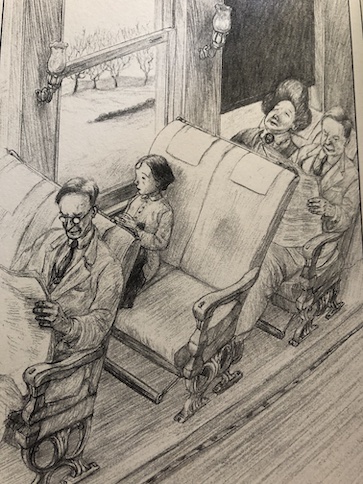
A relative who is traveling on business takes Elizabeth Ann partway by train and then makes sure that she gets on the right train to go to the Putney’s town in Vermont alone. Timid, fearful little Elizabeth Ann finds herself traveling completely alone for the first time to go to a place she’s never been and meet relatives she is sure she won’t like. Fortunately, many of Elizabeth Ann’s preconceived ideas are turned on their head from the first moment she steps off the train and is greeted by Great-Uncle Henry.
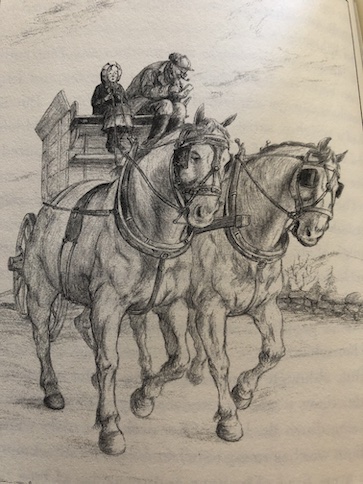
If it had been Aunt Frances greeting her, Aunt Frances would have immediately worried and fussed over her and asked her how she stood the ordeal of traveling. However, Uncle Henry acts like Elizabeth Ann hasn’t been through any ordeal at all. Instead, he just greets her cheerfully and helps her into his wagon. In fact, as they drive along, he unexpectedly gives the horses’ reins to Elizabeth Ann and lets her drive while he does some math. (We don’t know why he needs to do this; he just says he does.) He just tells her to pull on the left rein to make the horses turn left and the right rein to make them go right. Being handed this unexpected responsibility is terrifying for timid little Elizabeth Ann, and she has a moment of panic, worrying that she doesn’t always remember her left from her right. Then, Elizabeth Ann has an unexpected revelation: it doesn’t really matter if she doesn’t remember the names for the directions or which is which because she can just look and see where she wants the horses to go and pull the reins in that direction, no matter what that direction is called. After all, it’s not like horses really understand the words “left” and “right” anyway, just the direction of the pulling. This is an important revelation for Elizabeth Ann, who is usually accustomed to Aunt Frances doing everything for her, including her thinking. She has never really had to figure out things by herself before. When she voices this revelation to Uncle Henry, he simply agrees that she is correct, and Elizabeth Ann feels a rare sense of pride in her accomplishment.
When they reach the Putney Farm, Great-Aunt Abigail and Cousin Ann are glad to see her, but they don’t overly fuss, either. They call Elizabeth Ann “Betsy” and show her the hook where she can hang her cloak. Betsy is a little offended that they don’t help her take it off and hang it up for her the way Aunt Frances did. Their lack of fussing and expecting her to do things for herself makes her feel at first as if they don’t really care about her. Their farmhouse is also fairly small, it’s lit with kerosene lamps, and they do their own cooking instead of having a servant, like Great-Aunt Harriet and Aunt Frances did. These things make Betsy realize that the Putneys are poor, and she has a moment where she is overcome, thinking that she will be miserable in a poor, deprived household. Then, Aunt Abigail hands Betsy a kitten and tells her that, if she likes it, it can be her cat.
Betsy always wanted a kitten, but Aunt Frances would never let her have one because she was afraid that they would carry disease. Betsy forget her worries and misery while playing with the kitten, which she names Eleanor. She is also relieved that her relatives don’t fuss about her not liking certain foods. Aunt Frances always tried to make her eat her beans for nutrition, but the Putneys don’t care when she avoids them because she has a good appetite for everything else on the table. In fact, Betsy eats much more at the Putney farm than she ordinarily does because she is allowed to eat more of what she likes and nobody fusses over how much she’s eating or if she’s eating the right things. For her first night at the farm, Betsy has to sleep with Aunt Abigail because her room isn’t ready yet, but she ends up finding Aunt Abigail’s presence reassuring.
In the morning, her relatives decide to let her sleep in because she’s tired from traveling. When Betsy wakes up, she lies in bed for a while, waiting for someone to tell her to get up. When no one does, she get the idea, for the first time, that she can get up when she’s ready and doesn’t need for someone to tell her to do it. She also dresses herself and does her own hair for the first time. In a way, it’s a little thrilling because Betsy realizes that she can do her hair the way she wants it instead of the way Aunt Frances does it, and she copies a hairstyle she envied on one of her old classmates. However, it does bother her a little that her relatives don’t seem to care about whether or not she needs help and aren’t stepping forward to help her automatically. She does fine, but she’s accustomed to an adult hovering over her as a sign of caring.
Her relatives explain that they were letting her sleep as late as she wanted that day because they knew she would be tired. Cousin Ann gives her breakfast and lets her have as much milk as she wants because, unlike in the city, they produce their own milk from cows rather than buying it in quarts, so they don’t have strict limits on how much they can have in a day. Betsy is pleased by this, but she has another moment of panic when Cousin Ann tells her to wash her dishes after breakfast. Betsy has never washed her own dishes before and doesn’t know how. Seeing Betsy’s hesitation, Cousin Ann offers a view brief instructions, and Betsy accomplishes the task.
On her first day, she also sees Aunt Abigail making butter, something that Betsy has never seen before. She is accustomed to buying butter, not making it, and she didn’t even know before what butter is made from. Aunt Abigail is astonished that Betsy doesn’t know these things, but Uncle Henry points out that city life is different, and Betsy has probably seen things they haven’t, like how roads are paved. Betsy gets excited because roads being paved is a familiar sight to her, but she becomes embarrassed and confused when her aunt and uncle try to ask her questions about how the workmen do it. While she has seen roads being paved before, she took the sight for granted and never really noticed the details. Aunt Abigail suggests to her that she watch the butter making process closely and even take part in it so, if someone asks her later how it’s done, she can tell them all about it. Betsy accepts the lesson and even has fun making butter.
Then, her relatives surprise her by telling her that it’s time for her to go to school for afternoon lessons. They let her miss the morning lessons so she could rest, but now that she’s rested and had some time to look around the farm, she should go to the afternoon lessons. Worse still, they tell her that she should walk there by herself. Betsy panics again because Aunt Frances never let her walk to school by herself, but her relatives just give her a few directions to the school and a sugar cookie to take with her and send her out the door. Betsy could balk at this and say that she can’t do this and won’t, but their expectation that she can and will and her hesitancy to tell them differently make her walk down the road in the direction they say.
She almost misses the schoolhouse because it’s a much smaller building that she expected. Her school in the city was a multi-story building, but the local school is just a small, one-room schoolhouse. Fortunately, the teacher has been expecting her and looking out for her arrival, so she calls Betsy inside as she passes. Betsy is astonished at how few students there are, compared to her old school, and because there are so few, all the grades are just in that one schoolroom.
Even more confusingly, Betsy learns that this little school doesn’t do grades the way her old school did. Because there are so few students, and they’re all sharing the same room, it doesn’t matter too much what grade each student is studying in which subject. The teacher just moves them up and down as necessary to help them learn at their own, individual levels. At her age, Betsy knows that she should be in the third grade at school, but when the teacher has her read out loud with the other students at the third grade level, Betsy does much better than they do. She loves reading, and she reads all the time on her own, so she has progressed much faster in her reading skills than other children her age. Her teachers at her old school just never noticed because they were trying to keep track of so many students that they couldn’t pay that much attention to individual students’ progress. Her new teacher decides that she can read at a seventh grade level. Betsy is stunned and proud. The idea that she could move up multiple grade levels at once never occurred to her before as an option, but then, she worries that she can’t move up to seventh grade because she isn’t very good at math. She tries to explain this to the teacher, but the teacher isn’t concerned because she doesn’t make students study at one, consistent grade level for every subject. They can move ahead faster in some subjects than in others. When they’re struggling with one subject, she holds them back in that subject alone until they’ve mastered it. She does put Betsy back one grade level in math when she sees that Betsy is struggling, telling her that she can move up later when she’s had some time to review the material and improve.
It’s what Betsy really needs, but Betsy finds it disorienting that she isn’t part of one, consistent grade level at school. She says that she doesn’t know what that makes her, and the teacher replies that she is simply Elizabeth. Before, Betsy’s concept of school was that, every year, the students would simply move up one grade level, and that the goal of school was just for the students to move up through the levels appropriate to their age. Now, she is being introduced to the concept that the goal of education is for her to master the concepts being taught to her, regardless of the grade level, so that she will have the ability to do things like math, reading, and spelling. As long as she can learn to do these to a satisfactory level and keep improving, her specific grade doesn’t matter. In fact, when Betsy is upset later about failing an examination at school because she was nervous and made a lot of mistakes, Cousin Ann tells her that there’s no need to be nervous and that her grade on a single examination doesn’t matter because, regardless of how she did on that particular test, she knows that she actually does know the material and can use that knowledge in daily situations.
Betsy is also unexpectedly given the responsibility of looking out for a younger girl at the school, Molly. Because Molly is so good at reading, the teacher has Betsy listen to Molly read at the first grade level and asks her option of how Molly did and if she seems like she could manage the second grade level reading. Betsy has never had an adult ask her to supervise anyone younger before, and she unexpectedly discovers that she likes it and likes teaching someone younger. Later, Betsy is asked to hold Molly’s hand while they cross a log over a stream because the teacher wants older children to hold the hands of the younger ones and help them. Actually, holding Molly’s hand helps Betsy more than it helps Molly because Molly has walked on this log before and Betsy hasn’t, but being responsible for someone younger makes Betsy more bold. Although she would have been afraid to walk that log if she had to do it by herself, she can’t refuse when she has the responsibility of helping Molly. Later, she also helps to rescue Molly when Molly falls in a hole and needs help to get out. Betsy wanted to run for help at first, but when Molly begged her not to leave her alone, Betsy decides that she should do what Cousin Ann would do and figure out how she can use the things around her to solve the problem, spotting a branch that helps the younger girl climb out. Even though Betsy gets scared, when she has someone smaller than herself depending on her, she finds her courage.
Betsy has other adventures with Molly and her other new friends while living with the Putneys. When Molly’s mother becomes ill and has to go to the hospital, Molly is upset because she will have to move in with some cousins in the city who don’t really want her. Having been in this type of situation before herself, Betsy is immediately sympathetic, and she gets her relatives to agree to let Molly stay with them. Molly becomes like a little sister to Betsy, and they share in other adventures together. Along with some other girls from their school, they form a sewing circle to make some clothes for a poor boy at their school who lives with a stepfather who spends all of his money on alcohol. The book doesn’t shy away from describing how the boy is neglected, and the girls in the sewing circle are moved to tears when they go to the boy’s house to deliver the new clothes and see the circumstances he lives in. The Putneys also become concerned about the boy’s welfare, and they help arrange for him to be adopted by a man they know who has been talking about adopting a boy. Later, for Betsy’s birthday, Betsy and Molly go to the fair with some neighbors, but they are accidentally left behind when the people who were supposed to give them a ride home had to leave to tend to an emergency. Betsy is terrified, but with Molly to look after, Betsy manages to keep her head and think of a way to earn some money so they can buy train tickets home.
Betsy has been living with the Putneys for about a year when she gets a letter from Aunt Frances, who says that she will arrive soon to reclaim her. Aunt Frances thinks that Betsy must have been having a miserable time without her, but Betsy has actually come to think of the farm as home and loves it there. She doesn’t want to hurt Aunt Frances’s feelings or seem ungrateful for all the love and attention that Aunt Frances has lavished on her over the years. It seems like Betsy has to resign herself to returning to her old life in the city … unless Aunt Frances has also been making some changes to her own life since they were last together. When Betsy and Aunt Frances meet again, they truly come to understand each other, and they find a way for them all to live their best lives.
This book is now public domain and is available to read for free online through Project Gutenberg and Internet Archive (multiple copies, including audiobooks).
My Reaction
Educational Themes
I really enjoyed this book! I’d heard about it for years and never got around to reading it before. Dorothy Canfield Fisher was an early advocate of the Montessori method of education in the United States, and in particular, this book presents many of the principles of the Montessori method and how it can help children. The educational themes in the story are obvious when Betsy sees the differences between the one-room schoolhouse in the country and her old school in the city.
The benefits of the smaller class size are immediately obvious. Betsy loves reading but she always hated her reading class in school because each student took turns reading, so the most any particular student could read was one or two sentences, and even then, they might not get a turn if the class ran out of time before they got to all of the students. This description feels like an exaggeration of how reading classes might have gone at a bigger school, but there may be some truth in it. When I was at school, my classes typically had about 20 to 30 students in them, and when we took turns reading, we did more than that. It’s difficult to say for sure because I don’t think Betsy ever said exactly how many students were in her class, but I would think they would have to have at least twice as many as that to be as bad as she described. According to Going to School in 1876, some large city schools could have classes of 50 to 60 students during the late 1800s, so that is possible for a class in the early 1900s or 1910s as well. I do take the point that it’s easier for a teacher to keep track of the progress of individual students when the class size is smaller.
I also appreciated what the teacher said about allowing students to progress faster in subjects that are their strengths, even if they have to take extra time for problem areas in other subjects. When I reviewed The Beast in Ms. Rooney’s Room, there is a boy in that book who was held back a year in school because of his problems in reading, and he was embarrassed about not moving to the next grade with his classmates. If he could have moved forward in some subjects, it might not be so embarrassing for him to be held back in the one subject that gave him the most trouble. The problem is that he couldn’t do that because the classes at his elementary school are organized the way the ones at my old elementary school were – one single teacher at a particular grade level teaching all of the subjects for that grade level. Under that system, remaining at a particular grade level in one subject means remaining at that grade level, with that teacher for all subjects.
There is only one teacher at the one room schoolhouse in the story, so there’s no conflict about a student seeing one teacher for some subjects and another teacher for other subjects at a different grade level. All of the students are in just that one room with one teacher all the time, so the only difference when a student moves up or down in level for a subject is the book that the teacher gives them to study. That means that changes in grade level can be done informally for any or all subjects, whenever the teacher decides that a student is ready to move to the next level. The student just turns in their old book and gets a different one to study. If most grade levels were determined that easily for different subjects, I think there would be fewer parents who would be concerned about the prospect of holding a child back a grade temporarily to give them a better grounding for moving forward later, and students would experience less embarrassment about problem subjects if they could receive acknowledgement for better skills in other subjects. However, I can see that this system would be complicated in bigger public schools, and there would have to be a point when the student would have to master their series of subjects at a particular level to know when they could graduate from their school. I think that’s part of the purpose of the examinations Betsy describes in the book, but because the book only covers a single year, we don’t see what happens when a student is ready for graduation.
Emotional Management
In the beginning, Aunt Frances, in spite of all of her good intentions and research into psychology and raising children, unintentionally transfers her personal anxieties to Betsy without really giving her the tools that she needs to manage them, so they feel overwhelming to Betsy. The solution to this problem, as presented in the book, seems to be mostly being around people who do not express worries about things (if they’re nervous about anything, they mostly cover it up and don’t talk about it, except for one time, which I’m going to talk about) and who present manageable challenges to Betsy to show her that she can handle more than she thinks she can. I like the part about giving Betsy manageable challenges and some basic instructions for how to accomplish them when she doesn’t seem to quite know what to do. If they had just thrown challenges at her with no instruction at all, in a kind of sink-or-swim fashion, I think she would have been just overwhelmed and more panicky. However, I think there’s a point in the story that could use more clarification.
The differences between Betsy’s sets of relatives is initially presented, particularly by the aunts she’s been living with, as one of understanding and sympathy. Great-Aunt Harriet and Aunt Frances initially don’t like the Putneys because they don’t seem sympathetic enough, especially with people who are sensitive and nervous. Aunt Frances dedicates herself to sympathizing with Betsy about everything and talking to her about everything in her life, and the book presents this as a negative because their sympathetic conversations about the worries they have end up being a way of making each other more nervous. I think, in real life, there’s a happy medium between never talking about worries and wallowing in them.
The first problem with Aunt Frances’s attempts to sympathize with Betsy is that she makes assumptions that things that bother her will also bother Betsy, and this becomes the way that she accidentally transfers her anxieties to Betsy. Second, when Aunt Frances sympathizes with Betsy about worries or problems, she tends to dwell too much on the problem itself and how bad it feels, magnifying the issue and making Betsy feel worse. What I’m trying to say is that Aunt Frances’s attempts to sympathize would have worked much better if she had been willing to listen to Betsy’s concerns and sympathize a little about how certain things can make a person nervous but then move on to offering practical tips to deal with these feelings and different ways of looking at situations to take some of the anxiety out of them.
I didn’t like it when Cousin Ann seemed to shut Betsy down when she was talking about how tests at school make her nervous because I don’t like the idea of shutting people down when they’re talking about something important to them, but what made it better to me was that she did listen to Betsy for a bit before that and had already offered her a different way to look at tests that makes them seem more fun and less scary. When Cousin Ann cuts the conversation short seems to be the point when discussing and sympathizing is about to turn into brooding and dwelling on the negative. My only thought on that conversation is that it might have helped for Cousin Ann to point that out. Rather than asking if Betsy really wanted to keep talking about this, which makes it sound like disinterest in what Betsy’s saying, I think it might have been better to point out that, if she keeps dwelling on the parts of the experience that make her feel bad, she won’t let herself move forward, to see the parts of the experience that could be exciting opportunities and possible triumphs. Perhaps, it would be good to add that one poor test experience doesn’t mean that others will feel the same way or that she can’t do better the next time, especially if she spends her time in between tests focusing on how much she enjoys what she’s learning and how it can be fun to show others what she’s learned and what she enjoys about her lessons, putting herself in a better frame of mind for the next time someone asks her questions about what she’s learned. I just think that approach would help emphasize the lesson that Cousin Ann would really like to teach Betsy about reframing challenges in her mind and also help clarify that she’s not ending the conversation because she’s not sympathetic but because it’s better to give the positive thoughts time to take hold rather than dwell on the worries.
I think it’s also important for both Betsy and Aunt Frances to recognize that it’s okay to feel nervous but that it’s possible to handle situations even though they make them nervous. As someone who has had life-long issues with anxiety, I can also attest that one of the best approaches is learning not to be afraid of feeling afraid of something. That is, learning to recognize that being nervous isn’t a sign that a situation is unmanageable or that the feeling of anxiety itself is necessarily going to be overwhelming, something that Betsy learns through practical experience in the story. There are still times in the story where Betsy is afraid and has to handle difficult situations, but she learns that she can proceed and do what she needs to do even though she’s nervous and isn’t sure at first how things will work out. It isn’t explicitly spelled out in the story, but this is probably the most important lesson that Betsy was missing from her time living with Aunt Frances.
Betsy’s Family
There are no villains in this story. Although readers can see at the beginning that living with Great-Aunt Harriet and Aunt Frances has caused some emotional complications for Betsy because she has taken on their worries and anxieties, they do mean well and have made real efforts to understand Betsy and support her, as best they know how. Great-Aunt Harriet and Aunt Frances just have very different, more timid personalities than the Putneys and don’t find their style of communication reassuring or appealing. However, Betsy discovers, to her surprise, that she does come to appreciate the Putneys and that they are a good influence on her, helping her to come out of her shell, discover new abilities and interests, and develop some self-confidence.
At first, Betsy is a little offended that her Putney relatives don’t fuss over her like Aunt Frances did, and it makes her feel like they don’t care about her, but they do care. They are just more low-key in showing the ways that they care. They are a family that doesn’t like to fuss about anything. Personally, I thought that Cousin Ann should have let Betsy talk a little more when Betsy was distressed about doing badly on her exam, but I do see her point that Betsy’s talking about it seemed to be upsetting her more because she was dwelling on the problem rather than consoling herself and looking for solutions or new ways of thinking about the situation. Cousin Ann points out that exams aren’t always negative, and even when one doesn’t turn out so well, it’s not the end of the world, giving Betsy a new way of looking at the situation and defusing Betsy’s sense that every little setback is a tragedy.
The Putneys show how much they truly care when Betsy and Molly are accidentally left behind at the fair. When Betsy manages to get Molly home, she sees her relatives rattled and upset for the first time when they realized that the girls were lost, and they do some rare fussing over the girls, praising Betsy for her ingenuity in handling the situation. Although the Putneys normally make it a point to deal with things coolly and calmly, they do care about the girls and can get upset if they think there is a serious problem. They are not without feelings. They are also genuinely upset when they think Aunt Frances is going to take Betsy away, each finding their own way to show Betsy how much they care and how much they will miss her.
Spoilers
Fortunately, Betsy is allowed to stay with the Putneys in the end. When Aunt Frances comes to get her, she reveals that, in the year they’ve been apart, she has met a man and fallen in love. She is going to marry him, but marrying him means making some changes to her life, the greatest one being that they are not going to return to their old house. Great-Aunt Harriet has recovered from her earlier illness and has gone to live with another relative, and because her new husband has to travel constantly for business, Aunt Frances won’t be keeping a settled house at all. Aunt Frances, although usually timid, is actually looking forward to doing some traveling. She is still afraid of things like animals and would never be an outdoor/country kind of person, but travel to different cities sounds like her kind of excitement. However, she can see the difficulty of traveling with Betsy. Constantly moving would be difficult for her education, a complication that I was surprised that the characters didn’t spell out when they were talking to each other, given the educational themes of the story.
Betsy and Aunt Frances come to a new understanding of each other and the differences in the lives they want to live when they talk about what these changes would mean for their lives. Aunt Frances doesn’t want to simply abandon Betsy to the Putneys if she isn’t happy with them, but she can see that Betsy does like living there and would be happy to stay. Betsy hadn’t wanted to make Aunt Frances feel abandoned and unappreciated by telling her in the beginning that she wanted to stay with the Putneys, but when she learns that Aunt Frances will be happily married and enjoying the new experience of travel, she is able to tell Aunt Frances that she can see that having her come along would be inconvenient for her and that she would be happy to stay with the Putneys. Neither of them is offended or worried about living apart now because they can see that each of them will be happier with Betsy living with the Putneys. Aunt Frances is now free to get married and go where she wishes with her husband, assured that Betsy is doing fine and living in a stable home with people who care about her, even if it’s not quite living the lifestyle that she would like herself. Aunt Frances also promises to come visit sometimes, so it’s not a permanent goodbye.
It’s summer, and Garnet is a 9-year-old girl living on a farm with her parents and brothers in a rural community in Wisconsin. The story is episodic, with each chapter describing things that happen to Garnet over the course of one magical summer when she found a silver thimble down by the river. Garnet thinks that the thimble itself is magic, but maybe the magic is just in the happy summer adventures that follow.
The book is a Newbery Medal winner. It’s available to borrow and read for free online through Internet Archive (multiple copies, including one in Chinese).
The chapters in the book are:
The Silver Thimble
It’s been hot and rainless, and the crops are in danger of being ruined if they don’t get some rain soon. It’s a real worry because, if the crops are bad, Garnet’s family won’t be able to pay their bills. When Garnet and her brother Jay go swimming in the nearby river, Garnet finds a silver thimble. It’s a lucky find, and Garnet becomes convinced that the thimble is magic and that something wonderful is about to happen. Jay thinks that’s silly, but that night, the rain they’ve so badly needed comes! Garnet and Jay are so overjoyed with the rain that they go out running in the rain in the middle of the night, until they are frightened by lightning striking something, and their mother calls them back.
The Coral Bracelet
Garnet’s best friend is a girl name Citronella, who lives nearby. Citronella’s great-grandmother lives with her, and she tells the girls stories about what it was like when she was young. She tells them about Indians (Native Americans) who would sneak into her family’s house in bad weather to get warm and leave them presents as thanks. (I don’t know if any Native Americans ever did this in real life, but she says it like it really happened.) Then, she tells the girls about a special coral bracelet that she wanted at the general store when she was young and some foolish risks she took to get it.
The lucky thing that happens in this chapter is that Garnet’s father gets a government loan to build a new barn.
The Lime Kiln
The family needs to make lime for building their new barn. The kiln needs to burn for three days straight, and they all need to take turns tending it, day and night. Jay and Garnet are allowed to stay up all night there with their father. Friends help them, and neighbors come to visit and talk with them. Garnet brings along a picnic with sandwiches and apple pie that they eat at midnight.
The Stranger
While they’re tending the kiln, a strange boy comes along and asks them for food. His name is Eric, and he’s a parentless boy who travels around and makes his living from odd jobs. He tells them about his life and travels, and Garnet’s father hires him to help the family build the new barn.
Locked In
Garnet likes having Eric at the farm, but she’s also a little jealous that Jay wants to spend more time with Eric now than with her. Garnet starts spending even more time with Citronella, and the two girls build a tree house together. The girls tell stories in their tree house, and because it’s going to rain again, Garnet suggests that they go to the library in town. They get so engrossed in their books that they lose track of time and get locked in the library. Garnet thinks this is a fabulous adventure until Citronella points out that it’s Saturday, and the library is closed on Sunday. If they can’t find a way out, they could be there for the rest of the weekend!
Journey
It’s harvest time, and everyone is occupied in picking crops and canning foods. Garnet helps, and she is temporarily put in charge of the threshing machine. Unfortunately, she falls asleep and lets the straw stack pile up until it falls over and makes a mess. Eric tells her not to worry about it, but Jay yells at her and tells her that she had no business helping out as a girl and that she should be at the house with the women. Garnet is so upset at the way Jay has been critical of her lately that she decides to run away and hitchhike around, like Eric used to do.
“As a Ragpicker’s Pocket”
Garnet is still running away, and she takes a bus to the next town. By the time she has explored the town and looked at all the store windows, she isn’t so upset and can see the funny side of what happened with the thresher, and she’s about ready to go home. She buys a few things for her family at the dime store and a hot dog to eat. Then, she has a horrible realization: she’s out of money. How is she going to get back home?
Fair Day
Garnet goes to the fair with her family and neighbors, and she enters her pig, Timmy, in a contest. Timmy was the runt of his litter, but Garnet has taken special care of him, and she thinks that he has a good chance of winning a prize.
Ice-Cream Cones and Blue Ribbons
Garnet and Citronella enjoy the wonders of the fair while Garnet is waiting for the pig contest. They spot the lady sword-swallower darning her socks, they ride the rides, and they have snacks. The girls get stuck on the Ferris wheel when it stops working, and Garnet worries about getting down in time for the judging of the pig contest.
The Silver Thimble
The silver thimble hasn’t been mentioned since the first chapter, but when Garnet looks back on all the good things that have happened this summer, she’s still sure that it’s magic. All the good things that have happened started right after she found it. She shows the thimble to Eric, and the kids talk about what they want to do with their futures.
My Reaction
This story is more like a collection of stories, some of which continue each other. The book is somewhat episodic, leading up to the fair at the end of the summer. The stories are pretty gentle, slice-of-life adventures. Eric has had a hard life, but he doesn’t want to dwell on it too much, and things improve for him when he decides to stay with Garnet’s family. There are hints that Eric might marry Garnet someday, and the two of them might stay on the family’s farm. Eric has had enough of traveling in his young life, and he wants to be a farmer and thinks that he would like to save up money and buy land near the family’s farm. Jay wants to be a sailor or something else that will let him travel and see the world, although he thinks that he might want to come back to the farm when he’s done traveling and farm it with his father and Eric.
The book fits with the Cottagecore genre, and it would make good bedtime reading. Foodies will enjoy the mentions of old-fashioned treats, like apple pie, griddle cakes, and vinegar candy. Garnet also imagines that each of the kitchen things have their own personalities.
I liked Garnet’s name, which is very unusual in the early 21st century. Citronella is an even more unusual name, but I prefer Garnet. I think it’s charming, and it’s one of the less-common gem names used for girls. In the story, Garnet mentions that the librarian frequently gets her name wrong because gemstone names are popular in her time and area. There are other girls in town named Ruby, Pearl, Opal, and Beryl, and the library usually calls her Ruby, the most popular of the gemstone names.
There are some stereotypical mentions of Native Americans in the story. They’re not derogatory, and they’re minor parts, but there were a couple of things that struck me as being a little stereotypical, like the kids saying that they’re Comanche Indians doing a rain dance when they’re running around in the rain. I also didn’t care for the way the characters kept pointing out which people were “fat” or “fleshy.” They’re not really shaming these characters, just sort of remarking, but I just felt like it was rude and unnecessary. You see this sometimes in older children’s books. Fortunately, none of the fat characters are considered bad characters in this story, as they sometimes are in other books. There aren’t really any bad characters in the story in general. Jay is annoying at times and says things that put down his sister and girls in general in a bratty, macho kind of way, but nobody in the story is a villain.
This story picks up the spring after the previous book, Gone-Away Lake, with Portia Blake’s parents purchasing one of the old houses in the abandoned resort community now known as Gone-Away Lake. They’ve bought the large house that’s in the best condition, the one formerly known as the Villa Caprice. The wealthy woman who had once owned it had died many years before in the San Francisco Earthquake of 1906, leaving no heirs. Few other people would be interested in owning it since the lake has become a swamp, so the Blake family got a really good deal on it. The Blake family think the place is wonderful, filled with some amazing old things, and they’re looking forward to fixing it up and restoring the old garden. They plan to use the house as a summer home, and they will still live in their apartment in New York, where the kids go to school, for the rest of the year.
Portia’s aunt and uncle live nearby with her cousin Julian, and the two remaining residents of the old resort community, affectionately known as Aunt Minnehaha and Uncle Pin, still live there. Portia and Julian are part of a club they call the Philosopher’s Club, after Uncle Pin’s old group of friends, which includes Portia’s younger brother Foster and a couple of other kids who live in the area. They have a meeting space in another of the old, abandoned houses.
When the Blakes see the Villa Caprice again, the parents feel less optimistic about their purchase of the house because it looks shabbier than they remembered, and there is so much to fix. The adults know that it will take a lot of money and hard work to restore the house. However, the children are still enthusiastic because they know the old house is full of some fascinating things. One of the first things they run into is a dummy set up by the former owner to frighten and discourage trespassers. They nickname him Baron Bloodshed. When the adults realize that the old chandelier in the house is a Waterford chandelier, they begin to see that there may be some worthwhile treasures in the house after all.
The Blake family takes the children’s spring vacation to start cleaning the house and sorting through the things inside. They find some other valuable, collectible items, like a set of Lowestoft china and antique Chippendale furniture. The adults realize that, if they sell some of these valuable antiques, they can use the money to pay for the renovation of the house. The children have little interest in such things, but they are amazed by some of the old-fashioned features of the house, like the old dumb waiter. Foster climbs inside the old dumb waiter, gets stuck, and has to be rescued. His parents tell him off because it was a dangerous thing to do and the old rope holding it might have been rotten.
The children look forward to spending the whole summer exploring the house and seeing what other treasures it has to offer. Aunt Minnehaha tells them more about the wealthy woman who used to own the house, Mrs. Brace-Gideon, who was a very determined woman who was accustomed to telling everyone what to do and getting her way because of her money. She was self-centered and callous in some ways, but she was also a brave and just woman in others. When Aunt Minnehaha tells them a story about how Mrs. Brace-Gideon dealt with a burglar who was trying to rob her wall safe, Julian begins asking more questions about the safe because they haven’t seen any sign of it. Aunt Minnehaha says that Mrs. Brace-Gideon wasn’t a very trusting woman, so she probably either told everyone the wrong room it was in on purpose to keep its location a secret or maybe had it moved after that incident or removed the safe entirely when she decided that she wanted to move to California. Even if the safe still exists, concealed somewhere in the house, it’s not likely that it would contain anything really valuable because Mrs. Brace-Gideon might have taken her valuables to California with her. All the same, the kids think that it would be exciting to try to hunt for the safe, in case it’s still hidden somewhere.
The kids begin another fun summer, improving their club’s meeting place with discards from their new house, enjoying outdoor fun with their friends, hearing stories about the past escapades of the people of Gone-Away, and spending the night camping out in a spooky old house during a thunder storm. They enjoy finding new treasures among the abandoned belongings of Gone-Away, and before the summer is over, they find the greatest treasure of all!
The book is available to borrow and read for free online through Internet Archive (multiple copies).
My Reaction
This is a fun sequel to the original book! I loved hearing about the things the family discovered in their old house and how the adults let the kids have some neat old things for their club. The small details in the book are magical, like the addition of the dummy they call Baron Bloodshed and the way he keeps scaring them because they keep forgetting that he’s there until they stumble on him again.
It’s the sort of idyllic summer in a unique location that kids dream of having! I liked the treasure hunt for the lost safe, and there are many small adventures and escapades along the way. The stories that the older couple tell the children about wonderful past summers both offer the kids inspiration for their summer and are like little mini-stories within the bigger one.
Even though this old, abandoned community and the house the family is fixing up are charming, there is also some acknowledgement in this book that there are dangers in exploring and playing in the abandoned houses. The incident with the dumb waiter could have been dangerous, and there is also a collapsed stairway in the story. While these houses full of valuable antiques and hidden treasures are wonderful, the inclusion of some of the dangers of abandoned places, no matter how exciting they are to explore, add an element of reality to the story.
The Most Beautiful Place in the World by Ann Cameron, drawings by Thomas B. Allen, 1988.
Juan is a little boy living in the town of San Pablo in Guatemala. It’s not a very big town, but it is very busy. The town is on a lake with several other towns around it, but Juan has spent his whole life in San Pablo.
Juan is from a poor family, although he doesn’t consider his grandmother poor because she owns her own house and is able to take in other relatives whenever they fall on hard times. He knows that his father was the caretaker of a big house in the town, but he abandoned him and his mother when Juan was still a baby. His mother says that his father wanted to continue partying with his friends like he did when he was a single man, spending more than they could afford. After they argued about it, he left his family and went to a bigger city and never tried to see them again. Juan’s mother moved back in with her mother, so Juan grew up in a crowded little house filled with other relatives who needed help because they had gotten sick, lost their jobs, had marital problems, or various other things going wrong in their lives.
Juan’s grandmother supports herself by making arroz con leche and selling it in the marketplace. When Juan is still a small boy, his mother remarries to a man who doesn’t want anything to do with Juan, so his mother abandons him, leaving him with his grandmother. Juan is distressed by his mother’s abandonment, but his grandmother continues to look after him and begins preparing him to live an independent life from a young age. She has him help her sell arroz con leche in the marketplace, and later, she teaches him how to shine shoes so he can earn his own money. Juan is still very young, but his grandmother knows that life will tough for him without his parents.
Juan knows that his mother has had another child, and he feels jealous of his younger half-brother because he gets to live with his mother, and he doesn’t. (I question whether the younger half-brother is really going to be better off in the long run, but I’ll explain why below.) However, he is really jealous of the other children in town who get to go to school. Not all children in town go to school because many are from poor families, who need them to work and earn money, but Juan wishes that he could go to school, too.
He quietly teaches himself to read the signs in town and a newspaper, but he’s afraid to ask his grandmother about letting him to go school at first. He’s worried that, if he asks for that, his grandmother may tell him that she only cares for him because of the money he earns. If his grandmother abandoned him or withdrew her affection for him because he asked for too much, Juan doesn’t know what he would do. However, when he finally brings up the subject of school with his grandmother, he learns how much she really does care for him, how much she plans for his future, and how proud she is of him.
The book is available to borrow and read for free online through Internet Archive (multiple copies).
My Reaction
Juan’s family is poor, and at first, Juan doesn’t understand fully how poor they are. His grandmother’s life is more secure than others because she owns her own house, while others don’t, but even she has limited resources. The house has running water, but it doesn’t have electricity because she can’t afford it. She takes in other relatives when they are in trouble because she cares about her family, but she also has to make sure that everyone does whatever they can to support themselves because she can’t do it alone.
At first, Juan thinks that maybe she just keeps him because he earns money shining shoes, and she keeps most of his wages. However, when he talks to her about school, he learns that she has not spent any of his wages on herself or on other relatives. Instead, she has secretly saved them up because she knew that he would need money for his education, and she uses it to buy school supplies for him. At first, his teacher doesn’t want to accept him in class because the school year has already started, but when he demonstrates that he has already learned math from working in the marketplace and has taught himself to read, she accepts him. He exceeds everyone’s expectations for him, and his teachers even say that they will contribute to his education, if necessary, to keep him in school.
Juan’s grandmother cannot read, and she reveals that her parents wouldn’t let her go to school when she was young, even though she wanted to go. Her parents were afraid that she wouldn’t learn to do any practical work in school, so they didn’t want her to get an education, but she’s always felt disadvantaged because of it. She’s managed to get by in life, but she realizes that she could have done better with an education. She says that if Juan continues to work after school and does well in school, she’ll support his education, as far as he wants to go, even to the university. She says maybe he’ll even be able to figure out some of the big questions in life, like “why some people were rich, and some were poor, and some countries were rich, and some were poor, because she had thought about it a lot, but she could never figure it out.” Juan worries that he won’t be able to live up to his grandmother’s expectations for him, but she tells him not to worry about that. She just hopes for the best for him and wants to see him do the best he can because she loves him, and that’s what Juan really needs to hear.
The title of the story comes from a tourist poster that Juan reads to his grandmother, calling their town, “The Most Beautiful Place in the World.” Juan’s grandmother thinks that the most beautiful place in the can be anywhere where a person can be proud of who they are, but Juan privately thinks that the most beautiful place in the world is somewhere with someone you love and who loves you back. Juan has been deprived of love because of his parents’ abandonment of him, but he has found the love and support he needs from his grandmother, who wants him to succeed in life because she loves him and not just for what he can do for her.
Parts of the story are sad because Juan’s parents callously abandon him, and even his mother tries to act like it’s nothing because she knows his grandmother is taking care of him. I tried to decide how selfish Juan’s mother is in the story. On the one hand, I can see that she is poor and desperate and may have felt compelled to accept the first marriage proposal she was offered just to get out of her mother’s house, but she is very callous to her little son and his feelings and needs.
At first, he doesn’t even quite understand why his mother has left him, not even leaving him the bed they shared, so he has to sleep on some empty rice bags. He goes to his mother’s new house and tries to spend the night there. His mother lets him stay the night but hides him because she says his stepfather will beat him if he catches him in the house, which is why Juan never goes there again. I don’t know whether the stepfather ever beats Juan’s mother or the child they later have together, but the mother’s comment makes me think that it’s likely. Yes, Juan’s mother succeeded in getting remarried and out of her mother’s house, but I don’t think she’s really headed for a better life, and I have doubts about the future her younger child will have. It looks like the stepfather is selfish and temperamental, probably every bit as immature as Juan’s father was, and the children’s mother will always place her own needs first. As hurtful as it was for Juan to be abandoned by his mother, his mother is not going to nurture him and his future in the way his grandmother does. His grandmother has to be tough sometimes because of the family’s poverty, but she still does her best to look after everyone, even at her own expense, because she does love her family and wants the best for them and their futures, not just to get what she wants from other people and get ahead by herself. I would say that’s the quality that makes her different from Juan’s mother. At one point, she even marches Juan to her daughter’s new house and demands that she and her new husband at least provide a real bed for her son, reminding them of their responsibilities.
The book doesn’t go into the details of Guatemalan society and events in the 1980s, when this book was written, which was something I wanted to see. It’s pretty simple story for elementary school level children, but there is more going on behind the scenes that Juan would be aware of as a young boy living in a small town. The time period when this story was taking place was during the Guatemalan Civil War, which lasted from 1960 to 1996. The war and sharp differences in social class are partly responsible for the economic and societal inequities that Juan’s grandmother describes, although the economic and social disparities in Guatemalan society were part of the reason for the war in the first place. There was also general dissatisfaction with government incompetence and interference in Guatemalan affairs on the part of the United States, which sought to use Guatemala as part of its Cold War strategy, including using it as a training ground for Bay of Pigs Invasion against Cuba. These are complicated and long-term situations that would require more explanation than a children’s book of this level can provide, and because the characters in the story live in a small town, they may not be seeing many of these events directly. As he gets older, Juan will probably become more aware of the wider world and the circumstances that have shaped his family’s lives, as his grandmother hopes and expects, especially if he does end up going to the university in the capital city.