A Spell is Cast

A Spell is Cast by Eleanor Cameron, 1974.

This story is fascinating and magical, partly because of other the stories that it reminds me of and partly because, at various points in the story, I was pretty sure that I knew what kind of book it was going to be, but I was never more than partly correct.

When young Cory Winterslow arrives at the airport in California, she expects to be met by her Uncle Dirk. Uncle Dirk has sent her letters before and a picture of himself, but they’ve never actually met in person. Cory is supposed to be spending Easter vacation with her relatives, the Van Heusens, a wealthy family living on an estate called Tarnhelm. Her mother, Stephanie, sent a telegram to the Van Heusens to tell them when Cory would arrive on the plane from New York, where they’ve been living, but no one shows up to meet Cory at the airport. This seems almost like the beginning of a gothic novel, with a young heroine on her way to meet people she’s never met who turn out to not really be expecting her and aren’t what they appear to be, but that’s not really the case here.

Fortunately, a sympathetic older woman who was also on the plane, Mrs. Smallwood, talks to Cory, who explains the situation. Mrs. Smallwood knows the Van Heusens, and she calls both the house at Tarnhelm and Uncle Dirk’s office. Apparently, Uncle Dirk never mentioned to his secretary that he needed to meet anyone that day, and he’s away on business until late. Nobody is home at Tarnhelm, but Mrs. Smallwood is optimistic that it’s all just an oversight. She says that she’ll give Cory a ride to the house. Cory is hesitant to accept a ride from a stranger because she and Mrs. Smallwood have only just met, but it’s raining and she doesn’t know what else to do, so she goes with her. This part seems a bit worrying, but you don’t have to worry because it’s not a kidnapping story.

On the way to Tarnhelm, Mrs. Smallwood points out local sights, and Cory asks her a bit about her relatives. Cory’s mother has always been reluctant to talk about her relatives in California. Mrs. Smallwood describes Uncle Dirk as a young man who never smiles. She says that his mother, Cory’s grandmother, as a high society woman who sometimes acknowledges acquaintances in public and sometimes doesn’t, depending on her mood, something that often offends Mrs. Smallwood, as one of those acquaintances. They also pick up a boy called Peter Hawthorne, who was out walking in the rain and needed a ride. He introduces himself to Cory as the president of the Explorers Club. His description of Cory’s Uncle Dirk doesn’t sound very favorable, either. However, he mentions that the sign for the mansion at Tarnhelm has a unicorn on it, just like the unicorn on the pendant that Cory wears, which she thinks of as her “amulet”, and Cory takes that as a hopeful sign.

Unfortunately, the Smallwoods’ car runs out of gas. Since it’s not raining anymore, Peter offers to walk Cory the rest of the way to Tarnhelm. Then, it starts to rain again, so they take shelter in a cave that Peter knows. While they wait out the storm, Peter asks Cory more about herself. Cory explains that she usually refers to her mother as “Stephanie” because she’s actually adopted. She later reveals that she doesn’t know anything about her birth parents because Stephanie doesn’t like to talk about them, saying that it makes her sad. Stephanie is an actress, and they’ve had to move around sometimes. Because she’s had to switch schools several times, Cory hasn’t made many friends her own age. Cory doesn’t always go with Stephanie when she travels for work, often staying at home with housekeepers (which she calls “lady-helps”) so she can continue going to school. Stephanie isn’t married, so Cory doesn’t have a father to take care of her. The reason why she has come to stay with her relatives during this school break is that Stephanie needs to travel again for her work and couldn’t manage to find new help to stay with Cory. This is the first mention that Cory’s “mother” isn’t really her mother and these relatives that she’s going to visit aren’t blood relatives. This is central to the plot of the book, but there’s a twist coming, and it’s not the twist that I expected. I had theories about the identities of Cory’s biological parents at this point that turned out to be completely wrong.

When the rain lets up a bit, Peter takes Cory the rest of the way to the house, although they leave her luggage in the cave because it’s too hard to carry it over the muddy ground. When they arrive at the house, the housekeeper, Fergie, welcomes Cory. She says that everyone has been in a tizzy about her because Stephanie actually sent multiple telegrams with different sets of instructions for picking up Cory, so nobody knew when she was really arriving. (This is the first indication that Stephanie is unreliable.) Fergie and her husband, Andrew Ferguson, both work for the Van Heusens, and they make Cory feel welcome at Tarnhelm, fussing over her and giving her and Peter a hot dinner. However, they tell Cory not to mention the cave to her grandmother because she wouldn’t understand, and she might be unhappy about Cory showing up at the house wet and muddy. Peter promises to bring Cory’s luggage up to the house later. If this were a gothic novel style of story, the servants would be strict, unhappy, uncaring, or putting on a facade of caring while being just plain sinister, but the Fergusons are exactly as caring and friendly as they seem to be. This isn’t that kind of book.

The Fergusons are Scottish and a bit superstitious. At dinner, they notice that Cory is left-handed, “cawry-fisted”, as they call it. Peter is intrigued that “cawry” sounds like “Cory”, and the Fergusons say that there’s a superstition that left-handed people are enchanted or bewitched. However, the Fergusons don’t think it’s a bad thing that Cory is left-handed and possibly bewitched; it’s just more of an interesting idea to them. This story isn’t as supernatural as I originally expected.

The Fergusons tell Cory that her grandmother and uncle are good, kind people, but they aren’t used to children and are fussy about some things. Uncle Dirk is known to be moody, and Cory’s grandmother likes things quiet and orderly. Cory starts to think that she might be happier with just the Fergusons, although she is still curious about her relatives. She hopes that they will like her, and maybe if they like her enough, they’ll let her stay longer so she can go to Peter’s school and join his Explorers Club because she badly wants friends. Issues about how to make friends add an element of teen drama to the story, but there’s more going on here than that.

The house is beautiful and charming, and Fergie gives Cory Stephanie’s old room, which Cory loves. It has beautiful, old-fashioned furniture and its own fireplace! She also shows Cory a collection of carved wooden masks hanging on the walls of the hallways that her Uncle Dirk made. Uncle Dirk is an architect, but he’s also been a wood carver. In Stephanie’s room, there is even a mask of Stephanie’s face, which Cory recognizes. During the night, she half wakes up and is aware of her grandmother and Uncle Dirk in her room, whispering about her, saying that she looks rather plain and something about somebody “getting used to” something. They don’t deny this conversion later when Cory asks them about it, and there is less sinister significance to it than it seems at first.

The next morning, Cory meets her grandmother and Uncle Dirk at breakfast. They greet her politely, but her grandmother says that she wants to have a word with Peter about how he should have taken her to his house until the rain stopped, not made her walk through the mud to Tarnhelm, ruining her shoes. Cory asks her not to say anything to Peter because she really wants to join the Explorers, and they wouldn’t let her in if they thought that she was afraid of a little mud. However, her grandmother reminds her that she’s only there for a short visit, and she doesn’t want her getting hurt or doing anything dangerous. Uncle Dirk is more sympathetic and offers to teach her to swim.

Mrs. Van Heusen brings up the subject of Stephanie, and during the conversion, she lets slip that Stephanie has never legally adopted Cory. Now, we’re getting to a major plot point of the story! Stephanie is consumed by her acting work and not good with paperwork, and Mrs. Van Heusen thinks it’s about time that she took care of the issue of Cory’s legal adoption. The news comes as a shock to Cory, who thinks that, not being legally adopted, she doesn’t really belong to the family at Tarnhelm. Both her grandmother and Uncle Dirk hurriedly reassure her that she is family to them and belongs at Tarnhelm and that the official paperwork doesn’t really make a difference to them. There is no danger in the story of Cory being rejected by this family, and they don’t have any objection to her visit or Stephanie’s guardianship of her. However, this is another of the early indications that Stephanie is not as attentive as she should be as Cory’s guardian and that there are aspects of Cory’s life and well-being that are being neglected. Cory is starting to develop a new awareness of these issues.

Cory asks her grandmother and Uncle Dirk about her birth parents because Stephanie has never explained who they were or what happened to them. Her grandmother says that it’s only right that she knows and that Stephanie really should have told her before. Uncle Dirk explains to Cory that her parents’ names were Lawrence and Coralie Winterslow and that they were friends of Stephanie’s when they were young, before they were even married. They all liked to go skiing together. Cory’s parents lived in England for awhile after they were married, and Cory was actually born in London. Then, her parents were killed in a skiing accident in Switzerland. Stephanie had been with them on that skiing trip, and before Cory’s mother died from her injuries, she asked Stephanie to take three-year-old Cory because she had no living relatives on her father’s side and she didn’t want to leave her child with her own relatives, for some reason. Cory is glad to know the story of her parents but sad at the same time and worried about not being legally adopted. Fergie suggests to her that she write to Stephanie about it and see what she says. (At first, I was expecting that there would be more intrigue about Cory’s parents’ deaths, but there’s nothing suspicious about their cause of death. The story that Uncle Dirk tells Cory is exactly what happened. The Winterslows were also definitely Cory’s biological parents. I thought that there might be some intrigue about that, but her birth parents were who Uncle Dirk says they were.)

Later, Cory also asks Uncle Dirk about the unicorn on the sign at Tarnhelm and about her own silver unicorn pendant. Uncle Dirk tells her that he has a fascination for British history and heraldry, which is why he carved the unicorn as the symbol of Tarnhelm. He also says that the pendant used to belong to Cory’s mother and that her father had a matching unicorn tie pin, although he doesn’t know what happened to it after his death. Cory wishes that she’d thought to ask Stephanie about it in her letter.

All of this explanation about Cory’s parents’ history sounds pretty straight-forward, although sad. However, the story doesn’t end there. Everyone has a history, and there are things about her Uncle Dirk that Cory doesn’t know yet as well as the reasons why Stephanie has never completed Cory’s adoption papers.

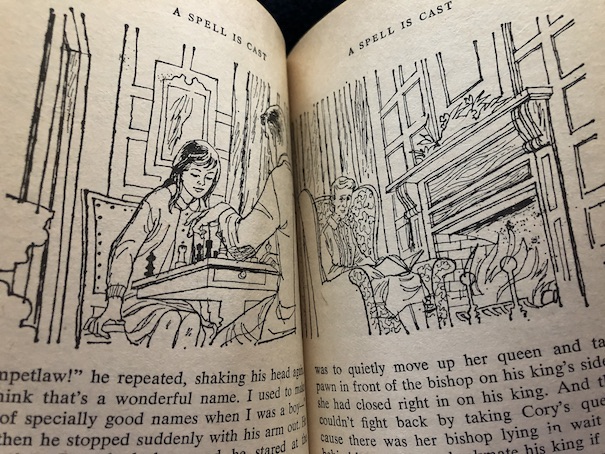
Cory becomes sick and feverish, spending a few days in bed. During this time, she has strange dreams, but not all of them are actually dreams. She remembers dreaming about a room with a chess set that has carved unicorns instead of horses as the knight pieces. Later, when Uncle Dirk plays chess with her, with a normal chess set, she mentions this dream, and both Uncle Dirk and her grandmother act strangely about it. Eventually, Cory comes to realize that her “dream” wasn’t just a dream, that she actually did get out of bed and wander around while she was feverish, but it takes some time before the full meaning of the chess set becomes clear to her.

Various people comment to Cory about Uncle Dirk’s moods and personality, hinting at past problems he’s had. Cory’s grandmother makes a comment to Cory about Uncle Dirk harming himself more than anyone else, except perhaps for one person, hinting at relationship troubles in Uncle Dirk’s past that contribute to his dark moods. Nosy Mrs. Smallwood also refers to the strange behavior of the Van Heusen family, often rude and unfriendly. While Mrs. Smallwood is a busy-body with issues of her own, she is correct in noticing the casual harm that various members of the Van Heusen family have done to people around them. It’s never intentional and they rarely notice the consequences of what they do, but that’s part of the problem. The Van Heusens are often selfish, thoughtless, and out-of-touch with other people’s feelings and the effects of their actions on others. Even Uncle Dirk acknowledges that members of the family are often hard on each other even when they care about one another.

However, the Van Heusens aren’t all bad, and some of them have changed somewhat over time. Mr. Smallwood, who is a more optimistic and level-headed person than his wife, tells Cory that his wife likes to live in the past, and while Uncle Dirk was a rather thoughtless young man who wouldn’t have made a good husband, he’s grown up since then. He says that Uncle Dirk has become friendlier and more thoughtful toward others, in spite of his occasional dark moods. But, since Uncle Dirk has never been married, what did Mr. Smallwood mean about him not making a good husband?

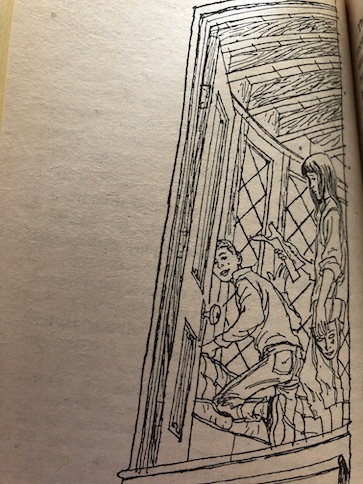
On the grounds of the Van Heusens’ estate, Cory spots what looks like the foundations of a house that was started to be built but never completed. Peter says that he and the other Explorers sometimes play around these foundations. Cory wonders who was planning to build a house there and why they never finished it. Uncle Dirk gets angry when he catches Cory and Peter snooping around the tower at Tarnhelm, where he keeps some of his old wood-carving things and where Peter finds some mysterious poetry.

Peter later takes Cory to visit Laurel Woodford, a young woman Cory met on the beach earlier, who helped Cory find her necklace when she lost it. Laurel is a weaver. Laurel lives by herself, but she says that she isn’t lonely because she has plenty of things to do that keep her busy. However, there is a kind of sadness about Laurel, and she has secrets of her own. She knows the Van Heusen family herself, and it wasn’t a happy experience for her.

Slowly, without Cory really doing any intentional investigating, the pieces of the past start coming together – Uncle Dirk, a marriage that didn’t take place, a house that wasn’t completed … and two identical unicorn pendants.

The story is haunting and magical, but not because of an real spells or magic. The only ghosts are the ghosts of the past. The book reminds me of a couple of other books that I’ve read, but explaining which ones involves some spoilers. I don’t mind giving spoilers for this story because I haven’t found a copy of this book that’s available to read online, and it’s something of a collector’s item now, with copies typically costing at least $20 and frequently more, although it’s sometimes possible to find one for less.

My Thoughts and A Few Spoilers

One of the interesting things about this book is that it reminds me of other books that I’ve read and liked. Some children’s books are mentioned in the course of the story because Cory likes to read, like The Five Little Peppers and How They Grew and The Story of the Amulet, but these aren’t the books that the story reminds me of.

Throughout the book, the Fergusons use various Scottish words and phrases, sometimes singing old songs or quoting from poems. Mrs. Van Heusen says that she particularly likes the Fergusons because her family was also from Scotland, and they remind her of her youth, which is a comfort to her. The Scottish element and the young orphan learning to make friends and become close to a new family remind me of Mystery on the Isle of Skye, although that book was actually set in Scotland. The books also have a similar feel in the way they approach the element of mystery in the story and the element of “magic” and “spells” that aren’t really magic spells. Both books have an enchanting quality to them, but it’s because of the atmosphere of the stories, not because there’s any actual magic.

During the course of the story, Cory learns more about what it takes to make friends. Peter realizes that Cory isn’t particularly good at making friends and confronts her about the reasons why. It’s partly because Cory has had to change school multiple times, but Peter has also noticed that Cory always waits for other people to approach her with offers of friendship and invitations to join in. If they don’t, she just feels hurt and left out instead of voicing her desire to join in. Even when she gets an invitation, her impulse is to reject it if she thinks it was only offered out of pity. Peter finds it annoying that Cory seems to need people to practically beg her to be their friend and join in activities. It reminds Cory of advice that Stephanie has tried to offer her before that she should just join in and not worry or assume that people don’t want her around. Even Fergie told her that if she wants to make friends, she’ll have to drop her pride, meaning that she’ll have to learn to make the first move and approach other people instead of waiting for them to come to her. This criticism is partly true, but Cory’s experience of life is that many of the things she wants also depend on the decisions of other people, and Peter comes to rethink some of what he said when some of his friends are less than accepting of Cory. It isn’t nice to be invited into a place where you aren’t really made to feel welcome and accepted. This is also a fitting description of Cory’s life with Stephanie, being largely raised by her hired help.

When Cory finally receives Stephanie’s reply to her letter, Stephanie’s selfishness and detachment from Cory’s life become increasingly apparent. Cory shares the letter with her grandmother and Fergie and outright asks her grandmother if she can stay in California. Her grandmother asks her if she won’t miss Stephanie because Stephanie is the only mother she’s known since she was little, but Cory says she won’t because Stephanie is gone so much and busy with her acting, leaving her with hired help. Fergie, while being hired help herself, is more maternal and says that situation is unacceptable, but Cory’s grandmother says that she’s not sure that she’s up to raising another child, that she’s old and wants her peace and quiet now. Even while Cory’s grandmother knows that her daughter is self-centered, she has a kind of self-centeredness of her own. When her grandmother gets dramatic about the worry Cory puts her through when she’s running around the caves with her friends, Cory realizes that Stephanie has been imitating her during her dramatic acts.

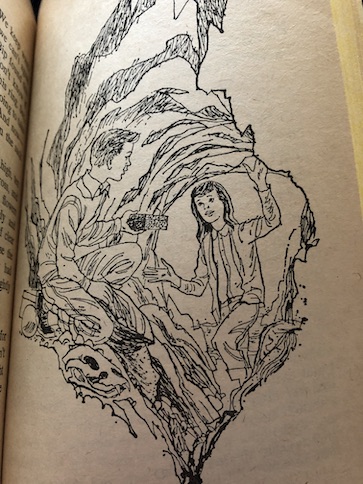
Cory begins to get the answers about her past and Uncle Dirk’s when Peter shares some treasure with her that he and other members of the Explorers have found and are hiding in a cave on the Van Heusens’ property. This treasure is part of the reason why some of the other Explorers have been less than welcoming to Cory, not wanting to share it and their secret hiding place with her. They’re worried that she’ll give their secrets away to the Van Heusens, and then, they’ll lose their treasure and their secret hiding place. However, among their treasures is a carved wooden box that Peter found, and it looks like Uncle Dirk’s carving work. Cory points out that the carved wooden box probably belongs to Uncle Dirk, and since it was on the Van Heusen land, he probably hid it in the cave himself. Peter, as the finder of the box, lets Cory have it to return to Uncle Dirk.

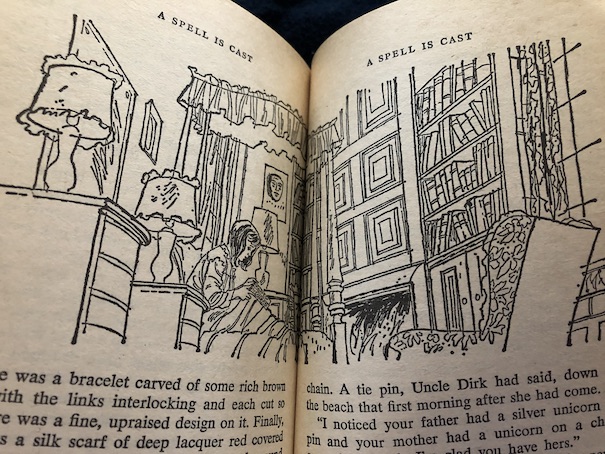
In the box, Cory finds four colorful feathers, four pretty seashells, a poem about an angry quarrel signed with the initials “L.W.”, a carved wooden bracelet, a woman’s scarf, and a small silver pendant that is identical to the one that Cory wears. However, the back of this particular unicorn has a rough spot where it used to be mounted on something else, and Cory realizes that this is the one from the tie pin that Uncle Dirk told her about, turned into a necklace. From these pieces, Cory begins to realize that the contents of the box are Laurel’s – her initials on the poem and a necklace made for her that Cory thinks must have come from her father. If that’s true, Cory thinks Laurel must be some kind of relation to her.

Cory also explores the room off the tower in Tarnhelm that contains the amazing chess set with the unicorn knights, and now that she’s no longer sick, she sees that the room also holds other furniture that Uncle Dirk made. Uncle Dirk was the person who started to have the house built, and he was making furniture to go in the house, but for some reason, he stopped and stored the furniture away because there was no new house to put it in. There are also carved masks of Laurel in the room.

Early in the morning, Cory decides to go see Laurel about what she’s found, knowing that if she waits, she’ll miss her because she’s about to leave on a trip. When Cory shows her the box that she’s found and asks her about the unicorn pendant and whether or not they’re related, Laurel tells her that they’re not related but that the unicorn did come from her father’s tie pin. Like my earlier theories, Cory’s theories about Laurel are partly right and partly wrong. After Cory’s parents died, Stephanie sorted through their belongings. She gave the little unicorn necklace to Cory, and she gave Cory’s father’s tie pin to her brother, Dirk. After Dirk got the unicorn tie pin, he had it made into a necklace for Laurel.

Laurel explains that, about seven years earlier, she and Dirk got engaged while they were still in college. However, Dirk was very spoiled by his mother after his sister left home and went to New York to do her acting. He was a very talented wood-carver and looked at himself as an artist who would never have to earn a living because his mother was very wealthy, and she encouraged him in his art. Dirk wanted to drop out of college and just spend his time doing wood carving, without caring much whether he ever made any money at it. Laurel argued with him about it because she didn’t like the idea of living on Mrs. Van Heusen’s money, and she broke off the engagement. Looking back on it, Laurel regrets doing that. She finished college and could have worked to support herself and Dirk independently, just as she’s been supporting herself these last several years, ironically with an art of her own, and with Dirk’s talent at carving, he might have ended up making money at his art anyway, doing something he really loved to do.

It was all about pride. Laurel was too proud to rely on Mrs. Van Heusen, who was happy to support her son’s art, and Dirk was both proud and spoiled and wanted everything his own way on his say-so without working things out with Laurel. Dirk was being a little selfish, but Laurel comes to realize that she was a bit selfish too because she refused to acknowledge how important Dirk’s art was to him and wanted him to be something else. At one point, Laurel wanted to make up with Dirk and talk things out, but he ignored her and refused to talk to her. She got so mad that she left the box of treasures in the cave where she and Dirk used to play as children and threw the engagement ring in the ocean. Since that time, she and Dirk haven’t been able to talk to each other, even though they both wanted to. Dirk gave up the woodcarving that he loved because it was a painful reminder of the reason why he and Laurel broke up. Instead, he went back to college and became an architect so he would have a profession of his own. However, he is given to dark moods because he misses both Laurel and his woodcarving and doesn’t know what to do about it.

The situation gets straightened out when Dirk, realizing that Cory is missing from the house and that fog is coming in, goes to Laurel’s house to make sure that Cory is safe with her. The three of them talk things over, and Dirk asks Cory to give him some time to talk to Laurel alone. Dirk and Laurel make up, and Laurel agrees to marry Dirk as they planned, on the condition that they both adopt Cory because she’s come to love Cory as a niece. Cory is overjoyed to hear the news, and Dirk plans to begin construction on the house that they’d started years before.

The story of the lovers parted by a prideful quarrel and the unicorns that bind them together reminded me of The Little White Horse by Elizabeth Goudge.

There is a scene when Stephanie shows up to claim Cory and take her back to New York, but the family talk it out with her. Stephanie admits that she took Cory partly because that was her promise to her old friend and partly out of guilt because the skiing trip where Cory’s parents were killed had been her idea. Mrs. Van Heusen tells her not to blame herself because she couldn’t have known what was going to happen and Cory’s parents chose to come on the trip with her. Stephanie further admits that she didn’t legally adopt Cory because she was aware that her lifestyle wasn’t particularly suited to bringing up a child, although she’s done her best, and because she knew that Cory did have other relatives. She doesn’t quite admit that she was hoping that one of these other relatives might take her someday, but she gives that impression. Cory’s relatives on her mother’s side haven’t tried to claim her because her grandmother on that side of the family was too old to look after her, and her aunt already had a large family and not much money. Stephanie loves Cory, even though she doesn’t really know how to raise a child and has found it difficult to care for her, and she feels betrayed at first when Cory says that she’d rather stay with Dirk and Laurel. However, Stephanie later apologizes to Cory for making a scene about it because it really would be better for everyone if Cory stayed in California, where she would have a stable life and Stephanie wouldn’t have to worry about her. Stephanie returns to New York on her own, and Cory tells Peter that she’s going to stay in California. Peter and the other Explorers welcome her into their club. Now that Cory knows that she’s going to be staying, everyone feels more like she truly belongs.

The Lancelot Closes at Five

The Lancelot Closes at Five by Marjorie Weinman Sharmat, 1976.

“Camelot” is the name of a new housing development being built in Shady Landing, New York. In the beginning of the story, Camelot has only three model homes, demonstrating what the houses in this new neighborhood are going to look like. In keeping with the Arthurian theme, the three model homes are called “the Excalibur”, “the Lancelot”, and “the Guinevere.” Abby’s family decides that they will buy a house there on the Excalibur model because they are tired of their crowded apartment in Brooklyn and Abby’s parents think that buying a house sounds like a good investment for future.

The move isn’t easy for Abby and her family. Abby doesn’t like leaving her old friends behind. There are several things wrong with the new house, including windows that are nailed shut, doorknobs that fall off, and a flooded basement. Also, the people who live in the village of Shady Landing don’t like the newcomers because trees were cut down to build Camelot.

However, Abby soon finds a friend, Heather Hutchins, who likes to be called “Hutch.” Hutch also lives in the new Camelot neighborhood. Hutch’s family is very health-conscious, believing in all-natural foods, which is why Abby doesn’t usually like to eat at their house, and Hutch’s mother is a very competitive person.

Then, Hutch springs a surprise on Abby. Hutch tells Abby that she wants to run away from home. She doesn’t want to be gone for long, just about day during the Memorial Day weekend. She doesn’t want to go far, planning to spend a night in the Lancelot model home. But, she wants Abby to come with her so she won’t be alone.

At first, Abby is a little reluctant, but Hutch is very persuasive, the idea does seem like a fun adventure, and hiding out secretly so close to home doesn’t seem too dangerous. In fact, since the public is invited to come and walk through the model homes, it doesn’t even seem like trespassing. Abby agrees to do it. The girls’ plan is to tell their families that they’re spending the night with each other but conveniently not mention where so they’ll assume that they’re just having a normal sleepover at each other’s house. Then, they plan to visit the Lancelot and hide there until it closes and all the other people leave.

When she proposes her plan, Hutch doesn’t explain her motives for wanting to run away for a day, and Abby decides not to question her, thinking that Hutch will tell her when she’s ready. She does note that Hutch doesn’t seem to get along well with her mother. Hutch’s mother doesn’t seem to connect well with other people in general, being more focused on what she wants them to do than on just acknowledging them or building relationships with them. Worse still, Hutch’s mother is what Abby calls a “scorecard mother,” always comparing her child to everyone else’s child, constantly keeping track of where Hutch is ahead and where she’s behind. Hutch’s mother has overly high expectations of Hutch and pushes for perfection. Hutch’s mother sometimes quizzes Abby about what she does to help out at home and how each of the girls are doing in school so she can compare them. Abby sometimes feels like she’s in the uncomfortable position of defending Hutch to her own mother.

The Lancelot model home is decorated in a fakey pseudo-Medieval style, in keeping with the Camelot theme. When Abby and Hutch sneak in, they pretend to be part of a family group touring the house and then hide under a bed until everyone else leaves. Their plan works, but staying in the house isn’t quite what Abby imagined it would be. The furniture is uncomfortable because it’s made to be looked at and not actually used. Not all of the appliances even work, like the tv, because they’re just for show and not for using. For their “supper”, Hutch has brought candy bars and pastries, things which her mother normally forbids her to have because they aren’t natural and will rot her teeth. Abby still can’t have some of them because she has food allergies and braces, but Hutch brings pound cake for her.

Hutch finally admits to Abby that her main reason for wanting to have this adventure is just to have the chance to do something for no other reason than she just wants to do it. Abby is right about Hutch’s mother. Everything that she wants Hutch to do is centered around gaining something – recognition, awards, physical health benefits, learning things and getting a mental edge. Hutch just wanted the chance to do something without a particular motive other than just wanting to do it and the fun of planning it out and pulling it off by herself, with the help of her friend.

Unfortunately, Hutch gets carried away with the success of her plan and turns on the lights, which attracts the attention of a passing police car, although the police just try the doors, decide that the lights were left on by accident, and leave without finding the girls. Then, Hutch doesn’t want to go to sleep and stays up, eating candy bars in bed, just because she’s normally not allowed to do that. Abby is uncomfortable in the big, fancy bed that isn’t meant to be slept in and can’t sleep, so she leaves and goes home, making Hutch mad. Abby spends the rest of the night sleeping in her sleeping bag in her family’s basement (which is no longer flooded) so she won’t give away Hutch’s secret.

Later, Abby feels guilty about abandoning Hutch, so she sneaks out early in the morning to check on her. Hutch got out of the Lancelot without being noticed, but she’s still mad at Abby for leaving her when she was trying to do something that was important to her. However, there is worse to come. The police hadn’t forgotten about something strange happening at the model home that night, and now, there’s a rumor in the neighborhood that the house was “vandalized” during the night (meaning the mess that the girls left in the house from the food they ate, trying to sleep in the bed, and using the bathroom). Abby is naturally a more timid person than Hutch, and while she has started to appreciate Hutch’s attempts to help her be more bold and take more chances, it makes her nervous that she and Hutch are the “vandals” whose escapades have now made the local paper. Abby’s father, an author, is even attempting his own investigation into the matter.

Abby is not only worried about repairing her friendship with Hutch but not getting found out for what they did. Then, one of the boys at school starts bragging, claiming that he and his friend were the ones who snuck into the Lancelot to hang out that night. He’s not the only one trying to claim credit for the stunt, either. Abby hopes that the whole thing will just die down and be forgotten, but Hutch doesn’t feel the same way. Even though she originally set out to do something just on a whim without looking for recognition, the idea that someone else might claim recognition for what she did galls her. What will happen when Hutch tries to reveal her role in masterminding the night in the Lancelot?

I purposely sought this book out online because I never owned a copy and I remembered it from when I was in elementary school, but the funny thing is that I don’t remember ever hearing the entire story when I was a kid. I think that my class might have just read a selection from the book, maybe as part of one of those story collections that has excerpts from books to demonstrate certain concepts and give samples of stories. I can’t quite remember now. All I remembered was that the main escapade was just a part of the story that took place at the beginning of the book, and the rest was about what happened because of the girls’ secret nighttime excursion. It makes the book a bit different from other children’s books about kids running away and hiding in usual locations, like From the Mixed-Up Files of Mrs. Basil E. Frankweiler, where most of the book takes place during the kids’ adventure and the kids’ parents are barely seen. In this book, the girls are mostly at their own homes, and the parents have prominent roles.

Runaways generally have two motives – getting away from something or going in search of something, and when you really think about it, they frequently have both. Hutch’s adventure is both about escaping from her mother’s oppressive rules and emphasis on perfection as well as undertaking something unusual and pulling it off for the sense of personal achievement. However, even though Hutch at first insists that she wanted to do it just for the sake of doing something that she wants, with no expectation of recognition or reward, it turns out that isn’t completely true. Part of the reason why she wanted Abby along was to get a sense of recognition from her for the accomplishment as well as her company. Her bad feelings toward Abby for abandoning their adventure and going home were partly because Abby didn’t value that type of uncomfortable adventure as much as she did and didn’t fully acknowledge the cleverness of her plan. Even if it started out as just a fun escapade, undertaken as a brief chance to break a few rules in secret, Hutch badly craves acknowledgement, just not in the form of the constant comparisons he mother makes between her and other people. What Hutch really needs is just to be acknowledged for being herself and to feel valued, no matter how she compares to others. In her attempt to make things right with Hutch again, Abby does something that she never thought that she would ever be bold enough to do: give Hutch’s mother a piece of her mind.

The book is available to borrow and read for free online through Internet Archive.

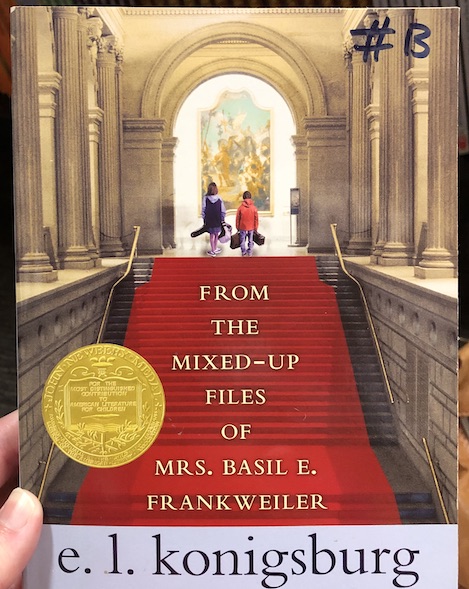
From the Mixed-Up Files of Mrs. Basil E. Frankweiler

From the Mixed-Up Files of Mrs. Basil E. Frankweiler by E.L. Konigsburg, 1967.

Twelve-year-old Claudia Kincaid is bored with her dull suburban life in Connecticut with her parents and her brothers. Her life also often seems unfair, like she has more responsibilities than her brothers do and she has more chores than her others friends. Basically, Claudia is bored and feeling unsatisfied with her life. She wants to get away from it all and have a little adventure … although not too much adventure because Claudia isn’t the overly-adventurous type.

Claudia is cautious and methodical. When she plans to run away from home, she carefully plans every step and invites her more adventurous nine-year-old brother Jamie to go with her, both for the companionship and because he is a tightwad and has the cash necessary to fund their adventure. Although Claudia and Jamie bicker as siblings, they’re closer to each other than to either of their other brothers. Jamie eagerly accepts Claudia’s proposition to run away, although at first, he’s a little disappointed when he finds out where they’re going.

Claudia plans for them to run away to New York City because, as she puts it, it’s “a good place to get lost.” The city is so big, Claudia is sure that two runaway children will be easily overlooked. She’s also found a great place for them to stay during their adventure: the Metropolitan Museum of Art. Claudia loves comfort, convenience, and beauty, and the museum can offer all of that without the fees of staying in a hotel. There are exhibits of furniture, which provide them with a bed to sleep in, and interesting exhibits to keep them entertained and educated, and all they have to do is evade the security guards. At first, Jamie thinks that sounds a little too tame, but their adventure soon proves to be exciting and challenging, with enough mystery to satisfy both of them.

Claudia and Jamie develop routines for sneaking around the museum, evading the guards, hiding the backpacks and instrument cases that hold their clothes, and raiding the coins in the fountain for extra money. One day, while they’re hiding in the restrooms and waiting for the museum staff to leave, the staff set up a new exhibit for an angel sculpture sold to the museum by the wealthy and mysterious widow Mrs. Basil E. Frankweiler, who is actually the person narrating Claudia and Jamie’s story in a letter to her lawyer.

Claudia develops a fascination for the angel and a desire to learn the truth about the theory that the statue was made by Michelangelo. Between the two children, Claudia is the more imaginative and romantic, but Jamie’s logical mind and zest for adventure serve them well as they delve deeper into the mystery. They do learn something important at the museum, but to get the full truth, they have to leave their planned hiding place in the museum and go see Mrs. Basil E. Frankweiler herself.

Mrs. Frankweiler is a delightfully eccentric student of human nature, who is fascinated by the young runaways who come to her for answers to a mystery hundreds of years old. In exchange for the details of their exploits, Mrs. Frankweiler gives the children a chance to locate the answers they’re seeking in her strange, mixed-up files. In the process, the children learn a secret that gives both of them the sense of being part of something secret and exciting and much bigger than their ordinary, hum-drum lives, which is what they were originally looking for when they ran away from home.

The book is a Newbery Award winner, and it is available to borrow for free online through Internet Archive (many copies).

My Reaction

During the course of the adventure, Claudia and Jamie become closer to each other than they were before they ran away from home. They learn a little more about each other and themselves, and neither of them is quite the same as they were before they started, which is at the heart of Claudia’s reasons for wanting to run away from home in the first place. The language and descriptions in the book are colorful, which is part of the reason why this book is popular to read in schools.

There were two movies made of this story. One is a made-for-tv movie version from 1995, although it changed some of the details from the original story. In the 1995 movie, there is a scene with Jamie getting sick and Claudia worrying about him and taking care of him that never happened in the original book. Also, in the movie, Claudia stops Jamie from taking the coins from the fountain when they had no qualms about raiding the fountain for money in the book. At the end of the book, the children don’t tell their parents where they were hiding when they return home, but in the movie, the parents do find out. There is also an older movie from 1973 which is sometimes called The Hideaways.

Ramona Forever

Ramona is in third grade now, and there are new changes coming in her life. At the beginning of the book, she and her sister Beezus still go to Howie’s house every day after school so Howie’s grandmother can look after them because both of their parents work, although lately Beezus has been finding other places to go after school, like her friend’s house and the library. That’s how Ramona knows from Howie that his rich Uncle Hobart, who has a job in the oil industry, will be coming to visit soon from Saudi Arabia. Ramona mentions it one night at dinner when her Aunt Beatrice is visiting. Aunt Beatrice says that she remembers Hobart from when they were kids and went to the same school, but she hasn’t seen him in years.

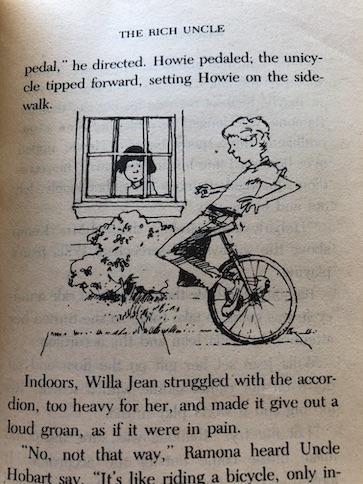
When Uncle Hobart comes, he brings a couple of small camel saddles for Howie and Willa Jean to play with. He also gives Howie a unicycle and Willa Jean a small accordion. When he meets Ramona, he embarrasses her by calling her Howie’s girlfriend and singing a verse from an old song about a woman named Ramona (links repaired Nov. 2023), and Ramona takes an instant dislike to him. She flat out tells him that she doesn’t like adults who tease (Neither do I, and I’m in my 40’s.), and he promises to reform, although Ramona thinks that he’s still joking around and isn’t satisfied.

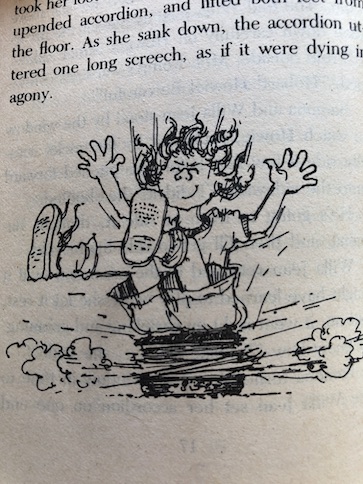
Uncle Hobart takes Howie outside to learn to ride the unicycle, and Willa Jean and Ramona try the accordion. When neither of them can figure out how to use it, little Willa Jean gets frustrated and sits on it, breaking it. Howie’s grandmother, Mrs. Kemp, gets angry at the girls, and Ramona thinks that the accordion was a dumb present to give to a little girl who wouldn’t be able to use it properly for years. Mrs. Kemp tries to shame Ramona to Uncle Hobart, blaming her for the incident. (As if Ramona was the babysitter instead of Mrs. Kemp, who incidentally, is being paid by Ramona’s parents to watch her as well as watching her own grandchildren. Ramona didn’t think of this, but I certainly did.) Ramona never really liked being watched by Mrs. Kemp, but the blaming and shaming makes her realize that Mrs. Kemp actually doesn’t like her and wants to make her feel bad, which is a disturbing feeling from someone who is supposed to be taking care of her. Ramona decides right then that Mrs. Kemp will never look after her again.

When the family talks about the situation at dinner that night, Beezus supports Ramona’s assertion that Mrs. Kemp doesn’t like them, saying that’s the reason why she’s been trying to find other places to go after school. Ramona’s mother asks her if she ever thought that maybe Mrs. Kemp would rather not be a babysitter at all, for either her grandchildren or Ramona, but women of her generation were only brought up to take care of their homes and children, and that’s all she knows how to do, whether she likes it or not.

Personally, I think this is true, but also irrelevant. Mrs. Kemp has a job to do, one that she’s being paid for, and if she’s taking the money, she also needs to take responsibility. Mrs. Kemp blames Ramona for not watching Willa Jean when that was her job, not Ramona’s, and Mrs. Kemp also has a responsibility to Ramona herself because that’s what she’s being paid for. Ramona is Mrs. Kemp’s babysitting charge. She’s a child, the child of paying customers who are specifically paying Mrs. Kemp for childcare. Ramona is not Mrs. Kemp’s personal servant or the babysitter for her granddaughter. Ramona is especially not Mrs. Kemp’s personal therapist or caregiver, who needs to help her manage her emotions or life decisions. Ramona is a child who is only with Mrs. Kemp for the purpose of being cared for by her, so let’s keep it straight who has a responsibility to whom in this situation. Besides not liking adults who tease like bratty children, I also don’t like adults who try to make kids be responsible for things that they should be responsible for themselves. Seeing Mrs. Kemp accepting money in exchange for irresponsibility and a bad attitude about her own general life choices that she takes out on her childcare charges is that much worse. Mrs. Quimby’s insights, while probably true, are also completely unhelpful to the situation. Mrs. Kemp is what she is, and what she is does not make her a good caregiver. Ramona and Beezus are correct to call her on it. Mrs. Quimby is concerned about hurting Mrs. Kemp’s feelings, but I think that should be the least of her concerns in this situation since Mrs. Kemp doesn’t seem to care about the children’s feelings and she’s in a position of trust over them. She is demonstrably not doing the very thing she is supposed to do, which care for the children she is paid to provide with childcare. You have one job, Mrs. Kemp, just one job! Mrs. Kemp is an adult, more than old enough to know better about how to behave and take responsibility for herself and the young children in her care, and she should choose to act like it or be prepared to face the consequences, not continue to get paid and thanked for work she’s not even willing to do, making her young charges miserable every single day. She’s taking advantage of the Quimbys’ desperation for child care, and that’s not right. I wished Mrs. Quimby would step up and support her daughters’ efforts to stand up for their well-being instead of enabling Mrs. Kemp’s bad behavior and making excuses for it, as if it were somehow Ramona’s fault that Mrs. Kemp doesn’t like being a babysitter and that eight-year-old Ramona actually has the power to solve Mrs. Kemp’s life problems. I can only suppose that the reason why Mrs. Quimby doesn’t is that she just doesn’t know where else to find someone willing to watch the girls after school.

Mr. Quimby asks Ramona what she thinks she should do about the situation, and Ramona hates being asked that because she wanted help from the grown-ups, not the responsibility of figuring out the problem with her adult caregiver by herself. Again, I really have to side with Ramona here. It’s not her job to be the adult in this situation, and the older I get, the less patience I have for irresponsible adults. I hated them when I was a kid Ramona’s age (and I ran into plenty of them, too), and I don’t feel any better about them 30 years later. If you want the authority of saying that you’re an adult, you have to take the responsibilities that come with that authority, taking the adult actions and making the adult decisions, not expecting the kids to do your job for you. That’s my attitude. I honestly don’t know what response Mr. Quimby was even looking for from Ramona, either. What can Ramona do if Mrs. Kemp is unhappy about her life choices and doesn’t treat her well because she doesn’t want to be her babysitter? Get some books on psychology from the library and turn into a therapist or career counselor at the age of eight to help Mrs. Kemp work through her emotional issues? Invent a magic potion that will age her to 58 so she can be Mrs. Kemp’s new best friend and they can go out for champagne brunches together instead of Mrs. Kemp babysitting her? What solution are you imagining here, Mr. Quimby? Ramona is an eight-year-old, and what what she thought she should do about this bad situation was talk to her parents, who hired Mrs. Kemp to take care of her in the first place, and get their help. How was she supposed to know that you didn’t want to help her, either? If I were one of the parents in this situation, I’d say that I understood the problem and that I’d think over some other after school possibilities for the girls, maybe look into some temporary care for the girls, possibly in the form of some kind of after school lessons in art or music or sports, paid for with the money that I would have given Mrs. Kemp for babysitting, especially since I already know that the Quimbys are already considering some coming changes for their family that will change their childcare situation. Of course, all of this is setting the stage for what happens next in the story.

Ramona asks if she can just stay home alone after school because some kids do, but her parents don’t like that idea. Beezus says that she could stay with Ramona because she’s in middle school and old enough to babysit. Ramona worries a little that Beezus will be bossy and that they’ll fight with no adults around, but Mr. and Mrs. Quimby agree to let the girls try it for a week while Uncle Hobart is visiting so Mrs. Kemp can spend more time with her son. If the arrangement works and the girls behave themselves, they can keep doing it after Uncle Hobart leaves.

Ramona asks Beezus why she’s so willing to look after her after school, and Beezus explains that things haven’t been to pleasant at her friends’ houses lately. Mary Jane needs to spend a lot of time practicing her piano lessons, and she got into a fight with Pamela because Pamela was acting like a snob and giving her a hard time about her dad’s work situation. Mr. Quimby has had a series of different jobs, and now, he is working only part time and going back to college to train to become an art teacher. Pamela has been bragging to Beezus that her father has a real job and that Mr. Quimby should “stop fooling around and really go to work.” (This is one of those snide kids’ comments that you can tell really came from Pamela’s parents and that she’s just repeating what they say to sound big. Pamela’s parents have probably been bad-mouthing the Quimbys behind their backs to talk themselves up because their employment has been more stable and some people need to look down on someone in order to feel good about themselves. I’ve seen that type before, too. By this point in the story, I had the feeling that the Quimbys seem to know a lot of people who are real jerks in one way or another, and I think it’s time that they made some new friends.) Beezus can’t take it anymore, so she’s stopped speaking to Pamela, which is about all you can do in a situation like that.

Beezus worries about their family’s future because she’s heard that schools are laying off teachers, and she fears that her father might not find a job when he’s done with his degree. She also think that their mother is probably pregnant because of the way that Aunt Bea keeps asking her how she’s feeling and a few months ago, she seemed to be suffering from morning sickness. If that’s true, she probably won’t be able to work much longer because she’ll have to take time off to have the baby and look after it. It make things difficult when the family is already concerned about money, although Beezus says that she wouldn’t mind helping to look after a baby because she likes babies. Ramona worries about the new baby and why their parents would want another child when they already have her and her sister, and she doesn’t like that the adults seem to be keeping important secrets.

The girls try to be extra good and responsible when they’re home alone together so they’ll be allowed to continue staying home alone, but they get into a fight one day when Howie comes over and offers to let Ramona ride his bike because he’s going to practice riding his unicycle. Beezus is afraid that Ramona will get hurt riding the bike and she’ll be considered responsible, but Ramona wants to go ahead and do it anyway because she’s been waiting for Howie to agree to loan her his bike. Ramona likes riding the bike, but she does fall off and scrape her elbow. Beezus refuses to help Ramona clean up afterward because Ramona insulted her before she went bike riding, and Ramona is angry with Beezus. In spite of that, the girls decide not to tell their parents about what happened because they don’t want to go back to Mrs. Kemp and their father specifically tells them not do anything to worry their mother, another sign that she’s probably expecting a baby.

Then, one day after school, the girls discover that their cat, Picky-picky has died, probably of old age. At first, they don’t know what to do, but remembering that they’re not supposed to upset their mother, they decide to bury the cat themselves. The girls are upset, but they manage to bury the cat, and they also make up with each other after their earlier fight. When their parents come home and find out about the cat, they feel badly that the girls had to handle the situation on their own. Mrs. Quimby says that, after they handled this difficult situation, she knows that they can be trusted on their own and that there’s no need for them to go back to Mrs. Kemp.

The girls’ mother finally admits that she’s going to have a baby, and the family begins talking about the new changes that they’ll have to make when the baby comes. The girls wonder who will have to share a room with the new baby, and they come up with ideas for names. Ramona worries about being a middle child now and not the youngest, but her mother reassures her that she still loves her. The Quimbys also consider that they may have to move in order for Mr. Quimby to find a teaching job, although Beezus and Ramona don’t like the idea of moving.

However, there are still more changes to come. Aunt Bea and Uncle Hobart announce that they are getting married! Ramona still doesn’t like Uncle Hobart and doesn’t really want him for an uncle, and after they’re married, they’re planning to move to Alaska because Uncle Hobart will be working in the oil industry there.

Changes aren’t always easy, but the girls enjoy taking part in their aunt’s wedding, and at the end of the book, their mother has the new baby, who turns out to be a girl. They call her Roberta, for a twist on her father’s name. Ramona begins to feel happy and comfortable with the changes in her life because she realizes that she’s growing up.

The book is available to borrow and read for free online through Internet Archive (multiple copies).

Ramona and Her Father

Ramona and Her Father by Beverly Cleary, 1975, 1977.

It’s September, and second-grader Ramona Quimby is already making out her Christmas list. However, Christmas this year might not be what Ramona expects. Her father comes home and explains that he’s been laid off from his job because a larger company bought the company he worked for and laid off the extra workers. Mrs. Quimby has a part time job, but it doesn’t pay much. Everyone in the Quimby family soon becomes worried about money.

Mrs. Quimby finds another job that’s full time, but Mr. Quimby still struggles to find work. Ramona doesn’t like to see her father so worried and stressed, and she tries to think of some way she could also earn money. When her father comments about how much money a boy on a television advertisement must have made, Ramona sets herself to memorizing various advertising phrases and repeating them, hoping to be discovered and hired to make an ad herself. Unfortunately, things that people say on ads don’t work in real-world settings, especially when you tell your teacher that her wrinkled stockings look like elephant skin.

The family has to eat food that they don’t particularly like in order to save money, and they start buying cheaper cat food for their cat. Picky-picky refuses to eat the cheap cat food, and before Halloween, he eats part of the girls’ jack o’lantern in desperation. Beezus, upset at the idea that their cat is apparently starving and desperate, angrily asks her father why they can’t afford Picky-picky’s usual cat food when they seem to have enough money for his cigarettes. (It’s a valid question. During my first semester of college, I totaled up a classmate’s expenses on cigarettes and realized that what she spent on them for a year was about the same as full-time student tuition at our community college, by early 2000s standards.) Her father tells her that’s none of her business, and Beezus retorts that it is her business. Cigarettes are harmful, and Mr. Quimby is spending money on them that the family desperately needs.

Ramona is worried because this is the first time that she’s heard that cigarettes are bad, although Beezus says that she learned it in school. Ramona tries to ask her father if what Beezus said is true, and he just says that he expects to be an old man someday, the kind that tells reporters on his hundredth birthday that he owes his longevity to cigarettes and whisky. This joke doesn’t reassure Ramona. Ramona decides that she’s going to get her father to stop smoking.

Ramona gets Beezus to help her make anti-smoking signs. At first, their father tries to ignore the signs, and then he starts getting annoyed with them. Ramona worries that she’s been mean to her father and upset him too much, but he later admits that she was right and that he’s going to try to quit smoking. Ramona takes him at his word and throws his cigarettes away, although he said that he would rather have cut down gradually. Still, his wife and daughters are happy about him quitting. For awhile, Mr. Quimby is edgy and irritable as he tries to get used to not smoking as well as still looking for a job.

As Christmas approaches, the girls’ Sunday school begins preparing to put on a Nativity play. Beezus gets cast as Mary, which pleases her because Henry Huggins is going to play Joseph. Ramona is so excited about the play that she wants a creative role for herself, and after the shepherds are cast, she says that she wants to be a sheep to go with the shepherds. The Sunday school teacher says that sounds like a good idea, but they’ve never had any sheep in the play before and don’t have a costume for her. Ramona says that her mother could make her one, and other children also say they want to be sheep.

However, as Beezus points out, now that their mother is working full time, she doesn’t really have time to sew a costume. Their mother also says that they can’t afford to buy new cloth for a costume, and the best she can do is an old white bathrobe that she might be able to alter into costume. Ramona’s father snaps at her that she’s been inconsiderate for expecting her to do something like this without asking first. Ramona feels badly and overhears her father calling her a spoiled brat. With his irritability, he’s been picking at her for various things, and one day, Ramona argues with him when she comes home from school and smells cigarette smoke.

Ramona’s father reassures her that he hasn’t purchased any new cigarettes. He just found an old one in a pocket that he forgot that he had and decided to smoke it to see if it would help him feel better. The two of them have a heart-to-heart talk about Ramona worrying about why they can’t be a happy family. Ramona’s father tells her that their family is happy. It’s just that no family is perfect and nobody’s life is perfect, and everyone goes through hard times now and then. The people in Ramona’s family still love each other and do their best for each other even when things are hard and they don’t always get along.

Things improve for the Quimbys as Christmas approaches. Mr. Quimby finally finds a new job. Ramona almost backs out of the Nativity play because her mother didn’t have time to make her a full costume, and she feels silly with what she’s wearing, but she changes her mind with the help of three older girls who were recruited to replace the Three Wise Men who backed out of the play.

One thing that kind of surprised me in the story was that Ramona’s parents seemed mildly scandalized when Ramona and Howie sang “99 Bottles of Beer on the Wall.” Beezus, who learned the song at summer camp and taught it to Ramona says that the neighbors will probably think they’re beer guzzlers after hearing Ramona and Howie sing it all up and down the street. It struck me as weird because I remember that everyone knew that song when I was a kid in the 1980s and 1990s, and nobody thought anything of it. I certainly never heard of anyone being scandalized by it. It’s just a silly counting song, and nobody really thought that any kid singing it had ever had beer. In fact, it was a common song for parents to get their kids to sing on long car trips because it takes a long time to finish, and during that time, the kids aren’t complaining or asking, “Are we there yet?”

The book is available to borrow and read for free online through Internet Archive (multiple copies).

The Son of the Slime Who Ate Cleveland

The Son of the Slime Who Ate Cleveland by Marjorie Weinman Sharmat, 1985.

Frank is the first to admit that he’s a bit eccentric and that his mind doesn’t quite work like other kids’. He’s a bit more imaginative, more daring. When he thinks of something, he can’t resist doing it, even pulling pranks on his best friends, Jack and Lee. He sees it as a way of expressing himself, and he wants to go into show business someday.

One day, the boys spot a jelly bean counting contest at the mall. The prize is two tickets to a move called Monster Mayhem and all the jelly beans they can eat in two hours. Frank isn’t really interested in counting contests. Jack and Lee, who have ambitions to go into law and banking, are more interested in counting things and competing with each other. Jack and Lee both come up with the exact same number of jelly beans that they think are in the jar, and they start arguing about which of them came up with the estimate first. Frank can’t decide which of them was first, so he just tells them that they’re both wrong and guesses his own random number without even trying to count the jelly beans. All three of them enter the contest.

That could have been the end of it, but Frank can’t resist telling other people about the contest. Not only does he tell them that he and his friends have entered the contest, but he tells them the exact number that Jack and Lee both guessed.

A classmate, Bianca, invites everyone to a party at her house where everyone has to come dressed as their favorite monster. Her parents are also there, dressed as Mr. and Mrs. Slime Who Ate Cleveland. Bianca’s parents are both psychologists, and they think it’s emotionally healthy for kids to expend their energies and go wild at parties, so they’re very permissive with Bianca and her friends. At the party, Bianca’s father takes an interest in Frank, calling him “son” (hence the name of the book) and telling him that he should mingle more with the other kids and be less of a loner. He offers to help Frank with vocational counseling for his future, which Frank is not eager to accept from a guy who is currently dressed as a Slime Who Ate Cleveland and who actively encourages the kids to have a potato sack race in the living room. Frank thinks an indoor potato sack race sounds crazy, Jack thinks it sounds dumb, but Lee is all for it. When Jack and Lee argue about the potato sack race, Bianca brings up the story that Frank told her earlier about the jelly bean counting contest and the boys’ argument over which of them guessed the answer first, putting it to a vote among the party guests. Lee wins the vote (which doesn’t mean much since the other party guests weren’t even there when they made their guesses), and Bianca switches her attentions from her current crush, Jack, to Lee (who doesn’t want Bianca’s attentions and becomes afraid to answer the phone when she keeps calling him).

Jack and Lee both get irritated with Frank for turning the jelly bean counting contest into a big deal and ask him to stop telling people about it because neither of them really even expects to win. However, the incident doesn’t even stop there, because it turns out that both Jack and Lee are declared the winners of the contest because their identical guesses are the closest to the real answer. The contest judges decide to award the prize jointly to the two of them – a movie ticket each and all the jelly beans that each of them could eat in an hour.

Sharing the prize could have resolved the incident, but Jack and Lee still have a competitive streak. Even though Frank congratulates them both as winners, Jack and Lee still argue about which of them is the “real” winner for coming up with the answer first. Frank tries to point out that each of them really only needs one movie ticket anyway, so what difference does it make if the other friend gets the other one? That doesn’t do any good, though. Jack and Lee both want to be acknowledged as the “real” winner, and thanks to the vote at Bianca’s party, other kids at school are taking sides to support their votes.

The entire jelly bean counting situation has gotten completely out of control! Jack and Lee won’t stop arguing with each other about who really won the contest, and both of them are mad at Frank for spreading the word about it and turning it into a bigger deal than it had to be. Frank needs to find a way to solve the argument and reconcile with his two best friends. Meanwhile, Bianca’s father, Mr. Wasserman, keeps calling Frank “son” and trying to talk to him about his vocational future, which makes Frank feel as green as the Son of the Slime Who Ate Cleveland.

Just when Frank thinks he’s got everything solved, a new contest threatens to set Jack and Lee against each other again. Frank tries one more outlandish scheme that exposes Jack and Lee’s arguments to an even wider audience than before. It takes some sincere friendship from Bianca, some words that actually make sense from her mother, and some “perfectly frank” talk from Jack and Lee to help Frank to recognize how his own behavior has contributed to the problems and how his friends really feel about some of the things he’s said and done.

The book is humorous, but Frank does develop some empathy through the course of the story, coming to a better understanding of how the people in his life really think and feel and the effects that his various pranks and stunts have had on people around him. Frank learns not just what it means to be “Perfectly Frank”, as he puts it, but what it really takes to be a sincere and honest friend. One of the best parts of the book is the banter between the various eccentric characters, from Frank’s straight-forward responses to the strange offers of advice from Bianca’s well-meaning slime monster father to the school principal’s attempts to convince Frank to take up paper clip collecting as a hobby to keep him out of trouble to the frank discussion of friendship Frank and Bianca have when Bianca asks Frank to kiss her.

The book is available to borrow and read online through Internet Archive.

How to Snoop in Your Sister's Diary

How to Snoop in Your Sister’s Diary by Janet Adele Bloss, 1989.

Lately, Haley has been jealous because her older sister, Lauren, has a new boyfriend and is spending all of her time with him. Haley feels neglected because Lauren doesn’t want to spend time with her any more. Haley resents the new boyfriend and worries about what Lauren and her boyfriend are doing together, so she begins regularly snoops in her sister’s diary to learn the details of Lauren’s relationship with her boyfriend.

However, Haley soon reads something shocking in her sister’s diary. Lauren might be about to do something disturbing and dangerous. But, what can Haley do about it when she wasn’t even supposed to know anything about it? If she reveals what she knows, Lauren will know about her snooping.

It turns out that Lauren already knows about the snooping and is angry with Haley about violating her privacy. Lauren isn’t actually doing anything wrong or even thinking about doing something wrong. She only wrote the shocking section in her diary to scare Haley, sort of like proving the old saying about how people who eavesdrop might hear things that they wish they wouldn’t (although the original saying is about how eavesdroppers might hear bad things about themselves). When Haley finally goes to plead with Lauren not to do what she thinks Lauren is about to do, Lauren reveals the truth, and the girls have an honest talk about what’s really been happening between them.

Personally, I didn’t think that the characters in the book acted in a very realistic manner. The main character didn’t react to certain situations in the way I would have expected, given her age. This is one of those stories which depends on characters holding things back and not communicating with each other openly for much of the story because, if they did, the story would have been resolved right away.

Amber Brown Goes Fourth

Amber Brown Goes Fourth by Paula Danziger, 1995.

Amber Brown Goes Fourth leaning against a tree

Big changes are happening in the life of Amber Brown. She’s back from her trip to England, during which she got chicken pox, and she’s about to start fourth grade. However, her best friend, Justin, has moved away, so she’s going to have to face the start of the new school year without him. Amber worries about whether she’ll be able to find a new best friend. Meanwhile, she’s also still adjusting to her parents’ divorce and her father’s move to Paris, France, and her mother has recently started dating a man named Max. Amber’s mother wants Amber to meet Max, but Amber doesn’t feel ready for that and is still quietly hoping that maybe her father will come back and her parents will reconcile.

Amber’s friend problems seem be solved when Brandi sits next to her in their new class. Brandi has changed since the last school year and is no longer best friends with snobby Hannah. Being friends with Brandi also forces Amber to make some changes. Brandi is quick to tell her on the first day that she isn’t Justin and that Amber can’t expect her to do the things that Justin would have done. Brandi is less excited about being friends with Amber than Amber is about making friends with her.

Amber worries that she doesn’t know how to make friends and especially that she doesn’t know how to make a best friend. She and Justin got to know each other when they were little kids, and Amber didn’t even have to try to make him her friend. However, that turns out to be the key to making friends with Brandi – not trying so hard and letting their friendship develop naturally.

When Amber and Brandi both have to go to the school’s afterschool program because their mothers work, they get to know each other better. Brandi hasn’t actually lived in Amber’s town for very long, having moved there to only about a year before, and when she moved, she also left behind her best friend and had trouble making a new one. When Brandi joined Amber’s class the year before, almost everyone already had a best friend and didn’t seem interested in making time for a new one, which is why she tried being friends with nasty Hannah. However, Hannah turns out to be mean to everyone, even the person trying to be her best friend, which is why Brandi stopped trying to be Hannah’s friend. Brandi has actually wanted to be friends with Amber for some time, but Amber was always too occupied with Justin, and after Justin left, Brandi was afraid that Amber was just looking for a Justin replacement and wouldn’t like her for who she really is. Amber tells her that she really does like her for being Brandi.

Amber comes to realize that it’s actually a good thing that Brandi isn’t exactly like Justin. She still keeps in touch with Justin by mail, but it’s also fun doing things with Brandi that she would never have done with Justin. Brandi teaches Amber to blow bubble gum bubbles with her nose. Because Brandi is a girl, Amber and Brandi can also do girl things together, like braiding each other’s hair. Brandi also likes to read more than Justin does, and the girls start talking about books with each other. Amber learns that not all changes are bad or difficult and that letting new people into her life brings interesting variety.

By the end of the book, she also comes to understand more about why her mother values her new relationship with Max. Justin’s mother was Amber’s mother’s best friend, and when Justin’s family moved away, Amber’s mother lost her best friend, too. That, combined with her loneliness since her divorce, led Amber’s mother to seek out new relationships, which is how she met Max and became fond of him. Max is apparently a nice man, and he even goes to the trouble of seeking out a particular mermaid toy for Amber because Amber’s mother told him that Amber really wanted one. At the end of the book, Amber still isn’t sure that she’s ready to meet Max because she feels like she needs some time to adjust to the other changes in her life first, but she begins to feel a little more open to the idea of change and letting new people into her life.

The book is very realistic about the gradual changes that Amber goes through as she starts fourth grade and learns how to make a new friend. Not everything in her life is completely resolved, like her feelings about her parents’ divorce and her mother’s new boyfriend, but Amber is making progress and growing up a little.

The book is available to borrow and read online through Internet Archive.

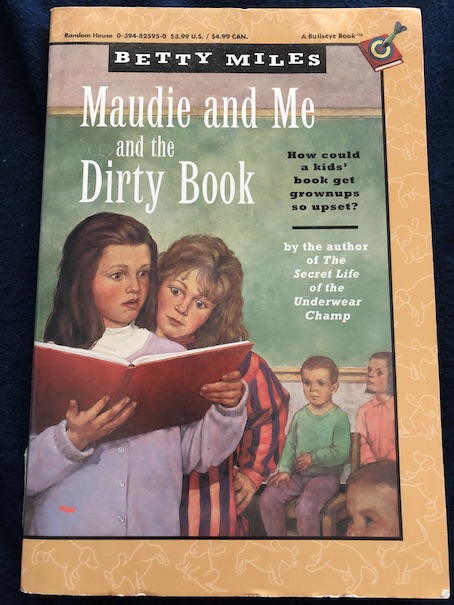
Maudie and Me and the Dirty Book

There’s a lot to discuss here, so I’m going to break up this whole entire review into themed sections and because this is going to be pretty long, I’m giving the link to the copies of the book on Internet Archive here.

Kate thinks of herself as a perfectly ordinary middle school girl. She’s certainly trying her hardest to be normal and cool and hang out with the “right” people. (In that compulsive way some people have when they’re just really trying way too hard because they feel like they’re supposed to. I’ll be honest, I found Kate to be a very trying character for about the first half of the book, and I have things to say about that in my reaction.) She’s very deliberately “normal” and her biggest worry is figuring out who the “right” people are to be friends with that it takes her completely by surprise that volunteering to take part in an English class project lands her right in the middle of a community scandal.

It’s Kate’s first year of middle school, and so far, Kate likes English class and her teacher, Ms. Plotkin. English was always her favorite subject, and Ms. Plotkin is one of those people who can make any subject or project sound exciting. Ms. Plotkin has a friend who is a first grade teacher at a local elementary school called Concord, and the two teachers think it would be a good interschool project to have middle school kids volunteer to read to the younger students to get them excited about reading and books. Kate volunteers right away because she loves reading and little kids. She’s been thinking that she’d like to earn some money by babysitting, so this reading project would be good experience that she might be able to use to get babysitting jobs.

Kate hopes that her best friends from elementary school, Jackie and Rosemary, will also volunteer for the project so they can do it together, but they don’t. The only other kid in class who volunteers is Maudie. Maudie has already been unofficially labeled as one of the uncool kids that all the cool kids avoid because they’re just not like the other, cool kids. There’s nothing seriously wrong with Maudie, but she’s a bit fat and Kate thinks of her as a kind of “dope” because she isn’t trying to act cool or normal like Kate and her friends do and generally isn’t trying to be like them. Kate even actively participates in all of the jokes and mean comments about Maudie that the other kids make behind her back because these shared “jokes” and slurs about Maudie are part of their bonding process with each other and define their in-group as being not-Maudie type people. (Oh, yes, I definitely have issues with Kate that I will rant about later.) That’s why Kate is horrified at first that she might have to actually work with and talk to Maudie if they’re the only ones doing this project together. Maudie is kind of fat, doesn’t quite dress like the other kids in small ways, and just kind of gives off an uncool vibe that’s sure to get Kate labeled as “uncool” if she has to hang out with her for this project. If that happens, she might become (gasp!) a not-popular person because the “right” people will avoid her. (Oh, noes! However will you manage?)

Maudie tells Kate that she volunteered for the project partly because she really likes working with kids, like Kate does, and she was hoping that she and Kate might be friends since they like the same sort of things. Maudie comments that she doesn’t like the atmosphere of this middle school because of people’s attitudes and obsessions with hanging out with the “right” people and being part of cliques. These are mature, sincere comments that shows insight into someone else’s character, and Maudie is correct that Kate is part of an exclusionary clique with Jackie and Rosemary. Maudie’s comments are actually a rather unsubtle hint at Kate that she’s being a bit of a snob and that she could be a nicer person if she could think outside of her snobby clique. Maudie is fully aware of what Kate and her friends are saying about her, and this is an invitation to Kate to change and be a friend, but Kate doesn’t get it at first. She’s too worried about seeming too friendly with uncool Maudie and what other kids will think of it, particularly Jackie and Rosemary.

Kate even thinks that she feels sorry for Maudie, wondering what it’s like to be her and mistaking her sincere offer of friendship for a desperate need to make a friend. Maudie’s actually just being a normal level of friendly in this conversation, but Kate’s assumptions about uncool people have given her a false view of reality. When Kate tries to imagine what it’s like to be Maudie, she’s not actually imagining herself as the real Maudie because she doesn’t really know Maudie at all and wasn’t really listening to Maudie when she was talking because she spent that time thinking about how not to say too much to her or be too friendly. Even though Kate kind of acknowledges that there’s nothing really wrong with Maudie, she still thinks of Maudie as a problem because of the social implications of seeming to like a person the “right” people don’t like, not realizing that the meanness she’s helping to enable is the real problem. (There’s nothing really wrong with Maudie, and I see a lot wrong with Kate and her friends because of their attitudes and the way they think about things. I’d also like to point out that Kate is not filled with sympathy at this point; she’s been nothing but self-pitying because of what she thinks is going to happen to her popularity at school for being seen with the wrong person. She’s projecting that self-pity onto Maudie who is, by herself, just expressing honest sincerity.)

At first, Kate tries to think if there’s a way that she can back out of the project, but in the first glint of honesty about her, she admits that she actually wants to do the project for the sake of the project itself. I always like people who have a particular hobby, cause, or interest that they like for its own sake because that’s a sign of a real personality or character. Standing up for a special interest and doing it anyway, even if nobody else is, also shows a strength of that character that’s worthy of respect. This is the one trait that made me willing to stick out the book with Kate, even though I seriously didn’t like her, because it showed the promise of character development.

Kate also finds additional willingness to continue with the project when Jackie passes her a note telling her to get out of the project so she won’t be “stuck with fat Maudie.” Even though Kate realizes that she was thinking the exact same thing and might have even said so out loud among her friends, it actually looks really bad and mean written out on paper in black-and-white. Kate thinks that writing it down makes it worse, not realizing that there’s really no difference at all, and it’s the thinking behind it that needs to change. Also, she finds it irritating that Jackie seems to think that she can tell her what to do. (I think that’s a legitimate complaint.) After they get out of class, Jackie even snubs Kate to hang out with other kids, and Kate knows that she’s lying to her about the reasons why.

Kate’s mother is actually glad when she hears that Kate will be doing the project with Maudie. Kate’s mother says that she doesn’t like it that Kate is so clingy with her old elementary school friends and that she’d like to see her branch out and meet some new people. (She doesn’t say why she wants Kate to do that, but at this point in the story, I’d already figured out why.)

When it’s time for Kate and Maudie to go to their volunteer project, a girl in class whispers a mean joke about Maudie to Kate, and Kate giggles. Then, Kate sees Jackie whisper something to the other girl and the two of them giggle. Kate suddenly wonders if Jackie is making mean jokes about her, and suddenly, it doesn’t seem as funny anymore.

(Oh, good grief! Is this the first time in her life she ever thought of this? You know, people who gossip and make fun of others (surprise!) spend their time gossiping and making fun of others. It’s what they do, and yes, they do it to different people, depending on who they’re talking to at the moment and who isn’t around to know. If someone gossips meanly about someone else to you, then yes, you can be confident that they’re gossiping meanly about you and making fun of you with someone else when they think you’re not listening. It’s their mode of communication and how they bond with people, and they have no idea why you’d have a problem with them doing to you that because you laughed with them before about someone else, so you must be okay with it and have no reason to get mad. I get impatient with people who don’t think about these things, and if Kate had the imagination to really put herself in someone else real shoes before, she should have thought of this long ago. She should know the kind of person Jackie is from years of experience with her, and she should have figured out that she wouldn’t like other people to say things about her that she’s been saying about Maudie. I feel like Anne Shirley from Anne of Green Gables, saying that if she had any real imagination, Kate could have put herself in someone else’s place and figured out what other people might be feeling, but she doesn’t do that because she’s too self-absorbed and doesn’t get it until someone does it directly to her within her hearing. Kate has plenty of self-pity but no sympathy, at least not at this point.)

The first chapters of this book were pretty painful for me because I had to put up with the kind of people I really hate, including the one telling the story, but fortunately, it does get more interesting from this point on. As they walk over to the elementary school, Kate and Maudie have a fun moment where they throw snowballs at a stop sign, and Kate forgets to be “cool” and snobby. At the elementary school, Kate has fun meeting the cute little first graders, and the first grade teacher reads Make Way for Ducklings to the class. Maudie also introduces Kate to the elementary school librarian because this is Maudie’s old elementary school, and she knows the faculty. The girls talk about Maudie’s time at Concord, and Maudie admits that she kind of misses it because it just seemed so much more friendly than Revere Middle School. Kate feels a little sorry for Maudie because she mentions that her best friend has moved away, and she asks if she’d like to go to the library together to pick out some books. Maudie accepts and says that she can hang out at her house afterward, if she wants, and Kate gets worried again that Maudie is starting to think that they’re actually friends or something. (Once again, oh, noes. However will you manage, Kate? You might accidentally give off vibes that you might be a likeable person or something, and how ever will you be popular if too many people in that vast sea of “wrong” people outside of your tiny clique like you?)

Kate and her friend Rosemary talk about the project a little, and Rosemary asks her what it’s like working with Maudie. Kate says that Maudie isn’t bad when you get to know her, and she is pretty good with the younger kids. Rosemary says that she’s been thinking that the comments people keep making about Maudie are really mean and she doesn’t deserve them because there’s nothing really wrong with her. Kate agrees.

Kate feels a bit bad about going to the library with Maudie because Jackie and the others are going skating, and Jackie is acting like she doesn’t even care that she isn’t going to be there. (It occurred to me that Jackie might actually care that Kate’s doing something with someone else and is trying to play it cool, but it’s dumb because that attitude just drives people away anyway. Either that, or she’s realized that Kate is somebody else to make fun of or gossip about with other girls, and that’s easier to do when she’s not there to defend herself.) Kate not only feels a little bad that she’s missing out on something with her friends, but she comes to realize that she’d rather go to Maudie’s house after the library after all because Maudie at least acts like she wants her around and Jackie doesn’t. Jackie seems to dodging her and trying to get rid of her to hang out with others. Also, it seems like all the other girls are obsessed with the new boy at school, Steve. Kate knows Steve slightly because his parents bought their house through her parents, who are realtors. (Ah, perhaps that’s why Jackie is acting weird! Instead of seeing Kate as her old friend, she’s starting to suspect her of being a rival for a cool guy at school.) However, Kate doesn’t really know Steve very well, and she finds the other girls’ fawning attitudes toward him embarrassing.

At the library, Kate and Maudie talk about their favorite kids’ books and try to pick out some books that will really please the first graders. Kate remembers that one of the first graders had told her that he was excited about getting a puppy, so she decides that she’d like to get a book about puppies. The librarian, who is actually a distant cousin of Kate’s, suggests a book called The Birthday Dog. It’s about a boy who wants a puppy for his birthday. The dog who lives next door is going to have puppies, but the puppies won’t be born in time for his birthday, and he’s disappointed at not getting a puppy for his birthday. Then, he gets a birthday card that says that he can have one of the dog’s puppies after they’re born. The boy and his father even get to see the first puppy being born and how the puppy grows until he’s big enough to leave his mother. The librarian says it’s a good book because the pictures are clear and realistic. The girls decide that they’ll use this book because of the puppy theme and because the boy in the story is about the same age as the first graders. This is where the censorship issue comes into the story. (More on this below, much more.)

Note: The Birthday Dog is not a real book, at least not as far as I can tell. Some of the children’s books mentioned in this book are real books, but some of them aren’t. I think it’s better for the purposes of the story if this picture book is not real because real books often have emotional baggage attached to them, possibly because of feelings of fond nostalgia because people liked them when they were young, resentment because of something the books said or the manner in which teachers or parents forced the books on them, or things people have heard other people say about books, even if the listeners haven’t actually seen the books themselves. For the purposes of this story, which is about examining people’s reactions to controversy, it’s better to approach this particular book with a clean slate, seeing it for what it’s described as being in the story and people’s reactions to it for what they are, removed from any personal emotional baggage. Assume from this point on that the book is exactly as the characters who read it describe it as being, nothing more and nothing less and that all reactions to the situation are exactly as described, nothing more and nothing less.

Kate does go to Maudie’s house, and she starts to learn that she and Maudie have some things in common and that even their mothers act very much the same way. Maudie’s mother has also been pressing her to make some new friends. Kate discovers that Maudie also enjoys old Marx Brothers movies and Maudie has a talent for impersonation. (Finally! A thing that you like, Kate! Early in the story, she was mainly about what she didn’t like and her preoccupation with being liked by the right people. Cool people in stories (and frequently in real life) never seem to genuinely, unironically like anything, especially things that are honest, goofy fun. It’s especially heartening to me that she likes something that not all of her friends like, so Kate is actually showing more signs of independent thoughts and feelings and interests beyond generic coolness and popularity-building. I’m emphasizing this because this was the point in the story to me that Kate started seeming like she might be a real person with an actual personality. Up to this point, she seemed like a two-dimensional wanna-be popular mean kid snob with no self-awareness.) By the end of the day, Kate actually begins looking at Maudie like a real friend and doesn’t seem to mind the idea. (Which means that Kate will finally stop getting on my nerves with her snobby, unaware mean girl act, and I can stop belaboring that point.)

Note: This is the part of the story where we get into issues of censorship and controversy in children’s literature. I think the earlier social machinations, cliques, and using negativity and putting other people down for the sake of personal promotion also ties in with this theme, which is why I went into detail about that before getting into this part of the book, but I’m going to discuss why it’s important later. One thing to keep in mind is that it isn’t unpopular Maudie who selects and reads the controversial book; it’s Kate, the one who’s been trying desperately hard to fit in with the “right” people and be popular and “normal.” Kate is about to be the one who will be ferociously judged by both other kids and adults for doing something controversial. For now, let’s get into the book controversy.

The next time the girls go to the elementary school, they show their books to Ms. Plotkin before they leave, and she approves of their choices. (This is key for the censorship issue. Keep in mind that the girls didn’t choose their books by themselves. They had recommendations from a librarian and the approval of their teacher for their specific selections.) Maudie reads her book, Little Bear, to the class first, and then Kate reads The Birthday Dog. The part where the puppy is born describes the mother dog’s stomach rippling, how she pushed the puppy out, and how she bit at the thin sac that covered the puppy when it was first born. Kate is reassured that the kids seem to like the story, but then the first grade teacher allows the students to ask Kate questions about the book, and Kate isn’t prepared for what the kids ask.

When one of kids ask how the puppy got inside its mommy, Kate looks at Ms. Dwyer, the first grade teacher, and Ms. Dwyer just nods at Kate to answer, not giving her any help or advice about what to say to a first grader about this.

(I just have to step in again at this point and say, if it were me as the adult present for this scene, I’d have noticed Kate’s discomfort, recognized this as a sensitive topic, and stepped in and said, “I’ll take this one, Kate,” and then said something that answers the question in the simplest, most literal terms without getting too deep or detailed. In this case, I might have said something about how that’s simply the way that babies begin to grow. It’s normal for babies to grow inside their mothers before their born because they are very small and weak at first and need some time for their bodies to develop before they can do even simple things like move around, eat, and breathe air on their own. Some animals lay eggs, like chickens, and the babies grow inside them and hatch out of them when they’re ready, and some animals have the babies grow inside their own bodies, like dogs, until they’re ready to come out. The mother’s body helps to protect them and give them what they need so they can grow. People are like that, too, and that’s why pregnant women look big around the middle before their babies are born, because the baby is growing inside them. But, it’s not a good idea to make a big deal about the way people look because you don’t want to make them feel bad or too self-conscious about their appearance (and I hope you know that I mean you too, Kate). Just be extra nice to pregnant people because it’s hard work carrying a growing baby around. If you want extra details, I recommend that you ask your parents because they’ve had kids before, and I haven’t, so they could describe how that feels better than I could.)

Kate stumbles about a bit, searching for a way of describing it, saying something about the father dog, but stopping because she isn’t sure what she should say or if she’s saying too much. But, some of the first graders begin blurting out bits and pieces of what they know, and some of them know more than Kate expected. One of the kids says that the father dog puts a seed into the mom. Kate says that’s correct and that’s called “mating.” Soon, little first graders are using words like “vagina” and “penis.” It’s important that the first graders are the ones who introduce these words into the conversation themselves, not Kate or the teacher or the book. Little kids like to receive recognition for things they know or things they have, so some of the kids are more than happy to show off what they know and to publicly declare which of those two they have. The first grade teacher just says that what they’re saying about the mother and father dog mating are correct and that’s how puppies start. Kate has a moment of panic when she’s afraid that the kids will start thinking about human babies and how she doesn’t want to go into detail on this subject, and she’s relieved when the kids return to the subject of dogs and start talking about their pet dogs’ names. Again, kids like to receive recognition for things they have and to compare things they have with others. When it’s pet dogs, it’s not as embarrassing.

When it’s time for Kate and Maudie to leave, Ms. Dwyer says that Kate handled the situation well, saying, “Kids this age can be embarrassingly frank! But I don’t want them to think there’s anything wrong with their natural curiosity. I’m glad you could answer them so matter-of-factly.” The girls bond over this odd, embarrassing incident, and they think that Kate seems to have handled it okay. Kate even reads the book to her elderly Aunt Lucy at her nursing home and some of the other elderly people there, and they like it, too. Then, the girls and their teacher start getting parental complaints.

The complaining parents in the story don’t handle the situation with grace and understanding, and they make things worse. Rather than defusing the situation and diverting focus from an issue that they didn’t want to discuss in the first place, they blow it up to the point where nobody in the community can ignore it. They phone the principal of the elementary school and the principal of the middle school. They go down to the library and demand to see copies of The Birthday Dog. Soon, everybody in the area hears some version of what happened in the first grade classroom, and just like in a game of Telephone, the events become mangled and confused. This is what I mean about misconception and misrepresentation and how people use these to further an agenda. Be prepared for more of this.

When the girls return to school after the weekend, Ms. Plotkin tells the girls that they need to have a talk with their principal. In the principal’s office, they tell the girls that some parents have complained about The Birthday Dog and the discussion that took place afterward. Ms. Plotkin and Ms. Dwyer take responsibility for allowing Kate to read the book and discuss it with the younger kids, and Ms. Dwyer says that she thinks Kate handled the discussion well. The girls feel like this situation is unfair. They didn’t really do anything wrong, and there are other people involved who also didn’t really do anything wrong. They don’t want the principal to blame their teacher for what happened. Kate feels responsible for having chosen the book in the first place, and Maudie even defends her, saying it was a good book and Kate didn’t do or say anything wrong. Kate appreciates her support because nobody had a problem with the book that Maudie read, and she didn’t have to stick up for her. The librarian helped Kate to choose it. Kate picked it based on her recommendation, so she’s involved, too.

The principal tells Kate that he wants to see the book in question, and he asks Kate to recount the entire discussion in the first grade class. It’s an uncomfortable conversation because Kate is a young girl and the principal is a grown man who is not related to her in any way, and Kate doesn’t like the idea of being forced to discuss anything related to sex with him, even if it’s an innocent recounting of a mildly embarrassing conversation. (If some parents don’t like being put on the spot discussing the issue with their own children, just have a little imagination and understand that this is even more uncomfortable for Kate, who is not related to the principal or anyone else involved with the exception of the librarian, and she is also subject to their authority because she’s a student and a minor. This is what their reactionary complaints have led to, and there’s worse to come.) Kate is accurate in her description, and the principal warns Ms. Plotkin about the importance of choosing appropriate materials for students because of parental anxiety about sensitive issues. Even though the principal acknowledges that the book seems pretty innocent from their description, the anxious, complaining parents can cause a lot of trouble for the schools, so they’re going to suspend the interschool reading program for the present.

This is where Kate begins to experience the varying reactions that people have to the incident, and the ways in which people approach the situation and Kate herself say things about their characters and their relationship with Kate. Kate begins to discover who her real friends are and has to face the wrath of people who are more concerned with their own agendas than they are with her or even the little first graders.

Of course, word spreads around the middle school that Kate and Maudie were called to the principal’s office, and rumors spread about the reasons why. Some of the students have heard bits and pieces of the story, and they’ve become exaggerated, just like the mean girl comments that people were making about Maudie in the beginning. Josh, Kate’s older brother, seeks her out at lunch and demands to know what people are talking about when they say that she was reading a dirty book to first graders and got called to the principal’s office about it.

Kate defends herself, saying that the book wasn’t dirty. She hates it that people are calling the book dirty because they’re making her seem like she’s a dirty person for reading it. Kate is afraid that people are looking at her like she’s a monster, even though she didn’t do anything wrong, and that they’re all going to hate and avoid her now because people are saying things about her behind her back and everyone will think that there’s something wrong with her when there isn’t. (Oh, gee, why does that sound familiar? This is where the story about censorship starts to tie back into the social maneuvering and nasty gossip from before. Kate started out being one of the active participants in this type of behavior, along with what she considered the “right” people, and now, she’s seeing what it’s like being on the receiving end of that same behavior from the same “right” people.) After hearing Kate’s description of what happened, Josh advises Kate not to panic and not to let anybody get to her or to try to explain the situation to anyone because it’s nobody else’s business. Their parents will support Kate and defend her to the complaining parents.

Rosemary also gives Kate a kind response, asking if she’s okay and telling her that not to feel bad if people are trying to make her feel bad for no reason. Kate does confide in her about the situation, and Kate, Rosemary, and Maudie also share a laugh at the ridiculousness of the situation because it was kind of funny to see the little first graders saying all of that stuff, completely unaware that it was potentially embarrassing, and even the principal looked embarrassed when Kate honestly recounted what the first graders said. Rosemary invites Maudie to join her and Kate in having lunch with Jackie and Christine. Jackie pesters Kate for details about what happened, but Kate decides that she doesn’t want to discuss it with them, and Jackie acts jealous when Steve says hi to Kate. Jackie and Christine leave the other three girls, confirming that an imagined rivalry over Steve is part of the reason why they’re acting like jerks.

Kate even thinks, “I didn’t know why Maudie would want to sit with us, if Jackie and Chris were going to act so snotty. I suddenly wondered why I should always sit at the same table. At least every time. I realized that no one was making me. I could sit anywhere I wanted. Maudie and Rosemary would probably go with me.” This is exactly what I was thinking and glad that Kate had this realization. Rosemary is a real friend who is worth retaining, but Jackie is drifting away, and it’s just as well for the other girls to let her go and develop a budding friendship with Maudie.

Kate’s parents are supportive of her, but they also worry that a fight over censorship could tear their community apart. Kate’s mom said that the elementary school principal would be required to take any complaint by parents seriously, but Kate points out that, by choosing to take this complaint seriously to spare the feelings of the adults seems to legitimize the complaint, like a tacit acknowledgement that something inappropriate happened even when it didn’t and that Kate did something wrong, even when she didn’t. In trying to spare the feelings of the uninformed and panicky parents, Kate feels like the adults seem prepared to throw her under the bus and slander her all over town. The middle school principal’s obvious lack of support for Ms. Plotkin also seems to be throwing her under the bus. It’s also already too late to worry about a fight starting, because it’s already begun and battle lines are being drawn.

I’d also like to point out that, to an extent, the battle lines were already drawn before Kate ever joined the reading program and read the book. The way that people react to issues stems from the issues in their own lives, their emotional baggage (you can’t live to adulthood without having at least some because real life experiences do that), and the goals that people want to accomplish. Kate was just unaware that these adults cliques and issue-based factions already existed, which is why she didn’t see this situation coming and accidentally put herself into the middle of it as their latest, hot-button target issue. It seriously bothered me because some of the adults in the story are bonding with their respective factions over the negative things they’re saying about young Kate, not unlike how Kate and her friends were originally bonding over saying nasty and derogatory things about Maudie.

The Millers, a difficult family who have been routinely complaining to Kate’s parents about a house they bought from them, frequently demanding that they solve problems that the Millers caused themselves, phone yet again to complain to them about Kate because the child of a neighbor of theirs was in the class where Kate read the book. (Note: It was not their child in the class, it was a neighbor’s, and we are not told how the neighbor feels about it. The neighbor likely does not know that Mr. Miller is even making this telephone call.) Mr. Miller thinks that Kate’s dad owes him an explanation for something he didn’t witness and no member of his family was involved in and that he just kind of vaguely heard about. This issue has nothing to do with the Millers and is none of their business, but from the descriptions of their behavior, the Millers have personal issues and a desire to make others accountable for things while not being accountable for things they do themselves. This is part of how people’s personal issues dictate where they stand on public ones and how they demonstrate what they’re thinking and feeling. It wouldn’t matter to the Millers what Kate said or did because they’re just the type to want to stick something to someone, anyone, for any reason they can find. It doesn’t have to make sense because the Millers are unreasonable people, so they do unreasonable things. That’s what makes them unreasonable people. Maybe it does make a kind of sense when you think about it.

Right after that, a parent of one of the students in Ms. Dwyer’s class calls to express her support for Kate and offer her a babysitting job, like Kate originally she wanted. In every conflict, there are going to be supporters as well as haters, and it’s not all bad to be part of a controversy when you’ve got the right supporters. The same choice or set of circumstances will get different reactions from different people, and Kate is learning that there’s no such thing as being popular with everyone. No matter what she does in her life, she will draw some people to her who understand and accept her while others will be pushed away, and it’s just a question of who she wants to bond with and how. In this parent who understands the situation and approves of how Kate has been handling it, Kate has finally found a “right” person to be friendly with who is using helpfulness and positivity instead of meanness and negativity and someone to bond with over shared values.

Ms. Plotkin comes to Kate’s house after a meeting of the teachers and principals involved and the librarian, and she says that they’ve come up with some ideas for defusing community complaints. However, word of the controversy has already spread, and Kate’s entire family is feeling the impact. People are writing angry letters to the editor of the local paper, and one of those people happens to be the father of Josh’s girlfriend, Denise, prompting her to break up with Josh. Kate reads these letters and feels horrible. They imply that she’s immoral or that she’s a dope. Kate thinks, “I wished I could just laugh at them, but I couldn’t. Those dumb letters hurt my feelings. Whoever made up the poem about ‘sticks and stones’ was wrong. Words do hurt you.” I’m glad that she realizes that, but I still would have liked it better if she hadn’t been a snob at the beginning of the book and said the things she said about Maudie before she got to know her. Kate has improved as a character, but I have less sympathy for someone when they’re on the receiving end of something that they carelessly dished out to others.

Denise’s father’s letter actually isn’t too bad, but Kate feels bad that he points out that it’s not right for someone who doesn’t know a child personally to bring up the topic of reproduction before a child is ready to hear about it, and “it is impossible for even the most well-meaning teacher to know when the moment is right for every child in class.” Kate doesn’t want to think that she accidentally pushed a little kid into learning something difficult before they were really ready and shocked them. Still, Kate remembers that Denise’s father wasn’t there and didn’t see the book or hear the discussion and might not understand what really happened. Kate finds out that Denise actually isn’t upset with her family; she’s upset with her parents for being closed-minded and making a fuss. She didn’t break up with Josh because she’s upset with him or with Kate or the rest of their family. It was because she’s worried about what they all might be thinking of her because of her father’s public reaction and criticism of them. She’s embarrassed by the way her father wrote that letter and added to the controversy, although Kate appreciates it for being one of the more thoughtful and less hateful letters.

(It occurs to me at this point that Denise’s father himself might be one of those “well-meaning” adults who maybe don’t know “when the moment is right” to say something because they don’t fully understand the situation or how his decision to say something affects other people. After all, he has directly affected his own daughter, the kid he should know the best, because he hasn’t considered her feelings or her position or talked her about the situation before he made his public reaction. Maybe just being someone’s parent alone isn’t enough to fully understand the child or the child’s life without that necessary communication.)

Steve tells Kate that some parent told his mother that “young children had been exposed to explicit sex materials” and was up in arms about the general reading materials in schools. This woman and some other parents had a private meeting about campaigning for “decent books.” Steve’s mom wasn’t impressed by that because she’d read some of her kids’ books from school and thought they were fine. The woman, Mrs. Bergen, accused Steve and his sister of reading smut behind their mother’s back and said that their mother should make them show her the books they didn’t show her before. Steve says that, when he used to live in California, there was a big controversy because an eighth grade teacher wanted kids to read Anne Frank’s diary, and the parents said all of the same things about that. (In the unabridged diary, there are parts where Anne Frank reflects on the concept of sex, getting her period, and her body parts, which she looked at on herself using a mirror. If a kid makes it to eighth grade (about 13 or 14 years old) without knowing what these things are or being afraid of them, they’ve got bigger problems than their reading material. That’s my opinion. Kids normally talk among themselves about these things, and for a person not to know any this stuff, they would have to be restricted from forming close friendships with other teenagers, denied the opportunities to discuss it honestly with family, and in modern times, restricted internet access where various sexual references abound and information is a mere Google search away. None of that would be healthy for a person who is only 4 or 5 years away from legal adulthood in our society.)

Kate is actually glad that Steve understands the issue and has opinions about it. She thinks that she wouldn’t like a boy who had no opinions. That was actually a major part of my original complaint about Kate. In the beginning, she didn’t seem to have any kind of individual personality or opinions of her own beyond her desire to fit in with the popular mean kids. By this point in the story, I felt that Kate was becoming a much deeper, more thoughtful character than the shallow, thoughtless little snob she seemed to be at first, so I was happy to see her coming to this realization and to agree with her about something.

Kate’s feelings finally overwhelm her in English class, after she’s been confronted by many people about the “dirty” book. Mrs. Bergen, a character who has not actually appeared anywhere in the story until this point, has been busily calling other parents and generally stirring things up with an exaggerated story that bears little resemblance to the real incident. Mrs. Bergen is clearly a woman with her own agenda and is taking advantage of the situation to manipulate others into doing what she wants. Kate goes on a rant in class about how unfair the situation is and how she doesn’t want everyone to look at her like she’s a monster or a sex maniac.

The class has a real discussion about the issues of censorship and freedom of speech and what teachers have to consider when they’re choosing “appropriate” material for the kids in their classes. Ms. Plotkin says that there are even some books that she’d rather her students not read until they’re older and have more life experience. (I have a story about that from when I was ten, when a friend “borrowed” a romance novel of her mother’s and told me the most shocking bits, much of which I didn’t really understand at the time. Oddly, that’s not what I ultimately took away from that incident, but since we’re on the topic, I will tell you what I took away from that below.) One boy in class talks about how his parents say that there are things that kids should only learn from their parents, and another boy says what if parents don’t tell the their kids things they really need to know because kids have to learn it somewhere. Jackie comments that she thinks some parents are just too embarrassed about things themselves and so they don’t want their kids to know about them, not because the kids can’t handle it but because the parents can’t. (I thought this was actually a surprisingly perceptive comment from her. Actually, I don’t think that Jackie isn’t perceptive. I just think that she doesn’t always use her social perceptions for good.) Mrs. Plotkin says that’s part of it, but also parents are genuinely concerned for their kids. They worry about a lot of terrible things that kids get exposed to through TV and life in general, and most of it is beyond their control, so they focus on the parts that they can control, like the kids’ reading material.

The kids in the English class say that this whole situation is unfair because none of the complainers were there during the original reading and discussion. Not all of these people even had kids who were involved, most of the complainers haven’t even seen the book in question, and a number of them have only gotten upset because they talked to someone like Mrs. Bergen, who wasn’t there and stirred them up with her exaggerated story. They’re reacting in some over-the-top ways when they don’t really know the real situation and don’t even stop to consider that they don’t know the real situation. Their reaction is having a negative effect on innocent people’s lives, by needlessly damaging innocent reputations, and that’s irresponsible. How people approach a situation and try to control their lives impacts others. While we’re discussing the issue of control, it’s also questionable how much some of these adults are controlling themselves, which is the one thing that everybody truly can control in life, even if they have no control over anything else. While these adults are yelling at people at the supermarket and writing angry letters to the editor, there’s something else that they’re not doing that’s even more important and would be much more responsible: sitting down with their kids to have an honest talk about life and their feelings and getting real feedback from their kids about it all to see how they’re really affected.

Mrs. Bergen finally makes an appearance when she confronts Kate’s mother at the supermarket, trying to get her to join her new group, Parents United for Decency. Kate’s mother tells her off before revealing that her daughter is the one who read the book at the school. Mrs. Bergen and her followers are shocked, and some of the mothers seem suddenly uncomfortable to have to deal with the people they’ve been maligning face-to-face, in a setting where they seem perfectly normal and can see that there is nothing really wrong with them. Mrs. Bergen calls Kate’s mother prejudiced because it’s her daughter who read the book, and Kate’s mother tells her that she’s the prejudiced one. She says that the librarian who recommended the book is her cousin and graduated at the top of her class, and she trusts her professional opinion of the book over their “misinformed ranting” when they haven’t even read it.

The local paper also prints some sympathetic letters about Kate and the book, including one written by her great aunt in the nursing home, saying that Kate read the book to her and her friends, and none of the senior citizens were shocked by it.

The issue ends up being discussed at a special public meeting of the school board, where the board votes about whether or not to allow the interschool reading project to continue. Kate feels awkward when her family sits with Denise’s family at the meeting, after the letter that Denise’s father wrote. However, Josh and Denise have made up, and their fathers are actually old friends who worked together, so the families don’t want to sacrifice that relationship for just this one issue. Personally, I agree with Kate’s awkwardness and feel like, if they were real friends, the two fathers could have just talked to each other privately and directly about what happened before Denise’s father sent one of the public letters that stirred the pot. Not only didn’t Denise’s father talk to his daughter, he didn’t even talk to his old friend about the issue before writing an impersonal public letter, read by the whole community! I don’t know why people don’t think of these things. Kate thinks that people around them at the meeting are looking oddly pleasant and civilized, considering how angry and ranting they were in the letters they wrote and realizes that you can’t always tell who’s a mean person because people don’t always look mean when they act it. “It would be more convenient if mean people looked mean so you could tell.”

When the middle school principal gets up to speak, he describes the reading project in a way that makes it sound dull but harmless. When Mrs. Bergen gets up to speak, she spins a story about how the whole thing was a dastardly, premeditated plot on the part of the teachers, who were scheming to tell impressionable children about sex and undermine their morals. (This book was published in 1980, 40 years ago and two years before I was born, so here, I paused for a moment to consider what Mrs. Bergen would have thought about things that “impressionable” children routinely type into Google, completely unprompted. When inquiring minds want to know something, they seek out sources of information, and kids today know way more about some of that stuff than I had the opportunity to learn, not counting that incident when I was ten. Actually, kids write things on the internet that aren’t exactly clean, either. Who needs books and teachers to corrupt innocent children when they can innocently corrupt each other and themselves? I’ve read fan fiction online.)

Mrs. Bergen’s speech doesn’t go over well, to Kate’s relief, and several other people talk. Then, one of the parents of a girl who was actually in the first grade class gets up and is dreadfully upset that they actually named male and female bodily organs in the class. The woman can’t even bring herself to say these words in mixed company because it’s so embarrassing, something that some of the other adults laugh at in the meeting. Kate senses that her mother is about to get up and speak, but she decides that she’d rather speak for herself. Kate says that she’s not embarrassed or ashamed by these words or by the book she read and that the words in question weren’t even in the book at all, the little kids supplied them themselves in a completely innocent way. Also, Kate thinks that it’s good for kids to learn the real, proper names of their body parts and not get embarrassed or ashamed like some adults, and if anyone wants to criticize the book, they really should read it all the way through, not just the one page with the birth. Kate’s impromptu speech is well-received and even Denise’s parents congratulate her.

The school board votes to allow the interschool project to continue with only one dissenting vote. It’s a victory for Kate, but there is something still bothering her. She knows that, while the dissenters are in the minority, her haters still hate her and are against her, and they’re still around, unpersuaded. They might be back to make trouble later, if they find the opportunity. Also, Kate has developed more of an ability to really see things from other people’s point of view with real depth (something she was unable to do even with Maudie at first). Now, she can think about how it would feel to be on the losing side of this conflict, and even to have a little empathy for Mrs. Bergen. She knows that she wouldn’t like to be in her position. Kate even starts to realize that there are limits to things like a person’s individual rights because, sometimes, those rights can encroach on another person’s rights. Where is the dividing line between having the freedom to say something and the freedom not to hear something? (Where is the dividing line to say what you want about another person and the freedom not to be bullied or have your name slandered? Where is the dividing line between freedom of association and the freedom to walk away from harmful relationships? What do you have a right to control or not control?) There is depth to these issues, and because Kate has matured through her experiences, there is depth to Kate’s thoughts about it. The world and other people are more complex than Kate has ever realized before.

Kate’s father says that all of these issues are complex, and there isn’t always a perfect solution. People just have to do the best they can to work things out as they go. Democracy is just like that.

I edited my review of this book from the way I originally wrote it because I wrote the first review more as stream-of-consciousness, and I decided that it was too awkward and difficult to follow. I left some of my reactions in the middle of the story summary because there were things that made more sense to discuss in the moment rather than trying to do a call-back to them later, but I decided to explain more of my reactions at the end of the summary.

I remember censorship and book banning were topics in children’s literature and tv shows when I was a kid. Generally, the opinion of those books and shows was that too much censorship was a problem, and there was a recurring theme in such stories that the people who were most vehement about banning books were the ones who had never read them and didn’t know much about what the books were really about. This particular book also has that element, but it goes deeper into the various motivations of people who are concerned about the content of children’s books and the varying degrees of concern they have. I thought that it also had some thoughtful insights into social maneuvering and the nature and behavior of cliques (much of which irritated me, even though I think it’s largely accurate, because cliques always irritate me), and some of it also ties into the nature of the public controversy about the book in the story.

Right up front, I have to explain that this book is about two major issues, but there’s a connection between them. The major issue of the story is censorship, particularly about sensitive topics presented to children. It’s an issue that still resonates today. In the early 21st century, there has been a revival of concern about certain issues in children’s literature, with an intensity and both legal and social consequences for people who tread too close to the edge that have children’s educators and librarians genuinely concerned for both their livelihoods, their own physical safety, and even that they may be sent to prison. However, this story closely examines the social consequences of being a controversial person or one who has been labeled as as someone outside the “right” kind of people. Beginning with the behavior of the girls in the story toward each other, the story examines how groups of people use their reactions to other people to bond with each other or solidify their own public image and promote themselves. What bothers me is that we see that type of social maneuvering echoed in the way the adults behave when the controversy over the book Kate read in class begins. It’s not just kid stuff; it’s people stuff, regardless of age.

This type of using other people for social maneuvering is a big pet peeve of mine. I’m very much against one-upmanship in all of its forms (and I complain about it constantly), so the way the girls in the story were trying to increase their own social cred and bonding with each other by putting down Maudie got on my nerves immediately and stayed on my nerves through the entire story. I personally consider it immature, but as someone who now qualifies as being considered middle-aged, I’m well aware that some adults don’t behave that much different from the way they did when they were young teens. Bowling for Soup made fun of that phenomenon in their song High School Never Ends (song and lyrics on YouTube – it also mentions sex – some adults are still as obsessed with finding out who’s having it with whom and what other people are saying about it as teenagers are):

“And you still don’t have the right look
And you don’t have the right friends
Nothing changes but the faces, the names, and the trends
High school never ends”

I talked about my annoyance with that throughout the story summary as incidents happened. I didn’t like Kate as a character from the beginning because she was an active participant in this without any self-awareness. Kate does improve as a character throughout the story, but it’s only after she’s on the receiving end of something similar to what she and her clique were dishing out. I was glad for the improvement, but it was hard to feel too much sympathy for someone who had previously been on the bandwagon with that.

The major issue hinted at in the title of the book is censorship, but that doesn’t actually come into the story until several chapters in (although the chapters aren’t very long). Before that, from the very beginning of the book, there is another issue about popularity and being part of the in-crowd, particularly that catty form of bullying so often found in schools and all too often afterward in workplaces because some people just never mature emotionally and socially. In particular, I noticed the misconceptions that develop around people because of this type of behavior. The concept of being friends with the “right people” especially bothers me. “Right” for what, specifically? In the beginning, Kate is worried about being popular, but she hasn’t stopped to think about popular with whom. As I pointed out in some of my reactions to the story during the summary, nobody on Earth is popular with absolutely everyone. Life is about making choices, and being in agreement or popular with some people very often means passing up connections with others at the same time.

Kate understands from the beginning that any friendship with Maudie means compromising friendship with her existing friends, who are against Maudie, particularly Jackie. What it takes her a long time to understand is that the same is true of being friends with Jackie. Jackie is mean, manipulative, and controlling, and being friends with her means shutting herself off from relationships with anyone who can’t stand the way that Jackie behaves and the way that Kate behaves in Jackie’s presence. Maudie indicates that’s the case when she has that honest conversation with Kate about how unfriendly people seem at their school, although Kate doesn’t get it at first.

Admittedly, I would never have had this conversation with Kate as a kid in middle school because I was the quiet, introverted type who more often watched others rather than speaking up, and I frequently made decisions without consulting other people about them, especially people I didn’t like. Maudie was trying to talk to Kate to give her a chance to be friends, but in all honesty, I would not have wanted to give Kate a chance as a kid. I wouldn’t have liked what I saw of Kate and her friends, and I would have seen that Kate’s behavior is completely intentional, so I would never have talked to her about anything if I could avoid it. It would have taken a great deal of effort to get along with people like that and, in real life, where there are no guarantees of a redemption arc, like in books and movies, the odds of all that effort paying off would be extremely low. People like that are the way they are because they like being that way, and more importantly, they get some kind of social payoff for it, so I wouldn’t expect them to change that and sacrifice whatever payoff they’re getting or think they’re getting just because someone who wasn’t part of the already-established “right” crowd was nice to them or honest with them. I would have completely written Kate off, and she would probably be too busy snubbing me to even notice that I was avoiding her, so it would probably never matter. She would think that she won by driving uncool me away, and I would be rid of her, so I’d win in the long run. Unless she changed and started being different, but I’d still rather skip associating with her until after that change happened because otherwise, I’d just burn out on her in a hurry.

In dealing with such a person in real life, I know that my existence wasn’t be the reason why she started acting the way she did in the first place, so having her in my life could never be the reason why she’d ever stop being like that, in the absence of another, more negative influence. In a way, the story illustrates my logic in this type of situation. Although she does change during the course of this book, it’s not really because of Maudie’s friendliness by itself. Maudie does present her with an alternate friend and a more positive influence, but what really turns Kate’s character is being treated in the way she has treated Maudie and seeing how awful it is, being gossiped about and treated as abnormal and “wrong” when she didn’t really deserve it. Kate just doesn’t get it in the beginning because nobody has ever treated her like she’s treated Maudie before and doesn’t have the imagination or empathy to figure it out without experience that type of hurt directly herself. What I’m saying is that, in a way, a person like her has to be hurt in that way to understand how it feels because they lack the ability to figure it out all by themselves. Maudie was offering friendship and positivity, but it wasn’t until she started experiencing the pain of the same type of negativity that she was dishing out herself that Kate had the incentive to accept those offers of friendship and more positive influences. If she hadn’t had that type of negative experience, I think it would have taken Kate much longer to make that type of change, or it might never have happened for her at all.

Really, when you begin to think about it, much of this story is about control, both the social aspects and the censorship ones. Kate comes to realize that she has the ability to choose her friends, that she has control over who she spends time with, and that she really would prefer to be with people who are kinder and less controlling of her than Jackie is. It’s Jackie’s attempts to control what Kate does and who Kate sees that begin to turn her away from Jackie, and as I said, I think that’s a valid complaint. The “right” people that Kate wants to be popular with in the beginning seem to be the ones who are in control of who is “in” and who is “out” and who associates with who, until she realizes that she doesn’t like that kind of manipulation and control, and she starts to see that there are other options outside of that negative, manipulative, and controlling group.

This talk about control and manipulation seems a bit dark, darker than the book actually reads, but there are some threads that run all the way through life, and the issues of the classroom do carry on to adulthood and into adult behavior. What kids learn in and out of the classroom shapes what they do and the kind of people they become because kids are all about learning how the world works and how to behave in the world to get what they want. The back of the book specifically talks about popularity and how the main character, for whom popularity is extremely important, has to learn to stand up for what she really believes in even if it’s not popular with everyone. Kate has to accept that she can’t always control how other people see her and how they talk about her, but she still has to learn to control what she stands for, how she expresses herself, what she is willing to do for the sake climbing the social ladder, and where her limits are.

The censorship issues in the book are also about control. Some of it is about social control, from the way the adults start forming little groups and cliques around the issue of the controversial book, using their badmouthing of Kate and “dirty” books as a bonding issue among themselves, not unlike the way Kate and her friends initially used their badmouthing of Maudie for bonding purposes among themselves. Some adults appear to be using the issue as a way of controlling others and promoting themselves for attention. However, as the teacher and Jackie point out during the discussion in English class, some parents who are worried about the “dirty” book are coming from a place of fear, and it’s specifically a fear regarding their lack of control. The teacher points out that parents try to control their children’s reading material and media consumption because they’re trying to protect them from serious issues and the related consequences, while Jackie’s emphasis is on parents protecting themselves from uncomfortable thoughts and topics by trying to avoid confronting them with their children. I think all of these aspects of control are present in the situation in the book and in real life, to varying degrees in different people, but I also think that both real people and the characters are trying to control things that they don’t actually have the power to control, at least not completely. I think a better response than trying to control the uncontrollable is to develop an attitude of confidence in handling the unexpected and imperfect. Readers can disagree with this interpretation, if they wish, but that’s the way I read this situation.

There are many things in life that are beyond people’s control, from scary world events discussed on the news to unexpected health problems to the awkward things that six-year-olds blurt out in public about their body parts. Human beings do like to have a measure of control because that’s what helps them minimize disaster in their lives, from minor embarrassments to actual harm. I understand the desire for control and certainty. However, I also believe in limits.

I believe that there are limits on what people can control in their lives, whether it’s controlling circumstances or other people, and I think there should be limits on what people can do to assert control over their lives by controlling other people. Human beings are naturally limited creatures. We never have full knowledge of anything, and there some things in life that you just can’t change, like the fact that human beings have certain body parts, and some girls do look at their private parts with a mirror like Anne Frank did because they’re curious about what’s part of their own bodies, and it’s really the only way to do that. Hey, they’re stuck with those parts, and people with female body parts get periods, whether they like it or not. Simply having a physical human body with all the related bodily functions is just one of the many things that nobody can control. Nobody asks anybody ahead of time if they want their bodies to be the way they are. They just are, and as people grow up, they have to learn about what things are and how to deal with them because that’s how the world is. Their bodies will still have the same parts that work the same way, whether they know the names of them or understand their function or not, and everyone reaches a point where they simply can’t avoid knowing.

Denise’s father said that “it is impossible for even the most well-meaning teacher to know when the moment is right for every child in class,” but his assertion, although “well-meaning” itself, also contains a couple of assumptions that may or may not be true. First, is there really such a thing as one, single “right” moment to confront some of life’s realities? Maybe there’s a “right” time for that, and maybe there isn’t. Maybe there isn’t any such thing as a perfect moment, and maybe life is more of a series of moments and gradual learning opportunities. Some realizations don’t come all at once but in stages and steps, some planned and some not. The discussion in that took place in the class of first grade students could be considered one such step in the lives of the students, although the way it reads sounds like it was more of a revealing of the level of understanding that some of the young students currently had rather than a presentation of new information because much of the talk was volunteered by the students themselves.

Second, Denise’s father seems to be assuming that parents are able to tell when when the “right” moment arrives for their children and will act accordingly when it does, and as an adult with over 40 years of life experience, I know that isn’t true. I’ve known and known of girls who were surprised and terrified by their first period because their parents didn’t think that the “right” moment had arrived until after their little girl started bleeding and absolutely had to be told that they weren’t dying and didn’t need to go to the hospital. (See some of the recountings of first periods on the CVS website for examples. I know a couple of others from friends.) It’s hardly a magical, heart-warming “right” moment when it plays out like that. Not everything has to be done immediately, today, but that doesn’t mean that parents always make things better by waiting as long as they want to talk to kids about situations that are simply going to arise at some point, without prior warning. Time waits for no one. Maybe when the “right” time comes in children’s life, the adults around them will recognize it and act accordingly, with the right amount of preparation, and maybe they won’t recognize it or have difficulty accepting that the time has come, so they’ll lose the moment and the kid will panic or turn to someone else for the answers they need instead. That type of situation is what some of the kids in Kate’s English class discuss. They seem to be aware that they need to have some understanding of certain things eventually, even if their parents never reach the point of being emotionally comfortable with the concept of them having that knowledge or sharing that knowledge with them. What I’m suggesting is that we can’t always choose the “right” moment to deal with uncomfortable or difficult things. Sometimes, moments just come, and we just have to react as gracefully as we can, prepared or not. The reading of the puppy book and the kids’ questions about it are just those kinds of circumstances.

Even if the puppy book hadn’t sparked this particularly discussion among the first graders, it could have arisen just from seeing a pregnant woman somewhere or one of the kids talking about a pregnant relative or pet in class. Not everything in life can be controlled, and I had the feeling like some of the adults were trying too hard to control the uncontrollable. Adults talk about controlling the books kids read because books are relatively easy to try to control because they’re physical objects, neatly contained between two covers and can remain closed and unread, but the life moments that books portray are nowhere near that controllable. Seeing pregnant people or animals, getting a period earlier in life than expected, or hearing someone talk about something are just things that can happen with no prior warning, regardless of what anybody is reading at the time. In a way, I think that having a brief introduction to certain concepts from a book might take some of the shock value out of something that the kids later see, hear, or experience than if those same circumstances arise when they are completely unprepared.

I don’t think that facing the unexpected is the end of the world. Life happens, and when it does, it might not matter precisely how it happened or whether the timing was inconvenient as long as adults are willing to deal with whatever happens when it does, even if it’s awkward and uncomfortable and comes sooner than we think it should. Kate’s father says that all of these issues are complex, and there isn’t always a perfect solution. People just have to do the best they can to work things out as they go. Democracy is just like that, and so is just plain life. Life can be complex and unpredictable, but we still have to live it as best we can as we go.

Although I strongly believe that life isn’t something easily controlled and that the ability to respond gracefully to the unexpected is important, I do also agree that there are some limits on what children should be shown intentionally and that adults should give it some thought ahead of time. I don’t think it’s entirely a matter of maintaining full control over what children see or making it everyone’s responsibility to just accept whatever people give them and just deal with it, but rather a combination of both. It’s a delicate balance, and it’s rarely perfect, but I maintain that it doesn’t necessarily need to be perfect because dealing with imperfection is a valuable life lesson by itself. Rather than worry about those imperfections and being fully prepared for them, I think it’s more positive and productive to show children that the unexpected, awkward, and uncomfortable are manageable. Things can take us by surprise, and we don’t always get to pick our ideal moments, but we can still manage things, even if it’s a bit awkward, so there’s no need to worry about exactly how life is going to go.

Earlier, I mentioned that, when I was 10 years old, a friend took a racy romance book that belonged to her mother, read it, and told me all the most shocking parts. At the time, I knew what sex was, and I understood the nature of what my friend described, although I’ll admit that I didn’t actually know all the words used in the descriptions. That is, I had some knowledge, but the book was definitely not suitable for girls our age or at my level of understanding.

So, what was the effect on me from this incident? Probably not the one that most people would expected. I knew my friend was intentionally trying to be shocking and scandalous, so I said “Ew!” at all the expected places for what she was describing, but the issue that ultimately stuck with me from this experience was more about relationships rather than sex.

It’s a little hard to describe without telling you what the book was about. Let’s just say that the woman wasn’t satisfied with her husband because she was craving something more dangerous. (This is putting it mildly, but that’s the general gist of it. I can’t remember what the title of this book was, so I can’t tell you now or even look it up myself.) So, after being delightfully shocked and scandalized by this forbidden book, I started feeling sorry for the husband in the story.

From the pieces of the story my friend told me, he actually seemed like he was a pretty nice guy, and he was trying to do things he though would please his wife. He didn’t know how she really felt or what she actually wanted, and that struck me as unfair. Although the book was from the point of view of the woman, I found myself, even at age ten, really not liking her because I thought she was self-absorbed and unappreciative of the relationship she had. She seemed to be all about what she wanted and didn’t think she was getting, and I didn’t think she was looking at her husband as a person who also had feelings and was trying to make her happy. After the initial thrill of the shocking bits wore off, my impression of the characters and their relationship stayed with me. They didn’t have a good relationship.

It’s true that you don’t always know how things will affect other people, especially young children, and for that reason, I do think information should be presented gradually and with some caution. The reason why I’m telling this story is to point out that unexpected reactions aren’t always negative ones. My experience with this book was similar to the one I had with the book on witchcraft that I saw when I was around the same age. I learned about something I didn’t want (even though the characters in the book were married and having sex, their relationship didn’t look good, and I thought the woman’s priorities were messed up), and I learned that I can reject ideas that are unhealthy. A person who already does consider other people’s feelings and puts high priority on people’s welfare will continue to have those concerns. If you already have certain priorities or behavioral standards that fit with your personality, they don’t just disappear. Even if something new and shocking temporarily shakes them, they’ll come back. I’ve realized before that I have the ability to reject things I see that I don’t like, whether it’s a book or a relationship with another person that just wouldn’t be healthy.

My friend really shouldn’t have taken that book of her mother’s without permission. Maybe my friend’s mother shouldn’t have been reading that kind of stuff, or maybe the book has a better ending that redeems the characters. (My friend never told me how it ended. She just wanted to shock me with the scandalous parts.) Over 30 years later, I still have reservations about those characters and their relationship.

I wouldn’t recommend kids read books like this. Not all of them are going to have the revelations I had when I considered the characters’ relationship. However, I do think that a couple of positive ways to prime kids for moments like this, when something is unexpected sprung on them (no matter why or by whom) are to make sure that they prioritize people’s welfare and consider the feelings of everyone involved (including but not limited to their own) and that they understand that not everything people tell them is going to be a good idea and that they have the right to reject things that wouldn’t be healthy or helpful for themselves. If you understand that you have both the right and the ability to walk away from anything, you needn’t fear much about what others might unexpectedly offer. I’d also still recommend that parents make it a point to talk to kids about what’s going on in their lives and how they feel about things, so if anything unexpected arises, you can respond to it quickly. I do also highly recommend that parents read some of the books their children are reading and/or ask them about what they’re reading and how they feel about it. If you regularly discuss what the people in your life are doing and how they’re feeling, you don’t have to wonder and worry about it.

I think a dose of honesty is also a good idea. I don’t see anything wrong with parents admitting to their kids that something has come up unexpectedly and that they’re not sure that they’re explaining things in a way the kids will understand, but that they’re making an effort to help them understand what just happened or what people are talking about. (“This isn’t quite the way I was hoping you would start learning about these things, and I’m not sure if you’ll completely understand what I’m about to say, but since the subject has come up, there are a couple of things that I think are important for you to know about this … Now, I’d like you to think a little about what we’ve just talked about, and we’ll talk a little more about it later, after you’ve had time to consider what I’ve just said, and I’ve had time to consider what else I should tell you about that.”) There are some things you can do to prepare for life’s difficult issues and conversations ahead of time, and that helps, but I think it’s also important to acknowledge that no one is every 100% prepared for everything. That might feel a little scary at times, but at the same time, nobody has to be completely prepared for everything for everything in life. We can still manage if we’re willing to be open and honest and accept life as it comes, dealing with things in the moment as best we know how. Knowing that it’s possible to do that makes it a little less scary.

Who Ran My Underwear Up the Flagpole

School Daze

It’s still just a few weeks into the first new school year at Plumstead Middle School, and Eddie still feels a little out of place. He still feels like he’s a grade school kid at heart and doesn’t fit in with the big kids at middle school. The most grown-up impulse that he has is to frequently stare and smile at Sunny Wyler, and she doesn’t even like him to do that.

Then, something horribly embarrassing happens. Mr. Hollis, the social studies teacher is so late that the entire class gives up on him arriving and decides to go to the locker rooms to change early for gym. Mr. Hollis storms into the boys’ locker room a minute later and barks orders at the boys to return to his class immediately. Eddie, scared to death of his angry teacher, follows this order to the letter – forgetting that he isn’t wearing any pants and is just sitting there in his underwear. Eddie is the only person who doesn’t get any punishment from Mr. Hollis, who is sympathetic to his plight, but that’s not enough to make up for everyone seeing Eddie in his underwear.

Eddie’s underwear has cartoon characters on it, which is just another thing that makes him feel like a baby in middle school. He enlists the help of his best friend, Pickles, to help him burn his old cartoon character underwear, planning to buy some new ones with money he was saving to buy comic books. Then, Pickles suggests to him that he do something else to see how grown-up he is: try out for the school’s football team.

Unbeknownst to the boys, Salem and Sunny are both trying out for the school’s cheerleading squad. Salem isn’t at all the cheerleading type, but that’s the very reason why she wants to join the cheerleading squad. She wants to be an author, and she’s trying to understand different types of people so she can create more realistic characters. Therefore, she sometimes does things that would otherwise be out of character for her just for the experience or to get inside the head of different types of people. However, Salem realizes that she isn’t a very good cheerleader, so she invites Sunny over to consult her on what to do.

In spite of her grumpy, prickly personality, Sunny is actually a very good cheerleader, but she can’t help Salem to improve enough to make the squad. The girls do see Eddie at the football try-outs, though. Eddie’s uniform is really too big for him, his helmet gets turned around, and he ends up with a nosebleed. The coach complains about everything that’s going on with the team and how little time he has to train them and says that what he needs is a manager, so Salem volunteers for the position. Salem is very good at organizing things. With Pickles as part of the school’s small marching band, the entire group of friends is now involved in the school’s football games.

The four kids still have lunch with the school principal once a week, having developed a friendship with him during their rocky first days of school. They tell the principal about their football involvement, and Sunny brings up the subject of Eddie’s Superman underwear that everyone in the class saw him wearing. Eddie denies having any Superman underwear (which is now true), and Pickles backs him up, saying that one pair was just an old pair that he had to wear that day because the others were in the wash. The principal tries to hint to Sunny that she should stop teasing Eddie, but she takes it too far, and Eddie ends up smashing a Devil Dog snack cake (link repaired Nov. 2023) into Sunny’s face. The principal is actually impressed that timid Eddie had to the nerve to do it, and oddly, Sunny doesn’t even seem upset afterward.

Thus begins Eddie’s first steps at learning to be more grown-up. However, it’s not going to be easy for him. His current reputation is going to be hard to live down. The other guys on the football team are all bigger than he is, and he’s been bullied by the big kids since school started. At one practice meet, his pants fall down because his uniform is too loose, and a big kid hoists him in the air to show everyone that he’s not wearing Superman underwear.

But, what Pickles had told Eddie when they were burning Eddie’s old underwear was correct: Eddie might be a kid, but so are all the other sixth graders at their school. Eddie isn’t the only boy on the football team who is new and small. He’s not the only one who is sometimes timid and awkward, either. As team manager, Salem soon begins helping the new football players tie the drawstrings of their pants more tightly because other players are worried about losing their pants like Eddie did. She also begins soothing their various injuries, fears, and ruffled feelings. Around their coach, the boys have to act tough and not cry, even when they’re scared or hurt, but since their team manager is an understanding girl, the boys can sometimes let down their guard and be more human with her. Salem gets a lot of insight into the emotions of football players, and in return, she helps the young players to understand and manage their emotions, too. Eddie resists most of Salem’s help because he’s trying to prove that he’s tough and grown-up, but without her support, many of the other boys would have quit the team.

As the season progresses, Eddie gets the chance to a football hero, the very first player to score a touchdown at their brand-new school, and Sunny realizes that she’d rather be a mascot than a cheerleader because she’s too grouchy to be a cheerleader and nobody tells a Fighting Hamster to keep smiling. However, even Eddie’s football victory doesn’t end the teasing, and somebody runs a pair of Superman underpants up the flagpole to mock him. In a desperate attempt to cheer him up, Salem promises to arrange the thing she knows that Eddie wants the most – a chance to kiss Sunny. Will it work?

The book is available to borrow and read for free online through Internet Archive.

The kids do some growing-up in this book, but not unreasonably so for eleven-year-olds. The party where Salem tries to arrange for Sunny and Eddie to kiss is suitably awkward. As the kids talk about the idea of kissing, they tease each other. I didn’t like the part where Salem called Sunny a baby for not wanting to kiss Eddie. It’s not that I don’t think that’s realistic for some eleven-year-olds, but I believe more in the modern idea of giving consent and respecting someone’s “no” when it comes to anything romantic. That didn’t occur to me when I first read this book as a kid, but that’s what real maturity does for you. The word “sex” does appear in the story when Salem challenges Sunny’s maturity, saying that she probably still giggles when someone says that word, to which Sunny quickly replies, “Don’t you?”

“‘No,’ said Salem, ‘as a matter of fact, I don’t. What’s there to giggle about? It’s nature. It’s as natural as trees and cows. Do you giggle when somebody says trees or cows?’
‘If the tree tries to kiss the cow,’ said Sunny, ‘sure, absolutely.'”

As part of their maturity talk, Salem points out that women do mature faster than men, and that’s why some young women marry older men. Well, that’s one explanation for that, although, as an adult, I can think of at least two more.

To her credit, Sunny thinks of a way to deliver a kiss to Eddie without exactly kissing him. She does it in a joking way as part of a game of Truth or Dare.

As a side plot, the kids were also trying to decide whether or not they want to go to the Halloween Dance at school. On Halloween, they all meet in their costumes, and Eddie is over his Superman underwear embarrassment enough to wear a Superman costume. At first, the kids think that maybe they’ll go to the dance, but on the way, they can’t resist stopping to trick-or-treat and end up changing their minds. They’re not really ready to be completely grown-up yet, any more than they’re interested in romance in any serious sense. What’s more, they’re all fine with that.

This is the book where Pickles makes himself a new skateboard out of an old surfboard that’s big enough to carry not only him but all of his friends, too. He calls it the Picklebus.