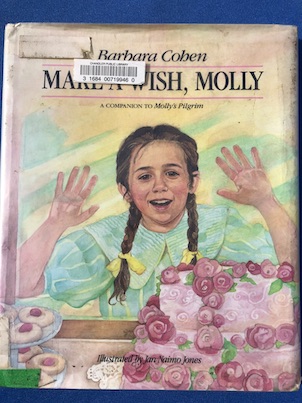
Make a Wish, Molly by Barbara Cohen, 1994.
This book is the sequel to Molly’s Pilgrim.
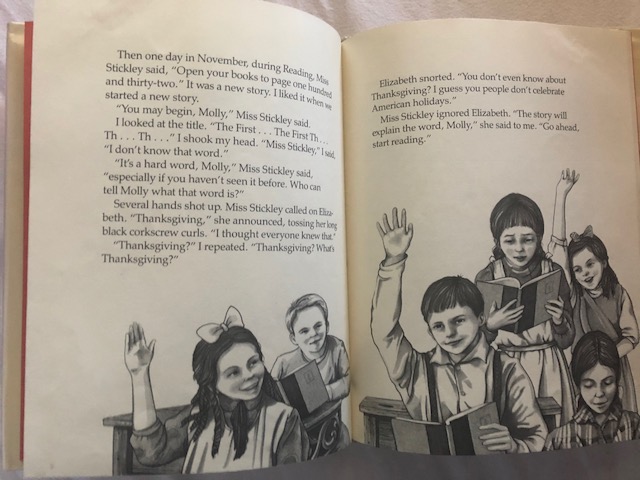
Things have improved for Molly in Winter Hill since she and Emma became friends. Now, Molly doesn’t feel quite so alone as she once did. However, Emma is still friends with the nasty Elizabeth (resident mean girl from the first book). Molly has learned that a major part of Elizabeth’s resentment toward her is that Elizabeth is used to being the teacher’s pet and the center of attention at school. In both first and second grade, she always seemed to be the favorite student. Now, in the third grade, Elizabeth thinks that their teacher prefers Molly, and she can’t stand it. So, she tries to make trouble for Molly whenever she can and make others not like her, too.
Emma tries to ignore Elizabeth’s nastiness and invites both girls to her birthday party. Molly is excited because she’s never been to a birthday party in America before, and birthdays are celebrated very differently in America from the way they were in Russia. Emma and Elizabeth (in her condescending way) explain how birthday parties are, that the birthday girl receives presents from her friends and gives them small party favors in return, and that there is cake and ice cream for everyone. Molly has never had a cake like the ones that the girls look at in the bakery window and is eager to try it. But, there’s a problem.

Molly’s mother says that it’s fine for her to go to the party and is willing to make some doll clothes for Emma’s birthday present, but she says that Molly cannot try the cake because the party will take place during Passover, and Jewish families like theirs cannot eat leavened foods during that time. Leavened foods are those that include rising agents, like yeast, baking powder, and baking soda, which includes cakes and breads. For Passover, Molly and her family are limited to things which don’t have these ingredients.
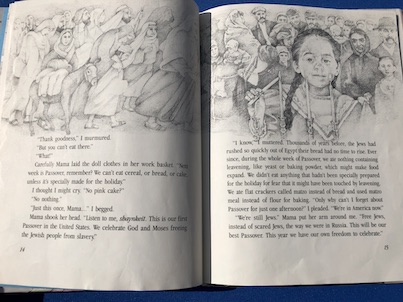
Instead, Molly’s mother packs a snack for Molly to take and eat while the others have the cake. At first, Molly thinks maybe she could disobey her mother just this once and try the cake anyway without her noticing and without feeling different among the other girls, but when a piece of cake is placed in front of her at the party, she can’t bring herself to eat it.
Of course, Elizabeth takes advantage of Molly’s inability to eat the cake to make her feel bad and look bad in front of the others. Elizabeth says that Jewish people don’t like to eat in Christian homes. Molly tries to explain that isn’t the problem and to tell them about Passover, but Elizabeth ignores her explanation and just says that Molly’s reluctance to eat proves that what her mother told her about Jews was true. (Let me just say that when a kid is as awful as Elizabeth is routinely, I always assume that the parents are exactly the same way. I decided that Elizabeth’s mother was probably a bully and a snob back in the first book, so hearing that she’s been spewing anti-Semitic comments is no more than what I would have expected. I view this type of behavior as an off-shoot of a bullying mindset, so I would completely expect that a person who is prone to one type of bullying would also engage in another. The apples never fall far from the tree.) Molly knows that she can’t make the other kids understand the situation, so she just leaves in embarrassment.

When she gets home, Molly tells her mother about what happened. Her mother says that everyone is a little different from other people, and there’s no use in pretending that they don’t live different types of lives from some of their neighbors. However, Molly also has a birthday coming soon, and Molly’s mother thinks that if they invite some of the girls from Emma’s party to their house for a celebration, they will see that Molly’s family isn’t quite as different as they might think.

At first, Molly isn’t sure that it will be such a good idea, but it turns out better than she expects. Her birthday is full of wonderful surprises. There’s no cake, but Molly’s mother bakes other wonderful goodies, like rugelach (pastries with apples, raisins, and nuts). Emma and another girl, Fay, try them and like them, but Elizabeth still refuses. She also just looks defiant when Molly’s mother proves to her that Jews will wash and reuse plates that Christians have eaten from, not throw them away, like Elizabeth’s mother said before. Once again, the issue with Elizabeth isn’t how correct or incorrect she (or her mother) was in whatever she said but whether or not she happens to look better than someone else at the current moment. All Molly’s mother’s demonstration means to her is that she just lost another opportunity to look better than someone, and that annoys her. But, Molly doesn’t care so much about Elizabeth’s lingering nastiness at that point because she knows that Emma is still her friend and Fay has just become a new friend.

There is also a movie version of this book, although the story was altered slightly so that the girl who insults Molly at the party says that it was her aunt who told her all the bad stuff about Jews, not her mother. Also, the movie takes place in a time contemporary with when it was made. The original book takes place in the past, judging by why the reasons why Molly’s family had to leave Russia and the clothes that the girls wear in the pictures.
 Steal Away by Jennifer Armstrong, 1992.
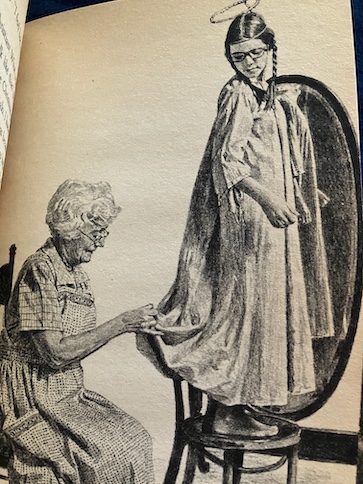
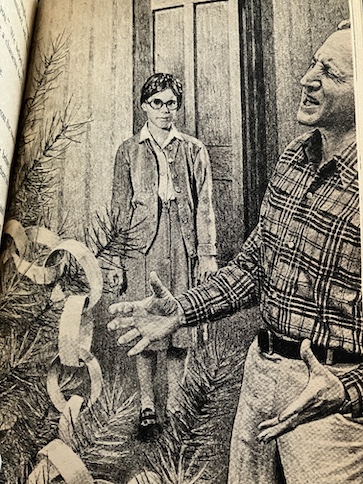

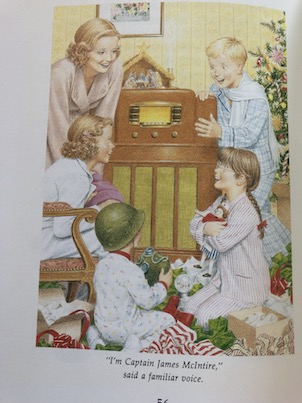
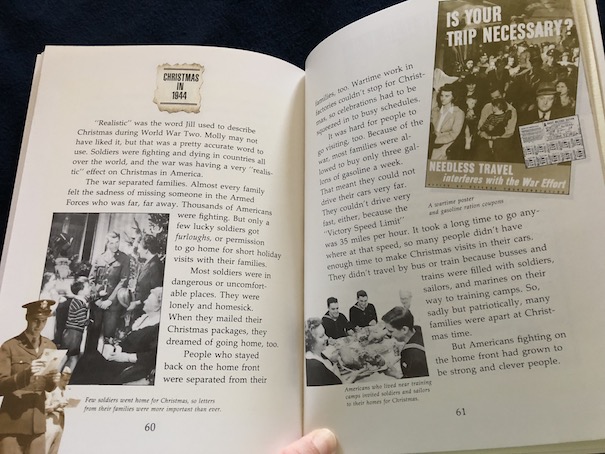
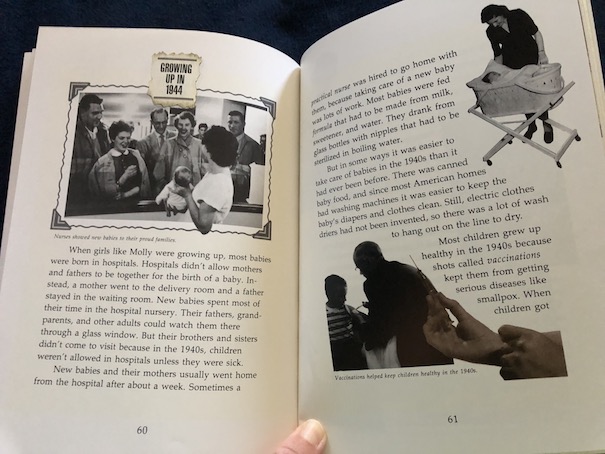
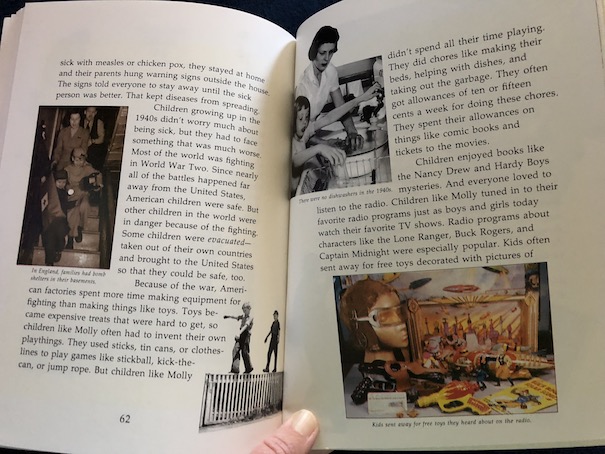
 Molly’s family has wonderful news! Molly’s father is coming home from the war to take charge of a veterans’ hospital right in their home town! Everyone in the McIntire is happy, but
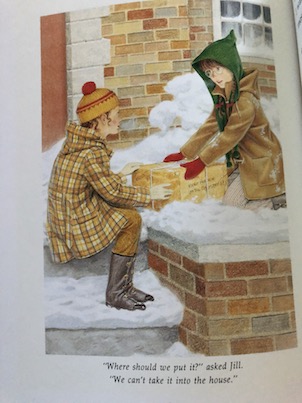
  Her friends try to help her by buying a box of hair permanent and offering to help her use it, but it soon becomes obvious that they really don’t know what they’re doing. Fortunately, Molly’s older sister, Jill, catches them before their experiment goes too far and talks them out of it. Molly’s older sister likes to trade hair tips with her friend, Dolores, and she’s more experienced with doing hair. She says that if curls are important to Molly, she’ll help her to set her hair in








 In 1707, a man living in Massachusetts named John Noble bought some land in Connecticut which had recently been purchased from a tribe of Indians (Native Americans) living nearby. He planned to move his family there and start a new homestead, but with his children so young and the baby somewhat sickly, it was decided that he would travel to the new land ahead of his family and start building a new house there. The only family member to accompany him was his eight-year-old daughter, Sarah, who came along to cook for him. Before they leave home, Sarah’s mother tells her to “Keep up your courage,” something which Sarah repeats to herself from time to time.
 On the way to their new property, Sarah and her father have to camp out in the wilderness, although they do manage to stay one night with a family called Robinson. The Robinson boys tease Sarah, saying that where she’s going, the Indians will probably chop off her head and eat her or do other horrible things. Their sister tells Sarah not to worry because her brothers just like to tease. Sarah’s father and Mistress Robinson also reassure her that the Indians in the area are friendly and that they sold their land knowing that new people would come there.
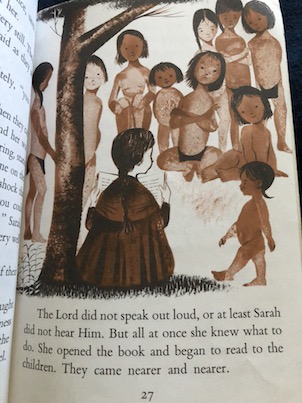 When Sarah and her father reach the land that is to be their new home, they take refuge in a hollow place in a hillside, and John begins building their new house. However, Sarah is still very nervous and lonely. Then, while Sarah sits, reading the Bible, some curious Indian children from the nearby tribe come to see her. She reads a Bible story aloud to them, and they listen, but she when she finishes the story, she can tell that they didn’t understand what she was saying. Sarah can’t understand them, either, when they try to talk to her. She gets impatient and snaps at them for not knowing English, and they run away from her. Sarah is sorry about that because she realizes that she shouldn’t have been so irritable, and even if they couldn’t talk to each other, it was still nice to have people around.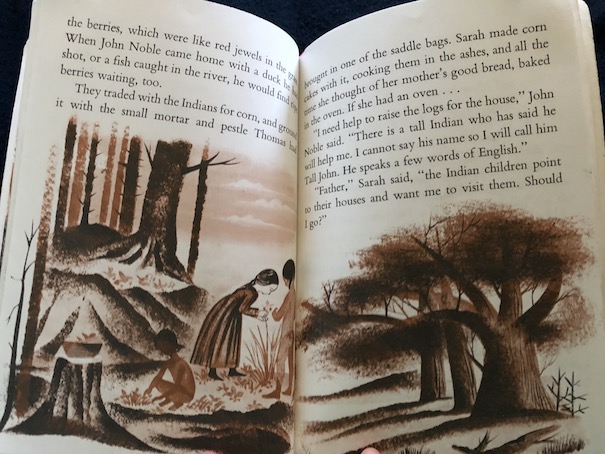




 Blossom Culp and the Sleep of Death by Richard Peck, 1986.
 Jestress's Forgotten Books and Stories