Mandie and the Forbidden Attic

MandieForbiddenAttic#4 Mandie and the Forbidden Attic by Lois Gladys Leppard, 1985.

Mandie is unhappy because her mother and Uncle John are sending her to a boarding school in Asheville. It is the same school her mother attended years ago, and her grandmother lives in the same town. Mandie is upset about leaving all of her friends and family behind, but Uncle Ned says that he will still visit her.

By the time that Mandie arrives at her new school, everyone else already knows each other, and none of them seem interested in making friends with her. One girl in particular, April Snow, takes a dislike to Mandie, which is difficult because they have been assigned to the same room.

Things change when Celia Hamilton comes to the school. She and Mandie become best friends, and Mandie is allowed to share a room with her. Then, strange things start happening. Mandie and Celia keep hearing strange noises during the night from the attic floor above them, and some of Mandie’s clothes disappear. At first, they suspect that April Snow may be playing a mean trick on them, but it turns out that she is not actually at fault. There is someone at the school who doesn’t belong, but finding this person may get Mandie and Celia into trouble.

This adventure requires Mandie to meet with her grandmother again.  Mandie is nervous about seeing her grandmother because her grandmother helped break up her parents’ marriage and sent her away with her father when she was a baby. Surprisingly, Mandie’s grandmother seems to like her and her friend Celia. She admires their spirit and even says that Mandie reminds her a little of herself when she was young.  This meeting helps the granddaughter and grandmother to make peace with each other and the past.

The book is currently available online through Internet Archive.

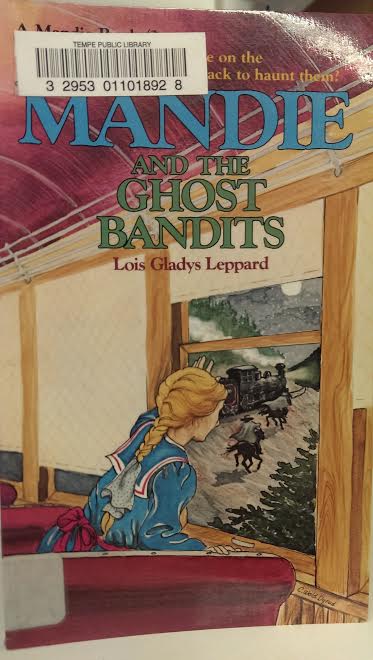
Mandie and the Ghost Bandits

MandieGhostBandits#3 Mandie and the Ghost Bandits by Lois Gladys Leppard, 1984.

Mandie and her family are going to proceed with the plan to create a hospital for the Cherokees with the gold that they found in the cave. To do that, they need to take the gold to a bank in Asheville.  They decide to take the gold secretly on a train. Uncle Ned stays in the baggage car to watch the gold as they set out on their journey.

When the kids decide to leave their car to go visit him, strange things begin to happen. They see riders dressed as ghosts out the window. Then, the car with Uncle Ned and the gold inside is disconnected from the rest of the train, crashing into a ravine. The train comes to a stop, and the kids jump off to see if they can help Uncle Ned.

Before they can find him, the train starts up again, leaving them behind, and they are taken prisoner by the mysterious ghost bandits. They are after the gold in the baggage car, but how did they know it was there when Mandie’s family tried so hard to keep it a secret? Mandie and her friends must escape and find the others before it is too late!

In some respects, I would call this more of an adventure story than a mystery, although there is still the question of how the bandits knew where the gold was in order to steal it.

The book is currently available online through Internet Archive.

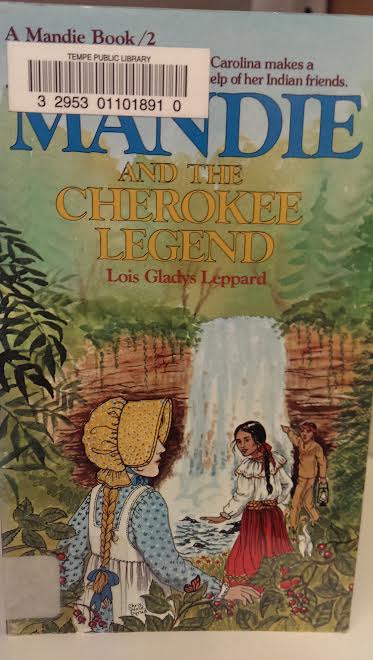
Mandie and the Cherokee Legend

MandieCherokeeLegend#2 Mandie and the Cherokee Legend by Lois Gladys Leppard, 1983.

Mandie is going to visit her Cherokee relatives with her mother and Uncle John. Mandie is eager to meet her relatives, and she hopes that they all like her. The Cherokees all knew her father well, and most of them are eager to meet her. All except for her cousin, Tsa’ni, that is.

Tsa’ni knows the stories of how white men have oppressed the Cherokees and forced them to move off of their land years ago, and he resents all white people because of it. The others tell him that he is wrong to hate all white people because of what some of them did in the past and that Mandie and her Uncle John are good people. However, Tsa’ni doesn’t listen to them, and he plays a mean trick on Mandie, Joe, and Uncle Ned’s granddaughter, Sallie. He offers to show them a cave, but then he abandons them inside.

The three kids have to find their own way out, but they discover a fortune in gold nuggets in the process. First, the children have to make it back to Uncle Ned’s house after a frightening night in the woods. Mandie, Joe, and Sallie accidentally stumble onto a still (machinery for making alcohol) that belongs to a white couple while they are wandering around in the woods after leaving the cave. The couple are worried that they will tell people about their illegal still, so they hold the kids prisoner.

Although the kids manage to escape, they must return to the cave to find the treasure again (while dodging Tsa’ni’s tricks to foil their efforts) and keep it safe (from the still operators and anyone else who might want to steal it) until they can decide what to do with it. As far as Uncle Ned and the other Cherokees are concerned, gold is bad luck because it was the discovery of gold which forced the Cherokees out of their old homeland. However, the origin of this gold may help to change their minds.

This book is one of the Mandie Books.  It is currently available online through Internet Archive.

Mandie and the Secret Tunnel

MandieSecretTunnelMandie and the Secret Tunnel by Lois Gladys Leppard, 1983.

Young Amanda Shaw is almost twelve when her father dies, leaving her with a bully of a sister and a mother who doesn’t really love her. Her only friends are Joe, who is the son of the local doctor, and Uncle Ned, a Cherokee Indian. Amanda and her father are part Cherokee, and Uncle Ned helps to look after her now that her father is gone. Then, Amanda’s mother remarries and sends her to live with another family who want someone to help them look after their young son. However, the family is rather mean to Mandie, exploiting her for cheap labor, and Uncle Ned offers to take Mandie to live with her uncle in the town of Franklin.

Mandie never knew that her father had a brother (Uncle Ned is Mandie’s “uncle” by affection, not blood), but she readily agrees to go to him. Uncle Ned and some other Cherokees help Mandie to sneak away in the middle of the night and make the journey to Franklin. When she arrives at her uncle’s house, she is taken in by the servants, but she is told that her uncle is away in Europe.  Mandie’s uncle turns out to be rich, and Mandie is very happy in his house. She gets new dresses for the first time in her life and makes friends with Polly, the girl next door.

Then, word comes that her uncle has died in Europe. Her uncle’s will is missing, and no one knows exactly what will happen to her uncle’s property or to Mandie until it is found. Strangers come to the house, saying that they are also relatives of Mandie’s uncle, but Mandie wonders if they really are who they claim to be. With the help of Polly and Joe, who comes to visit her, Mandie searches for her uncle’s missing will and accidentally finds a secret tunnel leading out of her uncle’s house.

As Mandie and her friends investigate this mysterious situation, where things and people aren’t what they claim to be, Mandie learns that her own past isn’t what she believed it was.  Her family has kept many secrets from her, and learning these secrets leads her to a better future than she’d ever imagined.

This book is one of the Mandie Books.  It is currently available online through Internet Archive.

Mystery of the Roman Ransom

romanransomMystery of the Roman Ransom by Henry Winterfeld, 1971.

This is the sequel to Detectives in Togas, a mystery story about a group of boys in Ancient Rome.  Like the first book, it was originally written in German and translated into English.

On Xantippus’s birthday, his students decide that they want to give him a special present because they think he’s turning 50.  Actually, it turns out that they did their math wrong because Xantippus (whose real name is Xanthos and only known as Xantippus as a nickname among his students) was born in Athens, and the Greeks use a different dating system from the Romans.  His Roman students forgot even after he had explained that in their history lessons, which really annoys him.  He is also really annoyed that the special present they decided to give him was a slave of his very own so that he can concentrate on his studies while the slave does all of his chores.  Xantippus points out that, far from being a present, slaves are actually a burden because there are extra expenses for owning them and it would end up costing him more money than he could afford (much like the “free” cars that Oprah Winfrey gave to some of her audience members), and Xantippus wants no part of it.  He gives the boys the day off from lessons to reward them for being thoughtful (although, not quite thoughtful enough), and tells them to return the slave to the dealer who sold him and get their money back.  But, it turns out that this slave isn’t just any ordinary slave.

romanransompicWhen they return to the slave dealer’s home, he is gone, and the place is boarded up.  An elderly slave who was left behind said that all of the other slaves were sold, and then the dealer simply fled, abandoning him.  He also says that there was someone else who had come to see the dealer, demanding that he hand over the slave called Udo (the one that the boys had already bought).  This man was a former gladiator with only one eye, and he was very angry that Udo was gone.  He swore that he would he would get Udo one way or another, dead or alive.  He threatened the dealer, saying that he would return later and kill the dealer and all of his slaves if Udo was not among them then.  The slave dealer, not knowing the names of the boys who had bought Udo or where he could be found and therefore unable to get Udo back, fled in fear of the former gladiator’s threats.

During this time in Rome’s history, crime rates were high because gangs of ex-gladiators, runaway slaves, and criminals roamed the city, robbing and terrorizing the citizens.  The boys soon learn that the dealer’s fears were well-founded when the ex-gladiator finds them in the marketplace while they are trying to decide what to do with Udo.  He tries to take Udo from them by force, but they fight with him and manage to escape by dumping a pail of honey over his head.

Once the boys are safely away and in their secret hideout with Udo, he reveals his true story to them.  At first, they had believed that Udo was deaf and mute because he acted like he couldn’t speak, but he tells them that he was afraid to do so because he is a hunted man.  He was the slave of a powerful Roman army commander now stationed in Germania.  He was sent to Rome by his master in order to deliver an important letter, but upon learning that he would be killed after handing over this letter, he did not complete his mission.

The meeting was to take place in a cemetery at midnight, and when Udo arrived, he became frightened and hid.  Then, he overheard his contacts, two men who did not seem to even know each other, talking about how he would be eliminated after passing on his message.  Now, these men are looking for him for the message that he did not give to them, and Udo cannot go back to his master because his master would probably kill him for disobeying orders.

Udo discovered that the letter contained instructions for an assassin to murder an important Roman senator, and upon learning that, all of the boys are immediately worried because they are all the sons of senators.  They demand to know which senator will be murdered, but Udo cannot tell them because that information was in the letter, and he lost it after he fled from the cemetery.  He thinks that it’s in a cellar where he hid and spent the rest of the night before he was found by a group of gladiators who sold him as a slave the next day.  Now, he’s not quite sure where that cellar was.  Udo also says that his master will arrive in Rome himself in three days and will probably just pass on the name of the intended target to the assassins then when he learns that Udo didn’t.  With time running out and their fathers’ lives possibly on the line, the boys and Udo struggle to find the letter and stop the assassination plot before it’s too late!

In Ancient Rome, slaves were common among the wealthy, and owners had the power of life and death over them.  They could punish a slave severely for even a small mistake, abandon them if they were sick or elderly, and even sell them to the gladiatoral arenas, where they would have to fight for their lives or die as public entertainment.  To the boys in the story, such things are simply facts of life as they have always known it.  Rome in general was a violent place.

The book is available to borrow and read for free online through Internet Archive.

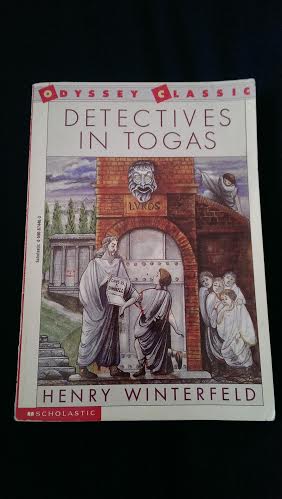
Detectives in Togas

detectivestogasDetectives in Togas by Henry Winterfeld, 1956.

Seven Roman boys, all the sons of wealthy families, attend the school run by the Greek mathematician and scholar, Xanthos. Although the boys are proud of their school, the lessons are sometimes boring, and everyone has given Xanthos the nickname Xantippus, in reference to the wife of Socrates, who was known for her nagging.

During a rather boring lesson on Greek vocabulary, a fight breaks out between two of the students that ends up creating a strange mystery for all of them. Caius was poking Rufus with his stylus, so Rufus wrote “Caius is a dumbbell” on the wax tablet where he was supposed to write his lesson. The boys get into a fight, and when Xantippus breaks it up, he sends Rufus home with the threat that he will expel him from the school.

detectivestogaspicThe next day, when the other boys arrive at school, they discover that their teacher has been attacked and robbed during the night. Worse still, when they go to Rufus’s house to visit him, they learn that someone has written “Caius is a dumbbell” on the side of the Temple of Minerva, which has been dedicated to the emperor. Defacing a temple is a crime, and soon Rufus is arrested and sent to prison (being young and part of an important family does not guarantee him special treatment). Rufus swears that he was not the one who defaced the temple, but who else could have done it?

Rufus disappeared that night, but if he didn’t go to the temple, where was he? Does the vandalism have anything to do with the attack on their teacher?  The key to the mystery seems to be a mysterious soothsayer with ties to some of the highest officials in Rome. Something sinister is happening in Rome, and the boys are the only ones who can discover what it is!

This story was inspired by a piece of graffiti found during excavations of Pompeii in 1936. (This video doesn’t actually show the Caius inscription but similar types of graffiti, including ones done by children. I keep looking for the Caius graffiti, but I can’t find pictures of it. This video of a lecture at the Western Australian Museum about ancient graffiti in Pompeii shows the more graphic adult kind of graffiti with swear words, if you’re interested.) In ancient Pompeii, someone wrote “CAIUS ASINUS EST” on the wall of a temple, which basically means “Cauis is a dumbbell” (or similar type of insult) in Latin.

Although the book was originally from 1956, it was also originally written in German. I have a later reprinting that was translated into English.  The book is available to borrow and read for free online through Internet Archive.  There is a sequel called Mystery of the Roman Ransom.

Silver Days

silverdaysSilver Days by Sonia Levitin, 1989.

This is the second book in the Journey to America Saga.

Escaping from World War II Europe was only the first step for the Platt family. Now that they are reunited in the United States, survival is still a struggle. They have very little money, and Lisa’s father struggles to find work and a permanent place for his family to live. Along the way, they encounter people who are prejudiced against them, some because they are Jewish and some because they are German, and are forced to confront certain prejudices that they hadn’t realized that they held as they settle into their new country and learn to live alongside people from different backgrounds who live very different lives.

Lisa describes her family’s day to day struggles and adventures with understanding. In Germany, her father had his own business, selling coats, but he has to struggle to get into the clothing business in America. Her mother, who had once had her own servants in Germany, is forced to take a job as a maid to help make ends meet. Besides the basic problems of learning a new language, dealing with a lack of money, and trying to find work, she also describes the parts of American culture that take her family by surprise. There are religious issues because most of the people around them are Christian, and Lisa’s mother is upset when her youngest daughter, Annie, ends up getting a role in her school’s Easter play. Her mother also isn’t sure what to make of the Japanese family who lives next door when Annie makes friends with their daughter.

Meanwhile, the war that they had feared is becoming a reality. People in the U.S. are starting to support the war effort, collecting materials that the army can use, starting Victory Gardens to help support themselves during food rationing, joining the army, and volunteering as nurses. The Platts also experience survivor’s guilt as they hear reports of friends and family who weren’t lucky enough to escape the Holocaust.

The Platt family is realistic, and they have their arguments as the stresses of all these changes take their toll on them. But, they are a loving family and continue to support each other through everything. The title of the book comes from a song, “Golden Days”, about looking back on happy times. When Lisa’s little sister Annie asks her if these are their “golden days”, Lisa tells her that she doesn’t think so, but she thinks that they might be silver ones, days leading up to happier times ahead.

In some ways, the children of the family have an easier time dealing with all the changes than their parents. In the beginning, they are aware that they don’t quite fit in, although they desperately want to. However, they do manage to make new friends, and Lisa and her older sister, Ruth, even find their first loves. While the world around them is changing, the three sisters also change, growing up, finding new interests, and learning more about themselves and the kind of lives they want to live in their new home.

The book is currently available online through Internet Archive.

Journey to America

journeytoamericaJourney to America by Sonia Levitin, 1970.

This is the first book in the Journey to America Saga.  Like her heroine, Lisa, Sonia Levitin also fled Germany with her family during World War II, and her stories are semi-autobiographical.

Twelve-year-old Lisa Platt lives with her family in Berlin in 1938.  But, with the rise of the Nazis, events have taken a frightening turn for Jewish families like theirs.  There has already been violence toward Jewish people, and travel is restricted.  Lisa’s father fears for their family, and their mother believes that war is about to break out.  Reluctantly, her parents have decided that the only thing to do is to leave Germany and try to start over somewhere else.

Because of the travel restrictions, Lisa’s father has to leave secretly, pretending that he is only going on vacation.  In reality, he and Lisa’s uncle will go to America and try to get established before sending for the rest of the family.  But, it isn’t safe for Lisa, her mother, and her two sisters to stay in Germany, waiting for word from them.  Instead, they pretend that they are joining Lisa’s father for a holiday in Switzerland.  They can only take a little luggage with them, as if they were really just going on vacation, and very little money.

journeytoamericapicBut, getting on the train out of Germany is only the first step of their long journey.  Lisa and her mother and sisters live as refugees in Switzerland, waiting for her father to help arrange for their passage to America.  Often, they have too little to eat because they don’t have much money.  There are some people who help them, and they make some new friends, but the long wait is difficult.  Meanwhile, they must face the frightening events taking shape around them, around the people they left behind, and their own uncertain future.
There is something in the stories that I’d like to describe a little more because I didn’t quite understand it when I first read this book as a kid, but I can explain it better now.  At one point in the story, Lisa’s grandmother suggests that her mother send the girls to England because other families are doing it and it would ensure that the children get safely out of the country.  Later, in Switzerland, Lisa gets a letter from her friend Rosemarie that says she and her sister are now in England without their parents because their father didn’t didn’t feel like he could leave Germany.  What they’re describing is the Kindertransport, a rescue effort started by Jewish, Quaker, and British government leaders to transport unaccompanied Jewish minors, from babies to age 17, from Germany and German-controlled countries to England for safety after the events of Kristallnacht made it clear that Jews were in serious danger in Germany.  When the children reached England, they were placed in foster homes, schools, and anywhere else willing to take them, similar to the way children evacuated from London to avoid the bombings later would be placed in foster homes or on farms.  Grandmother Platt points out that this could have been an option for her grandchildren when she discusses the possibilities with their mother, but since, neither the mother or father of the family wanted to stay in Germany, the family decided that they should all leave together.  The Kindertransport program ended when war actually broke out, but by then, about 10,000 children had been brought to England.  Although parents who sent their children to England on the Kindertransport hoped to reunite with them in England, most of the Kindertransport children who went to England never saw their parents again because their family members who stayed behind in Germany were killed in the Holocaust.  I had lessons about the Holocaust in school in Arizona, but they never mentioned the Kindertransport because it wasn’t something that really affected the area where we lived.  I did see a Holocaust survivor who came to speak at my high school in the early 2000s.  There were Holocaust survivors living in my area of Arizona then, and there still are as of this writing because I heard that they were among the first to be vaccinated during the coronavirus pandemic in early 2021.  This video from the BBC Newsnight and this video from the University and College Union explain more about it and have interviews with people who were brought to England on the Kindertransport as children.  Rosemarie and her sister would probably be very much like the people in those interviews years later.

Although there are sad parts of the book, there are lighter moments, too, and the characters are realistic and engaging.  There is only one illustration in my copy of the book, a drawing of Lisa and her sisters getting their pictures taken for their passports.  Other editions of the book have different illustrations.

The book is currently available online through Internet Archive (multiple copies, in different editions).

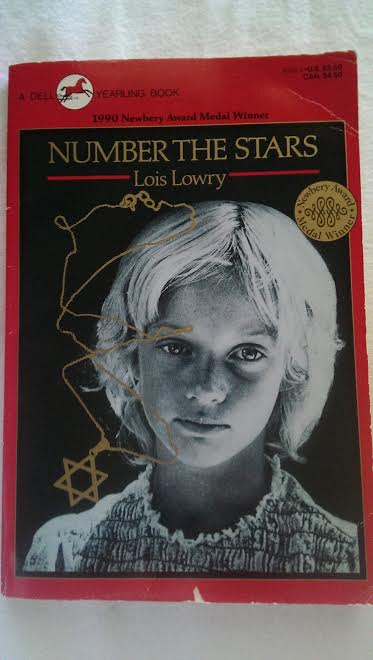
Number the Stars

numberstarsNumber the Stars by Lois Lowry, 1989.

Annemarie Johansen is ten years old and living in Copenhagen in 1943.  Denmark is now occupied by the Nazis, and she and her little sister Kirsti have become accustomed to the sight of German soldiers in the streets and the food rationing and curfews that have come with the war.  But, there are still worse changes to come in their lives. Jewish people like Annemarie’s best friend, Ellen Rosen, are in danger.  The Germans have been closing businesses owned by Jews, and worse still, some Jewish families simply . . . disappear.

Annemarie comes to understand the disturbing truth behind many of the things that have been happening around her, including the sudden death of her older, grown-up sister, Lise.  Although she had earlier been told that Lise had been killed in an accident, what happened to Lise was no accident.  Lise and her fiance, Peter, were both part of an underground Resistance movement, working against the Nazis.  Peter is still part of the Resistance, and he calls upon Annemarie’s family to help him save not only Ellen’s life but the lives of other Jews who are in danger.

When the Johansens learn that the Nazis are looking for Jews from the register at the Rosens’ synagogue, Annemarie’s family takes in Ellen and pretends that she is their third daughter, Lise, while Peter helps to hide her parents make preparations to get them out of the country.  They journey to the seaside, where Annemarie’s Uncle Henrik prepares to help take the Rosens and others to safety on his fishing boat.  At first, Annemarie is angry that the adults are telling her things that she knows aren’t true and keeping secrets from her about their plans, but they tell her that it is for her own good not to know too much because they don’t want her to be too frightened with the details.  She soon comes to see their point because, as they set their plan into motion, Annemarie must perform an act of bravery for it to be successful.

Besides being an historical novel, this is partly a coming-of-age story as Annemarie goes from being an innocent young girl to being more fully aware of the problems and dangers surrounding her, her family, and her friends.  The title of the book comes from a Biblical quotation about how God “numbers the stars” and Annemarie’s thoughts as she considers her situation and the danger everyone is in.  Ellen’s mother said that she doesn’t like the sea because it is too big and too cold, and on a starry night in the middle of their peril, it strikes Annemarie that night sky and the whole world is like that, too: too big and too cold.  Annemarie thinks that sky is full of more stars than anyone can count, and the world situation and its complexities seem too great for Annemarie to fully grasp.  The immensity and  dangerous nature of it all frighten her.

Annemarie’s older sister, the grown-up child in their family, understood the complexities and dangers of the world and risked her life to fight for their country’s freedom, ultimately losing her life in the process.  Annemarie’s younger sister is still largely unaware of the risks her family is taking to save their friends, still thinking in her innocence that the explosions from the destruction of the Danish naval fleet when the Nazis invaded were “fireworks” for her birthday.  At the beginning of the story, Annemarie is between her two sisters: more aware of what is going on than Kirsti is but not aware of what her older sister did or knew.  By the end of the story, Annemarie has moved to a more grown-up understanding but uses her innocent, little-girl appearance to fool the Nazis into thinking that she is just an ignorant child so they will be less suspicious of her.

Although this story is fiction, similar incidents happened in real life when people took great risks to help Jewish people escape from the Nazis. In the back of the book, there is an Afterword that explains more about the historical events behind the story.

This book was a 1990 Newbery Award winner.  It is currently available online through Internet Archive.

Soup

soupSoup by Robert Newton Peck, 1974.

This is the first book in a series about the author’s childhood best friend.  His friend’s real name was Luther Wesley Vison, but he always hated that name.  Because Luther refused to come home whenever his mother called his name for dinner, his mother took to just yelling, “Soup’s on!” when she wanted him to come home to eat.  After that, everyone else just started calling him “Soup”, which he liked a lot better than “Luther.”

Together, Soup and Robert had a reputation for getting into scrapes in their small town in Vermont.  The book is a series of short stories about the funny things they did as kids, like how they got revenge on the school nurse for asking embarrassing questions, how Soup got punished for breaking a window other than the one he’d actually broken, how Soup talked Rob into rolling down a hill in a barrel, and how Robert’s aunt let him tie her to a tree right before a lightning storm.

souppicSome of the stories are laugh-out-loud funny, and some of them have kind of a moral lesson to them, like the time when Rob realized that he didn’t have the heart to lie to his mother even if it would allow him to escape punishment for talking back to the school nurse, the time when Soup and Rob tried to cheat Mr. Diskin out of some money so they would have enough to go to the movies but ended up feeling guilty, and how the boys made themselves sick by attempting to smoke cornsilk.  Others are just stories of childhood events and friendship, like the story of how Rob and Soup played football and how Soup loaned Rob his new shoes when his were ruined.  Even though Soup often got Rob into trouble, he really was a good friend and went out of his way to make Rob feel better when he needed it the most.

Although it is a short chapter book that is easy to read, a couple of the stories might require some further explanations for young children reading them, like the one where the boys smoke cornsilk using homemade pipes and the one where Soup says that someone told him it was all right to cheat Mr. Diskin because he’s a Jew (a belief that they come to rethink when they feel guilty for cheating someone who was always fair with them and was kind to them even when he discovered the deception).  They deal with older practices and prejudices and can be the start of discussions about the lessons people learn by making mistakes. Other than that, these stories present a fascinating look at what it was like to grow up in the country during the 1920s.

The book is available to borrow and read for free online through Internet Archive.