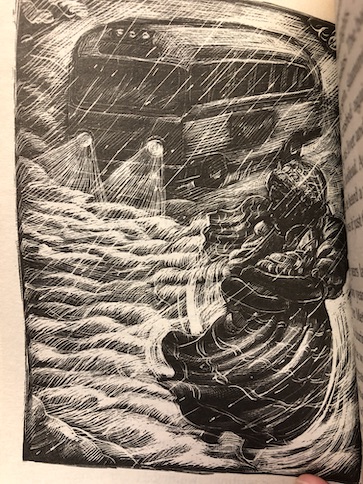
Johnny Tremain

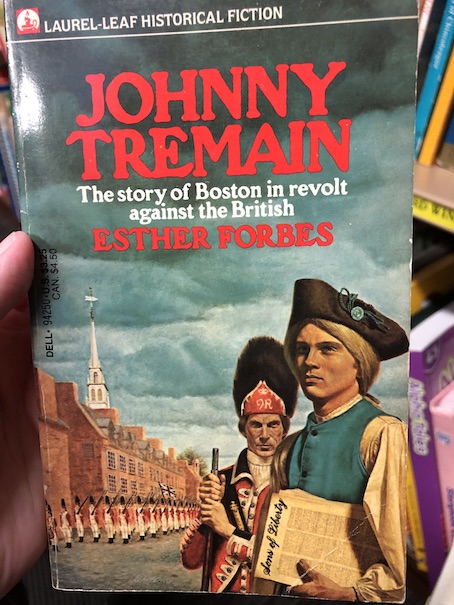
Johnny Tremain by Esther Forbes, 1943, 1971.

The story takes place in Boston around the time of the American Revolutionary War, and famous historical figures appear in the story.

Fourteen-year-old Johnny Tremain is a young apprentice to a silversmith. Even though he is one of the younger apprentices, he has talent and is favored by the silversmith. His favored position allows him to boss the other apprentices, and the silversmith is even considering having him marry one of his granddaughters when he has completed his apprenticeship so he can inherit the business. Johnny doesn’t mind the idea of marrying one of the granddaughters, although he is in the habit of teasing them, and inheriting the business would give him a steady future, although the business isn’t particular lucrative. Most people basically like Johnny, although one of the older apprentices, a boy called Dove, resents him.

Johnny has one particular flaw, and that is that he is arrogant and prideful. While he is talented, he gets overconfident and too full of himself because of his talent. The silversmith even warns him and lectures him about it, telling Johnny not to lord it over the other apprentices that they are not as gifted as he is.

However, Johnny doesn’t listen to him, and he soon pays the price for it. The reason why the silversmith’s shop hasn’t been very lucrative is because the silversmith is getting old, and he can’t work as hard as he used to. That’s one of the reasons why Johnny feels like he has to push the pace in the shop and keep the other apprentices in line. When the silversmith is late making a particular order, Johnny takes it on himself to complete the work on a Sunday, which is forbidden by the laws of Boston at that time and would have been forbidden by the pious silversmith, too, if he knew what Johnny was doing. While Johnny is working, Dove hands him a crucible with a crack it in, thinking to embarrass Johnny by ensuring that the work will go wrong. Unfortunately, it turns out to be worse than that. Johnny’s hand is badly burned by molten silver.

With a crippled and useless hand, Johnny doesn’t see how he can continue his apprenticeship and become a silversmith. For the first time in prideful Johnny’s life, he is an object of pity, and he seems to have no future ahead of him. There aren’t many kinds of work a person in his time can do with only one usable hand. The silversmith’s youngest granddaughter has always been sickly, and people think that she isn’t likely to live to adulthood. Even the girl’s own mother says that it hardly seems worth the effort of raising her when she isn’t likely to survive, and privately, Johnny has also agreed. Now that Johnny is disabled, seemingly useless, and without a future, is he also hardly worth anyone’s help?

The silversmith’s daughter-in-law, Mrs. Lapham, seems to think he isn’t worth anything. In spite of her being the one who originally insisted that he do the task on Sunday that crippled him, she begins giving him repeated and casual insults like “lazy good-for-nothing” and “worthless limb of Satan.” Her previous praise and encouragement for Johnny and wish for Johnny to marry one of her daughters hadn’t been based on any liking for Johnny but only based on what she thought Johnny could do for her and her daughters in the future. Now that he can’t take over the business, Mrs. Lapham is ready to kick him to the curb. Mrs. Lapham discourages Johnny from eating much food, tells him that she’ll be needing the place where he sleeps soon for someone else to help her father-in-law with his shop, and tells the silversmith that he should get rid of Johnny. The silversmith refuses to kick the boy out onto the street with nothing and no prospects, especially since Johnny has been doing small chores for the family to earn his keep. The silversmith tells Johnny that he cannot continuing learning the silversmithing trade, so he’s going to have to find a new one. He encourages Johnny to explore the city and watch different people at their trades until he can find one that he thinks he can do, and then, he will give the contract for Johnny’s apprenticeship to his new master.

However, Johnny is still prideful and can’t see himself doing any of the unskilled trades that might take him, and he only half-heartedly tries to find a new position. He still sees himself as a craftsman, and that’s all he really wants to be. He still feels like other jobs are beneath him. One day, he goes inside the printing shop for the Boston Observer, which the silversmith disapproved of for trying to stir up dissent and resentment against the English king among the colonists, and immediately is fascinated at the way the boy working in the shop interviews a woman about an advertisement for her lost pig. Johnny feels an odd friendly feeling toward the boy, who is a good and patient listener. When the woman leaves, Johnny finds himself pouring out his own story to the boy, whose name is Rab, without his usual arrogance. Rab understands Johnny’s feelings and agrees that most of the jobs that would be open to him now are the unskilled jobs he doesn’t want to do. He says that the Observer could hire him, but it would be a position as a delivery boy and messenger, but that doesn’t sound like the kind of work Johnny really wants. Still, Rab tells him that if he can’t find anything else, he could come back and take the messenger job. Johnny hopes that he can come back and tell him that he’s found a much better job.

However, Johnny still can’t find someone to take him. When he tries to get a job from John Hancock, whose project was the one that ruined Johnny’s hand, John Hancock is repulsed at the sight of Johnny’s hand and won’t even take him as a cabin boy for one of his ships. Johnny is angry and despairing when John Hancock sends him away, but John Hancock sends a slave after him with a whole back of silver, apparently out of guilt. Hungry because he’s had so little to eat lately, he goes to a tavern and orders a great deal of food. He is disappointed to see how much of his money he wasted and realizes that he has been a fool for ordering too much all at once. He spends the rest of his money buying presents for the silversmith’s daughters and new shoes for himself. When Johnny comes home in his new shoes, Mrs. Lapham accuses him of stealing them from someone because she can’t imagine that he could earn enough money to buy them. The girls are happy with the presents until the youngest one suddenly gets upset at Johnny touching her with his bad hand because it looks weird and she’s afraid of it, ruining the moment.

There is one last thing Johnny has that might help him. He has had a silver cup his entire life with his full name on it: Jonathan Lyte Tremain. The cup also bears the family crest of the Lyte family, a wealthy merchant family in Boston. Johnny’s mother never introduced Johnny to her relatives before she died, although she said that she was from a genteel and educated background and their own names, Jonathan and Lavinia, were family names. Johnny knows that the head of the wealthy Lyte family is also named Jonathan Lyte, so he thinks that he could be a relative. For some reason, his mother didn’t want him to show the cup to anyone, although she told him to keep it in case he ever needed it. She said to only show it others if he was in dire trouble and it seemed like even God Himself had forsaken him, and his current situation certainly qualifies.

When Johnny goes to see Mr. Lyte, Mr. Lyte doesn’t believe that he’s really a relative. He thinks that it’s just a story to get some of the Lyte family’s money, and he’s heard stories like this before. Johnny argues unpleasantly with Mr. Lyte before telling him that he has a silver cup that will prove the relationship. Mr. Lyte seems interested in the cup and tells Johnny to bring it to him that night. Before returning to Mr. Lyte with the cup, Johnny goes to Rab and tells him what he’s about to do. Rab gives him some food and a change of clothes before he goes but warns him that Mr. Lyte has been deceptive and unethical in his business dealings.

Rab’s warning is prophetic. When Johnny produces the silver cup, Mr. Lyte agrees that it is part of a set that the family has, but he says that the cup was stolen from his house only two months before. He accuses Johnny of being the thief and has him arrested. Rab finds out about it and asks Johnny if he showed the cup to anyone else before the date when it was supposedly stolen. With his mother dead, the only other person who could vouch that Johnny had the cup before is Priscilla, the Lapham daughter that Johnny was originally supposed to marry before the accident that ruined his hand. Priscilla, called Cilla for short, is willing to testify in court that Johnny showed her the cup before, but Mr. Lyte begins exerting his influence on the Laphams. He places a large order for silver and pays in advance as a kind of bribe, and Mrs. Lapham, who has already decided that Johnny is no good, declares that she will keep Cilla locked up on the day of the trial so she can’t speak on his behalf, even though she knows young Johnny will be executed without her testimony.

Rab correctly realizes that some of the attitudes of people against Johnny are because Johnny is an arrogant hothead who has made enemies because of the sharp and snooty remarks he’s made to them and about them in the past. He points out that these people, who have felt oppressed by Johnny are now taking their opportunity to get even with him and get rid of him, just like the rival apprentice whose dangerous trick ruined Johnny’s hand. If Johnny is going to get out of this mess and change his life, he’s going to have to change his own attitude and behavior and learn to make friends, develop some humility, and show gratitude for the help that he receives.

Fortunately, Rab knows a lawyer who is willing to take Johnny’s case without pay, Josiah Quincy (historical figure – Johnny notices that he has a dangerous-sounding cough, like the kind his mother had before she died, and the real-life Josiah Quincy did die of tuberculosis), because Mr. Lyte is a Tory who has crossed the Colonial Patriots who call themselves the Sons of Liberty with his crooked business dealings. Johnny’s trial becomes the latest skirmish between the two sides of the Revolution that is building. For the first time in his life, Johnny does have cause to be truly grateful to others. Unfortunately, he has also made one more enemy. Mr. Lyte is publicly embarrassed at having been shown to bring a false charge against an unfortunate boy in court, and if anyone is even more proud and arrogant than Johnny has been, it’s Mr. Lyte.

Johnny takes the job of delivery boy for Rab’s newspaper and becomes more involved in the politics of the Colonies and the growing Revolution. He learns how to ride a horse for the first time, even learning to manage a previously abused and skittish horse. Johnny becomes known as a good messenger and finds other side jobs. He develops his use of his uninjured left hand and even increases his use of his damaged right hand. He becomes better read and educated as he builds his messenger career. However, Johnny is also drawn into the growing conflict and learning the truth about his relationship with Mr. Lyte.

The book is a Newbery Medal Winner and available to borrow and read for free online through Internet Archive (multiple copies). It was made into a movie by Disney in 1957.

My Reaction

The Background of the Book

Because this book is an award-winner and has patriotic themes, it is a popular book for children to read and study in American schools. I didn’t actually read the book when I was in elementary school, probably because it contains works like “slut”, but I remember our teacher showing us the Disney live-action movie version from 1957. I still sometimes think of the Liberty Tree and the Sons of Liberty song from that movie. If you read the comments below the YouTube clip of that song, some people were commenting about seeing this movie when they were in 5th grade at school, and that’s about when I saw it, too, back in the 1990s. I found the song stirring then, although it looks a little corny to me now. For patriotic musicals, I prefer 1776, which I saw in high school and which is also corny but brings up some interesting historical topics. 1776 was based on a Broadway play written as the US approached its Bicentennial. If you look at my page of books from the 1970s, you’ll see that people were writing books for children focusing on the American Revolution, Colonial America, and other patriotic themes because the Bicentennial was on people’s minds at the time. The 200-year anniversary of the country was something people wanted to celebrate, and they used it as an opportunity to educate children about the history and lore of the country. Part of what makes Johnny Tremain interesting is that the original book was written in the middle of WWII, which was more of a worrying time rather than a celebration. The Disney move was made after the war, when people were in a celebratory and triumphant mood about how well the country was doing, and it ends on a triumphant note, but the original book was much darker.

During WWII, children’s authors had a choice about whether or not to mention the war in the books they were writing. If you look at my page of books written during the 1940s, you’ll see that some children’s authors addressed the war directly and even worked it into the plots of their books while it was still happening. I’ve marked which ones did that on the 1940s page. However, for those who didn’t want to write contemporary stories mentioning WWII, there were other options. Some authors wrote just-for-fun stories that had nothing to do with the war at all, which were good for helping children relax and take a break from the harsh realities going on around them, and some wrote books with historical themes.

The books with historical themes, like Johnny Tremain, often had a patriotic focus, putting the current war into perspective by reminding children that the country had been through struggles and dark times before, and reinforcing the patriotic ideals that made the struggle worth it. You can see these themes in both American and British books written around the same time, trying to help children understand that concepts of the war, what people were fighting to protect, and why the sacrifices and deprivations of the war were necessary.

There is a scene in Johnny Tremain where James Otis tries to make sure that the Sons of Liberty who are ready to fight the British understand what they’re really fighting for, the larger implications for the rest of the world, and the sacrifices they might make, including their lives. Some of his speech seems a little anachronistic with its mention of rights for everyone, regardless of race, because slavery is practiced during this era. I suppose it’s not impossible that Otis said something like that at some point, but racial equality would not have been high among the priorities of these people in real life. It felt like it was meant more for modern, 20th century audiences. He also makes a reference to rich people in France running down poor children in their carriages, which sounds like a reference to a scene in Charles Dickens’s A Tale of Two Cities, from 1859. My impression is that Otis’s speech in the book is meant more for the book’s original audience of children during WWII than for the original Sons of Liberty. Dr. Warren later makes comments about young men who give up their lives so that others can stand up like men and how a hundred or two hundred years later, men will be doing the same thing. I think those comments are also meant to help 1940s children understand why the men of their time, possibly their own fathers and brothers, might be willing to sacrifice themselves as soldiers.

Johnny Tremain is really a rather dark story in places, which is probably why my teachers showed us the Disney movie rather than having us read the book. They did have us read plenty of other dark stories when I was in school, even ones much darker that this one, although most didn’t have the kind of objectionable language this book does.

Story Themes

Although this is an historical novel, the main focus of the story is the transformation in young Johnny’s life and character as he suffers from misfortune, redeems himself, and plays a part in larger events and history. At the beginning of the story, even though Johnny is an orphan, he seems to have his future made at a young age. He has a particular talent for working with silver, and he’s in an apprenticeship and poised to take over the master’s business someday. However, like many classic heroes, he has the fatal flaw of hubris – he’s too proud of himself. It makes him arrogant and overconfident. His arrogance makes enemies of his fellow apprentices, and in one moment when he pushes his luck, his chief rival does something that seriously harms Johnny and apparently ruins his future. Johnny, who has never had any real patience or sympathy for other people who are less gifted or fortunate than himself finds himself in the position of needing patience and sympathy from others. His master sees the difficulty Johnny is in and tries to help him learn the lessons of humility that he needs to cope with the situation, but for someone as proud as Johnny has been, it’s not easy to cope with his humbled position. It’s a serious struggle for Johnny to find a new place in the world and a new path for his future. There are people who openly despise him for his weakened condition, which is unfair, and initially, he passes up some opportunities for improvement because he considers the jobs beneath him.

Johnny life changes when he finds himself in a situation so hopeless that he is really dependent on the help of other people. Some of those other people help Johnny in the court trial, not just out of a desire to help Johnny but also to embarrass Mr. Lyte by publicly exposing him for bringing a false charge. Still, they save Johnny’s life, and Johnny gains a new life by working for Rab’s family as a delivery boy and following Rab’s example in behavior. Rab is calmer and more thoughtful than Johnny, and he encourages Johnny to learn to be more thoughtful and to think before he speaks and acts. As Johnny does so, he notices that people begin treating him better because he begins giving the chance to do so instead of thoughtlessly offending them or picking fights. With Johnny’s change of attitude and behavior, he is able to forge new relationships, and new opportunities open up for him. While Johnny’s hand getting damaged seemed to be the end of everything to him and the delivery job at first seemed to be beneath him, these changes in his life actually lead to personal growth for him.

Through his work for the newspaper and the Sons of Liberty, Johnny becomes part of the American Revolution. It brings him into contact with many notable Revoluntionary war figures, including John Hancock, Josiah Quincy, Paul Revere, Samuel Adams, John Adams, and Dr. Joseph Warren. Not all of these figures are pleasant figures in the story. John Hancock, in particular, doesn’t treat Johnny well when he’s at the lowest point of his life. Dr. Warren is kind and attempts to help Johnny with his hand when they first meet, but at first, Johnny doesn’t want him to even look at it because he’s still ashamed of it and how it was damaged. Johnny later regrets that, and explains the details of his injury to him. The book ends with Dr. Warren performing a procedure to remove the scar tissue that has kept Johnny’s hand deformed. Without it, his hand will move more freely, and he will be able to fire a gun in the coming war and do other things he thought he would never be able to do again. It is uncertain whether or not he will ever regain enough dexterity to be able to return to being a silversmith, but his eyes have been opened to many other possibilities in life, and he has a cause to fight for first.

During the course of the book, Johnny also takes part in the Boston Tea Party and Paul Revere’s famous ride. His role as one of the participants in larger events is partly to teach and reinforce history lessons and patriotic feelings for the young readers of this book but also to show that even a flawed and somewhat disabled person like Johnny is worth something, has a future, and can participate in larger events and make their mark on the world. The more Johnny does participate in larger events and make connections with other people, the more his life also changes for the better and the more opportunities open up for him.

Life is Full of Mixed Feelings

I also noticed that there are many cases where people have mixed feelings about each other. As I said before, although Johnny becomes allied with the Sons of Liberty and believes in their cause, not all of them really treat him well, at least at first. Johnny also realizes that he doesn’t agree with all of their personal attitudes. At one point, he realizes that Sam Adams wouldn’t approve of the quality of mercy toward his enemies, but Johnny actually does. Although Johnny doesn’t like the British soldiers, there are moments when some of them do something kind or honorable. He doesn’t like them as a group, but he privately acknowledges that he can like certain ones as individuals in certain circumstances. Johnny comes to see the British soldiers as human beings who can be likeable, and as he sees that the situation around them is going to lead to war, he realizes that having to fight and maybe even kill some of these people would be painful. Although he still believes in his cause and is willing to fight for it, the seriousness and pain of war becomes clear to him.

Johnny’s ability to see multiple sides to people’s personalities and the capacity he has to show mercy even toward people he doesn’t like or who have actively tried to harm him are important developments of his character. Mrs. Lapham, Dove, and Mr. Lyte were all pretty bad to Johnny, in different ways. As the story progresses and Johnny’s condition in life improves and he has some separation and independence from both of them, he feels less resentful toward them both and even begins to see them in a better light. Personally, I don’t think that erases the unlikable and even dangerous sides of these characters. Mrs. Lapham would have happily watched Johnny be hung for a crime he never committed and was perfectly willing to take a bribe to lock up her own daughter, knowing that she was an important witness who could save him. That side of her personality is a definite side of her personality, and that is something that she definitely and knowingly did. However, Johnny later has a feeling of nostalgia when he remembers that Mrs. Lapham did have a hard life in some ways and yet was a hard worker, who always tried to look after her household, even when it was difficult, so she isn’t wholly evil. In some ways, her evil side and opportunism is a reflection of the hard life she’s lived and what she thinks she has to do to get ahead in the world and provide security for her fatherless daughters. Again, I don’t see her as being a really good person as a person because of what she does, what she thinks is acceptable to do, and how she treats other people, and I don’t believe that much of that was as necessary or excusable as she seemed to think it was. However, with some time and separation, Johnny starts to remember that she did have some relatively good sides.

I do note that, while it’s good that Johnny sees people for what they are, even acknowledging that unlikable people have their good sides, this does not mean that it would be good or healthy for Johnny to allow himself to be at the mercy or under the control of these people eve again. No matter how hard a worker Mrs. Lapham is, I can’t help but notice she is fundamentally untrustworthy. Knowingly helping to frame a helpless boy for a crime with a death penalty is pretty close to deliberate murder, and that’s about as bad as a person can get. The argument could be made that Mrs. Lapham didn’t know that Johnny didn’t steal the silver cup, but I don’t think that’s true. I’m sure that she was fully aware that he didn’t because of her declaration that she would lock up Cilla on the day of the trial, which indicates that Cilla told her what she knew and that the cup was honestly Johnny’s from the beginning, and she was determined to prevent Cilla from telling the truth in court, making sure that Johnny would die so she and her family could profit from Mr. Lyte’s bribe. No, from what I’ve seen of Mrs. Lapham, merely being a “hard worker”, while a good trait by itself, isn’t enough to redeem her as a character or make her trustworthy because she definitely doesn’t have that hard-working trait in isolation from her willingness to throw people under the proverbial bus and even try to get them killed for the sake of money.

Although Dove is never as sorry for the accident that hurt Johnny’s hand as he told their master he was. Behind the master’s back, he is gleefully cruel to Johnny when he has the opportunity. Admittedly, what Rab says about that being Dove’s form of retaliation for Johnny’s own arrogant meanness toward him is true, but it is equally true that Dove’s own behavior never improves even when Johnny’s does. Initially, Johnny swears revenge against Dove, but when he sees that his life isn’t really ruined by him and Dove gets some comeuppance in other ways, Johnny begins to feel a little more kindly toward him and no longer feels the need for revenge. (Although, he does get Rab to help him toss Dove into the harbor during the Boston Tea Party because Dove was trying to steal some of the tea for himself, in spite of the participants agreeing not to do that ahead of time, and attempting to lie about it. It’s not the grand revenge that Johnny initially envisioned, but it is a brief moment of comeuppance.) Johnny even treats Dove nicely after he goes to work as a stable hand for the British troops. Dove is loyal to the British, but the British are not nice to him in return, largely because Dove isn’t particularly competent at what he does and because he is obviously self-interested. Johnny realizes that he is lonely and could use friends, but even when Dove admits that Johnny and Rab treat him better than anyone else does (largely so they can pump him for information about the British troop movements), Dove still repeatedly tries to tell the British that Johnny is a spy for the Sons of Liberty and openly admits it to Johnny. Dove feels like it’s his duty as a loyal Tory to turn Johnny in, not showing loyalty to the people who have shown him the most kindness. Johnny understands all of that. While Johnny’s behavior has changed and improved, and because of that, Johnny is more respected by the even the British than Dove is. In the end, Dove is his own worst enemy, and his own behavior is the reason why more people don’t like him.

Mr. Lyte deliberately tried to have Johnny executed for a crime he didn’t commit. That was pretty horrible, and Mr. Lyte also steals the silver cup from Johnny when he attempts to sell it to him. It’s all the more horrible when Johnny is a young relative of his. However, there is something of an explanation behind it. Mr. Lyte didn’t recognize Johnny as a relative because he knew Johnny’s father under another name and had believed that Johnny’s mother, who was his niece, had died childless. Mr. Lyte is still an unethical man, both in his personal and business dealings, but although he was wrong about Johnny not being related to him, the one thing he was honest about was saying that was what he believed. His beliefs were wrong and the actions that were based on those beliefs were also wrong, but he wasn’t actually lying about those particular beliefs, even though he has lied about other things. Later, when Johnny’s life changes, he no longer cares about having the silver cup or any relation to the Lytes.

On the other hand, there are also some characters who seem likeable initially but who prove to have dark sides. The most notable character of this type is Lavinia Lyte, the daughter of the wealthy merchant, Mr. Lyte. At first, Johnny has a crush on her because she is pretty, although he knows that they are probably related in some way. However, he eventually discovers that Lavinia Lyte is silly, shallow, spoiled, snobbish, and uncaring. She takes Cilla and her little sister Isannah into her household as servants and companions when their family doesn’t have much money. It does help Cilla and Isannah monetarily, but Johnny notices that Lavinia treats them very differently. She initially only wanted Isannah because Isannah is a pretty and adorable little girl. Lavinia is supposedly mentoring Isannah as a protege and raising her to enter high society, but really, she treats her like a pet lap dog or a living doll she can dress up and play with. Isannah is young and impressionable and has never been much of an independent thinker, often imitating other people throughout the story. Under Lavinia’s influence, Johnny sees that Isannah is becoming spoiled and badly behaved, just like Lavinia, and is not developing properly, either intellectually, morally, or emotionally. Meanwhile, Lavinia treats Cilla like an ungrateful servant, calling her “stupid” when she doesn’t do things right, even when she is merely doing precisely what Lavinia told her to do in the first place. Johnny gets fed up with this situation and tells Lavinia off for it. In return, she snobbishly tells him that he’s just a ragamuffin boy. Although Johnny still feels some attraction for Lavinia because of her looks, he learns what her personal character is really like and what being around her really involves. This remaining attraction he feels for her dies when he understands their real family relationship.

Rab is generally a good character and a positive influence on Johnny, but even he has his faults. People in his family don’t communicate their feelings as much as they should, and Johnny becomes jealous and angry with Rab when he discovers that he’s been courting Cilla behind his back and not talking to him about it. Rab’s desire for a gun so he can fight in their cause also gets him into trouble a couple of times. Even as one of the nicest characters in the book, Rab isn’t perfect, either.

The characters in the story feel very real because they do have multiple sides to their personalities and often cause mixed emotions. Johnny also comes to realize that feelings about people and relationships can change over time. Some relationships develop for the best and others for the worse. It is a sign of Johnny’s growth as a character that he can see and acknowledge the complexity of the characters of other people and his own feelings regarding them. His ability to understand and manage his feelings grows throughout the story.

Something Upstairs

Something Upstairs cover

Something Upstairs by Avi, 1988.

This story begins with a famous quote:

Those who cannot remember the past are condemned to relive it.

Santayana

It’s an appropriate quote for the story, which is about memory and a repeated wrong that has led to a seemingly endless cycle of violence. The story is framed as having been told to the author by the boy who actually had this frightening adventure.

Kenny Huldorf is unhappy when his parents decide to move the family from California to Rhode Island. Kenny was happy in California, the weather was much better there, and the streets and buildings in Rhode Island all seem small and old. The house they move into is called the Daniel Stillwell House, and it was built in 1789. Right from the beginning, the house gives Kenny a strange feeling, like there’s something or someone there when there shouldn’t be anyone or anything.

Kenny starts to feel better when his parents give him the big, renovated room with the private bathroom in the attic of the house. He likes that room, but there are two smaller rooms off the attic that haven’t been renovated, and they give Kenny a strange feeling. His parents think they were probably old servants’ quarters. One of them has a stain on the floor that makes Kenny think of death, and even more frightening, Kenny gets an odd sense that, somehow, it’s a death he may be responsible for. For a time, Kenny tries to tell himself that it’s nothing but an old stain and occupies himself with unpacking and getting settled. Since school hasn’t started yet, Kenny gets bored and does some exploring of the area. He starts wondering about the history of the town and the house.

Then, one night, Kenny hears a strange sound from the room with the stain. When he goes to investigate, he sees a pair of ghostly, glowing hands reaching up out of the stain on the floor. The hands pull the rest of the ghostly person out of the floor, and Kenny can see that it’s the figure of a boy. When the boy tries to reach out to him, Kenny reacts defensively, and the ghost boy seems frightened and vanishes. The next day, Kenny asks his parents if they believe in ghosts. His father says he doesn’t but that Providence is a very old town and a lot of things have happened there over the years. His mother later says that she doesn’t really believe in ghosts either, but she believes that places have memories. Kenny’s parents conclusions seem to be that Kenny is sensing the general history of the town, but Kenny feels that it’s something more specific than that, that the ghost he saw is a specific person from a specific incident in the history of the house.

The family was given a scrapbook with a list of former owners of their historic home, so Kenny decides to do some research about the past owners and see if he can learn more about where the ghost came from and who it is. When he arrives at the local Historical Library, Kenny is surprised to find out that someone there is expecting him. He is directed to the office of an historian named Pardon Willinghast. Willinghast tells Kenny that he keeps track of the owners of historic homes, which is how he and others at the library recognized his last name, and he expected that someone from the Huldorf family might come to ask about the house. Kenny gives him the list of past owners and asks what Willinghast can tell him about them. Willinghast looks at the list of names and says that there probably won’t be much about them in the library but that he’ll do some research and see what he can find. Kenny also gets the idea to have the local pharmacy test a sample of wood from the stained floor to find out what the stain is.

The next time Kenny sees the ghost, he tries to talk to the ghost boy and ask him who he is. The ghost has trouble talking but manages to communicate one word: “slave.” The pharmacy tells Kenny that the stain on the wood is human blood. They can tell that the stain is more than 100 years old, which is why they haven’t reported it to the police, like they’d have to with a recent blood stain. When Kenny talks to Willinghast again, he wants to know about people who lived in his house over 100 years ago who might have owned slaves, which limits the scope of his investigation to the first three families who owned the house. Willinghast is oddly vague in his reply, and when the subject of abolitionists comes up, he makes vague references to “agitators” and people who want to “rush history.” When Kenny tries to ask him about a murder that may have occurred in the house, Willinghast becomes agitated himself and tries to discourage Kenny from inquiring further. He says that if a slave was murdered, it probably wouldn’t even have been reported in a newspaper because it wouldn’t have been considered important.

However, now that Kenny understands that a young slave was murdered in his house and is still haunting it, he can’t leave the situation alone. He continues trying to communicate with the ghost boy, and the ghost gradually finds it easier to talk to him. He says that his name is Caleb and indicates that he is tied to the stain on the floor. He can’t seem to move very far from it. He says that he’s a memory of what happened there. He is aware that he was murdered, but he doesn’t know who did it because he was killed in his sleep. He senses that he was killed by someone who wanted to keep him a slave because he and other black people were trying to free themselves from slavery. Kenny asks Caleb if there’s anything he can do to help him, and Caleb asks him to find his murderer. Kenny asks how he can do that when the murder happened so long ago.

Then, the attic changes, and Kenny finds himself back in the past, in Caleb’s time. Kenny looks out the window and sees a strange man in a black cape watching the house. As he explores the town, he witnesses a public argument about slavery and someone asks him to deliver a note. The next morning, Kenny is back in his own bed, in his own time. When Kenny talks to the ghost again, he describes what he saw in the past, and Caleb recognizes these events and people as being part of the circumstances that led to his death. He has trouble believing that Kenny really cares about what happened to him so long ago. He says that white people have broken their promises to him before, but Kenny insists that he does care and that he wants to not only solve his murder but prevent it so Caleb can finally be free from haunting that room.

However, that’s going to be even more difficult than Kenny thinks. On his next trip into the past, he discovers who their true enemy is: Pardon Willinghast. Willinghast isn’t just an historian. Almost like Caleb, Willinghast is memory, a piece of the past that keeps coming back to haunt the people who live in Caleb’s old house and who have tried to help Caleb before. Willinghast has figured out that if someone from the future comes to the past and they lose something they’ve carried with them or if they get hurt or change themselves in some way, they can get stuck in the past, seeming like ghosts to the people there. (Or, so he says.) He has used this knowledge before against other people who have tried to help Caleb, blackmailing them into helping him instead. Now, he has the lucky key chain that Kenny always carries with him. Until Kenny gets this key chain back, he’s stuck in the past, and Willinghast won’t return it until Kenny does what he wants. In fact, he implies that Kenny is already doing what he wants, leaving Kenny to wonder if he’s accidentally leading Caleb into a trap while trying to help him escape from one.

Kenny set out to help Caleb, but he’s in danger of becoming a part of the same cycle of murder that has been repeated over and over for almost 200 years. As Kenny tries to help Caleb, he knows he’s being manipulated by Willinghast into playing a role in a very old story, but since he doesn’t have a copy of the script, he struggles to figure out what has to change to break the cycle. Can he find a way to break cycle and escape without either himself or Caleb losing their lives?

Th book is available to borrow and read for free online through Internet Archive (multiple copies).

My Reaction and Spoilers

This is a book that I remembered from when I was a kid, but strangely, I’m sure that I never heard the end of it back then. I’m having trouble remembering exactly why I never heard the end. I think it might have been one that a teacher was reading aloud, and maybe I was absent the day she finished it. Either that, or I started reading it myself and chickened out before the end because I was spooked.

This book poses a kind of “gun-to-your-head” type of decision, forcing both Kenny and the readers to consider what they would do if they were forced to make a choice between two horrible options. In this case, Kenny is put into the position of being pressured into committing a murder or being trapped forever in the past. Willinghast committed the original murder, and he tells Kenny that the only way he’ll return his keychain to him and let him go home is if he shoots Caleb himself this time. Willinghast is confident that he can force Kenny to do what he wants because he’s done the same to others before him. Other past owners of the house have tried to help Caleb before, but Willinghast has manipulated each of them into betraying Caleb and shooting him instead. These are the betrayals that Caleb referred to earlier. Willinghast claims that each of these people has lost their memory of what they’ve done when they return to their own time, so Kenny won’t have to worry about feeling guilty about killing Caleb. But, if Kenny gives in, he knows that Caleb will remain a ghost, and someday, someone else will also be in Kenny’s position, another pawn in Willinghast’s sick game of endlessly repeated murder. As long as Willinghast gets his way, not only is Caleb going to be his perpetual murder victim, but every person who tries to help will continue to be victimized and forced to participate in his bloody crime.

There is also a deeper theme to this story. Violence begets violence, and hate begins hate. Murder, revenge, hatred, and yes, also slavery and racism, are part of violent cycles that draw other people into them long after the original deed was done. People are haunted by the past in many ways … especially those who feel like they’ve got something to prove about it. It’s a theme that’s been very much on people’s minds in the early 21st century, and there are many, like Kenny, who are unwilling to be pulled into going along with violence, murder, racism, and everything that goes with it just to save some past people’s public images or some modern people’s egos.

Willinghast has correctly realized that the reason why he’s able to come back is because he’s a part of Caleb’s memory as his original murderer. Every time Caleb’s ghost tries to solve his murder and change the past, Willinghast gets reawakened to interfere. In his role posing as the historian, he rewrites the accounts of Caleb’s death in the archives to trick the people trying to help him. He’s not about truth but manipulation, much like the pseudo-historians who resurface to tell “their truth” when certain controversial topics come up. He has a vested interest in lying to cover up his own shameful deed and to force others into helping him get things his way. Willinghast does not care either about accurate history or about the welfare of future generations; he only uses them to cover up his own misdeeds. He’s used other people to repeat his dirty work before, and he’ll do it again, blaming Caleb each time for bringing it on himself by trying to survive instead of just accepting his own murder and staying dead … unless things are different this time around. The violence ends when someone finally says no and refuses to play along. So, what Kenny is really looking for, in this situation where he seems to be given a choice between two horrible options, is a third option that allows both him and Caleb to escape.

Because the story is framed as one being told by Kenny to the author later, readers know from the beginning that Kenny finds another solution to the problem that doesn’t include murdering Caleb or being trapped in the past as a ghost. The suspense comes from the readers wondering how he’s going to do that. Kenny’s solution isn’t entirely peaceful (spoiler) because he ends up shooting Willinghast, but that could be seen as an act of self-defense, not only saving himself but also Caleb and all of Willinghast’s future victims. It seems like eliminating Willinghast was the only way to end the cycle of murder because it wasn’t really Caleb’s attempts to save himself or bring his murderer to justice but Willinghast’s attempts to cover up his crime that kept the cycle going. Willinghast blames Caleb for trying to avoid being murdered, but the truth is that it’s his original act of murder that created this situation from the beginning and his continual cover-up and recruitment of unwilling abettors that has kept the cycle going. Readers can debate whether there was another way to solve the problem, but once Willinghast is gone, the cycle is broken.

Some might also point out that the reason why Willinghast targeted Caleb in the first place was that Caleb shot one of Willinghast’s associates first, but the reason why Caleb did that was that Willinghast’s associates were violently targeting a black neighborhood, and Caleb was trying to hold them off. Once again, violence begets violence until someone decides not to participate. In the end, Kenny commits a violent act, but the cycle ends because he gets the one person who was at the center of all of the other violence from the beginning. Kenny also remembers everything that happened when he returns to his own time, which brings up a point that I’ve already mentioned but I’d like to explain in more detail: Willinghast is a liar.

The only reason why Kenny knows, or thinks he knows, that Willinghast has power over him and can prevent him from returning to his own time as long as he holds one of his belongings is because Willinghast says so. Nobody else in the story says that, and frankly, Willinghast is a known liar. He was never a real historian. He’s only another ghost from the past masquerading as one to trick people into doing his bidding. He fakes historical records to manipulate people. He is an admitted murderer. He said that Kenny wouldn’t remember what happened in the past when he returns to his own time, so he wouldn’t have to feel guilty about shooting someone, but Kenny remembers everything. This didn’t occur to me when I first encountered this story as a kid, but looking at it now, I can’t help but think, why the heck should Kenny believe anything that Willinghast says about how the time travel works?

At the point in the story where Willinghast tells Kenny that he’s trapped in the past as long as he has his key chain, Kenny already been to the past once and returned from it without either Willinghast’s help or interference. Kenny did not get to the past by Willinghast’s power, but through Caleb’s memories. Willinghast was counting on Kenny to be frightened and confused so that he would rely on his word for what’s going to happen to him in the past and feel like he had something real to lose for not going along with his plans, but even as I read the story, I doubted him. I think what he said about Kenny needing his key chain to return home might have just been another of Willinghast’s lies. I don’t recall seeing anything in the story that proved that Willinghast was right, and it seems that none of his other victim/accomplices put his lies to the test to find out. There is no one else trapped in the past as a ghost because we never see any such people in the story. So, if that hasn’t actually happened to anyone before, how would Willinghast or anyone else know that such a thing was even a possibility?

The fact that Kenny remembers shooting Willinghast also suggests that everything Willinghast said may have been a lie. He claimed that none of the other time travelers retained their memories, so Kenny wouldn’t remember if he shot Caleb. If Kenny wouldn’t remember shooting Caleb, how would he be able to remember shooting Willinghast? Unless Willinghast needs to be alive after Caleb’s death to rewrite people’s memories, it sounds like the idea that Kenny wouldn’t remember what happened in the past was a lie. We never see or hear from the other people Willinghast manipulated, so we don’t know for sure that they had no memories or guilt over what happened. That could be another subject for debate among readers, but from what I saw in the story, I’m thinking that Willinghast should be considered a liar on everything he said. I think the real trap wasn’t that Willinghast was holding Kenny in the past so much as Willinghast was making Kenny believe that he was. Although he tried to make Kenny believe that he only had two choices, Kenny himself found a third one. Perhaps there were other possible choices, but we know that there was at least one more option than Willinghast led Kenny to believe he had.

Because there are violent themes in this story, it isn’t for very young kids, but it does combine some historical details with excitement for kids who enjoy scary stories. There is also some use of the n-word on the part of the villains in the story, so be warned. The story is thought-provoking on the subjects of history and personal choices.

In the end, after Kenny has finished telling his story to the author, he says that he knows that Caleb survived the room where he was murdered before and no longer haunts it. Caleb ran away after Willinghast was dead, but Kenny doesn’t know where he went after that or what happened to him. He finds himself worrying that the violence caught up with him again somewhere else and that maybe he’s just haunting a different house now because the memory of all that was done to him will never end. This is the final question the story leaves readers. Is that how it really is? Is there an end to the wrong, or are Caleb and others like him still ghosts who haunt us all?

This story reminds me somewhat of a YouTube video made by Kaz Rowe in 2022 about the history of ghost hunting. While talking about the history of belief in ghosts and our society’s fascination with ghosts and ghost stories, Kaz Rowe points out that many of our historical American ghost stories focus on moments when our society failed and innocent or vulnerable people suffered. The ghosts that haunt our society often represent unresolved situations – unpunished crimes, unacknowledged injustices, perpetuated wrongs, and tragedies that can’t be undone. There is a feeling that there was more that our society could have done and should have done to prevent needless death and suffering, and that’s probably true. Perhaps some of these problems were the result of people who thought (or convinced others) that they only had one option or just one choice between two bad options – black-and-white thinking, if you will – so they made terrible choices, never considering or choosing to acknowledge that there might be other ways. One of the difficult parts of studying history is considering the choices not made and the things people of the past left undone. It does create an unsettling a sense of the unresolved, that the past is still with us and haunting us today. What Kaz Rowe was talking about is that part of the interest in communicating with ghosts is that sense of the unresolved. There were people in the past who needed help and didn’t get it, people whose voices weren’t heard when they needed someone to listen, and people who suffered when no one seemed to care. When people reach out to ghosts, they seem to be saying that, even if no one heard them or cared about them in their time, someone does care now and wants to hear what they have to say. We don’t have the ability to go back and change the past, like the character in the story, but there may be the hope that caring and listening can, in some way, offer peace to the ghosts of the past because someone finally understands what they went through and how they felt.

Do I think Caleb and others are still haunting us? Yes, after a fashion, I think so. There is the haunting feeling of a past that can’t be changed or entirely made right. Caleb isn’t haunting Kenny’s house anymore, but he is haunting Kenny’s mind because of the shared trauma of what they went through and Kenny’s lingering fears about Caleb’s life after the events.

In that sense, I would say that maybe the ghost hunters have it right. Maybe the best thing to do with the ghosts of the past is not to be afraid of them but to pay attention to them and see them and their situations for exactly what they were. The haunting in the back of our minds comes from our inability or unwillingness to see what we can sense is there and is begging to be seen. That feeling comes from the human impulse to investigate and understand. It’s the unknowables and uncertainties in life that are the most frightening. When you know, even when you know the worst, you stop worrying so much about it. There are no more unanswered questions and things that just don’t add up, the questioning little voices in your head fall quiet, and the ghosts have nothing more to say because they’ve been heard and seen.

The Dark-Thirty

The Dark-Thirty: Southern Tales of the Supernatural by Patricia C. McKissack, 1992.

There are ten short, scary stories in this book, not thirty. The author explains in the beginning that the name of the book comes from an expression kids used when she was young. The “dark-thirty” was the last half hour of light before it became truly dark outside, when the kids had to hurry home so they wouldn’t be out after dark, when the monsters came out. The author was African American, and the stories in this book have African American themes. They were based on stories that the author heard from her grandmother when she was young.

This is a book that I remember a school librarian introducing to us when I was in elementary school, probably around age 10 or 11. My memories of it are a little vague. I had forgotten most of what the stories were about, although the title stuck with me, and I remembered thinking that I should read it again someday. I have to admit that most of the emotions that I experience while reading this book as an adult were anger and frustration. The sad truth is that those are the emotions that permeate much of African American history, from the harsh conditions of slavery to the injustices of racism, and those are the aspects of the stories that stand out to me most as an adult. As I recall, I did think more about the ghost parts of the stories when I was a kid, but I didn’t have as deep an understanding of the background of the stories then. Maybe part of the lesson here is that human monsters are more terrifying than anything supernatural, partly because it’s the people who are or should be closest to you in a shared humanity are the ones who have the most opportunity to cause harm, if that’s what they’ve decided to do. That’s a rather dark thought, but these are dark stories with dark themes.

On a lighter note, I found the stories that introduced pieces of folklore fascinating. I’ve had an interest in folklore since I was a kid, which is part of why this book stuck in my mind for so many years.

I wouldn’t recommend this book for kids younger than 10 years old because of the dark themes. There is also derogatory racial language in the stories (including the n-word), particularly used by the villains, which helps show why they’re villains. I think, before kids are ready for this book, they need to have some background information on the subjects of racism and slavery to understand what’s going on, and they should also know that there are certain words they shouldn’t use themselves, even if other people do.

The book is a Newbery Honor Book. It’s available to borrow and read for free online through Internet Archive.

Stories in the Book:

The Legend of Pin Oak

The story is set during slave days. Harper McAvoy, a plantation owner, has resented one of his slaves, Henri, since they were both young. Harper was neglected by his father after his mother died giving birth to him, and years later, when his father finally returned to their estate, called Pin Oak, he learned that his other had another son with a free black woman, Henri. Their father had hoped that the two boys might be friends and that Henri would help Harper run the estate one day, but Harper always resented Henri for being more like their father than he was and for receiving the attention that his father never showed him. After their father died, Harper thought that he could sell Henri and be rid of him forever, but Henri has actually been a free person all along because his mother was free.

When the slavers try to take Henri anyway, he and his wife run away with their baby. They apparently die jumping to their deaths at a waterfall, although some say that they actually turned into birds and flew away while Harper is killed pursuing them. Others think that Henri and his family may have survived by jumping into a cave behind the waterfall, although there is evidence that Henri didn’t know there was a cave there. Their fate is left ambiguous.

We Organized

As part of the government’s effort to get people back to work during the Great Depression, the Library of Congress employed writers to record the stories of people who had been slaves. This chapter is a poem based on one of those stories.

Justice

This story is about the Ku Klux Klan. A wealthy and influential man called Riley Holt is murdered. The identity of the murderer is unknown, but local people are so shocked and angry at the crime that they are determined to get “justice” … one way or another. A bitter and suspicious local man called Hoop Granger blames a young black man named Alvin Tinsley. However, Alvin has an alibi, and the chief of police, knowing that Hoop is a bully and a liar and has a history of pushing Alvin to take responsibility for things he’s done himself, asks Hoop if he has an alibi, too. He says that he was working at his service station and his friends will vouch for him, but Chief Brown doesn’t think much of any of them as witnesses.

Hoop is a member of the KKK, and to throw suspicion for the murder from himself, he convinces his fellow KKK members that Alvin is guilty and needs to be punished. They capture Alvin and lynch him, but before Alvin dies, he promises to come back and prove his innocence. Hoop and his friends tell everyone that Alvin hanged himself after confessing to Holt’s murder. Not everyone in town believes the story, but they have no way of proving it’s a lie, and the authorities seem satisfied with the explanation (mainly because the mayor’s son was also part of lynch mob, and the mayor is forcing everyone to cover for him). However, Hoop can’t forget what Alvin said about coming back to prove his innocence. He seems haunted by Alvin’s words. Soon, he starts seeing things and becomes convinced that Alvin is coming back for him. Is it really a restless spirit or Hoop’s own guilty conscience?

The 11:59

This story is about train travel and the Brotherhood of Sleeping Car Porters. The Brotherhood of Sleeping Car Porters had stories that they liked to tell each other, like this story about a phantom train called the Death Train or the 11:59.

A retired porter enjoys telling the younger porters stories about how the Brotherhood was formed and the truly great men among the porters. Many of his stories are tall-tales. One of his stories is about the 11:59. When a porter hears the whistle of this phantom train, he only has 24 hours left to live, and nobody can escape it. Not even old Lester.

The Sight

There’s an old superstition that babies who are born with a caul over their heads will have psychic abilities and could be able to see the future or spirits. A boy named Esau gets “the sight” and is able to tell the future from a young age. However, people with “the sight” have to be careful who knows they have that power because some people will try to use them for unethical purposes, which might cause them to lose their gift, and Esau’s father is a con man. Esau knows that his father can’t be trusted, but when he feels compelled to warn his father of danger, his father learns what Esau can do. His father forces him to help him win at gambling with his gift until the gift finally fades. Then, his father deserts him and his mother. Esau’s mother says maybe it’s just as well to lose the sight, and Esau agrees, not liking it when he sees that bad things are about to happen.

Years go by, Esau grows up, and he eventually becomes a soldier in WWII. He manages to make it home safely, but he is surprised by the sudden return of his gift just in time to save his family.

The Woman in the Snow

This story involves the bus boycott in Montgomery, Alabama in the 1950s.

Grady Bishop, a white man with a bad history and a chip on his shoulder, has recently started working as a bus driver, although he’s never happy when he has to take the less prestigious route through the city, where a lot of black people catch the bus. Driving makes him feel powerful, but he considers this route beneath him.

One day, during a bad snow storm, a poor woman with a sick baby begs him for a ride although she doesn’t have money to pay. She’s afraid if she can’t get the baby to the hospital, she’ll die. Grady refuses to give her a free ride, convinced that she’s making too much out of nothing and just trying to get a free ride. Later, he hears that the woman and baby froze to death in the storm. A year after that, he sees the same woman again on the same route. Startled, Grady crashes his bus and is killed.

Years later, a black bus driver has that route, and other drivers tell him about the ghost lady with the baby that they see whenever it starts snowing. He becomes the last person to see the ghost lady … because he’s the first to give her a ride.

The Conjure Brother

This story explains that “conjure women” were women who sold herbal cures and practiced folk magic to help people change their luck.

A girl named Josie is tired of being an only child and wants a brother. However, her mother shows no signs of being pregnant, even though Josie keeps asking her for a brother. When she hears a couple of women talking about the local conjure woman, Josie decides to go see her and ask if she can help her get a brother. The conjure woman gives her a set of instructions to follow, but Josie performs the ritual too early at night. Instead of getting a baby brother, Josie gets an older brother, called Adam. Her parents act like Adam has always been their oldest child. Adam is bossy, and some of the things that used to belong to Josie now belong to Adam. Josie starts to think of Adam as a pest and returns to the conjure woman to ask her to do something about Adam, but instead, she learns an important lesson about sharing her life and house with a sibling.

Boo Mama

This chapter talks about the tumultuous times of the late 1960s and the assassinations of Martin Luther King, Jr. and Robert Kennedy. Some people felt so overwhelmed by everything that was going on that they just wanted to “drop out” of society and ignore the chaos around them.

Leddy has been a social activist since she was in her teens, but then, her husband is killed in the war in Vietnam, leaving her with a young child. After the deaths of Martin Luther King, Jr. and Robert Kennedy soon after her husband’s death, Leddy feels completely overwhelmed. She’s been putting forth all of the effort she has for a long time, and the deaths of the man she loved and the people who inspired her feel like too much. She has a breakdown and starts questioning whether everything she and her friends have done has really accomplished anything. Deciding that she needs a change of scene for her and her son, she moves to a rural community in Tennessee.

At first, her young son seems to do better in the countryside, and Leddy finds the change of pace relaxing, but then, her young son disappears. He wanders away while his mother is hanging out the laundry. The locals put together a search party. They search for days, but all they can find is the boy’s teddy bear. Everyone is convinced that he’s dead, but Leddy can’t give up hope that her son is still alive. Her son does turn up, but he is strangely different. Where has he been, and what has happened to him?

The Gingi

There is an old superstition that “Evil needs an invitation.” Among the Yoruba people of West Africa, there is a belief that evil spirits need someone to welcome them into a house before they can enter, so they will try to trick unsuspecting people into giving them an invitation. They use special talismans called gingi to guard against evil.

A woman named Laura is fascinated by a strange statue that she sees in a shop window. However, when she tries to buy it, the shopkeeper says that she’s never seen it before and warns Laura that evil spirits sometimes disguise themselves to trick people into taking them into their homes. Laura thinks this is just superstition and insists that she wants the statue. The shopkeeper charges her a price that’s too high to discourage her from buying the statue, and it almost works, but for some reason, Laura feels compelled to buy it and pays for it anyway. Seeing that she can’t prevent Laura from taking the statue, the shopkeeper insists that she take a small complementary talisman and keep it with her. The talisman is a small doll, and she gives it to her young daughter to play with.

The Chicken-Coop Monster

The final story in the book is semi-autobiographical, inspired by the author’s feelings when her parents got divorced when she was a child.

A young girl named Melissa is upset about her parents’ divorce. Her parents send her to stay with her grandparents in Tennessee while they’re sorting things out, but she becomes convinced that there’s a monster living in the chicken coop on her grandparents’ property. She and her friends are part of a group called the Monster Watchers of America. Melissa’s grandmother doesn’t believe in the monster, but her grandfather teaches her an important lesson about facing up to life’s monsters.

Two Are Better Than One

Two Are Better Than One by Carol Ryrie Brink, 1968.

This is a gentle coming-of-age story about two thirteen-year-old girls in Idaho during the early 1900s, but it’s told in a interesting format, as the reminiscences of one of the girls as an old woman and focusing on a story that the girls were writing together as teenagers. It’s like a story about a story within a story.

One Christmas, elderly Chrystal Banks receives a special present from her old friend, Cordelia Crump. The package contains two miniature dolls (she calls them “pocket dolls”) that Chrystal gave to Cordelia 60 years before. At first, Chrystal doesn’t remember giving her friend Cordy” these dolls but admits that her memory is starting to fail her. As she studies the little china dolls and their exquisite details, she begins to remember them and when she gave them to her friend. The dolls’ names are Lester and Lynette, and Chyrstal remembers how Cordy used to say that the little dolls were magical because any day she carried them seemed to become special and exciting. Even when Chrystal and Cordy grew older, supposedly too old for dolls, they still continued to love and believe in the magic of their special pocket dolls.

Before young Chrystal Reese (as she was known before her marriage) gave the dolls to Cordy, they were a Christmas present to Chrystal from her Uncle Dick. That was the Christmas when the girls were in seventh grade and were early thirteen years old. Uncle Dick had acquired a number of interesting presents for Chrystal on his trip to Europe. He doted on his niece because she had no parents or siblings, living only with her grandmother and Aunt Eugenia and their dog, Rowdy. All of the presents are wonderful, but the little dolls are something special. As she unwraps them, they are hidden within a small box inside another box inside of another box (not unlike the story itself). Chrystal loves the elegant, detailed, jointed dolls immediately and names them Lester and Lynette because they just seem like the right names for the dolls.

Immediately, she goes to see if the little dolls will work well in the dollhouse that she’s made out of orange crates. She has spent considerable time and most of her allowance money putting paint and wallpaper into the little house and making furniture for it. She made all of the dollhouse furniture to fit two small dolls that she already has, Elsie and Eileen. However, Elsie and Eileen are four inches tall, and Lester and Lynette are only about two-and-a-half inches tall, so they won’t work in the house. At first, Chrystal is unsure what to do with the tiny dolls. She loves them, but she’s going to have to figure out where to put them and how to play with them if they won’t fit into the doll house. Then, she gets the idea to give the little dolls to her best friend, Cordy. It’s a sacrifice to part with such a lovely present so soon after getting it, but she wasn’t satisfied that the little bottle of perfume she was going to give Cordy was really a good present. Besides, the girls are so close that they already share everything with each other, and as they like to say “Two are better than one.” Giving the dolls to Cordy won’t be like giving them so much as sharing them with someone who can help to make them even more fun.

Cordelia Lark (her maiden name) grew up in a well-off family with mostly boys. Her father was president of the local bank and president of the school board and a civic leader in other ways, and Cordy had four brothers and no sisters. Cordy and Chrystal are kind of like the sisters neither of them ever had. They like to call each other “Tween”, which is their special pronunciation of “Twin.” They justify being twins because their birthdays are only two weeks apart, so they’re almost exactly the same age.

On the way to Cordy’s house to give her the special Christmas present, Chrystal passes by the courthouse. When she and Cordy pass the courthouse, they can see the barred windows of the jail, and they make up stories to spook each other about how one of the prisoners might escape. On this particular day, Chrystal sees one of the prisoners gripping the bars of his window and looking out. He’s the first prisoner Chrystal has ever actually seen. She’s a little afraid of him, and when he starts talking to her, she doesn’t know what to say at first. The man first asks her what she’s staring at, and then he wishes her a Merry Christmas, even though he’s not having one. Not knowing what else to do, Chrystal murmurs “Merry Christmas” back and hurries on.

When Chrystal gets to Cordy’s house, the two girls exchange presents. It turns out that each of them almost got the other some perfume, but each of them changed their mind at the last minute and decided on something better. Cordy’s present to Chrys (as she sometimes calls her) is a book, which makes Chrystal happy because she loves books and didn’t get any for Christmas this year. But, it’s not just any book. This is Chrystal’s first grown-up novel instead of a children’s book. (They mention the Oz books, the Little Peppers, and the Little Colonel series as books they’ve read.) It makes Chrys feel grown-up. It’s a romantic story about a Southern girl during the Civil War who falls in love with a Northern soldier and eventually marries him. Chrys says that Cordy shouldn’t have told her the ending before she’s read it, but she’s still thrilled at having her first grown-up book.

Chrys worries that, since Cordy gave her a grown-up present, she’ll think that the little dolls are babyish, but Cordy loves Lester and Lynette immediately. She says nobody gave her a doll this year, and she felt disappointed because she loves dolls, and it just didn’t seem like Christmas without one. Chrys explains that these are pocket dolls, and they’re meant to be carried around in pockets, so they can go everywhere with the owner. Cordy says that they’re so tiny and perfect that they must be magic, and she decides to keep the names that Chrys gave them, Lester and Lynette. Cordy thinks that the little dolls are perfect to take along on adventures.

When Chrys tells Cordy about the prisoner, the two of them are nervous, although they don’t really think he can escape. Chrys asks Cordy to walk her home, but after they pass the courthouse, Cordy realizes that she’d have to walk past the courthouse alone on her way home. So, Chrys and Cordy turn around and walk the other way again, but then, they realize that they still have the same problem. No matter which way they go, they have to pass the courthouse, and no matter who walks who home, one of them will have to go alone at least partway. After they go back and forth a couple of times, they pause in front of the courthouse, and Cordy has an idea. She gives Chrys the Lester doll, keeping the Lynette doll for herself. That way, each of them will have someone to keep them company, and it will be like they aren’t alone. It gives each of them enough courage to go the rest of the way home, and it’s the beginning of their adventures with the dolls.

Chrys is inspired by her first grown-up book, and she thinks that maybe she’d like to write novels when she grows up. When the girls are in school, they like to write notes and funny poems with each other when they’re supposed to be studying, and Chrys suggests to Cordy that they start writing a novel together. Cordy agrees, and they decide to take turns writing chapters. They decide that the story will be about Lester and Lynette, and Chrystal writes the first chapter. Chrystal calls the story “The Romantical Perils of Lester and Lynette.”

However, the girls get in trouble for goofing off and not paying attention in class. Their strict teacher, Miss Hickenlooper, decides that the two girls can’t sit together anymore, and she confiscates Lester and Lynette and locks them in her desk. The girls are devastated. If the teacher wanted them to move desks, that was disappointing but justified, but she had no right to just take the dolls. The girls think that they’ll have to wait until the end of term to get them back, but they continue writing the story about the dolls. Chrystal had been going to write the first chapter about an elopement, but because the dolls are now imprisoned in the teacher’s desk, she decides to write it as a prison escape instead.

In the new version of the first chapter of the story, Lester and Lynette are brother and sister, and they are imprisoned in a castle overlooking the Rhine river in Germany (part of the the girls’ geography lesson in school) by their evil guardian, Baron von Hickenlooper. Lynette is rescued/kidnapped by a Viking pirate named Oskar, who carries her away from her brother, who still remains in the castle.

From this point on, the events in Chrys and Cordy’s lives alternate with new chapters of their tandem story about Lester and Lynette. Pieces of the girls’ lives work their way into the story. When the girls are ready to trade turns writing the story, they give each other what they’ve written so far and say “Muggins!” (The word comes from playing games like Dominoes and Cribbage where, if one player spots that another has missed a score or failed to count something properly, they can call “Muggins!” and add the overlooked points to their own score. I think what they’re implying is that this story is a game where one person picks up whatever the other one has left unfinished.) The girls also continue adding verses to an unflattering poem that they started writing about their teacher.

By accident, the girls loose track of the mean poem about their teacher, and Miss Hickenlooper finds it. At first, the girls are terrified that Miss Hickenlooper is going to be furious with them and do something horrible in punishment, but to their surprise, she starts crying. Miss Hickenlooper end up having a heart-to-heart talk about the girls’ experiences in Miss Hickenlooper’s class, what Miss Hickenlooper hoped for when she started teaching, and why she took Lester and Lynette from them. Miss Hickenlooper had wanted to be a teacher for a long time and was looking forward to it, but she had been away from it for a long time because she had to take care of her mother during a lengthy illness. Since she started teaching again, she can tell that her students haven’t been happy with her, but after reading the poem, she realizes that it’s worse than she thought. Even strict teachers can be respected by their students as long as they’ve taught their principles well and the students are learning valuable lessons. Miss Hickenlooper feels like she’s failed as a teacher because she hasn’t managed to connect with her students at all, and she’s making them miserable. The girls come to the surprising realization that their teacher really does care about her students and what they think of her.

The talk between the girls and Miss Hickenlooper was a little uncomfortable because the girls realize that they’ve done an injustice to Miss Hickenlooper by writing the mean poem about her, but I actually liked this part of the story because it’s the kind of honest communication that I often find missing in stories. Rather than anyone blustering or dodging or trying to save face, the girls and their teacher honestly discuss what happened and how they feel, and everyone involved learns something from the experience. The girls appreciate having this “human” communication with their teacher, and it earns their respect, more than any angry tirade or show of strength on their teacher’s part ever would have. It’s this very kind of open honesty and humanity with real feeling behind it that’s been missing from the class so far, and it’s what has prevented Miss Hickenlooper from really connecting with her students.

The girls apologize to Miss Hickenlooper about the poem, and Miss Hickenlooper admits the justice of some of their complaints. Miss Hickenlooper admits that maybe she went a little far in making Cordy turn out her pockets and taking her dolls from her for an extended period of time. Getting into someone’s pockets and taking personal possessions is a kind of invasion of privacy, and Miss Hickenlooper says that she only did it because the girls weren’t paying attention in class, which is true. In return, Chrys and Cordy acknowledge that they only wrote the poem to blow off steam because they were angry, but they also went too far, and they really should have considered their teacher’s feelings. The girls promise not to write any more poems like that, and Miss Hickenlooper gives Lester and Lynette back to them. Miss Hickenlooper says Cordy can keep the dolls in her pocket if she wants as long as the girls pay attention in class from now on. To further apologize, the girls make cards for their teacher and give her the two bottles of perfume that they almost gave each other for Christmas (“Two are better than one.”), and they start going out of their way to be nicer to her.

The girls’ talks with Miss Hickenlooper through the rest of the school year give her feedback that helps her to improve as a teacher. Later, when the girls are watching a lightning artist (someone who paints pictures very fast, not the more modern definition of someone who works in animation) at work and happen to see Miss Hickenlooper in the store as well, they point out that one of the artist’s pictures reminds them of the Rhine that they studied in class. Miss Hickenlooper doesn’t think much of the quality of the painting, but she admits that it does look like the Rhine and that another painting the artist did reminds her of Switzerland when she was there. The girls are amazed that Miss Hickenlooper has been to Europe because, other than Chrys’s Uncle Dick, they don’t know anyone who has. They ask her why she never talked about it in their geography lessons because that would have made them much more exciting, hearing about other countries from the perspective of someone who was actually there. Miss Hickenlooper is surprised. She says that she was only focused on teaching the lessons that she was assigned to teach and just never thought about including anything personal because she didn’t think her students would be interested in her personal stories. Again, it’s that personal element that Miss Hickenlooper needs if she wants to connect with her students on a personal level.

As the story continues, the girls also start to consider their attitudes about boys and men and future husbands. So far, most of their knowledge of boys has come from the boys at school and Sunday school and Cordy’s brothers, all pretty immature and rowdy. But, the girls are growing up, and so are some of the boys. New young men also come into the girls’ lives.

A friend of Chrystal’s grandmother asks her if she would be willing to rent a room to her 19-year-old son, who is looking for a place to stay as he takes his first teaching job at the local college. (That sounds young for a college teacher. In modern times, a nineteen-year-old would be a college student himself. Remember, this is the early 1900s, and education in the United States was very different then. Back then, teachers didn’t need to have the advanced degrees that they do now, and Mr. Banks later explains that he skipped grades when he was younger to get through school faster.) Chrystal’s grandmother agrees, although Chrystal isn’t anxious to have a teacher living in her house after her problems with her own teacher at school. Chrys also isn’t sure what to expect from a man living in the house because there’s never been a man in this house before. Cordy’s brothers are pretty rowdy. However, their new lodger, Mr. Banks, turns out to be quiet, polite, and very nice. (His last name is an indication that he’s going to be Chrystal’s future husband. There’s six years’ difference in their ages, but as times goes on, and Chrystal gets older, that’s not going to seem like as much of a gap.) He is the first person to ever address Chrystal as “Miss Reese”, which makes her feel grown-up.

Cordy’s family also has a boarder, Mr. Crump, who is attending the local college (obviously, Cordy’s future husband, based on her future last name). Mr. Crump is working his way through college by selling pots and pans, and Cordy goes with him to help carry things, bringing along Chrys because “Two are better than one.” The girls end up giving him some advice on his sales patter that helps him make more sales.

Meanwhile, the girls’ Sunday school class, which calls itself the Dorcas Club, decides to host a masquerade party with the boys’ class (who have dubbed themselves the Armored Knights) as their guests. Chrys and Cordy think of the boys as immature and uncouth and roll their eyes at the older girls who are boy-crazy. Then, because the party is on Presidents’ Day, all of the girls in the group want to go dressed as Martha Washington, and there’s a big argument about it. Originally, Chrys and Cordy wanted to be Martha Washington, too, but since that’s what all the others want, they decide that they want to do something completely original. Inspired again by the dolls, they decide to go dressed as dolls. However, because they don’t want to be like the prissy girls trying to be pretty and impress the boys, they decide not to go as elegant dolls but as old rag dolls in patched clothing.

The girls do win prizes for both the funniest and most original costumes at the party because they’re the only girls who don’t show up as some version of Martha Washington. However, the triumph turns against them because the girls who are in charge of the main entertainment for the evening have decided to turn it into the girls’ very first dance party with the boys, something that Cordy and Chrys weren’t expecting. Rag doll costumes are good for fun and games, but not so much for serious dancing and the possibility of budding romance. While all of the boys are wearing various fanciful costumes themselves, like pirates and clowns and cannibals, it turns out that they’re only interested in the girls who dressed in pretty clothes as Martha Washington, and none of them want to dance with the rag dolls. Chrys and Cordy were proud of themselves for being more original than the other girls, but it seems that the boys prefer “pretty” to “original.” At the end of the evening, none of the boys even want to walk Chrys and Cordy home. Chrys and Cordy feel embarrassed because their efforts to be “original” seem to have strayed a little into the outlandish at a time when the other girls and boys are starting to seriously get interested in each other.

Fortunately, their families guessed that something of the sort might happen and asked the young men boarding with them to go to the house hosting the party and walk the girls home if they had no one else to walk with them. Mr. Crump confirms to the girls that boys would prefer to walk with girls who made an effort to look pretty instead of girls who look like rag dolls. Mr. Crump says that there will be other parties, and next time maybe they’ll go as something more elegant, like Martha Washington, but the girls aren’t too thrilled about doing this type of party again. Mr. Banks takes a different view and says that he actually thought that the rag doll costumes were rather clever and that it was really better for the girls to be different instead of trying to be like every other girl in order to not stand out. “Sometimes it may hurt, but I think it’s better to be original.” Mr. Banks the college teacher is more mature than Mr. Crump the college student, and I think he has the right idea. Looks and clothing styles change, and people have different priorities when they get older, but original thinking and an interesting personality are hard to replace and never go out style. When Chrystal says that she doesn’t even know how to dance, Mr. Banks offers to teach her, so she can be more confident at future parties.

Having the boarders walk them home actually turns out to be an unexpected victory for Chrys and Cordy because, while the other girls were making fun of them for not having any of the boys dance with them or walk them home, Chrys and Cordy ended up being escorted by young men. Getting boys is all well and good for young girls, but being escorted by young men makes Chrys and Cordy look like young women, putting them on a higher level than mere girls. Chrys and Cordy don’t see it that way at first because Mr. Crump and Mr. Banks are just their families’ boarders and friends and treat them like younger sisters (at this point in their lives, anyway), but the other girls notice that the young men are more mature than the Sunday school boys, and it causes them to look at Chrys and Cordy with a little more respect for having their attention. In some respects, Chrys and Cordy might seem less mature than the girls who are excited about wearing makeup and getting boys because they’re into outlandish costumes and dolls and “romantical” stories, but in other respects, they may actually be a little more mature than the other girls for being confident in their individuality and the new awareness they’re acquiring of other people’s feelings. In the end, girls want to marry men, not little boys, anyway.

Through the spring, the girls have other adventures and continue writing their story with their dolls. Along the way, there are other signs that the girls are growing up. They notice that this is the first year when they’re more interested in getting new Easter bonnets than they are in their Easter eggs. Cordy’s family is heavily involved in the social life of the local college because two of their boys are students there, and Cordy even gets to go to some of the campus parties. She helps to serve punch there and sometimes gets to dance. She eventually arranges for Chrys to come with her to help with serving and have her first dance, too. Miss Hickenlooper also discusses the girls’ future with them, suggesting that they take exams to see if they can skip the eighth grade and go straight into high school because she thinks they’re smart enough to pass. The girls are uncertain if they want to go on to high school so quickly. They know they’re growing up, but they haven’t thought about high school yet (and this is a time period when not everyone even attended high school). There is also the horrible thought that one of them might pass the test while the other didn’t, and they might end up going to different schools and being in different grades. Miss Hickenlooper says that they don’t necessarily have to go on to high school yet, if they feel that they’re not ready, even if they’re offered the opportunity, but she urges them to take the tests anyway to see if they have the option. It makes the girls start questioning their future lives, what they really want, and where their education will take them.

At one point, Cordy’s brothers find their unfinished novel in Cordy’s room, steal it, and use it to make fun of the girls. The story isn’t really very well written because Chrys and Cordy are only thirteen years old. As readers will have noticed, there are spelling mistakes all through the story, and the girls also get mixed up about geography because they’re just focused on making the story exciting instead of really thinking about the setting. After their characters’ adventures on the Rhine, the girls send them floating in a boat to a tropical island with coconuts and palm trees because they don’t think about just how far away the tropics actually are. (Being shipwrecked on an island is also a common trope of vintage and antique children’s books, so they’ve probably read this type of story themselves. Just scroll through my lists of children’s books from the 1900s and earlier, and you’ll see what I mean.) Although Mr. Crump was laughing at the girls, too, he rescues the story from Cordy’s brothers and gives it back to them when he sees that the joke is going too far. However, the girls are somewhat dispirited, thinking that their story might be deeply flawed. At first, they don’t know if they really want to continue writing it, but in their desperation, they turn to the one person they know will be honest with them about what they’ve written and can not only tell them whether or not the story can be fixed but how to do it – their teacher, Miss Hickenlooper.

The book is available to borrow and read for free online through Internet Archive (multiple copies).

Themes, Spoilers, and My Reaction

The story is one of those gentle, calm stories with a few funny episodes and some genuinely touching moments. Fans of slice-of-life historical books like the Betsy-Tacy series will like this book. It is a coming-of-age story for Chrys and Cordy, as they begin to develop new attitudes and come to a deeper understanding of themselves and other people and start thinking about the future. However, the girls’ adventures also teach other people around them some lessons.

One of the themes of the book involves how people let their personalities show. Although the girls were originally thought silly for their outlandish rag doll costumes at the party, they were more bold and creative than the girls who just wanted to look like everyone else. Even though their creativity wasn’t fully appreciated at first, it ends up working in their favor in the long run.

One of the biggest developments in the story is the relationship between the girls and their teacher, and the keys to that relationship are learning how to see other people as people, how to be open about showing their personal sides, and how to appreciate people with different personalities. The girls begin as thoughtless students, and their teacher is a strict disciplinarian with little patience for their goofing off, which is why the girls see her as their antagonist. However, the girls’ eventually realize that, through their mean and complaining poem, they’ve hurt their teacher’s feelings as much as she’s hurt theirs, maybe more. It leads them to see her in a new light, as a person and just just their jailer (the role of her alter ego in the girls’ story). The honest talks between the girls and their teacher not only helps the girls to become more thoughtful and considerate of others’ feelings but also show their teacher that the key to improving her teaching and developing a better relationship with her students is to be a little more personal with her students. She gradually learns that letting her students see her as a person with interesting life experiences earns their respect more than just acting like an unfeeling drill sergeant enforcing discipline. Inspired by the girls’ interest in her travels when she was younger, Miss Hickenlooper starts bringing postcards and souvenirs from her travels to class to show during geography lessons. The students are fascinated by her souvenirs and stories and start thinking of her as an a kind of intrepid explorer or sophisticated world traveler instead of a dull woman who focuses on dry memorization and gets mad at them for daydreaming in class. As she tries new ways of approaching her lessons and adding in personal experiences, Miss Hickenlooper takes on a whole new role in the children’s lives and sparks all of their imaginations. All of the students, not just Chrys and Cordy, start behaving better because they become genuinely interested in what Miss Hickenlooper has to say and show them. They don’t want to make her angry because she’ll stop telling the interesting stories if they don’t get their work done. Just because she’s gotten more interesting and personal doesn’t mean she’s gotten soft. Don’t be afraid to be interesting and different!

The girls never actually show Miss Hickenlooper their story because they’re a little embarrassed by what they’ve gotten wrong, but they ask her questions about some of the things that they put in their story to find out what’s right. They do end up finishing the story and giving Lester and Lynette a grand wedding, but they also acknowledge that they are getting too old and busy with other things to continue playing with dolls, even Lester and Lynette. They plan to put Lester and Lynette away for now as souvenirs of their childhoods. Later, they do tell Miss Hickenlooper about their novel, and while she hasn’t read it, she has the feeling that she knows what it’s like from knowing the girls and their writing. (The girls wrote about scenes from their novel when asked to describe places they know for their high school entrance exams.) She tells them that she appreciates their imaginations but that they should remember to focus on the real world around them and gaining real experiences to write about in the future.

There are also themes that focus on what growing up and maturity mean. Because the story focuses on one school semester in the girls’ lives, there are many questions that the book leaves unresolved about what happened in the girls’ later lives, but it seems that their lives turned out well, and they look back on their experiences with Lester and Lynette as a turning point when they really started growing up. Toward the end of the story, the girls begin appreciating some of the possibilities of life and the wider world that they never considered before. Through it all, there is also the girls’ constant friendship. At the very end, elderly Chrys writes a letter to elderly Cordy, thanking her for sending the dolls and reminding her of this special time in their lives.

The author of this book, Carol Ryrie Brink, was also a child around the time that Chrys and Cordy were children. There is a picture of her as a child above her biography on the dust jacket of the book. She is also the author of Caddie Woodlawn, which is better known than this book.

I love books that contain details about life in the past, and there are a lot of fun details included in this story. I’ve mentioned some above, but that’s just scratching the surface. At one point, Chrystal says that the only paper she has that’s good for painting pictures is the pieced of paper that separate pieces of Shredded Wheat in the box. The lined paper from the notebooks she uses for school isn’t as good. When she’s out of those pieces of paper, she has to eat more Shredded Wheat to get more. I don’t remember seeing any similar kind of paper in shredded wheat boxes in my lifetime, so this must be something that existed before modern packaging.

At the college dances, the girls have dance cards for the young men to write their names and initials in to secure spots for dances. There are also occasional mentions of food, and Chrys mentions having floating island pudding for dessert, which I’d never heard of before. It’s a kind of meringue that floats on a base of vanilla custard.

Ben and Me

Ben and Me by Robert Lawson, 1939, 1967.

I remember reading this book in elementary school. It’s about Benjamin Franklin’s friendship with a talking mouse (fictional, of course), and how his mouse friend helped inspire him in his work.

The book begins with the author saying that this manuscript, supposedly written by Amos the mouse, was found in a small compartment in a room in an old house that was being renovated. The little compartment was furnished with miniature pieces of Colonial style furniture. The author goes on to say further that the manuscript has been authenticated as being early American and that the National Museum of Natural History has confirmed that the handwriting of the manuscript was done by a mouse. (I’d love to see comparisons of different animals’ handwriting and hear their explanation of how the handwriting of a mouse differs from the handwriting of other members of the rodent family, but trust us, kids, this is all very scientific.) The author says that this account of Benjamin Franklin’s life differs from the stories told by later scholars, but he trusts the descriptions of this mouse who was so close to Benjamin Franklin. (Yeah, sure, why not?)

In the “manuscript”, Amos says that he’s writing not long after the death of his friend, Benjamin Franklin, and some people have attempted to write about the life of Benjamin Franklin, but Amos isn’t satisfied with their accounts of his life and wants to write the truth himself. (Benjamin Franklin also wrote a famous autobiography, but they don’t mention that. I know that this is a story about a talking, writing mouse, but I’m just saying.) Amos says that, much as he liked Ben Franklin, Franklin was kind of stupid at times and that, as Franklin’s secret adviser, he was actually the source of many of Franklin’s greatest ideas.

Amos says that he was born into a large family of poor church mice. Then, during the winter of 1745, food grew scarce, and as the oldest of his siblings, Amos decided to set out to seek his fortune and maybe a way to help provide for the rest of his family. It’s a cold night, and lured by the smell of cheese, Amos finds his way into the house where Ben Franklin lives. He finds Franklin sitting and sneezing in a chilly room near a small fireplace. Ben is trying to write, but because of the sneezing, he’s not making much progress. Amos, cold and tired, climbs up on Ben and curls up in his fur cap and goes to sleep.

When Amos wakes up in the morning, the fur cap is hanging on the bedpost, and the room is still cold. Amos talks to Ben, recommending that he put more wood on the fire. Ben doesn’t question why a mouse is talking to him and just retorts, “Waste not, want not.” Amos points out that there will be plenty of waste and extra expenses if the cold makes him sick. Ben agrees with that and decides to use more wood on the fire. Then, Amos points out to him that the fireplace would be more effective at heating if it was in the middle of the room, explaining how his family used to gather around a hot chestnut to warm themselves. Ben is intrigued by the idea, and they discuss how a fireplace could be located in the middle of the room and how to handle the smoke from the fire. Ben excited sets to work building the stove according to Amos’s suggestions. His first attempt is a bit crude, but the stove works much better at heating the room than the fireplace did, and Ben is pleased. He shares some bread and cheese with Amos, and the two of them become friends.

Ben begins writing about the design of the stove as if he had created it all by himself, but Amos points out that Ben had acknowledged his contribution. Amos doesn’t care about getting fame or public credit for his contribution, but he needs food and has a large family to help provide for, so he and Ben work out an agreement: in exchange for Amos’s companionship and help, Ben agrees to leave regular supplies of food at the church for Amos’s family and to provide Amos and any descendants he may have food and a home in his fur cap. Ben sews some special compartments in the fur cap so that Amos has secure places to sleep and store a little food. There’s also a little compartment near Ben’s ear where Amos can quietly whisper suggestions to Ben.

Life with Ben isn’t easy. Amos hates it when Ben goes swimming and leaves his cap on the ground. One day, a dog steals the cap (along with Amos), and Ben has to chase the dog in order to get the cap and Amos back. Ben promises not to take the cap off his head ever again.

Amos also doesn’t like Poor Richard’s Almanack and doesn’t consider the facts or maxims it offers to be worth much. Ben points out that people do use his paper and its predictions of sunrise, sunset, and high and low tide, and the money the paper makes helps support them both. It also seems weird to Amos that Ben attributes everything to do “Poor Richard” when there is no such person. Amos starts substituting his own name for “Poor Richard” in the paper, and he also changes some of the predictions of times for the tides. It turns out that this is one area where Ben knows better than Amos because Amos predicts the wrong time for high tide and some ships are stranded. Confronted by the angry men from the ships, Ben points out that the paper with the wrong time says “Amos” instead of “Poor Richard”, so it can’t be his work. The angry people realize that Ben is right, and Amos realizes that he shouldn’t interfere with the paper.

Amos also hates it when Ben starts to experiment with electricity and Ben shocks him. He tells Ben to leave him out of his electrical experiments. However, Ben continues his experiments with a group of other interested people, disappointed that Amos doesn’t seem to understand what he’s trying to accomplish. Amos finally reads Ben’s writings about electricity and his experiment, and when a boy Ben got to assist him at one of his meetings uses Ben’s electrical device to shock the governor, Amos urgently whispers to Ben to stop the boy. Ben doesn’t consider the experiment to be a failure because it very effectively demonstrated how electricity affects human beings, although some people, including the governor, start avoiding Ben after the experience.

Then, Ben starts wondering if lightning and electricity are the same thing. Amos says he doesn’t care because both to those things should be avoided, whether they’re the same or not, and Ben says that he has “no vision.” Ben’s first experiment with lightning rods is frightening, even terrifying Ben to the point where he modestly refuses to take credit for the invention. In spite of that scare, Ben continues to wonder about the nature of lightning. He starts taking Amos with him while he flies kites for fun, and he rigs up a little car on the kite string for Amos so Amos can ride on the kite and come down when he wants to. Ben suggests that Amos that he could get a better view of lightning and describe it to him if he stays on the kite during a storm, and Amos refuses to consider it, but one day, Ben tricks him into doing it anyway. Amos is angry at Ben for making him suffer through the storm while he took shelter in a shed and refuses to discuss what he experienced with him. Burned with electrical shocks from the storm, Amos returns to his family at the church, where they dress his wounds, and he rests.

Ben comes to see Amos about their earlier agreement. Amos tells him that the electrical experiments were never part of the agreement and he will never return to him while he is doing these things. Ben agrees to stop all of the electrical experiments, and he and Amos write a new agreement with each other.

At this time, troubles are arising between England and the Colonies, and Ben is concerned. He tells Amos that he needs his skills for gathering information and asks him to accompany him to England to present the Colonies’ case before the King and Parliament. Amos initially agrees to go, but he backs out of the voyage when he sees that Ben has attached lightning rods to the ship. Pointing out to Ben that the lightning rods are a violation of their agreement, he returns to the church and lets Ben go to England alone.

While Ben is gone, Amos hears the people of Philadelphia talking about current events, like the stamp taxes, and how they feel about them. Amos finds himself siding with the colonists and wanting to do something to help, and he realizes that Ben is his best chance for helping to accomplish something. When Ben returns from England, Amos rejoins him, and he goes with Ben to the committee meetings he attends, including the one for writing the Declaration of Independence. Amos helps Ben by gathering information from other people. Amos meets another mouse named Red, who comes to Philadelphia with Thomas Jefferson and starts preaching revolution to the mice in town. Amos borrows some of the pieces of writing from Red’s Manifesto and tells them to Ben, who in turn, tells them to other members of his committee so they get included in the Declaration of Independence.

Then, George Washington says that the Colonies could really use some help and support from another country. Amos persuades Ben to suggest France. George Washington accepts the suggestion, and Amos accompanies Ben to France to ask for help from the French government. Ben enjoys the attention he gets from the ladies in France, frequently dining with his admirers. Amos is afraid of the ladies’ pet dogs and cats, though, so he persuades Ben to put most of his attention on a woman who doesn’t have cats. It turns out that this lady also has a mouse who lives with her named Sophia. Sophia is actually married, but her husband has been exiled to the United States, and her children are being held in the palace of Versailles. Amos wants to help Sophia, but he’s not sure how until after the Revolutionary War ends and Red arrives in France with Thomas Jefferson. Amos explains the situation to Red, and Red is more than eager to help assemble a force to stand up to the oppressive aristocratic French mice.

The mouse battle that follows terrifies the human French court, but the mice successfully rescue Sophia’s children. Ben suddenly finds himself a social outcast for bringing mice to the royal court, so he’s ready to return home, bringing Sophia and her children with them. Ben is welcomed home as a hero by the humans. Sophia is reunited with her husband, and Amos remains a friend of the family. Three of Sophia’s oldest children marry Amos’s three youngest siblings, tying their families together.

The story ends with the mice giving Ben a nice, new hat for his birthday. Ben keeps the old one just as a house for Amos to live in, but Amos is mostly retired, his time occupied by teaching his young nieces and nephews.

The book is available to borrow and read for free online through Internet Archive (multiple copies). There is also a Disney film based on the book that is also on Internet Archive (about 21 minutes long).

My Reaction

I remembered liking this story when I was a kid, but I’m not as fond of it now. I don’t like books with intentionally stupid characters, and in this case, the intentionally stupid character is a real, historical person, which doesn’t seem fair. I know it’s supposed to seem humorous, but it just doesn’t seem to hold up after all these years.

I also hated the part where Ben intentionally kept the poor mouse up in a kite for half an hour during a terrifying storm. It’s just so cruel, even though it’s supposed to humorous. What can I say? I have a soft spot for cute, fuzzy animals, and I just don’t like to think of any little animal suffering, even if it’s in blatantly ridiculous circumstances.

I had forgotten about the Disney cartoon, although I think I remember seeing that when I was a kid, too.

Medieval Places

Medieval Places by Sarah Howarth, 1991, 1992.

This book takes a unique approach to explaining life in the Middle Ages. It focuses on the types of places where people spent their time and what they did there. I like it that the author doesn’t rely on just one country for the descriptions of places, providing examples from various places around Europe, including Germany, France, Italy, and Iceland.

The book is available to borrow and read for free online through Internet Archive. There is also a companion book to this one about Medieval People. The author has also written other books about people and places in different time periods.

The places described in the book are:

The Field

During the Middle Ages, most people lived in small farming communities, making their living through farming. This chapter describes the agricultural year and the feudal system, where peasants worked fields belonging to lords and gave the lords their services and food they produced in return for use of the land.

The Peasant’s Cottage

This chapter explains what a peasant’s house and living conditions were like.

The Castle

This chapter explains how castles were built and how they were used to control territory. There is also a brief description of what life in a castle was like.

The Battlefield

This chapter describes how warfare and sieges were conducted and what types of weapons were used.

The Forest

People hunted animals in forests for sport and food, but there were rules regarding who could hunt where and what types of animals they were permitted to hunt. Anyone caught breaking these rules would labeled a poacher and could suffer serious consequences.

The Law Court

There were different types of law courts in different places, and they could handle different types of cases or offenders. For example, clergy were often tried in special courts. Punishments for offenders varied with the nature of the offense. Prison wasn’t typically a punishment by itself. Dungeons were more for holding prisoners until their case was tried. After the trial, another punishment would be assigned, possibly a fine or some form of public humiliation. For more severe offenses, offenders might have a hand or an ear cut off or might be executed. However, there were some law breakers who had so many supporters that no one was ever able to bring them to justice.

The School

Most schools were church schools held in monasteries, cathedrals, and other churches. There, students would be taught Latin (the universal language of educated people all over Europe during the Middle Ages) and religious lessons. Students practiced writing lessons on wax tables or pieces of slate that could be reused. School was not a requirement, and most lower-class children did not attend, either simply helping their families on their farms or learning a trade. There were some secular trade school run by towns to teach the children of merchants some basic skills, like reading, writing, and keeping accounts.

The University

The format for modern universities began during the Middle Ages. Particularly skilled teachers, often ones who taught at church schools, who gained a reputation for their teaching ability sometimes attracted a following of scholars, and people would travel to the location where they were teaching in order to study with them. Universities grew because of the excellent reputations of individual teachers, who attracted students to come. As they grew, they developed sets of rules, sort of like the a trade guild, organizing courses for students to study and exams to test them on what they had learned. There were no age requirements for students, but they always started by studying some general knowledge subjects, like Latin and mathematics, before choosing a specialty to study, such as law, medicine, or theology.

The Road

There were various reasons why people had to travel during the Middle Ages. Nobles had to travel to to visit different parts of their estates, and peasants had to travel to bring their produce to markets. Merchants would travel in search of customers for their trades. Criminals and judges both had to travel to law courts. Messengers would carry letters. There were also soldiers and religious pilgrims. People from every level of society could be on the roads. However, the roads were rough, making travel uncomfortable, and there was always the danger of robbers.

The Port

People also traveled by ship, and merchants brought goods from other countries through ports.

The Parish Church

Local parish churches were important centers of life and religion in the community. The local church would perform baptisms, marriages, funerals, and other services for the parishioners. Because most people couldn’t understand Latin and many couldn’t read at all, priests had to use sermons and scenes painted on the walls of the church to teach people Biblical lessons. Sometimes, church buildings and the churchyards surrounding them were also used for other important community functions, like schools, hospitals, meetings to discuss local matters, and even markets, dances, and games.

The Market

People in towns practiced trades other than farming, so towns held regular market days when village farmers could come and sell their produce.

The Guildhall

Various types of merchants and craftsmen formed guilds to organize and regulate the standards for their trades and how much their goods and services would be worth. Guilds were also responsible for arranging apprenticeships for those wanting to learn specific trades.

Medieval People

Medieval People by Sarah Howarth, 1991, 1992.

This book looks at Medieval history in terms of the different types of people in Medieval society and what their lives were like. It has examples from different countries focusing mainly on western Europe.

The book is available to borrow and read for free online through Internet Archive. There is also a companion book to this one about Medieval Places. The author has also written other books about people and places in different time periods.

The types people included in the book are:

The Chronicler

This is an important chapter because it explains how we know many of the things we know about the Middle Ages. Some people kept chronicles of events that happened in their time. Most of the chroniclers were monks because they were usually the ones who had both the education and the time to keep written chronicles. That’s part of the reason why many chronicles have religious overtones. People who wrote chronicles not only recorded events but also considered why certain important events may have happened, and they interpreted events through their religious beliefs.

The King

Medieval society was structured in levels, and the king was the person who held the most power and authority. However, he also depended on the nobles who supported him, so he had make sure that they were satisfied with his rule and rewarded for their loyalty. A successful king had to be a successful military leader, and he rewarded the nobles who served him with gifts of land. In turn, the nobles had to serve the king militarily and successfully manage their estates, and they could attract other people to serve them by granting them some of the land that they received from the king.

The Pope

The pope is the highest leader in the Catholic Church, and during the Middle Ages, Catholicism was the major Christian denomination in western Europe. (The Greek Orthodox Church was the major Christian group in eastern Europe, and Protestantism wasn’t an option until the Reformation.) Medieval popes were different from modern ones because they were political leaders as well as spiritual ones, and they clashed with secular kings about whose authority was greater.

The Bishop

Bishops were below the pope and the archbishops in authority, but they oversaw the lower religious officials within their territory or diocese. A bishop would make sure that church buildings in his diocese were being built and properly maintained and that the clergy were doing their jobs correctly and teaching and leading their parishioners properly. He would also oversee the training of new priests. In some ways, his position would be somewhat like that of a noble within the church, answerable to people higher than himself and in charge of people below him, but aside from his position in the church, a bishop would also have obligations to the king, owing services to him. Kings often used bishops as ambassadors and advisers and even as military leaders because they were among the most educated people available. However, this sometimes put bishops in an awkward position when their kings’ demands conflicted with their orders from the pope.

The Knight

A knight was a warrior who fought on horseback. Part of the service that nobles owed to their king in exchange for grants of land was supplying him with knights when he needed them. In the early Middle Ages, the status knighthood was a reward for excellent performance as a soldier, but later, there were rituals associated with knighthood, including that knighthood could only be granted by a king.

The Pilgrim

Pilgrims were travelers going to religious shrines. Some shrines were fairly close to the places where they lived, and some were far away, in major cities like Rome and Jerusalem. Pilgrims hoped to spiritually connect with the saints associated with the shrines they visited in order to ask for their help with some special purpose, such as recovery from an illness or the forgiveness of their sins.

The Lady

Women in Medieval society were subject to the authority of their fathers up until their marriage, and then, they were under the authority of their husbands. Money was a consideration when marriages were arranged, and marriages could be arranged for wealthy heiresses when they were very young. Married women had the task of managing their husband’s household and accounts, supervising the servants, and making cloth and clothing for her household. Women who did not marry might become nuns. Some liked the religious and scholarly life of a nun, but others simply became nuns because they had no other options and their families didn’t know what else to do with them.

The Herald

Knights always wore full armor when they fought, including a visor that covered the face. In order to know who was who, knights had special crests or coats of arms, which included identifying symbols and colors. Knights could wear their coat of arms on a tunic over their armor, have it displayed on a banner, and on coats on their horses. The herald was the person who kept track of everyone’s coat of arms, ensuring that they were all unique and settling disputes between knights who tried to claim the same combination of colors and symbols.

The Monk

Monks and nuns devoted their lives to prayer and meditation. Their days were organized around prayer, but they also performed manual labor, producing food for the monastery where they lived. Other tasks involved copying the Bible or prayer books and making clothing or medicine for the poor.

The Doctor

There were many dangers from illness during the Middle Ages, particularly the Black Death in the 14th century, when about a third of the population of Europe died. Doctors often didn’t understand the causes of illness, and not all doctors and healers even had any formal training. Wealthy people could afford doctors with more training. Cures often included combinations of herbs and various experimental substances, like crushed bugs or even gold and pearls. They had reasons for choosing the substances they did to put in medicine, but because they were lacking knowledge of the true nature of disease, their choices were often flawed.

The Heretic

Although the Catholic Church was the major form of Christianity in western Europe and widely regarded as the “true” Christian religion, religious beliefs were not completely uniform in the population. People whose beliefs seriously conflicted with the Church would be labeled as “heretics.” Because the Church believed that heretics’ souls were in danger, they could use severe punishments and even execution or the threat of it to force them to change or to stop spreading their messages to other people, thus endangering their souls.

The Mason

Masons were responsible for the great building projects of the Middle Ages, like castles and cathedrals. Some of these great buildings kept a staff on site to handle repairs, but some masons were itinerant, moving from site to site as necessary.

The Merchant

Merchants had to travel frequently to obtain and trade goods, some of them even from other countries. Towns would hold fairs at regular intervals where merchants would gather to sell their goods. Merchants with highly desirable goods could become very wealthy, and some people thought that they often got above their station in society, living like nobility.

Eyewitness Medieval Life

Eyewitness

Medieval Life by Andrew Langley, photographed by Geoff Brightling and Geoff Dann, 1988, 2004.

I love books that explain the details of daily life in the past, and I especially like Eyewitness books because they include such great photographs to show objects that people would have used in the past.

This book begins by explaining the time period of the “Middle Ages”, which was the period between Ancient Greece and Rome and the Renaissance, when culture and knowledge from Ancient Greece and Rome came back into vogue. The Middle Ages lasted about 1000 years, roughly from 400 to about 1540 AD. (Estimates of the start and end dates vary because this was a period defined by cultural changes, which are gradual and don’t have precise start and end dates.) This long period of time can also be divided into smaller periods and contained many important events that helped to shape society and culture, including The Crusades and The Great Plague.

Medieval society was hierarchical and was based on land ownership. The king and the highest nobles controlled the land and allowed people in lower levels of society to use it or grant farming rights to peasants in exchange for rent in the form of their services and a share of what they produced. The peasants or serfs were tied to the land they farmed, and the land was owned by the lords they served. They were not regarded as “free” people, and they couldn’t leave their lord or the land except by raising enough money to buy some land for themselves or by marrying a free person from a higher level of society.

A lord’s manor included not only his manor house or castle but the nearby village, church, and the farmland where his serfs worked. Often, villages and manors had little contact with the outside world, so the people who lived there had to make most of what they needed themselves. Most people never left their land or were only able to travel a short distance from it, so the only new people they might meet would be traveling peddlers, soldiers, or pilgrims.

The book explains what would be found in a typical Medieval home. Poor people lived in houses that had only one or two rooms for the entire family. Few people could afford to buy glass windows. Poor people only had wooden shutters to cover their windows. Others might have tallow-coated linen over a lattice frame, which would let in light, and some wealthier people had pieces of polished horn in their windows, which also let in light, although you couldn’t really see through them well. What people ate varied depending on their social status. Wealthier people could afford a wider variety of foods, and poor people mostly ate what they produced themselves.

Women’s lives also varied depending on their social status. Pleasant women farmed and provided for their families alongside their husbands. Women in families of craftsmen and tradesmen often worked alongside the men in the family business. Wealthy women managed their husbands’ households or could rise to rank of influential abbess if they joined religious orders. However, the highest ranks in society were occupied by men.

While peasants served their lords, lords also owed services to higher nobles and, ultimately, to the king, although sometimes the king struggled to control powerful nobles and assert his authority over them. The king generally had to keep his nobles satisfied with his rule if he wanted to retain their loyalty because, while he was the source of their land and authority, they were effectively ruling over their own smaller lands with their own troops. While nobles owed their king military service and support, if they were dissatisfied with the state of their lands or were just unoccupied with other battles to fight and saw an opportunity, they would sometimes use their troops to raid the lands of neighboring nobles. Part of the king’s job involved preventing his nobles from being dangers to him and to each other. The king also made and enforced laws, settled disputes, and oversaw the collection of taxes.

Christianity, specifically in the form of Catholicism, was central to the lives of people in the Middle Ages. During this time, stonemasons and craftsmen developed new techniques for building impressive cathedrals that still stand today. These cathedrals were lavishly decorated with statues, frescoes, and stained glass windows that depicted Biblical stories and the lives of saints. These works of art were important for helping to teach people who did not have the ability to read the Bible themselves about their religion.

Religious orders of monks and nuns performed important functions for society, such as caring for people who were poor or sick, providing safe places for travelers to stay, and copying written texts by hand. In the centuries before the printing press was invented, there were only handwritten books, and they took time and skill to produce. It could take an entire year for someone to copy an entire Bible. Few people were able to own personal books, and much of the schooling in this period was provided by religious orders.

The book describes the rise of Islam during the early Middle Ages, increases in trade and commerce, the growth of towns, and guilds that controlled different professions. It also describes Medieval music and entertainment, such as plays and parades. One of my favorite parts of the book is about fairs and feast days.

The book ends by describing the beginning of the Renaissance and the rediscovery of classical Greek and Roman culture as well as the beginning of the Reformation and the development of new scientific discoveries and artistic styles.

The book is available to borrow and read for free online through Internet Archive (multiple copies).

Eyewitness Castle

Eyewitness

Castle by Christopher Gravett, photographed by Geoff Dann, 1994, 2004.

Eyewitness books are always great for the photographs that they use to illustrate the concepts in the book!

This book is all about Medieval castles. It starts by explaining the evolution of castle-building from early wooden motte-and-bailey castles to the great stone castles that we often think of as being the classic Medieval castle. However, stone castles could come in different shapes and styles, depending on where they were located.

The book shows examples of castles in different countries. Most of the focus of the book is on castles in European countries, including Spain, Germany, and France. However, the book also includes information about castles in Japan.

Castles were built for defense, and the book explains the types of defenses that castles would have, such as gatehouses, murder holes, lifting bridges, battlements with corbels and machicolations, and loopholes. It also explains what a siege was like, what types of weapons would have been used, and what knights and soldiers were like.

The parts of the book that I liked best were the parts that described the rooms in a castle and the daily lives of the people in a castle. Among the rooms in a castles were the great hall, kitchen, and chapel. I like how they show the objects that would be found in different rooms and how they would be used.

The book explains the lives of the lord of the castle and women and children who lived there. There is information about the types of foods they would eat in a Medieval castle and the types of games and entertainment they would have enjoyed.

There is also information about other workers in and around the castle, including the castle builders and people who tended the castle’s animals and worked in the agricultural fields around the castle, producing food and textiles for the population.

There are sections in the back of the book with additional facts and information about castles and the people who lived in them and a glossary.

The book is available to borrow and read for free online through Internet Archive (multiple copies).

Castle

Castle by David Macaulay, 1977.

Castle is one of David Macaulay’s books about historical architecture, and like his earlier book, Cathedral, it has detailed and realistic drawings to explain each step in the building process.

The castle in the story is fictional, but it’s based on real castles built by English lords during the conquest of Wales, circa 1277 to 1305. The process for constructing the castle and the military strategy behind it are historically accurate. The English, under King Edward I, used a strategy of establishing permanent towns and castles in Wales to dominate the Welsh. The construction of these castles and their accompanying towns took years, but it was part of a long-term political and military strategy that actually aimed at avoiding direct armed conflict. The purpose of the castles and towns was not only to support the occupying English forces and settlers, but also to provide economic centers that the Welsh would also find beneficial. The idea was that the Welsh, while initially opposed to the interlopers, would eventually come to rely on the presence of the new towns for business and trade and not want to force the newcomers out. This strategy is in keeping with the nature of castles themselves because they are defensive structures, designed for holding off attackers in order to maintain territorial control, shielding the people within the castle so they cannot be forced out. The fictional castle in the story is built with a fictional town called Aberwyvern and belongs to a fictional nobleman, Lord Kevin.

The beginning of the book explains the military strategy of Edward I and how he appointed noblemen to build castles in Wales. When choosing the site for a castle, they would take into account the natural landscape and its defensive capabilities. For example, Lord Kevin’s castle will be built on a high outcrop on the edge of a river. The high ground and the surrounding water will make the castle harder to attack.

The book shows a plan of the castle that will be built and explains the different craftsmen who will be working on the construction, along with the tools they will use. The book then describes the various stages of construction, beginning with the preparation of the site and the digging of a moat that will separate the section of rocky outcropping where the castle will be built from the land around it, where the town will be located. The moat is important because it provides an extra defensive feature.

My favorite parts explain the living quarters of the castle. People think that castles must have been uncomfortable with bare stone walls, but actually, the walls are only bare in ruined castles that were exposed to the elements over time. When a castle was inhabited, the walls were covered with plaster. The plaster would be painted and/or hung with tapestries for decoration. Reeds and nice-smelling plants would cover the floors as a kind of carpeting, and the plants would be swept out and replaced regularly.

The castle and town take years to finish, and the pictures show how they look at each stage of construction, both in aerial view and up close.

Toward the end of the book, King Edward visits the castle and warns Lord Kevin that there have been some Welsh uprisings. Lord Kevin and his people make sure that they have enough food and supplies to last through a siege, and the following year, the castle’s defenses are put to the test when they do have to withstand a siege.

Eventually, the Welsh attackers are forced to retreat when they are unable to take the castle and they receive word that more English forces are coming.

Over time, the community includes people of Welsh and English descent, living side-by-side, and the town extends beyond the original town walls. The town walls are no longer necessary for defense. By that point, the castle itself is mostly neglected, and people sometimes scavenge stones from it for other buildings.

This book is a Caldecott Honor Book. It is available to borrow and read for free online through Internet Archive (multiple copies). There is also an animated film version of this story, which is available online through Internet Archive.