Molly’s Pilgrim

MollysPilgrim

Molly’s Pilgrim by Barbara Cohen, 1983.

Molly has been unhappy since her family moved to the smaller town of Winter Hill, New Jersey so that her father could get a better job. In New York City, there were other Jewish girls like her, and she didn’t feel so strange and out-of-place. The Winter Hollow girls don’t understand her at all and don’t like her. Molly’s family fled Russia to escape persecution, and they’ve only been living in America for about a year.  Molly still has a Yiddish accent and doesn’t quite speak proper English yet.  Molly is constantly teased about the way she talks and her unfamiliarity with American habits.
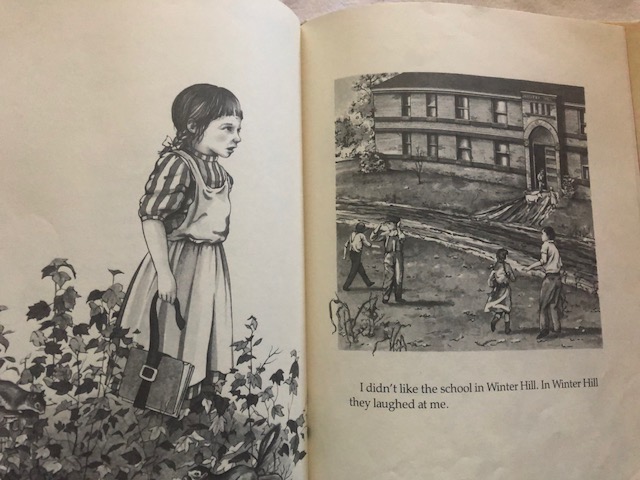
MollysPilgrimSchool

One girl in particular, Elizabeth, makes up rhymes to make fun of Molly, even following her home from school like a creepy stalker, to continue singing them at her. The other girls follow Elizabeth’s lead because they kind of admire her and because she is always giving them candy.
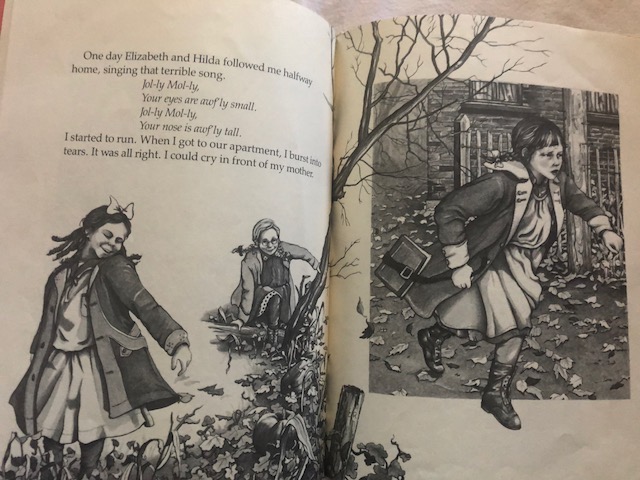
MollysPilgrimBullies

Then, one day, the girls’ teacher begins teaching them about Thanksgiving. Of course, Elizabeth makes a big deal about the fact that Molly has never heard about Thanksgiving before. But, Molly finds the story about the pilgrims interesting. The teacher says that for their Thanksgiving activity, instead of making paper turkeys like they usually do, the children are going to make clothespin dolls to look like American Indians and pilgrims, so they can create a scene like the first Thanksgiving.

MollysPilgrimClass

When Molly gets home and explains the assignment to her mother, she has to tell her mother what a “pilgrim” is. She explains it by saying that they were people who came from across the ocean in search of religious freedom. Her mother understands that and offers to help Molly with the doll.

However, when Molly sees what her mother has done with the doll, she is worried. The doll is beautiful, but her mother has dressed the doll in the clothes of a Russian refugee, like Molly’s family, not in the traditional Puritan garb of the pilgrims. At first, Molly is sure that she’ll be teased more than ever at school when she shows up with a doll wearing the wrong clothes and that people will think that she’s stupid for not understanding how pilgrims dressed.

MollysPilgrimDoll

But, Molly’s mother is correct in pointing out that their family are modern pilgrims, coming to America for the same reasons that the original pilgrims did. Molly does get some teasing from Elizabeth (that’s not a surprise, since it’s Elizabeth, after all), but when the teacher asks Molly about the meaning of her doll, it leads everyone to a better understanding, both of the holiday and where Molly and her family fit in with their new country and its history.

Molly’s teacher points out that the holiday of Thanksgiving wasn’t entirely an original idea that the pilgrims invented all by themselves but that they took their inspiration from a much older Jewish tradition from the Old Testament.  Human beings do not exist in a vacuum, and we all regularly take ideas that we’re exposed to and build on them in our own lives.  Although Puritans were generally known for their belief in religious “purity” (hence, their name) and noted for their intolerance to different religions and beliefs, they also strongly believed in education, which frequently involves taking past ideas and knowledge and applying them toward new situations.  Their Thanksgiving celebration was just an example of that, an older idea that they used for their own purpose, adapted to the lives of the people who adopted the tradition.  It was their celebration, but not their sole intellectual property.

The book is currently available online through Internet Archive (multiple copies).

There is also a sequel to this book called Make a Wish, Molly, in which Molly learns about birthday parties in the United States.

My Reaction and Additional Information

The book doesn’t mention it, but the word “pilgrim” itself is also much older than the early Puritan colonists in America.  Before the development of the America colonies, it referred to any religious traveler on their way to a holy place, and many people still use it in that sense.  A person on a pilgrimage could be just about anyone from anywhere going to anywhere else as long as the journey has spiritual significance.  The Puritan colonists used that term for themselves to emphasize the reasons why they were seeking new homes in a new land.  For them, it was a kind of pilgrimage to a place where they could start again.  Molly’s family came to America in search of religious freedom, just as the Puritans did.  Their journeys weren’t quite the same, but they shared a common purpose and ended up in the same place (more or less).

By showing the links between Molly and her family and the pilgrims, Molly’s mother and her teacher help the other students to understand that Molly really does fit in, that her being there makes sense, and that she has a place in their class and in their celebration of Thanksgiving.

This story was also made into a short film. I remember seeing it in school when I was a kid in the early 1990s.  I checked on YouTube, and there are trailers posted for this film.  One thing that I hadn’t remembered from when I was a kid was that the time period of the book was earlier than the film.  In the film, the characters are shown to be contemporary with the time the film was made, but the style of dress of the girls in the book’s pictures and the things that Molly’s mother says about why the family left Russia indicate that the book probably takes place during the late 19th century or early 20th century, possibly around the same time as the events in the famous play/movie Fiddler on the Roof.

As a side note, if you’re wondering why the girl is named Molly, which doesn’t sound particularly Russian, Molly is typically a nickname for Mary and other, similar-sounding, related names.  Molly’s mother also calls her Malkeleh, which may be her original name or perhaps another variant, if her original name was Malka, as another reviewer suggests.

In spite of the warning on that last site I linked to about reading a book with your child that may be covered in class, I say to go ahead and read it anyway.  It’s hard to say what books may or may not be used in classes by individual teachers, and if your child’s teacher doesn’t happen to use this one, it’s still a good story.  Perhaps just warn your child not to say something that would spoil the ending for their classmates who haven’t read it yet.
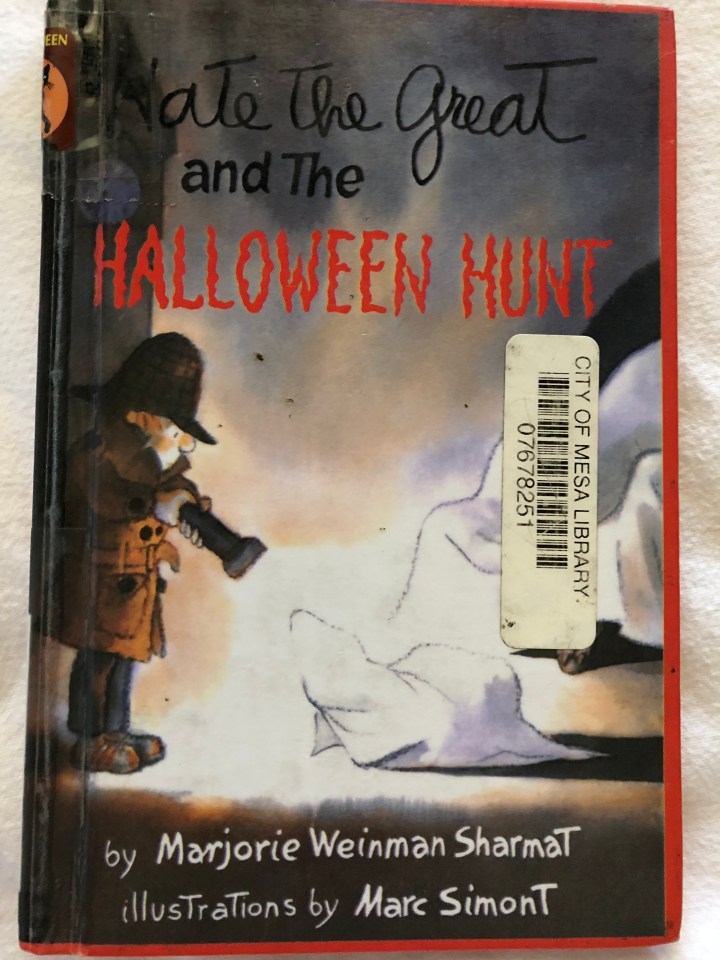
Nate the Great and the Halloween Hunt

NateHalloweenHunt

Nate the Great and the Halloween Hunt by Marjorie Weinman Sharmat, 1989.

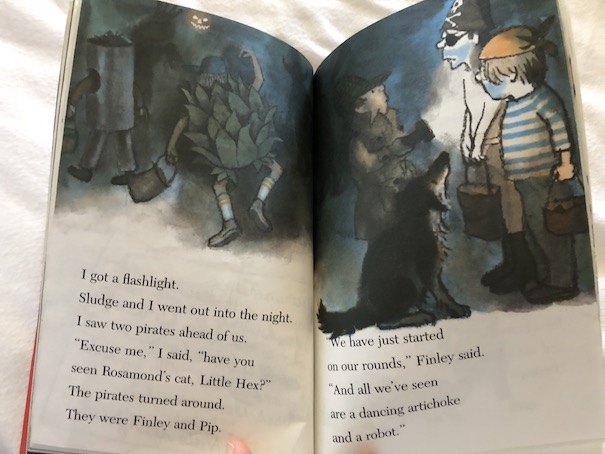
Nate the Great gets a Halloween case when Rosamond asks him to help her find one of her cats.  Rosamond and Annie show up at Nate’s house, trick-or-treating.  They’re both dressed as Little Red Riding Hood, and Annie’s dog, Fang, is the wolf/grandmother.

Rosamond has several cats, all named “Hex”: Big Hex, Plain Hex, Super Hex, etc.  But, she’s worried because she can’t find Little Hex.  Every Halloween, her other cats like to go to an old house in the neighborhood that is supposedly haunted in order to help haunt it, but Little Hex is afraid on Halloween and apparently hid somewhere.  Nate thinks that Little Hex will probably come out as soon as Halloween is over, but Rosamond is so worried that he agrees to look for Little Hex anyway.

NateHalloweenHuntTrickOrTreat

Nate interviews kids in the neighborhood to see if they’ve seen Little Hex, but they haven’t.  Then, he and his dog, Sludge, go to the haunted house to look around.  He sees Rosamond’s other cats, but not Little Hex.  There’s a scary moment when he realizes that he’s locked in the house, but Sludge helps him to escape.

Little Hex isn’t as far away or lost as Rosamond thinks, and Nate realizes that both Sludge and Rosamond herself have given him the clues he needs to solve the mystery.  Sludge demonstrates what an animal might do when it’s frightened, and Nate suddenly realizes why Rosamund’s treat basket was so much heavier than Annie’s even though they had been to the same houses.

The book is available to borrow and read for free online through Internet Archive.

The Spooky Halloween Party

SpookyHalloween

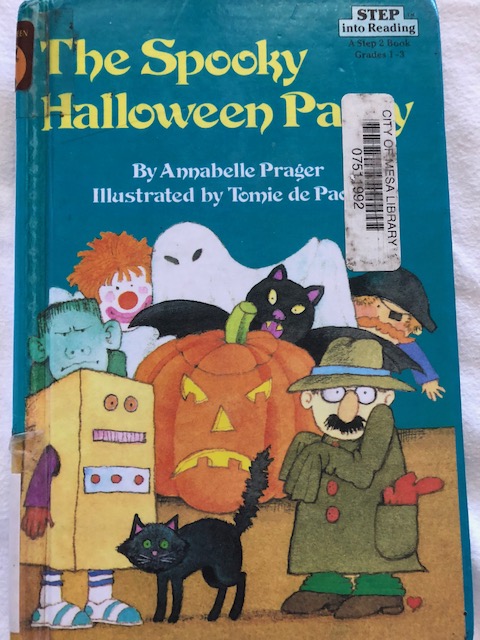
The Spooky Halloween Party by Annabelle Prager, illustrated by Tomie de Paola, 1981.

This book was an old Halloween favorite of mine when I was a kid.  It’s funny, slightly spooky, and has a bit of a twist ending!

Albert’s friend, Nicky, is inviting all of their friends plus his cousin Suzanne to a spooky Halloween party at his new apartment on Halloween night.  Albert hasn’t been to his new apartment yet, and Nicky says that it’s going to be really scary because he wants everyone to come in costume and to not tell anyone what they’re going to be so that everyone will be surprised when they take off their masks at the end of the evening.

SpookyHalloweenNickysParty

Albert doesn’t think Nicky’s party is going to be all that scary because he’s pretty confident that he’ll know who his friends are right away, even in costume.  Some of them have already given him hints.  Nicky was practicing going, “Whoo, whoo!” in order to scare people, so Albert knows that, whatever his costume is, it’s something that makes that sound.  Jan called up and asked Albert if he had an old mop that she could borrow, so he thinks that she’s probably going to be a witch and that she just got confused, thinking that witches carry mops instead of brooms.  Dan told Albert straight out that he’s going as a pirate because he doesn’t see the point in keeping his identity a secret.  So, Albert isn’t expecting any real surprises at Nicky’s party.
As for Albert’s costume, he’s tired of wearing the usual old clothes in the dress-up box, so he decides that this time, he’ll wear the box itself.  He cuts holes for his eyes and arms and decorates it so that he looks like a robot.  Almost completely covered by the box, he’s sure that everyone will have a harder time guessing his identity than he will theirs.

SpookyHalloweenElevator

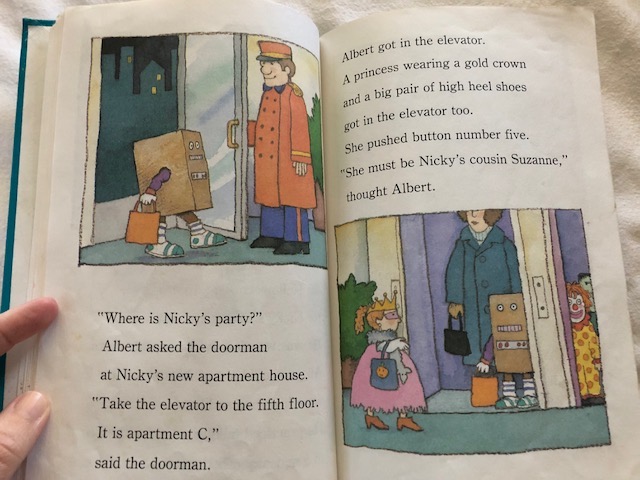
When Albert arrives at Nicky’s new apartment house, he meets a girl dressed like a princess in the elevator.  She says that she’s going to the Halloween party on the fifth floor, and when Albert says that he is too, she suggests that they walk there together.  Albert guesses that she is Nicky’s cousin, Suzanne, who he hasn’t met before.

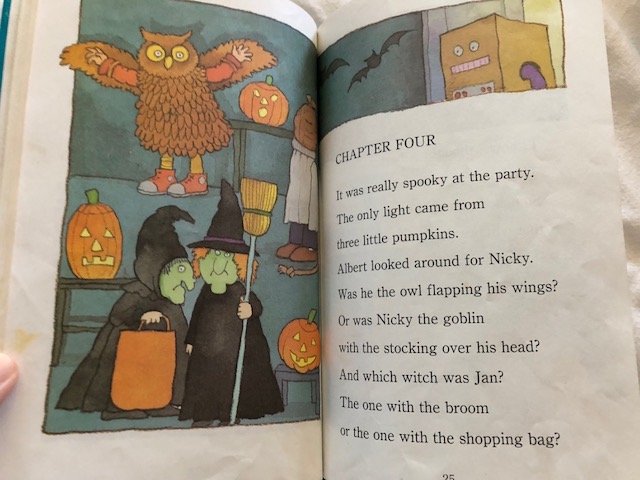
The apartment is pretty spooky, lit by jack o’lanterns, and there are already some guests there.  Albert is a little surprised that he doesn’t see a pirate, but there are a couple of witches and an owl, who could be Nicky.  Yet, when Albert tries to talk to the other guests, they seem to be acting strangely, and he realizes that he’s not quite sure who is really who.

SpookyHalloweenArrival

The princess is pretty spooked, and as the party goes around the apartment house, trick-or-treating, she kind of clings to Albert.  When some strange noises and a far-away “Whoo, whoo” sound startle her, Albert reassures her that it’s only Nicky in his owl costume.  Then, the princess tells him that she knows the owl, and it’s not Nicky.  That’s when Albert really starts getting scared, wondering why he doesn’t seem to know his own friends.

SpookyHalloweenTrickOrTreat

The book is available to borrow and read for free online through Internet Archive.

My Reaction and Spoilers

The reason why Albert doesn’t seem to know anyone becomes apparent when they unmask themselves after trick-or-treating.  Albert is really among strangers!  The princess isn’t Nicky’s cousin at all, and he followed her to the wrong Halloween party!  There were two Halloween parties on the fifth floor that night.  Nicky lives in apartment C, and Albert accidentally joined the party in apartment B.  Fortunately, Albert’s friends are also trick-or-treating around the apartment building and show up at that moment.

What started out as a potentially embarrassing mistake actually ends up making the evening more fun for everyone.  Albert’s mix-up brought an element of real suspense to both of the Halloween parties, with him wondering who everyone really was, the guests at the wrong party wondering who he was, and all of Albert’s friends wondering where he was.  Also, Albert gets some new friends out of this experience, and both parties end up combining into one big party at Nicky’s apartment.

SpookyHalloweenBigParty

Race isn’t important to the story and is never mentioned, but I’d just like to say that I appreciated the diversity of characters in the pictures.  Albert is black and so is Jan (you can see that when she isn’t wearing her clown costume), and the boy in the owl costume looks like he might be Asian.  I also really love that owl costume!  I don’t think I’ve ever actually seen anyone dress as an owl for Halloween, but it looks awesome!

Aunt Eater’s Mystery Halloween

AuntEatersHalloween

Aunt Eater’s Mystery Halloween by Doug Cushman, 1998.

This is a cute Halloween book for kids.  There are actually four short mystery stories in the book as Aunt Eater, dressed as Sherlock Holmes, goes to a Halloween party and encounters various spooky happenings.

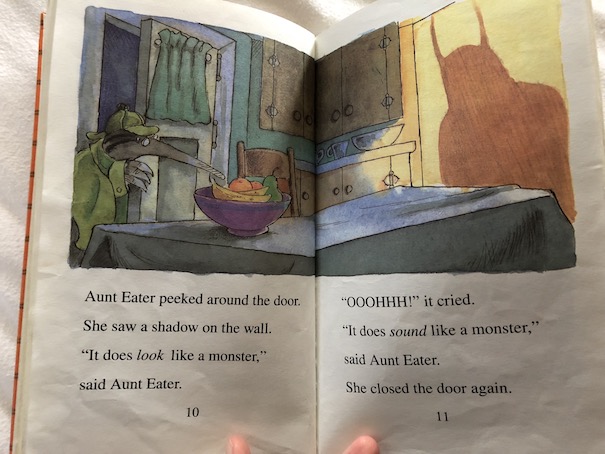
Aunt Eater Sees a Monster

While she’s on her way to the Halloween party, Wally stops Aunt Eater and says that there’s a monster in his kitchen and that it ate his father.  When Aunt Eater takes a look, she sees a scary shadow in the kitchen and hears a terrible groan.  Is it really a monster?

AuntEatersHalloweenKitchenMonster

Aunt Eater Sees a Ghost

Aunt Eater continues walking to the party with Mr. Chumly, who is dressed as a turnip.  Mr. Chumly points out a hollow tree that they pass and tells her that it’s supposed to be haunted by a headless ghost.  Aunt Eater doesn’t believe in ghost, but then a scary jack o’lantern appears, moving by itself, and it’s followed by a ghost with no head!  Fortunately, there is a logical explanation.

AuntEatersHalloweenHeadlessGhost.JPG

Aunt Eater Hears Some Music

Aunt Eater is glad to see all of her friends at the party.  Miss Underbelly has brought her pet snake with her.  Later, the piano suddenly starts playing strange music without anyone sitting at it, and the snake has disappeared!  What do you suppose is happening?

AuntEatersHalloweenPiano

Aunt Eater Dances a Jig

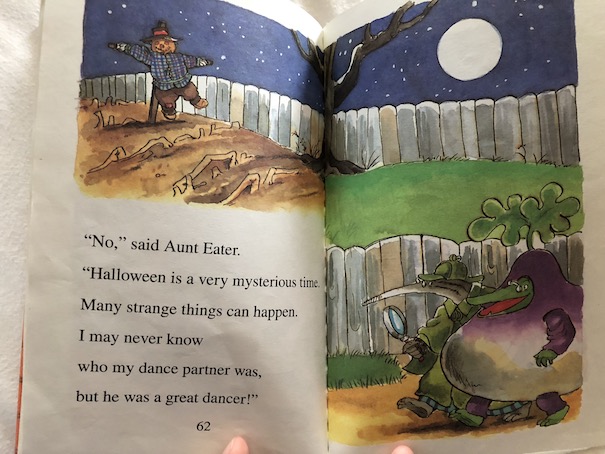
Mr. Fragg, a friend of Aunt Eater’s, is wearing a scarecrow costume, and he tells Aunt Eater that he’d like to dance with her later in the evening.  She does dance with a scarecrow, but then learns that it wasn’t Mr. Fragg because Mr. Fragg hurt his foot.  Who was that mysterious scarecrow?  Aunt Eater never figures it out, but readers do.

AuntEatersHalloweenScarecrow

The book is currently available online through Internet Archive.

Cranberry Halloween

CranberryHalloween

Cranberry Halloween by Wende and Harry Devlin, 1982.

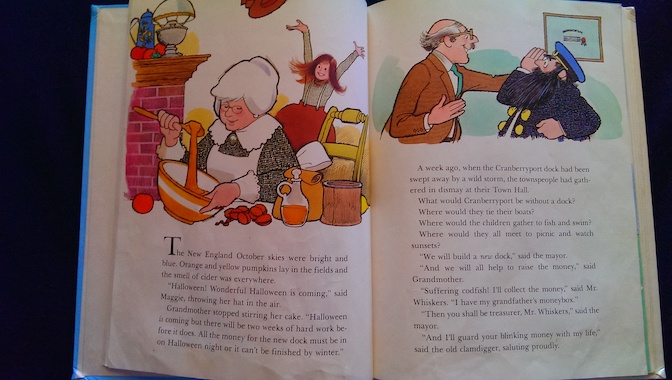
The citizens of Cranberryport need to raise money to build a new dock after theirs was destroyed in a storm. Almost everyone in town volunteers to help, and Mr. Whiskers volunteers to keep the money they raise in his grandfather’s old moneybox.

CranberryHalloweenRaisingMoney

Mr. Grape, a rather cranky old man, not only refuses to donate money to the cause but he insists that it is a mistake to trust Mr. Whiskers with the money because he is a sloppy and careless person. However, Maggie’s grandmother speaks up for Mr. Whiskers, and he gets the job of treasurer for the fund.

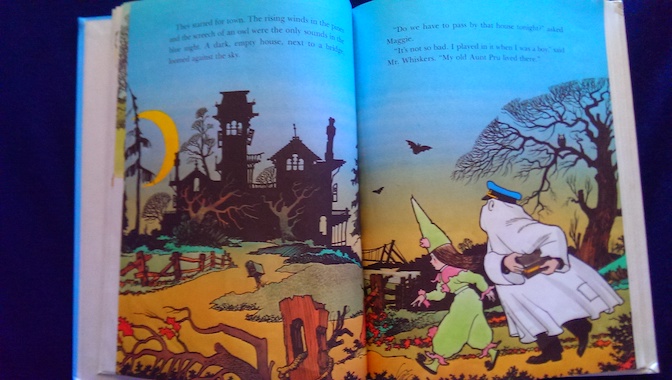
CranberryHalloweenSpookyHouse

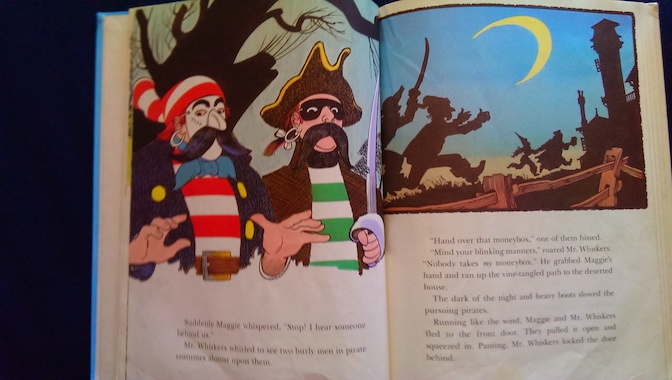
On Halloween night, Mr. Whiskers and young Maggie make their way to the town party, where Mr. Whiskers will present the money for the dock at the town hall.  As they pass by the spooky old house where Mr. Whiskers’s aunt used to live, two men in pirate costumes try to steal the money from them.

CranberryHalloweenPirates

Mr. Whiskers and Maggie hide in the spooky old house, but the pirates are still waiting for them outside. What are they going to do?

CranberryHalloweenTrapped

Mr. Whiskers uses his memories of the old house to find a way out, and it isn’t long before they uncover the villain who put the pirates up to the attempted theft.

The book includes a recipe for Cranberry Dessert in the back.

CranberryHalloweenRecipe

That Terrible Halloween Night

TerribleHalloween

That Terrible Halloween Night by James Stevenson, 1980.

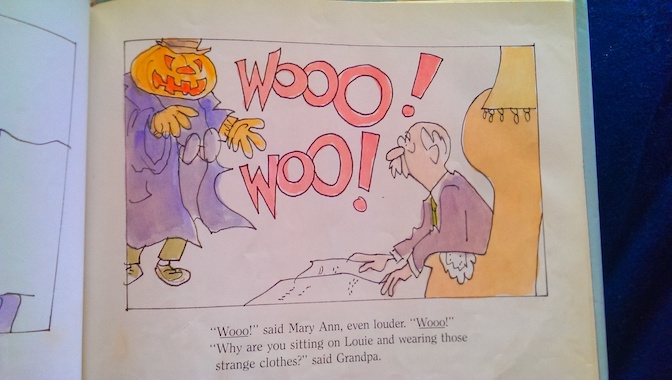
It’s Halloween, and Louie and Mary Ann think that it would be funny to play a joke on their grandfather and scare him.  First, they try putting a scary mask on their dog, Leonard, but their grandfather just pats the dog on the head.  Then, Mary Ann sits on Louie’s shoulders, and the kids put on a big, old coat and a pumpkin head.  However, their grandfather still isn’t frightened.

TerribleHalloweenCostume

When the kids ask him why he isn’t scared, their grandfather says that he doesn’t get scared much since “that terrible Halloween night.”  When the kids ask him what he means, he starts telling them about a Halloween when he was a kid.  He was out trick-or-treating when he saw a mysterious old house and couldn’t resist taking a look inside.

TerribleHalloweenTrickOrTreat

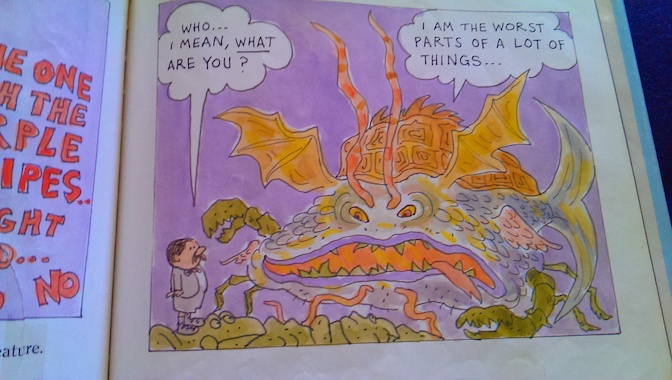
As the grandfather, as a kid, explores the house, he encounters all kinds of strange and frightening creatures.  (My favorite is the one that’s “the worst parts of a lot of things” just for the description.)

TerribleHalloweenMonster

But, nothing in the house is as scary as whatever is behind the final door in the house, the one that the monsters warn him not to go through . . .

TerribleHalloweenOldMan

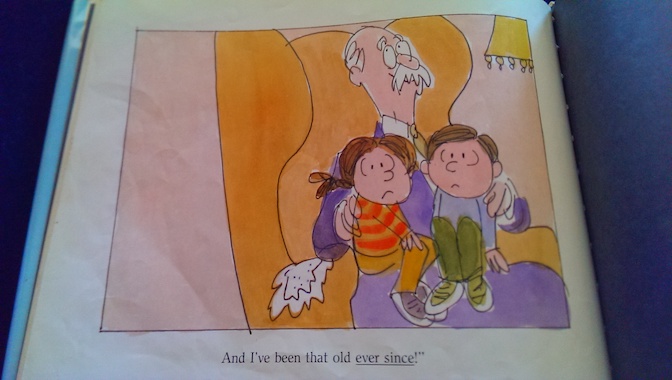
You never see what’s behind the door, but the result is the punchline of the story.  Typical grandfather way to frighten the kids!

TerribleHalloweenPunchline

One of the fun things about this story is that the grandchildren aren’t just listening to the story but are shown reacting to it as the grandfather tells the story, sometimes interrupting with questions or comments.  The pictures are drawn in a comic style, and much of the dialog is contained in speech bubbles in the pictures.

The book is currently available online through Internet Archive.

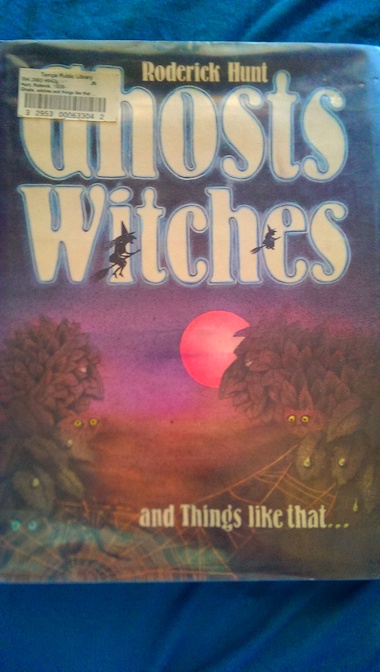
Ghosts, Witches, and Things Like That

GhostsWitchesThings

Ghosts, Witches, and Things Like That by Roderick Hunt, 1984.

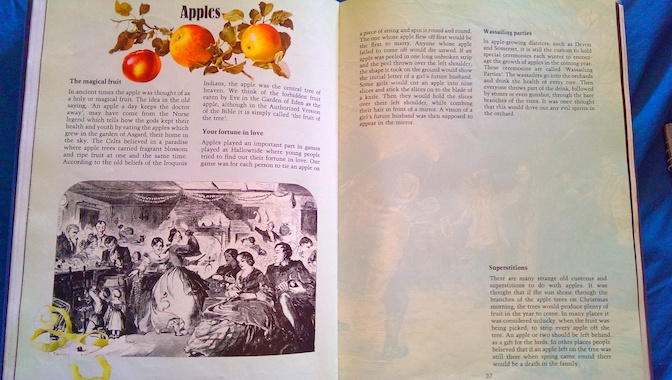
This is a collection of information about the history of Halloween and other things related to Halloween, like folklore, games, recipes, crafts, and poems.  There are sections about specific topics, starting with the section about Halloween itself (spelled Hallowe’en, this is a British book).  The section about Halloween talks about the origins of the holiday and has tips for holding a Halloween party, including how to make costumes and decorations, the rules for games to play (including some old traditional games), and recipes for various Halloween treats.

Other sections of the book focus on various monsters and mythical creatures associated with Halloween, such as witches, ghosts, fairies werewolves, and vampires.  There is a section of ghost stories and some fascinating historical information about spiritualists and how people have faked ghosts in the past, including the Pepper’s Ghost illusion that is still used in the haunted house in Disneyland.  The sections about witches, fairies, and monsters also include a mixture of history and folklore along with some jokes and poems about the various creatures.

GhostsWitchesHistory

This is a fun book to read around Halloween.  It’s a mixture of historical background, folklore, party-planning tips, games, and recipes.  I think that the information about traditional games is still my favorite part.

GhostsWitchesApples

Meet Molly

Molly, An American Girl

MeetMolly

Meet Molly by Valerie Tripp, 1986.

MeetMollyThreatMolly McIntire misses her father, who is a doctor stationed in England during World War II.  Things haven’t been the same in her family since he left.  Treats are more rare because of the sugar rationing, and she now has to eat yucky vegetables from her family’s victory garden all the time, under the watchful eyes of the family’s housekeeper.  Her mother, while generally understanding, is frequently occupied with her work with the Red Cross.  Molly’s older sister, Jill, tries to act grown-up, and Molly thinks that her brothers are pests, especially Ricky, who is fond of teasing.  However, when Molly and her friends tease Ricky about his crush on a friend of Jill’s, it touches off a war of practical jokes in their house.

MeetMollyHalloweenTrickHalloween is coming, and she wants to come up with great costume ideas for herself and her two best friends, Linda and Susan.  Her first thought is that she’d like to be Cinderella, but her friends are understandably reluctant to be the “ugly” stepsisters, and Molly has to admit that she wouldn’t really like that role, either.  Also, Molly doesn’t have a fancy dress, and her mother is too busy to make one and also doesn’t think that they should waste rationed cloth on costumes.  Instead, she suggests that the girls make grass skirts out of paper and go as hula dancers.  The girls like the idea, but Halloween doesn’t go as planned.

Everyone loves the girls’ costumes, and they collect a good number of treats in spite of the war rationing, but Ricky takes his revenge for their earlier teasing by spraying them with water and ruining their costumes and all of their treats.  When the girls get home, and Mrs. McIntire finds out what happened, she punishes Ricky by making him give the girls the treats that he’s collected, except for one, which she allows him to keep.  However, to the girls, this seems like light punishment, and they’re offended that he got off so lightly.

MeetMollyRevengeBecause he laughed at the girls, saying that he could see their underwear after he sprayed them with water and ruined their skirts, the girls decide to play a trick that will give Ricky his just desserts.  The next time that Jill’s friend comes to visit, the girls arrange to have Jill and her friend standing underneath Ricky’s bedroom window when they start throwing all of his underwear out the window, right in front of Ricky.  Ricky screams at the girls that “this is war!” just as their mother arrives home.
Their mother makes it clear that war is a serious thing, not a joke.  There is a real war on, and their childish pranks are wasting time and resources (like the food that Ricky ruined on Halloween – sugar is rationed, and some of their neighbors had gone to a lot of trouble to save their rations to give the kids a few treats).  She also points out that this is how real wars start, with “meanness, anger, and revenge.”  Faced with the reality of what they were doing, Molly and Ricky apologize to each other and clean up the messes that they each made under their mother’s direction.

In the back of the book, there is a section of historical information about what life was like for civilians in America during World War II.  People with relatives overseas worried about them, but people in service had to be careful about what they said in letters home, in case those letters were intercepted by enemy forces.  Some of the luxury goods that people were accustomed to having became more scarce, although the rationing wasn’t as bad in the United States as it was in Europe (this is covered more in a later book in the series) because certain types of materials had to be saved for the war effort (like the metals used to make cans for food, which is why victory gardens were important) and because factories that ordinarily made civilian goods were converted to make equipment for the armed forces.  For example, they mention that car factories were making things like tanks and airplanes and clothing factories were making tents and uniforms.  People referred to the efforts that civilians were making to save needed materials for the war as “fighting on the home front,” reminding themselves and others that the small sacrifices that they made each day, like driving their cars less to save gas or raising food for their families, helped to make a big difference for a larger cause.

The book is currently available online through Internet Archive.

Cranberry Easter

CranberryEaster

Cranberry Easter by Wende and Harry Devlin, 1990.

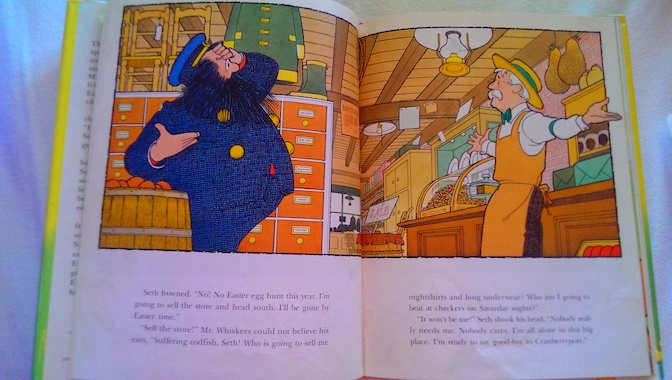
Mr. Whiskers is eager to talk to Seth, the owner of the General Store, about this year’s Easter egg hunt.  Seth hosts one every year, and Mr. Whiskers is full of plans.  However, Seth tells him that he’s thinking of closing the store and moving.  He’s been lonely in Cranberryport since his wife died, and he’s thinking that he might want to retire and move to a warmer climate.

CranberryEasterSethMoving

When Mr. Whiskers tells Maggie’s Grandmother what Seth said, she says that he’s not the only one thinking of moving.  A couple of her friends say that they can’t handle living alone on their farms in the winter anymore, and because they haven’t been able to find rooms to rent in town, they are thinking of moving to a warmer climate, too.

CranberryEasterMaggieSuggestion

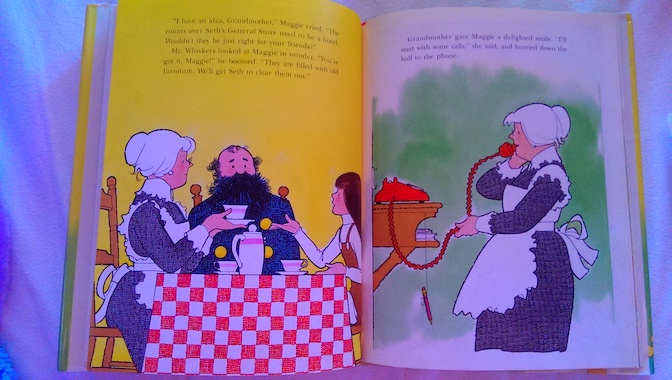
Then, Maggie comes up with a possible solution. She reminds them that the building that the General Store occupies was once a hotel.  There are rooms above the store that Seth hasn’t been using.  If he cleaned up those old rooms, he could rent them out to Grandmother’s friends.  Seth is reluctant at first because the rooms need a lot of work to clean up, but with a little urging and help from his friends, they soon manage to turn the old hotel rooms into nice-looking apartments.

CranberryEasterRenovations

Grandmother’s friends love the apartments because, with rooms right over the store, they won’t even have to go out for groceries when the weather is bad.  The arrangement works well for Seth, too.  When members of the community help to clean up the old rooms, it reminds him that he has friends in town, and with some of them living right above his shop, there will be no need for him to feel lonely anymore.

CranberryEasterApartments

Of course, when Seth decides to stay in town and hold the Easter egg hunt after all, Mr. Whiskers has to follow through on his promise to dress up as the Easter Bunny.

CranberryEasterBunny

Like other books in the series, this book includes a recipe in the back, for Cranberry Cobbler.

CranberryEasterCobblerRecipe

Addy’s Surprise

American Girls

AddySuprise

Addy’s Surprise by Connie Porter, 1993.

Christmas is coming, and although Addy and her mother have started to establish a new life for themselves in Philadelphia, they miss the rest of their family, whose whereabouts are still unknown.  Money is tight, and Addy’s mother is trying to save up for a new lamp for their room at Mrs. Ford’s.  Addy wants to buy her mother a pretty red scarf at the second-hand shop for Christmas, but saving up the tips she earns delivering packages for Mrs. Ford is slow.  Addy still wishes that they could afford beautiful dresses, like the rich women who visit the dress shop.One thing that Addy is looking forward to is the Christmas celebration at their church.  Her new friend, Sarah, has told her all about it.  She describes the potluck dinner, the beautiful decorations, and the shadow play they have to entertain the children.


Then, at church, the Reverend Drake tells everyone that more “freedmen,” people who have just come out of slavery, will be arriving in the city soon.  Reverend Drake asks the congregation to help, just as many of them received help when they first arrived.  Like Addy and her mother, these new people will be arriving with almost nothing, not knowing where to go and what to do, and will need money for food and clothes and places to live.  Addy and her mother decide that they want to help, although it means stretching their already-tight finances even tighter.

Addy is reluctant to part with the little money she’s been saving to buy the scarf for her mother, so she offers to help out in greeting the new arrivals and taking them to the church instead.  When Addy and Sarah go to the pier to meet them and guide them to the church, Addy feels badly at seeing the condition they are in.  This particular group is made up of slaves who were freed because the owner of their plantation was under pressure from the war.  He simply turned them loose with only the clothes on their backs and little idea of where to go or how to get help in establishing a new life.  Some of them are sick or injured, some have no shoes in the winter cold, and none of them have had enough to eat.  Addy reassures them that the church will help them.  The baby in the group particularly makes Addy think of her little sister, Esther, who is still in slavery in the South.  Addy begins to feel like the things she was worried about before, like dresses, a new lamp, and the scarf aren’t as important as she once thought they were.  When Addy has finally collected enough money for the scarf for her mother, she decides to donate the money to help the others instead.

It looks like Addy and her mother won’t be getting the special things that they had hoped for at Christmas, but Christmas is a time of surprises.  Through their own hard work, they’ve made some special friends in Philadelphia who care about them, and other, unexpected circumstances allow Addy to not only get the special Christmas dress she’s been dreaming of  (a customer returns a dress to the shop because her daughter can’t fit into it anymore) but to make a scarf of her own to replace the one that she was going to buy for her mother.  The Christmas party at the church is as wonderful as Addy expected, but there’s an even more wonderful surprise to come: Addy’s father has finally made it to Philadelphia!


I like the way Addy and her mother showed generosity and consideration to others in the story, even though they are also somewhat struggling themselves.  Through their own hard work and ingenuity, they manage to make their own Christmas presents with scraps from the dress shop, and Mrs. Ford shows her appreciation for their hard work by buying them the lamp they need.  Good things come to those who work for them!

AddySurpriseHistorical

There is a section in the back with historical information about Christmas celebrations around the time of the Civil War.  Because of the war, families weren’t always able to get or afford things they could before.  People sometimes raised money for soldiers or send them special care packages.  Slaves were allowed small celebrations, being released from work for a new days and given small gifts from the plantation owners.