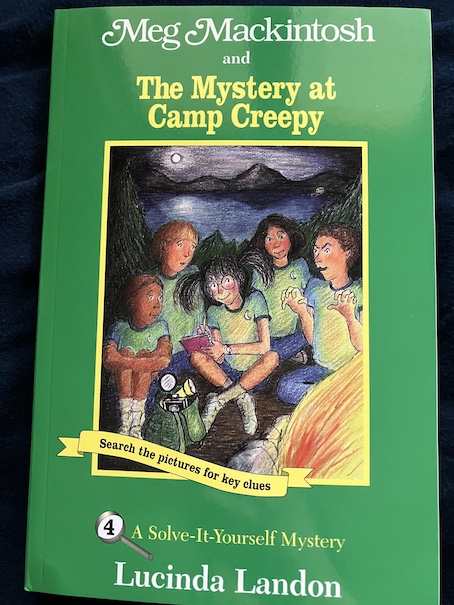
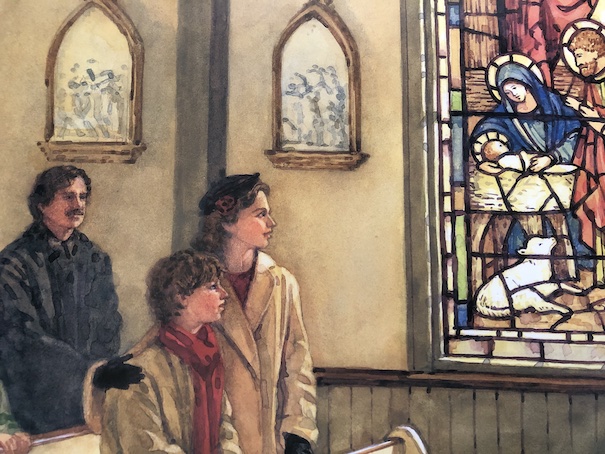
Meg Mackintosh and The Mystery at Camp Creepy by Lucinda Landon, 1987.
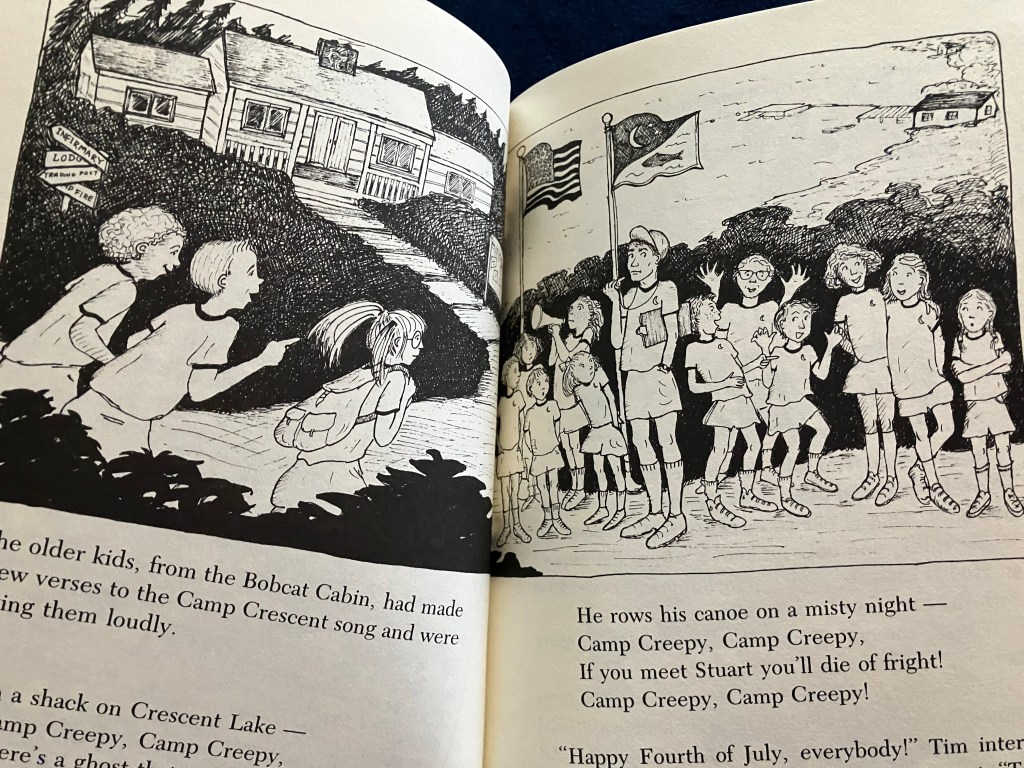
Meg Mackintosh is at a summer camp in Maine! The camp is called Camp Crescent, but it soon gets the name Camp Creepy because there’s a ghost story about the camp. The story says that an old man named Stuart once lived in the building that the camp uses for a boathouse and that he still haunts the camp. When people start hearing strange noises at night, the campers start thinking maybe the ghost story is true.
To celebrate the Fourth of July, the camp decides to hold a treasure hunt with puzzles for the campers to solve. Everyone is excited about the treasure hunt, but Meg is especially excited because she’s solved treasure hunts before. However, in her excitement to start the treasure hunt, she accidentally drops the first clue on the camp fire, and much of it burns.
Everyone is angry with Meg for messing up the treasure hunt because they’re supposed to solve it before nightfall to enjoy the prize. Although they don’t know what the prize is supposed to be, they’re told that it won’t be any good if they find it too late. While the others go on a hike, Meg fakes a stomach ache because she just can’t face the other campers again.
At the camp’s infirmary, Meg meets two other campers who are staying behind. Russell has a bad case of poison ivy, and Tina has been dealing with homesickness. They ask to see what’s left of the first clue, and Meg shows them. Something in the clue reminds Meg of something she saw at camp earlier, and the three of them begin thinking that they might be able to solve the after all. If they can just get past that first burned clue, they can continue the treasure hunt like normal.
Can the three of them manage to solve the treasure hunt and save the prize for all the other campers? Will they meet Stuart’s ghost along the way?
The Book is available to borrow and read for free online through Internet Archive (multiple copies).
My Reaction
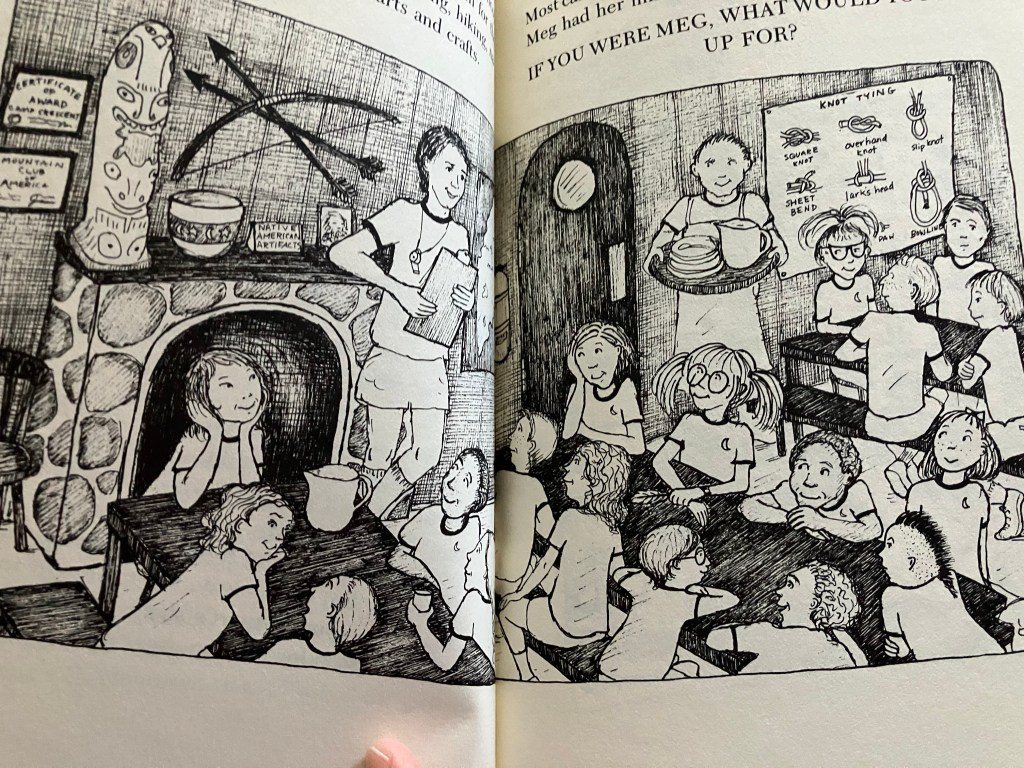
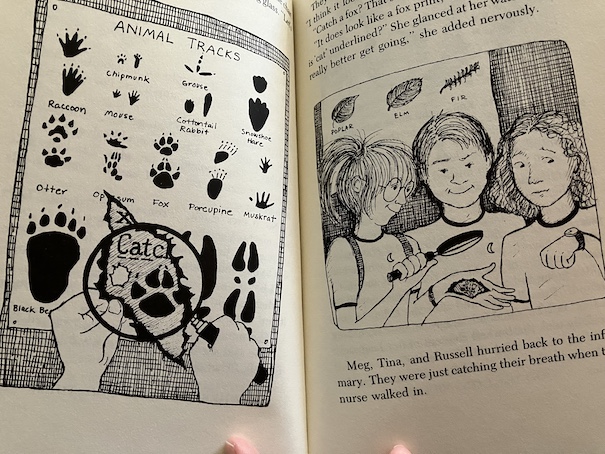
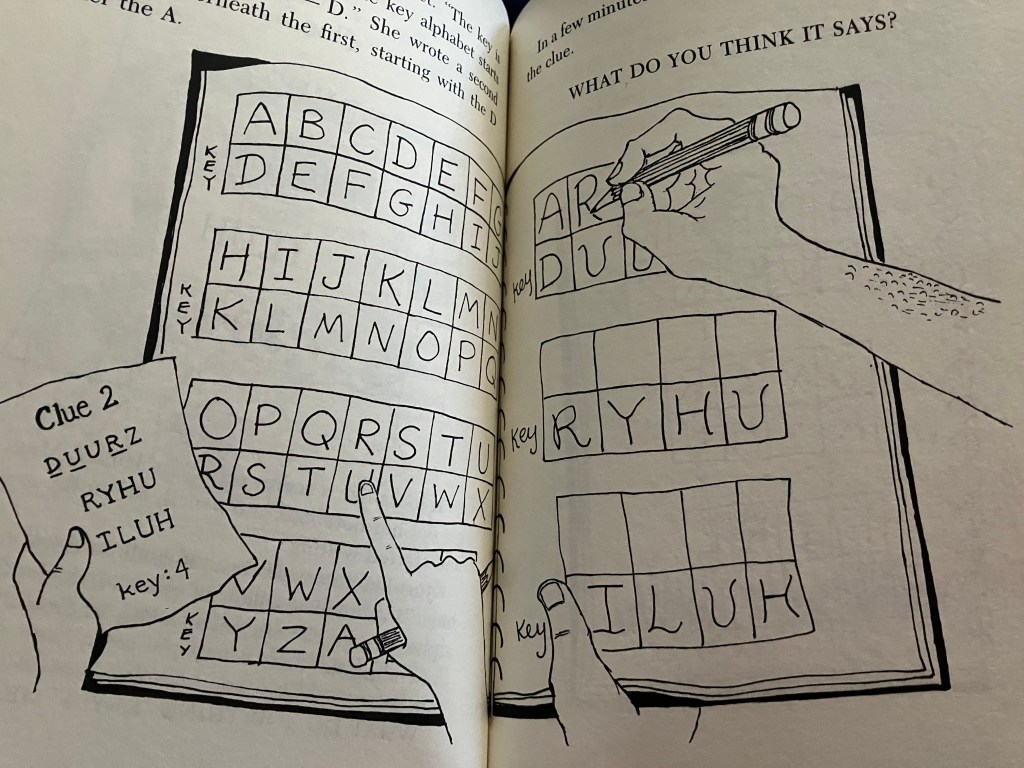
I always enjoy treasure hunt stories, and like other Meg Mackintosh mysteries, this story gives readers the opportunity to figure out the clues and puzzles along with Meg. The information readers need is in the pictures of the story.
Most of the focus of the story is on the treasure hunt, and the ghost is kind of a side plot. Maybe the ghost would seem a little spookier to young readers, but I have to admit that I found it difficult to think of anybody named Stuart as sounding very sinister. The legend of Stuart doesn’t even seem to carry any consequences for people who see him other than it just being spooky, so I didn’t think the story was that creepy.
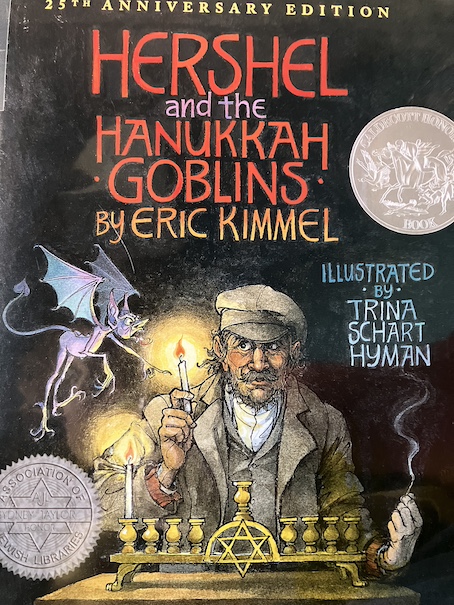
Hershel and the Hanukkah Goblins by Eric Kimmel, illustrated by Trina Schart Hyman, 1985, 1989.
On the first night of Hanukkah, a tired travel, Hershel, trudges through the snow on his way to the next village. There, he hopes to get something to eat and celebrate the holiday with the local villagers. However, when he reaches the village, nobody is celebrating.
When he asks the villagers why they’re not celebrating, they tell him that they can’t because there are goblins haunting the old synagogue on the hill. Every time they try to celebrate Hanukkah, the goblins come after them, blow out the candles on their menorahs, breaks their dreidels, and throw all the potato latkes on the floor.
Hershel decides that he isn’t scared of the goblins, and he’s going to put an end to their mischief. The village rabbi says that the only way to get rid of the goblins is to spend all eight nights of Hanukkah in the synagogue, lighting Hanukkah candles every night. Then, on the final night of Hanukkah, the goblin king must light the candles himself. Although this sounds difficult, Hershel is confident that he can do it. Although the villagers aren’t really expecting Hershel to succeed, they support Hershel in his mission, and they give him some food, a menorah, candles, and matches.
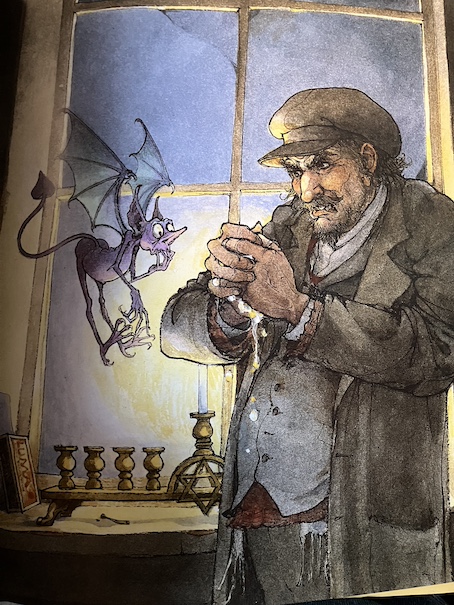
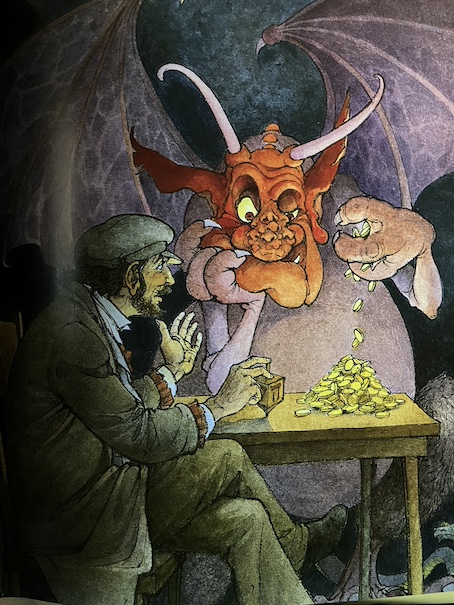
The old synagogue is creepy, and when Hershel lights his first candle, a small goblin appears to ask him what he’s doing. Herself isn’t intimidated by the little goblin, and he tricks the goblin into thinking that he’s strong enough to crush rocks in his hands by squeezing a hard-boiled egg in his hands until it breaks. The little goblins is scared away but warns him that bigger goblins than him will come later. The next night, a bigger goblin comes, but he isn’t very bright and gets his hand stuck in a jar of picks when he tries to take too many. The night after that, tricks the third goblin into playing dreidel with him and giving him all his gold.
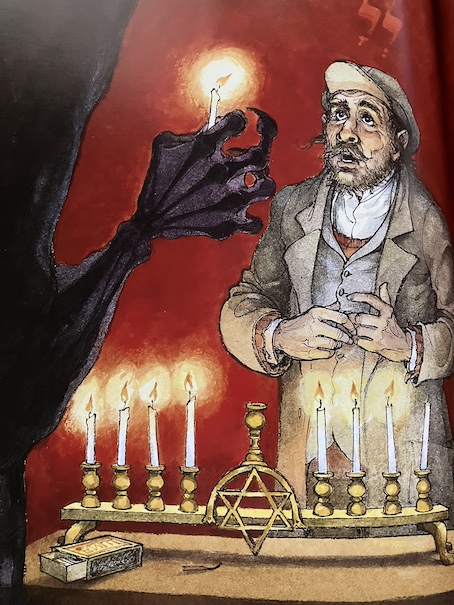
It continues like this, night after night, with Hershel tricking the goblins in various ways so that they’ll let him light the candles on his menorah. Finally, Hershel comes face-to-face with the most sinister goblin of all – the king of the goblins. Can Hershel find a way to trick him and get him to light the candles of the menorah himself?
The book is a Caldecott Honor Book and named a Sydney Taylor Honor Book by the Association of Jewish Libraries. It is available to borrow and read for free online through Internet Archive (multiple copies). It was originally published as a short story in Cricket magazine and later as a book, which is why the story has two copyright dates.
My Reaction
I’m not Jewish, and I admit that this isn’t a book I read as a kid, although I do remember that it was one that was often recommended when I was young. As an adult, I decided to try it, since I just never got around to it before. I really do like this story. I enjoyed the folklore elements, and I also appreciated that the main character saves Hanukkah, in much the same way that various characters had to “save” Christmas when I was a kid.
It makes me laugh to think about it now, but Christmas always seemed to be an extremely endangered holiday in Christmas television specials from my childhood. Some evil person or being was always out to destroy Christmas, for various reasons, with varying degrees of logic, and popular television characters always had to “save” it from being destroyed or canceled or whatever. It was fun and entertaining, but when you consider the entire canon of endangered Christmas holiday specials all together, it does seem like there isn’t a single year when Christmas isn’t in danger from somebody or something, making it weirdly routine for Christmas to almost not happen. At some point, I think my brother pointed out that Christmas was always in danger, but it seemed like Hanukkah was relatively safe. (At least, in the land of holiday-themed winter television specials starring well-known cartoon characters.) I figured that Christmas was likely a bigger target for the forces of evil due to its wide mass appeal because there were just more people who celebrated Christmas where I lived than Hanukkah (and also because of the all the related Christmas toy tie-in commercials and advertising sponsors for those shows).
So, I was delighted to see Hanukkah get saved from a band of comically nefarious goblins in this book. The goblin king is a sinister figure in the pictures, but fortunately, he’s not too much brighter than his cohorts. The book has been adapted as a stage play (you can sometimes find clips or trailers from performances on YouTube), and there is also an animated short film of the story. I think it would be fun to see a longer version, though, in video or movie form. The book skims over the details of what Hershel does to trick some of the other goblins after the third one, so there’s room to elaborate and make the story longer. I think I would have been a little scared by the final goblin when I was a little kid, but the goblins not being particularly bright and easy to trick does help remove some of the scare factor.
At first, I though that the story of Hershel might have been a folktale because it reads like one. In the back of the book, the author explains that he wanted to write a story that was somewhat like A Christmas Carol by Charles Dickens but about Hanukkah, and he took his inspiration from the folktale Invanko, the Bear’s Son (also known as Jean de l’Ours or John the Bear), which is includes the hero tricking a goblin, and he added in a Jewish folk hero, Hershel of Ostropol. The resulting story is sort of like a new folktale, remixed from old ones, which is fitting because that’s what happens with folk stories Overall, I thought it was a fun story.
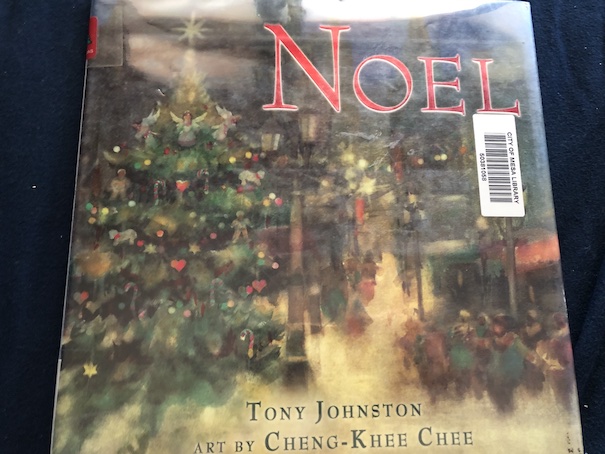
Noel by Tony Johnston, art by Cheng-Khee Chee, 2005.
This lovely Christmas picture book reads like a Christmas carol!
There is no story in the book. The text is poetry that celebrates the atmosphere of Christmas, the feelings in nature as anticipation builds and in cities as people gather to celebrate.
“Noel” is described as the sound of Christmas, like a bell, that people and animals all listen to hear.
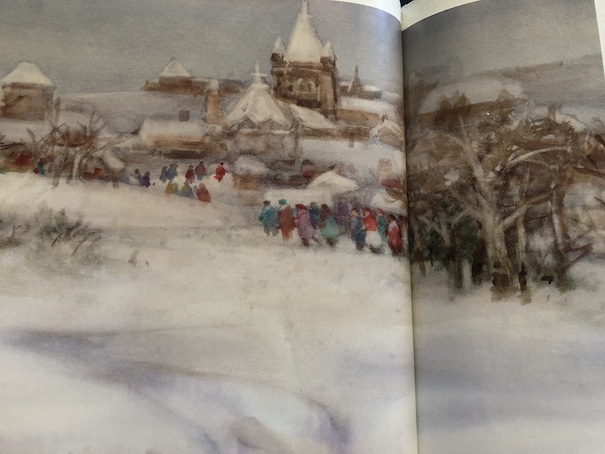
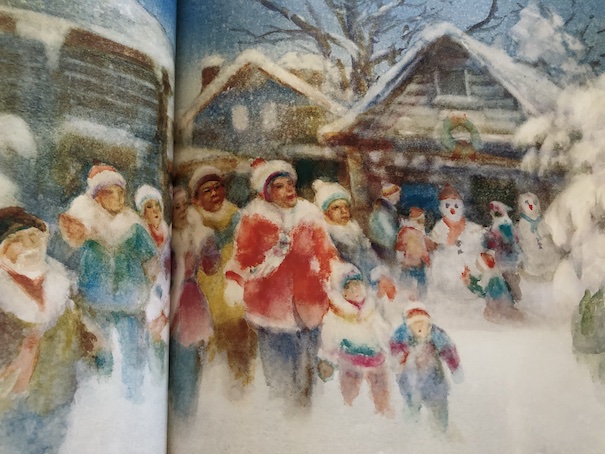
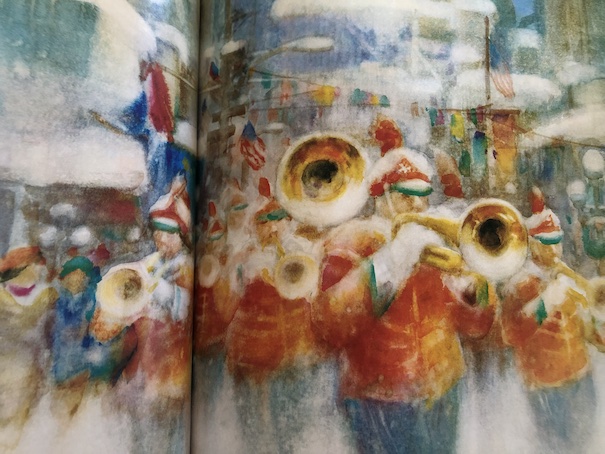
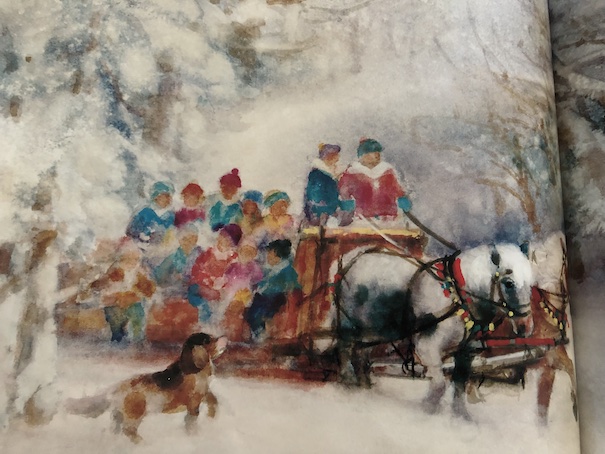
The artwork is beautiful, and there are scenes of people participating in classic Christmas celebrations, with a Christmas parade, snowmen, a public Christmas tree, and a sleigh ride.
The pictures really make the book beautiful and dreamlike. In the back of the book, there is a section that explains the art style. The artist used watercolors and a technique called “saturated wet-paper technique.” This technique is what gives the illustrations their fuzzy, dreamlike quality
The book is available to borrow and read for free online through Internet Archive.
The Legend of the Christmas Rose by William H. Hooks, paintings by Richard A. Williams, 1999.
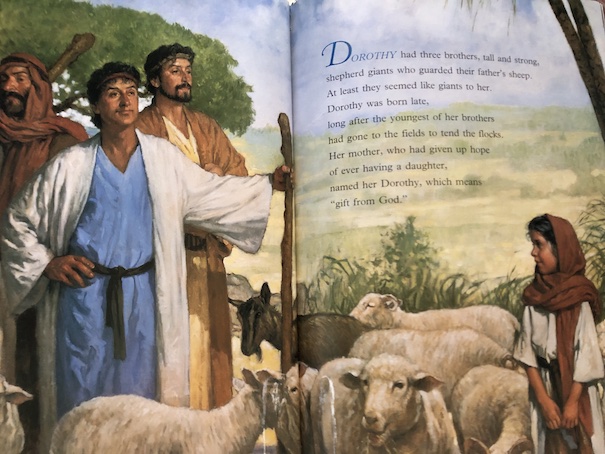
Dorothy is a 9-year-old girl with three brothers, who are all much older than she is. Her three brothers are all shepherds, and her daily chore is to take water to them when they’re out in the fields with the sheep. Her brothers love her, but they always treat her like a small child because they’re so much older.
One day, she spots some strange travelers on the road. She worries that they might be robbers, but her brothers tell her not to worry. There are more travelers on the road these days because the Roman Emperor has ordered everyone to return to their home towns to be taxed. However, because there are so many strangers traveling through the area, Dorothy’s brothers plan to spend the night in the fields with their sheep to keep an eye on them.
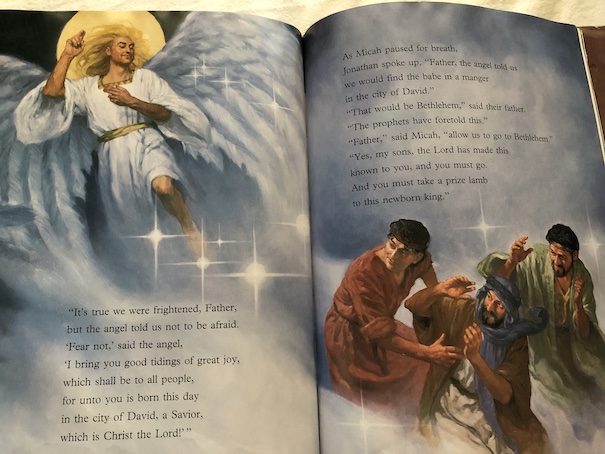
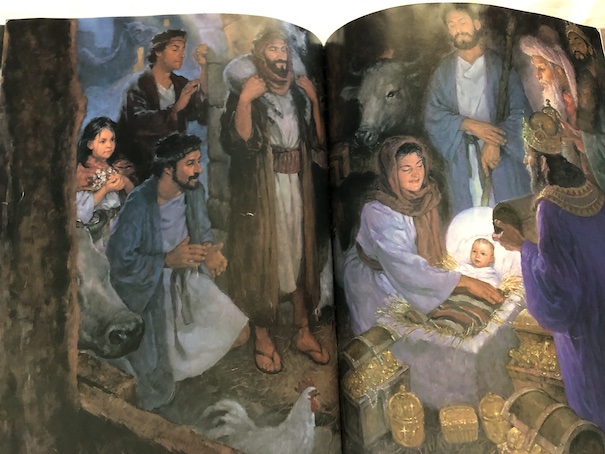
Early the next morning, the brothers return to the family home, excited. They tell their father that they saw angels in the field during the night. An angel appeared to them and told them that they would find a newborn Savior in a manager in the City of David, which is Bethlehem. Their father says that there is a prophecy about this. Because God has sent His messengers to announce the birth of the Savior to them, the brothers should go to the city and take a lamb with them as a present to the Savior.
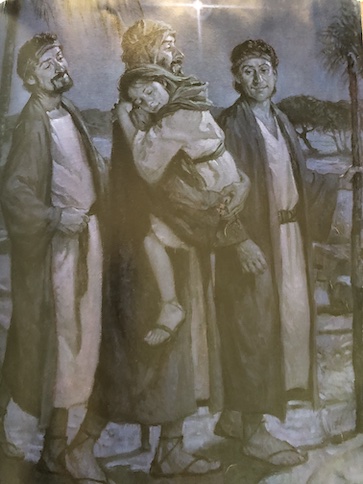
Dorothy helps her brothers to pack their supplies for the journey to Bethlehem, but she knows that she will not be allowed to go with them because she is too little. In spite of that, Dorothy makes the sudden decision to follow her brothers secretly. However, as they travel, Dorothy suddenly realizes that she doesn’t have a present of her own to offer when she arrives.
When Dorothy begins to cry about her lack of a present to give, an angel appears to her and produces snowy white flowers. Dorothy is happy because she can bring the flowers with her as a present.
The book is available to borrow and read for free online through Internet Archive (multiple copies).
My Reaction
There is an Author’s Note at the back of the book that explains about the Christmas Rose plant and its associated legends. The Christmas Rose is a real plant, but technically, it’s not a rose, and it doesn’t always bloom at Christmas. It’s native to southern and central Europe, where winters are relatively mild, and the flower can bloom in Christmas, but in colder climates, it tends to bloom in spring. It’s actually a member of the hellebore family, which is toxic to humans, although it has been used medicinally as a purgative, and it does contain a chemical that can be used to treat heart conditions. The story in the book also references the plants’ medicinal uses.
There are multiple legends about the origins of the plant. The version presented here, the legend about an angel giving the flower to a young shepherd girl to offer as a present to baby Jesus, comes from Medieval nativity plays. There is an older Greek legend where the plant was discovered by a shepherd around 900 BC. In that version of the story, the shepherd used the plant to cure three princesses who were afflicted with delusions that they were cows. After he cured them, the princesses’ father, the King of Argos, allowed the shepherd to marry his youngest daughter.
Overall, I liked this picture book version of the legend. I like books about folklore, especially ones that use lesser-known stories. The pictures in this book are also realistic and beautiful, taking up full pages.
The Little Fir Tree by Margaret Wise Brown, pictures by Jim Lamarche, 1954, 2005.
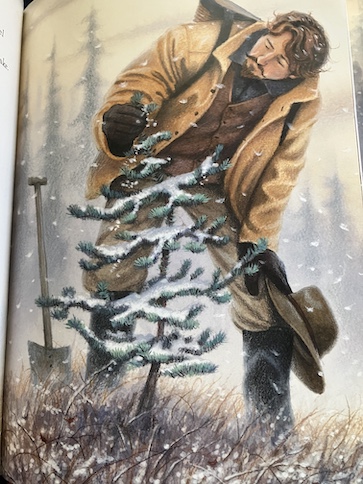
A little fir tree feels lonely among the large trees in the forest, but something happens that changes his life forever – he is chosen to be a living Christmas tree for a little boy!
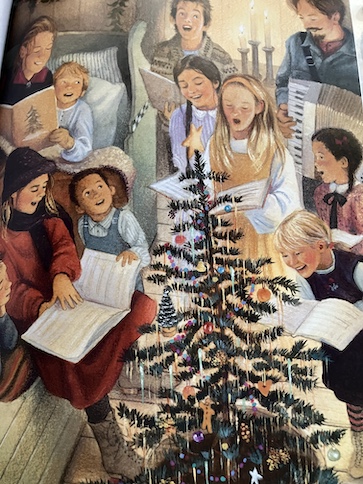
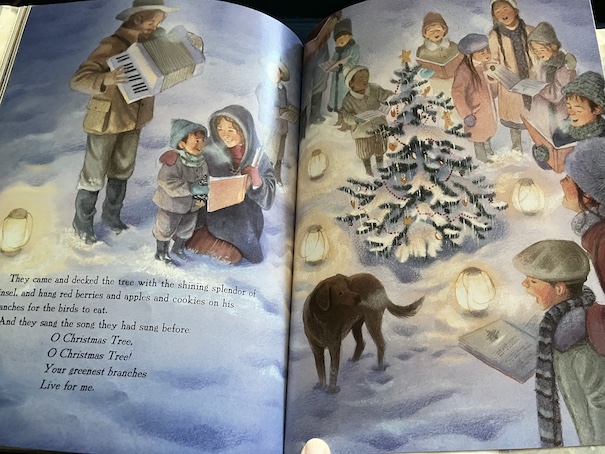
One winter, the boy’s father carefully digs up the tree and brings it home to his young son, who cannot walk because of a lame leg. The boy has been wanting to see the trees in the forest, but since he can’t go to the forest himself, his father has brought a free to him. The little fir tree loves being decorated, and the next evening, guests come and gather around him, singing Christmas carols.
In the springtime, the boy’s father takes the tree back to the forest, where he found it, and he plants the tree again so it will continue to grow. However, the following winter, the boy’s father returns to dig up the tree again and take it back to the boy for Christmas.
The little fir tree loves this ritual of visiting the boy and his family and being their Christmas tree every winter, but the next winter after that, the man doesn’t come to dig him up. The little tree is disappointed and lonely, but he is in for a surprise. This winter, the boy and his family come to see him in the forest!
The book is available to borrow and read for free online through Internet Archive, although that copy has different illustrations.
My Reaction
I mainly know Margaret Wise Brown for Goodnight Moon and The Runaway Bunny, but I found this Christmas story charming. I don’t like Christmas stories from the point of view of trees that are cut down, like the Hans Christian Andersen story, The Fir-Tree, which has a really depressing ending. I like it that this family in this book keeps the tree alive, returning it to the forest every year to continue growing. Things change for both the boy and the tree over the years, as they both continue to grow, but they change for the better, and they continue to be fond of each other and a source of inspiration for each other.
When I was a kid, our elementary school had a large tree on a hill on the kindergarten playground, and the story behind it was that it was once a living Christmas tree from the very first kindergarten class at the school. That tree is still there and alive today, about 50 years after it was first planted there and more than 30 years after I used to play under it. I like to imagine that it will be true of the little fir tree, too, that it will continue growing over the years.
Earlier versions of this book had different illustrations, but personally, I love the illustrations in this printing because they’re detailed and realistic. The version on Internet Archive has illustrations by Barbara Cooney, who is known for Roxaboxen and Miss Rumphius. Cooney’s illustrations are also good, but not as realistic as Larmarche’s, and they’re in a limited color range.
One other difference between versions of the book is that the earlier version also included the musical notes for the carols that the children sing and additional songs that aren’t included in the later version of the book. I enjoy books that include actual music and lyrics, like books that include recipes, because they are fun extras and add an extra dimension to the story by providing an accompanying activity. Although I like the more detailed and realistic illustrations of newer edition of this book, I do prefer the actual music and wider range of songs from the older version.
Mr. Willowby’s Christmas Tree by Robert Barry, 1963, 2000.
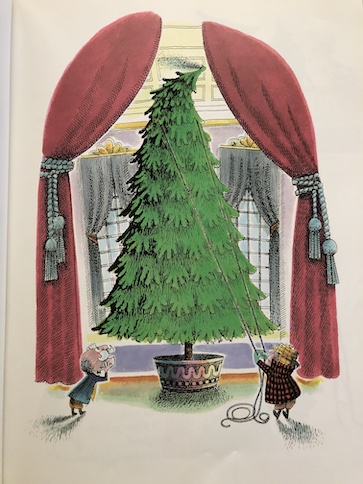
Mr. Willowby lives in a large house, and he orders a large Christmas tree by special delivery. It’s large and wonderful, but it’s just slightly too tall for the room where Mr. Willowby wants to put it.
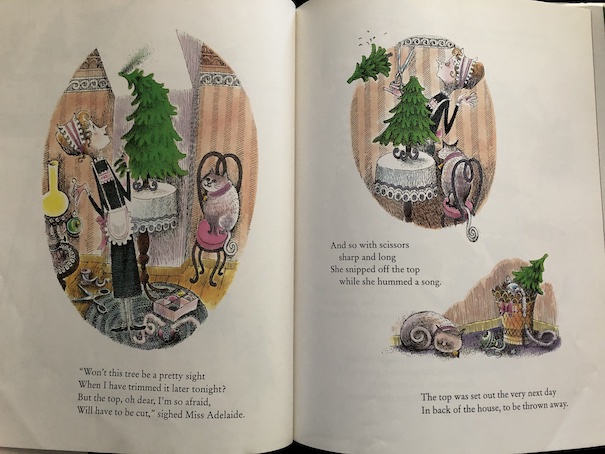
Mr. Willowby’s butler solves the problem by chopping the top off the tree, and because he doesn’t want the top to go to waste, he gives it to Mr. Willowby’s maid.
The top of the tree is about the right size to make a small Christmas tree for the maid’s room, but it turns out that it’s just slightly too tall again. The maid also clips the top off her tree.
From there on, the tree top moves on to other people and animals. The gardener spots the top that the maid throws out and decides it would make a nice, small Christmas tree. Like everyone else, though, he finds that the tree needs a little clipping for it to go where he and his wife want it to go.
As the top of the tree gets smaller, it starts drawing the interest of animals. Even animals enjoy having a Christmas tree as grand as Mr. Willowby’s!
The story is cute and told in rhyme! The book is available to borrow and read for free online through Internet Archive (multiple copies).
My Reaction
I remember this book from when I was a kid! I remember liking how several people and animals get Christmas trees out of just the top of one large Christmas tree. It’s a fun story about how one person’s trash is someone else’s treasure and nothing needs to go to waste. Mr. Willowby’s Christmas tree ends up helping everyone. In the end, everyone is happy because they all get a nice Christmas tree.
The illustrations in this book are full-color, but some older version of the book are in limited color – black, white, and green.
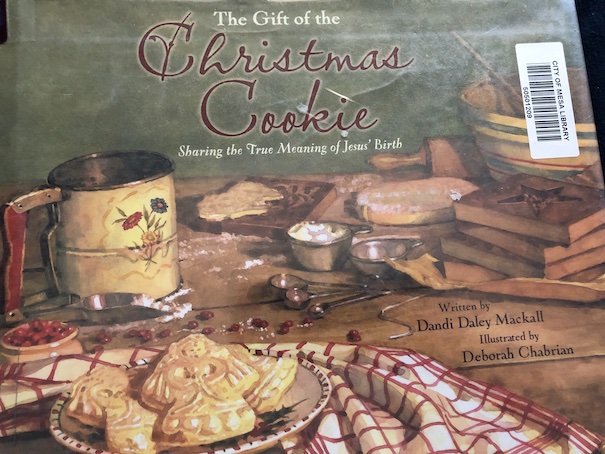
The Gift of the Christmas Cookie by Dandi Daley Mackall, illustrated by Deborah Chabrian, 2008.
This is a sweet Christmas story that discusses the meaning of Christmas along with the history of Christmas cookies.
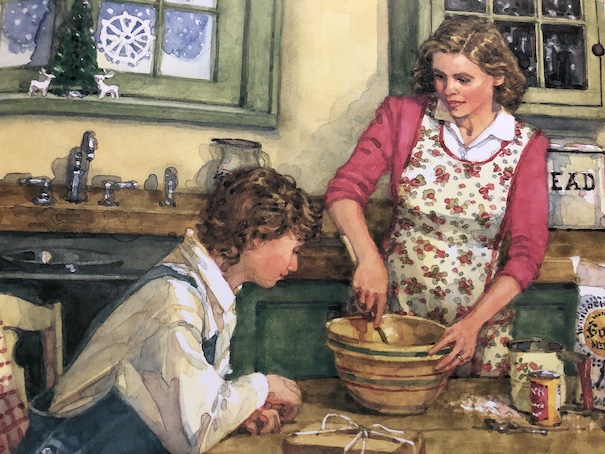
The story doesn’t provide a year, but it seems to be implied that it takes place during the Great Depression because Jack’s father is described as hopping a freight train to find work and send money home. Since then, Jack and his mother have lived alone, saving every penny that Jack’s father sends to them.
Then, before Christmas, Jack arrives home to find his mother making cookies. Jack is thrilled at the idea of having a rare treat, but his mother says that the cookies are for the needy at church. It’s disappointing because Jack has been feeling rather needy himself.
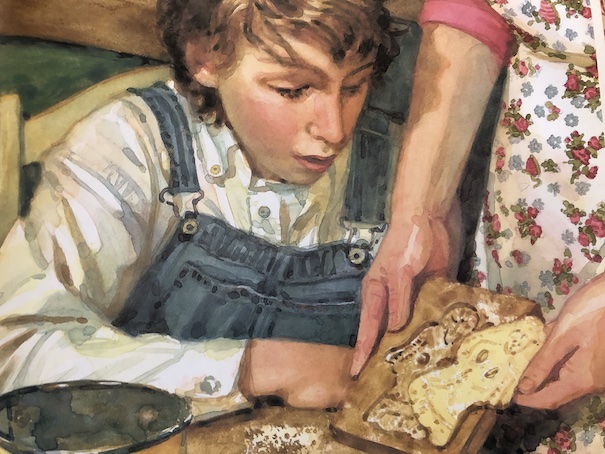
Then, his mother shows him the wooden cookie board molds that they will use. They are big with elaborate carvings of Christmas symbols. Making the cookies is labor-intensive, and Jack wonders why they’re working so hard to make such elaborate cookies that people will just eat anyway.
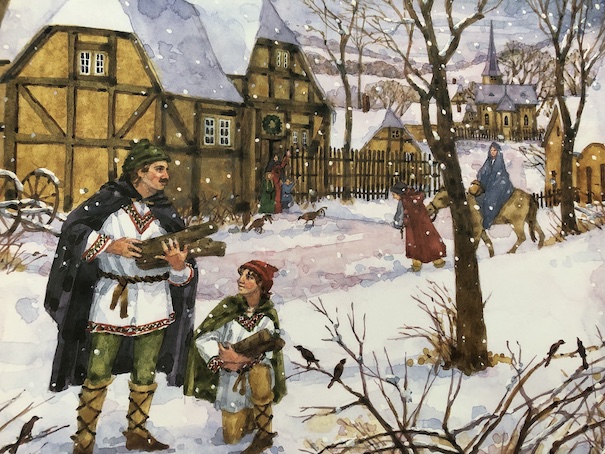
Jack’s mother tells him a story that takes place in the “Old Country” of their ancestors during the Middle Ages. (It’s in Germany, although Germany didn’t exist as the single country it is today back then.) Times were very hard, and people couldn’t afford much, but one family wanted to do something special for their neighbors for Christmas. The father of the family was a woodcarver, so he considered carving Nativity figures, but his wife said that many people were hungry, so it would be better to bake something they could eat. The woodcarver made wooden molds in the shapes of figures associated with Jesus’s birth, and his wife made the sweet dough to put in them, and they made cookies to share with their neighbors.
Jack’s mother saves one cookie from their batch in the shape of an angel for Jack so he can have a treat, but when a hungry man comes beginning for something to eat, Jack considers his own father, who might be traveling and hungry.
Jack is inspired to share his special Christmas cookie with someone who might need it more than he does and to pass on the story that goes with it.
My Reaction
I like stories that include some history, and I enjoyed this story about the origins of Christmas cookies and a lesson in generosity, giving to someone else as he hopes other people will be generous with his father. The invention of Christmas cookies can’t be traced back to any particular family, like the story in the book tells it, and Christmas cookies might have actually originated in Medieval monasteries because the monks would have had greater access to the sugar and spices needed than most people. However, the general concept of Christmas cookies made with molds is accurate. There is a brief note in the back of the book about the cookie boards or springerle molds that come from the Schwabian region of Germany, Switzerland, and Austria and how these molded cookies have had religious shapes since the Middle Ages. The book also notes that some cookie molds take the form of specially-carved rolling pins rather than the flat boards shown in the book, and this was the type of cookie mold that my grandmother used to use. When she made molded cookies, they were anise-flavored, which is traditional and tastes like licorice, although I prefer to make ginger cookies with my cookie mold rolling pin. The book includes a simple recipe for cookies that you can use with cookie molds or cookie cutters, and it uses the traditional anise flavoring.
In this Scandinavian Christmas story, young Treva and her brother Sami are getting ready for Christmas when strange things start to happen.
First, Treva feels like someone is watching them when they go to pick out a Christmas tree in the forest. Then, after they start decorating for Christmas, some of their decorations start to disappear. They had already wrapped Christmas presents and hidden them away, but they discover that those are gone, too!
Treva begins to realize what is causing these disappearances when she spots their Christmas pudding, apparently moving quickly across the snow, stuck to the back of a hedgehog! Treva follows the hedgehog and pudding into the forest, where she finds two trolls, pulling the pudding up into their tree house.
In the tree house, Treva finds the trolls arguing over all of the Christmas things they’ve taken from Treva’s family. Treva confronts them about stealing their Christmas things. The trolls say that they just want Christmas. They’re like small children who want something but don’t know how to get it or make it for themselves, so they just started trying to take it from other people.
Treva tells them that she will show them what to do for Christmas. She helps them clean up their little house, make decorations, and decorate their tree for Christmas.
She also explains to them that arguing and being greedy isn’t the proper Christmas spirit, and it’s been ruining their mood. She tells them to try cooperating with each other and playing nicely together while they decorate. Finally, she teaches them that Christmas is about being generous and giving something to each other, not just taking things. To demonstrate what she means, she gives them their first Christmas present, her favorite Christmas decoration.
With the trolls now able to have Christmas on their own, Treva is able to reclaim the rest of her family’s Christmas presents and decorations. However, the trolls and their hedgehog friend have one more special Christmas present to give now that they understand what giving is.
The book is available to borrow and read for free online through Internet Archive (multiple copies).
My Reaction
This is a fun Christmas story with beautiful, colorful illustrations! I really loved the pictures in the book, with all the colorful Christmas decorations. The designs of the family’s Christmas decorations are traditional Scandinavian decorations. The side and bottom panels of the illustrations also explain some of what’s happening even before the main character understands.
I also loved the designs of the troll and their fun hedgehog friend. Around the time this story was published, troll dolls, which have existed since the late 1950s, were having a rise in popularity. The trolls in this story somewhat resemble troll dolls, with their fluffy hair rising to a point, although the troll dolls have more colorful hair options. I enjoy stories that use fantasy creatures, especially ones that aren’t especially common. The trolls in this story are troublesome, but in a little kid manner, not overly threatening. They’re more about mild magical mischief and lessons they have to learn.
It’s winter, and Kirsten’s family is just starting to prepare for Christmas. Kirsten’s mother has her help make their Christmas bread. So many things have changed for their family since they came to America and moved to the frontier in Minnesota, Kirsten asks her mother if they will be celebrating Christmas just like they used to when they lived in Sweden. The family doesn’t have much money and can’t afford extra treats, but her mother says they will do the best they can.
When they arrived last summer, the family didn’t even have enough money to pay for a wagon to carry their belongings to their new house, so they had to leave them in storage in Riverton, including Kirsten’s doll, Sari. Since then, Kirsten has been using a stuffed sock as a doll. Kirsten’s mother tells her that her father has arranged for their trunks to be sent to Maryville, which is closer, but still 10 miles away. Kirsten is eager to retrieve them, but her mother says that will have to wait because there are too many other things they need to do now to get ready for winter. Kirsten worries that they won’t be able to get their trunks before the snows come. If the roads are blocked by snow, they won’t have their trunks until spring! The more Kirsten thinks about the trunks, the more she wishes that they had the things in them, the things that would remind her of her home in Sweden and make their cabin feel more like home.
One day, while she is playing with her cousins, Lisbeth and Anna, Kirsten mentions St. Lucia, and she is surprised when her cousins don’t know what she is talking about. In Sweden, families traditionally celebrate St. Lucia’s Day before Christmas. However, Lisbeth and Anna were too young when they left Sweden, years before Kirsten left with her family, so they don’t remember that tradition, and since they came to America, they only remember celebrating Christmas in December. They ask Kirsten what happens on St. Lucia’s Day. Kirsten explains that it’s the shortest and darkest day of the year. One girl in the family dresses up as the Lucia queen, wearing a white dress and a wreath of candles on her head, and she wakes her family, bringing them a special breakfast with coffee and Lucia buns. Anna is enchanted by this description, and the girl talk about surprising their families with their own St. Lucia’s Day celebration.
Then, Kirsten remembers that the long, white nightgown she used for her St. Lucia’s Day dress last year is in one of her family’s trunks, and St. Lucia’s Day (December 13th) is only five days away. The other girls are about to give up on the idea of celebrating St. Lucia’s Day, but Kirsten thinks maybe they should ask Miss Winston if she knows what to do. Miss Winston is their schoolteacher, and she’s still living with Lisbeth and Anna’s families. Miss Winston has mentioned that she misses the Christmas parties her family and friends had back East, so the girls think that she might enjoy helping them plan a special surprise.
Miss Winston is happy to give the girls some candles and help them make St. Lucia crowns, but Kirsten’s father is still too busy to get the family’s trunks. He gets so annoyed with Kirsten asking about them that he tells her not to ask about them again. Lisbeth says that, if their plan won’t work out for this year, they can do it next year, but Kirsten feels badly for getting their hopes up. Her own hopes are also set on having a St. Lucia Day, but she doesn’t know what to do without the dress in the trunk.
Then, one day, she finally hears her father say that he will have time to go for the trunks, and he thinks he had better do it soon because there will be more snow coming. Kirsten is excited and asks if she can go along with him to get them. At first, he doesn’t want to take Kirsten because there won’t be much room in the sleigh for her, and he thinks it would be better for her to go to school with the other children, but she persuades him to let her come.
The journey to Maryville is fun, riding through the snow and singing a Christmas carol. Kirsten even gets a piece of candy at the general store. When they retrieve the trunks, Kirsten wants to open them right away, but her father says they need to leave because it’s already snowing harder, and they need to get home.
The weather gets worse on their way home, and Kirsten wonders if they should turn back, but her father thinks they can make it home. As it gets worse yet, Kirsten’s father gets out of the sleigh to lead the horse through the snow, and he accidentally twists his knee. With her father injured, Kirsten gets out the sleigh to lead the horse. The situation is dangerous, but fortunately, Kirsten realizes where they are, and she knows that there is a cave nearby where they can take shelter.
When Kirsten and her father arrive home, they are greeted by their worried family, and it’s St. Lucia Day. With some help from Miss Winston and her cousins, Kirsten is able to give her whole family their St. Lucia Day surprise, but it has even greater meaning because of everything they’ve been through.
There is a section of historical information in the back of the book about how Christmas was celebrated on the American frontier in the mid-19th century and how it was different from the Christmases families like Kirsten would have experienced in Sweden.
The book is available to borrow and read for free online through Internet Archive.
My Reaction
This was my favorite of the Kirsten books! Although there is some danger to Kirsten and her father when they get caught in the snowstorm after retrieving the trunks, everything turns out fine, and Kirsten saves her father because she insisted on going with him on the trip. This book is also fun because it introduces readers to the concept of St. Lucia’s Day. I think the first book I read as a kid that explained about St. Lucia’s Day was the nonfiction book Christmas Around the World, but I liked seeing this frontier family celebrate their St. Lucia tradition.
thought that Kirsten’s parents impatience with her “pestering” them about retrieving the family’s belongings was realistic, just like parents in real life might act when a child repeatedly asks for something they can’t give them right away. However, at the same time, Kirsten’s mother seems to understand that Kirsten is asking for the trunks for deeper emotional reasons. Not only does Kirsten badly miss her doll, which has been stored in one of the family’s trunks since the beginning of the series, but the other things in the trunk are both useful for the winter season and have connections to the people the family left behind in Sweden. With Christmas coming, Kirsten and other members in the family are missing those connections and the feeling of home. Kirsten’s mother points out that people are more important than belongings, but she also agrees with Kirsten that some belongings represent ties to other people.
Kirsten also misses the tradition of St. Lucia’s Day because that tradition usually marks the beginning of the Christmas season for the family. When Kirsten surprises her family by dressing in her St. Lucia costume, it’s a happy surprise for everyone and really makes everyone feel like Christmas. However, Kirsten also feels the significance of the holiday more than she ever did before because, having been welcomed home by the lights of their house and her waiting and worried family, she better appreciates the tradition of St. Lucia welcoming others with light and food.
As with other historical American Girls books, I also enjoyed the detailed colored pencil drawings of the characters and scenes!
A Pioneer Thanksgiving by Barbara Greenwood, illustrated by Heather Collins, 1999.
This book is part story, part history, and part craft and activity book. It tells the story of a particular pioneer family’s Thanksgiving celebration in 1841 to explain the sort of Thanksgiving celebrations that pioneer families would have at the time, and there are related activities and recipes to accompany the story.
Everyone in the Robertson family helps with preparing the food for the Thanksgiving feast, including the family’s neighbors, who will be joining them. The story is episodic, focusing on different family members and their adventures and activities through the Thanksgiving preparations.
As they begin their preparations, they are worried about Granny, who is unwell. Mrs. Robertson is afraid that she might die because she doesn’t seem to be improving. As Sarah reads to her, Granny expresses a wish to taste her mother’s cranberry sauce one more time.
Sarah decides to go out and gather some cranberries for the sauce herself, but her little sister, Lizzie, tags along with her. The cranberry bog isn’t safe. Lizzie falls in and nearly drowns. Sarah manages to save her, but she’s very upset at almost losing Lizzie. However, her brother George finds Sarah’s basket of cranberries and brings it back to the house. The first activity in the book is a recipe for cranberry sauce.
Willie, one of the boys in the family, almost gets lost while looking for chestnuts for his mother’s chestnut stuffing, and he plays a game of Conkers with a Native American (First Peoples) friend, whose family trades foods with the Robertson family. Part of the story explains about Ojibwa and Iroquois thanksgiving ceremonies, and there are instructions in the book for playing Conkers with chestnuts and a Native American game with peach stones.
The younger children go into the woods to gather nuts, and there are instructions for weaving a nutting basket. Meg, the oldest girl in the family, makes bread with interesting designs, and there’s a recipe for bread. Sarah makes a Corn Dolly, and Granny explains the superstition of making a Corn Dolly and then plowing the Corn Dolly back into the soil at the beginning of the next planting season to ensure a good harvest.
Mr. Burkholder, their neighbor, tells them a story about when his family had newly arrived in North America and they had little food. Then, there is a section about weather and now to make a weather vane. Finally, everyone gathers at the table to say grace and enjoy the feast!
In the back of the book, there is a section about the history of Thanksgiving as a holiday in North America, both in the US and Canada. This book is actually set in Canada, and it explains that the date of Canandian Thanksgiving celebrations wasn’t initially fixed. Sometimes, they could be in October and sometimes in November. Canadian Thanksgiving was finally established as the second Monday in October in 1957.
I couldn’t find a copy of this book online, but I did find a copy on Internet Archive of a related book by the same author about the same pioneer family in Canada.
My Reaction
Although the book doesn’t say exactly where this family is other than North America, the other book about the family establishes that they are in Canada, and the references to Native Americans as “First Peoples” confirms it. When I first started reading the book, I thought that the pioneer family was somewhere in the United States or its territories. The lifestyle that the Canadian pioneers lived seems very similar to the way pioneers in the United States lived around that time, so I think the recounting of this family’s holiday would still be of interest to fans of the Little House on the Prairie series and similar books.
Hearing about Canadian Thanksgiving was interesting, and I liked the inclusion of information about the Thanksgiving traditions of the First Peoples and immigrants to Canada. The family in the story was originally from Scotland, and the grandmother in the story talks about how Thanksgiving celebrations remind her of the Harvest Home celebrations back in Scotland.
The book has a good selection of different types of activities for readers to try, from recipes to games to crafts. It seems like there is something here that could appeal to many people with different interests. Each of the activities appears next to a part of the story that references it, so readers can feel like they’re taking part in the activities along with the people in the story. I also really love the realistic art style in the illustrations!