The Witches of Hopper Street by Linda Gondosch, 1986.
Kelly McCoy and her friend, Jennifer, are offended that another girl from school, Rae Jean, is having a Halloween party and didn’t invite them. Jennifer says that they could just throw their own party on Halloween, but Kelly says that’s no good because everyone else they know is going to Rae Jean’s. It isn’t so much that Kelly really likes Rae Jean; it’s more that she hates being excluded.
The girls talk about what they want to dress as for Halloween, and Kelly suggests that they be witches because she’s fascinated by the witches she saw in a play of MacBeth. Kelly also has a book called “Magic and Witchcraft”, and she says that they could study the book and become real witches. Jennifer doesn’t see the attraction of becoming a witch, but Kelly promises that they’ll only perform white magic, where you use magic to perform good deeds, instead of black magic, which involves cursing people. Although, she might make an exception for just a few little black magic spells against Rae Jean. Jennifer says that Kelly can’t be serious, but Kelly says that she is because it’s awful being the only ones in the sixth grade not invited to Rae Jean’s party. Jennifer points out that Adelaide also wasn’t invited. The girls know that Adelaide isn’t popular because she’s overly tall and awkward and much smarter than the other kids. Then, Kelly gets an idea – there were three witches in MacBeth, so maybe they should invite Adelaide to become a witch with them.
When the girls see Adelaide on her way to Rae Jean’s house to help her with her math homework, they stop her and suggest to her that she join them as witches. Kelly tells her that Rae Jean is dangerous and that dangerous things will happen at her party. Adelaide says that she’s not going to the party anyway. Then, Kelly pretends to tell the future with a deck of cards, predicting that there will be a mysterious death in 24 hours. Her prediction comes shockingly true when Rae Jean’s cat kills her pet parakeet.
Kelly knows that the parakeet’s death was partly her fault for taking him out of his cage when Rae Jean brought her cat around, showing off her prize-winning pet, but she also blames Rae Jean for bringing her cat to her house in the first place, and the reason why they took the bird out of his cage was that Rae Jean was goading them about how dumb the bird was. (I think that the kids’ mother shouldn’t even have let Rae Jean bring her cat into the house. The other kids said that they didn’t want to talk to her, but the mother insisted that they let her in because she’s a “nice” girl. That was an irresponsible thing for the mother to do, and she’s not a good example to her children. When you have a pet in the house, you have to make the pet’s safety a priority, especially over being polite to someone who is rude and insulting anyway. Rae Jean shouldn’t have been allowed to bring a predatory pet into their house, uninvited, simply because she wanted to and the mother didn’t have the guts to say no and enforce some house rules. Of course, this is one of those annoying incidents in books that’s used to move the plot forward. If the parents acted anything like mine, it wouldn’t have happened, and this would be a different story.) Adelaide is impressed that Kelly’s prediction came true, and she agrees to be a witch with Kelly and Jennifer.
Kelly walks the others through rituals for being a witch, like signing their names in a Black Book (really, it’s an old brown science notebook), preparing their broomsticks (they’re supposed to be rubbed with the fat of a newborn piglet and belladonna, but the best they can do is strips of bacon and dieffenbachia), and preparing magical rings to protect themselves from evil creatures (Kelly got hers at an estate sale so she’d have one that belonged to a dead person, but the others just got their rings from the quarter machines at the supermarket). The girls pledge to keep their “coven” secret, but then someone leaves a message for them that says, “Midnight is the witching hour. Then you shall be in my power.” All of the girls deny having written it. So, who did? Who else knows about their witchy activities?
Kelly still hasn’t given up her plans to use this witch business to ruin Rae Jeans’ party. She soon acquires a new pet, a skunk, from her brother Ben’s friend Buster, whose father is a veterinarian. She calls the skunk Cinnamon and declares that he is her familiar. To keep the boys quiet about their activities, they have to let Ben and Buster join the coven as warlocks. As an initiation, all of the witches and warlocks have to drink salt water and eat beef liver. Kelly’s mother is perplexed by some of the odd things that they do, but she doesn’t question them too much, and none of the adults ever discover that the kids sometimes sneak out at night to perform rituals. (I could never have gotten away with this sort of stuff as a kid because my mother was always the type to ask a lot of questions about everything and get specific answers.)
Kelly gets the idea of making a voodoo doll of Rae Jean, using an old sweater of hers that Rae Jean’s mother gave her because she helped to get a box of old clothes down from the attic for a sale and because Rae Jean told her that the sweater was scratchy. To get Rae Jean’s hair and nails, the witches open a “spa” business at Kelly’s house. They succeed in getting hair and nail clippings, but Rae Jean gets scared away when their “spa” treatment involves mud that they just dug up in the backyard and has a worm in it. After they make the doll, they decide it looks really awful and sticking toothpicks in it is creepy, so they take the toothpicks out and get rid of it. Instead, they decide to focus on giving Rae Jean the “evil eye” – basically staring at her to make her feel uncomfortable. (That one works whether you’re a witch or not.) When Rae Jean and some others in class get sick, some of the other kids start to believe rumors that the girls have spread about a “poison plague.”
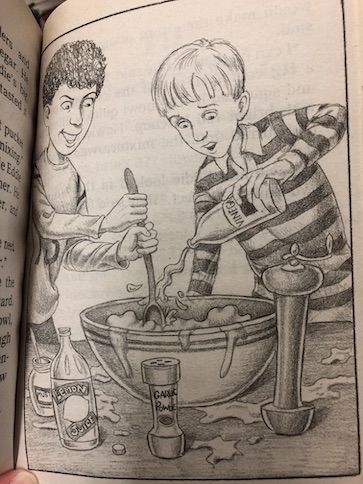
Eventually, Halloween comes, and Kelly gets the idea for her, Jennifer, and Adelaide to use their witch act while passing out candy to the trick-or-treaters. They put the candy in their “cauldron” (an old camping pot), give themselves fantastical names, and perform chants while handing out candy. They have fun with that, but they still feel left out of the party, so they decide to try one last witchy trick on Rae Jean. They decide to brew up a love potion (just apricot juice with honey, and they even think it tastes good themselves), sneak into the party as fortune tellers, and slip the potion into the party punch. Rae Jean’s mother is amused by their fortune telling act and lets them into the party, although Rae Jean isn’t happy to see them.
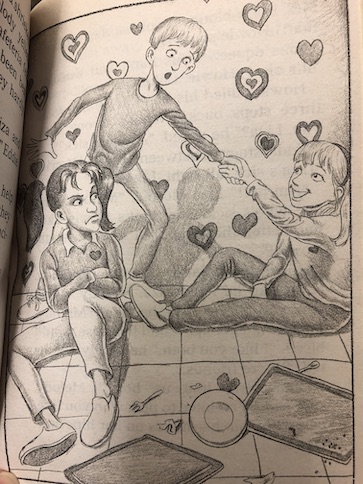
When Kelly’s new pet skunk gets loose in the party, there is some momentary chaos before Kelly manages to explain that the skunk is deodorized and can’t spray. During their time at the party, the girls learn the true identity of their mystery message writer and have an honest talk with Rae Jean about their feelings and apologize for the witchy things they’ve been doing. Rae Jean also tells them the reason why she didn’t invite them and how left out she felt when she didn’t get invited to a big party that Kelly had soon after she moved to the neighborhood. Rae Jean comes to realize how much she has provoked the other girls into hating her with some of her behavior, and she apologizes bringing cat to Kelly’s house and killing her parakeet. However, Kelly is also forced to acknowledge that she’s also provoked Rae Jean with her quick temper and attempts at revenge. All of the girls owe each other some apologies, and they make up. Kelly and her friends promise to give up all the witch stuff.
However, before they cut it out entirely, they have one last thing to do. Adelaide read about an old superstition that explains how to see a real witch at midnight on Halloween night, and before Halloween is over, the whole “coven” decides that they have to try it. What they see is a bit startling, and although it has an apparently logical explanation, gives the kids an appropriately witchy scare. Could there possibly be a real witch in their neighborhood?
I didn’t like the parts of this story about dead animals. I hated the part where the parakeet was killed, and later, I felt sorry for a cat that died (of natural causes, and it was a sickly stray, not Rae Jean’s cat). I never like stories where animals die, especially through human cruelty or carelessness. Yet, I have to admit that I have a particular attachment to this book, which I remember reading when I was ten years old. Some of their rituals are a little gross, but as I a kid, I think I was attracted to the idea of having a secret, mysterious club and intrigued by the identity of the mysterious message-writer. At the end of the story, they think they know who wrote the note, but their last midnight ritual causes them to have second thoughts.
This book is available to borrow for free online through Internet Archive.
My Halloween Story About My History With This Book:
This particular book and I have a history. This book was important to me as a kid because it sparked something formative, but to tell you what that something was, I have a confession to make: When I was a kid, I wanted to be a witch. I was in high school before the first Harry Potter books appeared, so it wasn’t about that. No, my introduction to witches was The Wizard of Oz, my favorite movie when I was five years old. I liked Glinda, the Good Witch of the North. Dorothy was my favorite character, but I liked Glinda, too. Later, when I saw the movie of Bedknobs and Broomsticks, my interest in witches increased. I also read The Blue-Nosed Witch when I was young, and I was hooked. For a portion of my early childhood, my favorite Halloween costume was a traditional witch costume.
I didn’t want to curse people or be an evil witch, like the Wicked Witch of the West, in spite of my traditional witch costume with the pointy hat. No, I wanted to be a Good Witch and maybe ride a broom and bring suits of armor to life and maybe defeat Nazis in a way that is far less gross than melting them, like in Indiana Jones and the Raiders of the Lost Ark. I had discernment. I had standards. I also had a fear of heights after falling off the monkey bars when I was four, so that probably should have been a clue that broomstick-riding was out for me, but when you’ve got magic, I guess these things aren’t much of a problem. I can’t say that I was really ambitious about wanting magical powers because I didn’t really do anything to acquire them, it was just that I kind of liked the idea … except for that one time, and that’s what this little side story is leading up to.
When I was about ten years old, I read this book with a friend, and we were both enchanted with the idea of making up our own rituals and becoming “witches” and maybe trying some spells on Halloween, just to see if magic works. I only had sort of a vague notion of what kind of spells that we could do. I guess I was picturing something like Bedknobs and Broomsticks, where you recite a rhyme and something is supposed to happen, but I didn’t know any real spells, just movie stuff, and I was clever enough to realize that the stuff in movies probably wasn’t real. Naturally, being a bookish person, I decided that the best way to learn more was at the library. PSAs on tv always told you to “Read more about it“, whatever “it” was. (This was the early 1990s, and I didn’t have access to the Internet yet. That wasn’t even an option.) If anybody had some real spells books, especially ones placed at a convenient height on shelves that a not-very-tall ten-year-old could reach, it would be my local public library, right? I was actually surprised myself when I found one in the library catalog. I really didn’t think it was going to be that easy. That wasn’t the hard part. The hard part was when I actually picked up the book and opened it.
Now, I have to admit here that I didn’t read the whole book, and years later, I can’t remember the title or even what the cover looked like. I kind of wish I did because there are people I would like to show this book to just to prove that it actually exists. When I told my mother about it later, she thought that I dreamed the whole thing, but I swear I didn’t.
This book did have “spells” of various kinds. I picked one from the table of contents (I forget what, but something that sounded like something two ten-year-old girls might want to do on Halloween) and looked at the instructions. It was disgusting. It involved things like animal entrails, which I wouldn’t have known where to get and wouldn’t have wanted to touch even if someone handed me a free bag full. There were other things about animal parts on different pages that disgusted me, too. Under no circumstances was I going to kill cute animals just to do some dumb trick on Halloween, and I wouldn’t have wanted these animals parts even if someone else had done the dirty work of getting them. I wasn’t a vegetarian, but these were definitely not things I could just buy at the grocery store, or better yet, cooked and yummy with a side of fries and a plastic toy.
As I was staring at this book, I suddenly realized that I had no desire to do anything it described and that I was never going to do anything it said. Then, I had a worse thought: someone else must have thought this was a good idea, or they wouldn’t have written it down. Maybe I didn’t want to mess with animal entrails and body parts to gain magical powers, but someone else obviously would. What kind of person would do such a thing? Whatever kind it was, it wasn’t me, and I knew it. The image of the type of person I would have to be in order to do any of this, in order to take any of this seriously, disturbed and repulsed me more than just what was written in the book itself. I slammed the book shut, shoved it back on the shelf, and ran away. I never saw it again, although I did try to find it again once to show it to my mother so that I could prove that I wasn’t dreaming. It wasn’t even in the catalog anymore then.
My guess is that, whatever this book was, either someone stole it from the library (it is the sort of thing an aspiring evil witch might do) or lost or damaged it or some parent or librarian realized that this might not be the best book for children and had it removed from the shelves. Since then, I’ve wondered who put that in the kids’ section in the first place. I’m not fond of censorship, but I have to admit that this book was pretty dang gross and creepy. Was that spell book really serious, or did I miss some introductory part that would have explained that it was all part of some larger ghost story or something? What was the point of the book? I’ve often wondered. All I really remember now is that it was in the first row of children’s non-fiction books at the library, probably the 100 or 200 section of the Dewey Decimal System.
I’m actually glad I did look at it, though, because it made me realize a few things about myself. I realized that there were limits to the things that I was willing to do and that I had the power to say no when something was beyond my limits. My friend was disappointed and thought I was a bit of a wimp for chickening out on our witch experiment so soon and not even showing her the book, but I didn’t care that much. I was firm. I also came to realize that sometimes, it’s the things we don’t do or won’t do that define who we really are. In the end, it may not matter what that book actually was so much as that it left me with a stronger sense of who I was. I should have paid more attention to the part in the Bedknobs and Broomsticks movie where Miss Price said that she realized a long time ago that she could never really be a witch because nobody who felt the way she did about “Poisoned Dragon’s Liver” could be a real witch. I came to appreciate the sentiment.
This experience didn’t completely scare me away from stories with witches in them, as evidenced by the Halloween stories I cover here. I was born close to Halloween, and I like the holiday because I enjoy the imaginative costumes and playing pretend. (Not to mention chocolate. I also enjoy chocolate.) I enjoyed the Harry Potter books, too. But, I know where the dividing line is between pretend and real. It doesn’t trouble me now because I already put the book back on the shelf and said no when it was asking too much, and some decisions stick for life. I don’t worry too much about giving fantasy books to kids, either. Everyone has decisions to make in life about who and what they want to be, and I figure that the younger generations might as well learn where the dividing line between fantasy and reality lies early in life. A bit of a scare now and then might even help them to think more deeply about life’s consequences and make better choices.
If that spell book had been less scary and disgusting, like something that Wiccans use that involves pretty things like crystals and herbs instead of entrails, I actually might have tried a few spells as a child, probably raiding the spice drawer in the kitchen or dismantling my rock collection for spell ingredients. However, Jenny Nicholson did a YouTube video, demonstrating how that typically goes for the aspiring witch. I thought it was hilarious, especially after my childhood escapade. I doubt that I would have had quite the range of objects that Jenny describes, and my parents would have been mad at me if I tried to throw eggs at trees, but I probably would have achieved similar levels of results if my friend and I had actually gone through with our experiment that Halloween. As an adult, I mostly think that things like that are more psychological tricks than anything else, and I find descriptions of them amusing now.
Anyway, that’s my creepy experience with “real” magic. If anyone thinks that they know what that creepy spell book was, feel free to tell me. I don’t feel like I have anything to prove magic-wise, but I still have people I’d like to convince that I didn’t just imagine that the book exists.



















 Jestress's Forgotten Books and Stories