The Nutcracker

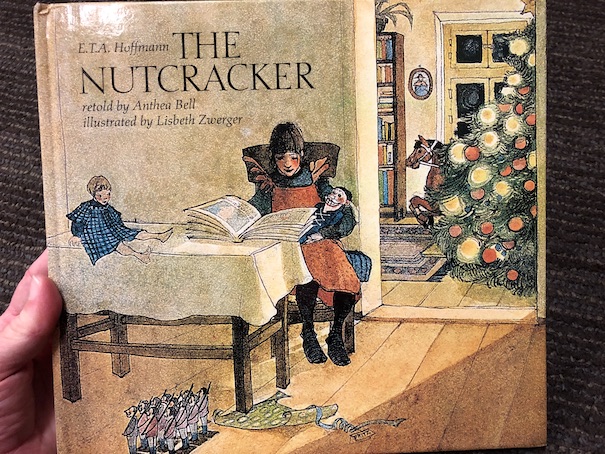
The Nutcracker by E.T.A. Hoffmann, retold by Anthea Bell, 1816, 1987.

The reason for the two dates of this book is that the original Nutcracker story was written by a German writer, E.T.A. Hoffmann, in 1816, as the novella The Nutcracker and the Mouse King. Some places, including the back of this book note different publishing dates for the original story because it was published more than once during the 1810s, as part of different story collections. This article gives more details about the original version of the story and different publications. Since then, it has been retold many times and in many different forms, including the famous ballet based on the story. In ballets and plays, the name of the heroine is often Clara, but in this picture book, as in the original story, the heroine’s name is Marie.

In the beginning of the book, which is set in the 19th century, Marie and her brother Fritz, are opening their Christmas presents on Christmas Eve. (The book explains that opening presents on Christmas Eve is a German tradition. A friend in Germany also explained that to me once because, in Germany, presents are supposedly brought by the Christ Child, not by Santa Claus. Since then, I’ve read that explanation may vary, depending on whether the household is Catholic or Protestant.) The children receive many wonderful presents, including a toy castle from their godfather, Mr. Drosselmeier. Marie’s favorite present is a nutcracker that looks like an odd little man. When Fritz is too rough with the nutcracker and breaks it, Marie takes care of it.
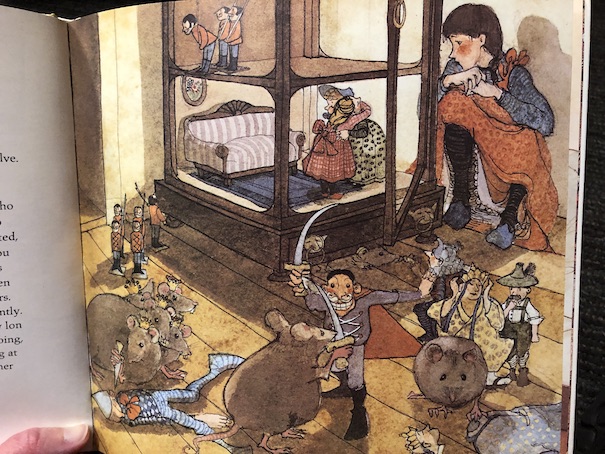
Marie stays up late, and when she finally puts the nutcracker away at midnight, she is astonished to see an army of mice coming out of the floorboards. The leader of the mouse army is the Mouse King, who has seven heads. The Nutcracker leads an army of toys against the mouse army. The mouse army appears to be winning, so, to save the Nutcracker, Marie takes off her shoe and throws it at the mice. Then, her arm hurts, and she apparently faints.

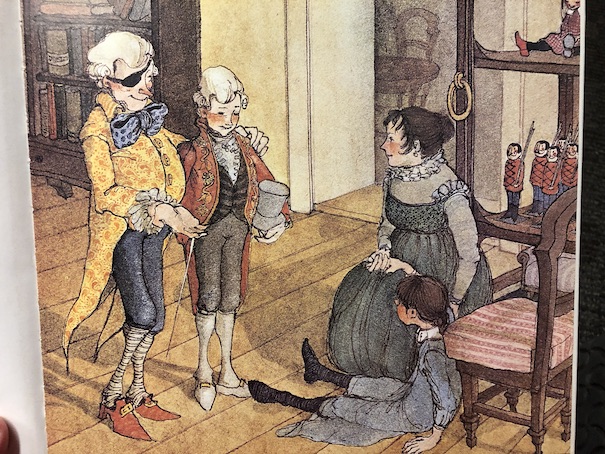
When Marie wakes up, she is in her own bed, and her mother tells her that she apparently put her arm through the glass door of the toy cabinet, cutting herself badly. When Marie tries to tell her mother about the battle between the toys and the mice, her mother and the doctor think that she’s ill and confine her to her bed for a few days. Mr. Drosselmeier repairs the Nutcracker and returns it to Marie, telling her the reason why nutcrackers look so strange and ugly, calling it The Tale of the Hard Nut.

Year ago, there was a royal banquet given by the King and Queen who were the parents of Princess Pirlipat. A mouse who claimed to be the queen of Mousolia demanded some food from the banquet as the Queen was preparing it. The King was angry that the mouse took some of the food and wanted revenge. The King asked his Court Watchmaker, who was also named Drosselmeier, to build some mousetraps to catch the mouse queen’s seven sons. When the sons were caught, the mouse queen vowed that she’d take her revenge on Princess Pirlipat. Princess Pirlipat was a pretty baby, but the mouse queen turned her ugly. The King took out his anger on the Court Watchmaker, ordering him to find a way to change Princess Pirlipat back to normal and threatening to behead him if he failed. After consulting the Court Astronomer, the Court Watchmaker learned that the key to breaking the spell on the princess was a special nut, which had to be cracked by being bitten by a man who filled certain special requirements, which all happened to be met by the son of the Watchmaker’s dollmaker cousin. The King had promised that the person who could break the spell could marry his daughter, but the mouse queen interrupted the last part of the ritual, causing the young cousin to turn ugly himself. When pretty Princess Pirlipat saw her rescuer turn ugly, she didn’t want to marry him anymore. The Court Astronomer said that the only way to break the spell on the young man was for him to defeat the new Mouse King – the mouse queen’s youngest son – and for him to find a woman who would love him regardless of his appearance.

Marie knows that the story is true because she has seen the Mouse King herself. She loves the Nutcracker and wants to help him. The Nutcracker returns to visit Marie during the night and makes repeated demands of her for her candy and toys. Marie knows that, no matter what she gives him, the Mouse King will keep returning to demand something else. The Nutcracker tells her that he needs a sword to fight the Mouse King. They borrow one from a toy soldier, and the Nutcracker successfully defeats the Mouse King, giving Marie his seven golden crowns.

As a reward for helping him, the Nutcracker takes Marie to the land where he is from, leading her there through a magic staircase in an old wardrobe. The Nutcracker’s land is beautiful, filled with candy and sweets and gold and silver fruit. (The Christmas Wood that they pass through reminds me of the woods in the wardrobe in The Lion, the Witch, and the Wardrobe.) The Prince Nutcracker’s home is Marzipan Castle in Candy City, where his beautiful princess sisters live. They welcome Marie and the Nutcracker home.

Then, suddenly, Marie wakes up, as if it were all a dream. However, Marie knows that it wasn’t a dream because she still has the Mouse King’s crowns. Marie tells the Nutcracker that she loves him. There is a sudden bang, and Marie faints. When she wakes up, she is told that Mr. Drosselmeier’s nephew has come to visit them. The nephew is the Nutcracker, restored to human form and now a handsome young man, thanks to Marie’s love. Marie later marries the nephew, and the two of them rule magical Kingdom of Sweets.
There is a section in the back of the book that explains a little more about E.T.A. Hoffmann and the original version of the Nutcracker story.

This book is available to borrow for free online through Internet Archive.
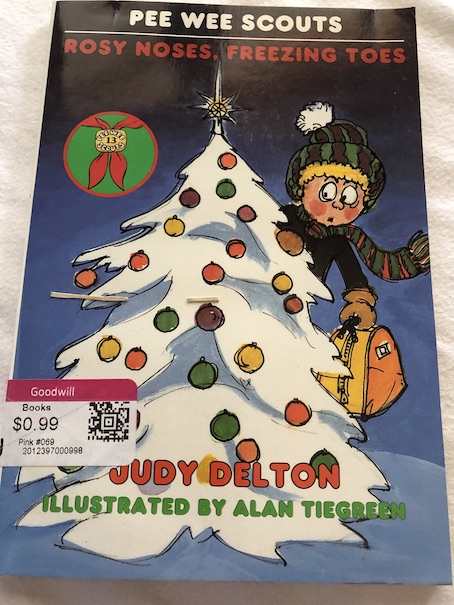
Rosy Noses, Freezing Toes

Pee Wee Scouts

#13 Rosy Noses, Freezing Toes by Judy Delton, 1990.

At one of the scout meetings, Mrs. Peters, the troop leader, says that her antique vase is missing. It’s a family heirloom, and Mrs. Peters wants to ask the scouts if they know anything about its disappearance or if they have any idea of what could have happened to it. None of them knows, but they’re fascinated by the mystery. After they search the house and can’t find it, Mrs. Peters says that she’ll just have to report its disappearance to the insurance company. Mrs. Peters is willing to let the matter go at that, but the scouts keep wondering what happened to the vase and if one of them could have taken it.

Mrs. Peters tells the scouts that the next badge they will earn will be their music badge. To earn the badge, the children will have to sing or play an instrument or tell the group about the life of a composer. Some of the children already play instruments and know what they’re going to do, but others aren’t sure. Since it’s December, Mrs. Peters suggests that some of them could sing popular Christmas songs or a Hanukkah song.

Sonny Betz declares that he doesn’t want to participate because he can’t play an instrument and over the next few days, he seems upset and nasty with people. Molly asks him what the matter is, and Sonny tells her that his mother is forcing him to take violin lessons. Mrs. Betz has always wanted Sonny to learn to play the violin, and his new violin teacher has assured her that Sonny will be able to learn the first line of Jingle Bells in time for the scouts’ music show, even though it’s coming up fast. Sonny isn’t happy about it, and to make him feel better, Molly tells him that he’s lucky because nobody else will be playing the violin and it will make him different. Unfortunately, the other kids tease him and call him “Maestro,” so he starts feeling bad.

Molly doesn’t like the way the others keep teasing Sonny, and when Tracy says that Sonny is a baby, Molly tells her that it’s not his fault because his mother is the one who makes him take violin lessons and keep the training wheels on his bike even though he’s in the second grade and all the other things that people tease him about. Mrs. Betz doesn’t realize how much Sonny hates some of the things that she makes him do and how much the other kids tease Sonny about these things. Molly overhears her mother saying that Sonny will “be a handful by the time he gets to high school,” probably because she’s imagining that Sonny will rebel against all things his mother has been making him do once he’s a teenager. Actually, it’s not going to take that long.

Mrs. Peters uses the insurance money from her vase to buy a piano. The scouts’ music show goes okay at first, although none of the kids are spectacular at music. Molly, Mary Beth, and Lisa paint their noses red and sing Rudolph the Red-Nosed Reindeer. Kevin whistles. Roger plays White Christmas on the drums with no other accompaniment, confusing everyone about what song he’s actually playing. Poor Sonny has to go last, when everyone is starting to get tired of the entertainment, but he doesn’t play well. The other scouts cover their ears, and the screeching of the violin makes the dog bark and Mrs. Peters’s baby cry. Sonny is so upset that he runs away from the show and has a fit.

The next day, Molly learns that Sonny has run away from home completely, leaving behind a note that he’s heading to Alaska. Everyone is searching for Sonny and getting worried about him being outside alone in the snow. However, Molly soon discovers that Sonny hasn’t gone as far as everyone fears and he’s certainly not on his way to Alaska. She discovers Sonny hiding in her family’s bathtub. Sonny explains to her that he didn’t have the money to go to Alaska, but he couldn’t bring himself to go home, and he picked Molly’s house to hide in because Molly is the only one who didn’t tease at him. Molly promises not to turn him in, but she says that he won’t be able to stay in her bathtub forever. His mother has called the police to report his disappearance, and Molly’s parents are bound to find him eventually. Sonny swears that he can’t go home because he hates playing the violin so much. What can Molly do to help him change his mind?

I didn’t like the way the other scouts were so mean to Sonny in the book. Sonny does do childish things, like being mean to the younger kids on the playground when he’s upset and throwing fits when things go wrong. However, Molly tries to be understanding with Sonny, even when he’s being fussy and whining, and she recognizes that Sonny is in a difficult position. His mother has certain expectations of him, and Sonny doesn’t think that anything will change her mind. The way things work out, though, makes it seem like Sonny never really explained to his mother how upset he was about the violin lessons and maybe not even how upset he’s been about some other things. Part of Sonny’s difficulty and the reason why he seems babyish to the other kids is that he seems to have trouble managing and articulating his emotions, including standing up for himself and what he really wants. Some of the other scouts help Molly to convince Sonny that running away isn’t the solution, and Molly calls Mrs. Betz to tell her that Sonny is okay but won’t come home until she promises that he can stop playing the violin. Sonny declares that he wants to see that in writing, and his mother gladly writes him a note that says that he doesn’t have to play the violin again.

So, what about the antique vase mystery from the beginning of the story? Before the end of the book, they do locate the missing vase (not really stolen, more misplaced and forgotten), but Molly accidentally breaks it. Mrs. Peters says that it’s okay because, with the vase broken, she doesn’t have to give the money back to the insurance company, and she gets to keep her new piano. She’s been wanting a piano, and the truth is that she never really liked the vase, even though it was a family heirloom. Yay? Merry Christmas!

The book is available to borrow for free online through Internet Archive.
Angels Don’t Know Karate

The Adventures of the Bailey School Kids

Angels Don't Know Karate Cover

#23 Angels Don’t Know Karate by Debbie Dadey and Marcia Thornton Jones, 1996.

Before Christmas, the kids at Bailey School are making snow angels, and they start talking about whether or not real angels exist. Melody and Liza say that they do and that everyone has a guardian angel. Eddie jokes that the new school crossing guard should have one as she repaints the crosswalk lines in the road. The kids say that she should also be careful not to get paint on the sidewalk in front of Mr. Mason’s house Mr. Mason is the meanest man in the neighborhood.

As the kids stand around talking, Ben, the school bully, hits Eddie in the mouth with a snowball. Eddie wishes that he knew karate so that he could take care of Ben, and Ben tells him that he’s a just a chicken, daring him to climb a tree on the playground. The other kids tell Eddie not to do it because the tree branches are snowy and icy and he’d probably fall, but Eddie feels like he has to do it to prove that he isn’t chicken. (Yeah, kid, the best way to prove you’re not scared of things is to do a stupidly dangerous thing because you don’t mind demonstrating that you’re desperately scared of what someone you don’t even like thinks about you.) Of course, Eddie does fall, but the others have the impression that the tree branches seem to be helping to hand him down to the ground, where the new crossing guard catches him. Melody thinks that, for a moment, it looked like the crossing guard had angel wings, but no one else saw it because they were all looking at Eddie.

The crossing guard says that her name is Angela Michaels and that she has just come to town for the opening of a new karate school. She invites the children to come to a karate demonstration at the mall. Eddie thinks that the karate demonstration would be great, and Howie says that karate isn’t about attacking people so much as protecting. More and more, Melody becomes convinced that Angela’s rescue of Eddie was a miracle, that she’s Eddie’s guardian angel, and that she’s come to Bailey City on a mission.

Angela turns out to be a karate expert, and the kids are impressed. Mr. Mason yells at the kids as they walk by his house on the way home, and they wish that Angela would teach him a lesson. Eddie says that if they want to spy on Angela and find out if she’s a real angel, Mr. Mason’s yard is the best place to do it because it’s near the crosswalk and no one would expect kids to be hiding in his yard. The others say that he’s crazy to want to go in mean Mr. Mason’s yard, but Eddie says that if Angela is a real guardian angel, they should be safe.

Mr. Mason catches the children in his yard, and Angela does intervene when Mr. Mason yells at them. She convinces Mr. Mason to let her make him a cup of Heavenly Tea. Melody decides that Angela’s mission is probably to help Mr. Mason be nicer and make some friends. Melody says that they should help Angela by being friends with Mr. Mason and doing nice things for him. The others think that she’s crazy, but she’s convinced that it’s safe to do nice things for Mr. Mason because Angela will make sure that they’ll be safe and that Mr. Mason won’t get mad.

Mr. Mason yells at the kids when they come to help him, but Melody convinces him to accept the cookies they’ve brought him and let them shovel some snow for him and decorate his yard for Christmas. He doesn’t seem particularly grateful at first, but he does accept their kindness. Then, to the children’s surprise, Mr. Mason becomes their new school crossing guard, replacing Angela. He says that Angela had to leave on some important business and that she convinced him that he would like the job, and he admits that he does like it. Melody remains convinced that Angela was an angel. Eddie says that she never proved it, but she says that some things don’t need proof, just belief.

Eddie never does use karate on Ben, but Angela deals with Ben for him. Angela catches Ben bullying another younger boy and teaches him that strong people are supposed to protect weaker people, not bully them. The children take karate lessons from Angela, and she’s tough. Eddie compares her to a drill sergeant. But, being tough isn’t the same as being mean. Angela is serious when she says that strong people have a duty to protect others, and that’s what she teaches other people to do. She uses her strength and toughness to help people, not hurt them. It’s a good philosophy!

The book is available to borrow for free online through Internet Archive.

Elves Don’t Wear Hard Hats

The Adventures of the Bailey School Kids

#17 Elves Don’t Wear Hard Hats by Debbie Dadey and Marcia Thornton Jones, 1995.

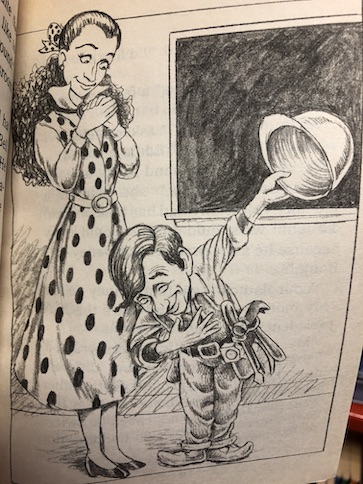
The playground equipment at Bailey School is old and breaking, so the PTA has decided to fund a new playground for the children. The playground is going to be built by the Bell Construction Company, and when the children meet the owner, Hollis Bell, he is an odd little man with curly-toed work boots. In fact, all of his men are unusually short. However, Mr. Bell promises to build the children the best playground they can imagine.

However, the parents at the school are arguing about the playground, how much it’s going to cost, and whether it really needed to be replaced at all. There’s not a lot of Christmas cheer going around, but Mr. Bell puts up Christmas trees and tells the children that they have their own kind of magic that can help fix their parents’ arguing.

One day, Mr. Bell comes to the third grade class to interview them about what they would like to have on their playground. All of the kids have different ideas, and they end up arguing about the things they’ve heard their parents say about what the playground should be like. However, Mr. Bell urges them to calm down and work together. He tells the children that they should make a list of what they all want and “check it twice.” One of the kids in the class says that it’s impossible to give everyone what they want, but Mr. Bell says that he’s in the business of making wishes come true. Liza asks what happens if someone puts down a really bad idea, and Mr. Bell says that he’ll know if an idea is a bad idea. Because Mr. Bell is short, his tools jingle like jingle bells, and he acts like he can grant their Christmas wishes, the kids start thinking that he might be an elf.

The kids are allowed to watch the workmen work, but Mr. Bell makes it clear that they’re not allowed in the trailer that’s attached to his truck. Naturally, the kids get curious about the trailer. They can’t help but sneak a look inside, and when they do, they find out that it’s a workshop full of toys!

As the children try to figure out if the construction crew might really be elves, they decide to ask the department store Santa more about elves. The kids debate about the department store Santa really being Santa, and the Santa makes a comment about how he’s been meaning to pay a visit to their school, seemingly ignoring a previous book in the series, when Santa apparently became their school’s janitor. However, later in the book, Howie refers to the “new janitor who keeps turning down the heat,” referring to what happened in the previous book, which is confusing. The department store Santa explains that his elves like to fix things, and they are particularly concerned with fixing people who can’t get along, hinting that the arguments over the school’s playground are what brought the elves to the school. Santa’s advice is for the children not to worry because the elves will disappear on their own “when the time is right.”

The deadline for submitting the plan for the new playground is approaching, and the kids realize that if the adults can’t agree on something, they might end up with no playground at all! When the “elves” leave to take care of a job “up north,” and the playground issue still isn’t resolved, the kids think that they probably weren’t magical elves and that they didn’t fix anything, but the kids aren’t ready to give up yet.

When Eddie suggests that they all just build their own playground out of wood and begins drawing his vision of it, it attracts the attention of the adults. At first, the kids think that they’ll have to do all the work on their playground themselves, but the more the adults hear them talk and study the picture Eddie drew, the more involved they become. When the adults were in charge, they each wanted to be considered the leader and authority on the project, with their ideas overshadowing everyone else’s, but with Eddie in charge, the project moves forward. Even though Eddie is a child, he’s the one with the vision to carry the project through, and he neutralizes the adults’ competing egos. The project ends up being finished unexpectedly fast, and in the end, no one knows who actually completed it, hinting that the Mr. Bell might really have been an elf and that he and the other elves secretly returned once everyone came to an agreement about what they really wanted. As always with this series of books, readers are left to draw their own conclusions.

The book is available to borrow for free online through Internet Archive.

Santa Claus Doesn’t Mop Floors

The Adventures of the Bailey School Kids

#3 Santa Claus Doesn’t Mop Floors by Debbie Dadey and Marcia Thornton Jones, 1991.

The school’s janitor, Mr. Dobson, quits one day after some kid spreads peanut butter from the food drive box all over the staircase banister. He’s had enough of their pranks! The third grade class’s substitute teacher, Mrs. Ewing, who is teaching the class while Mrs. Jeepers is visiting her family in Romania for Christmas, says that she’d hate to think that someone in their class actually stole food meant for some poor person and used it for an awful prank. The principal confirms that it was someone in their class when he pulls a couple of empty peanut butter jars from their trash can. The culprits turn out to be Eddie and Howie. So, the principal declares that, until they can get a replacement janitor, the third grade class will clean the entire building.

The other kids are angry with Eddie that they now have to give up their recesses to empty trashes and mop floors all over the school, and Melody says that it’s Eddie’s fault that Mr. Dobson is unemployed at Christmas. Eddie complains that “it was only peanut butter” and that it was Mr. Dobson’s choice to quit his job. The other kids know that part of Eddie’s problem is that he has an issue with Christmas, and that’s why he’s trying to spoil things. Eddie’s mother is dead, and ever since her death, his father hasn’t wanted to celebrate Christmas.

Fortunately, the principal soon tells the children that he has hired a new janitor, Mr. Jolly. Mr. Jolly is a cheerful older man with a thick white beard, and he likes to smoke a pipe. Mr. Jolly seems very nice, and he works very fast, but he has an odd way of watching the children and writing things down in a notebook.

Then, one day, the kids see Mr. Jolly talking to an odd little man, and they hear the man call him “S.C.” The little man seems very worried about something and wants Mr. Jolly to come and straighten out some kind of mess before Christmas. However, Mr. Jolly says that the work he is doing at the school is very important. They notice the kids watching them, so they don’t say any more, but the kids soon begin noticing other peculiar things about Mr. Jolly. He keeps the school’s temperature rather cold, but yet he likes to wear shorts. He doesn’t like it when Eddie turns up the thermostat because he likes the cold.

The temperature issue becomes serious because the kids have trouble working when it’s so cold. They have to wear their coats and sweaters all the time, and it gets to the point where it’s actually warmer outside than it is inside the building. Rather than freeze, Eddie decides that he’d rather get rid of Mr. Jolly. However, the other kids don’t want to help him after what happened with Mr. Dobson. Eddie takes it on himself to decorate the teachers’ lounge with toilet paper and turn up the heat again. However, Mr. Jolly solves both problems impossibly fast, and suddenly, the food drive box is overflowing with jars of peanut butter.

Liza is the one who suggests that Mr. Jolly could be Santa Claus. He looks like Santa Claus, and his short friend, who called him “S.C.” looks kind of like an elf. It would also explain why he likes cold so much and how he seems to do things magically fast. The others don’t believe her, and after Eddie pulls another trick that goes wrong, Mr. Jolly actually talks to him about Christmas and Santa Claus. Eddie says that those things are for little kids and even if there was a Santa Claus, he wouldn’t bring him what he really wants for Christmas.

Although Eddie doesn’t actually say it, what he really wants is attention from his dad. His dad is away a lot, working, and Eddie’s grandmother, who takes care of him, is often busy. However, Eddie becomes convinced that miracles can happen when his dad finally comes home for Christmas and actually wants to celebrate the holiday.

The book is available to borrow for free online through Internet Archive.

Changes for Samantha

American Girls

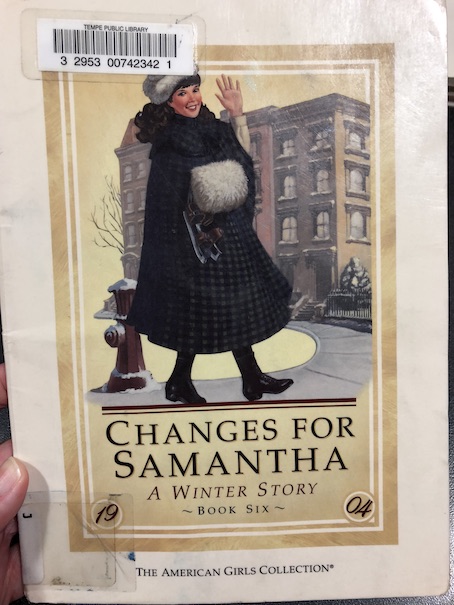
Changes for Samantha by Valerie Tripp, 1988.

This book is part of the Samantha, An American Girl series. This is the last book in the original series of Samantha’s stories and explains the changes in the lives of Samantha and her friends, especially Nellie. When Samantha met Nellie in the first book in the series, Nellie was a poor girl working as a servant girl in a neighboring house. Later, Nellie and her family moved to Samantha’s town, Mount Bedford, and Nellie and her sisters were able to attend school for the first time.

Now, Samantha has moved to New York City to live with her Uncle Gard and his new wife, Aunt Cornelia. Samantha likes living with them, although their housekeeper, Gertrude, is strict and often makes her feel like she’s doing things wrong. Samantha’s grandmother, a widow, has remarried to her long-time friend, the Admiral. Samantha’s life has changed considerably since the first book. Since her move to New York City, Samantha hasn’t seen Nellie or her sisters, but their lives have also changed, and not for the better.

When the book begins, Samantha and Aunt Cornelia are making Valentines to give to friends and family. Samantha receives a letter from Nellie that says that her parents have died of the flu and their employer, Mrs. Van Sicklen, is sending her and her sisters to New York City to live with her Uncle Mike. Nellie says that she’ll try to visit Samantha in New York City soon. Samantha is upset to hear that Nellie’s parents are dead, but Uncle Gard and Aunt Cornelia reassure her that Nellie’s uncle will take care of her and that she’ll soon be living much closer to Samantha.

After some time goes by and Samantha doesn’t hear any more from Nellie, she begins to worry about her. Uncle Gard decides to call Mrs. Van Sicklen and find out Nellie’s new address, but she doesn’t know where Nellie’s uncle, Mike O’Malley, lives. All Mrs. Van Sicklen knows is that he lives on 17th or 18th Street, but New York City is so big, that doesn’t help much. Uncle Gard and Aunt Cornelia say that maybe Nellie has had to get a job or look after her sisters and that she’s just been too busy to visit, but Samantha is still worried that something is very wrong.

Samantha decides to start asking around 17th and 18th Streets to see if she can locate Mike O’Malley, and she finds a chestnut seller who knows Mike O’Malley. However, he warns Samatha not to get involved with him because Mike O’Malley is a “hooligan.” Samantha worries about that, but it’s just another reason for her to want to check on Nellie. When she reaches the apartment where Mike O’Malley last lived, he isn’t there anymore. His neighbor explains that Mike O’Malley was a drunk who simply abandoned his nieces in his old apartment. The neighbor took the girls in for a while, but she is a poor woman with children of her own to raise, so she had to turn Nellie and her sisters over to an orphanage, the Coldrock House for Homeless Girls.

Samantha tells her aunt and uncle what she’s learned, and they’re upset that she went to such a dangerous part of the city alone. However, Aunt Cornelia agrees to take Samantha to the orphanage to see Nellie. The directoress, Miss Frouchy, is a stern and sneaky woman, but she agrees to let Samantha see Nellie, even though it isn’t a visitors’ day. It is difficult for the girls to speak candidly with Miss Frouchy watching them and monitoring everything that Nellie says. When Aunt Cornelia asks if Nellie and her sisters need anything, Miss Frouchy interrupts and says that they don’t. However, Samantha notes how thin Nellie looks and suspects that there is more going on than Nellie is being allowed to say, and Miss Frouchy even confiscates the cookies meant for Nellie and her sisters right in front of Aunt Cornelia and Samantha.

Aunt Cornelia asks Miss Frouchy for a tour of the orphanage so that Nellie and Samantha can be alone, and so the girls are able to speak openly. Nellie confirms that things are hard at the orphanage and her sister, Bridget, isn’t strong. Miss Frouchy thinks that Bridget is lazy and doesn’t want to work, so Nellie tries to cover Bridget’s chores as best she can. Samantha says that Nellie could come and stay with her and her aunt and uncle, but Nellie says that they probably don’t need any more maids. Samantha offers to hide Nellie and her sisters, but Nellie thinks that plan is too risky. More than anything, Nellie wants to keep her sisters together. She says with a little more training, she could find a job as a maid and support them.

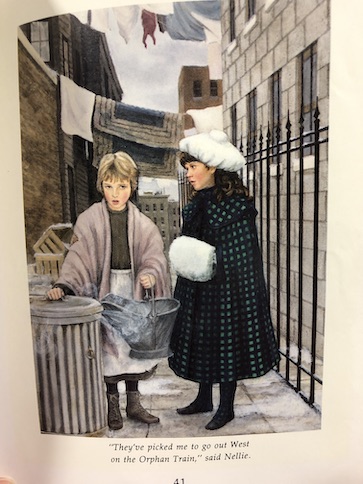
Samantha returns to the orphanage again with her aunt and uncle to visit all three girls, and she and Nellie arrange to meet secretly at the time when Nellie is supposed to take the fireplace ashes out to the alley for disposal. At their next meeting, Samantha finds out that Miss Frouchy took the gloves that they had given Nellie and even punished her for having them because she said that she must have stolen the gloves. However, there is worse to come. Soon, Nellie tells Samantha that she has been chosen to be sent out west on the Orphan Train, but because her sisters are too young to go, they’ll be left in New York alone. With the sisters about to be split up, Samantha’s plan to help the girls run away and hide is looking better.

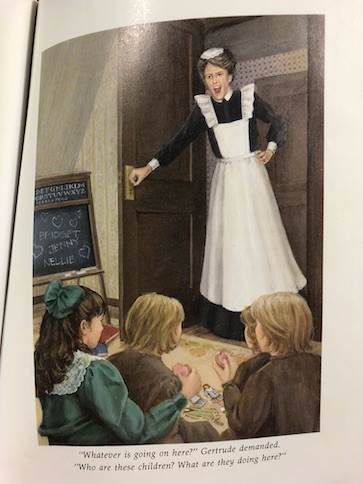
Together, Nellie and Samantha help to sneak the younger girls out of the orphanage, and Samantha hides the three of them in an upstairs room in the aunt and uncle’s house that isn’t being used. She sneaks food and toys upstairs to them, and Nellie sneaks out during the day to go looking for work. However, Gertrude soon gets suspicious about how much food Samantha seems to be eating and how she seems to be sneaking around with it. When the girls are finally caught, Samantha owes her aunt and uncle some explanations, but admitting the truth of what has happened changes things for the better for all of the girls.

In the movie version of the Samantha series, which combined all the stories from the Samantha books into one, the story ends at Christmas, but in the book, it’s Valentine’s Day. The Christmas ending is nice, but Valentine’s Day does make for a nice difference, and love is appropriate to the theme of the story. Uncle Gard and Aunt Cornelia end up adopting Nellie and her sisters, so they officially become part of Samantha’s family. Unlike other characters in the story, who see the orphans as either an inconvenience or a source of cheap labor, Uncle Gard and Aunt Cornelia genuinely love them and want to raise them.

Something that struck me about the book was that both Nellie and Samantha are orphans, but their lives were very different at the beginning of the story because Samantha is from a wealthy family with an uncle who loves her and Nellie is a poor girl with an irresponsible uncle. If Samantha had been poor, she might have been destined for an orphanage or the orphan train herself. Because she wasn’t and because her family looks after children well and is willing to share what they have with others, Samantha has a secure future, and Nellie and her sisters become part of their family.

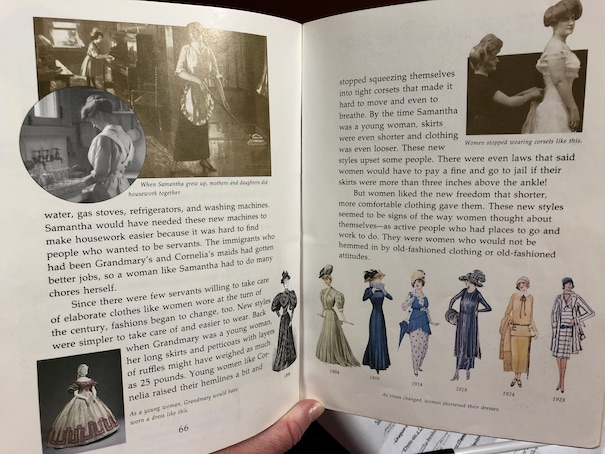
The book ends with a section of historical information about all the changes taking place in Samantha’s time, from technological changes, such as the first airplanes and new cars, to the increasing sizes of cities and new immigrants arriving in the United States.

As girls like Samantha grew up, society continued to change. In earlier books, Samantha’s grandmother talked about how young ladies aren’t supposed to work but learn how to be ladies and take care of a household. By the time Samantha was an adult, in the 1910s and 1920s, it was becoming more common for women to hold others jobs, although they would often stop working when they got married so they could focus on raising their children. The profession of social work evolved to help care for children like Nellie and her sisters. Some social workers also helped immigrants to learn English and train for new jobs when the came to the United States. The book specifically mentions Jane Addams, who founded the settlement house, Hull House.

Change is a major theme of all of the American Girl books, and a girl like Samantha would have seen some drastic changes in the ways that people lived as she got older. Over time, fewer immigrants looked for jobs as domestic servants, and newer forms of household technology, like washing machines, made it easier for housewives to do more of their domestic chores themselves. The section of historical information ends with examples of the changes in styles of women’s clothing through the 1920s, explaining how the changes in clothing styles were part of the changes in the types of lives the women wearing them were leading.

Although the book doesn’t go into these details, I would just like to point out how old Samantha would have been at various points in the 20th century. She was born in 1894, and ten years old in 1904, so that means that she would have been:

  • 23 years old when the US entered World War I in 1917
  • 26 years old when the 19th Amendment granted women’s suffrage in the United States in 1920
  • 30 years old in 1924 (Jazz age and Prohibition)
  • 35 years old when the stock market crashed in 1929, the beginning of the Great Depression
  • 47 years old in 1941, when the attack on Pearl Harbor occurred, and the US entered World War II, and 50 years old in 1944, when the Molly, An American Girl series takes place.
  • In her 50s during the early days of the Cold War. She would have to live to be 95 to see the end of it.
  • In her 60s through her early 70s during the Civil Rights Movement.

I like to think about these things because it puts history in perspective, and it gives us some sense of what Samantha’s future life might have been like. When she was a young woman, she may have joined the women’s suffrage movement with her Aunt Cornelia. She probably knew young men her age who went to fight in World War I. (Eddie, the annoying boy who lived next door to Samantha’s grandmother, would have been old enough to fight and may have been a WWI soldier himself.) Perhaps, Samantha’s future husband was a soldier. When she was older, Samantha could have either joined the temperance movement behind Prohibition or visited a speakeasy or at least knew people who did. It’s difficult to say what happened to Samantha’s family during the Great Depression. Depending on their professions and what they may have invested their money in, they may have lost their fortunes in the stock market crash, or they may have ridden out the whole thing in relative comfort. By World War II, Samantha may have had a son who was old enough to fight. One of the things I find interesting about historical novels with children is imagining what their future lives may have been like, and Samantha was born at a time when she would have witnessed many major events throughout her future life. The book shows how women’s fashions changed as Samantha grew up, but I’m fascinated by the events in Samantha’s life that I know must be coming, just because of when she was born. By the end of her life, the world would be a very different place from what she knew when she was young.

The book is available to borrow for free online through Internet Archive.
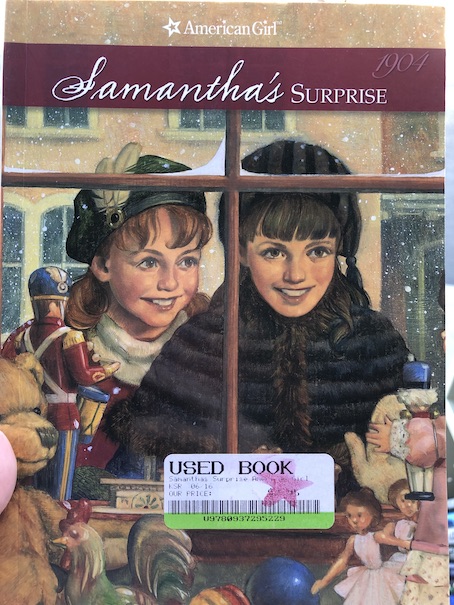
Samantha’s Surprise

American Girls

Samantha’s Surprise by Maxine Rose Schur, 1986.

This is part of the Samantha, An American Girl series.

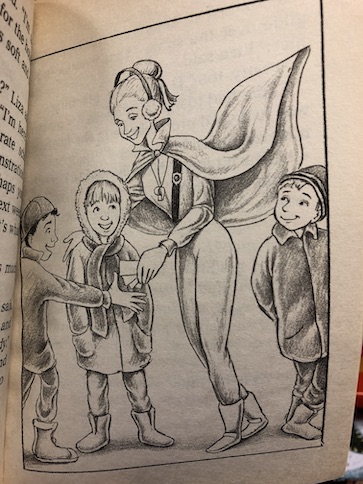
Christmas is going to be different this year for Samantha and her family. Uncle Gard is bringing his girlfriend, Cornelia, to spend the holidays with them. Christmas had started out so hopeful for Samantha, with an invitation to a friend’s Christmas party, elaborate plans for building a gingerbread house, and the secret presents that Samantha has been making for everyone. Cornelia’s visit changes Samantha’s plans.

For Samantha, Cornelia’s visit makes Christmas more difficult. At first, she says that she will help make Cornelia feel welcome and thinks to herself that she will have to get a present for Cornelia that is as elegant as she is. However, when Samantha tries to put up the usual homemade decorations that she made herself, the maid angrily takes them down, calling them “dustcatchers.” The house must be perfect for Cornelia’s visit, and Samantha is insulted that people see her decorations as an eyesore or inconvenience. The cook, who was going to help Samantha with her gingerbread house, says that there probably won’t be time for it now because her grandmother has asked her to make extra, special foods for Cornelia’s visit. Grandmary even tells Samantha that it would be better for Samantha to “stay out of the way” of their Christmas preparations.

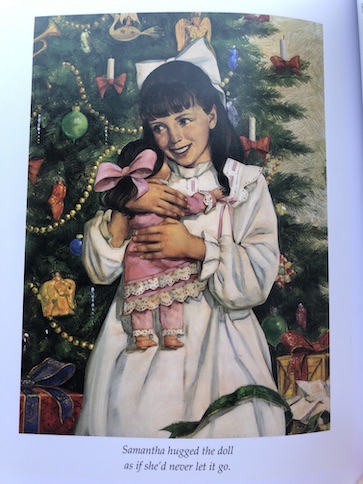
With Cornelia coming, no one seems to notice or care about Samantha. Samantha finds out that she won’t be able to attend her friend’s party because it is the night that Cornelia is arriving. It doesn’t seem likely that her grandmother will care about her secret Christmas wish for the beautiful Nutcracker doll in the toy store window. Samantha has been without a doll since she gave her own beloved doll, Lydia, to Nellie, who had never owned a doll before. Cornelia is an extra person Samantha needs to supply a present for, but she can’t summon up any enthusiasm for giving a present for someone who is making things so difficult for her.

Throughout the book, Samantha considers different presents that she could give to Cornelia, beginning with the most basic, convenient token gifts that she could give and then forget about, unlike her homemade, heart-felt gifts for everyone else. However, Samantha’s attitudes toward Cornelia change as she gets to know her better during the holidays and comes to see her as a source of fun and support.

When Cornelia actually arrives and begins participating in the usual Christmas activities, Samantha sees that she is far less fussy than the people who were preparing for her arrival. Unlike most other grown-ups, Cornelia is not too dignified to have fun while sledding or get messy while making gingerbread houses. Cornelia even suggests sledding, to Grandmary’s surprise. Cornelia always mentions how nice it would be to decorate a gingerbread house, like she did when she was a girl, Samantha says that she would like that too, but the cook is too busy to help this year. Cornelia says that is no problem because she and Samantha can make the gingerbread house themselves. Cornelia even makes sure that some of the decorations that Samantha made are prominently displayed on the Christmas tree.

By the end of the book, Samantha changes her mind about Cornelia completely. While everyone else seemed to be ignoring Samantha and going out of their way to make Cornelia feel welcome, Cornelia was paying more attention to Samantha and really thinking about what would make Samantha happy at Christmas. Cornelia is the one who correctly guesses what Samantha would really like for Christmas, and in return, Samantha decides to give her best present to Cornelia.

The story ends with Uncle Gard officially engaged to Cornelia.

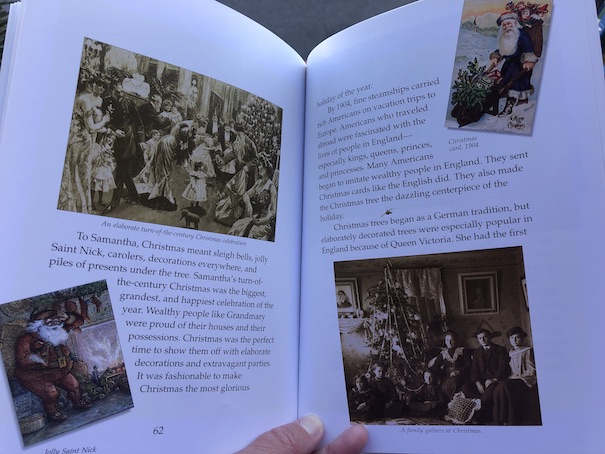
In the back of the book, there is a section with historical information about how people would celebrate Christmas during the early 1900s.

The book is currently available to borrow for free online through Internet Archive.

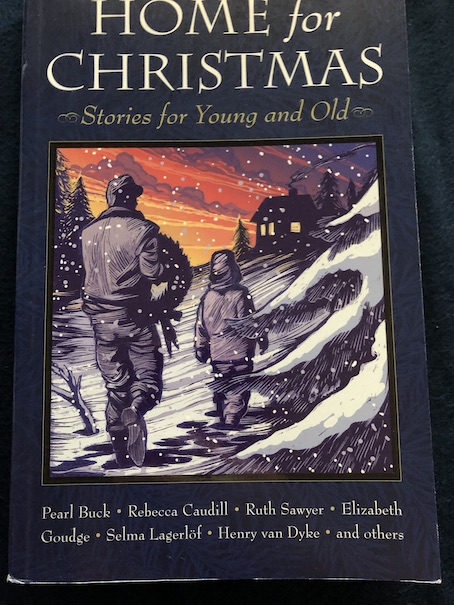
Home for Christmas

Home for Christmas: Stories for Young and Old compiled by Miriam LeBlanc, 2002.

Disclosure: Plough Publishing House sent a copy of this book to me for review purposes, but the opinions in the review are my own.

This is a collection of short Christmas stories written by famous authors from around the world. One of the things that I found interesting about the selection of authors in the book is that many of them are better known for writing on very different themes. Among the authors in this book are Madeleine L’Engle, who is known for writing science fiction, such as A Wrinkle in Time; Elizabeth Goudge, who wrote the mid-20th century classic children’s fantasy story The Little White Horse (later made into the film called The Secret of Moonacre); Katherine Paterson, known for her children’s novels, including Bridge to Terabithia, Jacob Have I Loved, and historical novels set in Asia, such as The Master Puppeteer; and Pearl S. Buck, author of The Good Earth.

Although the book is intended for children and families and many of the authors are known for writing for children and young adults, I think that many of the stories wouldn’t particularly appeal to children, especially younger children, because children wouldn’t be likely to understand them or they have darker themes, like bitterness that must be overcome and grief at the death of a child. The stories generally end well, but for young children, something simpler and lighter in subject matter, like the short stories in Merry Christmas from Eddie, would be more appealing. Really, I think this book would be best for adults, although I noted some of the more child-friendly stories.

One thing that I wished the book included is sections of information that explain a little more about the stories behind the stories. I recognized the historical references behind some of the stories, but other readers, particular children, might require a little more explanation to fully appreciate them. I think that’s another good reason why the stories might appeal more to adults.

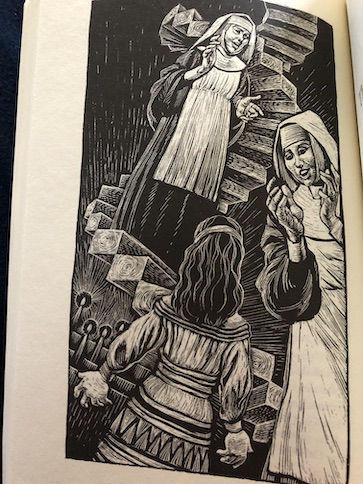
There are 20 stories contained in the book. Each of the stories in the book has one black-and-white picture in an old-fashioned woodcut style.

I don’t think that there are any copies of this book available to read for free online, but this book is available for purchase through Plough Publishing House.

The stories contained in this book are:

Brother Robber by Helene Christaller

A young monk sends three robbers away without food before Christmas because they are violent criminals, but an older monk convinces him to have compassion and to find them and give them the food they have asked for.

The compassionate brother, Brother Francis, is St. Francis of Assisi, although it is not explicitly explained in the story, and the younger brother, Brother Angelo, is the main character. The story of St. Francis, Brother Angelo, and the robbers is an old one that has been told before in other forms, but this is a good rendition.

Three Young Kings by George Summer Albee

Three boys at a school in Cuba are given the role of playing the Three Kings in their school play as well as delivering presents to the rest of the children in their community, giving them presents that their parents have already bought for them. However, their task proves harder than they thought when they see how upset the poor children are that they pass their houses and leave nothing because their parents couldn’t afford presents. What can they do?

This is a good book for talking about making choices. In the end, the community is satisfied with the boys’ choice, but a good topic for discussion after this story would be what the community will choose to do next year, when new boys become the Three Kings.

Transfiguration by Madeleine L’Engle

A nun in New York City struggles to answer a poor man’s questions about why Christmas should be so “merry” when there are so many poor people and bad things happening in the world. The real answer comes to her after the man tries to rob her.

The Cribmaker’s Trip to Heaven by Reimmichl

Willibald Krautmann spends his life making manger scenes for Christmas, and he is sure that his work will earn him a place in Heaven. Unfortunately, when he dies, he is not received in Heaven as he thought and, confronted with the history of his faults that prevents him from entering, he must seek an advocate to help him plead his case. However, it’s not too late for him to mend his ways, and the reader is left to imagine how much was real and how much was dream.

The Guest by Nikolai S. Lesskov

Timofai was a bitter young man, an orphan defrauded of his inheritance by his uncle. After a violent fight with his uncle, he is sent into exile in Siberia. Even after his life improves and he marries and has a family of his own, he still finds himself bitter about the injustice that was done to him. Is there anything that his friend and brother-in-law can say that will help him? When he finally meets his uncle again, after many years, will they both get the closure they really need?

Christmas Day in the Morning by Pearl S. Buck

An older man and his wife decide how to spend Christmas now that their children are grown and living their own lives, separately. As the man reflects on Christmases past, he realizes that love is what makes Christmas special and what you do to show other people how much you love them.

This is one of those stories that I think adults would understand more than children, although it’s a good thought to explain to older children.

The Other Wise Man by Henry van Dyke

The story of a wise man who set out to follow the star at Christmas, like the others, but didn’t arrive at Bethlehem with them because he stopped to help someone. Although he arrives too late to see the Christ Child, he is in the right places to help people because he set out on the journey. At the end of his life, this wise man does actually see Jesus at his crucifixion.

This is a famous 19th century story.

The Miraculous Staircase by Arthur Gordon

In Santa Fe, New Mexico, in 1878, an unusual carpenter promises that he can build a staircase to a church choir loft, even though the original architect didn’t leave space for stairs. Even though other carpenters had failed to find a solution to the problem, the mysterious stranger solves it. But, who was that mysterious carpenter, and how did he do it?

This is actually based on a true story! I’ve been to the church in Santa Fe, the Loretto Chapel, and I’ve seen this staircase myself! The short story ends with a few details about the history of the event.

No Room in the Inn by Katherine Paterson

When an eighteen-year-old boy’s parents leave him alone at the family’s inn, which is closed for Christmas while they visit his sister’s family, he’s a little sad at spending Christmas alone but also looking forward to some freedom to relax. However, a mysterious stranger who needs a place for the night changes his plans.

The Chess Player by Ger Koopman

The Christ Child must help an old man to forgive his estranged daughter on Christmas. Can the Christ Child soften a hardened heart over a game of chess?

The Christmas Lie by Dorothy Thomas

A poor young girl from a large family invents a story that some friends have invited the whole family to join them for Christmas dinner when, in fact, no invitation has been made. It had really been more of an impulsive wish that they had been invited, but when her family believes her and begins preparing for the event, can the girl find the courage to admit the truth? What will happen when everyone realizes that she lied?

This is one of the better child-centered stories in the book.

The Riders of St. Nicholas by Jack Schaefer

A group of cowboys have to decide which of them are going into town to celebrate Christmas and which of them will be staying on the ranch. The ones who get left behind plan a small feast for themselves as consolation for being left out of the fun. However, their plans change when they rescue a neighbor who got drunk and almost froze in a snowstorm.

Grandfather’s Stories by Ernst Wiechert

An old coachman tells stories that his grandfather told him. One Christmas Eve, his grandfather’s grandfather was driving a coach and saw a strange, smiling boy who seemed to be asking for something. Although his employer wanted him to drive on, the coachman gave the boy a ride, and it turns out to be the beginning of a miracle. In another story, a cruel master is changed for the better when he sees that the victim of his cruelty is Christ.

The Vexation of Barney Hatch by B.J. Chute

A panhandler gets recruited as a store Santa and helps a poor boy who only wants a harmonica.

The Empty Cup by Opal Menius

King Herod, knowing of a prophecy that a new king would be born, attempted to kill the new king to preserve his own power. Unable to tell which baby would be the prophesied king, Jesus, he ordered all of the boy babies in the area to be killed.

This story focuses on a man whose only child was killed. His wife seems unable to get over the shock and grief of their son’s death until another little boy teaches her how to get over a loss.

The Well of the Star by Elizabeth Goudge

The Well of the Star is a well where legend has it that the Wise Men stopped on their way to see Jesus. David is a poor shepherd boy who is left behind when the other shepherds go to see the baby Jesus. He is visited by the archangel Michael, who sends him to join the others, meeting the Wise Men on the way.

This is one of the better child-centered stories in the book.

A Certain Small Shepherd by Rebecca Caudill

Jamie’s mother died shortly after his birth, and for much of his young life, Jamie is unable to talk. When he begins going to school, he does well, except that he can’t answer questions out loud in class and not at all if he doesn’t know how to spell the word that he wants. It’s frustrating. However, when his teacher makes him a shepherd in the school Christmas play and his family has some unexpected visitors in a snowstorm, things change.

This is one of the better child-centered stories in the book.

The Carpenter’s Christmas by Peter K. Rosegger

The carpenter’s wife thinks that he isn’t be pious enough on Christmas, but he has an important job to do for someone less fortunate.

What the Kings Brought by Ruth Sawyer

In Spain, the tradition is that the Three Kings bring presents to children on Twelfth Night. A traveler in Spain shortly before Twelfth Night meets a poor young boy who is desperately trying to raise money to buy a new burro to help his father on his farm. The traveler and his friend come up with an idea to help the boy without it seeming like charity.

This is one of the better child-centered stories in the book.

The Christmas Rose by Selma Lagerlof

A Robber Mother trespasses on monastery ground and angers the monks when she tells them that their beautiful herb garden cannot compare to the way the forest looks on Christmas Eve. Abbot Hans decides to pay the Robber family a visit on Christmas, although it ends up being his last.
Mystery in the Old Cave

Mystery in the Old Cave cover

Mystery in the Old Cave by Helen Fuller Orton, 1950.

Mystery in the Old Cave nut gathering

Andy and Joan Draper are excited about spending the fall and winter in the country. Usually, they live in an apartment in New York City and only go to their family’s vacation home in Vermont during the summer. However, this year, some friends of their father will be moving to New York, and they’ll need a place to stay because they are having trouble finding an apartment of their own. The children’s father has decided to rent their apartment to his friends while his family stays in Vermont. That means that the children will have to go to school in Vermont, but the children like the idea because they will be able to do things that they normally can’t do when the seasons change, like gathering nuts. When the first frosts come, the hickory nuts on the trees fall to the ground, making it easy to collect them.

After Andy and Joan collect nuts for the first time, they decide to store them in the old sugarhouse on the property. Normally, the family doesn’t use the sugarhouse for anything, but it used to be used during the times when their vacation house was a working farm and people tapped the maple trees for their sap to make maple syrup. They would process the sap in the sugarhouse. Sometimes, farm hands also used to sleep there during the harvest.

Soon, the children begin to suspect that there’s a stranger hanging around the property. Their dog, Ponto, barks at someone the children don’t see and comes running back to them, acting like someone kicked him. Later, a strange man approaches them and asks them if they know anything about a cave in the area. Andy and Joan don’t know anything about a cave. The man tells them that it’s supposed to be near the old sugarhouse, but if the children haven’t seen it, it might have caved in or something. He seems very secretive and doesn’t want the children to tell anyone that he’s been asking questions, and the children wonder if he could be the one who kicked their dog earlier. Later, someone (perhaps this strange man) steals many of the nuts that the children gathered and even some cookies. The children change their minds about storing things in the sugarhouse and decide to keep their gathered nuts in an unused room in the main house. The only clue to the identity of who’s been sneaking around is a red pencil that the person dropped.

Mystery in the Old Cave store

The children make friends with a boy named Phil who lives nearby. Phil is an orphan who lives with his Cousin John (who he sometimes calls Uncle John because he is so much older), a mean and stingy old man who doesn’t treat him very well and makes him work hard around the house instead of going to play after school with the other kids. He doesn’t even replace Phil’s clothes when they get old and torn. Phil gets a job at the local store to earn some money for a new sweater, but Cousin John even confiscates Phil’s earnings.

Mr. Lane, who owns the local store, is nice, and he tells Andy and Phil about how maple syrup and maple sugar are made, something that everyone in town used to participate in so that it was like a community party. The boys think it sounds like a lot of fun, and while they are talking about the old sugarhouse, Mr. Lane mentions that, once, some thieves joined in when they were making making syrup. Nobody knew they were thieves at first; they were just a couple of strangers who came along with everyone else and started helping out. Later, there were some robberies in the area, and the thieves were found hiding in a cave near the sugarhouse. Mr. Lane says that he and his friends used to play in that cave when they were young, and Andy and Phil decide that they want to find it.

Mystery in the Old Cave bones

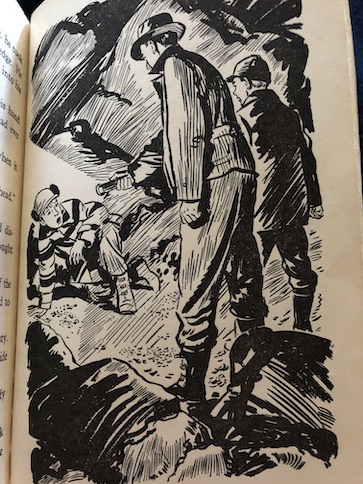
The boys take some tools with them while they’re looking for the cave, in case the entrance has been covered over, which turns out to be the case. Once they dig through the entrance, the rest of the cave appears intact. They find some old bones inside that probably belonged to a bear. They can’t look around much more because the cave is too dark, so they decide that they’ll return later with some lanterns. Mr. Lane tells the boys that there still might be stolen loot around because they never did find everything that the thieves took, including a pearl necklace that belonged to Andy’s grandmother, who was living there back then. Could these things be what the mysterious stranger is looking for?

Mystery in the Old Cave stove in store

During the course of the book, Mr. Lane begins to notice that Phil’s cousin isn’t giving him enough food. Cousin John denies Phil food when he refuses to turn over the extra money that he’s been earning to him. Mr. Lane gives Phil food from the store to eat. While Phil is at the store, he overhears the stranger, who calls himself Joe Williams, talking to Mr. Lane. Joe Williams admits that he’s looking for treasure in the area. Mr. Lane says that he doesn’t have high hopes that Joe Williams will find anything around the cave because the whole area was searched thoroughly years ago.

Phil tells Mr. Lane that he can’t stand living with his cousin anymore and wants to run away. Mr. Lane tries to persuade him not to go, saying that he can deal with Phil’s cousin, but Phil has had enough and worries that his cousin will make life hard for anyone who tries to help him. When Phil hides out in the old sugarhouse, he meets up with Joe Williams, who explains to him more about how he knows about the treasure that may be hidden in or around the cave. He’s about ready to give up the search, but Phil finds something that everyone else has overlooked.

In the end, Andy and Joan’s parents decide to take Phil in. Phil’s cousin agrees to sign over custody to the Drapers, provided that he gets to keep the money from Phil’s job that he took and the money that Phil’s mother left for Phil’s upkeep. I’m pretty sure that’s illegal and that the courts and social workers would have something to say about that if this story happened in real life in the 21st century, but in the story, Mr. Draper accepts the deal and basically uses the money that was meant for Phil to pay off his cousin to surrender custody of the boy. The story ends at Thanksgiving, with Phil sitting down to Thanksgiving dinner with his new family, who will really love him and treat him much better than his cousin did.

Mystery in the Old Cave hiding

This is one of those older mystery stories that’s really more adventure than mystery. There’s really only one suspect for the odd person sneaking around, and his reasons for sneaking around turn out to be exactly what he said they were. There is no other hidden purpose or secret past behind that man other than what he said, and in the end, he just kind of leaves the story. The kids don’t have many clues to the location of the stolen items, and in the end, Phil finds them more by accident than anything else.

Sometimes, when I’m unsatisfied by the ending of a story, I like to make up an alternate one of my own. If I were writing this, I’d have had Phil’s nasty cousin be involved in the robbery and the hunt for the hidden loot. For example, maybe he was actually one of the original thieves and had a falling out with his partners, and he’s secretly searching for the rest of the loot they hid for years. Maybe he’s had to redouble his efforts recently because they’re getting out of prison soon, and he wants to get to the hidden loot before they do. Cousin John is money-hungry enough that it could be plausible, and that would allow the story to end with him being sent to prison, which seems fitting.

This isn’t important to the story at all, but I just wanted to say that the copy I have of this book is damaged in a very odd way. On some of the beginning pages, someone has cut out a few of the words, ransom-note style. I don’t know why that happened. There aren’t enough missing for a real ransom note, and some of the cut-out words are still stuck in the pages, but since this is a mystery book, I kind of like the image of someone using it to write some kind of mysterious secret message.

I haven’t been able to find an online copy of this book yet, but Internet Archive has others by the same author.

No More Magic

NoMoreMagic

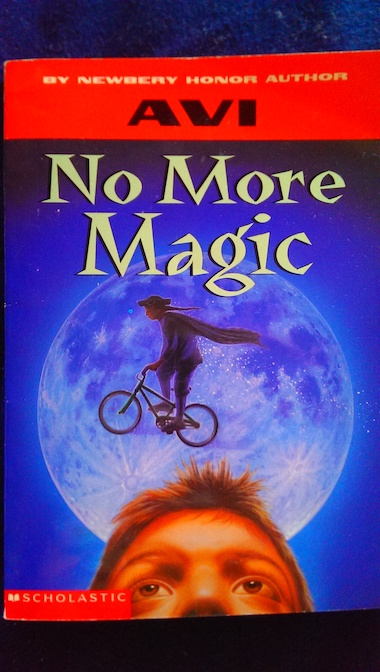
No More Magic by Avi, 1975.

Chris has a fun time on Halloween with his best friend, Eddie.  The two of them are dressed as superheroes.  Eddie is Batman, and Chris is the Green Lantern.  However, the next morning he discovers that his bike is missing.

Chris loves his bike because of its wonderful green color.  He thinks of green as a magical color, and the bike has a great shimmery kind of green paint that reminds him of the Green Lantern.  Although his green bike was a little old and his mother gets a good deal on a newer yellow bike, Chris misses his old one and begins investigating, trying to figure out who could have taken it.

At first, the challenge seems difficult.  On Halloween night, lots of people were running around in costume.  However, Chris’s community isn’t too big, and he is able to identify many of the people who came to the house around the time that the bike disappeared.  One kid that he doesn’t know well is Muffin, a new girl at school, who came to the house in a nurse costume.  There was also a mysterious kid who came in a warlock outfit, with a cape and a tri-cornered hat.

When Chris interviews Muffin to see if she knows anything about his missing bike, he learns that the warlock costume originally belonged to her.  She had made it herself and was proud of it, but someone stole it while it was hanging up to dry.  The nurse costume was a last-minute substitute.  Chris thinks that whoever was wearing the warlock outfit is the most likely suspect for stealing his bike because the local police chief told him that a man had complained that someone riding a bike like his and wearing a costume like the warlock costume ran into him.  He suggests that the two of them team up to find the mysterious warlock/thief and get their stuff back.

Muffin is kind of a strange girl and is oddly evasive about her life and family.  At first, all she will tell Chris is that her real name is Maureen (but she doesn’t like that name) and that she has come to town to live with her aunt because her parents “aren’t around.”  Her aunt seems somewhat strict, and Chris donates some of his own money to Muffin to help her buy a used bike so the two of them can ride around together, looking for clues.

One of the first things they learn is that the person wearing the warlock costume won the prize for the best costume at the Halloween parade downtown.  Chris didn’t attend the Halloween parade, but his friend, Eddie, says that he went.  However, Muffin and Chris notice that Eddie’s name wasn’t on the list of attendees.  When they try to ask Eddie about it, he becomes strangely angry.  Chris doesn’t want to think that his best friend could have stolen his bike or the warlock costume or both, but why would he try so hard to avoid answering their questions if he didn’t have something to hide?

Then, Chris learns why Muffin is so secretive about her life.  The school counselor has noticed that Chris has made friends with Muffin, which she thinks is good, but she tells Chris’s mother about Muffin’s circumstances because she thinks that they should know.  Muffin’s parents recently split up.  For unknown reasons, her mother walked out on her father.  Muffin’s father was distraught when his wife left, and he decided that he should go after her and try to straighten things out with her.  He left Muffin with her aunt and went to try to find his wife, although no one really knows exactly where they went or when Muffin’s father might be back to get her.  The part that worries the school counselor is that Muffin seems to be blaming her parents’ problems and their mysterious absence on magic.  She thinks that magic made her mother go away and that magic is what’s keeping her father away.  The school counselor thinks that being friends with Chris, who is a pretty practical kid (even though he also believes in magic a little), will help bring Muffin down to Earth, and Chris’s mother encourages him to be nice to Muffin and bring her over for dinner.

Still, Chris can’t shake the thought of magic from his head.  He has the strange feeling that, somehow, his magic bike and the magic that Muffin is looking for to get her parents back are connected.  One night, he even thinks that he sees the warlock flying across the sky with his bike, although his father thinks that he dreamed the whole thing.  Neither of his parents believes in magic, and Chris even comes to question whether Muffin is to be trusted.  However, as Chris’s father says, it’s often a matter of asking the right questions before ending up with the wrong answers.

Muffin’s belief in magic comes from what her father said after her mother left.  He said that “the magic had gone,” and he blamed himself for being too self-centered to realize it.  Adults would realize that “the magic” the father was talking about is the romantic feelings that come with love, but Muffin had interpreted the phrase literally.  When her father decided to go after her mother and try to work things out, he said that he was going to “go and find the magic and make it work again.”  Again, Muffin believed that was literally what he was going to do.

It turns out that there are perfectly logical explanations for what happened to both Chris’s bike and the warlock costume, and the two missing objects are not necessarily connected.  Much of what happened on Halloween night involved a series of coincidences, deceptions, and misunderstandings, but even when the full truth becomes known, Chris and Muffin can’t shake the thought that there was a kind of magic behind it all.  Plus, as the kids had guessed, Muffins parents return when they find Chris’s magic bike.

The book is available to borrow online for free through Internet Archive.