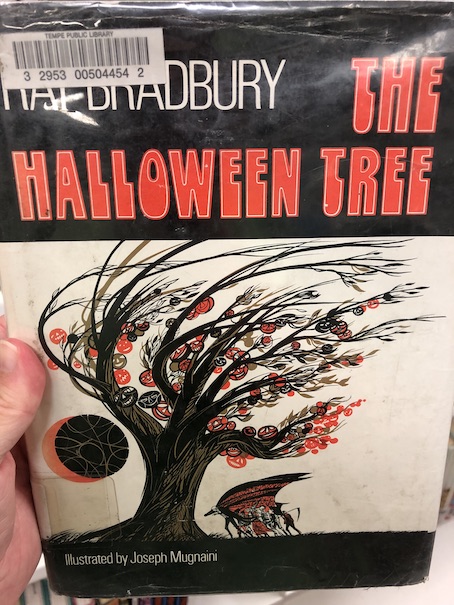
A group of neighborhood boys want to go trick-or-treating on Halloween night, but they’re upset because it looks like a friend of their, Joe Pipkin, won’t be coming with them. When they get to Pipkin’s house, he seems ill and is clutching his side. His friends worry that he’s sick, but he valiantly reassures them that he’ll be fine. He sends them on, telling them that he’ll catch up with them and that his costume will be great. Specifically, he tells them to “head for the House” which is “the place of the Haunts.”
The
house that Pipkin is talking about is the creepiest house in town. It’s large, so large that it’s hard to tell
how many rooms it has. The boys knock on
the creepy-looking door knocker on the front door, and a man answers the door. When the boys say, “trick or treat,” the man
says, “No treats. Only—trick!” Then, he slams the door without giving them
anything.
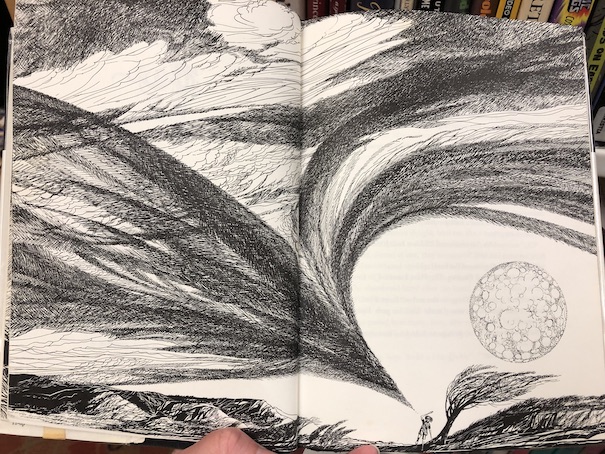
Not knowing what else to do, the boys walk around the side of the house and see a large tree, filled with jack o’lanterns. This is the Halloween Tree. The strange man they saw before rises up from a pile of leaves and scares the boys, giving them the “trick” that he promised them earlier. He finally introduces himself as Carapace Clavicle Moundshroud. He begins talking to them about the history of Halloween and asks them if they understand the real meanings behind the costumes they have chosen. The boys admit that they really don’t know the meanings behind their costumes, and Moundshroud points off into the distance, calling it, “The Undiscovered Country.” He says that out there likes the past and the history of Halloween and that the boys will learn the answers if they’re willing to go there. The boys are interested, but they say that they can’t go anywhere without Pipkin, who promised that he would come.
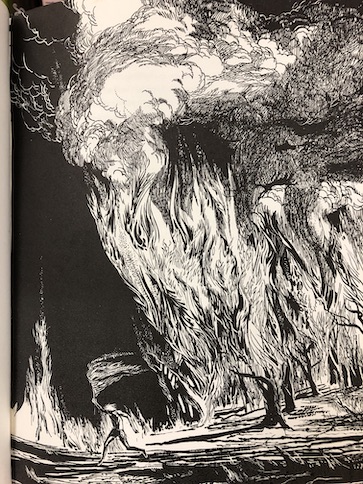
Pipkin suddenly appears in the distance, by a dark ravine, holding a lit pumpkin. He says that he doesn’t feel well, but he knew that he had to come. Pipkin trips and falls, and the light in his pumpkin goes out. From a distance, the others hear him calling for help. Moundshroud says that something bad has happened. Pipkin has been taken away to The Undiscovered Country by Death. Moundshroud says that Pipkin may not be taken permanently but perhaps held for ransom and that, if they follow Pipkin to The Undiscovered Country, they might be able to get his soul back and save his life.
Moundshroud has the boys build a kite that somewhat resembles a pterodactyl, and they use it to travel into the far distant past. The first place they arrive is Ancient Egypt, where the boys learn about mummies and how the Ancient Egyptians viewed the dead. They see Pipkin as a mummy, being laid to rest in a sarcophagus, surrounded by hieroglyphs, telling the story of his life. (Or, as Moundshroud says, “Or whoever Pipkin was this time around, this year, four thousand years ago,” hinting that Pipkin has been reincarnated before and what they are seeing during their journey are his past lives and deaths.) Pipkin calls out to his friends for help. Moundshroud tells the boys that they can’t save Pipkin now, but they’ll have a chance later.
They
continue their journey through time and around the world, seeing glimpses of
Halloweens past in Ancient Rome and the British Isles, where they learn about
druids, Samhain, and witches. Moundshroud
describes how the Romans supplanted druidic practices with their own
polytheistic religion until that was eventually replaced by Christianity. All along, they can still hear Pipkin calling
to them, and he seems to be carried off by a witch. As they pursue him, Moundshroud teaches them
the difference between fictional witches and real-life witches, which he
characterizes as being more like wise women, who don’t really do magic.
From there, they go to Notre Dame to learn about gargoyles. They continue to see Pipkin in different forms, even as a gargoyle on the cathedral. Pipkin tells them that he’s not dead, but that he knows that part of him is in a hospital back home.
In Mexico, the boys experience Dia de los Muertos and learn about skeletons and a different kind of mummy from the ones they saw in Egypt. They find Pipkin, held prisoner in the catacombs by the mummies, and Moundshroud tells the boys that the only way to save him is to make a bargain, both with him and with the dead: each boy must give one year from the end of their lives so that Pipkin may live. It is a serious decision, for as Moundshroud says, they won’t miss that year now, being only about 11 or 12 years old, but none of them knows how long they will actually live. Some of them who were destined to die at 55 would now only make it to 54, and as they reach the end of their lives, the year will seem that much more important to them. Even those who live longer will still want every day they can possibly have. However, each decides that he is willing to make the sacrifice because, without that sacrifice, Pipkin has no chance, and they can’t just let him die.
They
make the bargain and are soon returned home.
When they go to Pipkin’s house to check on him, they are told that Pip
is in the hospital because he had his appendix taken out, just in time to save
his life. At the end of the story, Tom
(who is the leader of the boys through most of the story), wonders silently who
Moundshroud really was, and he hears in his mind, “I think you know, boy, I
think you know.” Tom asks him if they
will meet again, and Moundshroud says that he will come for Tom many years from
now, confirming that Moundshroud was Death all along, which was why they had to
make the bargain with him.
I saw the animated movie version of this story long before I read the book, and it really gave me the creeps! Moundshroud is creepy because he is kind of two-faced. On the one hand, he seems somewhat helpful in helping the boys to find Pipkin and teaching them about the history of Halloween, but on the other, he does not admit to the children that he is Death until the very end, that he is the very thing that they need to save Pipkin from, and that they can only do it by offering a sacrifice of years from their own lives. Although it does occur to me that Moundshroud may not be quite as two-faced as he seems because Pip’s illness and potential death may not have been planned by him but simply the fated situation for Pip, and Moundshroud might have just taken it upon himself to provide a way for Pip’s friends to save him in the least painful way. By not telling them that a sacrifice of part of their lives would be necessary until the very end, after they had come to a better understanding of life and death in the history of Halloween, he may have made the choice easier for them to make. Also, he never says exactly how much time they bought for Pip with their sacrifice. The implication is that Pip is now free from his early appointed death date and will now live a full life, similar to what his friends will have. The exchange does not seem to be an even one, a year for a year, with the children needing to decide how many years they will donate to Pip. Although the kids still don’t know at the end how many years each of them will live, it seems that none of the rest of them is in danger of dying in childhood, and they will all live for many more years.
I wouldn’t recommend this book for young children (it still gives me the creeps, and I’m in my 30s), but it is interesting how they take a journey through the origins of Halloween. The book and the movie were somewhat different, partly because there were more kids in the group in the book and partly because the group of kids in the movie also had a girl in a witch costume. In the book, the kid in the witch costume was also a boy.
Both the book and the animated movie are available online through Internet Archive.
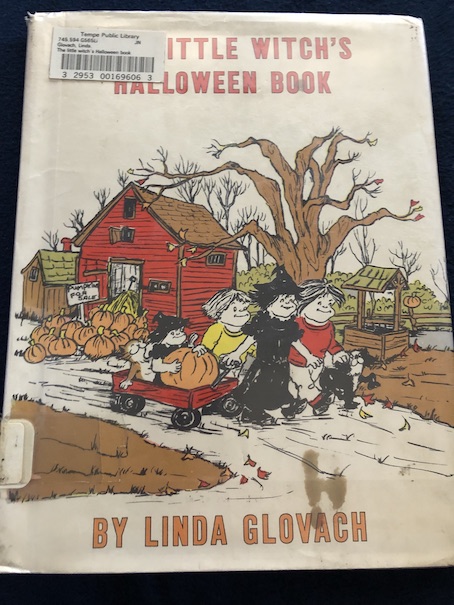
The Little Witch’s Halloween Book by Linda Glovach, 1975.
This book is part of the Little Witch series of craft and hobby books. This one is all about Halloween activities and suggestions for Halloween parties. The book is divided into sections for cards and decorations, parties and celebrations, and trick or treat. The Little Witch’s Code in the beginning has rules for Halloween safety such as having an adult inspect Halloween treats before the child eats them and going trick-or-treating in a group instead of alone. It also advises collecting for charities while trick-or-treating and not playing tricks on people.
The section about cards has Halloween card designs in different shapes. The party section also has a pumpkin card design to use as an invitation, but really, any of the cards could be invitations or party decorations.
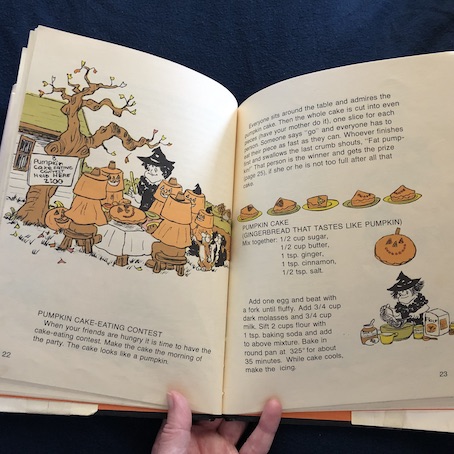
The party section has instructions for games and decorations. One of the games is a pumpkin cake eating contest and a recipe for a pumpkin cake, which oddly does not include any pumpkin, only the spices that are typically included in pumpkin pie. It’s more like a spice cake or gingerbread, and it’s decorated to look like a jack o’lantern face.
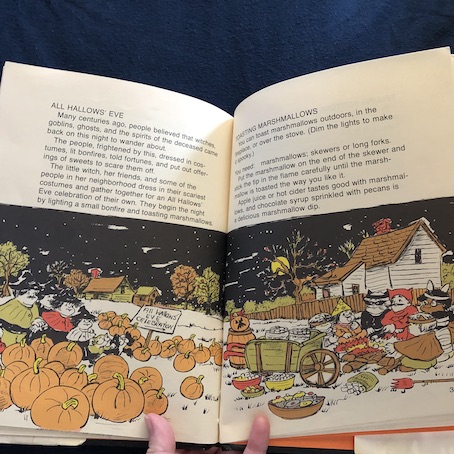
Other games and party treats include traditional ones, like dunking for apples and toasting marshmallows, but there are also some original games, like the Wicked Witch’s Candy House. That game involves party guests taking candy from a tray on top of a cardboard playhouse made from a large cardboard box while the “witch” inside tries to guess who they are. There is also a cute fortune-telling game.
The section about trick-or-treating has more recipes and instructions for making a treat bag and making jack o’lanterns out of oranges.
The book is available to borrow and read for free online through Internet Archive.
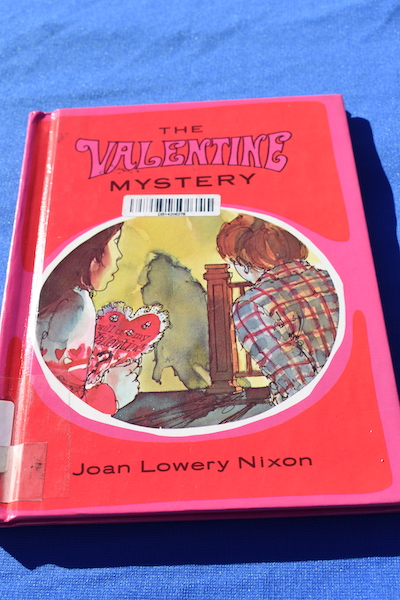
Someone leaves a mysterious, unsigned valentine for Susan Connally at her apartment on Valentine’s Day. Even though everyone was home at the time that the valentine was delivered, the only person who saw the person who brought it was Susan’s little, two-year-old brother, Barney. All Barney can say about this person is that “He had watches on his tennis shoes.”
Susan
and her other brother, Mike, decide to ask some of the other people who live in
their apartment building if they know anything about the valentine or a strange
person who wears watches on his shoes.
Nobody knows a person who wears watches on their shoes. Most people aren’t even wearing tennis shoes. They’re wearing boots because it’s snowing outside. The questions the kids are asking about people with watches on their tennis shoes sound so strange that one of their neighbors, Mrs. Pickett, thinks that the kids are trying to find the solution to a riddle and keeps guessing things like “a spotted dinosaur who has time on his hands?” (Mrs. Pickett is one of my favorite characters in this book. All of her solutions involve a spotted dinosaur, for some reason.)
There is a boy named Pete who lives in their apartment building. His family has only moved there recently, and he’s in Susan’s class at school. Susan thinks it would be nice if the valentine turned out to be from him, but he’s not wearing tennis shoes or watches. He’s also wearing boots with round buckles on them.
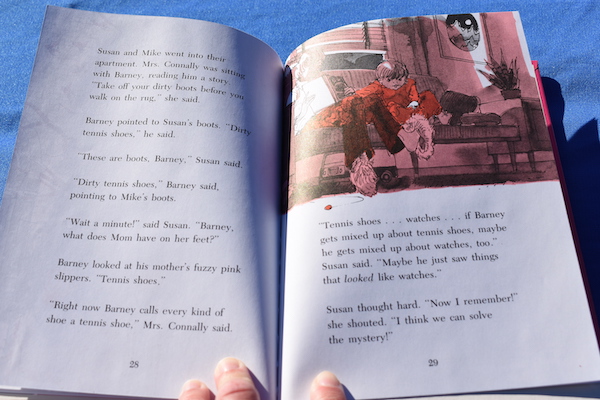
The breakthrough comes when the kids discover that their little brother is going through a phase where he calls all kinds of shoes “tennis shoes.”
The book is available to borrow and read for free online through Internet Archive.
I read this book when I was a kid and then spent years trying to remember what book involved a kid who thought someone had watches on his tennis shoes before I found it again. It’s a cute, fun Valentine’s Day mystery story, and I love all of Mrs. Pickett’s guesses about who would wear watches on their tennis shoes.
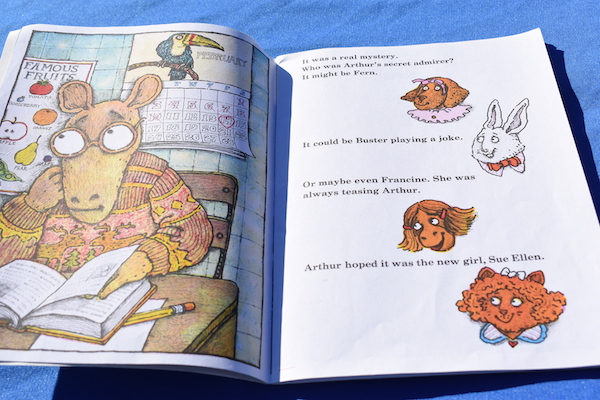
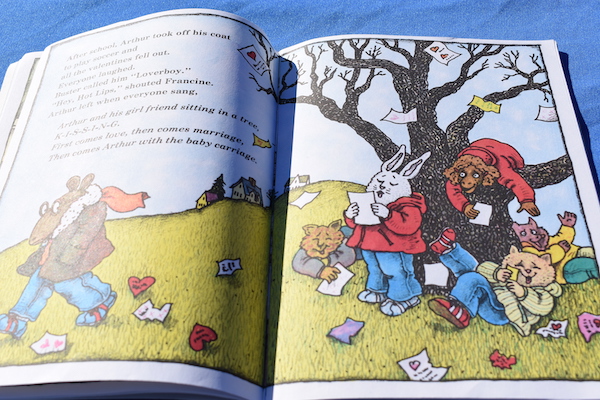
During the week before Valentine’s Day, someone keeps leaving unsigned valentines for Arthur. He wonders who it is, thinking about the different girls in his class at school. On the other hand, maybe someone is just playing a joke on him.
When his friends find out about his secret admirer, Arthur gets a lot of teasing. At one point, he thinks that he knows who the secret admirer is, but when he writes a valentine of his own for her, it turns out that he’s wrong, and it leads to more embarrassment.
However, Valentine’s Day isn’t over yet. Arthur’s secret admirer gives him a movie ticket, saying that she’ll meet him at the theater. With this last message, Arthur realizes who is secret admirer is and arranges a surprise of his own.
One Christmas Eve, a young boy is lying awake in bed when he hears strange sounds. When he looks out of his window, he is astonished to see a train outside of his house, where there aren’t any train tracks. He goes outside to investigate, and the train conductor tells him that the train is heading to the North Pole and asks the boy if he wants to come.
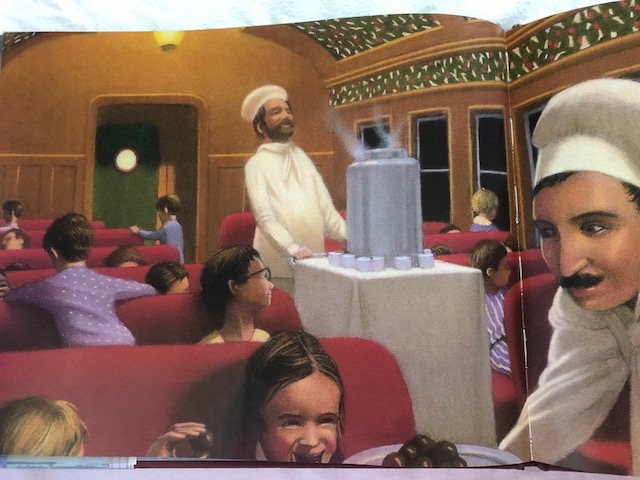
The boy (who is never named) believes in Santa Claus even though some of his friends no longer do, and he gets on board the train. The train is filled with other children, singing Christmas songs, eating candy, and drinking hot cocoa.
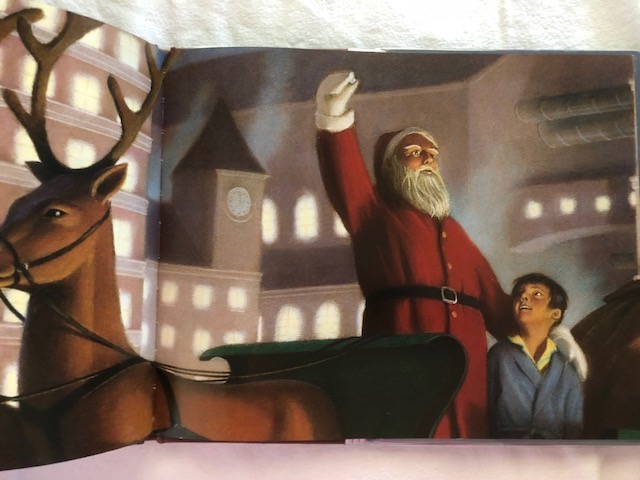
After a long trip over mountains and through forests, they arrive at Santa’s city at the North Pole, where they get to take part in a ceremony to give the first gift of Christmas. Out of all the children from the train, the boy who narrates the story is chosen to receive the first gift. He can ask for anything he wants for Christmas, but he asks for a bell from Santa’s sleigh as proof of his adventures and Santa’s existence.
When the children get on the train to go back home, the boy seems to have lost the bell because of a hole in his pocket, and he is sad. However, the bell reappears on Christmas morning as a mysterious extra present under the tree. The boy’s parents can’t hear the bell ring, and they think it’s broken, but the boy and his sister, Sarah, can hear it. The boy says when he and his sister grew up, Sarah eventually reached the point where she could no longer hear the bell, but he still can because only people who believe in Santa can hear the bells on his sleigh.
The book is a Caldecott Medal winner, and it has become a Christmas classic! Some places that have trains hold special Polar Express train rides where they decorate the trains with Christmas decorations and try to re-create the ride from the book. There is also a movie version of the book, although the story in the movie includes incidents which weren’t in the book to make the movie longer and more dramatic. The original story was very calm and low-key, although still magical, the kind of thing that you could easily read to a child in bed on Christmas Eve.
Most of what Internet Archive has about The Polar Express is related to the movie, but there is also an audio version of the original book. For the benefit of teachers and homeschooling parents, there is also A Guide for Using The Polar Express in the Classroom on Internet Archive.
The House without a Christmas Tree by Gail Rock, 1974.
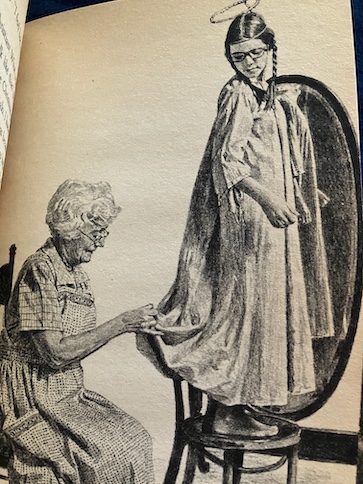
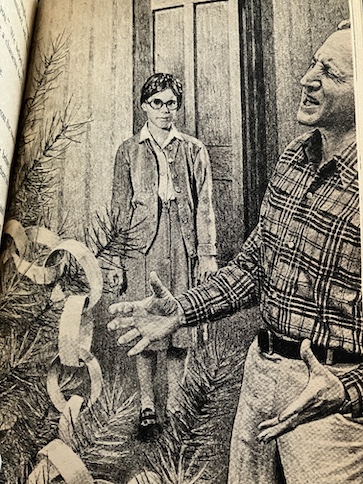
Addie Mills starts the story reminiscing about a special Christmas that she had when she was young and living in a small town in Nebraska with her father and grandmother in the year 1946. The story talks about the things that she did with her friends while they were getting ready for Christmas and buying presents for each other and such, but it mostly centers on how badly Addie wants a Christmas tree.
Addie is ten years old, and she can’t remember ever having a Christmas tree in the house. Apparently, the last time there was a tree in the house was when Addie’s mother was still alive, when Addie was a baby. Addie tries to talk to her father about it, but he just gets angry. Addie’s father doesn’t want a Christmas tree because it reminds him of Addie’s mother, and he still misses her.
Addie feels self-conscious because other families have Christmas trees, and she schemes to find a way to get one. When Addie wins a tree in a guessing contest at school, beating a girl from a needier family, Addie’s father gets angry and makes a scene, which makes Addie feel terrible. She gives the tree to the other family, and worries that her father doesn’t really love her.
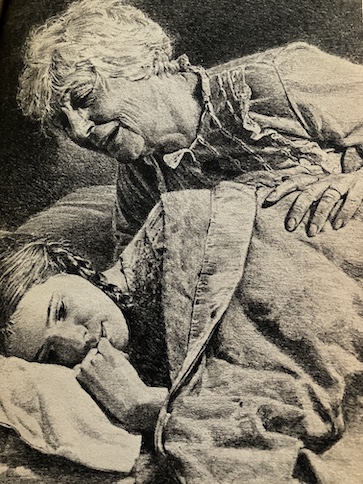
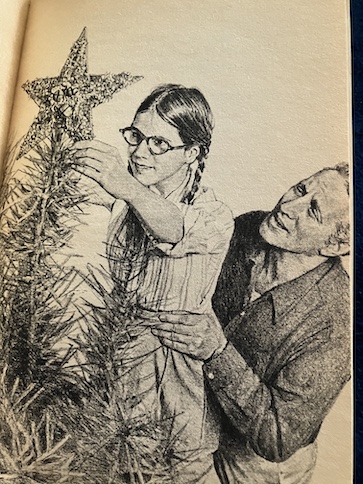
Seeing Addie’s desperation, Addie’s grandmother lectures Addie’s father, saying that his grief over his dead wife is keeping him from being happy and is making his daughter miserable too. In the end, Addie’s father sees the importance of the tree to Addie and decides that it’s time the family had one again.
This book is a little unusual in that the movie version came first, and then the book was written. Sometimes, you can find the movie or clips of it on YouTube. The book is currently available online through Internet Archive. There are also other books in the Addie Mills series.
My Reaction
Some people in real life also struggle with Christmas because Christmas can sometimes bring out sad memories or highlight losses. Christmas is often a time of reflection, the last major holiday before the end of the year and a very sentimental and idealized time, but life isn’t always idea. People who have suffered a loss or are unhappy with their lives in some way tend to reflect on what they don’t have, whatever or whoever is missing from their lives. This is how Christmas is for Addie’s father at the beginning of the story, and Addie’s grandmother is correct that either wallowing in sad memories or trying to hard to avoid them is holding Addie’s father and Addie herself back. It’s time for them to move on and build new memories with each other.
I like the story because the characters are very realistic. Addie and her father, like real people, often find it difficult to communicate and understand each other, but in the end, family love wins over the situation. Addie does get the tree she’s been longing for, and for the first time, her father talks to her about her mother. The Christmas tree and coming to terms with the memories of Addie’s deceased mother help the family to heal old wounds and establish better relationships with each other.
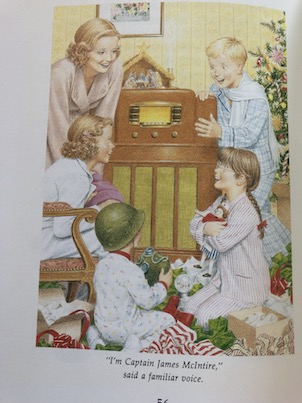
Christmas hasn’t been the same in the McIntire house since Molly’s father went overseas as a doctor during World War II. As Molly writes her father a letter before Christmas, she and her mother and siblings talk about whether or not he might send them presents. Molly is sure that he’ll send something and adds a “thank you” to the letter she’s writing, but her older sister, Jill, is less sure and worries that he’ll feel bad if Molly thanks him for presents that he was unable to send. The boys talk about whether or not any presents that he might send could be shot down before reaching them, and Brad, the youngest child in the family worries about whether Santa might get shot down, too. The children’s mother reassures them, but it’s just another sign of how the war has changed the feeling of Christmas.
Jill tries to be realistic and tells Molly that she should be, too. Jill thinks that there probably won’t be many presents this year, and what they get will be mostly practical things, handmade gifts, or hand-me-downs because of war rationing and the family’s need to be frugal. Everyone is determined to be practical and patriotic, but Molly finds all this “realistic” talk depressing. When her father was home, Christmas was always a time of surprises, and she likes to believe that, somehow, he will still find a way to surprise them.
When the children’s grandparents call and say that they won’t be able to come after all because of car trouble, and they won’t be able to bring them a Christmas tree as promised. The kids are depressed, but Molly says that they’ll just have to do as their mother told her earlier and rely on themselves to make their own Christmas surprises this year. Jill, Ricky, and Molly pool their money and go out to buy a tree. As in the Charlie Brown Christmas special, the only tree they can afford is small and scrawny, but it’s better than no tree at all.
Once they get the tree decorated, it looks much better. As they decorate the tree, Jill admits that some of her attitudes about how this Christmas should be different and more simple from others is because she really misses their father, and when everything looks the same as it did before he left, it just reminds her of how much she misses him. Molly also admits that she doesn’t really care what presents their father sends; she’s only worried that, if a package doesn’t arrive, it might mean that something bad had happened to him. All of the kids want the reassurance that their father is still okay.
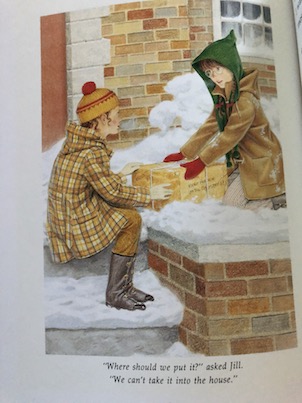
The next day, when the children go out to play in the snow, they find the package from their father that they’ve been waiting for! However, there is a note on the package that says, “KEEP HIDDEN UNTIL CHRISTMAS DAY!” Probably, their father wanted their mother to hide the package from the children, but since Molly and Jill are the first to find it, they decide to do the hiding themselves, putting the box in the storage room above the garage. Jill thinks they should tell their mother about it, but Molly persuades her to wait because she doesn’t want to ruin their father’s surprise.
On Christmas Eve, the girls retrieve the box and put it under the tree after everyone else is asleep. However, that’s not the end of the Christmas surprises. Their father has one more special surprise for them . . .
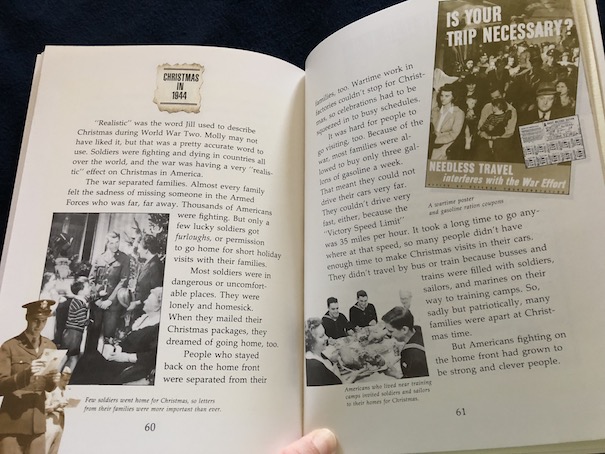
There is a section in the back of the book with historical information about Christmas during World War II. Many families couldn’t be together during the war because families members were overseas and because many civilians limited their traveling during the war in order to save gasoline. In fact, speed limits were greatly reduced in order to save gas – the “Victory Speed Limit” restricted people to driving no faster than 35 mph. Public transit, like trains and buses, was often needed to transport soldiers, so civilians avoided traveling as much as possible.
People also had to get creative about Christmas treats because some essential ingredients, like butter and sugar, were rationed. People also made their own decorations. The selection of toys was somewhat limited because factories had been converted to making war materials, and many families gave their children practical gifts. However, there were still toys available, and people managed to give their children a few special surprises.
The book is currently available online through Internet Archive.
Who’s Afraid of Haggerty House? By Linda Gondosch, 1987.
Kelly McCoy is eager to begin selling greeting cards for the Bismarck Greeting Card company because she wants to earn extra money for Christmas shopping. Her best friends, Jennifer and Adelaide are selling cards, too, and Kelly is looking forward to teaming up with them. However, she soon finds out that Jennifer and Adelaide have already finished their selling. While Kelly was visiting her grandparents for a couple of days, the other girls hurried right out and started selling their cards. They were worried about other kids beating them to the neighborhood houses. By the time Kelly is ready to begin, the others are done and tired of going door-to-door, and many of the houses in the area have already bought all the Christmas cards they want.
Angry and hurt, Kelly has a fight with the other girls, and they mention that one house they didn’t visit was Haggerty House, which is supposed to be haunted. Although the house spooks Kelly, she decides to go there and try to sell her cards. When her brother, Ben, followers her and hits her with snowballs, further angering her, she dares him to come to Haggerty House, too. Ben might be annoying company, but he’s still company.
Usually, the only time that kids in the neighborhood go to Haggerty House is on Halloween, and old Mr. and Mrs. Haggerty give good treats for the kids who are daring enough to visit, usually candied apples and nickels. When Kelly and Ben approach the house to sell Christmas cards, Mrs. Haggerty invites them in for hot chocolate. Mrs. Haggerty buys one of Kelly’s cards, and Kelly and Ben learn that Mrs. Haggerty is very lonely. Her husband is ill and in the hospital. She invites the garbage men in for hot chocolate, too, but is disappointed that they can’t stay very long because they have to finish their rounds.
Kelly and Ben can’t stay very long, either, much to Mrs. Haggerty’s disappointment. However, Kelly later accepts an invitation from Mrs. Haggerty to visit again. Mrs. Haggerty shows her some Christmas cards that people have given her previous years and tells her about her son, Tyler, who is a filmmaker in Los Angeles. Tyler doesn’t visit very often because his work keeps him busy. Mrs. Haggerty plays the piano, and she’s writing a song for Tyler for Christmas. Mrs. Haggerty enjoys Kelly’s visit and wishes she could stay even longer.
Mrs. Haggerty becomes closer to Kelly’s family. Ben helps Kelly to take Mrs. Haggerty’s picture and record the song she’s writing for Tyler so she can send it to him for Christmas. Mrs. Haggerty also comes with the McCoys when they go shopping for a Christmas tree, and she comes to see Kelly as the Ghost of Christmas Past in her school’s A Christmas Carol play.
Then, while the kids are helping Mrs. Haggerty decorate at her house, an eccentric woman from the neighborhood, Malvina Krebs, comes to the house to ask if Mrs. Haggerty would like to participate in one of the seances that she holds regularly with friends. Actually, they are hoping that she will let them hold a séance at her house because her house has such wonderful atmosphere and “vibrations.” Mrs. Haggerty agrees because she’s never seen a séance before, and the séance group will be additional company. Kelly asks if she could come because she’s curious to see what a séance looks like as well, and the ladies agree.
The séance is a very strange experience, although Kelly later discovers that some of what happened was a prank by her brother and his friend. It occurs to Kelly that what she likes about visiting Mrs. Haggerty is that, unlike her friends right now, Mrs. Haggerty is always glad to see her and the interesting things that they do take her mind off of her fight with her friends. However, she has come to miss talking to people who really understand her. She can imagine what Jennifer would say about the séance and how she would find it interesting and how she would understand how Kelly felt about it. Kelly’s earlier anger at her friends wasn’t really about how they made money with their cards and left no customers for her so much as they were having a good time without her and how they no longer seem interested in spending time with her. She confides a little in Mrs. Haggerty how she feels about her friends, and she says that friends don’t always act like friends should. Mrs. Haggerty herself doesn’t have as many friends as she used to because many of them have passed away.
Kelly does make up with Jennifer and Adelaide, inviting them to a Christmas party at Mrs. Haggerty’s. There, she learns that some of their stand-offishness and secretiveness was because they’ve been planning a special Christmas present for Kelly. The Christmas party is fun with a lot of old-fashioned games, but the best part is when Tyler finally comes home for Christmas!
The book is available to borrow and read for free online through Internet Archive.
My Reaction
Friendship is a large part of the theme of this story. Kelly comes to understand Mrs. Haggerty’s loneliness partly through her quarrels with her friends. At this point in their lives, each of them needs the other because they don’t really have anyone else. Kelly’s time with Mrs. Haggerty gives her a new perspective on her relationship with her friends, and she also comes to understand some of the difficulties that Mrs. Haggerty faces because she is elderly. Mrs. Haggerty’s song for her son is what makes him realize that he needs to spend more time with his aging parents, and Kelly and her friends decide that they will continue to visit with Mrs. Haggerty regularly.
#6 The Mystery in Arizona by Julie Campbell, 1958.
Di’s Uncle Monty (the real one, not the fake from previously in the series) has invited her and the other Bob-Whites to spend Christmas at his dude ranch near Tucson, Arizona. At first, Trixie is worried that she won’t be allowed to go with the others because her grades in school are bad and she needs to study. However, her parents finally agree to allow her to go when the boys offer to tutor her over the holidays, and Trixie can get information that she needs on Navajo Indians for her theme. It won’t be easy, though.
From the very start of their visit, problems plague the ranch, and it seems as though everyone has a secret. Most of the members of the Orlando family, who usually take care of cooking, cleaning, and other tasks on the ranch, have mysteriously disappeared, except for Maria and her young son. Maria refuses to say where the others are, but the little boy is unhappy that he couldn’t go with the rest of his family and makes strange comments about skeletons and other frightening things. Also, Rosita, a Navajo girl working as a maid at the ranch, is deeply unhappy and in need of money for reasons that she doesn’t want to explain.
Meanwhile, there is a trio of lonely and unhappy guests in need of cheering up. In an effort to help, the Bob-Whites volunteer to take over the Orlandos’ chores to keep the ranch running during the holidays. As Trixie gets drawn further into the mysteries plaguing the ranch, she finds it difficult to balance her work and her studies. Trixie worries that this might turn out to be a terrible way to spend Christmas, but with some help from the Bob-Whites, things might work out even better than anyone hoped.
One of the things that they discover is that the Orlando family is celebrating a family tradition similar to Dia de Los Muertos (Day of the Dead, similar to All Souls Day and Halloween) but their family celebrates it at a different time of year than is customary because they want their celebration to coincide with the birthday of one of their ancestors. They left without explaining because they were worried that no one would understand their traditions or approve of them. Maria Orlando did not go right away because she was worried about leaving her job, but when her son tries to run away and join the rest of the family, she decides that it isn’t fair to keep him away from the family celebration. After making sure that the Bob-Whites can handle the chores on the ranch, she takes her son to join the others in Mexico.
The three unhappy guests, Jane Brown, Mr. Wellington, and Mrs. Sherman, also have their problems solved. Jane learns to get over her shyness and enjoy herself. Mr. Wellington’s children, who had decided at the last minute to spend the holidays with friends, change their minds and come to spend Christmas with their father instead, cheering him up. After Maria leaves, Mrs. Sherman cooks Christmas dinner for everyone, allowing her to once again do the work she loved when she and her late husband ran a restaurant. Rosita’s secret is that she feels responsible for an accident that her father suffered when he was working with some more modern tools that she gave him for his silversmithing work. She took a job at the ranch to get some money for his medical treatment, but she is worried that she cannot earn all the money she needs during the holidays so that she can return to school. She sold some of her silver jewelry to Mrs. Sherman, but she refused to take more than $100 dollars for it, although Mrs. Sherman would gladly have given her all the money that she needed. Rosita is too proud to ask for or accept help from others. The Bob-Whites solve her problem by giving her the money that they earned working at the ranch as a Christmas present. In spite of all these distractions, Trixie manages to improve her math and get enough information for her theme on Navajos from Rosita.
This is the last Trixie Belden book written by Julie Campbell, the original author of the series. From this point on, the series continues with other authors.
The book is currently available online through Internet Archive.


















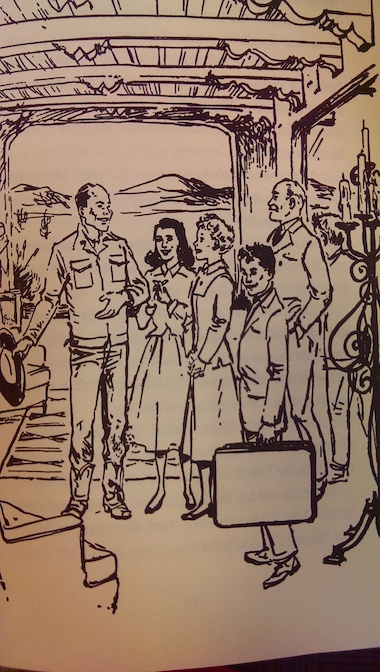 Di’s Uncle Monty (the real one, not the fake from previously in the series) has invited her and the other Bob-Whites to spend Christmas at his dude ranch near Tucson, Arizona. At first, Trixie is worried that she won’t be allowed to go with the others because her grades in school are bad and she needs to study. However, her parents finally agree to allow her to go when the boys offer to tutor her over the holidays, and Trixie can get information that she needs on Navajo Indians for her theme. It won’t be easy, though.

 Jestress's Forgotten Books and Stories