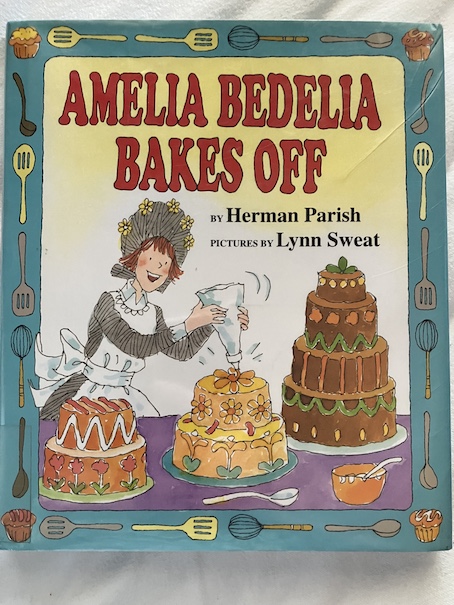
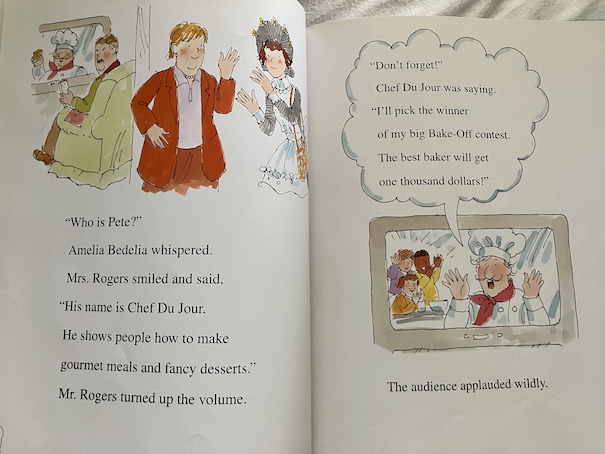
Mr. Rogers has been watching a tv show called What’s Cooking? with Chef Du Jour, and there’s going to be a Bake-Off contest in town! Because Amelia Bedelia is so good at baking, Mr. and Mrs. Rogers think she should try to enter the contest.
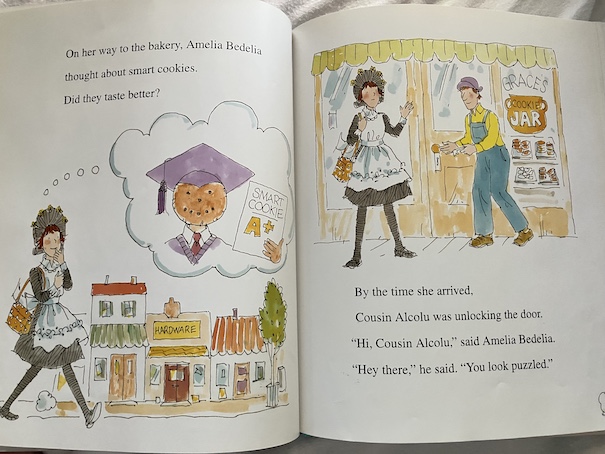
She is a good baker, but Amelia Bedelia has already agreed to spend the day taking care of the bakery called Grace’s Cookie Jar with her Cousin Alcolu while Grace is out of town. Even though Amelia Bedelia is good at baking, it turns out that she isn’t any better at following someone else’s baking and recipe instructions than she is at following any other to do list written by someone else.
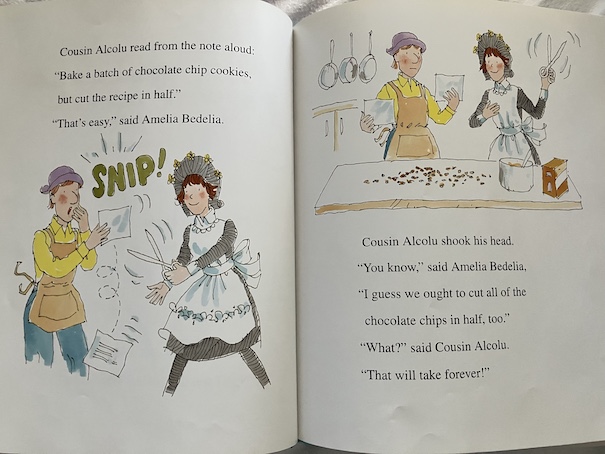
When Amelia Bedelia meets Cousin Alcolu at the bakery, they read the notes that Grace left for them. The first note tells them to “start every recipe from scratch”, so of course, they have to scratch each other’s backs before they begin cooking. From there, Amelia Bedelia thinks that cutting a recipe for chocolate chip cookies in half means that they have to literally cut the recipe paper in half. Then, for good measure, Amelia Bedelia thinks they should cut all the chocolate chips in half, too.
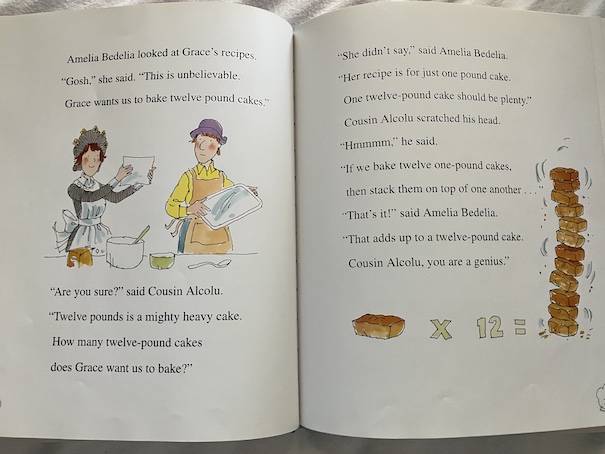
When Grace’s instructions ask them to bake “twelve pound cakes”, she assumes that she wants a cake that weighs 12 pounds instead of baking 12 small pound cakes. Fortunately, because that seems like such a big task, Cousin Alcolu suggests that they bake twelve one-pound cakes and just stack them, which is closer to what they’re actually supposed to do.
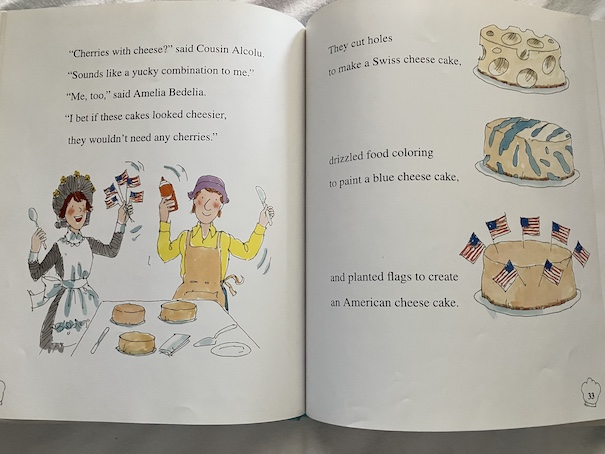
Amelia Bedelia and Cousin Alcolu get creative with decorating the cheesecakes because Amelia Bedelia doesn’t want to top them with cherries, like Grace asked. She just doesn’t think that cherries and cheese go together. Instead, they decorate them on the theme of cheese. Even though they don’t go about their baking in quite the way they’re supposed to, the things they make are still good.
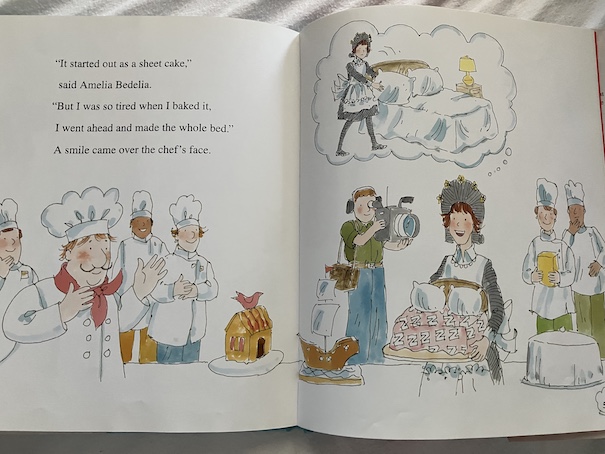
At the end of the day, Amelia Bedelia is tired, but she bakes one last cake for the Bake-Off. Since she’s so tired, she uses that a creative theme for her “sheet” cake! The book includes the recipe for Amelia Bedelia’s Sheet Cake.
The book is available to borrow and read for free online through Internet Archive.
My Reaction
Amelia Bedelia books are supposed to be ridiculous, playing off of expressions and words with multiple meanings. They aren’t really supposed to make sense so much as poke fun at Amelia Bedelia’s literal interpretations or confusion over instructions that other people give her.
I found this one a little out of character for Amelia Bedelia because one of her signature traits is that she’s good at baking. In other books, her baking skills often save her job or diffuse people’s anger at other instructions that she’s misinterpreted. Of all the things that Amelia Bedelia might understand, you would think she would know how to read a recipe. Although, admittedly, this isn’t the first time that she’s misunderstood something that someone else asked her to bake because she once cut up a calendar when she was asked to bake a “date cake”, apparently not understanding that dates are fruit. Now that I think about it, Amelia Bedelia also seems to bake her best dishes from memory, not usually consulting a recipe. Above all, though, there are a lot of baking and cooking expressions that would be fun to see Amelia Bedelia misinterpret (like when Amelia Bedelia pinches Cousin Alcolu when a recipe calls for a pinch of salt), and that’s what’s really the point of the story.
I did enjoy that, even though Amelia Bedelia and her cousin misinterpret Grace’s instructions, the things they make still taste good, and most of them are more or less what they’re supposed to be, like the cookies and the pound cakes.
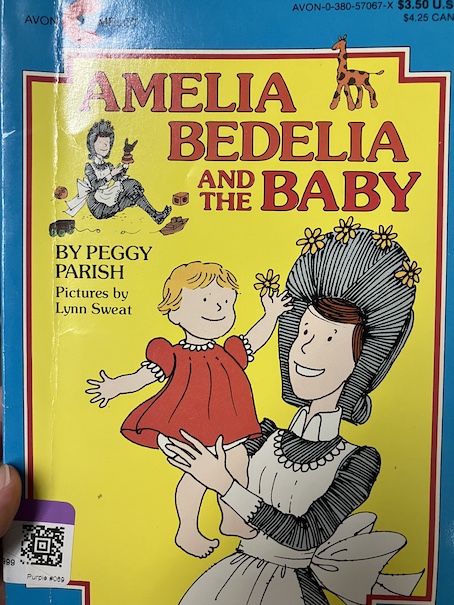
Amelia Bedelia and the Baby by Peggy Parish, pictures by Lynn Sweat, 1981.
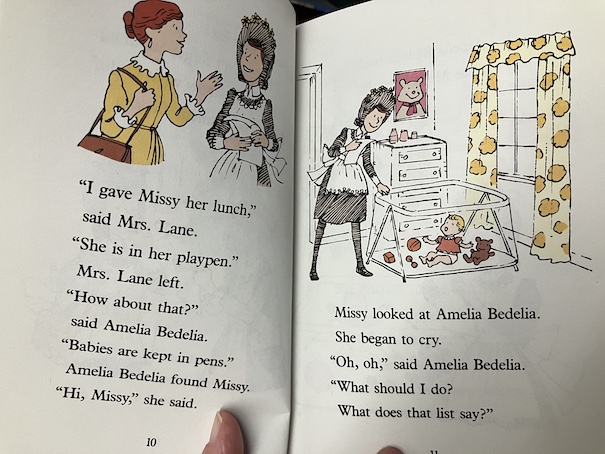
A friend of Mrs. Rogers, Mrs. Lane, asks Amelia Bedelia to babysit her baby. Amelia Bedelia says she doesn’t know anything about babies, but Mrs. Rogers says that Amelia Bedelia is good with children and points out that babies are also children. When she puts it that way, Amelia Bedelia agrees to babysit. Fortunately, she doesn’t have the idea that babysitting involves sitting on the baby, but being Amelia Bedelia, she finds plenty of ways to misinterpret the list of instructions that Mrs. Lane gives her for taking care of the baby.
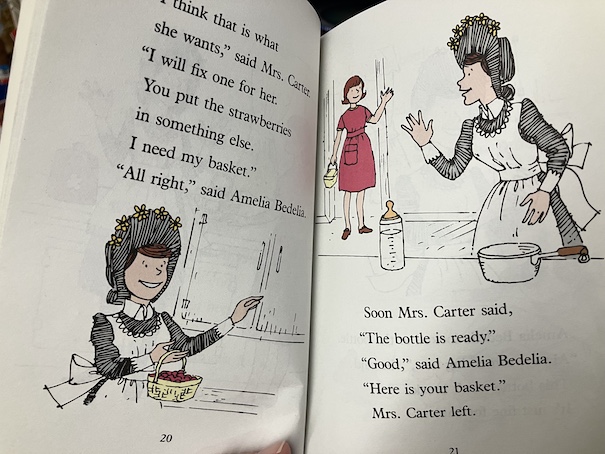
When the baby starts to cry, Amelia Bedelia consults the list and sees that she’s supposed to give the baby a bottle. She worries that a baby might break a bottle, though. She tries giving the baby a box and a can instead, but of course, that doesn’t work. Fortunately, Mrs. Carter stops by to drop off some strawberries and helps to fix the baby a bottle.
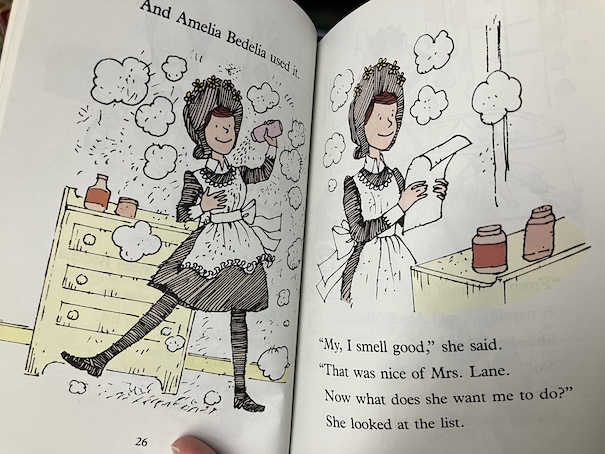
Amelia Bedelia successfully manages to give the baby a bath but thinks that the instruction to use baby powder means that she should use it on herself and that putting on the baby’s bib means that she should wear it herself. Similarly, Amelia Bedelia thinks that the instruction for naptime mean that she should take a nap herself, and she refuses to do it because she hates naps. Instead, she decides to make strawberry tarts while the baby takes a nap in her play pen.
Amelia Bedelia has some misinterpretations about what the baby is supposed to eat, and when Mr. and Mrs. Lane arrive home, the baby is a mess. Mrs. Lane is upset, realizing that Amelia Bedelia doesn’t understand anything about babies and baby food, but her husband gives her one of Amelia Bedelia’s amazing strawberry tarts. That, and realizing that the baby likes Amelia Bedelia makes Mrs. Lane change her mind.
The book is available to borrow and read for free online through Internet Archive (multiple copies).
My Reaction
Amelia Bedelia books aren’t supposed to be taken seriously. They’re just funny stories about the ways Amelia Bedelia misinterprets instructions people give her. She gets things wrong because she doesn’t understand certain expressions and words with multiple meanings.
In real life, putting someone like Amelia Bedelia in charge of a baby would be a complete disaster, and it could even be dangerous to the baby. Although things work out with the food Amelia Bedelia gives the baby, a real baby could choke on food they’re not old enough to handle. I couldn’t really blame Mrs. Lane for being upset when she realizes that she put someone who didn’t know what they were doing in charge of her small child. No real parents would be willing to let the matter go or invite her to come back in those circumstances just because they liked her strawberry tarts. However, because this is just meant to be a humorous story, everything works out okay in the end.
I did think it was kind of funny, in hindsight, that they never made any jokes about a babysitter sitting on the baby, which would be the kind of literal interpretation that Amelia Bedelia does. They probably couldn’t make that joke because, if Amelia Bedelia made any comment about that, nobody, not even Mr. and Mrs. Rogers, would dare leave Amelia Bedelia in charge of an infant. They also probably wouldn’t want kids to think that might be a funny thing to do. They also never made any jokes about “changing” the baby or having Amelia Bedelia wonder in what way she was supposed to be changed. That’s probably all for the best.
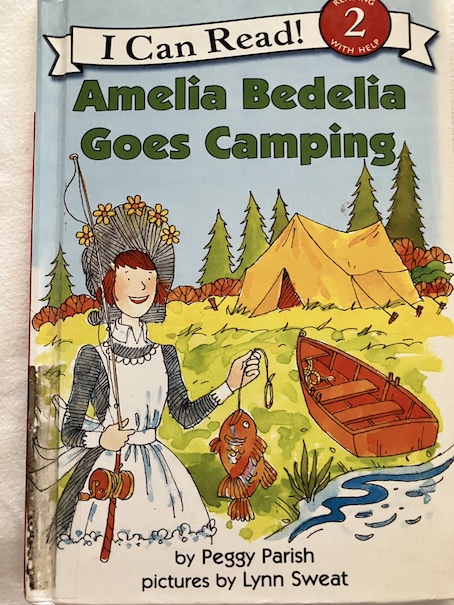
Amelia Bedelia Goes Camping by Peggy Parish, 1985.
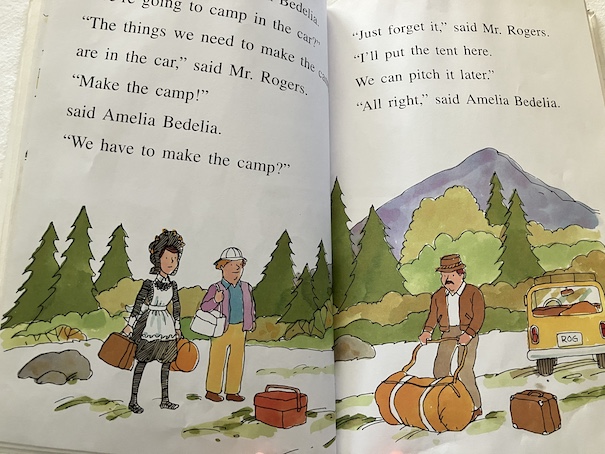
Mr. and Mrs. Rogers are going camping, and they take along their maid/housekeeper, Amelia Bedelia. Amelia Bedelia has never been camping before, and she brings along her unique habit of taking things too literally or misinterpreting instructions as Mr. and Mrs. Rogers explain to her what she needs to do while camping.
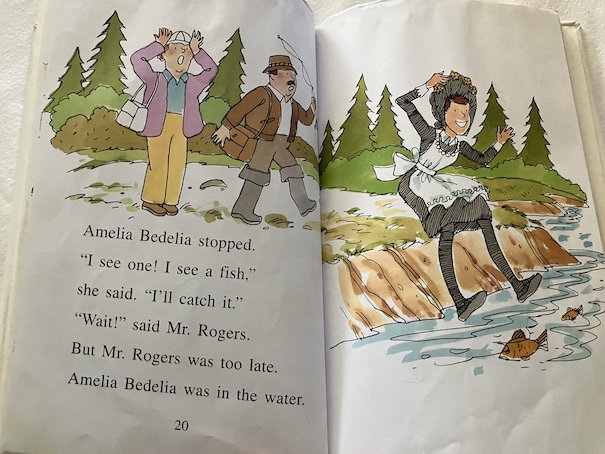
When Mr. Rogers tries to teach her how to catch a fish, he doesn’t tell her right away that they need to use fishing poles, so Amelia Bedelia just jumps right into the stream and grabs a fish right out of the water. It’s actually kind of an amazing accomplishment, but Mr. Rogers is stunned when Amelia Bedelia lets the fish go, not realizing that they were supposed to keep what they catch. She thought the activity was only about catching.
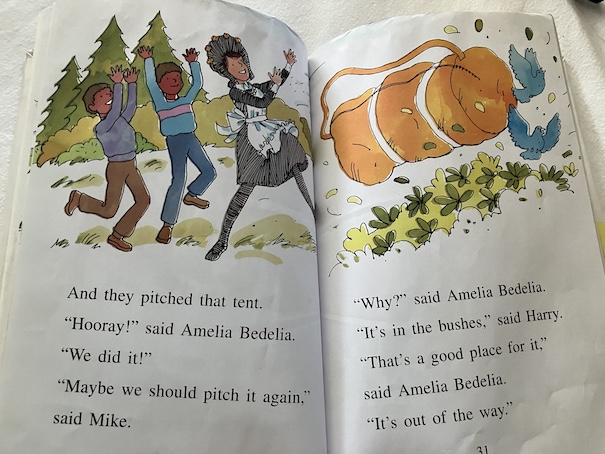
When Amelia Bedelia is sent to “pitch the tent”, she meets some boys, who say that they’ve heard of Amelia Bedelia. Even knowing that she’s pitching the tent wrong, by simply throwing it and letting it come down wherever it lands, the boys happily participate. When they suggest to Amelia Bedelia that maybe they should move the tent or throw it again when it lands in the bushes, Amelia Bedelia says that isn’t necessary because the tent is conveniently out of the way there.
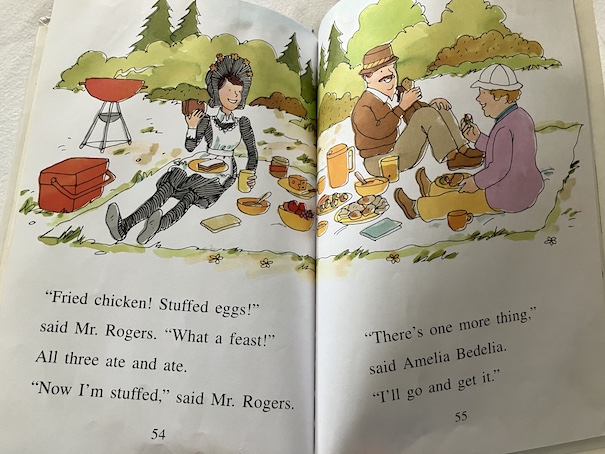
Amelia Bedelia also gets confused about starting a fire with pine cones because Mr. Rogers didn’t say to use a match, and she thinks “rowing a boat” means to put all the boats in a row. She also doesn’t understand that tent stakes aren’t the same as meat steaks and thinks that sleeping bags are bags that are asleep. The only order that I know that Amelia Bedelia refuses to obey is Mr. Rogers’s order to “go jump in the lake”, and that’s only because she is out of dry clothes! Fortunately, where Amelia shines is preparing a picnic feast for Mr. Rogers’s birthday!
The book is available to borrow and read for free online through Internet Archive.
My Reaction
The Amelia Bedelia books all poke fun at words with multiple meanings and the literal ways that Amelia Bedelia misinterprets various expressions. As with some of the other Amelia Bedelia books, though, the whole premise of the book is based on Amelia Bedelia not only getting confused about the proper meanings of words but also having no knowledge of the subject at hand. Amelia Bedelia doesn’t know what tent stakes are or what pitching a tent involves because she’s never been camping before. In spite of that, even knowing that Amelia Bedelia has no experience in camping and how she usually interprets instructions she doesn’t fully understand, Mr. Rogers assigns her tasks which he should know that she has no idea how to do. Not only does Amelia Bedelia never learn to check her understanding of what other people mean, Mr. and Mrs. Rogers never really learn that they have to teach Amelia Bedelia what she needs to know to do a task and check to make sure that she understands.
As with other books in this series, though, Amelia Bedelia’s cooking skills save the day and her job with Mr. and Mrs. Rogers! Maybe Amelia Bedelia should have just gotten a job in a bakery or something, but then again, she also messes up cooking instructions whenever she tries to do what someone else told her rather than just doing things the way she’s accustomed to doing them.
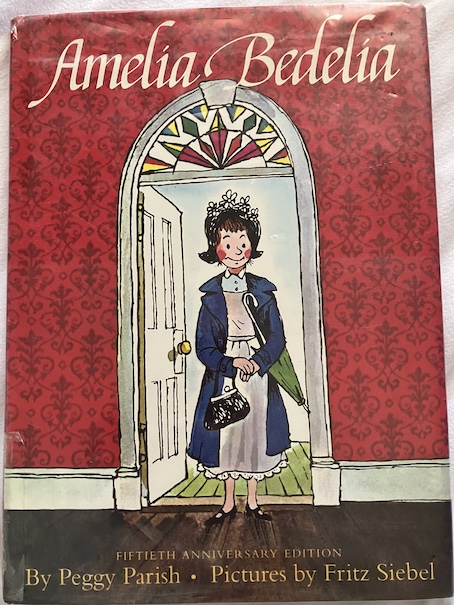
Amelia Bedelia is just starting her new job as a maid with Mr. and Mrs. Rogers! Mr. and Mrs. Rogers can’t be there to supervise her on her first day, but Mrs. Rogers leaves her a list of things to do and tells her to do exactly what the list says. Little does Mrs. Rogers know just how literal Amelia Bedelia can be!
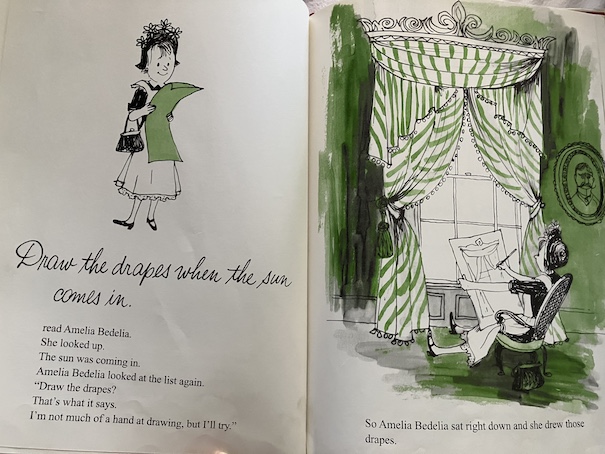
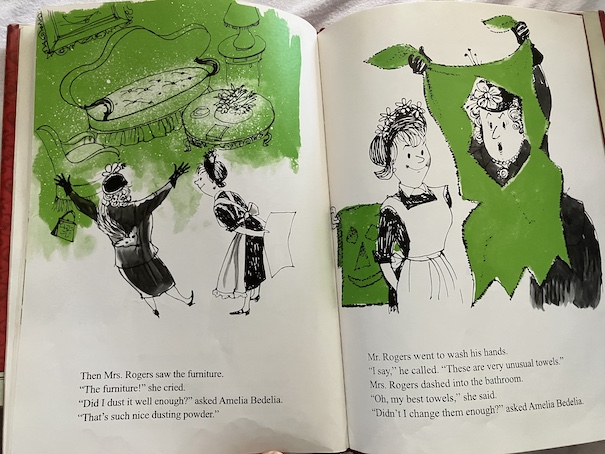
When Amelia Bedelia reads that she’s suppose to “change the towels”, she thinks that she’s supposed to change the way they look instead of replacing them with new ones. To Amelia Bedelia “dust the furniture” means to add dust to the furniture instead of removing it. The instruction to “draw the drapes” sounds like she should draw a picture of them instead of closing them.
When Mr. and Mrs. Rogers return to see how Amelia Bedelia is doing, they are shocked at what she’s done!
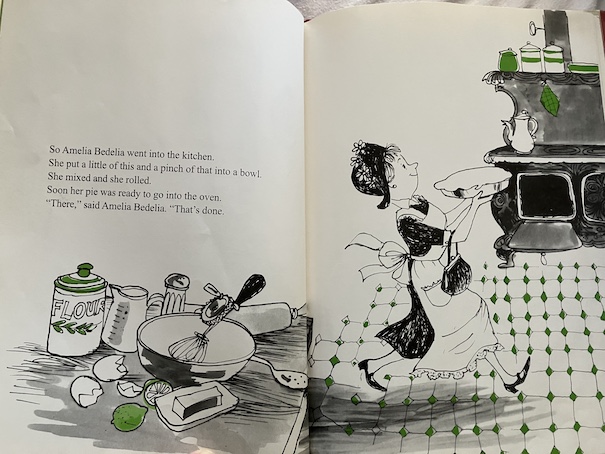
There is only one thing that can save Amelia Bedelia’s job: her ability to make an amazing lemon meringue pie!
The book is available to borrow and read for free online through Internet Archive.
My Reaction
This is the very first book in the Amelia Bedelia series, and I remember reading it when I was a kid. The point of the Amelia Bedelia books is to introduce kids to expressions and words that have multiple meanings. They’re pretty funny to read, although even as a kid, I had trouble believing some of the phrases that Amelia Bedelia takes literally. For example, when she “dusts” the furniture, she thinks that Mrs. Rogers should have told her to “undust” the furniture instead. I see what the author is saying, that it’s funny that we say “dust” the furniture when we’re actually removing dust instead of adding it, but I’ve never heard anybody in real life use the term “undust” the furniture. Amelia Bedelia is funny, but sometimes, it seems like it’s reaching a little to find terms she can credibly misinterpret.
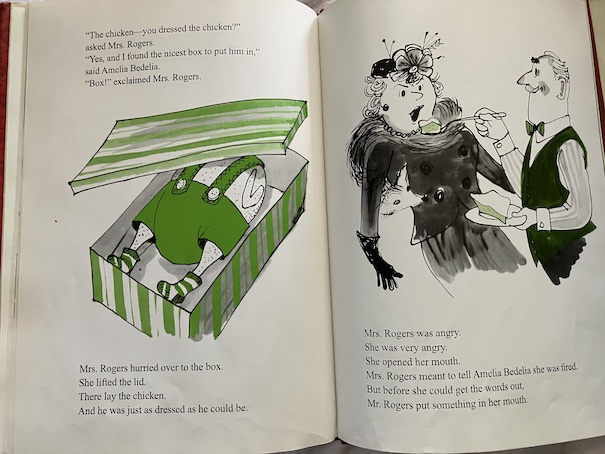
I also don’t think I fully understood the parts about trimming the fat on the steak and dressing the chicken as a kid because I wasn’t used to cooking. I think I got the concept that she was supposed to cut the fat off the steak rather than decorate it as one might trim a Christmas tree (a concept that Amelia Bedelia interprets the opposite way in her Christmas story). What she was supposed to do with the chicken she ended up “dressing” in clothes was a little more confusing. When I was a kid, I knew that people make stuffing or dressing to put in poultry, like chicken or turkey, when they cook it, or they can rub herbs and spices under the skin for flavoring, and I think that’s what Amelia Bedelia was supposed to do here. Even so, there are different types of stuffing or dressing to make and different mixtures of herbs and spices to use, and Mrs. Rogers doesn’t say what kind she wants. Of course, if she was more specific, Amelia Bedelia couldn’t have gotten so confused, and that’s really the point of the story.
I don’t know whether any teachers still use Amelia Bedelia books as examples of words and phrases with multiple meanings, but they are fun in that fashion. A good accompanying activity for these books is a project that I had when I was in school and that I’ve heard students still do – explain how to make a peanut butter sandwich (or any other kind of sandwich) to someone from another planet, who has no idea what a sandwich is or how to make one. Students doing this activity need to be as careful and detailed as they can because some phrases are easy to misinterpret if you assume that the person you’re talking to has no idea how anything works. I remember my old teacher would act out our instructions literally, almost like Amelia Bedelia. For example, if you said, “Put peanut butter on bread” without saying that you need to open the jar first and remove the peanut butter from the jar with a knife, the teacher would set the whole jar of peanut butter on top of the bread and just stare at it. If you explain the peanut butter sandwich instructions well enough that there’s no room for misinterpretation, you may have a future in technical writing!
The pattern established in this first book continues through other books in the series. In many other Amelia Bedelia stories, Amelia Bedelia misinterprets instructions she’s given by taking things too literally or misunderstanding words with multiple meanings, but she always manages to keep her job because she’s really good at baking and makes cakes, pies, and other treats that Mr. and Mrs. Rogers love.
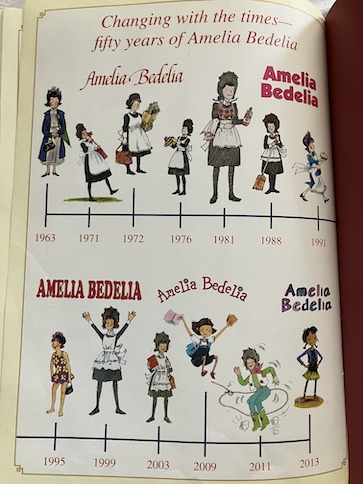
If you read the 50th Anniversary edition of the book, there’s a section in the back about the Amelia Bedelia series and how it’s changed over the years!
Happy Haunting, Amelia Bedelia by Herman Parish, pictures by Lynn Sweat, 2004.
When Amelia Bedelia arrives at the Rogers’s house just before Halloween, she is appalled by all the cobwebs. The house looks like a run-down haunted house, and Amelia Bedelia thinks someone wrecked it. Mr. and Mrs. Rogers reassure her that the house is just decorated for the Halloween party they are having that night. Amelia Bedelia almost forgot what day it was because she’s been busy, helping the local children make their costumes.
When Amelia Bedelia tries to help the Rogers get ready for the party, she demonstrates that she still takes everything way too literally. When Mr. Rogers asks her to both get the hammer and to crack a window, Amelia Bedelia assumes that he means her to use the hammer on the window and actually breaks it. When they ask Amelia to add an extra leaf to the table for the guests, she assumes they mean a tree leaf, and when Mr. Rogers asks her to hand him a witch, she asks him “Which what?”
Amelia Bedelia is enough to drive anyone batty, but she really does her best work in the kitchen. She is a good cook, and she and Mrs. Rogers have fun making a bunch of traditional Halloween goodies. Then Cousin Alcolu arrives with a bunch of pumpkins and a scarecrow for the party. They ask Amelia Bedelia what costume she will wear for the party that night, but she doesn’t have one. Mrs. Rogers says that she has an idea for her and for Cousin Alcolu.
The Rogers’s party that night is a success, and Amelia’s influence is obvious in the literal nature of some of the treats and the costumes she helped the children make. However, nobody can figure out where Amelia Bedelia is. At first, Mr. Rogers thinks that maybe Amelia is offended because he mistakenly called her normal outfit a costume, but then, he is sure that he recognizes Amelia Bedelia in her Halloween costume. Is he right? It certain seems something strange is going on! But, then again, Amelia Bedelia is there.
The book is available to borrow and read for free online through Internet Archive (multiple copies).
My Reaction
This is one of the newer Amelia Bedelia books, written after the death of the original author. Parts seemed a little cheesy to me, like Amelia Bedelia seeming confused about the Halloween decorations after helping the children make Halloween costumes. Amelia Bedelia is often a little mixed-up, but getting confused about the nature of the holiday just seemed to be overdoing it. Then again, even in the original books, she was confused about ordinary things associated with holidays, like what kind of “star” goes on top of a Christmas tree. It might be more in character than I thought at first, and it just seemed like overdoing it in this book because I read the original books when I was a kid wasn’t thinking that deeply about it back then.
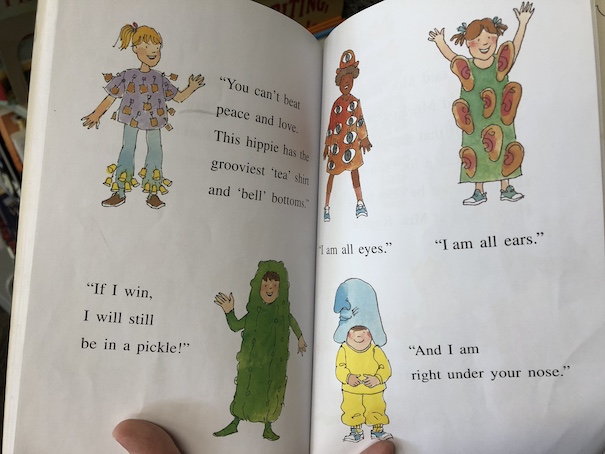
I did like it that Amelia Bedelia’s tendency to be overly literal is going strong in this book. Besides the mistakes she makes while helping Mr. and Mrs. Rogers get ready for their party, I enjoyed seeing the costumes that Amelia helped the children make. They’re all puns and literal interpretations of common expressions. Amelia Bedelia’s own costume is a fun twist!
The Scandalous Sisterhood of Prickwillow Place by Julie Berry, 2014.
The story is set in England in 1890. There are seven girls at the proper Victorian boarding school known as Saint Ethelreda’s School for Young Ladies on Prickwillow Road in Ely. As the beginning sections of the book explain when they introduce the girls and members of their families and acquaintances, they were all sent to Saint Ethelreda’s because their families want them to become proper Victorian young ladies, ready to make suitable and socially-acceptably marriages. Some of the girls have defects in their characters or personal interests that are considered entirely unsuitable, and their families are hoping that the school’s discipline and propriety will cure them.
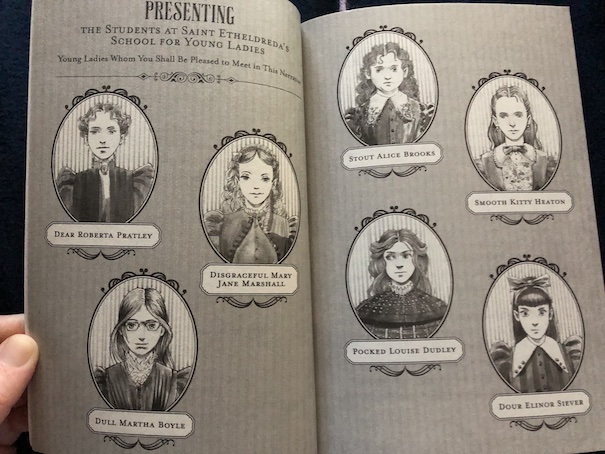
The seven girls are:
“Dear” Roberta Pratley – Her mother died while she was still young, and her father remarried. It was her stepmother’s idea to send her to boarding school, thinking her too soft, clumsy, awkward, and overindulged by her late mother. Her stepmother hopes that boarding school will strengthen her and turn her into a more graceful young lady. Roberta is known for being gentle and kind. She’s good at sewing.
“Disgraceful” Mary Jane Marshall – She was sent to boarding school by her mother, who has noticed that Mary Jane, while still rather young, is very pretty and precociously flirtatious, with a tendency to attract disreputable and penniless young men. Worse still, Mary Jane enjoys the company of these disreputable young men and regularly slips away from her mother to see them on the sly. Fearful that Mary Jane’s recklessness with young men will lead her into a disastrous marriage too early in life, her mother enrolled her in an all-female boarding school to keep her away from boys and, hopefully, give her a chance to mature and improve herself. So far, it’s not working. The only non-disreputable young man who interests her is the young local police constable.
“Dull” Martha Boyle – Martha has four brothers at home who make her life miserable with their pranks and teasing. Boarding school gives her an escape from them. She isn’t considered very bright, but she has a talent for music. She has a crush on a nearby farmer’s son.
“Stout” Alice Brooks – Poor Alice has a tendency to put on weight and is often compared unfavorably to her cousin Isabelle, who seems to be able to eat anything she wants without putting on an ounce. Alice doesn’t really hate Isabelle for this, but she’s tired of her grandmother’s criticism over it. She has a crush on a young law clerk.
“Smooth” Kitty Heaton – Kitty’s mother died when she was only four years old, and Kitty has no other siblings, which is a disappointment to her father, who hoped for a son to take over his business enterprises one day. Kitty’s father largely ignores her, and he has not yet noticed that Kitty is developing some shrewd business skills herself.
“Pocked” Louise Dudley – Louise’s face is scarred because she contracted smallpox at a young age. She survived this potentially-deadly illness because her devoted uncle, a talented doctor, nursed her through it. Ever since, she has revered her uncle and looks up to him as a mentor. Her uncle enjoys sharing his scientific and medical knowledge with her, he encourages her studies, and he thinks that she has the potential to a be doctor herself. Unfortunately, Louise’s parents don’t think that this is a proper profession for a young lady, so they sent her to boarding school to learn the kind of skills young ladies need to know to be wives and mothers. However, Louise has not given up her scientific interests.
“Dour” Elinor Siever – Elinor has a macabre side to her personality. Actually, her macabre side is most of her personality. When she was younger, she started sneaking out at night to explore, and she watched with fascination as the old grave digger in her town exhumed bodies to rob them or sell them for medical experiments. When the old grave digger spotted her watching him, she gave him a fright, and when her parents found out what she’d been doing, they packed her off to boarding school to put an end to this morbid interest and encourage her to be a sweeter, more cheerful, and more normal girl. None of that is working, but her morbid interests are about to come in handy when death comes to the little school.
One evening, while the headmistress of the girls’ school is dining with her visiting brother, both the headmistress and her brother are poisoned. The girls are saved because they were not eating the same food. Realizing that the headmistress and her brother are dead and quickly concluding that they were murdered, the girls debate about what to do. They consider calling a doctor, but it’s obviously too late for that. They could get the police, but before they do, the girls stop to consider what this will mean for themselves.
They have no idea who poisoned the headmistress and her brother. The girls prepared the food they were eating, so the poisoner could have even been one of them, or at least, they could be potential suspects. At the very least, the death of the headmistress means the end of the school, and the girls will all be sent home to their families. The truth is that the girls don’t want to go home. Each of them has some sort of tension at home or a reason why they were sent away, and they’ve all become like sisters to each other. More than anything, they want to be able to stay together and have some freedom from their tensions at home.
With their headmistress gone and no adults around to tell them what to do, what not to do, or how to be, the girls realize that they have unprecedented freedom to do as they like and be themselves, but that’s not going to last if they’re suspected of murder. Kitty is the first to suggest that they not tell anyone that the headmistress and her brother are dead, but she’s also the first to realize that, if they don’t find out who killed them, there will be a scandal, and each of the girls will be under suspicion for the rest of their lives. While Kitty relishes the idea of taking charge of the other girls and having them organize their own lessons and self-study from now on, according to the subjects that interest each of them the most, they also need to investigate and solve the murders. There is little hope for any of their future prospects if they have to go through life as murder suspects.
Their first problem arises when some friends of the headmistress and her brother show up unexpectedly as part of a surprise party for the brother’s birthday. Acting quickly, the girls hide the bodies and convince the guests that the brother has gone to India suddenly to tend to a sick relative and their headmistress has gone to bed because she was feeling unwell. However, one of the girls accidentally injures the ankle of the choir teacher, who has to spend the night at the school, causing them further complications. Desperately, the girls try to cover up the fact that their headmistress is dead and buy themselves time to investigate.
Although none of the girls is what their families consider a proper Victorian young lady, they each have skills that are useful to their deception and investigation. Kitty is good at organizing and managing people, and Mary Jane knows how to charm them. Elinor isn’t afraid of handling the dead, and Louise has scientific knowledge. Alice is the right size to pose for their headmistress in her clothes, and she has some acting ability.
Can the girls find the real murderer before someone figures out that two murders have taken place and blame the girls for them? What will the girls do if it turns out that the murderer is one of them? And, if it’s not one of them, what’s to stop the murderer from trying to kill again if he believes the girls’ ruse that their headmistress is still alive?
The book is available to borrow and read for free online through Internet Archive (multiple copies).
My Reaction
This is a humorous mystery with delightful characters! Although none of the girls is quite what their families or society wishes they were, readers will see that some of their supposed defects are actually strengths and skills. The humor in the story is dark, and the girls are unsentimental about the deaths of their annoying headmistress and her odious brother. They explain the reasons for their lack of sentimentality through their explanations of the victims’ characters. Neither of them was ever very nice to the girls, and they both had dark sides to their personalities.
Because some of the girls have morbid tendencies or possibly scandalous sides to their personalities that they need to cover up, it is plausible from the beginning that one of them could have had a reason to kill the headmistress, leaving readers more in suspense about the identity of the murderer. Although the girls love each other like sisters, there are moments when even they question whether they can really trust each other. However, the introduction of the headmistress’s friends and associates add other possible suspects to consider.
The first half of the book is largely about the girls getting themselves organized and covering up the deaths of the headmistress and her brother. They get more into solving the murders about halfway through the book, although they begin developing suspicions before that. I was pretty sure from the beginning that none of the girls did it, although the book does a good job of making it plausible that they could have. However, the girls soon learn that there were sides to their headmistress and her brother that they didn’t know about.
Early on, I had a theory that there could be more than one murderer involved. The headmistress and her brother didn’t seem to have exactly the same symptoms when they died, so I thought that it was possible that they were poisoned by different people coincidentally at the same meal. That’s not quite the right answer, although the parts of the story that made me think so are actual clues to what really happened. There are multiple villains in the story, some working together and some not. Some of what I suspected turned out to be true, but not all of it, and I didn’t figure out the whole situation before the characters explained it.
During the course of their adventures, the girls remain friends, and they also come to realize some things about themselves. Some of the girls develop budding romantic interests. Whether or not those fully develop, we don’t know, but it appears that there’s someone out there for everyone. Even Elinor finds someone to bond with over her morbid fascination for death. Some of the girls also come to realize talents they didn’t fully consider before and begin developing ambitions for their future. Kitty comes to reckon with her father’s lack of interest and emotional connection with her, and she also comes to realize that she shares some traits with him, even some of the less desirable ones. She realizes that she doesn’t want to be like her father, cold and commanding. While she felt little for her old headmistress, she was primarily motivated by her warm feelings for her best friends and fellow students, whom she regards as sisters. Because of her father’s detachment, she desperately guards the only warm connections she has in her life. Fortunately, the book has a happy ending. Circumstances allow the girls to continue with their education together in a way that supports all of their interests and under the guidance of someone who truly cares for them and understands them.
William Brown is an imaginative young boy who gets into trouble in various ways. People often don’t understand why William does the things he does because they don’t know what books he’s been reading or movies he’s been watching that inspire him to his various escapades.
William isn’t an example of how anybody should behave. He frequently lies to get his way, and he and his friends have formed a kind of club that they call the Outlaws, and they play at being outlaws. William is a scamp and a troublemaker, who sometimes means well and sometimes doesn’t because, after all, he thinks of himself as an outlaw. His family well know what William is like and the scrapes he’s likely to get into unsupervised, yet he is often left unsupervised and even given some responsibilities, which inevitably go horribly wrong.
This is the first book in a series, and each chapter in the book is a short story. Most of the books in the series are also collections of short stories. The stories are funny, but there are some things modern readers should be aware of, especially before sharing them with modern children.
This vintage British children’s series is well-known, although it has faced criticism for the ways the children in the stories treat animals. There are multiple incidents in this book – from the things the kids do with their pets when they have a circus to the lizard William accidentally kills in his pocket to the pet rat that gets killed when William tries to teach it to be friends with his dog.
There are also instances of inappropriate racial language, especially related to Native Americans because William finds them fascinating, at least in the way that books and movies portray them. At one point in this book, William pretends to be an American Indian, and the girl his brother likes plays along with him. William darkens his face with cork for the game, and the language they use with each other is stereotypical of old stories and movies with American Indians, like “paleface”, “red Indian”, and “squaw.” Various people use the phrase “Honest Injun” in the story.
William has a little extra money, so he buys some candy and goes to the picture shows. (These are silent pictures because of the time period, and William notes how exaggerated the actors’ facial expressions and gestures are.) William is inspired by the movies he’s seen, and he spends the rest of the day acting out what he’s seen, producing some embarrassing results because real life aren’t like movies.
2. William the Intruder
William’s older brother, Robert, has a crush on a girl. Robert gets their mother to invite her to tea, but he worries that William will mess things up because William often does. Their mother says that William will need to have tea with the family, but William is under strict instructions to spend the rest of the time playing outside and staying out of the way. However, the girl turns out to be a good sport who likes children, and she joins William in a game of pretend, where they pretend to be American Indians. Robert is disappointed that the girl seems to like William better than she likes him.
3. William Below Stairs
William gets into trouble at home, and feeling hurt and misunderstood by the just criticisms of his latest escapades with a balloon and inspired by a book that he’s been reading, he decides that the thing to do is to set out into the world to seek his fortune as a poor but deserving young man. He figures that everyone will be sorry when he gets rich with gold nuggets (like in the story) and won’t share them. Deciding that he will start out as a beggar and approaching a wealthy house to beg, William is mistaken for a boy who is supposed to be a new servant and gets his first taste of domestic labor. It turns out that being a poor but deserving young man requires more work than William is willing or able to do.
4. The Fall of the Idol
William gets a crush on his teacher and tries everything he can think of to impress her, including (gasp) actually studying for a change. Unfortunately, his teacher definitely doesn’t feel the same way about him.
5. The Show
William and his friends, a group called the Outlaws, decide to hold a circus. Aunt Emily, a hypochondriac relative who’s been making an unwelcome long stay with the family becomes an unwitting side show as the “fat wild woman” when William charges viewers to see her sleep and snore loudly. When the aunt wakes up and catches William and his guests, it ends her visit, but William’s father is actually relieved.
6. A Question of Grammar
William is bored on a rainy day, his family members all have something to do, and he doesn’t know what to do with himself. His mother’s suggestions are all boring ideas, his siblings have friends over, and his father just wants to be left alone. William asks his mother if he can have a friend over, but she says it’s too late to ask anybody. His family is all relieved when the rain is finally over, and they can send William outside to play.
However, William is still thinking about the idea of having friends over and having a party. His father emphatically refuses to consider the idea of William having a party, but later, a lesson at school about double negatives convinces William that his father’s refusal can actually be taken as approval. He knows the rest of his family will be going to visit an aunt soon, so he invites the children from his class at school to a party while his family is gone. The cook refuses to believe that William really has approval to have all of those children over, so she locks them outside, but William turns the party activity into a storming of the castle and a wild game of hide-and-seek!
7. William Joins the Band of Hope
When William’s mother makes him get cleaned up and try reading a book for a change, he accidentally convinces a visitor that he’s a serious and shy little darling. The visitor is a socially prominent woman who is involved with good works, and she persuades William’s mother to have him participate in one of her projects because children of their “class” are a good influence on others. William’s mother has doubts about how well that description fits William, but she is anxious to please this socially prominent guest, so she agrees to let William participate. William tries to get out of it by faking sick and pretending that he has a sprained ankle, but his family is unconvinced by his charades. However, it turns out that William’s other friends, part of a group they like to call the “Outlaws”, have also been recruited for the project. They make the meeting more interesting for the other children by teaching them a variation of William’s favorite game – one that his mother has forbidden him to play because it’s too rough.
8. The Outlaws
William’s mother volunteers him to take a neighbor’s baby for a walk as a favor, in spite of William’s brother pointing out that William might not be the most responsible person to look after a baby for any length of time. Unfortunately, William’s brother refuses to take care of the baby himself, so William is left with the chore that people should know he isn’t likely to carry out responsibly. William resents his mother giving him this task on his half day off school, and he dreads what his friends will say if they see him pushing a baby carriage. Then, William gets an idea. He takes the baby along to a meeting of the Outlaws as a kidnap victim to be held for ransom. The other Outlaws are thrilled with the idea, but the baby turns out to be too much for all of them.
9. William and White Satin
William is enlisted to be a page boy at a relative’s wedding, very much against his will. The bride thinks the idea of him being a page boy is sweet and romantic, but William knows all of his friends will make fun of him, seeing him dressed in the white satin outfit he has to wear. What saves the day for William is that the young girl recruited to be the bridesmaid thinks the whole thing is as sickeningly sweet as he does. When the two of them get too dirty in their outfits to take part in the ceremony, they are mercifully left at home to play their own games, and they think that’s much more fun and romantic than any wedding!
10. William’s New Year’s Day
Mr. Moss, who runs the store where William buys candy, says that he’s been asking the same woman to marry him every New Year’s Day for 10 years. William thinks that’s too many years to ask anybody over and over again, and he can’t understand who would turn down somebody who owns a sweet shop. On New Year’s Day, Mr. Moss has to run to catch his train to meet the lady, so he leaves William in charge until his nephew shows up to manage the shop. Mr. Moss thinks that William will only be in charge for a few minutes, but his nephew is sick and doesn’t come. William, left in charge, takes far more candy than Mr. Moss said he could have and attempts to overcharge another customer to cover the difference while he is overwhelmingly generous to a pretty girl he likes. Then, he generously hosts his friends and makes a mess. When Mr. Moss returns around lunch time, he would be more angry except that the lady finally agrees to marry him, and in the end, William has to cope with a serious stomach ache.
11. The Best Laid Plans
A young man has a crush on William’s sister, so he recruits/bribes William to be his confederate in a scheme to impress Ethel, getting him to fake sick on a trip with his sister so the young man can step in and “rescue” them by carrying William home. However, William turns out to be more of a handful (literally) than the young man expects, and the pet white rats that were William’s bribe cause chaos in the Brown household. (One of the rats meets a sad end from William’s dog when he tries to teach the two to be friends.)
12. ‘Jumble’
Although William’s dog, Jumble, appears in earlier stories in the book, this story is about how William acquired Jumble. Jumble the dog follows William home one day. He has a collar with his name on it but since he’s loose by himself, William thinks he’s a stray. His family tells him to take the dog to a police station to see if he has an owner, but William just can’t bring himself to leave Jumble there, so he brings him back home and tells his family that the dog followed him again. Eventually, Jumble’s owners do find him again with William. William insists that he didn’t steal Jumble, and he reluctantly asks if the family who owns him if they want him back. The girl in the family, who is William’s age, decides to give Jumble to William because she’s decided that she wants a Pomeranian instead, and the father of the family, who is an artist, sketches William with Jumble because he thinks that William has such an interesting expression.
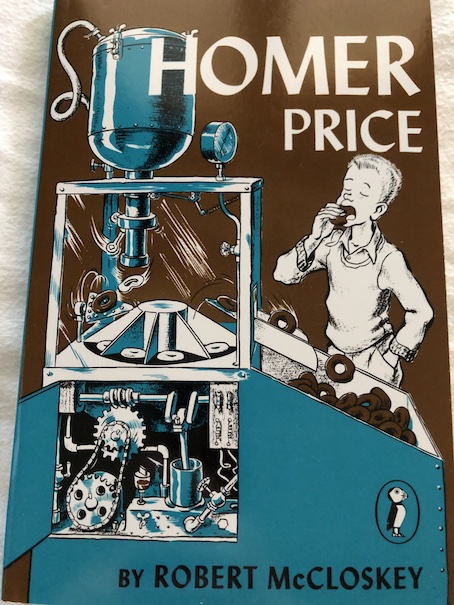
Homer Price is a collection of short, humorous stories about a boy who lives in a Midwestern town called Centerburg. His parents own a tourist camp with cabins and a filling station, and Homer helps out there with odd jobs. In his spare time, he has a hobby, building radios.
Many people remember this book specifically for the episode of the doughnut machine that goes out of control. Stories in the collection have been made into tv episodes or short films three times, and two of those are based on the doughnut machine story. (Sometimes, they appear on YouTube.) There is also a sequel to this book called Centerburg Tales: More Adventures of Homer Price.
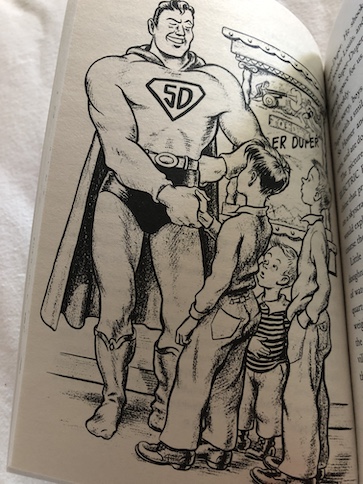
It didn’t occur to me until I started reviewing the book for this site, but it was first written and published during WWII. The war doesn’t play any part in any of the stories in the book, but it occurred to me as a fun collection of stories that its first audience of 1940s children might have enjoyed as a break from the chaos of the world around them. Various aspects of 1940s society and culture appear in the stories in humorous ways, like the comic book superhero who resembles Superman (a character introduced in comic books in 1938), lunchrooms (small diner-style restaurants), and the concepts of advertising, mass production, and suburbs with prefabricated houses.
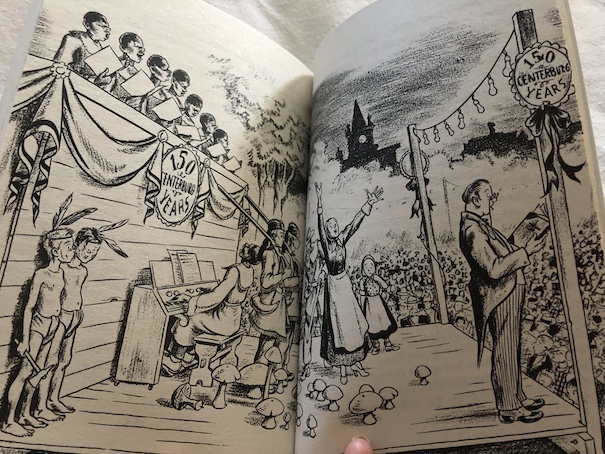
There is one incident that readers should be aware of that concerns descriptions of Native Americans. When the town holds its 150th anniversary celebration, Homer and his friends have roles in skits about the history of the town, playing Native Americans, and part of their costume involves dyeing their skin, which would be considered tasteless and racist in the 21st century. Their skit also includes a “scalping scene” (not really described, except saying that it “had to be modified somewhat”), which would also definitely not pass modern standards in any public performance. Because this is a collection of intentionally humorous stories, I’m not sure whether the author included this stereotypical depiction of kids playing Native Americans in a tasteless way to poke fun at such depictions or not, but I though it was worth mentioning for the benefit of people sharing these stories with children, so you know that part is there.
I didn’t notice anything particularly concerning about the depiction of black people in the book. Black people are included in the stories as members of the community without too much attention to the fact that they’re black. They’re simply part of the town, and nobody makes a big deal about them being there or refers to them by any derogatory names. One black boy finds a wealthy lady’s bracelet inside a doughnut in the doughnut machine story, and the local African Baptist Church choir performs at the town celebration.
Stories in the Book:
The Case of the Sensational Scent
One evening, Homer gets his usual bedtime snack of milk and cookies and leaves some milk out for his pet cat. However, a skunk wanders in and finds the milk. Homer decides to try keeping the skunk as a pet, naming it Aroma. Aroma helps to thwart a gang of robbers.
Case of the Cosmic Comet
Homer and a couple of friends are reading comics and marveling over a superhero called Super Duper (who is sort of like Superman). Later, Homer’s friend Freddy says that there’s going to be a Super Duper movie playing in town and that Super Duper himself will be there. Homer isn’t quite as enthralled with Super Duper as Freddy is because he knows it’s just fiction, and he thinks the stories are kind of formulaic, but he agrees to come to the movie. When the Super Duper’s car crashes as he leaves, they see that the Super Duper is actually an ordinary human who doesn’t really have super strength and can get hurt. Fortunately, he isn’t hurt badly, and the boys take their disillusionment well, profiting from the help they give him.
The Doughnuts
Homer’s aunt and uncle own a lunchroom, and his uncle is a gadgeteer with a weakness for buying labor-saving devices. One of these devices is an automatic doughnut-making machine. One day, Homer’s uncle is trying to fix the doughnut-making machine, and he asks Homer if he can finish fixing it and make some doughnuts for him while he runs an errand (really, he’s going to play pinochle at the nearby barber shop) because Homer is good with mechanical devices. When Homer gets some help from a patron, mixing up masses of doughnut dough from her family’s old recipe and runs the machine, Homer has trouble turning off the machine. It just keeps making more and more doughnuts! What are they going to do with all these doughnuts, and will they ever get the machine to stop?
Mystery Yarn
Miss Terwilliger is locally known as a great knitter. She’s taught most of the local women how to knit, and everybody also loves her fried chicken. She has two admirers who would like to marry her, the local sheriff and Homer’s Uncle Telly, but she just can’t make up her mind which she would like to marry. When the Sheriff and Homer’s Uncle Telly compete to see which of them has the largest collection of string, the Sheriff arranges for the two of them to unroll their giant balls of string at the local fair to prove which of them has more string. They also decide that whichever of them win the contest will also win Miss Terwilliger … until they discover that Miss Terwilliger also collects string and is determined to enter the contest … and she just might be beat them both. All’s fair in love and string collecting, and to the winner go the spoils!
Nothing New Under The Sun
A strange man comes to town. He seems a little odd and kind of shy. The sheriff is a little concerned about who he might be. The stranger himself just makes an odd comment about having been away from people for a long time. The stranger might be a shy eccentric, but the sheriff is concerned that he might be some kind of fugitive. The sheriff talks to various people around town, and they all offer their advice about how to judge a person’s character and what they think about the stranger. Various people say that he reminds them of someone from a story, and the town librarian identifies the character they’re thinking of as Rip Van Winkle. Could this stranger really be an old man who fell asleep for 30 years in the mountains, like in the story? If so, what’s with the bizarre vehicle the stranger has? When Homer finally persuades the man to show him his car and tell him who he is, the story turns out to be stranger than fiction: he’s a man determined to literally “build a better mousetrap” and turns out to be a kind of modern-day Pied Piper.
Wheels of Progress
Centerburg is celebrating its 150th anniversary with a public celebration and the creation of a new suburb with mass-produced, prefab tract houses (the kind made fun of in the song Little Boxes by Malvina Reynolds, which “all look just the same”). The identical nature of the houses turns into a nightmare when the street signs aren’t ready in time for the grand opening celebration, confusing the townspeople.
Fun fact: The original name of the town is revealed to have been “Edible Fungus” after the edible fungus that kept the original settlers who founded the town alive. The choir in the story sings a song about it.
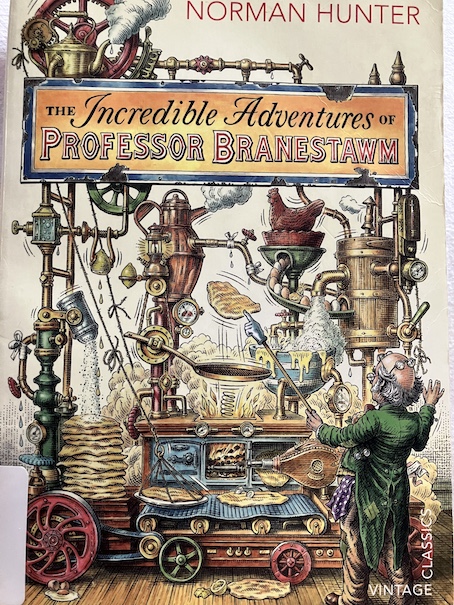
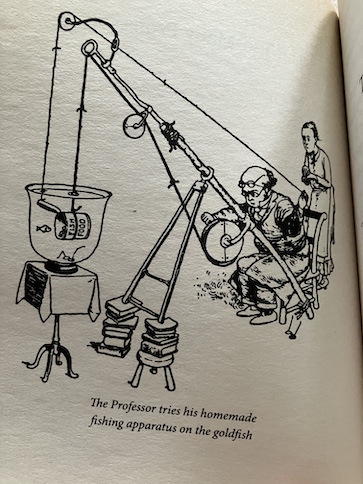
The Incredible Adventures of Professor Branestawm by Norman Hunter, 1933.
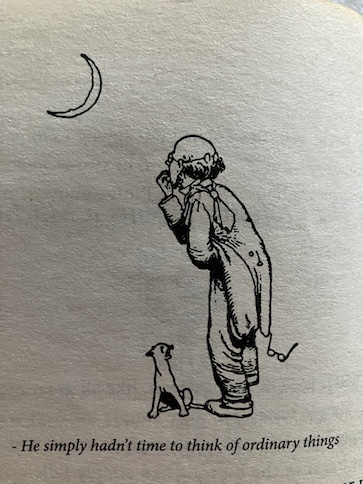
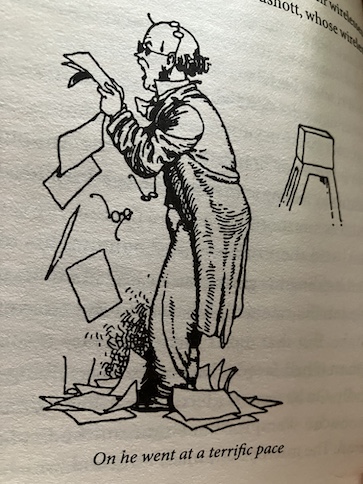
Professor Branestawm is a classic absent-minded professor. He’s is a balding man who wears several pairs of glasses, one of which is for finding the other pairs of glasses when he inevitably loses them. He’s a very clever man, but everyone knows that his inventions are likely to cause chaos. He’s not an easy person to talk to, so he doesn’t have many friends. His best friend is Colonel Dedshott, who is a very brave man.
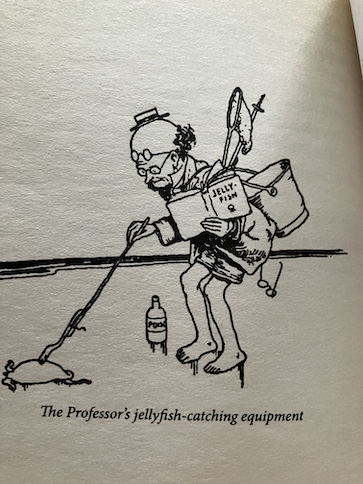
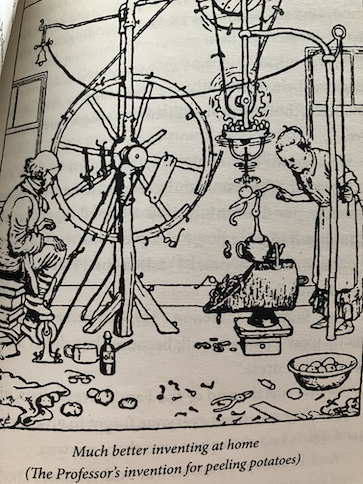
Every chapter in this book is about another of the Professor’s inventions and the adventures that the Professor, the Colonel, and the Professor’s housekeeper, Mrs. Flittersnoop, have with them and with various situations that the Professor creates with his absent-mindedness. The stories are accompanied by pen-and-ink drawings. I love the way almost every picture of the professor shows him shedding one or more of his many pairs of glasses and that the Colonel’s weapon of choice is a slingshot!
Chapter 1: The Professor Invents a Machine
One day, Professor Branestawm invites the Colonel to his house to see his latest invention, which he says will revolutionize travel. When the Colonel arrives, Professor Branestawm explains his idea. First, he points out that, if you’re traveling somewhere, you’ll arrive in half the amount of time you ordinarily would if you travel there twice as fast. The Colonel says that makes sense. Then, Professor Branestawm says that, the faster and faster you travel, the sooner you arrive at your destination. That also makes sense. Further, Professor Branestawm says, you eventually start traveling so fast that you arrive before you even start, and if you go fast enough, you can arrive years before you start. The Colonel doesn’t really understand this, but he takes the Professor’s word for it. The Professor has built a machine that will allow them to travel that fast, and the Colonel is eager to try it. He suggests that they try going back in time to a party he attended three years earlier. The Professor insists that they take some powerful bombs with them, just in case of emergencies (don’t try to make sense of it, there isn’t any), and the Colonel has his trusty catapult (slingshot) and bullets with him.
It turns out that, rather than going to the party three years earlier, they arrive at the scene of a battle that took place in another country two year earlier. Although they already know how the battle turned out, the Professor and Colonel can’t resist joining in with their bombs and catapult, and they end up wiping out an entire army and changing the result of the battle in favor of the revolutionaries. The revolutionaries are so grateful to them for their help that they take them to the palace of their former king, put the two men on the enormous throne there, and make them the new presidents of the country. Professor Branestawm realizes that they’ve made a terrible mistake and changed history because the king’s army was the one that was originally supposed to win the battle. The Colonel, however, doesn’t care because he thinks it sounds like fun to be a president and can’t wait to do some ruling.
Of course, the ruling of the two presidents doesn’t go well. Neither one of them really knows anything about running a country. Since they blew up all the country’s troops, there are no troops left for the Colonel to review, and he ends up playing with toy soldiers. Meanwhile, the Professor really just wants to get back to his inventing. Eventually, the revolutionaries get tired of this and tell them that they’ve decided that they don’t want any presidents, so they’re giving them a week’s notice before they’re out of a job. The Professor and the Colonel try not to take any notice (ha, ha) of the revolutionaries’ attempts to dethrone them. This just leads to the revolutionaries trying to imprison them in the dungeon, so the Professor and the Colonel are forced to escape in the Professor’s machine, which takes them back to the exact time and location where they started. They arrive just as the Professor’s housekeeper brings them some tea, so they have their tea, go about their usual business, and leave it to the historians to deal with the complications of the two of them changing history.
Chapter 2: The Wild Waste-Paper
When Professor Branestawm’s housekeeper puts a bottle of cough syrup with no stopper into the waste-paper basket, it accidentally creates a waste-paper monster! It turns out that it wasn’t really cough syrup in the bottle. It was a special life-giving formula that the professor invented. He only keeps it in a cough syrup bottle because cough syrup is the only thing that neutralizes the life-giving formula and stops it from bringing everything it touches to life, including the bottle holding it. Now that they’ve accidentally created a waste-paper monster, what can they do to stop it, especially since it seems to have the ability to use tools and is currently trying to saw down the tree where the Professor and his housekeeper are trying hide?
Chapter 3: The PRofessor Borrows a Book
Professor Branestawm accidentally loses a library book about lobsters, so he goes to another library to get the same book. By the time that he needs to return the library book, he has found the first one and lost the second one. For a while, he manages to avoid library fines by continually returning and checking out the same book from both libraries because the libraries don’t notice which library the book is from. Of course, he eventually loses the first book, too. He tries to fix the situation by getting the same book from a third library and then one from a fourth library, when he loses the third book. Where will it all end? How many libraries will have to share this one book, and where on earth are all these books about lobsters going?
Chapter 4: Burglars!
Professor Branestawm and his housekeeper go to the movies to see a documentary about brussels sprouts. (The housekeeper doesn’t care about brussels sprouts, but there’s a Mickey Mouse cartoon included with the feature, and she wants to see that.) When they get back, they discover that the house has been robbed! Professor Branestawm decides that he’s going to invent a burglar catcher, but the only burglar he catches is himself.
Chapter 5: The Screaming Clocks
Professor Branestawm’s clock stops, so he takes it to a clock repair shop. It turns out that the clock has only wound down because the Professor has forgotten to wind it. The Professor decides that he’s going to invent a clock that will go forever and never need winding. (This story is set before clocks that don’t need winding became common.) The Professor does invent a clock that will never stop and never need winding, but he makes a critical mistake: the chimes never reset after they strike twelve. They just continue counting up and up, endlessly, with no way to stop them! Just how many times will they endlessly strike before something terrible happens?
Chapter 6: The Fair at Pagwell Green
The Professor visits a local fair and invites the Colonel to join him. The Colonel ends up winning most of the prizes for the various games, and the Professor accidentally gets left behind in the waxworks exhibit, being mistaken for a wax statue of himself. When the Professor decides that it’s finally time to get up and go home, the people who work in the waxworks think that a wax statue has come to life!
Chapter 7: The Professor Sends an Invitation
Professor Branestawm writes a letter to the Colonel, inviting him to tea, but because he is distracted, thinking about potatoes, he accidentally writes a muddled letter and then mails the paper he used to blot the letter instead of the letter itself. The message that arrives at the Colonel’s house is a backward, muddled mess, and he has no idea who sent it to him. Since it looks like it’s written in some strange language he doesn’t know, the Colonel decides to take it to the Professor to see if he can decipher it. The Professor fails to recognize the letter as what he sent and has forgotten that he sent it. Will the two of them figure out what the letter is about, or will they eventually just give up and have some tea?
Chapter 8: The Professor Studies Spring Cleaning
Professor Branestawm’s housekeeper’s spring cleaning creates some chaos in the professor’s house, and the Colonel suggests that Professor Branetawm invent a spring cleaning machine. Predictably, the spring cleaning machine creates an even bigger mess and far more chaos.
Chapter 9: The T00-Many Professors
Professor Branestawm invents a very smelly liquid that brings things from pictures to life. The things from the pictures go back to being pictures when the liquid dries. Of course, there are some things that cause big problems when they’re brought to life. Possibly the most chaotic pictures that come to life are pictures of the Professor and the Colonel and the professor’s housekeeper. Who is who and which is which?
Chapter 10: The Professor Does a Broadcast
Professor Branestawm is invited to give a talk on the radio, and the Colonel helps him to rehearse. However, because he gets mixed up, he almost misses his own talk, and when he finally gives it, he speaks too fast and discovers that the time slot for his talk is much longer than he thought it was. Listeners are confused, but everything is more or less all right when the Children’s Hour comes on.
Chapter 11: Colonel Branestawm and Professor Dedshott
The Professor and the Colonel are going to a costume ball. Since the Professor doesn’t know what to do for a costume, the Colonel suggests that the two of them dress as each other. This causes some confusion, and neither of them likes each other’s clothes. The Professor’s social skills aren’t even great at the best of times, and the truth is that he’d rather be inventing things at home in his “inventory” (pronounced “invEnt – ory” as in a laboratory where you invent things, ha, ha). Then, the Countess at the ball raises the alarm that her pearls are missing! Everyone is confused when they try to get “the Colonel” to find the thief, and he doesn’t seem to know what he’s doing. It takes a while for things to get sorted out, but at least the Professor and the Colonel develop a new appreciation for being themselves instead of being each other.
Chapter 12: The Professor Moves House
Professor Branestawm’s house has gotten so full of his inventions that it’s become difficult to live there, so he’s decided to move to a new house. Moving to the new house is an escapade, and when Professor Branestawm and his housekeeper get there, they discover that the water and gas haven’t been connected up yet. Professor Branestawm’s attempts to remedy the situation render the new house unlivable, so he is forced to move back to his older house.
Chapter 13: Pancake Day at Great Pagwell
Professor Branestawm invites his friends and various members of the community to his house for a party, where there will be tea and pancakes. Everyone is happy to go because of the promise of pancakes, but when they’re all there, Professor Branestawm reveals that the party is to unveil is newest invention: a pancake-making machine! As the library man predicts, the pancake-making machine goes wrong (just like the Professor’s other inventions), but it’s all right because the town council comes up with a new purpose for it.
Chapter 14: Professor Branestawm’s Holiday
Professor Branestawm takes a trip to the seaside. He asks the Colonel to join him and bring his book about jellyfish, but unfortunately, he neglects to tell the Colonel where he’s staying (partly because he forgot where he was supposed to stay and is actually staying somewhere else). When the Colonel tries to find the Professor, he accidentally mistakes an entertainer dressed as a professor for Professor Branestawm. When the entertainer isn’t acting like himself (so the Colonel thinks), the Colonel becomes worried and decides medical intervention is necessary.
The book is available to borrow and read for free online through Internet Archive (multiple copies). It’s the first book in a series about Professor Branestawm, and it was also adapted for television multiple times.
My Reaction
Kids won’t learn anything about real science from Professor Branestawm, but the stories in the book are funny and not meant to be taken seriously at all. Most of the stories are about some pretty silly things that don’t really mean much in the end, but when you think about it, the Professor’s antics do lead to some pretty serious consequences, from wiping out an entire army just for the fun of it (pretty horrific in real life) and changing the course of history to accidentally blowing up someone’s house with his perpetually-chiming clock. No matter what the Professor does, though, there never seem to be any lasting consequences.
Even when people around him brace themselves for when the Professor’s latest project inevitably goes wrong, everybody still thinks that the Professor is pretty clever. The Colonel always thinks the Professor is clever, and even when he knows that the Professor is bound to do something that’s going to cause chaos, he enjoys the excitement. The housekeeper sometimes goes to stay with her sister, Aggie, when the chaos and excitement get too much for her.
The stories are just meant to be enjoyed for their zaniness, and there’s no point in analyzing them much. You don’t have to worry about whether anything the Professor does makes sense or exactly how he got any of his inventions to work. You can just enjoy seeing how everything develops and watch the craziness unfold! It sort of reminds me of Phineas and Ferb’s summer projects, which cause some chaos but are ultimately funny and always disappear at the end of the day. Enjoying these stories is what they used to say in the theme song for the tv show Mystery Science Theater 3000:
“If you’re wondering how he eats and breathes And other science facts, Just repeat to yourself “It’s just a show, I should really just relax …”
I can promise you that, no matter what happens in any of the stories, the Professor and his friends will ultimately be fine and will probably have a cup of tea (or “a cup of something”) afterward. This book was originally published in Britain the early 1930s, and it was read by children during the Great Depression. I can imagine that it might have given children then a good laugh and some escapism during troubled times.
Strangely, at least one of the Professor’s inventions, the clock that never needs winding, is a real invention that we have every day because time has moved on (ha, ha) since this book was originally written and published. In fact, it’s very unusual to find clocks that need to be wound these days. Of course, the part about the clock perpetually chiming more and more and blowing up when it gets to be too much is just part of the craziness of Professor Branestawm.
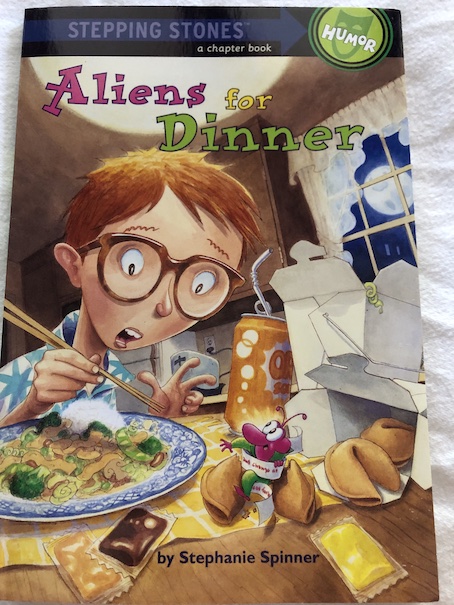
Aliens for Dinner by Stephanie Spinner and Jonathan Etra, 1994.
This book is part of the Aliens for Breakfast Trilogy, a short, easy chapter book series for elementary school children.
Richard Bickerstaff is unhappy because his mother has started dating a man named Bob Baxter. Richard thinks that Bob is weird, and he has an annoying habit of repeating himself. Then, one evening, when Bob is having dinner with Richard and his mother, Richard’s small alien friend, Aric, arrives with their Chinese food, hidden in a large fortune cookie. Aric is a commander of the Interspace Brigade, and they operate on a shoestring budget, so they often transport Aric in some form of food to save money.
Richard manages to slip away from his mother and Bob and takes Aric to his room, where Aric tells him about his latest mission. Earth is in danger from aliens from a planet called Dwilb. Dwilbs have a bizarre love of pollution, and pollution problems have gotten bad enough on Earth to attract their interest. The Dwilbs want to make Earth even more polluted so they can turn it into a pollution-themed amusement park for themselves called Toxic Waste Funland. Aric says that they’re so confident in their plan that they’re already running advertisements. Aric will need Richard’s help to stop them!
Richard asks Aric questions about what the Dwilbs are like. Aric says that they look like humans, but they have an odd habit of saying everything twice, and the repetition seems to have a hypnotic effect. Richard thinks that sounds familiar, and he remembers why when his mother and Bob come to say goodnight to him. Bob repeats himself! Richard starts to think that his mom might be dating an alien!
Meanwhile, the Dwilbs have caused a major oil spill nearby as part of their plan to pollute the planet further. Local people have been trying to help with the cleanup, but it seems like it’s just getting worse. Richard goes to take a look and sees Dwilbs splashing about in the oil, having fun! They love the oil spill, the exhaust from cars, and everything that’s dirty.
Richard asks Aric what they can do to stop the Dwilbs, but as often happens when Aric travels in the bizarre ways that Interspace Brigade sends him, has trouble remembering the Dwilbs’ weak point. While Aric struggles to remember, the Dwilbs start influencing the kids at Richard’s school, getting them hooked on a treat they call Sludgies. Under their influence, the kids start littering and stop caring about the environmental efforts their teacher is trying to talk to them about. Even Richard’s friend, Henry, is under their power and in no state of mind to help Richard.
Fortunately, there is a secret weapon right there at Richard’s school: the school principal and his ability to bore everyone almost to death. In the case of the Dwilbs, boredom is a serious threat!
My Reaction and Spoilers
The books in the Aliens for Breakfast Trilogy are humorous sci-fi stories, and the solutions to defeating the aliens always have some comic twist. The solution in this case is getting the school’s principal to speak to them and bore them out of their minds. Richard has to arrange for his principal to speak at a place where he knows all the aliens will hear him.
Richard has run into situations in previous books where strange people he knows turn out to be sinister aliens in disguise, and in this case, he thinks that Bob is one of the Dwilbs. However, there is a twist to this story. Bob isn’t one of the aliens. He’s a little odd, but he’s a human. His quirks just happen to resemble the Dwilbs. He has a habit of repeating himself, but he’s not at all bored by the way the principal speaks or the way Richard speaks when he imitates his principal. Bob is often a little boring himself. By the end of the book, Richard feels better about Bob when he discovers that Bob likes comic books as much as he does. The two of them start bonding by sharing comics. Bob has a collection of older comics that Richard has been wanting to read, and he lets Richard borrow them.
I like the references in the story to real franchises that fans of science fiction and comic books would know. Richard has a collection of X-Men comics.
The book was published in the 1990s, when I was still in school. I remember my teachers talking to us about environmental issues back them, especially about pollution and the importance of recycling. They often urged us to get involved and do our part to recycle and not litter. The environmental messages in this story, especially the ones Richard hears at school, bring back memories for me.















 Jestress's Forgotten Books and Stories