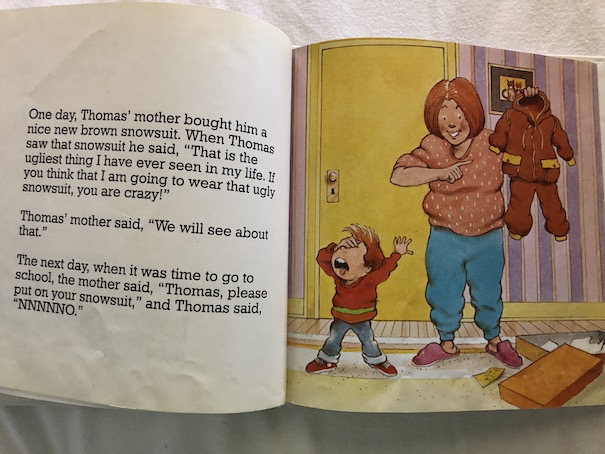
Thomas absolutely hates the new snowsuit that his mother bought him. He thinks it’s ugly. When it’s time for him to go to school, his mother has to wrestle him into it because he refuses to put it on himself.
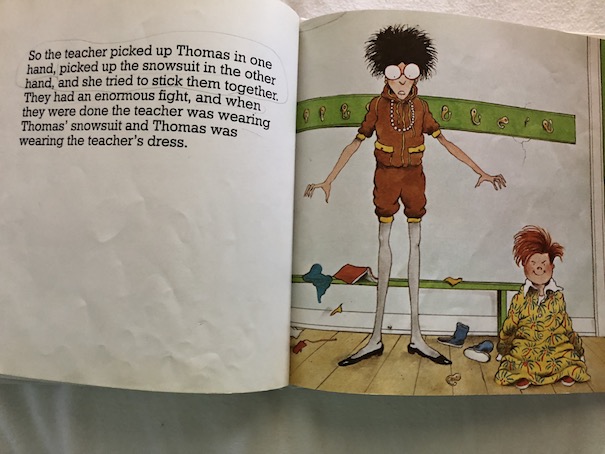
That’s fine until it’s time for Thomas to once again put on his snowsuit so he can go outside for recess. His teacher insists that he has to wear it, but he refuses. When the teacher tries to wrestle Thomas into his snowsuit, the results are hilarious!
Thomas and his teacher end up getting their clothes all mixed up. When the school’s principal tries to help, it only makes things worse.
Finally, Thomas is persuaded to put on his snowsuit when a friend of his wants him to come out and play.
Thomas eventually helps set the teacher and principal right again after recess, and the principal decides that it’s time to retire to Arizona, so he won’t have to deal with snowsuits again.
Like all Munsch books, the storyline is bizarre and hilarious, and half the fun is watching it unfold in the pictures!
The book is currently available online through Internet Archive.
Robin is playing in her backyard sandbox when she hears a “Murmel, Murmel, Murmel” sound from a hole that she has never seen before. In the hole, Robin finds a baby. Since Robin herself is only five years old, she decides that she needs to find someone older to take care of the baby.
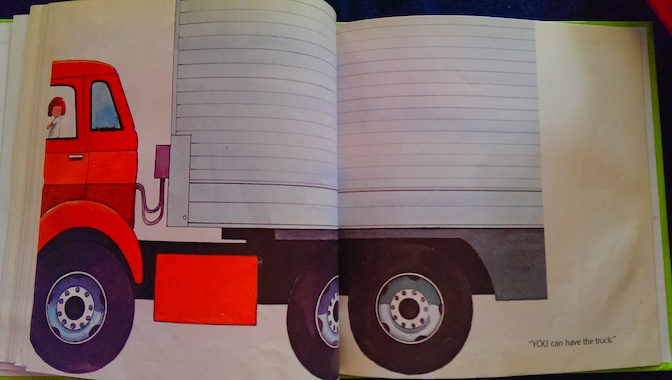
Robin asks various people, but they all have reasons why they can’t take the baby. Then, Robin encounters a truck driver who is enchanted with the baby’s “Murmel, Murmel, Murmel” and says that he wants him.
The story never explains where the baby came from, how he ended up in Robin’s sandbox, or if his parents are looking for him, but apparently, he’s happy with the truck driver. As for the truck driver’s truck, he says that Robin can keep it because he already has seventeen others. Robert Munsch books are like this. That’s basically the explanation.
The book is currently available online through Internet Archive.
Tyya begs her father to buy “something good” at the grocery store. Tyya would much rather have him get something like ice cream and cookies instead of boring things like bread and eggs, which is what he usually gets.
However, when she tries to get whole cartloads of ice cream and candy bars, her father makes her put it all back. Tired of her messing around, Tyya’s frazzled father tells her to just stand in one place and not move. Unfortunately, he tells her that near a display of large dolls. Because she doesn’t move, a store employee mistakes Tyya for a doll and puts her on the shelf with the others, giving her a price tag of $29.95.
Some people try to buy Tyya, but she yells at them, scaring them away. Tyya’s father comes to get her, but he has trouble taking her out of the store because she still has a price tag on her, and the man at the register insists that her father has to pay for her.
In real life, no grocery store would try to sell a child, and it would be a crime if they did. However, because this is a Robert Munsch story (where all kinds of crazy things happen), Tyya’s father finally pays the $29.95 because she’s worth it, and Tyya says that her father finally bought something good at the grocery store. Sort of touching, in an odd kind of way, I guess.
One of the benefits of this story is that it has a lot of potential for reading aloud because the reader can really play up the parts where the characters yell.
The book is currently available online through Internet Archive.
Moira wants to have a birthday party and to invite every kid in her school, from kindergarten to sixth grade. Her parents say that she can have only six party guests total, not six grades’ worth. However, so many kids at school want to come to her party that she ends up inviting the whole school anyway.
When every kid in school shows up on the day of the party, Moira’s parents are bowled over. There are so many kids that they hardly fit in the house. Moira calls up a pizza place, asking for an enormous amount of pizza, and a bakery, asking for an enormous amount of birthday cakes. The kids also help out by supplying their own food from home.
Naturally, Moira’s house is a mess, and her parents are upset, but Moira, seeing the enormous pile of birthday presents that everyone brought, promises a present to everyone who helps to clean up.
But, just when everything seems to have worked out all right, the trucks from the bakery and pizza place show up with the rest of Moira’s order.
The book is currently available online through Internet Archive.
It’s 1914, and Blossom Culp is just starting high school. Although the principal of her old school tells her that this is a chance for her to make a fresh start, it looks like Blossom’s future is going to be very much a continuation of her immediate past. In high school, she’s still a social outcast, looked down on by girls from better-off families, like Letty, the class president. Also, despite her principal’s assertion that Blossom’s previous forays into the occult were imaginary, the product of the mental confusion that accompanies puberty, and that she is bound to grow out of them, Blossom knows that her psychic abilities are a natural gift and will not be ignored.
Blossom begins high school friendless because Alexander Armsworth has been ignoring her lately because of his important new position as class vice-president, his infatuation with Letty, and his friendship with a couple of local hooligans, Bub and Champ. Alexander is looking forward to his role in planning the school’s Halloween Festival, telling Blossom that he’s over their earlier, childish occult escapades and the Halloween pranks he used to pull. Meanwhile, all of the other girls in school are infatuated with their handsome history teacher, Mr. Lacy, and so is the girls’ gym teacher, much to Blossom’s disgust. Blossom thinks that Mr. Lacy is full of himself and denies that she has any such silly crush on Alexander.
Blossom makes an unexpected friend in a girl called Daisy-Rae, a girl from the country who has brought her younger brother into town to attend school and hoped to get an education herself but has been too afraid of the big town to actually attend classes. Daisy-Rae hides in the school during the day and lives alone with her brother at night in the old chicken coop at the abandoned Leverette house. It is through Daisy-Rae that she learns that Alexander and his friends aren’t so above childish pranks as they claim to be. Blossom also discovers that Mr. Lacy has been romancing her old principal. Mr. Lacy isn’t quite what he appears to be and has some unsavory secrets in his past.
Matters come to a head when Alexander (at Letty’s urging) tries to persuade Blossom to dress up and become the fortune teller for the haunted house that the freshmen class is doing for the Halloween Festival. The haunted house is also a fundraiser, and Letty figures that they can get extra money from people if they’re willing to pay to have their fortunes told, and who would be better for the job than Blossom? However, Blossom isn’t one to go out of her way to please others, especially Letty, and it turns out that they’re holding the haunted house in the Old Leverette place. For some reason, that old house makes Blossom’s mother uneasy. She seems to think that it’s haunted, but in an unusual way. Blossom tells Alexander that she will not agree to be their fortune teller until he agrees to check out the house with her before Halloween and find out what’s wrong with it. She figures that, since both of them are psychic, they can learn what’s so unusual.
As Blossom learns, her abilities don’t confine themselves to the past and people who have died but extend to the future and the people who haven’t yet been born. Inside the Old Leverette house, Blossom suddenly finds herself entering the distant future, the 1980s. In the 1980s, the Leverette house is once again lived in, and Blossom meets a boy named Jeremy who is a lonely social outcast, like herself. Jeremy is a computer nerd, living with his divorced mother. He takes Blossom on a tour of their town as it is in Blossom’s future, much larger than it used to be and with many familiar landmarks missing. However, what Blossom sees in the future gives her the inspiration she needs to solve her problems in the past and hope that things will improve. In return, she also proves to Jeremy that he is far from alone and has had a friend for longer than he ever imagined.
The time travel to the 1980s comes off as being a little corny (or so it seemed to me), but the writing quality of the book is excellent. The author has an entertaining turn of phrase, and the book, like others in the series, is humorous and a lot of fun to read.
Besides being a kind of fantasy story, there are some interesting tidbits of history in the book, showing how people lived in the 1910s. Blossom explains about the things she and her classmates did at school, like wearing beanies on their heads to show which year they were (freshmen, future graduating class of 1918). At one point in the story, Blossom takes Daisy-Rae and her brother to their first movie, a silent film with an episode of The Perils of Pauline serial. While Blossom worries about the future, readers can get a glimpse of the past!
As for what Blossom learns about her own future, she avoids finding out too much because she’d rather not know the details. However, there are implications that she and Alexander may eventually marry and live in his family’s old house.
The book is currently available online through Internet Archive.
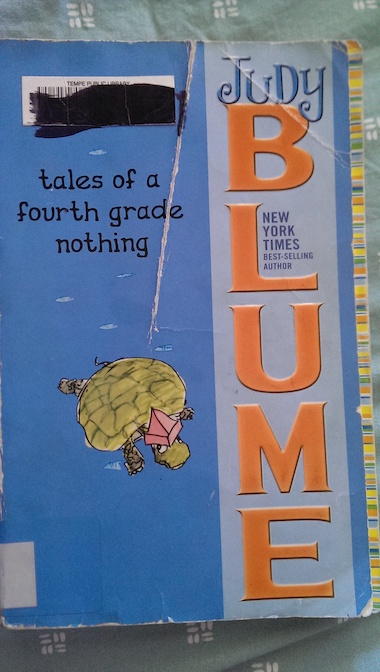
Tales of a Fourth Grade Nothing by Judy Blume, 1972.
Fourth-grader Peter Hatcher is being driven crazy by his younger brother, Farley, who everyone calls Fudge because he hates his name. People think that two-year-old Fudge (he turns three during the book) is cute, and his mother sometimes spoils him or gives in to his tantrums. To Peter, Fudge is a little terror, and he feels like his parents don’t care as much about him as they do about Fudge.
Most of the book is kind of like a series of short stories about Fudge’s antics which take place over the course of several months.
When Fudge goes through a phase of refusing to eat unless he gets to eat on the floor under the table, like a dog, their mother allows Fudge to get away with it, even patting him like a dog. Peter thinks that his mother would be better to let Fudge not eat until he gets hungry, and Fudge’s doctor gives her the same advice, but his mother lets Fudge’s behavior continue until their father gets tired of it and dumps a bowl of cereal on Fudge’s head, declaring, “Eat it or wear it!”
Fudge sometimes gets Peter into trouble, too. Peter’s mother takes them to the park along with Peter’s friend Jimmy and Sheila, a girl they know from school who also lives in the same apartment building as Peter. Their mother has to run back to the apartment for a moment, so Sheila volunteers to baby-sit Fudge. Mrs. Hatcher only allows it on the condition that Peter help her. Of course, Sheila, who is a pest, decides to chase Peter and tease him about having cooties, so no one is watching Fudge until he falls off the playground equipment and knocks out a couple of teeth. Peter can’t help but notice that he gets more of the blame for that from his mother than Sheila does, even though she was supposed to be the main baby-sitter.
Fudge’s third birthday party is a disaster, with other little kids as messy and troublesome as Fudge himself. He gets into Peter’s room and messes things up, including a project Peter was working on for school. For many of Fudge’s antics, Peter is able to laugh about them in the end, but there is frequently frustration at his mother’s inability to stop Fudge from doing some of the things he does or her willingness to put up with them and her seeming favoritism at times for the cute younger sibling.
Then, Fudge does the worst thing he could possibly do and eats Peter’s pet turtle, Dribble, the one he won at his friend Jimmy’s birthday party. Peter loved Dribble, talking to him throughout the book when he didn’t want to talk to his parents, and while everyone else is concerned for Fudge’s health and giving him presents for getting better, Peter is angry that his pet is now dead and no one seems to care about him . . . or about Peter himself. Or so Peter thinks.
There is one more present from Peter’s parents and grandmother: a pet that Fudge would never be able to eat, and it’s for Peter alone.
Peter’s parents do care about him, even though they can get so caught up in Fudge’s antics and rescuing Fudge from them that it can be difficult to show it. Most of the time, Peter is able to laugh with his parents at Fudge’s antics, which are pretty funny, but once in awhile, he also needs them to understand how the things that Fudge does affect him, too.
Reading it again as an adult, I sometimes find myself getting a little annoyed with the mother in the story. Being a mother of a young child isn’t easy, but Mrs. Hatcher does take out her frustrations on Peter (something she even admits to at one point when he confronts her about blaming him for Fudge’s playground accident and she apologizes), and I take issue with some of her priorities and assumptions about Fudge’s behavior. Sometimes, it seems like she doesn’t know her own child as well as his brother does and she doesn’t take take pragmatic steps in dealing with him and preventing problems before they start. At times, I found myself thinking, “She’s making a mistake here. Does she really not see this coming?” Admittedly, I’ve read the book before, so I have an advantage, but putting a three-year-old into a suit he hates for his birthday party with other three-year-olds? Seriously? Suits are things adults are interested in, not three-year-olds, and many adults try to avoid wearing formal wear whenever they can. She was trying to dress him up like a doll, not a real small child, and it was more for her sake than for his. Sometimes, Mrs. Hatcher is reluctant to punish Fudge (admittedly, he is pretty young for most punishments), although she does spank him once when he ruins Peter’s school project, showing that she can stand up to him when it’s important.
Possibly, Peter was a different, calmer child when he was young, and Mrs. Hatcher sometimes expects Fudge to be the same way when he isn’t. That might also explain the episode when Mr. Hatcher invites a business associate to stay with them for awhile, not considering that not everyone is used to putting up with a young child and some of the chaos that goes with it.
The age difference between Peter and Fudge is also important to the story. Fudge looks up to Peter and wants to do a lot of the things he can do and have things like the stuff Peter has. Having two kids with very different ages also makes family life a little harder because the children are in different phases of life and have different needs and interests.
Miss Nelson Has a Field Day by Harry Allard and James Marshall, 1985.
Everyone at school is disappointed in the school’s football team. Even the team itself thinks that they’ll never have a chance at winning, so they don’t bother to practice. They refuse to listen to their coach and spend all of their time goofing off. Finally, the coach starts to crack mentally from the strain, and Miss Nelson decides that something needs to be done.
Some of the kids mention that if Viola Swamp, the meanest substitute teacher ever, were there, she’d know how to deal with the team. Not knowing how to contact The Swamp, the principal tries to turn himself into Viola Swamp, but his outfit is just goofy . . . then the “real” Viola Swamp shows up to coach the team. As usual, she takes no nonsense from anyone.
The Swamp undeniably gets results, however, the principal has started to wonder who Miss Swamp is and how she always knows when to show up. Unlike in previous books in the series, Miss Nelson is teaching her class as usual while Coach Swamp is out on the field with the team. Since the previous books pretty well established that Miss Nelson and Miss Swamp are the same person, how is this possible?
The book is currently available online through Internet Archive.
My Reaction and Spoilers
The story doesn’t contradict the other books, and Miss Nelson is still Viola Swamp, but there is one more surprising thing about Miss Nelson that nobody knows which can allow her to appear to be in two places at once . . . she has a twin!
Stories with a secret twin can sometimes feel like a bit of a cop-out, but this one is funny because this is the first and only time Miss Nelson has called on her twin to help her with her double act as Viola Swamp. Miss Nelson’s twin sister is actually the one who’s teaching the class as the nice teacher while Miss Nelson is out on the field coaching as Viola Swamp. There is a moment at the end of the book where the twins are together and Miss Nelson explains to her sister why Viola Swamp is necessary. Sometimes, students need a little tough love and discipline, but by using her alter ego to dish it out when necessary, Miss Nelson gets to keep her reputation as the nice, sweet teacher she really is.
Even though readers know what’s going on with Miss Nelson and Viola Swamp from the previous books, Miss Nelson’s twin adds a nice twist to the plot. The fun of the Miss Nelson books is watching how Miss Nelson carries out her identity swaps. In this book, I also loved the principal’s hilarious attempt to play the part of Viola Swamp in a Halloween witch costume!
Miss Nelson is Back by Harry Allard and James Marshall, 1982.
Miss Nelson, a teacher, tells her class that she will have to be away for awhile, having her tonsils removed, so someone else will be teaching their class. At first, the kids think that they’ll be able to get away with a lot while Miss Nelson is away, but an older kid warns them that their substitute will probably turn out to be Viola Swamp, the meanest substitute ever.
The kids are nervous until they find out that Mr. Blandsworth, the school principal, will be their substitute himself. The worst thing about Mr. Blandsworth is that he’s boring, and he tends to treat them like they’re little kids. They put up with it for awhile, but then, they realize that they can get rid of Mr. Blandsworth by convincing him that Miss Nelson has come back to school.
They put together their own Miss Nelson costume, with some of the kids sitting on each other’s shoulder’s to appear taller in the outfit. It’s cheesy, but it convinces the principal. But, the kids take it even farther than that. Now that there’s no substitute teacher, they can do whatever they want! Their “Miss Nelson” takes the class on an impromptu field trip to the movies and the ice cream parlor, and no one stops them because they’re with their “teacher.”
Unfortunately, they make the mistake of walking past Miss Nelson’s house, and she discovers what they’ve been doing.
Miss Nelson arranges for Miss Viola Swamp to come and teach the class a real lesson.
The book is currently available online through Internet Archive.
My Reaction
I actually like this book even better than the first book in the series because I think that the kids’ Miss Nelson costume is hilarious! Mr. Blandsworth is completely clueless about the kids’ deception, just as he never figures out what the real truth is about “Viola Swamp.”
As usual for the series, the story never explicitly states that Miss Nelson and Viola Swamp are the same person, but it’s heavily implied in the text (such as Viola Swamp’s scratchy voice from Miss Nelson having her tonsils out) and shown in clues in the pictures. Miss Nelson uses “Viola Swamp” as her alter ego whenever she needs to give her students some tough love, but that’s just a joke that Miss Nelson shares with the readers.
Miss Nelson is Missing! By Harry Allard and James Marshall, 1977.
The kids in Miss Nelson’s class at school are terrible! No matter how nice she is to them, they always act up and refuse to do their work. Miss Nelson knows that this can’t continue.
Then, one day, Miss Nelson doesn’t show up for class. The kids have a substitute teacher, the terrible Miss Viola Swamp. Miss Swamp is super strict. She makes the kids work harder than they’ve ever worked in their lives, and she doesn’t put up with any nonsense.
Miss Swamp is so mean that the kids really start to miss nice Miss Nelson. What happened to her? The kids try to find their nice teacher so they can get rid of the mean substitute. They try to go to the police to report her as a missing person and go to her house to see if she’s there, but the only person they can find is Miss Swamp. They imagine all sorts of terrible things that could have happened to Miss Nelson.
Then, just as they’re sure that they’ll never see Miss Nelson again, suddenly she’s back. Miss Nelson never says exactly where she’s been, but the kids are so glad to see her that they behave much better.
This is the first book in a series. It is available to borrow and read for free online through Internet Archive.
My Reaction and Spoilers
The big joke of the book, and all the others in this series, is that Miss Nelson and Miss Swamp are the same person. It’s not much of a spoiler to say that because, even though the story never explicitly says that they are the same person, it’s heavily implied, especially at the end of the book. The fun is that the kids in Miss Nelson’s class never guess, leaving readers to enjoy the joke along with Miss Nelson.
Some people like to take advantage of people who are “too nice”, but just because a person prefers to be nice doesn’t mean that they’re weak, stupid, or incapable of being tough when they need to be. Miss Nelson just found a creative way to be as tough and mean as she needed to be to get the kids in her class to behave without ruining her own reputation as a nice person. “Viola Swamp” will always be there whenever Miss Nelson needs her again … and that leads into the rest of the books in the series.
Pippi Longstocking is an iconic figure in children’s literature, a little red-haired girl with amazing strength (she can lift a horse all by herself) and a quick wit, who can “always come out on top” in any situation and is frequently doing exciting and hilarious things without adult supervision. The books in her series were originally from Sweden, with the first one written in 1945, but I’m reading a later English translation.
In the first book, she comes to live by herself in a house, which she calls Villa Villekulla, in a small town in Sweden when her father, a ship’s captain, is washed overboard at sea. Although others fear that he is dead, Pippi thinks it more likely that he was washed up on an island of cannibals, where he will soon be making himself their king. (Of course, Pippi turns out to be right, but that’s getting ahead of the story.) Her mother died when she was a baby, so Pippi now lives all by herself, except for her pet monkey and horse. She pays for the things she needs with money from the suitcase of gold coins that her father left for her and spends her time doing just as she pleases.
Tommy and Annika, the children who live next door to Ville Villekulla, are perfectly ordinary, basically obedient children, who live normal lives with their parents. When Pippi moves in next door, their lives get a lot more exciting. The first time they meet her, she’s walking backward down the street. When they ask her why she’s doing that, she says that everyone walks that way in Egypt. Tommy and Annika quickly realize that she’s making that up, and Pippi admits it, but she’s such an interesting person that they accept her invitation to join her for breakfast. They’re amazed when they find out that Pippi has no parents, only a monkey and a horse living with her, and are entertained by the tall tales that she tells.
When they go back to see her the next day, Pippi tells them that she’s a “thing-finder” and invites them to come and look for things with her. Basically, Pippi is a kind of scavenger, looking for valuable things, things that might be useful, or (which is more likely) just any old random junk that she might happen across. Pippi does find some random junk, although she makes sure that Tommy and Annika find better things (probably by hiding them herself).
Then, the children see a group of bullies beating up another boy and decide to intervene. The meanest of the bullies, Bengt, starts picking on Pippi, but picking on a girl with super strength isn’t the wisest move. She picks him up easily and drapes him over a tree branch. Then, she takes care of his friends, too.
Word quickly spreads through town about this strange girl. Some of the adults become concerned that such a young girl seems to be living on her own. A couple of policemen come to the Ville Villekulla one day to take Pippi to a children’s home, but she saucily tells them that she already has a children’s home because she’s a child and she’s at home. Then, she tricks them into playing a bizarre game of tag that ends with them being stuck on the roof of the house. The policemen decide that perhaps Pippi can take care of herself after all and give up.
Tommy and Annika try to persuade Pippi to come to school with them, but that doesn’t work out, either. Pippi, completely unfamiliar with the routine of school, thinks that the teacher is weirdly obsessed with numbers because she keeps demanding that her students give her the answers to math problems that Pippi thinks she should be able to solve on her own. The teacher concludes that school may not be for Pippi, at least not at this point in her life.
Tommy and Annika delight in the wild things that Pippi does, like facing off with a bull while they’re on a picnic, accepting a challenge to fight a strongman at the circus, and throwing a party with a couple of burglars. When they invite Pippi to their mother’s coffee party, and their mother’s friends begin talking about their servants and how hard it is to find good help, Pippi (having already devastated the buffet of desserts and made a mess in general) jumps in with a series of tall tales about a servant that her grandparents had, interrupting everyone else. Tommy and Annika’s mother finally decides that she’s had enough and sends Pippi away. Pippi does leave, but still continuing the story about the servant on the way out, yelling out the punchline from down the street.
However, Pippi becomes a local hero when she saves some children from a fire after the fireman decide that they can’t reach them themselves.
The book is available to borrow and read for free online through Internet Archive.
My Reaction
I have to admit that, as a character, Pippi sometimes annoys me with her obvious lies and some of the stuff she does. She openly admits that she lies after telling some of her tall tales, but it’s the parts where she admonishes her listeners not to be so gullible that get to me. You can tell that her listeners aren’t really fooled at all; they’re just trying to be polite by not calling her a liar directly, and then she insults them for it. Maybe it’s Pippi who’s really the gullible one, thinking that she’s fooling people when she isn’t really.
Admittedly, Pippi’s wild stories are sometimes amusing. I liked the one where she claimed that the reason why other people don’t believe in ghosts is that all of the ghosts in the world live in her attic and play nine-pins with their heads. When Tommy and Annika go up there to see them, there aren’t any, of course, and Pippi says that they must be away at a conference for ghosts and goblins.
I just don’t like it that Pippi seems to be deliberately trying to make people look dumb when she’s the one saying all the stupid stuff and it’s really obvious that people know it. I also don’t like the part where she makes such a mess at the coffee party because she seems to be trying to be a messy pain on purpose. She insists that it’s just because she doesn’t know how to behave, but I get the sense that it’s just an excuse and that Pippi just likes to pretend to be more ignorant than she is, pushing limits just because she likes to and because she usually gets away with it. I didn’t think it was very funny. But, Tommy and Annika seem to just appreciate Pippi’s imagination, enjoying Pippi’s antics, which bring excitement and chaos to a world controlled by sensible adults, which can be boring to kids, and accepting Pippi’s stories for the tall tales they are, playing along with her.
Pippi herself is really a tall tale, with her super strength, her father the cannibal king, and her ability to turn pretty much any situation her to advantage. Part of her ability to “come out on top” is due to her super strength and part of it is that Pippi approaches situations from the attitude that she’s already won and isn’t answerable to anyone but herself. This approach doesn’t always work in real life (I can’t recommend trying it on any of your teachers, or worse still, your boss – not everyone is easily impressed, especially the people who pay your salary), and nobody in real life has Pippi’s super strength to back it up. The adults in the story frequently let Pippi win because they decide that fighting with her just isn’t worth it. (Admittedly, that does happen in real life, too. I’ve seen teachers and other people give in to people who are just too much of a pain to argue with because they’re too impatient or find the argument too exhausting.) Kids delight in Pippi’s ability to get the better of the adults, who usually have all the control, and in Pippi’s freedom to do what she wants in all situations.
One thing that might surprise American children reading this story is that the children in the story drink coffee. Tommy and Annika say that they are usually only allowed to drink it at parties, although Pippi has it more often. It isn’t very common for American children to drink coffee in general because it’s usually considered more of an adult’s drink and because of concerns about the effects of too much caffeine on young children. Children in Scandinavia tend to drink coffee at a younger age than kids in the United States.