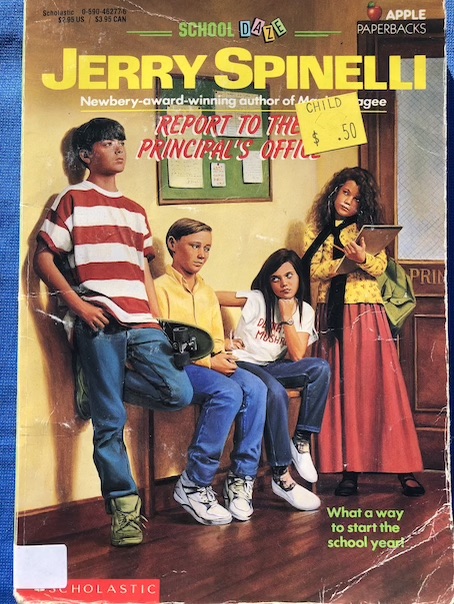
Report to the Principal’s Office

School Daze

This is the first book in a series about a group of unlikely friends in middle school.

The start of the new school year is a disaster for Sunny Wyler. Her best friend, Hillary, lives directly across the street from her house, and they’ve been close for their entire lives, always attending the same school. However, because of the construction of a new middle school in their town and changing school zone lines, which happen to be drawn directly down the middle of their street, Sunny and Hillary will now be sent to different schools for middle school. (During my childhood, parents could sometimes ask for a boundary exception for kids from the local school district so they could attend a different school with their friends, but that doesn’t appear to be an option here.) Hillary tries to be optimistic, pointing out that the new middle school that Sunny will be attending is much nicer than the old middle school that she will have to attend, but Sunny doesn’t care about that. She just wants to go to school with her best friend.

Sunny thinks that she’s come up with a plan to reunite with Hillary. She’s decided to make herself so obnoxious at her new school that they will kick her out, and her parents will have no choice but to send her to Hillary’s school. She’s decided to wear an old t-shirt that says “Death to Mushrooms” every day, never washing it, so she’ll smell bad. She’ll refuse to wash her hair, so it will be dirty and greasy. Above all, she’ll have the worst attitude, never smile, and never talk, never even answering if her teacher asks her questions in class.

Eddie Mott first encounters Sunny Wyler on the bus to school. She sits next to him, and he can tell right away that she has problems and a bad attitude, and that’s the last thing he wants for the beginning of his new school year. Eddie is trying to adopt a more grown-up image in his middle school years, and he desperately wants to fit in with the other kids. He’s trying to wear the right clothes, be friendly with other kids, and above all, avoid problems. None of that has prepared him for Sunny.

There is one person, though, who has done his best to prepare for all the kids who will be coming to the new middle school, the school’s principal, Mr. Brimlow. Over the summer, he studied the details of the incoming students, and he can recognize them on sight as soon as they arrive. When the school bus driver tells him that there’s a kid on the bus who refuses to get off, he recognizes the kid immediately as Eddie. Between dealing with Sunny’s aggressive unfriendliness and being roughed up by older kids on the bus, Eddie can’t bring himself to come to the school. The bus driver, impatient to get to his other job, actually drives off with the principal, Eddie, and Salem, a girl with literary ambitions who wanted to study the situation for story fodder, still on board.

Things are generally going wrong all over Plumstead Middle School as everyone, including the teachers, try to figure out their way around, but Mr. Brimlow is calm and good-natured, and getting back to school with Eddie and Salem after their bus adventure breaks the ice between them. When Mr. Brimlow gets back to his office, he finds Dennis “Pickles” Johnson waiting for him. Dennis, who gained his nickname from the time he decorated his family’s Christmas tree with actual pickles and the incident made the local paper, is an amateur inventor who made his own oversized skateboard that looks like a pickle. The reason why he was sent to the principal’s office is that his skateboard won’t fit in his locker, and he can’t have it in class. When Pickles asks the principal what could happen if he were allowed to ride his skateboard around the school, the principal asks to try the skateboard himself. He’s unable to stop himself and ends up rolling into a nearby classroom and crashing into the geography teacher’s desk, proving to Pickles (and everybody else) what could happen if Pickles is allowed to use his skateboard in the school hallways. Mr. Brimlow forbids Pickles to bring the skateboard to school again but also thanks him for the fun ride and invites him to lunch.

Far from being upset by the strange beginning to the school year, Mr. Brimlow is actually grateful for the eccentric students and their shenanigans because he really likes to get to know his students, and he particularly learns a lot about Eddie, Salem, Pickles, and Sunny on their first day. It hasn’t escaped his notice that Sunny is being purposely sour to other people, and it isn’t really a surprise when one of her teachers sends her to the principal’s office after she deliberately answers all of her math problems wrong, misspells everything in a writing assignment, writes all of her assignments in extra tiny writing to make them difficult to read, and then pretends to flick boogers at Eddie.

When she’s sent to the principal’s office, Sunny thinks that her plan of being obnoxious has already worked and that she’ll soon be sent home or to Hillary’s school, but the principal ends up inviting her to lunch along with Pickles, Eddie, and Salem. The principal actually enjoys the experience, and rather than punishing any of the students for their various shenanigans from the morning, he decides to give each of them special jobs to help them settle into life at their new school. Since Eddie was a flag raiser at his old school, Mr. Brimlow gives him that job at Plumstead Middle School, assigning Pickles to help him. He puts Sunny in charge of taking care of an escaped hamster that the kids found, and noting Salem’s interest in people’s personalities and organizational skills, puts Salem in charge of all of the other students as they are given the collective job of coming up with a mascot for the school.

Through these activities, the four kids become friends with each other and also start to become a real part of their new school. Instead of being kicked out, Sunny is the one who comes up with the winning idea for the school’s new mascot, the Hamsters, becoming attached to the hamster that she has to care for and upset during a time when she thinks that he’s dead. (Fortunately, the hamster is fine in the end.) Eddie thinks of himself as a wimp for being pushed around by the older kids, but Pickles becomes his friend and sticks up for him, and Salem writes a story about him to show him why he’s actually a hero in his own small way.

It’s a good story about a group of unlikely friends with likable, eccentric characters. In the end, the principal’s tactic of helping the students to adjust to middle school by getting them more involved works well, and even Sunny realizes that she can be happy in her new school with her new friends while still being friends with Hillary from across the street.

The book is available to borrow and read for free online through Internet Archive.

Mystery Madness

Mystery Madness by Otto Coontz, 1982.

While Murray’s parents are on vacation, his older sister, Blanche, is in charge of the house. One day, he calls Blanche to get a ride home from the dentist and hears what he thinks is Blanche shooting their housekeeper.

Earlier that morning, he had heard Blanche talking on the phone to someone about a gun. Then, when he calls home, a friend of Blanche’s, Harold, answers, and Murray hears a gun going off in the background and Blanche apologizing to the housekeeper and talking about blood on the carpet. When Murray gets home, his mother’s Persian rug is missing and sees what appears to be a head in a bucket under the sink in the kitchen, further proof that the housekeeper is dead and that her blood stained the carpet.

Murray doesn’t know what to do because he is sure that his sister would never shoot anyone on purpose, and he doesn’t want to see her go to jail. He consults a private detective, Mat Cloak, who he met in a doughnut shop, for help.

The detective agrees to look into the case, and along the way, he realizes that it has connections to a case that he is already investigating. What really happened to the housekeeper? Is Blanche really guilty of murder? Moreover, who is the strange man who is following Murray around?

It’s a very funny story with some twists that readers won’t be able to guess right away. Part of the mystery is pretty obvious because Blanche is a theater student, but the real mystery is one that Murray isn’t even trying to solve and the real villain is someone who Murray thinks is a victim.

The book is available to borrow and read for free online through Internet Archive.

Talking to Dragons

Talking to Dragons by Patricia C. Wrede, 1985.

This is both the fourth book in the Enchanted Forest Chronicles and the first book in the series that was written.  The author wrote this story before the others and then wrote the other three to explain how the characters got to this point.  The first three books in the series focus on Princess Cimorene and her adventures, but this book focuses on her son, Prince Daystar.

Partly because this series is kind of backwards, with the last book being the first written, I’m going to start with a spoiler.  When the book begins, Daystar is unaware that he is a prince and that his father is the king of the Enchanted Forest.  He grew up in an ordinary cottage on the edge of the forest, so he is accustomed to the presence of all kinds of fantasy creatures and fairy tale characters.  He thinks of himself and his mother as ordinary poor folk.  However, his mother has taught him not only reading and writing but other skills that are more unusual for peasants, like music, fighting, and even a little magic.

When Daystar is 16 years old, a wizard named Antorell comes to their house.  Daystar’s mother, Cimorene, seemed to know him, and he knows her.  Antorell demands “the sword” and the boy, and Cimorene casts a spell to melt him.  (“’No! Not again!’ he screamed.”  If you’ve read the other books, you already know why.  But, again, this book was written first.)

The next day, Cimorene gives Daystar a sword that he’s never seen before but which seems to draw him to it, and she starts giving him instructions.  The instructions are vague, but Cimorene insists that Daystar is to go into the Enchanted Forest and not to come back until he can explain why he had to go in there in the first place.  Also, he is not allowed to draw the sword from its scabbard unless he really needs to use it.  Cimorene says that she can’t explain more because it might “ruin everything.”  Not knowing what else to do, Daystar starts into the Enchanted Forest.  When he glances back, Cimorene and the cottage have suddenly disappeared.  Daystar has no idea why, but he has no choice but to keep going.

In the forest, Daystar meets a talking lizard called Suz, who claims to know everything about the Enchanted Forest and what goes on there (a tall claim, considering everything that goes on there).  When Daystar asked him if he knows anything about the mysterious, magical sword that his mother gave him, Suz tells him that it’s the Sword of the Sleeping King and that everyone has been looking for it.  Daystar knows nothing about it, which surprises Suz.  To Daystar’s surprise, both the sword and Daystar’s lack of knowledge agitate Suz, who says that he must get Kazul, who will know what to do.  Before he then runs off, leaving Daystar wondering who Kazul is, Suz tells him that he’s going to have to learn about the sword by himself because there are certain rules associated with magic, but that he should follow the sword to find out.

The next person Daystar meets is a red-haired girl who is stuck in a hedge.  She is surprised by how easily Daystar can get into the magical hedge, and at first, she thinks that he is a wizard.  She is relieved when she finds out that he’s not.  The girl, Shiara, tells Daystar that wizards have been chasing her because she burned the Head Wizard’s staff.  Most people could never accomplish that because wizards’ staffs are extremely powerful and have protective spells on them, but Shiara is a fire-witch.

As the two of them talk, Daystar learns that, while fire-witches are extremely rare and powerful come by their powers naturally, Shiara’s abilities are more unpredictable than most.  She has trouble casting spells on purpose, but when she gets mad, she can do some extremely powerful ones without really trying.  Fire-witches tend to have tempers, and Shiara is no exception.  Because of that, she doesn’t have many friends.  Most people are afraid to be around her because they never know when she’ll lose her temper and accidentally set things on fire.  Even worse, for Shiara, is knowing that most fire-witches are able to do very impressive spells and are almost invulnerable, but yet, she can’t even burn her way through a hedge when she tries it.  The wizards are very interested in her because most fire-witches are immune to their spells.  When they learned that she was a fire-witch who couldn’t cast her own spells, they tried to kidnap her in order to study her magic, which she how she ended up setting the Head Wizard’s staff on fire.

Daystar and Shiara finally get out of the magical hedge when Daystar suggests that Shiara try being polite to it instead of losing her temper.  Creatures and objects in the Enchanted Forest tend to respond well to politeness.  When they’re out of the hedge, a wizard shows up and tries to kidnap Shiara again, but Daystar defends her with his sword.  However, Daystar’s hand is injured when he tries to pick up the pieces of the wizard’s staff, and it explodes.

Daystar and Shiara seek help from Morwen, a witch who lives nearby.  It is from Morwen that Daystar begins to get a sense of what his sword is capable of doing.  He also meets up with Suz again, who tells him that he should go to the castle and that Kazul will meet him there.  Daystar still doesn’t know what he’s walking into, but missions in the Enchanted Forest can’t be ignored, and he has a mission to complete that everyone has been waiting for since before he was born.

By the end of the story, Daystar has learned what he needs to do to rescue his father, and Cimorene and Mendanbar are reunited.  Shiara ends up getting what she wants, partially, because she gains the ability to use her powers, but is forced to be polite in order to do so, which really irritates her.  She becomes Kazul’s new princess, where she will learn both the personal skills and magical skills she needs to control both herself and her ability.  Cimorene believes that Shiara will end up marrying Daystar eventually and becoming the next queen of the Enchanted Forest.  However, the series ends here, and the future is left to the imagination.  Morwen also decides to marry Telemain, a character from the previous books.

Like other books in this series, this book contains a lot of humor and parodies on popular fairy tales and fairy-tale creatures. Personally, I like the first two books in the series the best, but this one is also fun. There is a mild touch of romance to it, which is also nice.

The book is currently available online through Internet Archive.
There is one more story after this series, a short story in the collection Book of Enchantments that features Daystar and both of his parents but does not have Shiara.

Searching for Dragons

Searching for Dragons by Patricia C. Wrede, 1990.

This is the second book in The Enchanted Forest Chronicles, continuing the adventures of Princess Cimorene, although the story is told from the point of view of Mendanbar, King of the Enchanted Forest.  The Enchanted Forest is no ordinary kingdom, and Mendanbar is no ordinary king.  To be King of the Enchanted Forest means being a skilled enchanter.  Mendanbar can use the forest’s magic directly, making him more powerful than wizards.  Most of the creatures in the forest obey him, and unlike ordinary people, he can find his way around the forest almost automatically, even though things in the forest tend to move around.

At the beginning of the story, Mendanbar’s steward, Willin, pesters him about the subject of getting married.  Mendanbar hasn’t given the matter much thought since his father died three years earlier, but then, there’s been a lot to do.  Queen Alexandra has several daughters, any of which would be considered “suitable,” but Mendanbar doesn’t like any of them.  Mendanbar is annoyed because he’d just gotten the elf clans’ feud settled and was looking forward to a period of relative calm, so he decides that he’s going to give himself the day off, for a change.

He decides to take a stroll by the Green Glass Pool to relax, but on the way, he encounters a princess.  That’s not too unusual for the Enchanted Forest (home to many fairy-tale creatures and the events that make up fairy tales), but this princess strikes Mendanbar as a particularly scheming and ambitious one.  She tells him a great tale of woe in which her wicked stepmother cast her out that Mendanbar can tell is carefully rehearsed and might have even been the idea of the stepmother in question, with the idea of hooking an adventurous prince.  (Royal families do things like that, see the previous book in the series.)  However, Mendanbar is puzzled because the forest usually keeps out people who are obviously selfish.  Then, the princess mentions crossing an area of waste to get into the forest, and Mendanbar is alarmed because there shouldn’t be a wasteland there.  Forgetting about the princess, he hurries off to investigate.

Sure enough, Mendanbar discovers that a section of the forest is actually missing, destroyed to the point where there are just dead stumps.  Even the magic is gone.  Upon further investigation, Mendanbar finds dragons scales.  He isn’t sure why the dragons would want to attack the Enchanted Forest because they haven’t had any quarrels and mostly leave each other alone.  On the advice of a nearby talking squirrel, Mendanbar goes to see the witch Morwen.

After examining the dragon scales, Morwen demonstrates that, although they appear to be different colors and look like they’re from different dragons, they have actually been disguised.  They are actually from one dragon only.  Morwen also doubts that a dragon was really responsible for the damage to the forest.  After all, why would a dragon waste time disguising his scales when he could just pick them up?  Also, healthy dragons don’t shed that many scales.  Morwen is a friend of Kazul, who is the current King of the Dragons, and she advises Mendanbar to go see Kazul. 

Morwen also chides Mendanbar for not visiting Kazul when she became the king the year before.  Mendanbar feels a little guilty, saying that he’s just been very busy, which is true.  However, Morwen points out that what he could use is more effective help to organize things in the kingdom, not just making lists of things for him to do, like his steward does.  It’s part of the reason why people are saying that Mendanbar should get married.

Before Mendanbar can visit Kazul, he gets an unexpected visit from Zemenar, the Head Wizard.  Zemenar says that the wizards have been having problems with the dragons (again, see previous book) and that the dragons will not let them enter the Caves of Fire and Night.  He hopes that Mendanbar will allow them access from the Enchanted Forest.  Mendanbar doesn’t really trust the wizards, and he refuses the request on the grounds that he has something important to discuss with the King of the Dragons himself.  Zemenar tells Mendanbar about Kazul’s princess, Cimorene, blaming her for the the “misunderstanding” between the wizards and dragons.  Mendanbar at first imagines that Cimorene is much like the scheming princess he met that morning, but soon discovers that she’s anything but.  Taking the enchanted sword that only the kings of the Enchanted Forest can use with him, Mendanbar goes to visit the dragons.

At Kazul’s cave, Mendanbar meets Cimorene, who informs him that her official title is now Chief Cook and Librarian.  She tells him that part of the point of advertising this title is that it cuts down on the number of princes who come around.  Lots of princes want to rescue a princess, but few people want to rescue a Chief Cook and Librarian.  Mendanbar finds Cimorene a surprising change from the other princesses he’s met.  Mendanbar also makes a positive impression on Cimorene by using his sword to fix a broken sink, even if she describes the magic as being a bit “flashy.”

However, all is not well among the dragons.  Although Cimorene is reluctant to admit it at first, Kazul has mysteriously vanished.  She was planning to go out and search before Mendanbar showed up.  Kazul had been visiting her grandchildren when she decided to go by the Enchanted Forest to investigate someone growing dragonsbane.  Mendanbar shows Cimorene the dragon scales he found, and she indentifies them as belonging to Woraug, a dragon who was changed into a frog in the previous book.

It doesn’t take the two of them long to realize that the wizards are back to their old tricks and scheming.  However, what would they really have to gain by setting the Enchanted Forest and the dragons against each other?  And where is Kazul?

Like the other books in this series, this book is full of humor and a touch of mystery.  There are many parodies on fairy tale tropes, including an Wicked Uncle who’s not very wicked and does both a favor and an evil deed for his nephew by sending him to boarding school instead of abandoning him in the forest to have an adventure, as he’d hoped.  There is also romance between Cimorene and Mendanbar.  As you might have guessed, Cimorene is just the kind of practical princess Mendanbar needs to help him manage the magical chaos that is the Enchanted Forest and Mendanbar is the kind of king who is happy to find an intelligent princess who can do magic and rescue dragons.

The book is currently available online through Internet Archive.

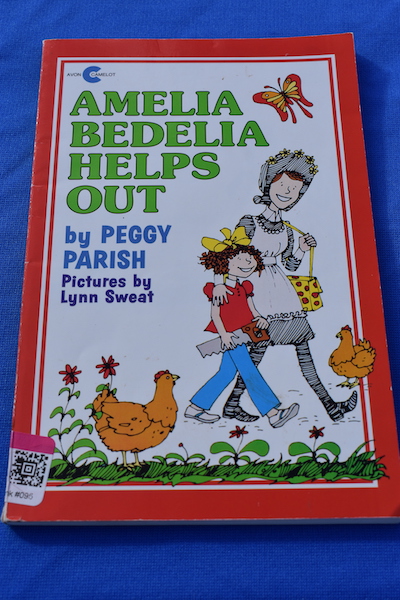
Amelia Bedelia Helps Out

Amelia Bedelia Helps Out by Peggy Parish, 1979.

Mr. and Mrs. Rogers are loaning their maid/housekeeper, Amelia Bedelia, to a friend, Miss Emma to help her with a few things around her house.  Amelia Bedelia also has her niece, Effie Lou, with her to give her a hand.  Effie Lou doesn’t quite know what her aunt does for a living, but although Effie Lou’s first instincts seem to do the normal thing with the instructions that Miss Emma gives them, Amelia Bedelia quickly “corrects” her niece to do things in her quirky, literal-minded way.  For example, when Miss Emma tells them to weed the garden, Effie Lou starts to pull the weeds, but Amelia Bedelia convinces her that they are supposed to add more since Miss Emma didn’t say “unweed” the garden.

From there, Amelia Bedelia interprets Miss Emma’s order to “stake” the beans in the garden as tying bits of steak to them.  They also give the chickens Miss Emma’s quilting scraps instead of food scraps and sew grass seeds onto thread instead of “sowing” them into the ground.

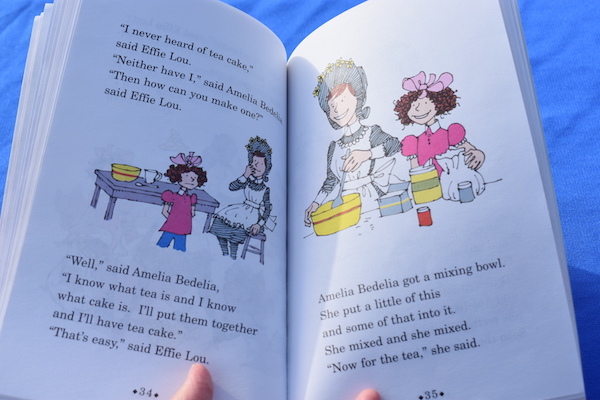
Is Amelia Bedelia a bad influence on her niece?  Maybe, but once again, her baking skills come to the rescue.  Miss Emma asks her to bake a “tea cake” for some guests who will be coming over. 

Now, depending on where you live, “tea cake” actually can mean different things.  Sometimes, it’s just a small cake that’s served with tea, and other times, it’s a special kind of cookie or biscuit (the distinction is regional).  The way Amelia Bedelia interprets it is a cake that actually includes tea as an ingredient.  Surprisingly, though, everyone loves it, even more than the nut cake she also baked.

The book is currently available online through Internet Archive.

Thomas’ Snowsuit

ThomasSnowsuit

Thomas’ Snowsuit by Robert Munsch, 1985.

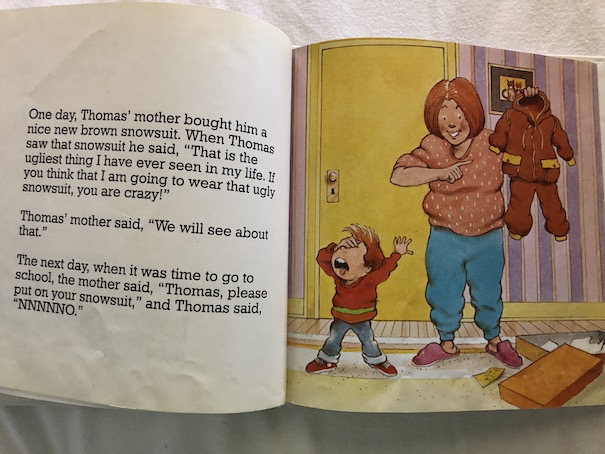
Thomas absolutely hates the new snowsuit that his mother bought him.  He thinks it’s ugly.  When it’s time for him to go to school, his mother has to wrestle him into it because he refuses to put it on himself.

ThomasSnowsuitNew

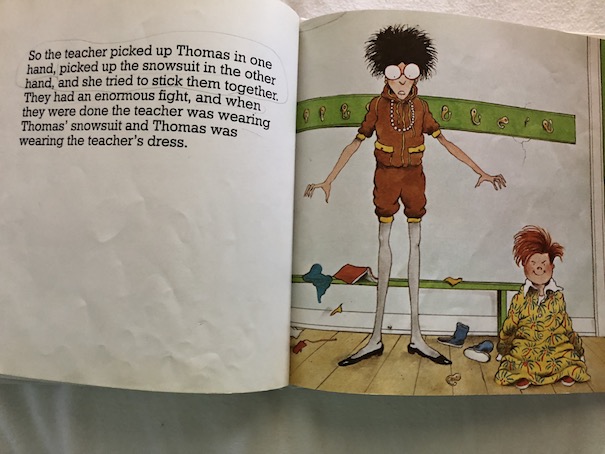
That’s fine until it’s time for Thomas to once again put on his snowsuit so he can go outside for recess.  His teacher insists that he has to wear it, but he refuses.  When the teacher tries to wrestle Thomas into his snowsuit, the results are hilarious!

ThomasSnowsuitTeacherSwitch

Thomas and his teacher end up getting their clothes all mixed up.  When the school’s principal tries to help, it only makes things worse.

ThomasSnowsuitTeacherPrincipalSwitch

Finally, Thomas is persuaded to put on his snowsuit when a friend of his wants him to come out and play.

ThomasSnowsuitFixed

Thomas eventually helps set the teacher and principal right again after recess, and the principal decides that it’s time to retire to Arizona, so he won’t have to deal with snowsuits again.

ThomasSnowsuitArizona

Like all Munsch books, the storyline is bizarre and hilarious, and half the fun is watching it unfold in the pictures!

The book is currently available online through Internet Archive.
Murmel, Murmel, Murmel

Murmel

Murmel, Murmel, Murmel by Robert Munsch, 1982.

Robin is playing in her backyard sandbox when she hears a “Murmel, Murmel, Murmel” sound from a hole that she has never seen before. In the hole, Robin finds a baby. Since Robin herself is only five years old, she decides that she needs to find someone older to take care of the baby.

Robin asks various people, but they all have reasons why they can’t take the baby. Then, Robin encounters a truck driver who is enchanted with the baby’s “Murmel, Murmel, Murmel” and says that he wants him.

The story never explains where the baby came from, how he ended up in Robin’s sandbox, or if his parents are looking for him, but apparently, he’s happy with the truck driver. As for the truck driver’s truck, he says that Robin can keep it because he already has seventeen others. Robert Munsch books are like this. That’s basically the explanation.

The book is currently available online through Internet Archive.
MurmelTruck

Something Good

SomethingGood

Something Good by Robert Munsch, 1990.

Tyya begs her father to buy “something good” at the grocery store. Tyya would much rather have him get something like ice cream and cookies instead of boring things like bread and eggs, which is what he usually gets.

However, when she tries to get whole cartloads of ice cream and candy bars, her father makes her put it all back. Tired of her messing around, Tyya’s frazzled father tells her to just stand in one place and not move. Unfortunately, he tells her that near a display of large dolls. Because she doesn’t move, a store employee mistakes Tyya for a doll and puts her on the shelf with the others, giving her a price tag of $29.95.

Some people try to buy Tyya, but she yells at them, scaring them away. Tyya’s father comes to get her, but he has trouble taking her out of the store because she still has a price tag on her, and the man at the register insists that her father has to pay for her.

In real life, no grocery store would try to sell a child, and it would be a crime if they did. However, because this is a Robert Munsch story (where all kinds of crazy things happen), Tyya’s father finally pays the $29.95 because she’s worth it, and Tyya says that her father finally bought something good at the grocery store.  Sort of touching, in an odd kind of way, I guess.

One of the benefits of this story is that it has a lot of potential for reading aloud because the reader can really play up the parts where the characters yell.

The book is currently available online through Internet Archive.

Moira’s Birthday

MoirasBirthday

Moira’s Birthday by Robert Munsch, 1987.

Moira wants to have a birthday party and to invite every kid in her school, from kindergarten to sixth grade. Her parents say that she can have only six party guests total, not six grades’ worth. However, so many kids at school want to come to her party that she ends up inviting the whole school anyway.

When every kid in school shows up on the day of the party, Moira’s parents are bowled over. There are so many kids that they hardly fit in the house. Moira calls up a pizza place, asking for an enormous amount of pizza, and a bakery, asking for an enormous amount of birthday cakes. The kids also help out by supplying their own food from home.

Naturally, Moira’s house is a mess, and her parents are upset, but Moira, seeing the enormous pile of birthday presents that everyone brought, promises a present to everyone who helps to clean up.

But, just when everything seems to have worked out all right, the trucks from the bakery and pizza place show up with the rest of Moira’s order.

The book is currently available online through Internet Archive.

The Dreadful Future of Blossom Culp

DreadfulFutureBlossomCulpThe Dreadful Future of Blossom Culp by Richard Peck, 1983.

This book is part of the Blossom Culp Series.

It’s 1914, and Blossom Culp is just starting high school. Although the principal of her old school tells her that this is a chance for her to make a fresh start, it looks like Blossom’s future is going to be very much a continuation of her immediate past.  In high school, she’s still a social outcast, looked down on by girls from better-off families, like Letty, the class president.  Also, despite her principal’s assertion that Blossom’s previous forays into the occult were imaginary, the product of the mental confusion that accompanies puberty, and that she is bound to grow out of them, Blossom knows that her psychic abilities are a natural gift and will not be ignored.

Blossom begins high school friendless because Alexander Armsworth has been ignoring her lately because of his important new position as class vice-president, his infatuation with Letty, and his friendship with a couple of local hooligans, Bub and Champ. Alexander is looking forward to his role in planning the school’s Halloween Festival, telling Blossom that he’s over their earlier, childish occult escapades and the Halloween pranks he used to pull.  Meanwhile, all of the other girls in school are infatuated with their handsome history teacher, Mr. Lacy, and so is the girls’ gym teacher, much to Blossom’s disgust.  Blossom thinks that Mr. Lacy is full of himself and denies that she has any such silly crush on Alexander.

Blossom makes an unexpected friend in a girl called Daisy-Rae, a girl from the country who has brought her younger brother into town to attend school and hoped to get an education herself but has been too afraid of the big town to actually attend classes.  Daisy-Rae hides in the school during the day and lives alone with her brother at night in the old chicken coop at the abandoned Leverette house.  It is through Daisy-Rae that she learns that Alexander and his friends aren’t so above childish pranks as they claim to be.  Blossom also discovers that Mr. Lacy has been romancing her old principal.  Mr. Lacy isn’t quite what he appears to be and has some unsavory secrets in his past.

Matters come to a head when Alexander (at Letty’s urging) tries to persuade Blossom to dress up and become the fortune teller for the haunted house that the freshmen class is doing for the Halloween Festival.  The haunted house is also a fundraiser, and Letty figures that they can get extra money from people if they’re willing to pay to have their fortunes told, and who would be better for the job than Blossom?  However, Blossom isn’t one to go out of her way to please others, especially Letty, and it turns out that they’re holding the haunted house in the Old Leverette place.  For some reason, that old house makes Blossom’s mother uneasy.  She seems to think that it’s haunted, but in an unusual way.  Blossom tells Alexander that she will not agree to be their fortune teller until he agrees to check out the house with her before Halloween and find out what’s wrong with it.  She figures that, since both of them are psychic, they can learn what’s so unusual.

As Blossom learns, her abilities don’t confine themselves to the past and people who have died but extend to the future and the people who haven’t yet been born.  Inside the Old Leverette house, Blossom suddenly finds herself entering the distant future, the 1980s.  In the 1980s, the Leverette house is once again lived in, and Blossom meets a boy named Jeremy who is a lonely social outcast, like herself.  Jeremy is a computer nerd, living with his divorced mother.  He takes Blossom on a tour of their town as it is in Blossom’s future, much larger than it used to be and with many familiar landmarks missing.  However, what Blossom sees in the future gives her the inspiration she needs to solve her problems in the past and hope that things will improve.  In return, she also proves to Jeremy that he is far from alone and has had a friend for longer than he ever imagined.

The time travel to the 1980s comes off as being a little corny (or so it seemed to me), but the writing quality of the book is excellent.  The author has an entertaining turn of phrase, and the book, like others in the series, is humorous and a lot of fun to read.

Besides being a kind of fantasy story, there are some interesting tidbits of history in the book, showing how people lived in the 1910s.  Blossom explains about the things she and her classmates did at school, like wearing beanies on their heads to show which year they were (freshmen, future graduating class of 1918).  At one point in the story, Blossom takes Daisy-Rae and her brother to their first movie, a silent film with an episode of The Perils of Pauline serial.  While Blossom worries about the future, readers can get a glimpse of the past!

As for what Blossom learns about her own future, she avoids finding out too much because she’d rather not know the details.  However, there are implications that she and Alexander may eventually marry and live in his family’s old house.

The book is currently available online through Internet Archive.