The Return of the Plant That Ate Dirty Socks

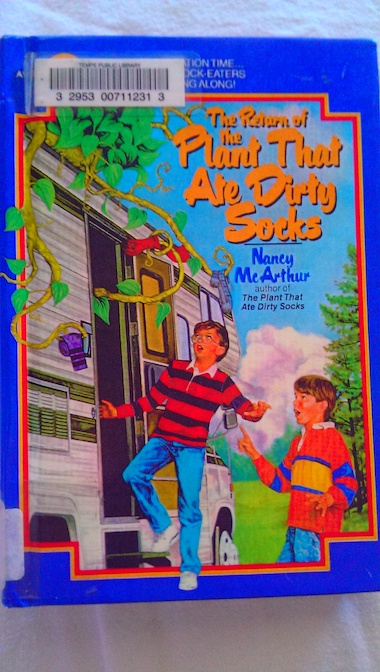
ReturnPlantDirtySocksThe Return of the Plant That Ate Dirty Socks by Nancy McArthur, 1990.

Michael and Norman’s father has finally gotten the chance to take a vacation, but his sons’ weird, sock-eating plants complicate things.  You can board pets or ask someone to come in and feed them, but how can you ask someone to leave out socks for your houseplants?  The boys’ parents still kind of think that the plants are more trouble than they’re worth, but the boys love them like pets and can’t bear to get rid of them.  Instead, they persuade their parents to rent an RV for the family’s vacation.  That way, they can take the plants along.

It seems like a good idea, although before they leave home, the boys notice that the plants are starting to produce seed pods, something that they decide not to tell their parents.  Instead, they simply remove the seed pods from the plants when they find them.  So, the family sets off for Florida and Disney World in their RV with the sock-eating plants sticking out through the sun roof.

At first, it seems like things might be okay on the trip, but one night, when the boys are visiting their grandmother and sleeping in the house instead of the RV, they forget to set out socks for their plants to eat.  When they wake up in the morning, the RV is gone.  The boys worry that the plants somehow got control of the RV and drove it off to find more socks, but it turns out that it was stolen by car thieves.  The police recover the RV but are puzzled when witnesses describe the thieves as abandoning the vehicle, screaming and running away without their shoes on, one of them only wearing one sock.  The family is relieved to get their RV back, not to mention their plants, however their adventures are just beginning.

The family has a good time when they get to Disney World, but the plants start drooping because they feel neglected, all alone in the RV all day.  To get the plants out in the sunshine and supervised more, the boys ask the people at the daycare center at the RV park if they can leave their plants there during the day.  The plants perk up a little more, getting attention from the staff and children, especially when they sing.

But, it turns out that the mother of one of the girls who has seen the plants, Dr. Sparks, is a botanist, and she’s very curious about the origin of these unusual plants.  The boys’ parents think that it might not hurt to get an expert opinion about their strange plants, but the boys worry that if the plants turn out to be very rare, scientists will want to take them away or their parents might decide to sell them.  Their parents still think that the plants are too weird and too troublesome to keep, but Michael and Norman think of them as their friends and pets.  They’ve been trying hard to keep their plants’ sock-eating abilities quiet.  Is it finally time to tell someone?  Can Dr. Sparks be trusted?

They end up asking for Dr. Sparks’ help when Fluffy accidentally eats something he shouldn’t.  Dr. Sparks knows that the plants are unusual, but by the end of the book, she’s still not sure that she believes that they really eat socks.  The boys give her some seeds so that she can experiment without taking their plants, knowing that she’ll eventually discover just how unusual the plants are.  By the end of the book, other people are also growing more plants like Fluffy and Stanley, partly because Michael’s friend Jason stole some of the seeds they were saving and sold them to other kids while Michael and Norman were out of town.  The boys can’t get back the seeds, but they force Jason to at least confess to the other kids that the plants will eventually eat socks.  Jason doesn’t think that they’ll believe him, but the boys know that it’s only right that the buyers be warned because they’ll discover the truth eventually.  Fluffy and Stanley are also starting to acquire the ability to move around on their own.

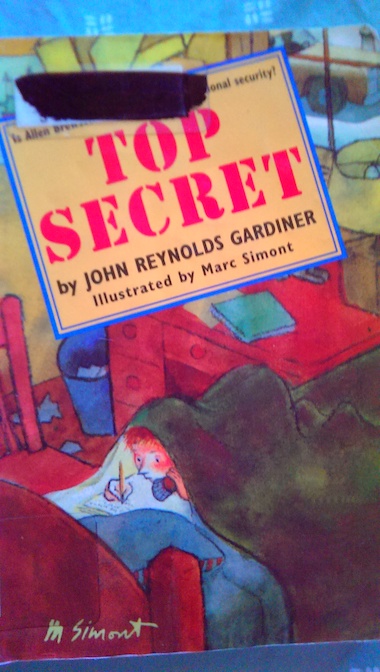
The Plant That Ate Dirty Socks

PlantDirtySocksThe Plant That Ate Dirty Socks by Nancy McArthur, 1988.
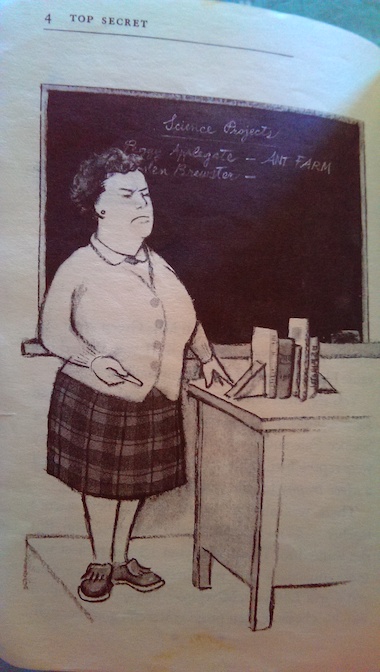
Michael and his younger brother, Norman, share a room, but it’s not a peaceful arrangement.  Norman is a neat freak, and Michael likes things messy.  Michael’s always saving random things that might turn out to be useful later, although how useful they are is questionable because it’s hard to even find anything in his pile of junk.  Michael also likes sending away for random things in the mail, like toys that require him to save a certain number of box tops.  Often, by the time these things arrive, he’s forgotten what he sent away for.

One day, Michael gets a couple of seeds in the mail that he doesn’t remember sending away for.  He plants one himself and gives one to his brother to plant.  The seeds come with a set of instructions, but Michael soon loses them, and the boys are left to care for their plants themselves.  Norman is very regular in his habits, watering his plant daily with his squirt gun and giving it the proper amount of plant food.  Michael is more experimental, dumping plant food on his plant haphazardly and even giving it bits of human food from time to time.  The boys have fun with their plants, treating them like pets, but soon, it becomes obvious that these aren’t normal plants.

It starts when socks start disappearing from Michael’s half of the room.  With Michael’s messiness, he often has to dig out his dirty socks from the rest of his stuff, but even after Michael cleans up his room, he still can’t find all of his socks.  The boys suspect that someone is stealing them, so they try to sit up at night (disguised as a robot and a gorilla, as if that would help) to find out who the thief is.  That’s how Michael discovers that his plant is actually eating his socks.  They try an experiment and discover that Norman’s plant also eats socks, except that Norman’s plant prefers clean socks, and Michael’s plant only eats the dirty ones.

When the boys demonstrate to their parents that the plants are eating socks, their mother wants them to get rid of the plants immediately, but the boys plead for their pet plants (which they name Fluffy and Stanley).  Michael promises to keep his half of the room neat from now on to keep his plant from eating anything it shouldn’t and proves that keeping plants for pets, even ones that eat socks, would be less expensive than keeping a dog or a cat, especially if they only buy cheap socks.  Reluctantly, their mother agrees to let them keep the plants, but their father forbids them to tell anyone about them because everyone will think they’re crazy.

However, with people at the store wondering why they’re buying so many socks, Michael’s friend Jason spending the night, and the upcoming science fair, for which Michael still needs a project, can Michael keep their weird plants a secret?  Does he even want to?

One of the things that I remembered from reading this book as a kid was the part where they invent Fudge Ripple Pancakes.  It starts because they were making up code words to use when talking about their plants, and someone overhears them saying “Fudge Ripple Pancakes,” so they have to make up a recipe to go with it.  The recipe isn’t exactly included in the book, but basically, it involves adding chocolate syrup to regular pancake mix.  The boys try it themselves and decide they like them.  Norman has a large squirt gun, kind of like a Super Soaker (but called by a different name), and he uses it to both water his plants and squirt syrup on his pancakes.

This is the first book in a series.

Mrs. Armitage, Queen of the Road

ArmitageRoad

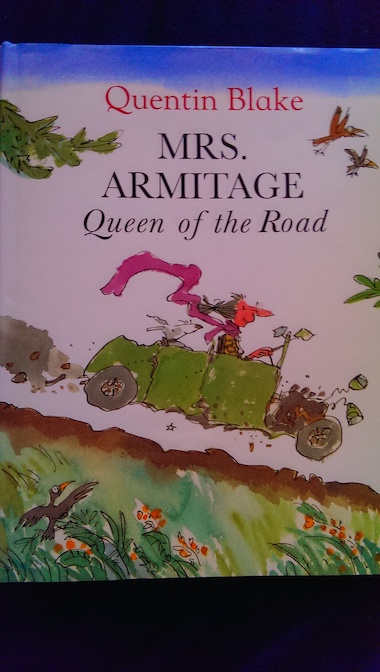
Mrs. Armitage, Queen of the Road by Quentin Blake, 2003.

When Mrs. Armitage‘s Uncle Cosmo decides to get a new motorcycle, he lets her have his old car.  However, it isn’t in very good condition.

ArmitageRoadCar

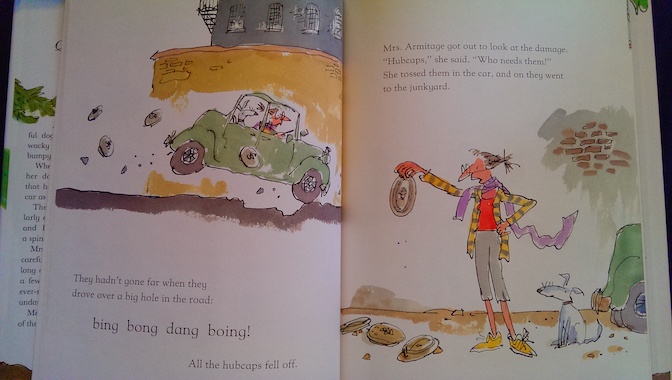
Mrs. Armitage and Breakspear decide to try it out, but as they drive along, pieces of the car fall off.  Some of it is because the car is in bad repair, and some is due to accidents Mrs. Armitage has.  First, the hubcabs, then the fenders fall off.  Mrs. Armitage shrugs it off , saying, “Who needs them?”

ArmitageRoadHubcaps

Eventually, the car goes almost entirely to pieces, but who needs it all?

ArmitageRoadWreck

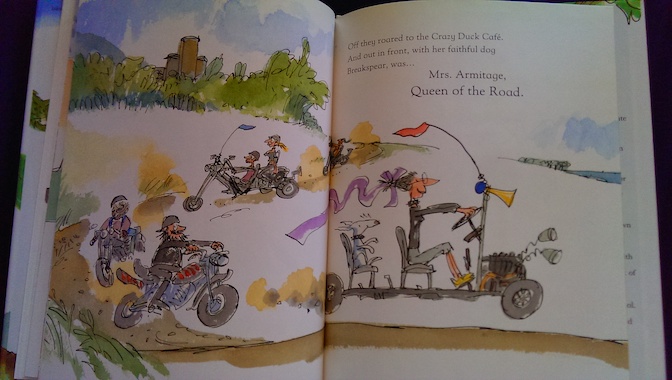
When Uncle Cosmo shows up with his friends and their motorcycles, they help her fix up what’s left of the car into one amazing machine!

The book is available to borrow and read for free online through Internet Archive (multiple copies, including one in Spanish).

ArmitageRoadMachine

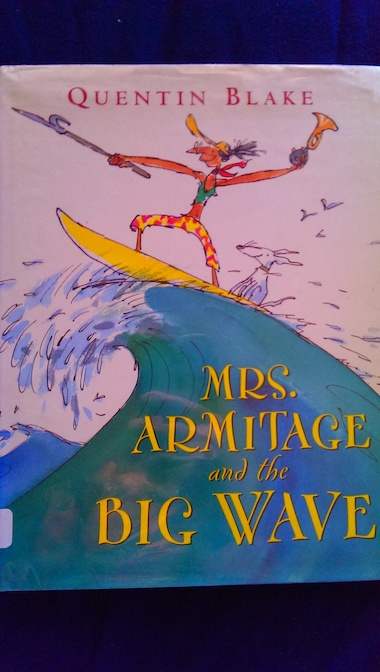
Mrs. Armitage and the Big Wave

ArmitageWave

Mrs. Armitage and the Big Wave by Quentin Blake, 1997.

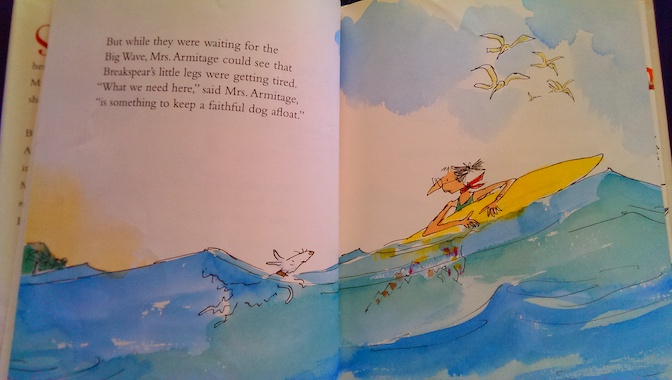
Mrs. Armitage goes the beach with Breakspear in order to go surfing.  She explains to Breakspear that they have to swim out and wait for the “Big Wave.”  But, waiting takes longer that Mrs. Armitage expected, and soon Breakspear is tired, and they’re both hot.

ArmitageWaveDogTired

Of course, Mrs. Armitage finds a solution for everything.  With an inflatable toy for Breakspear to ride on and some protective gear, they wait some more.  Needless to say, Mrs. Armitage doesn’t stop there.  As they wait for the perfect wave, there are plenty of other things that they need to keep themselves busy and make themselves more comfortable.

ArmitageWaveFloaties

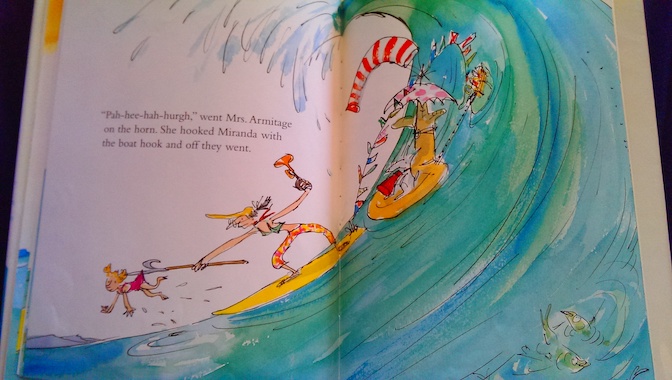
When the Big Wave finally comes, Mrs. Armitage not only makes an incredible show, but she also has what she needs to save a little girl who swam out too far and needed to be rescued.

The book is available to borrow and read for free online through Internet Archive (multiple copies, including one in Spanish).

ArmitageWaveRescue

Mrs. Armitage on Wheels

ArmitageWheels

Mrs. Armitage on Wheels by Quentin Blake, 1987.

Mrs. Armitage loves to ride her bicycle with her dog, Breakspear, running alongside.  However, she sometimes runs into difficulties that require some minor repairs to her bike, and she can’t resist the urge to tinker further.

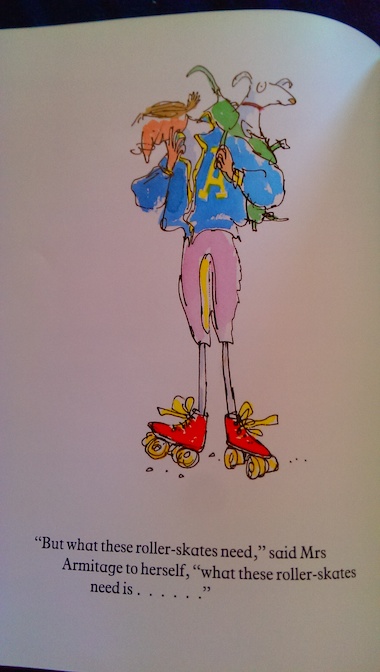
The more she thinks about it, the more ideas for improvements she has.  Each idea starts with the words, “What this bike needs . . .”

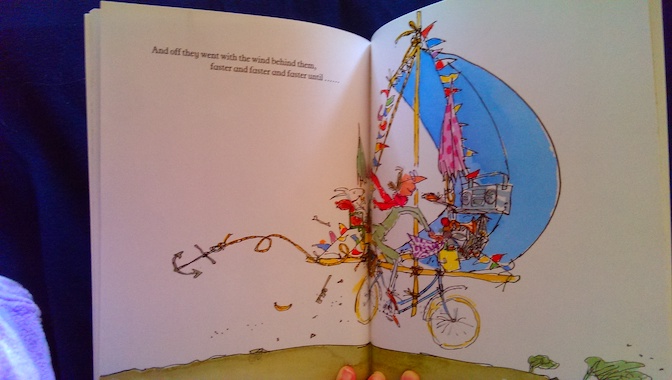
But, Mrs. Armitage goes well beyond what the bike really needs.  Beyond adding a seat for her dog and room for her lunch, she gradually turns her bicycle into a crazy, unwieldy contraption.

ArmitageWheelsSail

Was adding the sail and anchor where she went too far, or did she reach that point long before?  Even after she trades what’s left of her bike for some skates, one has the feeling that her tinkering is far from over.

The book is available to borrow and read for free online through Internet Archive.

ArmitageWheelsSkates

The One Hundredth Thing About Caroline

The One Hundredth Thing About Caroline

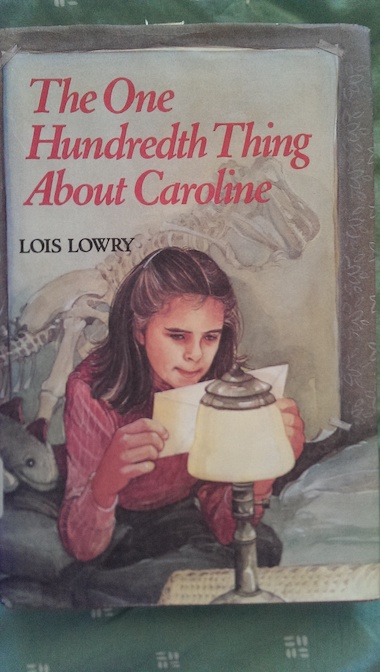
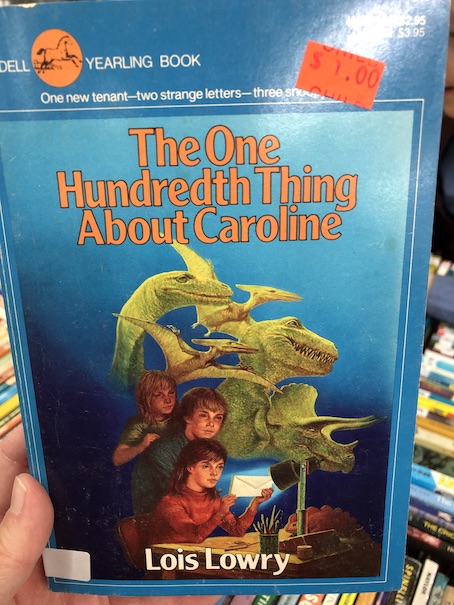
The One Hundredth Thing About Caroline by Lois Lowry, 1983.

Eleven-year-old Caroline Tate knows that she wants to be a paleontologist when she grows up, but she is also fascinated with her friend Stacy’s dream of becoming a great investigative reporter. For fun, the two girls begin investigating the people who live in their respective apartment buildings.

Caroline’s investigation focuses on the mysterious Frederick Fiske, who lives on the fifth floor of her building. In a wastebasket, she finds a letter written to him by a man she’s never heard of telling him to “eliminate the kids.” Also in the wastebasket, there is an overdue notice for Fiske from the library, and the book is about poisons. From this evidence, Caroline comes to believe that the strange Mr. Fiske is planning to murder some children.

The situation becomes worse when Mr. Fiske begins dating her divorced mother, and Caroline fears that the children Mr. Fiske is planning to murder are her and her brother, J.P.. Can Caroline, J.P., and Stacy prove that Mr. Fiske is a cold-blooded murderer before his relationship with the Caroline’s mother can go any further and before he succeeds in poisoning them?

The book is available to borrow and read for free online through Internet Archive.

My Reaction and Spoilers:

It’s a bit of a spoiler, but this is one of those stories where the mystery is largely based on a series of misunderstandings. The book is a comedy mystery.  Mr. Fiske isn’t really a murderer, although he has done some things which make the children suspicious.  It’s a humorous story, and the kids’ antics as they try to further their investigation and collect “evidence” against Mr. Fiske are hilarious.  Along the way, the kids end up helping Mr. Fiske with a problem he’s been having, and the kids realize that they’ve made a mistake about him and his intentions.  Whether Mr. Fiske learns of their suspicions about him or not is left to the imagination, although something at the very end of the story may bring everything out into the open.

The title of the book comes from a joke between Caroline and her mother.  Caroline’s mother is always talking about the things she loves about Caroline, giving them different numbers.

Amelia Bedelia’s Family Album

ABFamilyAlbum

Amelia Bedelia’s Family Album by Peggy Parish, 1988.

Mr. and Mrs. Rogers realize that they’ve never met the rest of Amelia Bedelia’s family, so they tell her that they’d like to give a party for her and family. Amelia Bedelia is happy about the party and shows Mr. and Mrs. Rogers some pictures of her relatives.

It turns out that her tendency to be extremely literal is a family trait. Her father is a telephone operator who operates on telephones and her mother is a “loafer” who makes loaves of bread. One of her uncles is a “big-game hunter” and has a checkers set that takes up an entire room, and another “takes pictures” in the sense that he is basically an art thief.

With each relative introduced, readers can pause for a moment to consider what each of Amelia’s relatives do, in a very literal sense, based on Amelia’s description, before turning the page to confirm it.  (I kind of identify with the “bookkeeper” because my room looks kind of like that, for similar reasons.)

In this picture book, Amelia Bedelia isn’t doing any chores or getting confused about instructions, like in other books, but all the occupation-related puns have the same feel as Amelia’s routine misunderstandings about the multiple meanings of words from the rest of the series.

The book is currently available online through Internet Archive.

ABAlbumReunion.jpg

Merry Christmas, Amelia Bedelia

Merry Christmas Amelia Bedelia

Merry Christmas, Amelia Bedelia by Peggy Parish, 1986.

Christmas is coming, and once again, Mrs. Rogers has left a list of things for Amelia Bedelia to do while she goes to pick up her Aunt Myra, who is visiting for the holiday.

Leaving Amelia Bedelia unsupervised with a list of instructions can be dangerous at any time of the year, but this time, Amelia Bedelia is in the holiday spirit, determined to do her literal best to stuff stockings (with the same kind of stuffing you might use with a turkey), trim the tree (to the size that she thinks Mrs. Rogers would want it), deck it out with lights and balls (light bulbs and sports balls of all kinds), and find an appropriate star to put on top (and, you know, who wouldn’t want to be a star?).

Merry Christmas Amelia Bedelia Balls on Tree
Merry Christmas Amelia Bedelia Tree Star

So what will Aunt Myra think of Amelia’s special brand of literal kookiness? Fortunately, she loves the idea of being a star, too. Amelia Bedelia may be aggravating in the way she interprets the instructions given to her, but she’s also endearingly humorous . . . and she bakes a really good spice cake, too.

The book is available to borrow and read for free online through Internet Archive.

Merry Christmas Amelia Bedelia Aunt Myra

Good Work, Amelia Bedelia

Good Work Amelia Bedelia

Good Work, Amelia Bedelia by Peggy Parish, 1976.

Amelia Bedelia works as a maid/housekeeper for Mr. and Mrs. Rogers. They like her, but they have to be extremely careful about the orders and instructions that they give her because Amelia Bedelia takes everything literally. For example, when Mr. Rogers asks her for toast and an egg for breakfast, she gives him a raw egg straight out of the refrigerator because he never told her to cook it. Telling her to “go fly a kite” is also pointless because she’ll simply go to the park and do it.

Good Work Amelia Bedelia Fly a Kite

Possibly the most dangerous thing Mr. and Mrs. Rogers can do is leave Amelia Bedelia alone in the house with a “to do” list. Unsupervised, she reads each item on the list and does her best to obey all of the instructions to the letter. From putting plants in pots from the kitchen to making sure that the bread rises by hanging it from a string to making a “sponge cake” that includes actual sponge, Amelia Bedelia muddles her way through, getting everything wrong while still being technically correct.

Good Work Amelia Bedelia Bread Rises

Good Work Amelia Bedelia Sponge Cake

So, why do Mr. and Mrs. Rogers put up with her? Well, for one thing, she makes a terrific butterscotch cake.

The book is currently available online through Internet Archive.

Good Work Amelia Bedelia Butterscotch Cake.jpg

The Best Halloween Ever

BestHalloweenEverThe Best Halloween Ever by Barbara Robinson, 2004.

Every year on Halloween, the Herdmans, who are the wildest, most awful kids in town, run amuck, vandalizing things, stealing, and bullying other kids out of their Halloween candy.  This year, the mayor has decided that he’s had enough of the chaos they cause, so he’s just going to cancel Halloween all together.  Although he doesn’t specifically name the Herdmans as the source of all the Halloween destruction, everyone in town knows that they are.  So, to the shock and dismay of all the other kids, there will be no trick-or-treating this year.

Instead, there will a safe, well-supervised (boring), school Halloween party.  The principal, who always hated Halloween anyway, isn’t happy about it, but admits that it would be better to have a party for the kids at school, with their parents present and helping out, than having them run wild in the streets with the Herdmans on the loose.  But, as every kid knows, running wild in the streets is really the heart of Halloween.  They long for the freedom of roaming the streets without adult supervision, for collecting candy to sort and trade (and, admittedly, lose to the Herdmans eventually), for staying up late, and for the surprises and magic of a real Halloween.

There isn’t going to be anything surprising or magical or even really scary about Halloween at the school.  All the kids already know that the monsters are just their parents and teachers in costume.  The only real benefit that they see to the event is that the Herdmans won’t be there because they say it sounds too boring.  But, with the Herdmans, nothing is ever what anyone would expect, and they not only show up but find a way to turn the event into something that brings back some of the surprises and real Halloween spirit that were missing from a party that was too well-organized and predictable.

Although the Herdmans are a large part of the reason why Halloween is difficult for everyone and the adults try so hard to control it, they manage to redeem themselves a little in the eyes of the other children by taking the events of the night out of the adults’ hands.  Before the other kids know it, strange things start happening at the party with a cat on the loose, worms in the witches’ brew, and children starting to disappear.  As the kids puzzle about these things and wonder where some of the other kids went, things start getting scarier (like they should on Halloween), and they find themselves following mysterious figures through the school in the middle of a black-out with a special surprise waiting for them . . .

I don’t think that this book was quite as good as the others in the series, but it was still fun.  Beth, the narrator, is correct in saying that the well-supervised Halloween party was really more for the adults than the kids.  To the adults, Halloween is kind of a bother, and sometimes, they act like all the kids, not just the Herdmans, get in their way even as they plan the school Halloween party.  At one point, Beth’s mother reminds Alice’s mother that the whole idea of the party is to do something for the children, not the adults.

The adults are so worried about keeping things orderly, safe, and convenient that they become too controlling.  Even on normal Halloweens, some of them have a tendency to overrule the kids on what they want to wear as costumes, with parents often insisting on costumes that are the least amount of bother for them to help with.  Louella’s mother insists that Louella be a pilgrim year after year just because she won a free costume once, even though Louella hates it. Really, what most of the kids like about Halloween is that it is usually a night for them, not the adults.  The kids chafe as the adults insist that they go to their orderly Halloween party and like it.  In real life, most adults know that forced fun isn’t really fun at all.

In the end, the Herdmans return all the candy that they had taken from the other kids over the last Halloweens.  Although the other kids find the Herdmans’ secret candy stash a treasure trove, much of the candy is stale.  They can eat some of it (which grosses me out, considering how old it probably is), and they have fun sorting and counting the rest.  But, the best treat for the kids was adding a sense of unpredictability and suspense to the night to bring back the real Halloween feeling.

The book is currently available online through Internet Archive.