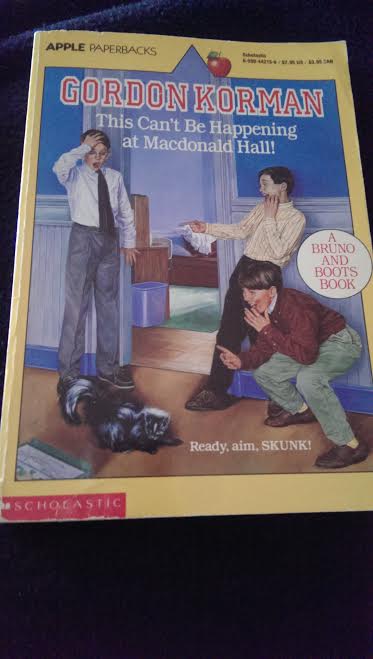
 This Can’t Be Happening at MacDonald Hall by Gordon Korman, 1978.
Bruno and Melvin (called Boots) have been roommates ever since they began attending boarding school at MacDonald Hall. The two of them are best friends, and they do everything together. Quite a lot of what they do involves practical jokes. But, they’ve really been pushing the limit with their antics, and when they go a little too far during a hockey game, the headmaster gives them the ultimate punishment: they can no longer share a room. Mr. Sturgeon thinks that they’re a bad influence on each other. Each of them is assigned to a new roommate, and they won’t even be able to hang out together.
The prospect of losing each other as best friends is too much for Bruno and Boots. Besides, neither of them likes their new roommates. Boots has to share a room with George, who comes from a wealthy family and is only interested in money. George is also a germophobe who hates it that Boots sneezes every morning when he wakes up. Bruno’s new roommate is Elmer, the school’s supreme science nerd. Elmer isn’t happy about Bruno’s presence, either, because Bruno and his belongings take up valuable space that Elmer requires for his many projects. Obviously, the situation is completely intolerable for everyone.
Bruno, the idea man of the duo, declares that he will find a way for him and Boots to become roommates again. They meet secretly at night to discuss their plans. The boys try every tactic they can think of. They try making themselves completely obnoxious to their new roommates so that Mr. Sturgeon will have pity on them and give them their old room assignments. They try framing George and Elmer for some outrageous pranks of their own so Mr. Sturgeon will think that they’re a bad influence on Bruno and Boots. Bruno and Boots even try (as an extreme measure) behaving themselves! What will finally work?
This is the first book in the MacDonald Hall Series (or Bruno and Boots) series. It is currently available online through Internet Archive.
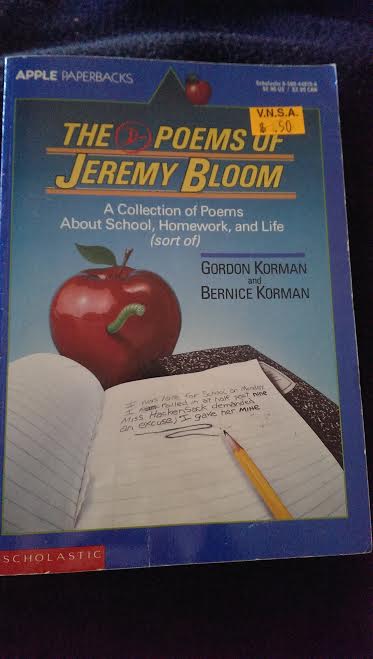 The D- Poems of Jeremy Bloom by Gordon Korman and Bernice Korman, 1992.
 Jeremy tries to make the best of things, but somehow (partly through his own fault and partly by accident), he continually manages to do things to annoy his poetry teacher, Ms. Terranova (or, as the kids call her, Ms. Pterodactyl, thanks to a mistake Jeremy made when he said her name on the first day of class). Every single poem Jeremy writes during the year receives the same grade: D-. The book is divided into different periods of Jeremy’s work, along with an explanation about what Jeremy did during each period to tick off his teacher. At the end, the reader can be the judge: Are Jeremy’s D- grades because he’s a terrible poet or because his teacher is mad at Jeremy for everything else he does during the year? (The answer is pretty obvious.)
 My Crazy Cousin Courtney Returns Again by Judi Miller, 1995.
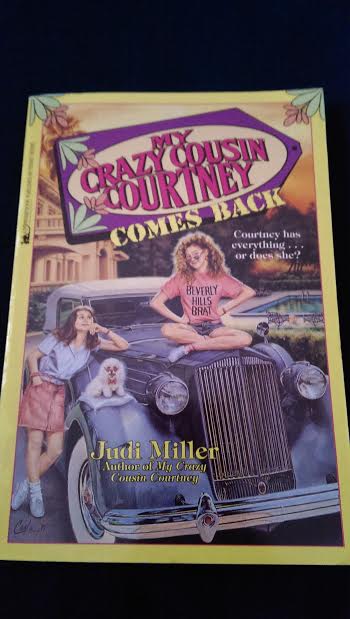 My Crazy Cousin Courtney Comes Back by Judi Miller, 1994.
 My Crazy Cousin Courtney by Judi Miller, 1993.
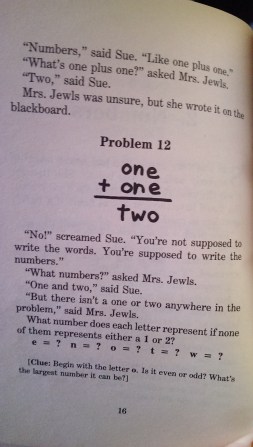 Basically, it’s a puzzle book. In the Arithmetic section, the letters in the words stand for numbers. The book gives an example to demonstrate how to figure out which numbers the letters stand for. The problems get harder through the sections labeled Numbers, Pronouns, and Paragraphs.
 Wayside School Gets a Little Stranger by Louis Sachar, 1995.
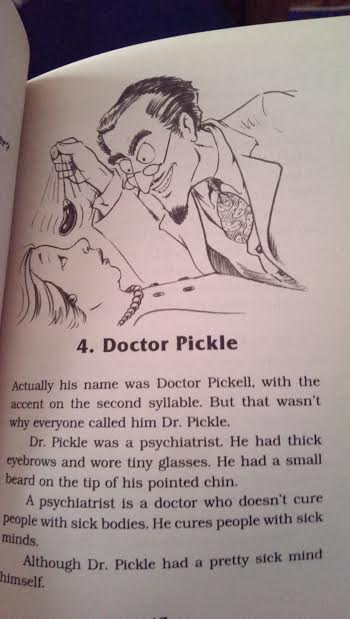 Meanwhile, the principal declares that “door” is a very bad word and that everyone should say “goozack” instead. Mrs. Jewls tells the children to write poems about colors, but some colors rhyme better than others. Kathy tries to convince everyone that Santa doesn’t exist. Miss Zarves (who also doesn’t exist), laments about how difficult teaching really is.
 Wayside School is Falling Down by Louis Sachar, 1989.
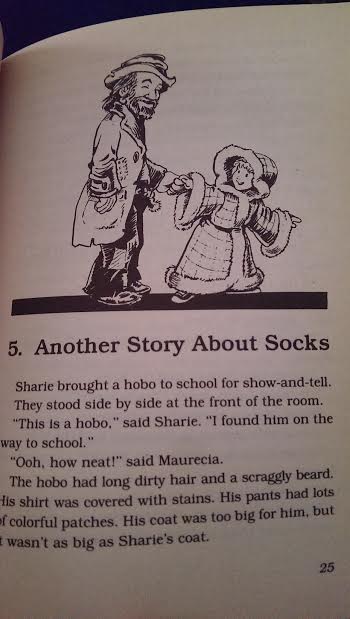 Socks figure into many of the stories, with a special jingle invented by Mac, who used to be named Nancy until he traded names with a girl. It’s fortunate that Mac invented the jingle because Allison uses it to free herself from the non-existent 19th story. Myron chooses freedom over safety, emancipating himself from the school’s rules. Bebe invents a younger brother, and things turn around for Leslie when her pigtails pull Paul. Rondi fears that she’s no longer cute now that her front teeth have grown in. Joy learns the best thing about the toy dog that Todd brought to school, and Ron actually tries the school lunch.
 Each of the books contains thirty stories, like the school (ha, ha!). It would take awhile to describe them all, but there are stories about each of the kids in Mrs. Jewls’s class. Mrs. Jewls took over the class on the 30th floor after Mrs. Gorf accidentally turned herself into an apple. She used to turn her students into apples when they made her mad, but most forms of revenge backfire eventually. Mrs. Gorf ends up turning herself into an apple when one of her students holds up a mirror, and then, Louis the yard teacher eats her.
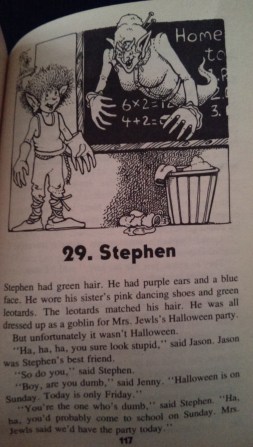 Mrs. Gorf does make one more reappearance on the Friday before Halloween. Mrs. Jewls and the children argue that she can’t haunt the school if it’s not Halloween, but when Halloween falls on a weekend, schools have to have their Halloween party on the Friday before. Stephen’s just happy that the ghost of Mrs. Gorf justifies his costume.
 Be a Perfect Person in Just Three Days! by Stephen Manes, 1982.
 Jestress's Forgotten Books and Stories