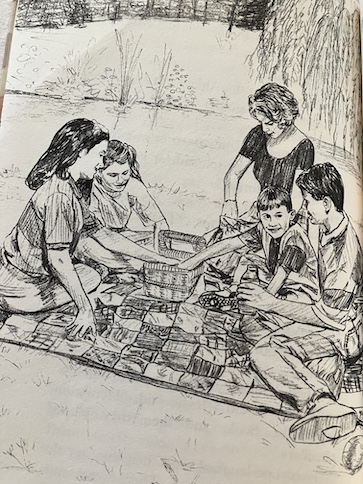
Jamie and the Mystery Quilt by Vicki Berger Erwin, 1987.
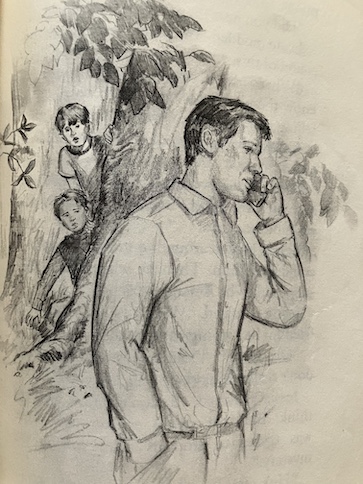
Money has been tight in the Huddleston family since Jamie’s father died. The family lives in a big, old house that’s been in the Huddleston family for generations, but it has gotten run down because the family doesn’t have enough money to fix it. The local historical society is interested in the house because of its age, but Jamie’s mother doesn’t know if the family will have enough money to hold on to it. Even heating the house has gotten expensive, and there are two girls in the family to raise and educate. Jamie’s mother is seriously considering selling the big house so she and the girls can move to a smaller, less expensive house, but Jamie can’t stand the idea of losing this house, which she loves. To help earn some extra money, Jamie takes on a part-time tutoring job, and she is thrilled when her first tutoring assignment is a popular boy from school, Kevin Parker.
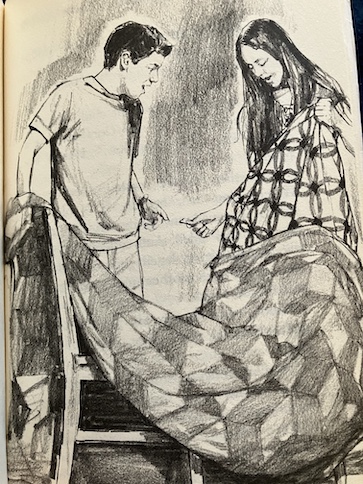
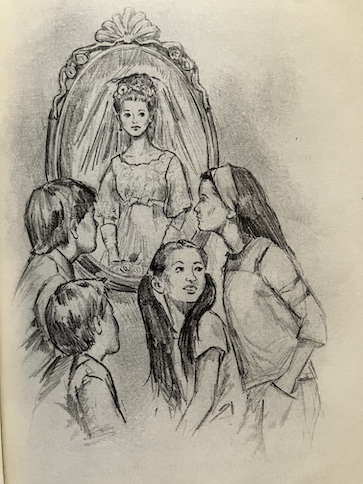
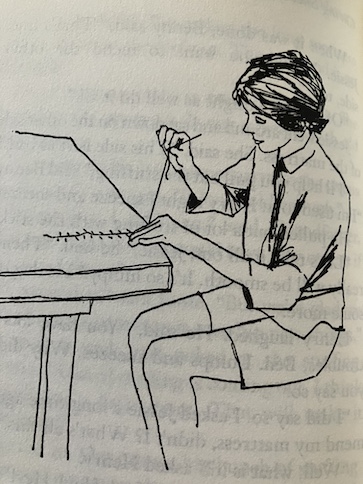
When Jamie discovers a chest of old quilts in the attic that were made by her great-grandmother, she is thrilled to find one that is actually a map of their house! She shows it to Kevin, who is fascinated. His mother has an antiques shop, and he has an interest in antiques because he helps his mother. Unfortunately, the realtor who is trying to convince Jamie’s mother to let him sell their house also sees the quilt and immediately becomes interested in its monetary value. Jamie tries to make it clear to him that the quilt is not for sale.
Then, one day, the quilt is stolen while it was hung out for an airing! Just about anybody could have taken it because it was outside, but when Jamie’s mother reports the theft to the police, the policeman who takes the report says that there have been other thefts of antiques in the area. Their case is a little unusual because the quilt is the only item missing, whereas the other thefts involved houses being completely cleaned out of truckloads of antiques.
There is something unusual about the quilt. Not only is it unusual to find a quilt that’s a perfect map of a house, but it seems like the quilt also contains a secret, hidden message. Was the quilt stolen for its monetary value or just because it’s a fascinating-looking quilt, or does someone else also have the sense that there’s a secret meaning in the quilt?
The book is available to borrow and read for free online through Internet Archive.
My Reaction
I remember liking this story when I was a kid. I remembered that the rainbow in the quilt was the clue to where the treasure was hidden, but I didn’t remember the story behind why the treasure was hidden. Jamie’s ancestors didn’t do anything illegal or unethical. It was more that they were going through hard times and resorted to an unappealing job that they didn’t really want to discuss with other people.
I didn’t think there was much secret about who the villain in the story was. There’s a person in the story who is both an unlikable character and who would have access to people’s homes to be able to steal from them. In some ways, I thought that the characters didn’t seem to realize that as soon as they should have. The mother in the story seemed a little too trusting.
The story seems a little slow, now that I’m rereading it as an adult, but I still have nostalgia for it. The quilt map is still a fantastic addition to a children’s mystery.
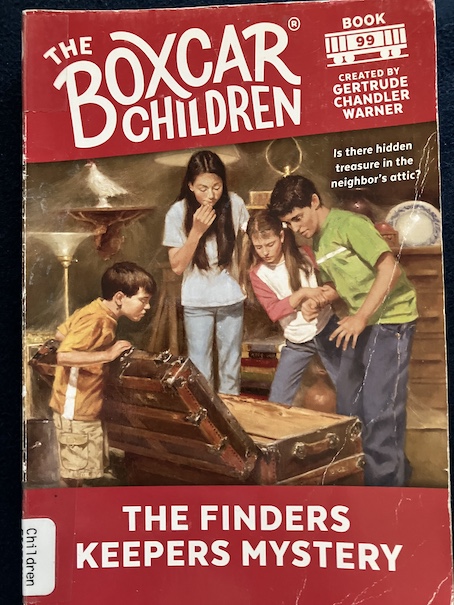
#99 The Finders Keepers Mystery by Gertrude Chandler Warner, 2004.
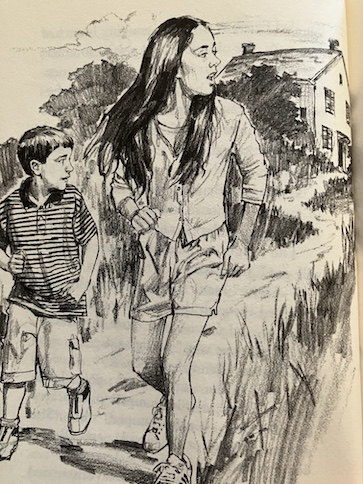
Jessie and Benny are returning from a trip to the post office when Jessie insists on taking a shortcut by the old Bidwell house, where no one has lived for a long time. Benny doesn’t want to take the shortcut at first because there are rumors that the old house is haunted. However, Jessie is eager to get home to dinner, so they take the shortcut anyway. Technically, they’re trespassing, but that’s how they find out that the house is no longer empty.
When someone bangs open one of the shutters of the house, the kids are frightened, thinking that maybe there really is a ghost in the house. However, they also notice that there’s now a broom on the porch. Thinking about it later, at home, they realize that a ghost wouldn’t be interested in sweeping. The next day, all of the Alden children go to look at the old house, and they notice a van in the driveway and that new flowers have been planted in the pots. The new owner of the house, Lina Diaz, introduces herself to the Aldens.
Lina recently inherited the house from a cousin. She’s an architect, and she’s looking forward to renovating the house. It used to belong to a great-great-aunt, Hope Bidwell, which is how the house got its name. The house is filled with antiques and family heirlooms, so Lina is going through things to decide what she wants to keep and what she might want to sell. She’s thinking of having a yard sale. The Aldens offer to help with cleaning and sorting items and setting up the sale, and Lina happily accepts the offer.
While they’re looking through things in the attic, they find a trunk with some beautiful old quilts. Lina says that they were probably made by Hope during the mid-1800s because she had a reputation for making beautiful old quilts. There is also a rumor that Hope left a treasure hidden somewhere in the house, although Lina doesn’t know what kind of treasure that’s supposed to be. She considers the quilts a kind of treasure because they’re beautiful and because of their family connection.
Lina tells the Aldens more about Hope. She was supposed to be married to a man named Robert, but sadly, Robert died of a sudden illness before their wedding. Hope supposedly made a beautiful wedding ring pattern quilt for her marriage, but nobody knows what happened to it since the marriage didn’t take place, and it doesn’t seem to be among the other quilts in the trunk. Each of them has a different quilt pattern, except for one that’s a plain gray and doesn’t seem to fit with the others, although it’s well-worn, showing that it was used a lot. A set of letters hidden in the lining of the trunk confirm the story about Hope and Robert and the existence of the wedding ring quilt Hope was making.
Almost from the moment they find those quilts, other people are interested in buying them from Lina, but Lina is reluctant to sell them because of the beautiful workmanship and sentimental value. She invites Edward Muncie from the state history museum to see the quilts because he’s an expert on quilts, he tries to persuade her to donate them to the museum. He thinks that they would make a wonderful exhibit, and he worries that they might get damaged if they’re simply left in the attic. If she isn’t willing to donate them, he says maybe he can persuade the museum to purchase them from her. Lina says that she’ll think about it, but she doesn’t really want to accept the offer.
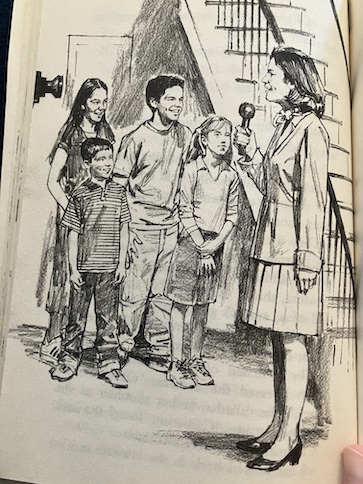
Although they tell Mr. Muncie not to discuss the quilts with anybody, it seems that he has told other people about them. Someone tries to break into Lina’s house during the night. Then, a reporter named Regina shows up at Lina’s house, insisting on interviewing her about hidden treasure and rare quilts in the house. They suppose that she heard about it from Mr. Muncie. Regina Lott does a news story about the quilts and Regina’s yard sale that gets collectors and antique dealers pounding on Lina’s door to be first to see what she has to offer … especially the quilts, although Lina still says they’re not for sale. One man who comes to the yard sale even tries to sneak into the house and look around, but the kids catch him.
A woman named Coral Weaver is the last to leave the sale. She’s interested in old clothes and cloth scraps. She explains that she owns a quilting store. She’s also interested in the antique quilts and the stories behind them. Lina doesn’t want to show her the quilts, but Coral invites her and the Aldens to come to her shop sometime so they can talk about quilts. Coral is the one who tells them that the man who tried to sneak into the house during the sale is Dirk Gray. He used to work for the state history museum, and he owns an antique store.
There is an obvious motive for many people to want the quilts because they have value as collector’s items. Collectors want them, and other people might want to sell them for the money. However, is it possible that the quilts are the key to the treasure that Hope supposedly left behind?
The book is available to borrow and read for free online through Internet Archive.
My Reaction
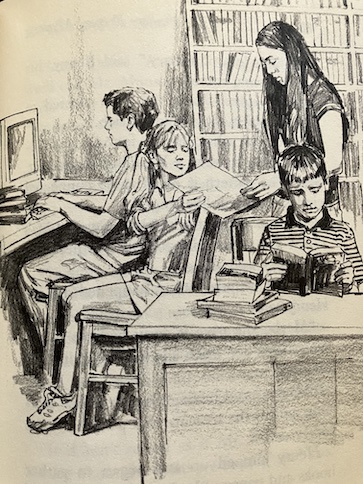
The mystery includes some interesting facts about quilts. At one point, the children go to the library and do some research about quilts to understand more about the quilts they found and why someone would want them so badly. The book explains that quilts can become collector’s items and that they can be worth a great deal of money.
The part I liked the best, though, was when they explained that quilts have different patterns, some more rare or intricate than others. Besides the wedding ring pattern quilt, the book also mentions patterns like flying geese and log cabin. The names of the patterns are based on what they resemble. Each of the patterns is a series of geometric shapes, but the shapes can resemble other things, sort of like the way basic shapes form pictures in tangrams.
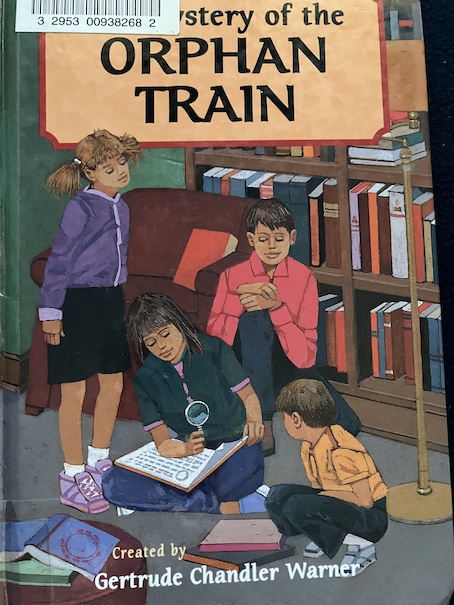
#105 The Mystery of the Orphan Train by Gertrude Chandler Warner, 2005.
Grandfather Alden is going on a business trip to Kansas, and he’s taking his grandchildren with him. They’re going to be staying at an old Victorian house that a friend of grandfather’s, Kate, has turned into a bed and breakfast. The house has been in their family for years, and one of its claims to fame is that a famous photographer, Ethan Cape, once stayed there and photographed her grandmother, Sally Crawford. Ethan Cape was known for his photographs of famous people, like royalty and movie stars, and nobody knew why he made it a point to visit this house in Kansas and photograph a woman he supposedly never met before, who wasn’t famous at all. People have offered to buy the photograph from Kate, but she refuses to sell it.
The Aldens find the old Victorian house charming, but Kate also tells them that there’s a mystery surrounding her grandmother. Not only does nobody know why Ethan Cape came to see her and photograph her, but Sally said before she died that she had a secret to share with her family. Unfortunately, she passed away before she could tell them what it was. It might have been the reason why she knew Ethan Cape and why he came to see her, but Kate thinks they’ll probably never find out.
A woman who’s staying at the bed and breakfast at the same time as the Aldens is fascinated by the bluebird necklace that Kate wears. The necklace used to belong to Sally, although nobody knows exactly how or when she got it or how old it really is. The woman recognizes it as an antique and tries to pressure Kate to sell it to her, but Kate refuses. Even a professor who is also staying at the bed and breakfast suggests to Kate that she might want to sell something for some extra money.
Far from wanting to sell anything, Kate has been trying to find some old family antiques that were sold years before when her grandfather needed money, repurchase them, and use them to furniture the bed and breakfast. She shows the Aldens one of the pieces that she’s managed to track down and buy, an old desk. It’s a bit of a mess, so the Aldens offer to help clean it up. While they’re cleaning, Henry finds a hidden compartment in the desk with a strange message for Sally signed “Thane Pace.”
When they show the note to Kate, she’s astonished, but she recognizes the name. Thane Pace was a boy who saved Sally’s life when she was a young child. Sally had been skating one day when she fell through the ice, and Thane Pace saved her. Thane Pace himself is a bit of mystery because he didn’t live in Sally’s town. He told everyone that he had come in search of his missing sister. They had both been sent out west on the orphan train as young children, but they were adopted by different families. However, nobody knows what happened to Thane Pace because, even though he saved Sally’s life, Sally’s father soon chased him away, accusing him of theft!
Was Thane really a thief? What does his message to Sally really mean? When Kate’s bluebird necklace suddenly disappears, the Boxcar Children investigate the mysteries of Sally’s past and consider if they’re related to the mystery of the missing necklace.
My Reaction and Some Spoilers
I loved this story, and it’s a new favorite of mine in this series! I love how the children have to look into the past and solve a kind of treasure hunt to learn the secrets of a pair of orphans from the past and the real identity of the famous photographer who once visited the house and his connection to it. Part of the mystery might seem obvious to adults and older readers who enjoy word games, even from my description, but I enjoyed the treasure hunt and riddles that lead the Aldens to the full story of what happened all those years ago.
I enjoy books with historical references, and the story explains a little about the history of the orphan trains, which ran from the mid-1800s to the 1920s. It was an early form of organized foster care in the United States, carrying orphans, homeless/abandoned children, or children whose parents were unable to care for them away from crowded orphanages in cities on the east coast of the United States to communities in the Midwest, where children were in demand as extra helpers on farms or in houses or just as family members for people who were unable to have children of their own. The orphan trains were later replaced with more modern forms of foster care, and there are rules now regarding the transporting, placement, or adoption of foster children across state borders. These rules exist to provide greater oversight for the protection of the children, the suitability of their new placements, and their continued welfare.
One of the criticisms of the orphan trains was that they provided too little oversight over the quality of the foster parents and their treatment of the children. The way the trains worked was that they had scheduled stops, and interested members of the communities could come to view the children from the train and select one or more to take home with them. There was little other qualification for a potential foster parent to take a child than for them to simply show up and little follow-up on the treatment of the children once they were placed with a new family, especially with the early orphan trains. They were known for placing most of their trust in “the kindness of strangers” will little verification. The result was that some orphans were lucky and were raised by families who loved them, treated them well, and educated them, while others were used as little more than slave labor.
Orphan trains were also known for their disregard for the relationships between siblings. They were focused on getting the children placed in homes as quickly and efficiently as possible, and if that meant splitting up siblings because a potential foster family only wanted one child, they would do that, which is the basis for the history behind this story. Potential foster families often had in mind the age of the child they wanted before they ever met any of the children, and they were eager to get exactly the type of child they had in mind. Some families specifically wanted boys who were old enough to help with farm work immediately, and they weren’t interested in infants, who would need extra care before they would be old enough to be useful. Other families specifically wanted infants so they could raise them as members of their own families without the influence of the children’s birth families, their memories of the past, or any bad habits they may have acquired hanging over them. These differing priorities among the foster parents are the reasons why siblings like Thane and his sister were separated from each other. However, Thane never forgot his sister, and he wanted to make sure that she knew the truth about their past in the end.
The disappearance of the necklace isn’t directly related to the secrets of the past, but the necklace is important as a family heirloom and the shared connection between Thane and his sister. It’s a separate puzzle from the treasure hunt to learn the truth about Thane, but it’s still fun and interesting.
#83 The Copycat Mystery by Gertrude Chandler Warner, 2001.
Aunt Jane invites the Alden Children to come visit her while her husband is out of town on a business trip, cryptically promising them “a trip back in time.” The Alden children wonder what that means, but it turns out that Aunt Jane is taking them to visit a Victorian farmhouse that’s been turned into a museum. Tour guides dress up in Victorian costumes and explain what life what like in the past.
The farmhouse museum has only opened recently, but it’s gotten off to a rocky start, and odd things are happening, and it makes the owner, Carl Mason, and the manager, Gwen, worry. When the Aldens arrive, the sign for the farmhouse is missing, and Benny finds it hidden by the old barn. Nobody seems to know who removed the sign and hid it, but Mr. Mason is angry because potential visitors would be unable to find the museum.
There also seems to be some hard feelings and tension among the people working at the museum and other members of the community. The groundskeeper, Draper Mills, who takes care of the farm doesn’t like the idea of the farmhouse being turned into a museum because he thinks visitors are going to trample the ground. Miss Penning, who lives nearby, is upset because Mr. Mason removed her great-great-grandfather’s portrait from the farmhouse. Her great-great-grandfather, Horace Wagner, used to own the farm, but Mr. Mason doesn’t want anybody to talk about him because Horace had a reputation as a practical joker. Miss Penning thinks it’s disrespectful not to acknowledge Horace’s role in the house’s past, but Mr. Mason doesn’t like the idea of practical jokes. He wants the museum to be more dignified and focused on educating people about life in the past. He think if they talk about Horace on the tours, it will make the house and museum seem more like a joke. Mr. Mason even removed Horace’s picture from the farmhouse so no one would see it. Meanwhile, Gwen is worried because the museum is short-handed over the summer. Gwen’s younger sister, Sharon, is helping out, but even so, they could use more help. Sharon seems to be quarreling with Gwen, too, although the Aldens aren’t sure why at first.
The Aldens like getting involved in projects, so they volunteer to help with the museum themselves. Dressing in Victorian clothes and leading tours sounds like fun! However, more odd things begin happening. An antique birdcage disappears and is found in an odd place with a live canary inside, and someone turns all the pictures in the house around and shortens the legs on Henry and Benny’s costumes. Odder still, Miss Penning says that each of the pranks is a copy of something that Horace did when he was alive. It’s like someone is duplicating all of Horace’s old practical jokes. The only difference is that Horace’s pranks were always in a good cause, like surprising someone with a special gift, helping someone feel better, or just being mildly silly and amusing. It seems like these copycat pranks are meant to disrupt the museum and cause trouble.
Miss Penning thinks that it’s the ghost of Horace doing these pranks, reminding people that he’s still a part of the house and that he wants acknowledgement. However, the Aldens think that it’s more likely to be a living person. Perhaps Miss Penning is doing these pranks herself to call attention to Horace’s memory. On the other hand, it could be Jake, the student reporter who is doing a story about the museum and who thinks the place seems too dull. Could he be trying to liven up his story? The Aldens also learn that Gwen has been Sharon’s guardian since their parents died, but the sisters have been quarreling because teenage Sharon wants to take part in a fashion show, and Gwen doesn’t approve. Could Sharon be staging the pranks to get even with Gwen? Mr. Mason is getting upset about all of these pranks, and if someone doesn’t put a stop to them soon, he might fire Gwen for not managing the museum well.
The book is available to borrow and read for free online through Internet Archive.
My Reaction
One of the themes of this story is about the differences between people’s perceptions of the past and the reality. People often think that people in the Victorian era were always “prim and proper” and joyless, but Horace Wagner was exactly the opposite. He had a quirky sense of humor and liked to display it.
Violet explains that people get the idea that Victorians were always stern and serious because they aren’t shown smiling in most old photographs, but that’s only because photographs in the Victorian era required everyone to sit perfectly still, and the subjects had to be extra careful not to move. When Horace had his picture taken, he also sat still and unsmiling, but he put the flower from his buttonhole behind his ear for the photo. Horace could never be completely serious, which is why Mr. Mason doesn’t think he fits in the Victorian museum, even though that museum was Horace’s old home. It’s ironic because the more serious view of the past that Mr. Mason likes to convey is actually a departure from the reality of the situation. Miss Penning is correct that removing Horace from the museum and never mentioning him is actually doing a disservice to the past, essentially hiding someone important to his time and the location because he didn’t fit the expected mold. The Aldens also realize that the stories about Horace are endearing to visitors and add an interesting dimension to the museum.
The solution to the mystery causes everyone to rethink a few things and to resolve conflicts they have with each other. Besides recognizing the difference between the perceptions of the past and the reality, some of the characters admit that they’ve been narrow-minded in their approaches and interpretations of other things. Gwen and Sharon reconcile when Gwen decides to allow Sharon to participate in the fashion shows. More importantly, Mr. Mason realizes that his approach to the museum was wrong and that Horace does belong in the story of the house and that it’s okay to present the less serious side of the past along with the more serious side.
I enjoyed this light-hearted mystery. I’m not a big fan of pranks in real life because they can easily go too far, and I don’t like practical jokes that seriously embarrass people or might hurt them. However, Horace was a more altruistic practical joker. His practical jokes were often meant to help people rather then hurt them. For example, when he was young, Horace’s brother was small for his age and worried that he would never grow, so Horace started shortening his brother’s pants secretly at night to make him think that he was growing, so he wouldn’t feel so bad. As the characters describe it, Horace’s pranks were generally pleasant. Only one, which he played on a local club that excluded a friend of his, was meant to cause some embarrassment to make a point about what it feels like to be excluded. Although the club members were embarrassed, his joke was pretty mild and served a higher purpose. As a character who drives the story without actually being present, I liked Horace. He was silly but basically good-hearted with his humor. By contrast, the modern practical joker copying his pranks is more self-centered and thoughtless about the consequences, although revealing this person does cause other people to consider the ways in which they’ve been thoughtless and make changes for the better.
The book ends with the characters enjoying “April Fool Pie”, which is a mock apple pie. They don’t provide an exact recipe, but they explain the ingredients.
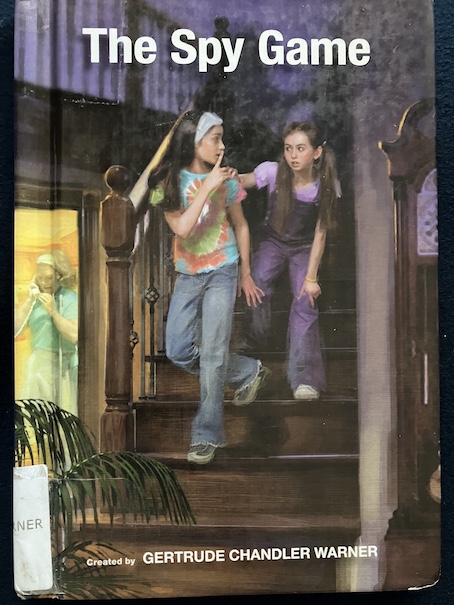
#118 The Spy Game by Gertrude Chandler Warner, 2009.
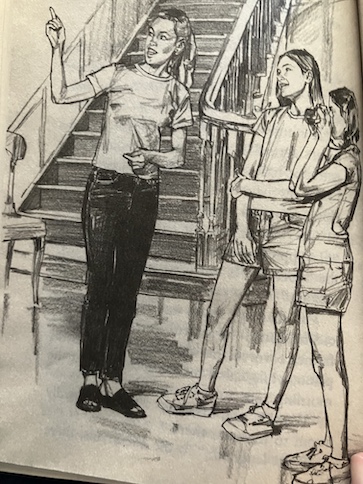
Mrs. Dawson, a friend of Mrs. McGregor, the Aldens’ housekeeper, stops by one day for a visit. Mrs. Dawson is also a housekeeper, working for Amanda Penner. She has been with the Penner family for years, although her ambition is to own a book store some day. Mrs. Dawson says that Amanda has injured her ankle falling over some loose stones in a walkway at the house she inherited from her grandfather. The Alden children are sympathetic, and they offer to help fix the walkway so nobody else will get hurt. Mrs. Dawson says that she’s sure Amanda would be grateful for the help, although they notice that she’s oddly evasive when Mrs. McGregor asks her if Amanda still likes writing.
When the Aldens go to see Amanda Penner, she tells them more about the house and her family. The house is over 100 years old, and she says that it was built by an ancestor of hers for his young bride, Pandora, who was called Dora. Amanda has many fond memories of the house because, even though she didn’t grow up there, she used to visit her grandfather there every summer.
When the children start fixing the stone walkway, they notice that there are letters engraved into the stones. They wonder if the stones are meant to spell something, and when they investigate, they find it leads to a riddle. They show it to Amanda, and she says that it looks like they’ve stumbled on her grandfather’s “Spy Game.” Her grandfather was a big fan of mysteries and used to play a kind of treasure hunt game with her. The game always started with a hint in the form of “I spy with my little eye …”, which is why she started calling it the “Spy Game.” Amanda says that, when her grandfather died, he left her one last “Spy Game” that supposedly leads to something gold, but she hasn’t been able to solve it. Naturally, the Aldens offer to help her find the hidden treasure!
However, they might not be the only ones looking for the hidden treasure. Amanda’s friend, Steve, is renting the room over the garage for the summer, and they overhear him talking on the phone about getting a “treasure.” They also hear Mrs. Dawson talking about opening “Pandora’s Box.” Are Steve and Mrs. Dawson also looking for the gold that Amanda’s grandfather left for her? All is not what it seems in this tale of treasure hunts and riddles!
The book is available to borrow and read for free online through Internet Archive.
My Reaction
There is a fun twist to this story that I don’t want to spoil! It’s hinted at throughout the book that the story behind the treasure hunt doesn’t quite add up, but the true purpose behind the treasure hunt makes a fun surprise! Actually, there’s kind of a double surprise, but I don’t want to spoil either one.
The setting of the story is charming, an old house where a grandfather used to play treasure hunt games with his granddaughter. I always loved treasure hunt stories as a kid, and this is the kind of book I would have loved back then. I liked how the clues in the story could have multiple meanings, like the clue about a tree and a “hollow” could refer to a tree in a place called a “hollow” or to a hollow tree. Readers are given enough information that they can try to figure out the clues along with the Aldens, but I thought that the room for interpretation in the clues made it an interesting challenge.
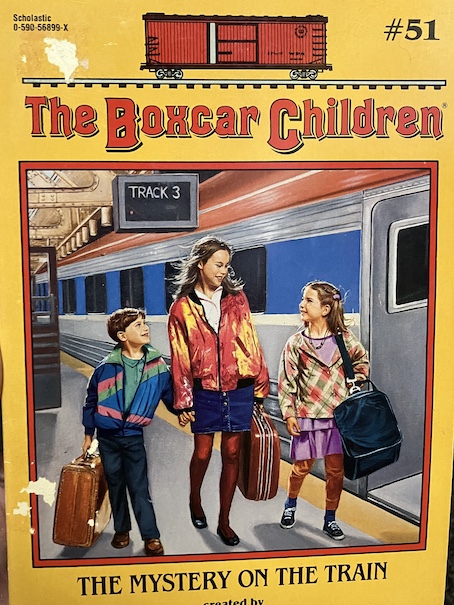
#51 The Mystery on the Train by Gertrude Chandler Warner, 1996.
The Alden Children’s Aunt Jane is planning to travel to San Francisco to join her husband, who is there on a business trip. Because the Boxcar Children have never actually traveled on a train trip before, she invites them to come with her. The trip will take three days by train. Then, they’ll spend a few days in San Francisco before flying hone. The Aldens love traveling, and they’re excited by the idea of a train trip!
When they arrive to catch the train, they witness an odd scene at the station. An older woman is fighting with a younger woman over what looks an art portfolio. The younger woman eventually gets hold of the portfolio, knocking the older woman to the ground, and runs for the train. The Aldens ask the older woman if she’s all right, and she says she is. They also ask her if the younger woman is the owner of the portfolio, and the older woman says yes. She doesn’t explain why they were fighting over it, but they later see her talking to the train porter and giving him some money. The Aldens wonder what that scene was all about.
On the train, they meet the young woman, whose name is Annie. She explains that she’s also heading to San Francisco because she wants to attend art school there. She tells them that she’s planning to stay with an uncle there and that her portfolio contains her art work. Annie and Violet enjoy talking about art together, but the Aldens have the feeling that there are things that Annie isn’t telling them. She seems very paranoid about her portfolio, always afraid to leave it unattended and panicking every time the porter tries to help her with it.
When the portfolio suddenly disappears, Annie admits to them that it doesn’t really contain her artwork. It actually has a set of vintage autographed movie posters that are valuable for collectors. They were part of an inheritance that she and her aunt shared, and she’s hoping that they will help fund her art school education. Who could have taken the portfolio on the train? Was it the man who actually told them that he collects old movie posters and that he’s hoping to purchase some in California, or maybe the mysterious man who wears sunglasses everywhere on the train? Could Annie’s aunt have paid the porter to retrieve the posters from Annie?
The book is available to borrow and read for free online through Internet Archive.
My Reaction
Mysteries set on a train are always fun because, like with mysteries set in isolated houses, there is a limited set of possible suspects, and they’re in a situation where people cannot easily enter or leave. We know that the portfolio is still on the train, somewhere, and the thief hasn’t left. It’s just a question of who the thief is and where the thief hid the portfolio.
There are some obvious suspects in this story, but there are a couple of points that make the mystery more complicated. One is that there are unknown relationships between different suspects, some which are easier to guess or figure out than others. Another point is that Annie is keeping secrets from the Aldens. Through the story, she isn’t entirely honest with them about what’s actually going on. There are also some things that Annie doesn’t fully understand. This is one of those stories where the stolen object is stolen more than once, changing hands before they fully grasp what happened to it the first time it disappears.
There are twists to this mystery that keep it interesting, and I love the train setting! The trains they ride on through their trip are real trains, and the experience of the trip is what the actual experience is like. They take two trains, changing in Chicago to the California Zephyr, which is a real Amtrak train that goes from Chicago to San Francisco. I’ve been on train trips before, and if you’re curious, there are YouTube videos people have made, showing their own train trips across the US, like this one showing a trip on the California Zephyr.
#11 Caboose Mystery by Gertrude Chandler Warner, 1966.
Grandfather Alden has a friend who owns a railroad, and he rents out cabooses to people who want to travel with the railroad. It’s a bit like traveling in a trailer, having a contained living area that includes a small kitchen, but the caboose is attached to a train and travels the rails, no need for driving. This story picks up after the Schoolhouse Mystery, with Grandfather Alden renting two cabooses so he can travel with his grandchildren. He will travel in the bigger caboose with Henry and Benny, and the girls, Jessie and Violet, will travel in the smaller one.
When Grandfather Alden takes the children to see the cabooses, the conductor, Mr. Carr, tells them that the bigger caboose has a history, but they’ll be hearing more about that later. A postman, Sid Weston, is at the station to deliver a letter for Mr. Carr, and he wants to have a look at the bigger caboose, but Mr. Carr doesn’t allow it. The Aldens wonder why he seems so curious about it.
When they embark on their trip, the Aldens are able to travel back and forth between the two cabooses to visit with each other. They enjoy watching the countryside going by while the train is moving. At every place the train stops, there is something interesting to see. At one stop, they get fresh corn to cook, and at another, they see beavers building a dam. There’s a man who lives by Beaver Lake who people call “Old Beaver.” Old Beaver is kind of a hermit, but he’s dedicated himself to protecting the beavers and their habitat. For some reason, when the Aldens tell him about the cabooses they’re traveling in and the number of the bigger caboose, 777, Old Beaver is disturbed and runs away.
Benny can’t forget about what Mr. Carr said about the bigger caboose having a “history,” and everyone wonders why Old Beaver had such a strange reaction to hearing the number of the caboose. They find out from a station master called Shaw that the caboose used to belong to a circus train. The circus owner’s wife lived there. A man who works for the station now used to be a clown with that circus, called Cho-Cho. His wife, Chi-Chi, was a tightrope walker and best friends with the circus owner’s wife, but she died suddenly when she fell during one of her performances. Cho-Cho left the circus after that.
There is a mystery surrounding Chi-Chi’s death because she used to own a beautiful diamond necklace that was given to her mother by royalty. She used to hide it when she wasn’t wearing it, and not even Cho-Cho knew where she kept it. After her death, nobody could find the necklace, and the police believed that it was stolen by the Thin Man who worked for the circus sideshow. Cho-Cho was friends with the Thin Man and didn’t want to think he had taken the necklace, but people had seen Chi-Chi showing him the necklace before she died, and nobody remembers seeing him give it back to her. After he was accused, the Thin Man ran away, and people thought that was an admission of guilt. The man called Old Beaver was the Thin Man’s best friend, and he blames the accusations for making his friend run away. Nobody knows where he is now.
It’s a sad story, but it confirms what Benny suspected, that there’s a mystery surrounding their caboose. Could the necklace be hidden there, or is there something there that could tell them where the necklace is?
My Reaction and Some Spoilers
Like many of the other early Boxcar Children books, there is often more adventure in the story than mystery. The mystery of what happened to the necklace is a definite mystery, but the Aldens end up finding the necklace more by accident than solving the clue that was left behind by Chi-Chi for Cho-Cho. Once they find the necklace, they understand what the clue was supposed to mean rather than figuring out what the clue meant to figure out where the necklace was. Still, it was a nice story. Finding the necklace also solves problems for the unhappy former circus performers they’ve met. Figuring out where the Thin Man is so they can tell him that his name has been cleared adds a secondary mystery for them to solve. The Thin Man’s name is cleared, Old Beaver feels better for knowing that the Thin Man is no longer a suspect, and Cho-Cho gets the necklace.
The idea of traveling in a caboose, or better yet, a pair of cabooses, sounds like the kind of fun adventure that many kids would enjoy! It’s a colorful way to travel, and while the kids travel by railroad, they learn a few things about the train and how it is run. At one point, they get to see the engine of the train and talk to the engineer. The things they see along the way are interesting, too. There is a point where Benny separates from the others to go see a talking horse from the circus while the rest of the family tours a glass factory and gets to pick out some pieces for themselves. The places they visit aren’t always the kinds of things families would seek out as destinations, but it’s charming that they get to travel this way on a train. They have fun along the way, and there’s always something interesting, wherever they stop.
There is a note from the author at the beginning of the book about the inspiration for this story, a trip that she took by caboose herself:
To My Readers The Little North Railroad is a storybook railroad, but the cabooses are real cabooses. With the help of six very kind trainmen, I myself took a trip by caboose, riding on the back platform and feeling just like Benny. I ran the Diesel engine, blew the whistle, rang the bell, and watched as the trainmen set off dynamite on the track, just as it says in these pages. As for the story, the adventures are wholly imaginary.
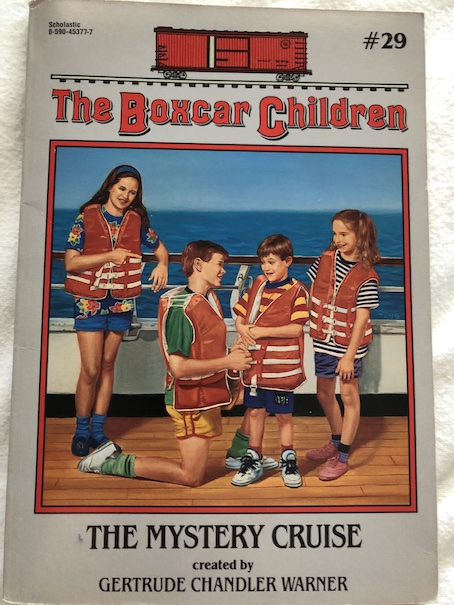
The Mystery Cruise by Gertrude Chandler Warner, 1992.
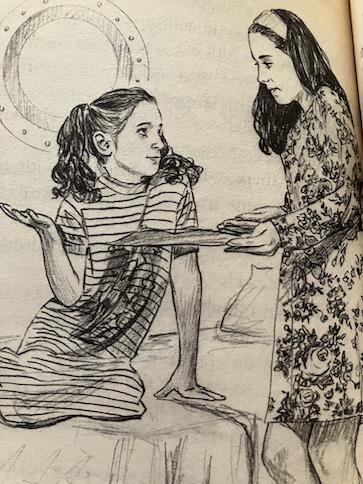
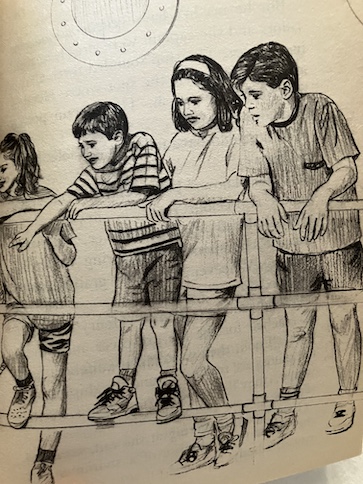
Mr. Alden takes his grandchildren on their first cruise to the Caribbean! The Alden kids are excited to go because there are a lot of interesting things to do on the cruise ship. However, they begin to notice some strange things happening happening on the ship and some odd people among the passengers and crew.
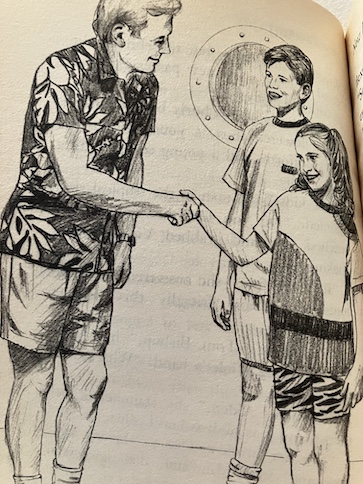
The first person they meet is Max, a history professor who shares their table at dinner. The Aldens can tell that something is bothering him. He gets a telegram that upsets him, and he seems desperate to communicate with someone, but for some reason, the phone and radio systems on the ship keep breaking down. It looks like sabotage! Could someone be trying to stop Max from communicating with someone?
Eventually, Max explains that he was notified about the death of a great-aunt, but to claim the inheritance, he must be present at the reading of the will, and various problems on the ship seem to be delaying the ship from reaching its destination in time. Besides the sabotage of the phone and radio, someone also gives a false cry of “man overboard” to make the ship stop. The crew is able to verify that nobody is missing from the ship by doing a head count. Is someone deliberately trying to prevent Max from reaching their destination on time, so he won’t receive his inheritance? If Max isn’t there, he says another relative, his cousin, will inherit, but this cousin isn’t on the cruise with him. Could she have hired someone to keep Max away from the will reading?
There’s a new employee on the ship, Heather, who seems very nervous and secretive about some messages that she’s been receiving. Heather also seems to know the Rands, a family who says that they used to work for another cruise company and who keep saying that the other cruise company was better. Could Heather and the Rands be working together to sabotage the cruise? Tom, another passenger, seems friendly and likes working out and showing off how well he lifts weights, but he also seems too interested in Max’s business and too happy about the ship’s delays. Could he be the mysterious saboteur? How can the Aldens be sure that they can get Max to his destination on time?
My Reaction
One of the things I enjoy about the Boxcar Children mysteries is that they’re good at presenting multiple suspects. The story delays telling readers about Max’s inheritance, so the first part of the mystery centers on what’s going on with Max. When we find out about the inheritance, the mystery becomes a question of whether or not his cousin is trying to keep him from the inheritance. There is only one other possible motive under consideration – that the Rands are still working for a rival cruise company and may be sabotaging this cruise to draw more attention to their company. Sometimes, Boxcar Children books take twists, where the more obvious motive isn’t the culprit’s real motive, but in this case, the inheritance is directly related to the mystery. It’s more a question of who is helping Max’s cousin and what the Aldens can do to help Max reach the reading of the will. In this case, the Aldens get the crew of the ship to help them with their plan to outwit and catch the saboteur.
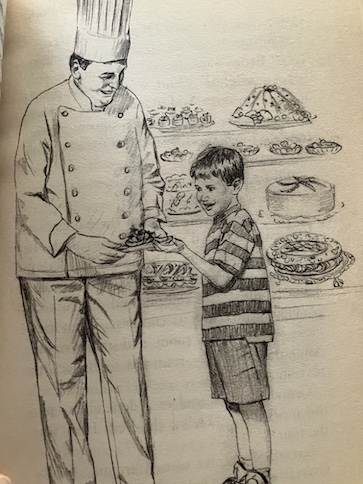
This is also one of those books where the Boxcar Children are given the opportunity to do things that most children in real life would never been allowed to do. Isaac, one of the chefs on the ship, is charmed by Benny and his love of food, and he invites him to visit the kitchen with his siblings to get free samples of different pastries and desserts. The children ask if they can help out in the kitchen in return for this special favor, and Isaac agrees. In real life, I don’t think most professional kitchens would just allow random kids to visit or to actually help with cooking. Professional kitchens have to maintain health standards, and people who work there have food handlers’ licenses. These things went over my head when I was a kid, but in some ways, they annoy me a little now.
One of the themes of the Boxcar Children books is that the Aldens are hard workers and are incredibly capable, even though they’re young. They often make it a point to earn any special treats or privileges they get or help out without being paid. I think it was the authors’ way of emphasizing the value of hard work. However, it bothers me now because situations like this in these books are very contrived, not things that real life kids would be given the opportunity to do, and probably not things they would even be allowed to do if they asked. Sometimes, the jobs the Alden kids get are due to their wealthy grandfather’s friends and connections, but other times, like this, it’s for no apparent reason. Benny just really liked the food, so they got an invitation from the chef.
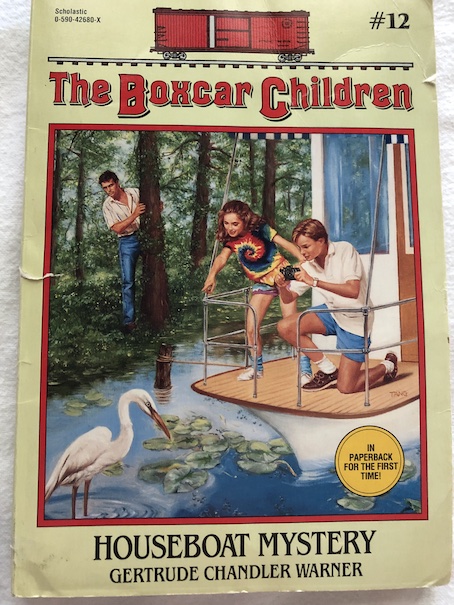
#12 Houseboat Mystery by Gertrude Chandler Warner, 1967.
Mr. Alden takes his grandchildren on a houseboat trip. It’s a peaceful trip at first, but they keep having encounters with someone driving a black car recklessly. It seems like the car turns up every place they go.
Then, Mr. Alden takes the children to an auction because Violet and Benny have never seen an auction before. They think it’s really interesting, but the auction is cut short because a valuable vase has been stolen. The police say it’s just part of a string of thefts that have been going on in the area.
After that, they visit a place called April Center, which is owned by an old friend of Mr. Alden. It’s a sort of mock town/park/tourist center. Cars aren’t allowed inside, so people rent horse-drawn carriages to go around the place and see various attractions. However, Mr. Alden and the kids notice that the horse that draws their carriage looks unusually thin, like it hasn’t been fed well. Mr. Alden knows his old friend loves animals and wouldn’t allow a horse in April Center to starve. He and the children start asking the horse’s owner about it. The horse’s owner, Sam, says that his boss is a nice man who pays him well, but eventually, he admits that he is short of money because he’s being blackmailed. His brother is in some kind of trouble, and someone threatens to go to the police about it if he won’t keep paying him. When the Aldens talk to Sam’s brother, Jeff, they are surprised that he also has an underfed horse, and he tells them the same story of blackmail. Someone has been making each of the brothers think that the other is in trouble, and they’ve both been paying money to hush it up.
Then, someone breaks into the Aldens’ houseboat and steals a clock, which is odd, and the Aldens think that maybe the thief was actually after something else. Could there be a connection between the break-in, the thefts, the blackmail, and the other strange things they’ve been seeing on this trip?
My Reaction
This isn’t one of those mysteries where readers need to figure out which suspect is responsible for something. There aren’t exactly suspects in this story at all. It’s more the case that the Aldens witness a series of strange and suspicious events, and they need to figure out the connection between them. Actually, the story feels more like an adventure than a mystery story. When the culprit is finally caught, it’s nobody we really know, just a random suspicious character that they keep bumping into along the way. To be honest, I really prefer a more traditional mystery, where readers get to know the suspects and have a chance to figure out who is doing what along with the characters.
There is a funny running gag in the story that the Aldens are allowed to name the houseboat anything they want during the time they’re renting it, and they can change the lettering on the boat as often as they want. Every day, they rename the boat after a different member of the family or someone they know. When they give the boat its final name at the end of the story, it’s a joke on reason why someone broke into their boat, which is one of the most mysterious parts of the mystery.
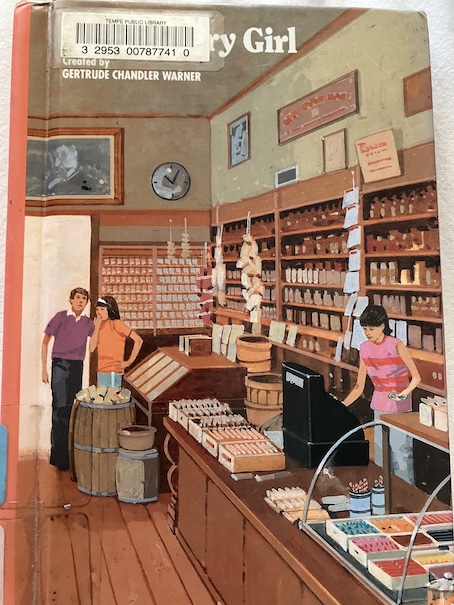
#28 The Mystery Girl by Gertrude Chandler Warner, 1992.
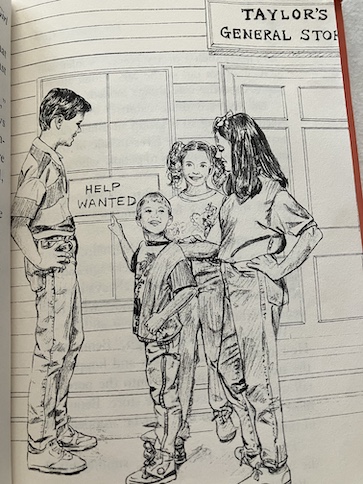
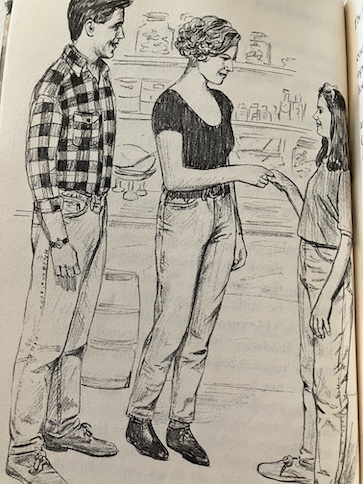
The Alden children are visiting their Aunt Jane, and Aunt Jane takes them to her local general store. The general store, like all old-fashioned general stores, carries a wide variety of goods, and the kids like the shop. However, the owner has been having some trouble. He’s lost his usual employees, and he has some new competition from a modern shopping center that’s been built. The store is still great as a local store for people who live nearby, but customer service is suffering without the usual employees. At the moment, the store owner only has one employee, a 19-year-old girl named Nancy.
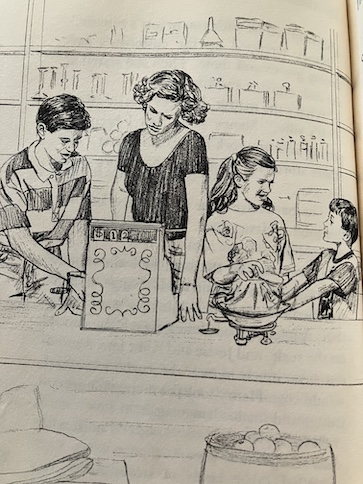
Nancy is pleasant and eager to work, but the Aldens can tell that she’s not very experienced. When Nancy is overwhelmed, trying to deal with multiple customers at once, Henry steps in and helps her because he used to work in a hardware store. He knows how to help a customer pick out hardware, and he can operate the store’s old-fashioned cash register. Both Nancy and the store owner are grateful for the extra help, and the Aldens offer to help out more until the store owner can hire someone else as a permanent employee. Aunt Jane approves of the kids working at the store, and because her house is some distance from the store, the store owner agrees to let the Aldens stay in one of the nearby cabins he owns, like Nancy.
The Aldens enjoy their time working in the old-fashioned store, and they like Nancy, but they soon begin to worry about her. Nancy claims that she’s worked in stores before, but they can tell that she really doesn’t know much about how to work in a store. She’s oddly evasive about her past and her family, and sometimes, she seems to forget what she told them about her past and family before when they try to ask her for more details. Then, they catch Nancy putting some money in the register when there are no customers in the shop and taking some things from the store for herself. Is Nancy stealing?
A woman shows up and tries to ask the Aldens a few questions about Nancy, but they don’t know much to tell her and don’t know why she’s asking. Then, a young man shows up and wants to speak to Nancy. They later hear Nancy arguing with this young man, and the young man says that they will continue look for Nancy and will find her, wherever she goes. Is Nancy in some kind of trouble?
My Reaction and Spoilers
I enjoyed the mystery. It doesn’t feel very high stakes, and I thought the answer was pretty obvious, but child readers might find it more mysterious. Unlike some other early Boxcar Children, this book is definitely a mystery with clues that readers can consider along with the Aldens to figure out what’s been going on and the identities of some of the people involved.
I figured out from the first that Nancy is a runaway, and that’s why people are looking for her and why she’s evasive about her past. Technically, at her age, nobody can compel her to return home, but I figured that her family was pressuring her to come back. I was a little concerned that there might be a darker reason for her to run away, like an abusive relationship or her having been involved with a crime, but there isn’t. She’s just a young woman who had a falling out with her family. She isn’t accustomed to working yet or being on her own, which is why she struggles at the store. This is her first job outside of school, and she lied about having previous experience to get it. She’s also been lying and dodging questions about her past so nobody will connect her with her family.
The Aldens realize, when they see the inside of Nancy’s cabin, that she doesn’t have many belongings. Nancy later admits that she took some things from the store because she needed a few essentials, but she also says that she put money in the cash register to pay for it. She just did it secretly because she didn’t want anybody to question her about why she needed some basic things that most people would expect her to have already. Although Nancy claimed that she was from a poor family and has been on her own for a while, the Aldens know that isn’t true because of her inexperience and because she wears a ring that looks pretty expensive. A person with a ring like that probably came from a family with money, and Nancy couldn’t have been too desperate for money, at least not for too long, or she would probably have sold the ring. Another clue for the Aldens is a photograph that Nancy has in her cabin, which helps to explain who the young man is.
Nancy eventually explains why she ran away from home, and she manages to work things out with her family. The story ends on a good note, with things improving for the general store, too. Nancy agrees to stay working at the store until the owner can get more permanent help, and she’s grateful that she now knows how to do her job better, thanks to the Aldens. One of the owner’s former employees also returns, and the general store proves to have a loyal customer base.